Volume 85 — BAILY’S MAGAZINE OF SPORTS AND PASTIMES No. 552. FEBRUARY, 1906. Vol. LXXXV.
Reading edition
CONTENTS.
PAGE
Sporting Diary for the Month v.
Colonel W. A. Cardwell, M.F.H. 91
Collection of Indian Weapons 92
What Next? 100
Foxhounds (Illustrated) 103
Hunt “Runners”—III. (Illustrated) 109
Oxford and Cheltenham Coach (Illustrated) 113
The Broads as a Sporting Centre (Illustrated) 115
Notes and Sport of a Dry-Fly Purist 120
A Hundred Years Ago 127
A Farewell to a Hunter (Verses) 128
The New Year at the Theatres 129
Racing at Gibraltar, in 1905 133
Half a Century’s Hunting Recollections—V. 138
Rugby Football 143
The Thoroughbred 147
Mr. Vyell Edward Walker 151
“Our Van”:—
Racing 155
The late Mr. W. G. Craven 158
Hunting 159
Hunting in Yorkshire 163
American v. English Foxhound Match 166
The New Army Polo Committee 166
The M.C.C. Cricket Team in South Africa 167
Golf 168
The Winter Exhibition at Burlington House 168
Pelota at the Winter Club 169
Fancy Dress Balls at Covent Garden 169
“Cinderella” at the Empire 170
Ballet at the Alhambra 170
Sporting Intelligence 171
With Engraved Portrait of Colonel W. A. Cardwell, M.F.H.
Colonel W. A. Cardwell, M.F.H.
Born in the year 1847, William Alexander Cardwell was entered to foxhunting when nine years old, having been blooded with the Southdown in the fifties when Mr. Donovan held office. He made his mark in the cricket-field among his contemporaries, and when he went to Harrow in 1862, took with him a reputation which gained for him the distinction of being first choice for his House eleven. Unfortunately his health broke down while at school, and in 1864 he had to leave and go abroad under medical orders. After a year or two on the Continent he returned home to finish his education at Oxford, where he found time and opportunity to indulge his taste for sport and games. He was a member of the Bullingdon Club, and in 1869–70 was master of the ’Varsity draghounds. He also played in his College (St. John’s) cricket eleven, and coxed his college eight. Colonel Cardwell was a good lightweight in his young days; he rode in all the College “grinds,” and also in the inter-’Varsity steeplechases at Aylesbury, with a fair measure of success. He was the possessor of a mare named “The Kitten,” in those days, and he cherishes for her memory the affection which is the rightful due of an animal on which the owner won his first race, for “The Kitten” carried Colonel Cardwell successfully in a good many steeplechases. He hunted frequently with the Quorn and the Bicester in his younger days, and has also seen much sport with the Badminton and Vale of White Horse; but residing, as he does, on the south coast, he has of late years done most hunting with the Southdown and East Sussex, after, of course, his own pack, the Eastbourne, of which he has been master since 1895. In August and September he usually hunts with the Devon and Somerset and the Quantock staghounds from Minehead. Sport in Sussex is carried on under very happy conditions; the farmers are a thoroughly good lot of sportsmen who always have a welcome for the hounds, and do all they can to further the interests of the Hunt. Wire, that burning question in so many more conspicuous countries, is practically unknown in the territory of the Eastbourne Hunt. As there is a good deal of game preservation in the country, the Master has considerable difficulty early in the season in arranging meets to suit the convenience of covert owners, who are also shooting men, but his experience is that consideration on the one side is invariably responded to by consideration on the other. Foxes are fairly plentiful in the Eastbourne country; mange gave trouble at one time, but the Hunt is now nearly free from it.
Colonel Cardwell has maintained his interest in cricket since his college days, and for twenty years was captain of the Eastbourne club. He was also captain of the Eastbourne Polo Club. Love of polo seems to have been hereditary, for his son, Mr. H. B. Cardwell, was captain of the Oxford Polo Club, and played in the winning team of the Eden Park Club for the County Cup in the years 1901 and 1902.
Colonel Cardwell has always taken a great interest in Volunteer Artillery. He raised the 2nd Sussex R.G. Artillery Volunteers, and commanded it for twenty-seven years, having retired only in June, 1903; he has also taken great interest in horsing and training the sixteen-pounder batteries.
In 1872 he married a daughter of the late Sir B. C. Brodie, Bart., of Brockham Warren, Betchworth, by whom he has four daughters and two sons, all of whom inherit their father’s sporting proclivities, and ride very straight to hounds.
Collection of Indian Weapons.
The eyes of the world have been lately turned to the stately progress which has been made by the Prince and Princess of Wales through the length and breadth of our Indian Empire. In a sense they may have had wider and more instructive experiences than fell to the lot of our King when, thirty years ago, he undertook the same Royal duty, and for the first time made the peoples of our great dependency personally acquainted with a Shahzada. But in some respects they have probably found that, since that date, something of the old glamour has passed away from the East. It has more and more assimilated Western ideas, and the great princes and feudatories have all been anxious to show to their future Sovereign how nearly they, their subjects, their armies, and their various public institutions, have approached English models. Practical value has been everywhere in evidence as much as possible, and as the old native picturesqueness has been somewhat dimmed, the ancient characteristics of the land may have been less sharply accentuated. In nothing has this been more seen than in the warlike equipment of the armies of the semi-independent states. All of these, with a view to taking their share in the defence of the peninsula, according to the requirements of modern war, are now trained, equipped and armed like British Sepoys, and the quaint bravery of mediæval sword, spear, shield, and armour has very generally disappeared. It is worth while, therefore, to say something about these time-honoured arms before they have become altogether things of the past.
A quarter of a century ago it was possible to find in India many of the weapons with which the natives had been provided in the days before the Pax Britannica secured the personal security of every individual inhabitant from raid and outrage, before the disarming act had been put in force in all districts under British rule, and while the military forces of semi-independent states still preserved their Oriental character. Now, I am told that, though many weapons may be bought, their genuineness is in most cases more than doubtful. The stock of old weapons has been absorbed in various ways, and there is no longer any production of such things for practical use. The tulwars and daggers which are sold to the globe trotters who, in their thousands, sweep over India during every cold season, are “bazaar made,” i.e., they are made by inferior workmen in the bazaar for sale and not for strife, and are very poor imitations of the real arms once worn by the old fighting men.
When I was serving in India, not long after the King’s visit, the country was still comparatively free from the tourist, and anybody who had a taste for Eastern art in any form was able, during his sporting excursions or in his other peregrinations, to meet men who still owned genuine old articles and were not indisposed to part with them, and made acquaintance with English officials and influential natives who were good-natured enough to assist him in his collections.
Many Europeans did not take advantage of their opportunities, but fortunately for myself I did not altogether neglect mine, and I now reap the reward by seeing, hanging in my modest hall, such a representative display of Indian weapons as it would be very difficult, if not almost impossible, to procure nowadays without the aid of great influence, much exertion, and a very considerable expenditure of money. Many of these weapons have been used by myself and friends in somewhat feeble attempts to emulate the feats performed with them by natives, and I have therefore a slight personal knowledge of their qualities and characteristics, and may at any rate claim that they have always been to me things of the greatest interest.
First let me notice the fact that it is not every Indian sword that can be handled and tested by a European. Our Aryan brethren have very small extremities, and the hilts of their swords do not, as a rule, give space for the more massive and heavily-jointed hand of an Englishman. It seems marvellous indeed how the sometimes ponderous weapons can have been easily wielded by the slight limbs for whose use they were made, but it must be supposed that well-trained wiry sinews may have as much executive power and endurance as bulging muscle, and that the proper method of using the individual weapon may have drawn more upon dexterity than upon the exertion of strength. And here it must be pointed out that, in all specially Oriental feats of arms, success is by no means to be attained by the exertion of great force. It rather depends upon accuracy of eye, perfect coolness of nerve, and deftness of hand. In the particular performance which English soldiers have most eagerly adopted from their Indian comrades and made their own, and has been found such an admirable exercise for promoting horsemanship and soldierly efficiency—tent-pegging—no great strength is required. And, in the same way, the class of swordsmanship for which Indian men-at-arms have been so remarkable is a matter of perfect mastery in handling a blade rather than of weightily applied blows. Probably no more graphic description of the difference which even to-day exists between Eastern and Western swordsmanship was ever written than in the story, in Sir Walter Scott’s “Talisman,” of Richard Cœur de Lion and Saladin giving each other proofs of the powers of their swords. I would fain quote the passage, but it would take up too much space, and I can only suggest that reference be made to it, and, if the whole romance has not before been studied, I congratulate the person who has so much available delight still untasted.
So many spectators have watched, in England, illustrations of tent-pegging at military tournaments and other gatherings that it is unnecessary to describe it, but it may fairly be said that the feat requires a higher form of skill and more consummate horsemanship than the old English exercises of a like nature, tilting at the ring or tilting at the quintain, neither of which appeals either to the performer or to the spectator as an example of very formidable fighting qualities.
The Oriental ideas about the use of the sword differ so completely from those of Western peoples that they may be briefly referred to. In Europe, the sword has generally been used for a trenchant cut, though the employment of the point has also been cultivated by some nations, especially among the higher ranks. About the only army in history that has used the point alone was that of Rome. The legionaries did little or no cutting, and this was the more remarkable because the Roman broadsword was a very short weapon, and all modern experience has seemed to point out that, if a sword is to be principally used for pointing, it must be of more than ordinary length. But, in the East, the trenchant cut, depending for its effect on the weight and power with which it is delivered, has never found favour, and the use of the point has equally been of very small consideration. The Oriental swordsman has always made use of what may be called a drawing cut, placing against the object that he wishes to sever the edge of his weapon, and either pulling it towards him or pushing it away from him, preferably the latter. The action is not, of course, in itself so instantaneous as that of the trenchant cut, but the whole time consumed by the swordsman is no longer in one case than the other, and may even possibly be shorter, for there is no preliminary swing of the arm and the drawing cut can be delivered without leaving a position of defence. The curved shape of most Oriental sword blades has been adopted for the purpose of giving the greatest effect to the drawing cut, as will be apparent to any one who considers the matter, for the curve naturally follows the action in the most complete manner, the keen edge being in contact with its object throughout the whole length of its blade. How deep an Oriental sword could bite in the hands of a skilful man, when used in the way that has been described, has been proved from time immemorial. On the battlefield it was no unfrequent circumstance to see heads and limbs cut clean off, and the wounds were generally of a terrible character. So well known was the deadly power of the Indian sword that, in our Eastern wars, precaution were often taken by our soldiers to protect with chains the shoulder and forearms (the places at which the enemy most often struck), and this modified form of armour may still be seen in the shoulder chains on one of the many patterns of service coat that have been issued to our cavalry in recent years.
Among the most popular feats of swordsmanship that are to be seen even to-day in the East are those that Saladin exhibited to Richard Cœur de Lion, cutting in two a down cushion or severing a floating veil—feats absolutely impossible of execution with a European sabre—and these are done, with many variations, not only dismounted but on horseback at full speed. Then there is the well-known performance of cutting a dead sheep in two. The sheep is hung by its hind-legs from the arm of a sort of gallows, and the swordsman, galloping past, delivers a back cut at it, aiming between the ribs and the haunch, and seldom failing to sever it. This feat, as it is now generally performed, is not so difficult as it may appear from description, for the carcase is skinned, and the backbone, with the slenderest portion of the body, offer really small resistance to a keen blade. But it is understood that, in olden days, it was not usual to skin the sheep, and the presence of skin and wool must then have made the swordsman’s task hard indeed. Many English officers have, with fair success, tried to cut a sheep in two, but, even though they used the curved Eastern sword, they always seemed to perform the feat by main force, and not by the proper use of the drawing cut, and I have in my possession a tulwar with a notch in the blade, showing where, in the hands of a very powerful man, it rent a sheep’s backbone. If a native had handled the weapon no such accident could have happened, for the drawing cut, depending only on the keen edge and the way in which it is applied, could not possibly have chipped the blade, no sudden shock being given by it to the highly-tempered steel. Lemoncutting, which is now often seen in England, was introduced from India, and here again neatness of performance is much more likely to be attained by the drawing cut than by the swashing blow employed by so many of our cavalrymen. True, the swords generally available for our competitions at home are hardly ever sharp enough to be used in the best way, and indeed the clumsy weapon now issued to English soldiers, with its absurd steel scabbard that quickly blunts a keen edge, is ill adapted for any practical purpose whatever.
So far, I have only talked about the most common and characteristic swords of India, which, with many minor distinctions and under the names of Tulwar, Selappa, Tegha, &c., &c., are found everywhere from Cape Comorin to the Himalayas, but there are several other swords, completely different, which are peculiar to individual tribes or nations among the vast congeries of races united under British rule or influence. First, the long, straight, double-edged blade, fitted into a gauntlet hilt which, though found in the north and south of India, is best known in the Punjab, where the Sikhs, in their sword play, still practise its use. The generic name of this sword is Pata, and it is said to have been the principal weapon used by the cavalry of the Great Mogul. To a European eye, it certainly appears a somewhat unwieldy weapon and ill-adapted to the purposes of a mounted man. Its blade is over three feet long, and it is fixed in a handle made like a plate mail gauntlet, which covers the arm nearly as far as the elbow. On account of its peculiar hilt, this sword is not manipulated like others from the wrist, but from the elbow; and, as far as I know, it is the only weapon known in the world which does not in some degree demand flexibility of wrist. Unlike the curved Tulwar, which has a rigid and rather narrow blade, the blade of the Pata is broad and flexible, and I have one specimen before me in which the point will almost meet the hilt. The qualities of steel from which the two kinds of swords are made are in this respect very different, but they are alike in that both can take the finest of edges. And all Eastern swords have this also in common, that all have wooden or leather sheaths, so that no risk is run that the edge of the blade shall ever be dulled from want of care. To-day, the Pata is never carried by Indian princes or nobles, even on occasions of state and ceremony, and it is never seen in the hands of anybody except the professional swordsmen, who give exhibitions of their skill at the great fairs and at Mohammedan or Hindoo festivals, such as the Mohurrum or the Dussera. The performances of any one of these men are wonderful. He will show the keenness of his weapon and his command of its weight by cutting in two a leaf laid flat on the outstretched palm of a friend, or by severing a cloth hanging loose in the air. He will then squat down on his hams and will slice from side to side a small nut, which is tossed on to the flat ground in front of him. He will grasp a sword in each hand and, so armed, will spring from his feet and throw somersaults backwards and forwards. Again, with sword and shield in his hands, he will leap head foremost through the stretched-out loop of a rope, held by two men at the height of their heads, as a circus-rider leaps through a paper hoop, and alight safely on his feet. These exhibitions are extremely popular, and the harvest of small change collected by the plucky athlete from the crowd of gaping spectators must do something to prevent the knowledge of the old sword-play from dying out. I have never seen or heard of a European essaying to handle the Pata, and, indeed, I have seldom seen a Pata whose gauntlet hilt would admit the grasp of even a small European hand.
Another straight-bladed and double-edged sword is the Khanda of the Rajput, and as the Rajputs are the most long-descended, chivalrous, and warlike of all the nations in India, so was the Khanda held in the highest honour and reverence, so was it worshipped yearly at the festival of the Karga S’hapna as a symbol of Heri, the god of battle, and so was an oath sworn upon it the most binding of compacts. Even to-day the Khanda, or indeed any sword, is recognised as an offering showing the profoundest homage and the strictest fidelity, by the universal Indian custom of presenting the hilt to a superior, who touches it in acknowledgment of the implied loyalty. The Khanda, like the Pata, is made of flexible steel of various degrees of excellence, though all blades are of the most reliable description. A rough test may be given, by which the merit of any particular straight blade may be approximately gauged. If it has one groove running down its length, it is good; if it has two, it is better, and if it has three, it is of special worth. Sometimes the Khanda has a long iron spike projecting from the hilt, and this was probably for the purpose of using the sword double-handed in case of need, and it could possibly also serve as an additional weapon in a close mêlée. It is to be remarked that, in using the Pata, Khanda, and other straight swords, the drawing cut is still the favourite, though the form of the blade involves that it must be somewhat modified.
Pass we to a class of swords which demand special remark, on account of their appropriateness to the districts in which they have originated, and of these there are two especially which attract our notice as being essentially the same in character, though they differ somewhat in shape. The Kukri, the national weapon of Nepal, is only eighteen or nineteen inches in total length, and has a blade of bright steel, incurved, heavy, and widening towards the point. It has more the qualities of a good billhook than anything else, and it was no doubt originally devised to do duty as a billhook as much as for fighting purposes, for the Gorkha had to clear his way through the thickly growing vegetation of the Terai forests. I have often lent to my shikaris, when shooting in the Western Ghauts, a Kukri for use in the jungle, and it always proved invaluable. What a handy tool it is in the grasp of its true proprietor, the Gorkha, is well known—how formidable it is as a weapon, those who have been in action with our Gorkha battalions can emphatically testify, and this can be the more clearly realised when it is told that, with his Kukri, the Gorkha can strike off the head of a bullock at one blow.
Like the Gorkha Kukri, the Ayda Katti, the big knife of the Coorg mountaineer, derives its shape from the daily requirements of life in dense jungles. The heavy monsoon clouds which, in their course, first meet and void their moisture on the hilly west coast of India, nourish an extraordinarily luxuriant vegetation, and the tribesmen there found the constant want of an implement to cut a path through the lush bamboos and creepers. The Coorg knife is about the same size as the Kukri, but is wider and heavier. It has also an incurved blade, and is equally useful for all the services of peace. The men of Coorg have had no recent experience of war, but legend tells that, sword in hand, they were in old days dreaded for their prowess in battle. The army of Hyder Ali found the Nairs (Coorg tribesmen) the most redoubtable opponents that it had to deal with before it had the ill-fortune to be marched against British battalions. The Coorg knife has the peculiarity that it alone, of all varieties of swords, never has a sheath. It is so constantly required on the west coast that it is generally carried in the hand ready for immediate use. When, of necessity, it is put aside, it is carried, still with the blade uncovered, slung across the owner’s hips.
No record of Indian swords would be complete without some mention of the Salawar Yataghan, the Khyber or Afghan knife, though perhaps it more properly belongs to the frontier. This is the weapon that in the hands of the Ghazis, drunk with bhang and lust of slaughter, has, in the actions on the North-West Frontier, done such stern work, and has also been signalised as the terrible instrument with which the wounded, who fell into Afghan hands, have ever been bloodily dispatched and mutilated. It has a broad, heavy, single-edged, straight-backed blade with a sharp point, and is so balanced that its trenchant cut is weighty indeed.
The Afghan gives no drawing cut with his Yataghan, but cuts like a European and, on occasion, uses the point. The weapon seems to be especially devised for the use of desperate men who wish to kill, without any thought of protecting themselves, for its handle being absolutely plain and unguarded like that of an ordinary carving knife, it can never be used effectively for warding a blow or parrying a thrust. The blade is generally about two feet and two or three inches long, and, made of bright steel, seems to derive its strength from its proportions and its thickness rather than from high temper. The Salawar Yataghan cannot be classed as a weapon adapted to any of the scientific niceties of swordsmanship, but must be thought of rather as a murderous knife, fit alone for purposes of slaughter.
There are other forms of swords to be found on the frontiers of India, the Burmese Dha, the Malay Kris, &c., &c., but none of them have any special merit as warlike weapons, and they are really almost impotent for attack or defence when opposed to the more well-considered weapons of more cultivated peoples. All of them have their limitations of value; they can inflict injury, but from their form they are essentially feeble in defence.
It was natural that swords, in their hilts, their blades and their sheaths, should, from the variety and general elegance of their shapes, have been the basis of ornament to a very great extent. The Monarch, the great Prince, or the warlike leader of men has, if he allowed himself ornament at all (and here be it remarked that the most potent individuals have almost always been remarkable for their personal simplicity), generally lavished such ornament upon his sword, the emblem of his power. And when he sent a gift to a brother potentate, or a man whom he delighted to honour, it was not infrequently a sword of the most perfect quality, adorned with jewels and workmanship of notable value. The ornamentation of swords gives to us a strongly-marked and trustworthy indication of the religion and often of the nationality of the men who fashioned them. There is as much difference between the artistic ideas of the north and south of India as there is between the delicate and graceful architecture of the great Mohammedan shrines and palaces, and the heavy, massive and sometimes grotesque construction of the old Hindoo temples. To enter into all the peculiarities of ornament would take too long, but it may shortly be said that, bearing in mind that it is contrary to the Prophets’ law to reproduce the similitude of any living thing, a sword ornamented with delicate tracery and a floral pattern may generally be supposed to come from a Mohammedan race in the North, while one bearing representations of men, beasts or birds, has probably been made in the Brahminical South.
All kinds of materials have been used in ornamenting swords. Besides precious jewels, gold and silver, a place has been found for Jaipur enamel, Koftgari work, Bidri work, &c., &c., and all means have been taken to add to artistic beauty, contrast of colour and intrinsic value. If any one would see how rich is the effect thus produced, let him take an opportunity of visiting one of our great national collections, those places full of articles worthy to be “stored in some treasure-house of mighty kings.”
There is one most invaluable quality in which all Eastern swords are well-nigh perfect. They are all most admirably balanced and can all be most effectively employed with the minimum of personal exertion. To appreciate this transcendent quality at its proper value, it is only necessary to handle an English cavalry sword, which is as much lacking in true balance as any Indian sword possesses that most essential character. The West has still some lessons to learn from the immemorial East.
To talk of the swords only of India has exhausted all my space, and yet but a very meagre sketch has been accomplished. Perhaps what has been written may, however, induce some reader to make an exhaustive study of the subject. He would surely be rewarded by learning much that is of the highest artistic, historical and practical value.
The other weapons of India, and there are many, are of nearly, if not quite, equal interest. Perhaps I may some day be allowed to say something about them.
What Next?
Any one who has wielded his pen with the independence which you, Mr. Editor, have permitted me to practise must expect criticism, nor should he turn a deaf ear to it. Critics, friendly or otherwise, have passed judgment on my Christmas dream of sport, my hazy forecast of its future, and some have thrown at me the pertinent query of, “What next would you have us believe, ‘you veiled old prophet of Khorassan’?” My only answer to-day is that of the sucking dove. “Wait and see.”
In this new year I do not stand alone when the momentous question is passed round of “What next?” among sportsmen, politicians, and populations. Hard nuts to crack there are on every side, and we envy not the jaws whose lot it is to deal with some of them.
Sportsmen, however, are for the most part content to sail with the breeze—contrary winds are troublesome, and they do not like losing sight of old landmarks, albeit in times like the present they are being wafted farther and farther away from them. This their compass, if they will only stop to consult it, must tell them only too truly. Ought they to put back into harbour, or boldly dash on towards other coasts and new scenes, of which it may profit them to know more? Does it not behove them to live and learn in a wider sphere of life than when they started on their life’s voyage; and, as politicians would put it, to think Imperially, even of their sports?
Thus they must ere long come to see that in the unison of ideas, the blending of nationalities, and the gradual bridging over of our insular position, we are fated to learn, however unwillingly, that the past and the future stand in an entirely different relation to one another than they have been wont to do.
Sportsmen, I would appeal to you. Is it not in your inmost hearts a question of what next all round the country? It was, perhaps, a bold stroke on my part to advocate even the partial extinction of the bookmakers, the reform of the Jockey Club, and the use of the Totaliser, or pari-mutuel, so strongly as I did last month; yet common-sense, expediency and profit seem to put this in the forefront of reforms on the Turf in reply to the question which heads this article. Our object-lesson on this subject is, undoubtedly, France, where, since September last, the bookmaker as such has been totally excluded, and we are indebted to a very lucid and exhaustive letter from a French backer, in the Sporting Times, for a knowledge of the results of its first two months’ working. He tells us that, taking the race meetings of Longchamps, Maison-la-Flite, Chantilly, Auteuil, Colombus, St. Ouen, St. Cloud, Compiegne and Enghien, the sum of 5,927,318 francs (£237,092) more were taken at the mutuel than in 1904, the total takings from September 3rd to November 13th, 1905, being 66,917,515 francs (£2,676,700), against, in 1904, 55,787,910 francs (£2,231,516), showing an increase of over eleven million francs. It follows that the deduction of 8 per cent., which is made for the benefit of horse-breeding, agriculture and the poor of France, has brought an increase of 890,368 francs (£35,612)!
If the same ratio of increased receipts is maintained through next year’s racing, the Societé des Courses alone will secure as its share of the profit about one million two hundred thousand francs! Stubborn facts these, which even the most inveterate Radical voter may take to heart in choosing his candidate for whom to vote, although for this election at least all votes will have been cast ere this article is published. If it were possible to gauge the probable receipts in the United Kingdom of the Totaliser as compared with France, we believe that the figures would considerably exceed those of France, seeing that the stakes annually run for in the United Kingdom, including steeplechasing and hurdle-racing, amount to not far short of a million pounds, and that race-meetings in this country are more widely distributed than in France. I am below the mark in calculating that at least ten times the stakes are made in bets, from which the deduction of 8 per cent, would produce a sum of eight hundred thousand a year.
What would the poor, the sick and the honest unemployed give for a dole out of this fund?
What would oppressed agriculture, unendowed horse-breeding, or the poor Royal Agricultural Society, say to the chance of a dip into this lucky bag? In almost every other country besides our own where racing flourishes, such an opportunity of effecting an economic reform, without increasing taxation, or interfering with vested interests, has been hailed with delight. In fact, we stand alone as a civilised nation in our abstention from its adoption, yet we have not, as it would seem, the motive power. If our conscientious objectors could but be made to see that by its adoption the worst features of our gambling pursuits would be checked, if not abolished, and that true sport in all its branches would thrive under its ægis, perhaps our legislature would throw no obstacles in its way. Perhaps then our Jockey Club, always so slow to lead the way, would throw off their vis inertia and become its disciples?
Perhaps, however, this important question may remain buried in the lap of the future, unless public attention is called to it ever and again with increasing vehemence, and we are able to see more clearly the bane of our insular position, and the false pride which blinds and prejudices us.
I have had the opportunity of discussing this question with many racing men, and with scarcely an exception they have brought no arguments forward antagonistic to it, the majority indeed being its advocates; yet there comes the reiterated cry from those who call themselves practical men: “My dear fellow; how are you going to act about it! What chance is there of obtaining sanction from the legislature?”
Supposing I were to suggest the similitude of the bye-gone Welsh remedy, which in its result swept away the multiplication of turnpikes in South Wales some seventy years ago, which materially hindered the traffic between Wales and England. These Welshmen donned the nightdresses of women, calling themselves daughters of Rebecca, who was “not afraid to meet her enemies in the Gate,” and on swift cobs they swooped down at night on all the gates, smashing and burning them. Neither the police nor military could catch one of them, and very soon it began to dawn on the Government that a good reason underlaid this lawlessness. A Royal Commission was appointed, which was the means of an Act of Parliament being passed which swept away the objectionable gates and placed the roads under Government supervision, and they then became the best in the Kingdom.
And now to apply the simile. The legislature has decided by the Kempton Park case that a racecourse is not such a public place as stated in the last Betting Act, where betting can be prohibited. Why, therefore, should not the Totalizer be erected there, and betting by such means be allowed just as much and as legally as it is now carried on by bookmakers. This cannot, to my thinking, be considered as a lottery, pure and simple, because it does not depend upon your merely drawing out the lucky number. You have all the prowess of the horses and the skill of their riders weighing in the balance, and you stand in exactly the same position as the man that speculates in stocks, or insures his risks. Why not, therefore, erect the Totaliser on some enclosures on our racecourses? and even should they prove targets for the attack of the police, or possibly the bookmakers, at starting, I believe that ultimately, sooner indeed than later, their case will prevail, and then the greatest and most wholesome reform in racing will take effect. It will then be time for my critics to exclaim, “What next?”
As regards hunting, I have only to appeal to your correspondent J. J. D. J.’s article in your magazine of last month, “Is Hunting Doomed?” to show that we cannot hope to see it carried on in many countries in the same haphazard way as of old. Despite the fact that its devotees are as keen and as good as ever, its facilities are narrowed year by year, and its difficulties multiplied. Oh, that it were not so, for as your readers, especially your elder readers, must know, in “Borderer’s” heart as a true sport, where gain or loss has no part, hunting stands alone as the best, most ennobling, and manliest sport that we can enjoy. Cosmopolitan also it has hitherto been. How long it will remain so we dread to contemplate. That also lies in the lap of the future.
When the what next of shooting is considered, I confess to being completely carried off my legs. Gunners have of late increased so rapidly in numbers and methods, that we know not where we may not be within the next few years, looking at the fact that circumstances are annually lending themselves to the extension of game preserving, and that the nouveaux riches can so easily indulge in this taste, which requires little learning, and short practice. Its aids to introduction into Society; its excuses for hospitality; its Royal patronage—all bring it immeasurably to the front; and when we read, as we did last month, of over 8,000 pheasants being slaughtered in three days at Vater Priory, we wonder what are the probabilities, or possibilities, or the future of shooting. Truly they can only be measured by the depth of the purse. All else can be thrown in.
I see that the Sporting League have issued a manifesto, warning sportsmen of dreadful things which the change in the Government is likely to bring about. Lord Daney’s Betting Bill is to be revived in its worst phases, and the sporting correspondent of Truth vouchsafes the opinion that he will see the sun and the moon drop from the sky before ready money betting will be legalised! This latter declaration fills me with hope, knowing, as we do, how often these truthful prophecies turn out to be fallacious!
Nor do I set much value on the fears of the Sporting League, because, if the vox populi is tested, as we are given to understand that it will be under Radical dominion, the betting question is much more likely to take a wider range, and peer and peasant alike will have equal rights of investing their money under perfect security on racecourses without let or hindrance. This can only be accomplished by means of the Totaliser, and working men will soon come to know that the usages of our Colonies and other neighbouring countries to their own have come to appreciate the benefits that it confers on them, and thus they will demand a vote in its favour at home.
It will take me a long time to believe that the faddists and the working men are destined to lie down together in perfect peace. Their ideas and methods are so utterly opposed. Indeed, my faith in the coming about of this great reform rests in “the tail wagging the head,” and that if the Jockey Club are to be stirred up, and the middle classes moved to action, it will be done by the progressive shoulder-to-shoulder pressure of the people, when once they appreciate the position, and realise the advantages to be gained, of which no small share will fall to their lot.
Thus perhaps the answer to “What Next?” will ring out.
Borderer.
Foxhounds.
THE SIRES OF THE DAY.
There will always be a certain amount of controversy in regard to the choice of sires. Some people are bigoted enough still in the belief that good looks and a level formation have nothing to do with the success of hound-breeding, and that attention only should be paid to abilities in the hunting field. If this had been the dictum of the Dukes of Rutland and Beaufort, or of Lord Henry Bentinck, or Mr. G. S. Foljambe, the breed would have well-nigh died out; but the great masters would have necks and shoulders, intelligent heads, deep ribs, straightness in fore-leg, and the round, cat-like foot. There is everything to charm one in the well-bred foxhound, and is there anything like him? The Peterborough Shows have done good in bringing the best-looking together, and in giving opportunities for seeing the best. There has been everything to prove that the best-looking are generally the greatest; they are so in nineteen cases out of twenty, and as they are picked for appearances as puppies, there should be nothing to offend the eye at all in any well-regulated pack. At Belvoir a moderate-looking one even cannot be seen. They are all beautiful hounds, and the difficulty is to find fault. This is the general high standard of the country, and with masters of hounds in great numbers who will have perfect hounds in and out of kennel, the conclusion must be arrived at that there is no other breed of animal so well looked after. The winners of the Champion Prizes at Peterborough during the last twenty years have been very great as sires. What a deal of good can be traced now to the Fitzwilliam Selim, and what a magnificent hound he was; and then there was the Warwickshire Hermit and Harper, the Oakley Rhymer, the Pytchley Paradox and Potentate, the Craven Vagabond, the Puckeridge Wellington, the Cleveland Galopin, and not to forget also the Quorn Alfred, the champion of his time, as did not Tom Firr lead him back a winner? There have been lots besides as either champions or winners in the couples of unentered ones, such as the Dumfriesshire Resolute, who has replenished half the Scotch kennels with good hounds, and the Pytchley Marquis, who stood in the ring with Resolute for the Single Puppy Cup, when the judges, Lord Enniskillen and Mr. Austin Mackenzie, eyed the couple for five minutes before they could decide that the Pytchley young one was a shade the better. Never have two young champions done more for the cause of sport, as to ask concerning all the good that has been done by Marquis is to set John Isaac on the pinnacle of excitement.
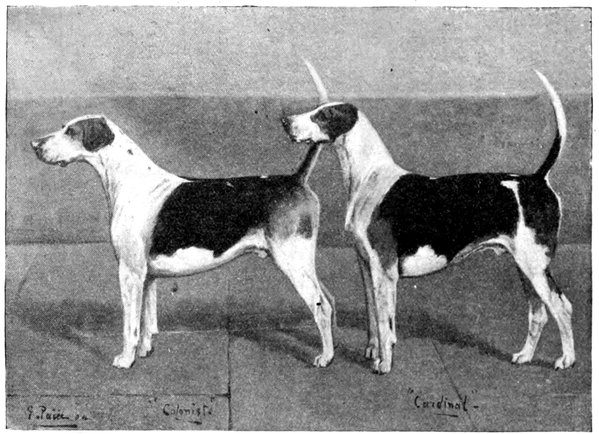
[PUCKERIDGE.] Colonist (1903). Cardinal (1902). [By Chancellor—Sarah.] [By Chancellor—Dauntless.]
Belvoir has never shown at Peterborough or any other show. Frank Gillard used graciously to say that it was charity to give other people a chance; but anyway, the ducal kennel has always had plenty of good mention at Peterborough, as a great many winners have been by its sires; and it has become a practice also amongst far distant masters of hounds to visit Belvoir on the day after the show, and thus to extend their insight amongst all exquisites of the foxhound family. It is just thirty years ago (1876) since Belvoir Weathergage was entered, and what an enormous amount of good has come from this single hound. At home he was the sire of Gambler and Gameboy, besides others of lesser note; and for other packs there was the Brocklesby Weathergage, the Fitzwilliam Weathergage, the Grafton Why Not, the Southwold Freeman, and the Warwickshire Why Not, all very noted hounds. One can scarcely say how many more famous sons of Weathergage there were, but just as he was spoken of by Frank Gillard as the best hound he ever hunted, Mr. Rawnsley, of the Southwold, says the same of his son Freeman, whilst very similar in character must have been the Grafton Why Not. In the next generation the excellence was again well continued; as where have better hounds been seen than the sons of Gambler, with Nominal and Gordon at home, and Lord Middleton’s Grimthorpe and Grasper, Mr. Austin Mackenzie’s Rallywood, Lord Galway’s Gambler, and the Grafton General and Gorgon. Gameboy, brother to Gambler, brought more kudos into the famous line, as he was the sire of the Holderness Gaffer, sire of their Steadfast, and the latter has been very useful in many packs. The line has apparently got stronger in years and generations, as from Watchman, son of Nominal, comes Dexter, a great sire certainly during the last six or seven years, and his son Stormer is the most fashionable, if not the greatest, of the day.
Belvoir Stormer (1899) is a very grand hound of the Gambler type, but a bit on the big side, good twenty-four inches, but there is all the quality in him of the Belvoir hound, and he has beautiful legs and feet. I make him out to have as much or more Osbaldeston Furrier blood in him than in any other to be found in the Stud-book. It came in through Weathergage, of course, back to Senator, and he got it through his dam Destitute, by Sir Richard Sutton’s Dryden, by Lord Henry Bentinck’s Contest. But then there was so much Senator blood in Gratitude, the dam of Gambler, and again in Needy, the dam of Nominal, as she was by Syntax, son of the Grafton Silence, son of Statesman by Senator, by the Oakley Sportsman, her dam Needless by Contest, out of Novelty, by Senator. The success of Stormer for other packs than his own has been almost extraordinary, and this can be seen in Baily’s Directory, giving the names and the pedigrees of the prize puppies at the various kennel puppy shows. They were first in the Quorn, Tynedale, Duke of Buccleuch’s (in bitches), Pytchley (in bitches), Lord Middleton’s (in bitches), and second in the North Staffordshire (dogs), the latter a remarkable puppy called General (a present as a whelp from Mr. R. Corbett, of the South Cheshire, as he would persistently join the pack when at walk, and hunt like an old one before he was entered).
It may be thought that there was more honour attached to Stormer in his earlier days, as the sire of the Atherstone Struggler and Streamer; of Lord Bathurst’s Stentor, unfortunately dead, when he promised to be one of the pillars of the family, as besides being the best puppy of his year at Peterborough, he got some very good stock, as seen by the puppy shows. Then there is Lord Yarborough’s Harbinger, exceedingly good looking, and so good in his work as to have been used in his second season; and some others in various kennels thought very highly of. Stormer, though, was in no degree more useful or popular than his sire Dexter, whose son, Daystar, was supposed to have been the best-looking hound bred at Belvoir since Gambler, but he was unfortunately killed by a kick in the hunting field. Dasher, another son of Dexter, met with a similar fate. Both these hounds got beautiful stock. But besides Stormer, there was another son of Dexter of the same age in Handel, almost more bloodlike in outline than the other, and as the sire of the Warwickshire Traveller to be held much in esteem. Both Stormer and Handel are still in orders at Belvoir. Lord Middleton has a great opinion of his own Dexter by the old Belvoir hound, and he has used him freely. Some very good sorts are brought in through the Birdsall Dexter, as his dam Woodbine was by the Grafton Woodman, so on both sides accounting for his excellence in the field. There is really a plentitude of the Belvoir Dexter and Stormer blood throughout the country, as through the former’s son, Dasher, again comes in the Rufford Furrier, with every promise to become a great sire; and there was a young hound in the Bicester kennels last year called Deemster, by Dasher, out of a beautiful bitch called Bravery, that looked like making a name if he has gone on all right.
If a breeder of hounds commenced his operations from the Belvoir Weathergage (1876), there are probably six distinct lines to work upon, or most certainly four, and he need hardly go further afield for blood, but cross from one to the other, just as old Mr. Parry used to do with his Pilgrims and Rummagers, and Mr. G. S. Foljambe did from the brothers Harbinger and Herald. The subsequent occupants of their kennel benches were not too nearly bred, five generations off was old Parry’s plan; but still, they were all blood relations. To speak with any certainty I should take the four lines from the brothers Gambler and Gameboy, and the two others from the Grafton Whynot (1882) and the Southwold Freeman (1885). The Gamblers I have pretty well referred to above, but his brother, Gameboy, was almost as important as the sire of the Holderness Gaffer, sire of their Steadfast, and of Mr. Austin Mackenzie’s Guider and Gambler. Of these Gaffer occupies an important page in the “Foxhound Kennel Stud Book,” as he was the sire of the Warwickshire Sailor, the sire of the Brocklesby Wrangler. Steadfast, again, was the sire of two very good stud-hounds of the present day, namely, Lord Harrington’s Sultan and Salisbury (brothers). The Grafton Whynot was in no degree less important than any of the above, as he was the sire of Workman, sire of Wonder, sire of Woodman, whose good ones throughout the country have been almost legion, to include the Craven or Old Berks Woodman, the Vale of White Horse Worcester, the Grafton Whynot (of 1897), the Puckeridge Chancellor (1898), and the Badminton Whipster (in orders five years). In my most recent travels I have heard of nothing but praise of the Grafton Woodman’s stock, splendid for nose, hard workers, demons on a dying fox, and always dependable for season after season. The old dog was thirteen years old before he was put away last spring, and I shall always regret not seeing him, as, to judge him from every point, he must have belonged to the very greatest. His son, Worcester, in Mr. Butt Miller’s kennels, enjoys the same reputation so closely associated with his sire, as there could be no better foxhound on the line of a fox, and he has got good ones right and left for Lord Bathurst’s, the Duke of Beaufort’s, the Craven, the Morpeth, and other packs all having representatives by him, besides a big following at home. The Craven regretted that their litter by him of three couples were all bitches, as they were so good, and a dog to have been a sire would have been all too acceptable. However, Lord Bathurst has got two very good sons of Worcester in Weathergage and Wellington, who trace back on their dam’s side also to some very telling blood from Mr. Austin Mackenzie’s Dexter, Belvoir Weathergage again, Warwickshire Harper, and Lord Coventry’s Rambler. Cooper thought last year that Weathergage might be the best foxhound in England. He should not be missed, therefore, by hound-breeders. Mr. Butt Miller has naturally several young Worcester sires, the brothers Bandit and Barrister striking me as about the best when I saw them. It is noticeable that the Morpeth’s second prize puppy, Whynot, was a son of Worcester’s.
The Bicester have had reason to uphold the Grafton Woodman line, as some of their best are by Whynot, notably a grand third-season dog called Wrangler, who gave one the impression of becoming a stud-hound of note some day. There are two or three of Mr. Heywood Lonsdale’s worth taking a good journey to see, Conqueror being one, and he is quite one of Lord Chesham’s breeding, going back into the Blankney sorts. The second prize puppy of the kennel last year was by Conqueror.
To turn again, though, to the Grafton Whynot. I saw him last May, with nine seasons marked against him, and the rumour was that he had been promised to Squire Drake, who might breed a pack again for the Old Berks through this son of Woodman alone, if he could keep the old fellow in useful orders long enough. He got rare stock for the Grafton, and so did his son, Wiseacre, who died too prematurely; whilst another son called Waggoner—still available, I expect—had the reputation of being the hardest driver in the pack. Of the Grafton dogs, though, I liked President the best, and he was out of a Woodman bitch. The next share of usefulness to be credited to Woodman may come from the Puckeridge, as Mr. Edward Barclay bred from him in 1897 with a bitch that went back to old Mr. Parry’s sorts, through Lord Portsmouth’s Gainer, a very noted worker, as I well remember, and got by Mr. Parry’s Gulliver far back in the sixties. Gainer was so good that the late Lord Galway favoured him extensively, entering three couples by him from four litters in 1873. Mr. Lane Fox was one of his patrons, and also Belvoir; but for the latter great kennel he did not get them very good about the knees.
The result of Mr. Barclay’s patronage to the Grafton Wonder, was Chancellor, and he was like all the rest of them, quite A1 in his work, and going on into his eighth season, at any rate. He has been bred from for the last five years with bitches mostly of Belvoir extraction, and in the Puckeridge list of 1904 there were eight couples by him in different years; all very good, so Mr. Barclay and his late huntsman, Jem Cockayne, have stated; but the best of all was Cardinal, out of Dauntless, by Belvoir Watchman, son of Nominal, son of Gambler, son of Weathergage, her dam Dahlia by Shamrock, son of Dashwood by Founder, belonging to the Fallible family. A splendidly bred hound, therefore, is the Puckeridge Cardinal, entered in 1902, so now just in his prime. He is a fine big hound also, and so good in his work as to have left a very strong impression upon Jem Cockayne, who was never happy unless Mr. Barclay kept breeding from him heavily, and about the first thing he did when engaged for the North Warwickshire was to get Mr. Arkwright to do the same. He told me he should like to have a kennel full of Cardinals, and really the puppy boxes at Brent Pelham last year were full of them. Another by Chancellor in the Puckeridge Kennel is Colonist, a year younger than Cardinal, but with almost as great a reputation, and bred very like his companion, as he was out of Sarah, by Belvoir Dashwood. Colonist took second prize as a puppy at Peterborough.
Yet another line from the ever-telling Belvoir Weathergage may be traced from the Southwold Freeman, who was thought by Mr. Rawnsley to have been the best hound he ever hunted in his life, and for the last twenty years this gentleman has shown a strong determination to hold the line. He had five and a half couples by him before the good hound was a five-year-old, and six couples and a half were entered afterwards from numerous litters. The same line can be traced through several channels at the present time, and to Frantic, sister to Freeman. Much of his has been crossed again to the Grafton Woodman, as Workable, a well-known Southwold bitch, has been a great treasure in the field and as a breeder of good ones; and Valliant, possibly Mr. Rawnsley’s best sire, is by the Brocklesby Wrangler, one of the sorts, as I have mentioned in this paper, out of a Freeman-bred bitch. To trace the branches from the Belvoir Weathergage, there is everything, then, to show that the merit has been almost inexhaustible, and that, if anything, it has increased in intensity by intercrossing: the Grafton Wonder, with the Gambler line, as instanced in the case of the Puckeridge Cardinal, and the Freemans, as shown by the Brocklesby Wrangler and Vanity, in their production of the Southwold Valliant; and again in the case of Worcester breeding his best from Nominal- or Gambler-bred bitches. It is a problem of breeding, and all compassed in thirty years. I can hardly believe it to be so long ago, looking back to 1873, when chatting to Frank Gillard, on the old flags at Belvoir, we admired Warrior, the crack of the kennel, as I then opined, and how Gillard told me that the beautiful blood-like hound before us was rather the result of an experiment. He hardly dared to breed from Wonder, on account of his swine chap, but he was tempted by his beautiful voice, and his union with Susan produced a perfect litter, to comprise Woodman, Warrior, Woeful, Welcome and Whimsey, all good-looking enough to be put on, and useful in producing subsequent Belvoir beauties; but the star of all was Warrior, the sire of Weathergage. Nearly all the best foxhound sires of the day trace to the latter, and it would be no very bad policy to breed from the older ones of their generation as long as they can be found—Belvoir Stormer, Handel, Grafton Why Not, Cricklade Worcester, Brocklesby Wrangler and Badminton Dexter—but still to remember that there is a younger generation, or even two, that is quite as good, and maybe safer, when enumerating the sires of the day, as the Warwickshire Traveller, the Belvoir Vaulter and Royal, the Atherstone Struggler and Streamer, the Grafton Waggoner and President, the Birdsall Dexter, the Puckeridge Cardinal, the Bicester Wrangler, the Fitzwilliam Harper, the Southwold Valliant, the Cricklade Bandit and the Cirencester Weathergage.
G. S. Lowe.
Hunt “Runners.” III. “Harry” and Sellars.
No better tribute to the scope of the runner’s usefulness could be put forth than the fact that he is running with us to-day. As might be expected, quite a little band of scarlet-coated runners live within easy reach of Melton and Oakham, a privileged area in which sport with one or other of the four Leicestershire packs may be seen on six days of the week. Theirs is a hard life at best, and were they not thoroughly endued with the spirit for sport, they could not for long follow their calling; but the runner of the rising generation has not the enthusiasm of a former generation. As for reminiscences, his begin and end with the week’s sport; as for the future, he hopes the going will not be any heavier in the coming week.
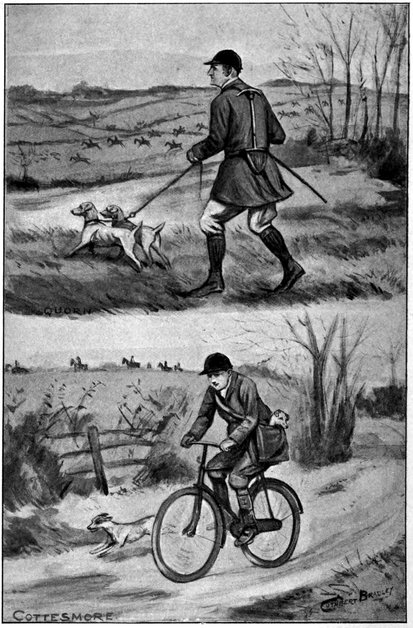
LEICESTERSHIRE RUNNERS.
The journey to covert through the characteristic Leicestershire gates, across grass fields and cow pastures, is the runner’s opportunity to be useful; at the meet the possession by the great majority of hunting men of second horsemen render his services less in demand than they used to be. The hunt runner is not the character he was in our forefathers’ day; but there are still uses for him in certain districts. At the present time both the Quorn and the Cottesmore have recognised men to lead their terriers, and perform other functions. With the Belvoir a runner may be seen joining the hunt on a Leicestershire day, but he is more or less “on his own”; for if a terrier is out it is running with the pack or led by a second horseman. So far as the Lincolnshire side of the Belvoir country is concerned, it is no country for runners; the area traversed is very wide, and the going is much too heavy to let a man on foot keep in touch with a well-mounted hunt. The same applies to the Blankney country, where we never remember seeing a runner on any occasion; the Blankney Hunt terrier is always carried by one of the second horsemen, slung in a game-bag so that he can be brought on the scene at the shortest notice.
When Lord Lonsdale instituted his memorable reign as master of the Quorn in 1893, he organised every detail of his staff, from Tom Firr in leathers and swan-necked spurs, to the hunt runners carrying the very latest pattern of bolting apparatus. No commander-in-chief of an army ever entered on a plan of campaign better found in every department, and the result was entirely satisfactory for sport, good runs, with a fox at the finish, being the order of things. On the opening day of that season at Kirby Gate, we had the good fortune to be one of the field mounted by Mr. James Hornsby, who then lived at Stapleford Park. Amongst the crowd at the meet, the figure of Harry the runner came in for general observation. He turned out in scarlet coat of a texture not too heavy; white flannel knickerbockers, black stockings, and a well-groomed hunting cap. He led a couple of varminty wire-haired terriers of the celebrated Lonsdale breed, and strapped to his back was a patent sapper’s spade with pick, made of the best steel. Thus equipped, Harry appears in one of the Quorn series of hunt pictures by Major Giles, which depicts hounds marking to ground in one of the characteristic hills typical of the woodland side of Leicestershire. With Harry was another runner, a strong athletic young fellow with a heavy moustache, who carried a bolting apparatus in the shape of thirty-five feet of piping with a brush at the end of it, not unlike that used by chimney-sweeps. Known to the hunt department as Sunny Marlow, he has always worked with Harry.
On the occasion before us, contrary to custom, the first draw was Welby Fishponds, instead of Gartree Hill, and we were marshalled by the field master, Mr. Lancelot Lowther, a field away whilst hounds drew covert. At last the silver whistles proclaimed hounds away on the back of a fox, and the cavalcade swept down the hillside. After a hunt of about an hour, with a somewhat catchy scent, and a blind line of country that laid the field out like ninepins, hounds marked to ground over a drain between Old Dalby Wood and Sixhills. Before we had been there five minutes, Harry was on the scene with his apparatus and terriers. Unstrapping the spade, he took off his coat, and putting his back into the work, he cut the sods out in double quick time. It was a characteristic shallow Leicestershire drain, running across a grass field, and crowning down into it, a terrier was put in at the far end. This moved the fox, and Alfred Earp, the whipper-in, was ready to seize him by the brush as he tried to slip further up. Wriggling like an eel at arm’s length, he was flung adrift, and the pack coursing the length of a field, rolled him over—the first fox of the season.
An official Quorn runner must be a good hand with the spade, for he gets many a rough day’s work in the off season digging out badgers, which abound in high Leicestershire. As most people know, badgers are very untidy neighbours for a fox covert, working out the earths so that stopping out becomes an increased difficulty. Very often digging out a badger earth may mean a week or two of solid work, for badgers go very deep, often among the roots of trees. As a rule the soil is light and sandy, working well; where badgers have been imported into clay soil districts to work out earths for foxes, they have at first opportunity migrated to districts where the digging suited them better. This last autumn one of the hunt runners told us that after some very hard digging they got hold of three badgers whose combined weight turned the scale at a hundredweight, the largest measuring 3 ft. 10 in. in length. The badgers are killed, and their skins sent in to the Master of the Hunt as trophies.
Since Captain Forester undertook the mastership last season, Harry has again, we understand, become a paid member of the staff as in Lord Lonsdale’s time. If the two men are not seen running with the Hunt on the same day, the one is pretty sure to be stopping earths in another district for next day.
A runner with the Cottesmore has to put a great deal of travelling into a day’s hunting when the fixture is wide of Oakham; on Mondays and Thursdays an average journey to the meet is from twelve to fifteen miles, with no chance of a lift by rail. Sellars, who has been runner for the best part of twenty seasons, tells us that he frequently starts from Oakham, with his terriers, at eight o’clock in the morning, to reach such fixtures as Castle Bytham, Holywell Hall, Stocken-Hall, or Clipsham, by eleven. Fortunately at the end of the day, hounds work back towards Oakham, so that when they whip off the runner is nearer his well-earned supper. Sellars is a well-set-up, active fellow, who relies on his own energies to carry him through, and where the heart is keen for sport it is astonishing what a man can accomplish. A younger runner to-day of shorter build lessens his labours by using a bicycle, which certainly gives him an advantage in districts where the roads serve. But Sellars has ridden to hounds in his time second horseman, as far back as when William Neil carried the horn, and he is hardly likely to adopt the “wheel.” In his cap, scarlet coat and leggings, he is the typical, sharp-featured runner, in hard condition to go all day, perfectly at home in the country, which he knows by heart.
With the respectful manner of one who has been in touch with hunting all his life, Sellars is not a great talker; he is a silent admirer of all connected with the Cottesmore Hunt, in which his sun rises and sets. During the hunting season there is plenty of work to be had between times in the shape of badger digging and earth stopping, besides taking a turn as beater when there is shooting going on in the district. The hay and corn harvest gives every available hand the chance of a fair day’s work for good pay, the farmers then finding the Hunt runners employment.
Sellars calls to mind the memories of a long succession of brilliant Cottesmore Hunt servants: mentioning William Neil and his famous first whip, Jimmy Goddard, who was the beau ideal of a horseman, and hung a boot better than most. The long service of George Gillson, as huntsman for the best part of twenty years, was remarkable for consistent and good sport, very popular with the countryside. A whipper-in who had a long tenure of service at that time was George Jull, who remained on for a season or two under Arthur Thatcher, and then went to Ireland. Amongst the many occasions that Sellars has helped to extricate horse and rider after a fall, he calls to mind an incident when Jull came such a crumpler, that he had to be conveyed by the Hunt runner to the nearest farmhouse.
Sellars was one of those who rendered first aid when Colonel Little took a bad fall this season, his horse rolling over him with serious consequences. A runner, if he is worth his salt, must be ready for any emergency, from rendering “first aid” to handling a fox or leading an unwilling hound. Very often his duties are in the track of the hunt, shutting gates and collecting strayed stock, so that he must be included amongst those who further sport by repairing mistakes of the careless.
Oxford and Cheltenham Coach.
To some who have read and heard what a sight it was in the old days to witness the coaches—both mail and stage—coming into and leaving Cheltenham, it may be a matter of surprise to learn that as late as 1862 a mail coach was running daily between Oxford and Cheltenham, an illustration of which is given with this short article, this being taken from a water-colour drawing by Mr. Bayzand, of Oxford, who has very kindly given me some interesting particulars of the coach and those connected with it. And I am also indebted to the courtesy of my friend Mr. Hendy, of the G.P.O., for further information as to dates, &c., &c.
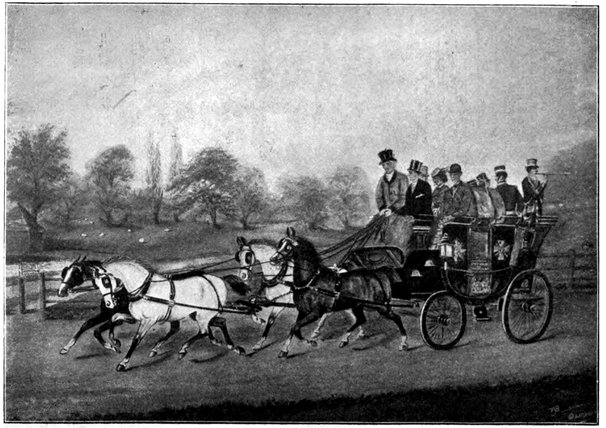
OXFORD AND CHELTENHAM COACH.
It appears that the coach first commenced to run in 1846–7, and did not carry mails until 1848, from which time till October 1st, 1855, mails were carried by it free of charge, i.e., merely in consideration of freedom from tolls; but from the date mentioned the sum of £150 per annum was given to the proprietors in addition to this privilege. The original owners were Mr. Waddell and Mr. Dangerfield, of Oxford, but after three or four years the concern was taken over and worked by Isaac Day, the trainer, of Northleach (through which quaint, and to this day remote, little town the coach of course passed daily), John Mills, of Burford, and Daniel Blake, of Cheltenham; and a little later still the last named took it over entirely, ultimately disposing of the business to Messrs. Edward Allen and William Colee, of the George Hotel, Cheltenham. Mr. Allen died in 1854, and the coach was then run by William Colee himself till the summer of 1856, when Mr. Richard Glover took it over, Colee retiring. George Colee, brother to William, is the coachman shown in picture, he used to drive from Oxford half the journey, bringing the up coach back, it being a day coach leaving Oxford and Cheltenham respectively at 11 a.m. Though starting from the “Old Three Cups Hotel,” Oxford, the coach was kept and horses stabled at the “Lamb and Flag,” St. Giles; the horsekeeper’s name there was Morgan. I am told that two portraits in the picture are particularly good—that of George Colee, and the grey leader; this mare was bought by Mr. Blake from Isaac Day, and I fancy she must have been a real good animal, as it is still remembered and recorded that her name was “Skater,” and she was blind. Isaac Day, by the way, was noted for his liking for a good cob, and no doubt during his connection with the coach he horsed his stage, or stages, well. The old trainer died in 1859, just about three years before the coach ceased to run, as it made its last journey in January, 1862, in which month the Witney branch of railway was opened. Though a mail the coach was not a fast one, being timed at from seven to eight miles an hour. After it ceased to run George Colee, I understand, contracted for the Steventon Mail, and one or two others local to Oxford, in which city he died. To those among the readers of these lines who knew Oxford in the old days, it may be of interest to note that in the picture the coach is represented on the Botley Road, passing Morrell’s old rick yard and the path leading to Ferry Hincksey, now all built over.
S. A. Kinglake.
The Broads as a Sporting Centre.
To the greater bulk of the thousands who visit the Broads season after season the great water-ways of Norfolk and Suffolk are an attractive summer holiday resort—that and that only. The all-round excellence and great variety of sport obtainable throughout the year is known only to a comparatively small number, and is indulged in by but few even of those. Probably summer sailing will remain the principal pastime—it is possibly the most enjoyable—on these waters for all time. And with good reason. Granted some knowledge of sailing craft and decent care in navigation, absolute safety is assured for even the smallest craft. The numerous regattas offer opportunities for the more skilful to prove their skill in friendly competition before admiring associates. Scores of miles of rivers and acres upon acres of broads are open to all—expert and novice alike. Equally enjoyable, in the opinion of many, is a holiday spent on a wherry, and not a few parties “swear by” the keen pleasure associated with a holiday under canvas, “camping out.” Inseparable from all is angling. And what a variety of anglers one meets with on the Broads! They fish from wherries, from yachts, from boats, from the bank, and, indeed, from any and every point of vantage. They use all sorts of tackling, from the boy’s polished ash-wood rod and ready furnished line—evidently purchased merely for the holiday and the fun of the thing—to the perfectly tapered roach pole and line of gossamer fineness, greatly prized tackling handled by an expert, who means fishing in all seriousness. Not infrequently a young couple, “pegged down” in very close proximity and evidently preoccupied with some other matter nearer and dearer than angling, allow the rod at their feet to angle for itself—which is, perhaps, the very best thing they can do if they really wish to catch fish.
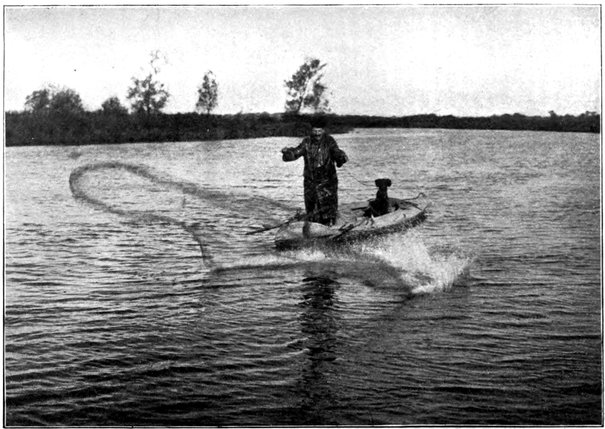
CASTING A NET FOR SMALL LINE BAIT. Photo by Clarke and Hyde.]
The artist, the botanist, and entomologist are numbered among the holiday seekers; and the indolent individual, “come to do nothing but lazy around,” is also in evidence, of course. All alike are happy as the days come and go and the summer wears on. Not the least enjoyable time is the late evening, when the wherries and yachts are moored for the night and the canvas camps are lit up. The solemn quietude of Broadland reigns on all sides, and than Broadland at night, can anything be more quiet, more peaceful, more soothing? The distant barking of a dog, the sound of song or music floating on the air from some craft, the splash of oars as a belated boating party passes by on the smooth surface of the stream, the flop! of a big bream “priming”—all these only go to accentuate the actual and wonderful quiet. So quiet is it, indeed, that as our ardent angler, out fishing for the night, lights his pipe, the scratch of the match on the box may be heard for some considerable distance. Thus the summer wears away; the end of the holiday comes all too soon, and the Broads lie neglected—or nearly so.
Yet the opportunities for sport after the holiday folk have departed and before they return are many. Those sportsmen are not wanting who will tell you that they prefer the room of the holiday seekers to their company, and that “sport on the Broads has gone to the deuce since the advent of hordes of cheap trippers and big boys with boats.” This is, however, too severe an estimate of the character of those who frequent the Broads during the summer. Other and probably more sound reasons could be given for the falling off in sport of late years; although it must be acknowledged that the presence of large crowds through the summer must have a more or less bad effect on sport all the year round. That sport on the Broads has declined is, unfortunately, beyond doubt. Granted this, however, there still remains satisfying sport available if only the sportsman will adapt his methods to the altered condition of affairs.
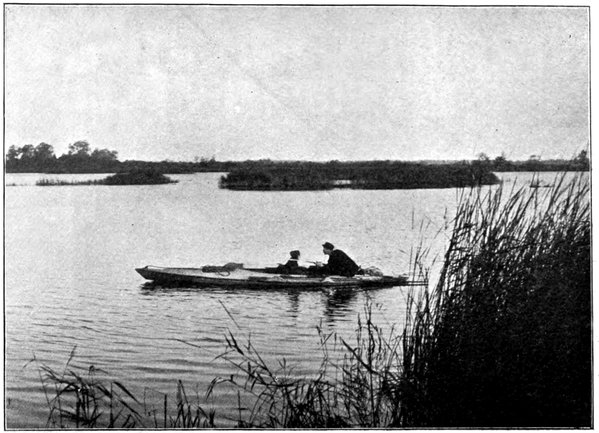
A BROADLAND SPORTSMAN WITH HIS PUNT AND DOG. Photo by Clarke & Hyde.]
Take, for instance, the rudd-fishing. The bags of these fish are considerably smaller now than they were ten, aye, even five years ago. It is quite possible that the crowds of summer holiday folk are partly responsible for this falling off; but is it not also probable that the gradual filling up of some parts of the Broads, mostly those parts where rudd do love to congregate, is by far the more important cause? Where the angler used to find the rudd in, say, two feet of water, there is now but a foot—in many cases barely that—yet the fish are still there. It is rather amusing than otherwise to watch the holiday folk going for these wary fish in such shallow water with the orthodox tackle of years gone by, i.e., a fine running line, float and shotted bottom; it is surprising to see a sportsman doing the same thing. Now, the rudd is essentially a summer-feeding fish, and what is more he is, when shoaling, a surface-feeding fish; therefore, even while the summer holiday folk are present, get you an eleven-foot fly rod, attach to the end of your taper line a two-yard fine taper gut cast, armed at the end with a fairly large crystal-bend hook; fill the hook with well-scoured gentles (half-a-dozen is not too many), and casting as you would with a fly, put this bait among the rudd that are shoaling in the shallow water, and see what will happen! The lid of your creel will constantly creak a welcome to a lusty specimen, and you will return to quarters with a heavy bag and a light heart, while the man with the float and shots will most probably return with a light bag, swearing at the decadence of sport on the Broads, and cursing the “cheap-tripper” as the cause of his non-success. So, too, with the bream-fishing. The day has gone by when you could pitch anywhere and make sure of a big bag of bream. This, also, is a summer-feeding fish, principally. Yet you have only to go about your work in a methodical and common-sense manner to command, at any rate, a respectable bag. Even while the crowd is in full evidence, look you for a quiet nook with a decent depth of water. You should have no difficulty in finding one; and having found it, nurse it even as a Thames or a Lea or a Trent angler nurses his swim. Bait it carefully, fish it as carefully with decent tackling, and success shall be yours clean in front of the man who, following the orthodox methods, follows also the “milky way” over the broad waters that are now continually disturbed by passing craft of all descriptions.
The best of the pike-fishing is to be had during the winter months, when the greater bulk of the weeds and rushes are rotted, and a keen frost is in the air. If you do not care to face the cold winds that sweep over Broadland at this time of year, then you must rest content with the comparatively indifferent sport with these fish obtainable in more genial weather conditions. But if you do not mind the cold, give the Broads a trial for pike during December, January or February. Certainly you will not be troubled with a crowd through the winter months! You will, as a matter of fact, have miles of river and acres of broad water to yourself. You can spin, paternoster or live-bait to your heart’s content, and you will catch fish that will handsomely reward you. No one who has only killed pike in Broadland during the late summer and early autumn months would credit the enormous increase in fighting power one’s quarry develops during the winter. The most successful tackling in the rivers is the paternoster, and for that matter it is the best on the Broads also. But spinning may be resorted to in the latter waters, and where a big fish is known to lie a live bait on snap tackle will most probably tempt him. You can catch your own baits from the rivers, but it is best to make sure of a supply from some fishing tackle dealer.
The ruthless destruction in the past of rare birds (and, by-the-by, the so-called “cheap-tripper” was not responsible for the unsportsmanlike slaughter) has rendered it necessary to protect many of them against utter extinction. The best of the wildfowling is strictly preserved. There is, however, some very good wildfowling to be had still from November until February. Here, again, the sportsman must not expect the bags obtainable years ago, but with careful stalking he should do fairly well. Some decent flight-shooting is also available. The three things absolutely necessary to success are, a handy punt, a hard-hitting gun, and a well-trained dog. The latter is the most important of all.
Notes and Sport of a Dry-Fly Purist.
THE TROUT SEASON, 1905.
Although at the present day, more than ever before, fishing in all its branches has an extensive literature of its own, there is, perhaps, no subject that requires more careful handling by an author anxious to interest his readers than dry-fly practice in general, and the sport obtained by his own rod in particular, during the long trout season. Nor is it easy to condense within the limit of a single article anything like full details of, and the actual incidents connected with, his captures—and also combine references to the delightful environment in which he is wont to pursue his fascinating art (the most humane of all sports where killing is concerned), and briefly to other matters, to embellish his descriptions. But I have done my best in what follows, and I hope the reader, all the better if he be an expert himself, will in imagination follow me through the verdant, flower-decked water meadows, and share the pleasures of an angler’s quest.
Long weeks before the first of April, which is the earliest date dry-fly sportsmen commence fishing in the Itchen, my preparations were completed—the eleven-foot “Perfection” split cane rod overhauled by its makers, and after many years’ hard work made to look like new (a trusty weapon as good as any angler need possess), was more than once taken from its case and within doors lovingly waved about as if casting a fly. An ample supply of well-tied flies was duly received, and on opening each small box the contents made one smile to look at because they would certainly be killers, i.e., red quills with gold tags, olives in three shades of colour as to wings, Englefield’s green quill-bodied flies with silver tags; gold-ribbed hare’s ear, and Wickham’s fancy, all dressed on sharp, full barbed, sneck-bend hooks in several sizes, and supplemented by old flies left over from previous seasons, which, when trout or grayling are well on the feed, are often accepted as readily as new ones—which would seem to prove that the fly is not of so much consequence as some people imagine. But beyond rod and flies, I attribute my success to always using a fine dressed running line, and the finest of gut collars, prepared by myself thus: Four strands of 18-inch picked refina natural gut knotted smoothly together, and pointed with two strands of 18-inch 4x fine drawn gut, forming a length of 2¾ yards, finer all through than usually supplied from shops, and yet strong enough to hold and play to a finish any trout up to 4 lb. I mention all this for the benefit of some men who I am certain do not fish fine enough in the clear Itchen.
All through April the river had a winterly appearance, the fish were not in condition, the weather unpropitious, and those too ardent anglers who did try met with poor sport; nor were blank days unknown.
For these reasons I did not make a beginning until May 19th, and it will somewhat simplify the following details of my dry-fly sport, and save much unedifying repetition, if I state at the beginning that all of it was obtained on the prolific River Itchen (at present as much deserving to be called “the queen of Hampshire rivers” as was formerly the Test), namely, from two meadows on the east bank above Winchester, where I rent the exclusive right ad medium flumen, but by the usual tacit understanding between owners of opposite banks, casting all across was not interfered with; in fact, it happened that no other rod fished there. It is a great advantage having even a small length of well-stocked water all to one’s self, and to watch it closely for flies and fish rising during the morning or evening, and take the benefit of such knowledge by resuming the rod at the nick of time, thus avoiding over-fatigue, and perhaps disappointment, while waiting long hours by the river-side to no purpose.
And by favour, annually granted to me for many years past for a liberal number of days after June, I plied my rod in the three miles of the main river, mill, and side streams of the Abbot’s Barton fishery between Durngate Mill and Headbourne Worthy. Also I was courteously offered sport in the lower reaches at Twyford and Shawford.
On my opening day, May 19th, at Winnall, a leash of trout weighing 5 lb. 2 oz. was killed. The next time I tried was on June 3rd, for only a quarter of an hour after sunset, in the much overfished public water known as “The Weirs,” when a brace, 2 lb. 1 oz., came to hand. On the 13th a brace was caught before noon in my private fishing, weighing 2 lb. 15 oz., and on the 22nd six, scaling respectively in the order of capture—1 lb. 9 oz., 1 lb. 5 oz., 1 lb. 5 oz., 2¼ lb., 2 lb., and 1¼ lb.; aggregating 9 lb. 11 oz., and proving the best day’s sport of the season, although on one of its hottest days. Two days after, in an hour while the sunset glory was fading, a handsome brace weighing 3¼ lb. was brought to grass. And during July, in the same limited extent of water, nearly always about sundown, the following were creeled—i.e., on the 1st three fish, 4 lb. 2 oz.; on the 3rd two, 2 lb. 3 oz.; on the 14th one, 1 lb. 14 oz.; on the 18th one, 1 lb. 2 oz.; and on the 29th one, 1 lb. 14 oz. Also on August 5th one, 1 lb. 9 oz., and on the 8th one, 1 lb. 5 oz.
On July 21st an early train landed me at Shawford, and on entering the beautiful park where is the seat of Sir Charles E. F., Bart., I turned short off to the right, and through a tangled undergrowth of wild flowers, weeds, and nettles, prickly bramble bushes and the trailing branches of Rosæ canina, soon reached the back stream, only to find a large group of cattle standing in it, tormented by flies, and churning the water into the colour of milk all the way down, spoiling one’s chance of fishing. But at the lower boundary of the demesne, where the main river mingles, it was clear and a few flies floating on it. Directly I knelt in the sedge a brace of partridges sprang from it and whirred away. Rooks were noisy in the elms, and from trees on a small eyot stock-doves told their monotonously mournful tales. But my eyes were watching a trout under an overhanging branch opposite. At length he rose and took a small, pale-winged sub-imago fly, and while I tied on to my fine gut cast the nearest artificial I could select in size and colour to the natural flies on the water, he dimpled the surface several times, but at the first wave of the rod down he sank to the bottom. Nevertheless, after a pause I threw my lure well over him—a yard in front, so that he might see it. At the first cast he moved, at the second boldly came up and snapped at it; was well hooked, played, and netted out, not much disturbing other trout in view, one of which a few minutes after shared the same fate, the brace weighing over 2 lb. Large fish are scarce in this fishery at present.
As I crossed over to the lower reach of the chief stream, my steps were stayed to admire the surroundings: the various stately trees in full foliage in solitary grandeur, or in groups adorning the emerald sward, which was profusely embroidered with Flora’s gifts. And on the river banks were seen the familiar flowers an angler loves, amongst them “love’s gentle gem, the sweet forget-me-not,” tall, graceful willow herb, spiked purple loosestrife, meadow sweet, mimulus reflected in the glassy stream, yellow iris, hemp agrimony, and a crowd of others. The blazing sun was now near the zenith, and the morning rise of ephemeridæ at its best; fish were feasting on them freely, not only in their haunts at the sides, but on the middle, over thick beds of starwort and waving crowfoot. For two hours I was almost constantly at work hooking and returning some ten- to eleven-inch fish and killing a leash about a pound each. It was very warm, and as I neared the small waterfall a clear space on the hard chalky bottom hidden from view almost tempted me to bathe; but instead I wetted a leaf of butterbur, and folding it inside my cap to cool my head, laid the rod aside and quietly sat on a prostrate tree to rest awhile. But reflecting that I had done fairly well, and the 2.36 Great Western train was available, I hastily put my tackle together, interviewed the keeper to show the sport, shouldered the creel, and arrived at the station just in time.
On July 31st I again had the privilege of fishing in the park. A gentle wind stirred the leaves to whisper, and it was only pleasantly warm. While I sat in the garden reach making all ready to begin sport, the gurgle of the falling water through the six hatches had a soothing influence on one’s spirit, and taking Tennyson’s “In Memoriam” from my side pocket I read a few passages, but as that was hardly in form for a dry-fly fisherman with the clear stream at his feet and fish in view waiting to be caught, I soon went above the hatches, and from the cottage gardens on the east side by 11.30 a.m. managed to creel a brace, and above Shawford Bridge from the west bank, another brace by two o’clock. Then, as before, I went back by train, and resumed practice in the evening; but there was no rise until 7.45, when phryganidæ were on or hovering over the surface of the water, chiefly in mid-channel, and trout, also grayling, were eagerly on the feed, making a splash, sometimes “a boil,” as they seized a fly. For a full hour with little cessation I was casting over them, hooking, unhooking, killing two brace, or returning fish. Altogether it was a fairly successful and very enjoyable day; but the four brace scaled only 7¾ lb.
By the courtesy of Alexander P. R——, Esq., I had the choice of a day’s fishing in his Twyford preserves, and after waiting for a favourable forecast of the weather, a bright morning and a gentle wind from the south tempted me to try on August 17th. A survey of the water showed it to be choked with weeds, some in flower standing out above the surface or greenly covering the bottom, except in a few places where the force of the stream had cleared spaces between, showing the chalky bed. Many dry-fly fishermen dislike such a dense mass of weeds, because it is so difficult to draw a hooked fish through or over them; but for several reasons I much prefer a fishery where they are seldom cut to one where they are shaved close by the chain scythe or torn out by grappling hooks, leaving little or no cover for the piscine denizens, and destroying their food; for young weeds are the habitat of larvæ, gammarus pulex, mollusca, &c., on which trout largely subsist. There are several inviting seats along the west bank on which one can rest at ease and watch for rises, or even cast one’s fly from, and also to admire the panoramic view along the bright water meadows stretching away to St. Cross, and beyond to historic Winchester, and shut in by undulating hilly downs on both sides, which ages long ago were probably the banks of a wide river, an estuary of the sea. Opposite is the church and pretty village of Twyford, where the remains of a Roman villa can be visited, and in the churchyard is a famous yew-tree.
From 9.30 a.m. until one o’clock I fished persistently, using small flies, but except one trout creeled weighing 1¼ lb., only undersized ones came to hand. There was no evening rise until 7.30, and very sparse then, but afterwards three trout were landed and put back, and one over a pound killed to make up a brace. The keeper then coming up to me, remarked that there had been no May-flies at Twyford this season.
On August 24th I made a good although delayed beginning on the Abbot’s Barton fishery. After stalking along the east bank from nine o’clock until nearly mid-day, and casting without once having a touch, hope waxed faint, and I thought I had made a mistake in choosing the day; but when the last meadow opposite the new gasworks was reached, a trout in position close under the sedge and sword-grass covered right bank on which I stood, was rising and sucking in large dark-winged olive duns as they floated toward him. I carefully drew back, and assuming the kneeling and crouching low down posture—also well hidden from view—I saw with satisfaction that I had not disturbed him from continuing his repast. But as I am not ambidextrous, it was difficult to place one’s fly by the right hand the proper distance before him. Trial after trial was made until he became suspicious and sank to the bottom, but was not scared away; I could see him plainly. Anon he rose again, but, fortunately for me, not so close to the sedge. To have made any bungle in casting now would have been fatal, therefore I felt it to be a crucial test of skill to place the lure just right. At the first presentation he took it, and by a gentle turn of the wrist, making a draw rather than a strike (for my red quill fly was dressed on a 000 hook), he was firmly hooked, and instantly rushing up stream ran out ten or fifteen yards of line ere I durst attempt to restrain him. And when I did so, wound the line in, and played from the bowed rod, he turned and scurried down stream, leaping out once only, but flouncing several times on the surface, thus helping to exhaust himself. Now was the moment for masterful pressure to be put on him; accordingly, when I drew back the line by degrees, and he felt the strain, he turned and headed up stream in wild affright, and it seemed some minutes before his struggles were over and he was safely netted out, the gut cast several times twisted tightly round his gills. He was a splendid trout weighing 2 lb. 13 oz. Men from the adjacent gasworks during the latter part of their dinner-hour had been watching behind me, but I was quite unconscious of their presence until they called out: “That is a nice fish, Sir,” and crowded round to admire it. About three o’clock another chance offered lower down at the first wide bend. Two fish, both within reach of where I knelt, were rising, but only at long intervals—probably their feast on flies was nearly finished and they had become fastidious, for when, at the second throw my fly covered the nearest one, he quietly sidled off under horse-tail weeds. But the other fish was not so shy, and after casting over him several times he accepted the fateful fly, was hooked in the tongue, and immediately bolting up stream made fast, for an anxious minute, in a weed-bed of water celery, from whence, however he was drawn forth by taking the line in the left-hand fingers and using gentle but gradually increasing force, while the right hand held the rod sloping backward from the vertical position, ready to play him when released. An excellent plan, but not fully effectual until the unavoidably slack line could be reeled in, the quarry held taut from the bending rod and drawn gasping into the landing net—a well-conditioned fish scaling 2 lb. 5 oz. The brace weighing 5 lb. 2 oz. was shown to the head keeper on my way back. There was absolutely not a single rise afterwards that I noticed. And another rod had the same experience, but not the same sport.