Volume 85 — BAILY’S MAGAZINE OF SPORTS AND PASTIMES No. 553. MARCH, 1906. Vol. LXXXV.
Reading edition
CONTENTS.
PAGE
Sporting Diary for the Month v.
Mr. Edward Mashiter, M.F.H. 175
Distemper in Hounds 176
Recollections of Seventy-five Years’ Sport—I. 183
The Education of the Puppy (Illustrated) 187
A few Cocks and some Rabbits 192
Breeds of British Salmon 195
The Foxhounds of Great Britain—A Review—(Illustrated) 199
Hind-hunting 204
Famous Grand National Riders (Illustrated) 211
A Hundred Years Ago 217
The Sportsman’s Library (Illustrated) 218
Two Noted Hunting Sires, Van Galen and Victor 223
The University Boat Race 228
Goose Shooting in Manitoba 230
“Hunting Ladies” 234
Some Theories on Acquiring a Seat 237
“Our Van”:—
Racing 241
Hunting 242
Hunting in Yorkshire 246
Death of Mr. E. A. Nepean 248
The Grand Prix at Monte Carlo 249
Golf 251
“His House in Order” at the St. James’s Theatre 252
Sporting Intelligence 254
With Engraved Portrait of Mr. Edward Mashiter, M.F.H.
Mr. Edward Mashiter, M.F.H.
Mr. Edward Mashiter, better known in Essex under his old name of Helme, was born in 1842, and was entered to hounds at the age of eight in Thoby Wood in the Essex country, during the mastership of Mr. Henley Greaves. His love of hunting, which is as keen now as in his youth, is inherited from his father, Mr. Thomas Helme, who hunted for many years in Essex, residing at Thoby Priory. Mr. Mashiter was educated at Winchester, settled down in Essex in 1861, and from that time to the present has hunted with the Essex and the Essex Union Hounds. He became Secretary to the Essex Union Hunt in 1878, and held that office during Mr. White’s, Captain Carnegy’s, and part of Captain Kemble’s masterships. On resigning the secretaryship in 1891, he was presented with a testimonial, consisting of silver candelabra, by the members of the Hunt. Mr. Mashiter resided at Hornchurch Lodge, his father’s place, from 1867 until 1890, subsequently living a few years at Hou Hatch, Brentwood, and in 1898 became Master of the Essex Union Hounds, in succession to Colonel Hornby, and has continued Master to the present time.
In the ’seventies Mr. Mashiter twice narrowly escaped losing his life in the hunting field. Whilst hunting with the York and Ainsty Hounds, during the mastership of Colonel Fairfax, his horse was carried off his legs when crossing a ford of the River Nid, near Kirk-Hammerton, with the result that Mr. Mashiter had to swim across the river, but got safely out with a ducking. Some years afterwards, when hunting with the South and West Wilts, of which his cousin, the late Captain Burchall Helme, was then Master, a collision with a runaway horse in the village of Tisbury gave him a fall which knocked him out of time. The runaway broke its shoulder in two places and had to be destroyed.
Mr. Mashiter assumed the name of Mashiter instead of Helme in 1899 in accordance with the will of his great-uncle, Mr. Thomas Mashiter, of Hornchurch Lodge.
On undertaking the mastership of the Essex Union Hounds Mr. Mashiter put on Arthur Thatcher, who had been the first whipper-in to Mr. Fernie for several seasons, as huntsman, and very good sport Thatcher showed. He left the Essex Union after two seasons to go as huntsman to the Cottesmore, where he has made his mark as one of the best huntsmen of the day. George Tongue, from the Blankney, succeeded Thatcher and has given very great satisfaction in every way.
Mr. Mashiter is a magistrate for Essex. He has also been a director of the well-known Romford Brewery for many years, but has ceased to take an active part in business since he became Master of the Hounds. He married, in 1867, Augusta, who died in 1895, eldest daughter of the Rev. Henry Annesley Hawkins, of Topcliffe, Yorks, and a niece of the late Captain Cooper, known as “Billy Cooper,” well known in the coaching world as one of the best amateur whips in England.
Mr. Mashiter now resides at Gatwick, near Billericay, in order to be near the kennels.
Distemper in Hounds.
OPINIONS OF MASTERS OF HOUNDS.
With the view of collecting information on the subject of distemper, we addressed enquiries to the masters of a number of those hunts in whose kennels last season the disease took an unusually serious form, and also to masters whose kennels had escaped lightly. The replies received are exceedingly full and informing; and as the views of the writers cannot fail to be of interest, we propose in the following pages to set out a selection of opinions collected.
It will be convenient to give the letters in the alphabetical sequence of the writers’ names.
Mr. E. E. Barclay, master of the Puckeridge, whose kennels sustained very serious losses in 1904–5, writes:—
“Distemper is like ‘scent,’ the more one sees of it the less one knows about it. All I do know is that it is a terribly fatal disease amongst hounds of all sorts, and in my experience almost invariably seems to pick out and kill the strongest and best of one’s entry. I have kept hounds (harriers and foxhounds) now for twenty-eight years, and have always bred a good many young hounds, so necessarily have seen a good deal, in fact, far too much, of distemper, and have now come to the conclusion that physic of any sort has very little to do with getting a hound through an attack. The only thing one can do is to keep them warm; don’t let the temperature of the hospital fall below 60° during the twenty-four hours, with plenty of fresh air but no draughts, and nurse them very carefully, feeding them a little at the time and often. Keep them clean, often sponging their eyes, nose, and lips with disinfectant to keep the offensive discharge, which usually accompanies bad cases, from getting caked.
“In the form that attacks their heads with twitching and blindness, setons in the back of the neck often help. In the more fatal lung cases with pneumonia, applications of mustard to the chest and sides is the only thing that may do good, but this form often turns to double pneumonia and the patients die in a few hours. In some cases distemper seems to turn to blood poisoning, attacking especially the feet, so that the feet almost rot away.
“I have found that those hounds that have frequent fits seldom recover, and if by chance they do pull round they are generally left with ‘snatches’ or chorea. Strychnine will often help ‘snatches’ at first, but if a hound has got them badly he seldom gets much better of them, though he may recover from the distemper itself.
“I only remember two summers when we did not have distemper badly in kennel, but in both these years the young hounds went down with it badly in the middle of December and we lost several, just when they were in hard work; and of course those that recovered were of little use for that hunting season.
“A medical friend was telling me one day of the way they now treat bad cases of pneumonia by putting the patient into an iced bath. This is done, of course, to get the temperature down, for what so often kills in cases of pneumonia is the collapse of the heart owing to high fever. Just at this time I had a very nice young dog-hound, who had been ill with distemper for a long time; it turned to pneumonia and he was ‘blowing’ like a grampus. He had a temperature of 105°,[4] and was apparently as good as dead and would have been so in an hour. We carried him into the feeding room and turned the cold water hose on him—down his neck, back and all over him. He very soon began to revive and in a short time stood up with his stern erect, evidently enjoying the treatment; he stopped ‘blowing’ after a short time, and in about fifteen minutes his temperature was 101½°. We carefully dried him without rubbing him more than we could help, and put him back into hospital. He seemed quite comfortable, the ‘blowing’ had entirely ceased and did not return.
“That hound did well for the next ten days, and we quite thought we had saved him when he suddenly died of heart failure. I own this experiment was not a success entirely, but here we had a case of very bad pneumonia in which the patient after a long illness was at the point of death, who through our success in getting his temperature down and completely stopping the ‘blowing,’ lived on and did well for ten days. I firmly believe if his strength had not been undermined by a long spell of illness before we tried the experiment that he would have recovered.
“I have tried all the so-called ‘cures’ for distemper, both old receipts and new, in the form of balls, powders, and liquid, and have come to the conclusion that they have little to do with a hound’s recovery.
“You use someone’s ‘Distemper Balls’ one year when you happen to have a mild run of the disease, and having very few fatal cases that year, you at once think it is this wonderful ball that has cured them!
“Next year you use the same ‘cure’ and your young hounds die like flies. I notice that puppies at walk often get what seems to be distemper and get over it, but when they come in down they go with the kennel distemper and they die.
“We always keep going in the hospital one or more Cresoline lamps, such as are sold at chemists, for burning in rooms of children suffering from whooping cough; this, I am sure, helps the lung and throat cases, and at any rate is a good disinfectant and can do no harm. I am now erecting, detached from the rest of the kennel buildings, a large brick hospital with a range of hot water pipes round three sides of the room, with Tobin ventilators to admit fresh air without creating a draught, and a good-sized lantern skylight in the roof to let out the foul air; and hope this may help us to nurse a larger proportion of distempered hounds through their trouble.
“It is a curious fact, but I have constantly observed that when, as there often are, among the lot ‘down’ with the disease, a young hound or two which, by reason of size or some other cause, are useless, and for that reason get no extra attention and no physic; these pull through without difficulty, whilst the pick of the entry, with every care bestowed upon them, die off wholesale. I am quite sure the distemper one gets in hound-kennels is quite different from that which the ordinary cur dog gets.
“I have tried carefully for two seasons Dr. Physallix’s inoculation serum, under two different veterinary surgeons, both clever men; but all to no purpose, the mortality being quite as high in the inoculated cases as in the whelps that had not been inoculated.”
Mr. Barclay holds that the subject of distemper is one that should receive the special attention of the M.F.H. Association, that it should be taken up in earnest and researches pursued systematically.
Mr. Assheton Biddulph (King’s County) holds that the strictest care and cleanliness in the kennel do much to minimise the consequences of an attack of distemper. In his kennels a very thorough system of cleaning and ventilation, combined with very free use of disinfectants, is enforced. The kennels are washed carefully and often with disinfectants, and are subjected to a weekly purification with chloride of lime, which is spread about under the benches; moreover, they are washed out at intervals daily with some carbolic fluid. “For several years,” says Mr. Biddulph, “I had no distemper in my kennels, from the time I began to follow the system above mentioned; and I feel convinced that it was neglect and the omission to carry out my orders that caused a sore visitation of it some five years ago. Since then I have had years without suffering an attack at all, and when the disease has appeared it has been in the mildest form.”
Mr. Biddulph attributes the immunity from illness enjoyed by his horses to similar precautions.
Mr. A. Scott Browne, who reported last summer that distemper appeared in the worst form known in twenty-five years’ experience, states that the disease took the form of septic pneumonia; hounds attacked often died before they lost condition, sometimes within thirty-six hours of the first symptoms of illness appearing. Most of those that succumbed had been inoculated with the serum tried by Mr. Barclay, “but,” adds Mr. Scott Browne, drily, “I have no reason to suppose, from a previous experiment, that this caused them to contract the disease in a more virulent form.”
Mr. T. Butt Miller (V.W.H., Cricklade) is unable to express any opinion; his experience is representative of the mysterious and fitful character of the disease. In 1904–5 he was very fortunate in escaping lightly. This year he has had it very badly, not only among the puppies at walk, but also among the young hounds that were entered this season.
Captain H. A. Cartwright (Wilton), writes as follows in explanation of the comparative immunity his hounds enjoyed in 1905:—
“I believe my walks on these Wiltshire Downs are very healthy, and being few, we only breed from the very best bitches likely to produce vigorous offspring, and do not breed from inferior bitches on the chance of getting something good or having a draft to sell. We are, however, handicapped by the necessity for confining the bitches in whelp, and with whelps, to the paddock, as it is near a big game preserve; and although I have a couple of bitches at a time on my own farm here, it is dangerous, owing to the prevalence of poison.
“As regards treatment, Sweetman, my huntsman, relies more on nourishment than physic, and allows the sick puppies no water. We lose more by yellows than distemper.”
Mr. A. W. Hall Dare (Wexford), believes that all hounds must have the disease some time in their lives; he has found that a really bad attack always leaves some weakness. Most cures are useful in some cases, according to his experience, but none are infallible.
Mr. Henry Hawkins, whose harriers suffered severely last spring, attributes the numerous deaths among his puppies chiefly to the fact that there was a continuous and cold east wind blowing at the time of the mortality.
Mr. M. L. W. Lloyd-Price, who has kept hounds for sixteen years, and a great many other dogs for over thirty years, having usually reared from twenty to thirty couples of whelps annually, writes as follows:—
“I have taken great pains to try to discover everything I could re distemper. I can give you no fresh idea for prevention of the malady. I have been, I may say, very lucky with regard to it, only getting it on an average bi-annually, and losing on an average only 10 per cent. Of this fact I feel confident, that the disease is not so bad among hounds in Wales as in England; possibly English hounds are higher bred, and that may be to some extent a reason. Also, I believe, hounds in Wales are more roughly brought up at their walks than in England, and allowed more liberty. This may be a reason also, although, as the farmer’s sheep-dogs get it very severely and many succumb, this is doubtful. I have been much troubled by kennel lameness, and a prevention for this would be more valuable to me even than one for distemper.”
Mr. R. W. McKergow (Southdown) writes: “In answer to your letter of yesterday, I cannot give any definite reason as to why we lost so many young hounds at walk in 1904–5. I think we had too many in some of the villages, and when the distemper broke out the whelps infected each other. We found that puppies at walk in more isolated districts stood a much better chance of recovery. I may add that this year we have chosen our ‘walks’ rather more carefully, and I believe we shall have a much better return. We sent out about fifty couple last year, and have, I believe, about thirty-two or thirty-three couple standing up and doing well. I may add that motor-cars were responsible for the death of some three couples last year, and during the last few months we have lost a further couple and a half from the same cause.”
Colonel A. C. Newland (Tivyside) says that although he lost only one hound last season the whole of the young entry suffered from distemper, and badly, too, in several cases. He continues: “I can only attribute our being fortunate enough to lose but one to the fact that every care was taken from the moment distemper showed in a hound to feed it up as much as possible, port wine, eggs, and beef tea being administered if necessary.”
Mr. A. L. Ormrod (Aspull Harriers), in course of an interesting letter, says: “Two or three of the puppies that came in from walk in the spring of 1905, so far as I can tell, have not suffered at all from distemper. The change of food and general conditions of living on first coming into kennel is always a trying period for puppies, and any inherent weakness in their constitution is likely to make itself manifest then. I should be interested to know how the proportion of hounds received back into kennels from puppy walkers compares with the experiences of breeders of other classes of hounds or dogs, such as greyhounds, sporting dogs, or even terriers.”
Mrs. Pryse Rice, who last summer was happy in her ability to report “no losses, nor have there been any for a number of years,” writes: “I regret to say I know of no prevention for distemper. All our hounds have it either at walk or when they come in to kennel. In the last ten years we have sent out to walk 115 couples, and the total losses, as returned in our puppy register, by distemper, have been two hounds in kennel (when we had it in a very bad form), and one of the whelps now out at walk. This year I think we have had distemper in its very worst form, not only having the puppies at walk down with it, but also the whole of the entry taken ill within three days of one another in the middle of the hunting season. Of the former we have lost the one previously mentioned; of the latter the greater part are now hunting again, and the others will be out in a few days. I think the small losses we have are, in the case of the whelps at walk, due to the very great interest taken in the puppies by the walkers, who, immediately a puppy seems out of sorts, report to the kennels, and on learning what to do take every possible means to save it. The reason we lose so few in kennel is, I think, due to the fact that neither we nor our men neglect the slightest symptoms of distemper in a hound that has not had it, and even though it appears to be but a slight cold, give at once a distemper powder. The cure for distemper I would sum up in a few words—good nursing, plenty of fresh milk, and use of Heald’s distemper powders immediately the slightest symptoms declare themselves.”
Mr. E. P. Rawnsley (Southwold) writes: “My losses of last season were not serious, because, instead of losing the best hounds, the worst died, though all had it. In the Southwold kennel we never fail to have the disease badly, though I have tried every sort of prevention and cure. My own idea is that it is almost an inevitable complaint, but if hounds could be separated, only a couple being put together, and one experienced man was told off to each four couple to nurse them night and day, with special cooking for them and the use of every modern antiseptic treatment, very few would die; the amount of room required and the expense entailed would be enormous, as thirty couple or more may be all down with it.”
Mr. Thomas Robson (North Tyne) attributes the virulence of the disease to the kennels. “Although,” he says, “we had no loss when the puppies were at walk, I lost some after they came in—in fact, this place seems fatal. I have lost as many as nine puppies in a fortnight, the only survivor being a collie which lay outside in a straw stack and got no attention whatever, while the other patients were coddled and got every attention; these, however, were younger than the collie. I lost seven greyhounds out of nine in October, and it is only an odd terrier I am able to rear here. I have known a tame fox die at the same time as terrier and foxhound puppies.”
Mr. H. W. Selby Lowndes (East Kent) writes: “There is no doubt that distemper is contagious. It assumes different forms at different periods. I consider that there is a difference in dogs as regards their susceptibility. It is noticeable that mongrels and hardy dogs will escape, while pure-bred dogs of a valuable breed are most susceptible.... As a rule, dogs have distemper but once, but I understand cases are known of dogs having it three and even four times. There are several forms of the disease. (1) That which is accompanied by a nasty husky cough, sneezing, increase of pulse, and temperature irregular; sickness is an early symptom, the animal soon wastes away, and there is a discharge of muco-purulent matter, and weeping from the eyes. (2) This form takes the shape of fits, and is most fatal. (3) The hepatic form, in which the leading features are yellowness of the skin and visible mucous membrane, constipation, hard and colourless fæces, urine deeply coloured, with little wasting, no cough, but symptoms of fever.
“As regards management, the following are the methods adopted in my kennel, which are fairly healthy. I have a grass yard and lodging which was used for many years for young hounds that came in from walk. During the first two years of my mastership, when the young hounds used the grass yard, distemper broke out very badly, and I lost a great many. Since then young hounds have not used the yard, and have been kept, as far as possible, on entirely fresh ground each year. They are kept in an ordinary kennel and flagged yard, but have any amount of liberty and exercise, and are taken where they can eat fresh grass, the natural physic of dogs. My kennels are annually disinfected, and, above all, the drains are carefully overhauled.
“When young hounds come in from walk Benbow’s mixture is a rare tonic for them. When seized by distemper, in the first stage we give an emetic—tartarised antimony 2 grs., and calomel 2 grs., followed up by a vegetable tonic such as gentian, ginger, &c., 10 grs., and in all cases good nursing. If the hound rejects his food and is sick, we give diffusible stimulants, and as a tonic 1½ grs. of quinine and a little port-wine three times a day. When a hound’s brain is becoming affected, as a rule any discharge from the nostrils diminishes; the animal begins to eat, and appears to be doing well; then suddenly he becomes excited, and fits follow. When this occurs a seton should be put in between the ears, and if the hound is constipated a mild purgative should be given. Fits, as said above, however, usually indicate a fatal form of distemper.
“In cases of yellow distemper give an ounce of Peruvian bark and a glass of port-wine three times a day.... Whatever remedy of the many in favour is used good nursing is most essential, plenty of air during the day, and warmth at night. Benbow’s mixture gives an appetite, and thus helps to keep the hound’s strength. When the appetite is gone, the patient should be given any dainty morsel procurable. Artificial heating in the hospital is a mistake. In all cases tonics should be the foundation of the treatment, with good nursing.”
Captain Standish (West Hambledon) remarks that distemper varies in intensity from year to year. The diaries kept by his father during his mastership of the Hursley, 1862–69, and the New Forest Hounds, 1869–74, show that he sustained heavy losses: and this despite the fact that in those days the absence of motor-cars and less rigorous game preserving made it possible to give hounds at walk greater liberty.
The Earl of Stradbroke (Henham Harriers) writes:
“After enjoying freedom from distemper for several years, it broke out last November, having been introduced by a retriever. The disease attacked the older hounds, none of the younger ones being affected; possibly the latter may have had distemper while at walk. One hound died. The disease seemed to be in the head and lungs. The treatment I adopted was to give a dose of castor oil directly a hound showed any sign of being amiss, and then Spratt’s Distemper Pills, feeding on milk or gravy, and avoiding all solid food for some days. Several of the hounds were very ill, the strongest being the most severely affected, but, with the one exception, they all pulled round, and none of them seem any the worse now, though it took them some weeks to recover condition.”
Mr. Hubert M. Wilson (Cheshire) thinks that his small losses of the spring of 1905 were rather a matter of good fortune than anything else. But he says: “I certainly had the young hounds put in couples as soon as they came in from quarters, and regularly exercised instead of being turned loose into the kennel. I also built a new kennel of wood, with a very good cinder yard, where they seemed to do very much better than in former years. These are all the precautions that occur to me at the moment that were taken. But I cannot help thinking that the hounds that are in-bred to certain strains are, if not liable to distemper, certainly less able to resist it.”
In answer to a further query, Mr. Wilson says that his last remark was meant to apply to in-breeding to any strain too much, and not to any particular strain of blood.
Some interesting and suggestive points are raised in the foregoing letters; as these indicate the necessity for further enquiry, and as space forbids any adequate review in the present number of the information kindly furnished by our correspondents, we propose to return to the subject in a future issue.
Recollections of Seventy-five Years’ Sport. I.
I saw a good deal of sport with the Pytchley and Quorn and also with Mr. Tailby’s hounds in old days. I remember one season, when I was staying with Mr. Angerstein at Kelmarsh, the Pytchley had been passing through a phase of indifferent sport, not having killed a fox for several days. On one of these days, after dinner, there was much talk on the subject, and some abuse of the huntsman, Charles Payne, and the hounds; I had a high opinion of both, and defended them, saying that the fault lay not with them, but with the Northamptonshire squires and the field. Mr. Vyse thereupon said he should like to know what I should do were I the master. I told him I would not put meat in my mouth until my hounds had been fed upon fox.
The reply brought down a good deal of chaff upon me. Next day, as it happened, we had a good run with an afternoon fox. After passing Yelverton Gorse, I felt sure that the main earth on the Hemploe was his point, and determined to give hounds a helping hand if it could be done; so, riding straight across the vale to the Hemploe, I reached the main earth barely two minutes before the hunted fox arrived, and turned him away. Hounds were coming steadily along, but half-way up the hill several foxes were afoot, and the pack divided, only five hounds sticking to the line of the hunted fox. Payne blew his horn to get them together, and the second whipper-in, attempting to stop the five, I told him they would kill their fox if he left them alone.
“What am I to do, Sir?” he asked.
I said, “You hear the huntsman’s horn?” and the man did nothing. Very soon after Payne came up, rather angry. The whipper-in, however, disarmed him by confessing that he had done wrong; “But,” he added, “I could not stop them, as Mr. Fellowes said they were killing their fox.” Whereupon Payne laid the body of the pack on the line, and killed in a few minutes.
I had the best of it that evening after dinner.
I was in the famous Waterloo run of February 22, 1866. Its merits have been very much overrated, for hounds were constantly changing foxes, and were never near catching any one of them. It was only a journey.
One of the fastest runs I ever saw in the Midlands was fifty-five minutes, from Thorpe Trussels to Rolleston. William Coke (otherwise known as “Billy Coke”), my old college friend, Stirling Crawfurd, Little Gilmour, and myself were alone with hounds when they killed in Rolleston Spinney; the pace had beaten the rest of the field. Another time I had a very fast gallop from Parson’s Gorse up to Bunny Park. The incident remains in memory, as I had it all to myself on a five-year-old horse, The Kite (by Falcon, dam by Julius Cæsar), belonging to Mr. Crawfurd. The Kite’s portrait, by Ferneley, now hangs at Buchanan Castle.
I had some good horses in those days. In a run from Crick Gorse hounds crossed the Stamford and Rugby Railway, then in process of construction, and enclosed with new double posts and rails. My horse jumped them both, in and out, and I was up when the fox went to ground in the yard at the back of Standford Hall.
The first man to come up was that fine old fellow, Sir Francis Head; I did not know him to speak to. He, however, made me a profound bow, saying he “hoped I was satisfied with myself.” I said my satisfaction was less with myself than my horse, as indeed it was, for that was my first day on him.
The Wizard was one of the best hunters I ever had. At the finish of a fine run with the Pytchley he jumped the Avon, in spite of the fact that the flood water was out on each side of him. It was a big jump; Jim Mason, the steeplechase rider, and many others, failed to reach the other side. Mason was so impressed with The Wizard, that he offered to pay me the value of the stakes of the Liverpool Steeplechase before the horse started, if I would lend him for six weeks; but I refused. He was well suited for the Liverpool course: fast, good at water, and also at banks—thanks to his training in Norfolk.
Mason had a vein of originality in him. Returning from hunting to Market Harborough from Langton one afternoon, he and some others had to cross the brook. Fog came on very suddenly, and they could not find the ford; they turned back, but it was so thick they could not find the gate. Mason then said there was nothing for it but to cry “Murder,” to bring some one to their aid, and he did it lustily. Nobody coming to help, he changed his tactics. “Let’s be very jolly and laugh,” he suggested. The rest agreeing, they laughed so long and loudly, that three labourers came to see what the joke was.
The Coot, a chestnut, was another good horse. On him I had a grand gallop from Waterloo Gorse, by Tally-ho Stick Covert to ground near Cottesbrooke Park. It was a very fast thing, and there was nobody else in sight of hounds during the latter half of the run.
The Coot was well known in Leicestershire in his day. Visiting the patients in the Leicester Infirmary one day, a poor fellow, who lay very ill in his bed, called to me, “Squire, Squire,” as I was leaving the ward. Going to his bedside, I found that he wanted to enquire after the health and well-being of the Coot.
One morning, when staying at Lamport Hall, I went to meet the Quorn at Keythorpe Hall, and as I came near, Charles Leslie (then M.P. for Monaghan) came galloping forward to meet me with a message from Sir Richard Sutton. It appeared that at a large party which had taken place overnight at Quorndon Hall there had been much talk about various riders, and Sir Richard had declared that if I were out I should beat the whole field. Leslie had sent his best horse, Marmion, for me to ride; but I preferred my own, and did not regret it.
It was as well that hounds were able to run that day, for there was some pretty hard riding. They found in Ram’s Head Gorse, and ran fast, over a very strongly-fenced country, to Stockerston Wood. I led during the whole run, jumping gates and whatever else came in the way; and when hounds entered the wood the only other man in the field was Little Gilmour. Lord Cardigan was close up with him: he had put his thumb out of joint in a bad fall, and had to go home.
In talking over the riders he knew with Lord Cardigan, he paid Lord Wilton what I thought a great compliment, saying he thought nothing of his riding, “for he would jump through the bars of a gate.” It seemed to me to prove the ease with which he crossed country, and certainly few men were often as near hounds as Lord Wilton in a good run.
Sir Richard Sutton was always very kind to me. I well remember his gratification when I justified his good predictions that I should cut down the field. But on another day I had the misfortune to get into his bad books. He was going to draw Norton Gorse, and on the way we had to pass through Ilston Spinney. Having had a hint from a farmer, I made haste to get through the spinney, and when half-way heard a view halloo. Away went the fox and away went the hounds on a blazing scent—no master, no servants, and a hard riding field on the top of the pack, with nobody to keep them in hand. It was a regular scurry, and many of them got falls, among them Lord Wilton. At last hounds checked, and the Baronet came up. We had unduly pressed hounds, and nobody had a word to say when he spoke his mind about it. We all caught it in a strain we remembered, though Sir Richard never allowed an abusive word to pass his lips. Egged on by others, I begged him to let us off, promising to help kill the fox, for I had seen him in the Norton Brook while I was in the air. Hounds were got on to the line, and, settling to it, soon killed him.
“Now,” said Sir Richard, “I will serve you all out; I’ll find my next fox in Charnwood Forest.”
There was general dismay at this announcement, for Charnwood Forest was fourteen miles off. Lord Gardner, recovering the shock first, came up to me.
“You must stop this!” he said. “Go and apologise for us.” I declined, feeling and saying that I was no better than the worst among the offenders; but on Lord Gardner’s urging that “there was nobody else he would listen to,” I gave way, and Sir Richard, like the really good, kind-hearted master he was, let us off, and found another fox close by.
There were two lively young members of the Quorn who habitually pressed hounds, Colonel Forrester and Bromley Davenport, whose shortness of sight may perhaps be pleaded in extenuation. On arriving at the meet in his chariot, as the vehicle was called in the ’forties, Sir Richard enquired of his first whipper-in whether these gentlemen were out. He was told they were, and forthwith the whipper-in was ordered to draw some of the best hounds, which were put into the carriage and sent home!
Sir Richard Sutton had a strong sense of the duty of a master and the right way to discharge it. On one occasion he killed his fox in the shrubbery of a clergyman. The place was very nicely kept, and the hunt servants having made, as was rather unavoidable, rather a mess of the paths, &c., the owner wrote to complain. Sir Richard, instead of going to the meet with a pair of horses next morning, ordered out four, and went a good deal out of his way to call and apologise; to offer payment also. The clergyman, a very gentlemanly man, repented the tenor of his complaint, and Sir Richard’s anxiety to put matters right quite disarmed him. He apologised for having written, would not hear of accepting compensation, and expressed the hope that he might see hounds in his neighbourhood again soon! So much for civility.
My acquaintance with Lord Gardner, to whom I have referred before, began in a way which illustrates one phase of that good sportsman’s character. One day, when still fresh from college, I was riding a five-year-old. Lord Gardner took my place at a fence and nearly gave me a fall. I passed him in the next field, out of which there was only one place, and that beside an elm. He came at it with a rush; I gave my horse his head, and jumping side by side with Gardner threw him heavily against the tree. He reported this to Mr. Little Gilmour, but got little sympathy, Gilmour telling him that if he meddled with me he would probably get himself killed. “Do you think so?” said Gardner. “Yes I do,” replied Gilmour. “Then please introduce me to him,” said Gardner. We became fast friends, and our friendship continued all the time he stayed in the country.
Rather a funny incident occurred with the Quorn one day in a scurry from Cream Lodge Gorse. A sporting captain’s horse fell over a large ant-hill, and the soldier came down rolled in a lump. I got down and stretched him out in a furrow. It was damp, and he soon changed his position; so, remarking that if he was able to look for a dry place I thought he could take care of himself, I jumped on my horse again and went on. The gallant soldier was grievously hurt by my remark, considering it implied that he was soft. His feelings suffered more injury than his body.
In a good run with the Quorn the fox crossed the canal. We most of us rode for the bridge and stood on it until the hounds were well over. Cardigan and Wilbraham Tollemache stuck to the hounds and crossed the canal with them, Cardigan exclaiming: “I am in first, Wilbraham!” In a minute his brother-in-law exclaimed, “I am out first, Cardigan,” and jumped on his horse, leaving Cardigan struggling in the water. A man on the bridge called out: “Paddle with your ’ands, my lord; paddle with your ’ands.” There were not many feet of water.
In those days there was scarcely any wire, and the now familiar warning to “ware wire,” was rarely heard. In a gallop from Masterton Oziers one large field was fenced with it, and we made for a gate. One man stuck to the hounds, and falling head over heels over the fence was a good deal hurt. We had called out “wire” repeatedly, and the more we did so the faster he rode. His reason for doing so, he said, was that he saw it was a big jump, and thought we were calling “fire, fire,” for him to fire away at it, with plenty of steam on! Mr. Haycock, a hard-riding yeoman, went head over heels in a bottom and could not get out. Lord Macdonald coming next pulled up. Haycock called out “Come on, my Lord, there is accommodation for you here as well as for me.” The Lord of the Isles declined the invitation. Haycock sold a nice horse to a Duke, who took him to task for selling him such a brute. “What’s the matter, your Grace?” “He has been running away with me all the morning.” “If that is all I don’t care; when he was mine I was always running away with him.” Sir James Musgrave, riding a nice horse, told him he was slovenly at timber. “Take him out on Sunday morning, Sir James, and give him a few heavy falls over timber,” was his advice.
No fence is as nice as timber if your horse knows his business, but do not take liberties with it with the sun in your horse’s eyes, or be heard to call out “ware horse”; it is always “ware hound.” Another hint—do not hunt in a cap, as it will not give way in a fall, but your neck may.
Gumley Wood was at one time unintentionally spoiled as a covert by the clergyman of Gumley. He was a mighty collector of moths; he so bedaubed with treacle the trees in the wood that the foxes would not lay in it; but we always found in the gorse close by. In the next parish lived one of Whyte Melville’s heroes, Parson Dove. Jogging home after hunting one evening, I asked him how he filled up his spare time in the summer; he said he gardened a good deal. Enquiry elicited that there was but one flower he cared for, and that was a cauliflower.
Robert Fellowes.
(To be continued.)
The Education of the Puppy.
Within a few short weeks the unwelcome words, “To finish the season,” will all too often appear as the corollary to the weekly newspaper announcements of hunting fixtures, and already “the stinking violet,” that is reported to have been anathematised by one of the greatest among huntsmen of the past as the means of smothering scent, is filling the air with the perfume of spring.
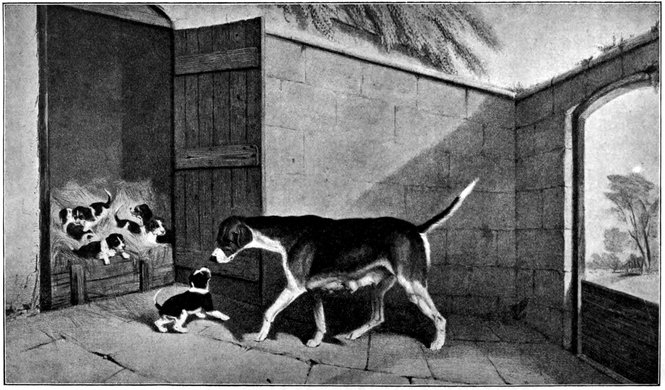
THE MOTHER.
At this season, when the trout fisherman is rejoicing in the warmer weather, that promises to bring about a hatch of March browns, and the shooting man is thinking of the first eggs of early-laying pheasants, when all the world welcomes the balmy days of spring, only the foxhunter is heard to complain. He is forgetful of the fact that he alone of the army of sportsmen enjoys a full six months of his favourite pastime, a six months that may be extended to eight, if he will content himself with the sport afforded by one or two of the woodland packs which, beginning cubhunting in the month of August, never consider the season finished until a May fox has been killed.
But even the discontented foxhunter, if he be worthy of the name of sportsman, can find something to do in connection with the “sport of kings” to while away the weary months until the dewy September morning, which finds him once more revelling in the music of hounds as they teach the cubs their business.
For some weeks, at any rate before his charges return to kennels, he cannot find better employment than the personal supervision of the education of the puppies, one or two of which, as an enthusiastic hunting man, we must take it for granted that he is walking. True it is that he will not have many weeks to devote to them ere the spring cart from the kennels makes its appearance to carry them off, loath though they may be to undergo what will be to them the most important part of their training, or to be drafted into the ranks of the unentered should they not prove equal to the standard, either in height, pace or quality, required by the particular hunt to which they belong.
Short although the time remaining may be for what we can term the preparatory schooling of the puppies, the ardent foxhunter may yet do much to make the youngsters committed to his care more fitted to take their places in the public school to which they are so soon to be removed. During the busy hunting season when their care has been in the hands of his deputies, our hunting man has probably thought little of the education of the puppies, which, maybe, will later on contribute to his next season’s enjoyment. But now that he has perforce to remain more at home he may discover that his duty as a private schoolmaster has been sadly neglected, and the puppies that should have been a credit to him have, from lack of the proper attention, grown up dunces, with all their good manners yet to be learnt, and many bad ones to be thrashed out of them. Let him then take them in hand at once, and endeavour to repair some of the mischief that his laxness has brought about. The hours spent in thus occupying himself will not be wasted, and he will feel the satisfaction of having done something for the hunt that has so often provided him with sport in the past.
To judge by the accompanying picture reproduced from a coloured engraving of considerable antiquity, the custom of sending puppies out to walk is of very long standing. It will be noticed that the puppies are to be conveyed to their destinations in bags or panniers slung across the saddle. The artist has depicted the kennel huntsman, faultlessly arrayed in scarlet, tall hat and top boots, trimming with a pair of scissors the ears of one of a good litter of puppies about to be sent to walk. The picture is suggestive of a train of thought that it may be well to give expression to at the present time, when the duty of puppy-walkers to their charges is under consideration, and possibly a few thoughts upon puppy management may induce the negligent walker to exercise greater care another season, even if it is too late to put them into practice during the time that remains before last year’s puppies return to kennel.
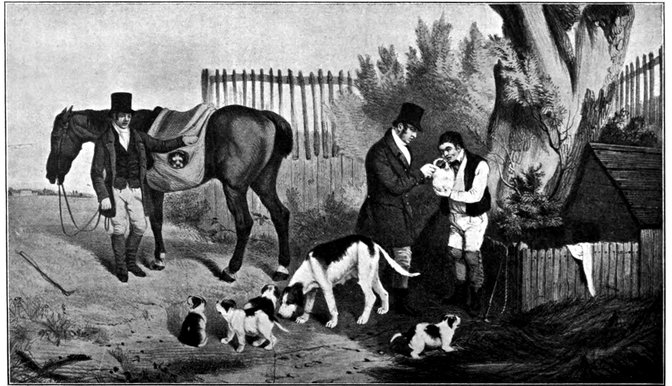
“SENT TO WALKS.”
First and foremost comes the thought of the comparatively few who are really qualified to walk a foxhound puppy. Many who undertake the duty do not appear to have their hearts in the work, their main object being to keep the puppies out of harm’s way—not so much to save the puppy from harm as to prevent him doing harm. On the other hand, there are some walkers who, in their anxiety to do well by the puppy, and give him enough exercise, allow him to run wild and to hunt hares. Of course, plenty of exercise is essential for the well-being of a foxhound, and in order to ensure his getting it the puppy should daily accompany some reliable person, be he the groom exercising horses or the tradesman who has long country rounds to make. The importance of his being a trustworthy man, who has his heart in the work, cannot be overrated, far more harm than good being done if, instead of keeping his charges in order, he encourages them to run wild. In this connection it may be mentioned that it does not always follow that foxhounds entered in their youth to hare are afterwards useless for fox, for many instances can be recalled of such puppies having turned out to be thoroughly reliable hounds, that would stick to a cold line even with hares jumping up in front of them; but it is a risky proceeding to give puppies exercise by allowing them to hunt ground game, and may lead to endless trouble.
As to the home treatment of foxhound puppies, no better advice can be given than that contained in a leaflet recently noticed in these pages. One thing to which due attention is often not paid is the accommodation provided for young foxhounds. Too many puppies are allowed to run about all day picking up filth, disturbing coverts, and doing all kinds of mischief; and then are left to find a damp, draughty bed in a wood house. On really wet days it is better to keep them shut up, except for a short time, during which they should have a sharp run, care being taken that a good bed of clean straw is afterwards provided in which to dry themselves. If allowed to remain wet, and to lie on the damp ground, evil results are bound to follow. It is also of the utmost importance that they should be shut up at night, otherwise everyone is molested, and bad habits, such as cattle and sheep worrying, are sure to be contracted.
A couple of puppies should always be walked together. They certainly thrive better, nor do they fret so much when first sent out, or when first taken back to kennels, although it must be confessed that where two or three are gathered together the capacity for mischief is not only doubled, but perhaps quadrupled. But if it is, the sport they will some day provide will more than compensate their walker for the few shillings they will cost him. As companions to children foxhounds cannot be surpassed, and many an hour will be whiled away in each other’s company, each keeping the other out of mischief.
A very sore point with puppy walkers, and one to which more attention might well be paid, is the fact that they are often requested to walk and do well for a couple of puppies possibly for six months, but when these puppies are returned to the kennels it is only to be destroyed, and often their fate has been perfectly evident for some months previously. The walker naturally feels aggrieved when such an ending comes to hounds on which he has spent time and money. Now, to remedy this state of affairs, it has been suggested that the kennel huntsman or some other responsible person should always be in touch with all puppies at walk, and should, as soon as he can detect for certain the worthlessness of a puppy, be entitled to relieve the walker of it, and thus save him unnecessary expense and much disappointment.
In conclusion, every member of a hunt, and everyone who has the well-being of foxhunting at heart, should feel himself under an obligation to walk a couple of puppies for his hunt, and thus relieve the master of the necessity for sending promising hounds to unsuitable walkers. But, quite apart from any obligation, the pleasure to be derived from seeing “puppies grow into hounds” will well recompense him, even if they never become shining lights in the pack, or win prizes at the Peterborough Show.
F.
A few Cocks and some Rabbits.
The shooting season is drawing to a close. One can almost fancy that there is a touch of spring in the air. The long frost has gone at last, and the thoughts of bird and beast are turning once more towards love and war. Far above us in the rocking elms, the rooks are noisily putting their own houses in order, and thievishly beggaring their neighbours. The partridges, no longer huddled together in thinned coveys, their feathers so fluffed out that they look double their natural size, have here and there already paired off. Old George, the keeper, reports that another twenty or thirty cocks can be spared, and that during the frost the hungry rabbits have been working havoc among the young trees. They must be thinned, or something is sure to be said presently on the subject of damages.
So a day is fixed for a last shoot, and, making an early start, four old friends walk across the quiet fields towards the Big Wood. Two guns are placed forward, and two walk with the beaters. I am one of the former, and, left to myself, the mystery of the Big Wood gets into my bones, and I begin to dream dreams. The silence is absolute. Presently, a tinted cloud of long-tailed tits invade the bushes round me, eager to discover an atom of greenery, and, if they do, quite prepared—if I may be allowed a forlorn little joke—to nip it in the bud. They remind one of a troop of lesson-freed children raiding the strawberry beds, in the hope that some early fruit may happily be found, ripe enough, in their very liberal interpretation of the term, to eat. My covert is drawn blank, so the tits are off, with a scolding complaint, to try their luck elsewhere.... Two rabbits, unconscious of impending fate, chase each other far down the ride which stretches before me. Silence reigns once more. Then, long before I can hear the beaters, pat, pat, pat, come some halting footsteps over the carpet of leaves. It is a wary old cock pheasant, already on the alert, and by no means unconscious of trouble ahead. He looks inky black in the shadow. He runs forward a few yards, then stops to listen; on again to the right, but, not satisfied, bustles back. An excursion to the left, but scenting danger there, he is back again. Then, irresolute, he stands facing me in the sunlight, with his bright eyes and gorgeous coat of many colours. He has played this game many times, and so far his head has kept his life. With my back to a tree, I do not move an eyelid, but he sees me, or smells my pipe, and back for good and all he scuttles, head down, with the evident intention of executing a flank movement to the rear. There is a cry of “cock back,” in the direction in which my friend disappears, but no answering gun. I like to think that the wicked old rascal has once more out-manœuvred us, and saved his skin. As the beaters push on, all the guns become busy. The bunnies are hustled noisily forward, and in the comparatively open space are bowled over, or, bolting back, have a shade of odds in their favour, some of them, I am afraid, being “picked off the beaters’ toes.” Hens come whistling over, offering most tempting shots. B., on my left, crumples up a very high one, because, he says, she had a leg down. Beaters and the other guns now emerge, and the slain are laid out and counted. Twenty-five rabbits, two cocks, a hare, and B.’s hen. Old George eyes her and B. suspiciously, and, feeling her all over, mutters “he didn’t see no leg down.” Nearly all the cocks have run on, but will be cornered presently. So the day wears on, monotonously delightful, one beat in the Big Wood being very much like another. But at lunch there seems to be some mystery in the air. Our host and old George are to be seen whispering together like conspirators; old George’s ribston pippin of a face screwed up into something as near a grin as it ever wears, while our host looks humorously perplexed. I notice afterwards that we leave out a certain beat, and call old George’s attention to the omission. “Never you mind Muster A., you go where you’re told,” is all I get for my pains. The old man still treats me as if I were about ten, the age at which he began to teach me to shoot. The mystery remained one until after dinner that night, when our host let the cat out of the bag, under solemn vows of secrecy. That beat was left out because in it lay a fine dog fox, shot through the head by the Master who was out with us, and who had shot at a rabbit in the thick undergrowth. Thus was the blood of many a bunny avenged, and poor “Charlie” met an inglorious end in the house of his friends. Old George, and no one else, happened to see the tragedy, and notwithstanding my protest that it was much too good a story to keep to ourselves, the Master knows nothing of the murder to this day.
As I have said, George and I are very old friends, but we are also very old antagonists. He is a great politician; a Radical of the Radicals, while of course with him I am a Tory of the Tories. To-day I manage to score off him; no easy matter at any time. He had picked up some early primroses in the wood, and put them into his button-hole, to keep for a certain young lady, a prime favourite of his, who, with our hostess, is to join us at lunch. Before he could give them to her I caught him by the sleeve, and, pointing to the flowers, cried:—
“Hullo, George, I’ve always said that you would see the error of your ways some day. So you’ve actually joined the League. Who captured you? Lady Mary?”
Now, Lady Mary is the energetic wife of our Conservative Member, and it is a matter of common knowledge that there is no love lost between her and George. First game of the rubber to me! But we were soon all square. In the afternoon, coming through a thick hazel copse, stooping and worming myself along, half blinded with the irritating blows from the whippy twigs, a five-pound note worked out of my waistcoat pocket, into which I had carelessly stuffed it. Old George, whom nothing escapes, picked it up, but said nothing. When the beat was over, and, before moving on again, guns and beaters were gathered round the game, he asked me, “Be you dropped hanything, Muster A.?”
“Not that I know of, George,” I replied. “Why?”
“’Cos I picked up this here, which I think come out of your pocket.”
“Yes, by jove, it’s mine,” I cried.
“I reckon they lie a bit thicker in Lunnon than down hereabout. When I seed it fust I thought it must be”—he paused for effect—“a luv-letter.”
As my aspirations in a certain quarter, not quite unconnected with the aforesaid young lady, were pretty well known, this sally was greeted with a loud guffaw at my expense, and the game was “one all.”
Later in the day he won the rubber. I was one of the forward guns in the last beat, and having placed my gun at safety against a tree was lighting my pipe, when, for the first time during the day, there was a cry of “woodcock forward,” and he flitted past me in his usual silent, ghostly fashion, quite close. I grabbed my gun, covered him, and pressed, then frantically pulled at the trigger. Long before I realised what was the matter, and had slipped up the safety-bolt, the cock had placed a thick tree between us, and my shot hummed harmlessly through Hampshire. I hoped against hope that I had not been detected. But as we gathered round I soon realised that I was lost.
“Did you see that there woodcock, Muster A.?” asked old George.
“Yes,” I replied with assumed carelessness. “I think I saw it: wide of me on the right.”
“Oh!” grunted the old man, “wide o’ you, was it? Where might you be a-standin’, then?”
“Oh, somewhere over there,” said I, waving my hand vaguely, and, trying desperately to create a diversion, added, “That was a high cock to wind up with, B., a regular clinker.”
“But,” persisted old George, “wasn’t you a-standin’ by that there hold hoak?”
“I believe I was, George,” I yawned, “somewhere there.... What did we get this beat?”
The old scoundrel walked off to my “hold hoak,” and picked up a cartridge. I was the only gun using a 16-bore.
“Bain’t this your cartridge?” he asked.
“Yes, yes, George,” I said.... “Shall we make tracks, it’s getting rather chilly.”
“Hout of range, was he,” said the imperturbable old chap. “Why, that there woodcock comed out by that there holly, and you could ha’ knocked ’un down with a stick.”
I ran up the white flag, and said humbly: “I was lighting a pipe, George, and was at safety.”
“I knowed that,” replied my tormentor, looking round in triumph, “for I see’d yer.”
The stars are shining frostily as we finish, and the full moon rides above the tree-tops, “like a rick a-fire.” Each beater gets a couple of rabbits and an extra shilling, as it’s the last day. Pipes are lit, and we walk home out of the Big Wood, more ghostly than ever in the moonlight, across the stubble and the plough, on to the open road. Bag: 28 pheasants, 7 hares, 120 rabbits, a couple of jays, and a rat.
A. H. B.
Breeds of British Salmon.
Having on a former occasion advanced some reasons for discrediting the theory that fish hatched from the ova of autumn-running salmon must immigrate or run inland in autumn; and that, similarly, the progeny of spring salmon must regularly return to the rivers in spring, in obedience to inherited proclivities, we may now be permitted to give additional reasons, not less weighty perhaps, for our disbelief. The gist of our previous argument in controverting the theory in question was that since the strength of the migration of grilse—and fish-culturists and competent observers have conclusively proved that grilse are the adolescents of spring and of autumn salmon alike—is always evident in summer, this fact alone completely knocks on the head every iota of what has been advanced to prove the existence of two different breeds of British salmon, each inheriting an instinct for ascending the rivers at a particular time, irrespective of age, sex, or condition. This theory of transmitted instinct to obey a seasonal duty may at first sight appear plausible enough to some, but those who give credence to it cannot, we fear, do so from ascertained facts. Why, for instance, as already remarked, the ascent of the grilse in summer should alone be sufficient to demolish such a theory, since, when making their first ascent, and while yet adolescents, they are not obeying, as is perfectly clear, an inherited instinct for ascending during what may be called the “parental ascending season.”
From personal observation and a mass of reliable data, we have the strongest reasons for believing that the spring salmon of the Scottish rivers—not the winter salmon, which, as a rule, are older and larger—are the most vigorous and active fish of all; that the grilse are the young of spring, summer, and autumn salmon alike, ascending at a time when the temperature of the fresh water suits them, for though scarcely less active, they are less vigorous and certainly more sensitive than the spring salmon; and that the autumn salmon, generally, are fish that have already been inland as spawners, and from not going back to the sea till late in spring or early in summer, are therefore later in reascending the rivers than they were in ascending them on the previous occasion, not returning from the feeding grounds till autumn, when they are heavy with spawn, and consequently unable to remain long in the fresh water without injury to themselves.
Mr. J. A. Harvie-Brown, F.Z.S., foremost and most versatile of authorities upon the salmon, entirely agrees with what we have stated. “The spring fish,” he says, “are vigorous younger fish and reach highest up the rivers, and can stay longer in the fresh water without hurt to themselves. The autumn fish are older, larger fish: and many begin to go out of condition before they leave the brackish, as they are less able to stay long in the fresh.”
In his book on “The Salmon,” the late Mr. Russell, of the Scotsman, argues “that the facts are at the least equally compatible with, and indeed entirely suitable to, the theory that the fish coming up all the year are the adults of various ages, and that those rushing up in a body in summer are the young of the same species. What are those clean salmon that run up the rivers in late winter or early spring? Where have they been in the preceding months? What do they want now? They cannot be wanting to spawn, for there is no spawning for at least six months to come. They cannot have spawned early in the preceding or rather present spawning season, gone down, recovered, and returned, for numerous experiments show that the period of return is about three months, and it is only about three months since the earliest fish had begun to spawn in the rivers which these are now ascending. They must have passed the autumn or earlier winter in the sea. Then they must have passed the winter without breeding.”
Briefly put, the views we hold concerning the whole matter (as regards long-seasoned rivers) are: That the early running salmon are fish that have not spawned in the immediately preceding season (the great majority, which are small fish, females preponderating, have passed their girlshood in the sea); that the late spring and early summer salmon, for the most part, are fish that have not been gravid in the preceding spawning season; that the salmon appearing later in the summer, say from June, represent the first-descended of the previous season’s spawners returning again to the rivers; that the grilse that arrive inshore in summer seeking the fresh water are the breeding portion of the stock of grilse for the year, as proved by their ova and milt, and that the autumn salmon, the great majority of which are large fish, are those that spawned latest in the previous season, or, as kelts, were exceptionally late in getting back to the sea.
What we have stated and emphasised above is expressly intended to show how untenable is the theory that spring and autumn salmon (or, as we should call them, if we are to speak accurately, spring-run and autumn-run salmon) are distinct and separate breeds.
We now come to give other strong reasons for discrediting the notion, theory or hypothesis, that there are different breeds of salmon in the Scottish rivers. Accordingly it is advisable to be specific, necessary to select certain rivers and state the facts. Our choice is the Don and the North Esk. Now as regards these rivers, what are the facts? First, that early every year thousands of salmon are netted at their mouths and in their tideways, and many thousands more above their tideways; second, that owing to the severe river netting plus the fixed obstructions which no fish can pass as long as the water has a low temperature, not a score, perhaps not half-a-dozen, pairs of so-called “spring fish” survive, and eventually reach the upper strath or glen sections. These are strictly facts, facts that cannot be disputed, facts that the Fishery Board for Scotland may conveniently verify. Now we should like to ask, is it at all likely that the many thousands of salmon that are netted in these rivers in spring are exclusively the progeny of three, six, or even a dozen pairs of spring-run salmon? We answer that it is not likely. We go farther and say it is impossible. But some one will query: Are there not in ten spawning salmon more thousands of potential salmon than the thousands that are caught annually in spring by the rods and nets conjointly? Quite true—say fifty thousand in a dozen fish of 8 or 9 lb. each (a good average weight in spring). But then the crucial question must be asked? What percentage, reckoning all the risks from frost, drought, spates, and so forth, hatches out? And what proportion, considering the scarcity of their food at recurrent periods, and all the perils and all the enemies to which they are exposed during the years of their growth in sea and river, survives to reach the adult stage? Let us suppose that 5 per cent. of the whole hatched ova—and this is a liberal estimate—advances through all the stages—parr, smolt, and grilse—till the adult fish is reached. On this calculation the mature progeny, resulting from a dozen pairs of spring salmon, would number two thousand five hundred.
No, we cannot accept the theory that spring salmon are a different breed from autumn salmon; nor can we agree with the dictum that they are to be preferred for hatchery purposes. No fish-culturist who has devoted himself with eminent success to the breeding of salmon, would ever dream of preferring the spawn of fish that have been ten or eleven months in the fresh water, to the spawn of fish that have been in the rivers only two. Numerous experiments have proved that of the ova of spring salmon about 75, and of the ova of autumn salmon about 95 per cent. is the average that hatches out and reaches the parr stage; and that as a particularly high percentage, 98 is more common in the latter than 78 in the former case. How, then, can it be contended that spring salmon are to be preferred for their ova? In conclusion, the whole argument may be clinched in a single sentence thus: If from twelve pairs of spring salmon, the maximum number of “escapes” in Don and North Esk annually, there survive to reach maturity a progeny of two thousand five hundred, are we not warranted in assuming that the grand result from the ova of the many thousands of fine large fish that ascend these rivers in autumn and early winter would be millions on millions of salmon, or more than the pools could comfortably hold? Enough! Enough! Informed opinion is against the theory of different breeds of British salmon with different inherited migratory instincts.
W. Murdoch.
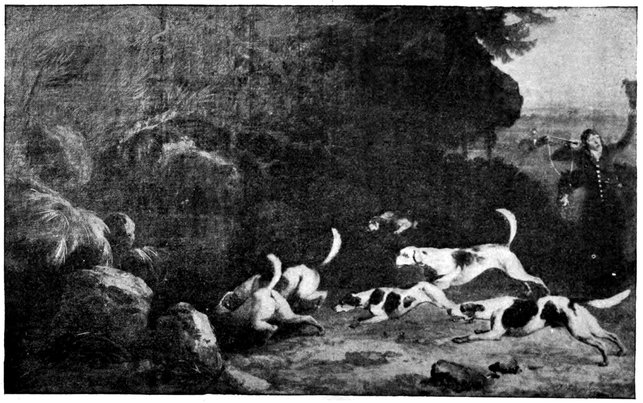
VANGUARD RUNNING A FOX TO GROUND. (From “The Foxhounds of Great Britain,” by permission of the publishers.) [From a picture at Birdsall.
The Foxhounds of Great Britain.[5]
A REVIEW.
History has been lavish in a casual sort of way with hounds and hunting during the last century. “Nimrod” in early days initiated descriptions of our most fashionable and best countries, as well as their denizens, and did a leading part to bring sporting literature into popularity; yet he was in no sense a hound man—he loved the horse and his rider, and was, par excellence, their historian. “Cecil,” who followed him, was, on the contrary, a hound man, his happiness lay in the kennel, and in his descriptions of the countries through which he toured, his pen ever hung on the treasures of the kennel, and its management in breeding. “Druid,” in his unique and gossiping way, gathered his facts and hound-lore from fireside chats with huntsmen—the best of his day. To him sketches of hunting countries mattered little; he simply delighted his readers with fragmentary touches, so pithy and telling, of men and hounds, and their manners, which, however, added little to the general history of hounds or hunting throughout the country. It has been left to Sir Humphrey de Trafford in this twentieth century to initiate the idea, and carry it out, of gathering together all the threads of bygone days, and weld them together in a comprehensive form, showing what our foxhounds throughout the United Kingdom are at the present time—their early history, their main features, their chief supporters, and their hound-lore. To bring all this into the compass of one volume was no easy matter, where so many interesting facts had to be garnered into a given space, and that by those best versed in their subject; yet the task has been accomplished in a way which I venture to think its readers will appreciate as eminently practical and useful.
Whether you take this historical sporting book as a whole, or in the light of individual packs and their countries, you cannot fail to be struck by the landmark that it is for us to-day. Here we find one hundred and ninety-nine English packs of foxhounds in England and Wales (and I have failed to discover one that is missing), twenty-four packs in Ireland, and eleven in Scotland; and it needs little research to see how they have one and all grown and flourished through good and bad times, fighting and encompassing difficulties, spreading, subdividing, increasing in numbers and in importance, ever onwards, until it can hardly be said that there is a square mile of country outside large towns or manufacturing centres where the foxhound is not honoured and welcomed. This is veritably a proud thing to say in the year 1906, yet it brooks no denial. It will surprise many readers to find with what authenticity some of our great packs can carry back their history to bygone centuries. Of these the Berkeley bears the palm, for did not a Lord of Berkeley so far back as the fourteenth century establish a metropolitan pack with kennels at Charing Cross? His descendants had so fostered and spread their hunting that in 1770 the then Lord Berkeley held all the country from London to Berkeley Castle, in Gloucestershire, a distance of 124 miles, with kennels at Cranford, Gerrard’s Cross in Bucks, Nettlebed in Oxon, and at Berkeley Castle. Thus arose the old Berkeley Hunt, which became a separate country in the year 1800, only to be since sub-divided into an east and west pack. The Berkeley also annexed at one time nearly the whole of Gloucestershire, and founded the Cotswold when they built kennels at Cheltenham. The noted Harry Ayris was huntsman at Berkeley from 1826 to 1857.
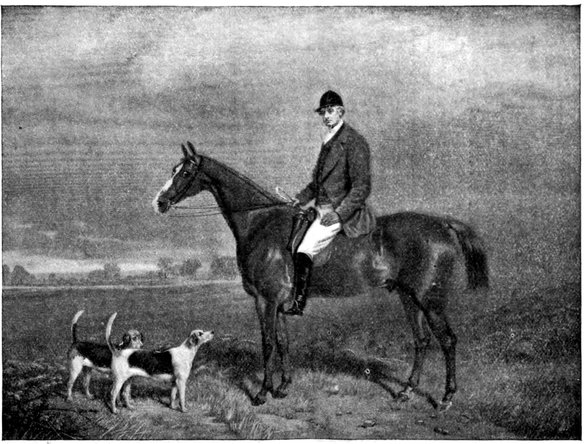
SIXTH VISCOUNT GALWAY IN 1875, WITH HIS FAVOURITE HOUNDS, BRIDESMAID AND RUBY. (From “The Foxhounds of Great Britain and Ireland,” by permission of the publishers.)
The Belvoir also claim a very old heritage, viz., from the reign of James the First, and the first Duke of Rutland hunted about the year 1650. The Bramham Moor pack was instituted in the reign of Queen Anne, and will ever be associated with the family of Lane Fox. The Burstow owe their origin to Sir Thomas Mostyn, who migrated from North Wales. The Burton will always be coupled with the name of Lord Henry Bentinck. The Badsworth claims 1730 as its date of origin, while the Badminton commenced its unbroken reign of ducal mastership and signal success in 1762, including as it then did the present Heythrop country and nearly all Wiltshire. The long service of their huntsmen has always been phenomenal. Philip Payne served as huntsman under four dukes, and Will Long, who succeeded, served as whip under him for seventeen seasons; and now Will Dale is continuing the rôle, in succession to Charles Hamblin, although as huntsmen themselves the last three Dukes of Beaufort have had no compeers.
The Bedale is inseparably associated with Lord Darlington and the dukedom of Cleveland; while the Old Berkshire country is, curiously enough, indebted to the Church for its early history; the Rev. John Loder being its founder in 1760, only to be succeeded by his son-in-law, Mr. Symonds, another clergyman, in 1850. This would seem to be a fitting history for a pack kennelled so near Oxford University; but indeed, as I have had occasion to mention in a former article in your Magazine, foxhunting owes much to its patronage by the Church from time immemorial, and surely this is not its most inglorious tradition.
We cannot help being struck with the number of packs that come under the letter B in this volume, no less than twenty-three of them, including the Duke of Buccleuch’s, in Scotland; and the letter C comes next with over twenty.
The Earl of Yarborough has the proud distinction of being the owner of a pack that through eight generations has been handed down lineally as a private pack to the present day, and from 1714 its kennel book has been maintained carefully. It is, indeed, hard to say how much foxhunting owes to such splendid sportsmen as the Pelhams have been in their care and breeding of hounds. The Yarborough pages in this book are a revelation to sportsmen who appreciate what a landowner can do with 60,000 acres within a ring fence, and able to indulge to the full in hereditary tastes.
Sir Watkin Williams-Wynn’s pack, the Wynnstay, is another instance of the success of a territorial magnate successfully forming an historic pack and country.
The Quorn, the head and front of fashion, that has led the way among the daring hard-riding spirits of Great Britain for more than 200 years, is most ably dealt with in this volume. From the days of John Boothby in 1700, and of old Hugo Meynell, who succeeded him in 1753 up to 1800, there have been twenty-five masters of the Quorn who have one and all handed down their names to posterity as worthy of note, and have earned the gratitude of many thousands of men who have in their time satiated their ambitions over those Leicestershire pastures, where the oxer still holds its own, and wire is treated as a noxious weed. The picture of old Hugo Meynell and his old huntsman, Jack Raven, is inimitable; you can see there the characters of those two aged sportsmen discussing the pros and cons of the day, and can fancy how fully they are entering into it. Let us leave that Meltonian chapter with all its particulars and prints to the full appreciation of its readers.
The Cottesmore is scarcely a less interesting chapter. Founded by the Noel family at Exton Park in 1753, that adjoins the village of Cottesmore, from which it takes its name, it soon came into the Lowther family, and was hunted for a long series of years by the first Earl of Lonsdale. Then we find Sir Richard Sutton at the head of affairs, followed by Sir John Trollope, afterwards Lord Kesteven, and Mr. Henry Greaves—always in high feather—with its glorious sweet-scenting country, its grand woodlands, strong foxes, and expansive acreage of upland pastures. Surely, if any country in the world is made for the sport of kings, that country is the Cottesmore, which now enjoys the acme of sport, and worthily so.
We long to dwell on the Atherstone, the Meynell, the Oakley, the Grafton, Lord Harrington’s, Lord Galway’s, and the Rufford, did our space permit, but are not their stories all faithfully and succinctly told there?
Cheshire stands out well, and the old Tarporley Hunt Club is a lasting tribute to the hunting instincts of that famed shire, where every other sport stands aside to make way for it. Shropshire also is its goodly neighbour, hunted as it is from end to end, right up into its Welsh border, in a style worthy of its best traditions; and viewed from its grand old Hawkstone on the north to gaunt Clee Hill on the south, is a fair domain of sport.
Yorkshire, of course, is another leading feature in the book, as well it must be, and so are our southern, eastern, and western counties; none, indeed, escape all the notice that is their due; and as it is not given to all sportsmen to revel in the realms of pasture, unalloyed by the drawbacks of small enclosures, hills and dales, crags and boulders, mud and marshes, or impenetrable woodlands, so we all accommodate ourselves to locality, and are happy in our less ambitious surroundings and histories. To these this book will not the less be a treasure. Whether we happen to be east or west, north or south countrymen, we recognise a friendly word, a well-known and honoured portrait on every page.
Neither Ireland nor Scotland has been forgotten, as it is well they should not be, for as far as hunting is concerned, are we not united in a bond of love and friendship, which it will indeed be hard to sever? For is it not to those Irish horses that we owe our mainstay over here, that so soon learn to jump our flying fences as easily as their native banks? And do not we welcome some of our finest riders from across the Irish Channel?
In dealing, however, with the historical side of our foxhunting book, we must not overlook its value as regards the foxhound himself. Great pains have been taken by the compiler of this work to define the combination of blood which has been diffused into each individual kennel and has contributed to its success. To hound-lovers this book must prove of especial value, and we can picture the delight of our old friend, Mr. Cecil Legard,—whose portrait is to be found in the introduction—when he scans its pages, and the satisfaction he feels at having spent many years in perfecting the Foxhound Stud Book. It would ill become me to enter into much foxhound lore in this short review, further than to say that, from the days of the old Corbet Trojan down to those of Brocklesby Rallywood, and so on through the Belvoir celebrities and the Craven and Warwickshire favourites, as well as others in profuse plenty, not only are they made mention of, but the portraits of many of them adorn the pages and speak for themselves as to the symmetrical beauty of the modern foxhound—a fact that the success of the Peterborough Hound Shows bears ample evidence to. When I look at these splendid specimens of hound culture I cannot ever refrain from picturing what natural perfection there must be in the grand attributes of that little animal the fox, which for centuries right up to to-day has been enabled to withstand the onslaught of his foes, and defy all their artifices.
A leading feature of this book is its illustrations. It will be evident to all who study it that to gather such a collection of portraits of men and hounds, as well as innumerable hunting groups and meets in almost every country, has been a work that has taxed the energies of all who have had a hand in its compilation. Such a thing has never been attempted before, and its accomplishment will suffice for many a long year. Turn over page after page as you may, you come across old and young friends, the Nestors of bygone days, and our best young Nimrods of to-day. This is in itself a theme on hunting, which I long to go away “full cry” on, were it not that you, Mr. Editor, let fall the threatening crack of the whip, warning me homewards. It concludes with tabulated pedigrees of some of our most celebrated hounds that have won the leading honours at Peterborough, such as Fitzwilliam Harper, V.W.H. Damsel, Belvoir Dexter, Grove Druid, Puckeridge Cardinal, Zetland Rocket, and Lord Middleton’s Cheerful, and winds up with a key plate of the Quorn meet at Baggrave Hall.
Perhaps we ought to say a few words in commendation of those fourteen sportsmen whose brains and pens have assisted the Editor in bringing this great work on foxhounds before the public. They knew their subject, and have striven hard and well to draw together all the cardinal points of interest in each country with which they had to deal. How far they have succeeded it will be for readers or critics to say. Inasmuch as I am myself a helpmate in this matter to a small extent it will not become me to say any more than that it has been a labour of love to me, and that I feel sure that Sir Humphrey de Trafford will, as the Editor, hand his name down to posterity in honour for this standard work.
Borderer.
Hind-hunting.
For those who like to combine hard riding with careful and interesting hound work, there is no sport to equal hind-hunting. It is not easy work. Indeed, there is no form of hunting which is harder upon man and horse. Patience, judgment and courage are required in no small degree by the man who would see a red-deer hind fairly hunted on Exmoor. In the course of a run we may and often do cross moor and fell, grass and plough. We plunge into the recesses of deep woods, clatter up the beds of mountain torrents, climb up ascents so steep that one wonders the horse can ever face them, and come down hills which seem more fitted for sheep or goats than horses. All this you must do if you wish to see hounds at work. You may do your best, and yet lose the chase, to recover it again later on, or perhaps be left alone to find your way as best you can. If the charm of hunting is uncertainty, then hind-hunting ought to be the most delightful form of the chase, for in none is there more. Sometimes the hinds will not run at all, at others they twist about so persistently that do what you will you cannot keep in touch with the chase, and find and lose the hounds half-a-dozen times in the course of a run. The knowing ones ride to points, cut off corners, wait for hounds to come back to them. But that is not the best way to enjoy a hind-hunt; indeed, taken in that form it might be thought a tedious and unsatisfactory form of hunting. I was for some time rather inclined to undervalue it. The whole secret of the pleasure is to see as much of hounds as you can. In doing that the interest never fails; if there is anything like a good run you want to be ever pushing on, always striving to get forward to take advantage of every check, and get the best of every turn. If one is always galloping to catch hounds, no horse could live through a really fine hind-hunt, a chase which may last for three hours or more, and cover any distance (as hounds run) from fifteen to thirty miles. But so long as you can keep near the pack, there will be many opportunities of easing the horse and nursing him to the end of the run.
Let me tell the story of a hunt with its moments of joy and excitement and its times of deep depression. It is a clear, bright morning, with not too much wind, so that one can both see and hear. The air is keen as we ride on to the meet, fixed for some cross-roads near the haunts of the deer. The first few miles are along a commonplace road enough, and then we turn up a steep hill and gradually come out on the higher land. This is not the Exmoor of the holiday stag-hunter, with its deep leafy combes, its broad expanse of purple heather. It is a study in browns and russets, with the grey-purple of Dunkery in the distance, and here and there a golden blossom of heather in the foreground. The landscape is like a chequer board, with the tiny square enclosures which creep up to the edge of the moorland.
There is one advantage about hind-hunting, you know where to look for your quarry, and they are not seldom out in the open. The Master takes with him four couple of hounds, and goes to look for the hinds. We all go, too, for sometimes the best of the run may come with the tufters. I have known them to get away with the hind, and the body of the pack never to have a chance of coming up.
Presently we hear the horn, a hound challenges, and we know the hunt is up. So closely do hinds resemble the heather in its winter brown, that it is not easy to see them. At last we obtain a glimpse of one as she comes stepping high over the heather with a free, easy and proud step. There is nothing more beautiful than the action of a hind; it is far more graceful than the lumbering lollop of a fat old stag with his mighty weight of body and antlers. The way she goes leads to a covert on the side of a hill, and we make for this point, arriving there before she does. This is one of those cases in which you cannot ride to hounds—there is a bit of impossible ground. We are now on one slope of a deep valley cut by a stream. On the opposite side is a hanging wood, and along its steep sides the hind is working, the hounds hunting fitfully behind. She dodges about, running twice up to the boundary fence, and twice turning back. This is the critical spot, for it is easy to be left here and very difficult to keep touch with hounds. The hind, moreover, comes straight across, almost touching one rider; the hounds stream after her, we scramble up the slope, and down she goes again. Galloping along the top we find an impenetrable beech fence, and by the time we are clear hounds have gone.
This is one of the dark moments of the chase. Though we do not know the country well, we do know that in front there are thick and extensive coverts. We are out of the fun unless we can pick up the pack, which has not yet been laid on. Luck favours us, and after a long trot we find them waiting in the heather on the open moor, and what is also good, our second horses. With hounds now eager for the hunt and a fresh horse, we canter easily over the heather, which is far better going now than in summer, soft, springy and delightful. Watch the hounds, how they try for the line. Presently one hound bounds over the heather and quickens its pace, and then another and another. “For’ard, for’ard!” shouts the Master, and touches his horn, then one and another of the pack speak. There is none of the dash, none of the clamour of foxhounds hitting off a line. The hounds are lobbing over the heather, and we drop into a hand gallop. Now one way they swing, now the other, for the hind seldom runs straight, but in a curious, hesitating, wavering, sort of way. This gives us many a turn. But we need to keep close, for hounds leave us in a moment if we are slack. Downhill she has run straighter, hounds pack more, and speak to the line more freely. This is a delightful gallop over the heather, the horse going easily as we turn down hill. Now catch hold of him and pull him back, and we stride down without an effort, and economise the strength we shall need later. Somehow the hind doubles back, aye, and nearly escapes, were it not that two couple of hounds hold to the line. This saves the situation, though it is quite a quarter of an hour or more, during which we have scrambled down a steep path and up another, before hounds are really going again. Then comes another phase of the chase. The hind has left the open moorland and taken to the fields. A very pretty hunt it is. The pastures hold a scent, and we hunt on merrily till a sharp turn nearly throws us all out. The master’s eye sees the pack at fault. He gallops up the hill, fetches his pack, and casts boldly and quickly down hill. The hind has taken to the water, and it would not be wonderful if she was near the end of her strength. We have been running for about two hours, and have made a seven-mile point.
“This hind must have had about enough,” remarks the Master; but she is not, in fact, near the end of her resources as yet. As soon as hounds touch the line she leaves the water, and runs along the cover on the wooded slopes above us. Suddenly we see the leading hounds turn, for a hind has as many turns and twists as a hare. Now comes an exciting time for us. Hounds are running in an inaccessible bottom, and we have to ride a path about two feet wide on the side of a hill, with tangled cover and brushwood. A branch bashes in one’s hat, another almost sweeps a rider out of the saddle; but the notes of the hounds coming up fitfully and always further on beckon us forward. The going may be bad, but we must get forward. What a relief to find one self on the open heather once more! The horse is not done yet, and we work our way back to hounds, which have a long start.
But now a deep, dark wood swallows them up, and we follow the Master on trust. How he knows or divines which way hounds are going it is hard to say; but it is all right, and we find hounds running over a grass field, and then comes a stretch of most appalling ground. Frozen turf, an outcrop of slippery rock, a hillside broken up as though a number of small earthquakes had taken place; somehow we scramble down. But the hind is really beaten at last. We have been hunting since 11 a.m., and it is now long past three.
This is a good, but not an unusual example of a hind-hunt in the winter or spring, on a day when the weather is fairly favourable. When the weather is bad on the moors it is very bad. For example, the hind has gone up on to the moor, but the hounds have changed in the coverts. The Master and one follower are sitting with a couple or so of hounds for half an hour waiting for the whippers-in to bring on the hounds, while pitiless rain-, hail- and sleet-storms sweep over the exposed hillside. At last the hounds come, and what is wonderful, they can still hunt, though a storm has swept over the moor and their deer is three-quarters of an hour in front. We ride to them a short distance, plunge into a deep valley, and failing to hit the right path where the hind turns up, lose hounds altogether for the day.
Again, sometimes the hind never runs at all, but dodges and turns and twists until at last she fairly beats off her pursuers. These erratic courses of the hind are, so far as we can tell, governed by two motives. The first is to lead hounds away from her calf—the red-deer calves run with the mother till they are nearly as big as she is—and having shaken off pursuit, to return to the place she started from. There is no device to this end she will not try. Sometimes she lies down in the open, and so well concealed is she that it is impossible to distinguish her from the heather. Again, she will work her way down the middle of a stream for a long distance, so that the winter flood may carry away the scent, or she will run backwards and forwards in a covert till the line is foiled. Worst of all she will join a herd. If a hunted stag endeavours to join a band of stags, the others will butt him out of their company. They are not going to be compromised by the presence of an unlucky relative. But a bevy of hinds seem to try to shelter a distressed one, and by running on with her in a bunch to puzzle the hounds. Thus hind-hunting stands very high in the estimation of lovers of hound work. Hind-hunting brings out many latent hereditary qualities of the foxhound. We are reminded that the foxhound’s ancestors hunted stag before they hunted fox. There are, unluckily, very few foxes in the west of England, but there are still some, though mange, traps and fox-sellers or stealers have worked great havoc. Yet hounds seldom run fox when once entered to deer. These staghounds soon develop a considerable aptitude for distinguishing the scent of the hunted animal, so that amidst a multiplicity of lines they hold to the line of the hunted deer. A hound named Tradesman, belonging to Mr. E. A. V. Stanley’s pack, ran a hind from Lype Common to Cloutsham, right round Dunkery, never changing and never losing the line. When the pack were astray, he held on by himself. When they were with him he led them, and was, no doubt, the cause of the death of a stout hind after a long chase. This is a trait which is greatly valued in France, but has been almost lost in most foxhound packs in England, since the huntsman is as ready to change his fox as the hounds are apt to run more eagerly on a fresh line than a stale one. Then the foxhound often recalls his bloodhound forbears, or at least those stately white Talbots, so much favoured by our ancestors, by his steady tracking of the hunted deer.