Volume 85 — BAILY’S MAGAZINE OF SPORTS AND PASTIMES No. 553. MARCH, 1906. Vol. LXXXV. (continued 2)
Reading edition
Like bloodhounds, the staghound runs silently, speaking for a find, for the recovery of the scent after a check, and in covert, in order no doubt that the pack may keep together, but when working over the heather the pack string out in a resolute, silent and rather blood-thirsty fashion, for a staghound means and expects to have blood, and there is quite a different note in his voice as the chase begins to draw to its finish. In most cases in the last stages of a hunt the hounds are close to their quarry, and they know what it means. A curious trait about a hunted hind is that while pursued by hounds she seems almost devoid of fear of horses and men. It seems as if the red deer, from having been a hunted animal for so many ages, was able to distinguish between a real and imaginary danger. A hind has the reputation of being a timid animal, but if you try to ride one off from a point she is bent on making you will soon find that she cares nothing for you, but will hold on obstinately, or perhaps stop short and dodge behind your horse and so make her point.
So, too, I have seen a hind spring up almost in the middle of the pack and endeavour to bother the hounds by running in among the horses. Not the least remarkable thing is the unconcern with which stags look on in the hind-hunting season. I had heard of this, but never saw so flagrant an instance as during the winter of 1905. There was a bevy of hinds on the side of a hill. They were moved by the tufters, which also disturbed a big stag that was lying in the heather. He sprang up and trotted at his leisure up the hill and watched the proceedings. As soon as he understood that hinds, not stags, were the quarry of the day, he strolled quietly back to his lair and laid down again in the place from which he had been disturbed. In the same way bevies of hinds will wheel round, apparently not the least alarmed by the passing of a stag-hunt. Most hind-hunts are long and devious, but every now and then a hind goes right away in a straight line. This, I think, depends a good deal on the cry of the hounds. The red deer, like the fox, regulates its pace by the waxing or waning of the clamour of the pack. As a rule I do not think that Exmoor carries a very good scent in the winter, and the surrounding cultivation is chiefly poor scenting ground. The Brendon Hills, too, do not favour hounds, so that they do not speak much. It is only the sweet scent and enduring foil of a red deer that enables hounds to hunt as well as they do. Of course here as elsewhere there are days when scent is good. With the hind, as with the fox, a strong scent makes a straight-necked quarry, and hounds will drive a hind right away and kill her in an hour and a half or so, which for a hind-hunt is quite a moderate run. It is a very fine form of hunting, especially if you treat it more as a foxhunt than a stag-hunt. The latter is to most people a series of passing pictures of the chase, with a glorious background of wild and magnificent scenery. It is a holiday recreation, rather than a serious business like our winter fox-hunting. But few people make a serious attempt to ride to hounds when hunting on Exmoor. When first I went out hind-hunting I did the same. But I reflected that if one had two horses that it ought to be as possible to see most of the hunt as for the master and the huntsman. Even they cannot go everywhere. Parts of the country are actually impracticable, but they manage in the main to be with hounds. Men who know the country manage with one horse, but the stranger naturally goes further and works his horse harder.
How do you get your second horse? If you send him with the master’s second horse, he is pretty sure to come up with you sooner or later. Of course you can see a great deal with one, but it is unsatisfactory not to be able to see hounds hunt. To enjoy hind-hunting, one ought to see enough to have a general idea of the working of the pack during the whole hunt. Some idea of the way hounds work may be useful, and if, as not unusually happens, the rider finds himself alone with three or four couple of hounds, he can be of use by stopping them; or, if that is not always possible, at all events by keeping the leading hounds in sight, so that when the pack check he may be able to give useful information.
After their second season staghounds generally run mute, or nearly so. Thus they are particularly liable to slip away unseen or unheard. Unfortunately, these are the more experienced members of the pack, which are able to hold to the line of the hunted hind amidst the many temptations to change which will meet them in the course of a winter’s day on the moor. Yet so staunch do the older hounds become, that I have known four couple of hounds to carry the line through Lord Lovelace’s coverts from Culbone Stables (one of the most hind-haunted places in Exmoor) and kill the hunted hind after all in one of the deep-cut combes many miles away. These hounds hunted themselves, but I had the luck to pick them up. Coming over some grass fields only one spoke at all; the same hound with a peculiar shrill note spoke again in the covert when they came out on the moor. The leading hound wasted no breath on talking, but just scoured away. The others whimpered eagerly, but none actually spoke till we touched the wooded side of the hill. In the valley where runs the stream to which two-thirds of the stags and hinds come to die, strangely enough hounds would not speak, though they were on moist grass and the hind was close in front. The leading hound plodded on, always on the line, solemn, intent, resolute, until we actually came up with the hind cowering under the bank by the bridge. She was crouched into so small a space that she was scarcely visible, and her coat harmonised with the brown stream, the dead foliage on the banks, but with the spirit of her race directly a hound bayed her she stood up and faced him as proudly as any stag could have done. The odd thing was how difficult it was to get the hounds to see her, and the old hound that had done all the work seemed to take very little interest in the subsequent proceedings. The rest of the work was done by a large black, tan and white hound, who bayed the hind, hunted her down the water, and was in at the death. The others may have done more, but the silence of staghounds inclines one to give them less than their due credit. The hound, like the man who talks much and loudly, gets the most credit, and in the case of the dog with justice.
If any one wishes to see this fine but little-known sport he cannot do better than go to Minehead, and find a judicious pilot; for it takes an apprenticeship to learn how to ride over the moor in winter. The main principles which experience has taught one, is that heather is reasonably safe going, and to be made the most of, and that in this as in other forms of hunting, the nearer you can keep to hounds the happier you will be.
A friend of mine who came down asked me once for advice, and the answer was: “never lose sight of the hounds if you can help it, and if you do, get back to them again as soon as you can.” A year later he told me, “I have done my best to carry out your advice, and have never seen reason to regret it.” The other matter to be borne in mind is that somehow or another you must go at a fair pace down hill, which to the new-comer looks a great deal more alarming than it really is when you become accustomed to the process. There is another point of view which may be touched on here, and that is that it is not an expensive form of hunting; three stout horses (any will do that are well bred, temperate, and have good shoulders) would afford four and a half days a week. Thus two would go out hind hunting on Tuesday and Friday. One would do a couple of days with foxhounds and harriers, and in most weeks one of the two hind-hunters would put in half a day with the harriers besides. The early spring, March and April, are good months, when the mild western climate will be appreciated. Hunting is slack at home, and we want something new. Well, you have heard of autumn stag-hunting, now try hind-hunting in the early spring.
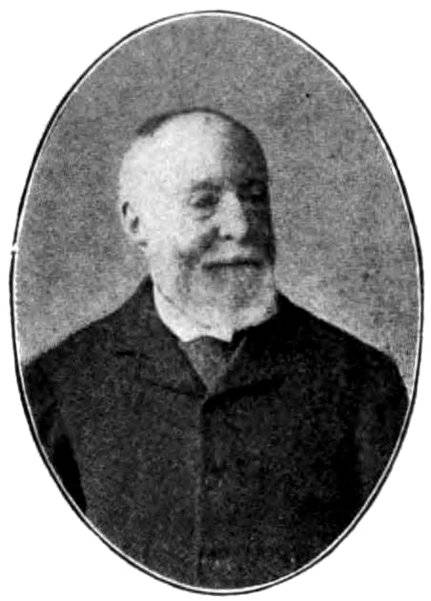
Mr. Alec Goodman, 1852, 1866.
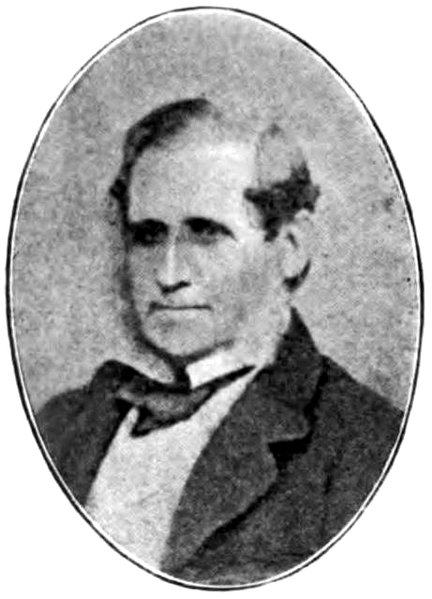
Tom Olliver, 1842, 1843, 1853.
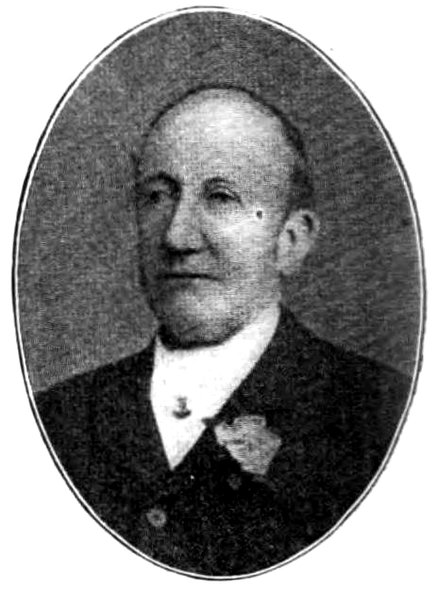
Mr. Tom Pickernell, 1360, 1871, 1875.
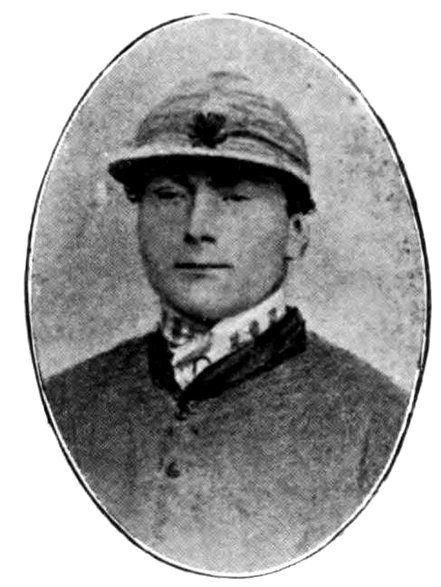
John Page, 1867, 1872.
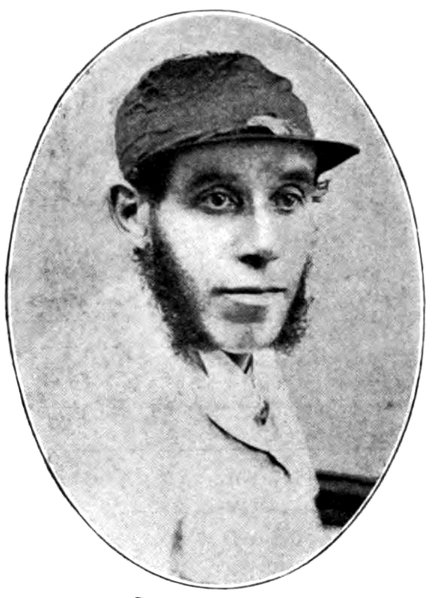
George Stevens, 1856, 1863, 1864, 1869, 1870.
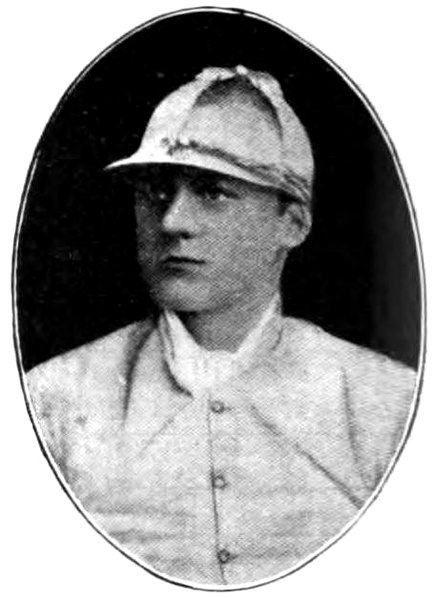
Mr. J. Maunsell Richardson, 1873, 1874.
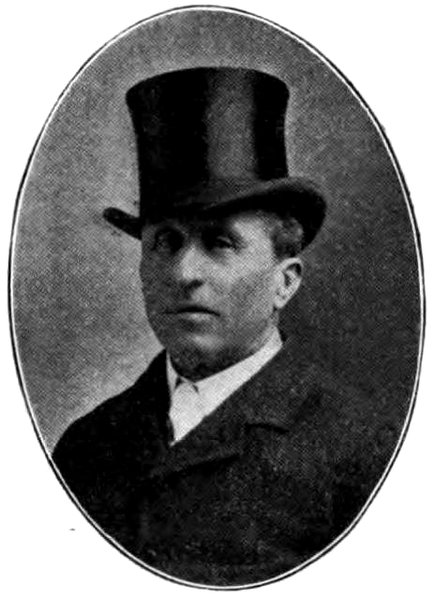
Mr. E. P. Wilson, 1884, 1885.
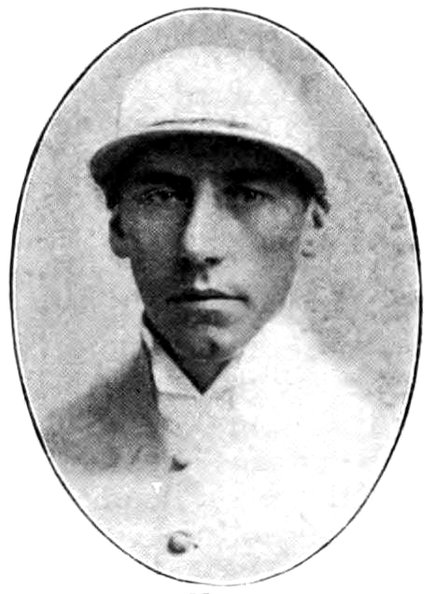
Arthur Nightingall, 1890, 1894, 1901.
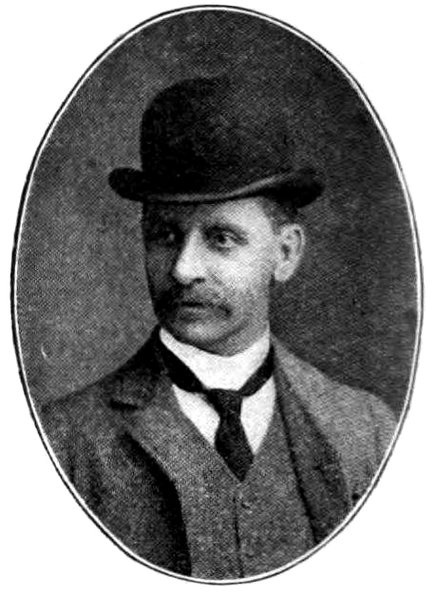
Mr T. Beasley, 1880, 1881, 1889.
FAMOUS LIVERPOOL RIDERS.
Famous Grand National Riders.
To design a picture, and then be able to write personally of the subjects contained therein, is certainly a pleasant phase of magazine work; at least, in illustrating this article and telling all I know of those who hold the best riding records in connection with the still greatest of all steeplechases, so I take it to be. Proud indeed am I to claim either a friendship or marked acquaintance with those gone to the great majority, as well as those remaining with us. The former in my picture consist of Tom Olliver, Mr. Alexander Goodman, George Stevens, and Mr. T. Beasley; of the latter I am pleased to think that Mr. Tom Pickernell, Mr. J. Maunsell Richardson, John Page, Mr. E. P. Wilson, and Arthur Nightingall are very much in the land of the living. I find that in riding in the National my nine friends or acquaintances can boast of accomplishing feats which have not fallen to the fortune of others engaged in the chase. Men like Lord Manners, Captain H. Coventry, and Mr. F. G. Hobson, it is true, were successful in their first and only mounts, a great thing to tell of; then Mr. J. Maunsell Richardson certainly goes one better in scoring two wins on Disturbance and Reugny in his only four efforts. But to stand by my picture. Besides Mr. Richardson, it contains men who have triumphed twice or more, and otherwise figuring at the head of the Liverpool riding records. In my table the amateur, it will be seen, has just a slight pull over the professional. There are five of the one and four of the other, but the professional really comes out on the top, for George Stevens out of fifteen mounts won five, was third once, and never met with a fall, while Tom Olliver and Arthur Nightingall, like Mr. Tom Pickernell and Mr. T. Beasley, have won it three times. It will be seen by the little tabulated figures that in attaining his three victories Olliver rode no less than nineteen times; that is in itself a record.
Won 2nd. 3rd. Unplaced Total of Mounts
G. Stevens 5 0 1 9 15
T. Olliver 3 3 1 12 19
Mr. Thomas 3 0 2 12 17
A. Nightingall 3 1 4 7 15
Mr. T. Beasley 3 2 1 6 12
Mr. Richardson 2 2 4
Mr. E. P. Wilson 2 1 0 13 16
Mr. A. Goodman 2 1 1 7 11
J. Page 2 1 1 7 11
The space allotted to me for this article naturally compels omission of a wealth of detail I possess of these splendid records, either left by my father or since collected by myself; indeed, it was my father who introduced me to each of the three riders at the head of the table. Tom Olliver I never saw ride, but it was in the early sixties I first saw him at the side of Fairwater as the winner of the Worcestershire Stakes. He trained the mare, and the portrait here given of this hitherto famous horseman recalls indeed other happy times at Pitchcroft, and of those who then, summer and autumn, visited its races. Tom Olliver must have been a wonderful man. In 1839, the inauguration year of the Liverpool Steeplechase, he was second to Jem Mason on the famous Lottery, which belonged to Mr. Elmore, who likewise owned Gay Lad. The latter gave Olliver his first win in 1842, and the next season, the first year it was transformed into a handicap, he was on the back of the hero Vanguard. His third win, in 1852, was on Peter Simple, in the colours of Captain Little; and when the latter won the chase on Chandler in 1848, Olliver was second on The Curate, half a length dividing the pair. Another of his three seconds, St. Leger in 1847, was only beaten a length, but neither of his three victories, it seems, were close fighting. In his nineteen rides, he only came to grief three times. The result in one of these was a broken collar-bone. The late William Holman once told me that an arm in a sling in later times due to Olliver’s just-referred-to Liverpool fall, prevented his piloting Freetrader, the victor of 1856. Holman, who trained the winner, likewise gave me the information that in seeking a fresh jockey the late Fred Archer’s father was offered the ride, and it was his refusal that gave George Stevens the first of his five Liverpool wins. The last time Olliver, however, rode in the Liverpool was in 1859, so in one-and-twenty years he missed riding only twice. Claudian his final mount, was unplaced; Half Caste won. In or out of the saddle mirth and wit was characteristic of Black Tom, as Olliver was often termed. Indeed, many good stories of his private and public life are recorded in the earliest numbers of Baily. To reproduce them here would fill pages.
It was at Worcester, as I have said, I made the acquaintance of Tom Olliver, so at the “faithful city” in those youthful days a friendly relationship sprang up in my home, and that which sheltered Edwin Weever at Bourton-on-the-Hill, and that of George Stevens and the Holmans at Cheltenham. Then again of my picture: among my father’s friends were Mr. Pickernell, more publicly known as Mr. Thomas, and Johnny Page. Mr. Alex. Goodman I never shook hands with until at a later period, the veteran then loving to chat of his recollections of Miss Mowbray and Salamander. That was in my early reporting days, which likewise brought me into contact with Mr. J. M. Richardson, at those University grinds some seasons before his most successful Disturbance and Reugny double was accomplished. He was always most kind in imparting information as to his race riding to me. The same I can say of Mr. E. P. Wilson, at a period when he was associated with now almost forgotten chasers bearing names like Starlight, Nebsworth, late Jacob, late Titterstone, and so forth, all before the great striding, but perhaps non-staying, Congress gave him his first four successive Grand National rides. Then of my two other portraits, associations remain of more than ordinary racecourse knowledge. Mr. Beasley is the one, and Arthur Nightingall the other. Indeed, I was pleased to see the last-mentioned put a cap and jacket on for the first time, I think, this season at a recent Kempton meeting. Nightingall, well aware of my being full of National records, jocularly reminded me of the fact that he was “still at it,” only, as he said, “to pass the winning score of Mr. Thomas, Tom Olliver, and Mr. Beasley,” even if he did not last long enough to catch up George Stevens’ five wins.
When George Stevens first won the Liverpool on Freetrader, he had only ridden once previously. That was on Royal Blue, who was unplaced in 1852, and in the three year interim he had no ride prior to his so-called chance winning mount. But of his other victories. When the Colonel won the last of the five, that was his hardest bit of riding, and the only time onlookers in the National saw him fight like grim death and by a neck dispose of his friend and saddle contemporary, George Holman, on The Doctor. On Freetrader I have heard it said he was lucky to win a length from Minerva, as the latter badly over-reached herself at the last jump. When he piloted The Colonel to victory the first time, he won by three lengths, a distance by which he, singularly enough, beat Arbury on Emblematic in 1864. Emblem’s success the year before was quite a runaway victory. Even with her 10 lb. penalty, Arbury there had less chance than with Emblematic. Stevens, of course, thought much of the great double he accomplished for Lord Coventry, but in later years I am inclined to think for “greatness” he leaned more to the side of The Colonel’s repetition. Be that as it may, he was naturally very proud of both, and unfortunately was not spared very long to enjoy a well-earned retirement. For Baron Oppenheim he tried to surpass his already earned record a third year on The Colonel. The weight, however, was too much, and in the position of sixth the second year The Lamb won Stevens rode his last National mount.
It was indeed only a few months after this that his life was cut short by a fall from his cob while riding to his cottage called Emblem, outside his birthplace, Cheltenham. Sad indeed is the story, too long to repeat here, but to commemorate his great Liverpool name and fame, there still exist of him at his native Cheltenham certain mementoes. The house he was born in I believe has vanished, but on the footway by the road-side where he met his death there is a little stone with the plain “G. S., 1871,” upon it to indicate the spot of so sad an end. Furthermore, there is another mark of esteem in the public cemetery. Here is a more conspicuous erection in the shape of a grey granite monument, included in the inscription on which are the names of the four horses upon which he triumphed at Aintree. He married the niece of Mr. Mat. Evans, once part owner of The Colonel. The widow is no more, but I believe the only son is alive and doing well at Derby in a very different calling from that of his father. Those who remember Stevens when he won the Liverpool twice for Lord Coventry, will recall his face beneath a cap he put on as a help to the artist who painted him on Emblem in Lord Coventry’s famous picture. The vignette I place in the centre of my group is, in fact, the original, and was kindly lent me by one of the deceased’s friends, Alfred Holman, who still keeps up the old family training traditions at Cheltenham.
When George Stevens was beaten on The Colonel in 1871, the year proved, perhaps, the most famous of Mr. Thomas’ three victories. It was The Lamb’s second success, and associated with this beautiful little chaser was the fact that Lord Poulett, his owner, had dreamt in the previous December he had seen his horse win with “Tommy,” as he called Mr. Pickernell, in the saddle: and he at once asked the pilot of a previous heroine, Anatis, to ride. The original letter making mention of this successful dream I have seen in Mr. Pickernell’s well-preserved scrap-book, containing much of his riding and other exploits. One of course there finds a deal about The Lamb. Besides the story of the dream, one can glean much of the many efforts of Anatis besides her win. There is plenty, too, of other sporting qualities of her owner, Mr. C. Capel, who, only about twelve months ago Mr. Pickernell followed to his last place of rest. I think Mr. Capel lies in the same cemetery as George Stevens. Now, concerning Mr. Thomas’ third successful ride in the National, well preserved in his book is yet another letter. This is not one of dreams; it is that of congratulation in the hours of Pathfinder’s glory, and is from the pen of none other than the late Admiral Rous. Mr. Pickernell once told me he had few keepsakes of his successful Nationals except those two letters, and to which he then added, “are they not enough to be proud of.” Only twice in nineteen years did Mr. Thomas miss a ride in the Liverpool. His first mount was Anatis, the year before she won; his last occurred in 1877, when he was third to Austerlitz on The Liberator, two years before Mr. Garry Moore won on the last named. The years Mr. Thomas missed mounts in the Liverpool were when Emblem and Emblematic won; not through spills or broken bones, or anything of that sort. Just at that time he became a benedict, and it was family persuasion kept him out of the saddle. Not for long, however, for what he picked up from Tom Olliver was well in the flesh, and of one reception he met with on his return to the pigskin he is quite as fond of talking of as of his three Liverpool victories. And well he might be. The calendar records tell that in 1866 he won all the three steeplechases run at Aintree’s autumn meeting, and they, of course, included the Sefton on Sprite. Here, with a broken stirrup leather carried in his hand, by a neck he beat Stevens on Lord Coventry’s Balder amid great enthusiasm. Mr. Thomas, who lives at King’s Heath, near Birmingham, last September attained his seventy-first birthday, and although if now never seen on a racecourse, he enjoys fairly good health. He likes to compare the old with the new; he knows, too, in his retirement all about regulation obstacles. Did he not give up the official berth of inspector of fences before the National Hunt placed Mr. William Bevill in that position. Mr. Bevill never knew what it was to taste the sweets of a Grand National victory. He is, however, one of those named in its records in connection with many luckless efforts.
Pathfinder’s victory saw the final National ride of another of my subjects, Johnny Page. He there was on the back of Baron Finot’s La Veine, and the French Baron being offended with not a very pleasant greeting at Bristol, curiously enough never tried his luck in the National again. Page, back in England many years ago from France, and down Henley-in-Arden way, is still alive to tell of his experiences of the Liverpool Steeplechase. He won it on Cortolvin and Casse Tête, was second on the former to Salamander, and third, as already said, to Pathfinder. In 1871 he was fourth on Pearl Diver to The Lamb, and all in eleven rides. He had early tuition as a jockey on the flat, for as a lightweight he steered First Lord (5 st. 8 lb.) when he won the Northumberland Plate. This, no doubt, assisted him in being so fine a judge of pace between the flags, and likewise gave him the ability in a finish, so much feared by his pigskin contemporaries. For this most of them gave him praise. One of the number, however, is Mr. Richardson, who, with Capt. Machell, so well managed the Disturbance and Reugny Limber Magna coups. Indeed, at the quiet little Lincolnshire nook even their near neighbour, the late Sir John Astley, according to his own words, hardly reckoned on their achievement. He tells us so in his book, and if he did not participate very much in their sweets he got up a
Disturbance and no Row,
words “The Mate” had printed on the invitation tickets to the Grimsby Town Hall Dinner, prepared in honour of Mr. Richardson’s victory. After Reugny’s success the rider of the latter and Disturbance married the Countess of Yarborough; and, long since retired from the race saddle, now amuses himself at golf in the summer and hunting in the winter. He comes racing occasionally, and has for years had colours registered. They were of a different hue until the death of Capt. Machell, when the white and blue cap which he has on in my picture was substituted. The photo is a copy of a painting in oil, a presentation to Mr. Richardson after his two Liverpool wins.
In Mr. E. P. Wilson’s sixteen attempts to win the Grand National, he was very near the mark on Congress when Regal beat him by a neck in 1876. He travelled as far as 1884 before scoring his first win on Voluptuary and then followed it up the next season on the uncertain Roquefort, on which he would probably have won a second time had the horse not fallen over the rails in the straight, when Gamecock triumphed. At any rate, in his long career, which started in 1873 and terminated in 1890, he did remarkably well. Congress, as before said, was his first mount, Hettie the last, and it was on the latter mare, although unsuccessful, he had the honour of wearing the colours of the King. A portrait in the Royal racing livery would no doubt be more effective to my group, but is not available, so one in hunting costume, from a recent photo taken by Frost, of Loughboro’, takes its place. Mr. Wilson some time ago changed his home from Ilmington to Loughboro’, retiring first from race-riding and then from training. He has, however, started a new career. At Loughboro’ I hear that he makes a good host at the Bull’s Head Hotel; when away from home he sometimes is found wielding the flag and officially despatching the racer and steeplechaser he loved so well.
Mr. Beasley’s death some months ago, after retirement from riding between the flags, caused general regret, but yet recalled a splendid Liverpool career. His three winners, Empress, Woodbrook, and Frigate, were all praiseworthy triumphs, the last-named being the most difficult, but perhaps the most acceptable, as the old mare had previously tried there so often. But Mr. Beasley was not without his disappointment at Liverpool, for fresh in my memory is that of the 1882 defeat of Cyrus, when Lord Manners won on a former stable companion, Seaman. That defeat was a head, and on one other occasion only has the judge ever given a Liverpool by that distance. Spahi in 1887 was also a disappointment when he fell so early in the race. Of Mr. Gubbins’ horse much more was expected. Mr. Beasley, however, knew how to take failures as well as sweets. He came of a good riding family, as the National of 1879 corroborates. Neither was successful, but in connection with the chase I think it is a record to find Tommy, Harry, Willie, and Johnnie, four brothers, all in one Aintree battle. The Liberator won that year. It is Mr. Harry Beasley I have to thank for my portrait of the brother with such a splendid Liverpool score against his name. Mr. Harry’s record is not quite so good, but nevertheless will bear inspection. One win (Come Away) and three consecutive seconds and a third is certainly not so indifferent out of thirteen mounts.
And last, but not least, Arthur Nightingall is approached. He began to ride in the Liverpool in 1886 on Baron de Tuyll’s The Badger. He had no mount through a mishap to his horse at the eleventh hour last year, and as I have said earlier he quite expects to make another effort this season. Nightingall is of opinion that Ilex, the first winner he rode, was the best, and his subsequent running with such as Cloister, and Come Away under big weights corroborates the notion. His win on Ilex, however, was far more easily achieved than that on either Why Not or Grudon; in fact, when speaking of Why Not, Nightingall has been heard to say that he was glad when he lifted the horse over the last fence; furthermore, so beaten were his opponents at the finish that he thinks he could have won on either of the other three who followed him home. Why Not did fairly well in his hands again when Soarer scored.
Now I am at my journey’s end. Space has not permitted me to tell of the many riders of single winners, but before I stay my pen in this long story of National successes, I must, indeed, indulge in the old cry of “one for the losers.” Plenty of good men and true, if they have only ridden one winner, well know the difficulty of accomplishing success. In my researches I find at Aintree fine horsemen, professional or otherwise, like Mr. Arthur Yates, Mr. W. Bevill, Robert I. Anson, Richard Marsh, the King’s trainer, Mr. Gordon, Mr. W. R. Brockton, Capt. W. Hope, Johnstone, Ben Land, the Earl of Minto (then Mr. Rolly), the brothers Holman, James Jewitt, Mr. Lushington, Capt. Smith, Col. Harford, and many others I cannot now recall are of the number. Many of these, too, are still in the land of the living.
Arthur F. Meyrick.
A Hundred Years Ago.
(FROM THE SPORTING MAGAZINE OF 1806.)
A notorious deer stealer, of the name of Smith, was apprehended by Hamilton and Lovett, officers, on Thursday morning, January 30th, by virtue of a warrant issued by the magistrates of Northamptonshire, which was backed at Marlborough Street office. The charge against the prisoner was for deer stealing in the park of the Earl of Pomfret, in the county of Northampton, where depredations had been committed to a considerable extent, as well as in various other parks in that neighbourhood. It was stated that a white buck had been selected for Christmas dinner in Earl Pomfret’s park, but that he was discovered to have been stolen when the keepers sought to take him for slaughter. The prisoner was represented as belonging to a gang of offenders some of whom were in custody in the country. He was the Robin Hood of the gang, and when committing depredations in the forests his bravado and fierceness of temper struck such terror into the minds of the keepers that when he was known to be poaching, even alone, no one dared to approach him. The prisoner, according to his own account, had carried on a successful trade in this way for many years with impunity. He did not consider deer stealing as any moral offence, but merely sporting, which he had been brought up to, and which he could never desist from. He was ordered to be committed to the county gaol of Northampton.
A match of pigeon-shooting took place at Heston on Thursday, February 13th, for twenty-five guineas, between J. Aaron, Esq., a gentleman of sporting celebrity, and Mr. Dunford, who was considered one of the first shots in Hampshire. Fifteen pigeons were allotted to each sportsman, and Mr. Dunford commenced the sport—which of these should produce most dead birds in fifteen shots. He killed the first nine, but hit the tenth bird without effect, and the eleventh he missed. The other four birds were despatched, making thirteen dead. Mr. Aaron followed, and killed eleven birds successively, when betting was seven to four on his performance. The twelfth and thirteenth birds were hit without effect, and the fourteenth he killed, and missed the fifteenth, by which he lost the wager.
Monday, the 10th, the stud of the late Premier, Mr. Pitt, consisting of nine saddle horses, was disposed of by public auction at Tattersall’s. The hon. gentleman was not distinguished for the excellence of his cattle, and in his carriage he actually drove job-horses. Of those brought to the hammer a bay gelding, six years old, by Pipator, fetched the greatest price, and sold for 130 guineas. It was put in at 40 guineas, and when it had reached 50 a person present, who had been in the employ of the late proprietor, bid at once 100 guineas, and it was ultimately knocked down to him. A gelding, by Grog, which Mr. Pitt used as a charger, fetched 72 guineas, and the whole 438 guineas.
The Sportsman’s Library.
The forty-third edition of John Wisden’s Cricketers’ Almanack[6] is a bigger thing than ever, and now the chronicle of the cricket of the year consists of over 700 pages, which fact demonstrates very forcibly how the popularity of cricket has increased since the first issue of Wisden in 1864, when 112 pages comprised the whole work.
Now that the other cricket annuals, the old green and red Lillywhites, no longer appear, the responsibility of chronicling the history of the game falls upon Mr. Sydney Pardon, the well-known journalist, who has now for some years so ably edited Wisden.
We agree with Mr. Pardon that the task of preparing Wisden does not become easier with the lapse of years, so vast is the amount of interesting matter which has to be compressed into one volume. The five cricketers of the year, whose photographs form the frontispiece, are Joe Vine, that keenest of cricketers in Sussex, who seems to enjoy nothing in life more thoroughly than chasing the ball all over the field, and if required will cheerfully field in the country at both ends.
He is a very good batsman, as his many fine partnerships with C. B. Fry for the first wicket amply testify. But the most interesting feature of Vine’s cricket was his bowling, which for a year or two nonplussed the best batsmen. He was able to bowl the leg-twisting ball at a quicker pace, both through the air and off the pitch, than any other English bowler, and when he found his length he was very deadly, reminding one of the best ball of Mr. G. E. Palmer, the Australian.
It is an interesting enough historical fact with regard to the greatest leg-twist bowlers, that their careers have generally been extremely brief. Mr. Palmer seems to have lost his length owing to his cultivation of the leg-twist. Mr. R. C. Ramsay, in 1882, was for Cambridge University a terror for a few weeks, and Messrs. C. L. Townsend, the late E. A. Nepean, and the brothers Steel, have all had great successes by this method in their time, but, somehow, no cricketer seems to have succeeded in the craft of bowling leg-twisters for a very long time, with the notable exception of Mr. Warwick Armstrong, who, during the last Australian tour in this country, bowled no less than 1,027 overs, of which 308 were maiden overs.
Joe Vine can point to a couple of very fine bowling performances. In 1901 he took sixteen wickets at Nottingham—eight in each innings—for 161 runs, and so enabled Sussex to win at Trent Bridge for the first time for forty years. In 1902, at Hastings, against the Australians, he took 7 wickets for 31 runs; but sad to say, in 1905 the 21 wickets he captured for his county cost over 41 runs apiece!
Mr. L. G. Wright, the veteran Derbyshire cricketer, justly enough, is one of the selected five, and although he is now over 44 years of age, he is by common consent held to be the best “point” amongst first-class fieldsmen of to-day. He stands close up to the batsman, and his agility and quickness are quite astonishing, for of recent years perfect wickets and academic batsmanship have rendered the post of point proper all but obsolete.
An interesting feature of Mr. Wright’s cricket is, that like a good vintage wine, it appears to improve with age. He first played for Derbyshire in 1883, and since 1887 he has been a regular member of the team when he could play, and last year, in his twenty-second season, he came out easily top of the county averages, with an aggregate of 1,651 runs for 38 innings, giving an average of 43 runs per innings.
Amongst other big performances he scored a century in each innings against Warwickshire at Birmingham. He scored 176 out of 323 in the first innings and followed on with 122 out of 197, in first and out last.
We understand that a very influential committee has been formed to organise a testimonial, and we wish the scheme every success. Probably, Mr. Wright holds the record of having played upon the losing side in more county matches than any other cricketer, and so his sustained good play for Derbyshire is all the more commendable.
George Thompson is another star cricketer who has lent much importance to the doings of a weak team, and it is not too much to say that, but for Thompson, Northamptonshire could not have last year gained admission to the first class. Since his first appearance in 1895 he has put in consistently good work both with ball and bat, and, whether for his county, or for the Players, or the Marylebone Club, he is always one of the most useful men on a side, as he also proved himself to be when, with Mr. Warner’s team in New Zealand, he took 177 wickets at a cost of under seven runs a-piece, and, in the West Indies, with Lord Brackley’s team, he took 126 wickets for ten runs a-piece.
Those tried and valuable cricketers, Walter Lees and David Denton, complete the gallery of five, and it may well be said of them that if they had played more often in the test matches of last season no one would have been surprised. In the absence of Mr. MacLaren, Denton was included in the England team at Leeds, but it was not one of his lucky days. Lees was reserve man on each occasion, without actually playing in any of the matches. At the time of writing Denton is the mainstay of the batting line of Mr. P. F. Warner’s team in South Africa, and it is just as well for the party that the Yorkshireman should find himself in luck.
There are some interesting personal reminiscences of the late Mr. R. A. H. Mitchell, written by Mr. Russell Walker and another old cricketer; and Captain W. J. Seton contributes a very complete article upon public school cricket. The list of cricket records is a rapidly increasing feature of the general information supplied by the editor, and now extends to some twenty-two pages, whilst no fewer than seventeen pages are taken up by short obituary notices of cricketers who died in 1905, there being many well-known names in the sad list. The record of the year’s cricket is more voluminous than ever, and the full doings and analyses of the Australian tour run into sixty-two pages.
In the records of the Australian wicket-keepers we are surprised to notice that whilst Kelly caught 19 and stumped 7, Newland caught 12 and stumped 7, and yet Newland was regarded by everybody as very considerably inferior to Kelly, and kept wicket upon comparatively few occasions.
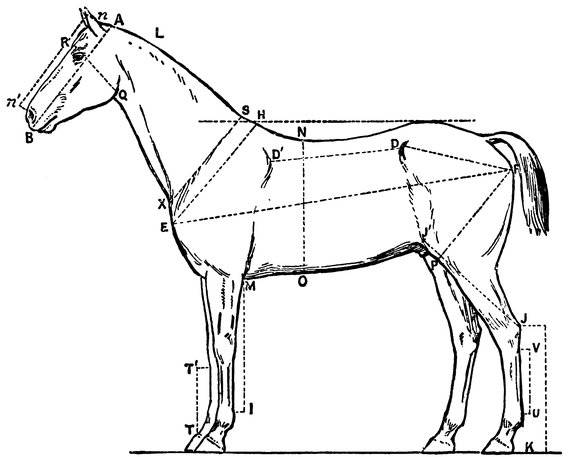
Fig. 73.—Proportions of the Horse in Profile From Goubaux and Barrier. (By permission of Messrs. Lippincott) (From “The Horse: Its Treatment in Health and Disease.”)
It is rather remarkable that of the many cricketers who played against the Australians only two bowled more than 100 overs against them, and these two, Mr. W. Brearley and Wilfred Rhodes, bowled 214 and 208 overs respectively. The bowler who bowled the highest number of overs next to these two is Haigh, with 99·4 overs, so that he was only short of 100 overs by two balls.
Mr. Brearley, with 37 wickets, got nearly twice as many Australian wickets as any one else, and Jack Hearne gets the best average with 7 wickets for 67 runs.
Mr. J. N. Crawford, the Repton and Surrey cricketer, supplies an interesting page in cricket history. Up to the end of July he was Captain of the Repton XI., and scored for his school 766 runs for an average of 85·11, and took 51 wickets at an average cost of 12·96. After this he was able in the few remaining weeks of the season to play enough first-class cricket to amass 543 runs, with an average of 33·93, and to take 47 wickets, his bowling average of 18·46 placing him eighth in the list of English bowlers. We cannot call to mind a parallel case of a school-boy doing such an exceptional amount of good work, both in school cricket and county cricket, in the same season. It would appear that the only thing to have prevented Mr. Crawford from representing the Gentlemen against the Players was that Repton School had a prior claim upon his services. This winter Mr. Crawford is enjoying great success in South Africa, both with bat and ball, and his return to this country will probably be jealously awaited by the keenest members of the Surrey Club. The date of Mr. Crawford’s birth is given as December 1st, 1886, so he has time in his favour, anyway.
The study of Wisden in the winter months is a fascinating pastime, but we have run on long enough, and must leave our readers to their own cogitations and musings over the book itself.
The second volume[7] of Professor Wortley Axe’s comprehensive work is now before us, and we may say at once that its contents maintain in every respect the high promise of its forerunner. Section III., dealing with the “Varieties of the Horse,” begun in the first volume, is completed, the majority of our breeds of ponies, the heavy horses and the foreign breeds most frequently imported being reviewed. The author regards the good representative Welsh pony as “one of the best and most serviceable animals” among his kind. It is unfortunately true that the Dartmoor, Exmoor and New Forest breeds, more especially the second, have been made the subject of so many experiments in crossing that the original type is become obscured, if not entirely lost. Sir Walter Gilbey has set out the history, or as much of it as can be discovered by assiduous and careful research, of our native breeds of ponies in one of his well-known books; and Professor Wortley Axe’s observations form a very able summary of all that has been written of the several breeds. The historical sketch of the Shire horse is also excellent; as regards the debated question of “feather” on the legs of the breed, the author urges that the desirability or the reverse of hair in quantity is a matter which should be left to practical men who are not likely to allow sentimental considerations to weigh with them. The author is not able to throw any fresh light on the origin of the Clydesdale; it would be surprising if he had, in view of the researches which have been undertaken with the object of elucidating the matter; what is known he epitomises with his usual conciseness and point. The Suffolk breed is hardly more satisfactory as an historical subject; it was certainly well-established in the earlier decade of the eighteenth century, and, without the possibility of doubt, was so at a much more remote date. The author is a warm admirer of the Suffolk, whose good qualities furnish him with the theme for one of his best chapters.
The Arab naturally leads the way among the foreign breeds noticed. The author adopts a judicial attitude concerning the merits of the breed; he appears to share the opinion of those who think the Arab susceptible of improvement, while he recognises the intrinsic qualities which render an Arab so valuable for crossing with our own light horses.
The greater portion of the volume is occupied by the veterinary chapters: those matters of which the reader must acquire knowledge as a condition of understanding the descriptions of symptoms, &c., which follow. We have, always in simple and lucid language to be understanded of the layman, most valuable and helpful chapters on the diseases to which the mouth, throat, stomach and intestines of the horse are liable. The descriptions are supplemented by excellent drawings, which cannot fail to be of service to the reader.
The illustrations, in colour or from photographs, are exceedingly good.
From the first part of “The Horse: Its Treatment in Health and Disease,” the following is quoted:—
The Head as a Unit of Measurement.
Ever since the days of Bourgelat the study of proportions in respect to the various regions of the horse has been vigorously pursued, especially by French hippotomists, and it is to the founder of veterinary schools we owe the first serious attempt to “establish the relation of the dimension which should exist between the parts of the body,” or, in other words, a law of proportion. As a result of numerous measurements, Bourgelat selected the head as a basis of proportion for all other parts, and the more recent researches of the distinguished savant, Colonel Duhousset, led him also to adopt this, and give it as a unit of measure.
The results of his observations are recorded by Goubaux and Barrier, from whose able work on “The Exterior of the Horse,” we extract the following list of proportions:—
The length of the head almost exactly equals the distance—
1st.—From the back to the abdomen N O, fig. 73 (thickness of the body).
2nd.—From the top of the withers to the point of the arm H E (shoulder.)
3rd.—From the superior fold of the stifle joint to the point of the hock J J.
4th.—From the point of the hock to the ground J K.
5th.—From the dorsal angle of the scapula to the point of the haunch D D.
6th.—From the xiphoid region to the fetlock joint M I; above this latter in large horses and race horses, below it in small horses and in those of medium size.
7th.—From the superior fold of the stifle joint to the summit of the croup in subjects whose coxofemoral angle is large; this distance is always less in other cases (G and B).
Two and one-half times the head gives—
1st.—The height of the withers H, above the ground.
2nd.—The height of the top of the croup above the ground.
3rd.—Very often the length of the body from the point of the arm to that of the buttock, E F.
The length of the croup from the point of the haunch to that of the buttock D F is always less than that of the head; this varies from 5 to 10 centimetres. As to its width from one haunch to another, it often exceeds only very little its length (often it is equal to the latter), G and B.
The croup, D F, exists quite accurately in length four times in the same horse.
1st.—From the point of the buttock to the inferior part of the stifle joint F P.
2nd.—In the width of the neck at its inferior attachment, from its insertion into the chest to the origin of the withers S X.
3rd.—From the insertion of the neck into the chest to the angle of the lower jaw X Q, when the head is held parallel to the shoulder.
4th.—Finally, from the nape of the neck to the nostril n n or to the commissure of the lips.
The measure of one half of the head will also guide us very much in the construction of the horse, when we know that it is frequently applied to several of his parts, namely:—
1st.—From the most prominent point of the angle of the lower jaw to the anterior profile of the forehead before the eye, R Q (thickness of the head).
2nd.—From the throat to the superior border of the neck behind the poll Q L (attachment of the head).
3rd.—From the inferior part of the knee to the coronet, T T.
4th.—From the base of the hock to the fetlock, V U.
5th.—Finally, from the point of the arm to the articulation of the elbow (approximate length of the arm).
Two Noted Hunting Sires, Van Galen and Victor.
After the experiences of very nearly a century it was singular indeed that the Hunters’ Improvement Society and the Royal Commission on Horse-breeding cold-shouldered the idea that like has a tendency to get like. For twenty years no clause appeared in their schedules that the thoroughbred horse eligible for a premium should have been a turf performer of some kind or other, and so sires obtained honours that were simply laughed at by owners and trainers. Sam Darling, John Porter, the late J. Humphreys, and Mr. Ben Ellam have had their jokes over the things, as they have called them, that have satisfied the State. Humphreys used to chaff a breeder about one that he was certain could not have gone fast to keep himself warm, and yet he won three Queen’s Premiums, and was sold as a hunting sire for 500 sovs. The conditions have now been altered to a certain extent, as turf performances are given in the catalogues, and the judges are invited to take notice of them. A shorter and better plan would be to admit no horse into the entry that had not won a race worth 100 sovs., or, to make it still easier, one that had not been placed in such a race. This would make the franchise, so to speak, sufficiently low, as there is this to be taken into consideration, that winners in these times of any event that savours at all of consequence are so terribly expensive as to make hunting sires, of great turf class, difficult to secure. The great points to be gained, though, from a racing career is that they can go fast enough to live with other horses, and that they have stood the exigencies of training to test constitution, temper, and the strain on limbs. The more proof of all this the better, as, to quote the late Lord Portsmouth’s views—and there was no greater judge—the best hunting sire has invariably been the racing slave; the horse that has commenced at two years old and run everywhere and often until he is six or seven. Whether the best are those that have won long-distance races, or to have been simply the quick, sharp sprinters, are other questions; but it will be generally allowed that gameness over any course is a quality to be held greatly in esteem.
The old-fashioned breeders of hunters were, no doubt, imbued with the idea that stoutness as shown on the racecourse was the essential quality to be looked for, and they had plenty of examples on their side down to quite 1840. The Boston side of Lincolnshire was filled with good hunters early in the last century by a Cup winner of Lord Egremont’s, who had the misfortune to break his leg in running for a race at Ascot. When the gun was being brought out to put an end to him, a sporting blacksmith from Lincolnshire begged the life of the noble steed, and contrived a sling for him in a building hard by. It took four months to get the limb thoroughly set, and then the blacksmith walked the horse to Boston, where he developed into the best hunting sire of that quarter, and after fifteen years’ service the grateful farmers had the horse painted by the senior Ferneley, and presented the picture to the blacksmith. Such were the feelings or sentiments for great hunting sires a hundred years ago, and perhaps the country is indebted for the good foundation in Yorkshire, Lincolnshire, and Shropshire, to such notable racers as Catton, Lottery, Clinker, the sire of the famous hunter of that name so memorable in the Melton matches, and the elder Clinker was second in the St. Leger of 1808, and got by Sir Peter the best horse of his day. It was said that Clasher, the successful rival in the great match with Clinker, was by the same sire, but other statements showed him to be by Clasher, another son of Sir Peter. Anyway, the two were closely related, and no two horses ever went over a stiffer four miles of country. Again, there was Cannon Ball, a winner of four mile races in his day, and the pride of the Quorn country as a sire, and was not Pan, the Derby winner of 1808, doing duty amongst the commoners of Shropshire in the days of Jack Mytton?
There is good reason to think that when the golden age of foxhunting was at its zenith the notable hunters were all by famous turf performers, and that the same views were taken in regard to hunter-breeding for the next five-and-twenty years. This would comprise the days of Perion in Yorkshire, Gainsborough in Devonshire, Doctor Syntax in Durham, Sir Peter Laurie in Gloucestershire and Herefordshire, and Arthur in Ireland—the kind of horses, in fact, of proved class that were used to get hunters. After this the ready materials became somewhat mixed, though there were still exceptionally good sires in the ’fifties, ’sixties, and ’seventies, with such stock to their credit that may well have been called magnificent.
To select the best may be difficult when such names as Mogador, Lambton, Maroon, Ugly Buck, North Lincoln, Pride of Prussia, Allow-me, and Lord Derby recur to memory, but taking all into consideration, both for England and Ireland, I should say that preference could be given to the two V.’s, Van Galen and Victor. They were both born within the same decade, and just after the second half of the century had commenced, as Van Galen was foaled in 1853 and Victor in 1859. They were both also bred in Yorkshire, and it is possible that they became hunting sires more by accident than anything else. Van Galen gave early indications of being a good racehorse, as he was highly tried as a two-year-old, and won his first race, the Tyra Stakes, at Newcastle in a canter. Then he suffered defeat when 7 to 2 was laid on him, and he ran forward in the Champagne Stakes at Doncaster. Through some accident, he had to be thrown out of training during the ensuing winter, and early in life became a hunting sire. He was just the sort for that vocation—a big brown horse, standing, when grown to his best, rather over 16 hands, and his card used to disclose at a glance a fine old Yorkshire pedigree by Van Tromp, winner of the St. Leger, and got by Lanercost out of Barbelle (all Yorkshire by Sandbeck), the dam of the Flying Dutchman, the dam of Van Galen, Little Casino, by Inheritor, dam by Waverley. To the best of my recollection, Van Galen travelled through, the country that comprised Northallerton, Bedale, Middleham, and Harmby—much the same ground, in fact, that was covered by Perion thirty years before; and I bear in mind staying near the last-mentioned Village in 1867, and that the Van Galen hunters were then the talk of the country. Mr. Bruere, a gentleman who kept a charming little pack of harriers near Middleham, had a beautiful hunter by Van Galen called Charlie, for whom, it was said, £700 had been refused, and he was certainly one of the best-looking and most mannerly hunters I have ever seen. He was in some of the great hunt steeplechases of the ’sixties. So were many others of the Van Galen family.
I bear in mind a horse called Vanbrugh, of the same type, big, weight-carrying, bloodlike horses that were natural jumpers from the time they were foals, and no days were too long for them. This is the character they gained in Yorkshire, and Van Galen hunters were sought after as much as the Perions had been. Like many other greatly patronised hunting sires, the famous son of Van Tromp had few opportunities with thoroughbred mares, but a chance union with Sybil, a mare belonging to the late John Fohert, the trainer of the Flying Dutchman, produced quite the stoutest horse of his time as the winner of the Chester Cup, and dead-heater for the Ascot Cup with Buckstone, to whom he gave a lump of weight. Tim Whiffler was quite in the family order, a big brown horse, and pity it was that he was sold to Australia after he had got some very useful ones, including Footman, who was backed heavily to win a Grand National. If ever there was one horse more than another bred to get great cross-country performers, it was Tim Whiffler, as his dam, Sybil, was by the Ugly Buck, whose fame down Northamptonshire way as a hunting sire was almost equal to anything. It was in after generations that Van Galen’s name lived so long, as a second visit to Harmby twenty years afterwards gave strong evidence that breeders had no intention of dropping the line, and that his daughters and granddaughters were regarded in the highest esteem as hunter producers. Another son of Van Galen’s, too, was Ploughboy, who was out of a Stockwell mare, and he did capital service for some seasons when he stood at the Newbiggen House stables, Beverley.
Victor left Yorkshire in very early life, as he was bred by Mr. R. Hunt, but for some reason not explained, he was taken to Lincoln as a two-year-old during the race meeting. Mr. George Hodgman, in his interesting book, called “Sixty Years on the Turf,” relates that having nothing to do one morning he strolled through the City, and passing the Saracen’s Head, saw a rough sort of countryman holding a horse in the adjoining yard. He had not the least idea of buying or dealing, but taking stock of the animal rather liked him, as he had good quarters, and was well ribbed up; his chief defect, so he thought, being his fore legs as he stood a bit over. “He don’t look much like a thoroughbred,” Mr. Hodgman remarked. “That’s just what he is,” was the retort; “perhaps you don’t know much about horses.” “You are quite right, I don’t,” said the now interested would-be buyer, “but what’s he by?” “By Vindex, Sir Charles Monck’s horse.” “Ah, well, just let the boy trot him about.” The boy took hold of the halter string and cantered him up the yard. Mr. Hodgman was satisfied. “How much do you want?” “Eighty pounds.” “I suppose he’s yours?” This suspicious remark occasioned some bad language, but then followed, “All right, keep your temper.” “I will give you eighty pounds, and he is mine.” The countryman pressed half-a-crown into Mr. Hodgman’s hand for luck money, and the deal was done. Victor did not do much that season, running twice, but unplaced, and he ran again as a three-year-old without distinction. At four he was specially prepared for the Royal Hunt Cup, Mr. Hodgman spending a hundred pounds for him to do his work on some ground at Winchester, which was precisely similar to the Ascot Royal Hunt Cup course. Tried good enough to win Mr. Hodgman invested a thousand on him, through Mr. George Herring, the now famous philanthropist. Victor started favourite at 3 to 1 in a field of twenty-eight and won in a canter by four lengths. In the same year he broke down when running in the Cambridgeshire, and ultimately Mr. Hodgman sold him at Tattersall’s for 28 guineas, the buyer being Mr. Simpson, of Diss, who some time afterwards sold him to the late Mr. George Arthur Harris, who imported him to his own stud farm in Ireland.
It was fortunate indeed for the land of hunters that such a purchase was effected, and Mr. Harris used to tell the story, that at the same time Mr. Simpson would have sold him Vedette for £40, but this was before the latter had got Galopin. In his new Irish home Victor was not long in making his mark, as from the very first he got beautiful weight-carrying hunters that had taken as naturally to jumping as small ducks to water. By about 1872 the dealers were enraptured with them. The five-year-olds had been seen in England, and there was a demand for as many as Ireland could supply. The fashion to get over a country on the Victors spread far into the shires. In Leicestershire, Yorkshire, with the Heythrop and Bicester, I was for ever hearing of them in my travels, and a great many in Ireland could not be purchased for any money. It was shown in later life that he could get steeplechase winners out of cart mares, and a great many winners of cross-country events were credited to young Victors. There had never been such a hunting sire since Arthur, and, like Van Galen in Yorkshire, he got a great Turf winner in Valour, the hero of the Manchester Cup of 1881, and certainly one of the best performers of his time. There must have been something in the blood of Victor that hit with the Irish mares, as no matter what they were like, from the Connemara pony to the cart mare, they all produce hunters to him with beautiful fore hands, galloping horses, in fact, that could jump. He really set people thinking as to what kind of horse is likely to be the best to get a hunter, as here was a quick, sharp horse over a mile that could slip a big field of twenty-eight and win in a canter, and the old-fashioned sire of the Gainsborough stamp was not believed in unless he had won over four miles in heats. There was no reason, though, why Victor should not have been a stayer, as he was by Vindex, son of Touchstone, and Garland by Langer, out of Caststeel, by Whisker, her dam Twinkle by Walton, the dam of Victor, the Scroggins mare, out of Miss Eliza, by Humphrey Clinker, who was by Clinker, the old-time sire above alluded to, out of Romulus’s dam, by Fitzteazle, son of Sir Peter. It is all the kind of blood that has told before, but not quite in racing pedigree, and that was the opinion formed of Valour, who was not a stud success. However, Victor’s path in life was that of a hunting sire, and as such he will never be forgotten. He lives still through his daughters and granddaughters, now the very best of hunting brood mares. The late Mr. Harris formed a stud for him, and it will always be called the Victor stud. A more prolific stallion there has never been. For many years his subscription list at Kilmallock, county Limerick, averaged from eighty to a hundred and twenty-eight a season, and when he was twenty-eight years old he got fifteen foals from twenty-five mares. He died in 1888, when he was in his thirtieth year. His owner, Mr. G. A. Harris, died in 1891, leaving the Victor stud to his son, Mr. John Harris, who is now also manager of the Ballykisteen stud, where court is held by Santoi Vites, Uncle Mac, and Wavelet’s Pride. There is something very remarkable about such horses as Van Galen and Victor. They have contributed much to the enjoyment of sportsmen, as their sons and daughters have made fox-hunting delightful. There cannot be made hunters without the material, and with that guaranteed the trade in hunters has increased; more people want to hunt, and the very breed of horses for the country’s good is greatly improved and advanced. How much is England and Ireland indebted then to the like of Van Galen and Victor.
The University Boat Race.
Simultaneously with the appearance of Baily for March, both the 1906 crews go into strict training for their race of April 7th. This date is certainly late, but not unduly so. April has been the month selected on numerous occasions of recent years, and Saturday, of course, especially appeals to Londoners. From the first, the Oxford President, Mr. E. P. Evans (Radley and University) has been in a position to view the outlook with a good deal of equanimity. For one thing, he has been blessed with a plethora of talent this year. Quite an exceptional lot of matured oarsmen are in residence and available. For another, he has had the valuable assistance of Mr. W. A. L. Fletcher, D.S.O., as coach, from the very beginning. This famous old Blue has been dubbed the “Kitchener” of coaches, and with a good deal of reason. His co-operation has ever been a potent factor towards victory both ways. As last year, he has given every aspiring Dark Blue oarsman his chance, and, thanks to his powers of discrimination, fewer changes have been made than usual. How rich in aquatic material Oxford is this season can best be gauged by the fact that many notable oarsmen have failed to find seats.
After his 1905 prowess, Mr. H. C. Bucknall (Eton and Merton) is very properly setting the work again. He was the hero of last year’s race, and is undoubtedly a stroke of the nascitur non fit order. If anything, he is rowing longer and stronger this season. No. 7 thwart has been occupied respectively by Mr. E. A. Bailey (Marlborough and Merton) and Mr. A. C. Gladstone (Eton and Christ Church), stroke of the winning eight at Henley in 1905. Mr. Bailey is the stronger oarsman, but hardly so good a waterman as the Etonian. Any sacrifice of avoirdupois, therefore, will be amply compensated for giving the last-named’s permanent inclusion. When once the machinery is seen in motion any prejudice on this score vanishes. The president himself is at No. 6, backed at Nos. 5 and 4 by A. G. Kirby (Eton and Magdalen) and L. E. Jones (Eton and Balliol). Mr. Kirby is a freshman, who also rowed in the Eton winning eight at Henley last year, and Mr. Jones an old Blue, who got his colours in 1905.
All these heavy-weights are rowing well and long thus early. They not only possess great strength, but know how to apply it. Mr. J. Dewar (Rugby and New College) has been rowing at No. 3 thwart, and already in capital style, but if Mr. Gladstone remains at No. 7, Mr. Bailey may supersede the old Rugbeian. Mr. C. H. Illingworth (Radley and Pembroke) makes a very fine No. 2. He is an old Radleian captain of boats, who has figured at Henley on many occasions. The old Blue, R. W. Somers-Smith (Eton and Merton), and G. M. Graham (Eton and New College), have both been tried at bow by turns. Mr. Somers-Smith is the more polished oarsman, but his rival is much more powerful and effective. And, since his permanent inclusion, he has come on very appreciably.
Mainly composed of old Etonians and old Radleians, this year’s crew is exceptionally weighty, three of the men scale over 13st., and Mr. Jones over 14st. Avoirdupois is decidedly a feature, but, even thus early, they make good use of their weight. Mr. Fletcher has certainly succeeded in inculcating the theory of the right mode of applying force. Individually there is not a bad oarsman among them; and there are no ugly bodies. The blade-work is good, the catch fairly so, while, on the whole, the stroke is rowed right home with excellent leg-work. “As a crew,” they are just the one for Putney, if not for Henley. Perhaps their gravest fault at this stage is a lack of combination in swing and drive. The slides are used up too soon—before the hands are fairly into the chest; this makes them rather short back, and affects the finish. Altogether, however, they are rapidly developing into “a crew,” and a good one at that. They go to Henley for a fortnight’s practice within the next day or so, and will be fully ripe for the change. As the outcome, better uniformity in swing, sliding, and blade-work—so essential to a fast crew—should speedily obtain. Given such improvement, they will migrate to Putney about the middle of the month, distinctly one of the most promising Oxford eights sent out for many a long year.
In lesser degree, the Cambridge President, Mr. R. V. Powell (Eton and Third Trinity) has also been confronted with an embarras de richesses this year; or, rather, he has had to discriminate between a large number of experienced oarsmen much-of-a-muchness in calibre. This, of course, has made his task much more difficult. For it is not enough that the men selected should separately be good, each must fit into his proper place, or the whole plan may be ruined. Mr. F. J. Escombe, the famous old Blue and coach, has assisted him from the first, which has meant a very great deal. Like Mr. Fletcher, he is nothing if not “observant,” while he is a past-master in the art (for an art it is) of gauging an oarsman’s real abilities. A lot of changing about has necessarily been imperative this year, and, as at Oxford, many notable oarsmen have failed to find places. For some weeks President Powell himself set the work, but his right place is at No. 6, by common consent. He is now rowing with remarkable power and polish at that thwart, and Mr. D. C. R. Stuart (Cheltenham and Trinity Hall) is at stroke.
This gentleman will be remembered as the famous London Rowing Club oarsman and sculler, who has figured prominently at Henley and Putney of recent years. He is not only a strong man physically, but applies his strength scientifically and keeps a good length. Even at full racing pace he appears easy to follow. He is admirably backed up at No. 7 by Mr. E. W. Powell (Eton and Third Trinity), brother to the president and a freshman this year. While the younger Powell is a stylist above all things, he puts a lot of power into his work and is very effective. So also is Mr. B. C. Johnstone (Eton and Third Trinity), the old Blue and C.U.B.C. Secretary, at No. 5. He and Mr. M. Donaldson (Charterhouse and First Trinity) at No. 4, are the heavy-weights of the crew, and splendid specimens of manhood. Both have improved hand over hand during the last three weeks, and, with President Powell, are the backbone of the crew. Mr. M. M. Goldsmith (Sherborne and Jesus) and Mr. J. H. F. Benham (Fauconberge and Jesus) are rowing at Nos. 3 and 2, respectively, up to date. They showed promising form in this year’s trial eights, and have gone on improving subsequently. As generally expected, Mr. G. D. Cochrane (Eton and Third Trinity), the reserve man last year, is seated at bow. He has recovered much of his best school form, and works as hard as any man in the boat. His colours are assured and deserved.
As will be seen, individually, the crew is somewhat heterogeneously composed. “As a crew,” however, the men have long since settled down to a very pleasing, effective, and uniform style. Taken individually, they are as good a set of men in a boat as the Oxonians. It is collectively that they fail to hit it off so well as their rivals at present. There is a smart recovery, a fair catch, and a fairly clean feather in evidence so far. But (by comparison) the less ostentatious but firmer and more vertical entry of the Oxford oars in the water produces more lift on the boat and more pace in the long run. A much improved leg-drive is now observable, but even yet the Cantabs do not make the best use of their weight. These and other irregularities will doubtless be rectified “bit by bit”—as Mr. Ashton Dilke puts it in another direction—as both Mr. Escombe and his charges are in deadly earnest. They also will migrate to upper Thames waters within the next day or so. A fortnight’s work on the livelier Bourne-End reach will do them all the good in the world, and prepare them gradually for their later Putney experiences. Oxford’s chances of success appear the rosier at this stage, but there is plenty of time for Cambridge to equalise matters. Oftener than not the last few weeks’ practice has sufficed to dash the cup of certainty from the lips of assurance. Will it this year? Under this heading I may have something to say to the readers of Baily next month.
W. C. P. F.
Goose Shooting in Manitoba.
Perhaps there are some of your readers, especially those devoted to the sport of wildfowling, who may like to have an account of rather a good day’s sport I enjoyed amongst these birds in a country where they are very plentiful.
It was a lovely day, early in the fall of the year, that I and a friend started out from the little town of Boissevain in our four-wheeled Canadian buggy, bound for Lake Whitewater, some fifteen miles across the prairie, where we had heard the most wonderful reports of the countless number of wild geese that frequented it. We were both armed with 10-bores, as a 12-bore is not very effective against these birds, owing to the great thickness of the down with which they are covered. As we drove along through the vast fields of stubble (the grain having been all cut, threshed, and safely stowed in the vast elevators by this time) we encountered numerous flocks of prairie chicken (a bird not unlike a greyhen, and of the grouse tribe), and managed to secure two or three brace of these birds from the buggy, the horses not minding the report of the guns at all.
In the distance we could see the shimmer of a large piece of water surrounded by tall rushes, which we rightly took to be our destination. It seemed to be only two or three miles away, but as a matter of fact we still had ten more miles before us. The air was so wonderfully clear and transparent that we could see the people walking in the main street of the little town of Whitewater, which stands at the north shore of the lake from which it takes its name. As we drew nearer the lake we could hear a noise something like a vast crowd cheering at a football match, and we both looked at each other and exclaimed, “Can those really be geese?”
It was now 10 a.m., about the time that the geese return to the lake after feeding on the stubble since daylight. As far as the eye could reach (and the country being perfectly flat for miles we could see a tremendous distance) there were countless flocks of these birds, all bound for the same destination, each flock in the shape of a triangle, with a leader. Some flocks must have had from three to five thousand in them, others only a few hundred, some less. They looked like a vast army in battle array, some quite white (the Wavey), others of a darker colour (the Honker), and some were cross-bred, with an occasional flock of Brants. But they were all too high and out of range of our guns, so all we could do was to sit there and gaze in open-eyed amazement at that vast throng, wondering if it could be real, as we are only accustomed to seeing these birds in singles and pairs in our native Wales, and then but very seldom. We were now fast approaching a farmhouse close to the shores of the lake, where we intended to make our headquarters for the day, and, if necessary, stay the night, so as to be on the spot for the early morning flight out on to the feeding ground (generally the best flight of the day). The owner of the farm, an Englishman, needless to say, received us hospitably, the more so when he heard we had not forgotten the demijohn of rye whisky, so much appreciated by the Englishman in Canada; this is really much better than the average Scotch whisky, after being kept seven years in bond by the Canadian Government before it is allowed to be sold.
After lunch we decided that the day was too still to get near the geese, as they only fly low when there is a wind; so we hid ourselves in the rushes, the water being up to our middles, and there to wait for any duck, &c., that should come our way. This belt of rushes, which is about half a mile broad and surrounds the lake, is noted for all kinds of duck and teal. In half-an-hour I counted six different kinds, including Mallard, Pintail, Canvass Back, Grey Duck, Blue- and Green-winged Teal, and I managed to secure five of the latter; but they are very hard to find when dropped in the thick rushes. By six we had each shot a score of ducks and my friend had also a snipe to his credit, so we trekked back to the farm to supper, and after turning to with the milking, &c. (or “chores,” as they are pleased to call all small jobs round the house, and I believe the word is derived from the French word choses) we had a pipe and a glass of grog and turned in, as we had to be up by 4 a.m. the next morning. For a long time I lay awake listening to the “honk, honk” of the geese returning to the lake, till at last they settled down for the night, and all was still except for the croaking of the frogs.
By 4.30 next morning we were lying in the long grass on the shore of the lake, opposite a large sand-bank, on which we could dimly see dusky forms stalking about. There was a stiff breeze from the north, and everything augured well for our day’s sport, if only they would come low enough and in our direction. Gradually the sun rose like a golden ball in the east and the birds seemed to be getting uneasy. All at once there were shrill cries, and we knew the morning flight had begun. My heart was beating like a sledgehammer, as I had never yet shot a goose.
We had both taken the precaution to bring cartridges loaded with No. 1 shot, and I had also a few loaded with B.B. shot, as they were said to be more effective.
I raised myself gently on my elbows, and peeping over the top of the grass, I saw thousands upon thousands of grey and white forms circling in the air above the sand-bank. The noise by this time was deafening, and although we were only lying twenty yards apart we could not hear each other speak. The noise suddenly seemed to grow louder, and looking up I saw a large flock making straight for the spot where we were lying, and only about forty yards high. We crouched lower and lower and waited breathlessly. The leader was a large white Wavey, and I made up my mind to have him somehow. Just as he got directly over my head I turned on my back, and let drive both barrels at him. For a moment he seemed to hesitate, the whole flock being thrown into confusion, and then he gradually fluttered down almost on my head. I rushed upon him for fear he should escape, and after wringing his neck madly, I danced a pas de seul round him for some minutes, quite forgetful of the hundreds of geese streaming over my head. But my friend recalled me to my senses quickly, and in language not quite parliamentary told me to lie down again and not be a fool. So I got down in the grass again on my back just as another flock came over, and out of which we got four apiece: it being a large flock we had time to reload and get in two barrels at the tail end. The great object is to shoot the leader, and that throws the whole flock into confusion, and you secure more time to reload, as they never go on till they have chosen another leader. An American told me a yarn of a countryman of his that used to ride along on horseback under the flock killing off the leader time after time, until he had exterminated the whole flock, but I give you this for what it is worth.
It was now about 5.30 a.m., and they were coming over us in one long stream all the time, evidently following the same flight which the first flock had taken, which I believe is their general custom.
By the time the last flock had disappeared on the horizon there were fourteen dead geese lying on the grass around us, and five wounded birds had flown back to the lake to die. A farmer living on the north shore of the lake told me he always went out directly the lake froze up and gathered in all the wounded geese that had been unable to fly and got frozen in with the ice. He said he often got from forty to fifty in this way.
By this time we were getting very stiff with the long wait, and were very glad to get up to stretch our legs, and congratulate each other on our excellent luck that the flight should just have come in our direction and within range.
We heard afterwards that more than a dozen sportsmen (amongst whom were two well-known Wall Street brokers who had travelled 2,000 miles for a week’s sport at this well-known Eldorado for wildfowlers) had that day lined the west shore with the hope of their taking that course, and they never saw a goose all day.
We now began to wonder how we were going to get our bag back to the farm, about a mile and a half distant, as fourteen geese are no light weight, and they were all fine fat birds (the stubble holding lots of feed for them that year, the crop having been a good one). Eventually we tied them all round our shoulders and waists and thus managed to stagger back to the farm, quite ready for our breakfast.
After breakfast we hitched up the horses, and bidding our host farewell, leaving him a few geese for his trouble, we started on our fifteen miles back to the little town of Boissevain. It was one of those glorious mornings with a lovely deep blue sky overhead that one only sees in North America at this time of year. We saw numerous flocks of prairie chicken, and added three brace of these birds to our bag.
At 12.30 we pulled up before the hotel from which we had started two days before, and were received with eager enquiries as to what luck we had had, or whether we had returned because the whisky had run out. Thus ended my first experience of goose shooting, and I have often wondered since why people use the expression “a silly goose,” for nobody could ever accuse a wild goose of being at all stupid.
In case any of your readers should ever find themselves in the neighbourhood of this lake I will try to give them some particulars of its situation and the best time of year to go there.
The wild goose is the only bird in Manitoba that is not protected by the Game Laws, and you can shoot him all the year round if you can get him. About the second week in April they come north from Mexico and Florida, and remain on Lake Whitewater till the first week in May, when they go north to the shores of the Hudson Bay to breed, coming south again in the fall of the year, remaining till the lake freezes up, when they go south as far as Mexico for the winter. I have known keen sportsmen, to whom time and money are no object, follow them thus through North America. Lake Whitewater is about fifteen miles long and six miles across, and not more than 5 ft. deep in the deepest part, with about 1 ft. of mud on the bottom. The water is alkali, and no fish are able to live in it. Its bottom is covered with small shells and this is the only reason I can think why the geese are so partial to it. They can feed on the bottom of the lake with ease, and being in the centre of a splendid wheat country they can quickly get out on to the stubble, and they feel they can sleep safely on the lake at night. The latest reports I had from this neighbourhood were very bad.
It appears that there is an American syndicate armed with a swivel-gun that comes over the line (the lake being close to the American border), and shoots the geese down in hundreds as they lie peacefully on the surface of the water at night, and, of course, they have hitched up and driven over the border with their spoil before daylight.
The local Game Guardian is evidently afraid to tackle them by himself, and the Western Canadian farmer is not sufficiently a sportsman to lend a hand. But it is a standing disgrace to the district that they should allow such a resort for geese to be ruined by a handful of Yankees, who have no legal right to shoot there whatever. Besides, the lake is quite a source of income to the little town which adjoins it, where the sportsmen who frequent this spot year after year buy all their provisions, ammunition, &c. If the citizens would only band together and make up their minds to catch the marauders red-handed, it could easily be done at a small cost, and this splendid resort for the wildfowler preserved for the future, whereas under the present conditions the birds will soon either be exterminated or driven to choose some other spot for their abode.
Borderer, Junior.
“Hunting Ladies.”
So much has it become an accepted fact that ladies in the hunting field, like motor cars, are there to stay, that it is perhaps unnecessary to trace the evolution of the modern sportswoman, or note her gradual development from the timid heroine of former days to the Diana of the present time, who is capable of holding her own with some of our best men across the stiffest country, of selecting her own hunters, and who possesses a thorough knowledge of all the details of stable management.
“Hunting ladies,” says a well-known contemporary, “drop into two classes, the industrious apprentice and the lotus eater,” and, without entirely endorsing such a sweeping assertion, there is much truth in the statement.
“The industrious apprentice” knows all about stable management and the price of forage, can identify a vixen with the tail of her eye, and may be followed with confidence in a big wood. She rides to the meet, knows all the bridle-roads, and three or four times during the season spends a Sunday afternoon on the flags.
Have we not all met her prototype?
The “lotus eater” will ride nothing but the best, has a preference for long-tailed horses with plaited manes, drives to the meet in a brougham, rides home at an inspiriting canter, and devotes the evening to the care of her complexion, the repose of her person, a Paquin tea-gown, and the infatuation of her latest admirer!
Possibly some may think this an exaggerated picture; still, many women in hunting countries go out because they are bored at home, because they see their friends and can talk scandal, because the hunt uniform is becoming; in short, for every conceivable reason, save and except a true love of sport.
It is, however, with the different types of the genuine sportswoman that we are now principally concerned, and though comparisons are always odious, yet we must acknowledge that it is only by comparing our own talents and performances with those of others that we can obtain a true estimate of their merit.
There is perhaps no more wholesome or profitable lesson for either man or woman than to be transplanted from the small provincial pack, where they have been considered a “bright and particular star,” to a fashionable hunt in the Shires, there to find themselves pitted against other stars whose light is considerably stronger than their own.
No doubt the good man or woman in an indifferent country will soon come to the front in any hunt, but competition is very severe, and whereas it is comparatively easy to make your mark in a field of forty, it is undoubtedly difficult to obtain a like distinction amongst the flower of a Leicestershire field.
Hunting is almost the only national sport in which men and women meet on really equal terms, and of late years women’s horsemanship, and perhaps we may say capacity for self-help, has increased so enormously that it must be a selfish man indeed who could truthfully declare that the presence of the average hunting woman in the field is now any real detriment to sport.
Also beauty in distress is a rarer object than in former days. Some few years ago, taking a lady out hunting practically meant an entire sacrifice of the day’s sport; now we seldom see Mr. B. off his horse, in a muddy lane, doing his frenzied best to improvise a breast-plate from a piece of string and the thong of his hunting crop for Mrs. G.’s horse, who possesses that intolerable fault in a lady’s hunter, a lack of “middle.” Self-girthing attachments have also obviated the irritating and incessant demand, “Would you be so kind as to pull up the girths of my saddle?” And ladies are undoubtedly much more helpful about mounting themselves.
We often hear it stated by the last generation that, since women invaded the masculine domain and took to cultivating field sports so enthusiastically, men have become less chivalrous and considerate in their manner and behaviour to the weaker sex.
Of course, now all intercourse between men and women is on a completely different footing to what it was fifty years ago, nevertheless there is no reason to suppose that a man respects a woman less because he does not address her in the language of Sir Charles Grandison, and there is still ample opportunity for the ordinary attentions and courtesies which women have a right to expect, and which we must own, in strict justice, it is usually their own fault if they fail to receive.
As far as horsemanship is concerned, we think men and women may be considered to divide the honours of the hunting field fairly evenly.
Even Surtees, who was by no means an advocate of hunting women, pronounced that when women did ride “they generally rode like the very devil,” they know no medium course, and are undeniably good or seldom go at all.
Every one will allow that with the long reins entailed by their position in the saddle, their firm seat and light hands, women are singularly successful in controlling a fidgety or fretful horse, and, in fact, are capable of riding any good hunter, provided he is not a determined refuser and puller; but if we analyse those qualities in which even good horsewomen fail, an eye for country and an ability to go their own line are unquestionably absent.
We once heard an enthusiastic sportsman declare that, in his opinion, no one who could not go their own line should be allowed to wear the Hunt button, but if all M.F.H.’s agreed with him upon this point, the greater percentage of their field would go buttonless.
Whyte Melville used to entreat lady riders “not to try to cut out the work, but rather to wait and see one rider at least over a leap before attempting it themselves”; still, with all deference to such a well-known authority, we cannot agree upon this point, as riding one’s own line entails that combination of valour and judgment which is the test of a really first-rate man or woman to hounds.
It is wonderful in a large field of horsewomen how remarkably few can live even three fields with hounds without a pilot; the path of glory may be said to lead, if not to the grave, at least to loss of hounds and frequent falls, yet, perhaps, there is no such intense rapture experienced as the bit of the run which we can truthfully assert we rode entirely “on our own.”
She had kept her own place with a feeling of pride,
When her ear caught the voice of a youth alongside,
“There’s a fence on ahead that no lady should face;
Turn aside to the left—I will show you the place.”
* * * * *
To the field on the left they diverted their flight;
At that moment the pack took a turn to the right.
If a lady is unable to go her own line and selects a pilot, she should remember that she is conferring no honour or pleasure upon her chosen victim, rather the reverse, as in most cases her company is “neither asked nor wanted.”
In return for his good offices, therefore, she should at least refrain from reproaches, if his judgment is not always infallible, neither should she weary him with unnecessary and tiresome questions, such as, “Can Tally-ho jump a really big place?” or, as we once heard while a whole field were waiting, strung up at the only available place, in the fence, “Bertie, Bertie, ought I to jump on the beans?”
Many women ruin their nerve and limit their amusement by persistently riding only one or two especial horses; whereas, if they made an occasional change in their stud and rode as many fresh mounts as they could possibly obtain, it would be an incalculable advantage to both their courage and their horsemanship.
If there is one point more than another in which the modern horsewoman triumphs over her prototype of the last generation, it is in the matter of economy. Up to a few years ago, in addition to the chaperonage of a male relative, it would have been considered quite impossible for any lady to hunt unless she had a groom especially told off to dance attendance upon her, a necessity which added very considerably to the expenses of hunting.
Now that both this custom and the also old-fashioned idea that a horse required special training to render him fit to carry a lady have died away, women can mount themselves both better and cheaper than formerly, and, thanks to their good hands and light weights, are able to make use of the many good little horses which fetch such comparatively small prices at Tattersalls’ and elsewhere.
Those who regard hunting as a luxury to be reserved exclusively for the wealthy would possibly be surprised to find upon how very small a sum many keen sportswomen obtain their season’s amusement; and certainly in this department, at all events, the “industrious apprentice” triumphs over her “lotus-eating” sister. We have read in sporting novels, and even come across an isolated case in real life, of a lady who professed to act as her own groom. Yet here we must draw the line, for it must be an exceptional woman indeed who can turn to and strap a horse after the exertion a day’s hunting entails. The majority of ladies in such circumstances, we feel sure, would agree with the ethics of an old “teakettle” groom, who was wont to observe that he did not “’old with all that they cleaning and worriting ’oss, after ’unting; guv ’im a good an bid o’ straw and let ’im roll and clean hisself!”