BAILY’S MAGAZINE OF SPORTS AND PASTIMES No. 551. JANUARY, 1906. Vol. LXXXV. (continued 3)
Reading edition
Warde attained the patriarchal age of eighty-five. Like all sportsmen of the “golden time,” he was a bon vivant, but in his last days he had to give up wine.
By a strange irony of fate, he died of water on the chest.
“This is a pretty business,” he said. “Here is a man dying of water, who never drank but one glassful of that nauseous liquid in his life.”
Hunting has its enthusiasts—its almost fanatical enthusiasts, I may say—and probably most readers of Baily have met with one or more of them. For my part I have come across many, but neither in my experience nor my reading have I encountered a more thorough hunting enthusiast than the hero of the following anecdote.
Many years ago a Mr. Osbaldiston, younger son of a gentleman in the North of England, was foolish enough to fall in love with one of his father’s maid-servants, and quixotic enough to marry her. As soon as the news came to the parental ears the imprudent Benedict was turned out of doors, his only worldly possessions being a Southern hound in pup. He and his partner in disgrace started for London, and after a while the young man succeeded in obtaining a clerk’s situation in an attorney’s office at £60 a year. As time went on olive branches gathered about him to the tune of half-a-dozen, from which it may be supposed he had enough to do with his small pittance to keep eight pairs of grinders in work. Yet he not only discharged these onerous domestic duties as beseemed a good husband and father, but he also enjoyed his favourite sport, and kept a couple of horses and two couples of hounds!
But how in the name of wonder could a young man with an income of five and twenty shillings a week and with a wife and family to provide for, afford to keep horses and hounds? Of course he neglected his home and his business, and ended his days in the workhouse. Nothing of the kind! His wife and children were well fed and comfortably clothed, he never ran into debt, and always had a decent coat on his back. And the way Mr. Osbaldiston managed it was this:—
After office hours he acted as accountant for certain butchers in Clare Market, who paid him in kind. The best of the meat provided the daily dinner for himself and his family, and the scraps and offal fed the hounds which he kept in his garret. Having saved up sufficient to buy his horses, he stabled them in a cellar, fed them on grains from a brew house close by and damaged corn from a chandler’s—writing letters, correcting bills, keeping books, and assisting with legal information the proprietors, and so saving all expenditure of coin. Down in the country where he hunted in the season he gained the good-will of the farmers by giving them a hare now and then and tipping them a legal hint, while the gentlemen over whose manors he rode were so delighted with his enthusiasm for sport that he could go almost where he pleased. If any poor hunting enthusiast of to-day were to keep hounds in a garret and horses in a cellar, he would meet with a very different fate; he would promptly be indicted as a nuisance and summarily be suppressed by the Society for the Prevention of Cruelty to Animals. Times are indeed changed!
The poet of “The Chase,” whom I have already quoted, describes hunting as the “image of war without its guilt.” It is not only the “image of war,” but it is the finest possible training for facing the perils and confronting the crises of actual warfare. The following anecdote of a once famous Leicestershire hunting-man, “Tommy” Yule, is one of the best illustrations of this truth that I have ever come across.
On the night of December 5th, 1857, the 11th Native Cavalry, stationed at Jalpaiguri, 650 strong, mutinied during the night, slew their English officers, and galloped off to meet the other portion of the regiment, then encamped some thirty miles off. Next day, having effected a junction with their comrades, they started to join the revolted Sepoys at Dacca. They rode in the direction of Purneah, with the intention of plundering that station on their way to the North-West. But they left out of their calculations a little man who was John Company’s Commissioner at Bhagalpur. Mr. Yule was an old Leicestershire hunting man, and was one of the most daring riders to hounds ever seen even in the Shires. He had ridden at both Newmarket and Liverpool as a gentleman jockey; he could box, shoot, fence, and play cricket in brilliant style—in fact, was a first-rate all-round man. He knew very little about soldiering, but he knew too much for the Pandies.
Well, to “Tommy” Yule the news was brought that the mutineers were “on the rampage.” At Bhagalpur he had with him fifty of Her Majesty’s 5th Regiment, 100 sailors, and two guns. As Commissioner of the district he was in command. Off he started without a moment’s delay to stop the game of murder, plunder, and ravishment. He came up with the rebels just outside Purneah, and dashed at them at once. They, however, had no heart for fighting, bolted, got round the station and made off for Dacca. But Yule’s blood was up. He had brought his stud of hunting elephants with him. He mounted fifty sailors and forty soldiers on them, and pounded after the flying foe. The little party marched all day and night, and got in front of their quarry the following morning. Then the rascals had to fight; ten Pandies to one Englishman, these were odds that even a modern Greek would face. They could not charge; their horses were fagged out. But Yule charged them, with some of his men on the elephants and some on foot, and killed 111 without losing a man. And the nerve, the pluck, the dash which achieved that brilliant success had been fostered and trained by hard riding over the pastures and bullfinches of Leicestershire.
I remember hearing Lord Wolseley tell the following story, which is a further proof of my assertion that hunting develops a man’s pluck and confidence.
“I once saw,” he said, “a Staff officer, a man well known in the hunting field, gallop with an order to a column of cavalry which had been drawn up in a sheltered position behind the village to be screened from the enemy’s fire. As he drew near the column, a round shot struck the ground under his horse’s belly. The horse made an effort to swerve, which was checked by its rider, without taking the cigar out of his mouth. He galloped up to the column, coolly gave his orders, and cantered back over the open ground, where the round shot were striking pretty thickly, still smoking his cigar as if he were taking his morning exercise. A few shots had previously plunged into the column, causing some excitement, which always happens when horses get knocked over; but the jolly indifference of this officer, and the manner in which he appeared altogether to ignore the existence of danger, had a capital effect upon the men.”
Lord Wolseley did not give the name of the officer, but I have been told that it was “Bob” Wood, sometime Colonel of the 8th Hussars.
Lord Roberts, too, paid a high tribute to a noted foxhunter when he declared, after his great campaign in Afghanistan, that one of the most valuable Staff officers in the British Army was Lord Melgund (the present Earl of Minto) who had few equals in those days as a cross-country rider.
The late Earl of Wilton, himself one of the finest horsemen and most enthusiastic followers of the chase the Shires have ever seen, used to say that he “had often heard the great Duke of Wellington remark that England would rue the day when her field sports were abandoned,” and that “amongst his best Peninsular officers were those who had most distinguished themselves in the hunting field,” courage and decision being the necessary attributes of success in the chase.
The “Iron Duke” himself was a keen lover of the sport. Mr. Larpent, who was Judge-Advocate of the British forces during the Peninsular War, relates, in his private journal, some anecdotes which prove how hard a rider and good a sportsman the conqueror of Napoleon was. For his own personal service Wellington kept fifteen horses, and paid high prices for them; and when one reads of such galloping to and fro as Mr. Larpent records, one is not surprised at the number of the Duke’s stud.
Here is an extract from the journal which illustrates both the tireless energy and the keen sportsmanship of the Duke:—
“Lord Wellington is quite well again; was out hunting on Thursday, and being kept in by rain all yesterday, is making up for it to-day by persisting in his expedition to the Fourth Division. He was to set out at seven this morning for the review of General Cole’s division, on a plain beyond Castel Rodriques, about twenty-eight miles from hence; was to be on the ground about ten, and was to be back to dinner to-day by four or five o’clock. This is something like vigour, and yet I think he overdoes it a little; he has, however, a notion that it is exercise makes headquarters more healthy than the rest of the Army generally is, and that the hounds are one great cause of this.”
Of these hounds Mr. Larpent gives the following details: “We have three odd sorts of packs of hounds here, and the men hunt desperately. Firstly, Lord Wellington’s, or as he is called here, ‘the Peer’s’; these are foxhounds, about sixteen couples; they have only killed one fox this year, and that was what is called mobbed. These hounds, from want of a huntsman, straggle about and run very ill, and the foxes run off to their holes in the rocks on the Coa. Captain Wright goes out, stops the holes overnight, halloes, and rides away violently. From a hard rock sometimes the horse gets up to his belly in wet gravelly sand; thus we have many horses lamed and some bad falls. The next set of hounds are numerous. The Commissary-General, Sir R. Kennedy, is a great man in this way, and several others. And thirdly, Captain Morherre, that is, the principal man of this place, has an old poacher in his establishment, with a dozen terriers, mongrels and ferrets, and he goes out with the officers to get rabbits. Lord Wellington has a good stud of about eight hunters. He rides hard, and only wants a good gallop, but I understand knows nothing of the sport, though very fond of it in his own way.”
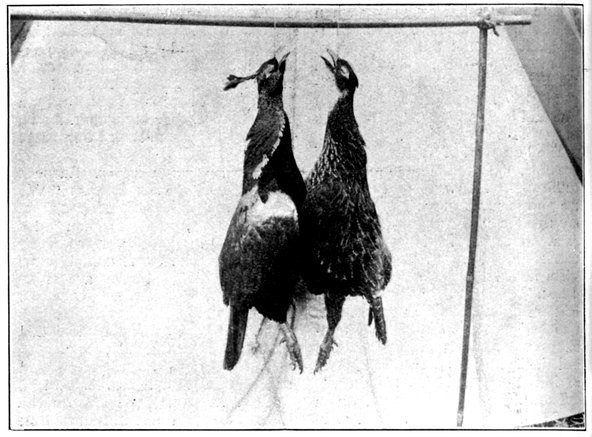
MONAUL PHEASANTS.
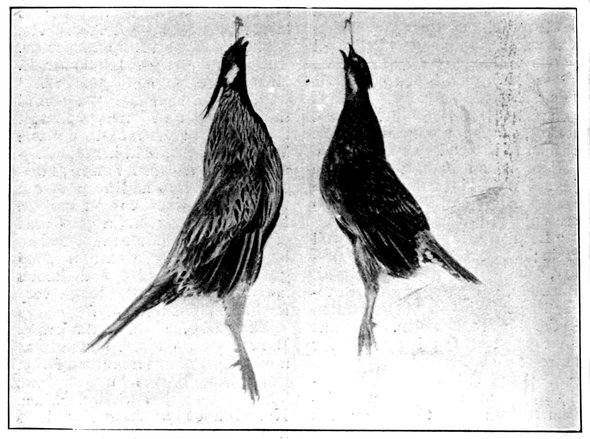
KOKLASS PHEASANTS.
The Duke, as most readers of Baily are no doubt aware, was a warm friend and admirer of that great king of the hunting field, Thomas Assheton Smith, whom Napoleon introduced to his officers as “le premier chasseur d’Angleterre.” And it was always a subject of regret to the hero of Waterloo that Assheton Smith had not joined the Army; “For,” said the Duke, “he would have made one of the best cavalry officers in Europe,” and he frequently remarked that many of his own distinguished cavalry officers in the Peninsular War owed their horsemanship to the example of Assheton Smith.
I have said that the Duke took a keen interest in hunting, and I may add that he gave practical proof of his genuine love of the sport; for when he was once asked to subscribe to a pack which was in financial difficulties, he said, “Get what you can and put my name down for the difference.” The “difference” was £600 a year, which the Duke cheerfully paid for many years.
Thormanby.
Pheasant Shooting in the Himalayas.
There is grand sport to be had in certain parts of the Himalayas in the glorious autumn weather peculiar to those mountain ranges.
For beauty of plumage and dashing flight few game-birds can compare to the monaul (Lophophorus impeyanus), and his haunts are among the wildest and most magnificent scenery.
In the Himalayan districts I am acquainted with, Kumaon and Garhwal, monaul are seldom found much below 8,000 feet altitude, but from that elevation up to about 12,000 feet are fairly plentiful. On the southern and western sides of the mountains, the forests monaul inhabit are usually evergreen oak, with a few spruce and cypress trees scattered about. On the northern and eastern slopes, which are clothed with forests to higher altitudes, monaul are found in woods of pine, deodar, spruce and birch. From the middle of October till end of December the weather is nearly always bright and clear in the Himalayas. The sun is not too powerful, and the nights cold and frosty. The best way to have sport with monaul is for two shooters, who know each other well, to go together, and beaters from six to a dozen, according to the nature of the ground. The beaters should be in charge of an experienced shikari, who is also a “master in language.” A local shikari will point out the best places for monaul, and the guns, one behind the other, about fifty yards apart, will walk slowly along the hillside, on a path if possible. One gun should be about sixty yards ahead of the beaters, and the other in line with them. The foremost gun, in most cases, will get the greatest number of shots.
The tactics of the beat, however, must vary according to the nature of the country, as ravines are usually beaten straight downwards, but in some cases, where a path leads zigzag up a long ravine, the beaters should get well ahead of the guns, and beat upwards. Monaul are exceptionally strong fliers, and about the toughest birds I know. If not hit well forward they will not come down, and the gun to use is a 12-bore cylinder with a charge of 13 16 oz. of No. 5, or 1¼ oz. No. 4 shot. I always use Ballistite powder and have never had a bad cartridge, always finding this powder equally good, whether in hot valleys at low elevations, or up in the cold at over 12,000 feet above sea level.
A mature cock monaul, with his plumage glistening in the sun, is a grand sight, and sometimes, especially early in the morning, he will fly with a kind of soaring motion, wings extended, as if to show himself off, and come sailing proudly overhead; at these times they are comparatively easy to shoot. Generally, however, they give really good rocketting shots, but at times will fly at a terrific pace straight down the hillside, keeping about the same distance from the ground all the way. These are difficult shots. A good dog is required to retrieve—a big dog—as monaul are heavy birds, full-grown cocks often weighing 5 pounds and more.
Another grand bird is the koklass (Pucrasia macrolopha), a beautifully-marked, gamey-looking bird, with a very quick flight. I believe the koklass to be the fastest game-birds that fly, and they get into their flight as quickly as partridges. Like monaul, too, they often dash straight down a hillside, keeping a few feet from the ground, and with a curve in their flight. They are found in the same forests as monaul, but also at lower elevations. In size they are about half the weight of monaul and much the same in shape. They are the best of all birds for the table.
The cheer (Phasianus wallichii) is, I believe, the only true pheasant found in India. They do not give as good sport as monaul and koklass, but I have often enjoyed myself with them. They frequent very steep pine-covered slopes, landslips, rocky scrub near precipices, and uninviting-looking places. Cheer shooting is about the hardest work I know, toiling about the steep hillsides among long grass and scrub. These birds lie very close, and after being flushed and marked down, often take a long time to rouse again. Wounded birds are extremely difficult to find, and your dog should be a steady and persevering retriever. Cheer are not found at very high elevations, from about 4,000 to 7,000 feet being their usual haunt, but occasionally, when the grass on the pine-covered slopes has been burnt, they will go into the oak forests above, where there is a thick undergrowth of ringalls. At these times they are harder to find than ever, and unless the beaters keep well in line, or you have a bustling spaniel to make them get up, it is almost impossible to bring any to bag.
Other so-called pheasants are the hubwaul or snow-cock (Tetrogallus himalayensis), the white-crested kalij (Euplocamus albocristatus), and the crimson tragopan (Ceriornis satyra).
The hubwaul is a fine bird, in shape like a gigantic partridge, found in coveys on the higher ranges above the forest limit. They are very wary and hard to circumvent, as they run long distances, and when put up often fly in a different direction to that expected. I have, however, often got at them in big ravines by sending a man to out-flank them on each side, myself keeping well out of sight behind boulders. I have also defeated them with the aid of a good bustling dog, and when they do come over one’s head give as good shots as any birds I know. In the winter they will come into wooded crags and precipitous ground, when the higher ranges are covered with deep snow.
The kalij pheasants are really more like jungle fowl than pheasants, frequenting thick scrub and undergrowth, near villages and in the vicinity of cattle sheds. They are great runners and fond of flying up into trees when bustled by dogs, but when they do fly put on a good pace and nearly always fly down hill. Plenty of beaters are required to put them up. Their flight is not high and bold like that of the monaul and koklass, and they are not found at high altitudes; from 4,000 feet to 8,000 feet being about the elevations at which they occur.
The tragopan is a very handsome bird, and rare, few being shot. He is the hardest bird of all to bring to bag, being a tremendous runner and keeping to the densest thickets, usually in ringalls and creeping rhododendrons, which are almost impenetrable to man. A good dog will flush them, when they will fly downwards a few feet over the undergrowth, taking long flights and running again immediately they alight.
In the autumn a varied bag can be made, either singly or with a boon companion. There is the friendly rivalry, the jolly fellowship of sportsmen, the chaff, the mid-day lunch by some brawling stream, the laze and smoke in the sunshine and clear mountain air, and the beat back to camp again in the evening. Scolopax rusticola is often to be found when beating for pheasants, also a solitary snipe or two; and two sportsmen who pull well together can have a rare time in the mountains, as besides shooting birds together they can often find room to separate and go after big game in different directions. Then there are the yarns to be told round the campfire after dinner, “sublime tobacco” to refresh the memory, and just “a dash” of good old Scotch to lubricate the throat and loosen the tongue.
A. P. Davis.
“Our Van.”
RACING.
Reading about the Derby autumn meeting in mid-winter is not so inappropriate as it might appear to be, for with sleet and snow falling on the first day the elements were more wintry than autumnal. I have seen this meeting celebrated with much more go than on the present occasion. It is essentially a meeting for hunting folk, so far as the county stand is concerned, and one seemed to miss far too many of the familiar faces. The impression conveyed by the gathering was of the lack-lustre order. Large fields of nurseries have long been a feature of the meeting, but of course the winning or losing of them conveys little merit or demerit. The fields for them have been larger; but I am not a worshipper of large fields, not being a clerk of the course or a holder of racecourse shares. From one point of view the field of twenty for the Gold Cup was very satisfactory, for it meant that twenty horses were thought to have a chance in a race of a mile and three-quarters. Fields for distance races undoubtedly have been looking up of late years. Yet few of our courses are less suitable for a race over such a distance as that at Derby—a parallelogram with rounded corners. So soon as horses have begun to stretch out along either of the longer sides—long only in comparison with the extreme shortness of the other two—than they have to steady for a corner. In such circumstances a mare like Hammerkop, who was carrying 9st. 3lb., could stand but little chance. At Newmarket she would have been well fancied. Yet there are people who grumble at those fine, straightaway stretches of turf, because the horses start so far away. These prefer courses of the circus order, for the sake of the spectacle. Although the regulation straight mile has by no means met with universal approbation, its introduction has more method than madness about it. In the formation of a new course the laying out of a straight mile must be associated with a good deal of luck, for, run in one direction, it might prove popular and the reverse if run the other way. At Gatwick there is a rise of some 6 ft. from start to finish of the straight mile, and at Newbury, I understand, the rise is much more than this. Experience has taught us that rising straight miles are not so popular as falling ones, which may be argued to show a tendency to weakness in horse-flesh, the qualities which take horses successfully up the long hill at Sandown being not often met with. Here we have a hint at a clashing of interests between such as like to have things made easy for them and those which may be regarded as making for the higher interests of the turf. This clashing of interests we shall always have with us, so we may take it by way of our daily salt, with equanimity.
The Derby Gold Cup, as a trophy, was a perfectly delightful production, it being a gold tankard in the 16th century style, and no one would appreciate it more than the owner, whose sideboard it was destined to adorn, for the race was won by Lord Rosebery’s Catscradle. Her starting price of 20 to 1 was justified by her previous running and when she made the first bend nearly last of all 40 to 1 would not have been taken. However, it was her day, and she came through her field to win in comfortable fashion by a couple of lengths from Airship. She ran practically unbacked by her connections. The race for the King’s Cup of two miles “did not fill.” Bachelor’s Button, who had acted as a spoil-sport at Lincoln, by frightening away opposition for the Jockey Club Plate, and walking over for the £300 given by the Jockey Club for the express purpose of furthering sport at meetings where such assistance would be welcome, had not been started for the Gold Cup. He was in reserve for the King’s Plate, but the race “did not fill,” so the meeting saved their £200 instead of increasing the winning account of Bachelor’s Button by that amount.
As season follows season the Manchester meetings attract a diminishing amount of attention. It is a question of reaping what you have sown. Large sums of money were spent upon an unsuitable site, much of the money in the erection of buildings more adapted to municipal purposes than to racing. Except that the big turn is one of the finest in England, the course has proved unsatisfactory, in consequence of the rapidity with which the going goes wrong under wet. In this respect the course is not much better than the old one, which it will quite resemble when it has undergone a course of protection from frost by means of hay for the same number of years. “Disappeared in the main drain, I assure you,” explained the late Duchess of Montrose on the occasion of one of her horses coming to grief in the evil going of the old course. People of the Turf standing of the late Duchess do not find themselves at the new course. The better classes of Manchester firmly decline to be attracted by the races, despite the club stand, the contrast with Liverpool being remarkable. The weather rarely fails to make the November meeting a ghastly affair. In going back to Castle Irwell the management deliberately went to the home of fog, and, in consequence, most of the racing, as a spectacle, is a farce. We are all aware that the period at which the November meeting is decided is too late for good weather, but any attempt to move the fixture forward, supposing such a desire existed, of which I have no knowledge, would scarcely meet with success. If the Stewards of the Jockey Club regard the meeting as an unimportant one they can claim to take this impression from evidence supplied by the meeting itself, the average value of stakes not entitling it to any standing. Eight of the twenty races provide the minimum £100 allowed to the winner, for instance. There must be some significance in the reduction of the Whitsuntide meeting, at which all the money is made, from four days to three. This year’s November meeting was treated to continuous wet, the going of each succeeding day being worse than that preceding it. The November Handicap was run on the last day, and the field of nineteen included some good handicap horses. As at Derby, form was knocked into a cocked hat, the 25 to 1 Ferment gaining a decisive victory. It is a pity that the racing season is each year brought to a close in this uncomfortable manner, and if one cannot quite go with those who recognise no racing previous to that taking place at the Newmarket Craven meeting one can at least see some plausibility in ending it with the Houghton. If mudlarking is to be done, one may as well do it personally, to the tune of hound music.
Although racing ends for the year at Manchester, the curtain cannot be said to fall until the Gimcrack Club dinner has been held. The function to which custom has given such wholehearted recognition sits well on the shoulders of the York Race Committee, which, as the Chairman at the recent dinner very properly pointed out, gives back to the Turf everything that is earned by the races. There are not many race-meetings of which this can be said; and what a contrast to money-grabbing Doncaster! Of course it is not wholly and solely custom that assigns to the Gimcrack dinner the importance which attaches to it. We have a trenchant way nowadays of kicking overboard any custom, however hoary, which has outlived its utility. For the Gimcrack dinner there is much need, for it is the only occasion of the year upon which Turf topics may be publicly ventilated. As to the kind of topics touched upon and their treatment, those depend upon the particular person who may be called upon to ventilate. When we consider that the guest of the evening, to whom free rein is given if he wants it, is the owner of the winner of the Gimcrack Stakes, we realise how very uncertain must be the question of oratory. It is possible to conceive an owner of a Gimcrack winner taking but little stock in the higher interests of the Turf. Mr. Hall Walker, whose filly, Colonia, won him the Gimcrack Stakes of 1905, is, however, not a man of this sort. How it came about I do not know, but some people expected Mr. Hall Walker to say “straight things” to the Jockey Club; but nothing could have been more exemplary than his references to that body. He was full of anxiety for the welfare of the Turf as connected with the welfare of the horse, and his enthusiasm led him to propound schemes some of us, I fear, will be inclined to regard as Utopian. Taking as his text the statement that, “In all the leading Continental States the production and development of the horse is made a subject of governmental care and solicitude,” Mr. Hall Walker proposed that the British Government should grant, if not funds, at least power to the Jockey Club, who was to embody amongst its functions that of a society for the encouragement of horse-breeding. In order to accomplish the desired ends, the Jockey Club was to have the power to establish race-meetings over all or any common land free from interference by local councils and the freedom to acquire by purchase any existing race-meeting. I do not pause to consider the plausibility of such a project or the probability of the Jockey Club embarking upon it, for I have used the word Utopian; Mr. Hall Walker next referred to the means by which any shortage in funds was to be made good. They were to be provided by the introduction of the pari-mutuel. He added—“The advantages of the pari-mutuel are clear and decided. In the first place, it would provide large sums of money for the end we have in view, and it would practically bring about the abolition of street betting.” The writer’s views on the subject differ from those advanced by Mr. Hall Walker, but space does not permit of a discussion of the question raised.
Lord Downe in a speech, the tone of which charmed every one, maintained that the only solution to the betting difficulty was to license bookmakers and making betting debts recoverable. Of course his lordship does not propose that the Jockey Club should take the initiative, remembering, as he does, that when the anti-gamblers were last at work, betting at Newmarket was disavowed. The Club could not well ask to have that legalised which they claim does not exist. That the licensing of bookmakers is a desirable thing all sensible men will gladly admit. Racing would be all the better for it, but unless the trend of thought takes an entirely new channel, I cannot see any form of Government legalising gambling in the shape of wagering on horse-races.
Viscount Helmsley, who added to the nice things said by Lord Downe about the Press, who came in for a rough handling at last year’s dinner, suggested the institution of races for ponies up to 14.2, for the encouragement of the breed. Racehorses in the past have not always been the 16 hands animals that are now so common. Two hundred years ago Mixbury, by Curwen’s Bay Barb, standing only 13.2, was the most famous galloway of his day. Pony and galloway racing is no new thing in the present generation, but it has not taken kindly to the sport. An experiment was made at Plumpton on Whit Monday, 1903, which resulted in complete failure, and it is not quite clear what racing under Jockey Club rules could do. A race here and there would not effect much, and it is an open question whether enough thoroughbreds of 14.2 and under exist to fill many races. There are at least a few clerks of the course who are enterprising enough to welcome any novelty, and if fields could be assured a first step would be taken. Without such assurance he would be a bold man to take the step of opening such a race. It might be worth the while of those interested in pony breeding to provide the stake in the first instance, and see how the suggestion took with others. Experience in India teaches us that good sport is to be had out of ponies.
STAGHOUNDS.
Hind-hunting is at its best in November and December. The hinds are difficult to kill; they are then stronger than stags. It is for this reason that I record what must be considered to be a notable performance of the Devon and Somerset from the Heathpoult on December 3rd. The fixture was for 10 a.m. You want all the daylight there is to kill a stout hind. There was a thick fog and they had to wait some time before it was possible to hunt. At last Mr. Morland Greig gave the word, and kennelling the pack, tufters were taken to Slowley. The run began almost at once, and the chase was nearly all over an enclosed country. The pace was often good, and the hunt lasted for two hours. But the feature of it was that we never got the pack, and that the whole was carried on by the huntsman with four or five couples of hounds. The hind escaped, but not till nearly four o’clock. A week later, in thick fog and driving rain, Mr. E. A. V. Stanley and the Quantock hounds drove a hind straight and fast from the same covert, and killed her near the pier-head at Minehead. Taking the weather into consideration this was a noteworthy gallop.
Two memorable runs have taken place with foxhounds during the past month. The week from December 5th to December 10th was perhaps the best of the season, and there was sport in every country. The Quorn was stopped by fog and hindered by absence of scent on the two days in the week—Monday, Friday—they were in the best country, but as we shall see, made up for it on Saturday. It is not the least remarkable feature of these waves of sport that they affect, about the same time, countries of different soils, climate, and contour, often widely separated by distance.
What I think may be called the two historic hunts of the month took place in Rutlandshire with the Cottesmore, and in Somersetshire with the West Somerset, on December 5th and 7th, while on the latter date the Pytchley had a good run, and on the Friday several packs, including the North Cotswold, enjoyed sport better than ordinary.
The Cottesmore met at Tilton on the first Tuesday in December. There were some preliminary chases which came to nothing, but served to show that there was a scent. The fox of the day was holloa’d away on the side of Skeffington Wood nearest the road. The hounds, when they hit the line, swung left-handed over the grass fields between the covert and the road. At Brown’s Wood, Thatcher, no doubt fearing a change, held the pack round outside. He was right, his fox had gone on across the road, but there was another line, and part of the pack were away. However, the huntsman and his division worked out the line over the road and into the fields beyond, the hounds clearly gaining confidence as they went. The whipper-in, having stopped the main body smartly, arrived in the nick of time with the rest of the pack. The hounds now settled to work, and improving the pace as they went, ran to Rolleston and on to Noseley, held on still to Glooston. At this, point the fox began to turn, and the Ram’s Head covert was reached and left behind. Thence they dipped down to the East Norton road, which the fox ran for some distance, and then turned left-handed as though for Launde Park Wood. By this time many good horses were stopping, for the pace and the severity of the country, which is all up and down—some of the hills are very steep—told on them. In the early part of the run the followers had been favoured by convenient gates, but now the pace improved, and it was not easy to skirt and keep one’s place, yet the fences, though fairly practicable, took much of the remaining steel out of the horses. When hounds turned up to Prior’s Coppice they began to run for blood. Bending towards Owston Wood the field thinned down, and horses began to stop everywhere. In the meantime hounds ran from scent to view, and rolled their fox over in the open close to Cheseldyne Copse. The run lasted one hour and forty minutes, covered fourteen miles as hounds ran, but as the course was a wide curve the point is of course not a long one. The run is remarkable for the wise tactics of the huntsman at the beginning, for extraordinary excellence of the country crossed, as well as for the steadiness of hounds in a well-foxed country, and the condition they showed in hunting for so long a time, and fairly running into their fox at last. That the pace was fast is shown by the number of horses in the best-mounted field in England that stopped by the way.
Into close connection with this run we may bring the other great hunt of the month. Although the country was very different the chase was not dissimilar. Indeed, before we can admit a run to the list of great chases it must fulfil certain conditions, of which the principal is that it must be fast and continuous. If hounds are merely hunting more or less for two or three hours at a slow pace, we often have an interesting day’s sport, but we have not had a great run. I should like to add that it must be after a single fox, but that would exclude so many famous hunts, but if the fox that started is the fox killed, then, no doubt, the triumph is all the greater. The West Somerset run was after one fox, the time was an hour and thirty-five minutes, the pace was good, the distance covered as hounds ran was fifteen miles, and the point rather over seven.
The fox was found on Sir Walter Trevelyan’s property and on the shooting in the occupation of Mr. Townsend Marryat, of Treborough Lodge, who had been keeping the Roadwater coverts quiet for the Hunt.
The fixture was the “Valiant Soldier,” Roadwater—a well-known anglers’ house—on Wednesday, December 7th. The fox was afoot in ten minutes after the start, and it was about twenty minutes more before he was fairly away. Once he was headed, but he resolutely swung round to make his point. Then the pace was very fast, and indeed there was need to gallop to keep on terms with the pack in this rather difficult country. The fox’s point was up wind for a certain well-known covert, but this he failed to reach, turning away within sight. Judging from the pace hounds had brought him along he had no choice but to turn or die. This move saved him for the time, for he gained ground and reached Sir John Ferguson Davie’s covert at Bittescombe Manor, within the borders of the Tiverton Hunt. Finding, however, no refuge there the fox turned back and made for Clatworthy Wood. Hounds were now gaining. He was too hot to stay in the covert and he broke again. The pack turned him in a big field, and catching a view rolled him over. The fox was easily identified as the one that started, as he was curiously marked.
As a run it was a hound chase, for the pack were not touched from find to finish. They cast themselves when necessary and twice picked up the line on the roads. They killed him unaided, as although the Master saw the kill he could not get to them, nor could the huntsman. Every hound was up—a great performance in a rough country. The mask was given to Miss Luttrell and will find a place at Dunster Castle, rightly enough, since the hounds are lent to the country by Mr. G. F. Luttrell.
While on the subject of historic runs news reaches me of a run with Sir John Amory’s staghounds which is in every respect a record, at all events, since the days of the Rev. Jack Russell. The distance, the pace and the line of country taken by the deer were all alike remarkable and interesting. This wonderful stag-hunt took place on Saturday, December 9th. The fixture was Chawleigh, in the Eggesford country, so long known to foxhunters as Lord Portsmouth’s. Seven deer were roused; a young stag was chosen. The hounds were laid on and the stag began by making a wide ring. He then ran by rather devious ways to the River Taw, which stag and hounds crossed. Those who have seen this river in flood will know that the ordinary fords are then impassable. Some miles had to be covered to reach a bridge and return towards the place where hounds were last seen. Luckily the stag and hounds had not vanished into space. The stag probably meant to return to the moors, but on reaching the railway he was blanched by a passing train, and this gave the field time to come up. The quarry was now driven clean out of his country, and he ran straight forward, heading for Torrington, near to which place they took him at 4.15, having been running for four hours and a half. The hounds were left at Eggesford, and the Master, Mr. Ian Amory, his brother, and Mr. de Las Casas made their way back to Tiverton which they reached about midnight.
In illustration of the fact that hounds can run in distant countries on the same day, the Quorn and Cottesmore both had a scent on the 9th, though the latter were hindered by fog. The Quorn were in that section of their country in which Bunny Park is a favourite covert. This part of the country has some plough, but grass and arable alike often carry a good scent, and on Saturday, 9th, hounds ran brilliantly over both alike. Scent held all day, but the fox was saved in the first run by a timely rabbit-hole, in the second by the darkening twilight of a short winter day. The Cottesmore, again, had a run on Tuesday, 12th, which would have been noteworthy had it been possible to see it, but fog caused many of the best followers to miss the fun. I think a great run should, especially in the grass countries, have its glory and pleasure divided between the hounds and the horses. In that most delightful country, Lord Bathurst’s division of the V.W.H., a very noteworthy gallop came off on November 24th. The point was the best I have to record this month, being nine miles in a straight line, with a deviation making up three more perhaps. Thus it will be observed that the run was unusually straight. This country is somewhat heavy going in wet weather, when it holds the best scent. Somerford Common supplied the fox. The pack started at once and settled to run. There was thenceforth small opportunity to make up a bad start. There was a short hesitation at Flisbridge, then they went on through Oaksey Wood, crossed into the Duke of Beaufort’s country, and arrived at Redmorton, where few saw the end. The fox saved his life here, as the covert was full of foxes.
The North Cotswold bitches are giving their master a brilliant season to finish with. Nor can we imagine a greater pleasure to any one than to see a pack one has built up one’s self gaining triumph after triumph. I cannot help thinking that the fact that this pack kill their foxes is one reason for their success.
Hounds that are successful become so full of confidence in their huntsman and in themselves, that they make light of difficulties that would daunt others. It looks as if Belvoir blood needed a quick huntsman to bring out its best qualities, for I have heard people say that they were not so fond of the strains in provincial countries. But facts are stubborn things, and the Duke’s kennel seems to be the true foundation on which to build a fast and killing pack.
Of the other packs hunting in fashionable countries, Mr. Fernie’s, the Atherstone and the Pytchley have all enjoyed good sport during December without, so far, any run above their usual level, which, be it remembered, is very high. It takes a very excellent gallop indeed to be considered out of the usual run of these countries.
Sometimes I think it possible that farmers may wonder whether the deeds of hunting people are in proportion to their professions of gratitude. At all events, the Warwickshire Hunt are doing their best to manifest the reality of their regard. They have voluntarily taxed themselves 10s. or £1 a-piece, according to their means, one-half of the fund so collected going to the “Royal Agricultural Benevolent Society,” and the other half to the relief of farmers in distress within the limits of the Warwickshire Hunt country. This scheme will, it may be hoped, find imitators in other countries. This and the Hunt Servants’ Benevolent Fund are the charities which no hunting people ought to neglect.
Rumours die hard, and the report that Mr. Hubert Wilson is going to resign the Cheshire is still going about. The fact is that he is willing to go on, and the country most anxious to keep him. The sport he has shown and his popularity, together with that of his huntsman Champion, should promise and secure a long reign. Frequent changes of mastership are a disadvantage not only to the individual country, but to hunting at large. So far there are but two countries likely to be vacant, and I hear that there are many applications for the North Cotswold, the chance of possessing that incomparable pack of bitches being no doubt a great attraction. The other pack is the Ledbury, which it is expected Mr. Carnaby Forster will resign before long, and I fear that the state of his health makes the report more than probable. He will leave a fine pack and a tradition of good sport behind.
HUNTING IN YORKSHIRE—A CAPITAL SUGGESTION.
The most important event in connection with hunting which has taken place in Yorkshire since the season begun—perhaps the most important event in the hunting history of the century so far—was the cap which was taken at the Habton fixture of the Sinnington Hunt on December 7th for the Hunt Servants’ Benefit Society; for if Lord Helmsley’s example is followed, as followed no doubt it will be and should be, that deserving Society will receive such an access of income as will enable it to fulfil all the duties of a benefit society in a manner which its founders in their most sanguine moments never dreamed of. Lord Helmsley’s happy inspiration met with a cordial response from those who threw in their lot with his hounds on the 7th, and, as many anticipated, annual subscribers to the Society answered cheerily to the courteous appeal of Mr. Alfred Pearson, who stood at the gate with the cap; the result was that a sum of £21 was collected. Ever prompt in anything which furthers the interests of hunting and those who hunt, Captain Lane Fox announced that a cap would be taken at Tockwith for the same purpose on the 15th, and though at the time of writing no account is to hand of what took place, there is no doubt that the response from the Bramham Moor field will be found as generous as that of their Sinnington friends. If this happy idea of Lord Helmsley’s is taken up all over the country and becomes an annual institution, as there is no reason that it should not, it would mean an access of income to the Hunt Servants’ Benefit Society of something between £4,000 and £5,000, and yet none would feel one penny the worse for the trifle he had given, whilst he would enjoy his sport all the better for knowing that he had done something to assist a deserving body of men to whom he owed so much.
The Bramham Moor have had a succession of good sport. On November 18th they had a capital day from Hutton Hall. They did little with their first fox, but with number two they had a brilliant forty-five minutes over the cream of the Ainsty country. He was an outlying fox, found in a turnip field outside Robin Hood’s Wood, and they raced him by Healaugh, Duce Wood, Askham Grange, and Ainsty Spring, and rolled him over in Bilbrough Park. A travelling fox was viewed as they were breaking this one up, and they ran him hard by Catterton, and then round by Askham Richard, and on to Healaugh, where they rolled him over.
On the 24th they had another good day. Finding a fox in White Syke Whin they ran him by Hutton Thorns, Rufforth and Rufforth Whin, and a ring round by the Harrogate railway, nearly to Hutton Thorns again, and up to Rufforth Village, where they checked. Hitting off the line they hunted on over the Boroughbridge road and into Red House Wood, where they marked their fox to ground.
They had another good Friday on December 8th, when they met at Wighill Village. Curiously enough, like the Hutton Hall day, it was a day of outlying foxes. A fox was viewed as hounds were moving off to try Shire Oaks, and for an hour hounds ran him very cheerily by Duce Wood, New Buildings and Wighill Avenue, over the Thorp Arch road, and on to the Carrs, below Esedike. Thence they ran a very similar ring by Shire Oaks and back by Wighill Avenue and Village, to the banks of the Wharfe, where they marked him to ground. Then came a fine burst of twenty minutes from Shire Oaks, by Tadcaster and Catterton Spring to Healaugh Church, near which the fox got to ground just in front of hounds. The day was brought to a conclusion by a gallop with another outlying fox, who jumped up in front of hounds at Angram, and they hunted him cheerily by Askham Whin, Collier Hagg, Healaugh and Normans to Askham Whin, where he beat them.
The Sinnington had a capital day from Habton Village on December 7th. They found their first fox in Skelton Whin, and had a good hour’s run with him by Riseborough and back through Skelton Whin up to Little Barugh, whence they ran a ring back to the whin and killed. They had barely eaten their fox when another went away, and they ran him at a good pace by Riseborough Hill and Normanby, and past Hobground House to Brawby Bridge, where a check took place. The fox was thought to have gone to ground, but he had gone through, and it was probably him that they killed when they went back to Riseborough.
SPANIEL TRIALS IN THE VALE OF NEATH.
Wales seems to be popular ground for the decision of spaniel trials, for since the Sporting Spaniel Society instituted working tests for “the handy man” of the varieties of dogs which are used in field sports in the autumn of 1898 the Principality has been visited some four or five times. In 1904 Sir Watkin Wynn’s unrivalled coverts in Wynnstay Park were placed at the service of the Club, and a very successful meeting was the result, but for the gathering which was held early in December the Vale of Neath was revisited, Mr. A. T. Williams, the President of the promoting Society, having invited the Committee to decide the competitions on his shooting at Gilfach, only a little over a mile from the flourishing town of Neath. It was to be regretted that the entry was so meagre, only half-a-dozen owners supporting the stakes; for not since the trials were started in Mr. Arkwright’s park near Chesterfield had better ground been visited, although no fault could be found with that at Ynisy Gerwn, on the other side of the valley, when the Welsh spaniels of Mr. A. T. Williams, Mr. W. H. David, and other local breeders, made so bold a show at one of the largest supported meetings of the series. The poor entry, by the way, was not caused by lack of interest in the work of the Club, but, for one reason and another, such men as Mr. Winton Smith, Mr. J. Alexander, Mr. Charles Watts, and Mr. J. P. Gardiner, whose spaniels had gained high honours at other trials, were prevented from sending dogs which had been broken and thoroughly trained with a view to competing. Then Mrs. H. D. Greene, the wife of the member for Shrewsbury, who is a great admirer of the Welsh spaniel, had to withdraw her entries because one of her brace was shot only the day before the trials when being put through her final facings. That was a great disappointment to the Shropshire lady, who had hoped to do well with the representatives of the Longmynd kennel. The conditions of the competitions were the same as usual, the spaniels being shot over in the customary sporting manner, while the principal points which were considered by the judges were scenting power, keenness, perseverance, obedience, freedom from chase, dropping to shot, style, method of beating and working to the gun, whether in covert, hedgerow, or in the open. In the single stakes the spaniels were also expected to retrieve at command, tenderly, quickly, and right up to the hand. Additional points, of course, were given for dropping to hand and shot, standing to game and flushing it at command.
The trials were worked on very sporting lines, and Mr. Williams and his keeper had certainly spared no trouble in preparing the shoot for the meeting, rides having been cut through gorse and bracken, while on the low-lying ground—which could not be worked because of the heavy rain on the first day—the earths had been stopped. The coverts swarmed with rabbits, and at the top of the hill on open fields a few hares were started from their forms and gave the shooters employment as well as providing capital tests for the spaniels.
As had been the case at all recent meetings, the chief honours were taken by the spaniels of Mr. C. C. Eversfield, a Sussex owner, and the best dog at the trials was Velox Powder, a liver-and-white dog of the old-fashioned English springer type, bred by Sir Thomas Boughey, and about as useful a dog in the field as any man could have. He took a positive delight in working rough ground to his owner’s command; he was absolutely steady to both shot and wing, while as to chasing a legged or running rabbit, nothing seemed to be further from his thoughts. He quite outshone all his kennel mates, and in addition to winning the chief single dog stake, he was awarded the dog championship, that which was offered for bitches being taken by Denne Ballistite, a daughter of Velox Powder. Brace and novice honours also went to Mr. Eversfield’s spaniels; in fact, the only other single dog at the meeting which showed anything like form was Mr. Arkwright’s Beni Hassan, an alert young spaniel of the Sussex type, which had been bred by Lord Tredegar. She was very nicely handled by Gaunt, who is so well known in connection with the Sutton pointers at the spring and autumn trials. The pick of the teams were the Welsh spaniels of Mr. A. T. Williams, and no finer work was seen during the meeting than that which they put in on the second day, when set the task of beating a patch of young gorse. They faced it unflinchingly, the English team sent from Hampshire by Mr. Warwick having to be almost forced into it, and even then it was all too evident that their task was distasteful. In rough covert it was once more shown that Welsh spaniels are unrivalled.
Further trials were held under the management of the Spaniel Club on Mr. Fydell Rowley’s estate near St. Neots in Christmas week. They promised to be a great success, judged by the good entry which was received by Mr. John Cowell.
THE CHRISTMAS SHOWS.
The brief series of Christmas Shows which begin at Norwich, are continued at Birmingham and Edinburgh, and terminate at Islington, have not presented any feature of very special importance, but the interest in them has been well maintained and the quality of the exhibits up to the average. The Norwich Show has for many years been the first, and it is always a very pleasant one, though it would be still more so if the final phase of the judging, when the champion prizes are awarded, was not unduly prolonged, a number of visitors being obliged to leave the Hall to catch their trains before the prizes have been allotted. The exhibitors included, as usual, His Majesty the King, who sent several entries of cattle from Sandringham with which he was moderately successful, and two or three pens of Southdowns, with one of which he won the championship for the best pen of sheep in the Show. This same pen of Southdowns, it may be added, went on to Birmingham, and, after winning first prize in its class, was given the reserve number for the championship, the actual winners being a pen of Hampshire Down lambs from the flock of Mr. James Flower, who is almost invincible with this breed. But the rubber game had to be played at Islington, and the King’s Southdowns came victorious out of the contest, for they were first in their class, first for the cup given to the best of the breed, first for the champion plate given to the best pen of short-woolled sheep, and finally took the Prince of Wales’ challenge cup for the best pen of sheep in the whole Show. As His Majesty won this cup last year with another pen of Southdowns, it has now become his absolute property.
To revert to the Norwich Show, in the contest for the champion prize for cattle the issue was narrowed down to Mr. E. T. Learner’s cross-bred (Shorthorn and Aberdeen Angus) heifer Luxury and one of the many good animals which Mr. R. W. Hudson sent from Danesfield. The verdict was given in favour of Mr. Learner’s cross-bred. Mr. Learner’s heifer and Mr. Hudson’s exhibit both went on to Birmingham, where, by the way, the Norwich judgment was reversed, Mr. Hudson’s beast being greatly admired for its admirable quality. The Norwich Show always has three or four classes for the red-polled breeds, and the competition is not altogether confined to the Eastern counties, for Sir Walter Corbet generally sends some of his Shropshire herd, and he did so with marked success on the present occasion, his principal opponent being Lord Amherst of Hackney.
Not a few of the Norwich exhibits went on to Birmingham, where the Show opened, as usual, on the Saturday week following Norwich, that is to say, on November 25th, and there was a notable gathering of Midland agriculturists, though Lord Bradford, the President for the year, was not well enough to attend, while by a melancholy coincidence the late President, Sir Henry Wiggin, had died a few days before the Show. The most salient feature of the Birmingham Show was the unbroken success of His Majesty the King, who sent from Windsor ten entries of Herefords, Shorthorns, and Devons, and won with them four first prizes, a second, and two thirds, while in addition to this he was awarded three special prizes for the best of each breed, and the President’s prize of £25 for the best of the exhibits in the cattle classes. After all these awards had been made the contest for the three challenge cups began, being presented by Messrs. Elkington, Thorley, and Webb, for the best animal in the Show; but while the Elkington challenge up has no restriction as to breeder, it is stipulated in the conditions of the two others that they shall be given to animals which have not passed out of their breeders’ hands. This did not prove any obstacle to the King winning all three, for he makes it a rule to exhibit only home-bred stock, so that the Hereford steer, the Shorthorn heifer, and the Devon steer, which had each been proclaimed the best of its breed, were all three in the ring to compete for these valued trophies. They had to meet two or three very fine specimens of the Aberdeen Angus and Shorthorn cross-breds, exhibited by Mr. R. W. Hudson and by Mr. Learner, to which reference has already been made in connection with the Norwich Show. The judges, however, gave the preference to the King’s trio, and, after eliminating the Devon, they dwelt for a long time between the two others, their ultimate decision being in favour of the Hereford steer, which scaled nearly 18 cwt., and was preferred to the Shorthorn heifer. Thus the King won all that was possible in the cattle section at Bingley Hall.
While it was in progress the Scottish National Show was being held in Edinburgh, and the principal winner there was a heifer of the Aberdeen-Angus breed, which, as will be seen below, not only carried all before her at Edinburgh, but followed up this by winning the Championship at Islington. This heifer, bred, and still owned, by Colonel McInroy, C.B., of the Burn, Edzell, has a remarkable record, and at the age of two years nine months her live weight was just over 16 cwt., which for an Aberdeen-Angus is very good. Burn Bellona, as this heifer was called, was much admired at Edinburgh, but it was scarcely to be expected that she would secure so complete a triumph at Islington, especially with such a strong opposition to face as she had in the Norwich and Birmingham champions, to say nothing of the King’s other representatives. His Majesty, strongly as he has been represented on previous occasions, has never had so many entries at Islington as this winter, he having sent nineteen head of cattle, sheep, and pigs from Sandringham, several cattle from Windsor, two of Aberdeen-Angus from Ballater. It was generally expected that His Majesty would follow up his Bingley Hall triumph, an impression which was strengthened when it was seen that the Hereford and the Shorthorn had won the Cup as the best of their breeds. These prizes had been won before the arrival of the King, who had, at considerable personal inconvenience, arranged, upon the eve of a political crisis, to come up and see the Show. His Majesty was received on his arrival from Sandringham, shortly before three o’clock, by Prince Christian of Schleswig-Holstein, Lord Tredegar, the President of the Smithfield Club, Sir Walter Gilbey, Chairman of the Royal Agricultural Hall Company, the Earl of Coventry, Sir R. Nigel Kingscote, and Sir John Swinburne, and he paid a visit to the avenues in which the Devons, Herefords, and Shorthorns were placed, these being the classes in which his most successful exhibits were located. After he had inspected them, his pens of Southdown sheep, one of which had already been awarded the Championship, were brought out for the King to see, and not the least interesting feature of his visit was the presentation of some of the New Zealand football players, who had been invited to lunch by the Council of the Smithfield Club, and who could scarcely have anticipated being accorded such an honour. His Majesty’s engagements did not admit of his remaining to see the championship for cattle decided, the judges having been so much retarded by the even quality of the competitors, and had he been able to stay, he would not have had the satisfaction of witnessing a repetition of the Birmingham triumph, as the Hereford steer and the Shorthorn heifer were both beaten by Colonel McInroy’s Aberdeen-Angus heifer referred to above. Moreover, the Hereford steer, which had been placed in front of the Shorthorn heifer, had lost flesh a trifle since Birmingham, and their respective positions were reversed, the Shorthorn heifer being the “runner up.”
There was a general meeting of the Club on Tuesday, when Lord Tredegar, whose elevation in the peerage will give general satisfaction, took the chair for the last time, and will be succeeded by the Prince of Wales, whose term of office now begins, so that all bodes well for the Smithfield Club Show in 1906.
SPORT AT THE UNIVERSITIES.
Unlike wild partridges after their flight, it does not take Light and Dark Blue athletes long to settle down. Reinforced by an exceptionally smart lot of all-round Freshmen, they got to work betimes this year, and with admirable results. Rarely, if ever, have the respective prospects been so rosy in most departments of sport at this stage. And October Term, 1905, will long be remembered for the many fresh records accomplished during the preliminary and (so to speak) educational period of preparation and practice. “Wet-bobs” on both rivers have been very busy. Magdalen (Oxford) and Third Trinity (Cambridge) carried off the Coxwainless Fours, the last-named “for the sixth successive year”—a record, by the way. They won with great ease, but Magdalen only just snatched the Oxford race from New College, after a magnificent finish. Racing on the Cam for the Colquhoun Sculls was of the sensational order. In heat 1, President R. V. Powell (Eton and Third Trinity) won with great ease in the grand time of 7 min. 49 sec., or eight seconds better than R. H. Nelson’s 1902 record. D. C. Stuart (Cheltenham and Trinity Hall) qualified to meet him in the final, and the well-known L. R. C. man only succumbed by one second in the truly marvellous time of 7 min. 46 sec. This record is likely to stand for many a long year. Both the Trial Eights races were rowed on December 3rd, the Dark Blues’ at Moulsford, and the Light Blues’ at Ely. H. C. Bucknall’s crew had an easy victory on the Thames, and Lewis’s crew even an easier on the Ouse, but, individually, some promising work was shown. It is probable that Messrs. Kirby, Illingworth, Wilson, Arbuthnot (Oxford), and Cochrane, Donaldson, Lewis, Shimwell (Cambridge), will receive ample trial for the representative eights early in the new year. As several Old Blues and Seniors otherwise are also available this year, a stubborn fight is thus early anticipated for either March 31st or April 7th.
Athletes proper have been equally busy. The Oxford Freshmen’s Sports unearthed some promising talent in Messrs. Lloyd (Ramsgate), Stevens (an American Rhodes Scholar), Hallowes (a distance runner above the average), Doorly (another Rhodes Scholar, high jumper), and Darling (the Old Winchester quarter-miler). On the whole the performances were fully average, as proved later by the L.A.C. v. O.U.A.C. meeting result. The Dark Blues won by the odd event, despite the fact that they were mainly represented by junior men. As President Cornwallis will be assisted by numerous Old Blues in the spring, he ought to put a strong team against Cambridge on March 30th or April 6th. The Cambridge Freshmens’ performances in toto were hardly so good, but Messrs. Halliday (Harrow), K. G. Macleod (Fettes), Horfield (Harrow), and Just (St. Paul’s), all shone out individually. Some of the Old Blues have already been giving a foretaste of later quality. R. P. Crabbe (Corpus) created a new half-mile record for Fenner’s ground by running that distance in the splendid time of 1 min. 56½ sec. on November 15th. Other fine performances have been done with the hammer, at long-jumping and distance running. On November 29th, F. M. Edwards (Queen’s) won the Sidney College Strangers’ Three Miles Race in 14 min. 42⅖ sec., or only four seconds outside H. W. Gregson’s record. The Trinity College v. Racing Club de France International meeting at Fenner’s was won by the Light Blues by 6 events to 3. For the Collegians, Messrs. Welsh, Just, Ryle, and the Hon. G. W. Lyttelton did best. The latter’s “put” of 38 ft. 5½ in. was exceptional for this early stage of the season. Messrs. Soalhat, Molinie, and De Fleurac showed fine form for the Frenchmen, who, by the way, were not at full strength.
Two Inter-’Varsity contests have been decided before Christmas, as usual, i.e., the cross-country race at Roehampton on December 9th, and the Rugby football match at Queen’s Club three days later. As generally expected, the Cantabs excelled at hare and hounds work, winning by 23 points to 32. A. H. Pearson (Westminster and Cambridge) finished first, and in the grand time of 41 min. 11 sec., which creates another record. The previous best was A. R. Churchill’s 42 min. 17⅕ sec. last year. Although beaten, the Oxonians made a big fight of it, and F. O. Huyshe, their captain, gets his full Blue for finishing in the first three, an honour also attained by Pearson (Cambridge). The cross-country records now read: Cambridge, 16 wins; Oxford, 10 wins. Cambridge were very strong favourites for the Rugby football match, many critics anticipating a record score for them. In the result, however, Oxford put their detractors to the blush by holding their own splendidly from start to finish. The Light Blues won by 15 points (3 goals) to 13 points (2 goals and 1 try)—merely a matter of place-kicking as will be seen. It was a most interesting game, full of incident, surprise, and fluctuating fortune, in which the Oxford forwards were always in evidence. They beat their heavier Cambridge rivals fairly and squarely, and at half-back, too, the Oxonians were the smarter. The Cantab “threes” line was vastly superior, but rarely did they get the upper hand, thanks to excellent generalship by “Captain” Munro (Oxford) who, personally, was a class by himself. So far, Oxford claim 13 wins in these matches, Cambridge 12, and there have been 8 drawn games. The records of the two clubs after the match read:—
For. Against.
P. W. L. D. G. T. P. G. T. P.
Oxford 14 5 9 0 24 18 179 30 27 229
Cambridge 15 8 7 0 40 23 271 20 17 150
These emphatically show that records of any sort are “a slender plank to lean upon”—as Sterne has it.
Appreciable progress has also been made at Association football, golf, hockey, boxing and fencing, billiards, lacrosse, &c. Space will not permit detailed comment, but, so far, Oxford appear stronger at “Soccer” football, billiards and fencing. Both Universities are strong in boxers this year, and Cambridge appear smarter at golf, in particular, and lacrosse. As at present arranged, the dates of next term’s Inter-’Varsity contests read thus: Association football, at Queen’s Club, February 17th; Hockey match, at Surbiton, February 21st; Lacrosse match, at Lord’s, March 3rd; Sports, at Queen’s Club, March 30th or April 6th; and Boat Race, from Putney to Mortlake, March 31st or April 7th. Of all-round progress I hope to chat with readers of Baily later. As in the last, so in the present ministry, many ex-’Varsity athletes of renown find place, notably Sir Robert Reid, the new Lord Chancellor. Other prominent University athletes have been honoured by the King in various ways, and everybody congratulates Mr. W. H. Grenfell, M.P.—the modern Admirable Crichton of Sport—upon his accession to the peerage. Alas! that it should be so, one has also to extend the hearty sympathy of all University sportsmen to that fine old English gentleman and prince of good fellows, Mr. Albert Brassey, M.P., M.F.H., of the Heythrop Hounds, upon the death of his son. He was persona grata at Oxford and Cambridge alike, and played polo v. the Light Blues at Hurlingham only last year. His death at Huntingdon came as a shock to hundreds of his friends who will mourn him long.
GOLF.
The course of the Royal St. George’s Club at Sandwich has been reconstructed on lines calculated to meet the new conditions brought about by the rubber-cored ball. Large tracts of new ground have been brought into requisition, and several of the holes have been greatly changed, though the first and last remain as of yore. It is expected that when next a championship meeting is held at Sandwich the scores will be higher than heretofore.
The congestion on the golf course at North Berwick is to be relieved by the creation of new links at the East end of the town. The ground has been gone over by James Braid and Bernard Sayers, who have laid out a course nearly 3½ miles in length. At present the ground is rough, but experts are agreed that it can be put into excellent condition for golf. If the new links prove a success, they will increase the popularity of North Berwick vastly, for at present there is great difficulty in getting a comfortable game.
The Batty Tuke Cup has been won this season by Edinburgh University, who playing at North Berwick defeated somewhat easily St. Andrew’s University. Each University has now won the Cup twice.
Andrew and Jack Kirkaldy, of St. Andrew’s, played a match over the old course at Gullane against Bernard and George Sayers, of North Berwick, and won by 8 up and 7 to play on the two rounds.
THE LONDON PLAYING FIELDS’ SOCIETY.
The London Playing Fields’ Society, which already possess permanent playing fields in the south-west, north-west and south-east of London, is endeavouring to secure a permanent playing field in the east, so that each district of London may have its own field. An opportunity now presents itself of acquiring forty acres of suitable land close to Fairlop Station, on the Great Eastern Railway. The sum of £6,000 is required for the purchase and laying out of the field, towards which the M.C.C. have promised £200 and a member of the Society has offered £1,000. An appeal is now being issued for the balance of the sum required. The scheme is being warmly supported by many influential men, and the G.E.R. has already consented to make a reduction in fares for cricketers and football players using the ground when it is completed.
“THE MOUNTAIN CLIMBER” AT THE COMEDY THEATRE.
Mr. Huntley Wright has so often made us happy and merry in his studies of musical comedy, under the banner of Mr. George Edwardes, that it was with feelings of deep interest that we went to see him play unmusically at the Comedy Theatre.
“The Little Father of the Wilderness,” a comedy in one act by Messrs. Lloyd Osbourne and Austin Strong, presents Mr. Huntley Wright as Père Marlotte, a Jesuit priest of the period of Louis Quinze. He has done enormously good work as a missionary in North America, and has been summoned to the Court of the flippant monarch in connection, as he presumes, with the work of his life. It turned out otherwise, however, and to his sorrowful amazement, the Little Father finds that his presence at Court is only commanded in order that he may decide a bet of the merry monarch as to the height of the Falls of Niagara. The heart-broken little priest is disappearing from the Court for ever, but for the sudden appearance of a most important Canadian dignitary, who recognises in the priest “The Little Father of the Wilderness,” and explains to the King some of the wonderful services that Père Marlotte has rendered to the world.
The sketch closes with Père Marlotte, momentarily translated to the See of Toulouse, blessing the entire company, including the King. Mr. Huntley Wright is extremely good as the Little Father, and it would be very difficult to find another part less like those in which we have been accustomed to see him at Daly’s Theatre.
Of “The Mountain Climber” we have not much to say, but all that we have to say is in praise of the performance. Any one in search of a hearty laugh should go to the Comedy Theatre “again and again and again”; for Miss Lottie Venne is playing there, and she is always worth taking a lot of pains to see, and in this production she has much to answer for. Mr. Huntley Wright as the spurious “Mountain Climber” is most actively amusing, and a great source of laughter throughout the play; but to some of us his acrobatic antics, expressive of mental distress, become somewhat upsetting, and one could have half wished that a rest-cure could have been instituted for this too highly strung hero. Mr. Wright is always funny, and we have no doubt but that a short experience of what we suppose we must style unmusical comedy will bring him to a stage of less restlessness. At any rate, even if the entertainment is now just the same as it was upon the first night, we can confidently recommend it to readers of Baily as a most amusing entertainment. And we have been told it is better than that!
“MR. POPPLE (OF IPPLETON)” AT THE APOLLO THEATRE.
Mr. Paul Rubens is a young gentleman of proved ability, and he has accomplished a feat of exceptional difficulty: he has produced a new and original comedy with music, in three acts, written and composed entirely by himself. That is a feat, but it need not be exceptional—the exceptional part of Mr. Paul Ruben’s performance is that his comedy is drawing crowded houses at every performance, and competition for stalls is quite fierce.
Mr. Popple is none other than our valued friend Mr. G. P. Huntley, very much at home in clothes of country cut and material, with fine pocket accommodation for apples and such country produce; in fact, at the finish of the play we are disappointed that he has not produced a ferret from some pocket. Mr. Popple is at home in his ulster and travelling cap, but he is certainly not at home either at the Hotel Blitz, Piccadilly, nor at the flat in Fount Street, kindly lent to him by an eminent actress, La Bolero, played by the charming Miss Ethel Irving.
And here is another important factor which makes for success, and much of the popularity of the production could be traced to the personality and charming singing of Miss Irving. Moreover, Miss Marie Illington is here with that artistic method of hers which gives point to any lines she has to speak. Miss Coralie Blythe also is good as the maid to La Bolero, and in the scene at the Motor Carnival scores a success with a song about “Bah! said the Black Sheep.”
There is a definite story running through the piece, and there are some tuneful musical numbers of the Rubens school. Probably the majority of the admirers of the author-composer would prefer more of his composition, without there being less of his authorship, if such a consummation could be arrived at. But at all events, so long as Freddy Popple is none other than Mr. G. P. Huntley, we fancy that his stay in town is likely to be a prolonged one. And probably by the time he is able to return to Ippleton he will find an improved train service, which will do away with that tiresome change of trains at East Wobsley.
Well done, Mr. Huntley, and well done, Mr. Rubens.
Sporting Intelligence. [During November—December, 1905.]
We regret to record the death, from heart disease, of Mr. Harvey Combe, which occurred on November 27th. On the death of his father, Mr. R. H. Combe, the deceased took his colours and had since kept some horses in training. Mr. Combe was only 44 years of age.
The sad accident which happened to Mr. Ralph A. Brassey whilst riding Carrigdown at the Cambridge University Steeplechases, on November 28th, we regret to say terminated fatally on the morning of December 4th, at the Huntingdon Hospital, the unfortunate young gentleman never having recovered consciousness. He was the son of Mr. and Mrs. Albert Brassey, and was only 22 years of age, whilst he had been four years at New College, Oxford. The deceased was Master of the University Draghounds, and in other branches of outdoor sports and pastimes was more or less prominent, indeed, he for the two past years represented his University against Cambridge in the polo matches.
The Ystrad and Pentyrch Hounds had a marvellous escape on November 28th. While crossing the Great Western Railway an express train dashed into the pack, but fortunately only one hound out of seventeen couples was killed.
As the result of injuries received while riding his horse Wych Elm in the Open Military Steeplechase at Aldershot, we regret to record that Captain E. Meyricke died on November 30th. The deceased, who was only 30 years of age, was a good all-round sportsman.
It is reported that Prince Edward and Prince Albert of Wales had their first experience with hounds during the month of November, meeting the West Norfolk at Herdman’s Barn, Massingham.
Mr. Charles Seymour died at his residence at Fulham on December 3rd, aged 73 years. Mr. Seymour, who came of old coaching stock, in his younger days drove the London and Hatfield coach, and was considered a fine whip.
The usual December sales were held at Newmarket, by Messrs. Tattersall, from Monday, the 4th, to Friday, the 8th December. The attendance was good and business throughout brisk; the total realised during the week being close upon £110,000.
The highest price obtained, on Tuesday, was 7,500 gs., paid for Delaunay, who goes to France, being purchased for M. de St. Alary from Sir James Miller. M. F. Brugmann bought Roquebrune, dam of Rock Sand, for 4,500 gs., and she goes to Belgium; Mr. Simons Harrison gave 2,500 gs. for La Sagasse from the same owner. Mr. Basil Hanbury’s Desinvolture made 1,000 gs.; from Mr. R. H. Henning’s lot Sir E. Cassel bought Xeny for 1,650 gs., and the Marquis of Serramezzana secured Best Light at 1,000 gs.
On Wednesday the Duke of Devonshire purchased the St. Simon mare Grand Prix at 3,000 gs.; Count Lehndorff took Flor Fina at 1,300 gs., and Ladyland at 1,000 gs., both from Mr. Simons Harrison’s contingent. Mr. Cleary gave 1,250 gs. for Refusal, by Bendor; Mr. W. B. Purefoy’s Nausicaa went to Sir E. Cassel at 1,000 gs. On the following day Mr. Cheri-Halbroun was a considerable purchaser, and he secured Lord Clonmell’s Galopin mare Dainty, at 2,000 gs., Sir R. Waldie Griffith’s Vittel, 850 gs., Mr. J. B. Joel’s Yola, 720 gs., and a number of others. Lord Clonmell gave 650 gs. for Mr. W. M. G. Singer’s Ladasia, and Sir P. Walker took Therapia from Mr. J. G. Baird Hay at 650 gs. The best prices obtained for the Duke of Portland’s were 880 gs. for Flete, Mr. Gurry, and 710 gs. for Raeburn, Baron Harkanyi. On the concluding day Sir E. Cassel sold Love Charm, Exchequer, and April Morn, each making 500 gs.; Mr. James Joicey’s Orpheus obtaining the same figure.
While hunting with the Atherstone from Newbold Revel Park, on December 8th, Colonel Worsley Worswick, of Normanton Hall, Hinckley, had a bad fall and succumbed to the injuries received on the following morning. It appears the horse fell at a stiff fence. The deceased was very popular in the country, and as a tribute of respect hunting was suspended for a week.
Mr. Alfred A. Stokes, Hon. Secretary to the Ledbury Hunt, died at his residence, The White House, Pauntley, Newent, on December 10th, at the age of 67.
The huntsman to the Bexhill Harriers, Carey Witherden, has been the recipient of a testimonial in recognition of his services with the pack during a period of nineteen years and under seven masterships.
As a result of injuries received while out hunting with the Essex Union Hunt six days previously, Mr. Albert E. Clear, of Maldon, died on December 13th. Mr. Clear was well known as a breeder and exhibitor of wire-haired fox-terriers.
The list of winning owners during the past season is for the first time headed by Colonel W. Hall Walker, M.P., whose six horses have secured stakes to the value of £23,687. Lord Derby occupies second position with £18,524; the next best being Mr. S. B. Joel with £17,944.
We regret to record the death of Mr. E. D. Brickwood, which occurred in London on December 14th, in his sixty-eighth year. The deceased gentleman, who was a brilliant oarsman in the late ’fifties and early ’sixties, was a well-known writer, and for forty years had editorial charge of the rowing department of the Field.
The famous stallion Diamond Jubilee, bred by and the property of H.M. the King, has been sold to the well-known Argentine breeder, Senor Ignacio Correas, at a high price, 30,000 guineas being stated as the figure. Foaled in March, 1897, Diamond Jubilee is by St. Simon, dam Perdita II.; in 1900 he won the Two Thousand Guineas, Derby, and St. Leger.
With reference to the several cases reported of hounds being impaled upon the spiked iron fencing in use in many parts of the country, Mr. Henry O. Ll. Baker, of Hardwicke Court, Gloucester, writes: “Spiked railings are much on the increase round new houses in the country. If owners could see the many cases that I know of, of unfortunate dogs being impaled on this very un-English kind of fence, they would do something to lessen the danger. A strip of wood fixed on the top of the spikes is all that is required. However much any one may object to hounds or dogs of any sort crossing their gardens, no one, I am sure, wishes to torture them. What is known as the bow-topped fencing answers the same purpose, without the risk of such terrible cruelty.”
Mr. R. W. McKergow, the Master of the Southdown Hounds, has called attention to a deterrent to the pleasure of hunting which has arisen through the inconsiderate behaviour of motor-car drivers at meets. The complaint has, of course, been lodged before now by other Masters who have also suffered from the same trouble, but the thoughtlessness, it is probably nothing more, still goes on. As Mr. McKergow points out, it is now a usual thing for several motor-car drivers to run right up to hounds and horses, continually sounding the “hooter” and keeping the machinery in motion, with the result that horses are frequently upset, to the great danger and discomfort of pedestrians, horsemen, and hounds.
The Master of the Southdown, however, has, says the Field, still another charge to bring, for he adds that when hounds move off the cars make for the most convenient spot to view fox and hounds, and so considerably interfere with sport by heading the fox, and he suggests as a remedy that if owners of cars would give instructions to their drivers not to get within, say, 200 yards of horses and hounds at the meet and to desist from following they would confer a great favour on all lovers of hunting. There is, unhappily, too little of the give and take policy observed nowadays, but it surely is not too much to expect motor-car owners, who, of course, have every right to attend an appointment, to observe these “rules and regulations,” and so help to make and not mar the enjoyment of their mounted fellows.
Mr. Ernest Robinson, who held the mastership of the disbanded West Surrey Staghounds during the last two years of their existence, was the recipient of a presentation from the members and farmers at the recent meet of the Ripley and Knaphill Harriers at Knowle Hill Park. The gift consisted of an illuminated address and a handsome silver salver, which, on behalf of the subscribers, were handed to Mr. Robinson by Mr. C. E. Denny, who said that this was a small expression of the warm thanks and appreciation of some of those who had enjoyed sport with the West Surrey. Mr. Denny mentioned that with the wind-up of the Hunt, after paying other things, he had about £80 in hand, which was to be handed over to the Royal Agricultural Benevolent Institution in the names of the farmers over whose land they had hunted, giving them a life membership of £10 10s. each.
At the recent Smithfield Club Show, London, the St. Pancras Ironwork Co., Ltd., 171, St. Pancras Road, London, N.W., so well known for their patent stable fittings, made a new exhibit in the form of a steam motor wagon and petrol van, showing good design and workmanship of the highest class.
TURF.
LEICESTER AUTUMN MEETING.
November 13th.—The November Auction Nursery Handicap of 500 sovs.; five furlongs.
Sir E. Cassel’s br. g. Goldrock, by Bill of Portland—Goldlike, 9st. W. Halsey 1
Mr. J. Perkins’ bl. c. Pescadero, 8st. E. Wheatley 2
Mr. B. Gottschalk’s b. filly by Teufel—Ilfracombe, 7st. 3lb. A. Templeman 3
10 to 1 agst. Goldrock.
The Atherstone Plate (Handicap) of 200 sovs.; one mile and a half.
Mr. R. J. Hannam’s b. c. North Deighton, by Kendal—Lady Liberty, 4 yrs., 6st. 2lb. (car. 6st. 6lb.) J. Cockeram 1
Sir E. Cassel’s br. h. Exchequer, 5 yrs., 9st. 1lb. W. Halsey †
Lord Ellesmere’s br. c. Winwick, 3 yrs., 8st. 3lb. W. Griggs †
10 to 1 agst. North Deighton.
November 14th.—The Leicestershire November Selling Handicap Plate of 500 sovs.; one mile and a quarter.
Mr. S. Loates’ b. gelding by Buccaneer—St. Ange, 3 yrs., 6st. 8lb. C. Heckford 1
Mr. C. P. B. Wood’s b. h. Prince Royal, 3 yrs., 8st. 9lb. H. Jones 2
Mr. R. J. Hannan’s ch. colt by Ugly—Bramble Jelly, 3 yrs., 8st. 1lb. E. Wheatley 3
100 to 8 agst. St. Ange gelding.
DERBY NOVEMBER MEETING.
November 15th.—The Markeaton Plate (Handicap) of 500 sovs.; the Straight Mile.
Mr. W. Dunne’s b. or br. c. Earla Mor, by Desmond—Weeping Ash, 4 yrs., 8st. 13lb. H. Jones 1
Mr. W. Bass’s b. f. Royal Lass, 3 yrs., 6st. 2lb. A. Vivian 2
Mr. Keswick’s b. h. Csardas, 6 yrs., 7st. 12lb. W. Higgs 3
3 to 1 agst. Earla Mor.
The Chesterfield Nursery Plate (Handicap) of 1,000 sovs.; for two-year-olds; five furlongs, straight.
Mr. F. C. Pratt’s b. g. Sophron, by Janissary—Miss Chiffinch, 7st. 9lb. W. Griggs 1
Mr. L. E. B. Homan’s b. f. Scotch Mistake, 8st. 2lb. F. Hardy 2
Mr. W. Bass’s ch. filly by Bend Or—Wasp, 8st. 3lb O. Madden 3
100 to 6 agst. Sophron.
November 16th.—Chatsworth Plate (Handicap) of 200 sovs.; five furlongs, straight.
Mr. Ned Clark’s b. g. Rising Falcon, by St. Issey—Magpie, 5 yrs., 10st. 2lb. O. Madden 1
Lord Marcus Beresford’s ch. c. Rosemarket, 3 yrs., 6st. 7lb. A. Templeman 2
Mr. C. Hibbert’s b. f. Snowflight, 3 yrs., 7st. 7lb. C. Trigg 3
100 to 12 agst. Rising Falcon.
The Friary Nursery Plate (Handicap) of 200 sovs. for two-year-olds; five furlongs, straight.
Mr. G. Miller’s b. c. Lamb and Flag, by Wolf’s Crag—Royaume, 7st. 5lb. A. Vivian 1
Mr. W. Goodchild’s b. c. Crusader, 7st. (car. 7st. 1lb.) C. Trigg 2
Mr. J. T. Whipp’s ch. colt by Galloping Lad—Evelyn, 7st. 8lb. E. Wheatley 3
10 to 1 agst. Lamb and Flag.
The Derby Gold Cup (Handicap) of 2,000 sovs.; one mile and six furlongs.
Lord Rosebery’s ch. f. Catscradle, by St. Frusquin—Catriona, 4 yrs., 6st. 7lb. A. Templeman 1
Mr. R. H. Henning’s br. c. Airship, 4 yrs., 8st. 5lb. W. Halsey 2
Lord Brackley’s ch. c. Imari, 4 yrs., 7st. 2lb. W. Saxby 3
20 to 1 agst. Catscradle.
NOTTINGHAM DECEMBER.
December 2nd.—The Midland Handicap Steeplechase Plate of 400 sovs.; three miles.
Mr. B. W. Parr’s ch. m. Aunt May, by Ascetic—Mayo, aged, 12st. 4lb. F. Freemantle 1
Mr. C. Bower Ismay’s b. h. Theodocion, aged, 11st. 6lb. W. Morgan 2
Mr. J. E. Rogerson’s b. g. Wee Busbie, aged, 11st. 2lb. D. Phelan 3
3 to 1 agst. Aunt May.
November 17th.—The Allestree Plate of 225 sovs.; one mile three furlongs.
Mr. G. A. Prentice’s br. c. Hong Kong, by Queen’s Birthday—Merry Wife, 4 yrs., 7st. 11lb. O. Madden 1
Sir E. Cassel’s b. h. Love Charm, 5 yrs., 9st. 2lb. W. Halsey 2
Mr. C. P. B. Wood’s b. h. Princess Royal, 5 yrs. 8st. 4lb. W. Higgs 3
7 to 2 agst. Hong Kong.
The Osmaston Nursery Plate of 460 sovs.; seven furlongs.
Mr. A. Stedall’s b. g. Kolo, by Matchmaker—Cloon, 7st. 1lb. C. Trigg 1
Mr. J. A. de Rothschild’s br. c. Beppo, 8st. 11lb. W. Halsey 2
Mr. L. Neumann’s b. f. Scylla, 7st. 10lb. Wm. Griggs 3
100 to 8 agst. Kolo.
The Chaddesden Plate of 225 sovs.; six furlongs.
Lord Dalmeny’s b. m. Caravel, by Pioneer—Kendal Belle, 5 yrs., 8st. 11lb. W. Higgs 1
Mr. J. Osborne’s ch. f. Flamston Pin, 4 yrs., 6st. 2lb. Flanagan 2
Major E. Loder’s b. h. Gold Lock, 5 yrs., 8st. 6lb. W. Halsey 3
100 to 12 agst. Caravel.
HOOTON PARK.
November 17th.—The Autumn Hurdle Race of 400 sovs.; two miles and a quarter.
Lord Cholmondeley’s b. h. Salute, by Carbine—Festa, 5 yrs., 10st. 8lb. Williamson 1
Mr. Deer’s Booty, 6 yrs., 11st. Mr. I. Anthony 2
Mr. J. B. Joel’s His Lordship, 6 yrs., 11st. Mr. Payne 3
10 to 1 agst. Salute.
November 18th.—The Cheshire Autumn Steeplechase of 400 sovs.; two miles and a half.
Mr. F. Bibby’s Wild Boer, by Victor Wild—Tati, 5 yrs., 10st. 11lb. Mason 1
Mr. J. Purcell’s Woodsdown, 5 yrs., 10st. 11lb. Mr. J. Manley 2
Mr. J. Edwards’s Mintstalk, aged, 10st, 10lb. A. Taylor 3
4 to 1 agst. Wild Boer.
BIRMINGHAM NOVEMBER.
November 20th.—November Nursery Plate (Handicap) of 200 sovs., for two-year-olds; seven furlongs, straight.
Mr. C. O. Medlock’s br. g. Adversary, by Matchmaker—Wayward Aggie, 7st. 2lb. W. Griggs 1
Mr. Wm. Johnston’s br. c. Dundreary, 6st. 10lb. A. Vivian 2
Mr. H. S. Gray’s ch. f. Flowerer, 7st. 5lb. A. Templeman 3
7 to 2 agst. Adversary.
Autumn Plate (High-weight Handicap) of 250 sovs.; one mile and five furlongs.
Mr. C. Mynor’s b. g. Thremhall, by Gonsalvo—Oubliette, aged, 8st. O. Madden 1
Mr. C. Lythe’s ch. h. Leviathan, aged, 7st. 1lb. A. Vivian 2
Mr. S. Loates’ b. gelding by Buccaneer—St. Ange, 3 yrs., 6st. 11lb. C. Heckford 3
6 to 1 agst. Thremhall.
WARWICK NOVEMBER MEETING.
November 21st.—The November Handicap Plate of 500 sovs.; one mile and six furlongs.
Major Gordon’s br. h. Spinning Minnow, by Isinglass—Go Lightly, 5 yrs., 6st. 11lb. J. Howard 1
Mr. F. Langstaff’s b. m. Debutante, 5 yrs., 6st. 6lb. J. Cockeram 2
Lord Penrhyn’s br. g. Haresfield, aged, 8st. H. Randall 3
100 to 7 agst. Spinning Minnow.
November 22nd.—The Midland Counties’ Handicap Plate of 500 sovs.; one mile.
Mr. W. Goodchild’s b. g. Schnapps, by Cherry Ripe—Muzzie, 5 yrs., 7st. H. Blades 1
Mr. L. de Rothschild’s ch. h. Kunstler, aged, 6st. 8lb. A. Vivian 2
Lord Dudley’s b. m. Mida, 5 yrs., 8st. 12lb. O. Madden 3
100 to 15 agst. Schnapps.
The Warwick Nursery Handicap Plate of 300 sovs., for two-year-olds; five furlongs.
Mr. A. Bostock’s b. f. Ignorance, by Pride—Spellbound, 7st. 13lb. O. Madden 1
Mr. P. Nelke’s br. f. Winnie K., 7st. 8lb. W. Saxby 2
Mr. W. R. Wyndham’s b. or br. f. Nairobi, 8st. 9lb. A. Vivian 3
8 to 1 agst. Ignorance.
MANCHESTER NOVEMBER.
November 23rd.—The Lancashire Nursery Handicap of 500 sovs., for two-year-olds; six furlongs, straight.