Volume 85 — BAILY’S MAGAZINE OF SPORTS AND PASTIMES No. 555. MAY, 1906. Vol. LXXXV.
Reading edition
CONTENTS.
PAGE
Sporting Diary for the Month v.
Mr. Assheton Biddulph, M.F.H. 343
Englishmen’s Sport in Future Years 346
A Plea for the Hare 350
Pelota 353
Jack Shepherd (Illustrated) 357
The Preparatory School 358
The Late Mr. John R. Gubbins (Illustrated) 362
Dressing Flies 367
Navicular Disease (Illustrated) 369
The Beech as a Commercial Tree (Illustrated) 375
The Hermit Family 377
Sport at the Universities 381
Foxhunting in France (Illustrated) 385
South African Policy of the Marylebone Cricket Ministry 387
Some Fables on Horses 391
The Advent of the Otter-hunting Season (Illustrated) 397
A Hundred Years Ago 398
The Sportsman’s Library (Illustrated) 399
Polo in 1906 402
“Our Van”:—
Racing (Illustrated) 405
French Racing 410
Hunting 412
Some Spring Productions at the Theatres 415
Golf 419
Sporting Intelligence 420
With Engraved Portrait of Mr. Assheton Biddulph, M.F.H.
Mr. Assheton Biddulph, M.F.H.
Mr. Assheton Biddulph, Master of the King’s County Hounds, whose portrait we give in this number, was born in the year 1850. He is the second surviving son of the late Francis M. W. Biddulph, of Rathrobin, in the King’s County, now the residence of the Master’s elder brother, Lieutenant-Colonel M. W. Biddulph, late 5th Fusiliers.
Mr. Francis Biddulph, from whom his son inherits his love of hunting, was a well-known sportsman in his day. The late Mr. O’Connor Morris, in his book “Memini,” remarks that he was “one who knew as much as most men about horses of all sorts, hounds, hunting, racing, &c.; in fact, he was an encyclopædia of sport, and could ride to perfection.”
There are not now living many who remember the sad period, sixty years ago, when Ireland was devastated by famine. Speaking of this time, an old hunting man, long since gone to his rest, said to the writer, “I never made such preparation for hunting as I did that year, but before a third of the season was over there was scarcely a pack of hounds in Ireland.” Hunting was only kept going in the King’s County by some energetic gentlemen, as the country began to recover, keeping small private packs and hunting in their own neighbourhood. Of these Mr. Biddulph was one. He was at the same time a staunch patron of the Turf, and owned many good racehorses. It was thus with his father’s pack the present Master was entered to hounds.
In 1869 Mr. Assheton Biddulph was gazetted to the 57th Regiment, the old “Diehards” (now 1st Battalion Middlesex), with which he was stationed for some time in Devonport, where, whenever free from duty, he devoted his spare time to the chase of fox, deer, and otter. Here, too, he made the acquaintance of Squire Trelawney and Mr. Jack Russell, the sporting parson. The regiment afterwards moved to Ireland, and thus gave him the opportunity of again hunting in his native country. In 1873, the battalion being about to proceed to Ceylon, and the outlook seeming to offer but little opportunity of active service, Mr. Biddulph sent in his papers, and began devoting his energies to his favourite sport. For two or three seasons he hunted principally in Galway as the guest of the famous Burton Persse, of whom he always speaks as his principal tutor in the art. At the same time he confesses to dipping stealthily into authorship; as “Vagrant” he used regularly to write hunting sketches in the Irish Sportsman for his old pedagogue, W. J. Dunbar.
Previous to this the late Earl of Huntingdon, then Lord Hastings, had undertaken the task of reviving sport in the district, and hunted both the original King’s County and also the country now occupied by the Ormond Hunt, in Tipperary, till the year 1876. The countries were then separated, the latter being taken over by Mr. W. T. Trench. They were, however, again united in 1879 under Lord Huntingdon, an arrangement which lasted till 1882; and during this period Lord Huntingdon received the greatest assistance from Mr. Biddulph, who acted as both hunt secretary and first whipper-in.
In the beginning of the season 1881–82 political troubles stopped hunting in the district; the hounds were sold, the country was broken up and left derelict for two seasons. In 1884 Mr. Assheton Biddulph faced all obstacles, and, with hardly a fox left in the country, finding hounds, horses, and everything for himself, started to resuscitate the fortunes of the Ormond and King’s County Hunt.
Those who know Ireland understand how difficult it is to keep clear of politics in that country. Mr. Biddulph, however, determined from the first to avoid contentions, and the wisdom of this resolution, though not wholly approved by those with whom he was most strongly in sympathy, has been fully proved by his success. Thus for thirteen years he hunted the great district occupied by both hunts, until in 1897 the countries were again separated, the Ormond being taken over by the present Earl of Huntingdon. Mr. Assheton Biddulph’s success during this period is best testified by the following resolution, passed at the annual meeting of the Hunt on May 5th, 1895:—
“That his many friends and the members of the Hunt accord a cordial vote of thanks to Mr. Assheton Biddulph for his unceasing zeal and untiring energy during his past eleven seasons of mastership, and that they take this public opportunity to express a deep sense of their appreciation of the grand pack of hounds he has bred in the country, the able manner he has managed and hunted them, the fine sport he has shown, the tact with which he has in troublous times overcome many and various difficulties, thus raising to a high position amongst the Hunts of Ireland the standard of the Ormond and King’s County Hunt, over which they sincerely hope he may be spared to preside for many years to come.”
In 1898, on the division of the country and on the occasion of the Annual Puppy Show at Monyguyneen, Mr. and Mrs. Biddulph were the recipients of a very valuable presentation of plate, accompanied by the following address in an illuminated album, which also contains the signatures of about three hundred subscribers, members of every class in the country:
“Your numerous friends in the King’s and adjoining counties in recognition of the lengthened period during which you have hunted the country at very considerable expense, and kept up sport in trying and difficult times when it was abandoned in so many other places, beg your acceptance of the accompanying pieces of plate, and trust that the inscription which they bear (embracing Mrs. Biddulph’s name as well as your own) will show how thoroughly we appreciate the admirable manner in which she has always seconded your efforts to popularise sport by her constant presence and prowess in the field. It will also, we feel assured, gratify you to know that this testimonial has been subscribed to over a very large area, and we all most heartily and warmly unite in hoping that you and Mrs. Biddulph will be spared for many years to maintain the best traditions of the hunt over which you so well preside.”
Since that time Mr. Biddulph has added to the King’s County a large portion of the Queen’s County, which was unoccupied, hunting three days a week with a splendid pack of hounds bred by himself from the best blood in the kingdom. Many of his fine stud of hunters are also home-bred. Among the latter must be mentioned Billy Boy, a gallant grey who carried his master for thirteen seasons. Never was a horse so well known over so large a district. Latterly Mr. Biddulph had given him to his children to ride, and he often carried the Master’s eldest daughter, Miss Kathleen Biddulph.
During all the years he carried Mr. Biddulph any place Billy Boy and his master did not get over or force a passage through no one else attempted. In the dining-room at Monyguyneen hangs a fine oil painting, by Lynwood Palmer, of the Master on Billy Boy, while Mrs. Biddulph, in the same picture, is portrayed on her own favourite of so many years, “Noirine,” now a pensioner, and half sister to Billy Boy.
Outside his own district Mr. Biddulph takes great interest in all hunting matters; he was the originator of puppy shows in Ireland, the first having been held at Monyguyneen in 1887. He was also one of the originators of the Irish Hound Show, at first intended to be held in Mullingar, but the scene of which, in consequence of difficulties, was changed to Clonmel, where it is still held. In his spare time he is a keen angler. He is fond of shooting over dogs, which he always trains himself, but does not care for the modern systems of shooting. A noted walker, no day is too long nor hillside too difficult.
Besides personally looking after all details of his kennel and management of his pack, which he, of course, hunts himself, Mr. Biddulph manages a large farm, from the produce of which the stable is principally supplied.
The family descends from the ancient one of the same name in Staffordshire, which is derived from one Ormus le Guidon, Lord of Darlaveston, Buckinghall, Biddulph, &c., who lived in the time of “Doomsday,” as mentioned by Erdeswick in his history of Staffordshire.
Mr. Biddulph married in 1880 Florence Caroline, younger daughter of the late Rev. Cunningham Boothby, of Holwell Rectory, Burford, Oxon. Mrs. Biddulph is as well known in the hunting-field as the Master himself. The family sporting traditions are carried on by their son, now a boy at Harrow, who must inherit the sporting instinct, descended as he is on his mother’s side from Thomas Boothby, who, as history records, was in the eighteenth century the first man to keep hounds for the purpose of hunting foxes only. Thomas Boothby’s horn is at present preserved as a treasured heirloom in the Corbet family, of Cheshire, into whose possession it passed through intermarriage. We should add that Mr. Biddulph is the second oldest Master in Ireland, having carried the horn for twenty-two seasons.
Englishmen’s Sport in Future Years.
It is an almost universally acknowledged fact that the passion for sport in its wildest and least artificial forms, which is inherent in the Anglo-Saxon race, has contributed not a little towards putting that race in the position which it now occupies in the world. It is the love of sport which makes it possible for Englishmen of good birth to endure long years of exile in the wilderness while doing the empire’s work, without suffering that mental, moral and physical deterioration which is so painfully apparent in men of Latin race in tropical Africa and America. It is the influence of sport, to which he is bound not only by individual taste but by the ties of heredity and tradition, which brings the English gentleman to the fore in any enterprise requiring nerve, independence, resolution and stamina, a cool head and a strong hand. It is the sportsman’s training which has made British officers the best officers in the world.
The question occurs to one, what will future generations do for their sport? If the British empire is to maintain her place and fulfil her destiny, it is absolutely necessary that the young men of the upper and upper-middle classes should have that sportsman’s training which is now happily within reach of most of them. The sports which are probably the most useful in the mental, moral and physical training which they give are hunting, the pursuit of large game, and in a lesser degree game shooting in the British Isles. And these three sports are all in danger, if not of extinction, at any rate of eventual restriction to the few and the rich.
It is obvious that other sports and games have their uses in the training of the youth of the nation, and most of them are likely to flourish as long as Britons remain Britons. Racing, for instance, was probably never more prosperous than now in England and Australia, and the sport has taken a good hold in South Africa; the class of horses run was never better, and the standard of turf morality, low as it undoubtedly is, shows signs of eventual improvement under the stern hand of the Jockey Club. And while it may be doubted whether “following the meetings” does a young man much good, except in so far as it teaches him which is the most foolish way of spending his money, yet, if he goes racing regularly and be not quite an idiot, he must pick up some little knowledge of horse-flesh and of mankind.
Polo is altogether admirable so far as it goes. It calls for nearly all the qualities which we are wont to approve of in our fellow countrymen. But it is too expensive an amusement and too limited as to the number of men who can join in it to be really useful as a training school. Cricket, football and rowing are very well in their way, but they are games as opposed to sports, and do not from their nature appeal to the wild pagan instincts which we have inherited from our Saxon, Norse, and Briton forefathers.
Foxhunting and the chase of the wild red deer undoubtedly head the list of British sports. But how long will they continue in their present state? The growth of London and other large towns is pushing hunting further and further away. The increase of population and the growing wealth of the middle class is dotting the countryside with villas, “week-end residences” (odious phrase), and fruit and flower farms. Much of the South of England which a generation ago was good wild hunting country is now completely spoilt, from that point of view, by bricks and mortar. Foreign competition and the lack of agricultural labour are forcing the farmer to practise the strictest economy and to fence his land with barbed wire. The leasing of shootings to rich men from the towns tends to make fox-hunting a less natural and more artificial sport every year, and to limit its scope. Every year more men and women want to hunt, and ought to hunt, and every year there is less room for them. A melancholy sign of the times is apparent in the number of masters of hounds who find “the game not worth the candle,” and resign. It appears that fox-hunting in a generation or two will be an amusement for the rich only, and for comparatively few of them, and it can never again be the glorious, wild, unartificial sport which our forefathers enjoyed.
Numbers of men find healthy and wholesome amusement in shooting; but shooting under the influence of the plutocrat has become terribly artificial, and its conditions are too carefully “cut and dried.”
To find true wild pagan sport, such sport as stirs the blood and brings to the top the hardiest and manliest instincts in human nature, one must go to the hills of Northern India or the wildernesses of tropical Africa. And even in these areas, vast as they are, the wild game is quickly disappearing. Much of the best shooting ground in Kashmire is “shot out,” and nothing short of very drastic remedies can enable the game to live in its original haunts. In South Africa the vast herds of antelope, the elephants and rhinoceros, which roamed at will in the highlands of the Transvaal and the valleys and forests of Zululand not so many years ago, have disappeared before the rifle of the Dutchman, or, more destructive still, the rifle of the nigger, supplied to him for some paltry gain by Dutch or Portuguese trader.
In Mashonaland and Matabeleland much of the game has been cleared off by rifle and rinderpest. The British South Africa Company’s Authorities (all honour to them for it) have established game preserves and a stringent game law, but still the game decreases every year. The reserves are not large enough and the precautions against infringement of the law not strict enough. Not so long ago a Dutchman in Matabeleland killed five kudu bulls in one day, and left them lying where they fell. It is true that he was detected and punished, but for every law-breaker who meets with his just reward quite twenty go free. It is a mistake to suppose that English sportsmen are responsible for the extermination of the game, for the amount which they kill is as dust in the balance compared with the wholesale slaughter committed by Dutch and Colonial settlers and traders and by natives.
The British East Africa Authorities (who, by the way, have reserved a strip of country alongside the Uganda Railway which is full of game) have decreed that a “sportsman’s license” shall be issued to a visitor to the country for £50, whereas a “settler’s license” may be had for £10. A law on the same lines, though the amounts are smaller, has just come into force in North-west Rhodesia. This seems to me manifestly unjust. A man goes out from England to shoot for the sake of the sport alone. So that he obtains good specimens for his collection and kills enough meat to keep his boys he is content, and wanton slaughter is probably repugnant to him. It would be useless for him to shoot more than his allowance of each kind of game, for an attempt to take the heads out of the country would lead to instant detection. Dutchmen, on the other hand, and, alas, many “English” colonials, are, like natives, hampered by no sportsmanlike considerations whatever. They kill game so that they may sell the hides for a few miserable shillings, and they kill it in season and out of season, bulls, cows and calves alike, careless of whether they can use or keep the meat or not. Moreover, they are not likely to run any risk of punishment for this wanton and indiscriminate slaughter, for the tell-tale heads are left upon the veldt. This kind of thing has been going on for years in Southern Rhodesia, and with the advance of “civilisation” it will proceed merrily in the territories to the north of the Zambesi, until all South and Central African big game has been either killed off or driven away to the fastnesses of the Bechuanaland deserts and the equatorial swamps. More ominous than anything else for the future of the great game is the fact (which the British South African officials may deny if they like) that the natives in their Northern territories have many rifles and plenty of ammunition.
I have attempted to show that, to my way of thinking, there will arise during the next few years two very pressing needs:—
(1) To find a new sporting training-ground for Englishmen.
(2) To save the great game of Africa and India from final extinction. And I think if the British, Colonial and Indian Governments be sufficiently enterprising and large-minded, these two objects might be effected conjointly, without much real difficulty and without great outlay.
My scheme is:—In the mountains of Northern India, in the Northern Transvaal, in Zululand, Mashonaland, Matabeleland, Bechuanaland, Northern Rhodesia, Uganda, British East Africa and Somaliland, there exist thousands of square miles of country, either mountain ranges, poor veldt, sandy desert, forest, bush, or swamp, which can never be used for either agricultural or pastoral purposes, but which are the natural homes of the great game.
Let enormous reserves be formed in these places, the larger the better, in which no game at all may be shot for market purposes. Rangers may be appointed, these being Government officials, and these rangers would have power to grant licenses to kill game to any approved British subject. The applicant would have to produce proofs that he was a respectable individual, and would have to make a statement upon oath that he wished to kill game merely for sport—for the sake of the trophies—or for scientific purposes, and not with any idea of making money out of it. He would have to pay for his license, the amount varying according to where he wished to go and what he wished to shoot. These licenses could be granted by the home or Colonial Governments for particular districts, subject to the approval of the local rangers, which of course would not be withheld except for good reason.
The money paid for the licenses would go towards the necessary expenses of maintaining the reserves.
The duties of a ranger would be:—
(1) To prevent unauthorised persons from shooting in the reserve; this should not be difficult, for news travels with amazing rapidity in savage countries, and a ranger would be sure to hear of any white man shooting within fifty miles of his camp.
(2) To prevent as far as possible the killing of game by natives, either with firearms, pits or deadfalls. This would be far more difficult.
(3) To check the sale of guns and ammunition to the natives by Dutch, Portuguese, or Arab traders.
(4) To see that no one is allowed to trade for ivory or skins within the reserves, and as far as possible to see that the natives are not in possession of these commodities.
(5) To keep himself acquainted as far as possible with the amount of different kinds of game in his reserve.
Sportsmen would be licensed to kill only a certain number of certain animals, at the discretion of the ranger. The latter would then be able to make sure that no particular kind of game was being unduly persecuted. For instance, if he thought the stock of kudu, let us say, on his reserve was getting too low, he would issue no licenses to kill kudu until he thought fit.
No white settlements would be allowed within the reserve, except the camps of the ranger and his assistants, and no trading would be allowed except by special permit from the ranger.
I am afraid my scheme will seem Utopian to most people. At the same time, I am convinced that only by some such drastic measures as I have outlined can the destruction of great game by traders and market hunters be checked, and the wild places of the empire be maintained for the enjoyment of British sportsmen.
Blackthorn.
A Plea for the Hare.
I never see a hare when out for a country walk or ride—it is different, I fear, when I have a gun in my hand or am following beagles—without thinking to myself, “Poor devil!” For here is an animal, one of the few mammals remaining to us in England, which is the essential to one branch of sport, and which plays a leading part in two others, absolutely unprotected by law even at the breeding season of the year, when all but the vilest vermin should enjoy immunity from persecution. “Unprotected by law,” however, is too mild a term, for the iniquitous Ground Game Act even goes so far as to actually sanction the destruction of hares the whole year round. I do not propose herein to deal with the manifold objections to this Act beyond what I may call this “all-the-year round” principle and the fact that it is framed without any knowledge of the natural history of the animal it professes to deal with. For though in some parts of Norfolk and elsewhere the enormous number of hares may possibly offer some defence for its perpetration, other localities in England are naturally so denuded of hares that the creatures demand almost as much protection as would a pair of golden eagles in Hyde Park. There is, in fact, just about as much common-sense in allowing this Act to have indiscriminate power all over our country as there would be in allowing the indiscriminate persecution of partridges all over Europe just because they happen to be especially numerous in Hungary!
To quote a case in point. I spent the first twenty years of my life in a part of Surrey which, if not very prolific in game, certainly produced a fair quantity. I never saw a hare in that district except on occasions when I was following the harriers, whereas in Norfolk I have over and over again counted ten or a dozen in one field; and yet the same law of extermination reigns supreme in either county. But if we feel aggrieved with those legislators who gave us the Ground Game Act, and whom no one in their wildest flights of imagination would accuse of being sportsmen, how much more indignant ought we to be with those who claim this title, and in that guise continue to persecute the hare long after the legitimate period of winter well into the months of spring? Opinions may differ as to the usual time for the appearance of the first litter of leverets; or perhaps I should leave out the word “litters,” as does often produce only a single youngster at a birth. I do not think, however, that I shall be unjust if I claim that naturalists will hold to the theory that young hares have in mild winters been found in January and February, and very commonly in March, while only those who wish to continue hunting or coursing through the mad month will advance the somewhat convenient idea that it is unusual to see leverets much before the end of April.
This very winter, on January 19th, I watched several groups of hares busily occupied in the pursuit of love-making. Assuming that their courtship lasted a full week, which is extremely unlikely, and that the period of gestation is anything between four and five weeks, it is fair to expect that several of the hares which I saw produced young ones early in March, and for at least the last ten days of February were in a totally unfit state to run before greyhounds, harriers, or beagles. And although the month in which I write is March, and in less than a week April will have arrived, I find in my copy of the Field the fixtures of no less than ten packs of harriers and beagles announced for the next seven days, and some of these without the welcome words, “to finish the season.” I hope the omission is accidental. From the same source I gather an account of a coursing meeting held as late as March 22nd, and it is quite safe to infer that many other less reputable clubs are still gaily continuing their season, and that there are a few packs of hounds still hunting puss who do not advertise their meets. And all through this time, which should be held sacred to the rites of love, in addition to coursing and hunting, the farmer continues to pump lead into the hind quarters of this unfortunate bundle of timidity.
I have mentioned as briefly as I could what we have done for the hare, let us now consider what she has done for us, and will continue to do, if we will only permit her. Out shooting we all know her charm. She may not be a very satisfactory animal to shoot at or even to kill, but the bag is not complete when we cannot add her to the total we gather round the covert-side or behind the hedges. Chiefly when partridge-driving we could least spare her cheery and monotony-breaking presence, that confiding way she has of sitting in the hedge opposite us and almost entering into conversation with us, and then her maddening habit of preferring the society of the beaters to our own. And, too, what a test of skill and quickness she affords in covert to the walking guns; and let us not forget how once—an all unconscious humourist—she beguiled an unfortunate M.F.H. into shooting a fox in mistake for her russet self! But it is not in the shooting-field that her chief business—her raison d’être, so to speak—lies; she plays a bigger part in the world of sport than that. There are, I believe, in England no less than one hundred and nineteen packs of harriers and forty-eight packs of beagles, making in all a total of a hundred and sixty-seven packs of hounds kept simply and solely to hunt the hare. Some of these, it is true, contain a considerable quantity of foxhound blood, but many are free from any taint of it whatsoever, and are as separate and distinct from foxhounds both in themselves and in their ancestors for all times as chalk is from cheese. These hounds exist chiefly in Lancashire, and also in Wales and Devonshire. But whether a hound is a true harrier, a diminutive foxhound, or a cross-bred, is of little importance in illustrating my point, so long as he is kept only for the purpose of pursuing the hare.
If we will consider the number of servants that each hunt has to employ, the quantity of food and fodder consumed by hounds and horses, where these latter are necessary, and multiply that result by a hundred and sixty-seven, we shall gain a rough estimate of the hare as an employer of labour and as a virtual principal in necessary purchases from farmers and various dealers.
I have not been able to accurately ascertain the number of coursing clubs existant in this country, but though they have diminished somewhat from the “good old days,” there are quite sufficient remaining to admit the claim that the cult of the greyhound resembles in a less degree the cult of the racehorse. The hare and the greyhound are quite inseparable; it is safe to say that without the former the latter would never have existed, nor would, even at this late stage of his evolution, continue to exist. If then, again, we will make a mental note of the quantity of kennels throughout the country, the work entailed by the Waterloo Cup and other less important meetings, the various employees of the Barbican Repository and Aldridge’s—though these places, of course, have other functions—we shall be bound to admit that in this branch of sport, again, the hare indirectly gives scope for a vast amount of labour. And she makes the money change hands, too, as witness the large prices now paid for greyhounds and the railway fares of spectators to various coursing meetings.
It is possible to gather from these rough facts something of the economic importance of this sandy mistress of the woods and fields; it is quite impossible to estimate how much health-giving pleasure she gives to the devotees of sport or to what enormous numbers she gives it. This point I can safely leave to the imagination of the reader. I have explained that the hare is entirely responsible for the existence of greyhound, harrier, and beagle, and to these three species I would add the Norfolk lurcher, an animal of unenviable reputation, but sometimes of extraordinary beauty, and an incalculable and perfectly legitimate assistance to the warrener. It remains only for me to touch lightly on her culinary value, to call to mind how she may be jugged, roasted, braised, hidden away in soups and game-pies, served as an entrée in a dozen different forms, and I have finished an extraordinary catalogue of virtues for one little animal. The sporting kings that came before us, the Richards, the Williams, and the Georges, knew her worth, and with divers pains and penalties forbade her indiscriminate destruction. Their actions gave us a goodly heritage of hares; and for what? That we should treat her with as little consideration as we show to a stoat or a rat, although she is less defenceless in her habits than these; that we should ruthlessly proceed to exterminate the goose that lays so many golden eggs.
Hunted and coursed till far too late in the season, shot and snared all the year round, without a hole or burrow wherein to hide her inconveniently large body, how long will she survive these methods save in the sacred precincts of the large game preserves whose owners—good luck to them!—drive a motor-car through the Ground Game Act? The Hare Preservation Act, the only legislation in her favour at present existant, is not worth the parchment the precious document is written on; for it only prohibits the sale of English hares during March, April, May, June and July. Of foreign hares it says nothing, and many foreign hares differ so little from the English ones that no one can tell the difference! And poor puss does not ask for much, she would like, as would all her friends, the abolition of the Ground Game Act; but, failing this, she only wants one little Act to give her immunity from death or danger from February 28th—or a little earlier if possible—to September 1st; and does she not deserve it?
Alan R. Haig Brown.
Pelota.
To the ball-playing English, the introduction to their notice of the ball-game of some other nation appears but in the light of a fulfilment of its natural destiny. Sooner or later all games come to England, on approval, as it were. In this way the vigorous Italian game of pallone was many years since exhibited in London, without any expectation of its being adopted by the English; whilst in 1875 lacrosse, the rough-and-tumble game of the Red Indian, put into playable shape by the Canadian, made its appearance to take up a permanent residence. It was inevitable that Pelota, the game of the Basques, should some day be brought to England, and the event duly took place in January last. I should have regarded it as little short of a calamity had I been deprived of a sight of the spectacle, but, although at the very time that the imported players were exhibiting their skill at Olympia I was travelling out of England, I was, strange to say, on my way to the Basque country and Northern Spain, where the game is assiduously played, though not more so than in those countries of the American continent which have been peopled by the Spaniards.
The derivation of the name of the game is the simplest. “Pelota” merely means “ball,” and the ball game of the Basques became “pelota,” just as the Canadian Indians, in the language of one of their tribes, designated what we now call lacrosse, “bagattaway,” i.e., the ball-game. The French Basques call the ball pelote, and the game pelota. Goya, in one of his many delightful pictures to be seen in Madrid, depicts a game of pelota in which the players, in the open, are using battledores. Goya (1746–1828) depicted the scenes of his own day. If he lived at the present time he would have to be satisfied with a couple of errand boys snatching a furtive game at hand-ball against a back wall or gateway. That is called “pelota” nowadays, just as was Goya’s picnic game, and on the walls of public buildings in Spain we read that the playing of pelota against them is forbidden. It is as well to insist upon the universality of the meaning of the word “pelota,” for quite recent visitors to Spain have recorded it as evidence of the avidity with which the game, meaning the scientific one of the courts, is played throughout Spain, that even the walls of churches would not be sacred to players but for these prohibitory notices. The error reminds one of the man who, seeing on the front at Hove, Brighton, a notice prohibiting hawking, took it to refer to some bygone practice of illegal falconry. If he was a foreigner, then he would be in precisely the same position as the flitting Englishman taking “pelota” to mean the court game, not being aware of its wide application.
The statement has been made more than once that pelota is the national game of Spain, numbers of Spaniards themselves being of this opinion. Pelota is the national game of the Basques, and it appears in Castilian and Catalonian towns, through their paid agency, as a spectacle, much after the manner of bull-fighting, although, in places where courts are established, the amateur is to be met with. Better informed Spaniards call the game the “Sport Vasco,”[13] giving a Spanish rendering of the word “Basque,” but “El juego de pelota” (the game of pelota) is of universal application. The game is played in three ways—with the bare hand, with the pala (battledore) and with the chistera, the long, curved, wicker implement, strapped to the hand, wherein the ball is caught, and wherewith it is propelled against the wall. The tactics bear the usual family likeness belonging to all ball games that include the use of a wall or walls. With certain restrictions, the wall struck, the ball must be taken and returned on or before the first bound; failure to do so, or to keep it within the limits of the court, losing a stroke. The scoring at present adopted is the simple one of points, so many up, and everything that goes wrong scores against the wrong-doer. It was not always played thus, for a quarter of a century since tennis scoring was in vogue in places, the game itself being also more intricate than that at present adopted. The pace at which the game is played is sufficient to preclude all else beyond mere service and return. The extreme resilience of the ball, whose solid rubber core supplies about three-fourths of the weight of the whole, is probably largely responsible for the pace, without which the game would not count for much. No definite dimensions are laid down for the court, and it is tolerably safe to say that no two will be found exactly alike. The Basque game of the Pyrenees is played in the open air against a single wall, and this was the original game, bearing much the same resemblance to the indoor game with three walls that the old-fashioned single wall racket-court, common enough around London a generation since, does to the indoor court with four walls. The Basques are fond of declaring that the old single wall game is the best, but in this I venture to join issue. Physically, outdoor play at any game is superior to indoor, but the addition of a side-wall, or walls, entirely changes a game by reason of the variety introduced. The front wall, called frontis, has, or should have, a face of smooth stone, cement being sometimes substituted. The height will vary, from the Pyrenean village court with seven or eight metres, to the indoor court with eleven metres or more. The floor will vary also, some open-air courts sufficing with cement in front for a few metres, the rest being gravel. But whatever the characteristic of the court may be, one feature belongs to all, and that is the pace at which the ball travels. In the case of the open court it will be understood that the ball is kept going until one player fails to secure it in his chistera on its return, or returns it out of court, which may be below the line, in pelota taking the form of a metal strip that rings on being struck.
The large enclosed courts, such as one sees at Madrid and Barcelona, are commercial affairs and admirably arranged for spectators. The best is probably at Barcelona. The length of the cement floor there is sixty-eight metres, with a width of eleven metres. The front wall is the same width as the court and eleven and a half metres high. On the left, extending the whole length of the court, is a wall of the same height, and there is an end wall the full width of the court, nine metres high. Statements to the effect that the front wall should be sixty feet high, must be made on a misconception. The wall of the building may approach that height, but the playing wall is as stated; and surely about thirty-six feet is high enough for anything. Let any one look at a wall sixty feet high and wonder what a ball could be doing at the top of it. The end wall is called the rebote (hence jeu de rebote), and it is probably this feature to which the Basques refer as being inferior, since it does away with fine length strokes played to keep an opponent on the back line; with the end wall he can take his time, waiting for the ball to come back. Such is the power put into the stroke that the ball frequently bounds from front to back wall, without touching the floor, and rebounds half way back again, although the end wall is not a quick one like the frontis. The ball for the game with the chistera must weigh between 118 and 122 grammes, and of this the rubber core must weigh between 90 and 94 grammes. The pace at which this missile can be propelled out of the chistera is terrific, it being greater than the hardest “force” ever seen at tennis, which is only reasonable, the one being the result of percussion, the other of a centrifugal motion, so to speak. The side wall introduces difficulties into the catching and also some very attractive corner play, necessarily absent from the single wall game. Appreciation of this fact is shown in the case of some open air courts to the front wall of which a short side wall has been added. Balls secured at short range, and fired into the corner just over the line (at Barcelona one metre twenty centimetres from the floor) are nearly always fatal, so sharp is the angle at which they come off, but if the ball be gathered—and to see this done on the rise at the pace the ball is travelling is a fine thing—then the boot is on the other leg. It is by the corner shot that most “won” points are secured, many more points being “lost” by failure to catch, or by returning out of court. In this direction rackets makes a far superior game; and although not cheap in the matter of balls, pelota would not have any advantage here. A split ball is useless, and a considerable number are required in each match. Balls are divided into “extra fina,” “fina,” and “renovado,” i.e., renovated, and a player must name which he is using and also the maker before commencing. The ball is bounced behind the service line decided upon and the server, dashing forward, “swishes” it, with one movement, against the frontis. It must rebound so as to touch the floor, if it is allowed to do so by the striker-out, between the fourth and sixth chase lines, called cuadros, of which there are seventeen at Barcelona, each four metres apart from the other. The indoor game is nearly always four-handed—a game at singles being a poor affair—two playing back and two forward. The back play is really very fine, for the ball has to be kept out of the reach of the forwards ready to pounce upon a short one.
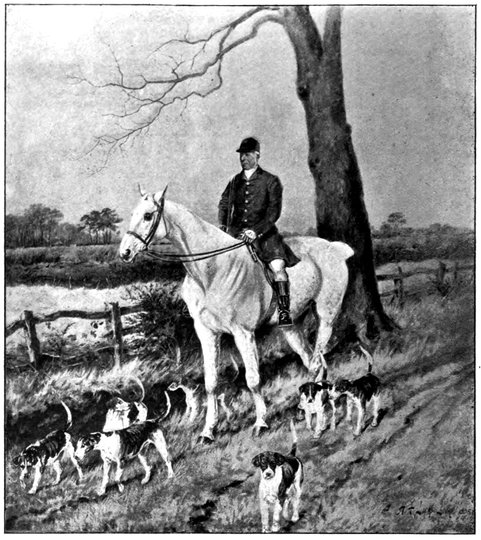
JACK SHEPHERD ON WHITETHORN. From the painting by A. F. Lucas Lucas.]
In the extreme unlikelihood of pelota being introduced into England, seeing that the much more economical open air rackets has been allowed to die, it may hardly be worth while to consider its suitability. But the suggestion has been put forward, so it may be mentioned that all with whom I came into contact who had knowledge of the game spoke of its extreme severity. A game of fifty or sixty points can last along while, and a ball is commonly returned twenty or thirty times in deciding a single point. The keynote to the game is severity, and from this there is no rest from start to finish, the opportunity for finessing with a slow one coming perhaps only once in a game, or not even once. The effect of the stroke with the chistera is very different from that effected with the racket, and exceedingly trying to the player.
As a spectacular game pelota is a great success, one side of the huge building being available for spectators, and the galleries at Barcelona will hold some thousands. The ground floors are occupied by the bettors, who are catered for by regular bookmakers and the pari-mutuel. Such an arrangement would no doubt answer well in England, but we need not think about that.
E. T. Sachs.
Jack Shepherd.
AN OLD HUNT SERVANT.
The accompanying portrait of Jack Shepherd, who for fifty-three years was so familiar a figure with the Fife Hounds, is reproduced from a photograph of a picture recently painted by Mr. A. F. Lucas Lucas as a companion to that of old Tom Carr, a former huntsman of the Bentley Harriers, also the work of Mr. Lucas Lucas. Jack Shepherd has a great record as a hunt servant. Born in 1835, he was very early entered to the work of the kennel, for at the age of 8 years he went to assist his father, who for thirty-five years held the office of feeder to the Fife Hounds. During the fifty-three years that Jack Shepherd was with the Fife there were naturally many changes in the Mastership of the pack; and as kennel huntsman he served under the late Colonel Anstruther Thompson and Colonel Cheape, Colonel Babington, Sir Arthur Halkett, Mr. R. Wemyss, and Major Middleton. In commemoration of his fifty years’ service with the Fife Hounds, Jack Shepherd was presented with a silver horn and a purse of gold subscribed by nearly two hundred of his admirers in Fifeshire. Last year he went as kennel huntsman to the Bentley Harriers, of which Mrs. Cheape is “Master.” It will be remembered that Mrs. Cheape, well known as “The Squire,” hunted the Bentley herself for many years; in fact, until she met with an accident last season. The picture, which was painted for Mrs. Cheape, represents Jack on his favourite mare, Whitethorn, with three and a half couple of the Bentley Harriers—Willing, Racket, Wanderer, Butterfly, Demon, Druid, and Lancelot by name.
The Preparatory School.
The last half century has seen a very great increase in the number of preparatory schools. As demand and supply always depend on each other, it is not difficult to see from this that the practice of sending boys to preparatory schools is becoming yearly more customary, and it must be admitted that this is of the greatest value in laying the foundations of a sound education and healthy constitution.
It is impossible to overrate the important effect which the preparatory school may have upon a boy’s life. It is the gradual substitution of school discipline for the unfettered liberty of home-life, and a gradual hardening process whereby the weakling gathers strength. At the age of eight and a half or nine the bitterness of leaving home is very great, and those who have the misfortune to be sent to a big school at that tender age find the plunge very cold indeed. The preparatory is a sort of half-way house between home and the public school, and not only in the matter of work but in every department of school life it has the greatest influence. The intellect of the average boy, when first he goes to school, is frequently quite frozen, and it sometimes requires several weeks of untold patience and individual attention before the thaw sets in. But not only is the mind of the small boy often in the most primary stages of development, but his physical strength is sadly deficient: and to plunge him suddenly into the midst of a number of boys far bigger and stronger than himself may very likely cause him to overtax his forces and to do himself real physical injury. Further, neither in the class-room nor in the playing field can he hope to have the same individual care and attention which is part and parcel of the preparatory curriculum. It is obvious, for instance, that the ordinary day at a public school is too long for most boys under fourteen years of age, and it is interesting to note that the headmaster of Eton is advocating more sleep for growing boys. Neither is the average boy under fourteen physically strong enough to rough it in the same way as older boys; he has no idea of taking care of himself, and would no more think of voluntarily changing his stockings because they were wet than of voluntarily going to bed because he was tired. When first a boy goes to school he cannot, as a rule, think for himself, and the first service which a preparatory school does for him is to teach him how to think, and the necessity of so doing. It may be argued that a boy will learn to think and act for himself far quicker if he is sent at once to a big school, but this is akin to the argument that throwing a man overboard is the best way to teach him to swim. It must be admitted, however, that there is a tendency nowadays to do too much for the boy, and that feeling of responsibility—which always has such a steadying and beneficial effect upon a boy’s character—is not sufficiently stimulated, owing to the overanxiety of parents and masters.
Perhaps the most charming and fascinating of God’s creations is the manly little boy of three or four years of age, and when first a boy goes to a preparatory school he retains much of this innocent charm. He is, as a rule, simplicity itself, and credulous to a degree, whilst probably at no time in his career is he so impressionable. It is, therefore, not difficult to see that, at no time in his life, is the influence which is brought to bear on him of more vital importance. After four or five years at a preparatory a boy has, or should have, a certain feeling of self-reliance, and a strong feeling of self-respect—two very essential attributes to his character when he enters the larger field of the public school. An excellent feature in the education of the modern boy is that he is continually rising to the top, and having to begin at the bottom again; when he is just beginning to feel a bit big for his boots at the preparatory, he goes on to the public school, where he is nobody, and has to start climbing up again. Arrived at the top he goes, or may go, to the ’Varsity, where again—for a time, at any rate,—he is nobody. Many a man’s character has been spoilt through the rise and fall not being sufficiently pronounced, and it is no uncommon thing to hear it said of a man that he was not kicked enough at school. Whilst a boy’s self-reliance is trained and stimulated, he learns continually that he is not the only person in the world, and that self-assertion is not the golden road to success. It is, however, in the nature of things that the home estimate of a boy should be somewhat different to that which is formed of him at school, and thus a boy frequently fails to realise the expectation of his fond parents. The state of mental ignorance in which some boys come to school is quite phenomenal, and it is no uncommon thing to find a new boy who actually cannot spell his own name or add three and four together. His very ignorance has led him to make droll remarks at home, which have, of course, been regarded as the soul of wit, and by mistaking instinct for intelligence, an entirely false estimate of his capabilities is frequently arrived at. So many small boys dislike reading, but are quite content to be read to—one of the primary causes of backwardness—the result being that when they come to school they have the greatest difficulty in keeping up with the others. It is most unfair, both to the master and to the boy, to send a child to school in this lamentable state of ignorance, and a great deal of valuable time has to be devoted to teaching a boy the most elementary things which are so easily learnt at home. A boy of this description could have little or no chance at a big school with forms of twenty or thirty boys in them, as it would be quite impossible for the master to give him the necessary amount of individual attention, whilst even at the preparatory, his progress is sadly hampered. The effect of this is that he fails to reach the higher forms of the preparatory school, and some of that essential grounding has to be hurried over or skipped altogether.
If, on the other hand, he has learnt to read and write well, and knows his arithmetic tables thoroughly—quite an unusual accomplishment—and has also a slight idea of what is meant by a substantive or an adjective, he has a fair chance of being in the swim, and at the end of his four or five years at the preparatory he will have passed through the different forms, each with their fixed standards, and will have received a thorough grounding which is of the most vital importance to his subsequent work. The usual number of boys in a form being nine or ten, it is easy to see that a master will be able to give each boy a considerable amount of individual attention, and will insist upon his work being very thorough. It is a mistake for boys to be kept at home too long, nine years of age being quite the limit, for unless a boy is exceptionally quick he will not get through the work necessary to enable him to take a good form at his public school, the advantage of which cannot be overrated, as he may otherwise vegetate in the lower forms, and lose all chance of getting to the top of the school.
Next in importance to his mental training, comes the physical development of the boy. That more attention is being paid nowadays to the health and strength of small boys is generally admitted. To quote from a paragraph in the Field of February 10th: “The modern preparatory schoolmaster has for more than a generation introduced greater comforts and more liberal diet for small boys, and the physical effect of it is visible to the eye that can recall and compare the average size of the twelve-year-old school-boy half a century ago with his modern representative.”
The old Spartan idea of hardening boys by a system of roughing it can be carried too far and may have the most detrimental effects. Montesquieu was not far from the mark when he advocated a liberal diet and moderate exercise till the age of twenty-one, by which time a man is fully formed and more fitted to undergo a stricter diet and more violent physical exertion. Till recent years, however, the reverse has been the case; school fare was synonymous with the bare necessities of life, plus the unwholesome concoctions which were eaten at all times of the day at the tuck-shop, whilst most violent exercise was taken immediately after dinner, the one square meal of the day. It is a popular fallacy that a boy has a digestion like an ostrich, but there are many men whose health has been permanently impaired by the trials to which their digestions were subjected when they were boys at school. One has memories of what, in school-boy parlance, were called “stodgers” (being square slabs of warm dough made palatable by a covering of burnt sugar), to say nothing of ices and sweetmeats and such like unwholesome things. Needless to say, the tuck-shop is a thing unknown at the preparatory school.
The ordinary day at the preparatory generally begins at about 7.30 a.m. At some schools the boys are taken for a short walk of about twenty minutes’ duration, with a sprint of a hundred yards about half way to warm them up and fill their lungs with fresh air, but this has the disadvantage of being somewhat dependent on the weather, and therefore liable to be irregular, when it ceases to be beneficial. At other schools it is the custom to do half-an-hour or an hour’s work before breakfast, which, in summer, at any rate, is no hardship, and this has the advantage of lengthening the play hours later in the day. If, however, small boys are to do much work before breakfast, they should have a cup of cocoa or milk before they begin. Breakfast, which should be a liberal meal, is generally at eight or half-past, and in winter this should always begin with a plate of well-cooked porridge. A doctor in the north was once heard to complain that he got nothing to do because “all the inhabitants began the day by putting themselves outside a big poultice of porridge.” If this is followed by either fish, eggs, bacon, or sausages, with plenty of marmalade, there is little danger of colds or chills. Weather permitting, the boys go out for half-an-hour after breakfast in the grounds, or there are classes with easy exercises in the gymnasium—a very necessary adjunct to every preparatory, especially in wet weather. From two and a half to three hours is the usual amount of work done in the morning, leaving an interval of three-quarters of an hour or an hour before lunch. At some schools an interval is taken in the middle of the morning, and work then goes on till dinner time; but the hour or three-quarters of an hour before dinner is very useful, especially in the summer, when the senior boys have cricket practice in the nets and are individually coached by the masters; whilst some of the boys have boxing, fencing, carpentry, or music lessons. Most preparatory schools possess swimming baths, and those boys who are not otherwise employed are generally permitted to bathe before dinner, under the supervision of a master, and nearly every boy learns to swim before he leaves school. The bathe seldom is allowed to exceed five or six minutes. Dinner is always a liberal meal, with plenty of vegetables, milk puddings, and so forth.
In the summer it is sometimes found advisable to work for an hour or an hour and a-half after dinner, leaving the cooler part of the day for cricket, which is continued till tea time. In the winter, on the other hand, the boys change fairly soon after dinner, and play football for an hour (generally Association, which is more suitable for small boys), after which they are free to carpenter, play racquets, or, at some schools, play golf. If the grounds are fairly large, a small nine-hole golf course is very easily laid out, and affords a vast amount of amusement and gentle exercise, and teaches a boy to keep his eye on the ball. Several schools are making little rifle ranges, which should serve a most useful purpose. The training of the eye cannot be begun too young, and every boy should be taught to handle a rifle. Work in the gymnasium should be as light as possible, heavy exercises having a tendency to develop the larger muscles at the expense of the smaller ones, and boys should never be in the gymnasium without someone in attendance. In winter, afternoon school generally begins at 4.30 and continues till 6 p.m., the usual hour for tea all the year round. At some schools the boys do an hour’s preparation after tea, but it is generally found that at this early age they are, for the most part, unable to concentrate their attention on one thing without assistance for any great length of time, and very frequently school continues from 6.30 or 7 till 8 p.m. After evening prayers or chapel they have a light supper of milk and buns, going off to bed about half-past eight. As most boys “live every minute of the day,” they are generally ready for bed and sleep without rocking. To quote from the Field again: “Nine hours between the sheets is not a moment too much for growing boys who have been taxing mind or muscle, or both, from réveille to tattoo, barring interludes of meal times. Among luxuries for the young few are greater than sleep, and none does less harm even when bountifully conceded.”
Every attempt is made at the preparatory to discover and foster any hobby which a boy may have, and the school library will probably contain many books on natural history, engineering, locomotion, electricity, shooting, fishing, sailing, and so forth, in addition to the usual novels. Perhaps no books are in greater demand than those of William J. Long, “Beasts of the Field,” “Fowls of the Air,” “School of the Woods,” and of Seton Thompson; though Rider Haggard, Conan Doyle, Stanley Weyman, and Max Pemberton are great favourites. Kingsley, Merriman, and R. L. Stevenson are mostly read by the bigger boys. Some schools have a small natural history museum, with collections of birds’ eggs, fossils, moths and butterflies; but the small boy has not, as a rule, sufficient patience and perseverance to make him a good collector. Stamp-collecting has many devotees, but by far the commonest hobby is photography, though good results are seldom obtained by the majority. It is also a common idea for boys to have little plots of garden, over which they spend no end of time and trouble; although their industry has frequently little to show for it, a love for flowers and an interest in gardening is often engendered. Anything, in fact, which serves to occupy boys’ minds, and which makes them think, is of the utmost value. The boy who can amuse himself is quite the exception, and it is one of the objects of the preparatory school to teach him how to do so.
In conclusion, it may be said that the chief functions of the preparatory school are the gradual substitution of school discipline for the liberty of home, the gradual training of a mind, generally quite unaccustomed to think, till it is able to understand and think for itself; the gradual development of the body, the encouragement in every form of manly pastimes and interesting hobbies; last, but not least, the engendering of that spirit of self-reliance and self-respect which are the safest armour a boy can have in the battle of life.
Magister.
The Late Mr. John R. Gubbins.
At no time can we afford to lose a good sportsman, least of all at present, when the old type, once common, is now scarce.
That the late Mr. John Gubbins was a sportsman of the truest old Irish type, no one who ever came in contact with him can for a moment deny, and one more generous or open-hearted was seldom met.
The youngest of a large family, son of Mr. Joseph Gubbins and his wife Maria, daughter of Mr. Thomas Wise, of Cork, he was born at the old family seat, Kilfrush, in the county Limerick, in 1839. On Tuesday, March 20th, Mr. Gubbins died suddenly of bronchitis at Bruree House, in the same neighbourhood, having for a long time suffered from general ill-health. He was J.P. and D.L. for his county for many years, was High Sheriff in 1886, and Master of the Limerick Foxhounds for five years previously. In 1899 he married Miss Edith Legh, of the well-known Cheshire family. Mrs. Gubbins died some years ago and left no family.
Settling at Bruree, hunting, coursing and salmon fishing were the sports which “Jack Gubbins,” for so he was always called, first enjoyed, and though always a heavy man, no one in Ireland went better to hounds. He was also a prime judge of the weight-carrying hunter. Some of the best horses the late Marquis of Waterford ever rode came to Curraghmore from the Bruree stable. In the early seventies he was owner of some useful steeplechasers, which were trained by Mr. Harry Lindé at Eyrefield Lodge; and it was pleasing to see how with the best of good feeling these horses were sent to meet in friendly rivalry those of his elder brother, Captain Stamer Gubbins, of Crimean fame. Captain Gubbins at that time had the strongest stable in Ireland and trained at Mountjoy Lodge, with old Dan Broderick as head lad.
Captain Gubbins, who died soon after from the effects of a broken leg sustained in a fall taken while schooling a horse, left most of his property to “Jack.” This included not only the racehorses, but the brood mares and youngsters which he had at his own place, Knockany, a few miles from Bruree, on the best managed and most extensive stud farm then in Ireland.
Reserving a few, John Gubbins sold most of the stud by auction; but there was a small, mean-looking chestnut yearling by Zenophon from Lina Rivers which he kept back, not caring that so miserable a little animal should appear in the sale room. This colt was eventually known as Seaman, who, after winning the Conyngham at Punchestown, the Grand Hurdle Race at Paris, and other great races for Mr. Gubbins, won the Grand National in 1882 for Lord Manners, who paid 2,000 guineas for this quondam cast-off yearling!
Beginning at once, Mr. John Gubbins improved both Bruree and Knockany out of recognition, setting up at the former a second stud farm superior even to the one he inherited from his brother; and it was not long before kennels to accommodate fifty couple of hounds were built on the best possible plan, and therein he started a pack of staghounds. After showing extraordinarily good sport for some seasons, he gave these up in 1881 to take the mastership of the County Limerick Foxhounds, which office he held for five years, giving the greatest satisfaction all round. But Land League troubles being imported into that previously peaceful county, the hunting had to be given up in 1886; the big establishment at Bruree was broken up, all but the stud farm, and Mr. Gubbins in disgust came to England.
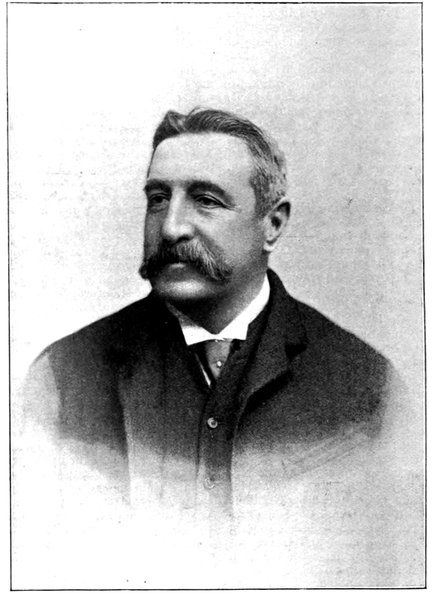
THE LATE MR. JOHN R. GUBBINS. Photo by Walery, 164, Regent Street.]
Leaving with Lindé an increased stud of steeplechasers, including Spahi, Ashplant, Seaman and Usna (the two latter being the best Harry Beasley ever rode), he began hunting in the Shires. To show how he acquitted himself it may be mentioned that after a brilliant forty-five minutes with the Belvoir and a kill in the open, Frank Gillard, on the part of the Duke of Rutland and members of the Hunt, welcomed the Irishman to the country, and presented him with the brush, which from find to finish he had truly earned. This brush, with inscription under, now hangs at Bruree.
Inheriting another large fortune from an uncle in Cork, the subject of this notice soon after started to race on the flat in England, giving up hunting through increasing weight and continued attacks of gout. It is impossible here to enter upon the achievements of John Gubbins on the Turf—besides, are they not matters of general knowledge? Suffice to say, they were brought about at first from the stable of Jousiffe at Lambourne by such horses as Stars and Stripes, John Morgan, Bruree, Marietta, Toffey, Kinsale, Improver, Holycross, Palace Gate and others, all bred at the home farms. But it was not till the horses were sent to Sam Darling, at Beckenham, that the summit of this sportsman’s ambition was reached. From that stable were sent, amongst other good ones, Blairfinde (own brother to Galtee More), Kendal Boy, St. Jacques, St. Valentine II., Revenue, and Port Blair. While there also were prepared the great Galtee More and the still greater Ard Patrick, whose names, by the way, are taken from those of the highest peaks of the Galtee Mountains, which overlook their paddocks.
It may be recorded that the race for the Eclipse Stakes at Sandown in July, 1903, when Ard Patrick, ridden by Otto Madden, beat at sex allowance the mighty Sceptre, both of them leaving that year’s Derby winner, Rock Sand, lengths in the rear, ranks amongst the finest contests ever witnessed on a racecourse.
These horses, one the “triple-crown” winner of 1897, the other the Derby of 1902, after winning in stakes £27,019 and £26,616 respectively, were sold, the former to the Russian Government, the latter to the German, for £21,000 apiece. And it may be stated that when in May, 1898, representatives of the Russian Government came to this country purposely to buy a really high-class thoroughbred stallion, after looking over every one that was for sale (and others which were not, such as St. Simon, Carbine, Cyllene, and Galtee More), they came to the conclusion that not one could compare with the Irish horse. It was with the utmost difficulty Mr. Gubbins was persuaded to sell the celebrity.
Knowing that Kendal had on two occasions beaten Ormonde in trials, Mr. John Gubbins bought him at a good price from the Duke of Westminster in the early nineties, and sending him to his stud at Bruree, the son of Bend Or and Windermere got winners with quite phenomenal success. After a few years he was sold to Mr. Platt for £18,000, with free service of mares, which brought the amount to nearly £20,000. So with the income he earned as a sire in Ireland at a fee of £200, Kendal must have done as well for Mr. Gubbins as did either his son Galtee More or Ard Patrick, who was from Galtee More’s dam, Morganette, but by St. Florian, the horse bought to take the place of Kendal. In fact, besides being one of the most successful owners ever known on the Turf with regard to stakes won, he was one of the most successful breeders, for almost all his horses were bred at home, except the stallions, Morganette herself coming from his mare, Lady Morgan. With the sum of £22,739 he headed the winning owners in 1897, and as he always backed his horses he had reason to be grateful to the Parnellites for driving him out of Ireland!
The good nature of this fine old Irish gentleman was such that never would he refuse information to any one as to his horses, the absolute stranger being as welcome to ask it as the dearest friend. It is not surprising, therefore, that no more popular colours were than the never-to-be-forgotten “violet with crimson buttons and crimson cap.” And when Ard Patrick won for him his second Derby, the generous owner not only made suitable presents to those directly concerned with the horse, but gave double wages for a month to all the employees he had at home, while he remitted a half-year’s rent to all his tenants.
In his young days he was himself a good man between the flags, winning the Downshire at Punchestown, on Fairyland, in 1870, carrying 13 st. 8 lbs., as he did the Welters at both Cork and Downpatrick, on a horse of his own, D. P. S. But it was with one of the brothers Beasley as jockey (generally poor Tom) he won nearly all the big steeplechases in Ireland and several in England; while if Usna, with Harry Beasley, had not met with the accident at the canal turn, through over-jumping, the Grand National of 1888 might have been won by Jack Gubbins’ horse. Seamen, also with Harry Beasley, won the Grand Hurdle Race at Paris in 1881; and when Whisper Low won the Grand Steeplechase there the year after, steered by Tom Beasley, Gubbins was half owner.
Strange to say he did not care much for racing in itself unless he had a horse engaged, and had been known to go salmon fishing in preference to visiting Punchestown; while in July, 1903, rather than go and see Ard Patrick win the Princess of Wales’ Stakes of £10,000 at Newmarket he went to the Gordon-Bennett Motor Race in Kildare. He was a good, practical yachtsman, and fond of coursing, but did not care for shooting.
Owing to failing health and more frequent attacks of gout Mr. Gubbins retired from racing after the sale of Ard Patrick; and at the Newmarket Second July Meeting of 1904, his horses in training were sold, the twenty-seven lots fetching 14,920 guineas. Last autumn, however, finding himself better, he sent a batch of yearlings to his friend, Sir Charles Nugent, at Cranbourne, and so promising were some that nominations were freely taken; but now, alas, their sportsman-owner is no more, and these become, through a curious rule, null and void.
At Punchestown, at the end of April, four Irish sportsmen will be missed, than whom four better never visited there—the late Baron de Robeck, John Hubert Moore, Tom Beasley, and Jack Gubbins.
P.S.—Just as the foregoing was sent to the printer news came of the death, on April 4th, of the greatest friend and life-long comrade of Mr. Gubbins, his brother-in-law, Wray Bury Palliser, of Annestown, County Waterford, J.P., D.L. He was the same type of old-time sportsman, and a genial, jovial companion; loved racing, but never owned racehorses, and in his day was a first-rate man to hounds, well-known in the halcyon days of Curraghmore.
H. S.
Dressing Flies.
Cocking may be (I do not say it is) a thing of the past, but what possibly may not be generally known is the keen interest fly-fishermen still have in the preservation and continuation of certain varieties of the old fighting breeds of English game. Many find it adds pleasure to the delights of catching fish to capture them with flies of their own making, and several of these (all amateurs) can and do turn out at the present day better work than has ever before been seen. But to achieve this the right material must be to hand, and from the start difficulty will be experienced in procuring hackles of the right colour, texture, and—most important in the case of chalk-stream fishermen—size. For frequently the July and August trout is not to be beguiled in the mid-day heat by anything bigger than a 000 hook, and the barnyard fowl wears no feathers that will hackle this; its fibres are much too long. Dyeing is largely resorted to to obtain with less trouble the exact hues required, but this does not entirely get over the difficulty, as the commoner red and ginger hackles will not serve as the groundwork for, say, a pale olive, and the blue, the honey and other light-coloured duns are just the ones that are most difficult to lay hands on. So it comes about that to mention blue dun game in the presence of a fly-tier produces much the same effect as the word “rats” does on any well-brought-up terrier.
At the present time, if the dun game varieties are wanted the best localities to search are the West of England, from Cornwall and Devon, through Wales to Cumberland, a circumstance which it is somewhat tempting to endeavour to connect with the driving into these parts of the British, amongst whom, as we know, the Romans introduced cocking, but this must be left to the antiquarians; probably it is only a coincidence due either to the presence of many fishing waters in those districts, or to the fact that in out-of-the-way England old customs died hard, and the law against cock-fighting was not so stringently carried out as in the counties more immediately under the eyes of the lawgivers, whereby the breeds have lasted longer there.
Gervase Markham, who wrote in the early part of the seventeenth century, had a poor opinion of the duns, but his strictures on their merits as fighting birds are not upheld by Robert Howlet, himself an author of an angling book, who writes, in 1807, that as to colour of cocks “there is nothing in it, for the world affords no better birds for the game than many of your duns and whites prove.” However, in most lists made out in order of merit this colour comes at the bottom, which perhaps accounts for the little space devoted to it in the literature so far consulted. I quote Mr. Harrison Weir’s description of the breed as far as regards plumage: “The truest and most rare” (of the duns) “is the blue dun, and these are sub-divided into light and dark. The hackle of the cock bird should be of an intense indigo-blue, and very bright, also the back and the tail-coverts; the wing having a distinct bar; the breast and thighs, as well as the tail, of a beautiful blue dun colour; the face red, with a dark rim round the eye, or dark eyelid; comb and wattles a brilliant vermilion.”
By diligent search specimens of these birds may still be found and procured, though in most instances only at the expenditure of much diplomatic skill and suasion, including that which is not allowed at election times, for if the owner supplies the trade he naturally is interested in limiting the supply and keeping intact a little “corner” of his own; if, on the other hand, he is a breeder by family tradition, money is little likely to induce him to part with his best. Still, perseverance does wonders, and either by getting sittings of eggs, or by picking up individual cockerels and pullets at prices such as are asked from hunt secretaries and treasurers of poultry funds, several enthusiastic fishermen are just now making a beginning at breeding on their own account.
It must not be thought that this is a new departure, for within the last thirty years two poultry shows, one at the Crystal Palace in 1871, and another at the Westminster Aquarium in 1892, have been held, at which prizes were offered both for hackles suitable for fly-dressing and for the birds which yielded them; but at this moment fresh interest seems to be aroused, more and more men are learning to tie, and thereby induced to breed, so that it should not be long ere such prizes shall be again competed for at the big poultry shows, which will by this means attract a visit from many to whom otherwise a fowl presents no points of interest except at meal-times.
Many of those engaged in poultry breeding know nothing—have never heard—of the blue dun game or of the demand for it and the kindred varieties, though they might do worse than run a pen or two of them, only bearing in mind that, though at present the demand is not met by the supply, at no time will it ever be very large or of a size to make game fowl breeding by itself a profitable commercial undertaking.
Besides shortness of fibre the other peculiar merits of the game hackles are their brilliancy, hardness, and ability to shoot the water. They are best obtained from a mature cock in the pink of condition (in cocking days this would have been the eve of a match), during the last two months of the year, except in the case of dun hackles, which are blue at Christmas, but before the autumn moult have golden tints. Of course, now that paraffin is used by the waterside, hen hackles are by no means to be despised, indeed, some tiers care little which they use provided they come off a game bird.
One and not the least advantage of being able to tie his own flies himself is that it enables the fishermen to judge of the work put into those he buys, and to put his finger on the exact material that is wrong when patterns are not copied accurately. This is not infrequently the case, and a good fly gets a bad name, most undeservedly, in consequence.
H. L. T. P.
Navicular Disease.
By Professor J. Wortley Axe.
There is no disease which so seriously affects the feet of our horses as “navicular disease.” Its commencement is subtle and its progress so insidious that it is only when the malady has reached a dangerous condition that it becomes known to the ordinary horseman. At this stage veterinary aid is usually sought, with the result that the owner has to be told that nothing can be done in the way of cure and very little towards stemming its onward progress. Why, it may be asked, do we occupy the pages of this Magazine with a subject so absolutely devoid of matter to which attention can be profitably directed. Our reply is that if little can be done in these directions we are not without hope of ministering to its prevention, and for this we claim some justification for so far imposing on our readers.
Before the days of Moorcroft and Turner navicular disease, although much in existence, was not recognised by the profession, and the lameness arising out of it was referred to the shoulder, with no other reason, save that indications of disease were not detected or detectable in other parts of the limbs. Then, as now, the feet of horses were noticed to contract, and when this condition was found to exist the lameness was attributed to it, and it alone. No one seems to have thought to look for the cause of contraction, and thus to trace the fons et origo mali, but all remained satisfied that the lameness arose from the pinching of the sensitive structures of the foot by the contracting hoof.
No doubt in some measure this was true, for it is impossible to think of a normal state of the sensitive parts of a structure like the foot being enclosed within a small and contracted hoof. As a secondary cause, therefore, contraction would be sure to make itself felt sooner or later by diminishing the size of the foot and interfering with the play of the parts within.
The peculiar stilty action which this disease induces brought into use the term “chest founder.” This term was meant to convey the idea of pain in the muscles of the chest, where the disease giving rise to it was supposed to exist, and it was not until Moorcroft and Turner traced the disease to the navicular bone that these meaningless terms ceased of employment, and the much more rational one, “navicularthritis,” came to be used in their stead. Whether this term is an appropriate one or not may be open to question, but it locates the disease, and in this respect it is distinctly useful.
Causes.—We cannot speak of the cause of navicular disease without referring to the influence of heredity. There can be no doubt that the property of transferring to the offspring the weakness inherited by the parent is just as marked in this as in any other affection, and the writer, in a long experience, has seen numerous instances of the disease handed down from the latter to the former. It must be understood that the transmission of hereditary taint or predisposition is what is understood here by hereditary disease. It is not that the disease in an active state is born with the animal, but that the parts are in that condition in which the disease may be easily excited in them by causes which would not affect an animal who was not the subject of hereditary weakness. It must not however, be stated that because a horse inherits a predisposition to navicular or any other disease that he should necessarily contract it. A good deal will depend upon the degree of intensity of the inheritance on the one hand, and the severity of the cause which acts upon it on the other. If it exists in such form as to be easily excited into action, it is not unlikely to appear, but where the hereditary predisposition is only possessed in a mild measure the animal may not meet with a cause sufficiently severe by which the predisposition can be made to assume an active state.
Exciting Causes.—They are numerous and varied. Conformation, action, shoeing, weight of body and general management, all play their respective parts in causing the disease.
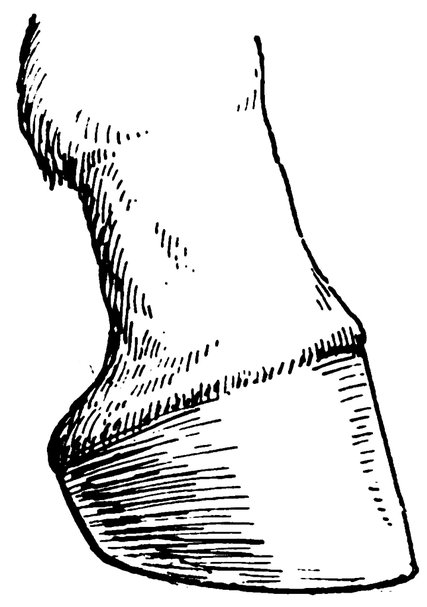
Side View of Healthy Foot.
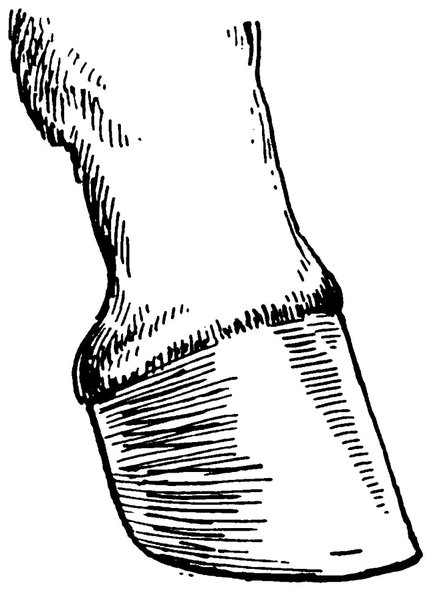
Side View of Diseased Foot.
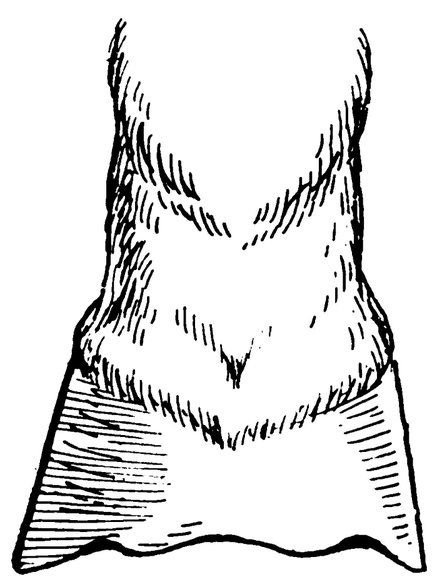
Back View of Healthy Foot.
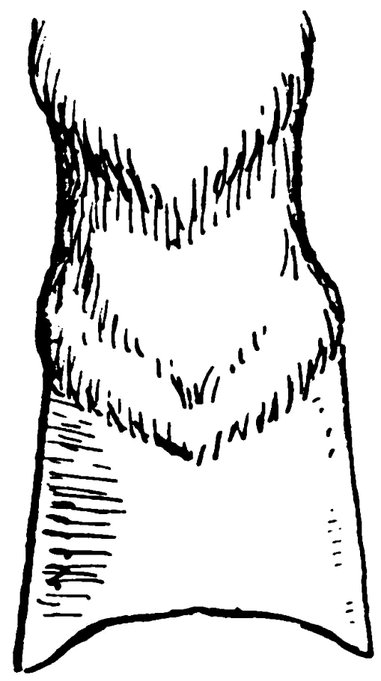
Back View of Diseased Foot.
As to conformation, it would seem that the more upright the parts below the fetlock joint, the less elasticity they present, and the more do they assume a mere column of support. In this case the weight of the body falls more directly upon the navicular bone, and the absence of that elastic recoil afforded by the oblique pastern tends to excite disease in it.
Action.—This will commend itself as an exciting cause to anyone who will watch the movement of different horses. The animal who lifts his limbs high in the air and brings them down again almost in the place from which he took them is much more likely to contract the disease than the horse whose movements are less exalted and more progressive. Especially is this the case if the body is loaded with flesh and the horse is in soft condition.
Shoeing.—Notwithstanding the very great benefits which have resulted to shoeing smiths from recent efforts in their behalf by Agricultural Societies and County Councils, there still remains much to be done ere we can claim to have placed the shoeing of horses outside the causes of navicular disease.
It is perfectly true that the impression left on the mind of a visitor to agricultural shows where shoeing competitions are in evidence is usually assuring, but it gives no idea of the general unfitness of the great bulk of the craft to follow the chosen calling of their lives. This is said in no want of respect for the shoeing smith, but rather with the object of drawing attention to him as a much-neglected individual, and one who is always thankful for anything that may be done for him in the way of education.
Paring the sole, the frog and the bars are all still in evidence both in town and country, but it is not always the wish of the shoeing smith that it should be so; too often it is the wish—nay, the will—of the owner or the coachman that the feet shall look smart, and in order to do this the smith abandons his better knowledge to “oblige.”
Nothing tends so much to lay the foundation for navicular disease as the repeated mutilation of these parts in shoeing. The sole, the frog and the bars are together designed among other things to keep the heels apart and protect the sensitive structures within, and notwithstanding this there are still those who for reasons of their own continue to disregard this very obvious truth and to insist on their horses’ feet being cut out of shape and weakened to the last degree. It is never given a thought that thickness of sole and frog is a defensive quality, and to cut them is to weaken them and to expose the parts within to pressure from without. Apart from bearing their share of the weight of the body, the bars are specially intended to keep the heels open and to maintain a healthy state of the foot, which cannot possibly exist where they are repeatedly cut away in the act of shoeing.
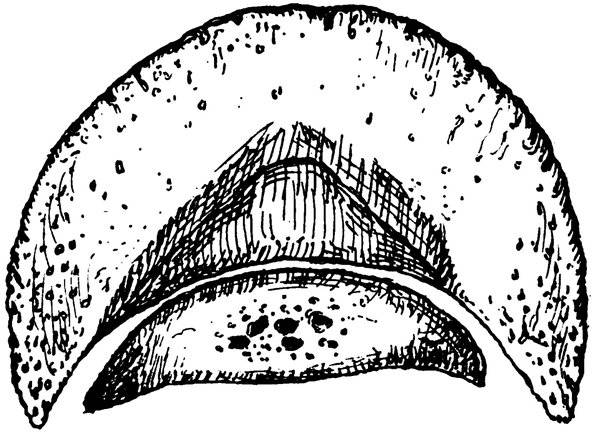
Navicular Bone.| Showing Small Ulcers invading its Structures.
Calks, and such means as are adopted to remove the frog from the ground, operate unfavourably on the feet, and especially where mutilation is part of the operation of shoeing.
Contraction of the foot not infrequently results where the hoof is allowed to grow unduly long and the frog is removed from the ground, or where, as the result of injury to some part of the limb, the foot is rested for a long period. Whether the result of the one cause or the other, it is a condition which, if not carefully rectified by shoeing, may excite navicular disease.
It is comparatively seldom that navicular disease is found to exist in the hind feet, and the preference which it shows for the fore ones may possibly be found in the difference which exists in the conformation of the limbs. The straight fore-leg allows the weight to fall directly on to the feet, while in the hind one it is first broken and diffused in passing through the angle forming the hock, so that by the time it reaches the foot the sharp edge of concussion is removed and the foot escapes the injury which is inflicted through the straighter column in front.
Prevalence of the Disease.—As to the horses which suffer from this affection, it may be somewhat difficult to say in which particular variety it is most prevalent. Between the light and heavy horses there is a great difference in favour of the latter, although since they have been called upon to do so much trotting work the malady has increased in the same proportion. There is a much greater number of cases among harness horses than any other description, but it must not be forgotten that they are the more numerous. And on this account we should look for more cases than are to be found in the other varieties.
Hunters are frequently found to be affected by navicular disease, although their work is for the most part over soft, yielding ground. These animals suffer most when made to jump from high banks into roads, especially when the muscles are tired and have lost much of their power. In these circumstances the full weight of the body falls upon the feet, with the result that the navicular bone may suffer by impact with the ground and become the seat of disease. But apart from these special accidents, hunters become subjects of the malady as the result of constant wear.
The racehorse, as such, is comparatively seldom the victim of this affection. So long as he is in training he is constantly on the turf, and at an early period is relegated to the stud, and ceases to be exposed to the causes by which the disease is excited. If, however, he does not himself contract the malady, his peculiar habits of life have a tendency to weaken the feet and to predispose his stock to contract the disease. In this way he becomes a factor in its propagation. His constant absence from the hard road does little to encourage the secretion of a thick, strong horn, and to impart to the feet that flinty hardness so much to be admired in a sire. “No foot, no horse,” is an axiom as true to-day as it was when first formulated by Lafosse. This is not said to prejudice the thoroughbred, for which the writer has a very high regard as a sire both of hunters and harness horses, but rather to hold out the caution to those who use him.
Symptoms.—There are few diseases in which the symptoms are so obscure and ill-defined in the earlier stages as they are in navicular disease.
The situation of the injured part forbids that inspection and manipulation which we may readily apply to other diseases, and there is too frequently no visible effects of the injury to guide the expert, but only an insidious and slowly progressive lameness.
It is more than probable that for some time the owner will be in doubt as to whether there is any defect at all. The only change observable to him is an uneasy sensation experienced when the horse is ridden in his fast paces. Soon, however, the defect becomes obvious in one leg or the other, and later in both.
At this time careful search may or may not discover visible contraction of the diseased foot. This condition, however, soon follows on by resting the foot in the stable or relieving it when at work. In the former case it is partially flexed and advanced more or less so as to take it away from the bearing, and in the latter the heel is kept as far as possible from the ground, and the weight is thrown on to the front part of the foot. All the changes which follow upon this are in the direction of contraction of the heels, and as this takes place the foot narrows behind. With the progress of the disease and the constant use of the sound foot it also begins to show signs of trouble, and the lameness which had hitherto been confined to the one now appears in the other. Knee action becomes defective, the step is short and “proppy,” or, as it is commonly expressed, “groggy.” On leaving the stable the horse is very lame, but as he continues to move the lameness in great measure passes away. The fore limbs are now upright, or he stands over at the knees, a fulness appears in the hollow of the heel, the foot becomes blocky, and the crust thick and dense, the sole is unusually concave, the frog wasted, and may be affected with thrush.
Treatment.—It may be accepted as true that once the disease is started its progress continues, and sooner or later brings its victim to the knacker’s.
In some horses the malady makes slow progress, but in others it is rapid and destructive. If the disease cannot be cured by the adoption of palliative treatment, much useful work may be obtained from an animal affected by it. When navicular disease is known to exist, special attention will, of course, be given to the shoeing. Here much may be done to keep the disease in check.
We see by the concavity of the sole and the contraction of the heels that the latter have not been allowed to come to the ground in the ordinary way. This is the keynote to which attention must be directed in regard to treatment. The heels must be defended by slightly thickening the shoe at this point, and the introduction of a leather or india-rubber band to break the jar on concussion.
The crust must not be allowed to grow unduly, but must be kept down by occasional rasping. By doing this, contraction of the foot is to some extent prevented, and the conditions of its elasticity preserved.
When in the stable a cold wet swab should be worn; it softens the hoof, prevents contraction, and enables the animal to work with comparative ease. Horses with navicular disease, especially those advanced in years, should be kept at work. Of all occupations none suit these animals like working on the land, where the feet meet with the least resistance. Mild counter-irritants to the coronets while still working may be applied, but on no account should the animal be allowed a “long rest,” during which he loses condition, and with it all the courage by which he has been enabled to “suffer and to work.”
The last and final act in the treatment of navicular disease is division of the plantar nerves.
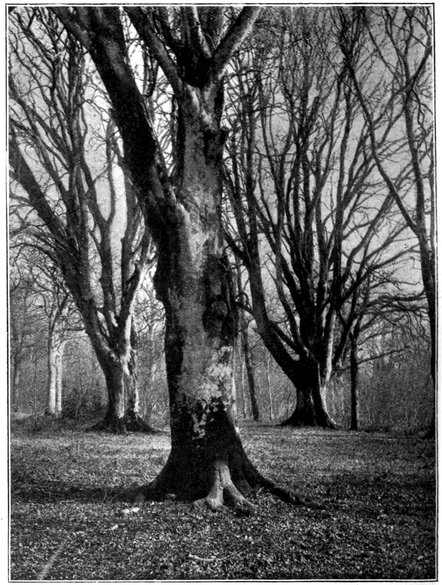
THE BEECH.
The effect of this operation is not to cure the disease, but by severing all connection with the brain, to prolong his working powers. This done, the animal ceases to feel the pain which troubled him before, and commences to use the diseased foot without giving it the slightest protection. The lameness, which was evidence of the care he bestowed upon it, passes away, and the foot, weakened by disease, resumes the work it did when in a sound condition. This tends to aggravate the mischief, and sooner or later to bring him to the hands of the knacker.