UNDER-DEVELOPED NEIGHBORS—THE UPPER MISSISSIPPIANS (1100?-1600 A.D.)
Reading edition
Less advanced Mississippi tribes with customs showing some admixture of Woodland cultural elements living contemporaneously in Missouri, Iowa, Wisconsin, Indiana and Ohio, encircled the Middle phase peoples on the east, north and west. Known generally now as the Upper phase peoples their sole representative in Illinois was the people of the Langford subculture, who dwelt around the southern end of Lake Michigan as well as in adjacent parts of Indiana and Michigan. The type station is the Fisher Village and Mounds near Joliet which were ably investigated by Mr. George Langford, Sr. some years ago.[16]
43
They built no flat-topped pyramids and left little, if any, evidence of their religious practices. Their art, as exhibited by pottery, personal ornaments or weapons was not of a high order. There is no evidence that they played the chunkey game. Some copper hatchets and ornaments were in use, but these appear to be of Middle Mississippi workmanship and may have been trade articles.
On the positive side, they buried their dead in dome-shaped earthen mounds, usually in the extended position, frequently with food (in clay pots with shell spoons), weapons (arrows and tomahawks or hafted celts), personal ornaments and various utilitarian implements. Dwellings had subsurface circular floors and were doubtless dome-shaped (hemispherical). The bow and arrow were in common use with arrowheads primarily of slender simple triangular shape, very rarely with side notches. Implements, weapons and ornaments were chiefly of chipped flint, ground or polished stone, river clam shells, bone and animal teeth. Copper was rarely employed.
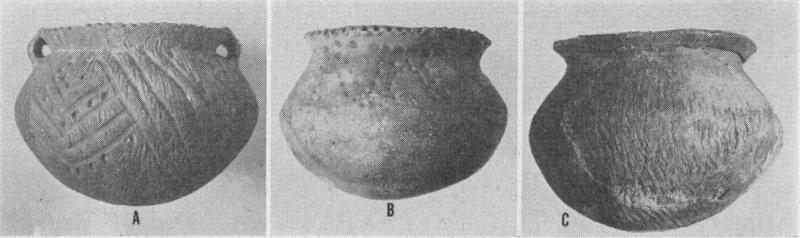
Fig. 30. Characteristic pottery from the Langford subculture, Upper Mississippi phase, (Fisher Site near Channahon, Illinois). (Photograph by George Langford, Chicago Natural History Museum.)
Pots were generally of the globular or flattened globular shape (olla or jar), tempered with grit (early) and shell (later), and decorated with geometric designs in broad lines and dots, drawn (“trailed”) or impressed on the shoulder region with a blunt tool (such as an antler tine). Lips of vessels were usually pressure-notched and surfaces cord-roughened. Loop handles on the jars were common.
Numerous examples of flat stone tablets associated with a number of short solid antler cylinders lead one to suspect that a game of chance of some sort was played and that gambling was probably indulged in.
Other than pottery and personal adornment, the only art practiced was the cutting of mussel shell into handled spoons and outlines of fish and other objects. Apparently there was no urge for fine workmanship.
It is highly probable that these Upper Mississippians were plant growers who hunted to secure their meat. The extent of village remains and the evidence of semi-permanent dwellings point to this type of economy even though no grain or seeds of any kind were found in 44 the site. Shell hoes of the common type were used. The dog was the only domesticated animal.
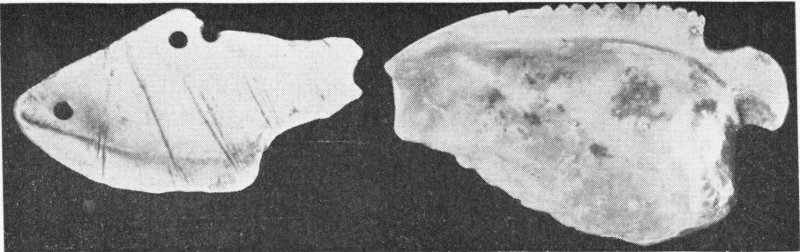
Fig. 31. Effigy fish and a decorated spoon (fragmentary) made of mussel shells. Langford subculture, Upper Mississippi phase (Fisher site). (Photograph by George Langford, Chicago Natural History Museum.)
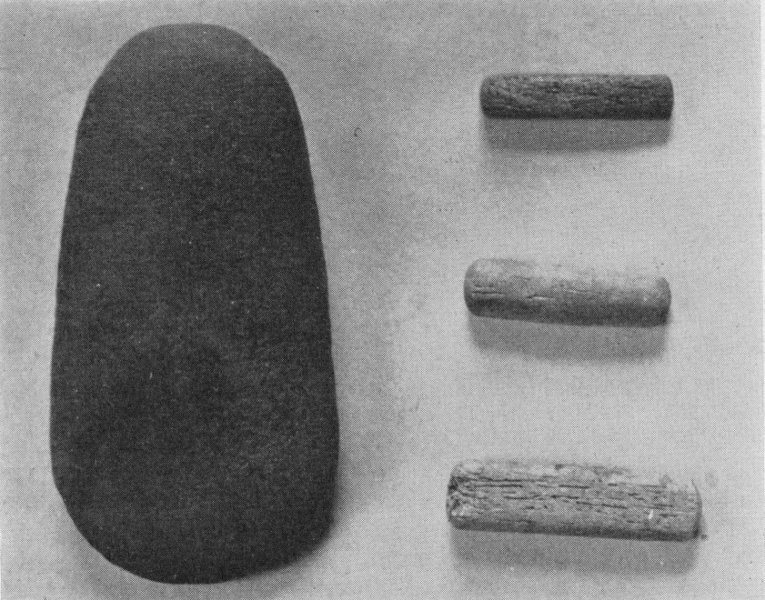
Fig. 32. Stone tablet and gaming pieces from the Langford subcultural period, Upper Mississippi phase (Fisher site). (Photograph by George Langford, Chicago Natural History Museum.)
Apparently most of their needs were supplied by their own efforts and from local sources. There is no evidence of any trade, except possibly of a very limited kind with near neighbors to the west.
The evidence for the residence around the southern lake shores is based chiefly on the occurrence of the Fisher pottery type. This area after 1760 was occupied by the Miami tribe who may possibly have been the builders of the Fisher Mounds.
45