THE HOPEWELLIAN CIVILIZATION[12] (500 B.C.-500 A.D.)
Reading edition
THE HOPEWELLIAN CIVILIZATION[12] (500 B.C.-500 A.D.)
Toward the end of the Initial Woodland period maize or corn, as we call it today, was introduced into northern Illinois, presumably from Mexico and Middle America through the agency of intervening tribes. In an apparently short time, its production seems to have been greatly intensified and exploited. Other food crops and tobacco may have accompanied maize.
About the same time, a formalized religion arose, probably concerned with the worship of deities who personified natural forces like the sun, rain and thunder, which were important to a plant-growing people. From the evidence of burial places, there seem to have been two or possibly three social classes. Doubtless the first comprised the families who introduced and grew the new food plants and who were inspired to invent the complex religion. The burial of the dead, especially those socially important and of the highest class, was accompanied by elaborate and colorful ceremonies closely bound to the religion. This seems to be a continuation in grander form of the earlier Red Ochre funeral and burial. It is unfortunate that we do not have tangible evidence of their other religious and political ceremonies which may have been even more impressive and significant. The official dress and insignia of the officials, which we can barely glimpse in the rich and varied remains in the tombs, signify a political system of social control and an established priesthood for the spiritual guidance of the community. Shamans or medicine men probably had only the duty of treating disease. Reverence for and possibly worship of ancestors is suggested by the impressive tomb chambers and mounds and the care obviously bestowed on certain of their socially prominent dead.
Social and political prestige, religious pomp and ceremonial, all seem to have combined to stimulate a demand for rare materials, beautiful jewels and impressive regalia. This initiated the search for pearls at home, the development of skillful and artistic workmanship in flint, bone, shell, copper and mica, travel abroad and trade in materials obtainable only in distant regions.
Aside from those technologies connected with the growing of plant foods, probably few new crafts appeared in the culture; rather those 27 already, existing in the Initial Woodland were raised to a high degree of excellence. Art in several forms flourished—carving in the round and in relief, the making of fine symmetrical polished, decorated and painted pottery commonly called typical Hopewellian, hammered copper jewelry, the setting of pearls and highly-colored native stones as eyes in sculptured animals and in bear-tooth pendants and ear ornaments, etching of delicate designs, naturalistic and conventional, on bone and the modeling and firing of exquisite statuettes in clay. We admire and wonder at the excellence of execution in the best of their small sculpture because they are skillfully fashioned and finished and because they so accurately portray the characteristics and habits of animals with which we are familiar. The artist had the crudest of tools to aid him—rough stone hammers and an anvil for pecking stone to the general form; sandstone files or abraders; clay and water to polish pieces; flint and tubular drills for boring; and flint knives to cut and engrave pottery and bone—in spite of which the best craftsmen well knew how to bring out the beauty of the piece.
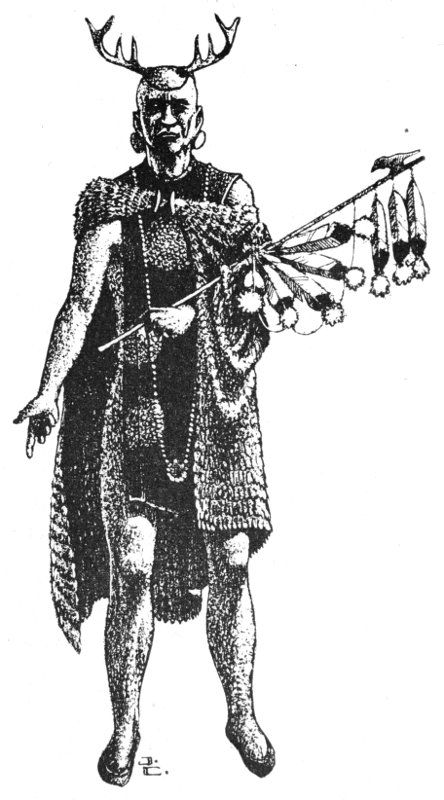
Fig. 17. Artist’s idea of a Hopewellian chief or high priest in full ceremonial regalia. (J.C.) Evidence for dress (except for calumet) has been found in Illinois.
28
For the first time in Amerindian history in Illinois we become aware of an accumulation of wealth, a surplus of handmade goods over and above those needed for survival; many of these were neither well-suited nor intended for immediate physical needs, but rather were aimed at social display or spiritual enhancement. Wealth reflects a relatively constant and abundant supply of food and other necessities and the resulting accompaniment of considerable leisure time for a sizable portion of the community. It may also mark the beginning of craft specialization.[13]
It is hardly necessary to add that, if such a profusion of grave offerings as indicated by Hopewellian tombs—feather cloth robes, pearl necklaces, copper hatchets, and beautifully fashioned art objects—were left with the dead, that the high political and religious officers were correspondingly bedecked in gorgeous apparel for civil and religious ceremonies.
Nor should sight be lost of the fact that these creations and materials, so commonplace and inexpensive today, were to the Hopewellians as valuable and highly desirable as gold, silk, and precious stones are to us in Western civilization. For a better perspective these tomb offerings should be compared with objects usually found in camp and grave sites of the Initial and Final Woodland peoples.
Traders may have gone to distant regions to select and barter for raw materials, to the Lake Superior region for copper, to Ohio for pipestone, to the south Atlantic and Gulf Coasts for the small Marginella and Oliva shells, for the larger Cassis and Busycon shells, and to the Yellowstone or Mexico for obsidian (of which little is found in Illinois graves). Trade, to some degree, removes the limitations imposed by the immediate surroundings. Pearls were secured in quantity from the clams of the native streams. Bone, antler, tortoise and clam shell, bears’ teeth, bear, wildcat and wolverine jaws from their hunting and collecting pursuits were utilized more fully than ever before. Even human jaws, possibly of enemies, were cut, polished and bored for use as pendants.
Though the Hopewellians may not have been the pacifists they are sometimes painted, there must have been long periods of peaceful relationships with distant and nearer neighbors with whom they traded or through whose territories their traders had to pass. Whether or not a condition of peace was maintained within the borders of their culture area by the force of arms is an interesting question that cannot now be answered.
29
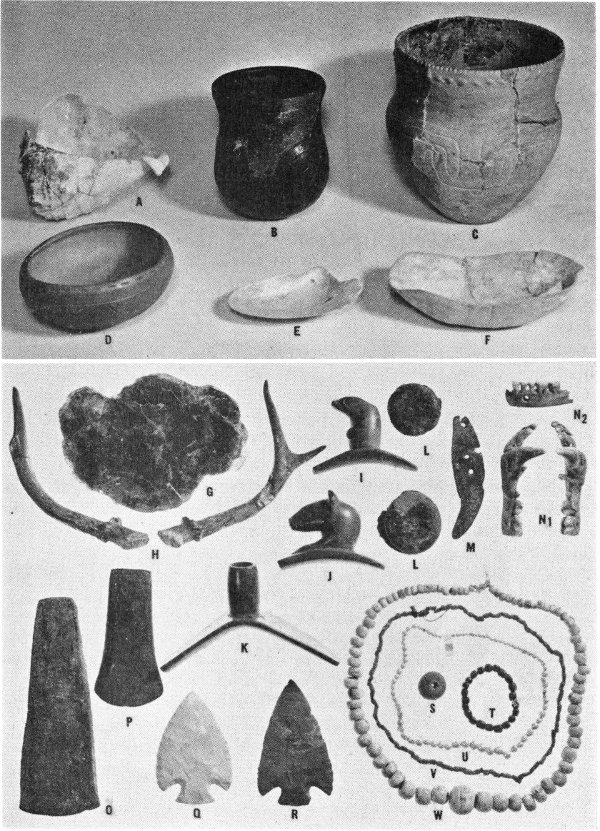
Fig. 18. The Hopewellian assemblage of artifacts that collectively identify the Hopewellian (Classic Woodland) period and, except for shell spoon, turtle shell dish, and some bead types, distinguish it from the other Woodland assemblages. A, drinking cup of marine shell (Cassis madagascarensis); B, C, D, Hopewellian pottery (restored); E, mussel shell spoon with “handle”; F, turtle shell dish; G, sheet mica (mirror?); H, antler headdress; I, J, platform pipes with effigy mammal bowls, polished stone (Otter and bear’s head, eyes set with copper pellets); K, platform pipe (plain bowl), curved base, polished stone; L, copper earspools or ornaments, pair; M, imitation bear tooth, copper; N, (Below) N₁, Bear jaw, cut in half, ground and drilled to be worn as a double pendant; (Above) N₂, Fragment of a human jaw that has been similarly treated; O, copper hatchet that carries imprint of textile on its surface; P, copper adze; Q, R, Hopewellian spearheads; S, massive bead of copper; T, bracelet of copper beads; U, necklace of pearls; V, necklace of copper beads; W, necklace of graduated ground shell beads from columella (central column) of marine shell.
30
In southern Illinois the advance of Hopewellian culture was slower. The infiltration of new pottery styles noted at Crab Orchard very possibly represents intermarriage with Hopewellian women. Possibly through ties of relationship and the acceptance of the new food plants, the old Baumer way of life was submerged by the Hopewellian customs though here and there former habits still are recognizable. Some customs of Baumer and Crab Orchard were adopted by the northern Hopewellians—the reel-shaped gorget, the plummet and the chipped stone hoe.
In the north of Illinois, Hopewellian lasted until 250 A.D. (Poole site) and in the west and south to about 450 or 500 A.D. Though the culture died out in Illinois by 500 A.D., it still flourished in Mississippi (Bynum site) around 800 A.D. and at Marksville, Louisiana, as late as 850 A.D.
As was stated earlier, emerging cultures grow out of earlier ones. Although it may not yet be generally recognized, the Hopewellian civilization probably exerted tremendous influence on the Mississippi cultures and on tribes that followed them in the great central valley of the United States and beyond, down to historic times. It must be borne in mind that in spite of their splendid achievements, the Hopewellians had no domestic animals but the dog, no herds for meat and great wealth, no draft animals to drag the plough and turn the mill. All labor was “by hand,” all transport on the back or in a boat driven by human power.