PALEO-INDIANS, BIG GAME HUNTERS, DISCOVER A NEW WORLD (50,000? to 8,000? B.C.)[5]
Reading edition
PALEO-INDIANS, BIG GAME HUNTERS, DISCOVER A NEW WORLD (50,000? to 8,000? B.C.)[5]
Man probably discovered America as early as 50,000 years ago and gradually occupied the two continents in the succeeding millenia. The first discoverers of the New World were of Mongolian racial stock as are the American Indians. They crossed from Siberia to Alaska over an existing land bridge, over ice, or possibly by wading or by boat over the shallow sea in the wake of mammoth, mastodon or musk ox herds on whose flesh they lived. Following in the path of the huge animals, they made their way possibly up the Yukon from its mouth to the divide, thence down into the Mackenzie Basin, and along a great river where now exist a chain of lakes and so into the Mississippi Valley.
The migrants trailing each herd doubtless traveled in their several ways in family groups, uniting from time to time to trap and kill one of the great shaggy beasts. When the animals stopped, the families bedded down nearby in the most sheltered spots available taking care not to lose touch with the herd. These were wanderers, not explorers, nor were they seeking new homes; they were hunters that traveled where the herd led.
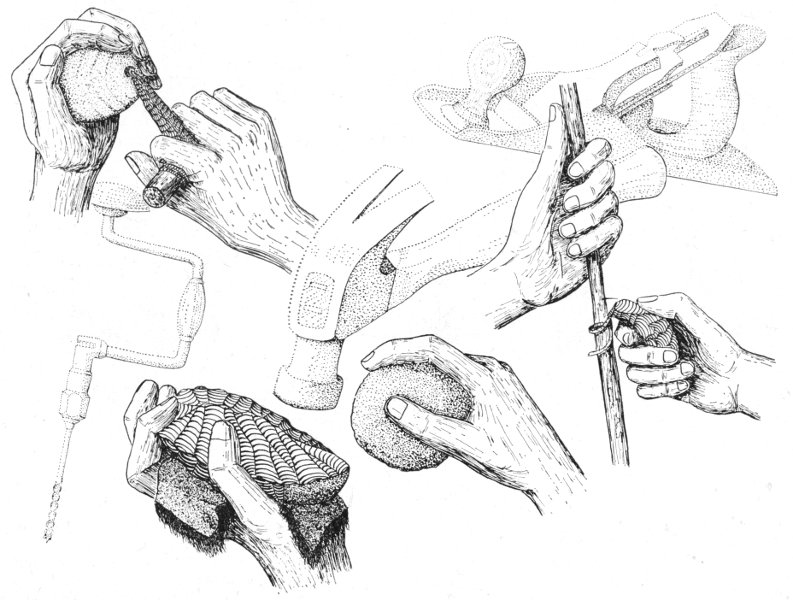
Fig. 1. Archaic flint drill, stone hammer, and flint scraper as used in Archaic period and their modern steel counterparts. (B.B.)
10
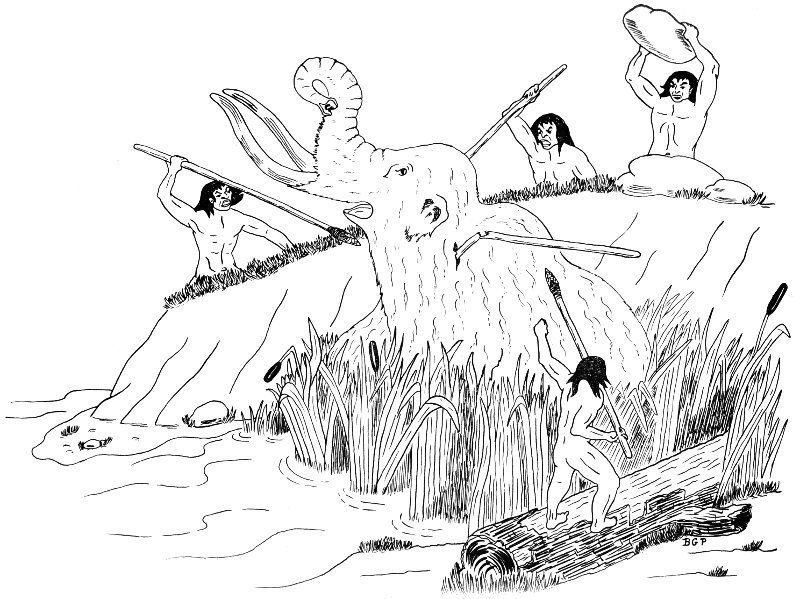
Fig. 2. Paleo-Indians attack a mired-down mammoth. (B.G.P.)
11
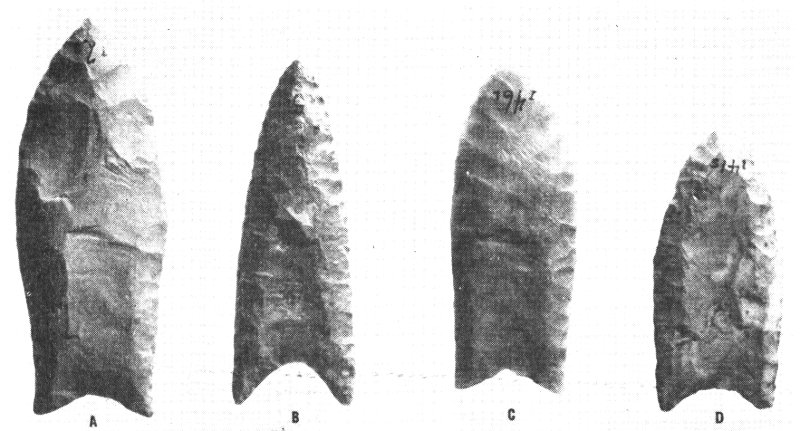
Fig. 3. Paleo-Indian spearheads from the William Small collection. A, B, and C are Clovis points; D, a Folsom point. All are from Illinois.
Their belongings, by our standards, were pitifully few, their way of life laborious, full of hardship and danger, but their needs were simple and their means of meeting them doubtless seemed ample to these hardy hunters. The chief weapon was a thrusting spear with a chipped flint head and a long shaft to keep the hunter as far from harm’s way as possible when attacking the dangerous animal. The narrow width of the spearpoint made it easy to withdraw from a wound and attack again. Our evidence that the Paleo-Indians (as the Big Game Hunters are commonly called) lived in Illinois are these same spearheads (Clovis and Folsom types), usually grooved or fluted lengthwise of the blade, which are scattered over much of the Illinois prairie as isolated finds. No campsites of this people have yet been discovered in Illinois, as they have been in Pennsylvania, Alabama and several southwestern states. We can only surmise that in Illinois the hunters also had stone hammers and chipped flint scrapers as they had elsewhere.
Having arrived in the great central valley between the Rocky Mountains and the eastern ranges, the herds probably moved slowly from one browsing ground to another in the open corridor between glaciers. It may have taken them many years to reach what is now the United States. Eventually the herds wandered back and forth across the Mississippi Valley, and some favorable spots came to be used as camping grounds again and again by the same or different families. Such places would appeal immediately to the campers because of their protection from rain and the piercing glacial winds, the presence of a plentiful supply of wood and water. The possibility of our gaining a better knowledge of Paleo-Indian life in Illinois rests on the discovery of such a site, difficult now to recognize because it may no longer provide wood, water, or shelter of any sort.
12
There are in southern Illinois a number of simple linear stone piles known locally as “stone forts,” all in the same type of land structure. Each forms an obstruction five to fifteen feet in height across a narrow neck or ridge leading to the plateau top of a near-vertical-sided “promontory” projecting out into a stream valley, making an excellent corral, with no fence necessary except across the entrance. They may have been used in late Paleo-Indian times and on into the Archaic period for impounding large game and/or driving them over the cliff.