A SECOND PLANT-RAISING CIVILIZATION—THE MIDDLE MISSISSIPPIANS (1000-1500 A.D.)
Reading edition
A SECOND PLANT-RAISING CIVILIZATION—THE MIDDLE MISSISSIPPIANS (1000-1500 A.D.)
The Middle Mississippi culture seems to have arisen, as previously suggested, in the area where several important highways of aboriginal travel converged—the region surrounding the Ohio and Mississippi rivers from the mouth of the Wabash to the mouth of the Illinois. Whether or not its development was stimulated by the contracts of Muskhogeans and Algonkians or whether it was due to interplay between the cultures of the Final Woodland petty tribes is unknown.
Two slightly differing subcultures of the Middle phase appeared in the state. One, known archaeologically as the Cumberland (Tennessee-Cumberland), may have embraced at one time all the southern Illinois counties between the mouths of the Kaskaskia and the Wabash. [The Angel Site near Evansville, Indiana, may belong to the Cumberland subculture.] The other subculture, which may be termed Cahokia, flourished in counties bordering on the Mississippi from Union County to Wisconsin. As the two periods show few significant cultural differences, they will, except as noted hereafter, be treated as a single unit.
The bow and arrow invented in the Final Woodland phase, was developed early in the Middle Mississippi period into an effective weapon although spear and perhaps spearthrower continued in use. The chunkey game was probably played as a part of a religious ceremony though it may quite possibly have served as a popular pastime as well.
Pottery was slow at first to change from its more obvious Woodland characteristics but new shapes foreshadowing most of those of the fully 35 developed (Old Village) cultural phase practically replaced the conical-based elongated pot early in the period. Cord-roughening and grit-tempering disappeared in the classic Cahokia period, and a fine polished blackware and a painted pottery were added to the smooth utilitarian ware. An excellent “dull gray” ware with smooth gray to brown surfaces was of more common occurrence. It appears to differ from the fine ware only in its partially oxidized surfaces probably due to poorly controlled firing methods.[14]
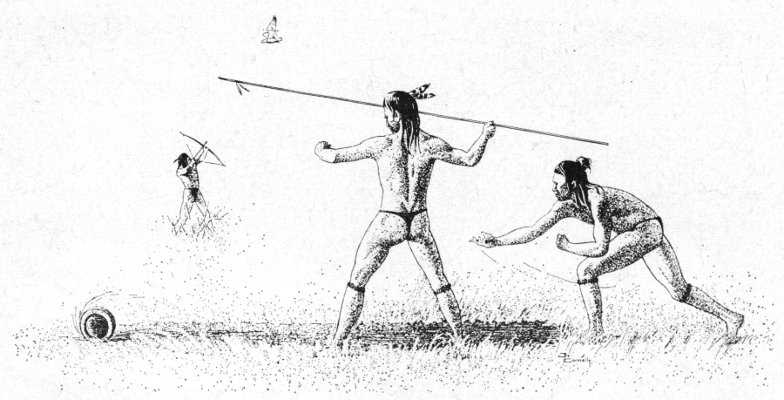
Fig. 23. The chunkey game in foreground. Man hunting with bow and arrow in background. Middle Mississippi period. (J.C.)
There were probably two or more social classes among the Middle phase people as there were among Hopewellians, Natchez and Polynesians.[15] The fine polished black and painted wares may have been 36 marks of distinction between the highest and lower classes since it is much less common. In Hopewellian times, it is probable that both the fine ware and the specialized forms (which were usually of the highest quality) were reserved for the highest caste. In the Mississippi period, the shallow bowl, the cup or beaker, and the plate of dull gray ware seem to have been wide-spread in the village and may indicate a general improvement of living conditions among the lower social classes since Hopewellian times.
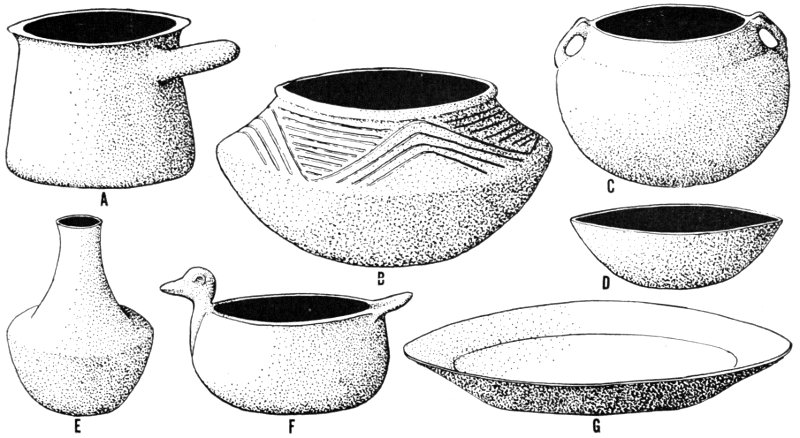
Fig. 24. Pottery shapes, Middle Mississippi period. A, “bean pot”; B, angular-shouldered pot or olla; C, common pot or olla; D, shallow bowl; E, water bottle; F, effigy bowl; G, plate.
Advances in the economy were obviously present in the fully developed Middle phase. The Union County flint “mines” and workshops were intensively worked. Trade with the Lake Superior, lower Atlantic and Gulf Coast regions was resumed. Chief imports of raw materials were copper and marine shells, Busycon, Marginella, Oliva and Olivella. Art, while possibly as highly developed as Hopewellian, resulted in a far smaller number of art objects in fewer durable media. Intaglio rock carvings (chiefly in southern Illinois) of geometric designs, human hands, ceremonial paraphernalia, animal outlines, and, in a few instances, painted hollowed-out animal silhouettes can probably be ascribed to this period on the basis of the symbols employed. Dwellings or cabins were relatively substantial structures and the extent of village remains indicate a large general population as compared to earlier times in the state. Trade and art suggest leisure and wealth or surplus available for exchange or to support officials and others in non-food productive 37 pursuits. This prosperity was possibly due to newly discovered methods of intensive cultivation of maize and possibly to a greater diversity of crops than ever before.
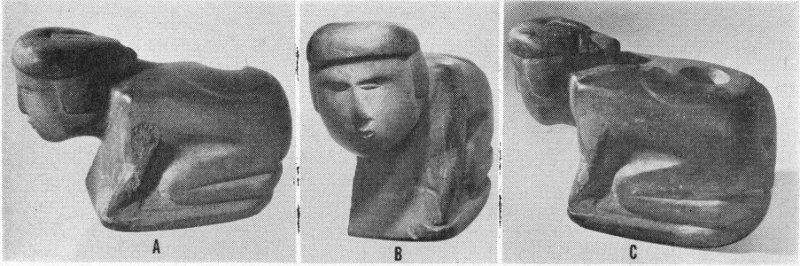
Fig. 25. Carved stone pipe (fragmentary) from Kingston Lake Site (Cahokia subculture, Middle Mississippi period). Owned by Donald Wray. Right-hand figure shows the pipe reconstructed.
Territorially the tribe probably consisted of a number of villages and the surrounding country. Each tribe may have had a chief village or capital that was also a religious center with tribal (public) buildings and a temple. Archaeological and historical evidence shows that these buildings, presumably temples and the dwellings of tribal chiefs and the high priests, were erected on the flat tops of rectangular earthen mounds or pyramids, which were grouped around a plaza of ceremonial square. Here the tribe gathered for religious and political ceremonies and for important funerals. Intertribal negotiations and chunkey games were probably also staged on or near the plaza.
Pipes, either of stone or pottery, were generally of the “equal-armed” type (where stem length is about equal to bowl height). In numerous instances, a short projection resembling the stem in shape but shorter, extends beyond the bowl away from the smoker. Massive effigy pipes of stone were widespread but not numerous. Some were excellently carved. From their construction, it is obvious that they were made to be smoked through a reed or hollow wooden stem called in later times the calumet. These together probably constituted a form of ceremonial pipe that served as a safe conduct between tribes, as a bond and signature at peace- and treaty-making ceremonies, and to present tobacco smoke as incense to the gods in religious rituals.
Priests and possibly tribal chiefs were interred in the flat tops of mounds (e.g. the Powell Mound) near temple or cabin. Generally, however, the dead were buried in cemeteries. In some instances, bodies were laid on the surface above a “full” cemetery and covered with earth brought from outside. Continuing this practice eventually produced a mound (e.g. Dickson Mound near Lewistown). Possibly the burial mounds at Cahokia were reserved for the socially prominent while the 38 lower classes were interred in the cemeteries nearby. The dead, especially important personages were attired in their finest apparel, insignia and personal ornaments. Beside them in the grave were placed their weapons, favorite chunkey stones, food and water in pottery vessels with shell spoons or a dipper.
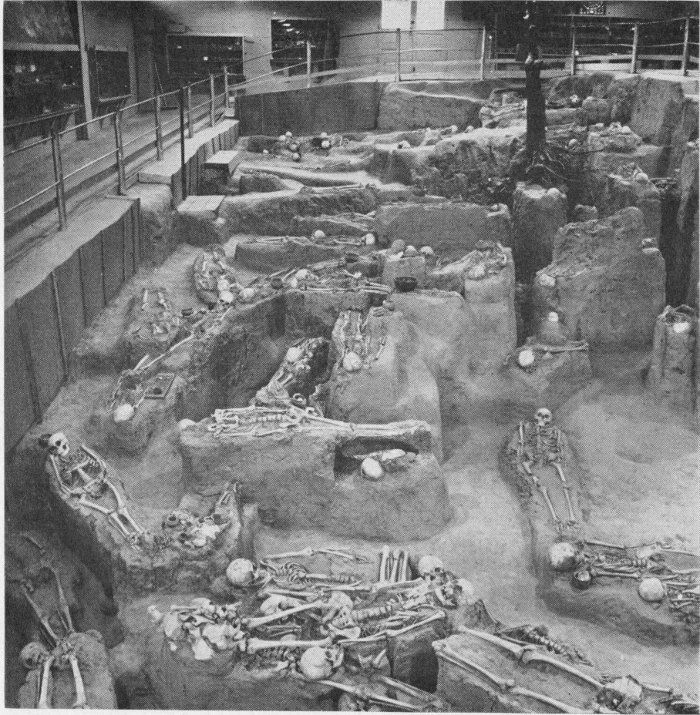
Fig. 26. Interior view of Dickson Mound (in Dickson Mounds State Park near Lewistown, Illinois), showing pottery and other artifacts as originally placed with the dead. Cahokia subculture, Middle Mississippi phase.
Chief villages were large religious centers often protected by an encircling palisade or clay wall reinforced with vertical posts or logs. Remains of defensive walls can still be readily traced by a trained eye at the Kincaid (Massac County) and Lynn (Union County) villages. Exploration of the Aztalan village (Wisconsin) yielded remains of a reinforced clay wall surmounted at regular intervals with towers of like construction. The Cahokia village seems to have been without fortifications.
39
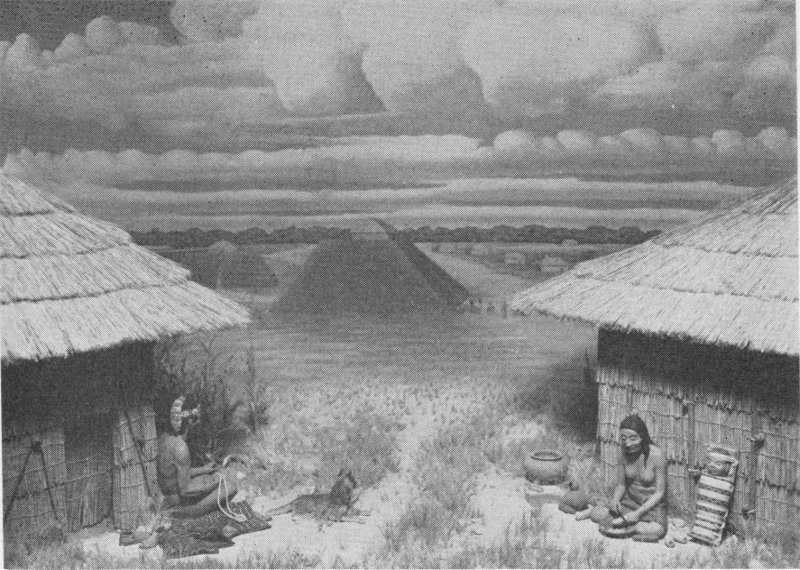
Fig. 27. Reconstruction of Kincaid Village (Cumberland subculture, Middle Mississippi period) near Metropolis, Illinois. (Diorama by Arthur Sieving.)
Smaller villages occasionally had one or two small flat-topped mounds which doubtless served as bases for the cabins of the Village Chief and possibly War Chief. Other Middle phase villages had no mounds or fortifications.
Cabins were of three or more types. In Illinois, two kinds had rectangular floor outlines and may have developed from the earlier Baumer square dwelling and the Lewis house. One of these types prevalent at Kincaid, as determined from charred remains, had a thatched gable roof supported on four corner posts with their lower ends sunk in the ground. Walls were made of clay daubed on a latticework of cane (with foliage) interlacing vertical wall posts, the interior covered with split cane mats. The rafters, corner and wall posts, and wall plates were of poles or small logs lashed together and held in place by braided ropes. Floors do not appear to have been depressed below surrounding ground level. A larger more substantial structure, presumably a temple, on a Kincaid mound (Mxo9) had thick walls of clay mixed with grass, but otherwise resembled the dwelling just described. The clay floor and wall surfaces were smooth. Fire basins of puddled clay within the building may have been the remains of altars.
Cabins in Fulton County (Fout’s Village) and at Cahokia were rectangular in floor plan but wall posts were probably bent over to be joined with corresponding opposite members to form an arched or vaulted roof, the precursor perhaps of the “barrel-shaped” Illini cabins 40 reported by French explorers. Floors were sunk somewhat below the ground level. Remains of cabins with circular floors occur also at Cahokia and in Fulton County.
Fig. 28. Petroglyphs from southern Illinois sites probably made by Middle Mississippian peoples. All figures are hollowed out or intaglio. (Photographs by Irvin Peithmann.)
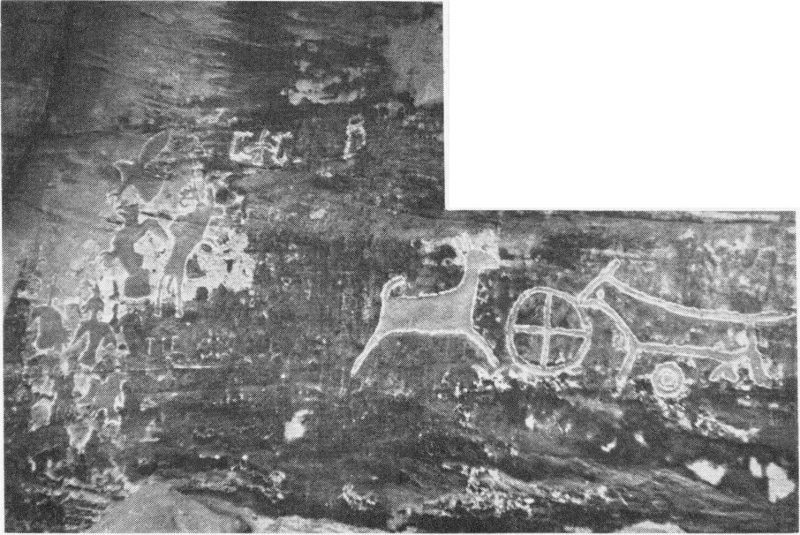
Back wall of rock shelter near Gorham, Illinois.
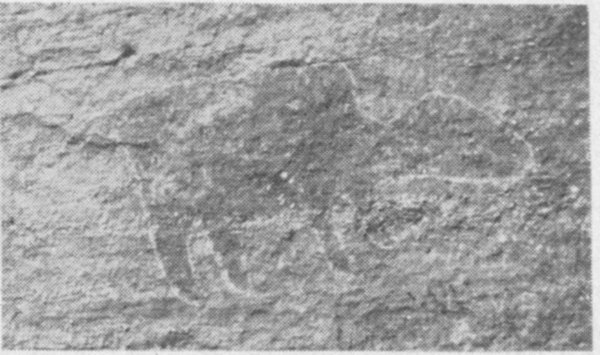
Figure of buffalo calf painted yellow over entire depressed area. The outlines were chalked in for the purpose of photographing.
Walls and wall posts of the Fulton County cabins appear in some instances to be formed of bundles of small branches or cane set in trenches possibly a foot deep. There is no evidence of the wattle-and-daub structure. Walls may have been covered with mats, or with rectangles of bark. Roofs were probably thatched.
Possibly the Cahokia subculture peoples constituted a single tribe, a small nation, or a confederation of tribes. At its most powerful period, the Cahokia settlement was perhaps the capital and religious center. The region south of a line joining the mouths of the Kaskaskia and Wabash rivers at one time probably belonged to another tribe or subtribe whose chief village was the Kincaid community in Pope and Massac counties and who, linguistically and culturally, were closely related to peoples in Tennessee and Kentucky and at the Angel site in Indiana.
Archaeologically speaking, the Middle Mississippi contrasts sharply with the Hopewellian culture. Certain artifacts are readily distinguishable and easily identified with the craftsman’s cultures. Actually the Mississippians differ from the Hopewellians chiefly in having substantial cabins, athletic games and the bow and arrow.
41
Remains of Hopewellian dwellings are rare, but the three or four found up to now are characterized by round or oval floor plans outlined with post holes of three to four inches in diameter. These seem to indicate hemispherical wigwams. No further evidence of wall or roof structure has been recovered. The rarity of these dwellings certainly suggests a less permanent dwelling than the Mississippi cabin. However, it will be remembered that some peoples pattern their tombs upon their dwellings. The upper caste Hopewellians built rectangular burial chambers which were walled up with logs laid one on another and roofed over with half-logs or bark. Similar log house surface structures would seldom leave discernible remains on decay. It is possible, though by no means certain, that the Hopewellians of highest caste, and perhaps of the other castes, built log cabins for dwellings.
The evidence for playing of athletic games in Hopewellian is very late and scanty. The only tangible indication are the rings, “pulleys” and a stone discoidal found with a skeleton in the Rutherford Mound. (See M. L. Fowler, The Rutherford Mound, Scientific Papers Series, Vol. VII, No. 1, Springfield, Ill. 1957, pp. 31-33). The rings of pottery and of cannel coal (or jet) seem too fragile for actual playing pieces and may rather be trophies or prizes, replicas of similar pieces made of wood. Such wooden pieces may have been used in games throughout middle and late Hopewellian times.
Fig. 29. (Photographs by Irvin Peithmann.)
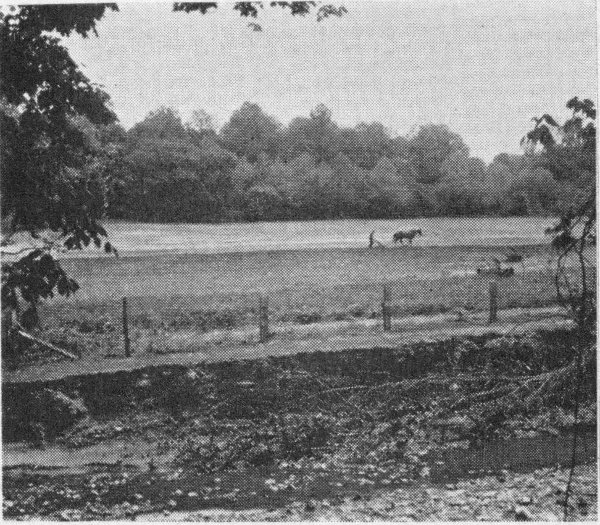
View of a stream-side flint mine and workshop (in field alongside) near Cobden, Illinois.
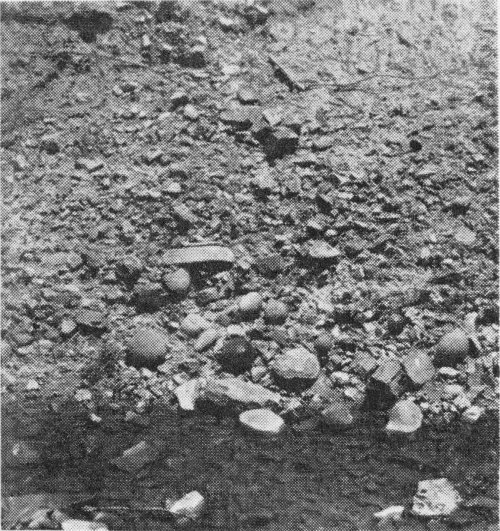
Close-up showing spherical or “ball-flint” nodules from stream banks similar to those worked up by Middle Mississippians and others in adjacent workshop.
The bow and arrow, at least, seems to be a decided improvement over the spear. It constituted a repeating weapon. Ammunition could be carried in the belt or on the back in a quiver without unduly hampering the bowman. On the other hand, it was useless in hand-to-hand fighting and a spear or dagger was needed to supplement it. Moreover, the spear with a thrower was a more accurate weapon than the bow, unless the arrows were carefully made and balanced. The bow never 42 seems to have wholly replaced the spear which continued to be a favorite weapon down into the European contact period.
The improvements that distinguish the Mississippians above the Hopewellians may be more apparent than real in the first two instances and, in the third, may represent a significant rather than a fundamental advance. Looking at the two periods from the broader cultural viewpoint, they appear to have many cultural features in common. The Middle Mississippians probably added new food and fibre plants to those of earlier periods, and perhaps increased production by improved, more intensive methods of cultivation. Their staple crops like those of the Hopewellians were corn, beans and tobacco.
The technologies or methods of making the necessary tools in the two cultures varied but little. Art was revived or rather re-developed in the Mississippian period but fewer media are employed. In artistic skill, imagination and productiveness perhaps the Hopewellians had an edge on the later people.
Trade and travel, though resumed to distant sections of the continent, does not appear so widespread or general as in the Hopewellian period. A formalized religion with colorful ceremonies seems to have revitalized the life of the people but possibly no more effectively than in the earlier period.
There was no significant improvement in labor, power or transportation; all were still accomplished wholly by human effort without the aid of draft animals. Traveling by boat was known and probably used by both cultures.
Comparing the two peoples with other plant growers having no domestic food-draft animals, it seems apparent that each had an effective political organization, a formalized vital religion with true priests (not “self-appointed” shamans) and a system of moral values and tenets that “church” and “state” were organized to maintain. All in all, from the broader cultural standpoint, they were amazingly alike.