THE INITIAL WOODLAND CULTURES[9] (2500-500 B.C.)
Reading edition
THE INITIAL WOODLAND CULTURES[9] (2500-500 B.C.)
After 5000 B.C. the temperatures continued to rise producing a climatic interval known as the Thermal Maximum when it was warmer and drier than at the present time. After reaching its high point, the temperature gradually declined and probably ended in southern Illinois about 2100 B.C. or later in a climate much like that of today.
By projecting the rate of deposit from the eight- to the eleven-foot level of the Modoc Rock Shelter up to the five-foot level where the Archaic remains appear to end, we secure a date for its upper limit of about 2100 B.C. (Deuel 1957, p. 2). The remains between the five- and eight-foot depths are scantier and less varied than in the earlier (lower) layers and may indicate a cultural group in a losing struggle to maintain itself under changing conditions.
21
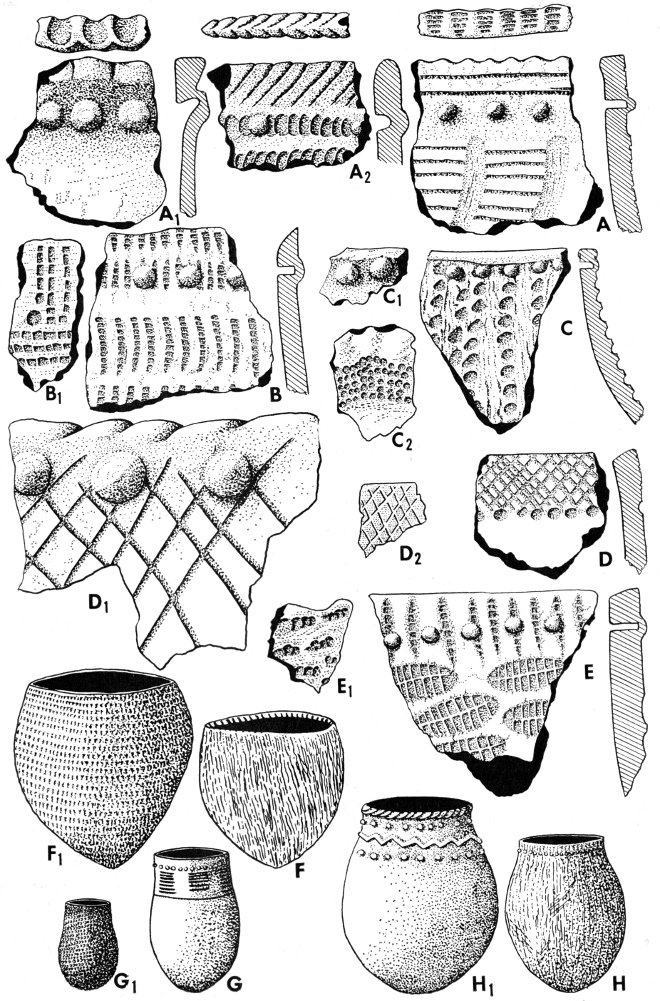
Fig. 11. Potsherds from the Lake Baikal in southern Siberia resemble those of Initial and Classic Woodland (Hopewellian) in Illinois. The letters with subscripts refer to Siberian pottery. A-E, reduced to ½ actual size; F-H, reduced to ¹/₁₆ actual size. (Siberian pottery from Richthofen in ANTHROPOS, 1932: 128, 129, 130; Illinois pottery from Illinois State Museum collections.)
22
In northern Illinois, similar climatic conditions were developing. There, possibly as early as 2500 B.C., a new culture, the Initial (early) Woodland, was coming into existence. At any rate, groups living there some time prior to 1000 B.C. made pottery, placed their dead in cemeteries and in low burial mounds in a flexed or “doubled-up” position, occasionally with food, personal ornaments and other funeral offerings.

Fig. 12. A flint dagger or hunting knife from “Red Ochre subculture” of Initial Woodland. (B.B.)
The pottery of one Woodland group (Morton) in the Illinois valley resembled, in shape, surface treatment, design and area decorated, pots made in the Lake Baikal region in Asia some 7000 miles distant. The appearance of such striking similarities has long been a puzzle to anthropologists. In the first place the detailed likenesses suggest both were made by one and the same people. It seems fairly obvious that the several resemblances did not travel from tribe to tribe from Asia to central North America. The preservation of a pottery tradition during a migration of 7000 miles, probably lasting for several generations, seems equally incredible. Perhaps the most plausible explanation is that two widely separated divisions of a people originating in central Asia with the same cultural background and similar surroundings arrived independently at a remarkably similar but very simple pottery type.
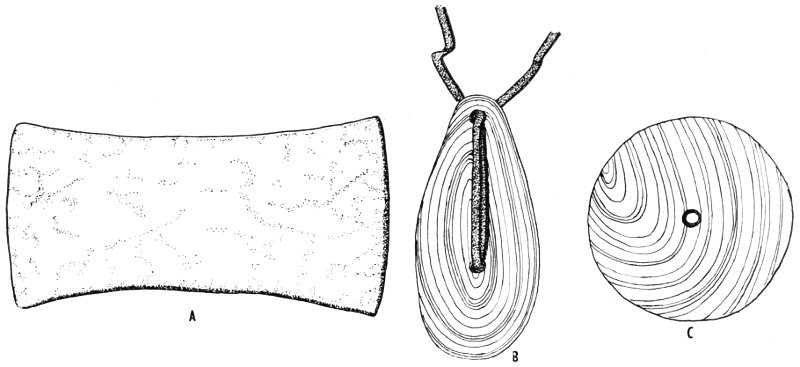
Fig. 13. A copper gorget, A, (possibly patterned after the double-bitted ax-shaped bannerstone) and shell gorgets, B and C, from “Red Ochre subculture” of Initial Woodland. All from Mound 11, Fulton County, Illinois.
These late migrants probably found groups like the Black Sand (and Red Ochre) peoples in Illinois who were just emerging from the Archaic phase into Initial Woodland. The settlements of all early 23 Woodland peoples were small in extent and poor in cultural remains. The population of these hamlets probably seldom exceeded fifty. No traces of house structures have yet been discerned. Temporary huts, probably built of small poles and brush, may have been conical or hemispherical in shape. The artifacts or cultural objects, except for a small amount of jewelry (shell and copper beads and pendants) and the few offerings placed in graves, show little evidence of any urge to fine workmanship or much feeling for beauty of line or form. Life was probably too hard and the effort in securing food and other requirements too exacting to leave much leisure for artistic workmanship in durable materials.[10]