THE ILLINOIS OR ILLINI[17] (1550?-1833 A.D.)
Reading edition
THE ILLINOIS OR ILLINI[17] (1550?-1833 A.D.)
The Illinois or Illini Indians are, so far as is now known, the next group to occupy the state following the Middle Mississippians. At the time of Marquette and Jolliet’s voyage in 1673, six tribes comprised the Illinois Confederacy, Kaskaskia, Cahokia, Michigamea, Peoria, Moingwena, and Tamaroa[18]. The tribes spoke the same or mutually intelligible dialects of the Algonkian language.
Some time before 1650, possibly a century or more, the Illinois Confederacy seems to have been a powerful nation but in the latter half of the 17th century this was a tradition rather than fact. The Confederacy appears to have engaged in no united action after 1650.
The Illini at that time were in the plant-raising stage of culture and possessed only the dog as a domesticated animal. Like many other plant-raisers, the families deserted the village for the hunt after the corn was hilled and again after the harvest.
Dress
Men went naked in summer except for mocassins. At times a breech cloth was worn; in winter buffalo skin robes were added and belts, leg bands and leggings on occasion.
Women when working apparently wore only a girdle (breech cloth), at other times a wrap-around skirt of skin with a belt passing over one shoulder and under the opposite arm. The skirt dates back to Hopewellian times and was used during the Mississippi period in Indiana and probably in Illinois. The bosom was covered with a deerskin wrap. Hair was worn long and fastened behind the head.
Economy
Labor was divided between the men and the women (and children). Men did the hunting, fighting and made the weapons. The women (and children) did the other work—the housework, planting and harvesting the crops, dressing deer and buffalo skins, making twine from bast, weaving cloth and, on the hunt, carrying the house parts and setting up the camp.
46
Buffalo meat was preserved by drying and smoking it over a fire in the hunting camp. Vegetable foods, corn, beans and squash were dried or parched and buried in containers or in lined pits in the ground and covered over. Watermelons, muskmelons (?), gourds and tobacco were also grown. Wild strawberries, paw paws, pecans, lotus roots, wild tubers, grapes and plums formed part of their diet.
The winter buffalo hunt usually took place a long way from the village. The hunting units each consisted of several families under a rigid police system and regulation to prevent the herd from being stampeded by an over-eager family before all were amply provided with meat. Violations of hunting regulations were punished by destruction of the offender’s property to which no resistance was ever attempted. The group surrounded the herd, at times encircling it with fires made at intervals near which the hunters stood and killed the stampeding animals. At times as many as 120 buffalo were killed in a day. The women cut out the tongues, skinned the animals, and, peeling off the sides of meat, dried and smoked them on wooden grates over a slow fire. The smoked sides were carried back to the village on the back, or when practicable in dugout boats. Carcasses and bones were left on the hunting grounds. Other animals were stalked by one or two hunters. Dog meat was considered a great delicacy.
Fish were caught in nets, by hook and line, speared or shot with bow and arrow. They were dried for preservation. Maple trees were tapped late in the winter, the sap caught in bark containers and made into a maple drink or reduced by boiling to syrup and sugar. Corn was ground into meal and baked into bread, or prepared as hominy.
Vessels and utensils were made of wood or clay, ladles from a section of the buffalo skull. Fire was produced by the hand drill in the usual manner.
The cabin type seems to have varied at different periods or in different tribes. In early times, cabins had rectangular floors and vaulted (barrel-shaped) roofs. They were roofed and floored with “double-mats” of flat rushes and were impervious to wind or rain. Occasionally they were erected on low mounds (two feet high) to keep the floors dry. Large cabins of the vaulted type had four fires, with one or two families at a fire.
Bark-covered hemispherical huts or wigwams may have been used on hunting trips. They were apparently common in some villages in 1723.
Overland travel was on foot. On streams the dugout boat was propelled by pole and possibly by paddle. Large boats were 40 to 50 feet long, capable of carrying 40 to 50 men. While dugouts were admirably suited for travel and trade between the Illini tribes along the Illinois and Mississippi rivers, they were, on account of their weight and unwieldiness in portaging, generally useless in raids against enemies.
47
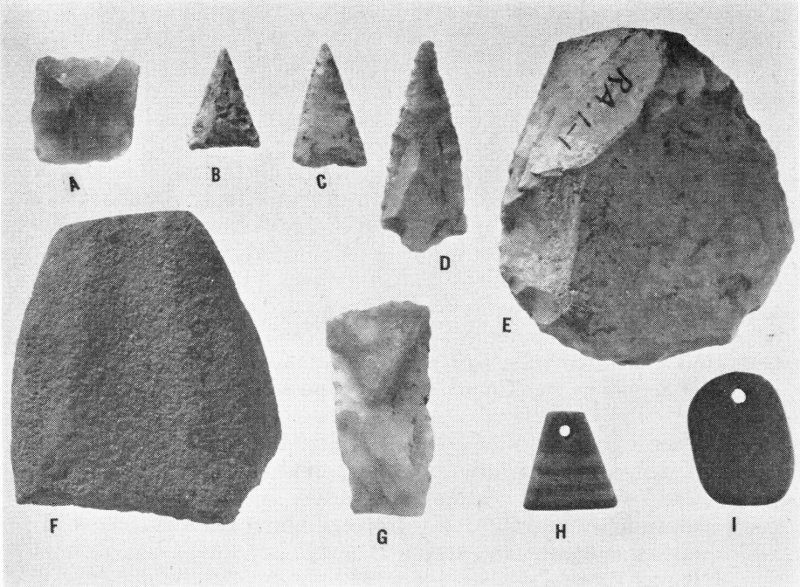
Fig. 33. Native Illini artifacts. A, Indian-made gun flint; B, C, D, chipped flint arrowheads; E, flint scraper; F, grooved abrader of sandstone; G, expanded base drill (grip only, point broken off); H, I, polished stone pendants. From Illini village site near mouth of Kaskaskia River, Randolph County.
Marriage Customs and the Family
An Illini man, desiring to get married, sent presents to the girl’s parents. If the suitor was acceptable, the parents kept the gift and took the bride to the man’s hut the following evening. Apparently there was no wedding ceremony.
Women had somewhat lower social status than their husbands. Wives did not eat with their husbands. A man was permitted two or more wives and often married two sisters. Children were well-treated. Infants were bound to a cradle board that the mother carried around. The cradle was pointed at the lower end and was stuck in the ground when the woman wanted to rest. Divorce was accomplished by a simple agreement to separate.
Political Organization
The explorers and writers to whom we are indebted for our knowledge of Illini social and religious organization were, unfortunately, casual and untrained observers who, on the whole, held the Indian and his customs in contempt. Important activities were often dismissed with meaningless generalizations, or omitted entirely, as if generally known. Consequently great gaps are left in the information that has come down to us.
48
From the various accounts, the impression is given that the Illini tribes (and possibly before the 17th century, the Confederacy) had a political government (rather than family social control) with formally appointed officers or civil chiefs. The Confederacy had one or more coats-of-arms (“totems”) that may have been recognized abroad as symbolic of the Illini (as was customary among the Natchez and other southeastern Indians). It had a Grand Chief, chosen in some manner not now known, from one of the constituent tribes. At one period “Prince Tamaroa” of the Tamaroas held the post, later Chief Ducoigne of the Kaskaskias. Whether or not the Confederacy acted as a nation after 1600 is doubtful. Each tribe had its own head chief and coat-of-arms, and the French appear to have treated directly with the tribal heads in matters of importance. Judging from other Indian Confederations, the individual tribe had probably retained its full powers, and concerted action by the Confederacy was possible only by unanimous consent.
Like most peoples in the simple plant-raising status, the tribe dealt as a state with other similar units in intertribal affairs. These included alliances and treaties of peace. Ambassadors or tribal representatives were sent from Illini tribes to their neighbors. On such occasions, the calumet was carried and served as a safe conduct.[19] Tribal representatives met approaching strangers (and presumably the ambassadors of another tribe), raising the highly adorned calumet (and pipe) toward the sun as they advanced. Smoking the calumet—by the contracting tribal agents at the conclusion of an agreement—corresponded to our signatures and seals at the end of a written treaty.
Each village probably had a chief, whose power (it was sometimes reported) was little. However, the chiefs wore, as badges of office, red scarfs woven of bear and buffalo hair. Their faces were painted red. The village men (or possibly the important men) met before the village chief’s cabin or in a large hut built especially for gatherings to deliberate on political or religious matters. The entire village often seems to have been in audience.
If there were social classes among the Illini, no mention is made of it in early reports. Men acquired prestige mainly through skillful hunting or success in fighting. The leader in a raid had to recompense the families of any followers killed in the fighting.
49
With so little description of the village and tribal assemblies and the chiefs in deliberation and judgment, it is difficult to determine the exact status of political organization of the tribe and its officers. It may well be that the powers of the chiefs immediately after European contact were small, and that in order to deal with the agency of a European state, the Illini found it necessary (as did the Delaware tribes) to grant greater authority and responsibility to their political leaders. It is probably also true that the chiefs would, under pressure from the whites, be reluctant to take responsibility for an unpopular concession and would declare that only the tribal council or assemblage could confirm the agreement under consideration. In any case, the Illini were on the threshold of true political control if they had not actually adopted it.
Raids
The tribe in historic times seems to have been the war-making group. Raiding parties tried to sneak undetected into enemy country and conceal themselves. From their hiding place, they fell suddenly on small unsuspecting enemy bodies, scalping men, killing women and children, and slipping away again with a few prisoners if practicable. Back in the village, captive warriors were bound to a frame of green wood, suspended over a slow fire, and tortured until death released them. Warriors hung the scalps taken upon their cabins as evidence of their prowess. The Illini claimed not to have tortured or burned captives until their men had been taken and so treated by Iroquois raiding parties. On the war path warriors carried bundles containing objects sacred to their guardian spirits and invoked them frequently to obtain victory.
Bows and arrows in quivers, hatchets or tomahawks, clubs, and “arrowproof” shields consisting of several layers of buffalo hide were carried on raids. The bow and arrow was considered superior to the gun because it could “fire” more rapidly.
Trade
Earlier in the European period, the Illini furnished Canadians with skins of beaver, raccoon, deer, bear and buffalo, but in 1776 the French (in Illinois) compelled them “to devote themselves to producing oil, tallow and meat which they traded with them.” (Deliette Memoir. See Pease in Bibliography under ILLINI.) The Indians traded for porcupine quills with more northern neighbors. After the European came, Illini trade was probably overwhelmingly with the whites, exchanging native products of the forest for coveted guns, iron knives, hatchets, brass kettles, cloth, glass beads and alcoholic liquors.
50
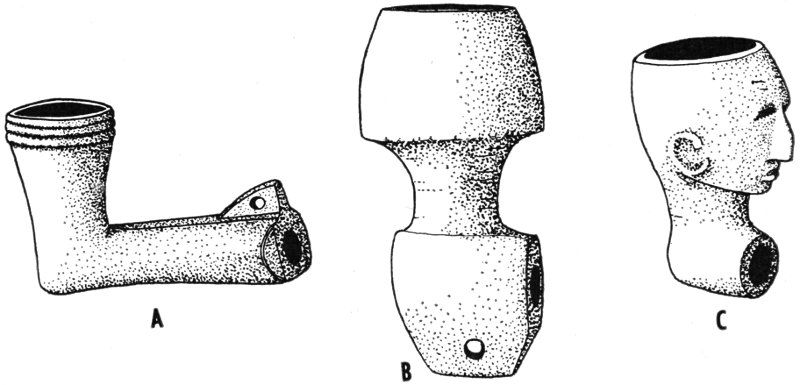
Fig. 34. A, B, common forms of Illini pipes (restored) of red Minnesota pipestone, Illinois State Museum collections: A, “Siouan”; B, Micmac; C, stone effigy-head type, (A. J. Throop collection). All from village near mouth of Kaskaskia River, Randolph County. (B.B.)
Religion
The religion of the early historic Illini was apparently a complex one. The sun was evidently a powerful deity from whom the calumet pipe had perhaps been supposedly received. A special calumet, apparently sacred to the sun, was revered as a palladium (like the Hebraic Ark of the Covenant) on which rested the safety of the nation. A special official had responsibility for its safe keeping. The smoke of the pipe was offered to the sun whenever the Illini prayed for rain, fine weather, or some other aid. Whether the Grand Manitou (Great Spirit), whom the French thought was the Supreme God of the Illini, was identical with the sun is not known though it seems probable.
In addition to the above gods, the Illini believed in numerous spirits and in reincarnation. A young man sought to secure a spirit as his superhuman helper or guardian for life. He fasted and prayed to the spirit to come to him in a vision. If successful (as he usually was), the spirit appeared to him in a dream and gave him instructions for a ritual by which he kept in contact with his protector. The objects needed for the ritual he collected on awakening and preserved them thereafter in a roll of painted matting. When calling upon his spirit protector, the bundle was opened and the rite performed, chiefly prayers and smoke offerings from a pipe blown toward the bundle.
It seems probable that there were true priests who were appointed by regular procedure and who received their power by virtue of their installation into office. The priests, we are told, painted themselves all over with clay on which designs were drawn. Their faces were painted with red, white, blue, yellow, green and black colors. The “high priest” wore a bonnet or crown of feathers and a pair of horns, possibly young deer or buffalo.
51
Medicine men also seem to have existed, persons who sought power from spirits to use in behalf of others for private gain or a livelihood. Possibly they were interested on the side in black magic or witchcraft, an anti-social activity.
Dancing, probably singing, and supplication, together with the inevitable smoke offerings from a ceremonial pipe doubtless formed a large part of public worship for which the whole community assembled. Details of the Illini ceremonies and their meanings are not known.
The French priests severely denounced native religious customs and “juggleries” of the Illini. The Peoria chiefs and priests resented this and resisted Christian attempts to convert the tribe (1693).
Funeral and burial customs seem to have been generally similar to those of other plant-raising peoples. All dead were treated with respect, decked in their best apparel, painted in preparation for burial. A dance was performed in honor of the deceased. A skin stretched over a large pot formed a drum which was beaten with a single stick as accompaniment for the dance. The participants were rewarded with presents at the conclusion of the dance. The gifts to be distributed were displayed in full view of the dancers and the duration of the dance was determined by their relative richness. An important personage was given special consideration and the whole community probably attended the funeral. Corn and a pot to boil it in were placed beside the dead. Friends standing around the grave threw into it bracelets, pendants and “pieces of earthenware” (pots?). The graves of chiefs were marked by a painted wooden post taller than the markers for ordinary people. Illini chiefs and persons of distinction as a signal honor were placed in tree-tops in a coffin made of bark. The tribe danced and sang for twenty-four hours during the funeral of a distinguished man.
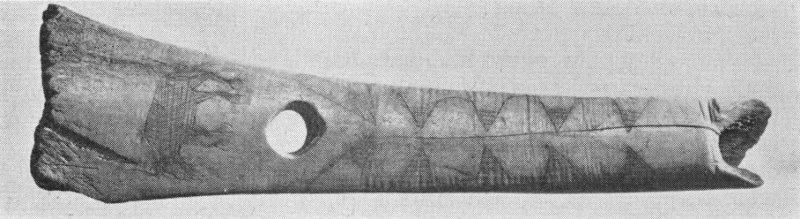
Fig. 35. Illini arrowshaft “wrench” or straightener of bison (?) rib engraved with figure of bison and cross-hatched triangles from Illinois village near mouth of Kaskaskia River, Randolph County.
Art
Men tattooed their “whole bodies.” They painted themselves in solid colors and with designs in red, black, yellow, blue, and other colors. The body was adorned with native jewelry, the nose and ears 52 were pierced for ornaments, and feathers of many colors were worn attached to the scalp lock. Moccasins were decorated with porcupine quill embroidery. Men clipped or shaved most of the head, leaving the scalp lock and four other tufts of long hair, two on each side, one in front of and behind each ear. After European trade goods were available, glass beads and cloth were obtainable in considerable quantities and largely replaced native dress materials and ornaments.
The Illini played lacrosse, an athletic game. The straw-and-bean game was a game of chance in which the players each took a number of straws from a bundle. The straws in each hand were discarded by sixes, the number left determining the winner of the round. Beans were used as counters. The Illini made wagers as to the outcome, even putting up their sisters as stakes in the game.
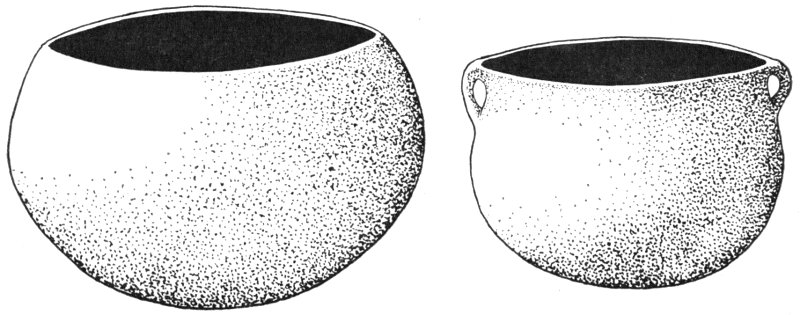
Fig. 36. Shapes of Illini pots (Middle Mississippi ware) reconstructed from sherds found in association with other native and European objects on the Illini village site near mouth of Kaskaskia River, Randolph County. (B.B.)
Archaeology of the Illini
Two village sites of the Illini have been investigated by the Illinois State Museum, one near Utica, LaSalle County (jointly with the University of Chicago) and one in Randolph County near the mouth of the Kaskaskia River. This last site was occupied for over a century by descendants of the Kaskaskias and other Illini tribes. Except for a small area where Archaic artifacts are found, it is a “pure” site.
The Illini tools, weapons and ornaments of native make were the usual chipped flint triangular arrowheads, simple flint drills and scrapers, rough stone hammers and abrading stones, small ground stone pendants, polished stone “Micmac” or “keel-based” pipe bowls (many of catlinite), the long-stemmed L-shaped catlinite pipes (sometimes called “Siouan”), and cut and engraved bone ornaments. An arrowshaft straightener carries an etching of a buffalo cow. Pottery is rare, but the pieces found in association with European trade goods are characteristically Middle Mississippian.
53
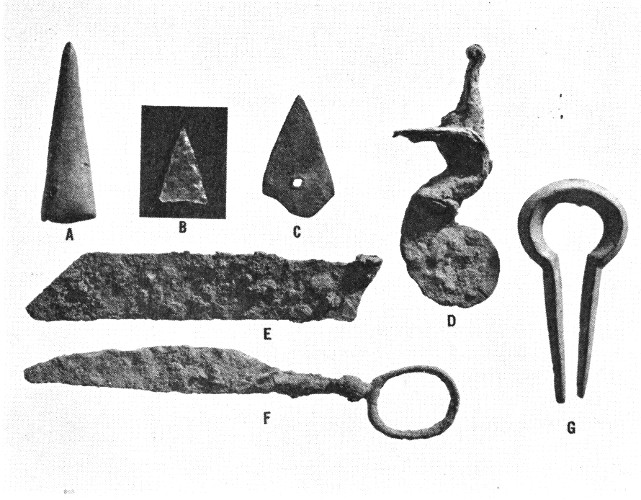
Fig. 37. European trade goods and artifacts made from European materials. All from Illini village near mouth of Kaskaskia River, Randolph County. A, conical arrowhead of sheet copper; B, chipped glass arrowhead; C, brass arrowhead; D, hammer of flintlock gun; E, iron blade of clasp knife; F, an iron scissor-blade; G, part of a jew’s-harp.
The Illini made artifacts from fragments of European materials, iron spear- and arrowheads, brass and chipped glass arrowheads, brass pendants, and beads of broken porcelain.
European trade materials far exceed in number the native products. Usually they are fragmentary (except for colored glass beads of many kinds): parts of copper and brass kettles, iron handles, gun hammers and other parts, lead balls and the molds for making them, molds for casting crosses and ornaments, iron spoons, kitchen and clasp knife blades of iron, “Dutch” white pottery pipes, scissors, jew’s-harps, bottles for wine and olive oil, brass buttons and finger rings.
The Illini seem to have cast lead into musket balls and chipped gun flints into shape but beyond that made no attempt to learn machine-age technologies. For firearms, gunpowder, iron knives and hatchets they were wholly dependent on the white invaders, a great disadvantage in event of hostilities and one that eventually cost them ownership of their ancient homelands.
54