THE DARK AGE IN ILLINOIS—FINAL WOODLAND (200 to 900 A.D.)
Reading edition
THE DARK AGE IN ILLINOIS—FINAL WOODLAND (200 to 900 A.D.)
The Hopewellian civilization apparently disappeared as suddenly as it seems to have arisen. This impression is probably due to the fact that the people continued to live in the old villages long after the characteristic colorful Hopewell customs were no longer practiced. Actually the culture may have declined for a century or more before it finally broke down completely. Many of the simpler folk traditions probably persisted in the area for some centuries afterward.
Possibly long continued abuses of power and privilege by religious and political officials, especially those from the highest social caste, weakened the confidence of the lower classes in their leaders and the culture. Newcomers from Iowa, Missouri and Kentucky may have further disorganized certain settlements and separated areas of the larger community from each other. Generally, however, the writer gets the impression that the decay began within the civilization although its final downfall may have been accelerated by external pressures.
With failing confidence and a rising uneasiness, trade would naturally decrease and the incentive to fine workmanship decline. The larger cultural community split apart into a number of small tribes, who were isolationists and individualists. All the separate little tribal units were Woodland culturally with some small evidence of their Hopewellian heritage, but each differed in certain respects from its 31 neighbors. Villages dwindled to the mere hamlets, widely separated one from another. The elaborate ceremonial dress, insignia, and jewelry, and the artistic creations (at least in durable materials) became a part of the past; the people found themselves reduced to the rude cultural level of their early Woodland ancestors. Huts were flimsy and left no discernible remains. Tools, weapons, and ornaments were, in general, carelessly made and poorly finished. Although tobacco was smoked and small patches of maize and beans may have been grown, the chief economic dependence undoubtedly was on hunting, fishing and collecting.
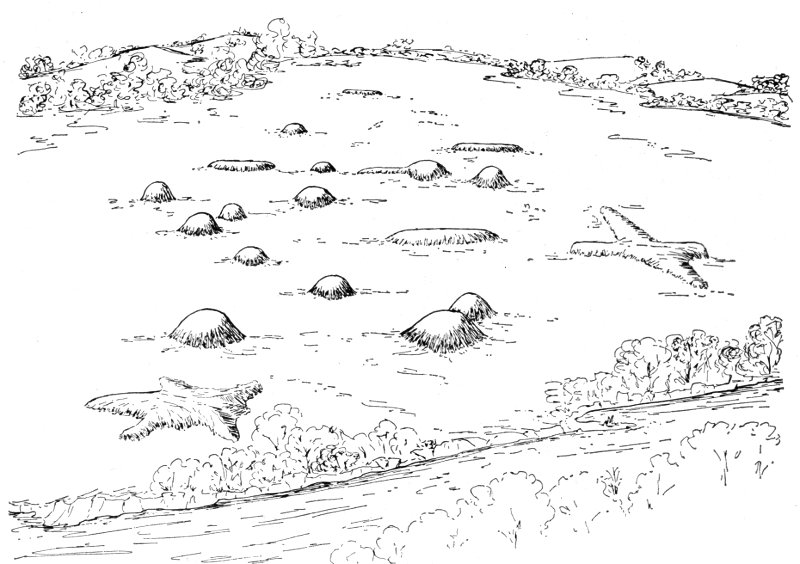
Fig. 19. Group of mounds exhibiting bird, mammal, linear and conical mounds as they occur characteristically in Effigy Mound subculture of Final Woodland. (B.B.)
The religious beliefs, too, were probably simplified and mixed with magic and superstition, surviving relics of the religion of the past age. In a word, the social and religious customs of the little tribes were broadly similar but in minor details differed from each other much as do their artifactual remains.
A study of the Final Woodland and other phases of Illinois history reveals certain relationships among some distinguishable differences of detail:
1. The almost complete lack of evidence of Hopewellian art, trade and religion in the late Woodland period gives little apparent indication that the people were the direct descendants and heirs of that civilization. 32 On the other hand, the general resemblance of Final Woodland assemblages to those of the Initial phase seems marked. Let us examine further.
Fig. 20. Graves near Quincy, Illinois, Stone Vault period. (Photographs through courtesy of O. D. Thurber.)
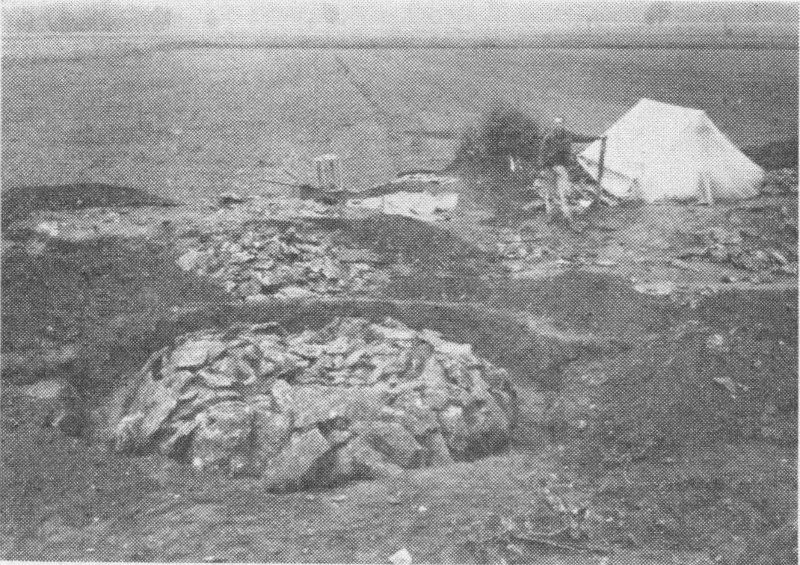
Stone mound after earth was removed.
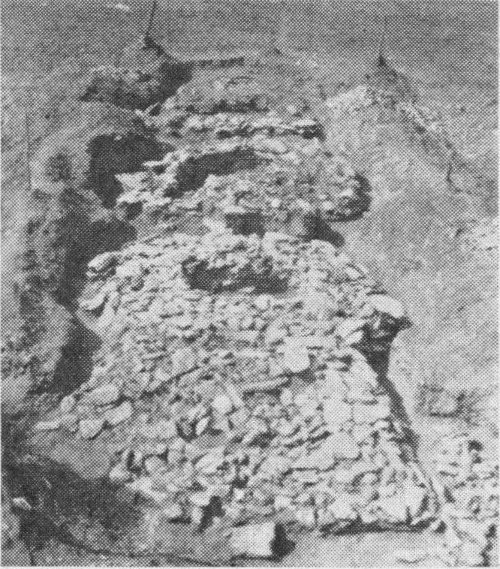
Four excavated “vaults”, the third of which shows a “corridor” entrance with stone steps.
The tobacco pipe of the late phase with the stem projecting beyond the bowl is found in most aspects. Likewise, the vertically elongated pot is common but not the only form. Burials are often in mounds, frequently in a central chamber or grave, with skeletons in the flexed and/or extended positions, occasionally accompanied by grave offerings. All these are broadly reminiscent of Hopewellian customs and, in the writer’s opinion, indicate a continuing thread of tradition from Initial Woodland through Hopewellian into the Final phase.
2. The relationship to the Middle Mississippi seems more evident and has been attributed by some authors to the “impact” of a high culture on that of cruder or “under-developed” neighbors. What are the grounds for these conclusions?
New pottery forms were being attempted, the flattened globular pot, the shallow bowl (occasionally found in Hopewellian sites), the cup or beaker and the plate. In southern counties, a new method of making pits is indicated by a tendency of sherds, even grit-tempered ones, to split or laminate (see Maxwell, Woodland Cultures of Southern Illinois, Beloit, 1951, p. 204). Secondary features previously lacking begin to appear as “raised points” or knobs on rims, some roughly resembling animal heads with ears and a snout. Triangular arrowheads and others reflecting larger spearhead types are all made from curved, not flat flakes as the Mississippian points are. The stone discoidal that seems to be the game piece of the historically known chunkey game, which was possibly initiated in late Hopewellian times (see Fowler, The Rutherford Mound, Springfield, 1957, pp. 31-33) occurs in the Bluff subculture and probably in the Tampico also.
33
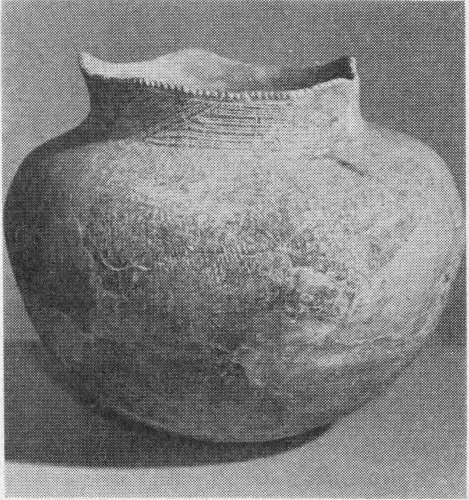
Fig. 21. Canton ware pot (Tampico subculture) from Clear Lake village site in Tazewell County. Designs are formed with cord impressions. (From Schoenbeck collection in Illinois State Museum. Max. diam. at shoulder 18″.
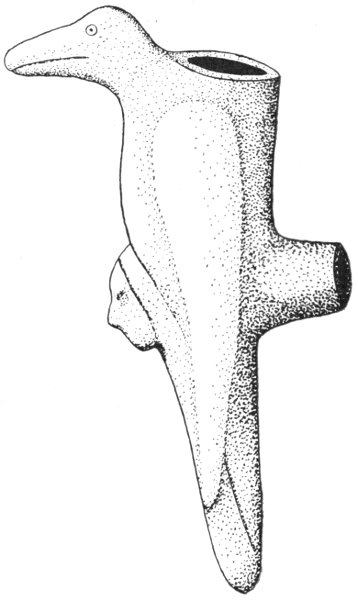
Fig. 22. “Handled” pipe in form of raven with head projecting from rim, from Jersey Bluff subculture. After Titterington. Reduced about ½.
All these bespeak Middle Mississippian tendencies. A common conclusion, as mentioned previously, is that these features were borrowed from non-Woodland groups. The writer, however, gets the impression from his studies that the Middle Mississippi phase developed through the interplay of invention and adoption of improvements, modification and re-invention, between the Final Woodland subcultures in Illinois and adjacent territory. This does not mean that Illinois communities alone were responsible for the emergence of this phase but rather that they played an important dynamic role in its development. The Cahokia subculture of western and central Illinois probably constituted the native local tribe or nation.
Final Woodland Archaeology
Archaeologically these peoples are in the Final Woodland phase of culture. The Final Phase yields tobacco pipes and crude flint arrowheads, its chief artifactual differences with the Initial phase. The clay of their pottery was generally mixed with grit or sand to prevent firing cracks in the vessel walls. The customary vertically-elongated pot with a conical or pointed bottom was accompanied by new forms—the globular or flattened globular with “round” (spherical) bases, the “coconut shell” cup or larger vessel, and shallow bowls. The flattened globular pots and the bowls were occasionally decorated with two or 34 four knobs or with “raised points” on the rim, sometimes giving a squarish appearance to the mouth. In some instances these decorative projections were crudely modeled ears and snout which give the effect of animals’ heads facing out and foreshadowing the Middle Mississippi effigy shallow bowls. An important invention, the bow and arrow, appears in Illinois for the first time in this period. Judging by the crudity of the chipped flint arrowheads, these people were poor archers and preferred the spear and spearthrower in hunting and fighting. Pipes, like most artifacts except weapon heads, are rare. The “elbow” or L-shaped pipe is generally representative of the culture.
The six recognized Final Woodland subcultures with their diagnostic (though not very significant) traits are (1) Effigy Mound named for its distinguishing characteristic; (2) Tampico with pottery decorated with designs formed by cord-impressions, in northern Illinois; (3) Stone Vault with stone mounds containing walled tomb chambers; (4) Jersey Bluff with its unique “handled” tobacco pipes, in the west; (5) Raymond, best characterized by the generalized Woodland nature of its artifacts; and (6) Lewis with incised spiral designs on pottery, in southern Illinois.