THE FOOD STORERS (BAUMER AND CRAB ORCHARD CULTURES) (1000?-100 B.C.?)
Reading edition
THE FOOD STORERS (BAUMER AND CRAB ORCHARD CULTURES) (1000?-100 B.C.?)
It has been seen that in southern Illinois the Archaic way of life may have persisted until 2100 B.C. or perhaps even later. Across the state on the Ohio River a Woodland people succeeded the earlier Archaic residents. Their culture is known as Baumer and their nearest cultural relatives lived south of the Ohio in Kentucky (Round Grave or Upper Valley People). The Baumer artifacts do not resemble those of the Archaic period very closely, giving one the impression that the Baumer people developed their way of life elsewhere and moved into Illinois, possibly while Archaic groups were still in the region.
The Baumer culture differs in several ways from the northern Initial Woodland; actually it appears to be more advanced although it has been termed early Woodland by some archaeologists. In the first place, the area of settlement was more extensive which seems to indicate a larger population than do early northern Woodland campsites. Their artifacts are numerous and varied, suggesting they were well adapted to their surroundings. Flat forms of polished stone (resembling in outline certain Archaic bannerstones from which they may have derived) served presumably as breast ornaments or gorgets (as similar pieces did in the Hopewellian period). Tear-shaped stone objects (plummets) were made as they had been in Medial and Terminal Archaic. House structures were semi-permanent, large, square, made of poles or logs set in holes in the ground. Huts with circular floors seem to have been in use also. Most important of the cultural habits noted were numerous pits apparently for the storage of food. In these the remains of acorns 24 and hickory nuts were found. These people, like the acorn gatherers of California and the Eskimo, knew how to preserve food over long periods. Acorns were probably abundant enough for a Baumer family to lay up several months’ supply in a short time. This permitted them to live in larger settlements and gave them sufficient leisure to build rather substantial houses and shape symmetrical ornaments from stone. These facts seem to substantiate the hypothesis that they were a sedentary people by virtue of their knowledge of how to store food.
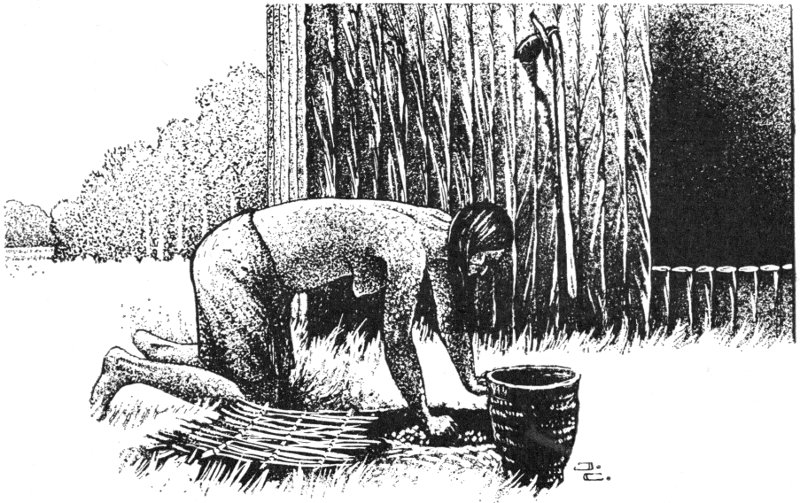
Fig. 14. Housewife storing roasted acorns in a pit near door of her square log cabin dwelling. Characteristic clay vessel (“flower-pot” type) with “mat-impressed exterior.” Baumer period. (J.C.)
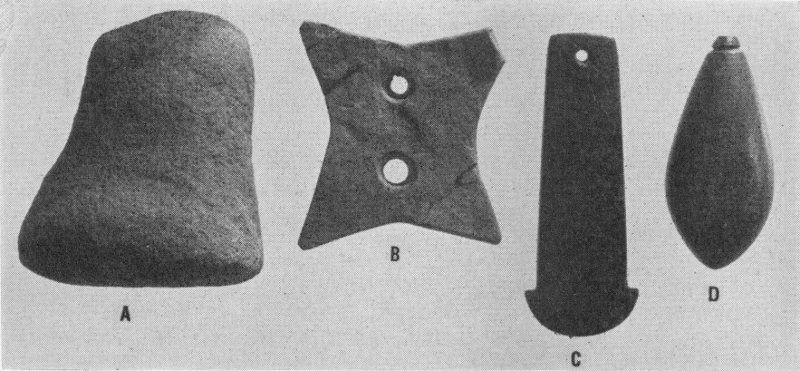
Fig. 15. A, stone pestle; B, reel-shaped stone gorget; C, “spud-shaped” stone gorget or pendant; D, grooved plummet. From the Baumer subculture and site.
25
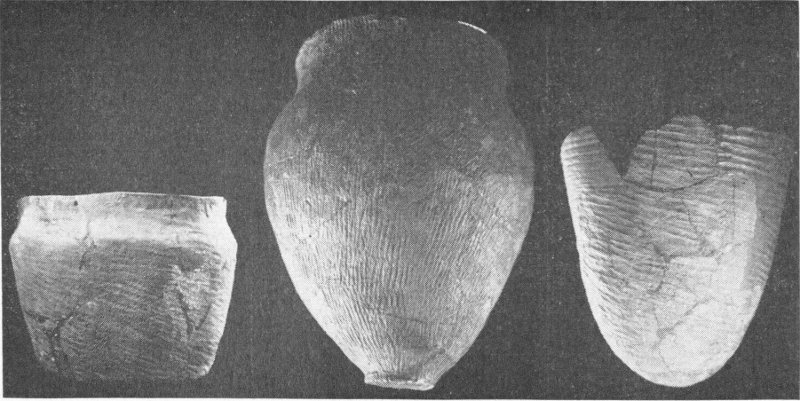
Fig. 16. Pots from the Crab Orchard period of Baumer subculture recovered from the Sugar Camp Hill Site by Moreau Maxwell for Southern Illinois University. Vessel in center is roughly 16″ tall. (Photographs furnished through courtesy of Dr. James B. Griffin, Univ. of Michigan.)
The size of the Baumer settlement, the semi-permanent houses, the presence of chipped spades, stone pestles and pottery might lead one to think that these people were plant-growers rather than simple food storers. Comparing them with the acorn-gathering tribes of California, who were storers and not food growers, it is seen that these, too, had permanent settlements with well over one hundred inhabitants, rather substantial houses, stone pestles, and some tribes, at least, had pottery vessels. The Californians doubtless had digging tools since the rooms of some houses were dug four feet down into the soil.
Traces of Hopewellian influence, possibly indicating inter-marriage with Hopewellians, have been noted at the Sugar Camp Hill site (date undetermined) in Jackson County, which is presumably later than Baumer. However, the Baumerians like the native Californians were conservative, for four centuries intervened between the oldest Hopewellian village in the north and the earliest known station of that culture in southern Illinois.[11]
26