Volume 2 — GENERAL DISEASES (continued 9)
Reading edition
In the torpid types preparations stronger in iodine should be used. Here Lugol's solution or iodide of potassium or sodium will be found very useful, either alone or in connection with the iron preparation above mentioned. Indeed, as in these cases it seems to be disassimilation that appears to be specially faulty, even very small doses of mercury in the form of bichloride or biniodide will be found useful. Donovan's solution may be prescribed in these cases along with the active preparations of iodine with good effect, or if the arsenic in that preparation is objectionable, one-fiftieth of a grain of bichloride or biniodide of mercury may be substituted. The mercurial should not, however, be continued longer than one or at most two weeks at a time, after which it should be suspended and the iodine continued.
Cod-liver oil, which is too indiscriminately prescribed in all cases, will be found to be of little use in the lymphatic types, if indeed it is not actually injurious; but in those cases with pale, thin skin, with deficient development of fat, and with small muscles—in short, those in which emaciation or delicacy is prominent—it is a most valuable remedy. It is almost surprising to see how rapidly ulcerations, caries, eczemas, catarrhs, etc. occurring in this class of subjects will disappear under the use of this medicine alone.
The hypophosphites and lactophosphates are also useful in this class of cases, especially where there is disease of bone or joints, in connection with the cod-liver oil. We have long been in the habit of using the following formula, which we have found very useful:
Rx. Pulv. Acaciæ, drachm ij;
Ol. Amygdal. amar., gtt. vj;
Syr. Calcii hypophosphit., vel Syr. Calcii lactophos., fluidounce iv;
Ol. Morrhuæ, Ft. mist. fluidounce iv;
S. Teaspoonful to tablespoonful three times a day according to age. Syrup of iodide of iron may be added if desirable, though we prefer to give this by itself.
Gentle exercise, passive or active, pure air, well-ventilated sleeping apartments, a generous diet—in which wholesome animal food should predominate—and bathing are of course as necessary and as useful in the treatment as in the prevention of the scrofulous diathesis.
Alkalies should be given in all cases in which we are trying to dissipate enlarged lymphatic glands, for the reason that caseation of these glands occurs because of insufficient alkalinity of the blood to effect reduction of fat, and because also the strumous almost always suffer from excessive acidity of the gastric and other secretions. When the iodides of potash or soda or the hypophosphites of lime and soda are given, the additional administration of alkalies may not be necessary; but if not, bicarbonate of sodium or potassium (which have long enjoyed a good reputation in the treatment of struma) should be added to the other remedies.
Since the appearance of Niemeyer's Handbook of Clinical Medicine the proper treatment of scrofulous glands that have undergone the caseous degeneration has been a moot question. Some recommend the ablation of these glands by the knife, some advise spooning out the caseous matter through a small opening, while others prefer to await the natural process of softening and the discharge of the caseous matter by suppuration. There can be no question that the removal of these glands by the knife, when this can be done without serious risk, will leave behind a less unsightly scar, and will be attended with less fever and consequent deterioration of the general health, than usually attends suppuration. Spooning out the caseous matter will perhaps leave no extensive cicatrix, but we can never be sure that by this operation we have removed all the caseous matter, and it must certainly be more painful than the knife. Mothers will generally object to either of these operations, and as the risks of infection by absorption of the caseous pus during the suppurating process do not seem to be very great, it is perhaps best to leave these glands to nature, unless the vitality of the patient is so low as to give reasonable ground for fear that the child may succumb to the effects of the natural process. If any surgical interference is deemed necessary, we are decidedly in favor of removing the caseous gland entire by the knife.
HEREDITARY SYPHILIS.
BY J. WILLIAM WHITE, M.D.
About a half century ago Mr. Abraham Colles, who had just resigned the professorship of the Theory and Practice of Surgery in the Royal College of Surgeons in Ireland, the duties of which, in the opinion of the college, he had discharged for thirty-two years in an "exemplary and efficient manner," wrote the following introductory paragraph to his remarkable chapter on "Syphilis in Infants:" "Perhaps there is not in the entire range of surgical diseases any one the contemplation of which is more calculated to arrest our attention or to excite our interest than syphilis infantum."
Although it was not then, and is not at the present day, strictly relegated to the domain of surgery, hereditary syphilis, like its parent disease, was generally treated of by the practitioner of that branch of medicine. And yet in the great majority of instances the management of such cases, especially as regards their family relations, the relations of husband and wife, the management of the latter during pregnancy, the delivery and subsequent care of the child, the necessary attention to the safety of other members of the family—in fact, all of the most weighty responsibility—falls upon the ordinary medical attendant. It is therefore in every way proper that the condition should receive some notice in a system of general medicine.
A proper presentation of the subject of hereditary syphilis involves a consideration of the vexed question as to the mode by which the disease is conveyed from parent to offspring. That it may be so transmitted has been generally believed since the doctrine was first announced by Torella at the end of the fifteenth century; and the facts in its support are so numerous and convincing that, in spite of a few distinguished opponents—among whom John Hunter was the most conspicuous1—it has been unhesitatingly accepted by the profession down to the present day. As regards the manner of transmission, however, controversy has been and still is rife. Opposing theories have been constructed and ardently supported, differing radically as to essential points, often resting upon exceptional or anomalous, and still oftener upon imperfectly observed, cases.2
1 Works of John Hunter, vol. ii. p. 383.
2 Parrot, in a clinical lecture on syphilitic abortion (Le Progrès Médicale, Nov. 3, 1877, p. 798), says: "The infection of children was known, but its true origin was not suspected. The belief of Gaspard Torella (1498) and Matthioli (1536) that it came from the nurses through the milk was generally accepted."
According to Diday, Paracelsus (1529) was the first to plainly state the heredity of syphilis: "Fit morbus hereditarius et transit a patre ad filium."
Others attribute the original announcement to Augier Ferrier (1553), and it seems certain that he was first to specify the three modes of infection of the product of conception: "La semence du père, celle de la mère, et la contamination de la mère durant la grossesse."
Fallopius in a posthumous treatise on the Mal Français (1566) adds the authority of his name to this view: "Præterea videbitis puerulos nascentes ex foemina infecta, ut ferant peccata parentum, qui vedentur semi cocti."
Ambroise Paré also acquiesced in the theory, saying, "Souvent on voir sortir les petits enfants hors le ventré de leur mère, ayant ceste maladie, et tost après avoir plusieurs pustules sur leur corps; lesquels étant ainsi infectés, baillent la vérolle à autant de nourrices qui les allaictent."
Subsequently, Mauriceau, Boerhaave, and Astruc sustained the same view, which, with the single exception of Hunter, had no prominent antagonist.
It was not, however, until the eighteenth century that it was described with any attempt at detail or exactness by Rosenstein, and his essay is loaded with errors. It was in the foundling hospitals of Paris at the end of the last century, in the wards of Salpétrière and Bicêtre, and in the hospitals of Vaugirard and in the Capucin convents of the Rue Saint Jacques, where pregnant women and nurses attacked with syphilis were admitted, that methodical and trustworthy observations were made (1780-1810) by Colombier, Despenières, Doublet, Mahon, Cullerier, and Bertin. Since then the history of the disease has been the history of syphilis itself.
A full consideration of these, or even a recapitulation of the respective arguments pro and con, would far exceed the limits allotted to the present article, and we will confine ourselves simply to stating the questions which most nearly concern the practical physician, and the conclusions which the accumulated observation and experience of the profession seem to justify. The points bearing upon the general subject of hereditary syphilis which exercise an important influence upon advice or opinions of the utmost gravity as regards the happiness and well-being of the individual or family may be enumerated as follows:
1. Is syphilis in all its stages transmissible (a) to the wife or husband, (b) to the offspring? Or, in other words, is it ever proper to consent to the marriage of a person who has had syphilis? If so, under what circumstances?
2. By what means or through what channels can the disease of the parents reach the child?
3. What are the pathology and symptoms of hereditary syphilis?
4. What is the treatment—(a) prophylactic, applied to the parents, and (b) curative? We may now take these up seriatim.
No more important questions can be submitted to a medical man than those pertaining to the marriage of syphilitics. Involving as it does the welfare of many individuals, modifying or fixing the conditions or circumstances of one or more lives, his opinion should be exceptionally definite and well grounded. The responsibility of advising or consenting to the marriage of a person who has once had syphilis is undoubtedly great; the responsibility of prohibiting it is, however, no less so. Matrimony is the natural condition for the majority of people. Enforced celibacy, especially in males, brings with it not infrequently a long train of attendant evils, moral and physical. It will not do to assume that professional duty is properly discharged by telling all patients to be on the safe side and to remain single for fear of inoculating wife or offspring, unless it can be clearly shown that there is a definite and unavoidable risk in every case, which continues throughout life.3
3 "The surgeon who, on account of past syphilis, forbids marriage to an otherwise eligible man must remember that he forbids it at the same time to some woman, who, possibly, if well informed as to her risks, would willingly encounter them.... Respecting a malady so common as syphilis, while it is often our duty to warn, it is also not unfrequently our duty to encourage" (Mr. Hutchinson, preface to the English translation of Fournier's Syphilis and Marriage, p. vii.)
There are two distinct methods of arriving at an answer to the question under discussion: first, by considering the probabilities in regard to the essential nature of syphilis; and, second, by carefully weighing the clinical evidence in the matter. It seems evident that belief in any particular theory of syphilis assigning it to this or that class of disease must have an important influence in determining the opinion which is held as to its curability, or at least as to its indefinite transmissibility.
If the late symptoms, the so-called tertiary outbreaks of the disease, are held to be evidences of the presence in the system of the specific virus, which has simply remained for a long period, perhaps for many years, latent or quiescent, and which is thus again manifesting its power; if syphilis is believed, accordingly, to be a practically unlimited disease, conforming to no known law as regards its duration, corresponding to no other infectious or contagious malady in having a period of termination—more or less delayed perhaps, or more or less indefinite, but still invariably present—at which time either the particular poison or the susceptibility of the system to its influence has become exhausted;—if tertiary syphilis, in other words, is regarded as simply a continuance or recurrence of the disease, differing in no essential respect, except as to the particular tissues involved, from the same disease in its early stages, it is difficult to see how marriage can ever be conscientiously recommended to a person who has once contracted it.
It is unfortunately true that in no given instance is it safe to assure a patient of further complete immunity from the disease. In any case, however mild in its course or under whatever treatment, there is always an element of doubt as to the development of subsequent symptoms. The probability of their appearance may be reduced to a minimum, the character of the case and the thoroughness of the treatment may both seem to give assurance that a cure has been completed, and yet both patient and physician may be mortified and annoyed by an outbreak of tertiary lesions. This, I think, would be admitted by every one of large experience with the disease, and indeed furnishes the chief argument to those who deny or are sceptical as to its curability. If, then, it were impossible to predict with any sort of certainty that the contagious and highly transmissible stage of syphilis would terminate during the life of the individual, it would manifestly be unwise to permit marriage, with its risk of inoculating the innocent partner and the consequent double risk to the offspring.
If, however, syphilis is, as taught by Mr. Hutchinson,4 one of the exanthemata, having, like them, a period of outbreak, a period of efflorescence or eruption, and a period of subsidence, and followed, like them, by certain non-contagious sequelæ, which we call the tertiary symptoms, but which are merely relapses or degenerations of parts affected during the secondary stage, it becomes evident that the risk of transmission to wife or husband or children after the lapse of a certain interval becomes greatly reduced or almost nil. No one thinks of forbidding marriage on account of a previous attack of small-pox or scarlet fever or typhoid fever, even although there are unpleasant consequences which sometimes follow these diseases.
4 The London Lancet, Feb. 5, 1876; Reynolds's System of Medicine, Am. ed., p. 423.
Or if another and still more plausible theory of syphilis is adopted, and we look on the tertiary period as one of contraction or obliteration of lymphatics due to long-continued irritation by the new cell-growths of the secondary stage, which from the very onset affect those vessels, our views will be materially modified. During the primary period, then, when the new cells, which either constitute the poison of syphilis or are its carriers, are accumulating at the site of original inoculation, constituting the induration of the chancre, or are slowly finding their way into the general system through the lymphatic vessels, proliferating in their walls and thickening and hardening them, or during the secondary period, when they are rapidly multiplying in all the tissues of the body, the risk of inoculation or transmission would be manifestly great. When, however, by destructive metamorphosis and degeneration, either with or without the aid of drugs, they have been eliminated from the body, the contagious element disappears with them; and although here and there throughout the body some important lymphatic trunk may have undergone irreparable injury, and may have been contracted or obliterated, permitting of the accumulation of waste products until the node or gumma or tubercle which we call a tertiary symptom makes its appearance, yet the disease has lost much of its terror, and has become dangerous only to the patient himself.5
5 Clinical Lectures on the Physiological Pathology and Treatment of Syphilis, by F. N. Otis, M.D.; Syphilis, by V. Cornil, Am. ed., 1882, pp. 17-27.
These theories are only alluded to by way of elucidation of the statement that belief in one or the other of them has an important bearing on the relation of syphilis to marriage, and because, whichever is thought to be the most plausible, they equally lessen or altogether do away with a certain proportion of the danger formerly thought to surround the marriage of a syphilitic even after a most protracted interval. It is not necessary to accept either the one or the other implicitly. The essential point is the recognition of the fact that modern syphilographers, as a rule, regard the tertiary or late symptoms as indicative of damage done during the active period—as relapses or sequelæ, and not as fresh outbreaks, of a highly contagious and transmissible disease. Their time of appearance, their entire want of symmetry, their non-contagiousness, their non-inoculability, all favor this view, and we may now see what evidence corroborative of it may be obtained from clinical facts.
It will be necessary, in the first place, to admit that there seems to be but little doubt in the minds of most syphilographers that in rare instances syphilitic children have been born to parents who had long passed the limits of the secondary period. At least the great majority of writers upon this subject speak confidently of the exceptional occurrence of such cases, and assert that syphilis may be transmitted during any of its stages.6 If, however, we come to look for positive evidence in this respect, we will find very little that is entirely satisfactory. Cases are reported, to be sure, in which eight, ten, twelve, or even fifteen or twenty, years after the primary sore, syphilitic patients have become the parents of children who showed unmistakable indications of the disease. When we examine the history of the cases, we find usually that many important points are omitted without which it is impossible to be certain of its true character. Were both parents originally infected? If not, has a recent case of syphilis occurred in the one who at first escaped? If they were both diseased originally, has either been subsequently re-infected?—a much more frequent accident than has been commonly supposed.7 On applying these tests to the cases in question it will be found that few if any of them are thoroughly convincing. Kassowitz's observations,8 made, it must be remembered, upon persons with whom no mercurial treatment had been employed, seemed to show that the average limit of transmissibility was about ten years, after which time healthy children began to be born. His observations were, however, incomplete in many respects, and, like all such investigations, are of course open to the suspicion of intentional deception on the part of the patients.9 Even these cases, however, show unequivocally, as do all which have ever been recorded, the steady diminution of the transmissive power under the influence of time alone.
6 Belhomme et Martin, Traité de la Syphilis, p. 413.
7 Cornil, op. cit., p. 20.
8 Die Vererbung der Syphilis, Wien, 1876.
9 See also Hutchinson, British and Foreign Med.-Chir. Rev., Oct., 1877.
I have said that the majority of writers seem to have no doubt of the long continuance of this transmissive power in rare cases. There are, however, a few notable exceptions. Fournier, whose immense experience and acuteness of observation entitle his opinion to the utmost consideration, says that in cases of paternal heredity the duration of the force of transmission never exceeds at the maximum three or four years.10 In no case of the many hundreds he has observed has he known a syphilitic father to infect a child—the mother being healthy—at a later period than the one mentioned. And he is equally positive that the gradual diminution and final extinction of the syphilitic reaction of the parents upon the children is a veritable pathological law, "absolutely demonstrated."11
10 Syphilis and Marriage, Am. ed., p. 87.
11 Op. cit., p. 88. Of course when both parents are diseased a somewhat longer period of activity is to be expected for the poison.
M. Mireur, a careful and accurate observer, records12 a striking instance in which in the history of a couple, both syphilitic and untreated, eight pregnancies occurred. The first resulted in abortion at fifth month; the second, in abortion at seventh month; the third, in a stillbirth; the fourth, a syphilitic child dying in one month; the fifth, in a syphilitic child dying in forty-five days; the sixth, seventh, and eighth, in living, healthy children. To me the most interesting fact in the whole relation is that during a portion of the time, and immediately after the last three pregnancies, which resulted in the birth of healthy children, both husband and wife manifested grave tertiary syphilitic symptoms—gummata, tubercles, ulcers, etc. This is direct evidence of the strongest kind in favor of the view that syphilis ceases to be transmissible by heredity at the end of a certain period, as we know that it ceases to be contagious or inoculable.
12 Essai sur l'Hérédité de la Syphilis, Thèse de Paris, 1867, p. 91.
M. Ricord long ago,13 and even before him Astruc and Doublet,14 had promulgated the same theory, Ricord asserting that in the tertiary stages the only effect of the disease upon the children was so to modify their organization and temperament as to expose them to developments of a scrofulous character—a view of the relation between syphilis and struma which has been so ably supported in our own day by Professor Gross.
13 Traité pratique des Maladies vénériennes Paris, 1838, p. 644.
14 Legendre, Nouvelles Recherches sur les Syphilides, 1841 (quoted by Belhomme et Martin).
M. Bazin also15 denies absolutely that tertiary syphilis is any more transmissible than it is communicable in other ways, although he fails to give his reasons for this belief.
15 Leçons sur les Syphilides, 1859, p. 35.
Hill and Cooper state16 that the transmissive power continues as long as the secondary eruptions are present, but usually ceases when the tertiary stage is reached.
16 Syphilis and Local Contagious Disorders, London, 1881, p. 62.
Van Buren and Keyes17 believe that fathers with tertiary syphilis certainly, as a rule, procreate non-syphilitic children; and in speaking of the fact that when the mother has syphilis the child is generally infected, they except the later tertiary stages.
17 Genito-urinary Disease and Syphilis, 1874, p. 521.
Bumstead18 and Taylor say that without mercurial treatment the danger of transmitting the disease to offspring usually persists up to the fourth year of syphilitic contagion.
18 Venereal Diseases, 1879, p. 739.
Mr. Lane says:19 "It is certainly the rule that when the parents have fully reached the tertiary stage the children born to them are free from all signs of syphilis."
19 Lectures on Syphilis, London, 1881, p. 65.
Mr. Hutchinson says:20 "It is almost an acknowledged law that parents in the late tertiary stages do not transmit taint."
20 The Med. Press and Circular, Aug. 2, 1882, p. 85.
It will be seen from the foregoing extracts, which might be greatly multiplied,21 that there is a strong tendency on the part of many authors to limit more or less strictly the period of transmissibility of syphilis even when the disease is allowed to progress without treatment. As to the facts that it becomes milder with time, both in parents and offspring, that it ceases to be conveyed from husband to wife or vice versâ, that with each succeeding year after the termination of the secondary period the chances of escape of the product of conception increase in a rapidly augmenting ratio,—there is no difference of opinion whatever. Neither is it seriously disputed that the length of time during which the disease remains active, as well as the degree of its activity, may be markedly and beneficially influenced by the administration of mercurial treatment. Under proper medication patients who have rashly or disobediently married in the height of the secondary period have been enabled to escape the danger of transmission either to spouse or offspring—have, in fact, had children born healthy and who never subsequently manifested any symptoms of the disease.
21 M. Diday, Traité de la Syphilis des Nouveau-nés, Paris, 1854, p. 183; M. Bertin, Traité de la Maladie vénérienne chez les Nouveau-nés, Paris, 1870, p. 142; M. Bazin, op. cit., p. 164; M. Roger, L'Union Médicale, 1865, t. i. p. 147 (quoted by Fournier).
I may add that my own experience seems to confirm the views which have thus been set forth. I have notes of all my cases occurring in private practice in a large city—some of them, I regret to say, among personal friends or acquaintances, some of them in our own profession—and have repeatedly given permission to men to marry or to resume marital relations after three years or three years and a half of mild mercurial treatment, to which during the last six months or a year had been added iodide of potassium. In many instances healthy children have been born: in none, so far as I know, has the wife or mother been directly infected. There have been a few doubtful cases in which premature deliveries or stillbirths have occurred, but in nearly every such instance there seemed to be other and entirely competent causes for the accident; and in none of them, as I learned from the father or from the obstetrician in attendance, were the children the subjects of unmistakable syphilitic symptoms.
As to the exact time at which it is safe to permit marriage, and as to the proper treatment before and after that event, it is hardly possible in an essay like this to enter into many details. Yet so much is involved in the answer to our first question that it may not be altogether out of place here to indicate briefly the views of the writer as to general methods of treatment. This is the more proper because in every case of suspected syphilis in a new-born child, in every case of threatened or actual abortion or miscarriage in the wife of a man who has at some time in his life had syphilis, these questions will present themselves, and the answers to them will greatly influence not only the diagnosis and prognosis, but even the treatment, of such cases.
1. In the first place, then, the diagnosis of syphilis should have been assured. No venereal sore can with certainty be pronounced to be syphilitic before the occurrence of general constitutional symptoms, either the early cutaneous eruptions or at least the general glandular involvement. Treatment begun prior to these developments leaves the whole case open to the suspicion of mistaken diagnosis.22
22 "It is unsafe to predict confidently that any venereal ulcer, even a soft sore attended with suppurating bubo, will entail no further consequences. There is a strong probability that an indurated sore will prove infecting; and there is a probability, though not nearly so strong, that a soft suppurating sore will not; but exceptions to both these general rules will be met with, and there is really no absolute proof of the infecting nature of any given sore but the fact of infection itself" (Lectures on Syphilis, James S. Lane, London, 1881, p. 23).
2. The drug which should at once be begun when the character of the case is fully recognized is mercury in one of its various forms. It may be given by the mouth, by inunction, by vaporization, by hypodermic injection, according to the preferences of the physician or patient; but, however administered, it should be given in sufficient quantity—i.e. in each case the full physiological dose of that particular patient should be employed. To ascertain this the amount used should have been gradually increased until commencing symptoms of salivation are produced, when it should be diminished about one-half.
3. The quantity which has been thus determined should be given continuously, or stopping only for the management of intercurrent complications, for at least eighteen months. If during this time new syphilitic symptoms make their appearance, the dose should be temporarily raised until they have vanished, when it should be brought down again to the original amount.
4. At the end of eighteen months or two years small doses of iodide of potassium should be added to the mercurial, and this mixed treatment should be persevered in for six months or a year longer, or should be still further prolonged if during that time any evidence of syphilis is seen.
5. At the end, then, of from two to three years, if no symptom has been seen for six months or a year, treatment may be stopped and the patient kept under observation for a year; and if during that time no symptom develops he may consider himself as in all probability cured. Any course of treatment less thorough than this should be set down as insufficient to afford any reasonable presumption of further immunity from the disease.
There is evidence to prove, on the other hand, that this plan of treatment, rigidly carried out, results in the majority of cases in curing the disease, or at any rate in putting the patient in such condition that he may with safety marry and may expect to have healthy children.
To recapitulate: Syphilis after a certain period, not extending much over four years where the disease is allowed to run its own course, and probably much reduced by treatment, ceases to be a contagious disease; and at about the same time or some time after loses, in the majority of cases, its capability of being transmitted.
As there are probably exceptions to the rule that this power of transmission disappears spontaneously within any specified time, it is never safe to trust altogether to the unaided efforts of nature, but a vigorous and sufficient specific treatment must be employed.
Given, however, the lapse of a sufficient time—say from three to four years as a minimum—the history of a proper and continuous plan of treatment, and the absence for a year or more of any specific symptoms whatever, and the risks of marriage are so reduced as probably to warrant a careful physician in permitting it.23 And conversely, of course—and this constitutes the reason for introducing the foregoing matter into a paper on hereditary syphilis—in any doubtful case where such a history can be elicited, and where all these precautions have been observed, it is improbable that any taint of syphilis has been transmitted.
23 This refers, of course, to an ordinary case of syphilis. If the symptoms have been unusually grave, if the deeper tissues or the viscera have been seriously involved, if cerebral or spinal complications have occurred, the situation is of course much more grave, and no step should be taken without the most thoughtful deliberation. The work of Fournier already alluded to (Syphilis and Marriage) furnishes an admirable guide under these circumstances.
Mr. Frederick Lowndes, surgeon to the Liverpool Dock Hospital (Lancet, July 8, 1882), says: "Each case must be judged on its own merits. When the constitution is good, and there has been sufficient specific treatment, marriage may be permitted within a much shorter period than M. Fournier suggests, and with safety. Syphilis alone and syphilis combined with scrofula are two very different foes to contend with, and if our patient be of a scrofulous temperament a delay even longer than M. Fournier's may be desirable."
He quotes Dr. Thomas Edward Beatty in an address at the annual meeting of the British Medical Association at Leeds in 1869: "Mercury given to the man when first diseased would, I firmly believe, have prevented this terrible calamity—i.e. the syphilitic infection of the wife; and I would now humbly suggest to all who undertake the treatment of venereal disease that if they have a certainty that their patients will remain celibate all their lives, they may heal up their sores and dispel their eruptions and sore throats in any manner they like, but that they have no right to expose the pure, innocent, high-minded females of society to contamination by marrying men treated without mercury."
Beyond this in positiveness of assertion it is not safe to go. There may be exceptions to these as to most other hygienic or therapeutic rules, but they will surely be of excessive rarity.
Before considering the methods by which syphilis can reach the child from one or the other of its parents, it may be well to mention the modes in which they can infect each other.
The father can derive syphilis from the mother only in the usual way—i.e. by contagion through a breach of surface permitting of the direct absorption of the poison, the development of the disease being attended by the usual phenomena—chancre, lymphatic enlargement, skin eruptions, etc. The woman may—and in the vast majority of cases does—acquire the disease from the husband in a similar manner. But there seems to be good reason for believing that she may also become infected through the medium of the child, who receives its syphilis directly from the father, the mother up to the time of conception having escaped contagion. More than this, it appears to be highly probable24 that no woman ever bears a syphilitic child and remains herself absolutely free from the disease.
24 The strongest argument against the theory that every woman who has had a syphilitic child has herself been infected lies in the existence of cases like the following, several of which have been observed: The wife of a man having active but untreated syphilis gives birth to one or two syphilitic children, she herself developing no symptoms. Later, the husband is placed on mercurial treatment. She then conceives and gives birth to a healthy child. He stops treatment, and she again bears a syphilitic child, which on his resuming his mercurial course is followed by another healthy infant. Such cases certainly indicate that the syphilis of the mother, if any exists, is incapable of transmission to the child, as the effect of the treatment of the father is too direct and unvarying to admit of doubt.
The existence of this form of infection—syphilis by conception—has been vehemently denied by many authors25—by some on the theoretical grounds that as the essential elements or carriers of the syphilitic virus have been shown to be cells or protoplasmic particles, and as, after conception, the embryo is supplied with serum, but not with cells of any kind, it is impossible that syphilis can be conveyed either to or from it;26 by others on reported observations of numerous cases in which mothers who have been delivered of syphilitic children have shown no evidences of the disease.
25 Kassowitz, Von Baerensprung, Bidenkap, and others.
26 Bumstead and Taylor, op. cit., p. 742.
It would appear, however, that, setting aside arguments based on theoretical considerations, the weight of clinical evidence is altogether in favor of the frequent, if not the invariable, contamination of the mother through the medium of the foetus. No physician of large experience in this class of cases can fail to have seen some in which the husband, having had syphilis and having married after an insufficient interval or an imperfect course of treatment, has infected his wife with the disease, although at the time no discoverable symptom is to be found upon his body—no abrasion, sore, mucous patch, no lesion of continuity or suspicious point of any description. An equally careful inspection of the woman will also in such cases be attended by negative results—no initial lesion, no spot of induration, no adenopathy being at all discoverable—and yet she will be found with unmistakable evidences of constitutional syphilis.27 There is a clue to all such cases which will immediately resolve the difficulty. In every instance, providing that no mistake has been made and that both husband and wife are really free—the one from any contagious lesion, the other from any evidence of a present or previous primary sore—it will be found that pregnancy has occurred; that the woman has either been delivered of a syphilitic child or has had an abortion or miscarriage at some time before the outbreak of the symptoms of syphilis. Although I am firmly convinced that this is a statement of facts based upon careful clinical observation, and although this view has received the unqualified endorsement of no less an authority than Fournier,28 it is yet strongly combated by many excellent authorities. They say in reply to the above arguments that the reported cases are open to just criticism, that trifling and unnoticed lesions of the father—chafes or abrasions almost microscopic—suffice to transmit it on his part; while as an explanation of the supposed absence of the primary lesion in the mother they plead the well-known difficulty of discovering it in women under any circumstances.
27 For a typical case see Colles's Works, New Sydenham Society, London, 1881, p. 253. From that date to this hundreds of such cases have been observed, and it would be idle to refer to them.
28 Op. cit., pp. 26-30. He confesses to complete ignorance as to the precise method by which this contagion takes place, whether by poisoning of the fecundated ovule at the moment of conception (the theory of Von Baerensprung) or by exchanges of the utero-placental circulation, and regards the various hypotheses upon these points as without practical value.
Another argument, however, which seems to me to be unanswerable lies in the application to the case in question of the well-known "law of Colles," which from the date of its first enunciation by its distinguished expounder in 1837 down to the present day has been found to be absolutely without exception. I know of no other statement in reference to disease which is at once so sweeping and comprehensive in its bearings and so completely substantiated by clinical experience. It may be given in his own words: "One fact well deserving our attention is this: that a child born of a mother who is without obvious venereal symptoms, and which, without being exposed to any infection subsequent to its birth, shows this disease when a few weeks old,—this child will infect the most healthy nurse, whether she suckle it or merely handle and dress it; and yet this child is never known to infect its own mother, even though she suckle it while it has venereal ulcers of the lips and tongue."29
29 The Works of Abraham Colles, edited by Robert McDonnell, the New Sydenham Society, London, 1881, chap. xiii. p. 287.
As to the absolute and unvarying truth of this law there is no excuse for a shadow of doubt. To quote Mr. Hutchinson: "It has received the assent of every authority who has written on the subject since it was announced. It has attracted attention both at home and abroad, and I am not aware that a single exception to it has been recorded.30 We have all of us seen chancres on the nipples of wet-nurses. They are, indeed, not very infrequent. We have, however, none of us seen such on those of the mothers of infected children. Let us remember that it is very unusual to put a syphilitic infant out to wet-nurse—a thing which no prudent physician would ever permit—and that, probably, for one so nursed a hundred are suckled by their mothers, and we can appreciate the weight which this entire absence of proof that mothers ever suffer bears. It amounts, I think, to all but proof that they are absolutely insusceptible."31
30 The cases of Cazenave (1847), Cocchi (1858), Müller (1861), Ranke (1878), Guibout (1879), Scarenzio (1880), and Zingalès (1882), are defective in important particulars, the first two so much so as to render them valueless. Ranke's case is by far the strongest yet recorded, but lacks fulness and rests upon his unsupported testimony. (See Hill and Cooper, op. cit., p. 55, and Nouveau Dict. de Méd. et de Chir., vol. xxxiv. p. 687.)
31 Dr. J. N. Hyde suggests (Archives of Dermatology, April, 1878, p. 103) that "the full weight of Colles's law is to be estimated in connection with the question whether the child whose hereditary syphilis is derived from the mother exclusively is capable of infecting its healthy father; and if no instance of this latter can be adduced a higher law becomes defined—viz. that the child whose hereditary syphilis is transmitted by one parent only is incapable of infecting either." He explains this hypothetical immunity, in which he seems to believe, by saying that "it is probably due to the fact that the syphilis-bearing cell-element cannot readily be implanted upon the soil from which it sprang—a fact illustrated by the infecundity of consanguineous marriages and the non-auto-inoculability in general of the primary lesion of syphilis." When, however, we exclude the large number of cases in which the father is already syphilitic, and remember that in the others the contact between him and the child is slight, infrequent, and fleeting—being usually limited to an occasional kiss or caress—it does not seem strange that no instances of such infection have been reported; nor does the fact seem at all worthy of being made the foundation of a general law.
There can be but one rational explanation of these facts—viz. that the mothers who have thus acquired an immunity have done so by first acquiring the disease. It may, in those cases where no secondary symptoms appear, be in a modified form, due, as suggested by Mr. Hutchinson, to some heteromorphism or alternation of generations on the part of a specific fungus, or to the excessively small quantity of the poison which finds its way from child to mother, or to some other obscure cause with which we need not now concern ourselves. It is, at any rate, no more mysterious than the protective influence of vaccine in small-pox, and when one is rationally explained doubtless the other will be found to be closely allied in its mode of action. The fact which interests us at present is that it is in the highest degree improbable that anything but some form of syphilis itself could afford this entire protection, and that it is not in the least unreasonable, but, on the contrary, logical and consistent with all the known facts, to suppose that while in some cases no observable symptoms might be produced, in others where the cause was the same, but more active, or the powers of resistance less, the usual constitutional phenomena would be developed.
We may conclude, then, that the husband may infect his wife—(1) In the usual manner or by direct contagion; (2) through the medium of the child, or at any rate by the production of conception.
The theory upheld by Von Baerensprung, that the syphilis of the mother is imparted to her at the moment of impregnation, the disease being impressed upon the fecundated ovule, does not materially conflict with the above views, conception being in either case the essential factor, but in the latter instance the intervention of the foetus itself not being necessary. It has to support it the clinical fact that in those cases where syphilis appears during pregnancy the outbreak of symptoms occurs at about the ninth or tenth week after the date of conception, or a period which closely corresponds to that of the appearance of general symptoms after exposure to ordinary contagion—allowing about three weeks for the so-called incubation of the chancre and six weeks for the secondary incubation.32
32 This has been shown not only by Von Baerensprung (Die Hereditäre Syphilis), but also by Diday, whose observations were intended to prove the possibility of syphilis being derived from the child by the mother—"choc en retour." In 24 cases the period at which the first eruption appeared in the mother averaged sixty-five days after conception; only once did the first signs appear after the fourth month of pregnancy.
It may also be said to be rendered probable by the following line of argument:
Colles's law, which is without exception, demonstrates that every woman who has had a syphilitic child has been herself infected, even if she has had no observable symptoms;33
Cases are recorded, however, in which a woman having given birth to one or more syphilitic children, and therefore herself syphilitic, bears healthy ones in consequence of specific treatment administered to the father before and during the period of conception, she remaining untreated;34
The determining cause, therefore, of the syphilis of the child is not the syphilis of the mother, but the condition of the fecundating germ of the father; and, as a corollary,
The determining cause of the syphilis of mothers in whom the disease follows conception is not by infection from the foetus through the utero-placental circulation35 or otherwise, but is the diseased male procreative cell which becomes blended with the female ovule.36
33 It is obviously no explanation of the law of Colles to say that "it would seem to indicate that the escape of the mother is due to some occult, undiscernible change in her system" (Bumstead and Taylor, op. cit., p. 745).
34 See foot-note, p. 262.
35 On account of the absence of cellular elements in the fluid interchanged.
36 An elaborate paper by Fraenkel (Archiv für Gynaekologie, 1873, vol. v. p. 1), based on twenty-one cases of childbirth, was written to prove by the condition of the placenta that direct infection of the child by the father was possible without the participation of the mother, and that when the latter became infected it was through the medium of the child (choc en retour). In fourteen of his cases the specific change in the placenta began in the foetal portion or affected it exclusively. These cases, however, as analyzed by Hill and Cooper (op. cit., p. 57), are altogether defective in important particulars. Of course to sustain his theory there should be indubitable evidence that the fathers were syphilitic, and that the mothers were not so. So far from this being the case, but one of the fathers was known to be syphilitic, while two of the mothers had evidences of constitutional syphilis at the date of childbirth, and nine others had markedly suspicious histories. The lesions of the placenta which are thought to be syphilitic consist in the development of papular or gummatous growths which give rise secondarily to inflammatory troubles affecting either the placenta itself or the placenta and the uterine mucous membrane.
If the premises are admitted the conclusions seem irresistibly to follow.
There is no proof whatever that the semen of a syphilitic man is contagious or can transmit the disease in any but the way above discussed. On the contrary, it has been shown experimentally37 that it is entirely innocuous and non-inoculable.
37 Mireur, Annales de Derm. et Syph., 1876, p. 77.
All other theories as to methods of contagion are so entirely hypothetical and unsupported by trustworthy evidence that we can afford to disregard them.
We may now consider the ways by which syphilis reaches the child, and they may be broadly classified into—
1. By descent from the father.
2. By descent from the mother.
3. By direct infection.
As a matter of course, the influence of the father upon the child, so far as regards heredity, ceases at the moment of conception; or, to be more exact, no subsequent condition of the male parent, no development or acquirement of disease, can exert any further effect. That the existence of active syphilis in the father may result in the transmission of the malady to the child can hardly be doubted. To be sure, there are numerous examples of cases where both wife and child have escaped though the husband showed at the time of conception very active secondary lesions. These, however, are exceptions, and do not in the least invalidate the rule that it is possible for a father to hand the disease directly to his child. There is no other possible interpretation of the cases already alluded to in which successive pregnancies in the same woman alternately resulted in healthy or in syphilitic children according as the father was or was not kept under specific treatment. Other arguments might be advanced, but that seems to me conclusive.
The relative effect of paternal as compared with maternal influence may be considered after we have described the latter.
Descent from the mother may occur theoretically in consequence of—
1. Infection of the mother previous to conception.
2. Infection of the mother at the moment of conception.
3. Infection of the mother during the period of utero-gestation.
As to the first of these methods of transmitting the disease there is little if any difference of opinion. Even those who claim the most for paternal influence38 include among the conditions which may give rise to syphilis in the child disease of the ovule, and it may be stated as incontrovertible that recent or active syphilis in the mother at the time of conception will almost certainly be followed by syphilis in the child. As a rule, women who have borne syphilitic children, even when they do not give unmistakable evidence of the disease, fail in health, become anæmic, and often develop glandular or osseous swellings which, according to Zeissl,39 are only relieved by antisyphilitic treatment. The bearing of Colles's law upon the alleged immunity in many instances of the mothers of syphilitic children has already been shown (p. 264); and there is other evidence, not perhaps so conclusive, but strongly corroborative, of the same view—viz. that their escape is only apparent, and that syphilis, either latent or active, always affects such mothers.40 There can be no manner of doubt that in every instance at or about the time of childbirth there are not to be found pathognomonic lesions of syphilis, nor do such lesions always make their appearance in cases where the period of observation is a short one; but it is claimed with much show of truth that prolonged and patient inspection of such patients will in time result in the discovery of some symptom which betrays the presence of the disease.
38 Bumstead and Taylor, op. cit., p. 745. Hutchinson in Reynolds's System of Medicine, Am. ed., vol. i. p. 431: "In a large proportion of the cases met with in practice the taint is derived from the father only." (On this point see foot-note to p. 270.) If there were any doubt as to the fact that syphilis in the mother only may be transmitted to the child, it would be removed by the cases of Bardicet and others mentioned in Nouv. Dict. de Méd. et Chir., vol. xxxiv. p. 688. In these cases nurses who had contracted the disease from their sucklings subsequently became pregnant (without having infected their husbands) and gave birth to syphilitic children.
39 Jahrbuch, vol. ii. p. 303, 1872.
40 Zeissl, Sigmund, Oewre, Flindt, Woodman, and others are quoted by Hill and Cooper to this effect. Woodman, for other purposes, gave the histories of 200 cases of infantile syphilis. In all of these the mothers had suffered from typical secondary lesions.
The cases in which treatment of the father has resulted in healthy children, whereas without treatment he procreated only syphilitic children, the mother being without either symptom or treatment, have been urged as evidence of the direct descent of syphilis from the father to the child without the intervention or participation of the mother. Doubt has been thrown upon them by those who uphold the contrary view;41 but after looking into them carefully I am constrained to admit that some of them, notably those of Kassowitz42 and R. W. Taylor,43 are convincing of the facts—(1) that treatment of the father controlled the condition of the child, and (2) that there was no evidence that the mother had syphilis. But we have seen that the only proof of the universal infection of mothers of syphilitic children is the law of Colles, and that in many cases the disease is for a long time latent or unrecognizable. Let us admit that this was the condition in the cases in question; it does not at all follow, necessarily, that because the mother has latent or hidden syphilis she must infect her child. Every case even of active syphilis in the parents is not handed down to the children, a certain proportion of whom escape even when both parents are in the height of the secondary stage at the time of conception.44 But the activity of the disease in the children, and even more the likelihood of its reaching them, are in direct proportion to its activity in the parents.45 A mother, therefore, who under the influence of active syphilis in her husband has given birth to two or three syphilitic children, and has herself shown no symptoms of the disease, may nevertheless have it in the latent form and have no strong tendency to transmit it. Consequently, treatment of the father will result in the procreation of healthy children, because it removes the active and efficient cause of their infection. To take any other view of these cases is to assume that every syphilitic parent must hand down the disease to the children—an assumption which is not in consonance with numerous well-attested clinical facts.
41 Hill and Cooper, op. cit., pp. 52, 53.
42 "Die Vererbung der Syphilis," Stricker's Med. Jahrb., 1875, p. 391.
43 Archives of Clinical Surgery, New York, Sept., 1876.
44 Fournier, op. cit., pp. 35-37.
45 Hutchinson, op. cit., p. 431.
Leaving this interesting question, however, we may consider the other methods by which syphilis descends from the mother to the child, having seen already that it is beyond doubt that it may be handed down by disease of the ovule due to syphilis acquired previous to conception, and having seen that there is a high degree of probability that the mother herself rarely, if ever, escapes the disease. The second method, or that in which the mother becomes syphilitic at the moment of conception, has already been sufficiently discussed. It is really, strictly speaking, an example of paternal heredity, as the resulting germ is syphilitic—not because the ovule of the mother was infected, but on account of the disease of the spermatozoid of the father.
There remains for consideration the influence upon the child of a syphilis acquired by the mother during some period of utero-gestation. That under these circumstances the child can become infected has been and is still absolutely denied by some very respectable authorities.46 All that is necessary for proof of its occurrence is, however, (1) freedom of both parents from syphilis at the time of conception, or, in other words, syphilis must have been acquired by both—not alone by the mother—after the beginning of pregnancy; (2) that the syphilis of the child be unmistakably pre-natal—that is, not acquired by some accident during or after birth.
46 Bumstead and Taylor, op. cit., pp. 742, 744. They base their denial, first, on the physiological fact (?) that no interchange of cellular elements between mother and father is possible, and next on the absence of satisfactory evidence of the occurrence of infection during pregnancy. Zeissl's case seems sufficient answer to the last assertion, and there is strong evidence that the first is without good foundation. "The placenta is penetrated by the virus, and does not play the part of a filter for the elementary particles of matter which, so far as we know, represent the true active contagion of the disease. In the absence of direct experiments, which it would be almost impossible to institute, we may argue from the facts known to exist in certain acute infectious diseases in which there are very interesting points of resemblance.
"It has been known for a long time that small-pox occurring in the mother may be transmitted to the product of conception enclosed in the uterus, and it is supposed that the virulent particles traverse the walls of the maternal vessels in order to penetrate the circulating apparatus of the foetus. But what is only a supposition in the case of small-pox seems to have been actually demonstrated in symptomatic charbon (Arloing, Cornevin, and Thomas), bacteridian charbon, and recurrent fever, in which the poisonous element is easily recognized. The recent experiences of Strauss and Chamberland (1882) have shown that the foetus participates in the 'infection charbonneux' of the mother. Albrecht has shown (1880) the presence of numerous spirochoetæ in the blood of the heart of a child born at seven months of a woman with a second attack of relapsing fever. It may be supposed, therefore, though not demonstrated, that the transmission of syphilis takes place by the same method as that of relapsing typhus or of charbon" (Nouveau Dict. de Méd. et de Chir., pp. 682, 683).
The following case,47 reported by a most accurate observer, seems to combine both these requisites. Zeissl the younger reports that O. X., thirty-six years old, never having had syphilis, left his wife, to whom he had been married two years, to go a journey on July 15, 1877. The wife was then in the second month of her first pregnancy. On July 24th O. X. had extra-marital intercourse. About twenty-one days after this coitus he observed a small lump on the inner surface of the foreskin, and on Aug. 22d he consulted Zeissl the elder. On Sept. 23d a maculo-papular eruption of the skin with erythema faucium appeared. Under treatment these symptoms completely disappeared. On Oct. 29th he went home to fetch his wife to Vienna for her lying-in, and had intercourse with her soon after his return, notwithstanding Zeissl's strict prohibition. At the beginning of December a hard sore developed on the left nympha of the wife, who was then in the seventh calendar month of her pregnancy. At the end of December a maculo-papular eruption spread over the body and was treated with mercury. On Feb. 14, 1878, a well-grown and apparently healthy female child was born at full term. When eleven days old48 a pustulo-scaly eruption came out on the child's soles and toes, and soon afterward a maculo-papular eruption over the body generally. A few days later the child died. No post-mortem examination was permitted. In July, 1878, the wife had iritis, and after that gummata on the leg. She miscarried in July, 1878, at the third month, and again in February, 1879, at the second month.
47 Quoted by Hill and Cooper, op. cit., p. 60.
48 Of course much too early for constitutional symptoms if the disease had been acquired during or after birth.
There seems to be no reasonable escape, after reading this carefully, from the conclusion that in some manner the poison of syphilis found its way from the mother to the child. The old idea that the latter was directly infected in utero from the semen of the father is altogether without foundation. Other cases equally satisfactory and complete have been reported, and, unless the intelligence or the truthfulness of the observers be impugned, establish without doubt the possibility of infection during utero-gestation.
In the above case the contagion of the mother occurred in the seventh month of pregnancy; and this, I believe, is as late as it has ever been known to be communicated to the child. The exact date at which it becomes impossible so to transmit it is unknown, but as a general rule it may be said that the earlier a mother is infected during gestation the less likely is it that the child will escape. Treatment of the mother—as of the father in cases where he is at fault—very greatly modifies the whole problem and adds immensely to the chances that the child will not be infected.
Direct infection of the child during birth could not properly come under the head of hereditary syphilis. There is no possible reason why, when the mother has contagious lesions of the genitals, acquired too late to infect the child in utero, this should not occur, but as a matter of fact no such case has ever been recorded. One explanation of this circumstance may be found in the protective covering of vernix and mucus which coats the infant's body and lessens greatly the risk of absorption. This hardly accounts satisfactorily, however, for the entire absence of such cases from medical literature, and it is fair to suppose that in all but those cases in which the primary sore is acquired during the last month of gestation—which for obvious reasons are excessively rare—the infant acquires some immunity which protects it from its mother, and is similar to that which, under Colles's law, operates in her favor. In other words, even though apparently free from syphilis at birth—a not uncommon event, as we shall see—it has a latent or modified syphilis which protects it from contagion.
We may now briefly restate the conclusions at which we have thus far arrived:
1. After a certain interval, not less than four years, and after thorough specific treatment, a person who has contracted a syphilis not especially severe or malignant in its type may be permitted to marry. The assent to marriage will then be based on a belief in the curability of syphilis or the cessation of its contagiousness, its inoculability, and, in the vast majority of cases, its transmissive power at the end of the secondary stage.
2. It may be inherited from either parent or from both, and the probability that this will occur increases in a direct ratio with the nearness of the time of conception to the date of their infection with the disease. The severity of the inherited disease in the child increases in the same proportion.
3. It is undoubted that, the father being healthy and the mother syphilitic, the child may, and in all probability will, have the disease.49
49 Dr. Sturgis, who disbelieves altogether in the possibility of paternal heredity, concludes, after examining the subject carefully, that (1) a mother begets non-syphilitic children as long as she is not infected, even though the father is syphilitic; and (2) the moment she is diseased the children are inevitably so (Paper on "The Etiology of Hereditary Syphilis," New York Medical Journal, July, 1871). This doctrine was previously supported by M. Cullerier, whose views gave rise to the remarks of M. Voillemier (quoted by Fournier) that if they were accepted "the father would be only the accidental occasion of a child; one would be, in reality, the child of his mother only." Cullerier's cases are invalidated by the fact that the syphilitic fathers who had healthy children had been subjected to mercurial treatment (Mém. de la Société de Chirurgie, Paris, 1854, quoted by Taylor in Archives of Clin. Surg., vol. i. p. 83). The theory is a very old one. Vassal has sustained this idea as long ago as the end of the last century. Kostum (1804), and after him Hufeland, were of the same opinion. Cullerier (1857) wrote: "In order that a child acquire syphilis hereditarily it is necessary that the mother is or has been syphilitic." Notta, Follin, Charrier, Mireur (1867), and Langlebert (1873) support this theory more or less earnestly. Oewre wrote (1873): "Paternal influence is nil as regards hereditary syphilis." Isseff (1879) wrote: "Where a man suffers or has suffered from syphilis he cannot transmit the disease to his descendants without infecting his wife; that is to say, in fewer words, there is no infection from the father." Sigmund says: "The heredity of syphilis is derived in its last analysis from the mother" (Nouveau Dict. de Méd. et Chir., vol. xxxiv. p. 689).
4. It is probable, but less so,50 that, the mother being healthy and the father syphilitic, the child will be infected.
50 This refers simply to the comparative probability of infection, and does not conflict with the statistical fact expressed by Hutchinson (Reynolds's System of Medicine, vol. i. p. 431) in his words: "In the large proportion of cases met with in practice the taint is derived from the father only." This numerical predominance of paternal influence is very readily explained. There are many more syphilitic men than syphilitic women, and especially among the couples who contract fertile marriages the number of women who are infected before becoming mothers is inconsiderable. On the other hand, it frequently happens that men who have had syphilis, but have been without symptoms for a longer or shorter interval, marry and transmit to a series of children a disease which has ceased to be directly contagious to their wives, the transmissive power continuing after the possibility of ordinary contagion has disappeared. As in the majority of such women the disease is latent, and may be only displayed in their immunity from infection, it becomes evident that, history and symptoms both being wanting on their part, the conditions justify the assertion of Mr. Hutchinson. (See Nouveau Dict. de Médecine et Chirurgie, p. 684.)
That assertion (quoted above) has, however, been thought by several writers to indicate his belief in the escape of the mother. That I have not misinterpreted him is evident from the following extract from an article on "The Transmission of Syphilis," written by him (Brit. and For. Med.-Chir. Rev., Oct., 1877): "I take it for granted (although I know that there are still some who doubt) that it is possible for a father to transmit the taint, the mother being at the time of conception wholly free. I believe, indeed, that in practice this is by far the most common way in which syphilis is transmitted. Whether in these cases it is correct to speak of the inheritance being paternal only is, as we have just seen, another matter, since it is possible that in every instance the mother derives an infection from the father, and may thus in turn influence it."
5. It is highly probable, though it can hardly be considered as proven, that in all cases where a child becomes syphilitic through paternal influence the mother is also the subject of syphilis, which may, however, assume a latent form, the only evidence of its presence in a few cases being the protection which it affords against contagion through the medium of the child.
6. Syphilis may be transmitted from mother to child even when it is acquired by the former as late as the seventh month of utero-gestation.
Since writing the above the thirty-fourth volume of the Nouveau Dictionnaire de Médecine et de Chirurgie has been published. In the article on syphilis seventeen pages are devoted to the question of heredity, which is reviewed in a most thorough manner and finally summed up as follows (p. 698):
"The most definite views which we possess on the subject of the hereditary transmission of syphilis may be thus expressed:
"Children may be infected by heredity, not only when the two parents are syphilitic, but also when only one, either the father or mother, is diseased at the time of conception.
"When both parents are diseased at that time there is more certainty that the child will be infected, and infected gravely, than if only one of them has the pox.
"The hereditary disease is not always fatal, even when both progenitors have actual specific symptoms. The more recent the disease of the parents the greater the chances of their transmitting the disease and of its assuming a serious form. There is no proof that inherited syphilis is more grave when derived from the father than when coming from the mother.
"It is altogether exceptional for the mother, healthy at the moment of conception, not to participate in the disease transmitted by the father to the child. If she escapes direct contagion—which is rare when the disease of the father is active—she undergoes a species of infection from contact with the contaminated foetus.
"Syphilis by conception, which is thus transmitted from the foetus to the mother, may present the usual characters and evolutions of the acquired disease; frequently, also, it is latent, and is betrayed only by the existence of immunity from further contagion on the part of the mother. It may finally manifest itself by tertiary symptoms or by systemic troubles without specific characters.51
51 "This form of syphilis shows itself in the mother in three ways:
"1st. By the usual signs of syphilis by contagion, with the exception of the primary sore, appearing about the sixty-fifth day after conception.
"2d. Appearing at a later date as secondary or even as tertiary symptoms, and preceded merely by a little disturbance of the general health, unhealthy appearance of skin, falling of hair, etc., but nothing truly specific.
"3d. Showing itself some years afterward in a tertiary form, having in the mean while given no indication of its existence save only in the protection it afforded against contagion from the child" (Nouveau Dict. de Méd. et Chir., vol. xxxiv. p. 696).
"The power of transmitting syphilis hereditarily decreases spontaneously as the disease of the parent becomes older. The influence of treatment is no less certain than that of time. When the two progenitors are at the moment of conception free from syphilis, the foetus may still be infected if the mother acquire the disease during her pregnancy."
Syphilis of the placenta is of especial interest in its relation to the abortions and stillbirths so frequent in syphilis. Until the elaborate paper of Fraenkel upon this subject (see foot-note, p. 265) almost nothing was known about it. He describes52 the macroscopic changes as consisting of increased size and weight of the placenta, closer and firmer texture of the placental tissue, the presence of old and recent extravasations of blood in all stages, opacity and thickening of the decidual covering and of the amnion and chorion, which are in places adherent to each other. Microscopically, it was found that the placental villi were filled with small nucleated cells, which were especially abundant in the centre of the villous spaces along the axis where the vessels usually take their course. The ends of the villi were enlarged with knob-like processes.
52 I condense here from the translation of Fraenkel's paper, which constitutes the bulk of chap. xxvii. of Bumstead and Taylor's excellent work.
Fraenkel's explanation of these changes is as follows: Under the influence of syphilis53 cell-proliferation begins in the villi, which are, normally, only sparingly supplied with cells. These new cells excite proliferation of the cells of the connective-tissue stroma and of the epithelium. This proceeds to such an extent that it leads to compression of the vessels,54 interfering with the circulation, and finally obliterates them. The vascular spaces into which the villi dip become filled up and narrowed, and often disappear. In this way, and also by reason of the thickening of the epithelium, the interchange between the maternal and foetal blood is interfered with, and at last is prevented.
53 Fraenkel took as his criterion of syphilis the presence of the osteo-chondritis described by Wegner (see p. 286).
54 "Hennig was the first who called attention to the intimate relation of the cell-growths to the vessels. The obliteration or compression of numerous vessels of the villi interferes with the mutual interchange of gases between the maternal and foetal blood, causing fatty degeneration of the villi and, if the process is extensive, the death of the foetus" (article "Syphilis," Ziemssen's Cyclopædia, vol. iii. p. 237).
If this process is spread over the whole placenta, the foetus perishes before it is complete. If it is limited to circumscribed areas, it may continue to live for a shorter or longer period.
These observations require to be repeated and confirmed, but they have served to open up a most interesting branch of syphilitic pathology.
Syphilis in the parents will manifest itself in the children in one of several ways, which are determined chiefly by two factors—viz. first, the length of the interval between the infection of the parent and the date of conception; and, second, the thoroughness of the treatment of the parents during that interval. To these may be added as subsidiary, but still of definite importance, a third, the type of disease which has affected the father or mother, whether mild or severe, benign or malignant.
From what has already been said in reference to the question of marriage, it will be at once understood that the danger to the offspring in untreated cases, and in those where conception has occurred during the early secondary period of the disease, is of the most extreme gravity.55 In such cases the usual result of pregnancy is abortion at from the first to the fifth or sixth month,56 the foetus sometimes exhibiting the evidences of the disease in the shape of large bullæ upon the palms and soles, or in the presence of characteristic visceral lesions, but quite as often showing nothing distinctive. It has generally undergone more or less maceration, and the skin, which is readily detachable, is of a congested, purplish color.
55 According to Kassowitz, in women who are not treated all pregnancies occurring within the first three years of their infection terminate either in abortion or in the birth of children who survive for only a few weeks or months.
Weber (quoted by Parrot, Le Progrès Médicale, Nov. 24, 1877, p. 882) treated thirty-five pregnant women by mercurial inunction, and they all went to full term under normal conditions. Among those treated with mercury and iodide of potassium, but who, by reason of intolerance of the former drug, took chiefly the latter, 20 per cent. aborted; when the mixed treatment was carried out regularly 15 per cent. aborted; and when only iodide of potassium was given 36 per cent. aborted. His studies were made on 109 syphilitic pregnant women. Parrot himself says (ibid.) that "abortion occurs in about one-third of all syphilitic women. Syphilis should always be suspected when this accident occurs several times successively." "The date of abortion depends on the age of the syphilis of the woman. It is most to be feared during the evolution of secondary symptoms, particularly when they are grave. There is more probability that it will occur when infection has preceded pregnancy than when it occurs during its course. Nothing is so much to be feared as contamination of the ovule. The nearer the date of infection of the mother approaches to full term, the fewer the chances of abortion. It is not likely to occur even when the mother is infected at five months."
56 Many observers think that abortion results directly from the death of the foetus. Babington (notes to Hunter's Treatise on Venereal), Trousseau, and Von Baerensprung were of this opinion.
Dr. Cory thinks that in many cases it is possible that the effect of syphilis may be to effect so early an abortion that the case is simply regarded as one of delayed menstruation or of menorrhagia. Such a conception would, however, be competent to infect the mother, and might seem to explain cases otherwise involved in obscurity.57 At least one-third of all syphilitic children are dead born.58 As time goes on, however, and the intensity of the parental disease is lessened, or in cases where appropriate treatment has been applied, either the abortion occurs at a later period of pregnancy or the children are brought alive into the world. Even then, however, and although at birth they may show no evidences of the disease, their chance of escape is but small. One-fourth of them die within the first six months. If they survive that period, the chances for life are slightly in their favor, but those for health or freedom from deformity and disease are still overwhelmingly against them.
57 As, for instance, when a woman married to a syphilitic man, but without issue, remarries a man with no history of syphilis, and yet gives birth to a syphilitic child. In such a case there would be no history of direct infection and none of pregnancy, the only two modes by which she could have contracted the disease, and the father—the second husband—might be unjustly suspected.
58 Kassowitz, op. cit.
The course of inherited syphilis differs strikingly from that of the acquired disease. It will hardly be necessary to do more than remind the reader of the ordinary stages of the latter affection—the primary, which includes the period of the chancre and of lymphatic engorgement, lasting about sixty to seventy days; the secondary, or exanthematic, characterized by copious cutaneous eruptions and extensive involvement of mucous surfaces, lasting from one to three years; the intermediate,59 or the stage of latency and relapses, lasting for a very variable period, from three to ten years, but under proper treatment very much reduced or altogether abolished; and finally, the tertiary period, beginning four or five years after contagion, extending indefinitely throughout life, but often in cases properly treated absent altogether.
59 So designated by Mr. Hutchinson, and for clinical purposes a very valuable addition to the periods of syphilis. He describes it as follows: The patient may be either wholly free from symptoms and in good health, or he may remain pale and rather feeble, and liable from time to time to slight returns of eruption on the skin, sores on the mucous membranes, condylomata, etc. He is protected as regards fresh contagion, and should he beget children they are almost certain to suffer. The relapses during this stage are usually easy to be distinguished from true secondary symptoms. There is little or no febrile disturbance, the rash is not copious, and often not symmetrical. Acute iritis, retinitis, etc. never occur for the first time, though they may do so in the form of relapses.
For purposes of description and of contrast we may similarly divide the whole period of evolution of a case of inherited syphilis,60 omitting the primary stage, which has never been found to exist in true cases of hereditary syphilis. Of course in congenital or infantile syphilis, in which by direct contagion, either from the mother or from any one else, the disease was acquired by the child, the course would not differ materially from that observed in the adult. But as this stage in all probability corresponds to the period during which the poison is already finding its way into the system through the lymphatics, of course it is not found in the child who is infected from the moment of conception or who receives the poison from the mother directly into the circulation.61 For from one to three weeks the infants often show no symptoms of the disease. In 158 cases collected by Diday, 86 manifested symptoms of the disease before the expiration of the first month, and 60 of the remainder before the end of the third month.62 When to these are added the statistics of Roger, we find that of a total of 172 cases, 159 showed syphilitic symptoms before the end of the third month.63 When the symptoms are present at birth, they consist largely in a general withered, atrophied, weazened appearance of the child; a hoarse cry, due to swelling, with subacute inflammation, or even ulceration, of the laryngeal mucous membrane; a coryza,64 due to a similar condition of the Schneiderian membrane; and certain cutaneous eruptions, the most common of which at this early date is the large vesicular or bullous eruption known as syphilitic pemphigus.
60 The idea that the character of the symptoms which first appeared depended upon and corresponded with the stage of the disease in the parent has now, I believe, no supporters. It was once thought, at least by some syphilographers, that if the parents were in the tertiary stage at the time of conception the child would develop tertiary symptoms, omitting the other stages.
61 If chancre were the first symptom of constitutional syphilis, why should it not appear in cases of hereditary syphilis?
62 Infantile Syphilis, p. 101
63 About 1823, from 16,000 to 17,000 children were admitted annually to the wards devoted to foundlings at Lyons. Clièt, recording his experience with this disease, says that syphilis is one of the most common of their maladies, but that "it exceedingly seldom shows itself at birth by evident signs" (Compte-Rendu Méd. Chir. des Observations à l'Hôpital général de la Charité de Lyon, 1823). Cristoferi, physician to the foundling hospital at Bologna, says that syphilis generally manifests itself between the ages of one and three months. Never once, he states, was a newly-born infant admitted with the disease unquestionably developed (Gazette Medica di Milano, 1844). Trousseau says that it "rarely appears before the second week, and very exceptionally after the eighth month" (Lectures on Clin. Med., vol. iv. p. 331, London, 1871, ed. of New Sydenham Society).
64 Usually appears later, but exceptionally at birth.
Pemphigus.—With regard to the specific or non-specific character of this eruption there has been much difference of opinion, and, as it is often the earliest distinctive expression of syphilis, a diagnosis of which could hardly be founded on the general appearance of the child, or even on the hoarse cry and the coryza, it becomes important to have definite ideas upon the subject. Nearly a century ago (in 1794) it was denied65 that this eruption was a manifestation of venereal disease; and this view has been supported by many able and accurate observers down to the present day. In 1851 a discussion upon the subject took place in the French Academy of Medicine, which elicited the opinions of the majority of those members who were entitled to speak with authority in the matter, and which has since been referred to by most writers. Cazeaux upheld the non-syphilitic hypothesis on the ground (1st) that the so-called syphilitic pemphigus of children does not differ from the simple pemphigus of adults, presenting none of the physical characters which distinguish the specific cutaneous eruptions; (2d) that it appears at birth or immediately after, while the symptoms of hereditary syphilis generally show themselves later;66 and (3d) that at that time there had been seen no cases of pemphigus at the Lourcine Hospital, where so many syphilitic children were born.67 In this view he was supported by Trousseau, Lasègue, Gibert, Bazin, and other obstetricians and syphilographers of note.68
65 Ariander, Mémoires de Méd. et d'Accouch., quoted by Diday.
66 This is now known to be an unreliable distinction, expressing perhaps a general rule, but one with so many exceptions as to render it void of diagnostic significance.
67 This may have been true at that time, but has certainly not continued to be so. Cornil says: "We often see at the Lourcine children born prematurely or at the full term with pemphigus, either fully developed at the moment of birth or appearing a few days afterward, and who commonly die with syphilitic cachexia, the sad heritage derived from their maternal parents."
68 Pemphigus may indeed be a specific affection, but no characteristic sign has been discovered sufficient to distinguish it from the ordinary form of pemphigus. "On the other hand, there is no inconsistency in admitting that syphilis, which so deeply impairs the constitution of the parent, may act like any other common cause and excite non-specific pemphigus; for an infant is badly lodged and poorly nourished in the womb of an enfeebled mother, apart from the influence of the virus" (Ricord, note to John Hunter's Works, 1853).
On the other hand, Dubois claimed a specific character for the affection on the ground (1st) of the fact that in the majority of cases there was a syphilitic history in the parents; and (2d) that the eruption often coexists with well-known syphilitic lesions. This was supported by Cazenave, Danyan, Bouchut, Vidal, Ollivier, and others.69 Diday, who devotes several pages of his interesting work on Infantile Syphilis to this subject, regards the eruption as simply a manifestation of a cachexia produced by syphilis,70 founding this opinion on (1st) the absence of specific characters in the eruption; and (2d) that syphilitic pemphigus is a rare affection in the adult, if it occurs at all, so that to recognize it in the child would be to make a single exception to the general rule that "all the syphilitic eruptions of new-born children have their equivalents in those of adults." He explained the two cases which were then (1858) recorded of cures of pemphigus by mercury71 by saying that it was the treatment of the diathesis, not of the disease, which caused the improvement. He acknowledges, however, the very frequent association of pemphigus in the child with syphilis in the parent, and says that it springs from the latter affection, "specially, but not specifically"—a rather wire-drawn distinction.72
69 Jullien (op. cit., p. 1005), after considering the opposing views as to the character of this eruption, says: "We have no hesitation in declaring ourselves in accord with Roger, Ollivier, Ranvier, Parrot, and others, and in distinctly separating from the specific affection the rare eruption known as simple pemphigus, sometimes epidemic, occasionally febrile, and appearing most frequently about three months after birth. We consider likewise that an evidence of congenital syphilis which is by no means doubtful is found in the bullous eruption seen at birth or within the first two weeks, comparatively frequent, and involving by preference the palms and soles. This opinion is based upon (1st) its appearance in children whose parents are known to be syphilitic; (2d) its association with syphilitic lesions of the lungs, liver, kidneys, thymus gland, etc.; (3d) its partial disappearance under mercurial treatment, and its reappearance when that treatment is discontinued."
70 Op. cit., pp. 70-77.
71 Depaul, Gaz. Méd. de Paris, 1851, p. 472, and Galligo, Gaz. Med. Toscana, 1852, p. 123.
72 Trousseau (Clinical Lecture on Syphilis in Infants), after detailing a case in which there was some doubt as to the existence of hereditary syphilis in a child born alive, and in which case the previous pregnancy had resulted in a stillborn child at seven months, the body of the latter having been preserved in alcohol and exhibiting numerous traces of pemphigus, says: "So far as I was concerned, this demonstration did not amount to more than the establishing of a probability, and several physicians who participated in this indecision finally accepted a compromise. They considered that maternal syphilis had determined a sort of cachexia in the foetus which had led to an eruption of bullæ which was not specific. By accepting this too-facile hypothesis you will imprudently open a door which you will with difficulty be able to close."
As these differences of opinion have been perpetuated to the present day, it has seemed to me proper to make this reference to their history, although I am strongly convinced that the progress of clinical and pathological knowledge enables us now to assert that although, as an exception, bullæ may be due to a profound cachexia not dependent on syphilis, yet that in the large majority of cases they are specific in their character.
The argument which always seemed to me the strongest, the fact that a similar eruption is almost—or quite—unknown in the adult, has been removed by the observations of Cornil, who has shown that it belongs properly with the papular rather than with the bullous eruptions, and should be classed with the roseola and papules of early syphilis—just where, from its clinical history, we should expect to find it. The raising of the epidermic layers is due chiefly to their delicacy, their slight resistance, and their previous immersion in the amniotic fluid—i.e. to conditions which are peculiar to the skin shortly after birth.73 He founds these very important opinions upon the autopsy of a child stillborn a little before full term, the mother being in the height of secondary syphilis. The child presented characteristic bullæ on the soles and palms. After hardening these were found to consist of the two layers of epidermis placed one above the other. Fig. 6 represents a bulla about one centimeter in diameter which was situated on the plantar surface of the great toe.
73 Cornil, op. cit., p. 203.
FIG. 6.
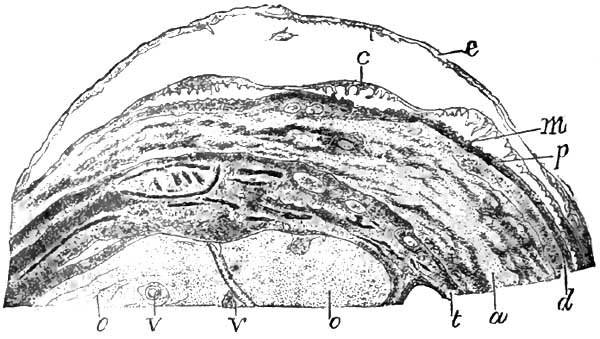
Pemphigus bulla from a new-born syphilitic child. The superficial epidermic layer e is elevated by a fluid exuded between it and the rete mucosum. The rete mucosum, c, is also partly raised, so that there exists a space filled with fluid between it and the papillæ, p. The epithelial prolongations and the ducts of the sudorific glands m, placed between the papillæ, and which run between them into the derm, are broken and suspended from the rete mucosum. d. Derm. a. Fibrous and muscular layers. t. Tendons and fibrous tissue. o. Cartilage of ossification of the first phalanx. v. Vessels. X 8.
FIG. 7.
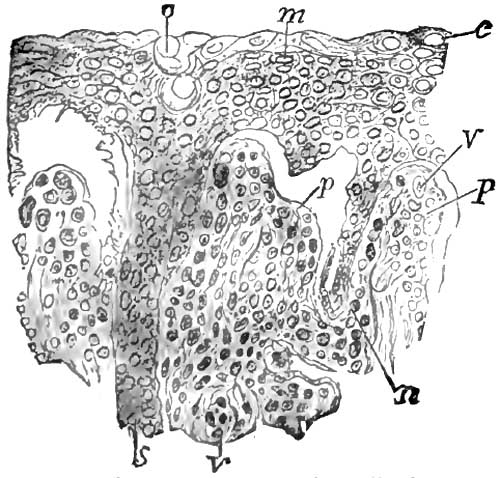
Section of the rete mucosum and papillæ from the same case of pemphigus as Fig. 6. o. Orifice of a sudorific gland. m. Cells of the rete mucosum, some of which are excavated, c. p. Papillæ. v. Their vessels. n. Prolongations of the rete mucosum between the papillæ. X 200.
If, then, we find an infant at birth or immediately after74 presenting on the soles, the palms, the fingers and toes, or on the limbs, an eruption consisting of blebs more or less perfectly distended with a liquid which may be clear, cloudy, or bloody, circular or oval in shape, sometimes irregular, seated on inflamed, reddish skin, and surrounded by trifling areolæ, we may strongly suspect the presence of syphilis in an active and most menacing form. And this suspicion becomes a certainty if, in combination with such an eruption, the general cutaneous surface is yellowish or muddy in hue, is hard, dry, wrinkled, without elasticity or softness—owing to the absence of subcutaneous fat—and, for the same reason, is furrowed and wrinkled about the face, imparting an appearance of senility; if the child has a hoarse cry, a discharge from the nostrils; and, of course, if there are at the same time other and unmistakable syphilodermata. This eruption is specially important, however, because upon the recognition of its specific character in cases of stillbirth, or in those in which the child survives only a few days—not long enough for the development of further symptoms—will depend the opinion as to the cause of death, which, whether expressed or not, will determine the future treatment of both parents during the interval and of the mother during the next pregnancy.
74 Non-syphilitic pemphigus is said to be never present at birth, nor until the child has become considerably exhausted by wasting from some defect of nutrition. It therefore does not appear until it is several weeks old. It then attacks the trunk in preference to the palms and soles.
We may now consider the other symptoms of the secondary period in the child.
Coryza is one of the most characteristic, and at the same time one of the most important, of these in its influence on the health of the child. It is due to the same condition of the mucous membrane lining the nasal fossæ as manifests itself simultaneously or soon afterward on the skin in the shape of erythema, roseola, or papules; in other words, it is a hyperæmia with papillary infiltration. Now, on the skin this condition, except in so far as it indicates the presence of a grave constitutional disease, is of no special importance. In the nostrils of a sucking infant, already debilitated and impoverished by the anæmia of syphilis, and depending upon its nutrition for the continuance of the miserable flickering life which was its original endowment, the same condition assumes the gravest significance.
The excessive supply of blood to the parts induces a catarrhal condition which shows itself in a thin, watery discharge, which, as the child during sucking is compelled to breathe through the nose, is rapidly dried into crusts. These become adherent, fill up and lessen the channel for the passage of air, and in so doing add to the rapidity and force of the respiration through the nose, and thus increase the tendency to the deposit of these crusts. The peculiar nasal, noisy respiration of the child has given the affection the popular name of snuffles. As the child can no longer breathe, or can breathe only with great difficulty, while sucking, it takes the breast only to drop it again immediately on account of impending suffocation.75 As the disease progresses ulceration occurs beneath the crusts, and often involves the entire thickness of the delicate mucous and periosteal layers underlying the thin bones of the nose; perforation of these bones results, sometimes with caries to such an extent as to cause an entire loss of the nasal septum, with flattening of the nose—a symptom comparable to one which sometimes occurs in the tertiary period of adults, but produced, as we have seen, by other causes. In adults syphilitic caries and necrosis are usually due to lesions seated primarily in the osseous or subperiosteal tissues; in the child, at least in this instance, these tissues are involved secondarily.
75 For an admirable description of the mechanism of this and other symptoms of coryza see Diday, op. cit., pp. 78-83.
Erythema, or roseola as it is differently called, is apt to present itself about the second or third week76 after birth. As in the adult, it begins upon the abdomen in the form of little oval, circular, or irregular spots, dull red in color and disappearing upon pressure. Later the color becomes deeper, the eruption extends to the trunk and limbs, and, as exudation and cell-proliferation succeed to simple capillary stains, it ceases to disappear when pressed upon. It is often moist, owing to the thinness of the epidermis, sometimes excoriated. Occasionally it is confluent, and covers large areas with an almost unbroken sheet of deep-red color.
76 Bassereau gives an instance of its occurrence within three days.
The diagnosis in the early stage is often difficult on account of the resemblance to the simple erythema of infancy. As the disease progresses, however, maculæ form here and there; the cell-infiltration involves the papillæ, several of which coalesce, forming flat papules; the nutrition of the superficial layers of the epiderm is interfered with, especially where it is thick, as on the palms and soles, and the eruption in those regions becomes scaly, and then the diagnosis is not difficult.
Papules and Mucous Patches.—In the ordinary evolution of the disease the next manifestation is usually the development of papules upon the general cutaneous surface and of mucous patches on the tongue, lips, and cheeks—probably also on other mucous membranes not exposed to examination. The papules are apt, for the reason already mentioned—the thinness and moisture of the skin—to be of the broad, flat kind, especially, as in the adult, in those regions where the elements of warmth and friction are superadded to the moisture, as in the folds of the skin about the genitalia, the neck, the flexures of the joints, etc. They are then moist, covered with a grayish secretion or a thin crust, and are in reality mucous patches. Occasionally they take on a little hypertrophy and develop condylomatous excrescences which closely resemble the simple acute condylomata of infants. In syphilis, however, the growth springs from a previously existing papule, which is not apt to be solitary, there being others in the neighborhood which will probably establish the diagnosis. The syphilitic condylomata also have a peculiar fetid discharge, resembling that of mucous patches and more or less characteristic.77
77 Van Harlingen, article "Syphilis" in the International Encyclopædia of Surgery, vol. ii. p. 560.
Mucous patches in the infant are among the most important of the early syphilitic lesions—not to the child itself, because they do not materially affect its health, save in those exceptional instances where they are accompanied by a marked degree of stomatitis, and thus interfere with its nursing. Their importance is due to the fact that they are almost constantly present, and they are thus by far the most frequent vehicle of contagion from the child to its nurse or to others with whom it may come in contact. At times they do not differ materially from the same lesion occurring in the adult, but lose much sooner their epithelial investment (on account of the delicacy and comparatively slight attachment of the epithelium at this stage), and they then appear as oval or irregular red, slightly depressed spots, distinct or coalescing, ulcerating or oftener covered by a false membrane. They especially affect the angles of the mouth and the sides and dorsum of the tongue; and indeed their disposition to select the former situation constitutes a diagnostic difference between them and non-specific stomatitis which is to be found in the sulci between the gums and cheeks and on the gums themselves—locations rarely invaded by mucous patches.78 When the latter are ulcerating or are concealed by diphtheritic membrane, and are situated on the tongue, they may be mistaken for either simple or parasitic stomatitis. The diagnosis can often be made by the presence of other syphilitic symptoms—coryza, erythema, and especially papules. In their absence, however, it must be remembered that in simple stomatitis, the inflammation not being limited to special areas, the whole tongue is apt to be involved or a much larger portion of the buccal mucous membrane; and as there is no marked tendency to cell-proliferation in these cases, the accompanying exudation is apt to be serous or watery and to result in vesiculation—a condition never seen in syphilitic stomatitis. In the parasitic disease, too, the inflammation is less localized, there is more swelling and congestion, and the false membrane is said to be of a whiter color.