Volume 2 — GENERAL DISEASES (continued 7)
Reading edition
TREATMENT.—Very mild cases of purpura simplex require no treatment, not even confinement within doors. The patient is often first made aware of his disease by accident; doubtless it frequently escapes detection altogether. It has been observed that purpura often appears upon the lower limbs of convalescents from other diseases when they first essay the upright position. Relapses of purpura also frequently appear as the patient leaves his bed. We have here an important indication for treatment—viz. the maintenance of the recumbent posture in cases of any degree of severity. Fresh vegetables and vegetable acids do not have the same happy influence as in scurvy. It is manifestly important that appropriate food should be administered in sufficient quantity, both to improve the general health and to repair the exhausting losses of blood. Milk is an exceedingly valuable article of diet in these cases, being but little apt to irritate the mucous membrane of the alimentary canal.
The patient should be guarded against violence. Injuries that may be of no consequence to healthy persons may excite in the purpuric profuse hemorrhage, free or interstitial. Violent emotions and physical efforts should be avoided, as in stimulating the heart's action a condition of increased blood-pressure ensues that may readily result in extravasation.
There are no remedies that exert a specific influence over purpura, and yet quite a number have enjoyed, and still enjoy, high reputation in controlling the symptoms. Probably the most frequently employed remedy against purpura is sulphuric acid, preferably the aromatic sulphuric acid, in doses of from 15 to 20 drops, diluted well with water and administered every third or fourth hour. It is certainly an agent of value, though some authors maintain that it has no efficacy (Immermann). Acetate of lead undoubtedly exercises an influence over the course of the disease. More recently, ergot has been employed. Its use has been highly extolled by Buckley and others. Very large doses may be given. The hypodermic use of ergotin has been followed by results most gratifying to those employing it. Oil of turpentine has enjoyed considerable reputation. A remedy that undoubtedly has a good effect is iron, both as exercising a controlling action over the bleeding and as assisting to repair the resulting anæmia. The tincture of the chloride is the most suitable preparation, and may be given in large doses (from minim xx to fluidrachm ss), well diluted, every fourth hour. Care must be exercised to avoid irritating the digestive organs with it. Formerly, venesection was employed to prevent the occurrence of hemorrhage, but its efficacy in this direction is at least doubtful, and cannot but help to intensify the disastrous consequences of severe and protracted attacks.
The various complications that may arise, as well as the general results of purpura, must be treated symptomatically. For the mucous membranes astringent washes should be used, and in favorable situations the tampon may sometimes be employed with profit. In purpura rheumatica the arthritic pains will be alleviated by anodyne liniments and plasters, and the often accompanying abdominal pains and colic by anodynes internally administered. Hæmatemesis, hæmaturia, etc. must be treated upon general principles. The results of profuse hemorrhage must be combated with stimulants. Transfusion of blood has been proposed and practised for the extreme anæmia that sometimes occurs, but without encouraging results. If necessary, the bowels may be kept free by mild aperients. In severe cases rest in bed should be rigidly enforced until after the establishment of convalescence. Quinia, iron, and nux vomica are indicated above all other remedies for the anæmia resulting from an attack of purpura.
DIABETES MELLITUS.
BY JAMES TYSON, A.M., M.D.
Diabetes mellitus is a term applied to a group of symptoms more or less complex, of which the most conspicuous is an increased flow of saccharine urine—whence the symptomatic title. It is associated with a derangement of the sugar-assimilating office of the liver, as the result of which an abnormally large quantity of glucose is passed into the hepatic vein and thence into the systemic blood, from which it is secreted by the kidneys. The condition is sometimes associated with alterations in the nervous system, at others with changes in the liver or pancreas, while at others, still, it is impossible to discover any structural alterations accompanying it.
FIG. 1.
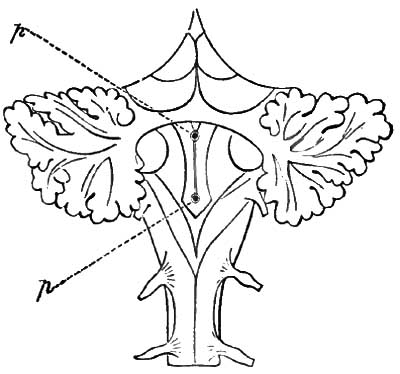
To show the position of the punctures required to produce glycosuria, the lobes of the cerebellum are separated. Below are seen the restiform bodies, the divergence of which circumscribes the apex of the calamus scriptorius and the fourth ventricle. The puncture p' produces glycosuria; the puncture p, glycosuria with polyuria; and a puncture a little higher up than p, albuminuria.
PATHOLOGY AND PATHOGENESIS.—Notwithstanding that this disease has been recognized for two centuries and a half, that abundant opportunity has been furnished for its post-mortem investigation, and that experimental physiology has contributed much information bearing upon the subject, its pathology is still undetermined. Experiment has, however, rendered it very likely that all cases of essential glycosuria—that is, all cases in which saccharine urine is not the direct result of over-ingestion of sugar or sugar-producing food—are accompanied by a hyperæmia of the liver. This hyperæmia, with its consequent glycosuria, can be induced by puncturing or irritating the so-called diabetic area1 in the medulla oblongata. This area corresponds with the vaso-motor centre, and with the roots of the pneumogastric or vagus nerve in the floor of the fourth ventricle; whence it was at first inferred that this nerve is the excitor nerve of glycosuria. It was soon ascertained, however, that when the pneumogastric was cut, glycosuria ensued only when the central end was stimulated, while stimulation of the peripheral portion was without effect. Whence it became evident that this nerve is not the excitor, but the sensory nerve concerned in glycogenesis.
1 The diabetic area, as marked out by Eckhard, and which corresponds with the vaso-motor area, as defined by Owsjannikow (Ludwig's Arbeiten, 1871, p. 21), is bounded by a line drawn four or five mm. above the nib of the calamus scriptorius, and another about four mm. higher up.
It was also learned in the course of continued experiment that glycosuria resulted upon transverse section of the medulla oblongata, of the spinal cord above the second dorsal vertebra, of the filaments of the sympathetic accompanying the vertebral artery, upon destruction or extirpation of the superior cervical ganglion, and sometimes, but not always, after division of the sympathetic in the chest (Pavy); also after section or careful extirpation of the last cervical ganglion, section of the two nerve-filaments passing from the lower cervical to the upper thoracic ganglion around the subclavian artery, forming thus the annulus of Vieussens,2 and after section or removal of the upper thoracic ganglion.
2 Cyon and Aladoff, reprint from the Mélanges biolgiques and Bullétin de l'Académie Impériale de Petersbourg, vol. xiii. p. 91; cited by Dr. Brunton in the Lectures named in note on p. 198; also British Medical Journal, Dec. 23, 1871, p. 731.
FIG. 2.
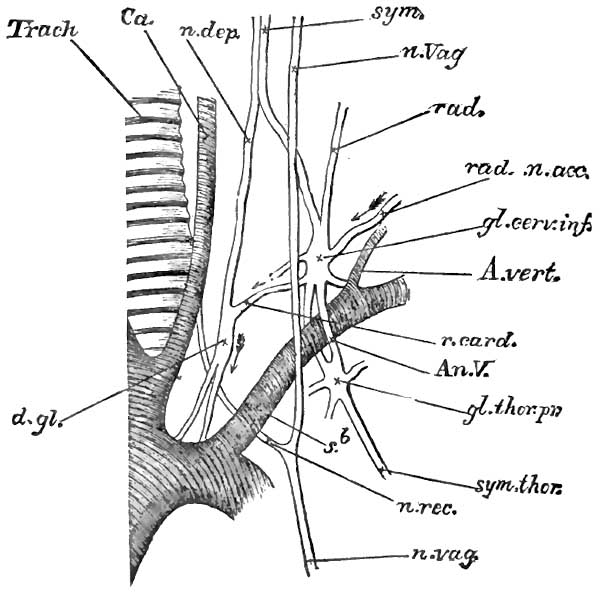
The last cervical and first thoracic ganglia, with circle of Vieussens, in the rabbit, left side. (Somewhat diagrammatic, many of the various branches being omitted.) Trach., trachea; Ca., carotid artery; n. vag., the vagus trunk; n. rec., the recurrent laryngeal; sym., the cervical sympathetic nerve ending in the inferior cervical ganglia, gl. cerv. inf. Two roots of the ganglion are shown—rad., the lower of the two accompanying the vertebral artery, A. vert., and being the one generally possessing accelerator properties; gl. thor. pr., the first thoracic ganglion. Its two branches, communicating with the cervical ganglion, surround the subclavian artery, forming the annulus of Vieussens. sym. thor., the thoracic sympathetic chain; n. dep., depressor nerve. This is joined in its course by a branch from the lower cervical ganglion, there being a small ganglion at their junction, from which proceed nerves to form a plexus over the arch of the aorta. It is this branch from the lower cervical ganglion which possesses accelerator properties, hence the course of the accelerator fibre is indicated in the figure by the arrows. (Modified from Foster's Physiology.)
All these operations paralyze the vaso-motor nerves by which, in health, the blood-vessels of the liver are kept in a state of tonic contraction; hence these vessels dilate when the nerves are cut. From the facts named we also learn the path of the glycogenic influence, which must be from the medulla oblongata into the spinal cord, thence by the filaments of the sympathetic which accompany the vertebral artery into the lower cervical ganglion; thence through the annulus of Vieussens into the first dorsal ganglion; and thence through the prevertebral cord of the sympathetic, and branches not precisely determined, to the hepatic blood-vessels as shown by the dotted line in Fig. 3.
FIG. 3.
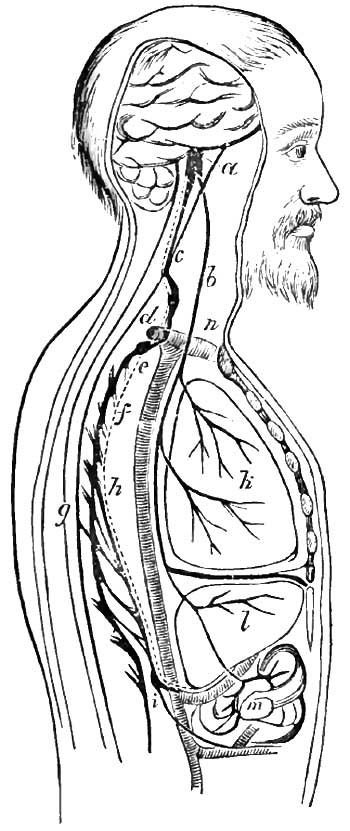
Diagram showing the course of the vaso-motor nerves of the liver, according to Cyon and Aladoff. These nerves are indicated by the dotted line which accompanies them: a, vaso-motor centre; b, trunk of the vagus; c, passage of the hepatic vaso-motor nerves from the cord along the vertebral artery; d, fibres going on each side of the subclavian artery and forming the annulus of Vieussens; e, first dorsal ganglion; f, ganglionated cord of the sympathetic; g, the spinal cord; h, the splanchnic nerves; i, coeliac ganglion, from which vaso-motor nerves pass to the hepatic and intestinal vessels; k, the lungs, to which fibres of the vagus are seen distributed; l, the liver; m, the intestine; n, the arch of the aorta.
I say, by branches of the sympathetic not precisely determined, because our power to produce artificial diabetes fails below the first thoracic ganglion; for section of the sympathetic between the tenth and twelfth ribs, and of the splanchnics, is not followed by glycosuria, although the vaso-motor nerves to the liver are known to pass through them.
According to Eckhard,3 the phenomena of artificial glycosuria are irritative and not paralytic. This view he believes sustained by his own experiments, according to which if the splanchnics, through which the vaso-motor nerves of the liver pass, are cut prior to the diabetic puncture, not only does this operation fail to produce glycosuria, but it even renders ineffectual the puncture itself as well as the section higher up. But Cyon and Aladoff remind us that it is not mere dilatation of the hepatic vessels, but increased velocity in the movement of the blood, which deranges the sugar-assimilating function and causes glucose to appear in the urine. The vaso-motor nerves of the intestinal blood-vessels also pass through the lower part of the sympathetic and the splanchnics, and section of the latter must cause these blood-vessels to dilate. Now, in rabbits, in which this experiment is usually performed, the digestive canal is very long, and the blood-vessels so capacious that when dilated they hold as much blood as all the rest of the vascular system together, so that when the lower sympathetic and splanchnics are cut, so much blood goes into the intestines that the increased velocity required in the blood-vessels of the liver to produce glycosuria is impossible. But if the vessels of the liver be first dilated by puncturing the floor of the fourth ventricle, section of the sympathetic or of the splanchnics may then be made without arresting the formation of sugar; whence it would appear that the glycogenic influence may still pass through the lower sympathetic and splanchnics.
3 Beiträge zur Anat. und Physiologie, iv., 1859, p. 1; vii., 1873.
In view of the fact that Eckhard4 has failed to confirm the results of Cyon and Aladoff, but has traced the glycogenic influence down the spinal cord as far as the fourth dorsal vertebra in rabbits, and even a little lower, and that Schiff5 has shown that diabetes sometimes results after section of the anterior columns of the cord between the medulla and the fourth cervical vertebra, Dr. Brunton6 suggests that the vaso-motor nerves of the liver may not always leave the spinal cord to join the sympathetic by the branches accompanying the vertebral artery, but sometimes pass farther down the cord, leaving it by the communicating branches to some of the dorsal ganglia, as indicated in Fig. 4.
4 Beiträge zur Anat. u. Physiologie, viii., 1877, p. 79.
5 Untersuchungen über Zuckerbildung in der Leber, 1859, S. 108.
6 Lectures on the Pathology and Treatment of Diabetes Mellitus; reprinted from the British Medical Journal, 1874, p. 12.
FIG. 4.
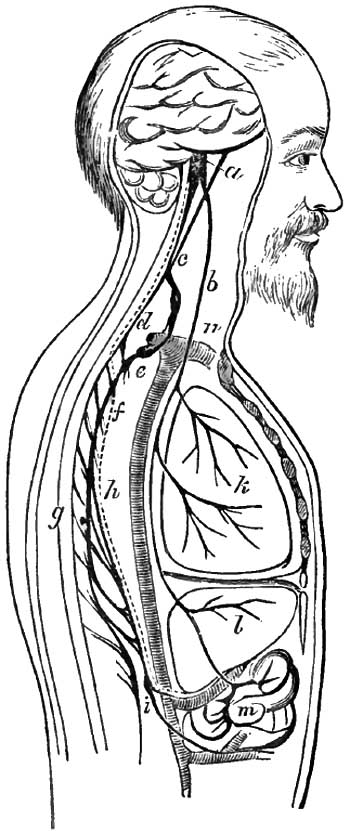
Diagram showing another course which the vaso-motor nerves of the liver may take. The letters indicate the same parts as in Fig. 3. The hepatic vaso-motor nerves are here represented as passing lower down the cord than in Fig. 3, and leaving it by communicating branches to the second dorsal ganglion. It is possible that they may sometimes leave by the branches to the first, and sometimes by those going to a lower, ganglion. In such cases any irritation to the third or one of the other cervical ganglia may cause diabetes by being conveyed along the vertebral artery and up the cord, as indicated by the dark line, to the vaso-motor centre, where it may cause reflex inhibition in the same way as any irritation to the vagus.
It is evident that an agency involving any part of this tract in such a way as to paralyze the vaso-motor nerves of the liver is capable of producing glycosuria. Such cause may operate upon the central ganglia whence the nerves emanate, as the vicinity of the oblongata and upper parts of the spinal cord or the coeliac ganglion and its branches, including those to the pancreas. Or the irritation may be peripheral and its effects reflex. We have seen that irritation of the central end of the cut vagus will produce glycosuria. Any irritation, therefore, involving the peripheral distribution of this nerve may produce it. Hence embarrassed respiration, whether due to disease of the respiratory passages, strangulation, or inhalation of irrespirable gases and anæsthetics, produces glycosuria in dogs and rabbits; and this symptom has been known to attend these conditions in the human subject. So, too, glycosuria may be produced by such substances as woorara, strychnia, morphia, and phosphoric acid, introduced into the blood and irritating the terminal filaments of the pneumogastrics, or it may be brought about secondarily through the embarrassed respiration these drugs produce. Such peripheral irritation may reside also in the stomach, intestines, liver, or any organ to which the pneumogastric is distributed.
It is not unlikely that irritation of the extremities of sensory nerves other than the pneumogastric may become the cause of reflex glycosuria. Even puncture of the floor of the fourth ventricle itself may be reflex in its operation, the roots of the pneumogastric being thus irritated. The effect of the irritation conveyed to the glycogenic centre is to inhibit the usual tonic influence of the vaso-motor nerve upon the vessel walls. Among the experimental irritations, in addition to puncture of the floor of the fourth ventricle, which produce glycosuria by reflex action, are injuries of the cerebral lobes and cerebellum, optic thalami, cerebral peduncles, pons varolii, middle cerebellar peduncles, and even of the sciatic nerve and brachial plexus; whence it may be inferred that pathological irritation in the same situations may result in a glycosuria, which is temporary or permanent according as the irritation is temporary or permanent.
Finally, there is no reason why an inhibitory reflex action should not originate in the sympathetic itself. When we remember that this nerve is both sensory and motor in function, and that the inhibitory influence to which the heart's action is subject is accomplished through the sympathetic as a sensory nerve and the pneumogastric as a motor, there is no reason why similar results may not be brought about by the sympathetic alone. This being the case, we need not ascribe glycogenic phenomena to irritation in Eckhard's sense—that is, to a direct stimulant action of the irritant upon the vaso-motor nerves of the liver—but may suppose a sensory influence to ascend one set of sympathetic filaments and an inhibitory influence to descend through another.
Dr. Pavy has recently put forward some chemical theories which explain the action of the hyperæmia in producing glycosuria, but they do not account for the hyperæmia itself. In healthy digestion the carbohydrates (starch and sugar) are converted, not into glucose, but into maltose, C12H22O11, dextrin being intermediate in composition. Maltose is absorbed and assimilated, converted into glycogen. So, too, when glucose is ingested as such, it is converted by the glucose ferment into maltose in the stomach and intestines. For the proper production of maltose and its assimilation a good venous blood, producing a maltose-forming ferment, is necessary. In diabetes, in consequence of the dilatation of the arteries of the chylopoëtic viscera, the blood enters the liver too little deoxygenated, and a glucose-forming ferment is produced. The glucose thus formed is not assimilable, but passes off into the circulation and the urine.
MORBID ANATOMY.—Such are some of the facts bearing upon the pathology of diabetes mellitus. Throwing out the milder type of cases, in which glycosuria is the result of an over-ingestion of saccharine and sugar-producing food—and these can scarcely be called instances of essential diabetes—it is evident that glycosuria may be produced in a variety of ways operating through the nervous system; and accordingly we may infer that there is scarcely an organ in close relation with the sympathetic system derangement of which is not capable of producing it. Among these we would naturally expect to find conspicuous alterations in the nervous centres, and yet I have never found changes in these centres after death. At the same time, others have noted meningitis, tubercular and traumatic, apoplectic effusions, and tumors of the brain, especially in the neighborhood of the medulla oblongata. The alterations in the nerve-centres described by Dickinson as the essential morbid anatomy of diabetes I have looked for in vain. These changes are described as a cribriform or porous condition of the white nervous matter, said to be visible to the naked eye. The spaces thus produced are partially occupied by dilated blood-vessels, which, in turn, are surrounded by dilated perivascular sheaths and broken-down nervous matter, into which extravasations of blood have taken place, as evidenced by the presence of pigment-granules. The changes are found in the white matter of the convolutions of the brain, but fewer and larger in the central portions. The corpora striata, optic thalami, pons, medulla, and cerebellum are favorite seats for the largest and most striking holes. In rapidly-fatal cases the cavities are sometimes filled with a translucent, gelatinous substance, containing, besides vascular elements, the globular products of nervous disintegration. In the more chronic forms of the disease, as it occurs in elderly persons, the excavations are usually empty, although the elements of nervous decay are still to be found fringing the margins or collected as an irregular sheath upon the dilated or shrunken artery. There are changes in the cord similar to those in the brain, but less decided. But the most striking alteration in the cord, according to Dickinson, although not always present, is dilatation of the central canal, which in the dorsal and lumbar regions is sometimes expanded to many times its normal diameter, and forms a conspicuous object immediately after the cord is divided.
These alterations have eluded the vigilance of other pathologists who have sought for them in well-determined cases of diabetes mellitus, while they have been found, on the other hand, in the nervous centres when no diabetes was present. In the recent discussion on diabetes at the Pathological Society of London, Douglas Powell7 seemed to be the only one who was convinced that most of Dickinson's specimens were examples of positive lesions.
7 London Lancet, May 5, 1883, p. 776.
A hyaloid thickening of the blood-vessels of the brain has been noted by Stephen Mackenzie8 and Seymour Taylor9 in some cases, and miliary aneurisms of the retina in one.
8 Discussion on Diabetes, Path. Soc. of London, London Lancet, April 7, 1883, p. 593.
9 Ibid., Lancet, May 5, 1883, p. 774.
Of other organs, one of the most frequently found diseased is the pancreas, and, according to Senator, it is fair to assume that disease of the pancreas is present in about one-half of all cases of diabetes. As the result of increased experience, I am inclined to attach much more importance to pancreatic disease as a cause of diabetes than I did a few years ago. Among the changes found is a pseudo-hypertrophy, which consists chiefly in a hyperplasia of the connective tissue, fatty degeneration of the gland-cells, and atrophy of the glandular structure; cancerous disease; calculous concretions in the ducts with or without obstruction; and cystic dilatation.
Facts bearing upon the relation of pancreatic disease to diabetes have been accumulating since Cowley first discovered calculi in the pancreas of a diabetic, and Bright pancreatic cancer in a similar case. Since then instances have multiplied to such extent that it would be unprofitable to enumerate them. But in 1877, Lancereaux10 communicated to the French Academy of Medicine specimens of profound lesion of the pancreas from cases dying of diabetes mellitus. This, he alleged, constitutes a special and distinctive variety of diabetes, characterized by sudden onset, emaciation, polydipsia, polyphagia, and peculiar alvine dejections. More recently, Depierre11 has confirmed these observations, apparently establishing this variety of diabetes mellitus, of which a very rapid course—six months to three years—and the habitual presence of diarrhoea are characteristic; while the presence of greasy or creamy stools, and the appearance in them of undigested nitrogenous substances, may aid in the diagnosis. Precisely such a case, running the same rapid course—less than one year—with emaciation, uncontrollable diarrhoea, creamy stools, jaundice, and pancreatic disease, came under the writer's care in 1882. At the autopsy the pancreas was found enlarged, and numerous gritty particles were disseminated through it.
10 "Notes et réflexions à propos de deux cas de diabète sucre avec altération du pancréas," Bull. Acad. de Méd., Paris, 1877, 2d Serie, vi. 1215-1240.
11 Med. News and Abstract, vol. xxxix., June, 1881, p. 344, from Jour. de Méd. et de Chir. pratiques, Dec, 1880.
Supposing such pancreatic disease to be primary, it is evident that it must operate through the coeliac plexus, which, with its ganglion, is gradually encroached upon. On the other hand, it is also possible that the disease of the coeliac plexus may be primary, and the coexisting pancreatic disease and diabetes mellitus both secondarily dependent upon it. This can only be settled by more careful study of the coeliac plexus after death from diabetes, but up to the present time facts would seem to support the view of primary pancreatic disease.
The liver is frequently enlarged—sometimes but slightly, at others decidedly. It has been known to reach three times the size of the normal organ. Again, it may be darker and harder—hyperæmic. By minute examination the acini are found enlarged, the capillaries dilated and distended; the liver-cells are enlarged, distinctly nucleated, rounded, and indistinct as to their outline, appearing to fuse into each other. A weak solution of iodine strikes a wine-red color, which, according to Rindfleisch, is confined to the nucleus, but, according to Senator, may extend to the whole cell. This reaction Klebs ascribes to post-mortem changes in the glycogenic substance. They are more striking in the portal or peripheral zone of the lobule, while the intermediate or hepatic artery zone is often fatty, and the central part, surrounded by the rootlets of the hepatic vein, is nearly normal. Stockvis and Frerichs ascribe the enlargement of the liver partially to a new formation of liver-cells—in other words, to a true hypertrophy. At other times the organ has been found reduced in size.
Dickinson, Trousseau, and Budd describe an overgrowth of connective tissue, as well as of the cells of the liver, producing a hypertrophic cirrhosis.
According to Beale, Frerichs, and Folwarczny, the fat which is found in small proportion in the liver-cells in health is often diminished, and even absent, and quantitative12 analysis by the last-named observer confirms this view. Such diminution may be the forerunner of an atrophy of liver-cells which has been noted, and which, as the disease continues, leads to the atrophy referred to as occasionally present. On the other hand, intense fatty degeneration of the entire organ, similar to that found in phosphorus-poisoning, has been met by Gamgee, associated with a lipæmic state of the blood and symptoms of acute acetonæmia.
12 Folwarczny, "Leberanalysen bei Diabetes Mellitus," Wiener Zeitschr., N. F., 1859, ii. 6.
The kidneys, in cases which have continued some time, are apt to be hyperæmic and enlarged, although primarily they are uninvolved. It would seem that the long-continued hyperæmia which is a necessary condition of the copious secretion of urine, results, sooner or later, in an over-nutrition of the renal epithelium, a widening of the tubules, and consequent enlargement of the whole organ. The changes are mainly of a parenchymatous or catarrhal rather than an interstitial nature, the epithelium being disposed to shed. These changes may reach a more advanced stage of cellular degeneration, and may be attended by albuminuria. The cells may become very large, present a yellowish-brown color, their nuclei indistinct and non-responsive to ordinary staining solutions, but may take a red stain with a weak solution of iodine, similar to that described in the case of the liver-cells. Mackenzie describes a hyaline degeneration of the intima of the arterioles and a skeleton condition of the epithelium of the collecting tubes.13 There may also be a catarrh of the pelves of the kidneys and ureters, due to irritation of the saccharine urine.
13 Loc. cit.
Atrophy of the testes has been noted by Romberg and Seegen in young men, and recently Hofmeier14 has reported the case of a young diabetic woman, aged twenty, who came under observation for pruritus vulvæ, in whom the uterus was found small, scarcely 5 cm. (2 inches) long, and the ovaries very much atrophied. As this young woman had no other ailment, the atrophy was ascribed to the diabetes.
14 Berliner klin. Wochenschr., 1883, No. 42.
Among the most constant secondary lesions is the aggregate of changes known as those of pulmonary phthisis. But a few years ago, when our ideas on this subject were more definite than they are to-day, and when it was thought we had three distinct varieties of phthisis—the tubercular, the catarrhal, and the fibroid—the phthisis of diabetes was regarded as typically catarrhal.15 At the present time, however, when the tendency at least is to regard all phthisis as tubercular, diabetic phthisis must be consigned to the same category. At the same time, if the tubercle bacillus is to be regarded as the essential criterion of tuberculosis, it must be stated that the diabetic patient is subject to two different lung processes—at least if the observations of Riegel of Giessen16 are to be regarded as correct. In two cases of diabetic phthisis studied at his clinic, the sputum of one contained numerous bacilli, while the other, although the case presented the most distinct signs of infiltration of the apex, and although more than fifty preparations were investigated, revealed none. The sputum was also said to present some unusual physical characters. So far as I know, no autopsies of cases showing these clinical differences have been reported, although there have been found in diabetes, distinct from the usual cheesy foci, fibroid changes with small smooth-walled cavities. In such cases tubercle bacilli would be absent, while the physical signs of consolidation would be present.
15 See the writer's work on Bright's Disease and Diabetes, Philada., 1881, p. 256.
16 Medical News, Philada., May 19, 1883, from Centralblatt f. klin. Med., Mar. 31, 1883.
As a part of the phthisical process in diabetes, cavities of various sizes are found and gangrene of the lungs has been observed.
ETIOLOGY.—The problem of the etiology of diabetes mellitus is as unsatisfactorily solved as is that of its pathogenesis. Certainly, a majority of cases of diabetes cannot be accounted for. A certain number may be ascribed to nervous shock, emotion, or mental anxiety; a few to overwork; some to injury and disease of the nervous system; others to abuses in eating and drinking. Among the injuries said to have caused diabetes are blows upon the skull and concussions communicated to the brain, spinal cord, or vaso-motor centres through other parts of the body. Hereditation is held responsible for a certain number of cases. Malarial and continued fevers, gout, rheumatism, cold, and sexual indulgence have all been charged with producing diabetes.
Diabetes mellitus is most common in adult life, although Dickinson reports a case at six years which was fatal, Bence Jones a case aged three and a half, and Roberts another three years old; and in the reports of the Registrar-General of England for the years 1851-60 ten deaths under the age of one and thirty-two under the age of three are included. This statement, in view of the experience of the difficulties of diagnosis in children so young, seems almost incredible. I have never myself met a case in a child under twelve years. At this age I have known two, of which one, a boy, passed from under my notice, while the second, a girl, recovered completely. The disease is most common between the ages of thirty and sixty. The oldest patient I have ever had died of the disease at seventy-two years, having been under my observation for three and a half years.
It is decidedly more frequent in men than in women, carefully prepared statistics of deaths in Philadelphia during the eleven years from 1870 to 1880, inclusive, giving a total of 206 deaths, of which 124, or three-fifths, were males, and 82, or two-fifths, females. This is the experience of all.
My own experience has been singular and interesting. Up to April, 1881, I had never met a case in a woman. Of 18 cases outside of hospital practice which I have noted since that date, 9 were men and 9 women. But I still do not recall an instance of a woman in hospital practice, although I have constantly cases among men.
Not much that is accurate can be said of the geographical distribution of the disease. It seems to be more common in England and Scotland than in this country, at least if the statistics of New York and Philadelphia are considered. In the former city, statistics extending over three and a fourth years show that out of 1379 deaths, 1 was caused by diabetes; in Philadelphia, in eleven years, 1 out of 875; in England and Wales, according to Dickinson from observations extending over ten years, 1 out of 632; and in Scotland, 1 out of 916. According to the same authority, the disease is more prevalent in the agricultural counties of England, and of these the cooler ones, Norfolk, Suffolk, Berkshire, and Huntingdon. According to Senator, it is more common in Normandy in France; rare, statistically, in Holland, Russia, Brazil, and the West Indies, while it is common in India, especially in Ceylon, and relatively very frequent in modern times in Wurtemberg and Thuringia. Seegen says it is more frequent among Jews than among Christians, but I have never seen a case in a Hebrew.
SYMPTOMS, COURSE, AND DURATION.—The earliest symptom commonly noted by the diabetic is a frequency of micturition and the passage of larger amounts of urine than is natural. Coincident with or immediately succeeding this is an undue thirst and dryness of the mouth, which soon becomes the most annoying symptom the patient has, the freest draughts of water giving but partial or temporary relief. To this succeeds dryness, and sometimes itching, of the skin and absence of perspiration. A good appetite with fair digestion accompanies this stage of the disease, but notwithstanding this the patient loses in weight. If a male, his attention is sometimes called to his urine by the white spot left after the evaporation of a drop of urine on his boot or clothing or by the stiffness of his linen due to the same cause. To these symptoms are sometimes added an intolerable itching of the end of the urethra in males and of the vulva in females, probably due to the irritation caused by the saccharine urine in passing over and drying upon these parts.
As the disease progresses muscular weakness supervenes. This, however, comes on at varying periods after the incipient symptoms make their appearance. Sexual inclination grows less. The muscular weakness gradually increases, if the disease is not checked, until the patient can barely walk: he totters in his gait, and reminds one of a case of Duchenne's disease. Even before this he sometimes gives up and goes to bed. Often harassing cough ensues, adding its exhausting effect to that of the essential disease. Percussion and auscultation discover consolidation at one apex or over larger areas of the lungs. Dyspepsia and indigestion replace the good appetite which attended the onset of the symptoms, and all efforts to increase the latter are unavailing. The heart begins to flag, and its action is irregular. It finally ceases to act, and the patient dies suddenly, sometimes unexpectedly. Or coma may supervene before death. This coma, known as diabetic coma, is generally ascribed to the accumulation of acetone or acetone-producing substance in the blood. It is supposed to be a product of the decomposition of the sugar in the blood, and the phenomena resulting from its presence are known as those of acetonæmia. Some further account of it will be given in the section on changes in the urine. It is sometimes recognizable by a fruity odor of the breath, which may even pervade the atmosphere of the room in which the patient lies, and may be recognized on entering. It has been compared to the odor of a room in which apples have been kept, again to sour beer, and again to chloroform.
During all this time the thirst and discomfort arising therefrom, continue, although it sometimes happens that toward the end the quantity of urine and its contained sugar diminish and the urine becomes darker in hue.
Such is the course of a typical case of diabetes mellitus. Other symptoms, less conspicuous, are a lowered temperature of the body, from 1° to 2½° F. or even more; cataract, dilatation of the retinal vessels, intraocular lipæmia, functional derangements of vision, including amblyopia, presbyopia, and loss of accommodating power; and occasionally total blindness from atrophy of the retina may be present. I have known almost total blindness to appear very early in the disease, and subsequently to disappear. Derangements of the other special senses, as impairment of hearing, roaring in the ears, and disorders of smell and taste, also occur. Boils and carbuncles are occasional symptoms; although usually late in occurrence, the former are said to be sometimes the first symptoms recognized. Numerous skin affections may occur. Ulcerated surfaces are slow to heal, and gangrene supervenes sometimes spontaneously, but more often as the result of some trifling injury. It may start from a blister produced by cantharides, although such instances are scarcely frequent enough to justify interference with treatment demanding blisters. More frequently surgical operations do badly. Allied to this tendency is a spongy state of the gums, with recession and excavation, resulting, in asthenic cases, in absorption of the alveolar processes and falling out of the teeth. Eczema of the labia and vicinity in females, and a similar irritation about the meatus urinarius in males, are annoying symptoms. A purulent-looking discharge has been seen issuing from the urethra, in which the spores of penicilium glaucum have been recognized by the microscope.
The term diabetic coma is applied to a form of coma which is apt to occur late in the disease, indeed most frequently to terminate it; while it is also used to indicate a train of nervous symptoms of which coma is the terminal one. To this train of symptoms the word acetonæmia is also applied, and should alone be used, while the term diabetic coma should be restricted to the terminal symptom. The coma, as well as the previous nervous symptoms, is considered due to the accumulation in the blood of a product of the decomposition of sugar, formerly believed to be acetone, but now thought to be an acetone-producing substance, probably aceto-acetic acid. It is likely that in all cases of diabetes a small quantity of this substance exists in the blood, from which it is separated by the kidneys and lungs, while it is only when these channels are insufficient for its removal that it accumulates and produces the symptoms described.
Usually, the coma comes on gradually, deepening until it terminates in death. In other instances it is preceded by various symptoms, including dizziness, drowsiness, cephalalgia, delirium, mania, muscular pains, gastric and intestinal symptoms, including epigastric pain, vomiting—sometimes of blood—and even purging; also dyspnoea, with short, panting respiration like that of an animal with both vagi cut, and a fluctuating pulse-rate which continues until coma is established, after which it remains rapid and small. Both the breath and urine may exhale the peculiar odor of acetone, or it may be absent, and the urine strikes the peculiar burgundy-red reaction with perchloride of iron to be again referred to.
These symptoms may be sudden in their occurrence, whence acute acetonæmia, or they may ensue slowly. Ralfe,17 who has studied the subject of acetonæmia very thoroughly, has called attention to the parallelism between the phenomena of acute acetonæmia and those of acute yellow atrophy of the liver and of phosphorus-poisoning. The sudden, sharp epigastric pain, with gastric disturbance and vomiting, often of blood; the peculiar panting dyspnoea referred to; the short, noisy delirium, followed almost suddenly by deep coma; the fall in temperature as the nervous symptoms develop; the irregular, and finally rapid, pulse,—are all symptoms common to the two conditions.
17 Clinical Chemistry, 1883, p. 98; also Discussion on Diabetes before Pathological Society of London, Lancet, April 7, 1883, p. 592.
Although acknowledged to be a grave complication, and the most frequent cause of death in diabetes,18 yet it does not follow that a fatal termination is inevitable when diabetic coma sets in. I have now a patient, a woman, who considers herself in perfect health, but in whom there remains a trifling glycosuria, who at one time was supposed to be dying of diabetic coma.
18 Of 400 cases of diabetes which passed under the observation of Frerichs, the majority died of acetonæmia (Frerich's "Ueber den plötzlichen Tod und über das Coma bei Diabetes," Zeitschr. für klin. Med., 1883, vi. 3-53). Of 53 persons dying of diabetes at Guy's Hospital, London, during the last ten years, 33 died comatose (Dr. Fred. Taylor, Discussion on Diabetes, Pathological Society of London, Lancet, May 5, 1883). In my own experience acetonæmia has not been so frequent a cause of death as phthisis, acute pneumonia, and heart-failure.
Crampy pains in the legs and facial paralysis are among the nervous symptoms sometimes present, and the term diabetic neuralgia has been applied to a special form of neuralgia peculiar to this disease. It is characterized by its acuteness, stubbornness, and symmetry. Its favorite seats are the inferior dental nerves and the sciatics. Greisinger referred to the frequency of sciatica in 1859, Braun again in 1868, and others still later; but Worms in 1881 established the close relation between the two conditions and the features described. Most recently (1884), Cornillon19 collected 22 cases of diabetic neuralgia, and has further elaborated the study. Believing that diabetes affects particularly those persons who have had serious attacks of rheumatism and gout, he is inclined to think the neuralgia as much due to uricæmia as to hyperglycosuria, and that these conditions cause, not neuritis, but transitory lesions in the nerve-centres, but whether in the membranes or gray or white matter is undetermined.
19 "Des nevralgies diabétiques," Revue de Médecine, 1884, iv. 213-230.
That the phenomena of acetonæmia are those of a toxic agent or agents in the blood derived from the sugar there present is generally conceded, although Sanders and Hamilton,20 after a study of the clinical histories and the result of autopsies in several cases, are disposed to ascribe diabetic coma to slow carbonic-acid poisoning due to fat embolism of the pulmonary vessels. So far as I know, these conclusions have not been reached by any other observers. R. H. Fitz21 and Louis Starr22 have each reported cases of diabetic coma with lipæmia, carefully studied with this point in view, without finding any facts to sustain the carbonic-acid theory.
20 Edinburgh Med. Journal, July, 1872.
21 "Diabetic Coma; its relations to Acetonæmia and Fat Embolism," Boston Medical and Surgical Journal, vol. cvi. p. 24, Feb. 10, 1881.
22 "Lipæmia and Fat Embolism in Diabetes Mellitus," New York Medical Record, vol. xvii., 1880, p. 477.
Alterations in the Blood.—The blood of diabetics is variously charged with sugar, which may be in such quantity as to impart a viscidity and higher specific gravity to the plasma, which has reached 1033, the normal being 1028. On the other hand, analyses have sometimes failed to discover sugar in the blood after death, the result, probably, of the tendency of the sugar to rapid disintegration. Alcohol and acetone, or acetone-producing substance (aceto-acetic acid), are occasionally present as the products of such decomposition, to which are ascribed the symptoms of acetonæmia already discussed.
The presence of fat in the blood of diabetics was noted by the earliest students of the disease. It is sometimes sufficient in amount to produce a milky appearance of the serum, while the analyses of Simon revealed a quantity of 2 to 2.4 per cent., the normal being 1.6 to 1.9 per cent. The fat thus present is said to be sometimes sufficient to cause fat embolism in the capillaries of the lungs, and cases of this condition have been reported by Sanders and Hamilton,23 Louis Starr,24 and Rickards.25 Ralfe ascribes the lactescent appearance of the blood to the action of the aceto-acetic acid, since acetic will give a milky appearance when agitated with a dilute and slightly alkaline mixture of fatty matter at 100°, and the injection of acids into the blood of animals leads to the increase of fatty matter in the blood and fatty infiltration of tissues.
23 Loc. cit.
24 Loc. cit.
25 Birmingham Med. Review, Jan., 1882.
It must be admitted that the mode in which this lipæmic state of the blood is brought about is imperfectly understood, and whether it be by some chemical agency of the kind described by Ralfe, or by rapid absorption of the subcutaneous fat, or from an imperfect oxidation of absorbed fat, is undetermined. Possibly all may contribute.
Albert G. Heyl26 has described an altered appearance of the retinal vessels recognizable by the ophthalmoscope, which he ascribes to the fatty blood-plasma at the periphery of the blood-current, the normal plasma being invisible on account of its transparency.
26 For a detailed description of this appearance, with a colored lithograph depicting it, see the author's work on Bright's Disease and Diabetes, p. 262.
The red blood-discs are diminished and their ratio to the white corpuscles altered. In a count by F. P. Henry, in Louis Starr's case, the number of red discs was 4,205,000 to a cubic millimeter, the normal being at least 5,000,000; the white were 50,000 to a cubic millimeter, or 1 white to 84 red, instead of 1 to 350 or 500.
Changes in the Urine.—The most important changes in the urine are its increase in quantity and the presence of sugar. The variations in the former are extreme, being from an amount which but slightly exceeds the normal to as much as 50 pints (23.65 liters) in twenty-four hours, and even more. The quantity is of course limited by the fluid ingested, and although it may exceed this amount for a day or more, it cannot do so for any length of time. It is generally a little less. The more usual quantity in the twenty-four hours is from 70 to 100 ounces (210 to 300 cc.).
The quantity of sugar varies greatly in different cases and at different times in the same case. The maximum quantity reported by Dickinson was 50 ounces, or 1500 grammes, in twenty-four hours. The proportion may reach as much as 15 per cent., but the more usual amounts are from 1 to 8 per cent., or from 5 to 50 grains (.324 to 3.24 grams) to the fluidounce, or from 300 to 4000 grains (19.44 to 260 grams) in the twenty-four hours.
It is important to know that intercurrent febrile disease may produce a decided diminution in the daily quantity of urine, and of the sugar contained in it. A similar decrease, and even disappearance, is said to take place sometimes toward the fatal termination of a case.
The effect of exercise upon the sugar secretion is not uniform. Bouchardat and Kuelz have noted a diminution, and even disappearance, of sugar from urine as its result, and it is reasonable to suppose that judicious exercise is at least without harmful effect, while it is certain too that muscular exercise, if excessive, will increase glycosuria.
Changes in diet of course modify the secretion of sugar, starches and saccharine foods increasing it, while nitrogenous and oily foods diminish it. So, too, the urine secreted on rising in the morning has almost always less sugar in it than that passed on retiring; and it is not rare to find no sugar in urine passed on rising, when that passed on retiring at night may contain a small amount of sugar—from ¼ to 1 per cent. On the other hand, I have found a small amount of sugar in the morning urine when the evening urine contained none. Anxiety and excitement both increase the proportion of sugar.
Inosite, or muscle-sugar, is sometimes associated in urine with diabetic sugar, and occasionally replaces it. So, too, in experiments upon animals puncture of the fourth ventricle is sometimes followed by inosuria instead of glycosuria, and in corresponding organic disease of the brain the same thing is observed. The substitution of grape-sugar by inosite in the course of diabetes is considered by Laboulbène27 a favorable change.
27 "Note sur l'Inosurie, succédant au diabète glycosurique, et paraissant avoir une action favorable," L'Union Médicale, Oct. 14, 1883.
As would be expected, the specific gravity of saccharine urine is usually high—most frequently from 1025 to 1040—and Bouchardat noted a specific gravity of 1074 in one instance. On the other hand, I have found sugar easily detectable in urine with a specific gravity as low as 1010. Pavy records an instance of the same specific gravity, and Dickinson one in which the specific gravity was as low as 1008. It is to be remembered that the sugar is rapidly destroyed when fermentation sets in. A coincident diminution in the urea and other solids of the urine will reduce the specific gravity of a saccharine urine otherwise heavier.
The depth of color of diabetic urine is inversely as the quantity passed. Hence, when this is very large the urine is pale, and even almost colorless, but it may still contain considerable amounts of sugar and possess a decided color, quite as deep as that of urine passed in smaller quantity. When exposed to the air, diabetic urine becomes rapidly turbid from the growth of fungi, including the yeast fungus and penicilium glaucum.
The odor of diabetic urine just passed is usually in no way peculiar, but as fermentation progresses an acetous odor is developed, which is ascribed to acetic acid. At other times the odor is quite peculiar, being spoken of as vinous or compared to that of sour beer, stale fruit, alcohol, chloroform, or, as by one of my patients, to sweetbrier.
Diabetic urine has almost invariably an acid reaction, which becomes more decided as fermentation progresses. As a consequence of this increased acidity, and sometimes independent of fermentation-changes, the urine deposits a sediment of uric acid, but with this exception diabetic urine is generally free from sediment. Diabetic patients on a meat diet sometimes have a good deal of uric acid from this source.
Albuminuria may coexist with glycosuria, but is not generally found until late in the disease, after changes in the kidney begin to make their appearance, unless, as may happen, glycosuria supervenes upon primary renal disease.
Alcohol and acetone, or an acetone-yielding substance—aceto-acetic acid—are sometimes found in diabetic urine. They are products of the breaking up of sugar, but chemists do not explicitly agree as to the exact method in which acetone originates in the organism. First recognized in the distillate of urine and blood of a diabetic patient by Petters28 through its physical properties, odor, combustibility, etc., rather than by actual isolation, it was further investigated by Kaulich,29 Gerhardt,30 Rupstein,31 and Markownikoff,32 who obtained it in an impure state from urine; by Deichmüller and Tollens,33 whose isolated substance was pure, and finally most recently by Jaksch34 and Penzoldt.35 The former found it not only in diabetic urine, but also in that of fever, and even of carcinoma. The latter found it by the indigo test in but 18 out of 22 diabetics, and by the iodoform test, either decidedly or feebly, in 20 out of 20; in 3 out of 11 cases of typhoid fever, in 6 out of 7 cases of pneumonia, in none of 6 cases of phthisis, in 1 out of 3 cases of measles, and in 1 case of cerebro-spinal meningitis. Finally, v. Jaksch has been led to believe, from his extensive investigations, that acetone is a constant and normal product of tissue-change, although Penzoldt considers such conclusion scarcely justified.
28 Prager Vierteljahrschrift, xiv. 3, 1857, S. 88.
29 Ibid., xvii. 3, 1860, S. 59.
30 Wiener Med. Presse, No. 28, 1865.
31 Centralbl. für d. med. Wiss., No. 55, 1874.
32 Liebig's Annalen, Bd. 182, S. 362.
33 Ibid., Bd. 209, S. 25.
34 Zeitschrift für physiol. Chemie, vi. 6.
35 "Beiträge zur Lehre von der Acetonurie und von verwandten Erscheinungen," Deutsch. Archiv für klin. Med., xxxiv., 2 Oct., 1883, S. 127.
Gerhardt early discovered a substance in the urine of diabetics and habitual drinkers which struck a deep-red reaction with chloride of iron. This he considered was the source of acetone, and was probably ethyl diacetate or diacetic ether, which by decomposition yields equal molecules of acetone and alcohol; thus:
C4H5O3C2H5 + H2O = C3H6O + CO2 + C2H6O. Ethyl diacetate. Water. Acetone. Alcohol.
This view is still held by some, but others, in view of the recent discovery of Deichmüller and Tollens,36 that diabetic urine when distilled yields decidedly more acetone than alcohol, have suggested that the substance is derived from aceto-acetic acid.
36 Loc. cit.
The first test suggested for acetone was Gerhardt's chloride-of-iron test. A solution of chloride of iron added to urine containing acetone strikes a burgundy-red color. But this reaction occurs with so many substances that it cannot be considered entirely reliable. Ralfe's modification of Lieben's iodoform test37 is made as follows: About a fluidrachm (3.7 c.c.) of liquor potassæ, containing 20 grains (1.2 grams) of iodide of potassium, is placed in a test-tube and boiled; a drachm (3.7 c.c.) of the suspected urine is then carefully floated upon the surface. When the urine comes in contact with the hot alkaline solution a ring of phosphates is formed, and after a few minutes, if acetone or its allies are present, the ring will become yellow and studded with yellow dots of iodoform, which, in turn, will sink through the ring of phosphates and deposit itself at the bottom of the test-tube. A number of other substances produce the iodoform reaction, but only one of these, lactic acid, is likely to be met in urine.
37 Clinical Chemistry, Philadelphia, 1884, p. 100.
The perspiration, saliva, exudations, and effusions in diabetic cases have all been found, at times, to contain sugar.
DURATION.—Diabetes is a disease of which the duration is measured by months and years, and although cases are reported in which death supervened in from six days to six weeks after the recognition of the disease, it is evident that such periods do not necessarily measure its actual duration. The disease may have existed some time before coming under observation. On the other hand, a case is reported by Lebert which lasted eighteen years; another, under the successive observation of Prout and Bence Jones, sixteen years; and a third, under Bence Jones and Dickinson, fifteen years. The younger the patient the shorter usually is the course run and the earlier the fatal termination. Yet I have known a girl of twelve recover completely. After middle age the disease is usually so easily controlled by suitable dietetic measures, if the patient is willing to submit to them, that its duration is only limited by that of an ordinary life, while carelessness in this respect is apt to be followed by early grave consequences.
COMPLICATIONS.—The almost sole complication of diabetes mellitus is the tubercular phthisis which so often terminates it. Indeed, it is doubtful whether this complication should not be regarded as a consequence, as should also the boils, gangrenous processes, and ophthalmic conditions which have been mentioned under Symptomatology. Jaundice has occurred three times in my experience up to the present time. Senator says that when not an accidental complication due to a catarrh of the duodenum it may result from compression of the biliary capillaries by the overloaded blood-vessels and enlarged gland-cells of the liver. In one of my cases, in which jaundice appeared to be the initial symptom, but which disappeared some months before death, the autopsy revealed atrophy of the liver. It is well known that pancreatic disease, especially cancer, is apt to be accompanied by jaundice, and as pancreatic disease is often at the bottom of diabetes, it will similarly account for the jaundice, while the presence of jaundice may also suggest a pancreatic diabetes.
DIAGNOSIS, INCLUDING THE TESTS FOR SUGAR IN THE URINE.—The diagnosis of diabetes mellitus, the disease being once suspected, is easy. The passage of large amounts of pale urine of high specific gravity, the presence of thirst, dryness of the mouth, fauces, and skin, and progressive emaciation even while the appetite is good, can scarcely be misinterpreted. In the urine from such a case the application of any of the tests for sugar will produce prompt response. The urine is not always so much increased as to attract attention, while its color is also sometimes but slightly changed; but the symptoms of thirst and dryness or clamminess of the mouth are seldom wanting. On the other hand, the discovery of a glycosuria without these symptoms is, as a rule, accidental. It is a question how far such degrees of glycosuria as do not produce the usual symptoms of diabetes in an appreciable degree are signs of positive disease. At the same time, its detection is important, in that there is always danger of the simple glycosuria becoming a diabetes—a danger which its recognition and suitable treatment may avert. Accordingly, the urine of all persons having unusual appetites without evident cause, and of those who are fond of eating and drinking, should be tested for sugar. This should also be done for those who have passed through severe mental or physical strain, have suffered shock or concussion of the nervous system, blows upon the abdomen, etc.
Testing for Sugar.—Under the head of Diagnosis I prefer to include the testing for sugar, which requires some detailed consideration. Unless it be that the indigo test recently revived by George Oliver of London prove more delicate, that form of cupric test known as Fehling's solution is, with suitable precautions, all things considered, the most satisfactory for general use.
Fehling's volumetric solution, suitable for both qualitative and quantitative purposes, is made as follows: Dissolve 34.639 grams of pure crystallized cupric sulphate in about 200 cubic centimeters of distilled water; 173 grams of chemically pure crystallized neutral sodio-potassic tartrate and 80 grams of potassium hydrate in 500 or 600 c.c. of distilled water. To the latter add the copper solution slowly, and dilute the clear mixed fluid to 1 liter. One cubic centimeter of this solution will be decolorized by 0.005 grm. of sugar, or 200 grains will be decolorized by 1 grain of sugar. Or the copper may be dissolved in 1 liter of water, and the tartrate and potassium hydrate in another, and a cubic centimeter of each mixed at the moment they are to be used.
For qualitative testing, put a cubic centimeter of Fehling's solution into a test-tube (or if the copper and the alkaline sodio-potassium tartrate solutions are kept separate, a cubic centimeter of each), and dilute with distilled water to 5 c.c. Boil, and if, after the lapse of a couple of minutes, the solution remain unchanged, it is fit for testing. If it becomes turbid or a red sediment falls, it is spoiled, and a new solution should be obtained.38 A cubic centimeter of the suspected urine is then measured out and added drop by drop to the solution kept hot. If there is much sugar, the first drop will throw down a yellow precipitate of suboxide of copper, which becomes rapidly red. If no reaction takes place after adding the entire cubic centimeter of urine, the addition should be continued until 4 c.c. are added, when, if, after the mixture has cooled, there be no response, it may be concluded that the urine is free from sugar. By operating with a cubic centimeter of the test-fluid and the same quantity of urine or multiples thereof, we may roughly estimate the proportion of sugar. Thus, if the cubic centimeter of undiluted urine just decolorizes the cubic centimeter of Fehling's solution, sugar is present in the proportion of one-half of 1 per cent.; or if a half cubic centimeter of the urine removes all the color, the quantity is 1 per cent. If the urine is highly charged with sugar, it may be diluted, and the degree of dilution being remembered, a rough quantitative estimation may be similarly made.
38 Should this not be possible, a little more soda may be added and the fluid filtered, when it is again ready for use.
If the urine contains very minute quantities of sugar, the reaction is less satisfactory. The copper is reduced, but the suboxide is so small in quantity that it is obscured by the excess of copper solution, and a mixture results which is greenish or greenish-yellow or yellow or milky, and on standing a small yellow sediment falls to the bottom. Now, it dare not be said that it is sugar which produces such reaction. It may be sugar, but it may also be uric acid. Uric acid is really more frequently a source of error than is commonly supposed. I have myself seen the reaction due to it so vivid that I did not suspect it could be due to any reducing agent excepting sugar; but, noting the next day a copious sediment of uric acid which had fallen during the night, a testing of the supernatant fluid then revealed no reaction whatever. Such a urine, after being treated by the lead process to get rid of the uric acid, fails also to respond. But this process is very tedious,39 and cannot be conveniently carried out by the busy practitioner. The same thing is, however, accomplished by treating the urine with hydrochloric acid, which in twenty-four hours precipitates all of the uric acid. Simple precipitation by lead acetate solution and filtration does not answer, because all of the uric acid is not thus removed. Other substances, as hippuric acid, urates, hypoxanthin, etc., are said to act similarly, but they produce no practical interference with the test. On the other hand, a small amount of sugar may be present and yet fail to show the reaction, because the cuprous oxide is held in solution by certain substances. Such are ammonia and nitrogenous matters, including albumen, creatinin, pepsin, peptones, urinary coloring matters, etc. The latter probably produce their effect through the ammonia which is given off while heating them in the presence of an alkali. Hence all albumen should be precipitated and filtered out of urines suspected to contain sugar, and the heat applied should not be too great. Finally, excess of glucose will also hold in solution cuprous oxide, so that the suspected urine should not be added in too large a quantity at a time, but rather drop by drop.
39 The details of this process will be found in the writer's work on the Practical Examination of Urine, 5th ed., 1883, p. 63.
But qualitative testing is not sufficient during the treatment of a case of diabetes. The percentage of sugar and the quantity discharged in twenty-four hours should be determined occasionally. The process is done as follows: Place 10 cubic centimeters of Fehling's solution in a porcelain capsule, and dilute it with 40 c.c. of distilled water. Fill a Mohr's burette with the urine, which, if it contain more than 1 per cent. of sugar, should be diluted with nine times its bulk of distilled water. Slowly heat the contents of the capsule to boiling, and then allow a little of the diluted urine to run in from the burette; continue the cautious addition of urine and the gentle heating until the blue color is completely removed from the Fehling's solution. To determine the exact moment at which this takes place requires a little experience, but its recognition is facilitated by carefully tilting the capsule after each addition and stirring, so that its clear white surface may be seen through the edge of the fluid and contrasted with the latter. The number of cubic centimeters of urine used should now be read off from the burette, the number of c.c. of undiluted urine calculated therefrom, and each c.c. multiplied by .005 grm. The result indicates the quantity of sugar in grams in the urine employed, whence the percentage of sugar is determined, and also the twenty-four hours' quantity, the amount of urine passed in that period being known.
The Fermentation Test.—A very simple and easy method of determining the proportion of sugar is by Roberts's fermentation method, which, although not so precise as the volumetric process, is still sufficiently so for clinical purposes. A small piece of German yeast or a teaspoonful of liquid yeast is added to about four ounces (120 c.c.) of the urine, which is kept lightly stopped, at a temperature of 20° to 30° C. (68° to 80° F.), for about twelve hours; at the end of this time the sugar will have been converted into alcohol and carbonic acid. The latter will have passed off, and the urine lost in weight because of the destruction of sugar; while the difference between the specific gravity before and after the fermentation indicates the number of grains of sugar per fluidounce. Thus, suppose the specific gravity before fermentation to have been 1040, and afterward 1025; there will have been 15 grains of sugar to the fluidounce, whence, again, the twenty-four hours' quantity can be calculated. If the metric system is used, each degree of specific gravity lost will correspond to .2196 grams of sugar in every 100 c.c. of urine.
The specific gravity of the fermented urine should be compared with that of the urine soon after it is passed, because saccharine urine under suitable circumstances undergoes fermentation without the addition of yeast; and, the specific gravity being thus lowered spontaneously, the reduction in the urine fermented by yeast would appear less than it actually is. At the same time, care should be taken that the urine is of the same temperature when the specific gravity is taken before and after fermentation.
The Picric Acid and Potash Test.—Although attention was called in 1865 by C. D. Braun,40 a German chemist, to a reaction between grape-sugar and picric acid, as the result of which the latter is converted into picramic acid, very little attention seems to have been paid to this announcement. Quite ignorant of it, George Johnson rediscovered this reaction in 1882, and published it in 1883.41 It is applicable to both qualitative and quantitative purposes. In order to make use of it, a standard comparison-solution is made as follows: Take 1 fluidrachm of a solution of grape-sugar, 1 grain to the fluidounce; mix it in a long test-tube with half a drachm of liquor potassæ (U. S. P. or B. P.) and ten minims of a saturated solution of picric acid; dilute the mixture to 4 fluidrachms with distilled water, to facilitate which a tube used for the purpose may be marked at 4 fluidrachms. Raise the mixture to the boiling-point, and continue the boiling for sixty seconds, to ensure complete reaction between the sugar and picric acid. During the boiling the pale-yellow color of the liquid is changed to a vivid claret-red. Cool the liquid by cautiously immersing the tube in cold water, and if it is not then at the level of the 4-drachm mark, raise it to this by adding distilled water. The standard color thus obtained is that which results from the decomposition of picric acid by a grain of sugar to the ounce, four times diluted, or by a solution of sugar containing one-quarter of a grain per ounce. But the picramic solution rapidly becomes pale on exposure, so it becomes necessary to make a more permanent solution to use as a standard. This may be accomplished by combining liquor ferri perchloridi drachm j, liquor ammonii acetatis drachms iv, acidum aceticum (glacial) drachms iv, and water enough to make ounces iiss. The color of this is identical with that of the picric acid reduced by a one-grain solution diluted four times, and, according to Johnson, it will retain its color unchanged for at least six months. At the same time, whenever a new solution is made it should be compared with that of the one-quarter grain per ounce solution of sugar, boiled with picric acid and potash.
40 "Ueber die Umwandlung der Pikrinsaüre in Pikramminsaüre, und Ueber die Nachweisung der Traubenzucker," Zeitschrift für Chemie, 1865.
41 British Medical Journal, March, 1883.
For qualitative testing Johnson directs: To a drachm of urine in a test-tube add a few drops, enough to give a distinct yellow color, of a saturated solution of picric acid. Add about 10 drops of liquor potassæ and boil. If sugar is present, the mixture becomes promptly red in hue.
FIG. 5.
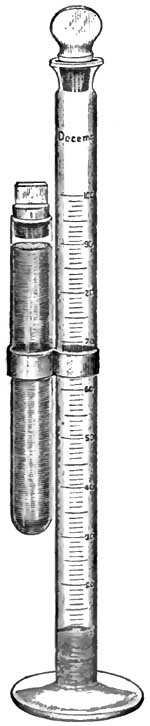
Johnson's Picro-Saccharimeter.
The shading of the side tube indicates the ferric-acetate standard. The darker shading at the bottom of the graduated tube shows the saccharine fluid, darkened by boiling with picric acid and potash, and occupying ten divisions between dilution.
The quantitative estimation is based upon an accurate approximation, by dilution, of the color of the tested fluid with that of the standard solution. Johnson recommends the picro-saccharimeter figured in the text. This is a stoppered tube twelve inches long and three-quarters of an inch in diameter, graduated into ten, and each of these again into ten other equal divisions. By the side of this tube, and held in position by an S-shaped band of metal, is a stoppered tube of equal diameter and about six inches long, containing the standard solution corresponding to the reaction of the one grain of grape-sugar with picric acid and potash diluted four times.
It has been found that ten minims of a cold saturated solution of picric acid are rather more than sufficient for decomposition by one drachm of a solution of grape-sugar in the proportion of one grain to the ounce. A drachm of the solution will therefore contain one-eighth of a grain of sugar, which is the strength of the solution used in making the standard-color liquid. In making the analysis, while the quantity of liquor potassæ used is always the same and the dilution is always to four drachms, the picric acid must be added in proportion to the amount of sugar present, so that if the urine contains as much as six grains to the fluidounce, sixty drops or a fluidrachm of the picric-acid solution would have to be used; and when the proportion of sugar is higher than this, the urine should be diluted with distilled water five or ten times before commencing the analysis, and the degree of dilution remembered in the computation.
If, now, a drachm of a solution of grape-sugar, containing two grains to the ounce, be mixed with the same quantity of liquor potassæ and picric acid and increased by the addition of distilled water to four drachms in the boiling tube, and boiled as before for sixty seconds, the result will be a mixture of much darker color than will be produced by the one-grain solution; but if the dark liquid be diluted with its own volume of water, the color will be the same as that of the one-grain solution or the standard.
It is plain, then, that if a given quantity of the dark saccharine fluid produced by boiling—say, enough to cover ten divisions of the graduated tube, as shown in the figure—has to have added to it an equal bulk of distilled water in order to produce the color of the standard solution, the tested fluid will be of the strength of two grains to the ounce; if three times, three grains; and so on; while fractional additions, as indicated by the graduated markings, would show fractional additions to the proportion of sugar.42
42 A more exact comparison of the saccharine liquid with the standard is made by pouring into a flat-bottomed colorless tube six inches long and an inch in diameter as much of the standard solution as will form a column about an inch in height, and an exactly equal column of the saccharine fluid in a precisely similar tube. The operator then looks down through the two tubes at once, one being held in each hand, upon the surface of a white porcelain slab or piece of white paper. In this way slight differences of tint are easily recognized; and if the liquid to be analyzed is found darker than the standard, it is returned to the graduated tube and diluted until the two liquids are found to be identical in color, when the final reading is made.
The presence of albumen, even in considerable amount, has but little effect upon the test, nor does the coloring matter of normal urine, according to Johnson; but he says there is a coloring matter associated with ser-albumen in albuminous urine, and with egg-albumen as well, which has a reducing action on picric acid. This is partly separated by filtering off the precipitated albumen, and entirely removed by repeated filtration through animal charcoal. So, too, the albumen removed by coagulation and filtration, if thoroughly washed, does not give any red reaction if boiled with picric acid and potash diluted in the same proportion as when testing for sugar. Neither do any other unoxidized sulphur compounds found in urine decompose the picric acid and render the test fallacious.
Johnson and his son, G. Stillingfleet Johnson, claim that the picric-acid test is as accurate as any other, and that it is even more accurate than either Fehling's or Pavy's process, because the picric acid is not acted upon by uric acid or urates, which do reduce the oxide of copper. The method of analysis by the picro-saccharimeter, they claim, is at least as speedy and as easy as any other. The materials and apparatus required are easily prepared, inexpensive, and not, like Fehling's copper solution, liable to undergo rapid changes.
But while Johnson claims that neither coloring matters of normal urine nor uric acid reduce the picric acid, he admits that he has tested with picric acid and potash a large number of specimens of normal urine with the almost uniform result of a depth of color indicating the proportion of .6 of a grain of sugar to the fluidounce, the indication varying between the limits of .5 to .7 grain. The ammonio-cupric method used at the same time gave results of from .7 to .9 grain to the fluidounce, or an excess of .1 to .3 grain. Now, if my own views, the grounds for which are announced elsewhere,43 are correct, strictly normal urine contains no sugar, and any reducing action upon oxide of copper is due to uric acid, either picric acid is reduced to a degree by uric acid or by some other constituent of normal urine. This, in the light of Oliver's44 recent investigations, may be kreatinin. For he has shown that kreatinin strikes in a few seconds a red color with the cold alkaline picric solution, which is quickened by heat. From this it would seem that the exact value of the picric-acid test has as yet to be determined.
43 Tyson, Practical Examination of Urine, 4th ed., Philadelphia, 1884.
44 On Bedside Urine-Testing, including Qualitative Albumen and Sugar, by Geo. Oliver, M.D., London, Member of the Royal College of Physicians of Lond., etc., 2d ed., London, 1884.
The Indigo-Carmine Test.—The fact that indigotine, the coloring matter of commercial indigo, is converted into indigo when heated with an alkali in the presence of glucose and certain carbohydrates, has recently been applied by George Oliver of London in the construction of a test-paper. Carmine of indigo is the sulph-indigotate of sodium, an intensely blue salt, soluble in 120 parts of water. Sulph-indigotic acid is made by heating indigo with sulphuric acid, and when combined with a base, sodium, produces indigo-carmine. When sodium carbonate is mixed with a solution of indigo-carmine, the latter is precipitated in a minute state of division, but is redissolved on heating, when there results a greenish-blue solution. A freshly-made mixture of the indigo solution and sodium carbonate furnishes a fluid not unlike Fehling's solution, which gives the reaction to be described with glucose. Unfortunately, such a mixture will not keep, and the reagent would be useless but for the happy idea of Oliver of making the test-paper. In doing this bibulous paper is immersed in a solution of indigo-carmine with carbonate of sodium.45 The paper is then cut into strips an inch long and one-quarter of an inch wide.
45 No more precise directions than this are given by Oliver, either in his papers in the Lancet for 1883 or in his little book just published, On Bedside Urine-Testing. The sugar test-papers, as well as the entire series of albumen test-papers, suggested by Oliver, are now made by Parke, Davis & Co. of New York, and by Wilson & Son, Harrogate, London.
Mode of Testing.—One of the test-papers and a sodium carbonate paper46 are dropped into a half-inch test-tube, and water added until the upper end is just covered; a column of fluid one inch in height and half an inch in diameter will thus be produced, so that the solution of carmine obtained on boiling will always acquire the same concentration. Heat is now applied, the tube being gently shaken, and boiling kept up for a second or two. A beautiful blue solution will result. The test-paper may now be removed or allowed to remain.
46 Test-papers of the same size, charged with a saturated solution of sodium carbonate.
Not more than one drop of the suspected urine is let fall into the tube from a pipette held in an upright position. Drops of equal size are thus secured. The contents of the tube are again freely boiled for a few seconds, after which the tube should be raised an inch or more from the flame and held without shaking, while the solution is kept quite hot, but not boiling, for exactly one minute. If glucose be present in abnormal amount, the soft rich blue will be seen first of all to darken into violet; then, according to the quantity of sugar, there will appear in succession, purple, red, reddish-yellow, and finally straw-yellow. When the last-named color has been developed the slightest shaking of the tube will cause red streaks to fall from the surface and mingle with the pale yellowness of the solution, while further agitation will cause the return of purple and violet and the restoration of the original blue.
The time required for the commencement of the reaction after the boiling of the test liquid is in inverse proportion to the amount of glucose present. When the latter is large, over 20 grains to the ounce, it will be but a few seconds; but when small, 2 or 3 grains, from thirty to sixty seconds may elapse. If the urine do not contain more than the normal amount of sugar47—i.e. under half a grain to the ounce—the color of the solution at the end of the heating for one minute will be unchanged. The test is available by artificial light as well as by daylight.
47 It will be noted from this that Oliver accepts the view that there is a small amount of sugar in normal urine.
Precautions.—1. Care should be taken during the testing not to shake the tube or to permit free ebullition. 2. While keeping the contents of the tube hot, the latter should not be held up between the eye and the sky, for then the early color-changes will probably escape observation. The tube should be kept below the eye-level and its contents viewed by the reflected light of some bright object, such as a sheet of white paper propped up an inch or two beyond the tube as a background. 3. Oliver is not aware that the presence of earthy carbonates will prevent the carmine reaction, but as a precautionary measure he suggests the use of a soda-paper whenever the water is exceptionally hard. 4. The acids of the urine rob the carmine-paper of much alkali, so that the addition of more than a certain number of drops of urine—varying of course with the degree of acidity—will at first retard and then prevent the reaction. The addition of the soda-paper will prevent any such interference, although Oliver says that by invariably submitting only one drop of saccharine urine to the test-paper, and keeping up the heating for not less than two minutes, he has never failed to obtain the characteristic reaction without using a soda-paper. It is well to remember, however, that an excessively acid urine may thus interfere, and that the soda-paper will prevent it. 5. The blue color of the carmine is discharged by caustic alkali—liquor potassæ or sodæ. The only chance of being misled by this reaction lies in using an imperfectly cleansed test-tube which may have contained Fehling's solution or the alkaline picric solution. The caustic alkali converts the blue carmine into a green solution, which, on heating, disappears; nor does it return by again shaking the contents of the tube.
Critical comparison of this test with Fehling's solution and picric acid by Oliver has shown that of sixty-four substances experimented upon, normal and abnormal constituents of urine or medicines which after ingestion are eliminated in the urine, Fehling's was reduced by fifteen, picric acid by eleven, and indigo-carmine by eight. The only substances producing the characteristic play of colors with indigo-carmine test-papers reacted with both picric acid and Fehling's solution. They were unoxidized phosphorus, ammonium sulphide, milk-sugar, dextrin, inosit, gallic acid, tannic acid, and iron sulphate. Both the carmine and picric acid were reduced by inosit, which merely turned Fehling's solution green. On the other hand, uric acid and urates, which reduce Fehling's solution, do not react with the carmine test, while kreatinin, which reacts with picric acid also, does not respond to the carmine. Albumen, if abundant, interferes with Fehling, but not with the indigo-carmine.
Detection of Inosit.—It has been said that inosit sometimes accompanies, and even substitutes, grape-sugar in the course of diabetes. It has been mentioned that it does not reduce Fehling's solution, but turns it olive-green. It reduces the carmine and alkaline picric acid solution, and is therefore not recognizable by these. The methods recommended for its recognition in the books are troublesome, and as its presence in the absence of sugar indicates a favorable change, it is not likely that a more precise recognition than is furnished by the olive-green reaction will be needed for clinical purposes.
PROGNOSIS.—The prognosis in diabetes depends upon the organ whose involvement is responsible for the symptoms, upon the stage at which the condition comes under observation, and upon the age of the patient. It has appeared to me that the cases of diabetes depending upon pancreatic disease are the most intractable, that their progress is scarcely checked by treatment, and that they are comparatively rapidly fatal in their termination. In the others, where the symptom is one of a central nervous lesion, it has always seemed to me to be of secondary importance that the glycosuria is itself less marked, that it is unattended by the other distinctive symptoms of diabetes, and that its issue is that of the nervous malady.
Again, it is well known that the later in life diabetes occurs the more amenable it is to treatment, and that if a proper diabetic diet be adhered to by the patient his life need scarcely be shortened. On the other hand, diabetes mellitus is a disease in which the expectant plan is dangerous. If it does not improve it usually gets worse; and many a patient has fallen a victim to his own indifference and indisposition to adhere to a regimen under which he could have lived his natural term of life. This is especially the case when the disease appears after middle life.
If, on the other hand, the condition becomes thoroughly established before twenty-five years of age, it is less amenable to treatment; but even in such cases a promptly vigorous treatment is sometimes followed by recovery. I have already mentioned the case of a child twelve years old in which complete recovery took place.
If tubercular phthisis supervenes, recovery is not to be expected, while intercurrent disease, as pneumonia, which is rather prone to occur, is very much more serious and apt to terminate fatally.
TREATMENT.—The treatment of the aggregate of symptoms known as diabetes mellitus is conveniently divided into the dietetic, the medicinal, and the hygienic, of which the first is by far the most important. The efficiency of this treatment depends upon the successful elimination from the diet of all articles containing grape-sugar, cane-sugar, beetroot-sugar, and starch, it being universally recognized that in the early stages of the disease these foods are the sole source of the glucose in the urine. The normal assimilative action of the liver, by which the carbohydrates are first stored up as glycogen, and then gradually given out as glucose or maltose to be oxidized, being deranged, such foods not only become useless as aliments, but if continued seem to aggravate the glycosuria, and the excretion of sugar steadily increases. There is, therefore, a double reason for excluding them from the food. This is easiest accomplished by an exclusive milk diet. The exclusive milk treatment of diabetes was suggested by A. Scott Donkin in 1868. That he is correct in his assertion that in the early stages of diabetes lactin or sugar of milk is quite assimilable, and does not in the slightest degree contribute to the production of glycosuria, I cannot doubt; that it is in this respect even superior to casein, as claimed by Donkin, I am not prepared to state from actual knowledge; but that casein itself resists the sugar-forming progress immeasurably greater than any other albuminous substance, so that in all but the most sure and advanced or complicated cases its arrest is complete, I am also satisfied. Certain it is that in a large number of diabetics the use of a pure skim-milk regimen results in a total disappearance of the sugar from the urine. That in a certain proportion of these cases a gradual substitution of the articles of a mixed diet may be resumed without a return of the symptoms is also true. In other more confirmed cases the use of skim-milk results in a decided reduction in the amount of sugar, with an abatement of other symptoms, which continues as long as the diet is rigidly observed. In still other cases, while the skim-milk treatment makes a decided impression upon the quantity of sugar, it still remains present in considerable amount, while the disease progresses gradually to an unfavorable issue. These three classes of cases represent, ordinarily, different stages of the disease, so that it may be said that as a rule cases recognized sufficiently early may be successfully treated with skim-milk, although it may occasionally happen that cases pursue a downward course from the very beginning despite all treatment. Yet I have never seen a case which, when taken in hand when a few grains of sugar only to the ounce were present, failed to yield to this treatment.
As to the method of administration, my practice with adults is to give eight ounces (an ordinary tumblerful) every two hours, beginning at seven or eight o'clock in the morning, and continuing to the same hour in the evening. Sometimes it is well to begin with half as much at first, but rapidly to increase to the required amount. This method ensures the ingestion of three to four quarts daily—a quantity generally sufficient to maintain the body-weight of an adult person of average size and taking moderate exercise, although a slight reduction may take place at first. But if the individual is very active or of large size, it will not be found sufficient. In such event the quantity must be increased as demanded by a feeling of unsatisfied hunger. I have known fourteen pints to be taken in twenty-four hours. But when the quantity becomes thus large, the inconvenience in ingesting it is very great, and it is much more convenient to coagulate the casein of a part of the milk and use the curd thus obtained, while the second part is drunk. Curd may be seasoned with salt to make it more palatable, and should be thoroughly masticated before it is swallowed.
The milk should not be taken too cold, especially if the amount ingested is large, else it is likely to reduce the temperature of the stomach below the point necessary for gastric digestion. The temperature should not be less than 60° F., nor much over 100°. Something depends upon the idiosyncrasies of the patient, which must be the guide as to temperatures intermediate between those named.
The chief advantage of the skim-milk over the unskimmed is simply that it is more easy of digestion. Many persons who cannot take unskimmed milk for any length of time without its deranging the digestion, or, as is commonly said, making them bilious, can take with impunity milk from which the cream is removed. Although Salomon48 claims to have shown that glycogen is produced in the liver of rabbits fed upon pure olive oil, it is at least probable that fat is among the last of the substances undergoing this conversion, and in ordinary cases of diabetes it is rather its indigestible nature which renders it prudent to remove from milk the greater proportion of fat by skimming it off.
48 Virchow's Archiv, Bd. 61, Heft 3, 1874, 18.
Still more easily assimilable is the peptonized milk, in which the casein is at least partially digested, and it should be employed where there is any difficulty in the way of using the ordinary milks. Either skimmed or unskimmed milk may be used for peptonizing, the latter peptonized being quite as easy of digestion as the former unpeptonized. I have found the extractum pancreatis of Fairchild Brothers & Foster most successful in the peptonizing of milk, and according to the following directions: Into a clean quart bottle put 5 grains of extractum pancreatis, 15 of bicarbonate of sodium, and a gill of cool water; shake, and add a pint of fresh cool milk. Place the bottle in a pitcher of hot water or set the bottle aside in a warm place, usually for three-quarters of an hour. When the milk has acquired a slightly bitter taste, it has been completely peptonized—that is, the casein has been completely converted into peptone. After the process is complete the milk must be immediately put on ice.
It is not always necessary to completely peptonize the milk, and if the bitter taste is unpleasant the process may be stopped short of this by putting the milk on ice, the degree of digestion depending upon the length of time the milk is kept warm.
While I am confident that the promptest and most effectual method of eliminating sugar from the urine is by a milk diet, it occasionally happens that a patient cannot or will not submit to so strict a regimen. In other instances, again, it is not necessary to resort to it, because a less restricted diet answers every purpose.
A suitable diabetic diet would also be obtained by eliminating from the bill of fare all saccharine and amylaceous and other sugar-producing substances. Such a diet is, strictly speaking, impossible. For, apart from the fact just mentioned that even fats, as well as albuminous substances to a degree, are capable of producing glycogen, the monotony of a pure meat diet soon becomes unbearable, to say nothing of other derangements it may produce. Fortunately, it is not necessary that such an exclusive diet should be maintained, for certain saccharine foods seem capable of resisting the conversion into sugar more than others. Sugar of milk, or lactin, has already been mentioned as one of these, and to it may be added the sugar of some fruits, and probably also inosit or muscle-sugar, mannite or sugar of manna, and inulin, a starchy principle abundant in Iceland moss. It is found also that there are many vegetable substances containing small quantities of sugar and sugar-producing principles which may be used with impunity in at least the milder forms of diabetes. This being the case, a bill of fare for diabetics may be constructed quite liberal enough to satisfy the palate of most reasonable persons by whom it is attainable.
FOOD AND DRINK ADMISSIBLE.—Shell-fish.—Oysters and clams, raw and cooked in any way, without the addition of flour.
Fish of all kinds, fresh or salted, including lobsters, crabs, sardines, and other fish in oil.
Meats of every variety except livers, including beef, mutton, chipped dried beef, tripe, ham, tongue, bacon, and sausages; also poultry and game of all kinds, with which, however, sweetened jellies and sauces should not be used.
Soup.—All made without flour, rice, vermicelli, or other starchy substances, or without the vegetables named below as inadmissible. Animal soups not thickened with flour, beef-tea, and broths.
Vegetables.—Cabbage, cauliflower, brussels-sprouts, broccoli, green string-beans, the green ends of asparagus, spinach, dandelion, mushrooms, lettuce, endive, coldslaw, olives, cucumbers fresh or pickled, radishes, young onions, water-cresses, mustard and cress, turnip-tops, celery-tops, or any other green vegetables.
Fruits.—Cranberries, plums, cherries, gooseberries, red currants, strawberries, apples, without sugar. Or they may be stewed with the addition of bicarbonate of sodium instead of sugar. (See below.)
Bread and cakes made of gluten, bran, or almond flour, or inulin, with or without eggs and butter. Griddle-cakes, pancakes, biscuit, porridges, etc. made of these flours. Where especial stringency is required these should be altogether omitted.
Eggs in any quantity and prepared in all possible ways, without sugar or ordinary flours.
Nuts.—All except chestnuts, including almonds, walnuts, Brazil-nuts, hazel-nuts, filberts, pecan-nuts, butternuts, cocoanuts.
Condiments.—Salt, vinegar, and pepper in moderate quantities.
Jellies.—None except those unsweetened. They may be made of calf's-foot or gelatin and flavored with wine.
Drinks.—Coffee, tea, and cocoa-nibs, with milk or cream, but without sugar; also milk, cream, soda- (carbonated) water, and all mineral waters freely; acid wines, including claret, Rhine, and still Moselle wines, very dry sherry; unsweetened brandy, whiskey, and gin. No malt liquors, except those ales and beers which have been long bottled, and in which the sugar has all been converted into carbonic acid and alcohol.
Vegetables to be especially Avoided.—Potatoes, white and sweet, rice, beets, carrots, turnips, parsnips, peas, and beans; all vegetables containing starch or sugar in any quantity.
The following list, including essentially the same articles, but arranged in the shape of a true bill of fare, by Austin Flint, Jr.,49 will be found very convenient:
BILL OF FARE FOR DIABETES.—Breakfast.—Oysters stewed, without flour; clams stewed, without flour. Beefsteak, beefsteak with fried onions, broiled chicken, mutton or lamb chops; kidneys, broiled, stewed, or devilled; tripe, pigs' feet, game, ham, bacon, devilled turkey or chicken, sausage, corned-beef hash without potato, minced beef, turkey, chicken, or game with poached eggs. All kinds of fish, fish-roe, fish-balls, without potato. Eggs cooked in any way except with flour or sugar, scrambled eggs with chipped smoked beef, picked salt codfish with eggs, omelets plain or with ham, with smoked beef, kidneys, asparagus-points, fine herbs, parsley, truffles, or mushrooms. Radishes, cucumbers, water-cresses, butter, pot-cheese. Tea or coffee, with a little cream and no sugar. (Glycerin may be used instead of sugar if desired.) Light red wine for those who are in the habit of taking wine at breakfast.
Lunch or Tea.—Oysters or clams cooked in any way except with flour; chicken, lobster, or any kind of salad except potato; fish of all kinds; chops, steaks, ham, tongue, eggs, crabs, or any kind of meat; head-cheese. Red wine, dry sherry, or Bass's ale.
Dinner.—Raw oysters, raw clams.
Soups.—Consommé of beef, of veal, of chicken, or of turtle; consommé with asparagus-points; consommé with okra, ox-tail, turtle, terrapin, oyster, or clam, without flour; chowder, without potatoes, mock turtle, mullagatawny, tomato, gumbo filet.
Fish, etc.—All kinds of fish, lobsters, oysters, clams, terrapin, shrimps, crawfish, hard-shell crabs, soft-shell crabs, (No sauces containing flour.)
Relishes.—Pickles, radishes, celery, sardines, anchovies, olives.
Meats.—All kinds of meat cooked in any way except with flour; all kinds of poultry without dressings containing bread or flour; calf's head, kidneys, sweetbreads, lamb-fries, ham, tongue; all kinds of game; veal, fowl, sweetbreads, etc., with curry, but not thickened with flour. (No liver.)
Vegetables.—Truffles, lettuce, romaine, chicory, endive, cucumbers, spinach, sorrel, beet-tops, cauliflower, cabbage, brussels-sprouts, dandelions, tomatoes, radishes, oyster-plant, celery, onions, string-beans, water-cresses, asparagus, artichoke, Jerusalem artichokes, parsley, mushrooms, all kinds of herbs.
Substitutes for Sweets.—Peaches preserved in brandy without sugar; wine-jelly without sugar, gelée au kirsch without sugar, omelette au rhum without sugar; omelette à la vanille without sugar; gelée au rhum without sugar; gelée au café without sugar.
Miscellaneous.—Butter, cheese of all kinds, eggs cooked in all ways except with flour or sugar, sauces without sugar or flour. Almonds, hazel-nuts, walnuts, cocoanuts. Tea or coffee with a little cream and without sugar. (Glycerin may be used instead of sugar if desired.) Moderately palatable ice-creams and wine-jellies may be made, sweetened with pure glycerin; but although these may be quite satisfactory for a time, they soon become distasteful.
Alcoholic Beverages.—Claret, burgundy, dry sherry, Bass's ale or bitter beer. (No sweet wines.)
Prohibited.—Ordinary bread; cake, etc. made with flour or sugar; desserts made with flour or sugar; vegetables, except those mentioned above; sweet fruits.
49 "On the Treatment of Diabetes Mellitus," a paper read before the American Medical Association at its meeting in Washington, May, 1884, and published in the Journal of the association July 12, 1884. I have so far modified the bill of fare as to permit the use of milk, which Flint excludes.
One of the foods the omission of which is most illy borne by the diabetic, however great his previous indifference to it, is wheaten bread, while the substitutes which have been at different times suggested for it very imperfectly supply its place. Perhaps the best known of these is the bread made of gluten flour. It was suggested by Bouchardat in 1841, and is made by washing the ordinary wheat flour to free it from starch.50