VI PERIOD OF SCIENTIFIC SUBDIVISION (FROM ABOUT 1825 ONWARDS)
Reading edition
§ 1. Origins and Implications of Scientific Specialization.
We have seen how the philosophy of Newton, with its implication, the Reign of Law, which is the Uniformity of Nature, has come to pervade scientific thought (p. 137). Now, before Newton as after him, there were certain natural divisions of scientific activity corresponding, in some degree, to the types and faculties of men. Since Science first began there have been Mathematicians, Biologists, Physical Experimenters, because in fact the particular powers which enable a man to reach distinction in one of these departments are of less value in the others. Until the period of which we are now to treat, investigators were accustomed to explore at large within these great departments. Such specialist professions as Actuarial Calculators, Economic Entomologists, Physical Chemists, or, in the department of Medicine, Medical Statisticians, Aural Surgeons, or Vaccine Therapists—familiar to us now—were unknown and undreamt of then. This subdivision is a new thing, and is a characteristic product of the period of which we have now to treat. The subdivisions, unlike those of old, are largely artificial. Thus, the Aural Surgeon who deals with the organ of hearing cannot be separated clearly by his training, his powers and faculties, his operative skill, nor even perhaps by his field of work, from the Stomatologist who deals with the mouth, or the Rhinologist who deals with the nose. Nevertheless these minute subdivisions are convenient and beneficent in medical as in other departments. The question of scientific specialization is so important and characteristic that we must examine it a little farther.
It is often thought that, since no man can compass all knowledge, this scientific subdivision is merely an attempt to compass a part of that growing mass of knowledge which is becoming progressively less compassable in its entirety. The movement, however, both in origin and development, is less simple than this, for there never was a time when a man could know all that was known about his world. In this respect our own age is even as other ages. Were the view philosophically tenable—which it is not—that Science becomes yearly less comprehensible, our outlook would be gloomy indeed. For since there is no evidence of any increase in the mental capacity of the human race—at least in historic time—such a view would imply a progressive diminution in the number of those competent to treat any wide scientific area, and a corresponding progressive separation from each other of minds with scientific insight. Fortunately such conditions do not prevail; the view that they do is simply due to a gross, yet widespread, misconception of the nature of Science.
Equally fallacious is the idea, which has become diffused by the existence of scientific specialization itself, that the progress of any science is to be measured by the mass of observations that its votaries have succeeded in accumulating. This is far from being the case. The advance of a science is measured by the degree with which it succeeds in bringing a multiplicity of observations under general laws. Judged by this standard, we should probably rate very highly, for example, the present state of what is called Demography, the study of the life conditions of communities, while we should rank much less highly, for example, the present state of the study of Aural Surgery. Yet, for one publication on Demography there must be many on Aural Surgery. In the one case, however, the accumulation of knowledge follows a well-directed and rational scheme. In the other it is prompted and occasioned by the immediate needs of individual sufferers. This must not be considered as derogatory to those whose task it is to treat the sufferers. The point is that the one department, of its nature, exhibits the rational spirit better than does the other.
Since Rational Medicine is the subject that we treat here, we shall select for discussion those departments which best illustrate its spirit. This does not imply, and is not meant to imply, any belittlement of the less fortunate departments. On the contrary, the less any scientific department has succeeded in eliciting general laws, the more necessary it is that those most capable for the prosecution of such advance should devote their attention to that department. It may, indeed, reasonably be urged that a leading defect in our scientific organization is that men of scientific insight crowd to just those studies where their special powers have already been best exhibited.
In previous chapters, dealing with more remote times, we have been able to place our facts in historic perspective. Despite the enormous mass of scientific literature dating from the seventeenth, eighteenth, and early nineteenth centuries, there is no real obstacle to selecting what is most important in it. True, it is beyond the power of any one student to examine all this literature at first hand, but it has been arranged and indexed, posterity has passed its verdict, and the historian can find his way through the thicket. It is also true that important advances are sometimes forgotten, as happened to Mayow’s discovery of Oxygen in the seventeenth century (pp. 126, 151), which was repeated by Priestley a hundred years later (p. 154). But the fact that we know of such neglected discoveries shows that, however unjust the fates may have been to Mayow, yet his influence has not been underestimated by later historians. The History of Science, therefore, can up to a certain point be written along the same lines as political or economic history.
The face of affairs changes, however, when we pass into a period which differs for different topics, but may be roughly defined as beginning somewhere between about 1820 and about 1870. We then begin to encounter the very questions with which men of Science are occupied in our own time. Since many of these questions still remain unsettled, it is impossible for the historian to say with certainty which are the most fruitful lines of work. The most he can hope to do is to distinguish the most influential and stimulating thinkers and observers from those who have been less so, and to say something about the ideas with which the more important schools of thought were instinct.
When we look into the origin of the system of specialization, whether in Medicine or in any other department of Science, we shall find certain philosophical tendencies at work of which the modern man of Science is the heir, though often the unconscious and sometimes the ungrateful and even the misunderstanding heir. Neither men of Science nor medical men are always philosophers, or at least not always consciously so. Nevertheless, they are as surely influenced by the streams of thought of their time as they are by their heredity and their physical environment. The general tendencies of Medicine in this or in any other age cannot be interpreted without some reference to the intellectual atmosphere in which it has arisen and in which it has flourished.
The intellectual atmosphere in which scientific specialism arose was that of the so-called ‘Utilitarian Philosophy’. Many of the dicta of that school, which came into prominence toward the end of the eighteenth century, are still used as part of the language of men of Science and others. ‘The greatest happiness of the greatest number’ is a formula launched upon our common speech by Joseph Priestley (1733-1804, p. 154). The pursuit of such happiness as the main object of human activity is taught by the ‘Utilitarian’ philosophy, a word coined by the English political and social thinker, Jeremy Bentham (1748-1832). To Bentham, the founder of that philosophy, we owe such useful additions to our language as ‘codification’ and ‘international’, and these, together with ‘utilitarian’, give us some clue to the character and mode of his thought. It is probable that no thinker had a larger share than Bentham in ushering in the era of the subdivision of the sciences.
Bentham made a sustained attempt to draw a parallel between the physical and the social sciences, and this gave him a special influence over medical thinkers and especially over those that dealt with the public health. His pupil, John Stuart Mill (1806-73), speaks of his master’s mode of working as ‘the chemical method’. It is thus not remarkable that Bentham should exert a profound influence on Medicine, both directly and indirectly. The peculiarly logical, uncompromising and perhaps un-English character of his mind, while it prevented him, fortunately for himself, from taking an active share in the task of government, did not prevent him from influencing those who did. Specifically, he is the direct begetter of our modern system of organization of the Science of Preventive Medicine.
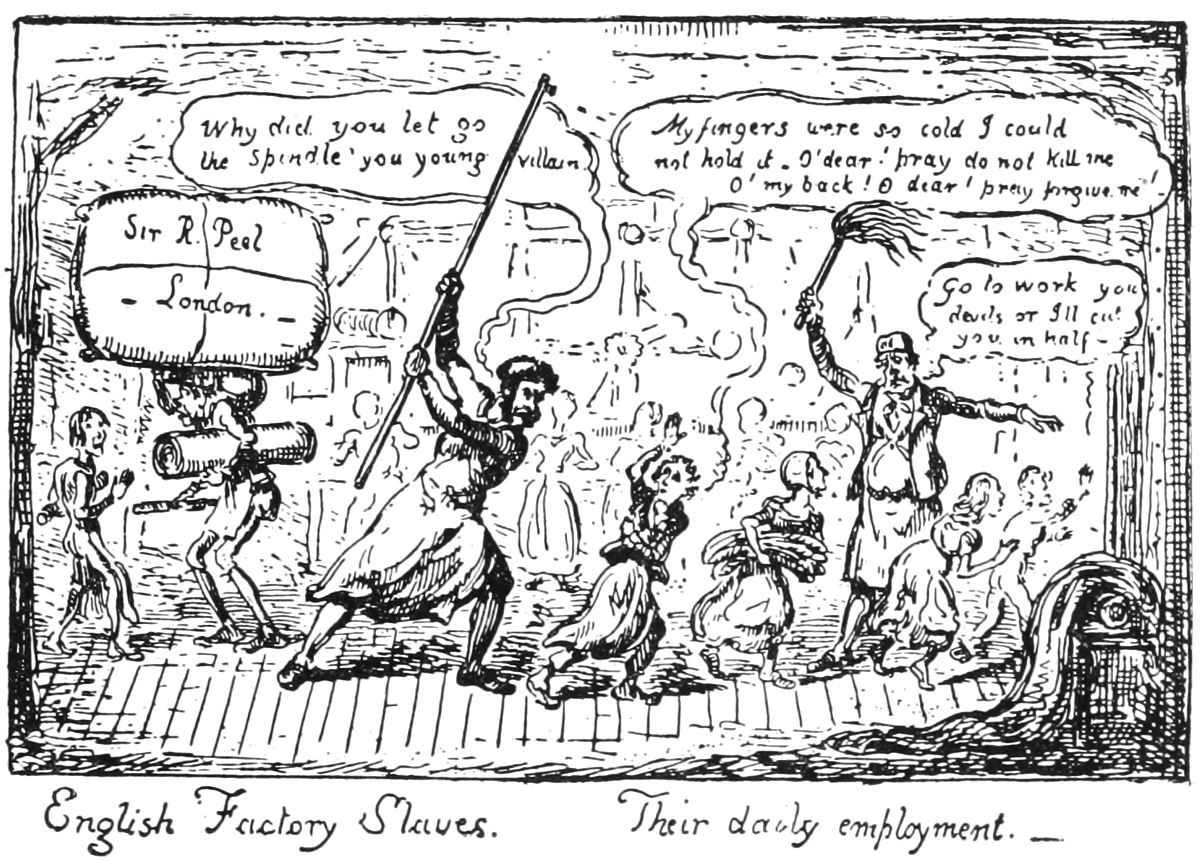
Fig. 95. A CARTOON OF THE EARLY NINETEENTH CENTURY illustrating the condition of children in the factories of the time. A bale is directed to Sir Robert Peel. This is the first Baronet (1750-1830), father of the statesman. Peel the elder was a cotton-spinner who imported from the London workhouses deserted children whom he treated well, but used to work his factories in Lancashire. He was a Member of Parliament and in 1802 carried the Act which was the forerunner of all factory legislation, An Act for the Preservation of the Health and Morals of Apprentices and others, employed in Cotton and other Mills.
§ 2. The Revolution in Preventive Medicine.
Of all the many changes in Medicine and Medical thought that the Period of Scientific Subdivision has witnessed, none have been more revolutionary than those in the department which deals with Preventive Medicine. Great and important reforms were introduced during the course of the eighteenth century. These, however, even when the result of legislation, were the outcome of the effort of individuals, or were concerned with the Army and Navy (p. 169). In the period that follows, the Public Health becomes a general political, legislative, and administrative matter, and ‘Prevention’ becomes its watchword. The public consciousness—moralists will call it the public conscience—had been aroused, and has never again entirely slept. The chief agent in the awakening process, the intellectual force at its back, was and is Jeremy Bentham.
Rational Medicine has, in general, no national frontiers. To it men of all the national units have made important contributions. But the care of the Public Health in the period on which we now enter, being an affair of legislation and administration, has developed along national lines and it is difficult to discuss it save on a national basis. It is a source of justifiable national pride that Britain has, from the first and throughout, been the leader of the Public Health movement. But while we lose little and gain much by telling the story from the British point of view, it has still to be remembered that, just as Rational Medicine has, fortunately, no spiritual frontiers, so, unfortunately, sickness and suffering have no physical frontiers. Epidemics pass the most scientifically constructed boundaries upon the surface of the map, and without a passport. In our time this evident proposition has obtained, at least, formal recognition. International health legislation has at last appeared. A future historian of Rational Medicine will be able to write his chapter on the Public Health from the point of view of Humanity at large. The historian who has the misfortune to be born too early must still content himself with treating the subject along national lines.
(a) Preventive Medicine in Britain.
If Bentham be the spiritual father of Public Health legislation, the protagonists whose names must be associated with the development of the movement along practical lines in England are Thomas Southwood Smith (1788-1861) and Edwin Chadwick (1800-90).
Thomas Southwood Smith was a Unitarian minister, and long combined this office with that of physician. Settling in London in 1820 he came under the influence of Bentham. By his essay on The Use of the Dead to the Living he did something to remove the odium attached to dissection. The scandals of the time and the common sense of the ‘utilitarians’ (p. 190) led to the passing of the Anatomy Act of 1832. Thus by a proper legal process bodies became available for dissection by medical students. Bentham died just before this Act became law and by his will left his body to Southwood Smith to be the subject of dissection and of an anatomical lecture.
Southwood Smith’s services to the spread of interest in Public Health were very numerous. He circulated a simple and popular Philosophy of Health (1835). He served on a board of inquiry as to the condition of children in factories (1832, cp. Fig. 191), and he was especially useful to the Poor Law Commissioners by reason of his exceptional knowledge of fevers. He was the founder of a ‘Health of Towns Association’ (1840), and of another association for ‘improving the Dwellings of the Industrial Classes’ (1842). In 1848 he became a member of a new government department, the ‘General Board of Health’ (p. 195). His official reports on Quarantine (1845), Cholera (1850), Yellow Fever (1852), and on the results of sanitary improvement (1854), were of world-wide use.
Edwin Chadwick (1800-90), who was not a medical man, introduced to public notice what he called the ‘sanitary idea’, a conception that colored the whole of his extraordinarily active life. He sat on Government Commissions on Poor Law, on Police, and on the investigation of the condition of factory children. One of his Reports (1833), issued while he and the century were both in the early thirties, recommended a system of inspection with a view to limiting children’s hours of work. The current system of pensions and of trade instruction to soldiers and sailors is the descendant of a scheme of Chadwick’s devising. An item in the evidence attached to one of his Reports is the public provision of open spaces for recreation, a topic of current interest at the moment of writing.
At the time of the accession of Queen Victoria in 1837 Chadwick was agitating for the appointment of a Sanitary Commission. Two years later, as a result of a grave epidemical outbreak in London, the Commission was appointed. Its reports, which drew wide attention at the time, have had a large share in determining the general course of health legislation in the ninety years that have since elapsed. The scientific basis of health legislation can only be determined if proper vital statistics be available. The Registration Act of 1838, under a developed form of which we still live and die, was in essence his work. If we search into the history of any department of the scientific treatment of the Public Health, we shall always ultimately work back either to Southwood Smith or to Chadwick and through them to Bentham.
Among the most important documents for which Chadwick was responsible was the Parliamentary General Report on the Sanitary Condition of the Labouring Population of Great Britain (1842). It came to fruit in 1848 with the Public Health Act, which established a new governmental department, the ‘General Board of Health’ (p. 196). The same year saw the passage of the Nuisances Removal and Diseases Prevention Act, by which summary action in such matters was rendered possible on the complaint of specially authorized local authorities. Just as the Board came into action there was an outbreak of Cholera in England, of which 54,000 persons died. The statistics available under the new system made possible the deduction that the infection is conveyed by drinking-water and led to suitable precautions. This is one of the many instances in which the practice of prevention of a germ-borne disease preceded any knowledge of its organic cause, or indeed any direct knowledge of disease germs at all.
The first town in England to appoint a Medical Officer of Health was Liverpool. The City of London followed in 1848, when Simon took office. After Southwood Smith and Chadwick, Sir John Simon (1816-1904) was the foremost figure in the history of the Public Health of this country. He later became medical officer to the ‘General Board of Health’. The work of this Board—together with its medical officer—was taken over, for political and administrative reasons, by the Privy Council. The medical department of the Privy Council became in 1871 part of the Local Government Board, the medical functions of which were absorbed by the new Ministry of Health in 1917.
To Simon are due the abolition of urban cesspits and improvement of the system of sewers, and the institution of sanitary inspectors and legislation concerning housing and overcrowding. One important result of these measures was that it became possible to abandon the cruel and wasteful system of quarantine that had been of value in the eighteenth century. Simon’s plan, which was gradually adopted, was to trust to the same preventive methods for foreign as for native infections. This was, of course, only possible with an efficient sanitary service such as he succeeded in instituting. Such measures were aided by laboratory investigations, begun by a small staff. At first largely occupied with examinations in connection with actual outbreaks, its scientific functions rapidly grew. Working on a wider basis, these functions have been performed for the nation since 1911 under the direction of the Medical Research Council.
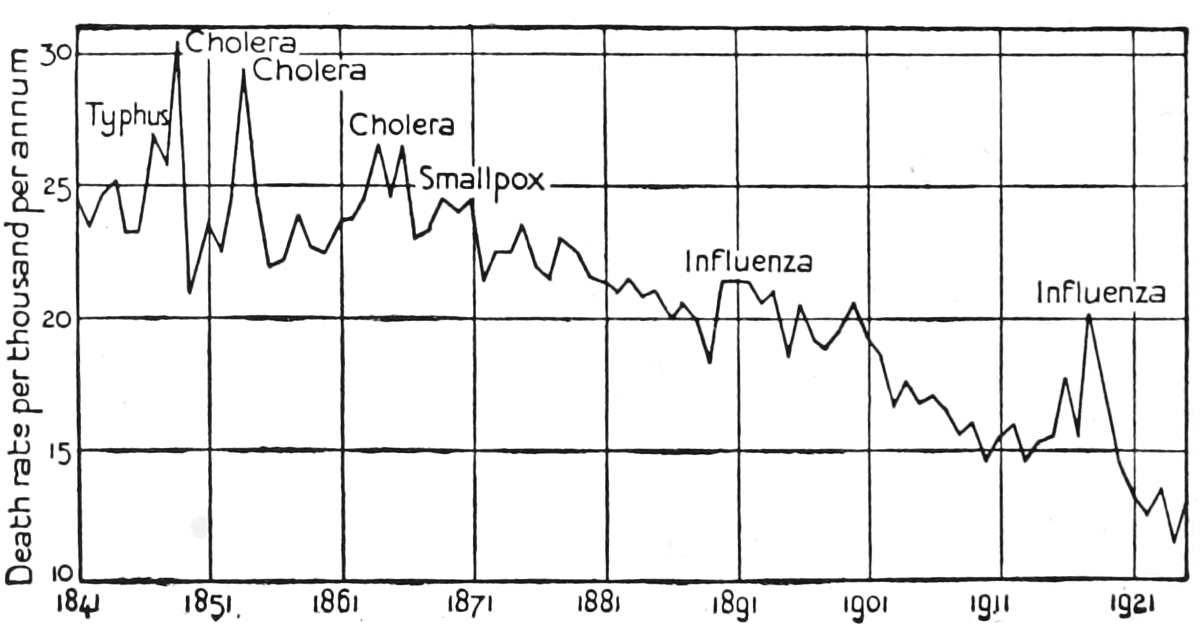
Fig. 96. Annual death-rate in London per thousand living over a period of 85 years.
It will be seen that the curve begins definitely to take a downward trend about 1870. It has been falling ever since. It is now less than half of what it was sixty years ago. This fall is largely, though not entirely, due to decrease in infant mortality. Some of the more important epidemics are indicated. Typhus disappears as an important cause of death in the forties and Cholera and Small-pox in the sixties. Since then the death-rate has been considerably influenced by Influenza outbreaks.
(b) Preventive Medicine in the United States.
In the United States the history of the national Public Health Service has been very different from that of the English system. The same philosophical tendencies have been at the basis of the American as of the English system. In the United States, however, the National Service has been linked with the Army and Navy in a manner quite foreign to British traditions. The Federal health system had its origin in the old Marine Hospital Service, first authorized by Congress in 1798. This enabled the President to appoint medical officers at ports and elsewhere for the purpose of giving medical treatment to disabled merchant seamen. The funds were obtained by a tax on those employed on American vessels.
The first marine hospital under the Act was at Norfolk, Va., in 1800. In 1802 a marine hospital was built for the port of Boston, and from time to time hospitals were built at other important seaports. To provide for the relief of seamen on inland waters Congress passed in 1837 an Act for the appointment of a board of advisory medical officers of the Army. A number of hospitals were established on its advice.
The evolution of public health functions from this service was along natural lines. The medical officers, in providing care for the American merchant marine, were often the first physicians to diagnose such diseases as Cholera, Yellow Fever, Small-pox and the like, which were being imported into the United States. In the epidemics of Cholera which occurred in certain ports of the United States the marine hospitals and their medical officers were utilized for the relief of those suffering from the disease. During the Civil War the marine hospitals, together with the medical officers, were used by the military authorities, both North and South, for the care of the military forces.
Not until 1878 did Congress authorize any extensive use of the Marine Hospital Service as a Federal Health Service. An Act of 1878 gave broad powers to the Service to co-operate with State and local health authorities in the control of disease, especially of Yellow Fever. In 1890 Congress decided to utilize the Marine Hospital Service as the Federal Health agency for the prevention of inter-State spread of Cholera, Yellow Fever, Small-pox and Plague. In 1893 the powers of the Marine Hospital Service in this regard were extended to cover all infectious and contagious diseases, in co-operation with State and local health agencies.
The efficiency of the Marine Hospital Corps in the control of epidemic diseases became widely recognized. In 1889 Congress passed an Act which made possible the further organization of the Marine Hospital Corps, and provided that the officers be commissioned in grades similar to those of the medical department of the United States Army. An Act of 1875 had already provided that the Surgeon-General (supervising surgeon) should be appointed by the President, with the consent of the Senate.
In 1893 the Marine Hospital Service was organized into the Federal Health Service. Congress continued to impose additional health functions upon the Service, and in 1902 changed its name to the ‘Public Health and Marine Hospital Service’ and made it a health service in name as well as function. The larger part of its duties, up to this time, had been the combating of epidemics, especially those of Yellow Fever, which from time to time swept the country. With the threat of Bubonic Plague in 1900 at San Francisco, the Marine Hospital Service was placed in charge of control methods and succeeded in preventing any extensive spread of the disease.
In addition to the quarantine and hospital functions, the activities of the Service soon came to include research and educational work. In 1902 Congress authorized the establishment of the Hygienic Laboratory for investigating Cholera, Yellow Fever, and other conditions. The Laboratory grew rapidly and is now a very important research institution, equipped for carrying on pathological, zoological, pharmacological, bacteriological, chemical, and physiological work.
From the control of epidemics, the Public Health and Marine Hospital Service began to develop control measures for the more common contagious and infectious diseases, such as Typhoid Fever, Diphtheria, and Scarlet Fever. The history of the wonderful control of Typhoid Fever which has taken place in the United States within the past twenty years is a part of the history of the Public Health Service in co-operation with State and local health agencies. Typhoid fever, which formerly took a toll of more than 50,000 lives annually, is responsible for the death of a mere fraction of this number at the present day.
The development of health functions of the Public Health and Marine Hospital Service continued until Congress in 1912 changed the name to its present one, the ‘United States Public Health Service’, and at the same time gave it broad powers to investigate the diseases of man and the pollution of navigable streams and lakes.
During the courses of Federal development the separate States of the Union were not devoid of protagonists of State intervention in matters of public health. Among these was Lemuel Shattuck (1793-1859), who, like Chadwick, was no medical man, but a student of social problems. Under the influence of Chadwick he drafted in 1850 the Report of the Massachusetts Sanitary Commission. This publication set forth a complete scheme of Public Health organization. The formation of the first State Board of Health in Massachusetts was, however, delayed till 1869. In this matter Massachusetts was, in fact, anticipated by Louisiana, which obtained a State Board of Health in 1855, and by New York City, which obtained a Board of Health in 1866. Most of the States followed in the seventies. The seventies and eighties were the decades in which the general principles suggested by the work of Pasteur and Koch were put into effect. The working hypothesis of sanitarians of the time was that filth and ill-drainage were direct factors in the production of epidemic disease. The view is now untenable, but there was unquestionably an immense improvement in health conditions resulting both directly and indirectly from the improved drainage, water-supply, housing, and the like that the agitation had stimulated.
As the bacteriological discoveries of the time became generally accepted, they were widely applied on American soil to the administrative control of disease, notably by the New York Department of Health under Hermann M. Biggs. That body, in 1892, instituted a bacteriological laboratory, the scope of which has steadily increased. Its work in connection with Diphtheria is elsewhere discussed (pp. 265-6).
To follow into our own time the development of factory legislation, vital statistics, school medical service, local health authorities, municipal laboratories and clinics, methods of food inspection, would be to write a text-book of Public Health Administration. In all these developments we see working the rational spirit in the peculiarly English field of Preventive Medicine. The spirit of Rational Medicine cannot function, however, without material upon which to work. The basis, the elementary matter, as it were, of that material, is the conception we form of the nature of the bodily processes. Such a conception it is the function of Physiology to provide and to Physiology we therefore now turn.
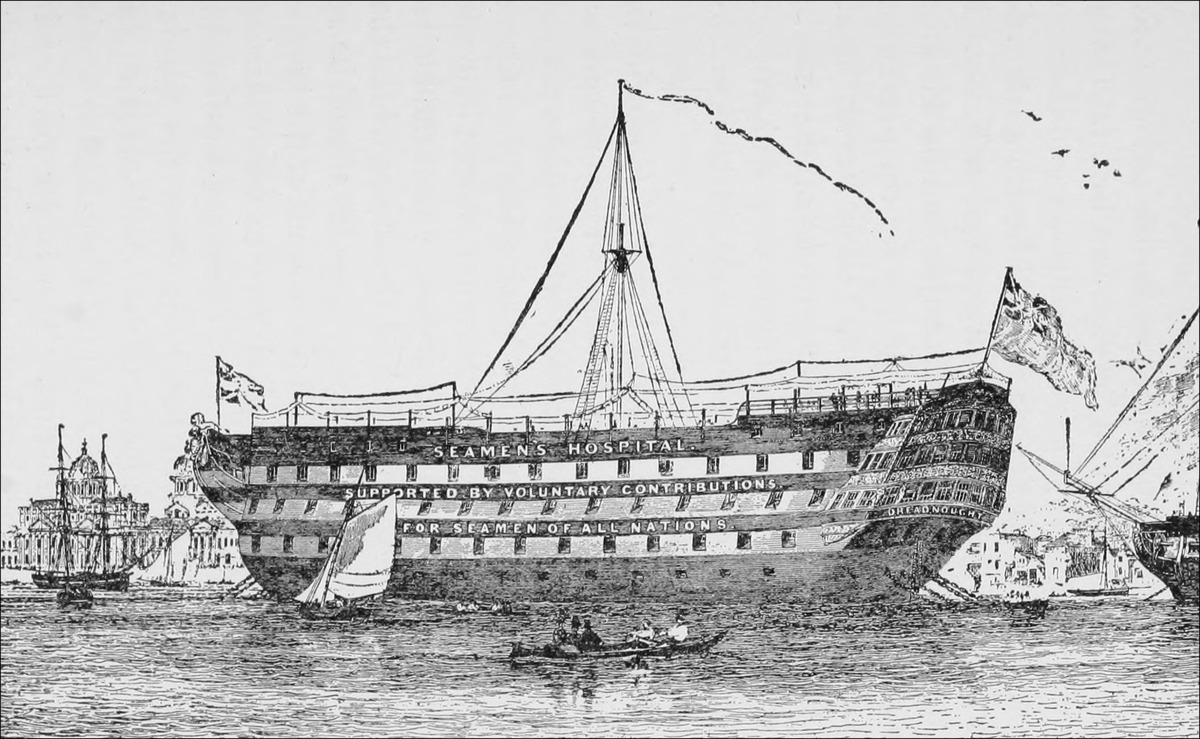
Fig. 97. THE OLD DREADNOUGHT HOSPITAL SHIP.
A ‘Seamen’s Hospital Society’ was founded in England in 1817. Its first hospital was the Grampus, an old 50 gun ship moored off Greenwich. This was succeeded in 1830 by the Dreadnought, 104 guns, and this in 1857 by the Caledonia, 120 guns, renamed Dreadnought. In 1870 this last wooden Dreadnought was broken up and the patients were transferred to a building on shore close by. The darkness, damp, ill-ventilation, noisiness and septic character of a wooden ship made it thoroughly unsuitable for hospital purposes.
In 1899 the ‘Seamen’s Hospital Society’ established a special Hospital and School for Tropical Diseases such as are peculiarly common among seamen.
§ 3. The Transition to a Physiological Synthesis.
Modern developments in physiological knowledge introduce an important period in the History of Medicine, for the study of the functions of the body is a natural portal of entry to the study of the perversions and suspensions of those functions that we call disease. The general character of physiological thought during the modern period may perhaps be described as the ‘synthetic study of the animal body’. The study has become synthetic because organs have not been studied so much in and for themselves as in relation to other organs. There has been, in fact, during the period, an increasing consciousness of the integration of the organs into one organic whole, the entire process being under the control of the nervous system, the various parts of which are themselves integrated (p. 308). This movement has, to some extent, mitigated the ever growing evils of scientific specialization.
(a) Anatomy and Embryology in the Earlier Nineteenth Century.
Let us first glance at the state of anatomical knowledge in the early and middle nineteenth century. The general structure of the animal body was well known. Descriptive Anatomy was not far from where it now is. Comparative Anatomy, which had made good progress, was given a fresh impetus by the researches and by the authority of a brilliant group of French investigators, headed by Baron Georges Cuvier (1769-1832), whose influence spread to England, Germany, and America, where the leading exponents were Richard Owen (1804-92), Karl Gegenbaur (1826-1903), and E. D. Cope (1840-97). Cuvier was a biological dictator whose opinion did much to encourage investigation, and something to discourage some important investigators. His services to Comparative Anatomy can hardly be overrated. There was, however, still no effective knowledge of the anatomical differences between the races of man, while the species of man and of allied forms, whose skeletons palaeontologists have since described, were quite unknown.
As regards knowledge of the process of Development of the animal body, the broad lines of Embryology were being put on a firm basis by Karl Ernst von Baer (1792-1876), whose work was finished in 1837, though he lived another forty years. The subject was to be given a new meaning by the evolutionary school, which applied to new details and to particular instances the work of Charles Darwin (1809-82). Foremost of this school was Francis Maitland Balfour (1851-82).
(b) Chemical Physiology in the Earlier Nineteenth Century.
The analysis of the functions and workings of the body had advanced far less than the knowledge of its structure. The study of Respiration was perhaps in the best position. The elementary conception of Respiration attained by Lavoisier at the end of the eighteenth century (p. 155) was hardly extended till E. F. W. Pflüger of Bonn (1829-1910), in the sixties and seventies of the nineteenth century, showed that the essential chemical changes of respiration do not occur in the blood or in the lungs, but in the tissues.
A very important figure in the scientific world of the thirties and forties of the nineteenth century was the German Justus von Liebig (1803-73), professor of Chemistry at Giessen. He was a convinced mechanist, and over the door of the University Laboratory which he founded he had inscribed the dictum God has ordered all His Creation by Weight and Measure. His great achievement was his application of chemical knowledge to physiology. He did much to introduce laboratory teaching, and certain apparatus which he invented is still in constant use.
Liebig greatly improved the methods of organic analysis and notably he introduced a method for determining the amount of urea in a solution. This substance is found in human blood and urine, and was the first organic compound to be ‘synthetized’, that is to say, built up from inorganic materials. It is of very great physiological importance. This is due to the fact that it is regularly formed in the body in the process of breaking down the characteristic nitrogenous substances known as proteins. Along with his colleague, Friedrich Wöhler (1800-82), who had already synthetized urea, Liebig wrote a famous paper (1832) in which he showed, for the first time, that a complex organic group of atoms—or ‘radicle’ as it is called—is capable of forming an unchanging constituent through a long series of compounds, behaving throughout as though it were an element. This discovery is of primary importance for our conceptions of the chemical changes in the living body.
From 1838 onwards, Liebig devoted himself to attempting a chemical elucidation of living processes. In the course of his investigations he did pioneer work along many lines that have since become well recognized. He taught the true doctrine, then little recognized, that animal heat is the result of combustion, and is not ‘innate’ (compare p. 156). He classified articles of food with reference to the functions that he conceived they fulfilled in the animal economy. An outcome of this was his food for infants and his extract of meat. Very important was his teaching that plants derive the constituents of their food, their carbon and nitrogen, from the carbon dioxide and ammonia in the atmosphere, and that these compounds are returned by the plants to the atmosphere in the process of putrefaction. This discovery made possible a philosophical conception of a sort of ‘circulation’ in Nature. That which is broken down is constantly built up, to be later broken down again. Thus the wheel of Life goes on, the motor power being energy from without, derived ultimately from the heat of the sun.
It was very unfortunate that Liebig conceived and adhered to a totally wrong view of the nature of putrefaction and fermentation, which it took Pasteur long years to displace.
(c) Nervous Physiology in the Earlier Nineteenth Century.
From Chemical Physiology we turn to glance at the knowledge of the Nervous System. Charles Bell and his contemporaries (p. 145) had attained to a clear distinction of the nature of motor and sensory nerves and their separate origin from the two spinal roots (Fig. 98). The next fundamental contribution was made by Marshall Hall (1790-1857), who established the difference between volitional action and unconscious reflex (1833).
The fundamental ideas in the conception of reflex action had already been adumbrated by Descartes. In the view of that philosopher, any stimulus is transmitted along nerve-fibers to the central nervous system. There, on account of existing nervous connections, it gives rise to a fresh impulse which passes along outgoing nerve-fibers to the active organ, muscle, or gland, which is thereby excited to activity (p. 128). Thus, every action of the organism, and its life as a whole, conforms to definite laws. These laws must be directed to its preservation, or organisms would cease to exist. It is thus possible to look on organisms simply as elaborate mechanisms. Except that we know that we ourselves think and feel, we might eliminate mind from our consideration of the action of beings other than ourselves. Such was the view taken by the mechanists and other members of the iatro-physical school (pp. 127-131), which followed, to a greater or less extent, the teaching of Descartes. The course of physiological advance may be described, briefly, as the expulsion of the mental element from process after process associated with vital activity. This avenue leads on to a philosophical discussion whither we shall not now follow. It will suffice, at the moment, to remind the reader that only through the channel of his own thinking and feeling is he able to follow these physiological discussions at all.
The conceptions of Descartes and of his successors were greatly extended by Marshall Hall. Interest was lent to Hall’s work by the contemporary discovery by French observers of what was regarded as a special center governing respiration—a very important reflex—in the lower part of the brain. Hall’s work gave ‘reflex action’ a permanent place in Physiology.
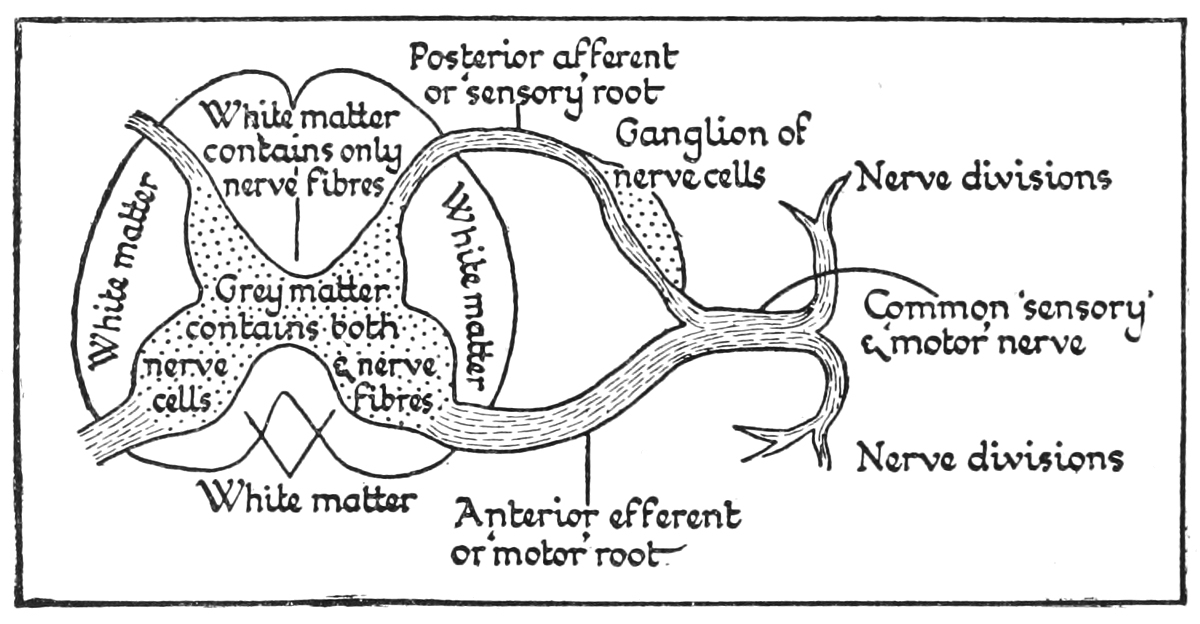
Fig. 98. Diagram of Transverse Section of the Spinal Cord and the Main Nerves derived from it.
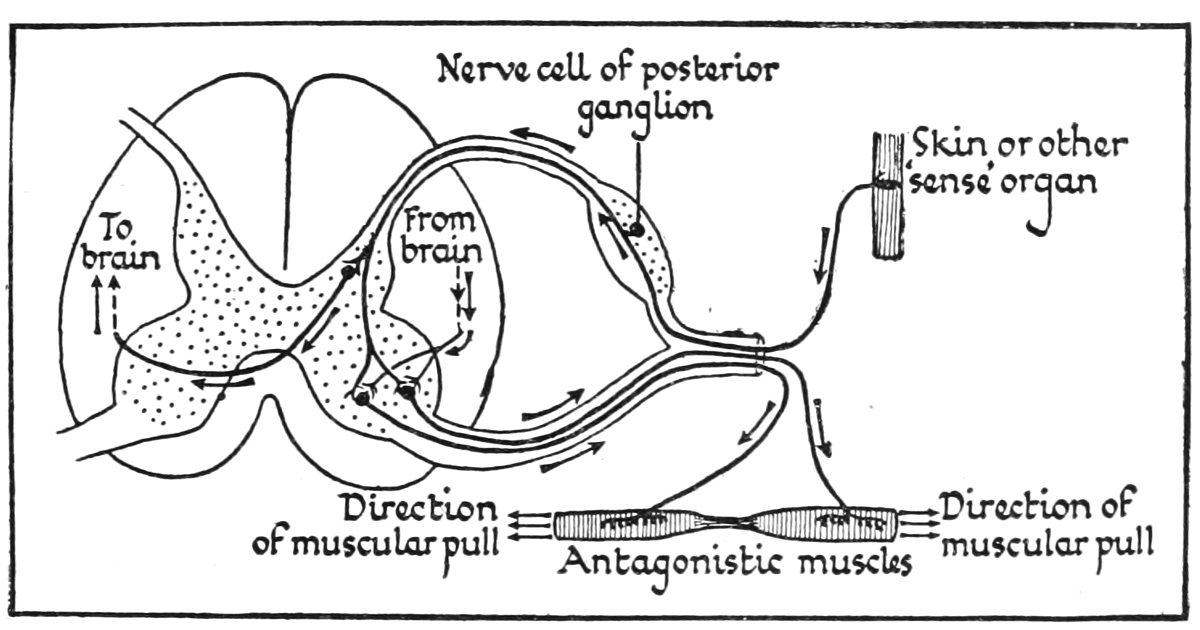
Fig. 99. Diagram to illustrate simplest form of reflex (cf. Fig. 98).
An afferent impression from a sense organ to the spinal cord may give rise to an efferent impulse by a purely intra-spinal process. This impulse may be of the nature of a complex and balanced muscular act involving a whole system of muscles, some of which may be antagonistic to each other. All this may take place not only unconsciously, without any intervention from the higher nerve-centers in the brain, but even in an animal from which the brain has been removed. On the other hand, channels exist (and are indicated in the diagram) for passage of impressions to and impulses from higher centers. These higher centers in many cases control or modify the resulting muscular or other action to a greater or less degree.
Since Hall’s time there has been a great extension of the conception of reflexes. It has been shown that, besides the simple nervous arc (Fig. 99), there are more complex nervous arcs which depend for their action on the integrity of an elaborate mechanism. The nervous system is ‘integrated’ under higher and higher centers, till at last the highest centers of the brain are reached (pp. 308-11). Many of the ordinary acts of life, sneezing, coughing, standing, walking, even breathing, are expressible as reflexes. The attempt has also been made to press the ‘instincts’ into the same category. But it is difficult to separate the instinctive from the volitional elements or to define either. Vast, therefore, as is the development of this department of physiology, it is a very delicate task for the historian to pass any verdict upon it. The ultimate value of all this work must depend upon the conception that the next generation attaches to the mental element in vital phenomena. There is evidence of reaction at the present time from the extreme mechanist physiological position.
Lastly, in the discussion of work on the nervous system comes the question of the localization of functions of the brain. The possibility of such localization is a very ancient speculation. The idea was developed along rational lines, in the first third of the nineteenth century, by certain Viennese workers who, having made important contributions to science, unfortunately afterwards degenerated into phrenological quacks. Later several German observers began the study of the electrical excitation of those parts of the cortex of the brain which specially control movement (Fig. 100). The work was continued and developed by a number of distinguished French and English observers, among whom Paul Broca (1824-80), Hughlings Jackson (1834-1911), and Sir David Ferrier (1843-) should be commemorated. Under their influence many operations usually regarded as involving complex mental processes, such as vision, speech, reading, writing, drawing, have been represented as depending on simple nervous relationships. Centers for the initiation of these operations have been described. Of late years, there has been reaction from this mechanical conception of the brain as an organ of the mind. The older school has, however, achieved clinical success especially at the hands of the great French physician Jean Marie Charcot (1825-93) and his pupils.
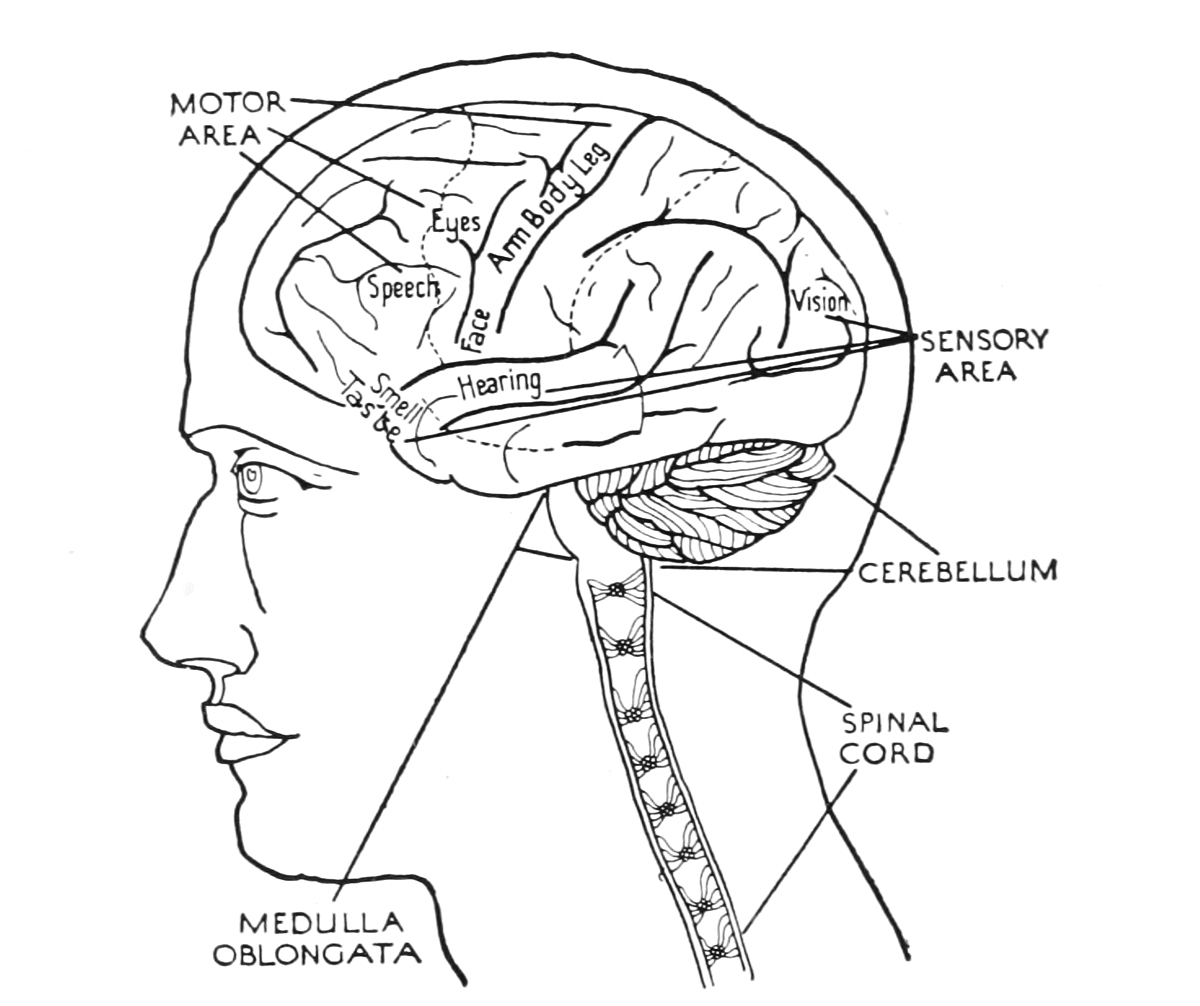
Fig. 100. Diagram to illustrate some of the main facts of Cerebral localization.
§ 4. The Experimental Foundations of Modern Medicine.
We may turn back to consider those who have been the immediate progenitors of modern Physiology. Among these, three men stand out beyond all others. In order of seniority, and perhaps of genius, they are Johannes Müller, Claude Bernard, and Karl Ludwig.
(a) The Work of Johannes Müller.
Johannes Müller (1801-58) was the greatest physiologist Germany has produced, and perhaps the greatest physiologist of all time. His genius was of the universal type and, despite his early death, he attained equal distinction in every department which he touched. Among these were Comparative Anatomy, Embryology, Physiological Chemistry, Psychology and Pathology. He was a careful scholar, well versed in the history of the subjects which he taught, and as great a teacher as he was an investigator. A very large number of the best-known men who have advanced Medicine during the nineteenth century were his pupils while he was a professor at Berlin. His lovable character was pervaded by a mystical tendency.
Müller’s text-book of Physiology began to appear in 1834. It introduced into the subject the comparative and psychological points of view, which were not fully appreciated until the generation that followed. The most remarkable generalization associated with his name—and one further developed by Ewald Hering (1834-1918)—is the ‘Law of Specific Energies’. According to this law each sensory nerve, however stimulated, gives rise to its own specific sensation and to no other. Conversely, the same stimulus applied to different organs of sense produces a different sensation in each organ—that sensation, in fact, that is its specific attribute. Thus electrical, mechanical, thermal stimulation produce only the sensation of light when applied to the optic nerve. On the other hand, any particular form of stimulation, for example electrical, produces sensations of light, smell, hearing or taste if applied to the appropriate nerves.
A moment’s reflection will enable the reader to realize the very great philosophical importance of these conclusions. They provide experimental evidence that the things of the external world are not in themselves discernible by us. Such external things we know only by the events to which they give rise acting on our senses, and yet from one and the same event utterly different sensations arise within us. To beings with senses different from ours the world also would be different. The ‘Law of Specific Energies’ is thus fundamental for our view as to the range of validity of Scientific Method.
Among other important contributions of Johannes Müller to the physiology of the nervous system were his experimental confirmation of Bell’s researches on the spinal roots (p. 145) and his experiments on the production of the voice. He launched important theories in explanation of color vision, of the mechanism of hearing, and of the phenomena of fever. He was one of the first to use the microscope in pathology and he was one of the founders of Physiological Chemistry.
Like every investigator Müller made mistakes. In 1840 he stated that the velocity of a nervous impulse could never be measured. By 1852 his gifted pupil, Hermann von Helmholtz (1821-94), had measured it. Much of Helmholtz’s work hardly comes within our department. He was, however, inventor of the instrument known as the Ophthalmoscope, by means of which the interior of the eye can be examined. This is the main factor which has enabled Ophthalmology to develop along true scientific lines (p. 319).
(b) The Work of Claude Bernard.
Claude Bernard (1813-78), the great French physiologist, was Müller’s junior by twelve years and was in almost every respect a contrast to him. His mind was of that peculiarly French type to which anything mystical is abhorrent. He had few eminent pupils who owed much to him directly, but the influence of his ideas, through his writings, can hardly be exaggerated. Especially Bernard was the founder of ‘Experimental Medicine’, that is of the artificial production of disease by chemical and physical means. This is one of the most important scientific movements within our field.
Bernard’s great discovery, which occupied him for over ten years, was that the liver has the power of building up and storing certain highly complex substances, derived from the food and brought to it by the blood. The substances thus stored, and notably that known as glycogen, are distributed to the body according to its needs, in simplified and modified form. Now Wöhler in 1828 had synthetized urea (p. 206) and it was well recognized that this substance is a final degradation product which the body manufactures by breaking down the substances derived from food. It was also recognized that from this breaking-down process the bodily energy is obtained. Bernard showed that the body could build up complex chemical substances as well as break them down. This destroyed the conception, then still dominant, that the body could be regarded as a bundle of organs, each with its appropriate and separate functions. Bernard thus introduced what we may call a ‘Physiological Synthesis’, a conception of great import for the development of medical ideas.
No less important, and bearing on the synthetic view of the working of the animal body, was Bernard’s work on the physiology of digestion. Up to the time of Bernard, an elementary knowledge of the facts of digestion in the stomach constituted the whole of digestive physiology. While Bernard was working on the glycogenic function of the liver, another worker had suggested that the secretion of the organ known as the ‘pancreas’, or sweetbread, emulsifies fats. Soon after, a German researcher showed that pancreatic juice acts on starch. Bernard now stepped in and cleared up the whole subject. He showed that digestion in the stomach is, as he described it, ‘only a preparatory act’. He proceeded to demonstrate that the pancreatic juice, passing into the intestine, emulsifies the fatty food substances there and splits them up into fatty acids and glycerin. He further demonstrated the power of the pancreatic juice to convert starch into sugar, and he showed that it has a solvent action on such ‘proteids’ or organic nitrogenous substances as have not been dissolved in the stomach.
The third great achievement of Bernard was his exposition of how the blood-supply to the different parts of the body is regulated. This we now call the ‘Vaso-Motor Mechanism’. In 1840 the existence of muscle fibers in the coats of the smaller arteries was discovered. Bernard showed that the contraction and expansion of the ‘arterioles’ is associated with a complex nervous apparatus. The reactions of this apparatus depend upon a variety of circumstances in a variety of other organs; again an illustration of the close and complex interdependence of the various functions of the body upon each other.
(c) The Work of Karl Ludwig.
Karl Ludwig (1816-95) held a series of professorships at Marburg, Zürich, Vienna and Leipzig. He was, after Müller, the greatest of German physiological teachers, and he surpassed even Müller in the number of his pupils. As a physiologist he was chiefly remarkable for his ingenuity as an inventor, for his wide and deep knowledge of the physical sciences and for his extreme generosity in handing over his work to his pupils.
Among the many lines of investigation of fundamental importance which Ludwig initiated, some of the most remarkable depended on the discovery of new methods. Just as the microscope had opened to the anatomist unexplored fields of research by bringing him into closer relation with objects which were hitherto beyond his scrutiny, so the rapid progress of physics and chemistry had placed more exact modes of observation and of measurement within reach of the physiologist. But the application of these methods was attended with great difficulty; there was no physiological laboratories, no instruments, no capable mechanicians to whom the physiologist could apply for assistance. Under such conditions, ingenuity and resource were indispensable to success, and in these qualities Ludwig was pre-eminent.
Accordingly, we find that two of the most important of the early investigations of Ludwig were as much due to his ingenuity as an inventor as to his clear grasp of the physiological questions which his inventions were intended to elucidate. The most interesting of these inventions, or rather adaptations, is the mechanically rotating drum or kymograph, as it is called. The word itself is derived from two Greek words which mean ‘wave writer’. This instrument is now widely used, not only in Physiology but in every department of Science in which permanent records of any continuous movement are desired. The most familiar instance is the self-recording barometer. The kymograph—the use of which had been suggested by Thomas Young (p. 319, and Fig. 101) in 1807—led to much wider applications of the method of automatic record. Ludwig himself applied it to indicate the movements of respiration, as well as the variations in arterial pressure. Subsequently it became further adapted to the ‘graphic method’, and it serves not only for the investigation of animal movements of every conceivable kind, but even for the transient and delicate electrical changes which are associated with vital action.
An instrument invented by Ludwig is the mercurial blood-pump, the purpose of which is to separate from a known quantity of blood, derived directly from the circulation, the mixture of gases which it yields to a vacuum. This is an indispensable apparatus for the investigation of the physiology of breathing.
Ludwig devoted much attention to the physiology of secretion. Here his work has been of great importance in connection with the time-honored discussion between the ‘vitalists’ and the ‘mechanists’. He succeeded in showing that the process of secretion can be so transformed experimentally as to do external mechanical work. This was victory for the mechanist theory. The idea has since been applied to many structures.
It is impossible to attempt here any general summary of the conclusions reached by physiological research since Ludwig. Some have affected the actual practice of Medicine. Others are too recent or too little certain to have reacted in this manner. It is, however, safe to say that the more important conclusions of the three modern founders of the science, Müller, Bernard, and Ludwig, form the main scientific background of the clinical practice of our time. The results of the movement that they represent, together with the knowledge of the cellular structure of the body (§ 5, p. 219) and of the life-histories of the disease-causing organisms (§ 6, p. 224), are the three main groups of ideas which separate the physician of our day from Laënnec (p. 161).
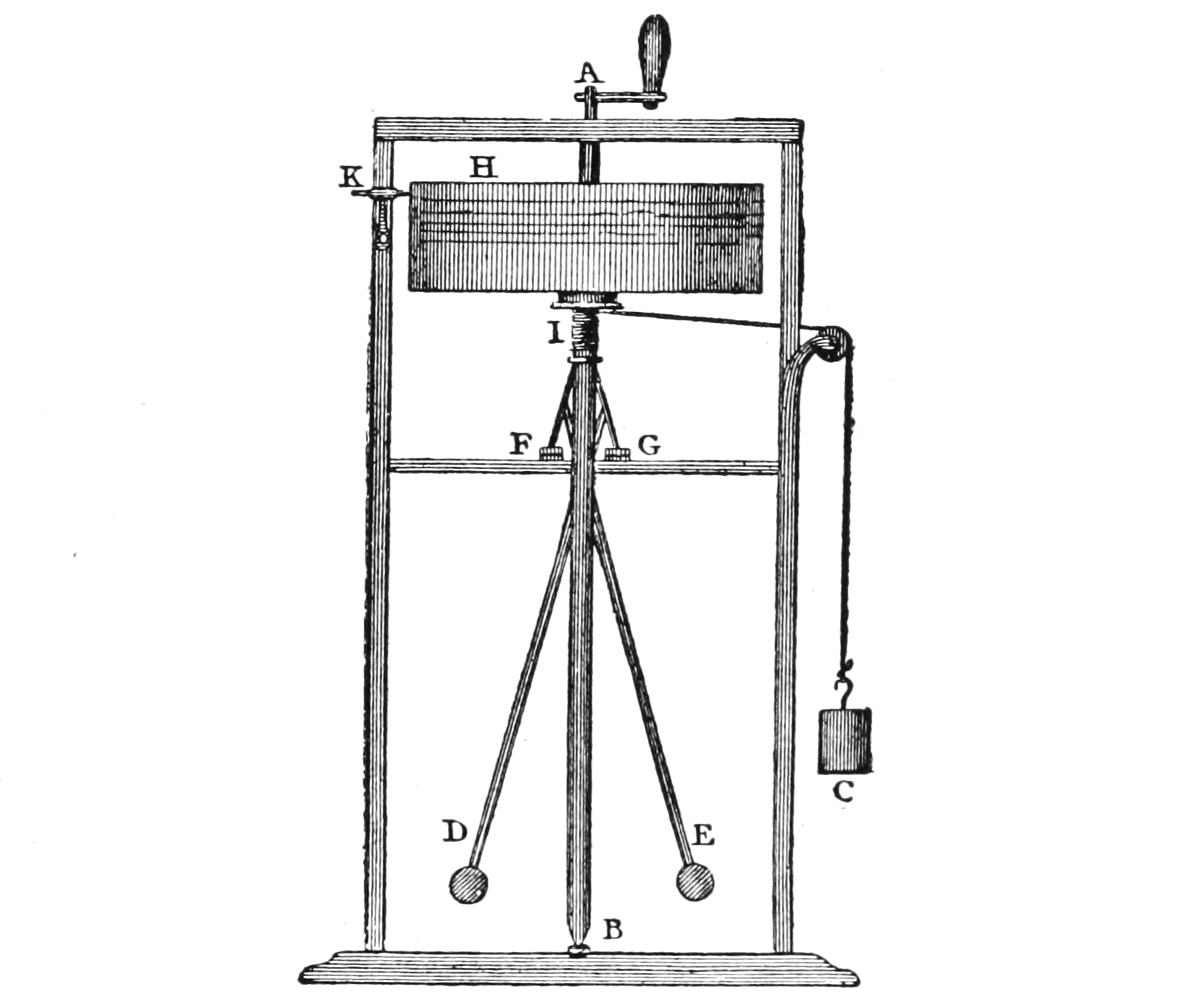
Fig. 101. Thomas Young’s Kymograph.
The cylinder H turns with the axis AB on which it is rigidly fixed. It is rotated by a handle at A which raises the weight C. When the weight is allowed to fall the cylinder rotates automatically. The rest of the apparatus is devised to secure constancy in rate of rotation. This was done by utilizing the effects of centrifugal force.
(As the rate of rotation increases the pendula D and E fly apart, they separate the weights F and G. These move with friction which increases as they separate, thus decreasing the rate of rotation.)
The movements of the pen at K are transferred into permanent graphic form by writing on the rotating cylinder H.
§ 5. The Cell Theory and Cellular Pathology.
During the process of the microscopic analysis of plants that took place in the seventeenth century a number of observers distinguished the walls of plant-cells and the word cell was introduced into the English language. Less clearly, a similar structure was discerned in animals. No real understanding of the nature of cells was, however, reached. Little farther progress was made in the eighteenth century, but just at its close a young French microscopist, Marie François Xavier Bichat (1771-1802), likened the microscopic structure of the animal body to the substance of a woven fabric. The word he used was the old French term tissu. He perceived that the different parts of the body, bones, muscles, nerves, blood-vessels, and the like, each presented a characteristic microscopic pattern. According to these appearances he analyzed the parts of the body into twenty-one ‘tissues’. Study of this kind came to be called ‘Histology’ (Greek histos = web).
During the seventeenth, eighteenth, and early nineteenth centuries, some advances were made in the knowledge of those organisms whose bodies are made up of only one cell, but their essential nature was still unappreciated. In the early nineteenth century a number of botanists and others were observing cells and cell contents. But no important advance in the interpretation of the appearances was made until the matter was taken up by Schleiden.
Matthias Jakob Schleiden (1804-81), professor at Jena in 1838, put the matter in a new light. He noted, as had certain of his predecessors, the constant presence in every cell of the structure we now call the ‘nucleus’, and came to the conclusion that it is essential to the life of every cell. He reached the conception, moreover, that in a multi-cellular organism, such as a tree, every cell has a double life, one an essential and independent one, pertaining to its own development alone, the other an incidental and dependent one, in so far as it is an integral part of the plant. His work was somewhat vitiated by a fanciful conception of the origin of new cells.
The work of Schleiden was amplified and corrected in 1839 by Theodor Schwann (1810-82), a pupil of Müller. He showed that the tissues of animals, like those of plants, are susceptible of analysis into cells, and the difficulty of this process arises from the extreme modification of such cells as have developed for various special purposes. He showed too that the ovum or egg of animals is, in the first instance, a single cell, and that the cells of the body are derived and descended from it. He demonstrated that the entire animal or plant body is composed either of cells or of substances that are excreted or thrown off by cells. He gained some insight into the life of animal cells and in doing so he invented the very useful word metabolic. The word means ‘liable to change’. It was used by Schwann, and is still habitually used in modern Medicine to indicate chemical changes within the body which are specially associated with living activity.
Contributions to the cell theory were made by other botanists. Hugo von Mohl of Tübingen (1805-72) distinguished the contents of the vegetable cell just under the cell-wall from the watery sap that fills the interior, introducing for it the term protoplasm (1846). The Swiss, Karl v. Nägeli (1817-91), by chemical examination proved that protoplasm is nitrogenous and differs from other cell constituents (1862).
The cell theory was placed on a firm and clear footing by Max Schultze (1825-74), successor of Helmholtz (p. 213) as professor of Anatomy at Bonn. He defined the cell as ‘a lump of nucleated protoplasm’ (1861), introduced the idea of protoplasm as ‘the physical basis of life’, and showed that it presented essential similarities, physiological and structural, whether in plants or animals, and whether in higher or lower forms.
The study of tissues, Histology, was raised to the status of an independent science by the Swiss, Albrecht von Kölliker (1817-1905), pupil of Müller and professor at Würzburg, who wrote the first text-book on the subject (1850-52). Apart from this achievement, Kölliker is remarkable for having reached some of the conclusions in connection with heredity that are associated with the name of Mendel, of whose work he knew nothing.
Even more influential on medical thought than Kölliker was Rudolf Virchow (1821-1902) of Berlin, one of the leading names in modern Medicine. There is indeed hardly any department of medical thought that has not gained something from Virchow’s work. His great achievement is the way in which he carried the Cell Theory into the analysis of diseased tissues. In his Cellular Pathology (1858) he analyzes diseased tissues from the point of view of cell formation and cell structure. Important sections of the science of Cellular Pathology have been explored so well by Virchow that they have been little extended by his successors. He initiated the familiar idea that the body may be regarded as ‘a cell State in which every cell is a citizen’. Disease is often but a civil war. The white blood corpuscles, which have the power of engulfing and rendering innocuous bacteria and other foreign bodies, have been compared to police or scavengers. In some respects Virchow was strangely conservative, and notably he opposed the evolutionary view of the origin of living forms. Virchow’s conceptions of the functions of the white blood corpuscles were largely extended by the Russian biologist Élie Metschnikoff (1845-1916) and the English worker Almroth Wright (1861-).
Since Virchow and Kölliker the study of the intimate structure and workings of the cells themselves, as distinct from the tissues, has become a separate and independent science under the name of Cytology. It may even be extended to the study of cells in disease as Cyto-Pathology.
Among the major developments of Cellular Pathology and Cyto-Pathology is the study of abnormal ‘new growths’. The most malignant types of these belong to the group known as the ‘Cancers’. The occurrence of most of these becomes more frequent as life advances (Fig. 135). Their cytological features are now well known. A cancer consists essentially of an increase of cellular tissue, following abnormally rapid multiplication of one type of cell. The new growth is equipped with a blood-supply which enables it to increase at the expense of other tissues and regardless of their needs.
Cancers almost always arise at one point, and are very seldom multiple in origin. It is fairly established that they are not infectious or contagious, and there is no very satisfactory evidence that a tendency to them is inherited. Our scientific knowledge of Cancers is largely derived from animals. Cancers are ‘specific’ in the sense that those of one animal species will not grow when inoculated into another species. An immense amount of work has been done on inoculated Cancers, but it has become evident that some physiological factor is involved in Cancer incidence such that an inoculated Cancer is not entirely comparable with so-called ‘spontaneous’ Cancer. As to what that physiological factor can be we are still in the dark.
Although we know nothing effective as to this physiological factor, yet experiments in the artificial production of Cancer, apart from inoculation, have been attended with success. That various forms of chronic irritation are associated with the onset of Cancer has long been clinically recognized. It has been found possible to reproduce experimentally this relation between irritation and new growth, and so, for example, to induce Tar Cancer in mice. Nevertheless, it must be admitted that Cancer investigation is in an unsatisfactory state, and has yielded fewer positive results than any other department of Pathology of comparable importance. It is possible that we do not yet know enough of normal Cell Physiology to investigate with profit the forms of cellular perversion known as Cancer.
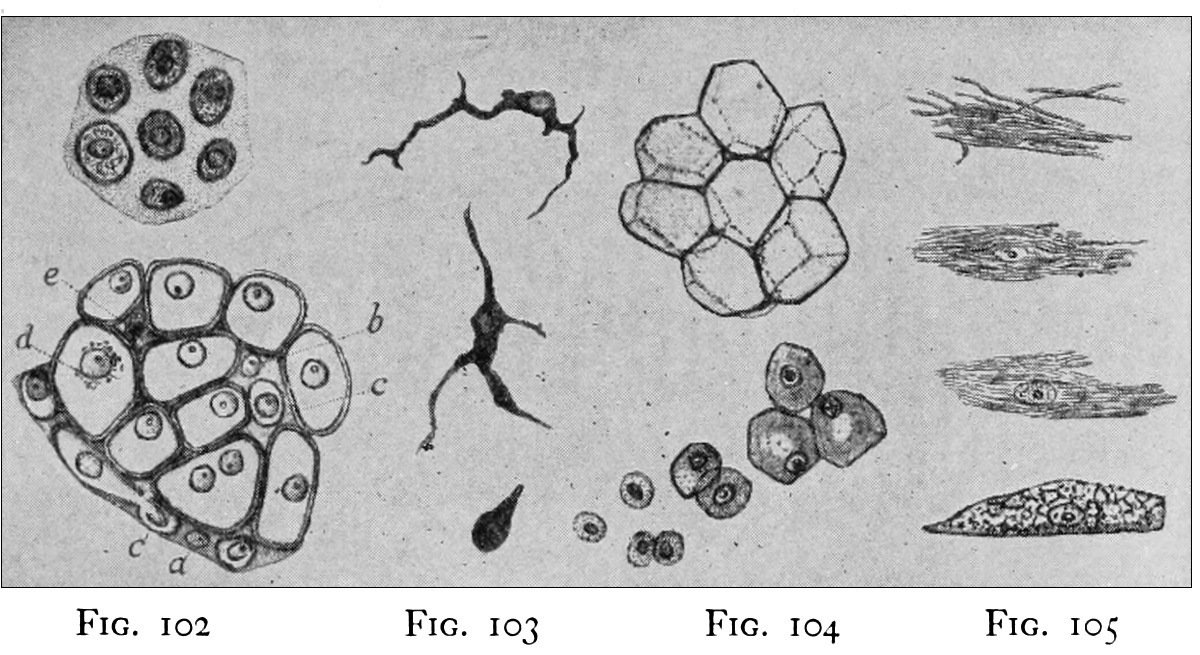
Drawings by Theodor Schwann to illustrate the nature and origin of animal cells. All are highly magnified.
Fig. 102. The first step in the origin of cartilage from cellular tissues. At the lower part the young cells are without cell-walls. In the upper part they have formed walls and are beginning to secrete cartilaginous substance. Nuclei and nucleoli are clearly visible.
Above is shown a piece of maturer cartilage, in which the cells are imbedded in a mass of cartilaginous material.
Fig. 103. Pigment cells, such as are characteristic of the skin of the frog. In the lowest cell, which is contracted, the nucleus is concealed by the pigment. The upper two are more expanded and in them nuclei can be seen.
Figs. 104 & 105 show how structures of very diverse form can be differentiated from cells of the same type.
Fig. 104. Young cells from a developing feather. These cells may enlarge, secrete hard walls, and form the fine spongy tissue of the inner part of the shaft of the feather. Or the cells may elongate, the protoplasm become granular, and finally break up into fibers (Fig. 105). These form the tough fibrous matter of the outer part of the shaft of the feather. In either case, the nucleus disappears and the cell dies.
§ 6. Establishment of the Doctrine of the Germ Origin of Disease.
The view that many diseases, especially those of a contagious or infectious nature, originate from the invasion of the body by special organisms and their multiplication within the body, came into prominence in the second half of the nineteenth century. There had been many previous adumbrations of this view and, in its final establishment, more than one hand may be discerned. Above all others who have worked in this field towers the mighty figure of Louis Pasteur (1822-95). We shall do no grave injustice to any man if we treat the scientific demonstration of the doctrine as the product of his superb genius.
The opening of Pasteur’s interest in disease can be seen in his work on fermentation. At first he was faced with the opposition of Liebig. According to that eminent chemist, fermentation was not the result of vital activity but was a purely chemical change (p. 207). A ferment he regarded as an unstable organic product, the character of which determined the manner of decomposition of the medium in which it is placed. Pasteur demonstrated that, as there is a specific alcoholic ferment, so there is a specific milk-souring ferment. Any nitrogenous matter present in a fluid containing it will serve as food for the development of a ferment, but will not of itself induce fermentation. Ferments have, he demonstrated, the power of reproduction. Pasteur rapidly seized on the idea of the specificity of ferments. An albuminous sugar solution can be converted into various products by the addition of various ferments. According as one sows, so will one reap. The milk-souring ferment, Pasteur concluded, is organized and living, and its action is correlated to its development and organization. No life, no ferment; no ferment, no fermentation.
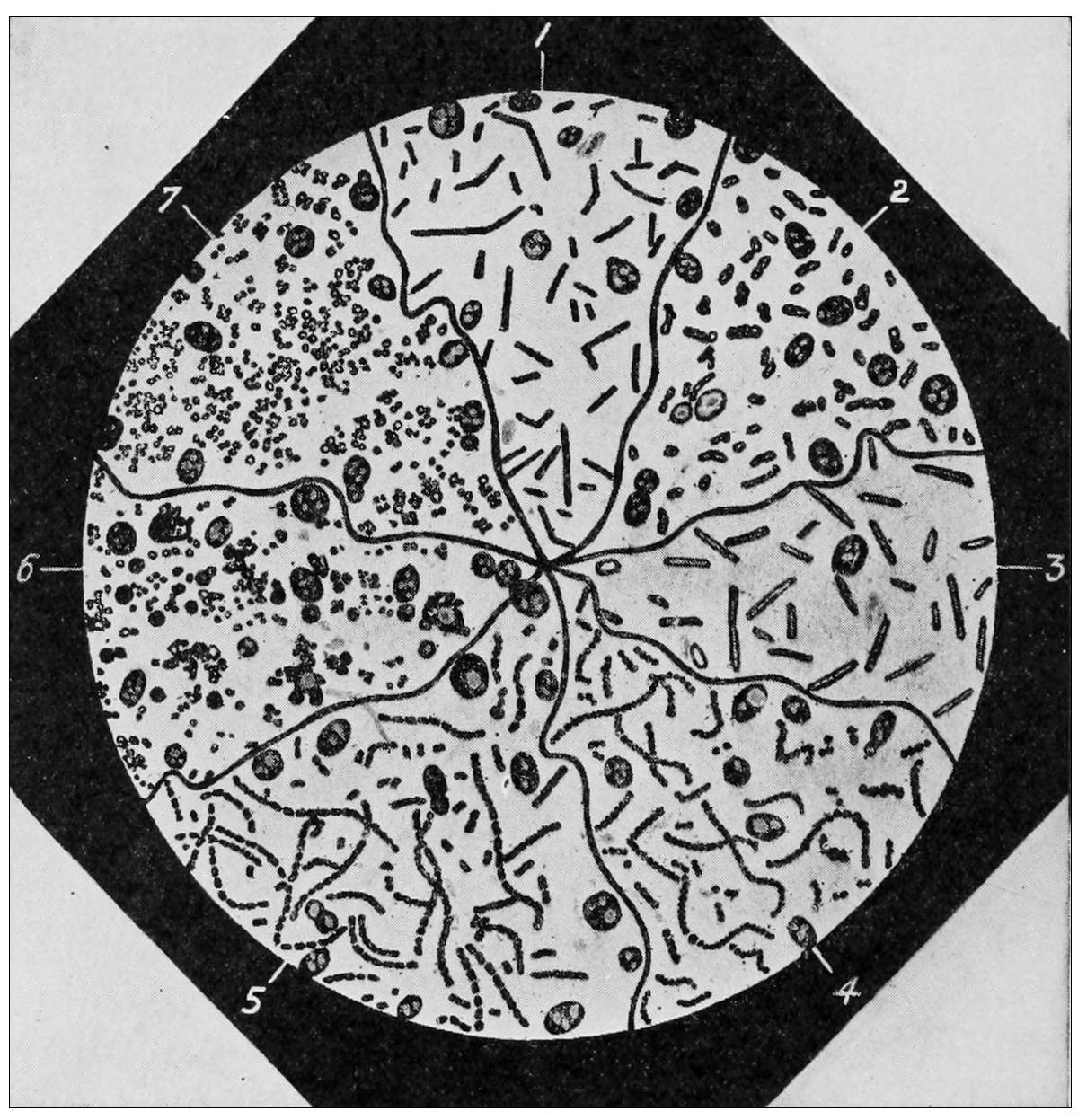
Fig. 106. Organisms of Fermentation highly magnified from Louis Pasteur’s Studies on Beer of 1876.
1. Bacillus of Turned Wine. 2. Ferment of Soured Milk. 3. Butyric Ferment. 4. Ferment of Ropy Wine. 5. Ferment of Vinegar. 6. Amorphous deposit. 7. Sarcinae.
During the next years Pasteur applied himself to a study of ferments and notably of those which involve deterioration of wines and beers. This led him to perceive that there is a great multiplicity and variety of these organisms. Now it was an old and well-known view that fermentation, putrefaction, and the infection of disease had much in common. It was perfectly natural, therefore, for Pasteur to regard the latter in the light of a vital process. A great difficulty was, however, the demand that any such doctrine made on the germ-bearing capacity of the air. Cities were not slow to avail themselves of this weakness, and pointed out that, according to Pasteur, the air must be one solid mass of germs! For the opponents of Pasteur the living organisms found in the process of fermentation or decomposition were the result, not the cause, of the process. These organisms were regarded by them as spontaneously generated in the fermentation process. Thus arose a discussion of the old theme of spontaneous generation.
By 1859—the year of publication of Darwin’s Origin of Species—Pasteur was engaged in controversy as to the ‘Origin of Life’. The discussion specially turned round what were then regarded as the lowest forms of life, the Bacteria. Were they ever spontaneously generated, or were they not? If a flask of broth, supposedly sterilized by boiling, went ‘bad’ and organisms appeared in it, was it certain that they had come from without, or could they have been spontaneously generated by the broth itself? Life must begin somewhere. Then why not here at this lowest stage? If this view be justifiable, Pasteur’s doctrine of the nature of ferments must fall to the ground.
Pasteur had thus before him the task of proving a universal negative—a task impossible in Formal Logic. But Science is not Formal Logic. In the end he clinched the matter by an exquisitely simple experiment which must, at once, carry conviction. A flask with a long S-shaped neck is filled with a putrescible fluid. It is heated to boiling, to kill all organisms, and then left in the still air of a room. Air can enter, but any floating germs that enter naturally fall on the floor of the S-shaped neck of the flask. Months may go by without any change in the liquid, but once the neck is severed, so that organisms can enter freely from the air, fermentation sets in within a few hours, and organisms can be detected in the liquid. Only living organisms from the air can have caused the change.
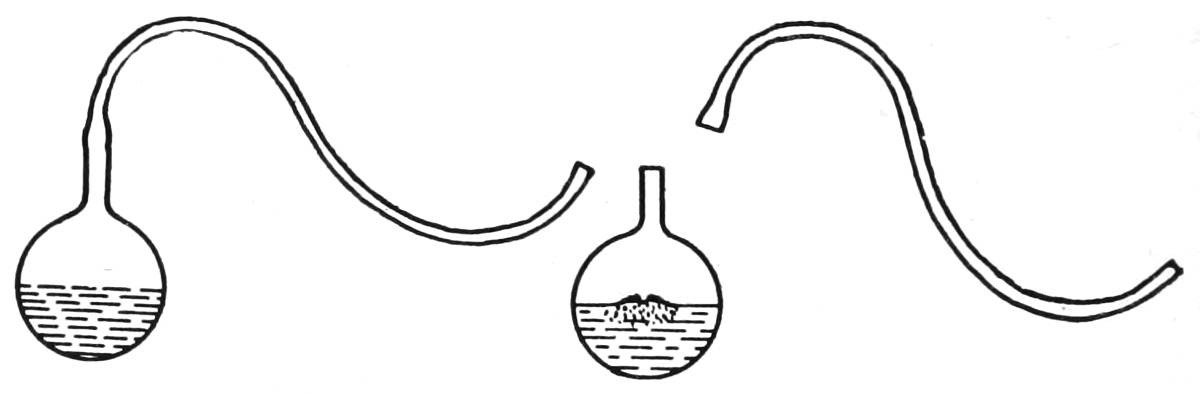
Fig. 107. Pasteur’s crucial experiment to prove that fermentation or putrefaction is the result of the action of air-borne organisms. The S-shaped flask contains a putrescible fluid such as meat broth. The flask containing the broth is subjected to prolonged heating to destroy all organisms. It is then left in position with the mouth open. Days, weeks, months, even years, may pass without sign of putrefaction. No organisms reach the broth, since any that enter the open mouth fall on the floor of the neck and remain there. Sever the neck of the flask so that organisms can fall from the air directly on to the surface of the fluid and these multiply. In a few hours putrefaction sets in. This is shown by the formation of a film or scum on the surface just below the severed neck. Microscopically the broth is seen to be teeming with organisms.
The first disease which Pasteur was able to demonstrate as causatively related to a living organism was a condition that was devastating the silk-worm industry of France. In 1866 he proved the contagiousness of the disease, showed that it was due to a living organism, and followed the organism through the life-history of moth, egg, worm, and chrysalis.
In 1870 the Franco-Prussian war broke out. Pasteur now decided to make investigations into the diseases of beer, his object being to improve the French brews and to carry the war into the enemy’s camp by making them equal to the German! He succeeded in isolating special organisms, mostly yeasts, which produced defects in beer (Fig. 106). This work naturally led to an enlargement of his views on the nature and action of micro-organisms.
About this time Pasteur was elected a member of the French Academy of Medicine, a very unusual honor for one not a medical man. Lister had already begun his teaching, based partly on the work of Pasteur, and indeed his first important paper on antiseptic surgery had been published in the very year of the Franco-Prussian war. On entering the Academy Pasteur found himself faced by all kinds of ancient prejudices and misconceptions in connection with his new doctrine, and especially with his denial of spontaneous generation. Among his supporters was the physiologist, Claude Bernard (p. 213). His work proceeded to more and more triumphant issues.
The first disease that affects man on which Pasteur was able to throw light was Anthrax, in relation to which his work interdigitates with that of Robert Koch and some other observers. Anthrax is a deadly and highly contagious condition which commonly affects cattle, but sometimes spreads to man. As early as 1855, a German observer had noted microscopic rod-like objects in the blood of beasts dead of the disease. In 1868 an older French contemporary of Pasteur had shown that a bacillus is not simply the inseparable companion of the disease, but also is its cause and its only constantly acting cause. At this time the losses of cattle from Anthrax in France were enormous. The character of the outbreaks had been studied and seemed wholly unexplained by what was known of the bacillus. Farmers found that they lost cattle in fields from which infected animals had been excluded for months or even years. How was it to be explained?
The explanation was, in fact, advanced in 1876 by the German observer, Robert Koch of Berlin (1843-1910), whose work was now beginning. He showed that the anthrax bacilli under certain conditions formed ‘spores’, that is to say small encysted bodies, exceedingly resistant to heat and to other changes of external conditions (Fig. 108). This discovery opened up a new field which was cultivated by Koch and Pasteur and their followers.
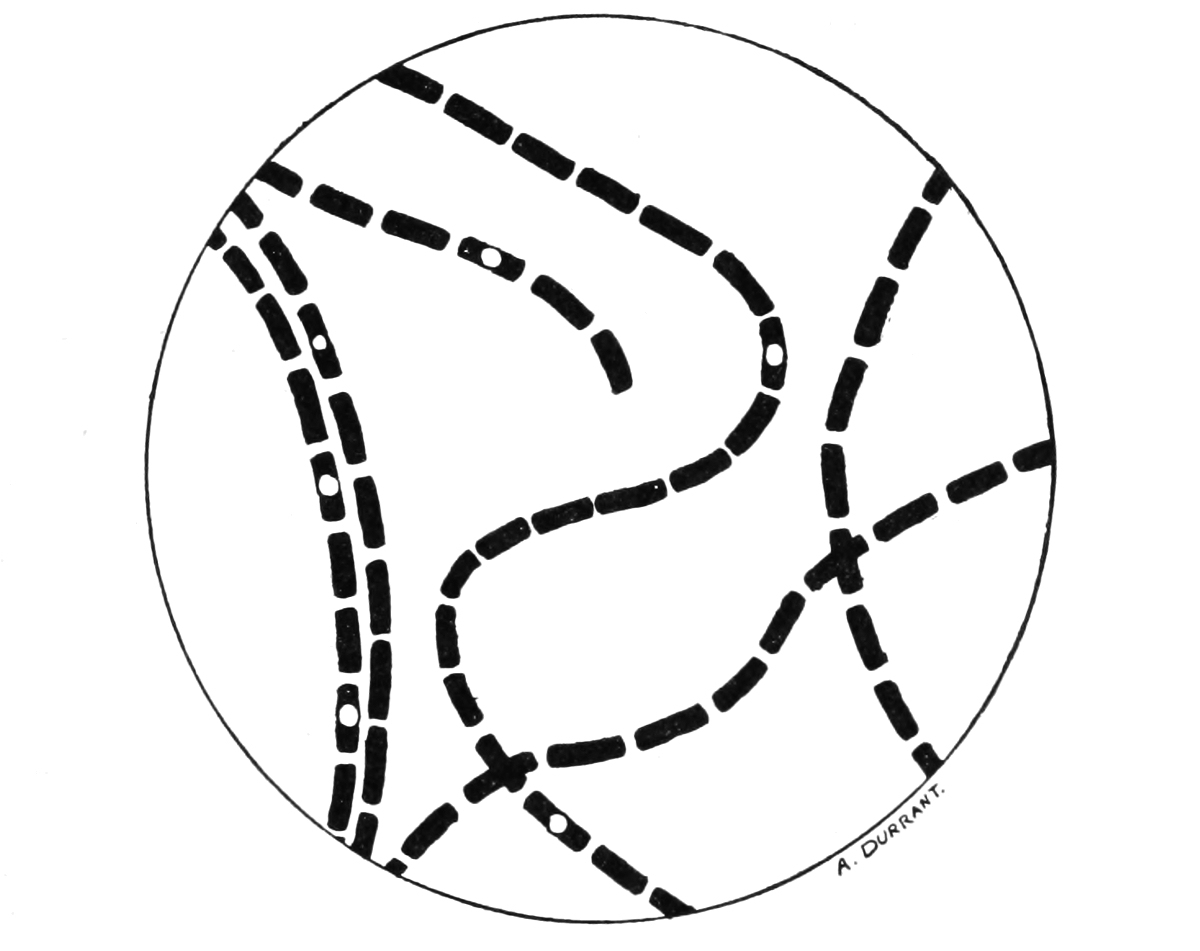
Fig. 108. Bacilli of Anthrax, from a culture, highly magnified.
The rod-like organisms are growing typically in chains. Some of the rods have white clear spots in them. These are the highly resistant ‘spores’.
While making his studies on ferments in 1863, Pasteur had witnessed the formation of spores in the organisms of butyric fermentation, but had failed to grasp their significance. In 1869 he had again found spores forming in the organisms of silk-worm disease, and had shown that they resisted prolonged drying. On the basis of their resistance he had explained the persistence and latency of the silk-worm disease. Other observers had had similar experiences. The investigations of none of them, however, approached in brilliance and completeness those of Koch.
Koch found that spores always form in the blood and tissues of animals dead of Anthrax, provided that
(1) the temperature is suitable, and (2) there is sufficient oxygen. These two conditions, temperature and oxygen, were found to be necessary. Below 18° Centigrade spores are not formed; at 30° Centigrade they occur at the end of thirty hours; at 35° Centigrade in twenty hours. The rapidity with which spores are formed is, therefore, proportional to the amount of heat. Oxygen was also found to be indispensable. Anthrax blood, if deprived of oxygen, ceases to be virulent in twenty-four hours without putrefaction. When the blood is allowed to putrefy the virulence also disappears if putrefaction exhausts the oxygen quickly enough to prevent the spores having time to form. If the spores have already formed, putrefaction does not kill them, nor does it prevent them from developing later if circumstances become favorable. The persistence of the disease and its return in an infected country was thus explained. It was the spore which was the agent of preservation, which persisted where the conditions of temperature and of aeration had permitted it to form, and which always held itself in readiness to make new victims.
The matter was carried further by Pasteur in 1877. At that time he did not know of all the work of Koch. He succeeded in obtaining pure cultures of Anthrax. The question was then still being debated in France as to whether Anthrax was caused by a ‘virus’, that is to say a non-living poison, or by a microbe. Pasteur had long been a believer in the microbic theory, and it seemed to him probable that the blood of an animal infected with Anthrax, if sown in a suitable medium, would stock it solely with anthrax bacilli which he could then keep pure for an indefinite time in successive cultures, as he had done with yeast and other ferments.
Experiment proved this to be the case, and showed that the anthrax organism multiplied abundantly in urine made neutral or slightly alkaline. From that time the problem was solved. Take a series of cultures of the organism, transferring each time one drop from the preceding culture into 50 c.c. of fresh urine. The first dilution is 1/1000, the second one in a million, the third one in a thousand million. After ten cultures it falls to such a figure that the original drop of blood has been drowned in an ocean. Everything that it carried with it, to which we might attribute the production of Anthrax—red corpuscles, white corpuscles, granules of all sorts—is either destroyed by the change of medium or is widely disseminated in this ocean and is lost. Only the organism can escape the dilution. Why? Because it has multiplied in each of the cultures. A drop from the last culture killed a rabbit or guinea-pig as surely as a drop of anthrax blood. It was, therefore, to the organism that the virulence belonged. A conclusion of the first rank was firmly established.
With a ‘pure culture’ of Anthrax in his possession Pasteur was able to experiment in a way which none had previously attempted. The most interesting stage of his work was now entered upon. He perceived that there are some species of animals which are refractory to Anthrax. Such are the birds. Nevertheless, the blood of a bird, when drawn from the animal, is an excellent culture medium for the bacterium. Why does it resist infection in the animal? Pasteur showed that the anthrax organism will not live in the bird because the living-blood in full circulation is filled with an infinite number of corpuscles which, in order to live and perform their physiological function, need free oxygen. When, therefore, the anthrax organism enters normal blood of living birds, it meets competitors ready to seize the oxygen for their own use. But the blood of other animals besides birds contains corpuscles eager for oxygen. Why can anthrax grow in them and not in birds? This question Pasteur answered by a convincing series of experiments (1878). The normal temperature of birds is higher than that of mammals and is, moreover, higher than that at which the growth of the anthrax organism is most vigorous. Thus the blood corpuscles of the bird have the anthrax bacteria at a disadvantage. But if, by a cold bath, the temperature of a bird be lowered to that of a mammal, and if anthrax organisms be injected into the blood-stream, they will grow and flourish at the expense of the bird.
The experiments with Anthrax on fowls led to experiments on the same creatures with another disease, the virulence of which was known to vary, Chicken Cholera. Thus arose naturally Pasteur’s ideas and observations in the department of Immunity (p. 261).
If Pasteur can be said to have laid the foundations of the knowledge of the nature of infection, it is to Koch that we owe the main basis of the technique by which diseases are now studied. He it was who elevated Bacteriology into the position of a separate science. Soon after his work on Anthrax he published a remarkable research which placed our knowledge of wound infection on a firm footing. He is thus among those who helped to create modern surgical technique. Many other communications came from him. None was of more far-reaching importance than his demonstration of the organism of Tuberculosis in 1882. All subsequent work in connection with Consumption and allied conditions has been rendered possible only by this discovery of Koch. Other investigations associated with his name are on Cholera and on Sleeping Sickness. Koch was unquestionably the greatest bacteriologist that the world has seen. His genius was limited as compared to that of Pasteur, but his exquisite technical skill and acumen have never been excelled.
Since the time of Pasteur and Koch, the study of infectious disease has developed along various special lines. The work of these two men, however, has determined the direction of those lines, and they themselves are the most typical, as well as the greatest, representatives of the most important of all movements in modern Medicine.
§ 7. Anaesthesia.
The aspect of surgical practice was dramatically changed during the course of the nineteenth century by two discoveries, that of Anaesthesia and that of the Antiseptic method. It will be convenient to consider Anaesthesia first.
There were from the earliest times many devices for producing more or less complete unconsciousness during surgical operations. An idea of the extremes to which surgeons at the beginning of the nineteenth century were put in this matter can be gathered from a glance at some of their devices (Fig. 108a).
The new era began in 1846 when the dentist, William Thomas Green Morton (1819-68), demonstrated at the Massachusetts General Hospital the simplicity and safety of Ether anaesthesia. The idea immediately caught on. Before the year was out Ether was being used for surgical purposes in England. In January, 1847, Sir James Young Simpson (1811-70) was using it in Edinburgh for obstetric purposes. A few months later he adopted Chloroform, which had been prepared by Liebig in 1832.
The use of the drugs spread very rapidly and almost as rapidly changed the character of surgical technique. Until the adoption of anaesthesia, speed was of primary importance in surgical procedure. Excessive speed now became a matter of less importance, and operative neatness and completeness took its place as the chief quality of good surgery. Moreover, operations of a more drastic character could be undertaken since the shock to the patient was minimized. Women in labor were found to bear Chloroform peculiarly well and safely, and its use in midwifery steadily spread despite some foolish and fanatical opposition.
Soon after the introduction of anaesthetics efforts were made by various methods to secure a painless state of a part without involving unconsciousness. The first successes were obtained in 1884 at Vienna with applications of solutions of the alkaloid (p. 325) Cocaine, first to the eye, then to the nose and other parts. Cocaine, or some derivative of it, has ever since been much used in Medicine. It was soon being given by injection under the skin for small superficial operations. Next, good results from injecting solutions of it into the nerves were obtained by several American surgeons, earliest of whom was W. S. Halsted (1852-). His work of 1885 was extended in 1898 by Harvey Cushing (1869-). Yet another American surgeon, J. L. Corning (1855-), introduced the method of so-called ‘spinal anaesthesia’. This is secured by injecting a solution of Cocaine or one of its derivatives into the spinal canal and thereby inducing insensibility to pain (‘analgesia’) below the site of injection. In 1908 the American G. W. Crile (1864-) introduced a valuable method of combining local and general anaesthesia, whereby he minimized the effects of ‘shock’ (pp. 310-11) during the progress of the operation.
From first to last almost all the pioneer work upon anaesthetics and analgesics has been of American origin. Even the word anaesthesia is an American invention. It was introduced or at least familiarized by Oliver Wendell Holmes (1809-94), the distinguished and brilliant author of the ‘Breakfast Table’ series. Laughing Gas was first applied to dental purposes a short time before Ether was given its surgical application, and its introduction for this purpose was the work of the American dentist Horace Wells (1815-45), of Hartford, Connecticut.
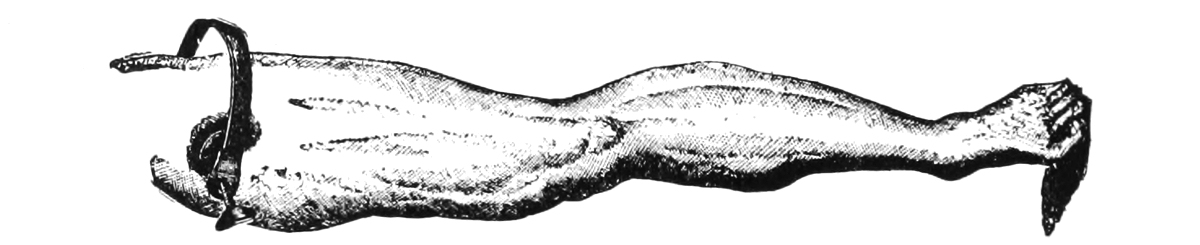
Fig. 108a. SCREW adapted to the lower limb, as used by surgeons in the eighteenth century and the early nineteenth century, to compress the nerves in order to secure analgesia during amputation. Its application, however, was extremely painful in itself and injurious to the part operated on.
§ 8. The Revolution in Surgery.
This history of antiseptic surgery is inseparably linked with the name of Lord Lister (1827-1912), whose work naturally dovetails into that of Pasteur. Lister’s attention was first called to the work of Pasteur in 1865. But Pasteur’s views on the life of micro-organisms came to a mind that had been prepared for them. Lister had had, moreover, a long and varied surgical experience and had been present at the first operation performed in England under Ether anaesthesia in 1846.
At that time and for long after, Surgery was cursed by the constant fear of sepsis. A vast amount of death and suffering was due to this cause, and surgeons were reluctant to perform many operations that we should now regard as trivial. Lister’s first attempt to make any scientific analysis of the septic state is to be found in a paper by him on The Early Stages of Inflammation (1853). He showed that the effects of irritation on the tissues are twofold. Firstly, there is a dilatation of the arteries which is developed through the nervous system. Secondly, there is an alteration in the tissues on which the irritant acts directly. This alteration imparted, as Lister thought, an adhesiveness to both the red and the white corpuscles, making them prone to stick to one another and to the walls of the vessels, and so giving rise to stagnation of blood and ultimately to obstruction.
Some years before (1847) A. V. Waller (1816-1870), a pupil of Magendie, had shown that during the process of inflammation there is an active migration of white blood corpuscles through the walls of the capillary blood-vessels. Waller’s observations attracted but little attention at the time. They were, however, amply confirmed in 1878 and the following years by the German pathologist Julius Cohnheim (1839-84), a pupil of Virchow. Cohnheim showed that this process of migration of white blood corpuscles is the essence of inflammation and that when inflammation goes on to suppuration the pus that is formed consists largely of white blood corpuscles in a dead and disintegrating state.
Irritation, and the reaction of the body against it, ‘inflammation’, are encountered in all injuries in which the healing is not direct and healthy. It was those cases of injury in which the healing was indirect and unhealthy which then formed the surgeon’s chief problem. Of these there are a variety, now rare, then very common and fatal, as Blood-Poisoning, Erysipelas, Pyaemia, Septicaemia, Hospital Gangrene, and that form, then so common as to be almost normal, simple suppuration of a wound.
About 1861 Lister began to teach publicly that the occurrence of suppuration in a wound is determined ‘simply by the influence of decomposition’. The nature of decomposition was revealed to him by the writings of Pasteur. From him he learned that putrefaction was, in fact, a fermentation, and that it was caused by the growth of minute microscopic organisms borne by the air. It was generally supposed that air was the cause of sepsis, and precautions were taken to exclude it from wounds. But Lister now saw that not air but that which it carried was the mischief-maker.
The general course of action was now clear to him. As a laboratory proposition the destruction of the organisms of the air was simple. The problem was to exclude them from wounds during and after operation. The solution of that problem developed as ‘Antiseptic Surgery’, which later became ‘Aseptic Surgery’. At first he paid most attention to air, as the source of infection. He recognized, however, that he must also deal with the germs present in the wound and on his hands. Of the methods available for ridding the air of its germs, viz. heat, filtration, and chemical action, he chose the last.
At that time carbolic acid was in use as a means of treating sewage. At first, therefore, Lister tried lint soaked in crude carbolic. This he found liable to cause superficial sloughing and death of the tissues. He next obtained a purer acid, using a solution in oil. A putty formed of common whitening and a solution of carbolic acid in linseed oil was used as a dressing. He adopted later a system of spraying the part during operation (Fig. 109).
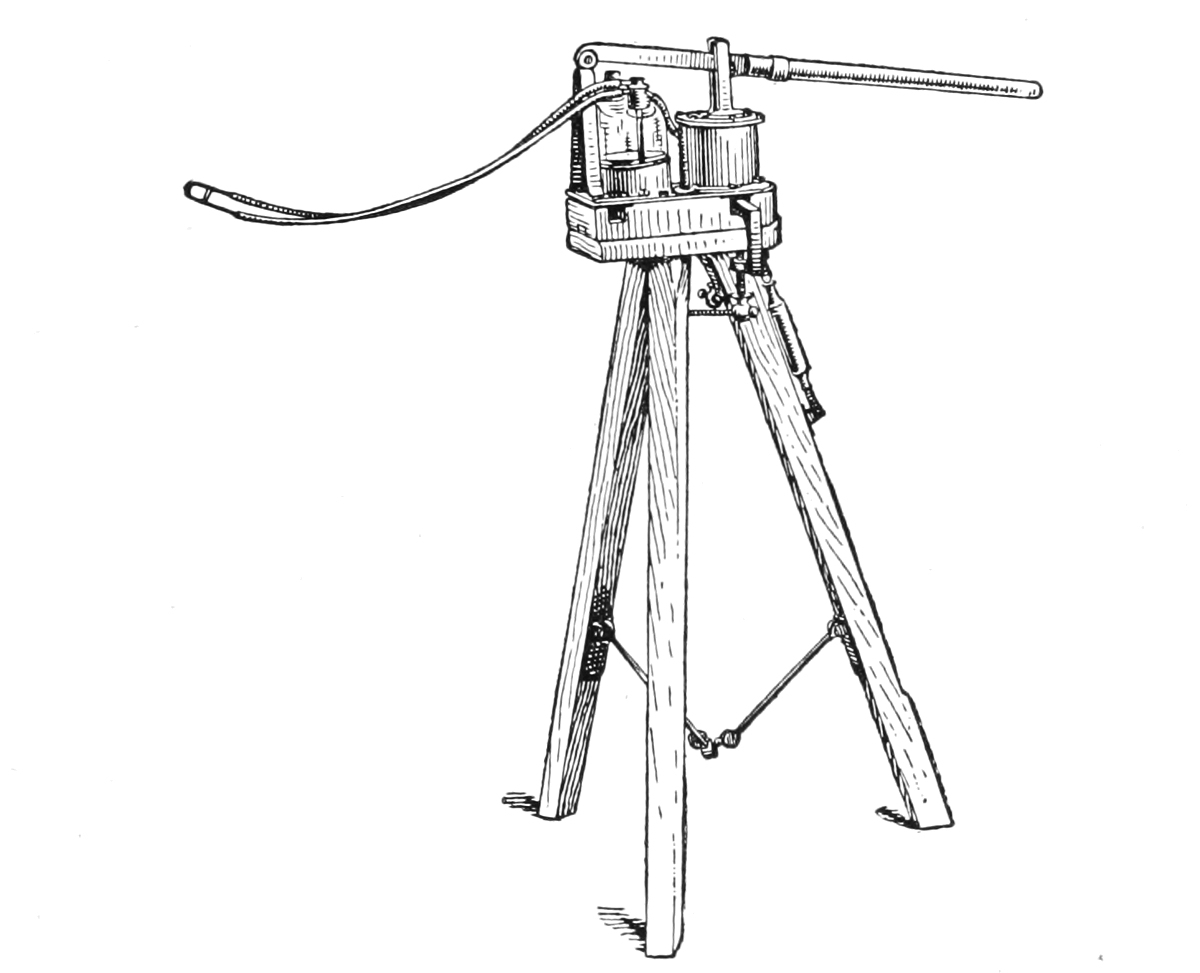
Fig. 109. THE ‘DONKEY ENGINE’, an apparatus designed and used by Lord Lister to maintain a carbolic spray over a part during operation. The engine is worked by the up and down movement of the handle to the right and the spray is delivered through the tube to the left.
When Lister began his work, amputation of a limb was a very fatal operation. Yet it had to be performed in most cases of severe fracture in which the bone was exposed because, without it, death from sepsis was almost certain. The improvement in Lister’s own records of amputation, incident upon his adoption of the antiseptic method, is well brought out by his own figures:
Years. Cases. Recovered. Died. Mortality.
1864-66 35 19 16 43% without antiseptics
1867-70 40 34 6 15% with antiseptics
These results were considered extraordinarily good in their day. It is an index of the further advance since Lister’s first attempts that results ten times as good would now be regarded as unsatisfactory. Moreover not only has the further development of Lister’s method rendered amputation safer, but also it has enabled the surgeon to treat many cases without amputation, when before he would have been compelled to resort to that measure.
Lister first recorded his observations on the antiseptic system of surgery in 1867. Apart from the technical advances that he then set forth, he recorded also many new pathological facts that have since proved of great practical importance. Thus he showed that an uninfected clot, if undisturbed, can become organized into a living tissue, and that a piece of dead bone may be absorbed in an aseptic wound. These are now matters of common knowledge, but then they were instrumental in introducing a radically new outlook.
Lister gradually perfected his technique, chiefly in the direction of using milder antiseptics and adopting heat for the sterilization of instruments and dressings. The antiseptic system was given its military application in France during the war of 1870. It was soon taken up also by German surgeons. The history of surgery since Lister’s day has been very often told. An important element in it is the gradual supersession of ‘antiseptic’ by ‘aseptic’ methods (p. 248).
The Listerian system, in rendering surgery safer, had also the effect of opening up many fields of operation that had previously been regarded as impracticable. Especially is this the case with abdominal surgery, which effectively dates from the introduction of the antiseptic system. Lister was often misunderstood and some of his contemporaries, and some even of those who opposed him, were really practising his system without knowing it.
Among the most important reactions of antiseptic surgery was that upon the conduct of labor. Here Lister had a predecessor, as he gladly and generously acknowledged. This was the unfortunate and almost insane Viennese genius, Ignaz Semmelweis (1818-65). At the great lying-in hospital at Vienna in which he was an assistant the death-rate at one time rose to thirty per cent., the so-called ‘puerperal fever’ being the active cause. The women were attended by students or physicians who were visiting the post-mortem room. Semmelweis showed that the infective material that conveyed the fever was brought by the hands of the operator from the dead bodies and he showed that puerperal fever was caused by decomposed animal matter. By insisting on the hands of the operators being sterilized, Semmelweis succeeded in 1846 in enormously reducing the mortality. After the acceptance of Lister’s antiseptic system the methods of Semmelweis were universally introduced into the practice of Midwifery. Another predecessor of Lister was Oliver Wendell Holmes. As early as 1843 he pointed out that the mysterious ‘puerperal fever’ was contagious, and carried by the hands of the operator. He suggested precautions not dissimilar to those of Semmelweis.
Fig. 109a.
OPERATING TABLE USED BY LORD LISTER in the Glasgow Royal Infirmary.
§ 9. Some Modern Surgical Advances.
Among the most capable surgeons of Lister’s own day was Thomas Spencer Wells (1818-97) of London. This great operator had been opening the abdomen successfully for certain conditions since 1858. By 1867 his methods were approaching the Listerian. Under Lister’s inspiration he further improved his technique and did more than any other man to raise the possibilities of abdominal surgery. Spencer Wells stands out for the extreme simplicity, directness, and effectiveness of his methods (Fig. 111), and for his exceptionally conscientious care as an operator. His name is commonly attached to an instrument of his invention of catching the bleeding ends of cut blood-vessels. The familiar ‘Spencer Wells forceps’ is at this day probably more frequently used than any other surgical instrument (Fig. 110).
Fig. 110.
‘SPENCER WELLS FORCEPS.’
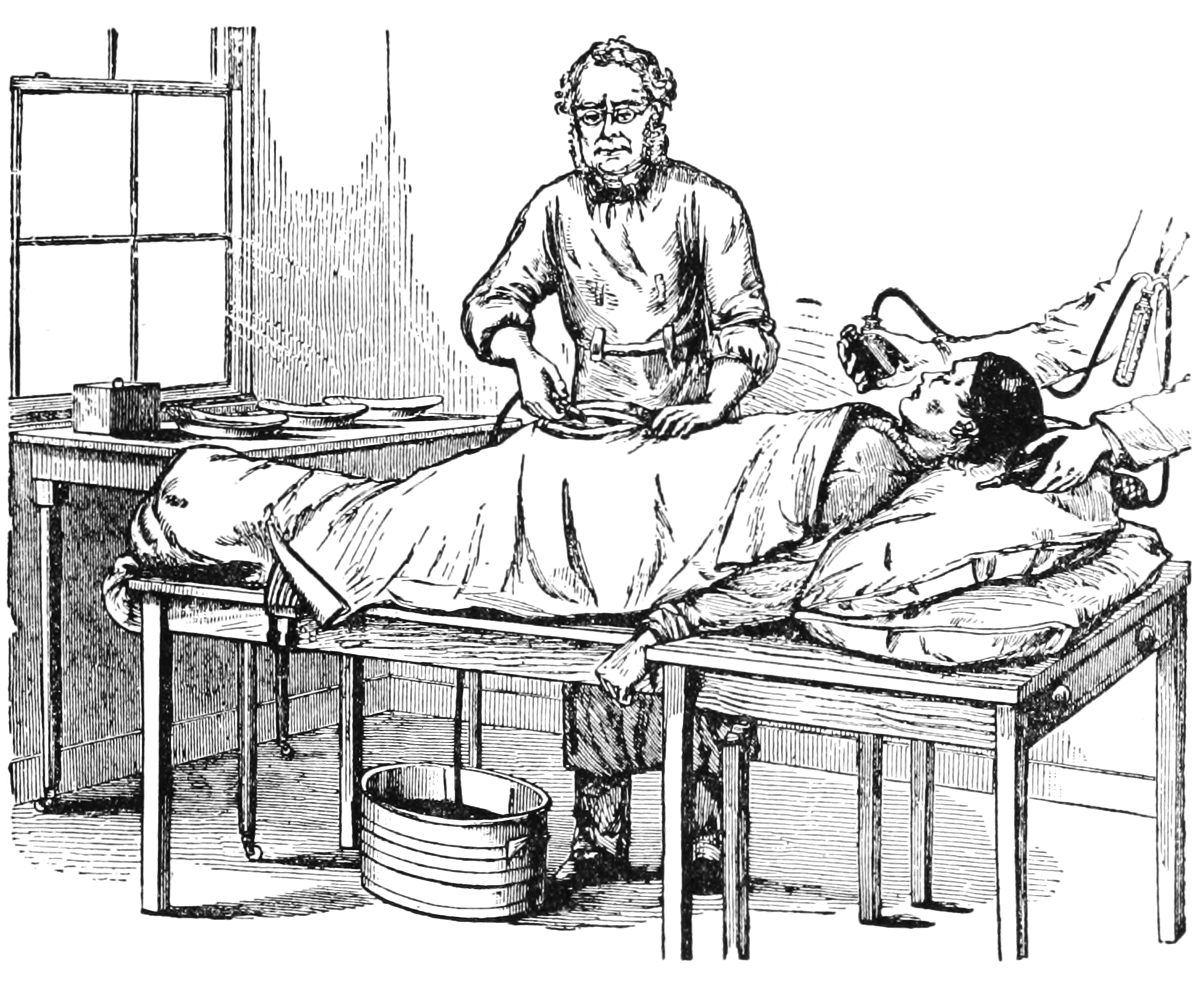
Fig. 111. SPENCER WELLS performing an abdominal operation about 1870. The picture illustrates the extreme simplicity of the methods of this great surgeon. It also shows a method of administering chloroform. Air is pumped through a bottle into a mask held at a variable distance from the face of the patient.
Since the time of Lister many branches of Science have contributed to the development of surgical technique. No addition to the surgical armory has, however, been more important than that made by the physicist Wilhelm Conrad Röntgen (1845-1923). In 1895 he found that when an electric discharge passes through a high vacuum rays are emitted that are far more penetrating than ordinary light. These rays have since then been placed in series with light rays, ultra-violet rays and infra-red rays, and it has been shown that they differ from these only in their wave-length. The surgical application of the Röntgen or X-rays was at once made to the examination of bone. Since then the more accurate knowledge of the properties of these rays has made them of value in exploring almost every organ of the body. Radiography is now constantly applied in the diagnosis of medical and surgical conditions of the organs of the chest and abdomen.
The more dramatic achievements of modern surgery, the drastic operations that surgeons are now able to perform on the great cavities of the body—head, chest, and abdomen—have attracted much public attention. Nevertheless few surgical advances have relieved so much suffering and disability as the unsensational development in the treatment of fractures.
After the advent of Listerian methods the technique of the treatment of compound fractures was gradually perfected. Simple fractures—which are far commoner—continued, however, to be treated with splints in the traditional fashion. Plaster of Paris bandages, which came into wide use in the ’seventies, were some improvement; but prolonged immobilization of a limb, in either splints or plaster bandages, always involves much subsequent pain and stiffness, lasting, at best, for months. To obviate this, Massage—a practice of immemorial antiquity in Folk Medicine—had been introduced into Surgery in the sixteenth century by Ambroise Paré (pp. 92-94). The subject was little heard of till the last thirty years of the nineteenth century. The pioneer was the Dutch surgeon Johann Mezger (1839-1900), through whom some scientific advance was made.
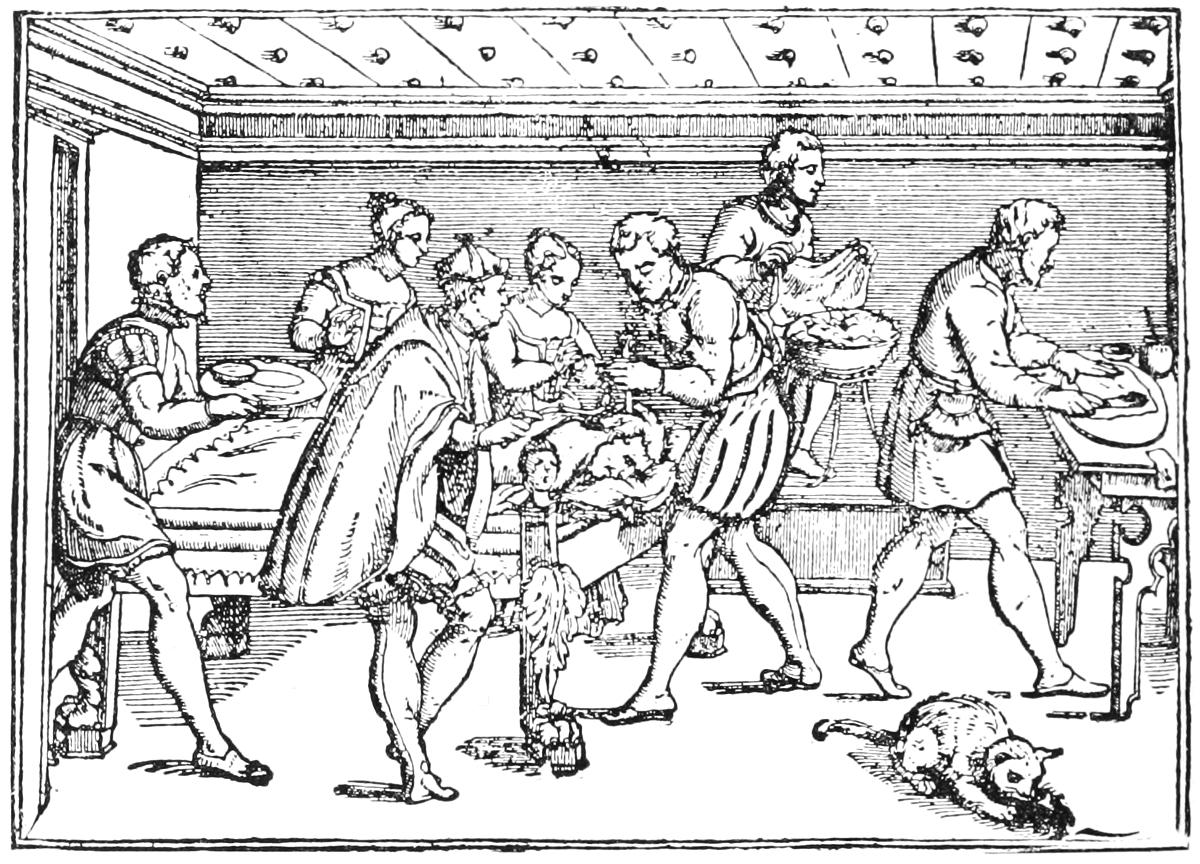
Fig. 112. AN OPERATION IN THE SIXTEENTH CENTURY.
The semi-conscious patient lies face downward on an elaborately carved bed. The bearded surgeon, dressed in his ordinary clothes, is trephining his skull and is rotating the trephine between his hands. Against the side of the bed lounges a gallant to whom a servant brings refreshment. In the background are two women assistants. A male assistant is spreading a plaster and another warming a towel over a brazier. Note that all present, surgeon, nurses, assistants, &c., wear their ordinary dress. No arrangements are made for washing. In the foreground is a cat playing with a mouse.
The introduction of X-rays into Surgery made for very accurate diagnosis of the state of fractures. It has thus gradually become possible to treat a large proportion of these injuries without immobilization either by splints or plaster. In many cases the injured limb is merely held in correct position between sandbags and massage used from the first. Much stiffness and disability is thereby avoided and the length of the period of treatment greatly shortened. The rise of a class of scientifically trained Masseurs has made possible a wider application of this valuable curative procedure.
Improvements in methods of operation have been very numerous during the last generation. Many can be appreciated only by those with technical knowledge. In 1886 Ernst von Bergmann of Berlin (1836-1907) introduced steam sterilization of dressings and thus moved toward the replacement of antiseptic by aseptic methods. W. S. Halsted, then of New York, had been working to the same end. In 1890, finding it impossible to sterilize the hands completely, he introduced the rubber gloves now universally employed by surgeons during operations. Much important work in experimental surgery has been done by Alexis Carrel of New York (1873-) and some of his laboratory methods have become available in surgical practice. The technique of abdominal surgery has been greatly advanced by many workers, important among whom are J. B. Murphy (1857-1916) of Chicago and the brothers Charles and William Mayo (1865 and 1861) of Rochester, Minnesota. The surgery of the brain was prosecuted in England by Rickman Godlee (1849-1925), the nephew and biographer of Lister, by Victor Horsley (1857-1916), and above all by William Macewen (1848-1926), a successor to Lister’s chair at Glasgow and one of the finest exponents of Listerian methods. The surgery of the nervous system in general, and that of the brain in particular, has been carried to extraordinary refinements in America by Harvey Cushing. There can be no doubt that during the twentieth century advances in Surgery have been more important and more numerous in the United States than in any other country.
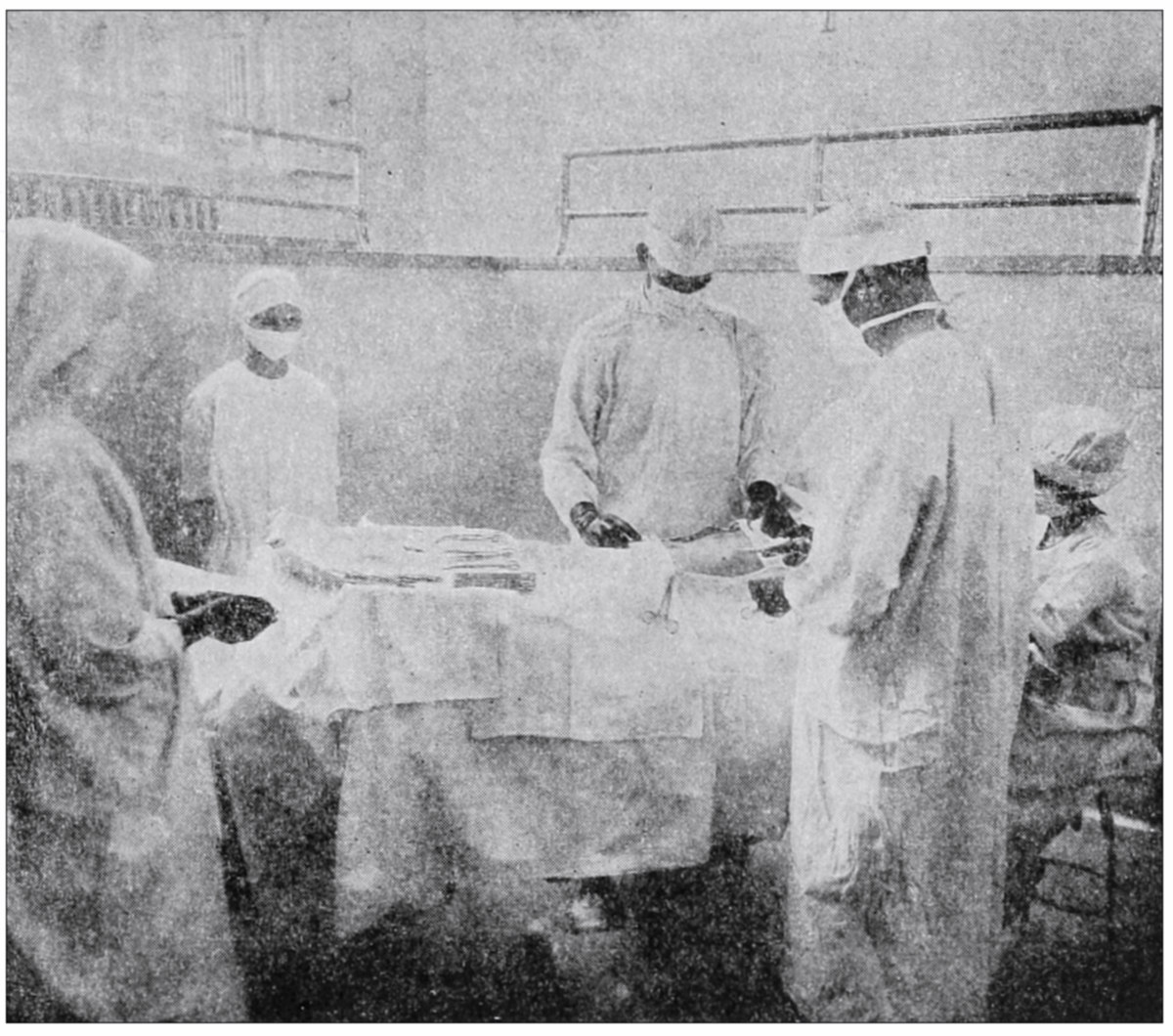
Fig. 113. AN ABDOMINAL OPERATION UNDER MODERN CONDITIONS
Only those directly concerned with the operation are present in the room. All wear aseptic clothes and aseptic rubber gloves. Every source of infection is guarded against and all breathe through masks. The patient is covered by aseptic cloths and only the part operated on is exposed.
§ 10. Bacteriology becomes a special Science.
We have seen the microbic view of the origin of disease demonstrated as a reality by Pasteur (pp. 224-35) and extended to special disease conditions by him and by Koch (pp. 229-32). While the French observer stood above all men for the clearness and steadiness of his vision and for his persistence and resource in following what he had seen from afar, his German colleague had a genius for visualizing particulars and for adapting mechanical devices and scientific discoveries to particular ends. Koch thus vastly improved and elaborated the methods for detecting and examining minute organisms. The significance of his results was at once recognized, but the complexity of the technique involved and the time and training necessary demanded the elevation of the subject into the position of a special science.
Though but fifty years old, the science of Bacteriology has itself undergone repeated subdivision. Noteworthy though the results of this process of constant subdivision have proved, it must be emphasized that the state of scientific subdivision cannot be final, and is indeed without meaning unless it lead to a subsequent synthesis—an event which we still await. It is the general Laws reached by these special sciences that are philosophically important, and the specialist himself is often ill-placed and ill-equipped for the estimation of the true significance of such Laws. The philosophic thinker who deals with generalities and centuries must often be content to pass the details in silence. Nor is this true only of the professed philosopher. It applies no less to the philosophical physician. It is his task to try to see life steadily and see it whole. He must think both in terms of the individual life and of the community life, and for him the results of the bacteriologist, the physiologist, and of all their colleagues are as means to an end. It is from this standpoint that we should seek to visualize the fruits that bacteriological science in this last age has laid at the feet of humanity.
With Koch’s work on Anthrax in 1876, on the bacteria that commonly infect wounds in 1878, and with his great discovery of the bacillus of Tuberculosis in 1882, the study of the infective diseases entered on a new stage. The enemy had been seen and was now known for what he was. The bacteriologist had succeeded in making prisoners. These had been isolated and made to live in test-tubes. Moreover, the organisms had been compelled to dwell alone without mixing with other species. They had been obtained, as bacteriologists say, in ‘pure cultures’, and delicate methods of detecting and differentiating them had been developed. With a pure culture in his hands, the bacteriologist can determine the influences favorable or unfavorable to the growth of the disease organism, and he can investigate conditions that can exalt, destroy, or modify its activity (p. 233).
An important series of criteria established by Koch have remained the tests by which the disease-bearing character of these organisms can be established. To prove that an organism is the inseparable cause of any disease we need to demonstrate:
1. The constant presence of the organism in every case of the disease.
2. The preparation of a pure culture, which must be maintained for repeated generations.
3. The reproduction of the disease in animals by means of a pure culture removed by several generations from the organisms first obtained.
These conditions have been fulfilled for many diseases. Evidently the third test can be applied only in conditions to which animals other than man are susceptible. Now in this matter the organisms that produce disease vary greatly. Some, for instance those of Anthrax, are easily conveyed to a variety of species of animals; others, for instance those of Syphilis, are with difficulty conveyed to very few species of animal; yet others, for instance human Malaria, cannot be conveyed to any animal save man.
Some light is thrown on the life-history of the second and third classes by recent discoveries. The science of Comparative Pathology, that is the knowledge of the relations of the diseases of different species of animals, is of very recent growth. It has already demonstrated, however, the existence of organisms bearing some resemblance, for instance, to those of human Syphilis and human Malaria as the cause of disease in animals. By studying the life-history of these organisms in animals and by studying their effect on animals, valuable side-lights have often been thrown on the allied diseases in man. Moreover, in exceptional cases and in some special diseases, it has been possible to convey a disease experimentally to man.
A second important factor has gradually come into prominence with the extension of bacteriological knowledge. It is evident that not all men are subject to all human diseases. Even in the most destructive epidemic there are some that escape. These lucky ones may be naturally ‘immune’. Many diseases, such as Measles, seldom recur in individuals who have been infected, so our lucky ones may thus have an ‘Acquired Immunity’.
The general nature of Immunity we shall presently discuss (p. 259), but we note here that Immunity may be relative or absolute, and may, moreover, vary according to the circumstances of the individual. Thus, for instance, a well-fed, well-housed person of temperate habits, living an open-air life, is unlikely to develop consumption. Restrict his diet, confine him in an office, deteriorate his mode of life, and he may well fall a victim to it. The investigation of facts such as these on a large scale has demonstrated that the soil in which disease grows is of no less import than the seed from which it grows. The problem of disease causation is thus immensely complex. We are only just beginning to draw up general laws on the subject, and in approaching it we are beyond the frontiers of our positive knowledge. Turned back from this difficult borderland, we must content ourselves with surveying a part of the better-known territory and considering a few specific bacteriological achievements. These we may now consider under the headings of the diseases associated with them.