II THE HEIRS OF GREECE (300 B.C. TO A.D. 200.)
Reading edition
§ 1. The Alexandrian School.
Soon after Aristotle, about 300 B.C., a great medical school was founded at Alexandria in Egypt. That country had been conquered by Alexander the Great, after whom the town was named. On Alexander’s death, Egypt came under the rule of one of his generals, Ptolemy, who established a dynasty which became extinct with the famous Queen Cleopatra, thirty years before the Christian era. Alexandria was a favorite residence of this Greek dynasty and became more Greek than Egyptian. Ptolemy and his successors were patrons of learning, and at the Alexandrian school remarkable anatomical and physiological researches were made. These were the work of Greek physicians who, in the tradition of their people, were only too wont to associate their discoveries with sweeping theoretical generalizations, often on very inadequate bases.
The two earliest medical teachers at Alexandria were also the greatest, Herophilus of Chalcedon, who flourished about 300 B.C., and his slightly younger contemporary Erasistratus of Chios. Herophilus may be regarded as the father of Anatomy, Erasistratus as the father of Physiology.
Herophilus was probably the first to dissect the human body in public. He recognized the brain as the central organ of the nervous system and regarded it as the seat of the intelligence, thus reversing the verdict of Aristotle on the primacy of the heart. He was the first to grasp the nature of the nerves, which he distinguished as connected with motion and sensation (Fig. 98), though he did not separate them clearly from tendons and sinews. He greatly extended the knowledge of the parts of the brain. Certain parts of the brain still bear titles which are translations of those which he gave them. He also made the first clear distinction between arteries and veins.
At the time of the institution of the Alexandrian medical school, and for long after, there flourished that view of the structure of the world known as atomic, propounded by the philosopher Democritus (c. 400 B.C.). The chief exponent of the theory was Epicurus (342-270), whose philosophy was of the order which we should now call ‘materialistic’. For it the only ultimate realities were atoms and ‘the void’, and everything was ultimately expressible in these terms. Epicurean philosophy was not without its reactions on Medicine at Alexandria, where its leading exponent was Erasistratus of Chios.
Erasistratus was essentially a rationalist and professed himself a foe to all mysticism. In the last resort, however, he had to invoke the idea of Nature as a great artist acting as an external power, shaping the body according to the ends to which it must act. This is in contrast with Aristotle’s view of the ‘soul’ as an Entelechy (p. 33), an innate and inherent factor. Erasistratus sought to express his views in atomic terms, but, to make physiology intelligible, he added a conception, Pneumatism, found also among older thinkers. Pneumatism is the belief that the phenomena of life are associated with the existence of a subtle vapor, ‘pneuma’ or spirit, which permeates the organism, and causes its movements. This subtle vapor is held to have some affinities with the air we breathe. Pneumatism is, in fact, a primitive attempt to explain the phenomena of respiration.
Erasistratus observed that every organ is equipped with a threefold system of ‘vessels’, vein, artery, and nerve, which divide to the very limits of vision, and he considered that the process of division continues beyond those limits. The minute divisions of these vessels, plaited together, he believed to make up the tissues. Veins, arteries, and nerves are, for him, made of minute tubes of the same nature as themselves, through which they are nourished. Blood and two kinds of pneuma are the essential sources of nourishment and movement. The blood is carried by veins. Air, on the other hand, is taken in by the lungs and passes to the heart, where it becomes changed into a peculiar pneuma, the Vital Spirit, which is sent to the various parts of the body by the arteries. This spirit is carried to the brain, in the cavities or ‘ventricles’ of which it is further changed to a second kind of pneuma, the Animal Spirit. The animal spirit is conveyed to different parts of the body by the nerves, which are hollow.
In the brain Erasistratus observed the convolutions, noted that they were more elaborate in man than in animals, and associated this complexity with the higher intelligence of man. He distinguished between the main parts of the brain, the ‘cerebrum’ and ‘cerebellum’ (Fig. 100, p. 210), and gave a detailed description of the ‘cerebral ventricles’ or cavities within the brain and of the ‘meninges’ or membranes that cover the brain. He considered that the cerebral ventricles were filled with Animal Spirit. (Compare Galen’s scheme, p. 58.)
Erasistratus attained to a clear view of the action of muscles in producing movement. He regarded the shortening of muscles as due to distension by Animal Spirit conveyed to the muscles by the nerves. We may note that similar theories as to the nature of muscular action were again set forth, on theoretical grounds, in the seventeenth century by Descartes (1596-1650, pp. 127-8) and by Borelli (1608-79, pp. 129-30), but were rebutted by the experiments of Swammerdam (1637-80, p. 123). We may recall that we are still in the dark as to the mechanism of contraction of muscle fiber, the structure of which was first revealed by Leeuwenhoek (1632-1723, Figs. 55-56A, p. 121).
Erasistratus considered the chief cause of disease to be excess of blood or Plethora. Diseases thus caused differ according to their site. Among them are coughing of blood, epilepsy, pneumonia, tonsillitis, &c. Most of these diseases could be treated by diminishing the local supply of blood by starvation. Among his contemporaries and successors blood-letting was an habitual practice applied to almost every condition. Erasistratus employed it but rarely, and his followers banned it altogether. He was consistently opposed to violent remedies. Among the therapeutic measures which he favored were regulated exercise, diet, and the vapor bath.
Erasistratus complained that many physicians of his time were not interested in Hygiene. He therefore wrote a treatise on the subject. Though he regarded Hygiene as a means of substituting prevention for cure, this did not prevent him from being extremely careful and precise in his treatment of cases.
After the first generation or two, the activity of the Alexandrian medical school flagged, though the city long remained a great teaching center, and minor medical advances were made. Surgery (cf. Fig. 14) seems to have languished less than Medicine. The stagnation in medical matters at Alexandria is in contrast to the continued activity there in Mathematics, Astronomy, Mechanics and Geography.
With the absorption of Egypt into the Roman Empire in 50 B.C. and the extinction of the Ptolemaic dynasty by the death of Cleopatra in 30 B.C., Alexandria ceased to have great scientific importance. The school continued for centuries with restricted activity and devoid of all originality. Intellectually, it had become subordinate to the Metropolis. Rome was now mistress of the world and the future of Medicine must be considered from the point of view of the Roman Empire.
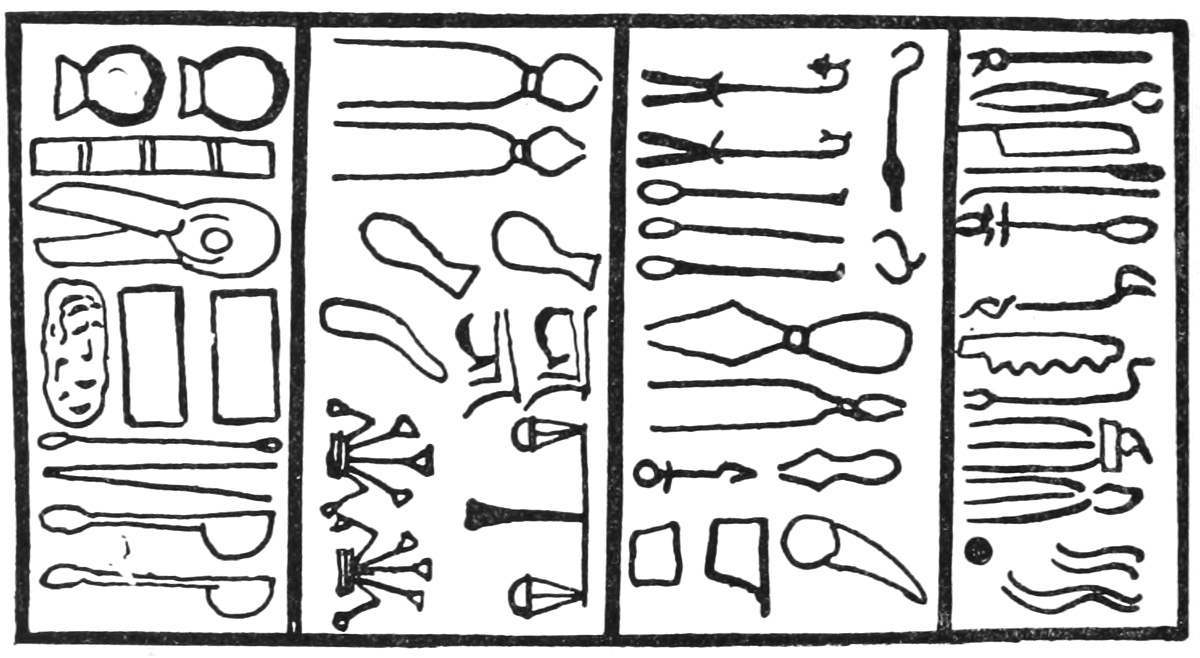
Fig. 14. INSCRIBED TABLET OF ABOUT 100 B.C. from the wall of the temple of Kom-Ombos in Upper Egypt. The temple itself was built by Ptolemy VII (181-146 B.C.), but the carving is later. It is divided into four partitions. These illustrate the surgical instruments in use in Egypt during Alexandrian times.
In the partition to the extreme left can be seen two cupping-glasses (cf. Fig. 8), a case of instruments (cf. Fig. 15), a pair of shears, a sponge, a probe, a pair of fine forceps, and two knives (cf. Fig. 9).
In the next partition to the right can be seen two large forceps, two bags or flasks, a strigil, two magic eyes, a pair of scales, and two growing plants.
In the next partition to the right can be seen several hooks of different forms, several knives, and two or three pairs of forceps.
In the partition to the extreme right can be seen a bifid probe, a pair of tongs, a long-bladed knife, probes, a double hook, a saw, a cautery, and several objects probably intended to represent bandages.
§ 2. Medical Teaching in the Roman Empire.
The original native Roman medical system was quite devoid of scientific elements and was that of a people of the lower culture. Interwoven, as is all primitive Medicine, with ideas that trespass on the domains of religion and magic, it possessed that multitude of ‘specialist deities’ which was so characteristic of the Roman cults. The entire external aspect of Roman medicine was changed by the advent of Greek science. Yet, notwithstanding the large medical field that the Western Empire provided, and the wide acceptance of Greek medicine by the upper classes, it is remarkable that the Latin-speaking peoples produced no eminent physician.
At first scientific medical education at Rome was entirely a matter of private teaching. The earliest important scientific teacher there was the Greek Asclepiades of Bithynia (died c. 40 B.C.), a contemporary of the poet Lucretius and, like him, an Epicurean. Asclepiades, like Erasistratus, imported the atomic view of Democritus into Medicine. He deeply influenced the course of later medical thought, ridiculed the Hippocratic attitude of relying on the ‘healing power of nature’ which he regarded as a mere ‘meditation on death’, and urged that active measures were needed for the process of cure to be ‘seemly, swift and sure’. He founded a regular school at Rome which continued after him.
At first the school was the mere personal following of the physician, who took his pupils and apprentices round with him on his visits. At a later stage such groups combined to form societies or colleges, where problems of the art were debated. Towards the end of the reign of Augustus (27 B.C.-14 A.D.) or the beginning of that of Tiberius (14 A.D.-37 A.D.), these societies constructed for themselves a meeting-place on the Esquiline Hill. Finally the emperors built halls or auditoria for the teaching of Medicine. The professors at first received only the pupils’ fees. It was not until the time of the Emperor Vespasian (reigned A.D. 70-9) that medical teachers were given a salary at the public expense. The system was extended by later emperors.
Thus Rome became a center of medical instruction. After a time subsidiary centers were established in other Italian towns. From Italy the custom spread and we meet traces of such schools at the half-Greek Marseilles as well as at Bordeaux, Arles, Nîmes, Lyons, and Saragossa. For the most part these provincial schools produced workaday medical men, few of whose writings have come down to us. They were perhaps largely training-places for the army surgeons. That class seldom had scientific interests, though Dioscorides, one of the most prominent physicians of antiquity, one who earned the respect of Galen and has deeply influenced the modern pharmacopoeia, served in the army under Nero. His book is, in fact, an extremely useful though ill-arranged compendium of drugs. Dioscorides wrote in Greek, and his work was not translated into Latin until the sixth century of our era.
The earliest scientific medical work in Latin is the De re medica of Celsus, which was prepared about A.D. 30. It is in many ways the most readable and well-arranged ancient medical work that we have. It is, however, not an original work but a compilation from the Greek, and the sole surviving part of a complete encyclopaedia of knowledge. Many of its phrases are closely reminiscent of the Hippocratic Collection. The ethical tone is high and the general line of treatment sensible and humane. Celsus, though almost forgotten in the Middle Ages, was the first classical medical writer to be printed (A.D. 1476).
The treatise of Celsus opens with an interesting account of the History of Medicine. It then passes on to deal with diet and the general principles of therapeutics and pathology, next it discusses internal disease, and then turns to external diseases. The last part of the work is devoted to surgery, and is perhaps the most valuable of the whole.
Celsus professes himself a follower of Asclepiades of Bithynia (p. 41), but, unlike his master, he by no means despises the Hippocratic expectant method of ‘waiting on the disease’. In many matters we are struck with
his boldness as a surgeon. Thus he describes plastic operations on the face and mouth, and the removal of polypus from the nose. He tells too of the very dangerous operation for extirpating a goiter (p. 303), and of cutting for stone. He gives an excellent account of what might be thought the modern operation for removal of tonsils. Noteworthy also is his description of dental practice which includes the wiring of loose teeth and an account of a dental mirror. An idea of the surgical instruments in use in his time can be obtained from those recovered from Pompeii (Fig. 15).
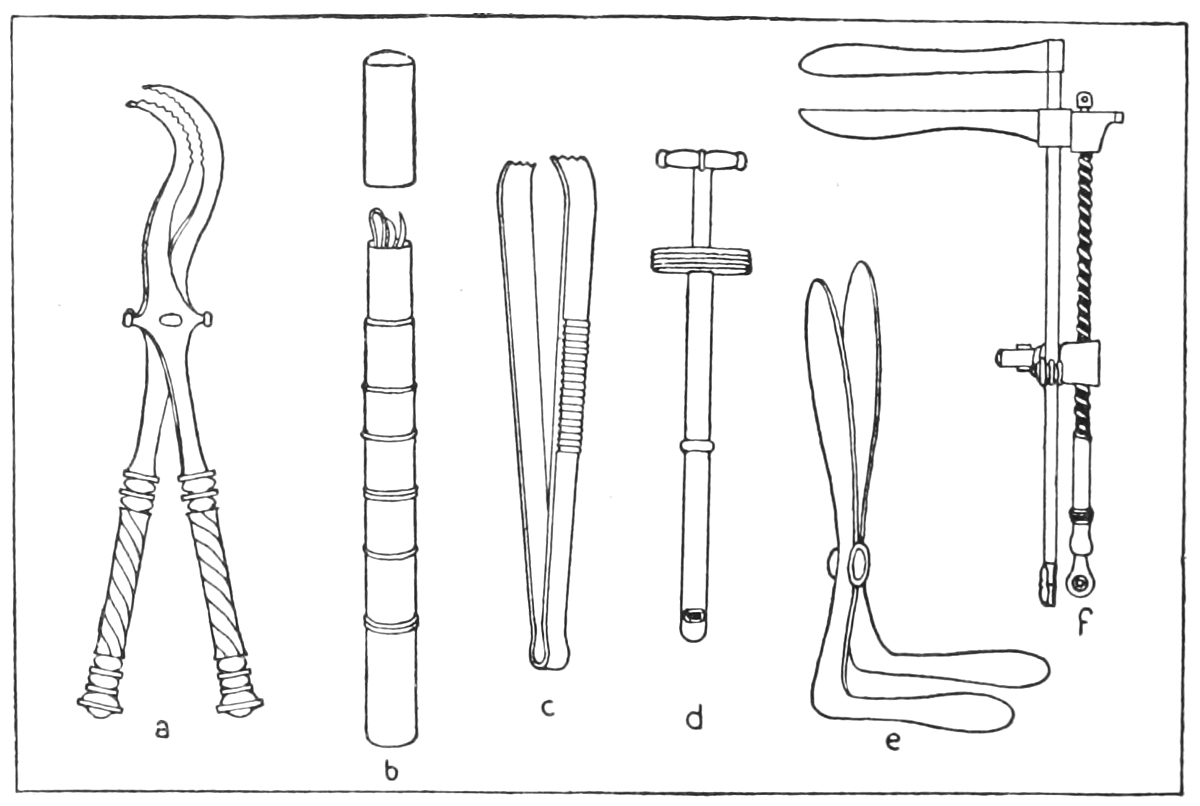
Fig. 15. ROMAN SURGICAL INSTRUMENTS of the first century A.D. found at Pompeii.
a. Forceps, probably for extracting teeth.
b. Small pocket-case of instruments containing sharp spoon, probe, &c.
c. Fine-toothed forceps.
d. Trocar and cannula for tapping fluids confined in cavities.
e. Speculum for examining orifices and cavities.
f. Instrument for dilating wounds that they may be more fully examined.
§ 3. Medical Services of the Roman Empire.
If, in Medicine itself, the Roman achieved but few advances, in the organization of medical service, and especially in the department which deals with public health, his position is far more noteworthy. All Latin writers on architecture give much attention to the orientation, position and drainage of buildings. From an early date sanitation and public health drew the attention of statesmen. Considering the dread of the neighborhood of marshes on the part of these practical sanitarians of Ancient Rome, and in view of modern knowledge of the mosquito-borne character of Malaria (pp. 284-5), it entertaining to find the mosquito net ridiculed by the poets Horace, Juvenal and Propertius!
Sanitation was a feature of Roman life. Rome was already provided with cloacae or subterranean sewers in the age of the Tarquins (6th cent. B.C.). The Cloaca Maxima itself, the main drain of Rome, which is still in use, dates back to that period.
The antiquity of hygienic ideas is seen in an interdict, by a law of about 450 B.C., against burials within the city walls and in the instructions issued to the town officials to attend to the cleanliness of the streets and to the distribution of water. Among these ancient laws we may note one attributed to the first king of Rome, which directed the opening of the body in the hope of extracting a living child in the case of a woman dying in pregnancy. It is the origin of the so-called ‘Caesarean section’ on the living mother, the method by which Caesar himself is said to have been brought into the world. At the date of these decrees physicians in Rome were either slaves or in an entirely subordinate position. Their status was improved by Julius Caesar (102-44 B.C.), who conferred citizenship on all who practised Medicine at Rome, in order to induce physicians to settle there.
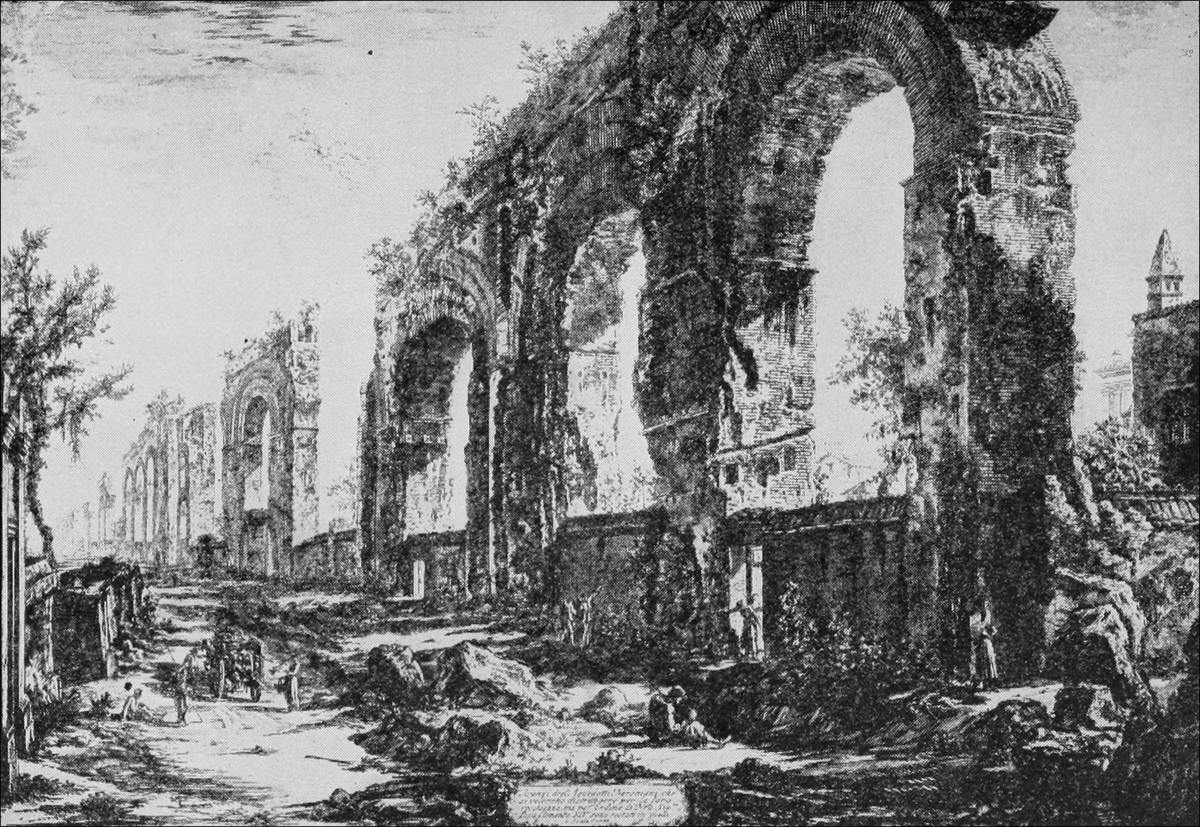
Fig. 16.
AQUEDUCT OF NERO. This structure, when complete, conveyed part of the water-supply of Rome.
(
From an engraving by Piranesi.
)
The finest monument to the Roman care for the public health stands yet for all to see in the remains of the fourteen great aqueducts which supplied the city with 300,000,000 gallons of potable water daily. No modern city is better equipped (Fig. 16).
Under the early Empire a definite public medical service was constituted. Public physicians were appointed to the various towns and institutions. A statute of the Emperor Antoninus of about the year A.D. 160 regulates the appointment of these physicians, whose main duty was to attend to the poor. In the code of the Emperor Justinian (A.D. 533) is an article urging them to give this service cheerfully rather than the more subservient attendance on the wealthy. Their salaries were fixed by the municipal councillors. They were encouraged to undertake the training of pupils. Inscriptions attest the respect in which these state physicians were held in many towns.
It is in connection with the army that we see the Roman medical system at its best. There was an adequate supply of military medical attendants who were well organized (Fig. 17). The defects of the Roman army medical system were, however, absence of any elastic scheme for the ranking of medical officers, and complete subordination of the medical to the combatant officer. These facts are of a piece with the general Roman indifference to theoretical science, and explain
why the Roman army surgeons made no additions to knowledge. The social status of the medical staff in the Roman military hierarchy was that of the non-commissioned personnel, which included accountants, registrars and secretaries.
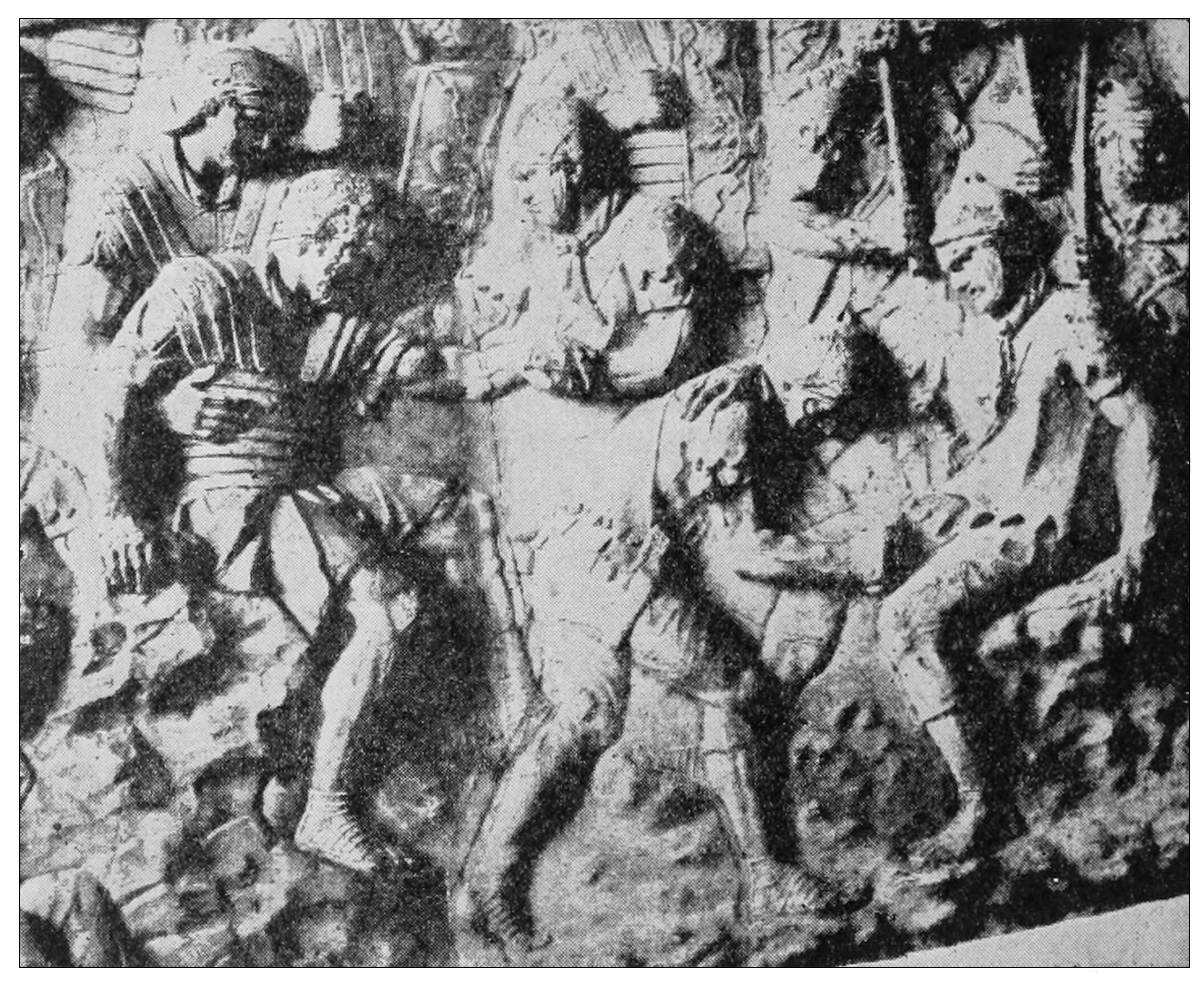
Fig. 17. ROMAN ADVANCED DRESSING-STATION. (From Trajan’s column.)
To the left two Roman soldiers assist a wounded comrade. To the right a Roman military surgeon bandages the wounded thigh of a friendly ally. The costume of the surgeon is almost identical with that of the soldiers, though he carries a case for ‘first aid’ slung over his shoulder.
§ 4. Roman Hospitals.
The great contribution of Rome to Medicine—and it is a very great one—is the hospital system. It is a scheme that naturally arose out of the Roman genius for organization and is connected with the Roman military system. Among the Greeks, iatreia, ‘surgeries’, were well known; they were, however, the private property of the medical man. Larger institutions were connected with Aesculapian temples and there is evidence of some degree of scientific medical treatment in these places. In the Republican period the Romans were no better off and, despite the vast numbers of slaves, there was no provision for them when sick. A temple to Aesculapius had been established on an island of the Tiber in Republican times. It became the custom to expose the sick and worn-out slaves on this island of Aesculapius, to avoid the trouble of treating them. The Emperor Claudius (A.D. 41-54) decreed that such slaves were free, and that, if they recovered, they need not return to the control of their masters. Thus, the island became a place of refuge for the sick poor. We may regard it as an early form of public hospital (Fig. 18).
Later writers speak of valetudinaria, ‘infirmaries’, for such persons, and give humane directions for their management. Such valetudinaria were in use even by free Romans. The excavations at Pompeii show that a physician’s house might even be built somewhat on the lines of a modern ‘nursing home’. It was probably in the provinces that private institutions first developed into subventioned public hospitals.
This development of public hospitals naturally early affected military life. At first, sick soldiers had been sent home for treatment. As the Roman frontiers spread ever wider this became impossible and military hospitals were founded at important strategic points. The sites of several such military hospitals have been excavated. The best explored is near Düsseldorf and was founded about A.D. 100.
From the military valetudinarium it was no great step to the construction of similar institutions for the numerous Imperial officials and their families in the provincial towns. Motives of benevolence, too, gradually came in, and public hospitals were founded in many localities. The idea passed on to Christian times, and the pious foundation of hospitals for the sick and outcast in the Middle Ages is to be traced back to these Roman valetudinaria. The first charitable institution of this kind, concerning which we have clear information, was established at Rome in the fourth century by a Christian lady of whom we learn from St. Jerome. The plan of such a hospital projected at St. Gall in the early years of the ninth century has survived. It reminds us, in many respects, of the early Roman military hospitals. These medieval hospitals for the sick must naturally be distinguished from the even more numerous ‘spitals’ for travellers and pilgrims, the idea of which may perhaps be traced back to the rest-houses along the strategic roads of the Empire.
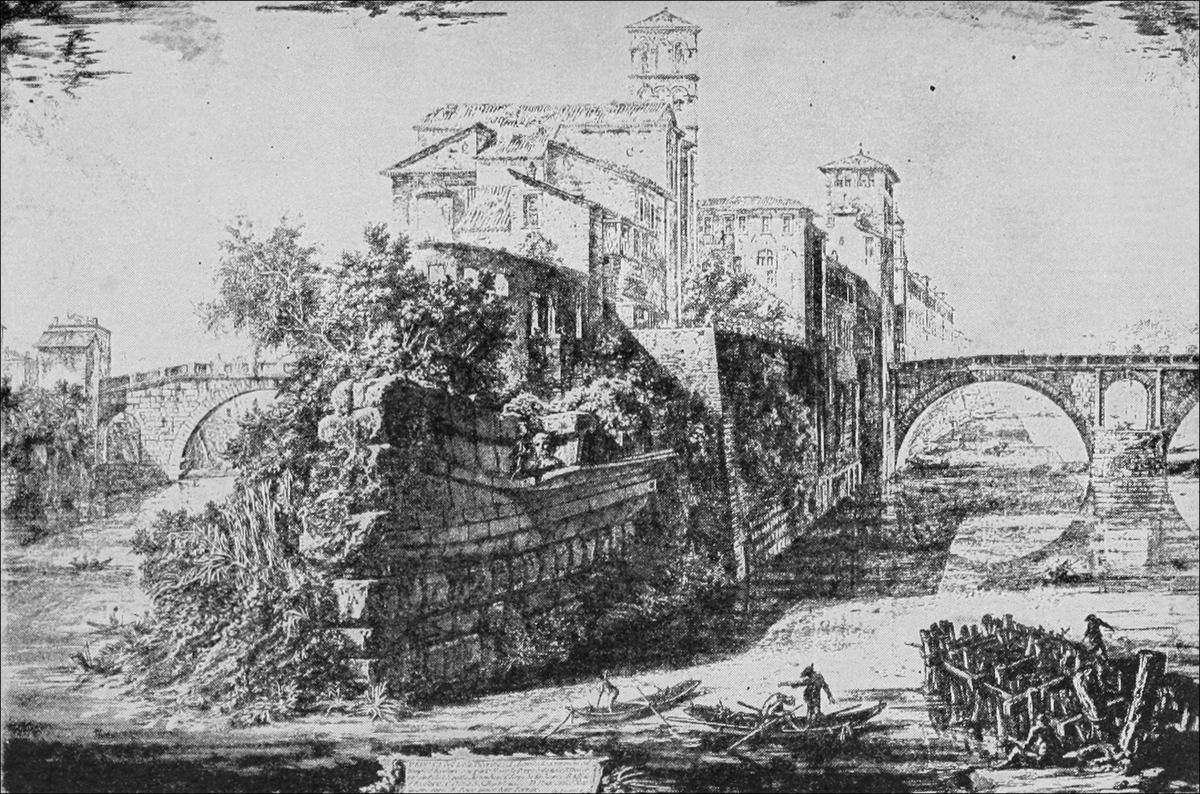
Fig. 18. ISLAND OF ST. BARTHOLOMEW IN THE TIBER AT ROME. (From an engraving by Piranesi.)
The island was the site of a temple to Aesculapius used as a refuge for worn-out slaves. It is the first known public hospital. The entire island is carved in the form of a ship. On its prow can be discerned the head of Aesculapius and his staff and serpent.
§ 5. Galen.
The Latin culture, as we have seen, did not adapt itself easily to the prosecution of scientific Medicine. Long after Greece had ceased to exist as an independent state such medical writings as appeared were usually in the Greek rather than in the Latin language. This is true to the end, and the end came, so far as creative science is concerned, with the second half of the second century. The scene is then, and for centuries to come, mainly occupied by the huge overshadowing figure of Galen.
Galen of Pergamum (A.D. 130-200) devoted himself to medicine from an early age, and in his twenty-first year we hear of him studying anatomy at Smyrna. To extend his knowledge of drugs he made long journeys to Asia Minor. Later he proceeded to Alexandria, where he improved his anatomical equipment, and here, he tells us, he examined a human skeleton. His direct practical acquaintance with human anatomy was limited to that skeleton, for dissection of the human body was no longer carried on in his time. Thus, his physiology and anatomy were derived mainly from animal sources.
The general medical standpoint of the Galenic is not unlike that of the Hippocratic writings, but the noble vision of the lofty-minded, pure-souled physician has utterly passed away. In its place we have an acute, contentious fellow of prodigious industry, who is frequently satisfied with a purely verbal explanation. Yet he is an ingenious physiologist, acquainted with the internal parts, so far as this is possible from a devotion to dissection of animals, equipped with all the learning of the schools of Pergamum, Smyrna and Alexandria, and rich with the experience of a vast practice at Rome. Galen is essentially an ‘efficient’ man. He has the grace to acknowledge constantly his indebtedness to the Hippocratic writings.
Some of Galen’s works are, however, mere drug-lists, little superior to those of Dioscorides (p. 43). With the depression of the intelligence that corresponded with the break-up of the Roman Empire, it was these that were chiefly studied and distributed in the West. The Greek medical writers after Galen were but his imitators and abstractors, and they usually imitated and abstracted Galen at his worst. Through some of them Galen’s works reached the West at a very early period in the Middle Ages.
§ 6. The Final Medical Synthesis of Antiquity.
We now turn to the theoretical content of the vast mass of Galenic writings. These set forth a medical system of which the substance is based on the Hippocratic Collection and the form derived from Aristotle. This synthesis, in more or less corrupted form, provided the theoretical basis of medical practice for the next fifteen hundred years. Galen’s view of the human body may be examined under two aspects, which we describe as (a) philosophical and (b) descriptive.
First as to the philosophical aspect. Galen’s voluminous works are saturated with the theory that all structures in the body have been formed by the Creator for a known and intelligible end. In the anatomical works, masses of explanation, based on this view, dilute the often imperfect accounts of structures. Thus, following the Aristotelian principle that Nature makes nought in vain, Galen seeks to justify, the form and structure of every organ—nay, of every part of every organ—with reference to the functions for which he believes it is destined. To do this is to claim that in every work of Creation—of which Man’s body is a type—and in every detail of such work, we can demonstrate God’s design along known principles. It is to claim, in fact, a complete knowledge of the Laws of Nature. No modern man of science, however intoxicated with his own achievements, has as yet arrogated such powers to himself. To conceive that such claims should be made by a pious, theistically minded author, the reader must think himself back into a very different philosophical environment from that to which we are nowadays accustomed.
The prevailing philosophy of Galen’s world was the Stoic. Now in the world of the Stoic philosopher all things were determinate, and they were determined by forces acting wholly outside Man. The type and origin of that determination the Stoic sought in the heavens, and found in the majestic and overwhelming procession of the stars. The recurring phenomena of the spheres typified, foreshadowed, nay, exhibited and controlled, the cycle of man’s life. Man dwelt in a finite world, bounded by a definite frontier—the sphere of the fixed stars. Within that spherical frontier all things worked by rule—and that rule was the rule of the heavenly bodies. Astrology had become one of the dogmas of the Stoic creed.
To such a world Galen’s determination was in itself no strange thought. Yet Galen’s view was far from being wholly in accord with Stoicism. Though a determinism, it was a determinism of perfection in which all was fixed by a wise and far-seeing God, and was a reflection of His perfection. Now such a scheme did not ill fit the new creed which was just beginning to raise its head and was destined to replace Stoicism and all the other pagan schemes. Galen’s thought, in fact, made a special appeal to the Christian point of view, and this is, doubtless, the reason that his works have been preserved in larger bulk than those of any other pagan writer. The Galenic standpoint appealed equally to the theological bias of Islam, whose medical knowledge was based almost entirely on Galen.
We may now turn from the philosophical to the descriptive bases of Galen’s medical system, namely to his Anatomy and Physiology.
We may begin with the bones. These Galen had studied on an actual human skeleton at Alexandria. He divided them into long bones with a central canal and flat bones without such a canal. He had a fairly good idea of the bones of the skull. He regarded the teeth as bones, and he gives a good description of their origin. He recognized twenty-four vertebrae terminated by the sacrum. Galen gives accurate elementary descriptions of the vertebrae, of the ribs, of the breastbone, of the collar-bone, and of the bones of the limbs. He divides joints or junctions of bones into two main orders, those with movement and those without movement, and the titles that he gives to his main divisions have survived in our modern nomenclature.
As regards the muscular system there can be little doubt that Galen’s work was in large part of a really pioneer character. Throughout his works the muscles are perhaps the structures that he describes most accurately. His writings contain frequent references to form and function of muscles of various animals. Thus, the dissection of the muscles of the orbit and larynx was performed on the ox, and the muscles of the tongue are described from the ape. Occasionally he indicates that he is aware of the differences between certain of the muscles he is describing from those of man. For his investigation of muscles Galen used particularly the Barbary ape (Macacus inuus), a creature anatomically near enough to man for a knowledge of its detailed structure to be applicable to human Surgery. (Figs. 19 and 20.)
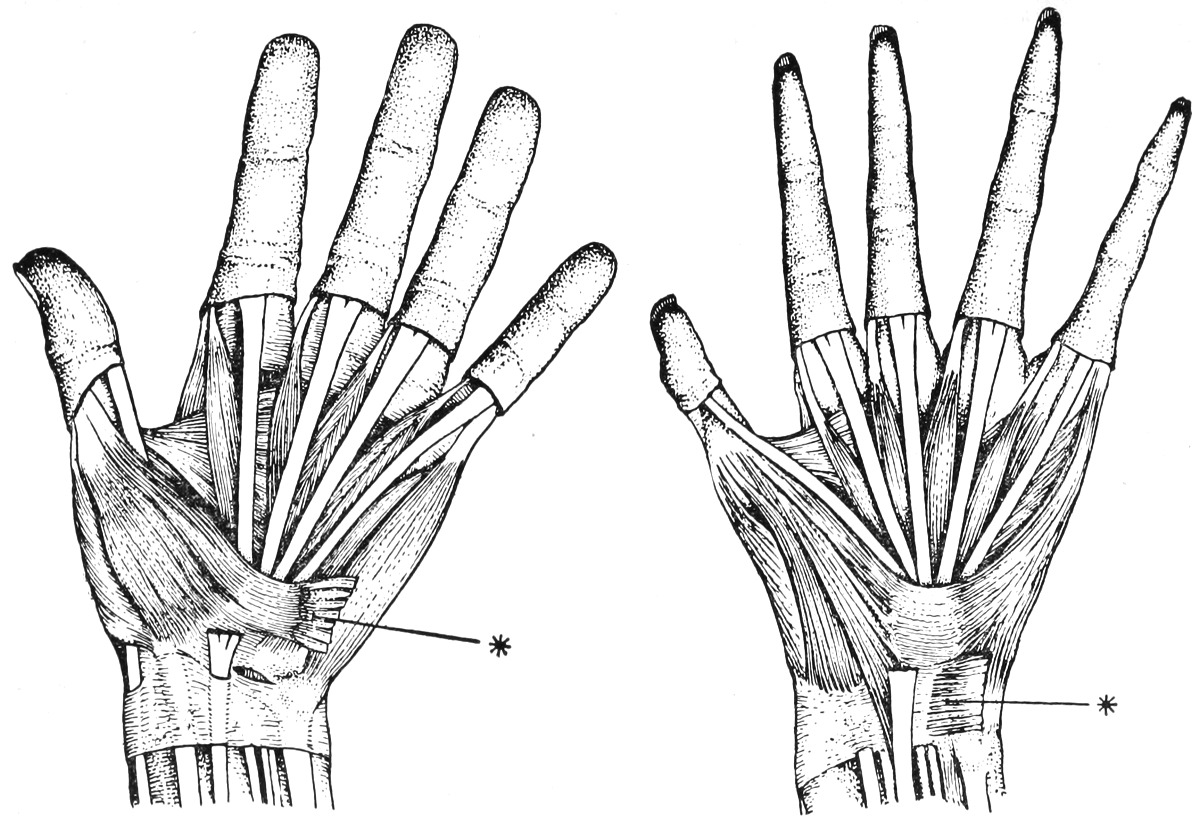
Fig. 19. DISSECTION OF HAND OF MAN.
Fig. 20. DISSECTION OF HAND OF BARBARY APE.
The ape’s hand shows all the main muscular and tendinous structures present in the human hand, though the proportional development differs somewhat. The same is true of other parts of the body. Galen’s anatomy, drawn from the Barbary ape, was thus quite serviceable for many surgical procedures. Apart from proportion, the most obvious anatomical difference in the hands of the two species is the position of attachment of the small severed muscle indicated by the asterisk in both cases.
Galen’s description of the brain and of the vascular system is inferior to his account of the bones and muscles. His account of the nervous system, other than the brain, occupies an intermediate position. His account of the origin of nerves from the brain has left its traces even in modern descriptive anatomy.
Finally we may turn to Galen’s theory of the working of the human body, that is to his Physiology.
The basic principle of life in the Galenic physiology was a spirit or pneuma drawn from the general World-spirit in the act of breathing. It entered the body through the windpipe or trachea and so passed to the lung and thence, through the arteria venalis—which we now call the ‘pulmonary vein’—to the left ventricle of the heart, where it encountered the blood (Fig. 21). But what was the origin of the blood? To this question his answer was ingenious, and the errors that it involved remained till the time of Harvey (Fig. 43, p. 113).
Galen believed that food-substance from the intestines was carried as ‘Chyle’ by the portal vein to the liver. There it was converted into blood and endowed with a particular pneuma, the Natural Spirit, which bestowed the power of growth and nutrition. Part of this lower-grade blood was carried from the liver to the right ventricle, where it gave off impurities by way of the vena arterialis, our ‘pulmonary artery,’ to the lungs, whence they were exhaled in the breath. The venous blood, thus continuously purified, ebbed to and fro in the veins for purposes of ordinary nutrition. A very small part of this venous blood passed through invisible pores in the muscular septum to the left ventricle. There it mixed with air drawn in from the lung by way of the arteria venalis, our ‘pulmonary vein’. From this mixture was produced a higher-grade blood, the arterial blood, instinct with the principle of life and charged with a second kind of pneuma, the Vital Spirit. Blood containing this second kind of pneuma ebbed to and fro in the arteries endowing the various organs with function. Such as reached the brain became there charged with the noblest essence of all, the third pneuma, the Animal Spirit or breath of the soul. The Animal Spirit was carried from the brain by the nerves—believed to be hollow—and through them initiated the higher functions of the organism, including motion and sensation (Fig. 21).
Among Galen’s most remarkable efforts are the investigations he made of the physiology of the nervous system. He tells of his experiments on the spinal cord. Injury to the cord between the first and second vertebrae caused, he observed, instantaneous death. Section between the third and fourth produced arrest of breathing. Below the sixth vertebra it gave rise to paralysis of the chest muscles, breathing being then carried on only by the diaphragm. If the lesion was lower the paralysis was confined to the lower limbs, bladder, and intestines. The physiology of the spinal cord is worked out most ably and in very considerable detail.
Galen established no school, nor had he any definite followers. His self-satisfaction and love of controversy were not of the kind that would endear him to disciples. On his death in A.D. 200 the active prosecution of anatomical and physiological inquiry ceased absolutely. The curtain descends at once, and, for the subject we are discussing, the Dark Ages have begun.
Rational medicine in the pagan world descends into darkness as surely and even more abruptly than Philosophy. The whole system is soon to be overwhelmed. Alexandria has long been in decline. A mob, fanatically Christian, has destroyed her school and library, with all the hoarded wisdom of the pagan past. Men of the new faith fix their eyes on the wrath to come and the glory after it. In the race for salvation, who will pause to consider this miserable tenement of clay? Antiquity is no more. A new age has begun.
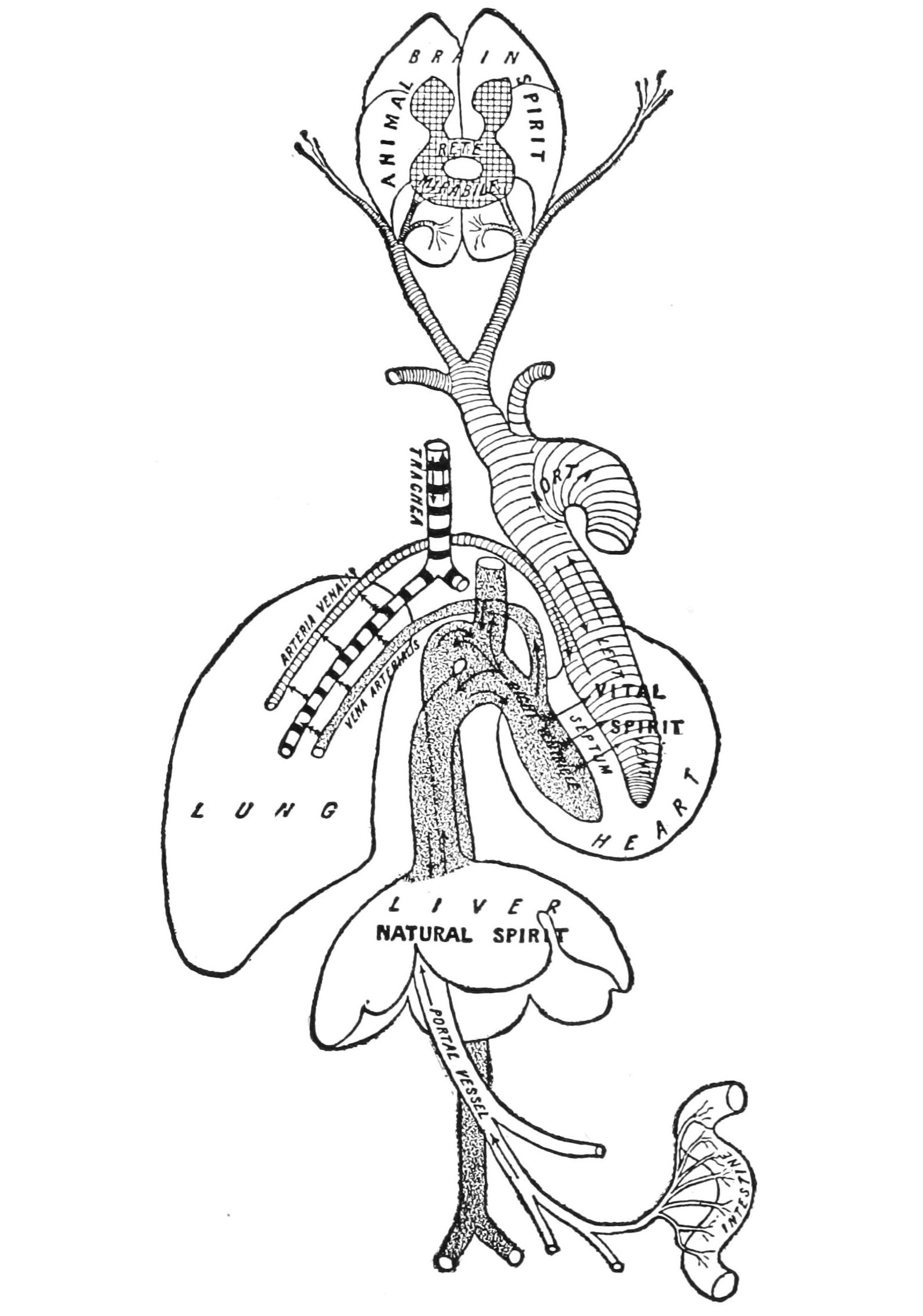
Fig. 21.
GALEN’S PHYSIOLOGICAL SYSTEM.