III THE MIDDLE AGES (FROM ABOUT A.D. 200 TO ABOUT A.D. 1500.)
Reading edition
§ 1. The Period of Depression in Europe.
The observational period of Antiquity closed with Galen. The centuries that follow exhibit progressive deterioration of the intellect. For that deterioration many causes have been assigned. An important factor was certainly the philosophical outlook of later paganism. Men lacked a motive for living. Their view of the World was dreary and without hope. It is sometimes alleged that the advent of Christianity was a factor in the decay of Science, but Science was, in fact, in headlong decay before Christianity was in a position to have any real effect on pagan thought.
Christianity came to the ancient world as a protest and a revulsion against the prevailing and extremely pessimistic pagan outlook. Christianity brought men something for which to live. It was natural that it should oppose the philosophical basis of pagan thought. In this sense Christianity was certainly anti-scientific. Early Christian thought exhibits an aversion to the view which places the whole of man’s fate under the dominion, the inescapable tyranny, of Natural Law. It is, however, essential to remember that the early Church, in developing this opposition, was not dealing with living observational Science. The conflict was simply with a philosophical tradition which contained dead, non-progressive and misunderstood scientific elements.
For some eight centuries from the time that Christianity finally replaced Paganism in the Roman Empire—from about A.D. 400 to about A.D. 1200—such remains of classical learning and classical science as survived were in monastic keeping. It was only in the monasteries that there were any who cared at all for these things, and it was only in the monasteries that manuscripts could be either written or preserved. We cannot be sufficiently grateful to the monks for having succeeded in preserving even as much as they did. Nevertheless, whether we consider what they saved or what they lost of medical literature, we can express no high opinion of either monastic taste or monastic judgment.
The curse of the Science of Medicine, as of all sciences, has always been the so-called ‘practical man’, who will consider only the immediate end of his art, without regard to the knowledge on which it is based. Monkish medicine had no thought save for the immediate relief of the patient. All theoretical knowledge was permitted to lapse. Anatomy and Physiology perished. Prognosis was reduced to an absurd rule of thumb. Botany became a drug-list. Superstitious practices crept in, and Medicine deteriorated into a collection of formulae, punctuated by incantations, which became less understood and further removed from their originals at each copying. Medicine remained surrounded by sacred associations (Fig. 22), but the scientific stream, which is its life-blood, was dried up at its source.
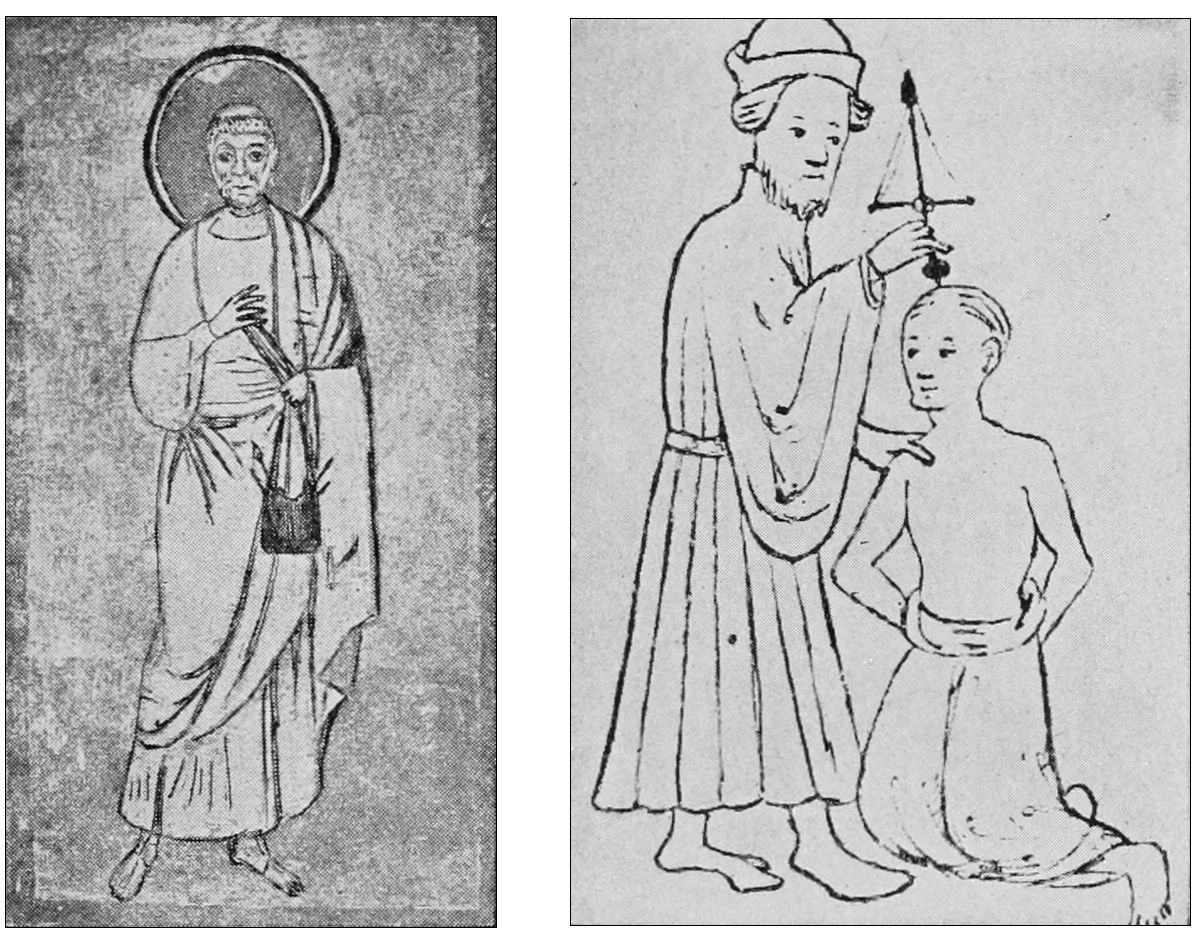
Fig. 22. EARLIEST KNOWN REPRESENTATION OF ST. LUKE AS A PHYSICIAN. From a seventh-century painting in the underground basilica of Saints Felix and ‘Adauctus’ at Rome. St. Luke, as an Evangelist, holds a scroll between his hands; as a Physician he carries suspended from his left arm a bag containing four instruments, one of which is a lancet. The head is tonsured like a monk’s. By courtesy of Rev. Father J. R. Fletcher.
Fig. 23. PICTURE OF TREPHINING from a thirteenth-century manuscript. The surgeon is using a well-known and primitive form of drill, the mode of action of which will be understood by the accompanying diagram, shown as Fig. 24.
There was just one area in the Latin West where a slightly higher standard prevailed. In the South of Italy the Greek tongue still continued for centuries to be spoken and written. Though civilization had sadly deteriorated with the disorders of the times, yet there remained here and there in that region a slightly higher intellectual standard than prevailed elsewhere in Europe. Moreover, about the same time as the Norman Conquest in England, there was a Norman Conquest of South Italy also. The strong arm of the Norman administrator might wield the weapon of a tyrant, but at least it brought order where there had been anarchy. Learning under the Normans could lift a timid head. Notably at the town of Salerno, not far from Naples, there arose something resembling a medical school. At Salerno in the eleventh century there was a certain amount of translation of medical works from Greek into Latin. The choice of works for translation was very poor, but it was something that enough mental energy existed for the effort.
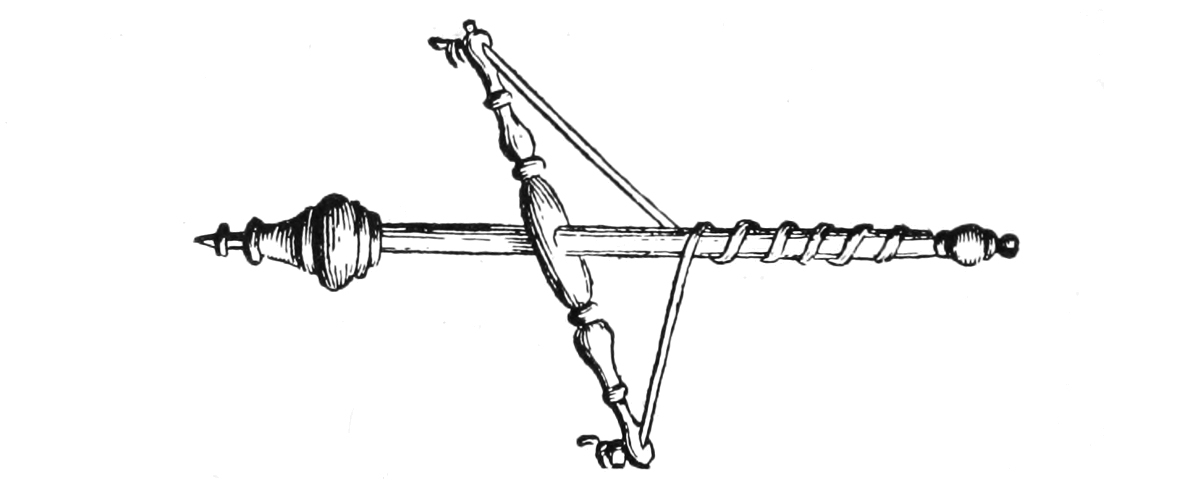
Fig. 24. Figure to illustrate the mode of action of the instrument used by the surgeon in Fig. 23. The twist of the thong causes rapid rotation of the axis. The rotating point is pressed on the skull and gradually penetrates it. From a drawing of the sixteenth century.
Salerno differed too from other centers of learning of the time in that instruction was not entirely under monastic auspices (Fig. 25). Some, at least, of the Salernitan physicians were laymen. At the time of the Norman conquest of Salerno, the school was stimulated by the advent of a wanderer from the East, Constantine by name (died 1087). This man brought with him medical works in Arabic which he was able to translate into rude Latin. The Latin versions prepared by Constantine, corrupt, confused, barbarous, often almost incomprehensible, were yet a better intellectual fare than that on which the torpid mind of Europe had long fed. The Salernitan medical writings of the eleventh and twelfth centuries exhibit some faint-hearted attempts to return to Nature. Constantine was but the harbinger of the great ‘Arabian revival’ the further origins of which we must now seek to trace.
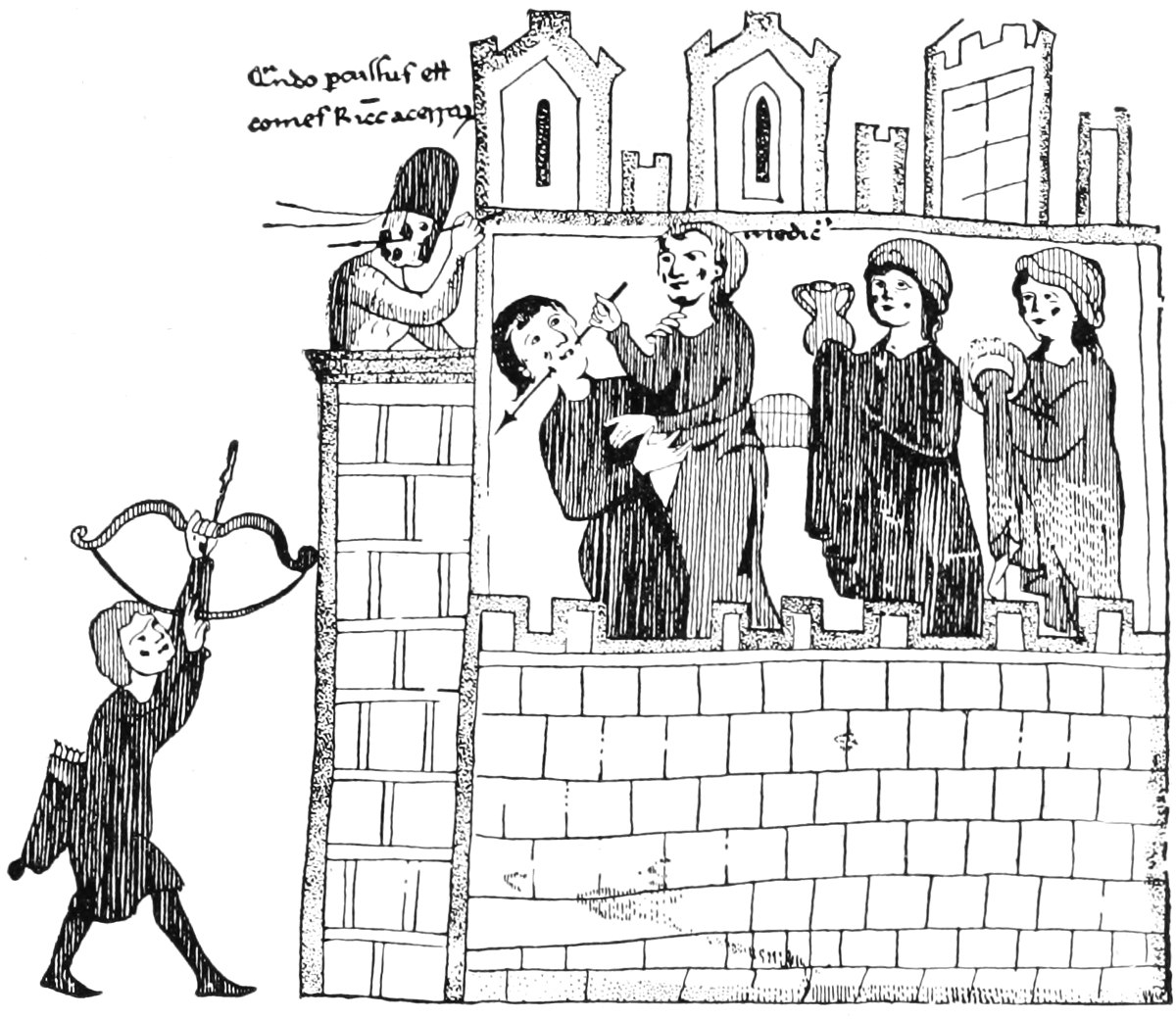
Fig. 25. SCENE AT A SIEGE OF SALERNO from a manuscript prepared in South Italy early in the thirteenth century. An archer transfixes two of the defenders through the cheeks. A medicus is aiding one of them. Two nurses, bearing drugs and dressings, attend the medicus. It illustrates the existence of lay physicians at Salerno at this date. The medicus is not tonsured.
§ 2. Arabic Medicine.
Barbarian incursions sapped and finally destroyed the Western Roman Empire. The influence of those incursions on the Eastern Empire was less dramatic. It is true that the intellectual outlook of the East Roman or Byzantine Empire was no less modified, in the course of time, than was that of the West. In the absence, however, of any collapse of the system of government, the ancient Greek learning or rather the documentary casing in which it was enshrined, was better preserved than were the Latin traditions. Men in the Eastern Empire could still read the ancient Greek medical works in the language in which they had been written, and, if their reading was unintelligent, it was at least persistent. Moreover, heretical Christian sects on the confines of the East Roman Empire prepared for themselves translations of many of the ancient Greek authors. One of these heretical sects, the Nestorians, exhibited great missionary activity. It was perhaps on this account that the Nestorians prepared translations of many Greek medical works into their own language, Syriac.
In the seventh century, Islam arose and soon swept over vast areas that had erstwhile belonged to the Emperor of the East. The territory occupied by the Nestorians in the Near East came early under Moslem rule. The Moslems, at first indifferent to infidel learning, came gradually to appreciate it. In the ninth century a great and united Moslem Empire was established with its center at Bagdad. The need for translation of Greek scientific works into Arabic, the common language of Islam, now asserted itself. One after another the medical writings that had been turned into Syriac were translated into Arabic, and Greek Science in general and Greek Medicine in particular were thus spread far and wide in the Moslem world.
Greek science in the Arabic version came in time to be better understood by Arabic-speaking students than it had been by any since Galen. Nor were the Arabic-speaking peoples content to rest on the texts that had thus descended to them from antiquity. A considerable number of Arabic writers produced works of their own, some not wholly devoid of originality. Unfortunately these men were without effective anatomical or physiological basis for their medical knowledge, though many of them were acute clinical observers, and, even from the modern point of view, some of their works are not wholly contemptible. Thus Rhazes (860-932), a native of Basra on the Persian Gulf, wrote a work containing the first known description of Measles, which he carefully distinguishes from Small-pox. The Persian Avicenna (980-1036) composed a vast encyclopaedia of medical knowledge, the so-called Canon, which served as the main text-book of Medicine both among the Arabic-speaking peoples and in the Latin West until the seventeenth century. The Jew, Isaac of Kairouan (852-952), composed a treatise on fevers which was the best account of the subject available in Europe during the entire Middle Ages. The Moor, Albucasis (11th cent.), left a text-book of surgery which was an important element in the revival of the subject in Italy and France.
These are only prominent members of a vast school of writers who flourished in Arabic-speaking countries between the ninth and thirteenth centuries. The bulk and number of their writings is portentous. Many of their works were translated into Latin, often by Jewish translators (Fig. 26). These Latin translations caused a reawakening of the intellect of Europe, and provided the staple reading in the medieval universities throughout the Middle Ages.
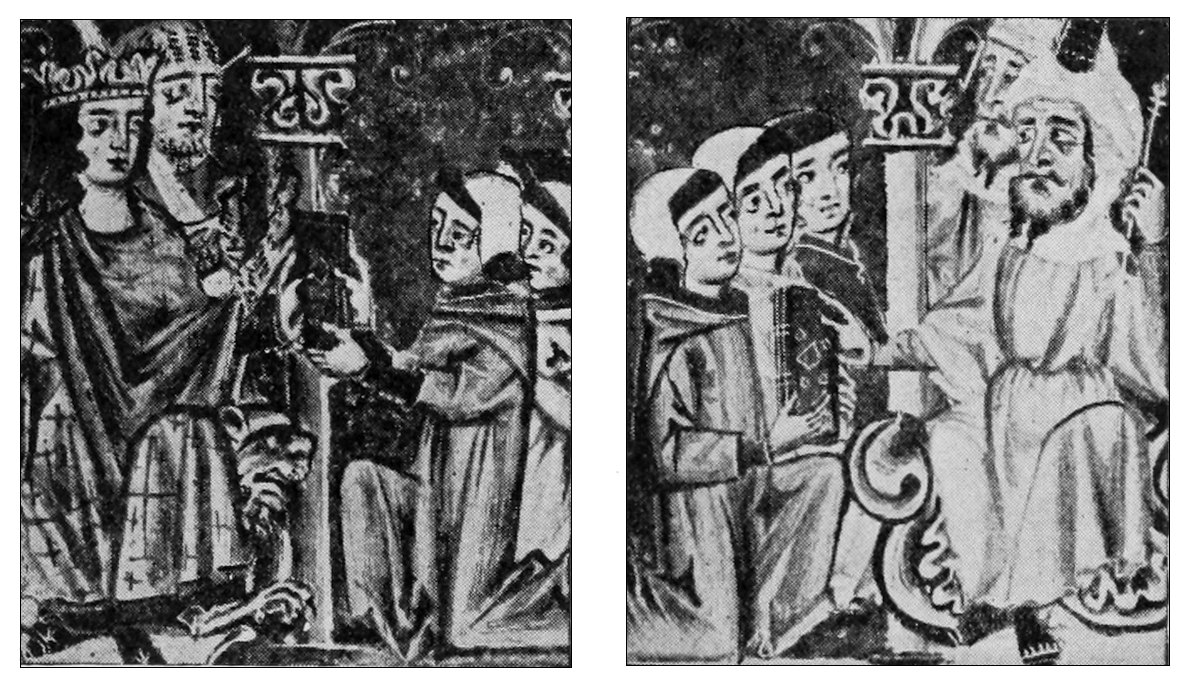
Fig. 26. A JEWISH TRANSLATOR receiving an Arabic medica volume from an Eastern potentate (right) and handing it, translated into Latin, to a Western monarch (left). From a thirteenth-century manuscript.
§ 3. The Medieval Awakening.
The Spanish peninsula had been inundated by the Islamic tide as early as the eighth century. After a while the waters began to recede. The speech and culture of Islam had become stamped upon the natives of the peninsula, and were only gradually replaced by the Latin civilization and dialect which we now call Spanish. During the centuries of Islamic retreat, there was thus a bilingual population in the peninsula, so that access to the Arabic learning became possible. The translations that were to have influence on Europe were always into Latin. To make or to obtain such translations many adventurous spirits journeyed from Christian Europe into Spain, or sometimes into Sicily where conditions were very similar. These men were aided in their work by native Jews or by Mohammedans. The heretical company which they kept, together with the strange and mysterious material which they brought back with them, earned them a reputation as magicians. The memory, for instance, of Michael Scot is connected with the Black Art, and has been presented by Sir Walter Scott in his poem The Lay of the Last Minstrel.
The wizard Michael Scot (died 1235) journeyed in both Spain and Sicily, learned Arabic and Hebrew, and had commerce with Mohammedans and Jews. He turned a number of Arabic works into Latin, and, in particular, he prepared versions of the biological works of Aristotle (pp. 28-33) which, though corrupt and second-hand, had much influence in determining the direction of medical thought during the Middle Ages.
There was a large class of such translators and commentators who made Arabic Medicine accessible to the West. This Arabic-Latin literature is generally characterized by the qualities most often associated with the words medieval and scholastic. It is extremely verbose and almost wholly devoid of the literary graces. An immense amount of attention is paid to the mere arrangement of the material, which often occupies its authors more than the ideas that are to be conveyed. Great stress is laid on argument, especially in the form of the syllogism, while observation of Nature is entirely in the background. Above all, there is a constant appeal to the authority of the ancient masters, especially Aristotle and Galen. Lip service is often paid to Hippocrates, but his spirit is absent from these windy discussions.
When the Latin translations from the Arabic reached the readers for whom they were intended, they were eagerly studied. The texts were, however, by no means permitted to remain in their pristine state, but were submitted to exactly the same process to which their Arabic authors had themselves subjected their Aristotelian and Galenic models. The Christian writers of the West treated the Latin translations of Rhazes, of Avicenna, of Isaac and of Albucasis (p. 67), as subjects for commentary. Their works were expanded, annotated, castigated again and again, and without any new inflow of ideas. The result is a progressive elaboration of form and deterioration of content throughout the centuries. Vast masses of argument, rebuttal, refutation and confirmation drowned again the human spirit which hardly recovered from its submersion until the sixteenth century.
§ 4. The Universities.
Nevertheless, when these translations were new to Europe, and especially in the thirteenth century, they caused much stir. In this awakening a large part was played by the Universities. These were established in numbers during the thirteenth and the following centuries. University life gradually came to exercise a profound effect on social, political and intellectual conditions. In most of the Universities Medical Faculties grew up. The medical teaching was entirely theoretical and there was no clinical instruction, though at the beginning of the fourteenth century some advance was made by the introduction of brief and superficial anatomical demonstrations (p. 74).
As a type of Medieval University, we may take Bologna, which was an important center of learning from a very early date (Fig. 27). As the Universities multiplied, they began to some extent to ‘specialize’. Bologna had appeared first as a Law School and continued to develop along the same line. In the second half of the thirteenth century it was by far the most important seat of legal learning in Europe.
An organized Medical Faculty existed there as far back as 1156. The teaching at Bologna, as in other medical schools, consisted entirely of readings of Latin translations from Arabic which were becoming ever more accessible. Yet it was at Bologna that public dissection was first practised. The early advent of dissection has often impressed the historian. There was still no botany worthy of the name, no zoology, hardly any naturalistic art, no experimental science, no systematic record of observation in any department. Yet dissection had become recognized at Bologna by the end of the first quarter of the fourteenth century. The question is why men, so little interested in Nature and Nature’s ways, should have lent themselves to so repellent a process as dissection of the human body? The answer is that the earliest reason for examining the human body was simply the gathering of evidence for legal processes. As time went on, post-mortem examination passed into anatomical study. But still dissection did no more, and was asked to do no more, than verify Avicenna—whom nobody doubted. It was, in fact, little but an aid to the memory of students.
At Bologna we can trace the rise of a surgical school beginning about the end of the twelfth century. Prominent among its early surgeons was William of Saliceto (1215?-1280?). He wrote a very able treatise on Surgery, containing a section on Anatomy. The anatomical portion is borrowed from the current Arabian anatomies, but contains some evidence of direct access to the dead human body. He includes in his work a good description of trephining the skull (Fig. 23).
A most interesting contemporary of William of Saliceto was Thaddeus of Florence (1223-1303), who also taught at Bologna. This man perceived the importance of access to Greek sources, as distinct from Graeco-Arabic, and he encouraged the preparation of good Latin translations of medical works direct from the Greek. He stamped his personality on the whole development of Medicine at Bologna, and he is bound up with the beginning of dissection. But if Medicine owed a debt to Thaddeus for introducing better texts and better Anatomy, he did grave harm to the subject in another direction. The scholastic and argumentative form assumed by medieval Medicine is largely due to him, and it is to the assumption of this form that we owe the almost complete absence of scientific advance between the thirteenth and sixteenth centuries.
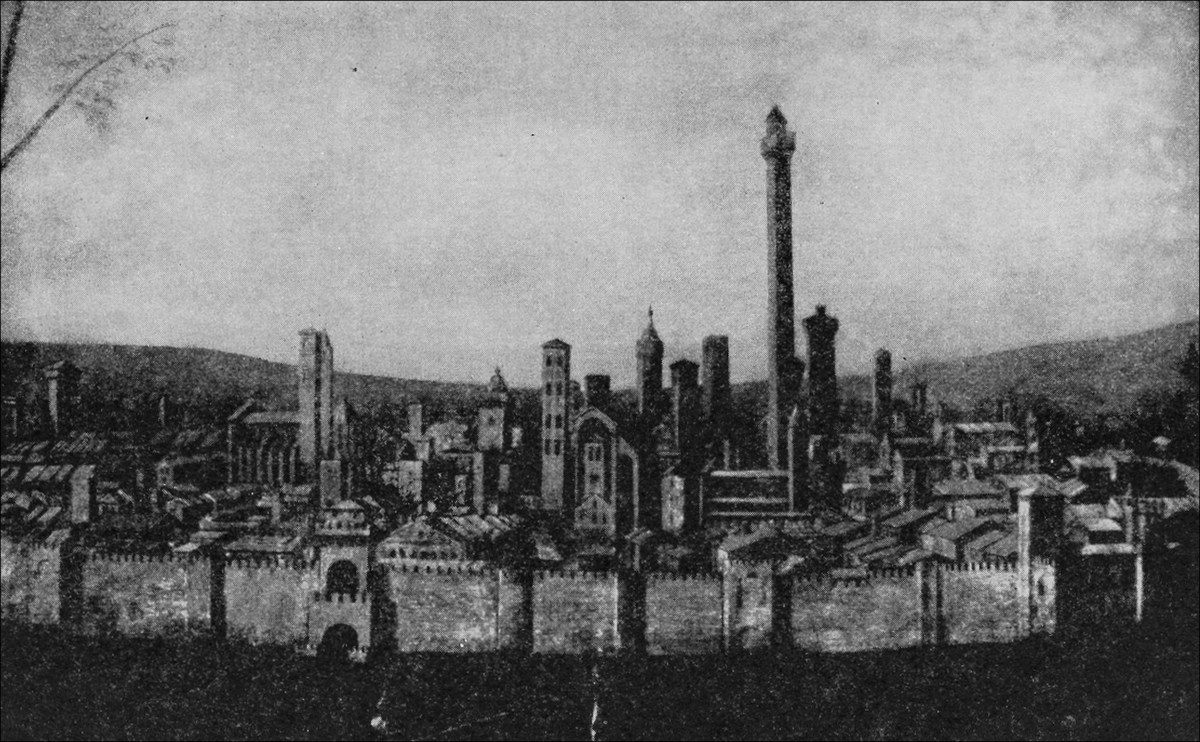
Fig. 27. MEDIEVAL BOLOGNA, from a mural painting of about 1500 in the town-hall of the city. The city contained a number of towers, nearly all of which have now been destroyed.
§ 5. Medieval Anatomy, Surgery and Internal Medicine.
At the very end of the thirteenth century there came to Bologna a Norman student, Henri de Mondeville (about 1270-1320). In 1301 he settled at the famous Medical School at Montpellier in Southern France, and thus transplanted to France the medical, surgical and anatomical traditions of Bologna. Those traditions were of Arabic origin, and mainly borrowed from Avicenna.
Contemporary with de Mondeville was one whose method of teaching shines as a good deed in a naughty world. Mondino di Luzzi (c. 1270-1326) was a pupil of Thaddeus and a fellow-student of Henri de Mondeville. He worked systematically at Anatomy and dissected the human body in public. His treatise on Anatomy, written in 1316, is the first modern work on the subject. Those who preceded him incorporated their anatomical work in larger treatises on Surgery, and do not refer directly to their own anatomical experiences. With Mondino this is changed. His work is essentially a practical manual of the subject and he is with justice called the ‘Restorer of Anatomy’. He had read widely among the Arabian anatomists, and naturally borrowed from them. Nevertheless, his work contains a considerable number of references to actual anatomical procedure. Moreover, he deals not only with Anatomy in our modern sense, but also includes Physiology and much discussion of the application of anatomical and physiological principles to Medicine and Surgery. His book thus gives a good deal of insight into the scientific knowledge of the day.
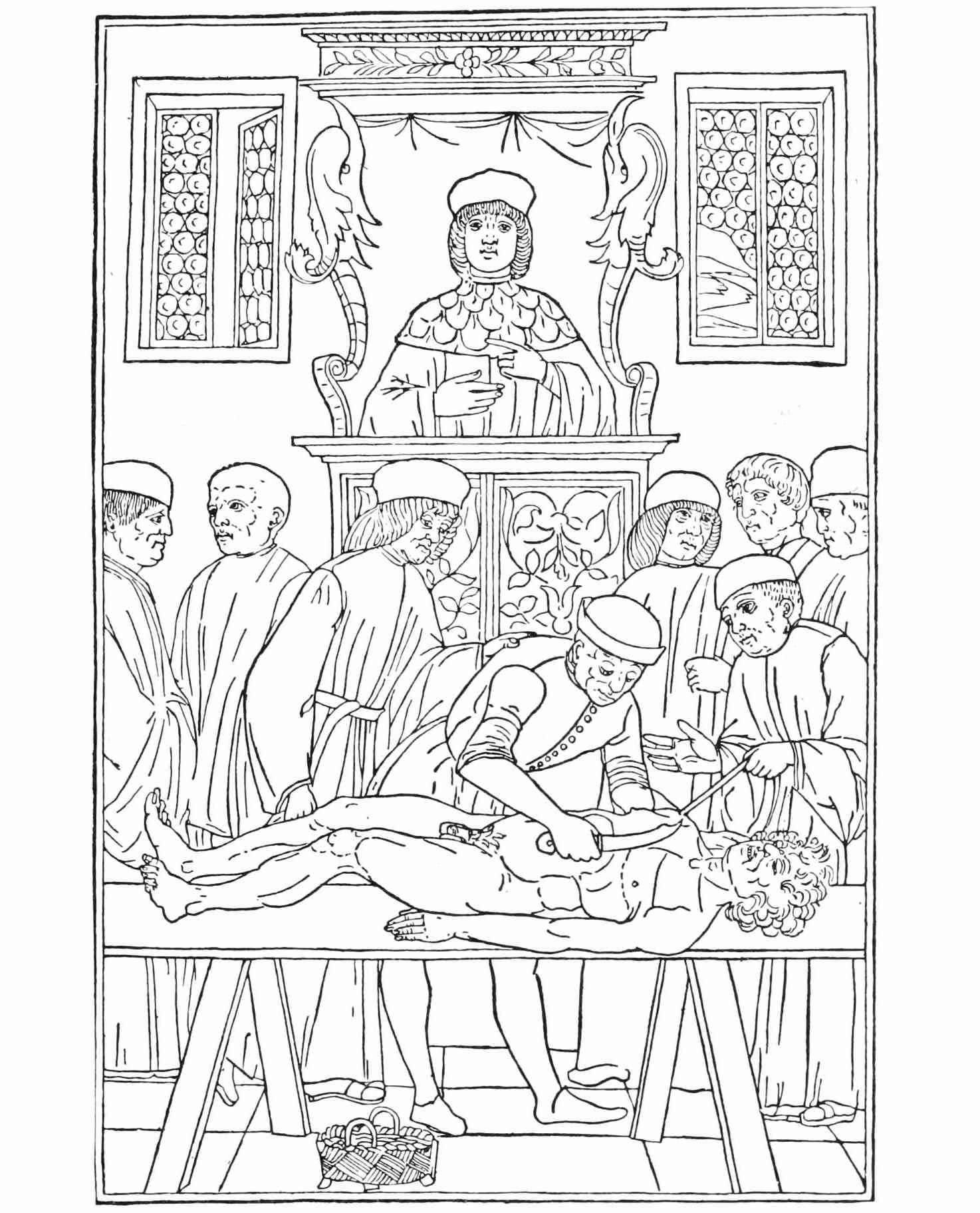
Fig. 28. AN ANATOMICAL LECTURE AT PADUA in the fifteenth century, from a contemporary Italian woodcut.
The professor stands in his ‘chair’, a great pulpit or ‘cathedra’, reading from his book—hence the English academic titles ‘Reader’ and ‘Lecturer’ or ‘Lector’ (that is, ‘one who reads’). The body is dissected by a menial, whose work is guided by an assistant, who, with wand, points out (Latin demonstrat, hence our modern title Demonstrator) the lines of incision. Students in academic dress stand around, but do not themselves dissect.
We would emphasize the fact that Mondino dissected in person. In this respect he was wiser than his successors until the time of Vesalius. As dissection gained formal inclusion in the curriculum, the professor became more haughty, further removed from the object of his study. Leaving his position by the body, where he might demonstrate to his students, he ascended his high professorial chair, a great elevated structure provided with steps and a reading-desk. From there he read from his text-book while a junior colleague pointed out the line of incision and a menial performed the actual dissection (Fig. 28). All was thus done at third-hand and according to the written word. We are in the scholastic period, and must not expect any frequent appeal to Nature. Having once got into his chair, it took a good deal to persuade the professor to descend from that dignified position. Thus, it is saying much for Mondino that he was his own demonstrator. He took the first and perhaps the greatest step. It was two centuries and more before the next step was taken.
Most typical of medieval surgeons was Guy de Chauliac (1300-68), who studied at Montpellier, Paris, and Bologna, and practised at Montpellier and afterwards at Avignon, where he was a member of the Papal Court. He was a man of much learning, and his Great Surgery became the standard treatise on the subject during the later Middle Ages. It fixed medieval practice. It is to be found in scores of manuscripts and was frequently translated and printed. Among the good points of his practice is his acceptance of responsibility for certain operations, such as those for rupture and for cataract, which at that time were usually left to wandering charlatans who regarded themselves as specialists. A famous passage in his work describes the use of a narcotic inhalation frequently used during the Middle Ages and into modern times. Of such a narcotic it is written that:
I’ll imitate the pities of old surgeons To this lost limb, who, ere they show their art, Cast one asleep, then cut the diseased part. (Thomas Middleton, Women beware women. First acted 1622.)
The general character of Internal Medicine during the later Middle Ages was below that of Surgery. Modern clinical Medicine is firmly based on such sciences as Physiology, Pharmacology, Pathology, Biochemistry and Epidemiology. In the Middle Ages and far beyond, Physiology was still that of Galen, which had lost in exactness what it had gained in bulk from the Arabic and Latin commentators. Pathology was still that of the four humors. The knowledge of drugs was empirical, and the sciences of Pharmacology and Biochemistry as yet were not; while the medieval conception of the nature of epidemics was the very perversion of reason and common sense. Nevertheless, as we shall see, the Middle Ages ultimately succeeded in instituting a limited number of effective preventive measures.
§ 6. Medieval Hospitals and Hygiene.
Undoubtedly an important development of medieval Medicine is its hospital system. The public hospital arose in pagan antiquity out of the Temples of Aesculapius and the military valetudinaria (p. 49). The conception was seized on by Christianity and developed beyond all knowledge. In the early Christian centuries, hospitalia, ‘guest chambers’ or ‘guest houses’, were set aside for the numerous hospites, or ‘pilgrims’. Similar buildings under the same title came to be instituted for the care of orphans, the aged, the blind, and other victims of fortune. Thus arose the medieval hospital system, of which ours is the direct outgrowth.
In matters of Hygiene the Middle Ages are a byword. The health conditions of a medieval town were far below those of the same town under the Roman Empire. Water-supply was deficient, drains were absent, streets and houses filthy and overcrowded, rooms unventilated. Nevertheless, there is one important hygienic conception for which our own age owes a considerable debt to that which preceded it. Despite their scientific acumen in many departments, it is yet true to say that among the physicians of classical antiquity we find no consistent view of the transmission of infection by contact. Indeed the whole idea of infection was effectively absent from them, so that preventive measures based upon it could not be developed. It was reserved for the Middle Ages to conceive serious official measures against the spread of epidemics. These measures were consciously derived from the leper ritual of the Bible with its fundamental concept of isolation.
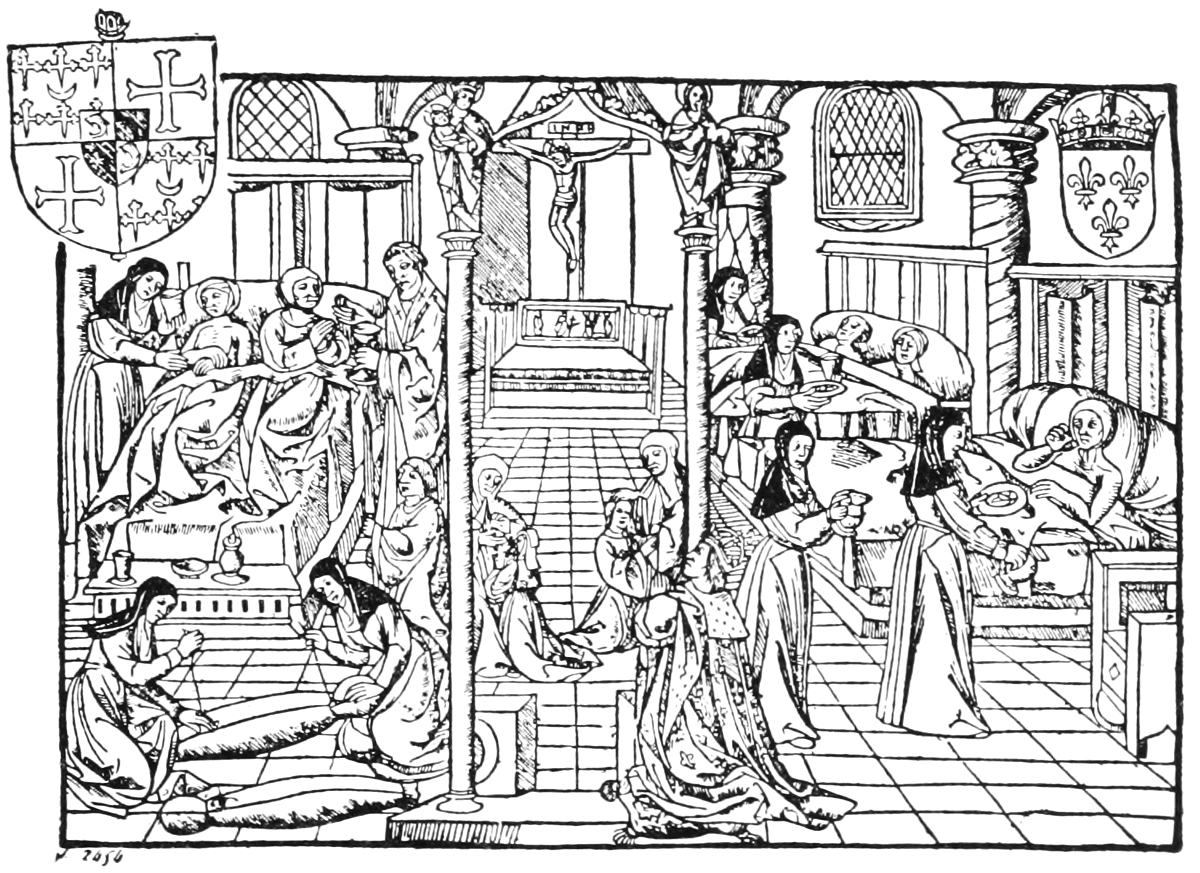
Fig. 29. A HOSPITAL WARD in sixteenth century Paris. In the left aisle, a nun folds the hands of a dying patient, while a priest gives the Sacrament to another in the same bed. In front, nuns sew shrouds. The right aisle is more cheerful. Nuns minister to two patients in one bed, while a convalescent, fortunate in having a bed to himself, vigorously takes nourishment. In the centre nuns receive postulants and a royal founder kneels in prayer.
During the early centuries of the Christian era, Leprosy, which had till then been confined to the East, crept along the Mediterranean littoral and thence northward throughout Europe. The disease was from the first regarded as contagious, and various regulations were introduced to isolate and separate the unfortunate sufferers. The medieval treatment of lepers is one of the dark incidents of man’s inhumanity to man. The leper was banished from human society. He was declared legally dead. He was excluded even from church or allowed to attend only in special seats where a special basin of holy water was assigned to him. How rigorously this segregation from the ranks of free people was carried out by law is well known. The cruel edicts were, however, effective. In the course of centuries it freed Europe from Leprosy, of which it is said there were at one time some 20,000 cases in France alone. Thus about one person in 200 would have been a leper, and the burden of the leper on the community was comparable to that, let us say, of the feeble-minded and insane with us.
Leper inspection, the regular examination of all suspects and carriers of leprosy, became a most elaborate business. It was entrusted to a special branch of the civil service and was gradually freed from ecclesiastical control.
This preventive method of combating a chronic disease, which, as we know now, has a very low infectivity, had a peculiar and unlooked-for result. The meticulous system of warding off the contagion of leprosy so occupied the attention of physicians that they came to see allied conditions in the same light. So it was that in the thirteenth century the general concept became current of disease as contagious. A number of other diseases besides leprosy were recognized as infectious. Among these were Plague, fevers with obvious rashes, Phthisis, Granular Conjunctivitis, the Itch and Erysipelas. Municipal authorities were from time to time ordered to put patients suffering from one or other such diseases outside the city gates. They were forbidden to traffic in articles of food and drink and were placed under restrictions not unlike those of lepers. The devastating epidemic of the Black Death of 1347-8 brought restrictions of this order into special force. Thus the Black Death had somewhat the same effect on the health administration of the day that the Cholera outbreaks of the thirties of the nineteenth century had upon modern Europe. The health service began to be put into more efficient order.
In the later Middle Ages there were actually instances in which the Pest was averted or successfully combated by these means. This seems to have been the case of Milan and Venice between the years 1370 and 1374. At that time the Plague was again advancing through Europe. The most drastic regulations were invoked to prevent infected persons from entering the cities, and these regulations came into force well in advance of the disease.
There is one incident in this medieval attempt to prevent Plague that has left a mark on our language. The Republic of Ragusa, on the eastern side of the Adriatic, adopted and extended the regulations that had been so successful at Venice. A landing-station was established far from the city and the harbor. There incoming suspects had to spend thirty days in the open air and sunlight, and any who had traffic with them were isolated. The period of thirty days was spoken of as the Trentina. Later this was found to be not long enough. The thirty days became forty days, the Quarantina, whence we have the word Quarantine. The system of quarantine gradually spread through Europe. It was accompanied by very drastic destruction, by burning, of all goods belonging to the infected.
These attempts to arrest epidemic disease were sometimes successful and the elaboration of quarantine measures was among the few advances with which we may credit the Middle Ages. The fact that we can now dispense with quarantine must not blind us to its value in conditions other than our own.