VI PERIOD OF SCIENTIFIC SUBDIVISION (FROM ABOUT 1825 ONWARDS) (continued 3)
Reading edition
The operative treatment of the eye is of great antiquity. The most important operative procedure is that for ‘cataract,’ a condition caused by an opacity of the lens. ‘Couching’ for cataract, that is depressing the opaque lens, was practised by Alexandrian surgeons in the third century B.C. It is described by Celsus (p. 43) in the first and mentioned by Galen (p. 50) in the second Christian century. Contemporary with these authors are descriptions of the actual extraction of the lens affected with cataract.
In Imperial Roman times there were surgeons who devoted themselves exclusively to cataract operations. These were practised during the Middle Ages by the Arabs and to a less extent by the Westerns. For the most part the operations were performed by wandering quacks, who were, however, often very skilful. In the sixteenth century operations on the eye began to pass into the hands of recognized medical practitioners. The advances in the knowledge of the anatomy and physiology of the eye in the eighteenth century enabled the French surgeon Jacques Daviel (1696-1762) to explain the real nature of cataract, which is usually nothing but a senile change in the lens of the eye. His knowledge made it possible for him greatly to improve the operation for extraction, so that, over a large range of cases, he had only 11 per cent. of failures.
The modern era of ophthalmic surgery was ushered in by Donders (p. 319), von Helmholtz (pp. 213 and 319), and Albrecht von Graefe (1828-70). The last was a professor at Berlin who greatly improved the operation for cataract and introduced or improved many other important operations on the eye. He was one of the first to make important clinical observations with the ophthalmoscope, and he showed how the instrument may be made to yield information not only of the condition of the eye itself, but also of the brain and of its membranes, an application which has become of the greatest value in later medical developments. Though he died before the most important work of Pasteur and Lister had become generally accepted, von Graefe was yet practising a system of surgery which was not far from aseptic.
As with most departments of Medicine, so also with Ophthalmology, the most significant advances during the last generation have been in the direction of prevention rather than cure. Prominent among these measures are, firstly, school inspection with the consequent early detection and isolation of infectious cases of conjunctivitis; secondly, maternity welfare accompanied by prompt notification and treatment of the very dangerous and sight-destroying ‘Ophthalmia of the New-born’; thirdly, improved light regulation in factories and schools; and, fourthly, adequate provision of spectacles for school children with errors of vision.
The recognition of the infectious character of the very chronic and sight-destroying disease known as Trachoma, or ‘Granular Conjunctivitis,’ has been of great importance for the Public Health. The disease is common in the near East and in Eastern Europe and by no means rare in slum quarters in the West. A rigid system of inspection of immigrants, together with quarantine combined with treatment, has done much to diminish its ravages in the United States.
§ 20. Investigation of the Nature and Action of Drugs.
(a) Entry of Vegetable Drugs into the Pharmacopoeia.
An examination of the list of drugs that are in use at the present day—apart from those which have been introduced by the scientific movement of the last generation—yields some surprising results. Some thirty per cent. of the crude vegetable drugs in the modern official Pharmacopoeia were known in remote antiquity. The Egyptian medical papyri mention, among others, Aloes, Caraway, Castor Oil, Coriander, Dill, Fennel, Juniper, Mint, Myrrh, and Turpentine. Among Egyptian mineral remedies still in use are salts of copper and of lead. Assyrian medical tablets refer to most of the Egyptian drugs as well as to a number of others, among which are Almond Oil, Aniseed, Galbanum, and Liquorice. Among Assyrian mineral remedies that are used by us to this day are Alum and Bitumen. Early Indian medicine had a very copious pharmacopoeia. Cannabis indica, known as ‘Hashish’ or ‘Indian hemp’, Cardamoms, Cassia fistula, Datura stramonium, and Nux vomica are among the valuable Indian herbs now in use in scientific medicine, while Mercury preparations were perhaps ultimately of Indian origin.
The medical herb lore of the Greeks comes to us chiefly from Dioscorides (p. 43), who mentions about five hundred plants. A large number of these are still in our own Pharmacopoeia. Among these, besides those of Egyptian, Assyrian, and Indian origin, are Ammoniacum, Belladonna, Camomile, Catechu, Cinnamon, Colchicum, Colocynth, Crocus, Galls, Gentian, Ginger, Hyoscyamus, Lavender, Linseed, Male Fern, Mallow, Marjoram, Mustard, Poppy, Rhubarb, Sesame, Stavesacre, Storax, Terebinth, Tragacanth, and Wormwood. About thirty-seven per cent. of our Pharmacopoeia was known to the later Greeks. From them the Arabs derived, adding, however, enormously to their drug-lists, so that we may say that about fifty per cent. of our drugs were in use by the Arabic-speaking physicians of the Middle Ages. With the discovery of America further important additions were made. Of these we have already discussed the introduction of Cinchona, Ipecacuanha, and Tobacco (p. 95). Few important additions were made in the eighteenth century, though among them was Digitalis (p. 328).
(b) Active Principles.
One of the things that separate the practice of Medicine of our time from that of previous ages is our power to give drugs in ‘pure’ form. This means not only that we can secure drugs without adulteration, but also that the active substances in drugs can be chemically isolated and given without admixture. Most drugs used in Medicine are, in fact, of vegetable origin. The possibility of giving them in chemically pure form depends upon the discovery, early in the nineteenth century, that plants owe their poisonous and remedial properties to small quantities of Active Principles, which are susceptible of chemical extraction and isolation. Thus the science that deals with the action and nature of drugs, Pharmacology, really took its rise about a hundred years ago, though many had experimented with drugs at an earlier date.
Further progress in the same direction has been made by the so-called ‘synthetic’ preparation of drugs. Certain substances of vegetable origin do not readily yield their active principles and to extract them very complex chemical processes may be involved. There are special obstacles to the complete purification of other drugs, even when they have been obtained in a relatively pure state. These difficulties can sometimes be surmounted by the preparation of the drug from inorganic materials. This synthetic process of preparation is now possible for many substances that are of medical application. Furthermore, when a drug can be thus synthetically prepared, it is often possible to try chemical variants upon it, and thus to obtain a more effective preparation.
In former times a vast number of drugs were habitually employed by physicians, and they were often given in very complicated prescriptions. ‘Polypharmacy’, the giving of many drugs, is a vice from which Medicine has now in large part freed itself. The number of drugs given by scientific physicians is far fewer that it was. For this there are several reasons. Firstly, many drugs were found useless for the purpose for which they were administered, and were at times even dangerous. Secondly, since attention has been drawn to the active principles of drugs rather than to the crude natural drugs, it has been seen that, in fact, many of the drugs that were being given were merely duplicates one of another, and that often the administration of the active principle itself was more effective and more reliable than that of the source from which it was obtained.
What then is the nature of the drugs now being administered by scientific physicians? They fall into a number of classes. The nature and action of some of these is so simple that no prolonged discussion of them is necessary. There are, for instance, the inorganic acids and alkalis, the primary action of which, when taken internally, can be determined by a series of experiments on gastric juice in a test-tube kept at body temperature. Again, there are soluble inorganic salts, which are absorbed unchanged from the alimentary canal. These have the effect of increasing secretions. Their purgative effect is well known, though the physiological details of their action are not yet clear. There are yet other substances, such as metallic Mercury in ‘grey powder’ or Bismuth, which act mechanically, even when administered internally. Over and above these simpler substances, and in addition to the traditional vegetable substances which have been in use as medicines for centuries, there are others which have only been accessible during the last few generations. We have already discussed under separate headings the derivatives from animal glands, such as of the Thyroid (p. 305), of the Adrenals (p. 307), or of the Pancreas (p. 306), as well as the bacterial Vaccines (p. 261) and Antitoxins (p. 267). We now turn to pure chemical substances of vegetable origin. Of these mention may be made especially of the groups known as the Alkaloids and the Glucosides.
(c) The Alkaloids.
By ‘Alkaloid’ is understood a nitrogenous substance, usually of vegetable origin, which forms salts with acids. The alkaloids are mainly obtained from the dicotyledonous plants. Generally they occur in nature in combination with plant acids such as citric or tartaric acid. The alkaloid group contains some of the most important drugs that we possess. Among them are Morphine, Strychnine, Cocaine, Atropine, and Quinine.
The investigation of the alkaloids began with the nineteenth century. Morphine was isolated from Opium by the Parisian apothecary Charles Derosne (1780-1846) in 1803. He failed, however, to recognize its chemical affinities, which were first grasped by the German apothecary Adolf Sertürner (1783-1841). Their work, however, attracted but little notice until attention was drawn to it by the great French chemist Joseph Gay-Lussac (1778-1850), in 1817. The result was the concentration of much scientific ability on the alkaloids. Prominent among the early investigators were the French pharmacologists Pierre Joseph Pelletier (1788-1842) and Joseph Caventou (1795-1878). Between 1818 and 1820 they isolated from Cinchona (p. 95) certain alkaloids allied to Quinine, from Nux vomica the alkaloid Strychnine and certain of its allies, and from Coffee the alkaloid Caffeine. Pelletier in conjunction with the distinguished chemist Jean-Baptiste Dumas (1800-84) followed this by a quantitative examination of a number of alkaloids in 1823. The first alkaloid to be used as such in medicine was Strychnine. It was introduced in 1821 by the French physiologist François Magendie (1783-1855), the teacher of Claude Bernard.
In the thirties and forties of the nineteenth century Liebig, who had developed his doctrine of radicles (p. 206), attempted to determine the formula of alkaloids. He was followed by Wöhler (p. 206). Since then an immense amount of work has been done in investigating the chemical nature and physiological action of alkaloids. The general result has been to reveal the fact that each alkaloid-yielding plant contains not one but a number of alkaloids. Those from the same plant often have similar but not identical action upon the animal body. The differences in physiological action of allied alkaloids have occupied much of the attention of pharmacologists. The accurate knowledge of these differences has made possible a far greater finesse in the administration of alkaloid drugs than was previously possible. Some alkaloids can be prepared synthetically, but the process is mostly of theoretical rather than practical importance.
(d) The Glucosides.
The Glucosides are an ill-defined group which have in common the property of yielding a sugar-like substance—usually glucose itself—as a result of certain chemical processes. They are mostly of vegetable origin and the history of their investigation has been parallel with that of the alkaloids. The first glucoside to be isolated was Salicin, which was obtained from willows in 1819. It is the active principle of the very ancient remedy for rheumatism, ‘Oil of Wintergreen’. Salicylic acid was introduced into Internal Medicine in 1873 and its derivative, Aspirin, in 1899. Both drugs are of great importance, and many other derivatives of Salicin are in use. Salicin and its derivatives can be prepared synthetically, and the synthetic products are in use in Medicine.
Of all the glucoside-yielding plants, perhaps medically the most important is the Foxglove, Digitalis purpurea. The use of the plant was known to some of the medieval herbalists, and is, moreover, recommended in the German and English printed herbals of the sixteenth and seventeenth centuries. Foxglove is mentioned as a folk remedy in George Eliot’s Silas Marner, the story of which refers to a period round about 1750 before the Industrial Revolution, ‘when the spinning-wheels still hummed busily in the farm-houses’ (Fig. 89). It was introduced into scientific Medicine in 1785 by William Withering (1741-99) of Birmingham in his Account of the Foxglove, which gives details of numerous cases treated with it.
Digitalis long resisted the attempts to extract an active principle, but since the seventies it has yielded to investigators a whole series of glucosides. Digitalis and its derivatives have become of much importance, especially in the treatment of cardiac conditions. Despite the success in obtaining glucosides from the Foxglove, the extract of the plant itself continues in wide use.
(e) The Study of Pharmacology.
Since the middle of the nineteenth century the investigation of the physiological action of drugs has been mainly in German hands. The most prominent exponents of the method have been Karl Binz (1832-1912) and Oswald Schmiedeberg (1834-1921), both professors at Dorpat, where there has been a pharmacological laboratory since 1849. The first pharmacological laboratory in America, that at Ann Arbor established in 1893, and the first in England, that at University College, London, established in 1905, were successively occupied by A. R. Cushny (1866-1926). The work of these and of other pharmacologists has not tended to increase but to reduce the number of drugs. Nevertheless, some new drugs of great importance have been introduced by them. Of these, among the more valuable is Amyl nitrite, the inhalation of which was first recommended by T. Lauder Brunton (1844-1916) as early as 1867 as a remedy in certain cases of sudden heart seizure.
Improvements have been made not only in the drugs themselves but also in modes of administration. The ancient methods of inunction and inhalation, as well as other older methods, have been greatly elaborated in modern times, and are now of wider application than they were. No advance of this order compares in importance with the introduction of the Hypodermic Syringe by the ingenious French surgeon Charles Gabriel Pravaz (1791-1853). By means of this instrument various drugs can be injected directly into the subcutaneous tissues or into the veins. This mode of administration is more accurate and under better control than any other, and the action of the drug so injected is swifter and more sure.
(f) Chemotherapy.
During the twentieth century the outlook on drug treatment has been modified by the success obtained in the specific treatment of certain diseases, that is to say, treatment by remedies which strike at a particular disease and no other. Until quite recently scientific Medicine recognized very few specific remedies. It had been ascertained that Cinchona owes its value in Malaria to the alkaloid Quinine (p. 326), which acts as a specific exterminator of the malaria parasites, and not simply as a remedy for fever in general. It had also been ascertained that Ipecacuanha owes its value in tropical Dysentery to the alkaloid Emetine, which acts similarly as a specific exterminator of the protozoal organisms which are the infective agents. Quinine and its allied alkaloids and Emetine and its allied alkaloids were practically the only specifics the value of which had been scientifically proved, except Mercury for Syphilis.
About the beginning of the twentieth century arose the new ‘Chemotherapeutic’ movement as it came to be called. This movement was initiated by the studies of natural Antibodies (p. 262) by Paul Ehrlich of Frankfurt (1854-1915). Antibodies are strongly antagonistic to the parasitic organism the toxin of which has elicited them, but, on the other hand, they are quite harmless to the animal body in which they reside. Here are ideal remedies provided by Nature herself. Ehrlich compared them to magic bullets, constrained by a charm to fly straight at their objective and to injure no other. No such perfect artificial drugs have yet been produced. The problem of Chemotherapy is rather how to poison the parasite as much as possible while poisoning the host as little as possible.
When Ehrlich began the study of Chemotherapy observers had long known that certain aniline dyes have a special affinity for certain cells or organisms. Indeed the affinity of certain of the dyes for certain bacteria had made possible the work of Koch on Tuberculosis and on other diseases. As far back as the seventies and eighties much work had been done on the subject, and the action of these dyes had interested a large variety of investigators. Ehrlich’s first results were on a protozoal parasite, which infests dogs. By injecting small doses of a certain aniline dye into the veins of the infected animal it was found possible to destroy the parasites while doing very little injury to the dog.
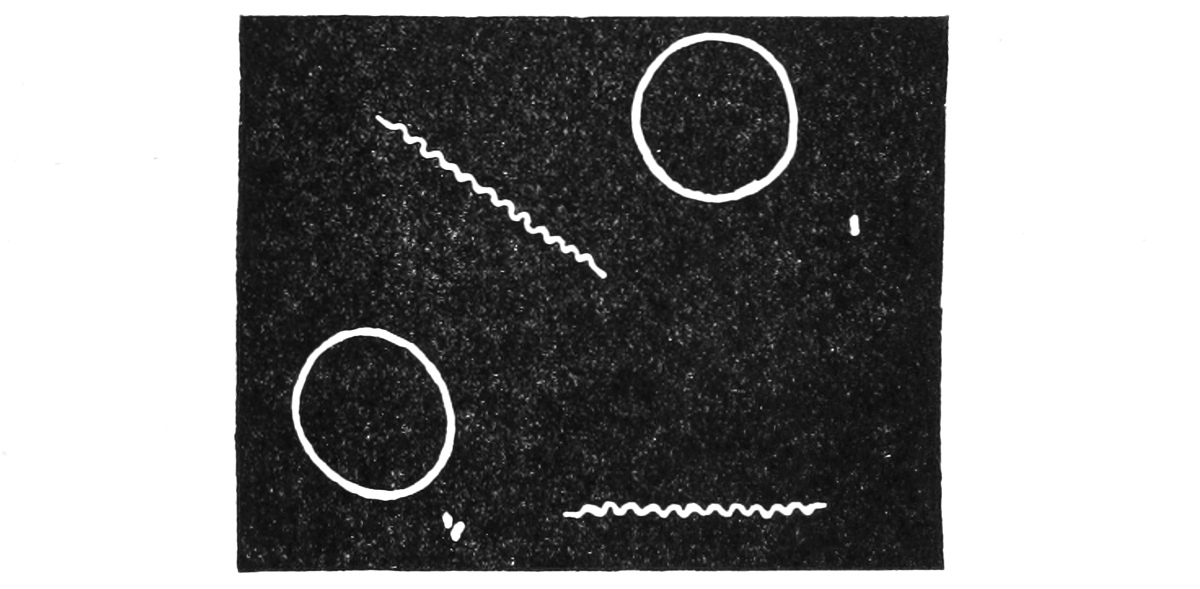
Fig. 133. The Organisms of Syphilis in a smear from the Local Infection. Highly magnified. They are best seen by means of a special optical arrangement in which the outlines of the objects appear glistening white and the background black. The round objects are pus corpuscles, the two spiral objects the organisms of syphilis.
At this point Ehrlich turned aside from the aniline dyes to study the effects of much more toxic substances. He selected the compounds of arsenic for the purpose. After prolonged research, he obtained an arsenical derivative which proved very toxic to parasitic protozoa and little toxic to their animal hosts. When a vast number of experiments had been made, this substance was tried in 1910 in cases of human Syphilis. This disease had been shown by Fritz Schaudinn (1871-1906) in 1905 to be due to a protozoal parasite, the Spirochaeta pallida (Fig. 133). The results obtained by the new remedy were very satisfactory and a valuable specific was thus added to the medical armory. The drug became widely known as 606, since this is its number in the series of the arsenic derivatives with which Ehrlich had experimented. In the meantime others had been at work along lines suggested by the aniline experiments. Their investigations led in 1920 to the discovery of a specific against the deadly Sleeping Sickness or Negro Lethargy. This drug is known as Bayer 205 from the firm that prepared it and the number in the series of substances that were tested.
Since the first preparation of 606 and 205 some interesting facts have emerged concerning their action as well as the action of Quinine, Emetine, and other specific remedies. It has been found that the toxicity of these substances to the parasites against which they are aimed is much greater when the parasites are within the body than when the drugs are applied to the organisms outside the body. In other words, the drugs do something to the body, or the body does something to the drugs, that is inimical to the parasite. The nature of that something is still under discussion. In the case of Quinine it seems that the Quinine so affects the red blood corpuscles that the malarial parasites cannot enter them and so cannot go through their sexual cycle (Fig. 123). Thus the Quinine does not act as a direct poison but attacks the parasite in a much more subtle manner. In the case of other parasites the action of the specifics is more difficult to understand. It should be pointed out, however, that the chief victories of Chemotherapy have been in dealing with the protozoal rather than the bacterial diseases. A main task of future Medicine will be the discovery of means of eliciting antibodies against the various bacterial infections. For this there is more immediate hope from the use of remedies of vital origin than from those synthetically produced.
§ 21. Interpretation of Collective Medical Data.
The drawing of a deduction of scientific value from experience is by no means a simple process. In many sciences the investigator has the power to control experience; in other words he can experiment. But even the interpretation of experiment needs special precautions. The physical experimenter must, for instance, make sure that he has but one ‘variable’. Thus, if examining the effects of pressure on a gas, he must see that in raising or lowering pressure he is not altering temperature, or if recording the effects of temperature he must satisfy himself that he is eliminating those of pressure. In experiments upon living things the limitation of the field of action to one simple factor is often—perhaps always—impossible. The biological investigator is therefore accustomed to accompany his experiment with ‘controls.’ Thus, if he wishes to ascertain the effect on the growth of animals of feeding with milk that has been boiled, he must feed one series of animals on unboiled milk while he is experimenting with a series fed with the boiled milk. He must take steps to ensure that the two series are similar as regards age, strength, size, &c., and that the conditions under which they live are identical, except as regards the one factor the results of which he seeks to ascertain.
When the observer is dealing with human material, it is very seldom that he can either restrict the number of variables to one or secure an adequate series of controls. Physicians are habitually in a position in which action of some kind is demanded. They cannot await the conclusion of laboratory researches, which may extend over years, for the patient must be relieved at once or die. Being often unable to use those most reliable instruments of science, experiment or observation under control conditions, physicians have come to rely on what is called ‘a general experience of disease’.
One of the commonest fallacies of such general experience is assignment of causative relationship between two conditions, simply on the ground that they frequently occur in association. Thus it is a fact—and one to which attention has been drawn by medical observers—that rheumatic affections and red-headedness are often found together. But both conditions are common and it has not been satisfactorily demonstrated that the association of the two is any commoner than their frequency in the population at large would render probable. Such general experience is therefore very fallible and is incapable of scientific expression, though it is often very valuable and sometimes indeed entirely indispensable. To give such experience scientific expression, to place it in terms of the ‘primary qualities’ of the founders of modern Science (pp. 106-7), it is necessary to put it into statistical form. Statistical statement thus becomes of the highest importance for medical progress. Medical statistics, when prepared from proper material and drawn up with the requisite skill, are at once the most exact and the most generalized expression of medical experience.
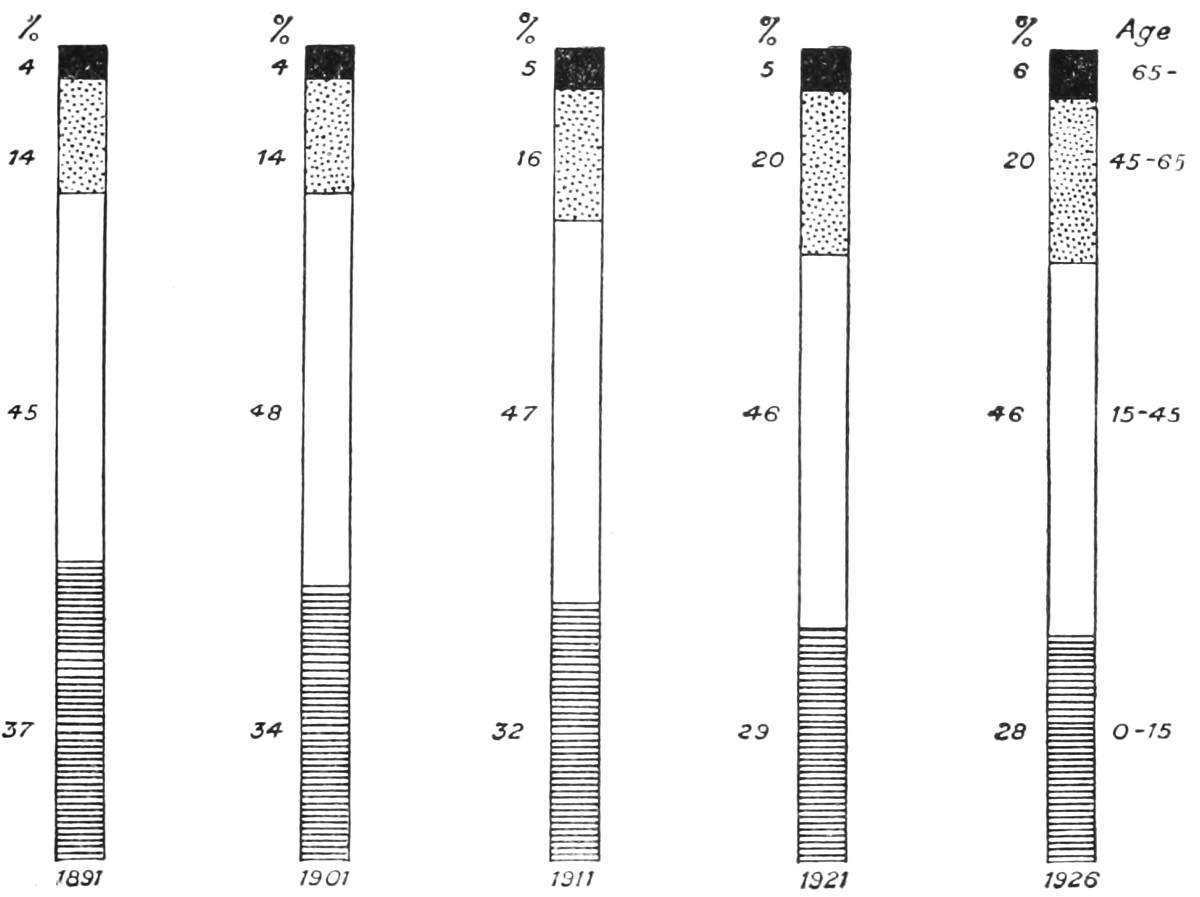
Fig. 134. Diagram illustrating the alteration in the Percentage of Age-Distribution of the population of England and Wales from 1891 to 1926. It will be observed that the people of England and Wales have been getting steadily older.
Statistical statements, however, vary greatly in their value and ease of interpretation. The simplest statistical statements with which the medical man has to deal are perhaps those which relate to surgical operations. The categories in which the patient may be placed are here limited; he may die, recover, improve, or get worse. If the operation is a quite simple one, and if the surgeon is perfectly honest, and also—which is rarer—quite unbiased, a small body of statistics may carry immediate conviction as to the value of an operation. Thus, Lister’s first results with amputation, as obtained under his antiseptic conditions, at once satisfy the mind, although the conclusions are based on only forty cases (p. 240). No surgeon at once both able and willing to appreciate these results would hesitate to adopt the new method.
The operation of amputation is, however, in a statistical sense, a particularly simple matter. The patient must either undergo the operation or not, and the proportion of cases in which the necessity is doubtful is very small. Further, he either recovers or dies—for the operation could hardly be in itself unsuccessful, nor the surgeon in doubt as to whether the patient had recovered or not. Many operations, however, are not of this order. They may be performed for conditions as to the exact nature of which the surgeon is uncertain, and for symptoms which may be only partially relieved. Thus, the removal of the appendix for Appendicitis may be most urgently necessary for the saving of life in one case and may be a matter of convenience for the relief of more or less indefinite symptoms in another. Further, what one surgeon calls appendicitis another may not. One surgeon may have every appendix that he removes submitted to skilled pathological examination before he accepts the case as one of appendicitis and places it among his statistics. Another may be quite content with naked-eye appearances of the nature of which he alone is witness, judge, and reporter. It is, therefore, clear that any collective statement as to the results of such an operation must be cautiously scrutinized before conclusions of the slightest scientific value can be drawn from them.
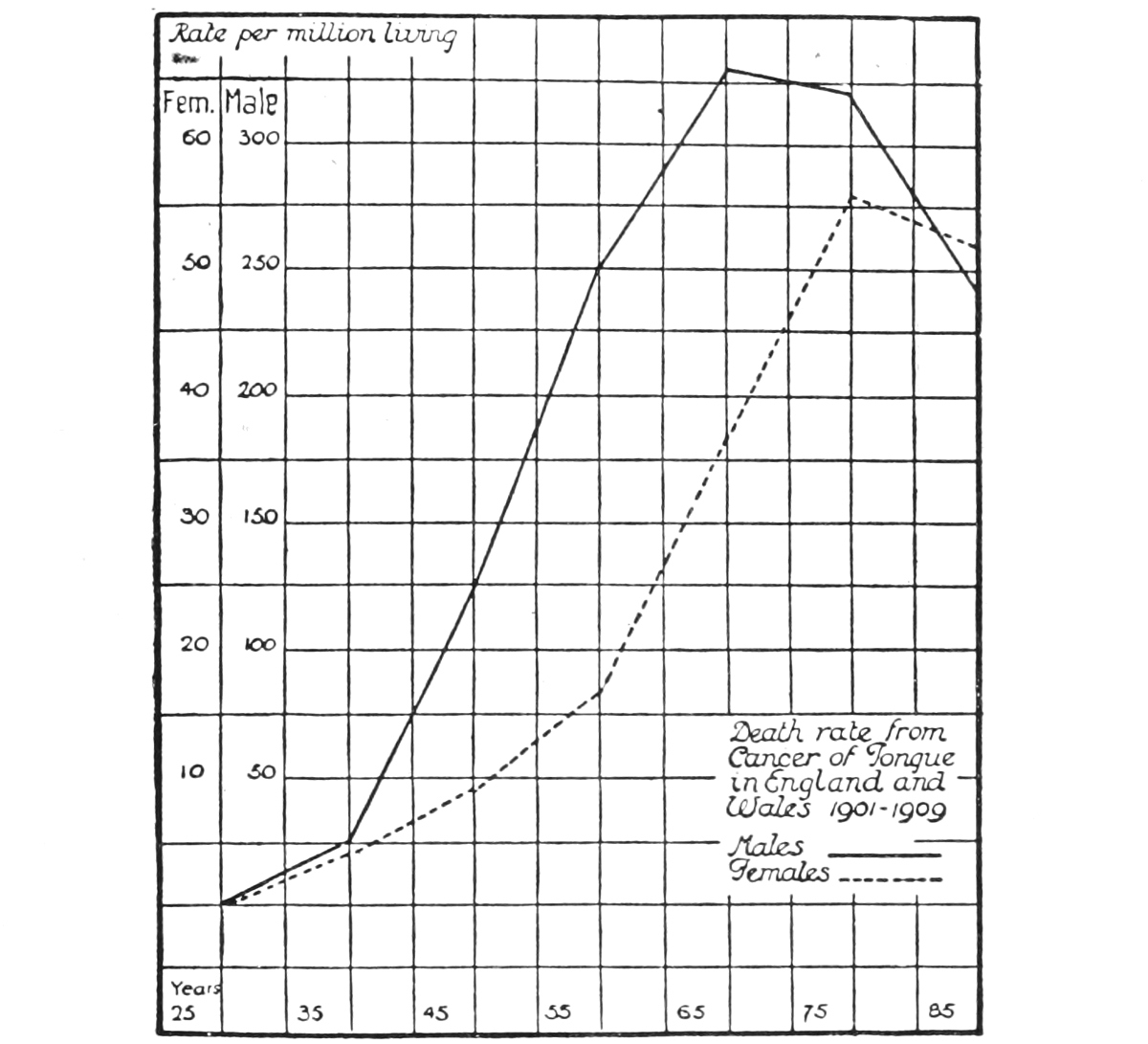
Fig. 135. Death-rate from Cancer of the Tongue. It will be observed that it is not a common cause of death till about 45 years of age, but that it then increases rapidly to fall again in both sexes in old age. These features are clearly related to various factors in the causation of the condition. One of these is certainly Syphilis, which is most frequently contracted between 20 and 30 and more often by men than women. The so-called ‘tertiary’ effects of this condition, some of which lead to Cancer of the Tongue, do not usually make themselves felt, however, for many years after infection. Contrast Fig. 136 and Fig. 137.
There is a common and rather foolish saying that ‘Statistics may be made to prove anything’. This is true, but it is true only in the sense that evidence may be made to prove anything. The matter turns on the questions, firstly whether the evidence is of a good or a bad order, and secondly whether the investigator is in a good or bad position to interpret the evidence. A statistical statement may be well or ill founded and well or ill interpreted, but statistical statement is, in fact, the only scientific method open to us for presenting long series of data. The conclusions to be drawn from those data, though sometimes evident and easily elicited, at other times demand specially skilled and specially trained interpreters. Moreover, to be of value to others, such interpreters must also be skilled in expression, so that the main body of those who have no statistical training may be in a position to understand the essential elements in their conclusions. In no medical department is literary power of greater importance than in that which deals with statistics. Thus has arisen the small but highly important class of medical statisticians. The rise of medical statistics into a vocation places the crown on Medicine as a science. It is not given to many medical men to be proficient in this department. But the duty lies on all medical men, and indeed on all citizens, to appreciate the value of this study and to seek to appraise its simpler and more established conclusions.
It is remarkable how frequently a straightforward statistical statement may remove a false impression, even when the impression is based on evidence not of a wholly unscientific character.
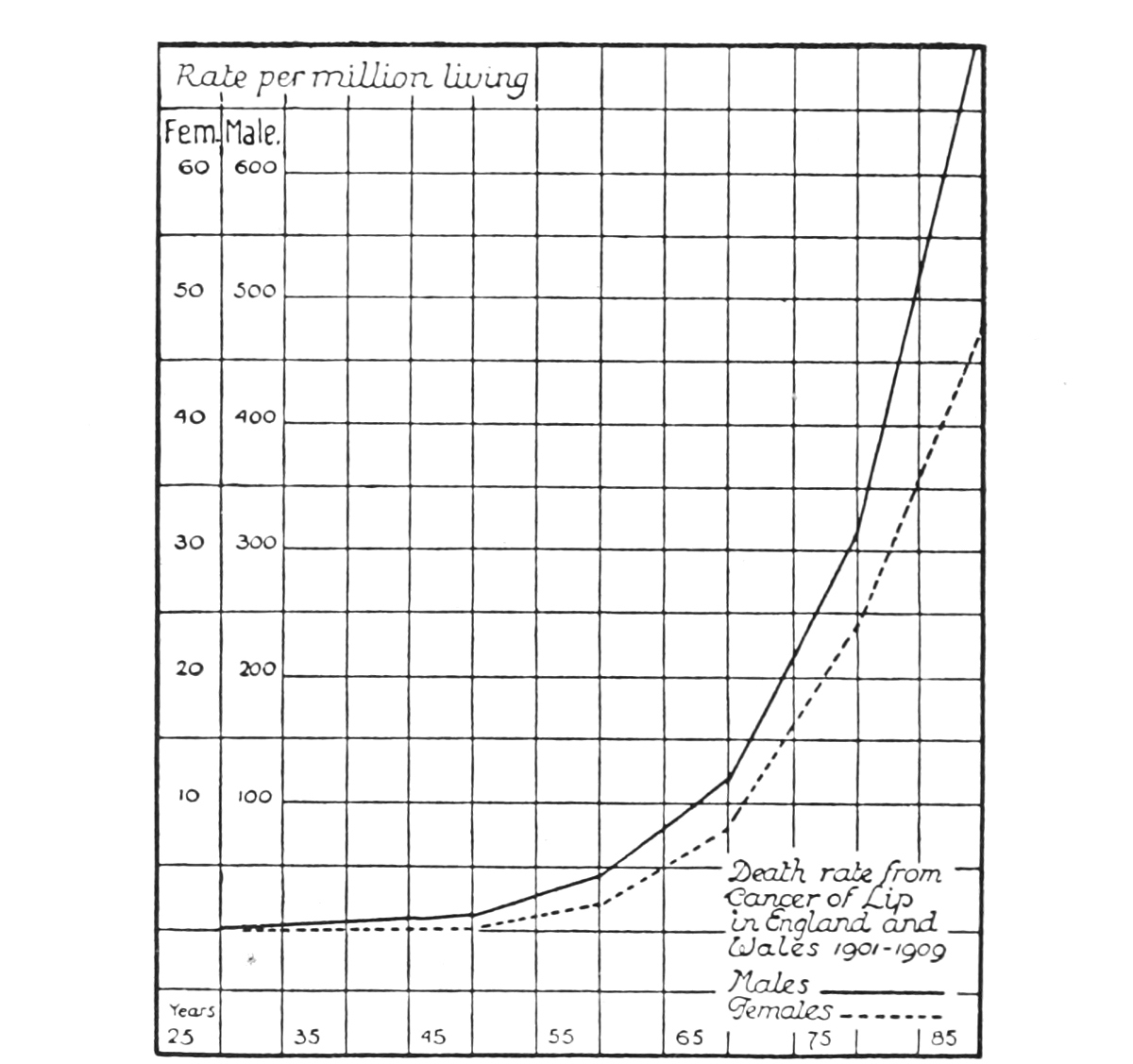
Fig. 136. Death-rate from Cancer of the Lip. It will be observed that this curve resembles in form that of the death-rate from Cerebral Haemorrhage as shown in Fig. 137, but differs from that of the death-rate from Cancer of the Tongue as shown in Fig. 135. The chances of dying from Cancer of the Lip are negligible till middle age is past and then increase progressively throughout life. In the causation of Cancer of the Lip Syphilis is not an important factor. On the other hand the continuous irritation of pipe-smoking, which acts not at one age but throughout life, has to be considered as a causative element. Hence the resemblance to Fig. 137 rather than to Fig. 135.
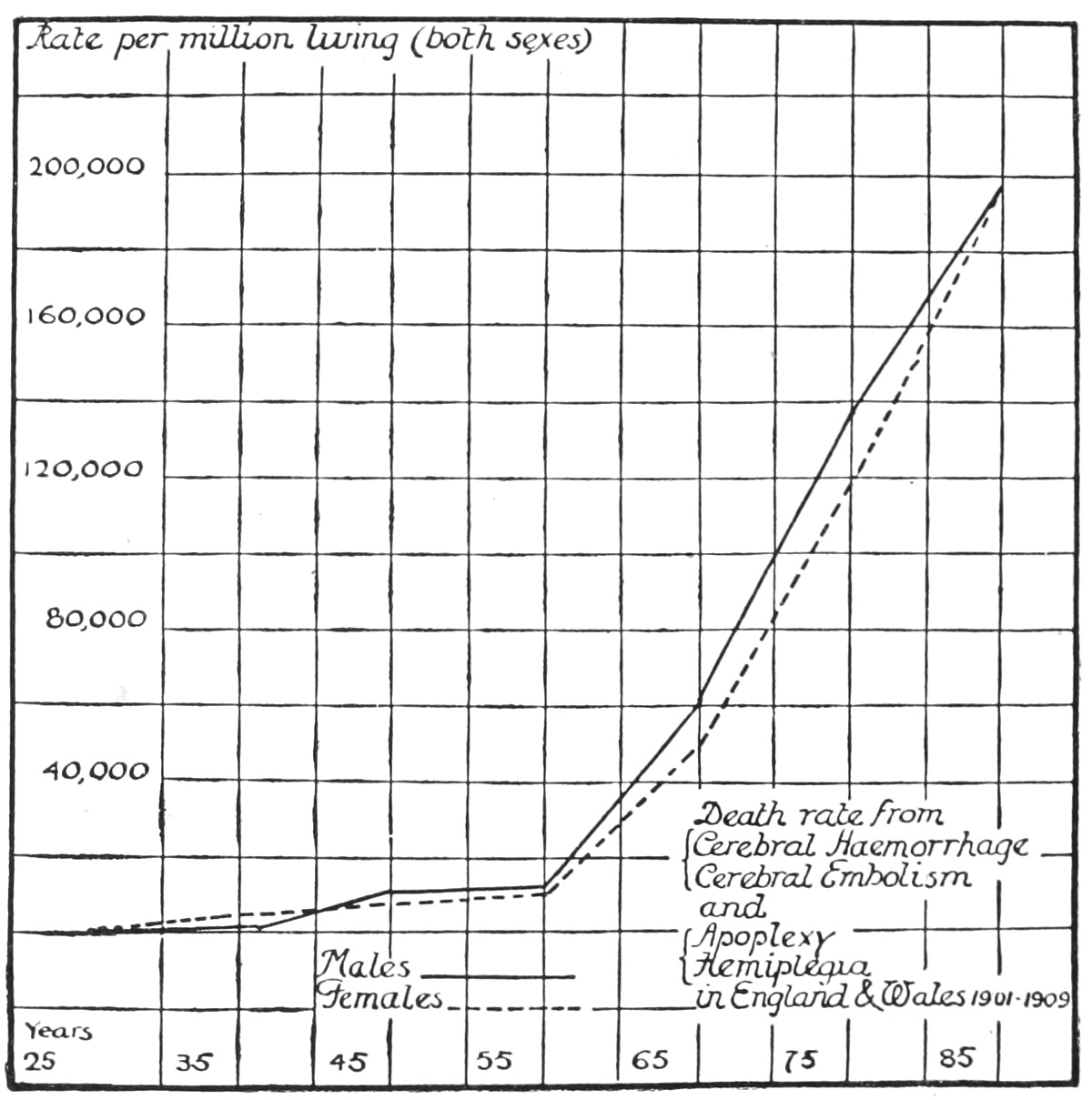
Fig. 137. Chart of death-rate from Cerebral Haemorrhage and Allied States. These conditions are extremely rare in the young, but among the commonest causes of death in later life. The liability to them increases progressively to extreme old age. This is explained by the fact that Cerebral Haemorrhage, etc. follows on the rupture of a blood-vessel in the brain and the rupture of the vessel is conditioned by the hardness and brittleness of its coat. The hardness of the arteries increases progressively in later life, whence the saying ‘a man is as old as his arteries’.
For example the increase in the incidence of deaths from Cancer has often been emphasized. But Cancer is a disease of advancing life. The age distribution of the death-rate from many forms of Cancer is closely parallel to that of certain other forms of senile disease (Figs. 136 and 137). Now the age constitution of the population of most civilized countries is altering in the sense that the proportion of the elderly and aged is constantly increasing (Fig. 134), so that some increase in the Cancer incidence must be expected. Moreover the appearance of some increase in the incidence of Cancer is due to improved diagnosis. How far there is a real increase, when these factors have been taken into account, is still somewhat doubtful. It must always be borne in mind that a relative decrease in the proportion of deaths from any cause must automatically increase the proportion of deaths from other causes.
Again, there is no doubt of the fall in the death-rate in England and Wales from ‘Phthisis,’ or pulmonary tuberculosis, during the last fifty or sixty years. There is also no doubt of the effect both of bad housing and of urban conditions in inducing a susceptibility to chest disease in general and to pulmonary tuberculosis in particular. Further, there is no doubt that the rural population suffers less from pulmonary tuberculosis than the town population. These matters of common medical knowledge have naturally led to the conclusion that the rise of the great towns has led to a great increase of pulmonary tuberculosis, and that this increase has been remedied by the improved housing and sanitary conditions of the last generation. A study of the statistical evidence, however, negatives this view. The rise in the proportion of deaths from pulmonary tuberculosis took place before the Industrial Revolution. Moreover, the proportion began to fall long before the campaign against tuberculosis could affect the issue. The history of pulmonary tuberculosis may, in fact, be regarded as that of an ‘epidemic’ outbreak, extending over about 100 years, of a disease which has always been endemic and remains so now that the epidemic is past.
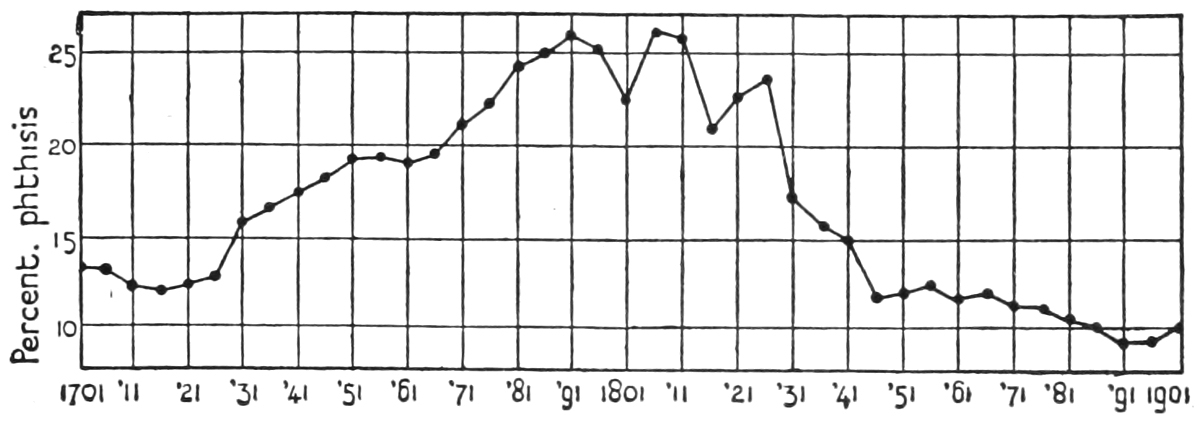
Fig. 138. Curve showing percentage of deaths from Phthisis to total deaths from all causes in London over a period of 200 years. It will be seen that the percentage begins to rise definitely about 1730 and to fall definitely about 1830. This state of affairs may be pictured as an epidemic lasting about 100 years.
These points are well brought out in the accompanying diagram (Fig. 138). The fall in the proportion of deaths from Phthisis expressed there gives rise to further considerations. It might seem that the statement that the proportion of those who died from phthisis was diminishing left in itself no doubt that the disease was less prevalent than formerly. This, however, is not the case. Phthisis is more liable to affect those under forty-five years of age than those who are older. Now the proportion of the population that is under forty-five is steadily diminishing (Fig. 134). This is one of the results of the steadily diminishing general death-rate (Fig. 96, p. 196). Therefore the proportion of the more susceptible to the less susceptible is diminishing. It might have been the case (though it is not) that the ratio (more susceptibles)/(less susceptibles) was not only decreasing but was actually decreasing more rapidly than the ratio (total deaths)/(deaths from phthisis). Had this been so, the conclusion would have been justifiable that the fall in the proportion of deaths from the disease did not correspond to any decrease in its infectivity. In fact, however, the prolonged high mortality from phthisis and its later rate of fall do suggest the former prevalence of a more virulent type of the disease over a long period, in other words something of the nature of a prolonged epidemic.
This conclusion leads us to the conception of the nature of an epidemic. To gain some conception of the ideas involved in that word, we must glance back in history.
From the time of Hippocrates onward the subject of Epidemic outbursts of disease has drawn the attention of physicians. A writer in the Hippocratic Collection thought he could perceive an association of symptom-complexes with each other and with the weather. In the great work Epidemics, to which the name of the Father of Medicine is attached, such a view, known as that of ‘Epidemic Constitutions,’ is set forth. The view was revived by Sydenham in the seventeenth century and has given rise to a vast literature extending to our own time. In the eighteenth and nineteenth centuries the attempts of the investigators of vital statistics to place the leading events of life in a form capable of exact analysis (pp. 166-68) focused attention on the search for a mathematical expression for the rise and fall of epidemic diseases.
The first successful attempt to describe epidemics along these lines was made by William Farr (1807-1883), an official in the office of the Registrar-General in London, and one of the greatest of all epidemiological thinkers. His first publication on the subject was in 1840, and had reference to the recent outbreak of small-pox, in which more than 30,000 had died in England and Wales. It was his merit to observe that the successive decreases in the number of cases in successive equal periods during the decline of the epidemic correspond to the successive increases in the number of cases during successive equal periods of the rise of the epidemic. In other words, he observed that the rise and decline of an epidemic tend to be mathematically symmetrical.
Farr’s suggestion that epidemics are liable to follow the lines of regular mathematical rules drew little attention at the time, but in a later year it led to a most remarkable and striking prophecy. At the end of 1865 Cattle-plague broke out in England. Week by week the number of cases increased. In the fourth week of February 1866 the responsible Minister, in a speech in Parliament, gave a very gloomy account of the state of affairs, expressing the belief that the devastation would be far beyond what had yet been encountered. Farr, however, had been watching the returns, and had been applying his rule to them. He thereupon made a public pronouncement of his belief that at an early date the outbreak would reach its maximum and would then decline. The outbreak did, in fact, very closely follow the course which he had predicted by reasoned calculation. Farr even prophesied the number of cases that would occur week by week. His prophecy was near the truth.
During the years that followed Farr’s prediction his views were applied with success to a variety of epidemic conditions. The regular form of the development of the epidemic was found to apply in certain outbreaks of typhus, measles, and other conditions.
Farr’s law was more exactly expressed by him in 1868. It remained, however, simply a mathematical law, a rule of which the underlying cause was not apparent. It was soon observed that his law applied to many but by no means to all epidemics. Moreover, it was perceived that the actual figures which he gave for his epidemic of 1840 resembled those of certain other epidemics in that they could be fitted with greater or less exactness to a well-known mathematically described curve, known as the ‘normal curve of error’. We need not discuss the mathematical foundation of this curve, which is shown in two variants in Fig. 139. For our immediate purpose it is enough to observe that it rises gradually at first, but then more steeply, that the steepness decreases after a while, and then the curve begins to decline again, as it rose. We note that it is symmetrical.
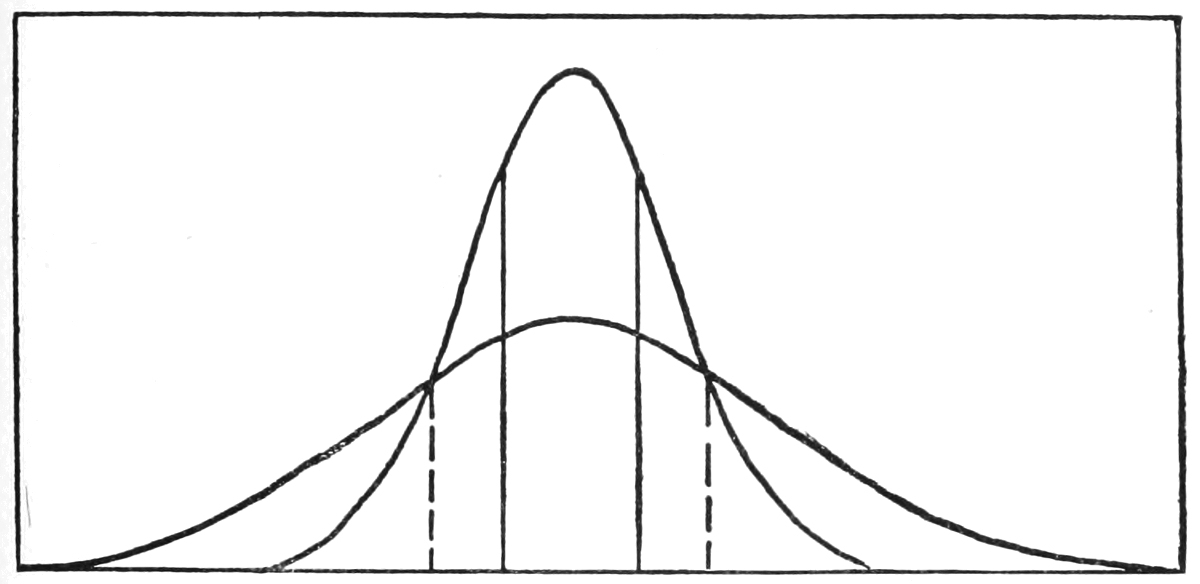
Fig. 139. The Normal Curve of Error, shown in two types made with the same formula but with different constants. This curve has been shown to be similar to that representing the incidence of cases in some Epidemics.
Vertical lines are drawn from two pairs of symmetrical points. The continuous lines refer to the higher curve, the broken lines (from the points of intersection of the two curves) refer to the lower curve. The lines will be seen to divide the curves into three parts. This division is of such a character that the sum of the two lateral areas is equal to the central area for each case.
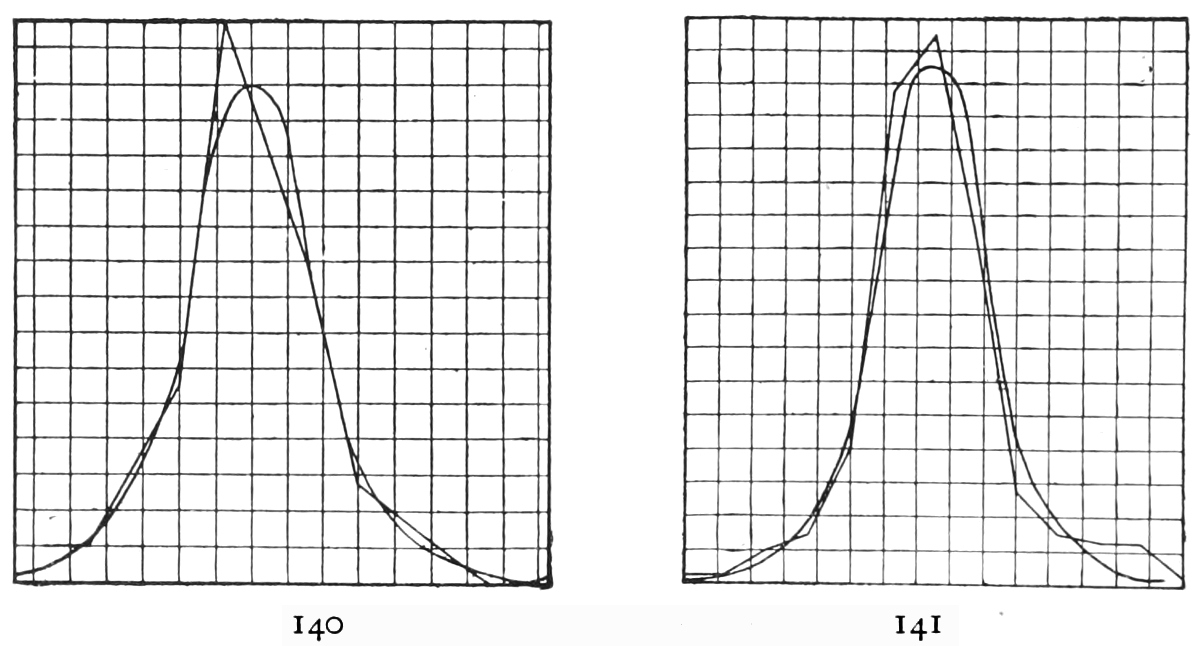
Fig. 140. Curve of monthly number of deaths from Small-pox during an epidemic at Warrington, Lancashire, in 1743.
Fig. 141. Curve of weekly number of cases of Scarlet Fever registered during an epidemic at Glasgow in 1892.
Both curves are fitted to the theoretical epidemic curve, and are modified from Brownlee. The curves are in both cases explained on the assumption that the infectivity, having reached a high point at the beginning of the outbreak, decreases thenceforward in geometrical progression.
When we are dealing with living beings or are dealing with things that may indefinitely approximate to a mathematical rule, but never entirely fit it. Especially when the living beings are also human beings, with their infinitely complex relationships, various factors are present which interfere with the exact application of mathematical findings. Nevertheless, the theoretical form of the epidemic is an extremely useful framework into which actual epidemics may often be fitted, with greater or less exactness. In the accompanying figures (Figs. 140-141) are adduced cases of greater exactness. There are, however, many cases in which an ‘outbreak’ does not seem to fit the simple theoretical curve at all. Examination of such curves has in some cases suggested that we have not one epidemic or disease but two or more to deal with. In some cases it has been possible to analyze the outbreak on the basis of two or more theoretical curves, suggesting in fact two or more outbreaks of similar but not identical causation (Fig. 142).
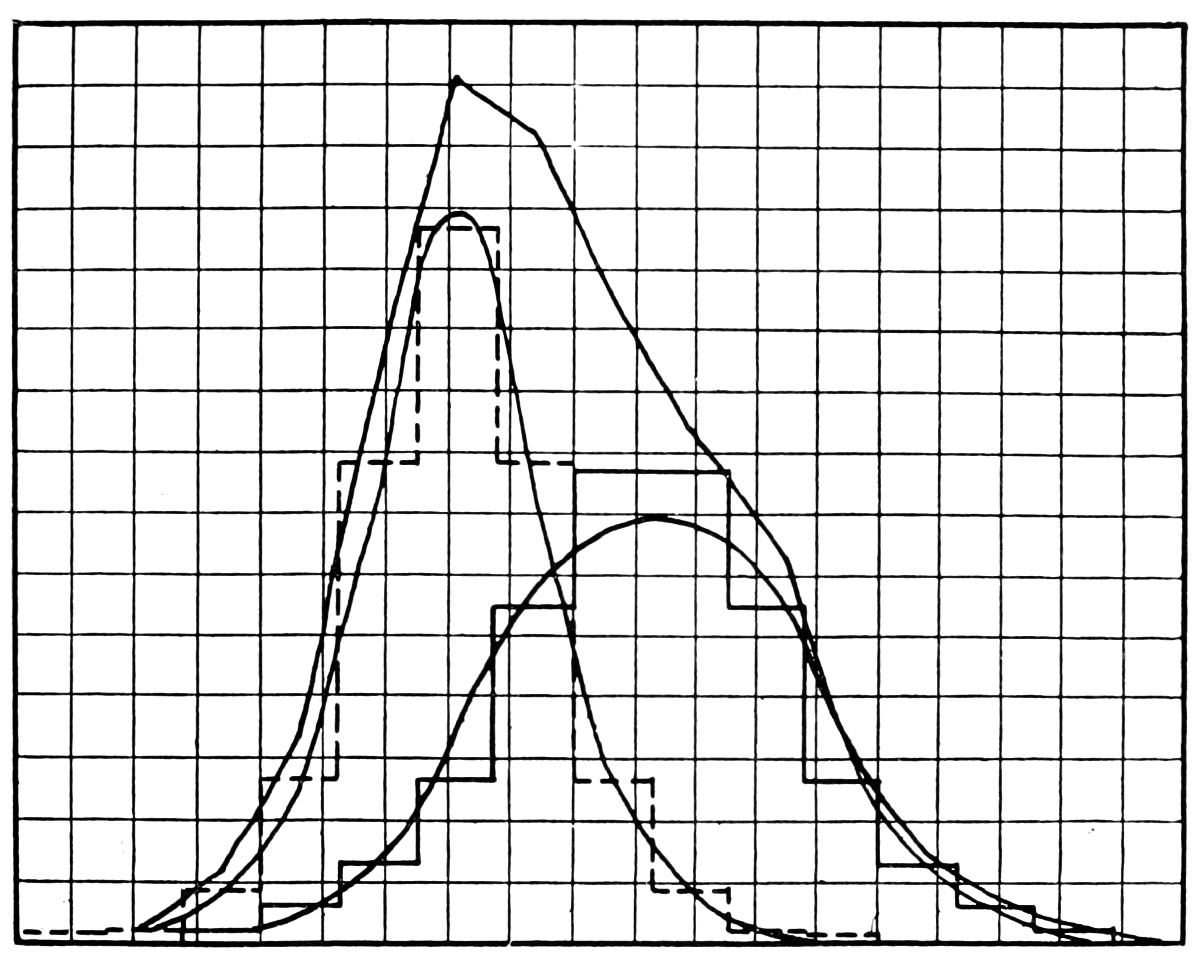
Fig. 142. THE CURVES OF SOME EPIDEMICS, which do not follow the theoretical curve, may be analyzed as compounded of two or more epidemics, each of which accords individually to the mathematical rule. Thus ‘Summer Diarrhoea’ is a seasonal disease very fatal to infants in England during the hot months, July and August. The angular curve shows the average daily incidence of deaths from this disease in London during the fifty-three years 1850-1903. It can be analyzed into two of the theoretical epidemic curves.
Each reading of the curve, calculated from the actual cases of ‘Summer Diarrhoea of Infants’, can be divided into two, as indicated in the step-like readings, one dotted and the other continuous. These accord beautifully with two theoretical curves, thus indicating not one but two recurrent epidemics. It thus seems probable that two separate sources of infection are confused as ‘Summer Diarrhoea of Infants’.
What can be the causative element which constrains the incidence of a disease in a population to follow mathematical rules? An answer was provided by John Brownlee (1868-1927), the late statistician to the Medical Research Council of England. The leading fact about an Epidemic is that it rises to a maximum, falls, and then dies out, and that the curve representing the number of new cases in a series of equal and consecutive periods of time throughout the Epidemic is symmetrical. In practice the decline is usually a little slower than the rise. This is sometimes, at least, due to better observation and record of the later cases. Now why does an Epidemic die out? The possible reasons may be reduced to three. Firstly, the end of an Epidemic may be due to the exhaustion of susceptible persons in the population. That is to say, all the survivors are immune, either being so by nature or having become so by having contracted the disease and recovered. Secondly, it is conceivable that the liability to the disease should be decreased, not by rise in the proportion of immunes, but by externally acting causes, as, for instance, by rise of seasonal temperature, which would provide conditions under which the organism loses its infectivity. Expressed in older language, this is to say that the ‘Epidemic Constitution’ (p. 342) has changed. Thirdly, the infecting organisms may, of their own inner nature, lose their infectivity. The second factor may act in special cases, but may be disregarded except in those cases. We are, therefore, left with the first and third.
Now it is possible to construct curves that would correspond to the exhaustion of the supply of susceptible persons by continuous increase of the proportion of those who become immune either by taking the disease or by dying. These curves, however, have the character that their descent is more rapid (and neither as rapid nor less rapid) than their ascent. It is the merit of Brownlee to have suggested that the actual curve of the Epidemic corresponds to a known though very little understood biological phenomenon, namely change in the infectivity of the invading organisms. The simplest expression of his discovery is that the loss of infectivity of these organisms is approximately in the ratio given by a geometrical progression. That is, if the infectivity of the Epidemic be m, and at the end of a unit of time mg (when g is less than unity), at the end of a second unit of time it will be mg2, and at the end of the third mg3, and so on. Assuming this to be a fact, the course of Epidemics would follow the curve of normal error (Fig. 139).
Of late years it has been possible to institute artificial epidemics in a series of animals under control conditions. Such experiments must, in the nature of the case, cover a large number of years, but they bid fair to throw much light on the nature and progress of human epidemics.
These results seem to show, what was believed on other grounds, that in the case of highly infective disease, to which, in any population, there are many highly susceptible, isolation of declared cases has little or no effect on the course of the Epidemic. Such diseases are Scarlet Fever, Measles, Influenza, &c. Moreover, the experimental epidemics seem to confirm the conclusions of Brownlee that in some cases at least the course of the epidemic is determined by biological changes within the parasitic beings that cause it.
Thus in the end our health, our lives, and indeed the continuance of our civilization may well depend upon a factor which is outside ourselves. For reasons which we know not, the pullulating billions of living things which are around us, upon us, within us, take up a virulence which before they had not, and after a time they lose that virulence to become as they were before. The world is devastated by an outbreak of Plague, of Cholera, of Influenza. But how and why the organisms that carry these diseases should acquire a new and more deadly infectivity lies among the secrets yet locked within the living cell. Life—the life of the Cell, of the Bacterium, of Man himself—remains among the Arcana Naturae. These are the secret things that in their essence—which is Life—remain and will remain behind the veil. From such cells we came, through such cells we shall return. As to what is the force which starts these processes on their way, we are as ignorant as children, and must remain so, in essence, till we understand the nature of the processes of coming into being and passing away. So Medicine must end where she began, quaking before the Mystery of Life, a Mystery which could only be resolved if we could express Mind in terms simpler than itself. If this could be done the veil that is cast over all flesh would indeed be rent. But the author of this work believes that the hope of this is vain and that we are here in the presence of one of the ultimate things.