V THE PERIOD OF CONSOLIDATION (FROM ABOUT 1700 TO ABOUT 1825)
Reading edition
§ 1. The Reign of Law.
During the sixteenth and seventeenth centuries the human mind cast off its medieval vestments and, having refreshed itself at the spring of Antiquity, turned to array itself in the garments of the New Philosophy. The advent of new ideas and new knowledge had been very rapid. The method of Research had been determined by Galileo at the beginning of the seventeenth century. The meaning of Research was determined by a second great investigator, Newton, at the end of the same century.
The change wrought in the thought of their time by Vesalius, Galileo, Harvey and their like was quantitative rather than qualitative. They discovered new laws of Nature, but the discovery of such new laws was hardly unprecedented. Law had been traced in the heavens from of old. The rules of planetary and stellar motion had been gradually developed from the simple astronomical theories of the ancients. The great astronomers of the sixteenth and seventeenth centuries did not hesitate to appeal to the records and doctrines of medieval writers, for new mathematical relationships of the heavenly bodies had been elicited even during the Middle Ages. In the sixteenth century Astronomy under Tycho (died 1601) put her house in order for the ‘Great Instauration’ of the coming age. And then Galileo startled the world (1604) with that new star of his (p. 104), among the most remote heavenly bodies in the very region held by the Aristotelian and Platonic schemes to be utterly changeless. The Revolution in Thought had begun, though no new order had been established.
By 1618 Kepler had enunciated his ‘three laws of planetary motion’, bringing these movements into an intelligible relation with each other. Then the experimental philosophers set forth to establish terrestrial mechanics. They determined the mode of action of gravitation, and Galileo came near to the ‘three laws of motion’ which we call Newton’s. But it was Newton who first affirmed them clearly and succeeded in linking them with Kepler’s laws of planetary motion. Before Newton, no man had shown or perceived that rule by which the natural succession of earthly phenomena is in relation to that of the heavenly bodies. Nay, Faith and Reason alike would have been against such a view. To prove that the relationship amounted to identity, to move men’s minds to see that the force that causes the stone to fall is that which keeps the planets in their path, this was Newton’s unique achievement. It was Newton who first enunciated a law whose writ ran alike in the Heavens and on the Earth. With Newton the Universe acquired an independent rationality, and the whole cosmology of Aristotle, of Galen, and of the Middle Ages lay in the dust.
When Newton had completed his work, the Gravitation of the Earth and of the Heavens was seen to be one, and all the Mechanism of the Universe lay spread before him. The vision was set forth in his Principia (1687). It established a view of the structure and working of the Universe which has survived to our own generation.
And now as to the change wrought in men’s minds. It was something more than a Revolution. It was the establishment of a New Order. Newton conceived a working Universe wholly independent of the Spiritual Order. As to how far his vision is philosophically tenable and as to how far he realized its nature, these are matters which we need not discuss here. There can, however, be no doubt that Newton utterly destroyed the very foundations of medieval thought. With Newton there sets in the last stage of ‘scientific determinism’.
During the two centuries and a half since the Principia appeared, Science has developed prodigiously along the lines into which Newton led her. In reliance on the universality of Natural Law, the stars in their courses have been paced, weighed, measured, analysed. The same process, directed to our own planet, has traced its history, determined its composition, demonstrated its relation to other bodies. Physicist and chemist have suggested a structure in terrestrial matter similar to that of the stars and suns. The world has been reduced to a unitary system. Wherever men have sought Law, they have found Law. With search skilful enough and patient enough, Law has ever emerged. It has been the Age of the Reign of Law.
It is true that in our own time philosophers in general have come to see that these Laws of Nature are within us as much as without; that they are, in part at least, the result of the structure of our minds. This is a point of view, however, which has not affected, and perhaps will not affect, the working man of science. His constant occupation, since the days of Newton, has been the pursuit of Law, and he has always been satisfied that Law has only to be sought in order to be found. This conception has affected the medical and biological sciences very deeply. Thus the influence of the Newtonian philosophy is as traceable in them as it is in the astronomical and physical sciences. Galileo showed men of science that weighing and measuring are worth while. Newton convinced a large proportion of them that weighing and measuring are the only investigations that are worth while. The question as to whether this view is ultimately true or philosophically justifiable does not need discussion at the moment. The point, for our immediate purpose, is that the view has been and is very widely held.
§ 2. The Rise of Clinical Teaching.
The eighteenth century dawned with the refreshing breeze of Newtonian philosophy blowing through it. During the previous two hundred years there had been an immense amount of new and fruitful research along diverse lines. Chemistry and Mechanics, Botany and Comparative Anatomy, Descriptive Anatomy and Experimental Physiology, Epidemiology and Microscopic Analysis, all had yielded startling results. The new generation was bewildered with the very mass and novelty of the material. The Biologists of the time must have been well nigh hopeless of reducing their vast accumulations to order, when they contemplated the beauty and symmetry of the mathematical relations that Newton and his followers had introduced into Cosmic conceptions. Thus the eighteenth century is a period for Biology of pause and consolidation during which attempts were made to introduce unitary conceptions into the mass of accumulated material. It was, moreover, a period of consolidation not only of ideas but also of teaching. These tasks at first turned men’s minds away from the immediate accumulation of further knowledge. So it is that the first half of the eighteenth century exhibits something of a gap in the progress of Research. The medical field is largely filled by two great figures, Boerhaave and Haller.
Until the seventeenth century there was no systematic clinical teaching. The Universities gave medical degrees on the basis of a spoken disputation. No contact with the patient was demanded. The first effective attempt to change this was at Leyden, where about 1636 clinical teaching was instituted. Owing to this, and to the fact that, as at Padua, students of every religious denomination were accepted, Leyden became much frequented by foreign and especially by Protestant students. The attractions of the place were increased by Sylvius (pp. 131-2) who, in the second half of the seventeenth century, added laboratory instruction to his clinical teaching. Leyden had several eminent anatomists, while its botanic garden and museums added to the practical character of the medical instruction that it offered.
Hermann Boerhaave (1668-1738) was first appointed as a teacher at Leyden in 1701. At once the medical school attained a front rank reputation which rapidly came to surpass even that of Padua. Boerhaave had very few beds at his disposal, but never did man make better use of his opportunities. Besides clinical, chemical, botanical and anatomical instruction he followed such of his patients as died into the post-mortem room and there demonstrated to his students the relation of lesions to symptoms. He is thus the introducer of the method of medical instruction still in vogue in our modern medical schools.
Boerhaave was a man of wide culture. He rescued and published the plates of the priceless Bible of Nature of Swammerdam (p. 121). He brought to Leyden the best anatomist of his age, Bernard Siegfried Albinus (1697-1770). With him Boerhaave edited in superb form the collected works of Vesalius (1725, p. 85 ff.). The edition exhibits remarkable prevision of the scientific needs of the scholarship of our own time. To Albinus, and indirectly to Boerhaave, we owe the most beautiful of all works on muscular anatomy (1747), a book still in current use (Fig. 66). Apart from his clinical ability and acumen Boerhaave was a skilled chemist, botanist, and anatomist.
With all these accomplishments Boerhaave was better able than any man of his time to achieve something like a medical synthesis, to bring all the sciences to the service of the patient. Taking one thing with another, considering his influence as a teacher, his clinical acumen, his power of inspiring younger workers, his wide learning, his balanced vision, his eagerness for new knowledge, his sanity, his humanity, his generosity, and his prophetic power, Boerhaave must be regarded as the greatest physician of modern times. To him the debt of British Medicine, and through it of British well-being, is quite incalculable. Through his pupils he is the real founder of the Edinburgh Medical School, and through it of the best medical teaching in the English-speaking countries of the world. The success of the Edinburgh school, founded while the great Leyden professor was still in his prime, can be ascribed to two causes which are perhaps reducible to one—the inspiration of Boerhaave. These two causes are, firstly, the enthusiasm of its early teachers, and, secondly, the concentration of all the medical teaching, both clinical and subsidiary, in one great university school.
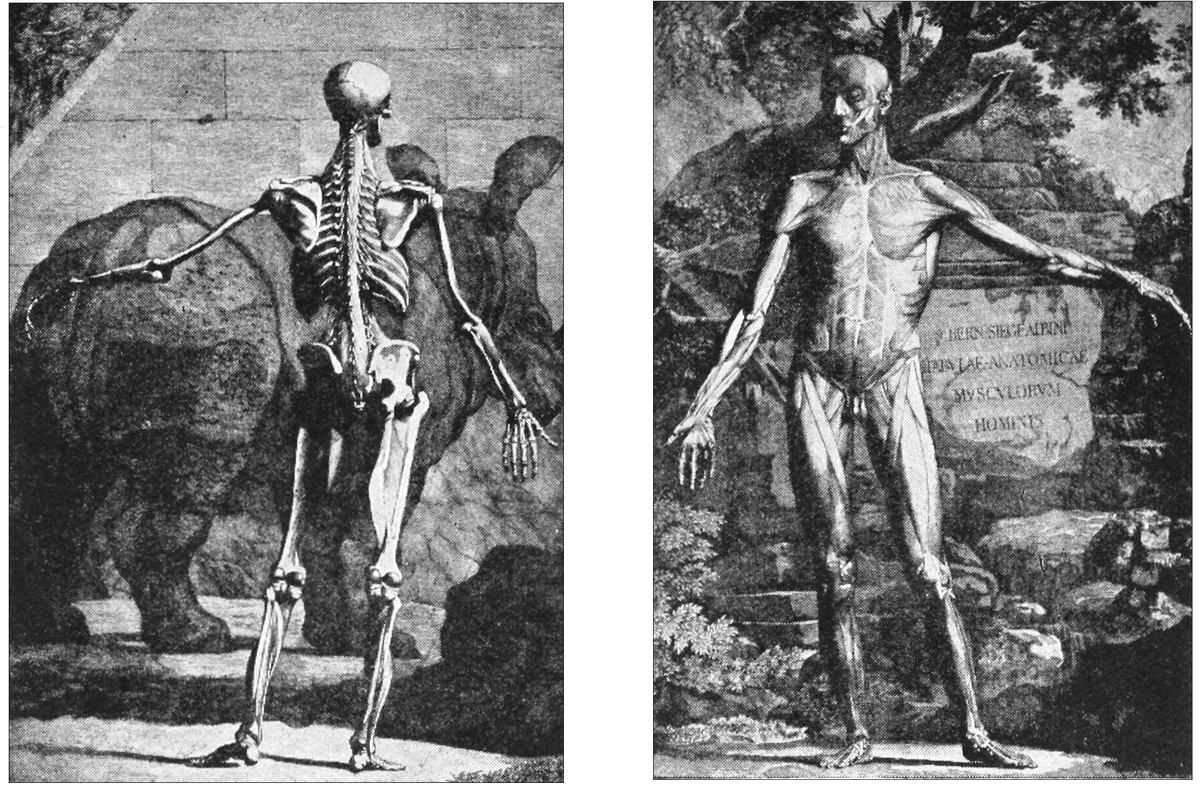
Fig. 66.
TWO PLATES FROM BERNARD SIEGFRIED ALBINUS.
Anatomical Plates of the Muscles of Man
, Leyden, 1747.
These are the most beautiful and among the most accurate anatomical figures ever published.
§ 3. Physiology passes to the Modern Stage.
The only figure in the eighteenth century whose influence is comparable to that of Boerhaave is his pupil, the Swiss Albrecht von Haller (1708-77), one of the most accomplished men of all time. In actual scientific achievement Haller stands, indeed, far above his master. He achieved distinction as poet, botanist, anatomist, and novelist, carried on a prodigious correspondence, was an exceedingly learned bibliographer, and perhaps the most voluminous of all scientific authors. His special distinction, however, is as a physiologist.
Haller’s great work, Elements of the Physiology of the Human Body (1759-66), marks the modernization of the subject of which it treats. Of the highest importance were his researches on the Mechanics of Respiration, on the formation of bone, and on the development of the embryo. He did good work on the action of the digestive juices. His most important contributions, however, are his conceptions of the nature of living substance and of the action of the nervous system. These conceptions formed the main background of biological thinking for a hundred years, and are still integral parts of physiological doctrine.
All departments of Medicine must be influenced by the views we may hold on the nature and action of the nervous system, just as all parts of the body are influenced and indeed are linked together by that system. Thus the growth in knowledge of the physiology of the nervous system is extremely important to us if we would gain a true idea of the progress of Rational Medicine.
When we look into the history of nervous Physiology before Haller, we shall be struck by the smallness of the observational foundation of a vast speculative structure. That we may be the more charitable in our judgment of such fanciful developments, we may recall that the Mind is so constructed that it can take little interest in the accumulation of instances unless it can adduce general laws therefrom. Theory is thus as necessary to practice as practice to theory. The earlier doctrines of the nature of nervous action are, however, so unlike those we now hold that we can afford to pass over them lightly. They consist of speculations on the topic of the seat of the soul, together with explanations which suppose the passage either of a fluid or of some chemical change down the nerves. Haller was the first to construct a theory of the nervous system that has an appearance of modernity.
During the seventeenth century the favorite doctrine of nervous action supposed the existence of a nervous fluid. This, it was held, passed down the nerves to inflate or extend the muscle fibers. Inflation was supposed to shorten the fibers and so the muscle came to contract. An exquisite experiment by Swammerdam with his nerve-muscle preparation had disproved this (p. 123). But Swammerdam’s work was unknown till published by Boerhaave in 1736, and so the matter stood till Haller’s time.
Haller concentrated the problem on an investigation of the fibers. A muscle fiber, he pointed out, had in itself a tendency to shorten with any stimulus, and afterward to expand again to its normal length. This capacity for contraction Haller, following a predecessor, called irritability. He recognized the existence of ‘irritability’ as an element in the movement of the viscera, and notably of the heart, and of the intestines. The feature of ‘irritability’ is that a very slight stimulus produces a movement altogether out of proportion to itself, and that it would continue to do this repeatedly so long as the fiber remained alive.
But besides the force inherent in a muscle fiber Haller showed that there was another force which comes to it from without, is carried from the central nervous system by the nerves, and is the power by which muscles are normally called into action. This force, like that of irritability, is independent of the will, and like it can be called into action after the death of the animal. Haller thus distinguished the inherent muscular force from the nerve force. Both these forces he further distinguished from the natural tendency to contraction and expansion, under changing conditions of humidity, pressure and so on, of all tissues, living or dead.
Haller, having dealt with the question of movement, turned to that of feeling. He was able to show that the tissues are not themselves capable of sensation, but that the nerves are the sole channels or instruments of this process. He showed how all the nerves are gathered together into the brain, and he believed that they tended to its central part. These views he supported by experiments and observations involving injuries or stimulation to the nerves and different parts of the brain. He ascribed special importance to the cortex, but the central parts of the brain he regarded as the essential seat of the living principle, the Soul.
Throughout his discussion Haller never falters in his display of the rational spirit. He develops no mystical or obscure themes, and, although his view of the nature of Soul may lack clarity, he separates such conceptions sharply from those which he is able to deduce from actual experience. He is essentially a modern physiological thinker, and certain of his themes were developed by workers who come on the frontiers of what we have called the ‘period of consolidation’.
Among these workers we would select the Scottish surgeon Sir Charles Bell (1774-1842), who in 1811 showed that of the two roots from the spinal cord by which all the nerves of the body arise one root conveys only sensory elements while the other conveys only motor elements (Fig. 98, p. 208). By this discovery Bell not only completed the views of Haller on the central nervous system, but also brought them within the range of practical Medicine.
§ 4. Some Physiological Advances.
Haller provided a philosophical basis to physiological conceptions. There were, however, other workers of the time who added to the knowledge of actual workings of the animal body. First among these, both in time and eminence, stands the English country clergyman Stephen Hales.
The Rev. Stephen Hales (1677-1761) was by temper a biologist, but he had received a training in Mathematics and Physics. With this ideal equipment, he proceeded to investigate the Dynamics of the Circulation. His method consisted in applying the principle of the pressure gauge or manometer to living things. By tying tubes into the arteries and veins of animals, he was able to record and measure the blood-pressure. He thus laid the foundation of an important mode of studying the diagnosing disease. He extended his exact investigations into most of the mechanical aspects of the circulation. He computed the circulation rate and he estimated the actual velocity of the blood in veins, arteries, and capillary vessels. He made a very important contribution by showing that the capillary vessels are liable to constriction and dilatation, a knowledge that has since become not only important for physiological theory but of primary significance to the practising physician (p. 309). He began to explore the wonderful mechanism of the heart by which that organ adjusts itself to its needs of output. He exhibited his versatility by important contributions to many other departments, as, for instance, his discoveries on Respiration, his improvements in Ventilation (Fig. 67), and his campaign for Temperance. All his work is characterized by simplicity and directness, the supreme marks of his genius.
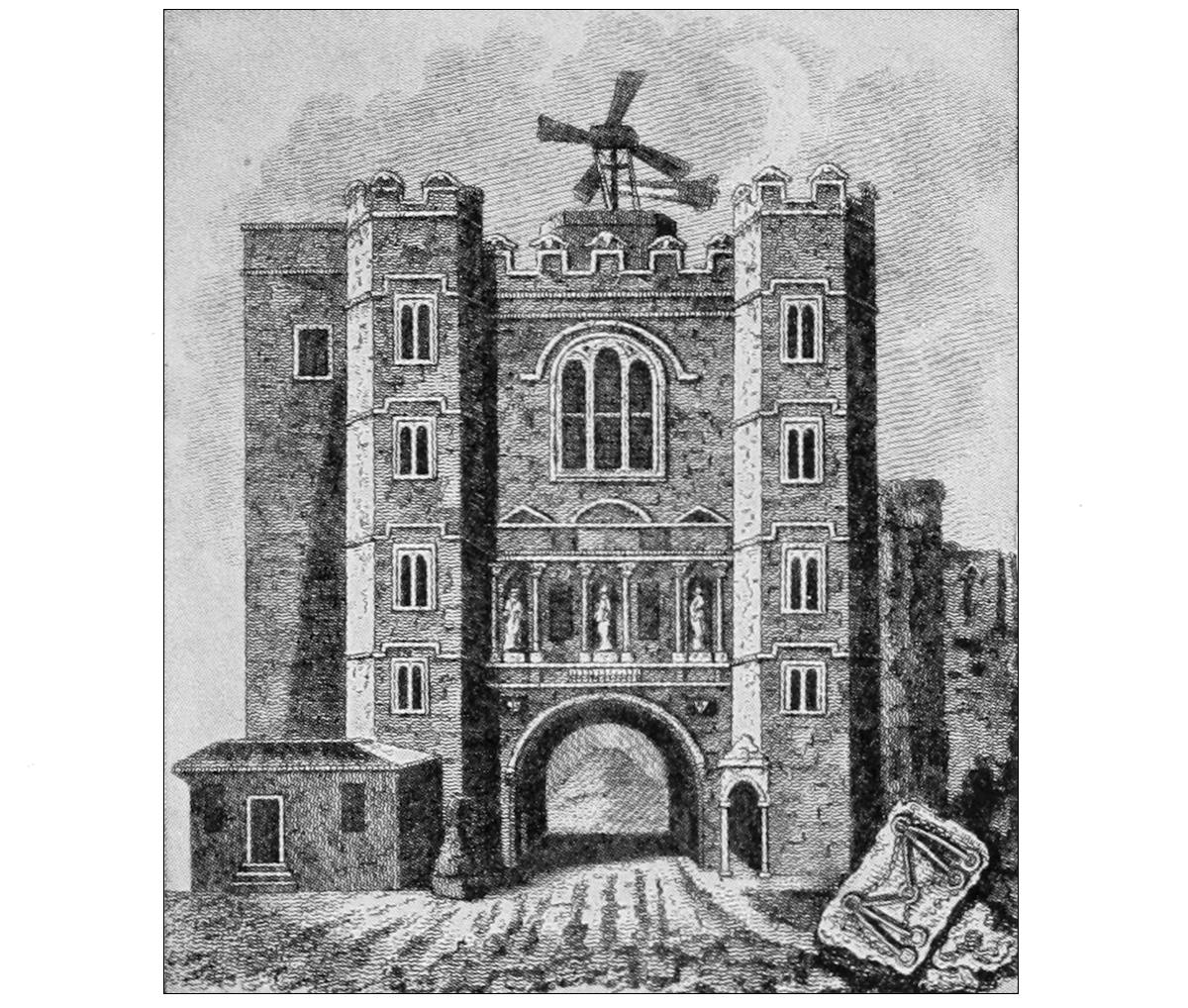
Fig. 67. WINDMILL VENTILATOR designed by the Rev. Stephen Hales, and erected by order of the Aldermen of the City of London, in 1752, on the roof of Dick Whittington’s Gate at Newgate Prison. From a print in the British Museum.
In the meantime considerable progress was made in the knowledge of the digestive processes. The French naturalist, René Antoine de Réaumur (1683-1757), best remembered for his thermometer (1731) and for his superb work on insects (1734-42), made a series of experiments on gastric digestion in birds (1752). By an ingenious contrivance he succeeded in obtaining gastric juice in a pure state. He was able to demonstrate its power to dissolve food substances in a test-tube kept at body temperature. This was important, since many believed that the process of solution was the result of a churning process induced mechanically by the muscles of the stomach-wall. Réaumur thus gave the death-blow to the Iatrophysical conception of digestion (p. 130).
The investigation of gastric digestion was further pursued by a versatile Italian, the Abbé Lazaro Spallanzani (1729-99), who showed that the churning action is an aid, but not an essential, to the process of digestion (1782). He proved that digestion was not of the nature of putrefaction and differed essentially from the fermentation of wine. Spallanzani thus improved on the view of Sylvius (p. 132), and took a step towards that solution of the natures of putrefaction, fermentation, and digestion which was finally provided by Pasteur (p. 225). He showed that the gastric juice was secreted by the stomach itself, and not introduced into it from other organs. A suspicion that the gastric juice contained a free acid crossed his mind. He observed that it curdled milk and so began our knowledge of a separate ferment, that of ‘rennet’. Spallanzani’s results may be summarized by saying that he showed that gastric juice had a solvent power sui generis, and that this power or faculty was of a different order from putrefaction or vinous fermentation.
The phase of digestive physiology represented by Réaumur and Spallanzani was brought to a close by the English physician William Prout (1785-1850), who demonstrated in 1823 the existence of free Hydrochloric Acid in the stomach. He showed that the presence of this acid was necessary for gastric digestion, but that the actual process of solution of food was the work of another agent. The matter was at last brought into the range of medical practice by an American Army Surgeon, William Beaumont (1785-1853), who, in the ten years ending 1833, had the opportunity to investigate gastric juice in a man who, having been shot in the stomach, had a permanent fistula. Through this the juice could be obtained and the lining membrane of the stomach examined at will.
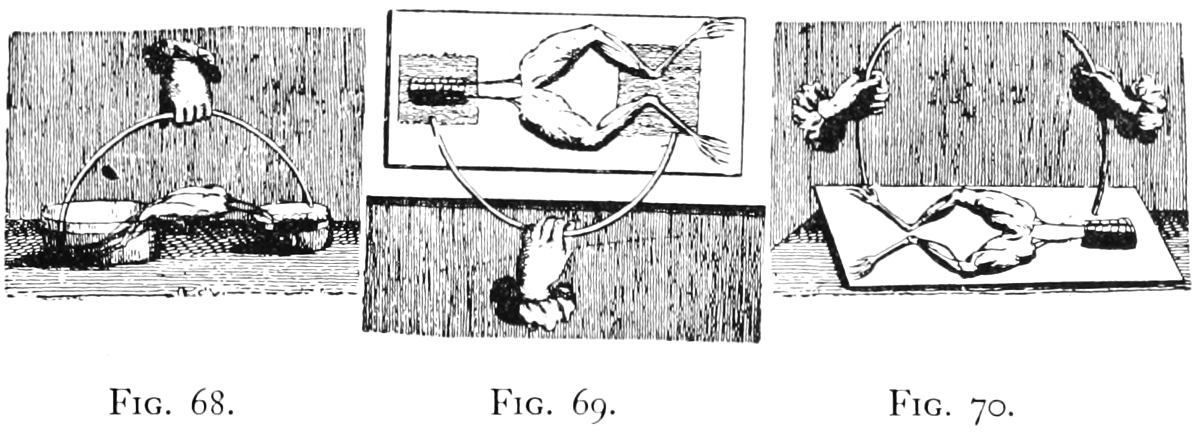
Experiments illustrating the effects of metallic contacts on the nerves and muscles of frogs’ legs. From A. Galvani, On Electric Forces, 1792.
Fig. 68. Contact is established between water in two dishes. In one lies the end of the nerve with the spinal cord and vertebral column attached. In the other are the feet of the frog.
Fig. 69 shows contact by a metal bar with two damp mats on one of which lies the spinal cord and on the other are the feet.
Fig. 70 shows a broken contact which can be completed by bringing the metal rods together.
An important department of Physiology was opened by the extension of the knowledge of electric phenomena to the living body. Static electricity had been studied since the beginning of the seventeenth century. Luigi Galvani (1737-98) of Bologna, while investigating the susceptibility of nerves to irritation, showed that nervous action could be induced by electrical phenomena (1791). He was, as a matter of fact, producing an electrical current. Many thought at the time that a new kind of ‘animal electricity’ had been produced and they dubbed it ‘galvanism’.
Alessandro Volta (1745-1827) of Pavia, deviser of the ‘Voltaic pile’ (Figs. 71-3), had long been working at electricity. He was able to demonstrate (1800) that galvanism is without any essential animal relationship, and showed that a muscle can be thrown into continuous contraction by repeating electric stimulations.
Humbug and misunderstanding in connection with the electrical relations of living tissues were rife, and it was not till after the period we are now considering that electricity came to take a place in rational Medicine. The change came with E. Du Bois-Reymond (1818-96), who took the matter up scientifically about the middle of the nineteenth century (1843 onwards). He showed that a nervous impulse is accompanied by the passage along the nerve of a change of electrical potential. It should be added that, despite all the work since done upon the nervous system, this is still the only physical accompaniment of a nerve impulse that has been detected.
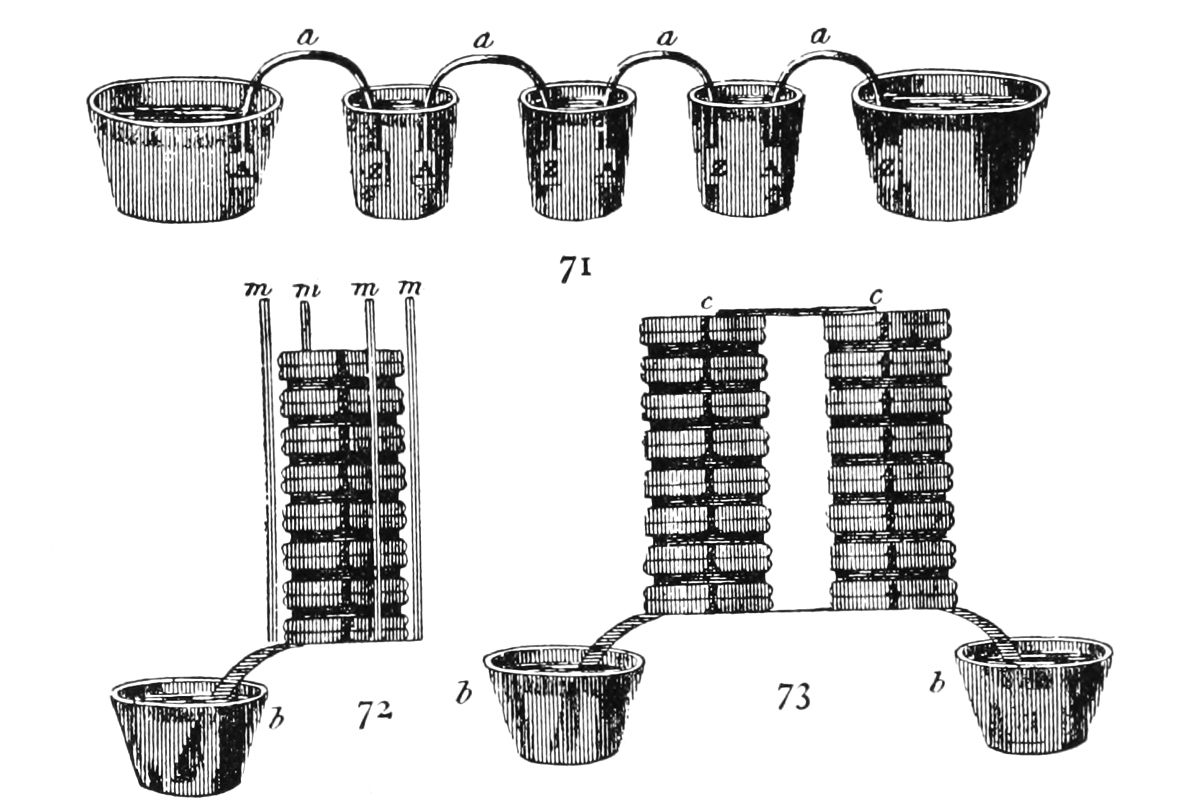
Figs. 71, 72, and 73. From an article by Volta, On the Electricity excited by the mere Contact of Substances of different kinds, published in 1800.
Fig. 71 is the famous ‘Couronne de tasses’. It consists of a series of vessels containing salt water, in which are steeped plates of alternate silver A and zinc Z. The plates are connected by strips of metal a a a. If the first and the last cup be connected by a conductor, a current flows from one to the other.
Fig. 72 is a simple voltaic pile, consisting of alternate disks of silver and zinc, sandwiched between wet strips of leather. The pile is held by glass rods m m m. From the lowermost disk a strip of metal passes to a vessel containing salt water. A current will pass from the uppermost disk to the vessel if the two are connected by a conductor.
Fig. 73 is a similar apparatus with two piles connected by a metal plate c c, and two vessels b b. A current will pass between the two vessels b b if they are joined by a conductor.
§ 5. Discovery of the Nature of the Air.
The seventeenth century saw advances in the knowledge of the air. Boyle (1654, p. 124) had shown by means of his air-pump that air was a material substance and could be weighed. By exhausting the air from a vessel in which an animal had been placed, he showed that it was this material substance and no ether, spirit, or other mysterious entity which supported respiration. Mayow (1668, p. 126) proved that a part only of the air was necessary for life, and later that this same part was removed equally by respiration and combustion (Figs. 74-5). His work was forgotten for a hundred years. The great theorists, Stahl, Boerhaave and Haller, knew him not, and Stahl’s doctrine of phlogiston set back the hands of the clock. No advance was made till the work of Joseph Black (1728-99) which appeared soon after the middle of the eighteenth century.
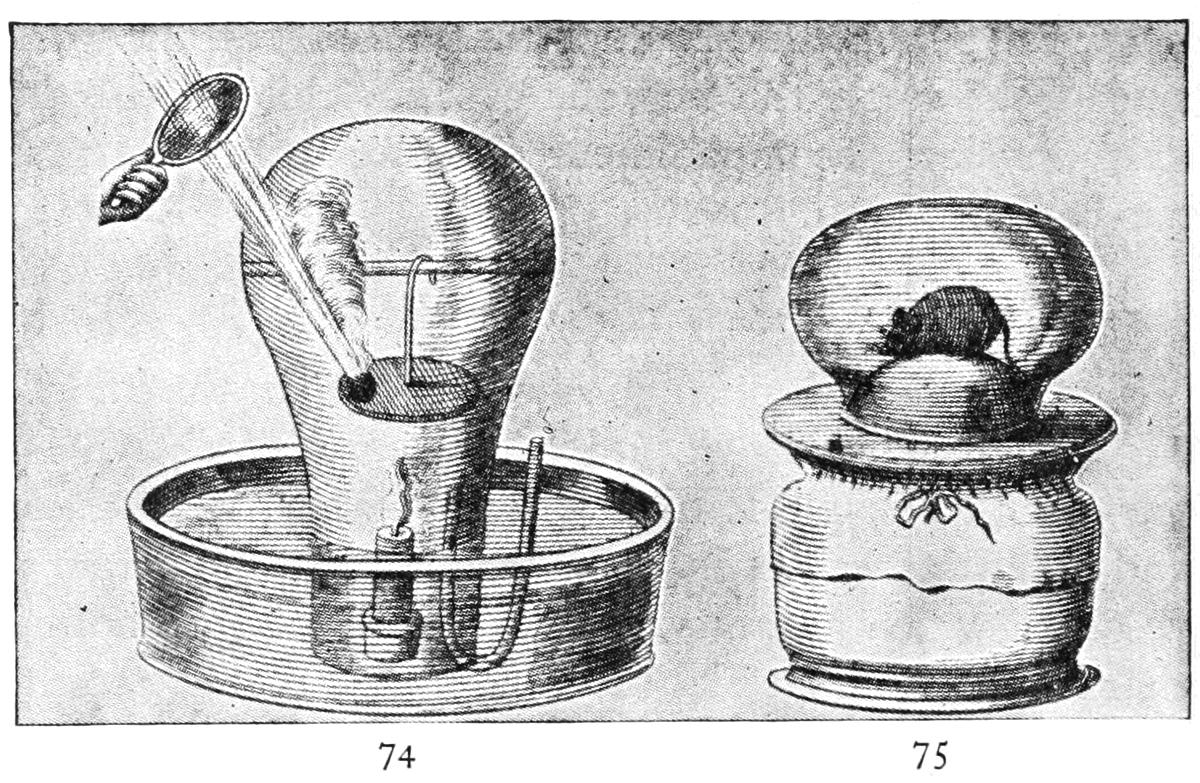
Figs. 74 and 75, illustrating the chemistry of burning and breathing, from a work issued by Mayow in 1674. The experiments show the essential similarity of the two processes in their effect upon the air.
Fig. 74. A candle is burning and a piece of inflammable material is being ignited in a glass vial by a burning-glass, the mouth of which is under the surface of the water. The air can, if desired, be changed or sampled through the attached tube.
Fig. 75. A mouse confined under a glass cover. The air under this cover communicates with that in the vessel below, and can be cut off more or less completely by means of a more or less porous diaphragm.
Black was a cautious investigator and his success was due to the accuracy of his measurements. He was aware of the fact that chalk, when heated, is transformed into quicklime (equation 1, p. 152), thereby losing its power of effervescing with acids, but gaining the power of absorbing water (equation 2). In modern nomenclature, the changes are:
(1) CaCO3 = CaO + CO (2) CaO + HO = Ca(OH)2
The first achievement of Black was to show that in the process of heating the chalk lost weight (equation 1). This was a blow at the phlogiston theory, for it had been supposed that quicklime consisted of chalk plus phlogiston, and that the phlogiston was conveyed to it during the heating. Black now showed that if slaked lime be treated with a mild alkali, such as the carbonate of sodium, it is changed back to the state in which it was before heating, in fact into chalk, while the mild alkali is converted into a caustic alkali. As we now express it:
(3) Ca(OH)2 + Na2CO3 = CaCO3 + 2NaOH
Black’s triumph consisted essentially in showing that reactions (1) and (3) were indefinitely reversible and that the same amount of CaCO3 could always be extracted from (3) as was put into (1). Moreover, he showed that a definite amount of chalk, whether heated into quicklime or not, neutralized an equal weight of acid, the only difference being that the neutralization took place with effervescence and loss of weight if the chalk were unheated, and without effervescence or loss of weight if the chalk were first heated into quicklime. Thus:
(4) Unheated CaCO3 + 2HCl = CaCl2 + H2O + CO2 (5) Heated CaO + 2HCl = CaCl2 + H2O
The substance given off by the chalk in (1), absorbed by it in (3), and produced by the reaction (4), he named fixed air. We now call it Carbon dioxide. The conversion of caustic lime into ordinary chalk by exposure, CaO + CO2 = CaCO3, proves that Carbon dioxide is a normal constituent of the atmosphere. Black learned something of its properties, and his work is also of very great importance as the first detailed quantitative study of a chemical reaction and its reversal. The properties of Carbon dioxide were further investigated (1766) by Henry Cavendish (1731-1810).
The next advance in the chemistry of the air was made by the English Unitarian Divine, Joseph Priestley (1733-1804). A series of important observations was made by him in the seventies and eighties of the eighteenth century. He showed that green growing plants would make respired air again respirable, and that they gave off a respirable gas. In 1774 he prepared Oxygen by heating certain oxides, though, still hampered by the phlogiston theory, he failed to recognize the nature of the oxygen he had produced. The conclusions of his striking experiments on blood, which he showed to depend on this same agent for its changes from venous to arterial, were similarly vitiated.
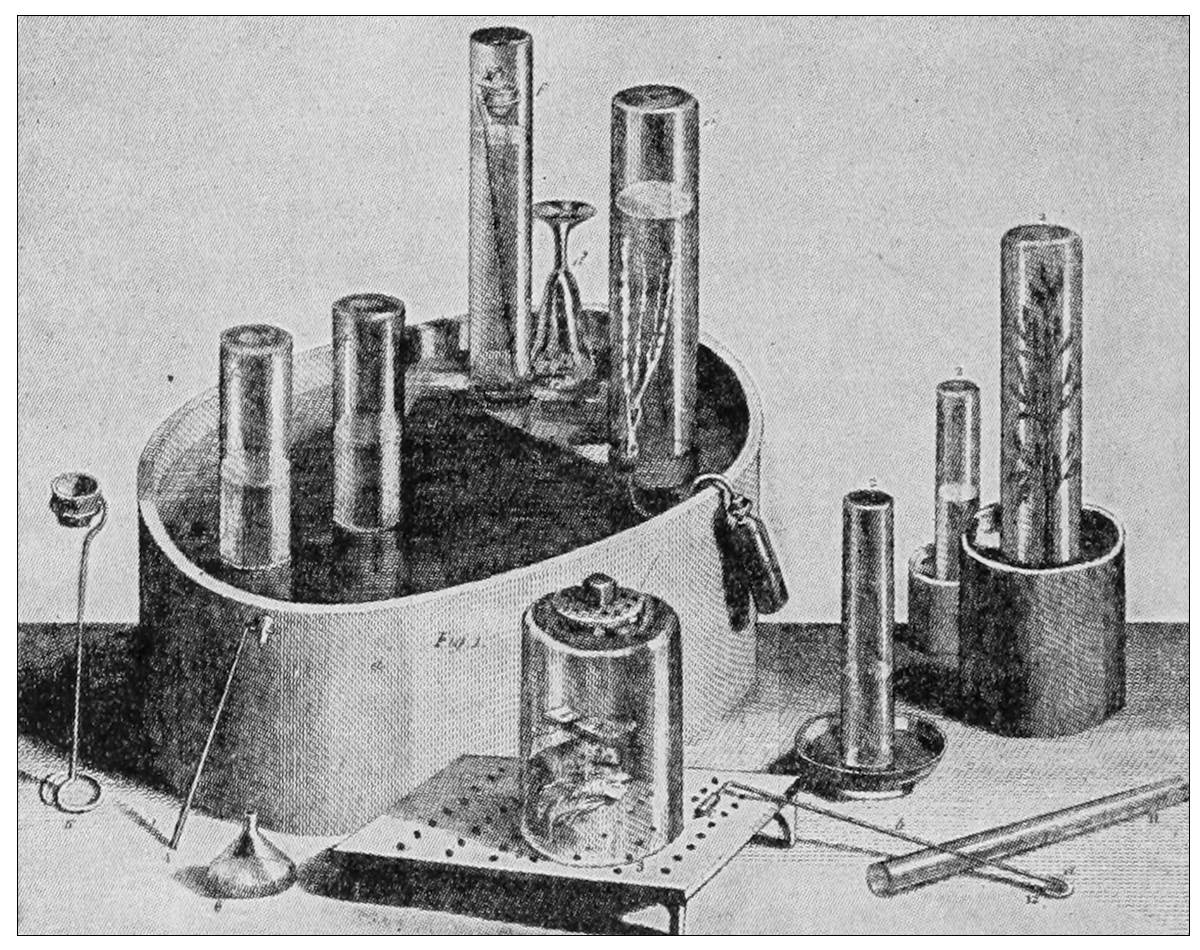
Fig. 76. APPARATUS from Joseph Priestley’s Experiments and Observations on different Kinds of Air, Birmingham, 1774. In the background can be seen an experiment on the effect of combustion on confined air. There are also two cylinders inverted over water in which green plants are growing. In one of them the growing plant has given off a gas (oxygen) which Priestley showed could support both combustion and respiration. In the foreground under a bell-jar are some mice on which Priestley performed respiratory experiments.
The real passage to the modern point of view in our knowledge of the air was made by the brilliant French chemist Antoine Laurent Lavoisier (1743-94). He made an extensive quantitative investigation of the changes during breathing (Fig. 77), burning, and calcination. In the course of these he discovered the true composition of respired air, and showed how both Carbon dioxide and water are normal products of the act of breathing. If clear grasp of the implication of discovery be made the test, Lavoisier must be regarded as the discoverer of Oxygen.
Cavendish (1731-1810) had already discovered the composition of water (1785). Lavoisier concluded that water and Carbon dioxide are produced by the process of oxidation in the lungs, and that it is this oxidization process, and not any innate quality of a mysterious character in the body or in the blood, that is responsible for the bodily heat. Lavoisier introduced much of the chemical nomenclature that we still employ. So far as respiration is concerned, subsequent research has added much to his standpoint. In the purely chemical aspect, however, it has altered little, though we now know that the tissues and not the lungs are the seat of oxidation.
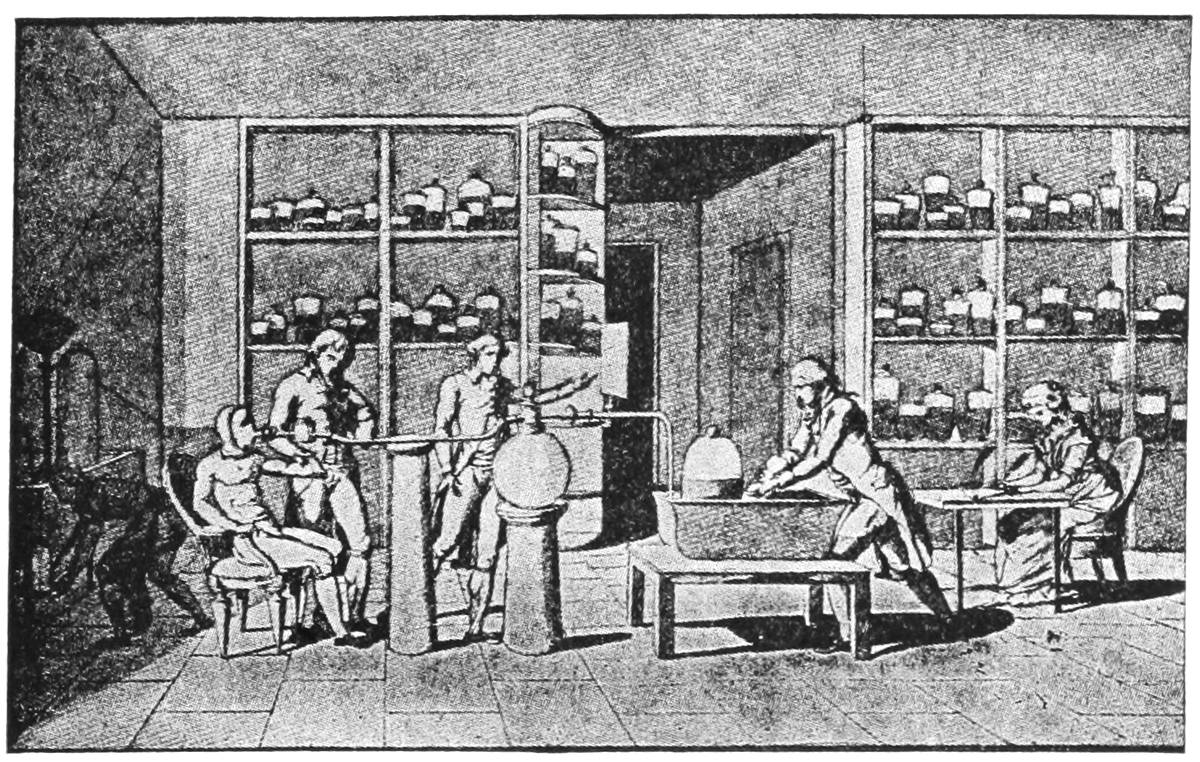
Fig. 77. LAVOISIER in his laboratory making experiments on breathing. To the right Madame Lavoisier sits at a table, taking notes. Lavoisier stands behind, directing. To the left is the subject of the experiment. His face is covered with a mask provided with a valve. He is breathing into the apparatus. An assistant feels his pulse while a second assistant collects the respired air in a bell-jar inverted over a trough.
From a contemporary sketch.
§ 6. Morbid Anatomy becomes a Science.
The main intellectual movement of the seventeenth and eighteenth centuries had been focused, so far as Medicine was concerned, on the manner of working of the animal body, the department that we now term Physiology. It was necessary to obtain clear concepts of the action of the body in health before venturing into discussion of its action in disease. Towards the end of the seventeenth century, an industrious compiler had put together all the then published records of post-mortem examinations up to his time. During the first part of the eighteenth century many practitioners in Physic and in Surgery published isolated cases or groups of cases connected with particular diseases. Boerhaave regularly attended post-mortem examinations (p. 140). No general pathological principles had, however, yet been elicited on a scientific basis. The theories of disease such as those of Boerhaave were perforce still mainly speculative, for there were no extensive records of the correlation of symptoms during life with the appearances of the organs of the body after death, the subject we now call ‘Morbid Anatomy’. This gap was first effectively bridged by Morgagni.
Giovanni Battista Morgagni (1682-1771) was professor at Padua for no less than fifty-six years. During this time he performed an enormous number of post-mortem examinations, and made important contributions to Descriptive Anatomy. In his seventy-ninth year, eleven years before his death, there emerged from his enormous experience his work On the sites and causes of disease. This classical treatise may still be read with profit. Its leading feature is the very careful way in which actual cases are recorded. The life-history of the patient, the history of his disease, the events in connection with his final illness and death, are all recounted with detail and care. The condition of the organs at the post-mortem examination is minutely described and an attempt is made to explain how the symptoms were the result of the lesions. Morgagni is justly said to have introduced the ‘anatomical concept’ into the practice of medicine. This concept is one of the main elements in modern diagnosis, and a modern physician, in reflecting on a case, considers first whether he is able to express the symptoms in terms of lesion. There are many lesions of great importance and frequent occurrence which Morgagni was the first to describe.
The task which Morgagni had undertaken was worthily continued by the Scot, Matthew Baillie (1761-1823), nephew, pupil, and heir of William Hunter (p. 165). Baillie was a successful London practitioner. He followed a new and convenient method in arranging his work according to organs instead of by symptoms, as Morgagni had done. Baillie performed post-mortem examinations on several men of eminence, among them Dr. Johnson, whose lung he describes (see Fig. 78).
The task of naked-eye pathological anatomy, effectively begun by Morgagni, was effectively completed by Karl Rokitansky of Vienna (1804-78). His work (1842-6) was based on an experience extending over 30,000 post-mortems! Though disfigured by a bizarre theory, it left but few gaps for subsequent workers. From now on, the science of Pathology was to be prosecuted in a new spirit and with new instruments. Even in his own day Rokitansky was something of an anachronism, with his pure naked-eye anatomy hardly ever involving experimental evidence on the one hand or the findings of the microscope on the other.
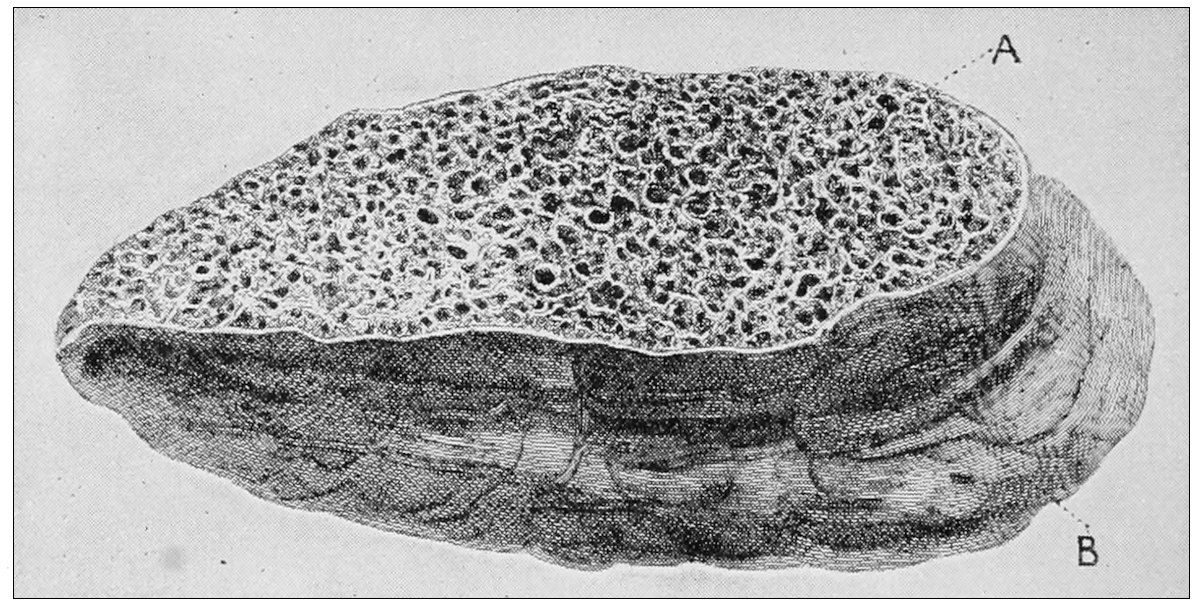
Fig. 78. PART OF THE LUNG OF DR. SAMUEL JOHNSON, from a drawing published by Matthew Baillie. Johnson was a fat, unwieldy man, with a great barrel chest, who suffered for many years from shortness of breath. These are common associations with the pathological condition known as Emphysema, in which the lungs, which are normally of fine spongy texture, become full of abnormally large cavities, so that, as Baillie remarks, they come ‘to resemble the air cells of the lungs of amphibious animals’ (cf. Fig. 45, p. 116). In the figure B represents the external part of the lung and A its cut surface. On the cut surface the large cellular structure can be seen. The very dark points are the orifices of cut branches of the pulmonary vessels.
§ 7. Clinical Methods and Instruments.
The great teachers of the earlier eighteenth century, though better equipped as regards knowledge than their predecessors, had hardly any better means of diagnosis. Pulse-measurers and thermometers such as those of Sanctorius and Galileo (p. 109) had proved impracticable by the bedside. The microscope had not yet entered into Clinical Medicine. Chemical analysis as applied to disease had proved, as yet, of little value.
The first efficient instrument of precision to merit clinical adoption was the ‘pulse watch’, by Sir John Floyer (1649-1734), an English provincial physician. It was introduced as early as 1707 as a ‘Physician’s Pulse Watch’ and was an instrument constructed to go for just one minute. At that time the making of a twenty-four hours watch with a seconds-hand presented great mechanical difficulties. Floyer’s invention was not widely adopted at the time. Attempts were also made to introduce a thermometer into practice, but again the construction of suitable instruments proved impossible.
Effective pulse watches and clinical thermometers did not penetrate into the general practice of Medicine till well into the nineteenth century. Two instrumental advances of first-class importance to Medicine were, however, introduced during the later eighteenth century. These were the methods of Percussion and Stethoscopy.
Percussion of the surface of the body yields notes of varying degrees of resonance. Its application has proved of great value to the physician in outlining the position of the organs and of lesions, especially those of the chest. It was invented by Leopold Auenbrugger (1722-1809), a Viennese physician who first introduced it in 1761. Like the thermometer, it was very slow in entering the general practice of Medicine.
Auenbrugger deserves great credit for his invention, but he did not work out its application with anything like the completeness that the Breton physician, René Théophile Hyacinthe Laënnec (1781-1826), applied to his ‘stethoscope’ (1819). Laënnec’s instrument was of the uni-tubular type that is now seldom seen. At first, indeed, he used a mere roll of paper. His idea was rapidly diffused into every country.
But Laënnec did far more than introduce a useful and convenient device into Medicine. He explored with extraordinary skill the physical signs in the chest which correspond to a large number of diseases. The major part of our chest-lore and much of the technique and nomenclature of chest examination come direct from him. Despite continual bad health and the shortness of his life, Laënnec’s brilliance and devotion to duty at a hospital in Paris enabled him to transmit his views and methods to many other physicians, both French and foreign. He is unquestionably among the greatest physicians of all time. Clinical medicine assumes with him a completely modern aspect. In reading his work one feels that, had he been called in consultation by a medical man of our own day, the two would have been able to understand each other perfectly, after only a little adjustment and explanation.
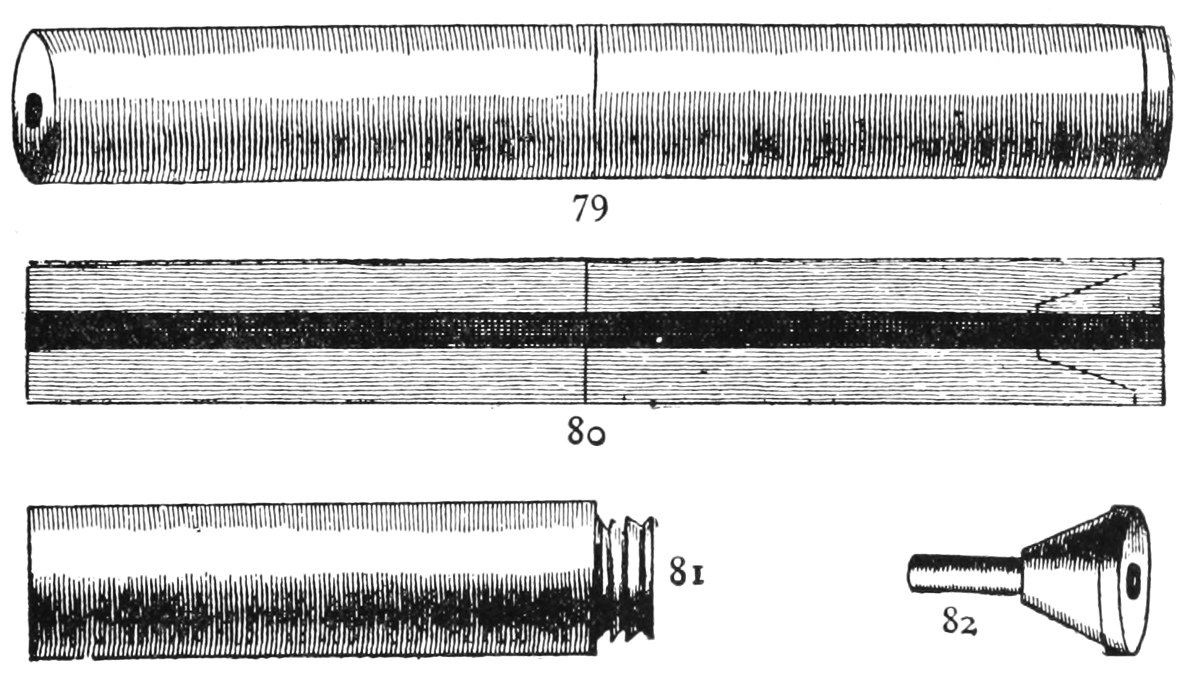
Figs. 79-82. LAËNNEC’S WOODEN STETHOSCOPE, from his work of 1819, On Instrumental Auscultation.
Fig. 79 is the complete instrument.
Fig. 80 is the instrument in section.
Fig. 81 is the ear-piece unscrewed.
Fig. 82 is the detachable chest-piece terminating in a thin metal tube.
§ 8. Surgery and Obstetrics.
During the eighteenth century the improved knowledge of Normal and Pathological Anatomy was a great aid to the surgeon. The technique of Surgery was certainly improved. Operations were now being performed with success that could not before have been attempted. Nevertheless few important new principles were introduced until long after the nineteenth century had dawned. It is indeed probable that as a means of life-saving Surgery had an almost inappreciable effect on vital statistics until the advent of Anaesthesia and Antiseptics. Even the greatest surgeon of the eighteenth century, John Hunter, introduced no fundamental new surgical principles. True, the names of many surgeons of the period have become associated with operations invented or introduced by them, but it was not till after the advent of antiseptic methods that these were practised with full success. There are but two surgical matters in which advances of great significance can be said to have been made. These were the treatment of Venereal Disease and the treatment of Labor.
Syphilis, which existed in Europe in the later Middle Ages, had usually been confused with Leprosy and other conditions (p. 98). Its treatment by Mercury had been practised at least as early as the fifteenth century, perhaps as an inheritance from the Arabic-speaking physicians. During the sixteenth and seventeenth centuries various other remedies were tried (Fig. 33); much quackery arose around them. In the eighteenth century the accumulated experience of generations returned again to Mercury. Satisfactory methods of administration were evolved and the treatment became standardized. It hardly changed until the twentieth century.
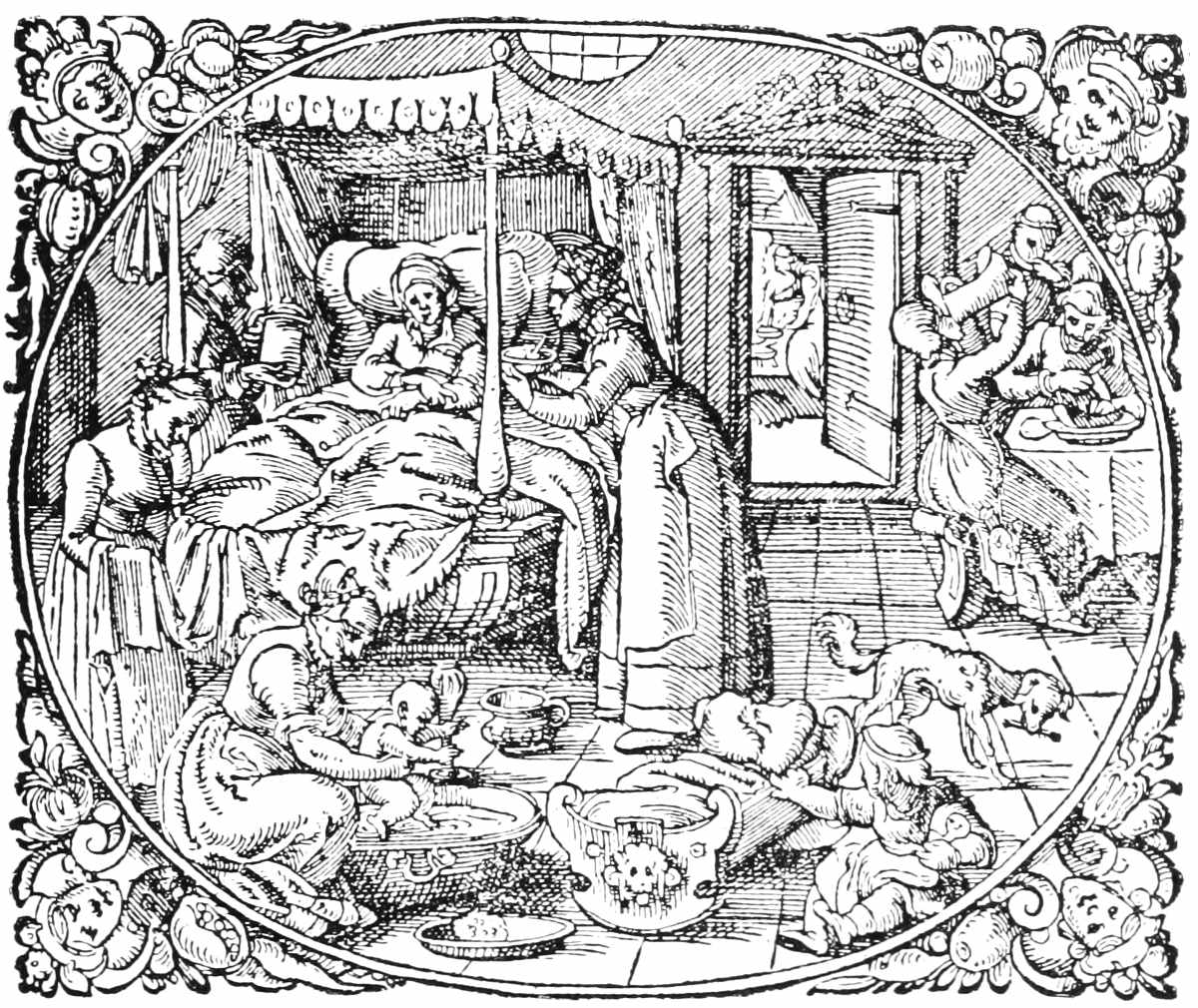
Fig. 83. LYING-IN SCENE in the sixteenth century from a contemporary work on midwifery. Drinking and feasting is going on in the room where, in addition to the patient, there are two men, five women, and two children. A dog chews a bone on the floor, cooking is in progress in the adjoining room. Food and drink is being forced on the unfortunate patient herself. The whole scene, which is intended to portray an upper-class household, suggests carousal, disorder, and dirt, as well as ignorance of the most elementary principles of hygiene.
The treatment and care of women in Labor made considerable progress during the period of which we are treating. We have seen how there were advances even during the sixteenth century (p. 93) by such a writer as Paré. Works on obstetrics intended for women were often printed in the sixteenth century in France, England and Germany. Scientific obstetric
works were produced especially in France in the second half of the seventeenth century. The obstetric forceps was known, but was still a family secret. At the time and for long after, there was a great objection on the part of pregnant women to treatment by men. The midwives were for the most part ignorant, dirty, unskilful and superstitious, and the loss of life and health that resulted from their mishandling was enormous. The objection to the ‘man midwife’ was only gradually overcome, though his advent was unquestionably attended by a fall in the mortality. About the middle of the eighteenth century, moreover, the obstetric forceps came into wider use. One of the ablest and most successful of the obstetric physicians was William Hunter (1718-83), the brother of John Hunter.
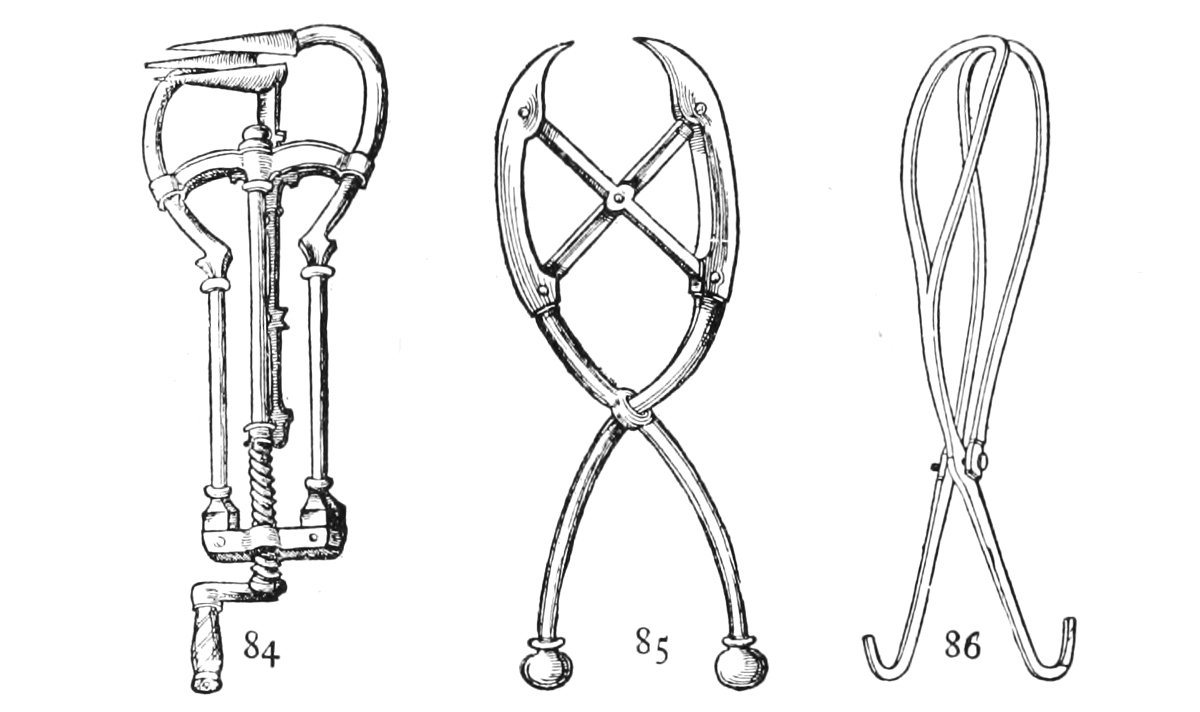
Early obstetric instruments.
Fig. 84 is the very dangerous and brutal Speculum matricis used to force open the mouth of the womb in cases of difficult labor. A similar instrument has been used since antiquity to dilate wounds.
Fig. 85 is an even more terrible and powerful instrument, the Apertorium, provided with a sharp edge by means of which the mouth of the womb was violently cut or torn.
In the seventeenth century less heroic measures began to be used, and the obstetric forceps was introduced.
Fig. 86 shows a pair of obstetric forceps as used in the seventeenth century. The instrument is the direct ancestor of that now in use, which, however, is a vast improvement upon it. The obstetric forceps was invented by a member of an hereditary family of man midwives, at the beginning of the seventeenth century. The nature of the instrument was long kept a secret. This particular instrument was found by accident in 1813, having been hidden under the floor by a member of the family of the inventor.
Despite the absence of any great new principle in the surgery of the period, there can be no doubt that a new spirit was introduced by John Hunter (1728-93). His complex and interesting character demands better treatment than it has yet received. As an investigator his powers were superb, but, like Leonardo, he was handicapped at every turn by literary incoherence. Nevertheless, with him Surgery begins to appear, at last, as a real Science and not as a mere applied Art. Hunter brought to bear on the subject a mind stored with ideas drawn from Comparative Anatomy and Pathology. Quick to detect analogy, shrewd in his scientific judgments, tireless and unsparing of himself in his pursuit of truth, a victim of disease self-inflicted in the service of science to which he was tragically a martyr in his death, he shows as a heroic figure, rendered no less heroic by some very human failings. Fully to appreciate so incoherent a writer, it is unfortunately necessary to wade through many works written in his own clumsy and ill-arranged manner. To gain any real idea of this great personality we must consult the writings of his contemporary colleagues.
So far as actual advances are concerned, two may be connected with Hunter’s name. Firstly, in the treatment of the deadly condition known as ‘Aneurysm’ he introduced a method of operation which is still in vogue. Secondly, he enormously improved the method of making and ordering a museum. His monument is the Hunterian Museum in London, based on his specimens of which many may still be seen there. The museums of Natural History, as now constituted in all civilized countries, have been influenced by, if they have not been derived from, that which he literally gave his life’s blood to found. He was right when he said musingly in his illness, ‘You will not easily find another John Hunter.’
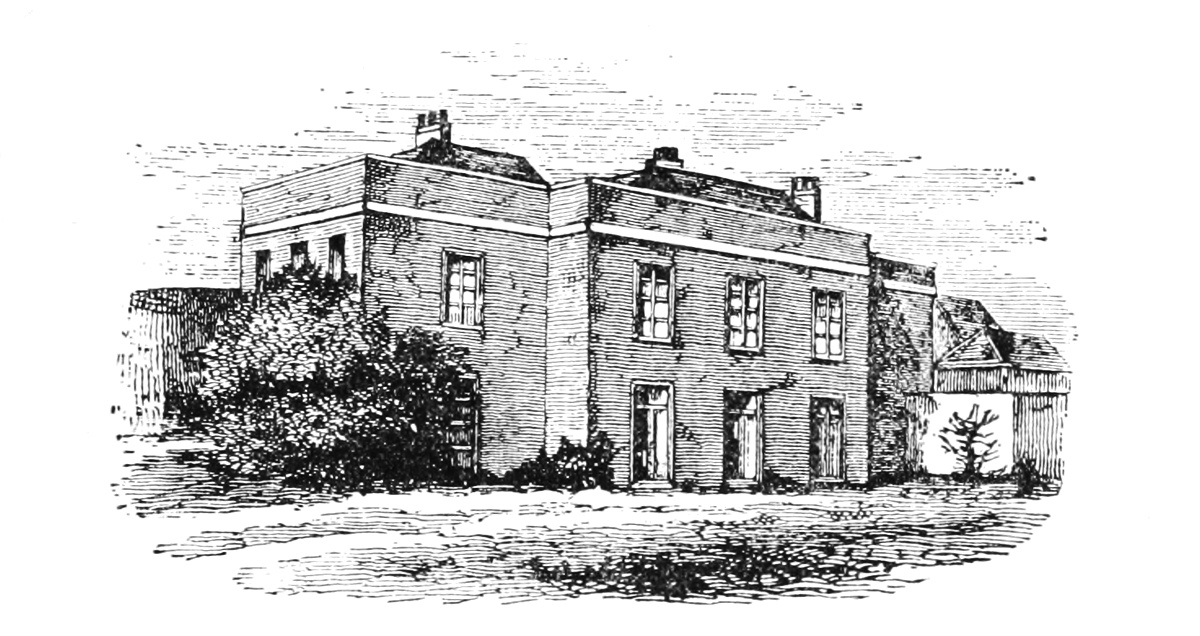
Fig. 87. JOHN HUNTER’S COUNTRY HOUSE at Earl’s Court, Kensington, before its demolition in 1886. This house was in the country in Hunter’s day, though its site is now a busy part of London. For many years he used it as a laboratory and menagerie, and much of his best work was done there.
§ 9. The Beginnings of the Science of Vital Statistics.
Attempts to combat widespread disease and to improve the public health are to be found in the history of all civilizations, both ancient and modern. Nevertheless, the rational method cannot come into operation until it has exact data upon which to work. Such data may be numerically expressed, a fact first appreciated by the versatile English physician and inventor, Sir William Petty (1623-87), who is usually regarded as the father of the science of Political Economy. In 1662, and on many subsequent occasions, he joined a friend in issuing Natural and Political Observations upon the Bills of Mortality of London. In this work he endeavored to deduce population, death-rates, disease prevalence, and other matters of vital statistics from the crude figures of the day. He was fully aware of the imperfection of his materials, and on this account he urged the necessity of providing a system and a government department for the collection of trustworthy statistics. In his Political Arithmetick (1683), the basic work of modern Economics, he displays ideas of a very modern character. Among these is his view that the true wealth of a country is to be sought in its efficient man power.
A number of Petty’s fellow members of the Royal Society began to take interest in statistics. Chief among these was Edmund Halley, the astronomer (1656-1742). Toward the end of the century (1693) Halley produced a mass of statistics on the chances of life at various ages, designed for the estimation of the price of annuities. During the eighteenth century numerous writers devoted themselves to similar investigations. An important contributor to the mathematical basis of vital statistics was the French Huguenot and friend of Newton, Abraham de Moivre (1667-1754). His Doctrine of Chances (1715) and his Annuities upon Lives (1725) are important contributions to the subject. His celebrated hypothesis that among a body of persons over a certain age the successive annual decrease by death may be esteemed as nearly equal (that ‘the decrements of life are in arithmetical progression’) was under discussion for a century, but is now accepted.
In 1761 a Prussian clergyman, J. P. Süssmilch (1707-82), produced an extraordinary theological work, The Divine Ordinance manifested in the Human Race through Birth, Death, and Propagation. Its object was to exhibit God’s design in the constancy of the numerical relationships of vital statistics. Despite the motive—somewhat unpromising for a scientific treatise—the work is of great historic and scientific importance, for it was based upon a vast mass of statistics and showed a great advance in method. It stressed the importance of accurate data and the necessity for numerous observations, if reliable conclusions were to be drawn. From the time of the publication of the work of Süssmilch, the statistical study of population advanced rapidly. The basis of statistics was greatly improved by the introduction of the census system which was put into action in England in 1801.
The science of vital statistics was placed on a firm foundation by the Belgian astronomer Lambert Quetelet (1796-1874). His principal work, On Man and on the Development of his Faculties, An Essay on Social Physics, contains an account of his statistical researches on the development of the physical and intellectual qualities of man and on the ‘average man’ both physically and intellectually considered. He followed this in 1848 by his treatise, On the Social System and the Laws which govern it. In it he shows how the numbers representing the individual qualities of man may be grouped round the numbers referring to the average man in a way corresponding to the principles of the theory of probabilities. This conception, elaborated and further analyzed, has formed the basis of all subsequent researches in vital statistics.
§ 10. Military, Naval, and Prison Medicine.
The eighteenth century saw some of Petty’s principles put into practice. There was, as yet, but one section of public life in which scientific principles of preventive medicine could be applied. Only in the Army and Navy were the sufferers from disease under adequate control and observation, and only there were proper statistics of sickness and health available. Thus, many of the most important movements in Preventive Medicine during the eighteenth century, both in England and other countries, were initiated by naval and military surgeons.
Among military medical reformers an important place is taken by a Scottish pupil of Boerhaave, Sir John Pringle (1707-82). He had a large military experience in the British army, occupied a position of great influence, and was able to get many of his views and reforms generally accepted. Pringle was among the first to see the importance of ordinary putrefactive processes in the production of disease, and quite the first to apply these principles in hospitals and camps. Important conclusions on these matters were published in his Experiments upon Septic and Antiseptic Substances, with Remarks relating to their Use in the Theory of Medicine, which appeared in 1750. He identified ‘gaol fever’ or typhus with ‘hospital fever’. He laid down important rules for the hygiene of camps which involved avoidance of marshes, proper drainage, and adequate latrines. His most permanent service was probably his suggestion that army hospitals should be regarded as neutral, and be mutually protected by belligerents. This great physician is a good illustration of the ‘new humanity’ which came into public life in the eighteenth century. In much of that movement one may feel the influence of that most humane of physicians, Hermann Boerhaave (pp. 140-1).
Hardly less important than the work of Pringle for the Army was that of his brother Scot, James Lind (1716-94), for the Navy. Lind was a pupil’s pupil of Boerhaave. He had a long naval experience and in 1753 wrote an important work on Scurvy, then a very common and fatal disease at sea. He demonstrated how this might be prevented by the adequate use of fresh fruit or, when this was not available, of lemon juice. Fresh water had always been a difficulty of sea voyages. Lind arranged for sea-water to be distilled for the purpose. He introduced rules for the prevention of typhus on ships, and made great improvements in naval hygiene. His essay of 1757 On the most effectual means of preserving the Health of Seamen is a classic. He also wrote an important Essay on Diseases of Europeans in Hot Climates, which opened the campaign for the conquest of the tropics (p. 270).
Lind, like Pringle, is one of a type that is very fully represented in the eighteenth century. A worthy representative of that school was Captain James Cook (1728-79), the explorer, who adopted Lind’s principles. He established a record in one of his voyages to the South Seas. The voyage lasted three and a half years, and many hardships had to be endured, but out of 118 men only one died, and he was consumptive when he embarked from England. Of a different type was the Manchester health reformer, Thomas Percival (1740-1804), who worked to introduce the reforms of Pringle and Lind into civilian life. The work of Percival leads on naturally to Southwood Smith and Chadwick (pp. 193-5).
The eighteenth century was essentially a period of individual effort. The time was not yet ripe for public action on a large scale in matters of Hygiene. Pringle, Lind, and Percival had, however, their humanitarian parallels among prison reformers. Scientific attempts to improve the ventilation and sanitation of prisons had been instituted by the Rev. Stephen Hales (pp. 146-7). None brought greater devotion to the task than John Howard (1726-90), a native of London who spent his vigorous powers in investigating the prison system. His researches extended to the hospital, quarantine and prison systems of France, Flanders, Holland, Germany, Italy, Greece and Turkey (Fig. 88). His reports were directly instrumental in the improvement of the hygiene both of prisons and hospitals, as well as in the institution of special fever hospitals in many countries. Some aspects of Howard’s work were carried on by the great Quaker philanthropist Elizabeth Fry (1780-1845), others came within the field of activity of Southwood Smith and Chadwick (pp. 193-5).
The eighteenth-century humanitarian movement was active and had many able representatives in the United States. Foremost among them was Benjamin Franklin (1706-90), while in the ranks of Medicine none takes a higher place than Benjamin Rush of Philadelphia (1745-1813). Rush was particularly revolted by public punishments, to the abolition of which he devoted much energy. In matters of Hygiene Rush was ahead of his time. He wrote on the hygiene of troops and laid special stress on fresh air and cleanliness of body and mind as an aid to health. He had a peculiar horror and repulsion for alcoholic intemperance. He was responsible for the first systematic work on insanity published in America. He left a fine account of a Yellow Fever epidemic at Philadelphia, and he approached the truth in his view that the disease arose in Philadelphia itself and was not brought as an infection from without.
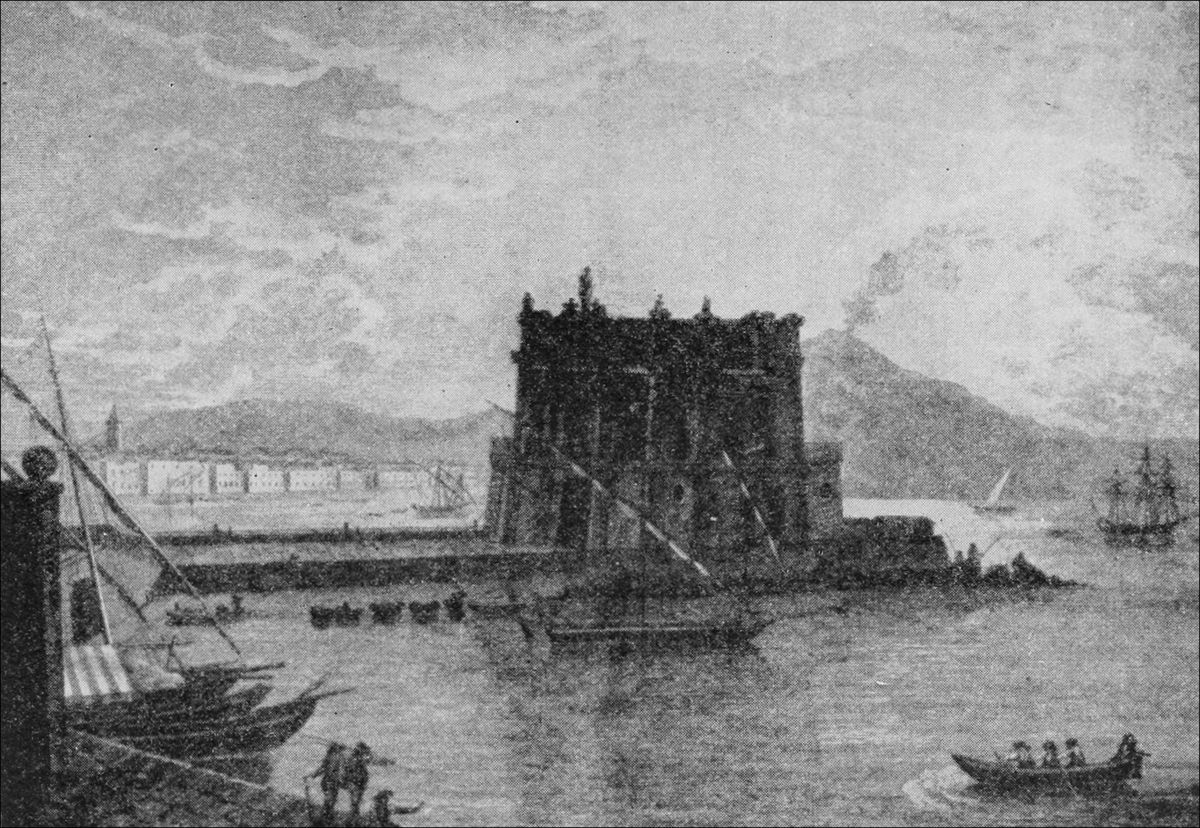
Fig. 88.
AN EIGHTEENTH-CENTURY QUARANTINE STATION (Naples).
From John Howard’s
An Account of the principal Lazarettos in Europe
, Warrington, 1789.
§ 11. The Industrial Revolution.
During the eighteenth century the character of English civilization became modified by a factor which has since profoundly influenced all civilized countries. There was a rapid increase in the number and size of the towns. The main cause of this was the transformation of Industry by the use of mechanical power. The change that resulted in the life and outlook of the people was very profound. These changes and the causes that gave rise to them are usually spoken of as the ‘Industrial Revolution’. That revolution had effects that were both wider and deeper than followed any other such single upheaval in history. With the mechanical elements that were at the back of the Industrial Revolution, such as the improvements in transport, the invention of industrial machinery (Fig. 90), the enclosure of common land, the new position of agriculture, we are not here directly concerned. What does affect our story is the increasing urbanization of the population, which began early in the eighteenth century, increased rapidly soon after the middle of the eighteenth century, and has progressed continuously ever since. In this matter England is but a type, for all other civilized countries followed in her wake, though at a somewhat later date.
Along with the growth of towns and the increased population there was an increased demand for food. The country became better cultivated and better drained, and there were many improvements in agriculture. Thus, certain diseases began to diminish, notably Malaria, essentially a disease of undrained and ill-cultivated lands. The expulsion of this disease, as of Typhus, was the work of the nineteenth century (p. 283).
It is often assumed that the physical evils of life became accentuated by the rise of the great towns. Nevertheless, investigation shows that the opposite has been the case. During the eighteenth century men and women began to crowd into the great towns from the country. They were, in fact, right in their choice, for their chances of life there were greater than upon the land. In the rural districts infamous housing conditions, an overcrowding beyond anything which we now encounter, exposure to weather, uncertainty and fluctuation in the prices of commodities, low wages, unpassability of roads in winter time, inaccessibility of medical aids, combined to render life, and especially child life, more precarious than in urban areas.
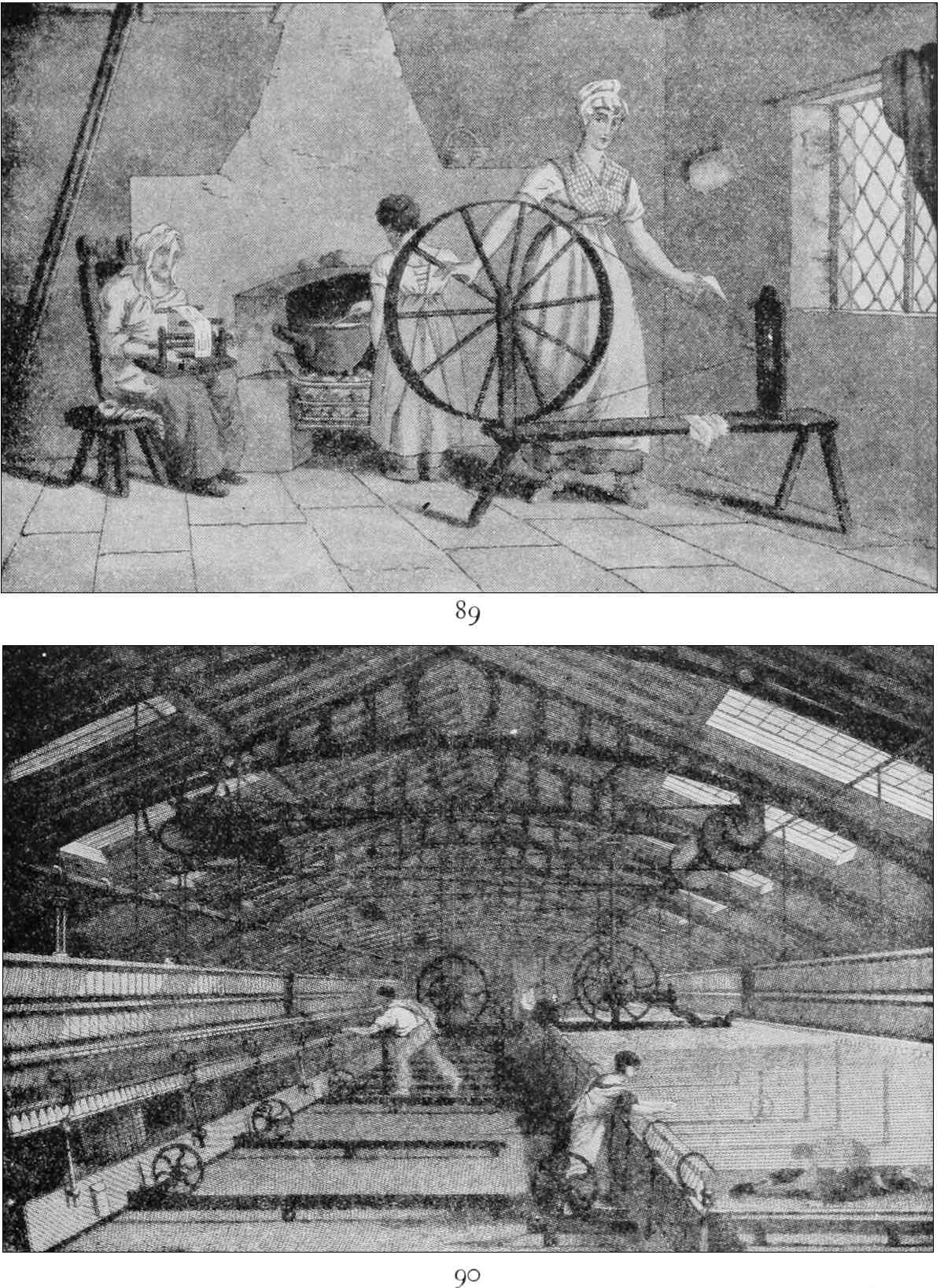
Figs. 89 and 90 illustrate the passage of the textile trade from home industry to factory work with the consequent break-up of the family as the labor unit. Textiles were the first important articles of commerce to be thus affected, but others rapidly followed. The pictures are typical of the Industrial Revolution.
The improvement of hygienic conditions in the towns began in England soon after the middle of the eighteenth century. Westminster obtained an Improvement Act in 1762, Birmingham in 1765, the City of London in 1766, Manchester in 1776, and most of the other provincial towns soon followed. As a result of such Acts noisome streams which were but open drains were covered in, the streets were paved and lighted, and the sewers improved. There were still many glaring defects of sanitation which have occupied and still occupy reformers, but by the end of the eighteenth century the general appearance of a street in one of the more advanced cities was much what it now is. The change from the medieval conditions of a century before was at least as great as the changes that have since taken place.
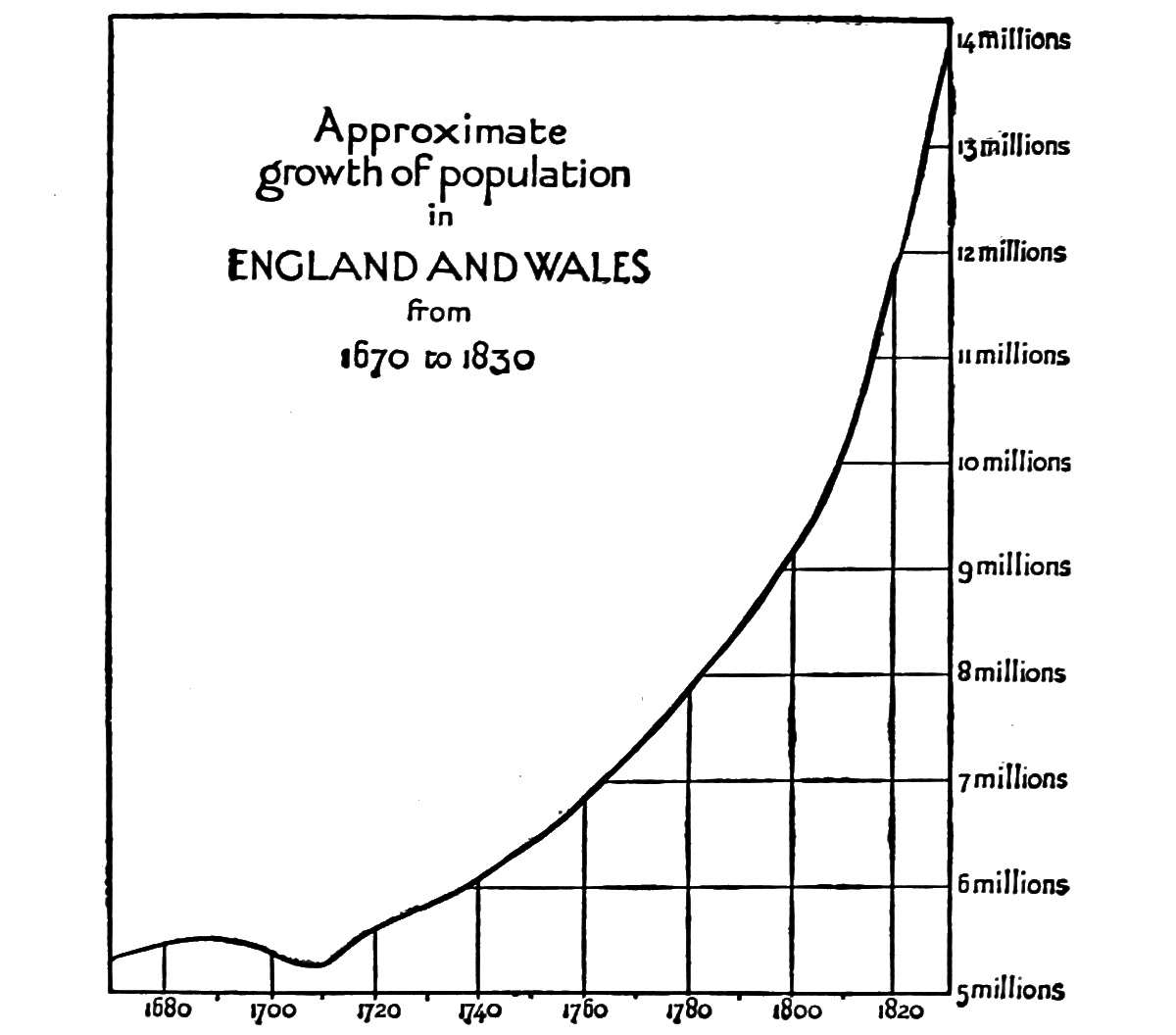
Fig. 91 shows how the population of England and Wales started to increase rapidly about 1750, with the beginning of the Industrial Revolution. The chart covers a period in which statistics were not exact. The figures for it have had to be estimated, but they are probably accurate as round numbers. The census returns are available from 1801.
1910-12
Age 1730-9 1740-9 1750-9 1760-9 1770-9 1780-9 1790-9 Males Females
10 36·9 37·0 37·3 36·9 36·7 37·5 38·2 — —
20 29·1 28·9 29·2 29·3 29·4 29·9 28·4 42·35 46·71
30 23·7 23·5 23·8 24·1 24·1 24·9 24·4 33·87 37·94
40 19·6 19·2 19·4 19·6 19·5 19·5 19·5 26·03 29·67
50 16·1 15·8 15·7 16·1 15·9 15·7 15·8 19·09 22·17
60 12·2 12·4 12·1 11·9 11·9 12·0 11·9 13·09 15·39
70 9·4 8·6 8·7 8·5 8·3 8·7 8·5 8·17 9·57
80 5·9 5·7 5·7 5·7 5·7 6·3 6·2 4·79 5·39
Showing the expectations of life in London for each decade from 1730-1800, with recent data for comparison.
Age 1730-9 1740-9 1750-9 1760-9 1770-9 1780-9 1790-9 1911-12
10-20 6·5 5·9 5·9 7·1 8·2 7·1 6·5 —
20-30 17·5 17·6 17·2 17·9 17·3 16·4 15·1 3·7
30-40 27·1 26·3 26·1 25·2 25·0 23·9 23·7 6·2
40-50 36·6 38·6 35·9 36·3 35·5 35·4 34·3 11·7
50-60 45·5 47·9 45·7 42·1 45·0 44·7 44·6 21·1
60-70 61·4 63·4 63·7 64·4 62·8 64·7 64·1 40·3
70-80 83·7 98·3 96·4 101·8 105·0 101·7 104·4 87·3
80-90 143·1 150·4 151·0 153·0 152·7 153·0 155·1 181·9
Showing the death-rates at Age groups in London for each decade from 1730-1800, with recent data for comparison.
Fig. 91A. TABLES showing that vital conditions in the eighteenth century did not deteriorate but improved with the Industrial Revolution.
But if the streets had improved there was much under and around them which would horrify us now. Water-supply, as in London, was usually drawn mainly from surface wells and rivers. In most towns a continuous water-supply was unknown. Even when water mains existed, the supply to the houses was limited. Thus, even in the early nineteenth century London houses had a water-supply only three times a week, and then only for a few hours at a time. The water mains were often defective, and there was not always that clear distinction between a water main and a sewer that we now regard as desirable. Floods were a constant trouble in all riverside towns. Cesspools were in use even in London as late as the middle of the nineteenth century, and water-closets did not become general, even in the better houses, until about 1828. The methods of disposal of sewage hardly bear relation. In London the sewage simply polluted the rivers.
The improvement of such conditions as these could only be made by State action. The eighteenth century did well where individual activity was concerned. It was reserved for Southwood Smith (p. 193) and Chadwick (p. 194) to introduce into the sphere of practical political action the truth, set forth by Bentham (pp. 190-2), that all factors which influence the health of the country must be the concern of the Legislature.
We gladly pass from this darker picture to the Hospital and Dispensary Movement which took its rise about the middle of the eighteenth century. Many of the great hospitals both in England and in Continental countries were either founded or rebuilt about this time. Thus, the London Hospital was rebuilt in 1752, St. Bartholomew’s in 1730-53. Between 1700 and
1825 no less than 154 hospitals and dispensaries were founded in the British Isles. Though defective from the modern point of view, yet under the influence of the sanitary reformers, Hales (p. 146), Pringle (p. 169), Lind (p. 170), and Percival (pp. 170-1), these were incomparably better equipped, better ventilated and better found than such institutions would have been at the beginning of the eighteenth century. The notes of the industrious Howard (p. 171) give us a very complete picture of them, and one that is more favorable than might, perhaps, have been expected.
A defect of the hospitals of the time was certainly the nursing. This, however, was somewhat better in the Lying-in-Hospitals, where the services of a higher type of woman were available and where ladies served on the committee of management. The general state of the hospitals remained much the same until transformed by the changes in surgery and nursing in the second half of the nineteenth century, though a number of special fever hospitals and pest-houses were established.
Something must be said of the more prevalent diseases of the Industrial Revolution. Stress is often laid on the effect of urban conditions on child life. Yet there can be little doubt that historically the movement has been beneficial to it. This comes out well in the death-rates. Thus, in England in the period around 1740, before the industrial revolution had begun, about 75 per cent. of children born died before the age of five. In the period around 1800, when the industrial revolution had set in, the percentage of deaths had fallen to about 41. In the period 1915-24 it was about 14. Among the most characteristic diseases of children is Rickets. It is very difficult to trace the early history of this disease, but its incidence seems to have been very high about 1700, and to have fallen progressively throughout the eighteenth century. This fall, it has been suggested, was due to agricultural improvements which led to better supplies of better-fed meat. It was these improvements and better supplies that, in their turn, made the big towns possible.
We have already spoken of Scurvy on ships. It was, however, well known on land, especially in winter when green vegetables were not to be had. Lind (p. 170) in 1753 found it common in the land population. The advances in agriculture removed it altogether from the land diseases during the eighteenth century.
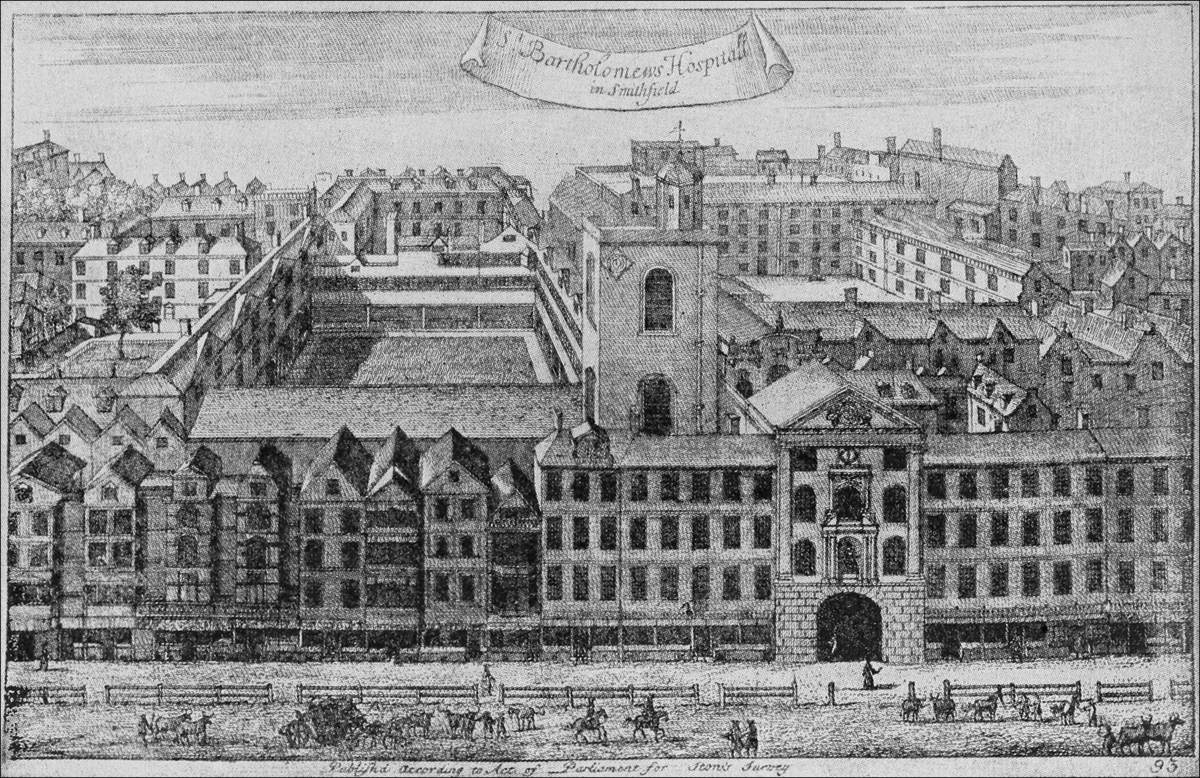
Fig. 92.
ST. BARTHOLOMEW’S HOSPITAL AT SMITHFIELD, LONDON, in 1720.
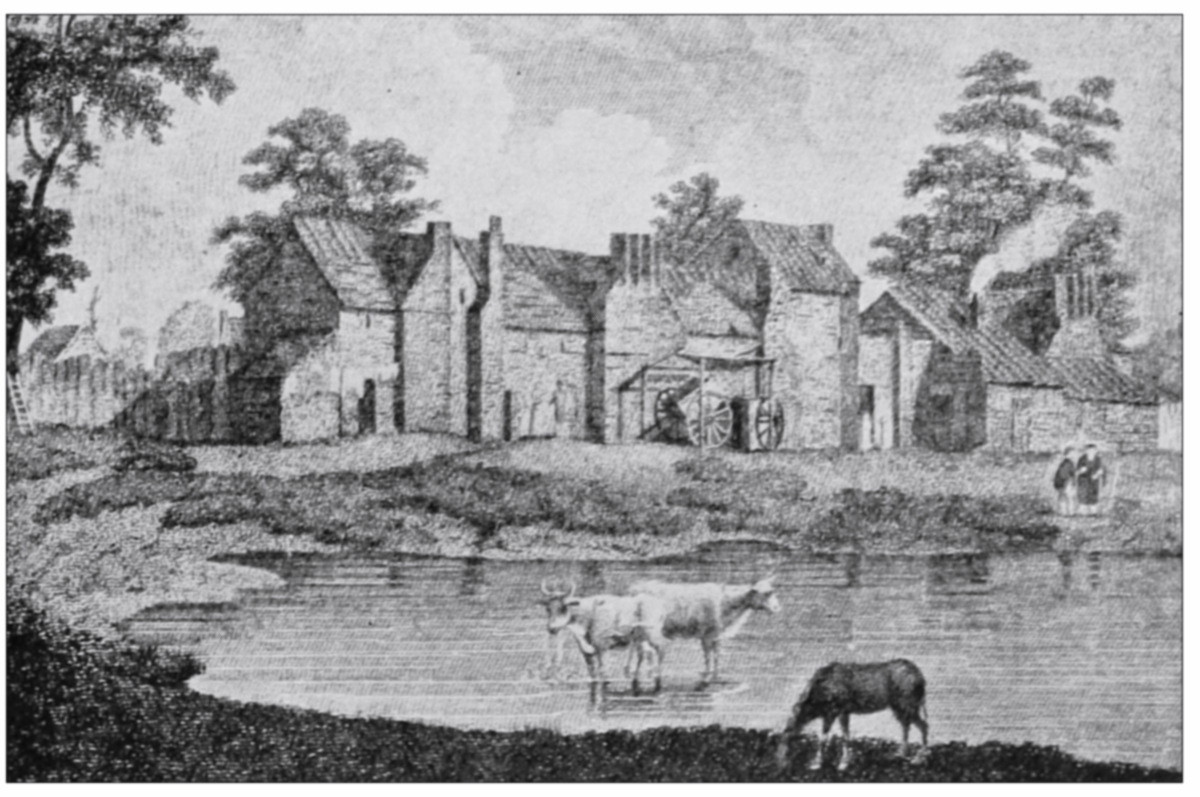
Fig. 93.
A VIEW OF THE PEST HOUSE in Tothill Fields, London, in 1796. From a print in the British Museum.
§ 12. Control and Recognition of Epidemic Diseases.
Over one department of public health there was State supervision during the eighteenth century. The ports were guarded against the introduction of Epidemic Diseases, and especially against Plague. Throughout the eighteenth and early nineteenth century there was Plague in the Near East which extended at times to various parts of Europe. It was epidemic in Russia in 1709 and some 150,000 died of it. In 1719 it spread to Eastern Central Europe. One historic outbreak was at Marseilles and Toulon in 1720, when 90,000 died. The outbreak caused great alarm in England, but did not reach this country, nor has there since been any outbreak here. Quarantine is now regarded as antiquated, vexatious, inhumane, expensive, and ineffectual. It seems probable, however, that during the eighteenth century, when drastically enforced, as in France with the Marseilles epidemic, it had indeed the effect of keeping the disease within bounds. Incidentally, it led to the foundation of many plague hospitals or Lazarettos, of the conduct of some of which Howard (p. 171 and Fig. 88) speaks well.
During the eighteenth century Small-pox was never absent from this country. From time to time the disease became epidemic, and there were grave and fatal outbreaks. Thus, in 1774 there was an outbreak of small-pox at Chester. Next year an investigation was made of the degree to which the population had suffered. It was then found that before the outbreak there were in Chester only 15 per cent. who had not already had the disease. The incidence on those unprotected by a previous attack was 53 per cent., with a death-rate of about 17 per cent. of those actually infected and of about 9 per cent. of the entire unprotected population.
With the certainty of contracting small-pox before their eyes, men sought a way of getting it in a mild form. Outbreaks of small-pox varied greatly in virulence, and infection with a mild form would lead to protection from a graver one. In the East a method of direct inoculation of the disease from a patient suffering from a slight attack was widely in vogue from an early date. The practice attracted little attention in Europe until Lady Mary Wortley Montagu (1689-1762) studied it at Constantinople. It was then soon taken up in England, and became recognized on the Continent.
The efforts of Lady Mary in England were reflected on the other side of the Atlantic. The famous Puritan leaders, Increase Mather (1639-1723) and Cotton Mather (1663-1728), turning from their exploits against the witches, ardently urged the operation. In England the learned Dr. Richard Mead (1673-1754), an eminent and far-seeing physician who exercised very great influence on the medical world in his day, published in 1747 a work in which he supported the practice of inoculation with all the weight of his authority. During the subsequent half-century the practice spread widely. The operation was largely in the hands of specialists who were not always medical men.
Such was the state of affairs when the country practitioner Edward Jenner (1749-1823) came upon the scene. In 1796 a dairymaid became infected with a disease of the udders of cows, distantly resembling small-pox. She developed pustules on her hand. Jenner inserted a little of the matter from one of these into the arm of a boy of eight, who developed typical cow-pox. Jenner next inoculated this boy with small-pox, which, however, failed to develop. The evidence, so far as it went, was complete. It is an entire justification of what might seem nowadays to be a reckless experiment, that at that time inoculation of small-pox was a normal and effective defensive procedure. The disease of cows has since become known as Vaccinia, and the process of inoculating it as Vaccination.
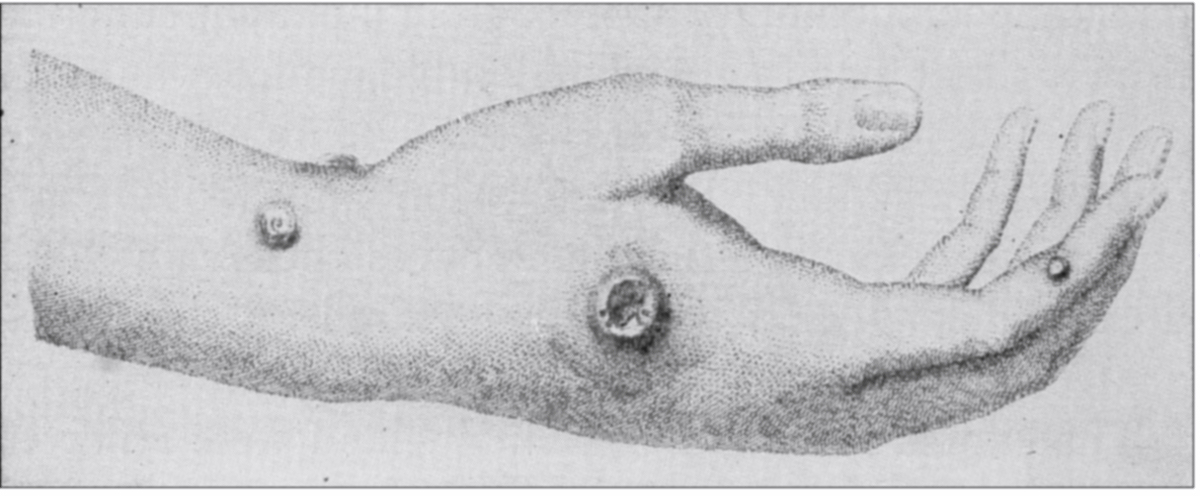
Fig. 94. HAND OF DAIRYMAID infected with cow-pox from a cow’s udder. From Edward Jenner, Inquiry into the Causes and Effects of the Variolae vaccinae, a Disease discovered in some of the Western Counties of England, particularly Gloucestershire, and known by the name of the Cow Pox, London, 1798.
The discovery of vaccination, important though it be, is a mere trifle compared to the train of new work and new thought that has been opened out by it. The whole study of Immunity, which has now become an independent science, arises from it. The work of Pasteur (p. 225), Lister (p. 239), and Koch (p. 234), and a large part of modern therapy, are among the achievements of this movement.
Besides Plague and Small-pox, many other epidemic diseases became more clearly understood during the period we are considering. Among these was Scarlet Fever, the history of which is particularly interesting for the variations which it has shown in virulence. It first became clearly recognizable as a mild disease without prominent symptoms about 1650. Good observers in the half-century that followed considered it a new disease. In England it continued to be of little importance till about 1748, when it began to be associated with grave throat symptoms and to be confused with Diphtheria. This phase continued for about ten years. The virulence then dropped and the disease continued of slight consequence till 1785. It then grew virulent again and remained so till about 1808. The malignancy then fell again and remained low for about thirty years. It rose about 1837 and from then till 1884 it was one of the great killing diseases, especially of childhood. Since then, the mortality from it has steadily decreased.
During most of its history Scarlet Fever has been liable to greater or less confusion with Diphtheria. The clinical distinction was first clearly made in 1826 by Pierre Bretonneau of Tours (1771-1862), who gave Diphtheria its present name. The same French physician performed the first successful tracheotomy in a case of Diphtheria. He is also known for pioneer work in the recognition of Typhoid Fever.