EPILOGUE
Reading edition
We have now traced various movements in Medicine throughout the ages and have seen how all the sciences in turn have been made to bring their tribute to the alleviation of suffering. We have seen especially how the consideration of disease as a whole, and of the health of peoples as a whole, has introduced a new view in the handling of disease. Health is a public asset, and its promotion has now been recognized as a public duty. There are undeniable disadvantages in placing officers of the State in control of the personal liberties of its citizens, but, on the whole, the advantages, in matters of health, have outweighed the disadvantages. Only a professed pessimist or a crotchety reactionary could deny the gains to humanity from the passage of preventive measures from private into public hands.
There is another side of the picture which we have need also to consider. The advances in Medicine and the advantages that have accrued therefrom have been entirely the result of the application of the rational method of observation and experiment. To control Nature we must above all things understand Nature. Neither the conception of Nature as the kind old nurse nor the conception of Nature ravening red in tooth and claw will stand. Least of all can we tolerate the picture of Nature as a bountiful mother. If we go to her asking something for nothing, she (far from bountiful) will give us little but what we have given her, and to him who but begs she gives no more than a beggar’s portion. It is thus that she has served the magician and the wizard, who think they can compel her to give them all things by their paltry charms!
The amount of human labor and ingenuity that is now being thrown into the investigation of Nature is almost incredible even to men of science. Some conception of the enormous and unreadable bulk of scientific literature may be gained by a glance at the International Catalogue of Scientific Literature. This gives the titles alone of original articles in the various departments of physical science. These titles for the year 1914 alone occupied seventeen closely printed volumes! The rate of publication has accelerated considerably since then. There are now about 25,000 periodicals devoted to scientific publications! There are very few departments of science which do not have some bearing on Medicine. It is evident that no human mind can possibly compass even a year’s output of this material.
And yet it is not the bulk of writing on Science that forms the only or even the chief deterrent to the general comprehension of its principles. The mass of scientific detail has always been beyond the power of one mind to grasp. But as we have traced Rational Medicine through its long course in Antiquity and the Middle Ages to its debouchment on to our own time, we have found not only a more difficult but also a new situation. In approaching our own age we have found ever more difficulty in discussing Rational Medicine as a single channel of thought. It spreads into a Delta, of which, though the many mouths may inosculate, yet the tendency seems to be for an ever wider divergence. This diffusion, induced by increased specialization, cannot go on for ever without defeating the very objects for which specialism was invented.
On the other hand, when we glance at the tasks now being performed by the medical man, we cannot fail to be struck by the great increase in the number of things that have come to be regarded as within his sphere. It is a commonplace that he has in large part taken the place of the parson. But he has also made encroachments on the functions of the lawyer, the legislator and the judge, of the schoolmaster, the architect and the statistician. He has assumed some of the duties of the parent and guardian, while even the soldier and the policeman are to some degree under his control. In the ordering of their lives, and even in the regulation of their vices and the reform of their shortcomings, men and women are far more willing to seek the advice and help of the medical man than once they were. The reason is, without doubt, that his advice is much more worth having than it once was.
The organization of research, the systematized record of experience, the improved intercommunications of our time, have combined to increase vastly the medical man’s sources of information and to make his application of them more accurate and more scientific. Moreover, there are factors in our social life itself that have tended not only to deepen the physician’s knowledge but to widen his experience. His effective working-day has greatly lengthened. No doubt, the motor car and railway train are important elements in this extension of the doctor’s day, but a far more fundamental element is the advent of the skilled nurse. Many tasks which occupied the time of the doctor in the old days are now relegated to her. The result is that the doctor sees a far greater number of patients and has a much greater experience of actual sickness than was formerly possible.
But after we have discussed all those factors which have gone to the increase of the power of Physic we have still to consider the philosophical basis which has conditioned this increase. Men do not willingly accept that in which they do not believe. The shifting of men’s trust implies a shifting in their faith. In truth the triumph of Physic has underlying it a subtler triumph, that of Scientific Determinism. The great increase in the detailed knowledge of Nature has led to a great increase in the belief in the Reign of Law. Disease and death were once thought to be the special acts of Providence. They are now widely held to be illustrations of determined natural laws. Men of science in general, and medical men in particular, are not wont to profess themselves philosophers, but, in fact, much of their work is done in a spirit which would have us believe that these determined laws are universal and are wholly outside ourselves. Has there not arisen a school that would claim that our thinking is but a seeming, and that we do but behave as though we thought? Three centuries ago Descartes conceived that the animal might be treated as a machine. If man be but an animal, consequences are entailed from which Descartes shrank, for the watchword of his philosophy was ‘Cogito, ergo sum’, I think, therefore I am. There is a newer school whose work is intimately bound up with the progress of Medicine that would abandon this basic doctrine of the father of modern Philosophy, who is also the founder of Physiology, as a separate discipline.
The position as it stands appears as a dilemma. The triumphs of Science have been secured by disregarding Mind, and yet they cannot be appreciated or advanced without invoking Mind. Unless we accept the full conclusions of the Determinist Philosophy, we are forced to the conclusion that Mind must do something to the animal body. If Mind holds the reins, there must be a point at which Mind pulls the reins. The matter ever in dispute is where that point may be. If life and growth are bound up with an Entelechy, as seems to the author of this work to be the case, there must somewhere and somehow be a level in the organism at which the laws of physics and chemistry are transcended by some other mode of action.
It is no part of our task to provide a Philosophy which will resolve all the problems that our subject raises. Nevertheless, in the presence of this dilemma, such a work should not close on too optimistic a note, in the department either of medical thought or of its application. Even if looked at merely as an interpreter of its own terms, determinist thought, which lies at the basis of modern medical developments, has not been quite so universally successful as is often supposed, and as the preceding pages of this book may lead the reader to think. While enormously increasing the sum of our knowledge of Nature, it has also tended more and more to separate the parts of that knowledge from each other. It is clear that no such way of thinking can ever give us a survey of Nature as a whole. It can never enable us to ‘think things together’, and without such thinking together our life is and must remain a contradiction and a muddle.
For a real survey of Nature we must look to another Philosophy and another Method. We are in this matter but just entering on a new era, and may it not be that some sort of solution will be provided by a better study of the Mind itself? Only by our minds can we know that Nature presents us with any order at all. It therefore behoves us to search out most diligently all that we can learn about our minds, to see whether, on the one hand, this determined order, which has so impressed our age, is in any degree within us and part of our observing instrument, or whether, on the other hand, it is wholly without us. There is much evidence that it is not wholly without us, and that Determinism is a habit in our method of thinking on certain topics, and that the emphasis on the ‘primary qualities’ (see pages 106-8) which we inherit from Galileo is by no means justified. It may be that what we think and feel and see is not only as real as what we weigh and count and measure, but that weighing, counting, and measuring are but forms of thinking, feeling, and seeing. In this connection the reader should turn over again in his mind the implications of the ‘Law of Specific Nerve Energies’ enunciated by Johannes Müller (see pp. 212-13).
Nor must we end on too optimistic a note as to the actual achievements of Science. Advances in our knowledge have certainly been very great, but they may be and often are exaggerated. We must always guard ourselves against considering mere accumulation of detail as an advance. The collection of data is but a means to an end, and if that end is not reached they are a very weariness and vexation of the philosophic spirit. Real advance in knowledge can only be tested by effective advances in theory, and thus judged the cost of progress—the cost in the brute accumulation of facts—has increased far more rapidly than progress itself. What is wanted is not so much new data as correlation in their accumulation. The increase in medical specialism is not so much evidence of advance as it is of the heaping up of uncoordinated observations.
Works on Medicine intended for popular consumption are often couched in the jubilant terms of victory. Yet there are whole departments in which no progress whatever has been made. We pride ourselves on the advance in knowledge of infectious disease which the germ theory has brought us, and yet we are utterly and completely ignorant of the two things about infectious disease which are the two things most worth knowing on that topic. Firstly, no man has conceived the way in which the parasites of disease first fastened themselves on the animal body, a specific parasite to a specific animal. In other words, we have not the least idea how diseases first begin. Secondly, no man has conceived a reason why diseases, distributed over a wide area and in many bodies, should vary in virulence from time to time, why, for instance a relatively mild condition, such as influenza, should suddenly devastate the world. It is easy to say that human resistance varies, but that is only to restate the problem in terms of which we know nothing. On these high topics of Medicine we know as much and as little as Hippocrates.
Moreover, if we turn to definite diseases, there are many conditions, and those among the most important, of which our ignorance is almost complete. Thus of the very common and painful diseases, muscular rheumatism and rheumatoid arthritis, we know hardly more than Hippocrates and our remedies are but little more effective than his. The common cold—economically the most important of all diseases, not excluding Cancer and Tuberculosis—has a vast literature, but the physician is almost helpless in its presence and can but let it run its course. Measles, Whooping-cough, and Influenza have become more deadly of late years. We have still no clear line of treatment for them. Nor have we any real insight into the nature of Cancer. Those who reach advanced age have no better chance of life than they had two hundred years ago (p. 177). Above all, it must be remembered that the great majority of deaths are caused by diseases theoretically preventable. There is a natural term to life which it is desirable that all should attain. Yet most of us will surely die a violent death as truly as though struck down by a felon’s hand. Death from disease is an unnatural and a violent death.
Faced by facts of this order there are those who constantly urge increased activity in medical ‘research’. But research can only be prosecuted by those whose talents specially fit them for the work. With reason it may be and is doubted whether there are many in Western Europe or America who could profitably be employed on medical research who are not already so employed. It is easy to make investigations on a certain level, but those best qualified to judge are of opinion that the general level of medical research has fallen, not risen, of late years. The number of publications has multiplied manyfold, but there are those who doubt if there is much increase in investigation of the first order. The increase in specialism and the extremely narrow outlook of some workers has stultified much investigation, since with his decreased range the researcher is often less able to perceive the bearings of his own work. Thus he may labor for years elaborating a technique by means of which he may collect facts without that guiding wisdom or judgment that is the mark of genius. It must ever be borne in mind that the object of fact-collecting is the deduction of law. Not all facts can be collected, for facts are infinite in number, and it is therefore necessary to select. Selection involves judgment, the final and indefinable property of Mind; for, if from the facts no laws emerge, the facts themselves become an obstacle, not an aid, to scientific advance.
All who have to read systematically large masses of modern scientific literature have been unfavorably impressed by its absence of form. It is evident that a large proportion of scientific workers lack adequate literary training and never acquire a proper sense of literary form. The growing interest in Science has had an unfavorable effect on Education in the direction of early and intensive specialization. The result is that many scientific publications are but semi-literate, they are often incoherent in presentation and even more frequently unnecessarily diffuse. Nor is it merely a matter of form. Language is but the outward and visible sign of which Thought is the inward and spiritual reality. Confused writing usually indicates and always leads to confused thinking. Thus the unliterary character of scientific writing bids fair to pass from being a mere nuisance to become a great scientific evil. Good and effective writing implies a broad and solid literary background, just as good and effective scientific research implies a broad and solid scientific background. The fact is that the Humanities and the Sciences are far from being as independent of each other as many suppose. If literary studies lead to clear and effective expression and clear and effective thinking in the domain of Science, scientific studies ventilate and inform and vitalize Literature. The separation of the two disciplines, especially in the adolescent stage of mental development, does an injury to both. The concentration of the endowments of Learning on the scientific departments and especially on the departments of applied science has given rise to a very widespread evil which is none the less evil because it is subtle.
Within the sphere of the specifically medical sciences themselves there are tendencies which are open to somewhat similar criticism.
The great fallacy from which scientific Medicine has suffered in the past, and still to some extent suffers, is the ‘direct attack’. We have come to look upon the animal organism as an immeasurably complex machine. For its elucidation knowledge from the most diverse quarters is therefore demanded. The physical chemist, the organic chemist, the physicist, the mathematician, the protozoologist, the systematic biologist, the botanist, the spectroscopist, the geologist, and a host of others are following callings which have no obvious bearing on the study of disease. Yet the results obtained by them, and by men of science in many other departments, must be utilized in the study of disease. Our knowledge of health and of disease thus depends on the sciences as a whole—nay, on Knowledge as a whole. Those who would promote the health of mankind would do well if they sought to encourage not so much the medical sciences as Science as a whole, or rather Learning as a whole, for Science is a way of life which may penetrate into all departments of Learning, and is something far greater than those discrete accumulations of knowledge that we call ‘the sciences’. The Sciences, working out their destiny, must in the end come together again.
If that consummation be reached we may expect improvement in health and prolongation of life to a degree greater than any previous ages have seen. We may indeed expect something yet better, for we may hope for a philosophy of the mind that shall make life better worth the living.
Medicine cannot give immortality, but it should enable us all to live out our full lives. Death, coming in due and not undue time, is shorn of all his terrors, when every man and every woman
Shall come to his grave in a full age, Like as a shock of corn cometh in, in his season. Job v. 26.
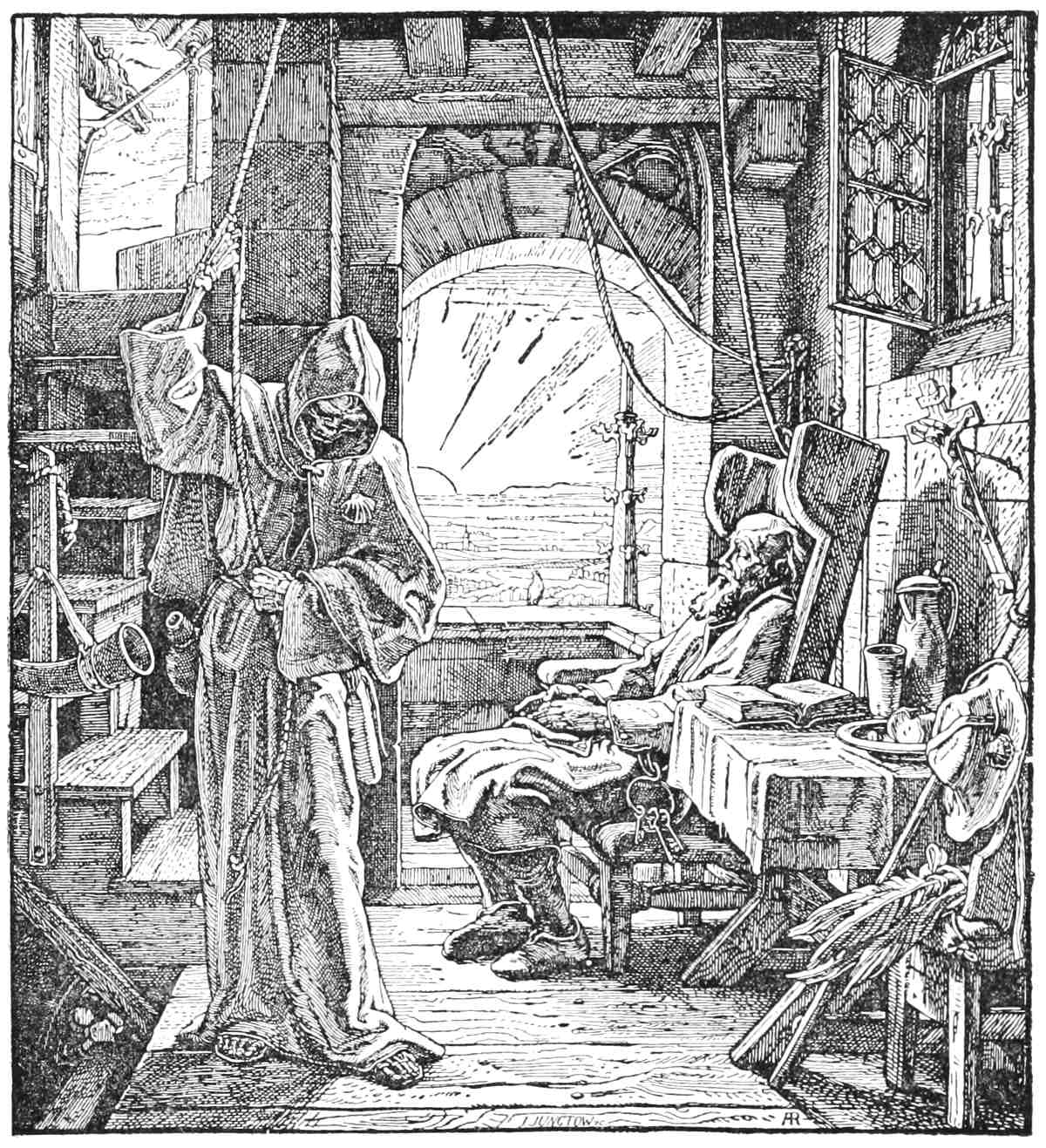
FRIENDLY DEATH