Volume 3 — Family TETRAONIDÆ.—The Grouse.
Reading edition
As already stated, the Tetraonidæ are pre-eminently characterized among gallinaceous birds by their densely feathered tarsi, and by the feathers of the nasal fossa or groove, which fill it completely, and conceal the nostrils. The toes are usually naked (feathered to the claws in the Ptarmigans), and with pectinations of scales along the edges. The tail-feathers vary from sixteen to eighteen and even twenty in number; the tail is rounded, acute, or forked. The orbital region is generally somewhat bare, with a naked stripe above the upper eyelid, beset by short fringe-like processes, while many genera have an inflatable air-sac on the side of the neck.
The following synoptical table will give a general view of the North American Tetraonidæ, although the arrangement is more artificial than natural. The species of Tetrao and Bonasa inhabit wooded regions; Lagopus belongs to the more arctic portions of the continent and the snowy ridges of the Rocky Mountains; the others are found in the great prairies of the West, Centrocercus being confined to the sterile plains covered with sage or wormwood.
The following synopsis is intended to aid in defining the genera, but does not profess to constitute a natural arrangement.
Genera.
A. Legs feathered to and on the basal membrane of the toes, which are bare. No ruff on the side of the neck, which, however, has an extensible bare space.
Canace. Tail broad, nearly even, or truncate, and rounded laterally, two thirds the wing. Nasal fossæ scarcely half the culmen.
Centrocercus. Tail excessively lengthened and cuneate; longer than the wings. Nasal fossæ two thirds the culmen. Shafts of feathers on the lower throat very spinous.
Pediœcetes. Tail very short, but graduated, and with the two middle feathers (perhaps tail-coverts) lengthened beyond the rest, and two thirds as long as the wing; the next longest half the wing. Nasal fossæ not half the length of culmen. Shafts of throat-feathers normal.
B. Legs feathered to the lower end of tarsus.
Cupidonia. Tail very short, truncate, but laterally graduated; half the wings. Sides of neck with long, pointed, or lanceolate, stiff feathers. Nasal fossæ scarcely one third the culmen.
C. Legs feathered to the claws.
Lagopus. Tail about two thirds the wing, truncate; of sixteen to eighteen feathers. Most species becoming white in winter; none of the other genera exhibiting this peculiarity.
D. Lower half of tarsi bare, with two rows of scutellæ anteriorly.
Bonasa. Sides of neck with a ruff of broad, truncate, soft feathers. Tail very broad, square, as long as the wings.
Genus CANACE, Reichenbach.
Gen. Char. Bill smooth, with no lateral groove, depressed, or broader than high. Feathers of the head and neck all normal, i.e. no crest, nor lengthened plumes of any kind. Tail lengthened (i.e. nearly equal to wing), rounded, the feathers broad to the end; consisting of from sixteen to twenty feathers. Toes naked.
Subgenera.
Canace. Tail of sixteen feathers; no air-sac on side of the neck. Size small. (Type, T. canadensis, L.)
Dendragapus. Tail of twenty feathers; an inflatable air-sac on side of the neck. Size large. (Type, T. obscurus, Say.)
The American species of Wood Grouse appear, on comparison, to be generically distinct from Tetrao, of the Old World, (type, Tetrao urogallus,) and, moreover, are themselves comprised under two definable subgenera. Canace proper has a near relative in Falcipennis, Elliot, (type, Tetrao falcipennis, Hartlaub,) of Siberia, which differs merely in the attenuation of the primaries, and seems to us not separable from Canace. There is no European genus nearly related to our birds. T. urogallus differs very essentially in high, compressed, and light-colored bill, elongated and stiffened feathers of the whole head and neck, metallic colors, etc. T. (Lyrurus) tetrix approaches nearer in the bill, but also has metallic colors and a very peculiarly formed tail. Thus it seems absolutely necessary to adopt the name Canace, of Reichenbach, as a generic term by which to designate the American Wood Grouse.
Subgenus CANACE, Reichenbach.
Canace, Reichenbach, Av. Syst. Nat. 1851. (Type, Tetrao canadensis, L.)
Gen. Char. Tail of sixteen feathers, rounded, the feathers broad to the end. A colored (red or yellow) “comb” of naked skin over the eye. No inflatable air-sac on side of the neck. No crest, nor unusual plumes, about the head or neck.
Species and Varieties.
T. canadensis. Above distinctly barred with plumbeous and black; beneath black, with a white border to the throat, a white pectoral band, and white markings on the sides. Female barred with ochraceous, gray and black above, and with orange-ochraceous and black on the lower parts.
Tail rounded, tipped with rufous; upper tail-coverts tipped narrowly with deep ash. Hab. British America, east of the Rocky Mountains, from Alaska (Yukon region) to northern border of United States … var. canadensis.
Tail nearly even, black to the tip, or else with a narrow white terminal bar; upper tail-coverts broadly tipped with pure white. Hab. Northern Rocky Mountains to the Pacific coast … var. franklini.
Canace canadensis, var. canadensis, Linn. SPRUCE PARTRIDGE; CANADA GROUSE.
Tetrao canadensis, Linn. Syst. Nat. I, 1758, 159.—Forster, Phil. Trans. LXII, 1772, 389.—Sabine, Zoöl. App. Franklin’s Exped. 683.—Bonap. Amer. Orn. III, 1830, pl. xxi, f. 2, ♀.—Ib. Am. Phil. Trans. III, N. S. 1830, 391.—Rich. F. Bor. Amer. II, 1831, 346, pl. lxii, ♀.—Nuttall, Man. I, 1832, 667.—Aud. Orn. Biog. II, 1834, 437; V, 1839, 563, pl. clxxvi.—Ib. Birds Amer. V, 1842, 83, pl. cclxciv.—Baird, Birds N. Am. 1858, 622.—Maynard, B. E. Mass. 1870, 138 (Massachusetts).—Coues, P. A. N. S. 1861, 226.—Gray, Cat. Brit. Mus. 1867, 86.—Dall & Bannister, Tr. Chicago Ac. I, 1869, 287.—Finsch, Abh. Nat. Verz. III, 1872, 61. Canace canadensis, Reich. Av. Syst. Nat. 1851, p. xxix. Bonap. Comptes Rendus, XLV, 1857, 428.—Elliot, P. A. N. S. 1864, 23.—Ib. Monog. Tetraon. pl. Tetrao canace, Linn. Syst. Nat. I, 1766, 275. Black Spotted Heathcock, Edwards, Glean. pl. cxviii. Spotted Grouse, Pennant.
Sp. Char. Tail of sixteen feathers. Above black. Feathers above distinctly banded with plumbeous; beneath uniform black, with a pectoral band of white, and white on the sides of the belly. Chin and throat above, black. Tail with a broad brownish-orange terminal band. Length, 16.20; wing, 6.70; tail, 5.44.
Female smaller, but somewhat similar; the black bars above broader, the inner gray bars of each feather, including the tail, replaced by broader ones of brownish-orange. The under parts have the feathers black, barred with the brownish-orange, which, on the tips of the belly-feathers, is pure white. The clear continuous black of the head and breast is wanting. The scapulars, greater coverts, and sides are streaked as in the male.
A female (No. 39,136, G. A. Boardman) from Maine differs from the above description in having the ground of the plumage a bright orange-rufous, the distinct bars of which are broader than the black ones; this is probably an autumnal bird, and represents the peculiar plumage of that season.
Males vary, individually, in the extent or uniformity of the black of the breast.
Specimens from Alaska (Nulato, Kodiak, etc.), Red River, Liard’s River and Fort Liard, Hudson’s Bay Territory, Canada, and Maine, appear to be absolutely identical.
The young in downy state are pale buff-yellow; the head above, with the back and wings, pale fulvous; a black stripe on side of head (from bill to end of auriculars), two spots on crown, and transverse crescentic spots on back and wings, black.
Hab. Spruce forests and swamps of the Northern United States to the Arctic seas; west nearly to Rocky Mountains.
Habits. This bird, variously known as the Spruce or Wood Partridge, Canada, Black, or Spotted Grouse, is found, in favorable localities, from the Northern United States as far north as the woods extend, to the Arctic Ocean, being found, even in midwinter, nearly to the 70th parallel. Sir John Richardson found all the thick and swampy black-spruce forests between Canada and the Arctic Sea abounding with this species. In winter it descends into Maine, Northern New York, and Michigan. Its migrations are, however, only partial, as it is found in the severest weather of midwinter, in considerable numbers, as far north as latitude 67°. According to Mr. Douglas, west of the Rocky Mountains it is replaced by the T. franklini. This bird is said to perch in trees, in flocks of eight or ten, and is so stupid that it may be taken by slipping a noose, fastened to the end of a stick, over its head. When disturbed, it flies heavily a short distance, and then alights again among the interior branches of a tree. Richardson invariably found its crop filled with the buds of the spruce-trees in the winter, and at that time its flesh was very dark and had a strong resinous taste. In districts where the Pinus banksiana grows it is said to prefer the buds of that tree. In the summer it feeds on berries, which render its flesh more palatable.
Captain Blakiston states that he has found this species as far west as Fort Carlton, and Mr. Ross has traced it northward on the Mackenzie to the Arctic coast.
Mr. Audubon met with it in Maine, in the vicinity of Eastport, where they were only to be met with in the thick and tangled forests of spruce and hackmatack. They were breeding in the inner recesses of almost impenetrable woods of hackmatack or larches. He was informed that they breed in that neighborhood about the middle of May, a full month sooner than they do in Labrador. In their love-season the males are said to exhibit many of the singular manners also noticeable in the other members of this family. They strut before the female on the ground, something in the manner of the common domestic Turkey-cock, occasionally rising in a spiral manner above her in the air; at the same time, both when on the ground and in the air, they beat their wings violently against their body, thereby producing a peculiar drumming sound, which is said to be much clearer than the well-known drumming of the Ruffed Grouse. These sounds can be heard at a considerable distance from the place where they are made.
The female constructs a nest of a bed of dry twigs, leaves, and mosses, which is usually carefully concealed, on the ground and under low horizontal branches of fir-trees. The number of eggs is said to vary from eight to eighteen in number. It is imagined by the common people that where more than ten eggs are found in the same nest they are the product of two females, who aid each other in their charge. The eggs are described by Audubon as of a deep fawn-color, irregularly splashed with different tints of brown. They have but a single brood in a season, and the young follow the mother as soon as they leave the shell.
As soon as incubation commences, the males desert the females and keep in small flocks by themselves, removing to different woods, where they usually become much more shy and wary than at any other season of the year.
In their movements on the ground these birds are said to resemble our common Quail, rather than the Ruffed Grouse. They do not jerk their tails in the manner of the latter bird, as they walk, nor are they known to burrow in the snow; but when they are pursued they invariably take refuge in trees, from which they cannot be readily made to fly. When driven from one place of refuge to another, they accompany their flight with a few clucks, and those sounds they repeat when they alight. When a flock thus alights, it may all be readily secured by a little precaution and pains. It is said that they are so unwary and regardless of the near presence of man, that when thus in the imagined shelter of a tree they will permit themselves to be approached, the whole flock shot, or even knocked down with a stick. Sometimes they may all be taken alive, one after the other, by means of a noose affixed to the end of a long pole.
According to Audubon, the Canada Grouse indicate the approach of rainy weather by retiring to roost at an unusual time in the day, whenever a storm is impending. If observed to fly up to their roost at midday, it rarely fails to rain or snow before the evening; and if, on the contrary, they remain busily engaged in search of food until sunset, the night and the following morning are pretty sure to be fresh and clear.
The young of this Grouse are very strong and active from the moment they are hatched, and are able to fly at a very early age. When in Labrador, Mr. Audubon almost walked, by accident, upon a female Canada Grouse, surrounded by her young brood. This was about the middle of July. The affrighted mother, upon perceiving him, ruffled up all her feathers in the manner of the common Hen, and advanced close to him as if determined to defend her offspring. Her distressed condition claimed his forbearance, and she was allowed to remain in safety. As soon as he retired she smoothed down her plumage and uttered a tender maternal chuck, when the little ones took to their wings with ease, though they appeared to be not more than one week old.
Mr. Audubon found this Grouse moulting as early as the 20th of July. At that period the young were generally already able to fly fully a hundred yards in a single flight. They alighted on low trees and were easily taken alive.
This Grouse feeds, in the summer, on berries of various kinds, as well as upon the buds and leaves of several different kinds of plants and shrubs. In the autumn they gorge themselves with the berries of the Solomon’s Seal. At this season their flesh is much the best. In the winter, when they feed on the buds of the hackmatack and the spruce and firs, and also upon the leaves of the spruces, as stated by Richardson, they have a bitter, disagreeable taste, and are hardly fit to eat.
This Grouse may be readily kept in confinement, and even made to breed there. Mr. Thomas Lincoln, of Dennysville, fed some of them on oats, on which food they appeared to thrive very well.
The eggs of this food vary in length from 1.75 inches to 1.68, and in breadth from 1.22 to 1.20 inches. Eggs taken at Fort Resolution, by Mr. Kennicott, have a ground of a deep dull cream-color, shaded with ochre. They are of an oblong-oval shape, speckled and marked with spots of a dark chestnut-color. In these specimens the spots are larger towards the smaller end.
Canace canadensis, var. franklini, Douglas. FRANKLIN’S GROUSE.
Tétrao franklini, Douglas, Trans. Linn. Soc. XVI, 1829, 139.—Rich. F. Bor. Am. II, 1831, 348, pl. lxi.—Baird, Birds N. Am. 1858, 623.—Lord, Pr. R. A. Inst. IV, 1864, 123 (between Rocky Mountains and Cascades).—Gray, Cat. Brit. Mus. 1867, 86.—Cooper & Suckley, 261.—Coop. Orn. Cal. I, 1870, 529. Tetrao canadensis, var. Bonap. Am. Orn. III, 1830, 47, pl. xx. ? Tetrao fusca, Ord. Guthrie’s Geog. (2d Am. ed.) II, 1815, 317. (Based on small brown Pheasant of Lewis & Clark, II, 182, which very probably is this species.) Canace franklini, Elliot, P. A. N. S. 1864.—Ib. Monog. Tetraon. pl.
Sp. Char. Similar to C. canadensis, but with the tail-feathers entirely black, without orange-brown terminal band; the upper tail-coverts broadly tipped with white. The tail less rounded. Wing, 7.35; tail, 5.62.
Hab. Northern Rocky Mountains, near the United States boundary, and west to Coast Range.
The difference from canadensis is very appreciable, though we cannot consider it as of specific importance. This consists chiefly in the rather longer, more even tail, with broader feathers, which are pure black instead of very dark brown, and entirely without the orange terminal band. The white streaks on the scapulars are larger terminally, and much more conspicuous, and the upper tail-coverts are conspicuously barred terminally with white, not seen in the other. The female differs from that of canadensis in the white bars at the ends of the tail-coverts, and in having the tail-feathers tipped with whitish instead of orange-brown.
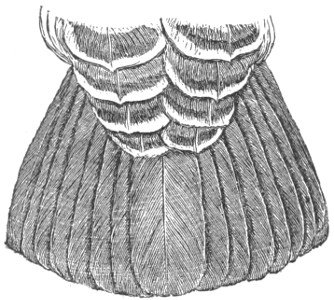
C. franklini.
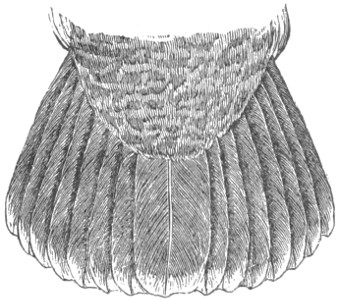
C. canadensis.
Habits. From the Rocky Mountains to the Pacific, and from Oregon to high northern latitudes, this variety replaces the common Spruce Partridge of the Eastern Continent. Sir John Richardson, as well as Mr. Drummond, regarded these birds as only a western variety of the canadensis. The latter, who had ample opportunities for studying the manners of both, was unable to perceive any difference between them. Mr. Douglas took a different view, though he admitted that their habits were essentially the same. Swainson also regarded the two birds as distinct species. This variety is stated by Richardson to inhabit the valleys of the Rocky Mountains, from the sources of the Missouri to those of the Mackenzie; and on the authority of Mr. Douglas, it is also to be seen sparingly on the elevated platforms that skirt the snowy peaks of Mount Hood, Mount St. Helens, and of Mount Baker, where it is said to run over the shattered rocks and among the brushwood with amazing speed, only using its wings as a last effort to escape. Mr. Douglas also states that it makes its nest on the ground, of dried leaves and grass, not unfrequently at the foot of decayed stumps, or by the side of fallen timber in the mountain woods. The eggs are incorrectly described as of a dingy whiteness and as smaller than those of the European Columba palumbus.
Dr. Suckley found this Grouse abundant in the Rocky as well as in the Bitterroot and the Cascade Mountains, and in Washington Territory, near the Yakima Passes. It is known to the Indians as the Tyee-kulla-kulla, meaning the gentleman-bird. It was only found plentiful in the eastern portion of Washington Territory. Specimens of this species, sent by Dr. Suckley to the Smithsonian Institution, were procured by Mullan in St. Mary’s Valley, in the Rocky Mountains. They were quite common in that region, and were readily obtainable, as they were very tame and unsuspicious. Mr. George Gibbs informed Dr. Suckley that in November, 1847, he obtained in the Willamette Valley a small Grouse that may probably be referred to this species.
Mr. Lord thinks that this species is rarely found west of the Cascades; but on the eastern side and along the whole district lying between the Cascades and the Rocky Mountains it is common, always keeping among the mountains, to the height of seven thousand feet. He regards them as one of the most stupid of birds. When several are flushed together, they fly up into the nearest pine-tree, from which you cannot frighten them with sticks and stones. He has often shot several in a tree where there were others without the latter attempting to fly away. During the winter they remain in the deep woods and sheltered places, and feed on the buds of the pines. They nest in early May, and have chickens in June and July. He was of the opinion that these birds do not pair; but from the large number of females, as compared with the males, he thinks they are polygamists.
Captain Blakiston considers this variety to be confined to the Rocky Mountains and the country between that range and the Pacific. He met with it for the first time while following an Indian trail through a thick pine woods, from the summit of the Kootenay Pass into the valley of the Flathead River. The bird arose and perched itself on a projecting branch, when he was at once struck with the dissimilarity to the Canada Grouse, which was made still more apparent by the whiteness of its flesh. Afterwards he procured other specimens. He describes them as being quite as unsuspicious and stupid as the Canada Grouse, allowing themselves to be shot on the trees without making any attempt to escape.
Subgenus DENDRAGAPUS, Elliot.
Dendragapus, Elliot, P. A. N. S. Philad. 1864. (Type, Tetrao obscurus, Say.)
Gen. Char. Tail of twenty feathers, rounded, rather large (about two thirds the wing); the feathers broad to the tips, which are almost truncated. A colored (orange or yellow) “comb” of naked skin over the eye, and an inflatable air-sac on side of the neck. No crest or other unusual plumes about the head or neck.
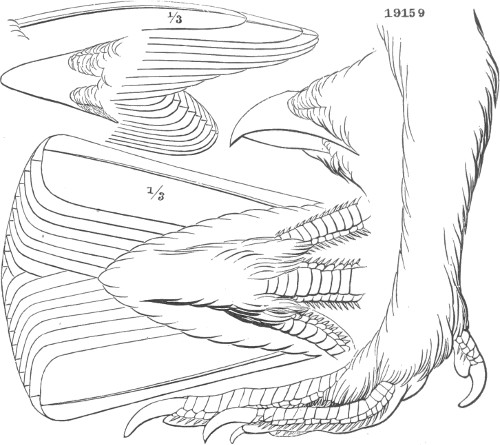
19159 ⅓ ⅓
Tetrao obscurus.
Species and Varieties.
C. obscurus. Above nearly uniform plumbeous-dusky, minutely mottled on the wings. Tail uniform black, with or without a lighter terminal band, and sometimes finely and obscurely mottled above. Lower parts nearly uniform clear plumbeous, or blackish-dusky; a dusky half-collar on the throat; chin and throat white, variegated with dusky. Length, about 20.50; wing, 9.40; tail, 7.45. Female smaller, the colors more variegated, with the dusky less continuous, and less in amount.
A. Tail rounded, with a distinct terminal band of clear plumbeous.
Above brownish-ashy, minutely mottled (transversely) with dusky and, to a less extent, with yellowish-brown. Beneath fine pure ashy. Hab. Sierra Nevada (from Fort Crook southwards) and Rocky Mountains, from the Hellgate region to New Mexico … var. obscurus.
Above brownish-black, minutely and sparsely mottled with slate and rusty-brown. Beneath dark plumbeous. (In northern specimens, especially in females from Sitka, much washed with dark castaneous-rusty.) Hab. Northwest coast mountains, from Oregon to Sitka … var. fuliginosus.
B. Tail nearly even, and without any terminal lighter band, or else having it badly defined.
Colors, in other respects, of var. obscurus, but cheeks, etc., less dusky. Hab. Rocky Mountains of British America, south to the Yellowstone and Hellgate region of United States (where grading into var. obscurus) … var. richardsoni.
PLATE LIX.
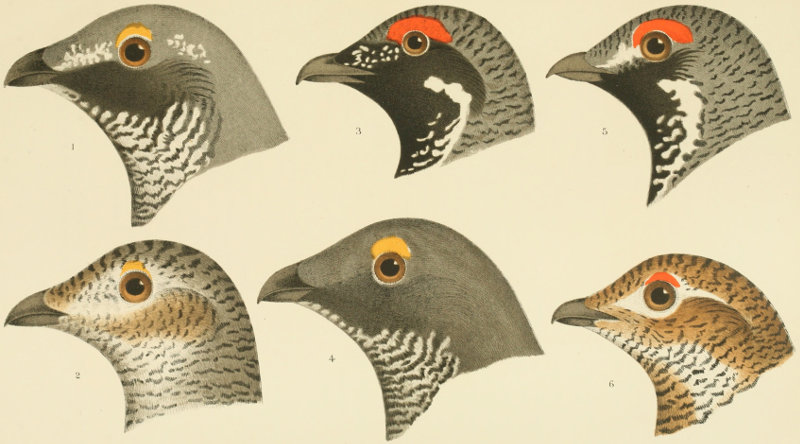
1. Canace obscurus. ♂ Rocky Mts., 19159.
2. Canace obscurus. ♀ Rocky Mts., 19166.
3. Canace franklini. ♂ Rocky Mts., 398.
4. Canace richardsoni. N. Rocky Mts.
5. Canace canadensis. ♂ Nova Scotia, 12564.
6. Canace canadensis. ♀ Nova Scotia, 12565.
Canace obscurus, var. obscurus, Say. DUSKY GROUSE.
Tetrao obscurus, Say, Long’s Exped. R. Mts. II, 1823, 14.—Bon. Mon. Tetrao, Am. Phil. Trans. III, 1830, 391.—Ib. Am. Orn. III, 1830, pl. xviii.—Baird, Birds N. Am. 1858, 620.—Scl. P. Z. S. 1858, 1.—Gray, Cat. Brit. Mus. V, 1867, 86.—Coop. Orn. Cal. I, 1870, 526 (in part). Canace obscura, Bonap. Comptes Rendus, XLV, 1857, 428. Dendragapus obscurus, Elliot, P. A. N. S. 1864, 23.—Ib. Monog. Tetraon. pl.
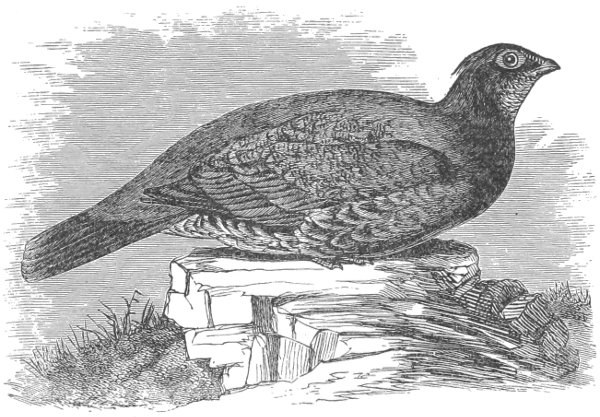
Canace obscurus.
Sp. Char. Male (19,161, Deer Creek, Neb., Feb. 13; G. H. Trook.) Ground-color above slaty-black, but this almost completely overlaid by a minute, transverse mottling of bluish-ash,—pale brown on scapulars and secondaries,—mostly on terminal portion of the feathers. Scapulars with a conspicuous shaft-streak and terminal spot of white. Terminal band of tail sharply and abruptly defined, pure pale bluish-ash, and 1.50 inches in width. Tail slightly rounded (about .80). Lower parts fine bluish-ashy, becoming lighter posteriorly, more plumbeous anteriorly. On the sides of the jugulum the feathers snowy-white beneath the surface, and this much exposed, producing a somewhat broken but conspicuous patch. Throat white, with transverse crescentic bars of dusky; this barred white curving upward to the auriculars, behind a uniformly blackish malar patch; lores and post-ocular region with distinct white spots, producing an inconspicuous stripe from the bill through the eye. All the feathers of the lower parts margined terminally with white, this growing broader on the flanks and crissum, the former of which have a more brownish and mottled ground, and broad white shaft-stripes. Lining of wing almost wholly white. Tarsi ashy-white. Length, 21.00; wing, 10.00; tail, 8.00; tarsus, 1.80; middle toe, 1.80.
Female (58,636, Uintah Mountains, July 5, 1868; R. Ridgway). Somewhat similar to male in pattern. Dusky-black above, much broken by narrow transverse bars of yellowish-brown; these broad, regular, and sharply defined anteriorly, posteriorly broken and mottled. Middle tail-feathers much mottled, obscuring the ashy tip: ash beneath unbroken only on the abdomen; the jugulum, sides, etc., having transverse bars of yellowish-brown. Wing, 8.70; tail, 6.00.
Young (58,658, Uintah Mountains, July 5, 1868; R. Ridgway). Above yellowish-brown, the feathers with conspicuous shaft-streaks and deltoid terminal spots of white; both webs with large, transverse, roundish spots of black; secondaries with six bands of black and white, both broken, however, by coarse mottlings; tail like the secondaries. Beneath dull whitish; jugulum and sides with rounded spots of black, those on opposite webs not joining. Head yellowish-white, crown spotted with black; an indistinct dusky stripe over lores and upper edge of auriculars.
Hab. Rocky Mountain region of the United States, principally south of South Pass, and Sierra Nevada, north to Oregon and south to San Francisco Mountains, New Mexico.
The “Dusky Grouse” figured and described by Mr. Audubon of this species, is not the bird of Say, nor based on specimens collected by Townsend. The figures were probably taken from the skins in possession of Mr. Sabine, referred to by Bonaparte in American Ornithology (Vol. III, 1828, 36), which Sabine proposed to name after Richardson. Douglas, in describing his Tetrao richardsoni, quotes “Sabine MSS.,” but does not describe his specimens, and, as far as his incomplete description goes, seems to have had the true T. obscurus before him. Richardson’s description and figure belong to the second species, the same with Audubon’s. Wilson’s figures, in Illustrations of Zoölogy, 1831 (plates xxx, xxxi), are taken from specimens received from Mr. Sabine, of the same species, but in different and less perfect plumage than Mr. Audubon’s.
Habits. This species was first discovered and described by Say in 1820, though its existence had previously been known to the fur-trappers. Its food consists of various berries, and the flesh is said to be very palatable.
Dr. Newberry pronounces this Grouse decidedly the handsomest of all the American birds of this family; its flesh white, and fully equal to that of the eastern Ruffed Grouse or Quail. It is said to inhabit the evergreen forests exclusively, and to be found not uncommonly in the Sierra Nevada, as well as in the wooded districts of the country lying between the Sacramento Valley and the Columbia. In the Cascade Mountains Dr. Newberry found it associated with the Ruffed Grouse, which it resembles in habits more than any other species. When on the ground they lie very close, flying up from your very feet as you approach them, and, when flushed, always take to a tree, from which they cannot be dislodged except by shooting them. In the spring the male sits motionless on a branch of a pine or a spruce, and utters a booming call, which, by its remarkable ventriloquial powers, seems rather to mislead than to direct the sportsman, unless he is experienced in shooting this kind of Grouse.
Mr. George Gibbs informed Dr. Suckley that he has met with the Dusky Grouse as far south as the Russian River Mountains, in California, and found it also common on the east side of the Cascades, as far north as the 49th parallel.
Dr. Cooper’s account of these birds is substantially similar to the account given by Dr. Suckley of the fuliginosus. He found it common in most of the forests, especially in the dense spruce woods near the coast. It was rarely seen on the open prairie. In the dense woods it was exceedingly difficult to detect. During May, near the coast, and till August, on the mountains, the low tooting of this Grouse was heard everywhere, sounding something like the cooing of a Pigeon, but in the same deep tone as the drumming of the Ruffed Grouse. Dr. Cooper also mentions its remarkable powers of ventriloquism, so that while the bird may be sitting on a tree directly over your head the sound seems to come from places quite remote.
Dr. Woodhouse states that the Dusky Grouse is found among the mountains about Santa Fé, in New Mexico.
This Grouse was first met with by Mr. Ridgway on the Sierra Nevada, in the vicinity of Carson City, where it was seen in the possession of Indians who had been hunting on the mountains. It was found on the East Humboldt Mountains, in the month of September, and at that time occurred in small flocks, consisting chiefly of young birds, and probably composed of single families. Afterwards, in the summer of 1869, it was found in considerable abundance in Parley’s Park, a few miles from Salt Lake City. It there chiefly inhabited the copses of scrub-oaks along the lower border of coniferous woods. In July it was found in the Uintah Mountains in very great abundance, and for a while formed the chief subsistence of the party. It was there known as the Mountain Grouse. Nothing very distinctive was ascertained in regard to its habits, except that it was said to resemble very closely, in manners, the Ruffed Grouse. Its flesh was excellent eating.
Dr. Suckley, in a series of papers on the Grouse of the United States which were read before the New York Lyceum in 1860, states that this species probably extend their range to quite a distance south of latitude 40° along the line of the Rocky Mountains, in New Mexico. This writer claimed to have met with them near Pike’s Peak, in the Cheyenne Pass, and in 1853 he found them in great numbers in Lewis and Clarke’s Pass, west of Fort Benton. He also found them abundantly in Oregon and on the slopes of the Cascade and Coast Ranges, extending wherever pine or fir timber occurs, to the very borders of the ocean. The Black Hills, in Nebraska, he gives as their most eastern limit.
The same author corrects the statements of Douglas as to certain habits of this species. The males are said not to be particularly pugnacious, and very rarely forsake the boughs of the pine or fir trees for a rocky eminence. They feed on berries only during a brief season in autumn, at all other times of the year subsisting upon the leaves of the pine and fir, especially those of the Douglas Fir. This food imparts a strong resinous flavor to the flesh of this Grouse, which, however, is not unpleasant, and after a while becomes quite attractive to the epicure. The love-notes of this bird are said to be deep, soft, plaintive, but unmusical, and resemble the whirring sounds made by a rattan, swung rapidly and in jerks through the air. These notes usually begin the first week in March. The young are able to fly feebly by the first of July. By the last of August they have attained their full size. In the winter they retire to the tops of the loftiest firs, where they pass the season in an almost immovable state of hibernation. Between July and winter they may be readily shot. Once raised, they invariably fly to trees. They heed but little the report of a gun unless they have been wounded. Their flesh is said to be midway between the color of the Pinnated and the Ruffed Grouse, partaking of their good qualities, but surpassing either.
The eggs of this species are oval in shape; one end is a little more obtuse than the other. The ground is of a pale cream-color, and is marked with small rounded spots of reddish-brown. These are more numerous and larger towards the larger end. They measure 1.95 inches in length and 1.45 in breadth.
Canace obscurus, var. fuliginosus, Ridgway. OREGON DUSKY GROUSE.
? Tetrao obscurus, Newberry, P. R. R. Rept. VI, iv, 1857, 93.—Coop. & Suckl. 219.—Lord, Pr. R. A. Inst. IV, 122 (British Columbia).—Dall & Bannister, Trans. Chicago Ac. I, 1869, 287 (Alaska).—Finsch, Ab. Nat. III, 1872, 61 (Alaska).
Sp. Char. Beneath plain dark plumbeous, without whitish borders to the feathers except on flanks and crissum; whole head almost uniformly plain dusky-black. Tarsi dark plumbeous. Wing, 9.50; tail, 7.50; tarsus, 1.75; middle toe, 1.80.
Female (11,826, Chiloweyuck Depot, Washington Territory, Aug. 6, 1858; C. B. Kennerly). Above black, broken by transverse mottlings of bright reddish-brown or rufous; these confused posteriorly, but in form of regular transverse bars anteriorly. Below dusky-plumbeous, plain on abdomen, with sagittate spots on jugulum, and deltoid ones on the flanks, etc., of reddish-white. Length, 20.00; wing, 8.50; tail, 6.30.
Adult male (4,505, Cascade Mountains, Dr. Newberry). Above plain fuliginous-black, the mottlings scarcely apparent. No white markings on scapulars; tail-band deep plumbeous, only .60 wide, but well defined.
Young (11,827, Chiloweyuck Depot). Similar to, but much more reddish than, young of var. obscurus.
Hab. Northwest coast region, from Oregon to Sitka.
A male (46,070, May, 1866; Bischoff) from Sitka is much mottled with bright reddish-rusty on the dorsal region, and washed with the same on the forehead. (Tail-band .60 of an inch wide). A female (46,073, Sept., 1866) from same locality is so strongly washed with dark, almost castaneous, ferruginous as to appear mostly of this color above, this being very bright on the crown and forehead.
Habits. This race is the more northern and northwestern coast form of the Dusky Grouse, and is found from the Columbia River and British Columbia to Alaska. According to Dr. Suckley, it is generally known as the Blue Grouse in Oregon, and is also called the Pine Grouse, as well as the Dusky Grouse. He met with it for the first time when his party had reached the main chain of the Rocky Mountains, and where they found it exceedingly abundant, as afterwards in the Blue Mountains of Oregon, the Cascade Mountains, and in all the timbered country between the Coast Range and the Pacific Ocean. About the middle of November these birds are said to entirely disappear, and it is very rare to meet with even a single individual between that period and the 20th of the following March. As to their whereabouts during this period there is a great difference of opinion among the settlers. Some maintain that they are migratory and retire to the south. Others are of the opinion that they retire to the tops of the highest evergreen trees, where they pass the cold season in a state of partial torpor among the thickest foliage of the branches. As these birds are known to subsist on the leaves of the Coniferæ, and can always obtain sufficient water from the snow and rain-drops to supply their wants, Dr. Suckley was inclined to favor the latter explanation of their absence. He saw one of these birds on the ground during a fall of snow, in January, near the Nisqually River, in Washington Territory, and he was informed that a hunter near Olympia, whose eyesight was remarkably excellent, was able, any day during the winter, to obtain several birds by searching carefully for them among the tree-tops of the tallest and most thickly leaved firs. This requires much better eyesight than most men possess, for these birds are of a sombre hue, crowd very closely to the limb, and sit there immovable. They are therefore very difficult to find among the dense branches.
The first indication of their presence in spring is the courting call of the male. This is a prolonged sound, resembling the whir of a rattan cane moved rapidly through the air. This is repeated several times with considerable rapidity, and then stops for a brief interval. This is said to be produced by the alternate inflation and contraction of sacs, one on each side of the throat, which are usually concealed by the feathers, and are covered by an orange-colored, thick, corrugated skin. At Fort Steilacoom these birds were very abundant during the spring and early summer, and were mostly confined to the forests of firs. Later in the season, and after hatching, they are more generally found on the ground in search of berries and seeds. When alarmed, they seek safety among the dense foliage of the trees, seeming instinctively to understand the advantage of thus hiding. He has known an entire flock of five, concealed among the ferns and grass, to be shot one by one, without an attempt being made by a single individual to fly. This Grouse is said to be a very fine table bird, its pine taste only adding to its game-flavor. Their full weight is from 2¾ to 3½ pounds.
Dr. Cooper never met with the nest of eggs of either of the races of the Dusky Grouse, but in June flocks of half-grown young were killed by the Indians near Puget Sound. In winter they were so rarely seen west of the mountains that they are believed to keep entirely in the trees. In October, 1853, he saw a flock running through the snow near the Spokane Plains, one of which was shot; but he never afterwards met with any in the winter.
Mr. J. K. Lord found this Grouse almost exclusively on the western side of the Rocky Mountains. It appeared at Vancouver, at Nisqually, and along the banks of the Fraser River, about the end of March, the male bird announcing his coming by a kind of love-song. This is a booming noise, repeated at short intervals, and so deceptive that Mr. Lord has often stood under the tree where the bird was perched and imagined the sound came from a distance.
Mr. Nuttall found this Grouse breeding in the shady forests of the region of the Columbia, where he saw or heard them throughout the summer. He describes the tooting made by the male as resembling the sound caused by blowing into the bung-hole of a barrel. They breed on the ground, and are said to keep the brood together all winter.
Townsend describes the eggs as numerous, of a cinereous-brown color, blunt at both ends, and small for the bird. The actions of the female, when the young are following her, are said to be exactly similar to those of the Ruffed Grouse, employing all the artifices of that bird in feigning lameness, etc., to draw off intruders.
Canace obscurus, var. richardsoni, Douglas. RICHARDSON’S DUSKY GROUSE.
Tetrao obscurus, Aud. Orn. Biog. IV, 1838, 446, pl. ccclxv.—Ib. Syn. 1839, 283.—Ib. B. Am. I, 1842, 89.—Nutt. Orn. I, 1840, 609.—Swains. F. B. A. II, 1831, 344, pl. lix, lx. Tetrao richardsoni, Dougl. Linn. Trans. XVI, 141.—Lord, Pr. R. A. I. IV, 122 (between Cascade and Rocky Mountains).—Gray, Cat. B. Brit. Mus. V, 1867, 86. Dendragapus richardsoni, Elliot, P. A. N. S. 1864, 23.—Ib. Monog. Tetraon, pl.—Wilson, Illust. 1831, pl. xxx, xxxi.
Sp. Char. Tail-feathers broad and nearly truncated; tail almost perfectly square, and black to the tip, with the terminal band either only faintly indicated or entirely wanting; in all other respects exactly like var. obscurus. Male (18,397, Browns Cut off. N. Rocky Mountains; Lieutenant Mullan). Length, about 20.00; wing, 9.00; tail, 7.30; tarsus, 1.70; middle toe, 1.85. Female (18,398, forty miles west of Fort Benton; Lieutenant Mullan). Wing, 8.60; tail, 6.00; tarsus, 1.60; middle toe, 1.60.
Hab. Rocky Mountains of British America, south to the Yellowstone and Hellgate region of the United States.
No. 18,377, Hellgate, and others from localities where this form and var. obscurus approach each other, have the terminal zone of the tail of the usual width, and even sharply defined; but it is so dark as to be scarcely distinguishable from the ground-color.
Habits. In regard to distinctive peculiarities in habits and manners, of this form of Grouse, if it possesses any, our information is quite limited. In its external markings and in size it appears to be readily distinguishable from the T. obscurus either specifically or as a well-marked interior race. Mr. J. K. Lord refers to it in his account of the obscurus, where he states that between the Cascades and the Rocky Mountains the Dusky Grouse appears to be replaced by a well-marked variety, if not a distinct species. In size it is a trifle smaller, but the great mark of distinction is the entire absence of the white band at the end of the tail. In their habits, in their periods of arrival and departure, or rather of appearance and disappearance, the two varieties are pronounced to be, in every respect, similar. In regard to their unexplained disappearance and reappearance, Mr. Lord is of the opinion that these birds do not migrate, but only retire into the thickest trees, and, living on the buds, pass the winter thus sheltered in the tree-tops.
Captain Blakiston thinks that this species is the form that inhabits the interior of British North America, and refers the figure of the male in Richardson’s Fauna to the richardsoni,—the Black-tailed and smaller species. In his wanderings he met with these birds only in or near the pine woods on the slopes of the Rocky Mountains; but, having killed only females, he could not feel certain of the species. These Grouse range towards the Pacific as far as the Cascade Mountains of Oregon and British Columbia, and along the Rocky Mountains from the head-waters of the Platte to the Liard River, a tributary of the Mackenzie. When the ranges of the two species are fully defined, he thinks the T. richardsoni will be found the more northern bird.
The eggs of Tetrao richardsoni are very similar, except in size, to those of the obscurus, resembling them closely in their ground-color, as well as in their markings. In the specimens in the cabinet of the Boston Natural History Society the spots are smaller, a little less distinct, and less numerous. The eggs are 1.75 inches in length, and from 1.35 to 1.36 inches in breadth.
Genus CENTROCERCUS, Swainson.
Centrocercus, Swainson, F. B. A. II, 1831, 496. (Type, Tetrao urophasianus, Bon.)
Gen. Char. Tail excessively lengthened (longer than the wings), cuneate, the feathers all lanceolate and attenuate. Lower throat and sides of the neck with stiffened, apparently abraded, spinous feathers. Nasal fossæ extending very far forward, or along about two thirds of the culmen. Color mottled yellowish-grayish and dusky above; beneath whitish with black abdominal patch. Stomach not muscular, but soft, as in the Raptorial birds!
Centrocercus urophasianus, (Bon.) Sw. SAGE-COCK; COCK OF THE PLAINS.
Tetrao urophasianus, Bonap. Zool. Jour. III, Jan. 1828, 214.—Ib. Am. Orn. III, 1830, pl. xxi, f. 1.—Ib. Mon. Tetrao, in Trans. Am. Phil. Soc. N. S. III, 1830, 390.—Douglas, Trans. Linn. Soc. XVI, 1829, 133.—Nuttall, Man. I, 1832, 666.—Aud. Orn. Biog. IV, 1838, 503, pl. ccclxxi.—Ib. Birds Amer. V, 1842, 106, pl. ccxcvii.—Newberry, Zoöl. Cal. & Or. Route, Rep. P. R. R. Surv. VI, iv, 1857, 95.—Max. Cab. J. VI, 1858, 431.—Wilson, Illust. 1831, pl. xxvi, xxvii. Tetrao (Centrocercus) urophasianus, Sw. F. Bor. Am. II, 1831, 358, pl. lviii.—Gray, Cat. B. Brit. Mus. III, 46, 1844.—Baird, Birds N. Am. 1858, 624.—Coop. & Suckl. 222.—Jard. Game Birds, Nat. Lib. IV, 140, pl. xvii.—Elliot, P. A. N. S, 1864.Ib. Monog. Tetraon. pl.—Gray, Cat. Brit. Mus. V, 1867, 87.—Coop. & Suck. 222.—Coop. Orn. Cal. I, 1870, 536. Centrocercus urophasianus, Jardine, Game Birds, Nat. Lib. Birds, IV, 140, pl. xvii. ?? Tetrao phasianellus, Ord, Guthrie’s Geog. (2d Am. ed.) II, 1815, 317, based on Lewis & Clark, II, 181. Cock of the Plains, Lewis & Clark, II, 180, sp. 2.
Sp. Char. Tail-feathers twenty. Above varied with black, grayish-brown, and brownish-yellow; coverts having all the feathers streaked with the latter. Beneath black; the breast white; the upper feathers with spiny shafts; the lower streaked with black; tail-coverts with white tips; the sides also with much white. Male. Length, 33.00; wing, 13.00; tail, 13.00. Female. Length, 21.50; wing, 10.75; tail, 7.50. Chick. Upper surface brownish-gray, lower grayish-white. Above irregularly and coarsely marbled with black, the markings most conspicuous on the head. Bill black.
Hab. Artemisia, or sage, plains of the Northwest.
Habits. The Cock of the Plains appears to be confined to dry and sterile regions, from the Black Hills to California and Oregon, and from British Columbia nearly to Arizona, but only in those portions of the plains in which the Artemisia, or sage, abounds. It was met with by Townsend for the first time about fifty miles west of the Black Hills. He did not find them in the valley of the Snake River, but saw them again at Wallah-Wallah, on the banks of the Columbia, and near the mouth of the Lewis River. He only found it on the plains that produce the wormwood, on which plant it feeds, and in consequence of which the flesh becomes so bitter that it is unfit for food. It was very unsuspicious and easily approached, rarely flying unless hard pressed, and running ahead at the distance of a few feet, clucking like the common Hen. When disturbed, it would often run under the horse’s feet. According to his account it rises very clumsily, but, when once started, flies with great rapidity and also to a great distance. It is said to have the sailing motion of the Pinnated Grouse. They are abundant in autumn on the branches of the Columbia, at which time they are regarded as good food by the natives, and are taken in great quantities in nets.
Mr. Nuttall met with this Grouse in considerable numbers on the north branch of the Platte. They were always on the ground in small flocks or pairs, by no means shy; but when too nearly approached, uttering a rather loud but short guttural cackle, and rising with a strong whirring sound. Their notes, at times, strongly resembled those of the common Hen. He never met with them in any forest, nor have they been taken near the coast of California.
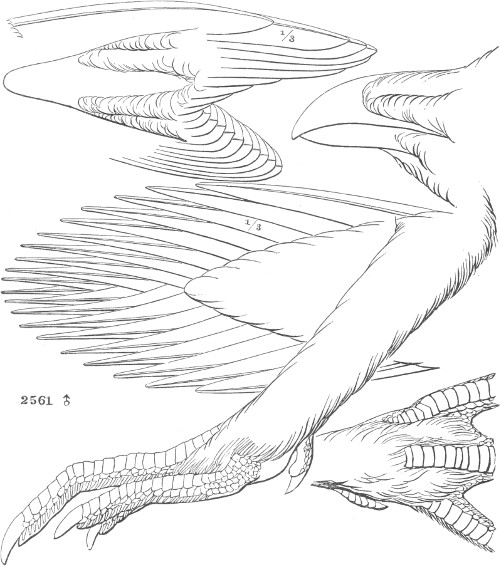
2561 ♂ ⅓ ⅓
Centrocercus urophasianus.
This species was first obtained by Lewis and Clark’s party in their expedition to the Rocky Mountains. It was afterwards met with by Douglas, who published in the Linnæan Transactions (XVI, p. 133) an account of its habits. He described its flight as slow, unsteady, and as affording but little amusement to the sportsman; being a succession of flutterings, rather than anything else. They rise hurriedly, giving two or three flaps of the wing, swinging from side to side in their movement, and gradually falling, making a whirring sound, at the same time uttering a cry of cuck-cuck-cuck, like the common Pheasant. They pair in March and April.
At the mating-season the male is said to select some small eminence on the banks of streams for the very singular performances it goes through with at that period in the presence of its mate. The wings are lowered and dragged on the ground, making a buzzing sound; the tail, somewhat erect, is spread like a fan; the bare and yellow œsophagus is inflated to a prodigious size, and said to become nearly half as large as its body, while the silky flexile feathers on the neck are erected. Assuming this grotesque form, the bird proceeds to display a singular variety of attitudes, at the same time chanting a love-song in a confused and grating, but not an offensively disagreeable tone, represented as resembling hurr-hurr-hurr-r-r-r-hoo, ending in a deep and hollow utterance.
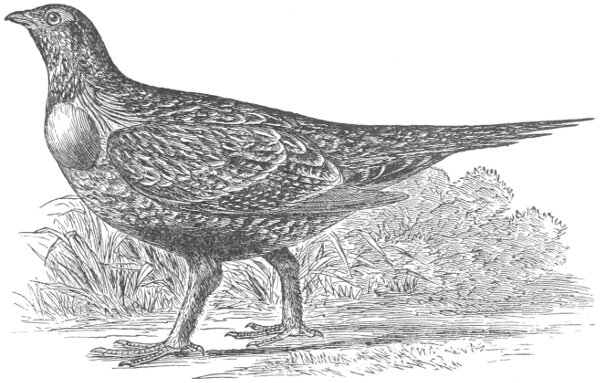
Centrocercus urophasianus.
Their nests were found, by Douglas, on the ground, under the shade of Artemisia, or when near streams, among Phalaris arundinacea, and were carefully constructed of dry grass and slender twigs. The eggs are said to be as many as from thirteen to seventeen in number, and the period of incubation to be twenty-one or twenty-two days. The young leave the nest soon after they are hatched.
In the winter these birds are said to be found in large flocks of several hundreds, in the spring in pairs, and later in the summer and fall in small family groups. They were abundant throughout the barren amid plains of the Columbia and in Northern California, but were not met with east of the Rocky Mountains.
Dr. Newberry regards this Grouse, when in full plumage, as rather a handsome bird, and much better looking than any figure he has seen of it. It is much the largest of American Grouse, weighing from five to six pounds. The female is much smaller than the male, and is of a uniform sober-brown color. The male bird has a distinctive character in the spaces of bare orange-colored skin which occupy the sides of the neck, and are usually concealed by the feathers, but may be inflated to a great size. The species was not found in the valleys of California, but belongs both to the fauna of the interior basin and to that of the Rocky Mountains, the dry desert country lying on both flanks of this chain. He first found it high up on Pit River, and once came suddenly upon a male in an oasis near a warm spring, which started up with a great flutter and rush, and, uttering a hoarse hek-hek, flew off with an irregular but remarkably well-sustained flight, which was continued until the bird was out of sight. In searching around he soon found its mate, which rose from under a sage-bush with a noise like a whirlwind. This specimen was secured, and these birds were afterwards found to be quite abundant, but very strong-winged and difficult to kill. It was no uncommon thing, Dr. Kennerly states, for him to pour a full charge of shot into them at a short distance, dislodging a quantity of feathers, and yet to have them fly off to so great a distance before they dropped that he could not follow them. He found them only in the vicinity of the sage-bushes, under which they were usually concealed. He afterwards saw them very abundant on the shores of Wright and Rhett Lakes. In one instance he observed a male bird to sink down on the ground, as the train approached, depressing its head, and lying as motionless as a stick, which it greatly resembled. As he moved towards it, the bird lowered its head until it rested on the ground, and made itself as small as possible, and did not rise until he had arrived within fifteen feet of it. West of the Cascade Range it did not occur, and all its preferences and habits seemed to fit it for the occupancy of the sterile region of the central desert. Its flesh is dark and highly flavored with the wormwood. The young, if parboiled and stewed, are said to be quite good; but, on the whole, this Grouse is inferior for the table to any other American species.
Dr. Cooper gives this bird as common in Washington Territory, on the high barren hills and deserts east of the Cascade Mountains, and limited in its range by the growth of the Artemisia tridentata, the leaves of which shrub seem to be the principal part of its food; the flesh tasting so strongly of it as to be unpalatable. He saw none north of the Spokane Plains, the country being apparently too woody. On those plains they were very common. He describes its flight as more heavy and less noisy than that of most Grouse, and when they are started, it commonly extends a long distance before alighting.
Dr. Suckley found the Sage-Cock abundant on the plains of Oregon, near Snake River, on both sides of the Blue Mountains, as also along the line of the Columbia, on the open plains, and on the sage barrens of the Yakima and Simcoe Valleys,—in fact, wherever the artemisia was found. The leaves of this shrub either are preferred or are necessary to its existence, for no other food was found in their full stomachs, even in localities where abundance of grass-seed, wild grain, grasshoppers, and other kinds of food, might be found. This species has apparently the power of going a long while without water. Lieutenant Fleming informed Dr. Suckley that he found them about twelve miles west of Fort Laramie, but they were not seen east of that point so far south. In August, 1853, one was procured about two hundred miles east of the Rocky Mountains. He also observed a small flock on the plains bordering on Milk River, in Nebraska. Near Soda Lake, the sink of the Mohave River, Dr. Cooper met with it, which is without doubt the most southern point at which it has been discovered. Dr. Coues has never met with it in Arizona.
Mr. Ridgway encountered it everywhere in the Great Basin where there was a thrifty growth of the artemisia, which appears everywhere to regulate its existence. He corroborates the accounts given of its heavy, lumbering flight; and when it has once escaped, it flies so far that the sportsman rarely has a second opportunity to flush it. It rises apparently with great effort. He was told by the settlers of Nevada and Utah that the Sage-Hen was never known to touch grain of any kind, even when found in the vicinity of grain-fields. This is attributed to a very curious anatomical peculiarity of the species,—the entire absence of a gizzard; having instead a soft membranous stomach, rendering it impossible to digest any hard food. In a large number of specimens dissected, nothing was found but grasshoppers and leaves of the artemisia.
Two eggs in my cabinet, from Utah, measure, one 2.20 by 1.50 inches, and the other 2.15 by 1.45. They are of an elongate-oval shape, slightly pointed at one end. Their ground-color varies from a light-greenish drab to a drab shaded with buff. They are thickly freckled with small rounded spots of reddish-brown and dark chestnut.
Genus PEDIŒCETES, Baird.
Pediœcetes, Baird, Birds N. Am. 1858, 625. (Type, Tetrao phasianellus, Linn.)
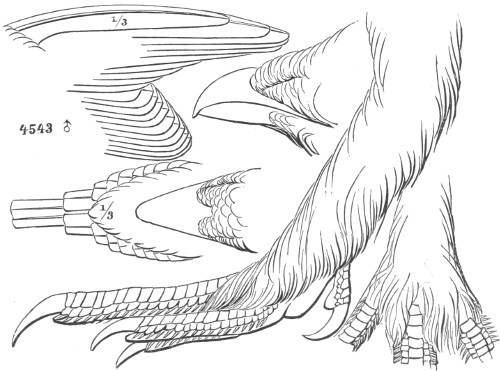
4543 ♂ ⅓ ⅓
Pediœcetes phasianellus.
Gen. Char. Tail short, graduated; exclusive of the much lengthened middle part, where are two feathers (perhaps tail-coverts) with parallel edges and truncated ends half the full rounded wing. Tarsi densely feathered to the toes and between their bases. Neck without peculiar feathers. Culmen between the nasal fossæ not half the total length.
Species and Varieties.
P. phasianellus. Above variegated with transverse spots of yellowish-brown and black; wing-coverts with large, roundish white spots; outer webs of primaries with quadrate white spots. Beneath white anteriorly and along the sides, with V-shaped marks of brown or dusky. Sexes alike in color and size.
Above blackish-dusky, variegated transversely with yellowish-brown; scapulars with broad white medial longitudinal streaks of white. Markings below clear, uniform blackish-dusky. Toes entirely hidden by the long hair-like feathers of the tarsus. Head and neck with the ground-color white, the throat heavily spotted with dusky. Hab. British America to Arctic regions … var. phasianellus.
Above yellowish-brown, mixed with reddish, and variegated transversely with black; scapulars without white longitudinal spots. Markings beneath clear pale brown, with dusky borders. Toes entirely bare. Head and neck deep buff, the throat not spotted. Hab. Prairies and plains of northern U. S., from Wisconsin and Illinois to Oregon … var. columbianus.
PLATE LX.
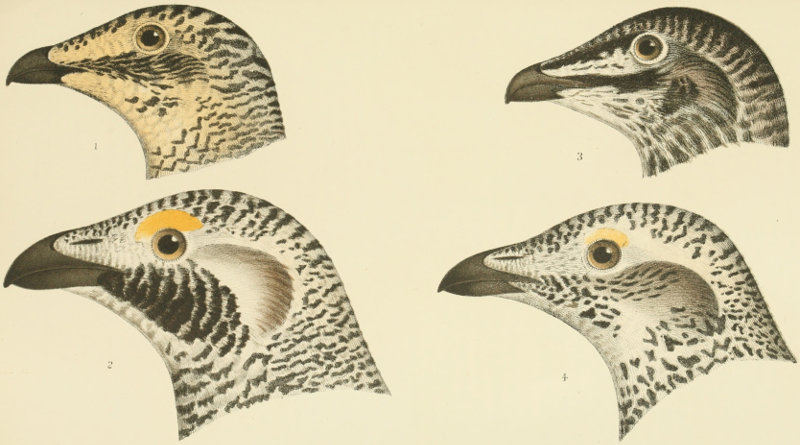
1. Pediœcetes columbianus. Missouri Plains, 4543.
2. Centrocercus urophasianus. ♂ Nebraska, 12561.
3. Pediœcetes phasianellus. Hudson’s Bay, 32319.
4. Centrocercus urophasianus. ♀ Nebraska, 11349.
Pediœcetes phasianellus, var. phasianellus, Elliot. SHARP-TAILED GROUSE.
Tetrao phasianellus, Linn. S. N. I, (ed. 10,) 1758, p. 160.—Forst. Phil. Trans. LXII, 1772, 394, 495.—Gmel.—Lath.—Bon. Comp. List.—Sabine.—Edwards.—Richardson. Centrocercus p. G. R. Gray, Cat. B. Brit. Mus.—Bon. Compt. Rend.—? Swains. F. B. A. (in part?). Pediœcetes p. (not of Baird, Birds N. Am.)—Elliot, P. A. N. S. Philad. 1862, 402–404.—Ib. Monog. Tetraoninæ, pl.—Murray, Edinb. Phil. J. 1859 (Trout Lake Station).—Dall & Bannister, Tr. Chicago Ac. I, 1869, 287.—Gray, Cat. Brit. Mus. V, 1867, 88. Tetrao urogallus, var. β, Linn. S. N. I, (ed. 12,) 273. Pediœcetes kennicotti, Suckley, P. A. N. S. Philad. 1861.
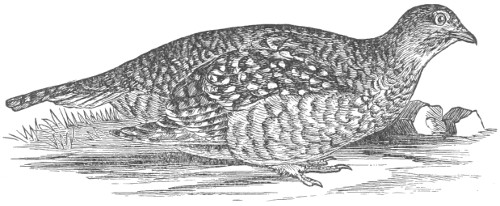
Pediœcetes phasianellus.
Sp. Char. Prevailing colors, clear dusky-black above, and pure white beneath; no buff about the head. Upper parts variegated with transverse, rather zigzag, spots of yellowish-brown; scapulars with broad, elliptical, longitudinal medial spots of pure white; wing-coverts with large rounded, and outer webs of primaries with smaller and more quadrate, spots of pure white. Breast thickly covered with broad V-shaped, and the sides with less numerous sagittate, marks of uniform clear slaty or dusky. Legs densely feathered, the long hair-like feathers reaching beyond the claws, and completely hiding the toes. Throat thickly spotted with dusky. No appreciable differences in plumage between the sexes. Male (31,616, Fort Resolution, Dec. 1862; J. Lockhart). Wing, 8.60; tail, 4.50, the two middle feathers one inch longer.
Hab. British America, from Hudson’s Bay Territory, south to northern shore of Lake Superior, and west to Alaska and British Columbia.
Habits. The Arctic form of the Sharp-tailed Grouse is found throughout the Arctic regions, from Alaska southward and eastward to an extent not fully ascertained. Mr. Dall states that this variety is not uncommon at Fort Yukon, where Mr. Lockhart found it breeding and obtained its eggs. It has also been seen some two hundred miles down the river, but it is said not to be found below the cañon known as the Ramparts. Captain Ketchum, in his adventurous winter trip from Nulato to Fort Yukon, is said to have killed several of these birds. Specimens are in the Smithsonian Museum from Moose Factory and elsewhere along the southern part of Hudson’s Bay, and it is said to be abundant about Nipigon Lake, north of Lake Superior.
Mr. Kennicott found the nest of this bird at Fort Yukon, at the foot of a clump of dwarf willows. It was in dry ground, and in a region in which these willows abounded and were quite thickly interspersed with other trees, especially small spruces, but no large growth. The nest is said to have been similar to that of Cupidonia cupido. Mr. Lockhart also found it breeding in the same region. The nests seen by him were likewise built on a rising ground under a few small willows.
Richardson assigns as the northern limit of this species the region of the Great Slave Lake, latitude 61°, and as its most southern point latitude 41°. It was found in abundance on the outskirts of the Saskatchewan plains and throughout the wooded districts of the fur countries, frequenting the open glades or low thickets on the borders of lakes, especially where the forests have been partially cleared; perching on trees in the winter, but keeping to the ground in the summer; and, at all seasons, met with in small flocks of from ten to sixteen. They are said, early in spring, to select some level place, where a covey meets every morning and runs round in a circle of about twenty feet in diameter, so that the grass is worn quite bare. If any one approaches this circle, the birds squat close to the ground; but if not alarmed by a too near approach, they soon stretch out their necks to survey the intruder, and resume their circular course, some running to the right and others to the left, meeting and crossing each other. These “partridge-dances” are said to last a month or more, or until the female begins to incubate. This Grouse rises from the ground with the usual whirring noise, and alights again at a distance of a few hundred yards, sometimes on the ground or on the branches of a tree. In winter they hide in the snow, and make their way with ease through the loose drifts, feeding on the buds of the willows, larches, aspens, etc. In summer and autumn their food is principally berries. They are said to lay about thirteen eggs early in June; the nest being on the ground, formed of grasses lined with feathers.
The eggs of this variety closely resemble those of the columbianus, but are generally of a decidedly darker ground. They average 1.75 inches in length by 1.28 in breadth. Their ground is a dark tawny-brown minutely dotted with darker spots of brown.
Pediœcetes phasianellus, var. columbianus, Baird. COLUMBIA SHARP-TAIL.
Tetrao phasianellus, (not of Linn.,) Ord, Guthr. Geog. (2d Amer. ed.) II, 317, 1815.—Nutt.—Aud.—Newb.—Bon. Syn. and Am. Orn.—Coop. & Suckl.—Max. Cab. J. VI, 1858, 435. Centrocercus p. Swains. F. B. A.—Bonap. Comp. Rend. Pediœcetes p. Baird, Birds N. Am. 1858, 626. Phasianus columbianus, Ord, Guthr. Geog. (2d. Am. ed.) II, 317, 1815. Pediœcetes columbianus, Elliot, P. A. N. S. Philad. 1862, 403.—Ib. Monog. Tetraoninæ.—Cooper, Orn. Cal. I, 1870, 532. Tetrao urophasianellus, Dougl. Trans. Linn. Soc. XVI, 136, 1829.
Sp. Char. Prevailing colors yellowish-brown and white; ground-color of head and neck deep buff. Upper parts variegated with transverse spots of black, and more or less tinged with rusty; scapulars without longitudinal spots of white; wing-coverts and outer webs of primaries with large conspicuous spots of pure white, the former roundish, the latter more quadrate. Breast and sides with V-shaped markings of pale yellowish-brown, bordered with dusky. Throat immaculate, or only minutely speckled; feathers of tarsus short, the toes completely bare. No appreciable difference between the sexes. Male (22,011 Simiahmoo, Washington Territory; Dr. Kennerly). Wing, 8.00; tail, 4.40, two middle feathers one inch longer. Female (19,173, Rose Brier Creek; F. V. Hayden)! Wing, 8.80; tail, 4.00.
Hab. Plains and prairies of the United States, from Illinois and Wisconsin, west to Oregon, Nevada, etc.; south to Colorado, New Mexico, etc.
Habits. This species is the more southern of the two varieties of Sharp-tailed Grouse found in North America. Owing to the confusion which has existed until recently, in which both the northern and southern races have been considered as one, the geographical distribution of each may not be defined with complete exactness. The present form is found in Illinois and Wisconsin, and westward to Oregon and Washington Territory, and as far to the north as British Columbia and the southern portions of the Saskatchewan Valley.
Dr. Newberry found this Grouse associated with the Prairie Chicken on the prairies bordering on the Mississippi and the Missouri, and frequently confounded with that bird, though readily distinguishable by its lighter plumage, its speckled breast, and smaller size. It is always the least abundant of the two species, when found together. The range of this Grouse extends much farther westward; the cupido being limited to the valley of the Mississippi, while the former is found as far west as the valleys of California. North of San Francisco his party first found it on a prairie near Canoe Creek, fifty miles northeast of Fort Reading; subsequently, on a level grass-covered plain in the upper cañon of Pit River, these birds were met with in great abundance. They were also found about the Klamath Lakes and in the Des Chutes Basin, as far as the Dalles. The flesh was very much like that of the Prairie Chicken. This bird is said to lie close, and when flushed to fly off, uttering a constantly repeated kuck-kuck-kuck, moving with steadiness and considerable swiftness. It is, however, easily killed. The young birds are fat and tender, and as they fall on the grassy prairie scatter their feathers, as if torn to pieces.
According to Dr. Suckley, the Sharp-tailed Grouse entirely replaces the Pinnated Grouse in Washington Territory. He first noticed it near old Fort Union, at the mouth of the Yellowstone River. From that point to the Cascade Mountains of Oregon and Washington Territory it was exceedingly abundant wherever there was open country and a sufficiency of food. In certain places they were in great numbers in the autumn, congregating in large flocks, especially in the vicinity of patches of wild rye, and more recently near settlements where there were wheat-stubbles. They resemble the Pinnated Grouse in habits. Where they are numerous, they may frequently be found, on cold mornings in the autumn or early winter, perched on fences or on leafless trees, sunning themselves in the early sunlight. At Fort Dalles a young bird, scarcely two days old, was found on the first of April. This early incubation seems to prove that they must have more than one brood in a season. The young Grouse was confided to the charge of a Hen with a brood of young chickens; but it refused to associate with them, and escaped, probably to perish of cold. Dr. Cooper adds that this Grouse is found in Washington Territory only in the low alluvial prairies of the streams emptying into the Columbia east of the Cascade Mountains, where it was found in flocks of several hundreds. They shun high grounds and forests entirely. The only cry he ever heard them utter was a cackle when suddenly started from the ground. Their wings make a loud whirring, as among others of this family.
Mr. J. K. Lord found this species abundantly distributed on the western slope of the Rocky Mountains, ranging right and left of the 49th parallel. It was particularly numerous on the plains near the Kootanie River, round the Osoyoos Lakes, and in the valley of the Columbia. He did not meet with any on the western side of the Cascade Range. It is also found in the Red River settlements and in Northern Minnesota.
Mr. Elliot is quite in error in stating that this Grouse does not occur east of the Mississippi as it is found nearly throughout Northern Illinois and Southern Wisconsin. I have seen a flock within thirty miles of Chicago, and have from time to time had their eggs from Dane County, Wisconsin.
Mr. Lord regards this Grouse as remarkable both for its field qualities—such as lying well to a dog, rising with a loud rattling whir, frequenting open grassy prairies, and flying as straight as an arrow—and for its excellence as a table dainty. For delicacy of flavor its flesh is unequalled. With the fur-traders this species is known as the Spotted Chicken, and is, furthermore, the Skis-kin of the Kootanie Indians. Its singular combination of colors—white, black, and brownish-yellow—makes it exactly resemble the ground on which it lives, and admirably harmonizes with the dead twigs and leaves of the artemisia, the dry and sandy soil, the brown of the withered bunch-grass, and the sombre-colored lichens of the rocks. It often requires a keen and practised eye to distinguish one of these birds from the ground on which it has fallen, even though the eye be kept on the spot where it was seen to fall. This similarity of colors with those of the prairie no doubt effectually conceals them from the hawks and owls.
Its favorite haunt is on open grassy plains in the morning, keeping concealed in the long thick grass, coming about midday to the stream to drink, and to dust itself in the sandy banks. It seldom goes into the timber, always remains close to the prairie, and never retires into the depth of the forests. It lays its eggs on the open prairie in a tuft of grass, or near the foot of a small hillock, nesting early in spring, and depositing from twelve to fourteen eggs. The nest is a mere hole scratched in the earth, with a few grass-stalks and root-fibres laid carelessly and loosely over the bottom. Mr. Lord describes the eggs as of a dark rusty-brown, with small splashes or speckles of darker brown thickly spattered over them.
After nesting-time they appear in broods about the middle of August, the young birds being about two thirds grown. At this time they frequent the margins of small streams where there is thin timber and underbrush. After the middle of September they begin to pack, two or three coveys getting together, and flock after flock joining until they accumulate into hundreds. On the first appearance of snow they begin to perch on the dead branches of a pine or on the tops of fences. Near Fort Colville, after snow fell, they assembled in vast numbers in the large wheat-stubbles. They became wary and shy, the snow rendering every moving thing so conspicuous that it was next to impossible for dogs to hunt them.
The food of this Grouse consists principally of berries in the summer months, such as the snowberry, the bearberry, the haws of the wild rose, and the whortleberry, grain, the larvæ of insects, grass-seeds, etc. In the winter they run over the snow with ease and celerity, dig holes in it, and burrow underneath in the manner of a Ptarmigan. During the two winters Mr. Lord spent at Colville, flocks of these birds congregated around the hayricks at their mule-camp. In a temperature often 30° and more below zero, and the snow several feet deep, they were strong, fat, and wild, and did not appear to suffer at all from the intense cold. Indeed, they are said to pair very early in the spring, long before the snow has gone off the ground, and their meeting is preceded by some very singular performances, which are called by the fur-traders chicken-dances, to several of which Mr. Lord was an eyewitness. Groups of these birds assemble for their dances either about sunrise or late in the afternoon, selecting for the purpose a high round-topped mound, which in the course of their evolutions becomes worn quite bare. At one of the dances witnessed by Mr. Lord there were about twenty birds present; the birds nearest him were head to head, like gamecocks in fighting attitude,—the neck-feathers ruffed up, the little sharp tail elevated straight on end, the wings dropped close to the ground, but keeping up a rapid vibration or continued drumming sound. They circled round and round each other in slow waltzing time, always maintaining the same attitude, but never striking at each other. Sometimes the pace increased, and one pursued the other until the latter faced about. Others jumped about two feet in the air until out of breath, and then strutted about in a peculiar manner; and others went marching about with tails and heads as high up as they could get them.
Captain Blakiston states that on the Saskatchewan this species was very generally distributed throughout the interior. He met with it just below the forks of the Saskatchewan, and traced it to the western base of the Rocky Mountains. He found it breeding at Fort Carlton. He regards these birds as of polygamous habits. In the fall they are found in families, in the semi-wooded country bordering on the prairies. They perch on trees, frequently at the very top, and their crops are found stuffed out with berries. These are chiefly the fruit of the bearberry, the ground juniper, the snowberry, the small prairie roses, the buffalo-berry, and several kinds of buds. They have also been known to feed on caterpillars and other insects baked and crisped by prairie fires. Captain Blakiston was also an eyewitness of one of the singular love-performances of these birds, known as dances. His account of it, which is very full, is almost exactly in correspondence with the account referred to as given by Mr. Lord.
Mr. Ridgway met with this Grouse at one locality only, encountering them late in September in the Upper Humboldt Valley. There it was found in considerable numbers in the rye-grass meadows on the foot-slopes of the Clover Mountains. They were startled from the ground, where they were hidden in the grass, and when surprised frequently took refuge in the willow-thickets along the streams near by. Their flesh was found to be most excellent.
The eggs of this species vary considerably in size, but average about 1.80 inches in length and 1.30 in breadth. They are oval in shape, slightly pointed at one end. Their ground varies from a light clay to a dark rusty-brown, generally plain, but frequently speckled minutely with fine dottings of a darker brown.
Genus CUPIDONIA, Reichenbach.
Cupidonia, Reichenbach, Av. Syst. Nat. 1850, p. xxix. (Type, Tetrao cupido, L.)
Gen. Char. Tail of eighteen feathers, short, half the lengthened wings; the feathers stiffened and more or less graduated. Bare inflatable air-sac of the neck concealed by a tuft of long, stiff lanceolate feathers; an inconspicuous crest on the vertex. Tarsi feathered only to near the base, the lower joint scutellate. Culmen between the nasal fossæ scarcely one third the total length.
This genus, as far as known, is entirely peculiar to North America, where but one species, with two races, is known.
Species and Varieties.
C. cupido. Ground-color above yellowish-brown, tinged with grayish and reddish; beneath white; whole upper and lower parts variegated with transverse bands,—those beneath regular, broad, sharply defined, and plain dusky-brown, those above more broken, broader, and deep black. Head buff, with a broad vertical stripe, a broad one beneath the eye from bill to ears, and a patch on lower side of auriculars, brownish-black.
Tarsi clothed with long hair-like feathers, the bare posterior face entirely hidden. Dark bars above, .30 or more in width, deep black; those beneath, about .20 wide, and dark brown. Top of head nearly uniformly blackish; face-stripes dusky-black. Bill, .40 deep, .50 long; wing, 9.00. Hab. Prairies of the Mississippi Valley; south to Louisiana; formerly eastward to Long Island and Pennsylvania … var. cupido.
Tarsi clothed with short feathers, the bare posterior face conspicuously exposed. Dark bars above less than .20 in width, dark grayish-brown; those beneath about .10 wide, and pale grayish-brown. Top of head with only a slight spotting of blackish; face-markings reddish-brown. Bill, .35 deep, .55 long, from nostril; wing, 8.30. Hab. Southwestern Prairies (Texas?) … var. pallidicinctus.
PLATE LXI.
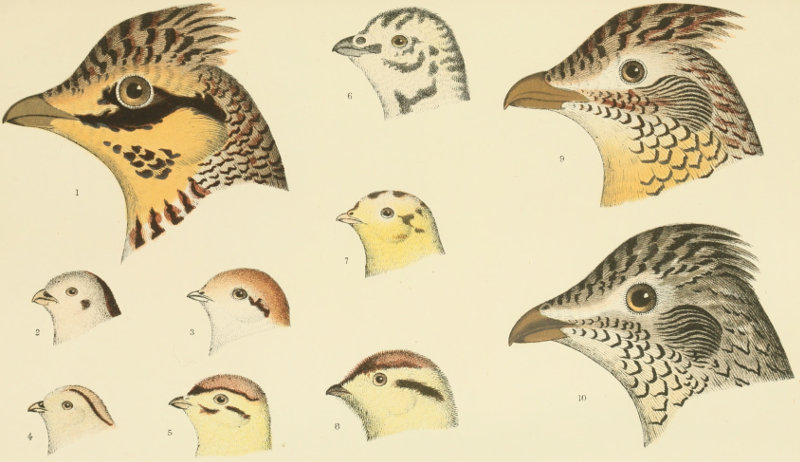
1. Cupidonia cupido. Ad., 17045.
2. Cyrtonyx massena. Juv., 37292.
3. Bonasa umbellus. Juv., 61949.
4. Lophortyx californicus. Juv., Cal., 12591.
5. Canace canadensis. Juv., Maine.
6. Centrocercus urophasianus. Juv., 38551.
7. Cupidonia cupido. Juv., 25989.
8. Lagopus albus. Juv., 44631.
9. Bonasa umbellus. Ad., D. C., 12568.
10. Bonasa umbelloides. Ad., Rocky Mts., 11394.
Cupidonia cupido, var. cupido, Baird. PRAIRIE HEN; PRAIRIE CHICKEN; PINNATED GROUSE.
Tetrao cupido, Linn. Syst. Nat. I, 1758, 160.—Gm. I, 751.—Lath. Ind. Orn. II, 1790.—Wilson, Am. Orn. III, 1811, 104, pl. xxvii.—Bon. Mon. Tetrao, Am. Phil. Trans. III, 1830, 392.—Nuttall, Man. I, 662.—Aud. Orn. Biog. II, 1834, 490; V, 1839, 559, pl. clxxxvi.—Ib. Birds Amer. V, 1842, 93, pl. ccxcxvi.—Koch, Wiegmann’s Archiv, 1836, I, 159.—Max. Cab. J. VI, 1858, 439. Bonasa cupido, Stephens, Shaw’s Gen. Zoöl. XI, 299.—Gray, Cat. Brit. Mus. V, 1867, 88. Cupidonia americana, Reich. Av. Syst. Nat. 1850, p. xxix.—Bonap. Comptes Rendus, XLV, 1857, 428. Cupidonia cupido, Baird, Birds N. Am. 1858, 628.—Elliot, P. A. N. S. 1864.—Ib. Monog. Tetraon. pl.—Dresser, Ibis, 1866, 26 (Brownsville, Texas).—Maynard, B. E. Mass. 1870, 138 (Martha’s Vineyard, and Naushon Island, Mass.)
Sp. Char. Male (10,006, Tremont, Illinois; W. I. Shaw). Ground-color above ochraceous-brown, tinged with grayish; beneath white, the feathers of the jugulum dark rusty-chestnut beneath the surface. Head mostly deep buff. Upper parts much broken by broad transverse spots, or irregular bars, of deep black, this color predominating largely over the lighter tints. Primaries and tail plain dusky; the former with roundish spots of pale ochraceous on outer webs, the latter very narrowly tipped with white. Lower parts with regular, continuous, sharply defined broad bars, or narrow bands, of clear dusky-brown. A broad stripe of plain brownish-black on side of head, beneath the eye, from rictus to end of auriculars; a blotch of the same beneath the middle of the auriculars, and the top of the head mostly blackish, leaving a broad superciliary and maxillary stripe, and the whole throat immaculate buff. Neck-tufts 3.50 inches long, deep black; the longer ones uniform, the shorter with only the edge black, the whole middle portion pale buff, shading into deep reddish-rusty next to the black. Wing, 9.00; tail, 4.50; bill, .40 deep by .50 long, from nostril; tarsus, 2.10; middle toe, 1.85. Female similar, but with shorter and inconspicuous cervical tufts. Young (25,998, Rockford, Illinois; Blackman). Above, including tail, yellowish-brown; feathers with conspicuous white shaft-streaks and large blotches of deep black. Outer webs of primaries with whitish spots. Top of head rusty-brown with a black vertical and a dusky auricular patch. Lower parts yellowish-white, with irregularly defined, transverse, grayish-brown broad bars; anteriorly more spotted, the jugulum tinged with brown.
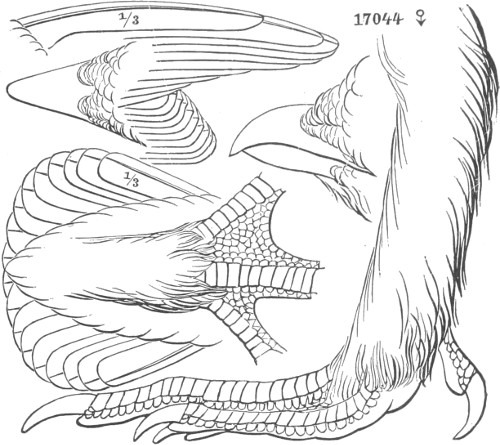
17044 ♂
Cupidonia cupido.
Chick (25,989, Rockford, Ill.). Bright lemon-buff, tinged on sides and jugulum with reddish; upper parts much washed with rusty. A narrow auricular streak, blotches on the vertex and occiput, a stripe across the shoulder, and blotches down the middle of the back and rump, deep black.
Hab. Prairies of the Mississippi Valley, from Louisiana, northward. East to Pocono Mountains, Pennsylvania. Formerly along the eastern coast of the United States from Long Island to Cape Cod, or farther. A few still left on Naushon (?) and Martha’s Vineyard.
A pair from Calcasieu Pass, Louisiana, most resemble Illinois specimens, but are smaller (wing, 8.60, instead of 9.00), and there is rather more reddish, with less black, in the plumage.
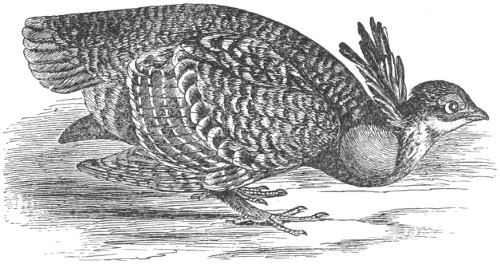
Cupidonia cupido.
Habits. The Pinnated Grouse, more generally known through the country as the Prairie Chicken or Prairie Hen, once occurred as far to the east as Massachusetts, a few still remaining on the island of Martha’s Vineyard, and where it was, in the early settlement of the country, a very abundant bird; and to the southwest to Texas and throughout the Indian Territory, where it appears to be extending with the areas developed by civilization. While at the East this bird has almost entirely disappeared, in consequence of the increase of population, and except here and there in a few small and distant districts has disappeared from the Middle and Eastern States, at the West and Southwest it has greatly extended its distribution, appearing in considerable numbers, and constantly increasing as the country is settled and the land cultivated with grain. Even in Illinois, where there has been a large increase of population during the past ten years, these birds are known to have become much more numerous. It is, however, probable that they will again be driven from this region when the population becomes quite dense. Mr. Allen met with this species in several points in Kansas and in Colorado, where they had either just made their appearance, or where they had recently been noticed, and were observed to be on the increase. The small remnants left in Massachusetts are protected by law, which may preserve them a few years longer; and in Illinois and other Western States stringent provisions seek to prevent their wanton destruction. In Michigan, according to Mr. D. D. Hughes, this Grouse is common in the two southern tiers of counties, but is rarely met with in that State farther north,—an absence attributable to the want of open country and suitable food, as west of Lake Michigan it is found in great abundance much farther north. In the more southern portion of the State it is already very rare, and in localities completely exterminated.
Dr. Woodhouse found this bird quite abundant throughout the Indian Territory; more numerous, however, in the vicinity of settlements. During the fall of 1849, as he was passing down the Arkansas River, along the road leading from Fort Gibson to Fort Smith, these birds were in large flocks, feeding among the oaks upon the acorns; hundreds were to be seen at the same time. It was also very common throughout Eastern Texas.
Mr. Dresser found the Pinnated Grouse very common in travelling from Brownsville to Victoria, after leaving the chaparral and entering the prairie country. Throughout the whole of the prairie country of Texas it is abundant.
They were found by Mr. Audubon especially abundant in the States of Kentucky, Missouri, Illinois, and Indiana, where his observations date back more than half a century, and when the country was comparatively unsettled. It was there, he states, in what was then known as the Barrens of Kentucky, that before sunrise, or at the close of the day, he “heard its curious boomings, witnessed its obstinate battles, watched it during the progress of its courtships, noted its nest and eggs, and followed its young until, fully grown, they betook themselves to winter quarters.”
When he first removed to Kentucky the Pinnated Grouse were so plentiful, and were held in such low estimation, that no hunter deigned to shoot them. They were, moreover, looked upon with ill-favor by the inhabitants on account of the mischief they committed among the fruit-trees of the orchards during winter, when they fed upon the buds, or in the spring, when they consumed the grain in the fields. In those days, in the winter, this Grouse would enter the farm-yard and feed among the poultry, would even alight on the house-tops or walk in the streets of the villages. On one occasion he caught several alive in a stable at Henderson, where they had followed some Wild Turkeys. Twenty-five years later, Mr. Audubon adds, in the same country where they had been so very abundant, scarcely one could be found. Mr. Audubon speaks of their selling in Eastern markets, in 1840, at from five to ten dollars per pair. This is so no longer, facilities in railroad transportation and their continued abundance at the West rendering them a comparatively plentiful and cheap article of food.
Mr. Audubon mentions that at the same period they were still to be met with in some portions of New Jersey, in the “brushy” plains of Long Island, on Mount Desert Island in the State of Maine, and also in another tract of barren country near Mar’s Hill in the same State. In regard to the two last-named localities he may have been misinformed.
Mr. Lawrence mentions this species as still occurring in the vicinity of New York City. Mr. Turnbull mentioned it as now very rare, but occasionally met with, in the counties of Monroe and Northampton in Pennsylvania, and on the plains in New Jersey. It is not referred to by either Professor Verrill or Mr. Boardman as occurring in any part of Maine. It is, however, given by Mr. McIlwraith as an occasional visitor near Hamilton, in Canada, on the western frontier, a few individuals being occasionally observed along the banks of the St. Clair River, but not known to occur farther east.
Mr. Audubon also mentions having found these birds abundant in all the vast plains bordering on the prairies of the Arkansas River, and on those of the Opelousas in Louisiana.
In the earliest days of spring, even before the snows have all been melted, these birds no longer keep in large flocks, but separate into smaller parties, and the mating-season commences, during which their manners, especially those of the male, are very peculiar and striking. A particular locality is selected, to which they resort until incubation has commenced. The males meet in this place, and engage in furious battle with one another. At this season they are especially conspicuous for their great pomposity of bearing; with tails outspread and inclined forward to meet the expanded feathers of their neck, and with the globular, orange-colored, bladder-like receptacles of air on their necks distended to their utmost capacity, and issuing a peculiar sound, spoken of as booming, these birds strut about in the presence of one another with various manifestations of jealous dislike and animosity, soon ending in furious contests. Their wings are declined, in the manner of the Cock-Turkey, and rustle on the ground as the birds pass and repass in a rapid manner; their bodies are depressed, and their notes indicate their intense excitement. Upon the appearance of a female answering to their calls, they at once engage in their desperate encounters. They rise in the air and strike at one another in the manner of a gamecock, and several engage in a miscellaneous scrimmage, until the weaker give way, and, one after another, seek refuge in the neighboring bushes, the few remaining victors discontinuing their contests as if from sheer exhaustion.
The “booming” or “tooting” sounds made by these birds is heard before daybreak, and also at all hours before sunset, in places where they are abundant and tame; but where they are rare and wild they are seldom heard after sunrise, and their meetings then are in silence. Even in the fall the young males evince their natural pugnacity by engaging in short battles, which their parents usually interrupt and put a stop to.
This bird nests, according to the locality in which it is met with, from the beginning of April to the last of May. In Kentucky, Mr. Audubon has found their nests with eggs early in April, but the average period there was the first of May. Their nests he describes as somewhat carelessly formed of dry leaves and grasses, interwoven in a tolerably neat manner, and always very carefully placed among the tall grass of some large tuft in the open ground of the prairies, or, in barren lands, at the foot of a small bush.
The eggs are said to be from eight to twelve in number, never more; they are larger and more spherical than those of the common umbellus, and are of a darker shade. The female sits upon them about twenty days, and as soon as the young can extricate themselves from the shell the mother leads them away, the male having previously left her.
Early in the fall the various broods begin again to associate together, and at the approach of winter it is not uncommon to see them in flocks of several hundred individuals.
The young broods, when come upon suddenly and taken by surprise, instantly scatter and squat close to the ground, so that, without a dog, it is impossible to find them. The mother gives a single loud chuck as a signal of danger, and the young birds rise on the wing and fly a few yards in different directions, and then keep themselves perfectly still and quiet until the mother recalls them by a signal indicating that the peril has passed. In the meanwhile she resorts to various devices to draw the intruder away from the place.
This Grouse raises but a single brood in a season; and if the first laying has been destroyed or taken, the female seeks out her mate, makes another nest, and produces another set of eggs. These are usually smaller in size and less in number than those of her first laying.
The Pinnated Grouse is said to be easily tamed, and may be readily domesticated, though I do not know that the experiment has been thoroughly tried. Mr. Audubon once kept sixty of them in a garden near Henderson, Ky. Within a week they became tame enough to allow him to approach them without being frightened. He supplied them with abundance of corn and other food. In the course of the winter they became so gentle as to feed from the hand, and walked about his garden like so many tame fowl, mingling occasionally with the poultry. In the spring they strutted, “tooted,” and fought as if in their wild state. Many eggs were deposited, and a number of young birds were hatched out; but they proved so destructive to the vegetables that the experiment was given up and the Grouse were killed. The male birds were conspicuous for their courage, and would engage in contest with the Turkey-cocks, and even with the dunghill cock, rather than yield the ground.
In severe weather these birds have been known to roost in trees, but they generally prefer to rest on the ground. Advantage is sometimes taken to secure them by visiting their resting-places in the night with nets. On the ground they walk somewhat in the manner of the common Hen, but in a more erect attitude. When surprised, they rise with a whirring sound; but if they perceive the approach of any one at a sufficient distance, they run off with considerable speed, and hide by squatting in the grass or among bushes. They are fond of dusting themselves in ploughed fields or in dusty roads, rearranging their feathers in the manner of the Wild Turkey.
When the female, with her young brood, is surprised, she instantly ruffles up her feathers, and acts as if she contemplated flying in your face; this she rarely, if ever, attempts, but resorts to various artifices to decoy the intruder away.
Their flight is said to be strong, regular, and swift, and may be protracted to the distance of several miles. It is less rapid than that of the umbellus, and the whirring, as they rise from the ground, less conspicuous. As they rise, they utter four or five very distinct clucks, but at times fly in silence.
Their flesh is dark, and the flavor is very distinctly gamy, and is generally regarded as excellent.
In the love-season the males inflate the two remarkable air-bladders, which, in color and shape, resemble small oranges, lower their heads to the ground, open their bills, and give utterance to very singular and distinctly separated notes, by means of the air contained in these receptacles, rolling somewhat in the manner of the beatings of a muffled drum. The air-reservoirs are alternately filled and emptied as they make these sounds. Their notes may be heard to the distance of nearly a mile. When these skins are punctured, they are no longer resonant.
The late Mr. David Eckby, of Boston, furnished Mr. Audubon with a full account of their habits, as observed by him in Martha’s Vineyard, and also on the island of Nashawena, where they were then kept in a preserve. They were observed never to settle down where the woods were thick or the bushes tangled, but invariably in the open spaces; and as they never start up from the thick foliage, but always seek to disengage themselves from all embarrassment in their flight by reaching the nearest open space, they offer to the sportsman a very fair mark. The sound they utter in rising, when hard pressed, is said to resemble the syllables coo-coo-coo. They were observed to feed on the berries of the barberry, which abound on those islands, boxberries, cranberries, the buds of roses, pines, and alders, and on the nuts of the post-oaks, and in the summer upon the more esculent berries. At the West they frequently feed on the seeds of the sumach. They are also very destructive to the buds of the apple, and are very fond of the fruit of the fox-grape and the leaves and berries of the mistletoe. During the planting-season their visits to the wheat and corn fields are often productive of great damage.
Three eggs in my collection, taken from a nest near Osage Village, in Indian Territory, which contained sixteen eggs, measure, one 1.65 by 1.20 inches, another 1.63 by 1.28, and the third 1.75 by 1.28 inches. They are of a rounded-oval shape, more obtuse at one end than the other, and of a uniform color, which varies from a light clay-color to a dark tawny-brown. The eggs are sometimes, but not always, minutely sprinkled with brown.
Cupidonia cupido, var. pallidicinctus, Ridgway. THE TEXAS PRAIRIE HEN.
Cupidonia cupido, var. pallidicinctus, Ridgway.
Sp. Char. Similar to var. cupido, but above nearly equally barred with pale grayish-ochraceous and dusky or blackish-brown. Beneath white, with faint, but sharply defined, narrow bars of pale grayish-brown. Top of head with light bars prevailing; head-stripes reddish-brown. Male (10,007, Prairies of Texas, Staked Plains?; Capt. J. Pope, U. S. A.). Wing, 8.30; tail, 4.20; tarsus, 1.70; middle toe, 1.50. Female (10,005, same locality, etc.). Wing, 8.20.
Hab. Southwestern Prairies (Staked Plains, Texas?).
In its relations with the C. cupido, this race bears a direct analogy to Pediœcetes columbianus, as compared with P. phasianellus, and to Ortyx texanus, as distinguished from O. virginianus. Thus in a much less development of the tarsal feathers it agrees with the southern Pediœcetes, while in paler, grayer colors, and smaller size, it is like the southwestern Ortyx.
Genus BONASA, Stephens.
Bonasa, Stephens, Shaw’s Gen. Zoöl. XI, 1819. (Type, Tetrao bonasia, L.)
Tetrastes, Keys. & Blas. Wirb. Europ. 1840, p. lxiv.
Gen. Char. Tail widening to the end, its feathers very broad, as long as the wings; the feathers soft, and eighteen in number. Tarsi naked in the lower half; covered with two rows of hexagonal scales anteriorly, as in the Ortyginæ. Sides of toes strongly pectinated. Naked space on the side of throat covered by a tuft of broad soft feathers. Portion of culmen between the nasal fossæ about one third the total length. Top of head with a soft crest.
This genus, in its partly naked tarsi, with two rows of scutellæ anteriorly, indicates a close approach to the American Partridges, or Quails. It has a single European representative, the B. sylvestris, Steph.
Species and Varieties.
B. umbellus. Rump with cordate light spots; sides with transverse dark spots. Tail with two gray bands (one terminal), with a broad blackish zone between them. Cervical tufts glossy black or dark brown, with a semi-metallic steel-blue or green border.
Prevailing color bright ochraceous-rufous; tail always rufous in the Middle and Southern States, occasionally gray on the Alleghany Mountains, and in New England States; usually gray in Eastern British America. Hab. Eastern Province of North America … var. umbellus.
Prevailing color bluish-ashy; tail always pale ash. Hab. Rocky Mountains of United States, and interior regions of British America, to the Yukon … var. umbelloides.
Prevailing color dark ferruginous; tail always dark ferruginous near the coast, occasionally dark gray in mountainous regions. Hab. Northwest coast region (Oregon, Washington, British Columbia, etc.) … var. sabini.
The above synopsis is intended to present in the simplest form the characteristic features of the three definable races of this exceedingly variable species, as exhibited in a light rusty rufous-tailed form of the Atlantic States, a pale gray ashy-tailed form of the Rocky Mountains of the United States and British America, and a dark rusty rufous-tailed form of the northwest coast region. These three, when based on specimens from the regions where their characters are most exaggerated and uniform, appear sufficiently distinct; but when we find that specimens from the New England States have the rufous bodies of umbellus and gray tails of umbelloides, and that examples from Eastern Oregon and Washington Territory have the dark rusty bodies of sabini and gray tails of umbelloides, and continue to see that the transition between any two of the three forms is gradual with the locality, we are unavoidably led to the conclusion that they are merely geographical modifications of one species. The continuity of the dark subterminal tail-band in umbellus, and its interruption in umbelloides,—characters on which great stress is laid by Mr. Elliot in his monograph, above cited,—we find to be contradicted by the large series which we have examined; neither condition seems to be the rule in either race, but the character proves to be utterly unreliable.
In the less elevated and more southern portions of the Eastern Province of the United States, as in the Mississippi Valley and the States bordering the Gulf and South Atlantic, the rufous type is prevalent; the tail being always, so far as the specimens we have seen indicate, of an ochraceous-rufous tint. Specimens with gray tails first occur on the Alleghany Mountains, and become more common in the New England States, the specimens from Maine having nearly all gray tails. Specimens from Labrador approach still nearer the var. umbelloides,—the extreme gray condition,—and agree with Alaskan specimens in having more brown than those from the interior portions of British America or the Rocky Mountains of the United States. More northern specimens of the inland form have, again, a greater amount of white than those from the south or coastward. Passing southward from Alaska toward Oregon, specimens become darker, until, in the dense humid forests of the region of the Columbia, a very dark plumage, with little or no gray, prevails, most similar to, but even more reddish and much darker, than the style of the Southern States of the Eastern Province. Passing from the low coast forests to those of the mountains, we find again equally dark specimens, but with grayish tails; the amount of gray increasing, and its shade lightening, as we approach the central Rocky Mountains.
The American species of Bonasa possesses a quite near analogue in the B. sylvestris, Bonap. (Tetrao bonasia, Linn.), or Hazel Grouse, of Europe. This species has almost exactly the same pattern of coloration (including tail-markings), but is very much smaller, has the neck-tufts rudimentary and white, and the throat black, instead of just the reverse.