Volume 3 — Family COLUMBIDÆ.—The Pigeons. (continued 2)
Reading edition
Their food, in a wild state, consists of grass-seeds and various small berries, with which they swallow a large proportion of gravel to assist digestion. They are extremely fond of dusting themselves in the sand, lying down in it in the manner of various gallinaceous birds.
The eggs of this species are of a uniform bright white color, are slightly more pointed at one end than at the other, and measure .85 of an inch in length by .63 in breadth.
This species was found in abundance at Cape St. Lucas by Mr. Xantus. They were nesting from April 15 until August 29, and evidently had two or more broods in a season. Their nests were usually placed in low cactuses, near the ground, or in small shrubs. Their nests, eggs, and general habits, so far as we can gather them from the meagre notes of Mr. Xantus, are in no wise different from those of the more eastern birds.
PLATE LVIII.
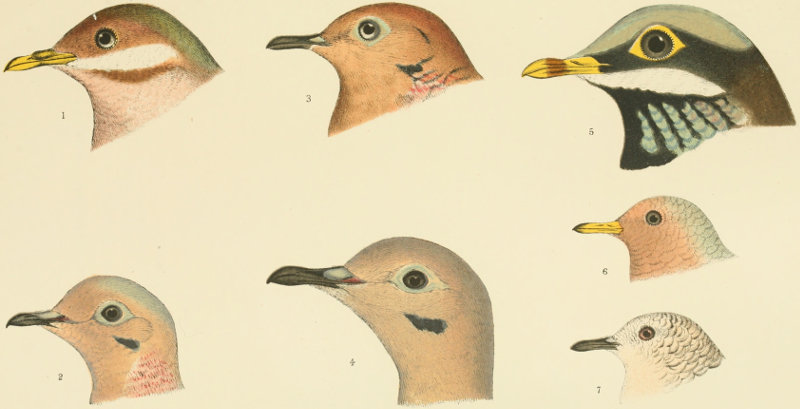
1. Oreopeleia martinica. ♂ Jamaica.
2. Zenaidura carolinensis. ♂ N. C., 55569.
3. Zenaida amabilis. ♂ Jamaica, 24406.
4. Melopeleia leucoptera. ♂ Mazatlan, 34009.
5. Starnoæna cyanocephalus. ♂ Jamaica, ? 12541.
6. Chamæpelia passerina. ♂ 28281.
7. Scardafella inca. ♂ Texas, 45465.
Genus OREOPELEIA, Reichenbach.
Oreopeleia, Reichenbach, Handbuch der speciellen Ornithol. I, i, 1851, page xxiv. (Type, Columba martinica, L.)
Gen. Char. Bill lengthened, slender; culmen half the rest of the head from the frontal feathers. Feet large, stout; tarsi longer than the middle toe and claw, covered anteriorly by transverse scutellæ. Inner lateral claw longer than outer; reaching beyond the base of the middle one, the outer falling short of it. Hind toe and claw more than half the middle. Quills and tail-feathers very broad; the wings rounded; second and third quills longest, the first intermediate between the fourth and fifth. Tail suborbicular, the shafts convex outwardly; the feathers rounded, and a little graduated.
Of this genus, which is peculiar to America, two well-marked species, may be distinguished.
O. martinica. Above chestnut-rufous, the crown and nape with purplish-green, the lower part of nape with golden-green, the back with violet, the other upper parts with bright purplish-red reflections; beneath pinkish-white, more purplish on the jugulum. A distinctly marked light stripe on the cheek, bordered below by one of purplish-red. Length, 10.70; wing, 6.20; tail, 5.75. Hab. Key West, Florida (?) Cuba, and Martinique.
O. montana.111 Above deep orange-rufous, without bright reflections, but with an opaque gloss of reddish-purple on the back and nape. Beneath ochraceous, inclining to vinaceous on the jugulum. Cheeks without distinct whitish bar bordered below by reddish. Wing, 5.70. Hab. Atlantic region of Middle America from Xalapa to Brazil; West Indies.
Oreopeleia martinica, Reich. KEY WEST PIGEON.
Columba martinica, Gmelin, I, 1788, 781 (not of Temminck). Geotrygon martinica, Bonap. Consp. Av. II, 1854, 74.—Cab. Jour. IV, 1856, 108. Oreopeleia martinicana, Reich. Syst. Av. 1851, page xxv.—Ib. “Icones Avium, tab. 257, fig. 1431.” Columba montana, Aud. Orn. Biog. II, 1834, 382, pl. clxvii.—Ib. Syn. 1839, 191.—Ib. Birds Am. V, 1842, 14, pl. cclxxxii.—Nuttall, Man. I, (2d ed.,) 1840, 756 (not of Linnæus). Zenaida montana, Bonap. Geog. & Comp. List, 1838. “Columbigallina montana, Temminck.” “Columba mystacea, Lembeye,” Bonap. (not of Temminck). Oreopeleia martinica, Baird, Birds N. Am. 1858, 607.—Cab. J. IV, 109 (Cuba).—Gundl. Repert. Cub. I, 1866, 299 (Cuba).—Reich. Handb. Taub. 31, tab. 257, fig. 1432.
Sp. Char. Ground-color of the upper parts, including wing (both surfaces), and tail-feathers, chestnut-rufous; the upper part of head and neck with metallic reflections of green and purple; the back, rump, and wing-coverts, with reflections of metallic light-purplish or violet. There is a white band from the lower mandible along side of the head, bordered below by purplish-red, like the forehead, and a similar band through the eyes, which are without metallic lustre. The breast is very light purplish-red, fading to white towards the tail and chin. The feathers of the under tail-coverts are dusky-brown at the base. Length, 10.70; wing, 6.00; tail, 5.75.
Hab. Key West, Florida; Cuba and Martinique, perhaps elsewhere in the West Indies.
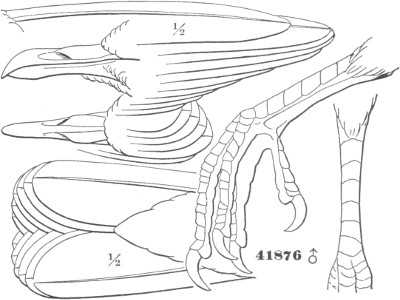
41876 ♂ ½ ½
Oreopeleia martinica.
Habits. The Key West Pigeon is found within the fauna of the United States only in the extreme southern portion of Florida, and, so far as known, only on the island of Key West, where Mr. Audubon met with them, and enjoyed a limited opportunity of observing their habits. He describes the flight as low, swift, and protracted, as he saw them passing from Cuba to Key West. They moved in loose flocks of from five or six to a dozen, and so very low as to almost seem to touch the surface. They were fond of going out early in the morning from their thickets to cleanse their plumage in the shelly sand, but on the least approach of danger would fly back to the thickest part of the woods, throw themselves on the ground, and run off with great rapidity. Their movements of the tail and neck are similar to those of the Carolina Dove. Their coo is said to be neither so soft nor so prolonged as that of the common Dove, and may be represented by the syllable whoe-whoe-oh-oh-oh. When suddenly approached, they utter a guttural gasping sound. They are said to alight on the lower branches of shrubby trees, and to delight in the neighborhood of shady ponds, always inhabiting by preference the darkest solitudes. Whatever may have been their abundance on Key West, in Mr. Audubon’s time, it is certain that they are very rare there now, as I am not aware of their having been taken of late years by any of the numerous collectors who have visited South Florida since Mr. Audubon’s time.
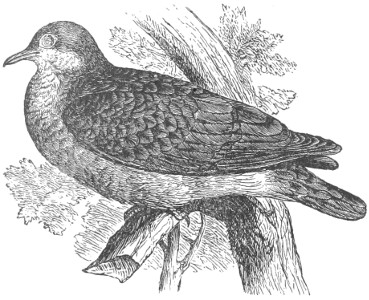
Oreopeleia martinica.
The nest is described as formed of light dry twigs, in shape much resembling that of the Carolina Dove. Occasionally it is placed on the ground, and is then less elaborate. Some are placed on large branches near the ground, while others are built among slender twigs.
Towards the middle of July, according to Mr. Audubon, they become so abundant that sportsmen are able to shoot a score or more in a day. They feed on berries and the seeds of various plants, and are especially fond of the fruit of the sea-grape.
Genus STARNŒNAS, Bonaparte.
Starnœnas, Bonaparte, Geog. & Comp. List, 1838. (Type, Columba cyanocephala, L.)
Gen. Char. Bill short; culmen about one third the rest of head, measured from the frontal feathers. Legs very stout and large; tarsus bare on the entire tibial joint, and covered with hexagonal scales, largest anteriorly, longer than the middle toe and claw. Inner lateral claw the larger, reaching the base of the middle claw; all the claws short, thick, and blunt. Hind toe and claw short; half the middle. Wings short, broad, and concave; much rounded. Tail short, broad, nearly even, but slightly vaulted.
The single species of Dove composing the genus in many respects resembles the Partridges or Quails, both in external appearance and in manners.
Starnœnas cyanocephala, Bon. BLUE-HEADED PIGEON.
Columba cyanocephala, Linn. Syst. Nat. I, 1766, 282.—Gmelin, Syst. I, 1788, 778.—Wagler, Syst. Avium, 1827, Columba, No. 112.—Aud. Orn. Biog. II, 1834, 441; V. 1839, 557, pl. clxxii. Starnœnas cyanocephala, Bonap. List, 1838.—Ib. Consp. II, 1854, 69.—Aud. Syn. 1839, 193.—Ib. Birds Amer. V, 1842, 23, pl. cclxxxiv.—Gundlach, Cab. Journ. IV, 1856, 108.—Baird, Birds N. Am. 1858, 608.—Cab. J. IV, 108 (Cuba).—Gundl. Repert. Cub. I, 1866, 299.—Reichenb. Handb. Taub. 30, tab. 257, f. 1431; 266, f. 2879–81. Starnœnas cyanocephala, Reichenbach, Systema Av. 1851, p. xxv, pl. xxiii.—Ib. Icones Av. tab. 260 and 266. Geophilus? cyanocephala, Selby, Pigeons, Jard. Nat. Lib. V, 216, pl. xxvii. Columba (Lophyrus) cyanocephala, Nuttall, Man. I, (2d. ed.,) 1840, 769. Columba tetraoides, (Scopoli,) Gmelin, I, 772. Blue-headed Turtle, Latham, Syn. II, II, 651.
Sp. Char. Bill blue, the fleshy part at the base carmine. Iris brown, scales of feet carmine, the interspaces white. Above and on sides glossy dark chocolate-olivaceous; beneath brownish-red, lighter centrally. Chin and throat black, with a narrow border of white below. A white line begins in the chin, and passes under the eye to the occiput. Sides of head above this and forehead black; crown blue. Length, 10.70; wing, 5.40; tail, 4.35.
Hab. West India Islands; according to Audubon found occasionally at Key West, Florida, and other southern keys.
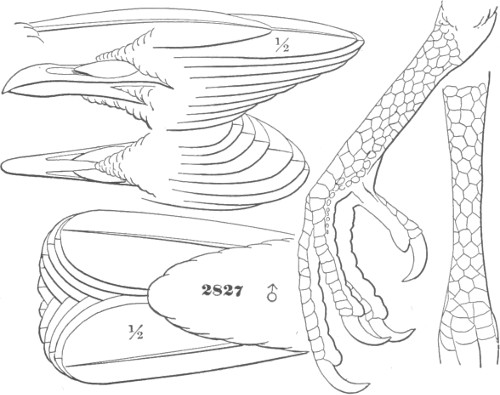
2827 ♂ ½ ½
Starnœnas cyanocephala.
The axillars and under surface of the wings are like the belly. The crissum is most like the back. The outer tail-feathers have a bluish tinge above.
The hind toe in this species is not strictly in the same plane with the others, but placed a little above their point of insertion.
Habits. This handsome Pigeon belongs to the fauna of the West India Islands, and is only an occasional visitant of Key West and other southern keys of Florida. They are a common species in Cuba, from which island a few are stated by Mr. Audubon to migrate each year to certain of the keys of Florida, where, however, they are rarely seen on account of their living only in the most tangled thickets. Mr. Audubon saw a pair on the western side of Key West. They were near the water picking gravel, but they would not suffer a near approach. He saw a pair, also, that had been taken, when young, on “Mule Keys.” These fed well on cracked corn and rice, but he was unable to obtain any further information in respect to them.
Though abundant in Cuba this species does not appear to have been found in Jamaica, except as an imported bird from the former island, contrary to the assertions of various writers, as Temminck, Brisson, and others. Mr. Gosse was not able to trace its presence, though its existence among the precipitous woods on the north side of that island he regards as quite possible.
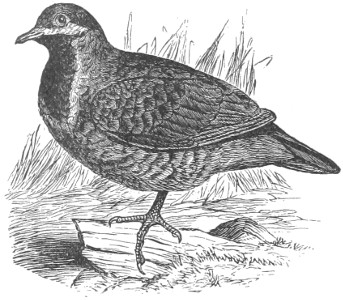
Starnœnas cyanocephala.
Like Oreopeleia martinica and Zenaida amabilis, this species, though described by Audubon as not being rare on the keys of South Florida, has not been met with in that State by later explorers.
An egg of this species laid in confinement in the aviary of Dr. Bachman, in Charleston, S. C., is of a rounded-oval shape, and of a uniform creamy-white color; it measures 1.43 inches in length by 1.10 in breadth.