Volume 3 — Family FALCONIDÆ.—The Falcons. (continued 3)
Reading edition
Adult female. Plumage similar; white more brownish; abdomen with indication of bars. Wing, 15.50; tail, 8.70; tarsus, 3.30; middle toe, 2.20.
Young (42,130, ♀, Mirador, Mexico; Dr. C. Sartorius). Black of adult replaced by dingy dark brown, this darkest in the hood; white and dusky regions gradually blended, the feathers of the breast being whitish, edged (longitudinally) with brown. No trace of the transverse bars, except on the tail, which is like that of the adult.
Hab. Middle America north of Darien; southern border of United States from Florida to Lower California; Cuba.
Localities: Guatemala (Scl. Ibis, I, 214); Cuba (Cab. Journ. II, lxxix; Gundl. Rept. 1865, 221, resident); ? Trinidad (Taylor, Ibis, 1864, 79); Texas (Dresser, Ibis, 1865, 329, breeds); Arizona (Coues); Costa Rica (Lawr. IX, 132); Yucatan (Lawr. 16, 207.)
LIST OF SPECIMENS EXAMINED.
National Museum, 16; Boston Society, 2; Philadelphia Academy, 4; Museum Comp. Zoöl., 1; R. Ridgway, 2. Total, 25.
Measurements.
Sex. Wing. Tail. Culmen. Tarsus. Middle Toe. Specimens.
♂ 14.60–16.50 9.00–10.00 1.20–1.48 3.20–3.60 1.90–2.00 6
♀ 14.75–16.00 8.80–10.00 1.20–1.45 3.55–3.75 2.00–2.10 8
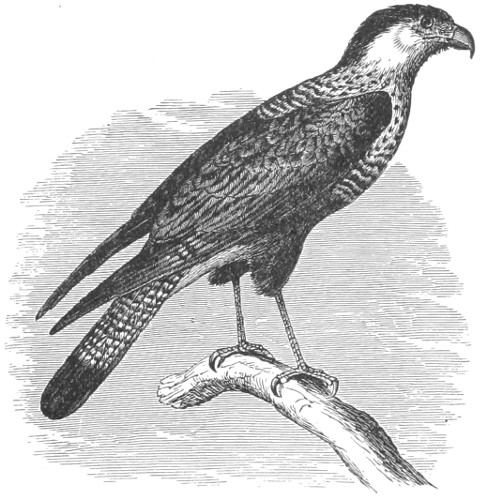
Polyborus tharus, var. auduboni.
Habits. The Caracara Eagle, as this bird is called, though it seems to possess, to a large degree, the characteristics of a Vulture, and hardly any of the true aquiline nature, is found in all the extreme southern portions of the country, in Florida, Texas, Southern Arizona, and California. Audubon met with it abundantly in Florida in the winter of 1831. Mr. Boardman has seen it quite common at Enterprise, associating with the Vultures. Dr. Woodhouse, while encamped on the Rio Saltado, near San Antonio, in Texas, frequently saw the Caracaras, and always in company with the Vultures, which he says they greatly resemble in their habits, excepting that they were much more shy. He could, however, readily approach them when on horseback. Mr. Dresser also frequently encountered it in Texas in the vicinity of San Antonio, and speaks of it as abundant from the Rio Grande to the Guadaloupe, but never noticed any farther east. In Arizona, Dr. Coues says, it is not a rare bird in the southern and western portions of that Territory. Lieutenant Couch likewise describes them as exceedingly abundant from the Rio Grande to the Sierra Madre. He speaks of killing a male bird on the nest, which was in a low tree and composed of sticks. He adds that this bird destroys the Texas field-rats (Sigmodon berlandieri) in large numbers.
Dr. Heermann met with this species on the Colorado River, near Fort Yuma, in company with the Cathartes aura. He found it so shy that it was impossible to procure a specimen. He found it along the Gila River, and again met with it in Texas wherever there were settlements. At San Antonio, wherever there were slaughter-houses, he met with them in great numbers, twenty or thirty being often seen at a time.
Grayson gives the Caracara as quite abundant in the Tres Marias. Although it subsists mainly on dead animals and other offal, it is said to sometimes capture young birds, lizards, snakes, and land-crabs. It generally carries its prey in its beak; but Colonel Grayson states that he has seen it also bear off its food in its claws, as Hawks do. It walks with facility on the ground, and was often met with in the thick woods, walking about in search of snakes. Mr. Xantus found it nesting at Cape San Lucas, placing its nest on the top of the Cereus giganteus. It occurs also in the West Indies, especially in the island of Cuba, where it is known to breed. Eggs were obtained and identified by the late Dr. Berlandier, of Matamoras, in Northern Mexico, on the Rio Grande, in considerable numbers.
Mr. Salvin (Ibis, I, 214) says the Caracara is universal in its distribution in Central America, appearing equally abundant everywhere. At Duenas it was a constant resident, breeding on the surrounding hills. Its food seemed to consist largely of the ticks that infested the animals. In Honduras Mr. G. C. Taylor found them very common, quite tame, and easily shot. They feed on carrion and offal, were often seen scratching among the half-dry cow-dung, and are “a very low caste bird.” Mr. E. C. Taylor (Ibis, VI, 79) frequently saw this bird on the shores of the Orinoco. It was very tame, and generally allowed a near approach, and when disturbed did not fly far. He did not meet with it in Trinidad.
On the Rio Grande the popular name of this species is Totache, while in Chile the P. tharus is called Traro, but its more common name throughout South America is Carrancha.
According to Audubon, the flight of this bird is at great heights, is more graceful than that of the Vulture, and consists of alternate flapping and sailing. It often sails in large circles, gliding in a very elegant manner, now and then diving downwards and then rising again.
These birds feed on frogs, insects, worms, young alligators, carrion, and various other forms of animal food. Mr. Audubon states that he has seen them walk about in the water in search of food, catching frogs, young alligators, etc. It is harmless and inoffensive, and in the destruction of vermin renders valuable services. It builds a coarse, flat nest, composed of flags, reeds, and grass, usually on the tops of trees, but occasionally, according to Darwin, on a low cliff, or even on a bush.
Mr. R. Owen, who found this bird breeding near San Geronimo, Guatemala, April 2 (Ibis, 1861, p. 67), states that the nest was built on the very crown of a high tree in the plain. It was made of small branches twisted together, and had a slight lining of coarse grass. It was shallow, and formed a mass of considerable size. The eggs were four in number, and are described as measuring 2.15 inches by 1.60, having a light red ground-color, and spotted and blotched all over with several shades of a darker red.
Dr. Heermann found the nest of this species on the Medina River. It was built in an oak, and constructed of coarse twigs and lined with leaves and roots. It was quite recently finished, and contained no eggs. Mr. Dresser states that it breeds all over the country about San Antonio, building a large bulky nest of sticks, lined with small roots and grass, generally placed in a low mesquite or oak tree, and laying three or four roundish eggs, similar to those of the Honey Buzzard of Europe. He found several nests in April and through May, and was told by the rancheros that its eggs are found as late as June. The nests found in the collection of Dr. Berlandier, of Matamoras, were coarse flat structures, composed of flags, reeds, and grass. The nests, though usually built on the tops of trees, are occasionally found, according to Darwin, on a low cliff, or even on a bush. The number of the eggs is rarely, if ever, more than three or four. Four eggs, taken by Dr. Berlandier near the Rio Grande, exhibit a maximum length of 2.44 inches; least length, 2.25; average, 2.41. The diameter of the smallest egg is 1.75 inches; that of the largest, 1.88; average, 1.81. These eggs not only present the great and unusual variation in their length of nearly eight per cent, but very striking and anomalous deviations from uniformity are also noticeable in their ground-color and markings. The ground-color varies from a nearly pure white to a very deep russet or tan-color, and the markings, though all of sepia-brown, differ greatly in their shades. In some, the ground-color is nearly pure white with a slight pinkish tinge, nearly unspotted at the smaller end, and only marked by a few light blotches of a sepia-brown. These markings increase both in size and frequency, and become of a deeper shade, as they are nearer the larger end, until they become almost black, and around this extremity they form a large confluent ring of blotches and dashes of a dark sepia. Others have a ground-color of light russet, or rather white with a very slight wash of russet, and are marked over the entire surface, in about equal proportion, with irregular lines and broad dashes of dark sepia. Again, in others the ground is of the deepest russet or tan-color, and is marked with deep blotches of a dark sepia, almost black. The eggs are much more oblong than those of most birds of prey, and in this respect also show their relation to the Vultures, rather than to the Hawks or Eagles. They are pyriform, the smaller end tapers quite abruptly, and varies much more, in its proportions, from the larger extremity, than the eggs of most true Hawks.
Lieutenant Gilliss found the South American race exceedingly numerous throughout Central and Southern Chile. It was constantly met with along the roads, and wherever there was a chance of obtaining a particle of flesh or offal. At the annual slaughtering of cattle they congregate by hundreds, and remain without the corral, awaiting their share of the rejected parts. It was so tame, from not being molested, that it could be taken with the lasso, but when thus captured, it fights desperately, and no amount of attention or kindness can reconcile it to the loss of liberty.
Throughout South America it is one of the most abundant species, its geographical range extending even to Cape Horn. Mr. Darwin found the Polyborus nowhere so common as on the grassy savannas of the La Plata, and says that it is also found on the most desert plains of Patagonia, even to the rocky and barren shores of the Pacific.
Genus PANDION, Savigny.
Pandion, Savign. 1809. (Type, Falco Haliætus, Linn.)
Triorchis, Leach, 1816. (Same type.)
Balbusardus, Fleming, 1828. (Same type.)
Gen. Char. Bill inflated, the cere depressed below the arched culmen; end of bill much developed, forming a strong, pendent hook. Anterior edge of nostril touching edge of the cere. Whole of tarsus and toes (except terminal joint) covered with rough, somewhat imbricated, projecting scales. Outer toe versatile; all the claws of equal length. In their shape, also, they are peculiar; they contract in thickness to their lower side, where they are much narrower than on top, as well as perfectly smooth and rounded; the middle claw has the usual sharp lateral ridge, but it is not very distinct. All the toes perfectly free. Tibiæ not plumed, but covered compactly with short feathers, these reaching down the front of the tarsus below the knee, and terminating in an angle. Primary coverts hard, stiff, and acuminate, almost as much so as the quills themselves; third quill longest; first longer than fifth; second, third, and fourth sinuated on outer webs; outer three deeply emarginated, the fourth sinuated, on inner webs.
Of this remarkable genus, there appears to be but a single species, which is almost completely cosmopolitan in its habitat. As in the case of the Peregrine Falcon and Barn Owl, different geographical regions have each a peculiar race, modified by some climatic or local influence. These races, however, are not well marked, and are consequently only definable with great difficulty.
Species and Races.
P. haliætus. Wing, 15.20–21.50; tail, 7.00–11.11; culmen, 1.20–1.40; tarsus, 2.00–2.15; middle toe, 1.60–2.00. Second or third quills longest. Above clear dark grayish-brown, inclining to brownish-black, plain, or variegated with white. Tail brownish-gray (the inner webs almost entirely white), narrowly tipped with white, and crossed by about six or seven nearly equal bands of dusky-black. Head, neck, and entire lower parts, snowy-white; the breast with or without brown spots or wash. A dusky stripe on side of head (from lores across the ear-coverts), and top of head more or less spotted, or streaked, with the same. Adult. Upper parts plain. Young. Feathers of the upper parts bordered terminally with white. Sexes alike (?).
Wing, 17.00–20.50; tail, 7.00–10.00; culmen, 1.20–1.45; tarsus, 1.95–3.15; middle toe, 1.50–1.90. Second or third quills longest (in eighteen specimens from Europe and Asia). First longer than fifth. Breast always (?) spotted with brownish, or uniformly so; top of head with the black streaks usually predominating. Tail with six to seven narrow black bands, continuous across both webs. Hab. Northern Hemisphere of the Old World … var. haliætus.68
Wing, 17.50–21.50; tail, 8.70–10.50; culmen, 1.25–1.40; tarsus, 2.00–2.40; middle toe, 1.70–2.00. Second and third quill longest. Breast often entirely without spots; top of head and nape usually with dark streaks predominating. Tail with six to seven narrow black bands, continuous across both webs. Hab. Northern Hemisphere of the New World … var. “carolinensis.”
Wing, 17.50–19.50; tail, 9.00–10.00; culmen, 1.25–1.40; tarsus, 2.10; middle toe, 1.70–1.95. Third quill longest, but second just perceptibly shorter (eight specimens, including Gould’s types). Breast with the markings sometimes (in two out of the eight examples) reduced to sparse shaft-streaks, but never (?) entirely immaculate. Top of the head with the white streaks usually predominating, sometimes (in three out of the eight specimens) immaculate white (the occiput, however, always with a few streaks). Tail with six to seven white bands on the inner webs, which (according to Kaup) do not touch the shaft. Hab. Australia … var. “leucocephalus.”69
Pandion haliætus, var. carolinensis (Gmel. FISH-HAWK; AMERICAN OSPREY.
Falco carolinensis, Gmel. Syst. Nat. p. 263, 1789.—Daud. Tr. Orn. II, 69, 1800. Pandion carolinensis, Bonap. List, pt. iii, 1838; Consp. Av. p. 16.—Strickl. Orn. Syn. I, 64, 1855.—Aud. Birds Am. pl. lxxxi, 1831.—Cass. Birds Cal. & Tex. p. 112, 1854.—Brewer, Oölogy, 1857, p. 53, pl. iii, fig. 33, 34.—Newb. P. R. R. Rept. VI, iv, 75, 1857.—Heerm. VII, 21, 1857.—De Kay, Zoöl. N. Y. II, 8, pl. vi, fig. 18.—Cass. Birds N. Am. 1858, p. 44.—Coop. & Suck. P. R. R. Rept. XII, ii, 153, 1860.—Coues, Prod. Orn. Ariz. 1866, p. 13.—Gray, Hand List, I, 15, 1869.—Max. Cab. Journ. VI, 1858, 11.—Lord, Pr. R. A. I. IV, 1864, 110 (Brit. Columb.; nesting).—Fowler, Am. Nat. II, 1868, 192 (habits). Falco cayennensis, Gmel. Syst. Nat. p. 263, 1789.—Daud. Tr. Orn. II, p. 69, 1800. Falco americanus, Gmel. Syst. Nat. p. 257.—Lath. Index Orn. p. 13, 1790; Syn. I, 35, 1781; Gen. Hist. I, 238, 1821.—Daud. Tr. Orn. II, 50.—Shaw, Zoöl. VII, 88. Aquila americana, Vieill. Ois. Am. Sept. I, pl. iv, 1807. Pandion americanus, Vieill. Gal. Ois. pl. ii, 1825.—Vig. Zoöl. Journ. I, 336.—Swains. Classif. B. II, 207, 1837. Aquila piscatrix, Vieill. Ois. Am. Sept. I, pl. iv, 1807. Accipiter piscatorius, Catesby, Carolina, I, pl. ii, 1754. A. falco piscator antillarum, Briss. Orn. I, 361, 1760. A. falco piscator carolinensis, Briss. Orn. I, 362. Pandion haliætus, Rich. Faun. Bor. Am. II, 20, 1831.—Jard. (Wils.) Am. Orn. II, 103, 1832.—James. (Wils.) Am. Orn. I, 38, 1831.—Aud. Orn. Biog. I, 415, 1831.—Gray, List B. Brit. Mus. p. 22, 1844. ? Pandion fasciatus, Brehm, Allgem. deutsch. Zeitung, II, 1856, 66 (St. Domingo).
Sp. Char. Adult male (17.227, San José, Lower California, December 15, 1859; J. Xantus). Upper surface dark vandyke-brown, with a faint purplish cast; quills black. Every feather with a conspicuous, sharply defined terminal crescent of pure white. Tail brownish-drab, narrowly tipped with white, and crossed with seven (one concealed) regular bands of dusky; inner webs almost wholly white, the black bands sharply defined and continuous; shafts entirely white. Ground-color of the head, neck, and entire lower parts, pure white; a broad stripe from the eye back across upper edge of the ear-coverts to the occiput brownish-black; white head also sparsely streaked with blackish, these streaks suffusing and predominating medially; nape faintly tinged with ochraceous, and sparsely streaked. Breast with large cordate spots of brown, fainter than that of the back, a medial spot on each feather, the shaft black; rest of lower parts immaculate. Lining of the wing white, strongly tinged with ochraceous; the brown of the outer surface encroaching broadly over the edge. Under primary-coverts with broad transverse spots or bars; under surface of primaries grayish-white anterior to the emargination irregularly mottled with grayish; axillars immaculate. Wing-formula, 2=3, 4–1, 5. Wing, 20.00; tail, 8.80; culmen, 1.35; tarsus, 2.15–1.10; middle toe, 1.90; outer, 1.75; inner, 1.40; posterior, 1.15; posterior outer and inner claws of equal length, each measuring 1.20 (chord); middle, 1.15. “Iris yellow; feet greenish-yellow.”
Adult female (290, S. F. Baird’s Collection, Carlisle, Pa., April 17, 1841). Dark brown of the upper surface entirely uniform, there being none of the sharply defined white crescents so conspicuous in the male.70 Tail brown to its tip, the dusky bands obscure, except on inner webs. On the top of the head, the dusky is more confined to a medial stripe. Pectoral spots smaller, less conspicuous. Under surface of primaries more mottled with grayish. Wing-formula, 3, 2–4–1, 5. Wing, 20.50; tail, 9.15; culmen, 1.35; tarsus, 2.15; middle toe, 1.70.
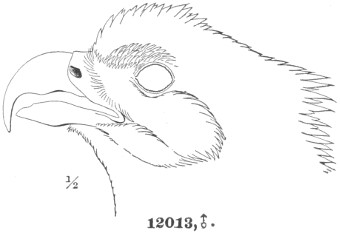
12013, ♂. ½
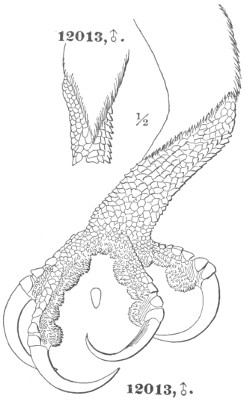
12013, ♂. ½
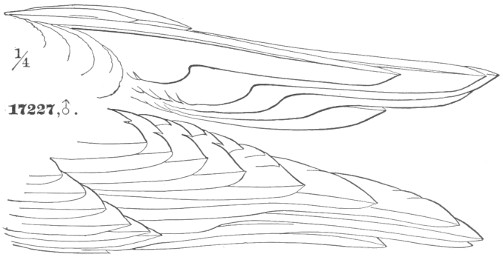
17227, ♂. ¼
Pandion carolinensis.
Hab. Whole of North America, south to Panama; N. Brazil; Trinidad, Cuba, and other West India Islands.
Localities: Belize (Scl. Ibis, I, 215); Cuba (Cab. Journ. II, lxxx, nests; Gundl. Repert. Sept. 1865, 1, 222); Bahamas (Bryant, Pr. Bost. Soc. VII, 1859); Panama (Lawr. VIII, 63); Trinidad (Taylor, Ibis, 1866, 79); Arizona (Coues, Pr. A. N. S. 1866, 49); N. Brazil (Pelz. Orn. Bras. I, 4).
In eight out of twelve North American adult specimens, there is but the slightest amount of spotting on the breast; in two of these (4,366, Puget Sound, and 12,014, Oregon), none whatever; in 17,228 (♂, Cape St. Lucas), 2,512 (♂ S. F. B. Carlisle, Pa.), 34,065 (♀, Realejo, Central America), and 5,837 (Fort Steilacoom), there is just a trace of these spots.
The specimens described are those having the breast most distinctly spotted. Specimens vary, in length of wing, from 17.50 to 20.50. There appears to be no sexual difference in size.
The distinctness or identity of the European and North American Ospreys can only be determined by the comparison of a very large series; this we have not been able to do, and although it is our belief that they should not be separated, the impressions received from a close inspection of the specimens before us (twenty-seven American and eighteen European) seem to indicate the propriety of distinguishing them as races.
The male of the pair described appears to be perfectly identical, in all respects except size, with a very perfect, finely mounted European male; indeed, the only discrepancy is in the size, the wing of the European bird being only nineteen inches, instead of twenty inches as in the American. The female, however, differs from European females in having the brown on the breast in the form of detached faint spots, instead of a continuous grayish-brown wash, more or less continuous.
The types of our descriptions are the only specimens of the American series which show even an approach to the amount of spotting on the breast constant in birds from Europe.
The American bird, as indicated by the series before us, would seem to be rather the larger; for the European specimens measure uniformly about an inch less than the American in length of the wing.
In all the American specimens, of both sexes, the shafts of the tail-feathers are continuously white, while in the European they are clear white only at the roots or for the basal half.
While, in consideration of the above facts, I am for the present compelled to recognize the American Pandion under the distinctive name of carolinensis, I may say, that, if any European birds occur with the breast immaculate,—no matter what the proportion of specimens,—I shall at once waive all claims to distinctness for the American bird.
LIST OF SPECIMENS EXAMINED.
National Museum, 7; Philadelphia Academy, 3; New York Museum, 1 (Brazil); Boston Society, 6; Museum Cambridge, 9; Cab. G. N. Lawrence, 1; Coll. R. Ridgway, 1. Total, 28.
Measurements.
Sex. Wing. Tail. Culmen. Tarsus. Middle Toe. Specimens.
♂ 19.00–20.50 10.00–10.50 1.35–0.002.25–2.40 1.80–1.85 5
♀ 18.75–19.00 8.80–9.50 1.25–1.35 2.00–2.25 1.70–1.80 4
Second and third quills longest; first shorter or longer than fifth.
Habits. The Fish Hawk of North America, whether we regard it as a race or a distinct species from that of the Old World fauna, is found throughout the continent, from the fur regions around Hudson’s Bay to Central America. According to Mr. Hill, it is seen occasionally in Jamaica, and, as I learn by letter from Dr. Gundlach, is also occasionally met with in the island of Cuba; but it is not known to breed in either place. Dr. Woodhouse, in his report of the expedition to the Zuñi River, speaks of this Hawk as common along the coasts of Texas and California. Dr. Heermann mentions it as common on the borders of all the large rivers of California in summer; and Dr. Gambel also refers to it as abundant along the coast of that State, and on its rocky islands, in which latter localities it breeds. I am not aware that it has ever been found farther south than Texas, on the eastern coast. On the Pacific coast it appears to have a more extended distribution both north and south, but nowhere to be so abundant as on certain parts of the Atlantic coast.
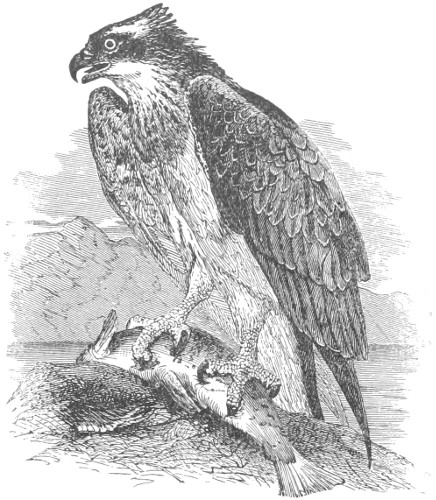
Pandion haliætus (European specimen).
Mr. Bischoff obtained this species about Sitka, where he found it breeding, and took its eggs; and Mr. Dall procured several specimens near Nulato in May, 1867, and in 1868. They were not uncommon, frequenting the small streams, and were summer visitors, returning to the same nest each season. Colonel Grayson found it breeding as far south as the islands of the Tres Marias, in latitude 31° 30′ north. The nest was on the top of a giant cactus. Mr. Xantus describes it as breeding on the ground at Cape St. Lucas.
In the interior it was met with by Richardson, but its migrations do not appear to reach the extreme northern limits of the continent. That observing naturalist saw nothing of this bird when he was coasting along the shores of the Arctic Sea, nor did Mr. Hearne find it on the barren grounds north of Fort Churchill. Its eggs were collected on the Mackenzie River by Mr. Ross, and on the Yukon by Messrs. Lockhart, Sibbiston, McDougal, and Jones. At Fort Yukon, Mr. Lockhart found it nesting on a high tree (S. I. 15,676).
On the Atlantic coast it is found from Labrador to Florida, with the exception of a portion of Massachusetts around Boston, where it does not breed, and where it is very rarely met with. It is most abundant from Long Island to the Chesapeake, and throughout this long extent of coast is very numerous, often breeding in large communities, to the number of several hundred pairs. Away from the coast it is much less frequent, but is occasionally met with on the banks of the larger rivers and lakes, and in such instances usually in solitary pairs. Dr. Hayden found it nesting in the Wind River Mountains on the top of a large cottonwood tree.
Mr. Allen reports this species as abundant everywhere in Florida, and as especially so around the lakes of the Upper St. Johns, where it commences nesting in January. At Lake Monroe he counted six nests from a single point of view. It is said by fishermen to occur on the coast of Labrador, but it is not cited as found there by Mr. Audubon, nor is it so given by Dr. Coues. It is, however, very common on the coast of Nova Scotia, breeding in the vicinity of most of the harbors. It is given by Mr. Boardman as common near Calais, where it arrives about the 10th of April, and remains until the middle of September. It is found along the whole coast more or less abundantly, especially near the heads of the numerous estuaries.
In Central America it is cited by Salvin as occurring abundantly on both the coast regions, and is particularly common about Belize, where it is believed to breed. It is said by Mr. Newton to be found on the island of St. Croix at all times except during the breeding-season. It was also occasionally seen at Trinidad by Mr. E. C. Taylor.
The Fish Hawk appears to subsist wholly on the fish which it takes by its own active exertions, plunging for them in the open deep, or catching them in the shallows of rivers where the depth does not permit a plunge. Its abundance is measured somewhat by its supply of food; and in some parts of the country it is hardly found, in others it appears in solitary pairs, and again in a few districts it is quite gregarious.
The American Fish Hawk is migratory in its habits, leaving our coasts early in the fall of the year, and returning soon after the close of the winter. Sir John Richardson states that the time of its arrival in the fur regions is as early as April, and on the coast it has been noticed in the middle of March. It breeds on the coast of Nova Scotia late in June, on that of Maine earlier in the same month, in New Jersey and Maryland in May, and still earlier in California.
It is said to arrive on the New Jersey coast with great regularity about the 21st of March, and to be rarely seen there after the 22d of September. It not unfrequently finds, on its first arrival, the ponds, bays, and estuaries ice-bound, and experiences some difficulty in procuring food. Yet I can find no instance on record where our Fish Hawk has been known to molest any other bird or land-animal, to feed on them, though their swiftness of flight, and their strength of wing and claws, would seem to render such attacks quite easy. On their arrival the Fish Hawks are said to combine, and to wage a determined war upon the White-headed Eagles, often succeeding by their numbers and courage in driving them temporarily from their haunts. But they never attack them singly.
The Fish Hawk nests almost invariably on the tops of trees, and this habit has been noticed in all parts of the country. It is not without exceptions, but these are quite rare. William H. Edwards, Esq., found one of their nests constructed near West Point, New York, on a high cliff overhanging the Hudson River. The trees on which their nests are built are not unfrequently killed by their excrement or the saline character of their food and the materials of their nest. The bird is bold and confiding, often constructing its nest near a frequented path, or even upon a highway. Near the eastern extremity of the Wiscasset (Me.) bridge, and directly upon the stage-road, a nest of this Hawk was occupied several years. It was upon the top of a low pine-tree, was readily accessible, the tree being easily climbed, and was so near the road that, in passing, the young birds could frequently be heard in their nest, uttering their usual cries for food.
The nests are usually composed externally of large sticks, often piled to the height of five feet, with a diameter of three. In a nest described by Wilson, he found, intermixed with a mass of sticks, corn-stalks, sea-weed, wet turf, mullein-stalks, etc., the whole lined with dry sea-grass (Zostera marina), and large enough to fill a cart and be no inconsiderable load for a horse.
When the nest of this Hawk is visited, especially if it contain young, the male bird will frequently make violent, and sometimes dangerous, attacks upon the intruder. In one instance, in Maine, the talons of one of these Hawks penetrated through a thick cloth cap, and laid bare the scalp of a lad who had climbed to its nest, and very nearly hurled him to the ground. A correspondent quoted by Wilson narrates a nearly similar instance of courageous and desperate defence of the young. They are very devoted in their attentions to their mates, and supply them with food while on the nest. Wilson relates a touching instance of this devotion, where a female that had lost one leg, and was unable to fish for herself, was abundantly supplied by her mate.
In some localities the Fish Hawk nests in large communities, as many as three hundred pairs having been observed nesting on one small island. When a new nest is to be constructed, the whole community has been known to take part in its completion. They are remarkably tolerant towards smaller birds, and permit the Purple Grakle (Quiscalus purpureus) to construct its nests in the interstices of their own. Wilson observed no less than four of these nests thus clustered in a single Fish Hawk’s nest, with a fifth on an adjoining branch.
The eggs of the Fish-Hawk are usually three in number, often only two, and more rarely four. They are subject to great variations as to their ground-color, the number, shade, and distribution of the blotches of secondary coloring with which they are marked, and also as to their size and shape. Their ground-color is most frequently a creamy-white, with a very perceptible tinge of red. This varies, however, from an almost pure shade of cream, without any admixture, to so deep a shade of red that white ceases to be noticeable. Their markings are combinations of an almost endless variation of shades of umber-brown, a light claret-brown, an intermingling of both these shades, with occasional intermixtures of purplish-brown. They vary in length from 2.56 to 2.24 inches, and in breadth from 1.88 to 1.69 inches. It would be impossible to describe with any degree of preciseness the innumerable variations in size, shape, ground-color, or shades of markings, these eggs present. They all have a certain nameless phase of resemblance, and may be readily distinguished from any other eggs except those of their kindred. There are, however, certain shades of wine-colored markings in the eggs of the Fish Hawk of Europe, and also in that of Australia, that I have never noticed in any eggs of the American bird; but that this peculiarity is universal I am not able to say. The smallest egg of the carolinensis measures 2.31 by 1.62 inches; the largest, 2.56 by 1.88.
The European egg is smaller than the American, is often, but not always, more spherical, and is less pointed at the smaller end. Among its varieties is one which is quite common, and is very different from any I have ever observed among at least five hundred specimens of the American which I have examined.
An Osprey’s egg in my collection, taken near Aarhuus, in Denmark, by Rev. H. B. Tristram, of Castle Eden, England, measures only 2.12 inches in length,—shorter by a fourth of an inch than the smallest American,—in breadth 1.62 inches; its ground-color is a rich cream, with a slight tinge of claret, and it is marked over its whole surface with large blotches of a beautifully deep shade of chocolate.
In their habits the European and the American birds seem to present other decided differences. The American is a very social bird, often living in large communities during the breeding-season. The European is found almost invariably in solitary pairs, and frequents fresh water almost exclusively. The American, though found also on large rivers and lakes, is much the most abundant on the sea-shore. The European bird rarely builds on trees, the American almost always. The latter rarely resorts to rocky cliffs to breed, the European almost uniformly do so. There is no instance on record of the American species attacking smaller birds or inferior land animals with intent to feed on them. The European species is said to prey on Ducks and other wild-fowl.
Genus NAUCLERUS, Vigors.
Nauclerus, Vig. 1825. (Type, Falco furcatus, Linn.; F. forficatus, Linn.)
Elanoides, Gray, 1848. (Same type.)
Gen. Char. Form swallow-like, the tail excessively lengthened and forked, and the wings extremely long. Bill rather small, and narrow; commissure faintly sinuated; upper outline of the lower mandible very convex, the depth of the mandible at the base being only about half that through the middle; gonys drooping terminally, nearly straight. Side of the head densely feathered close up to the eyelids. Nostril ovoid, obliquely vertical. Feet small, but robust; tarsus about equal to middle toe, covered with large, very irregular scales; toes with transverse scutellæ to their base; claws short, but strongly curved; grooved beneath, their edges sharp. Second or third quill longest; first shorter than, equal to, or longer than, the fourth; two outer primaries with inner webs sinuated. Tail with the outer pair of feathers more than twice as long as the middle pair.
The genus contains but a single species, the N. forficatus, which is peculiarly American, belonging to the tropical and subtropical portions on both sides of the equator. The species is noted for the elegance of its form and the beauty of its plumage, as well as for the unsurpassed easy gracefulness of its flight. It has no near relatives in the Old World, though the widely distributed genus Milvus represents it in some respects, while the singular genus Chelictinia, of Africa, resembles it more closely, but is much more intimately related to Ictinia and Elanus.
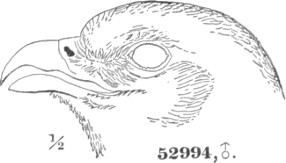
52994, ♂. ½
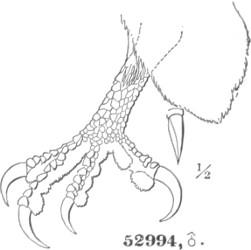
52994, ♂. ½
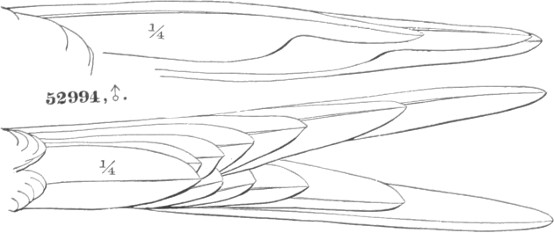
52994, ♂. ¼ ¼
Nauclerus forficatus.
Species.
N. forficatus. Head, neck, entire lower surface, and band across the rump, immaculate snowy-white; upper surface plain polished blackish, with varying lights of dark purplish-bronze (on the back and shoulders) and bluish-slaty, with a green reflection in some lights. Young, with dusky shaft-streaks on the head and neck, and the feathers of the upper parts margined with white. Wing, 15.40–17.70; tail, 12.50–14.50; culmen, .70–.80; tarsus, 1.00–1.30; middle toe, 1.15–1.20. Hab. The whole of tropical, subtropical, and warm-temperate America. Accidental in England.
Nauclerus forficatus, (Linn.) Ridgway. SWALLOW-TAILED HAWK; FORK-TAILED KITE.
Accipiter cauda furcata, Catesby, Carolina, I, pl. iv, 1754. Falco forficatus, Linn. Syst. Nat. I, 89, 1758. Falco furcatus, Linn. Syst. Nat. p. 129, 1766.—Penn. Arct. Zoöl. p. 210, No. 108, pl. x.—Gmel. Syst. Nat. p. 262. Nauclerus forficatus, Ridgway, P. A. N. S. Phil. Dec. 1870, 144.—Daud. Tr. Orn. II, 152.—Shaw, Nat. Misc. pl. cciv; Zoöl. VII, 107.—Wils. Am. Orn. pl. li, f. 3, 1808.—Aud. Birds Am. pl. 72, 1831; Orn. Biog. I, 368; V, 371.—Bonap. Ann. Lyc. N. Y. II, 31; Isis, 1832, 1138. Milvus furcatus, Vieill. Ois. Am. Sept. pl. x, 1807. Elanoides furcatus, Gray, List B. Brit. Mus. p. 44, 1844.—Strickl. Orn. Syn. I, 141, 1855.—Owen, Ibis, II, 1860, 240 (habits). Nauclerus furcatus, Vig. Zoöl. Journ. II, 387; Isis, 1830, p. 1043.—Less. Man. Orn. I, 101; Tr. Orn. p. 73.—Swains. Classif. B. I, 312; II, 210, 1837.—Bonap. List, p. 4; Cat. Ucc. Eur. p. 20; Consp. Av. p. 21.—Gould, B. Eur. pl. xxx.—Aud. Synop. p. 14, 1839.—Rich. Schomb. Reis. Brit. Guian. p. 735.—De Kay, Zoöl. N. Y. II, p. 12, pl. vii, f. 15.—Gray, Gen. B. fol. sp. 1, pl. ix, f. 9; Gen. & Subgen. Brit. Mus. p. 6.—Brew. (Wils.) Synop. Am. Orn. p. 685.—Woodh. Sitgr. Exp. Zuñi & Colorado, p. 60.—Kaup, Monog. Falconidæ, Cont. Orn. 1850, p. 57.—Brewer, Oölogy, I, 1857, 38.—Cass. Birds N. Am. 1858, 36.—Coues, Prod. Orn. Ariz. 1866, p. 12.—Dresser, Ibis, 1865, 525 (Texas, nesting).—Gray, Hand List, I, 27, 1869. Elanus furcatus, Vig. Zoöl. Journ. I, 340.—Steph. Zoöl. XIII, pl. ii, p. 49.—Cuv. Règ. An. (ed. 2), I, p. 334.—James. (Wils.) Am. Orn. I, 75.—Jard. (Wils.) Am. Orn. II, 275.—Jard. Orn. Eur. p. 29.—Nutt. Man. p. 94. Accipiter milvus carolinensis, Briss. Orn. I, 418, 1760. Elanoides yetapa, Vieill. Enc. Méth. III, 1205, 1823.
Sp. Char. Adult, male and female. Whole head and neck, lining of wings, broad band across the rump, and entire lower parts, pure white. Interscapulars and lesser wing-coverts, rich, dark, soft, bronzed purplish-black. Rest of upper parts, including lower part of rump, upper tail-coverts, and tail, more metallic slaty-black, feathers somewhat greenish basally, more bluish terminally, with a peculiar, soft milky appearance, and with very smooth compact surface. Tertials almost entirely white, black only at tips. White on under side of wing occupying all the coverts, and the basal half of the secondaries. Wing, 15.40–17.70; tail, 12.50–14.50; tarsus, 1.00–1.30; middle toe, 1.15–1.20.
Younger. Similar, but with the beautiful soft purplish-bronzed black of shoulders and back less conspicuously different from the more metallic tints of other upper parts. Young (youngest? 18,457, Cantonment Burgwyn, New Mexico). The black above less slaty, with a brownish cast, and with a quite decided gloss of bottle-green; secondaries, primary coverts, primaries, and tail-feathers finely margined terminally with white. Feathers of the head and neck with fine shaft-lines of black.
Hab. Whole of South and Middle America, and southern United States; very rarely northward on Atlantic coast to Pennsylvania; along the Mississippi Valley to Minnesota and Wisconsin; breeding in Iowa (Sioux City) and Illinois; exceedingly abundant in August in southern portion of the latter State; Cuba; accidental in England.
Localities: Guatemala (Scl. Ibis. I, 217); Cuba (Cab. Journ. II, lxxxiii); Brazil (Cab. Journ. V, 41); Panama (Lawr. VII, 1861, 289); N. Texas (Dresser, Ibis, 1865, 325, common, breeding); Veragua (Salv. 1867, 158); Costa Rica (Lawr. IX, 134); Minnesota (thirty miles north of Mille Lac, lat. 47°; Trippe, Birds of Minn., Pr. Essex Inst. VI, 1871, p. 113).
A pair marked as from England (56,099, ♀, and 56,100, ♂, “in England geschossen”; Schlüter Collection) are smaller than the average of American skins, the female measuring, wing, 15.50; tail, 13.00. The colors of this female, however, are as in American examples. The male has the plumage somewhat different from anything we have seen in the small series of American specimens. The whole upper parts are a polished violaceous slaty-black, this covering the back and lesser wing-coverts, as well as other upper parts. Were a large series of American specimens examined, individuals might perhaps be found corresponding in all respects with the pair in question.
LIST OF SPECIMENS EXAMINED.
National Museum, 9; Philadelphia Academy, 3; New York Museum, 4 (Brazil); Boston Society, 1; Cambridge Museum, 2; Cab. G. N. Lawrence, 3; Coll. R. Ridgway, 1. Total, 23.
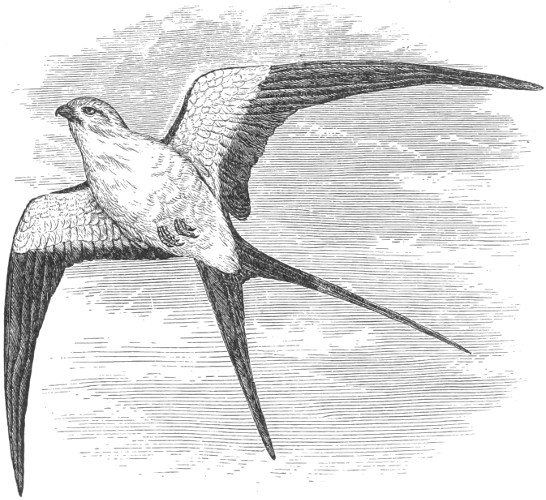
Nauclerus forficatus.
Habits. The Swallow-tailed Hawk has an extended distribution in the eastern portion of North America. It is irregularly distributed; in a large part of the country it occurs only occasionally and in small numbers, and is probably nowhere abundant except in the southwestern Gulf States, or along the rivers and inland waters. On the Atlantic coast it has been traced, according to Mr. Lawrence, as far north as New York City. According to Mr. Nuttall, individuals have been seen on the Mississippi as far as St. Anthony’s Falls, in latitude 44°. It is found more or less common along the tributaries of the Ohio and Mississippi, where it is essentially a prairie bird, and breeds in Southern Wisconsin, in Iowa, Nebraska, and Kansas, and throughout Illinois. It has been taken in Cuba, and occasionally also in Jamaica. It is found in Central America, and in South America to Northern Brazil, Buenos Ayres, and, according to Vieillot, to Peru. It nests in South Carolina and in all the States that border on the Gulf of Mexico, frequenting the banks of rivers, but is not found near the seaboard.
Mr. Thure Kumlien noticed a pair of these Hawks in the neighborhood of Fort Atkinson, Wis., in the summer of 1854, and had no doubt they were breeding, though he was not able to find their nest.
Mr. Osbert Salvin, in a letter from San Geronimo, in the Vera Paz (Ibis, 1860, p. 195), states that he has positive information that this Hawk breeds in the mountains about Coban, his chief collector having found a nest there with young the previous year. Specimens had been before that received by Mr. Sclater, forwarded by Mr. Skinner, from the neighborhood of Cajabon, Guatemala. It was said to be more numerous at Belize.
Mr. Dresser informs us that he was so fortunate as to find this graceful bird very abundant in some parts of Texas, and he had a good opportunity of observing and admiring it in its true home. It was occasional about San Antonio de Bexar, where it was usually seen late in July before heavy rains. Near the Rio Grande or in Texas he did not see it at all. At Peach Creek and near Gonzales he found it not unfrequent; and on the Colorado, Brazos, and Trinity Rivers it was one of the most common birds. It only remains there during the summer months, arriving early in April, and breeding later than the other birds of prey. On the 26th of May he found them very abundant on a creek near the Colorado, but none had commenced breeding. They were preparing their nests; and, from the number he saw about one large grove, he judged that they breed in society. On his wounding one of them, the rest came flying over his head in the manner of Seagulls, uttering harsh cries; and he counted forty or fifty over him at one time. He was informed that these Kites build high up in oak, sycamore, or cottonwood trees, sometimes quite far from the creeks.
Mr. Dresser describes this bird as exhibiting a singularly pleasing appearance on the wing, gliding in large circles, without apparent effort, in very rapid flight. The tail is widely spread, and when sailing in circles the wings are almost motionless. One was noticed as it was hunting after grasshoppers. It went over the ground as carefully as a well-trained pointer, every now and then stooping to pick up a grasshopper, the feet and bill seeming to touch the insect simultaneously. They were very fond of wasp grubs, and would carry a nest to a high perch, hold it in one claw, and sit there picking out the grubs. Their stomachs were found to contain beetles and grasshoppers.
Dr. Woodhouse speaks of this Hawk as common in Texas, and also in the country of the Creek and Cherokee nations. He confirms the accounts which have been received of its fondness for the neighborhood of streams, and adds that along the Arkansas and its tributaries it was very abundant.
Mr. Ridgway states that this Hawk arrives in Richland County, Ill., in May, and lives during the summer on the small prairies, feeding there upon small snakes, particularly the little green snake (Leptophis æstivus) and the different species of Eutænia. It builds its nest there among the oak or hickory trees which border the streams intersecting the prairies. Towards the latter part of summer it becomes very abundant on the prairies, being attracted by the abundance of food, which at that season consists very largely of insects, especially Neuroptera. It is most abundant in August, and in bright weather dozens of them may be seen at a time sailing round in pursuit of insects.
Mr. Audubon speaks of the movements of this bird in flight as astonishingly rapid, the deep curves they describe, their sudden doublings and crossings, and the extreme ease with which they seem to cleave the air, never failing to excite admiration. In the States of Louisiana and Mississippi, where, he adds, these birds are very abundant, they arrive in large companies in the beginning of April, and utter a sharp and plaintive note. They all come from the westward; and he has counted upwards of a hundred, in the space of an hour, passing over him in an easterly direction. They feed on the wing, and their principal food is said to be grasshoppers, caterpillars, small snakes, lizards, and frogs. They sweep over the fields, and seem to alight for a moment to secure a snake or some other object. They also frequent the creeks, to pick up water-snakes basking on the floating logs.
On the ground their movements are said to be awkward in the extreme. When wounded, they rarely strike with their talons, or offer serious resistance. They never attack other birds or quadrupeds to prey upon them.
This Hawk is a great wanderer, and a number of instances are on record of its having been taken in Europe. One of these was in Scotland, in 1772; another in England, in 1805.
Mr. R. Owen (Ibis, 1860, p. 241), while travelling from Coban to San Geronimo, in Guatemala, among the mountains, came suddenly upon a large flock of two or three hundred of these Hawks, which were pursuing and preying upon a swarm of bees. At times they passed within four or five yards of him. Every now and then the neck was observed to be bent slowly and gracefully, bringing the head quite under the body. At the same time the foot, with the talons contracted as if grasping some object, would be brought forward to meet the beak. The beak was then seen to open and to close again, and then the head was again raised and the foot thrown back. This movement was repeatedly observed, and it was quite clear to him that the birds were preying upon the bees.
This Hawk constructs its nest on tall trees, usually overhanging or near running water. The nest is like that of the Crow in its general appearance. It is constructed externally of dry twigs and sticks, intermixed with which are great quantities of the long Spanish moss peculiar to the Southern States, and lined with dry grasses, leaves, and feathers. One found by Dr. C. Kollock, of Cheraw, S. C., in May, 1855, containing young, was on a large tree, not near the trunk, but on one of the projecting branches, and difficult of approach.
The eggs are described by Mr. Audubon as from four to six in number, of a greenish-white color, with a few irregular blotches of dark brown at the larger end. The drawing of an egg, obtained by Dr. Trudeau in Louisiana, and which was made by that gentleman, is very nearly spheroidal, and its measurements are, length 1.75 inches, breadth 1.56. It corresponds with Mr. Audubon’s description of the egg of this Hawk.
An egg in the collection of the Smithsonian Institution, taken in Iowa by Mr. Krider, does not correspond very well with the description and figure mentioned. It measures 1.80 in length by 1.40 in breadth; its form is very regularly oval, both ends being of nearly the same shape. The ground-color is a creamy white, one end (the smaller) splashed with large confluent blotches of ferruginous, and the remainder of the surface more sparsely spotted with the same; these rusty blotches are relieved by smaller, sparser spots of very dark brown.
Dr. Cooper, in a letter dated Sioux City, May 21, 1860, mentions finding the nest of this Hawk in a high tree in Northwestern Iowa, latitude 41° 30′. The bird had not begun to lay.
Genus ELANUS, Savigny.
Elanus, Sav. 1809. (Type, Falco melanopterus, Daudin.)
Milans, Boie, 1822.
Gen. Char. Bill rather small and narrow, the tip normal; commissure moderately sinuated; upper outline of lower mandible greatly arched, the height at base less than half that through middle; gonys almost straight, declining downward toward tip. Nostril roundish, in middle of cere. Tarsus and toes (except terminal joint) covered with small roundish scales; under surface of claws just perceptibly flattened; sharp lateral ridge on middle claw very prominent; a very slight membrane between outer and middle toes. Second quill longest, third very slightly shorter; first just exceeding fourth; second and third with outer webs slightly sinuated; inner web of first emarginated, of second sinuated. Tail peculiar, emarginated, but the lateral feather much shorter than the middle, the one next to it being the longest.
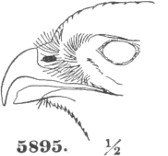
5895. ½
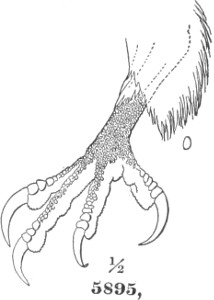
5895. ½
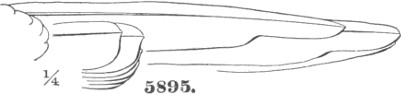
5895. ¼
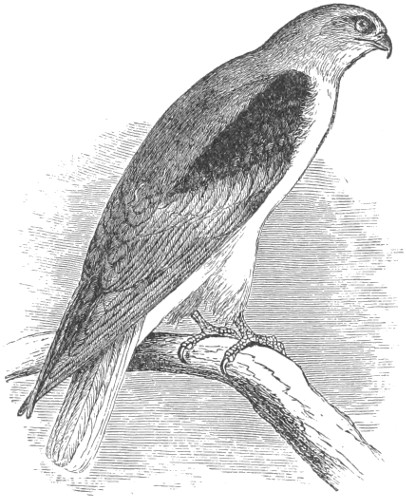
Elanus leucurus.
The species of this well-marked genus are confined to the tropical and subtropical portions of the world, and appear to be only two in number, of which one is cosmopolitan, and the other peculiar to the Old World.
Species and Races.
Common Characters. Above pearly ash, becoming white or whitish on the head and tail, with a large black patch covering the lesser-covert region. Lower surface continuous pure white; a black spot on front of, and partly around, the eye.
1. E. leucurus. A large black patch on the lining of the wing, in the region of the primary coverts. First quill very much shorter than the third; second quill longest.
Black patch on lining of the wing restricted to the primary coverts; lesser coverts, on outer surface, not conspicuously bordered anteriorly with white.
Above deep bluish-ash, with the inner webs of the secondaries appreciably paler, sometimes abruptly white. Wing, 11.60–12.65; tail, 6.80–7.80; culmen, .65–.80; tarsus, 1.20–1.50; middle toe, .94–1.20. Hab. Tropical and subtropical America … var. leucurus.
Above pale ash, with the inner webs of the secondaries hardly, or not at all, appreciably paler than the outer. Wing, 11.00–12.50; tail, 6.20–7.00; culmen, .70–.77; tarsus, 1.10–1.66; middle toe, 1.05–1.08. Hab. Western Australia … var. axillaris.71
Black patch on the lining of the wing extending over the whole of the lesser coverts; lesser coverts, on the outside, conspicuously bordered anteriorly with white.
Similar to var. axillaris, except as above. Wing, 11.75–12.30; tail, 6.30–7.00; culmen, .75–.80; tarsus, 1.10–1.40; middle toe, 1.15–1.25. Hab. Southern Australia … var. scriptus.72
2. E. cæruleus. No black on lining of the wing. First quill usually longer than the third, never very much shorter; second longest. Colors darker than in E. leucurus.
Wing, 12.00; tail, 6.10; culmen, .75; tarsus, 1.25; middle toe, 1.20. No ashy tinge on side of breast. Hab. Southern Europe and North Africa … var. cæruleus.73
Wing, 9.50–10.70; tail, 5.40–5.75; culmen, .65–.70; tarsus, 1.05–1.10; middle toe, 1.00–1.10. Sides of the breast strongly tinged with ashy. Hab. Southern Africa and India … var. minor.74
Elanus leucurus (Vieillot). BLACK-SHOULDERED KITE; WHITE-TAILED KITE.
Milvus leucurus, Vieill. Nouv. Dict. Hist. Nat. XX, 556, 1816; Enc. Méth. III, 1205, 1823. Elanoides leucurus, Vieill. Enc. Méth. III, 1205, 1823. Elanus leucurus, Bonap. Eur. & N. Am. Birds, p. 4, 1838; Consp. Av. p. 22, 1850.—Gray, Gen. B. fol. sp. 4, 1844; List B. Brit. Mus. p. 46, 1844.—Rich. Schomb. Reis. Brit. Guiana, p. 735.—Cass. B. Cal. & Tex. p. 106, 1854; Birds N. Am. 1858, 37.—Kaup, Monog. Falc. Cont. Orn. 1850, p. 60.—Heerm. P. R. R. Rept. VII, 31, 1857.—Coop. & Suck. P. R. R. Rept. XII, ii, 149, 1860.—Coues, Prod. Orn. Ariz. p. 12, 1866.—Strickl. Orn. Syn. I, 138, 1855.—Gray, Hand List, I, 28, 1869. Falco melanopterus, Bonap. Journ. Ac. Phil. V, 28; Ann. Lyc. N. Y. II, 31; Isis, 1832, p. 1137. Milvus dispar, Less. Man. Orn. I, 99, 1828. Falco dispar, Bonap. Am. Orn. pl. xi, f. 1, 1825; Ann. Lyc. N. Y. II, 435.—Aud. Am. B. pls. cccli, ccclvii; Orn. Biog. IV, 367, 1831.—Temm. pl. cl. 319 (Juv.).—James. (Wils.) Am. Orn. IV. 13, 1831. Elanus dispar, Cuv. Reg. An. (ed. 2), I, 334, 1829.—Less. Tr. Orn. p. 72, 1831.—Jard. (Wils.) Am. Orn. III, 378, 1832.—Bridg. Proc. Zoöl. Soc. pt. ii, p. 109; Ann. Nat. Hist. XIII, 500.—Aud. Syn. B. p. 13, 1831.—Brew. (Wils.) Synop. p. 685, 1852.—Nutt. Man. p. 93, 1833. E. leucurus, Brewer, Oölogy.
Sp. Char. Adult. Upper surface, including occiput, nape, interscapulars, scapulars, rump, upper tail-coverts, and wings (except lesser and middle coverts), soft, delicate, rather light bluish-cinereous, becoming gradually white on anterior portion of the head above. Rest of the head, with the tail, lining of the wing, and entire lower parts, pure white, sometimes with a very faint tinge of pale pearl-blue, laterally beneath; two middle tail-feathers ashy, but much lighter than the rump; shafts of tail-feathers black, except toward ends. Bristly loral feathers (forming ante-orbital spot, extending narrowly above the eye), a very large patch on the shoulder, covering lesser and middle wing-coverts, and large quadrate spot on under side of wing (on first row of primary coverts), deep black. Under side of primaries deep cinereous (darker than outer surface); under surface of secondaries nearly white. Second quill longest; third scarcely shorter (sometimes equal, or even longest); first longer than fourth. Tail slightly emarginated, the longest feather (next to outer) being about .50 longer than the middle, and .60 (or more) longer than the lateral, which is shortest.
Male. Wing, 12.50; tail, 7.10; tarsus, 1.20; middle toe, 1.15.
Female. Wing, 12.80; tail, 7.10; tarsus, 1.45; middle toe, 1.35.
Specimens not perfectly adult have the primary coverts, secondaries, and inner primaries, slightly tipped with white.
Still younger individuals have these white tips broader, the tail more ashy, and the upper parts with numerous feathers dull brown, tipped narrowly with white; the breast with sparse longitudinal touches of brownish.
Young (♀, 48,826, Santiago, Chile, May, 1866; Dr. Philippi). Occiput and nape thickly marked with broad streaks of dusky, tinged with rusty; scapulars umber-brown, tipped with rusty; all the feathers of wings narrowly tipped with white; tail-feathers with a subterminal irregular bar of dark ashy; breast tinged with rufous, and with badly defined cuneate spots of deeper rusty. Wing, 12.25; tail, 7.50. (Perhaps not the youngest stage.)
Hab. Tropical and warm temperate America (except the West Indies), from Chile and Buenos Ayres to Florida, South Carolina, Southern Illinois, and California; winter resident in latter State.
Localities: Xalapa (Scl. 1857, 201); Guatemala (Scl. Ibis, I, 220); Brazil (Pelz. Orn. Bras. I, 6); Buenos Ayres (Scl. & Salv. 1869, 160); Venezuela (Scl. & Salv. 1869, 252).
Specimens are from Santa Clara, California, Fort Arbuckle, Mirador and Orizaba, Mexico, Chile, and Buenos Ayres; from all points the same bird.
This species presents a very close resemblance to the E. melanopterus of Europe, and the most evident specific difference can only be detected by raising the wing, the under side of which is quite different in the two, there being in the European bird no trace whatever of the black patch so conspicuous in the American species. The primaries, also, on both webs are lighter ash, while the ash of the upper parts in general is darker than in leucurus and invades more the head above, the forehead merely approaching white. The tail is more deeply emarginated, and the proportions of the primaries are quite different, the second being much longer than the third, and the first nearly as long as the second, far exceeding the third, instead of being about equal to the fourth. In the melanopterus, too, the black borders the eye all round, extending back in a short streak from the posterior angle, instead of being restricted to the anterior region and upper eyelid, as in leucurus.
A specimen of “E. axillaris” from Australia (13,844, T. R. Peale) appears, except upon close examination, to be absolutely identical in all the minutiæ of coloration, and in the wing-formula, with E. leucurus; and differs only very slightly in the measurements of bill and feet, having these proportionally larger, as will be seen from the table. Another (32,577, H. Mactier Warfield) has the upper parts so pale as to be nearly white.
A young specimen of E. axillaris differs from that of E. leucurus as follows: the occiput, nape, and dorsal region are stained or overlaid by dull ashy-rufous, instead of dark brownish-ashy; more blackish on the head. No other differences are appreciable.
A very characteristic distinction between leucurus and axillaris is seen in the coloration of the inner webs of the secondaries: in the former, they are abruptly lighter than the outer webs, often pure white, in very striking contrast to the deep ash of the outer surface; in the latter, both webs are of about the same shade of ash, which is much paler than in the other race. Occasional specimens of leucurus occur, however, in which there is little difference in tint between the two webs.
LIST OF SPECIMENS EXAMINED.
National Museum, 10; Philadelphia Academy, 2; New York Museum, 2; Boston Society, 4; Cambridge Museum, 2; Cab. G. N. Lawrence, 2; Coll. R. Ridgway, 2. Total, 24.
Measurements.
Sex. Wing. Tail. Culmen. Tarsus. Middle Toe. Specimens.
♂ 11.80–12.50 7.30–7.60 .66–.80 1.30–1.50 1.00–1.15 8
♀ 11.60–12.65 7.20–7.80 .70–.72 1.25–1.40 1.10–1.20 8
Habits. The Black-shouldered Hawk is a southern, western, and South American species. On the Pacific it is found to occupy a much more northern range of locality than in the eastern States, where it is not found above South Carolina and Southern Illinois. Specimens have been taken near San Francisco in midwinter.
Several individuals of this species, precisely identical with others from the United States, were taken by Lieutenant Gilliss, in the astronomical expedition to Chile. Its range in South America does not appear to be confined, as was supposed, to the western coast, as specimens are recorded by Von Pelzeln as having been obtained by Natterer in Brazil, at Ytarare, Irisanga, and San Joaquin, on the Rio Branco, in August, February, and January. These were taken on the heights. They are also found in the countries of Mexico and Central America.
Elanus leucurus.
This species has been met with in South Carolina, Georgia, Florida, Alabama, Mississippi, Louisiana, and Texas, and probably occurs also in New Mexico and Arizona. Dr. Gambel describes them as very abundant in California, where they are said to be familiar in their habits, and breed in clumps of oaks, in the immediate vicinity of habitations. Dr. Heermann also speaks of them as common in that State. But neither of these naturalists appears to have met with their nests or eggs. It is not mentioned either as a bird of Cuba or Jamaica by Mr. Lembeye, Dr. Gundlach, Mr. Gosse, or Mr. March.
Dr. Cooper speaks of this bird as a beautiful and harmless species, quite abundant in the middle districts of California, remaining in large numbers, during winter, among the extensive tulé marshes of the Sacramento and other valleys. He did not meet with any during winter at Fort Mohave, nor do they seem to have been collected by any one in the dry interior of that State, nor in the southern part of California. He has met with them as far north as Baulines Bay, and near Monterey, but always about streams or marshes. Their food consisted entirely of mice, gophers, small birds, and snakes, and they were not known to attack the inmates of the poultry-yard.
Bonaparte, who first introduced the species into our fauna, received his specimen from East Florida. The late Dr. Ravenel obtained one living near Charleston, S. C., which he kept several days without being able to induce it to eat. Mr. Audubon received another, taken forty miles west of Charleston by Mr. Francis Lee. This gentleman, as quoted by Audubon, mentioned its sailing very beautifully, and quite high in the air, over a wet meadow, in pursuit of snipe. It would poise itself in the manner of the common Sparrow Hawk, and, suddenly closing its wings, plunge towards its prey with great velocity, making a peculiar sound with its wings as it passed through the air. Its cries on being wounded resembled those of the Mississippi Kite. It was so shy that Mr. Lee was only able to approach it on horseback.
Audubon states that Mr. Ward, his assistant, found this species breeding on the Santee River early in the month of March. Their nests were said to be placed on low trees near the margin of the river, and to be not unlike those of the common Crow, but without the substantial lining of its nests. Mr. Ward also mentioned seeing them flying over the cane-brakes, in pursuit of large insects, in the manner of the Mississippi Kite, and finding the birds very shy.
In Southern Illinois it has been known to occur as far north as Mount Carmel, where Mr. Ridgway saw a pair in July, flying about among the dead trees bordering a lagoon near the Wabash River.
Mr. Audubon, in his visit to Texas, saw several of these birds flying at a small elevation over the large marshes, and coursing in search of its prey in the manner of the common Marsh Harrier.
Dr. Heermann found the extensive marshes of Suisun, Napa, and Sacramento Valleys the favorite resorts of these birds, especially during the winter, and there they seemed to find a plentiful supply of insects and mice. They ranged over their feeding-grounds in small flocks from a single pair up to six or seven. He fell in with an isolated couple in the mountains between Elizabeth Lake and Williamson’s Pass, hovering over a small freshwater marsh. In July and August the young were quite abundant, from which Dr. Heermann inferred that it does not migrate for the purposes of incubation. Dr. Gambel, who procured his specimens at the Mission of St. John, near Monterey, describes it as flying low and circling over the plains in the manner of a Circus, and as feeding on the small birds. It was easy of approach when perched on trees, and uttered a loud shrill cry when wounded, and fought viciously.
Lieutenant Gilliss, who found them in Chile, describes the nest as composed of small sticks, and states that the number of the eggs is from four to six, and that they are of a dirty yellowish-white with brownish spots. The common name of this Hawk in Chile is Bailarin (from the verb bailar, to dance or balance), from the graceful and easy manner in which it seems almost to float upward or to sink in the air.
An egg of this species, in the collection of the Boston Society of Natural History, measures 1.64 inches in length by 1.48 in breadth. In shape it is very nearly spherical, and equally obtuse at either end. The ground-color, though nowhere very distinctly apparent, appears to be of a dull white, strongly tinged with a reddish hue. Distributed over the entire egg are broad deep flashes of a dark mahogany-brown, intermingled with others of a similar color, but lighter in shading. These cover the egg more or less completely, in the greater portion of its surface. This egg was taken near Fort Arbuckle, Indian Territory, May 9, 1861, by J. H. Clark, Esq., and sent to the Smithsonian Institution.
Genus ICTINIA, Vieillot.
Ictinia, Vieill. 1816. (Type, Falco mississippiensis, Wilson.)
Nertus, Boie, 1826. (Type, Falco plumbea, Gmelin.)
Pœcilopteryx, Kaup, 1844. (Same type.)
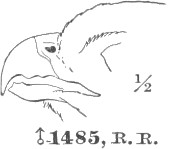
♂ 1485, R. R. ½
Ictinia mississippiensis.
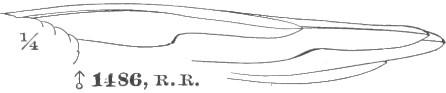
♂ 1486, R. R. ¼
Ictinia mississippiensis.
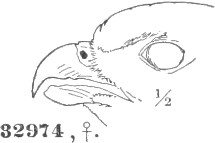
32974, ♀. ½
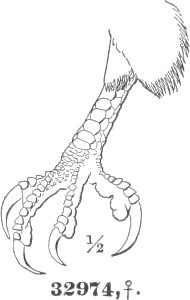
32974, ♀. ½
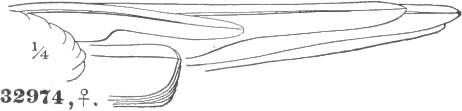
32974, ♀. ¼
I. plumbea.
Gen. Char. Form falcon-like; the neck short, wings long, and pointed, the primaries and rectrices strong and stiff, and the organization robust. Bill short and deep, the commissure irregularly toothed, and notched; gonys very convex, ascending terminally; cere narrow; nostril very small, nearly circular; feet small, but robust; tarsus about equal to middle toe, with a distinct frontal series of broad transverse scutellæ; claws rather short, but strongly curved, slightly grooved beneath, their edges sharp. Third quill longest; first of variable proportion with the rest. Tail moderate, the feathers wide, broader terminally, and emarginated.
This genus is peculiar to America, the two most closely related genera being Elanus on the one hand and Harpagus on the other. Its species belong to the tropical and subtropical regions, one of them (I. plumbea) generally distributed throughout the intertropical portions, the other (I. mississippiensis) peculiar to Mexico and the southern United States.
In their habits, they are very aerial, like the genus Nauclerus, sailing for the greater time in broad circles overhead, occasionally performing graceful evolutions as they gyrate about. Like Nauclerus, they are also partially gregarious, and, like it, feed chiefly on insects and small reptiles, which they eat while flying.
Species.
Common Characters. Adult. Uniform plumbeous, becoming lighter (whitish) on the head, and darker (blackish) on the primaries and tail. Inner webs of primaries with more or less rufous. Young. Beneath whitish, striped longitudinally with brownish; above much variegated: tail with several narrow whitish bands.
1. I. mississippiensis. Adult. Wings lighter than the tail, the secondaries hoary whitish; inner webs of primaries with only obscure spots of rufous, the outer webs with a very obscure stripe of the same. Tail wholly black. Young. Stripes beneath reddish-umber; lower tail-coverts with longitudinal shaft-streaks of the same. Second to third quills longest; first shorter than seventh and longer than sixth. Wing, 10.60–12.30; tail, 6.00–7.00; culmen, .60–.65; tarsus, 1.30–1.55; middle toe, 1.00–1.10. Hab. Prairies and savannas of the southern United States and Northern Mexico, from Wisconsin and Georgia to Mirador.
2. I. plumbea.75 Adult. Wing concolor with the tail, the secondaries black; inner webs of the primaries almost wholly rufous; outer webs with only a trace of rufous. Tail with about three bands of pure white, formed by transverse spots on the inner webs. Young. Stripes beneath brownish-black; lower tail-coverts transversely spotted with the same; upper parts darker. Third quill longest; first shorter or longer than the seventh. Tail more nearly square. Wing, 10.50–12.20; tail, 5.60–6.80; culmen, .62–.70; tarsus, 1.15–1.50; middle toe, 1.00–1.05. Hab. Tropical America, from Paraguay to Southern Mexico.
Ictinia mississippiensis (Wilson). MISSISSIPPI KITE; BLUE KITE.
Falco mississippiensis, Wils. Am. Orn. pl. 25, f. 1, 1808.—Lath. Gen. Hist. I, 275.—James. (Wils.) Am. Orn. I, 72, 1831. Nertus mississippiensis, Boie, Isis, 1828, 314. Milvus mississippiensis, Cuv. Règ. An. (ed. 2), I, 335, 1829. Ictinia mississippiensis, Gray, Gen. B. fol. sp. 2; List B. Brit. Mus. p. 48, 1844; Gen. & Sub-Gen. Brit. Mus. p. 6, 1855.—Cass. B. Cal. & Tex. p. 106, 1854.—Kaup, Ueb. Falk. Mus. Senck. p. 258, 1845; Monog. Falc. Cont. Orn. 1850, p. 57.—Strickl. Orn. Syn. I, 140, 1855.—Brewer, Oölogy, I, 1857, 41.—Coues, Prod. Orn. Ariz. p. 13, 1866.—Dresser, Ibis, 1865, 327 (Texas).—Gray, Hand List, I, 28, 1869. Falco plumbeus, Aud. Orn. Biog. II, 108, pl. cxvii; V, p. 374, 1831. Ictinia plumbea, Bonap. Eur. & N. Am. B. p. 4, 1838; Ann. N. Y. Lyc. II, 30; Isis, 1832, p. 1137.—Jard. (Wils.) Am. Orn. I, 368, pl. 25, f. 1, 1832.—Brew. (Wils.) Synop. 685, 1852.—Aud. Synop. B. Am. p. 14, 1839.—Woodh. (Sitgr.) Exp. Zuñi & Colorad. p. 61, 1853.—Nutt. Man. 92, 1833.
Sp. Char. Adult male (No. 1,486, Coll. R. Ridgway, Richland Co., Ill., August 19, 1871). Head, neck, secondaries, and entire lower parts plumbeous-ash, becoming, by a gradual transition, lighter on the head and secondaries, where the shade is pale cinereous; the head anteriorly, and the tips of the secondaries, being silvery-white. Lores and eyelids black. Rest of the plumage dark plumbeous, approaching plumbeous-black on the lesser wing-coverts, primaries, and upper tail-coverts, the tail being nearly pure black. Primaries with an indistinct narrow concealed stripe of chestnut-rufous on the outer webs, and larger spots of the same on the inner webs; feathers of the head, neck, and lower parts abruptly pure white beneath the surface, this showing in partially exposed spots on the pectoral region and crissum. Scapulars also with large concealed white spots. Shafts of primaries and tail-feathers black on both sides. Wing-formula, 3, 2–4–5–6, 1. First primary angularly, the second concavely, emarginated. Tail emarginated, lateral feather longest; depth of fork, .40. Wing, 11.75; tail, 6.80; culmen, .63; tarsus, 1.20; middle toe, 1.15.
Adult female (No. 1,487, Coll. Ridgway, Richland Co., Ill., August 19, 1871). Similar to the male, but head and secondaries decidedly darker, hardly approaching light ash; scarcely any trace of rufous on the primaries, none at all on outer webs; shafts of tail-feathers white on under side. Wing, 11.80; tail, 7.25. Bill, cere, eyelids, and interior of mouth, deep black; iris deep lake-red; rictus orange-red; tarsi and toes pinkish orange-red; lower part of tarsus and large scutellæ of toes dusky. (Notes from fresh specimens, the ones above described.)
Immature male (transition plumage; 1,488, Coll. Ridgway, Richland Co., Ill., August 21, 1871.) Similar to the adult female, but the white spots on basal portion of pectoral and crissal feathers distinctly exposed; secondaries not lighter than rest of the wing. Tail-feathers with angular white spots extending quite across the inner webs, producing three distinct transverse bands when viewed from below. Inner web of outer primary mostly white anterior to the emargination. Wing, 10.50; tail, 6.25. Color of bill, etc., as in the adult, but interior of mouth whitish, and the iris less pure carmine.
Immature female (Coll. Philadelphia
Young female (first plumage; Coll. Philadelphia Academy, North Fork Canadian River, September 19, 1851; Dr. Woodhouse). Head, neck, and lower parts white, with a yellowish tinge; this most perceptible on the tibiæ. Each feather with a medial longitudinal ovate spot of blackish-brown; more reddish on the lower parts. The chin, throat, and a broad superciliary stripe, are immaculate white. Lower tail-coverts each with a medial acuminate spot of rusty, the shaft black. Upper parts brownish-black; wing-coverts, scapulars, and interscapulars, feathers of the rump, and the upper tail-coverts, narrowly bordered with ochraceous-white, and with concealed quadrate spots of the same; primary coverts, secondaries, and primaries sharply bordered terminally with pure white. Tail black (faintly whitish at the tip), with three (exposed) obscure bands of a more slaty tint; this changing to white on the inner webs, in the form of angular spots forming the bands. Lining of the wing pale ochraceous, transversely spotted with rusty rufous; under primary-coverts with transverse spots of white. Wing, 11.90; tail, 6.40.
Hab. Central Mexico and Southern United States; common as far north as Georgia (accidental in Pennsylvania, Vincent Barnard), on the Atlantic coast, and Illinois, Iowa, and Wisconsin, in the Mississippi Valley. Exceedingly abundant summer bird on the prairies of Southern Illinois.
Localities: Coban (Salvin, Ibis, III, 1861, 355); E. and N. Texas (Dresser, Ibis, 1865, 327); Chester Co., Pa. (breeds; Barnard.)
LIST OF SPECIMENS EXAMINED.
National Museum, 6; Philadelphia Academy, 4; New York Museum, 1; Cambridge Museum, 1; Cab. G. N. Lawrence, 1; R. Ridgway, 3. Total, 16.
Measurements.
Sex. Wing. Tail. Culmen. Tarsus. Middle Toe. Specimens.
♂ 10.60–11.85 6.00–6.80 .60–.65 1.35–1.55 1.00–1.10 6
♀ 11.30–12.30 6.50–7.00 .60–.65 1.30–1.40 1.00–1.05 5
Habits. This Hawk appears to be confined to the extreme southern and southwestern portion of the Gulf States. It is not known to occur farther north than South Carolina on the Atlantic, though on the Mississippi it has been traced much farther north. It is most abundant about the Mississippi. It was first discovered by Wilson near Natchez, where he found it quite abundant. Mr. Say afterwards observed it far up the Mississippi, at one of Major Long’s cantonments. On Captain Sitgreave’s expedition to the Zuñi and Colorado Rivers, it was found to be exceedingly abundant in Eastern Texas, as well as in the Indian Territory, more particularly on the Arkansas River and its tributaries.
Dresser states that he found this Hawk by no means an unfrequent bird in Texas, and generally in the same localities with the Nauclerus forficatus. It was not very common near San Antonio, but was occasionally found, and even breeds there, as he procured both the old and the young birds during the summer. In travelling eastward in the month of May, he first noticed them near the Rio Colorado, and was told by the negroes on one of the plantations that they were then nesting. On the 20th of May he shot a female on the banks of that river, from which he extracted a fully formed egg. It was almost round, and rather large for the size of the bird. Eastward from the Colorado he also saw this Hawk quite often.
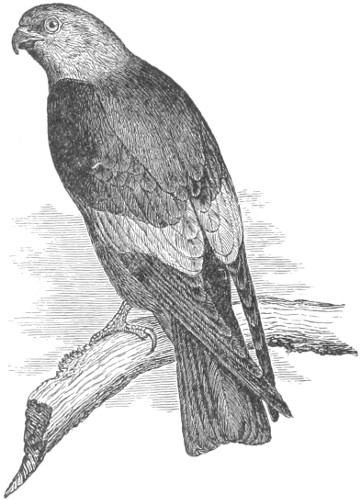
Ictinia mississippiensis.
Though the species, no doubt, occurs in Mexico, Mr. Sclater states that all the Mexican Ictiniæ which he has seen, collected by Sallè, Boucard, and others, have belonged to I. plumbea (Ibis, 1860, p. 104). A single specimen from Coban, Central America, was obtained by Mr. Salvin, but I. plumbea was by far the most common species of Ictinia in Vera Paz.
This species was first discovered within the territory of the United States by Wilson, in his visit to Natchez. He had noticed the bird sailing about in easy circles, and at a considerable height in the air, generally in company with the Turkey Buzzards, whose manner of flight it almost exactly imitated, so much so as to make it appear either a miniature of that species, or like one of them at a great distance, both being observed to soar at great heights previous to a storm. Wilson conjectures that this apparent similarity of manner of flight may be attributable to their pursuit of their respective kinds of food,—the Buzzard on the lookout for carrion, and the birds of the present species in search of those large beetles that are known to fly in the higher regions of the air, and which, in the three individuals dissected by him, were the only substances found in their stomachs. For several miles, as he passed near Bayou Manahak, the trees were swarming with a kind of Cicada, or locust, that made a deafening noise. He there observed a number of these birds sweeping about among the trees in the manner of Swallows, evidently in pursuit of the insects, which proved indeed, on dissection, to be their principal food.
One of these Hawks was slightly wounded by Wilson, and though disabled and precipitated from a great height exhibited evidence of great strength and an almost unconquerable spirit. As he approached to pick it up, the bird instantly gave battle, striking rapidly with its claws, wheeling round and round, and defending itself with great vigilance and dexterity, while its dark red eye sparkled with rage. His captor wished to preserve it alive, but, notwithstanding all his precautions in seizing it, the Hawk struck one of its claws into his hand with great force, and this could only be disengaged by Wilson’s dividing the sinew of the heel with a pen-knife. As long as the bird afterwards lived with Wilson, it seemed to watch every movement, erecting the feathers of the back of its head, and eying him with a savage fierceness. Wilson was much struck with its great strength, its extent of wing, its energy of character, and its ease and rapidity of flight.
Audubon regards this species as remarkable for its devotion to its young, and narrates that in one instance he saw the female bird lift up and attempt to carry out of his reach one of her fledglings. She carried it in her claws the distance of thirty yards or more.
He also describes their flight as graceful, vigorous, and protracted. At times the bird seems to float in the air as if motionless, or sails in broad and regular circles, then, suddenly closing its wings, is seen to slide along to some distance, and then renews its curves. At other times it sweeps in long undulations with the swiftness of an arrow, passing within touching distance of a branch on which it seeks an insect. Sometimes it is said to fly in hurried zigzags, and at others to turn over and over in the manner of a Tumbler Pigeon. Audubon has often observed it make a dash at the Turkey Buzzard, and give it chase, as if in sport, and so annoy this bird as to drive it to a distance. It feeds on the wing with great ease and dexterity. It rarely, if ever, alights on the earth; and, when wounded, its movements on the ground are very awkward. It is never known to attack birds or quadrupeds of any kind, though it will pursue and annoy foxes and Crows, and drive them to seek shelter from its attacks. The Mississippi Kite is said to be by no means a shy bird, and may be easily approached when alight, yet it usually perches so high that it is not always easy to shoot it.
In Southern Illinois, Mr. Ridgway found this Kite to be a very abundant summer bird on the prairies. There it is found from May till near the end of September, and always associated with the Swallowtail (Nauclerus forficatus.) It breeds in the timber which borders the streams intersecting the prairies; but it is not until the hottest weather of July and August that it becomes very abundant, at this time feeding chiefly upon the large insects which swarm among the rank prairie herbage. Its particular food is a very large species of Cicada, though grasshoppers, and occasionally small snakes (as the species of Eutænia, Leptophis æstivus, etc.), also form part of its food. Its prey is captured by sweeping over the object and picking it up in passing over, both the bill and feet being used in grasping it; the food is eaten as the bird sails, in broad circles, overhead. Mr. Ridgway describes the flight of this Kite as powerful and graceful in the extreme, and accompanied by beautiful and unusual evolutions.
According to Mr. Audubon, the nest of this species is always placed in the upper branches of the tallest trees. It resembles a dilapidated Crow’s nest, and is constructed of sticks slightly put together, Spanish moss, strips of pine bark, and dry leaves. The eggs are three in number, nearly globular, and are described by Mr. Audubon as of a light greenish tint, blotched thickly over with deep chocolate-brown and black; but the eggs thus described are those of some totally different species.
The same writer mentions that a pair of these Hawks, whose nest was visited by a negro sailor, manifested the greatest displeasure, and continued flying with remarkable velocity close to the man’s head, screaming, and displaying the utmost rage.
The description given by Mr. Audubon of the egg of this species, and also that in my North American Oölogy, of the drawing of an egg said to be of this bird, taken in Louisiana by Dr. Trudeau, do not correspond with an egg in the cabinet of the Boston Society of Natural History, formerly in that of the late Dr. Henry Bryant. This egg measures 1.50 inches in length by 1.32 in breadth, is very nearly globular, but is also much more rounded at one end, and tapering at the other. It is entirely unspotted and of a uniform chalky whiteness, with an underlying tinge of a bluish green. It was found by Mr. C. S. McCarthy in the Indian Territory, on the north fork of the Canadian River, June 25, 1861. The nest was made of a few sticks, and was in the fork of a horizontal branch, fifteen feet from the ground. There were two eggs in the nest.
It was also found breeding by Mr. J. H. Clark at Trout Creek, Indian Territory, June 21, and by Dr. E. Palmer at the Kiowa Agency (S. I. 13,534).
Genus ROSTRHAMUS, Lesson.
Rostrhamus, Less. 1831. (Type, Falco hamatus, Illig.)
Gen. Char. Wings and tail large, the latter emarginated. Bill very narrow, the upper mandible much elongated and bent, the tip forming a strong pendent hook; lower mandible drooping terminally, the gonys straight; the upper edge arched, to correspond with the concavity of the regular commissure. Nostril elongate-oval, horizontal. Tarsus short, about equal to middle toe, with a continuous frontal series of transverse scutellæ; claws extremely long and sharp, but weakly curved; inner edge of the middle claw slightly pectinated. Third to fourth quills longest; outer five with inner webs sinuated.
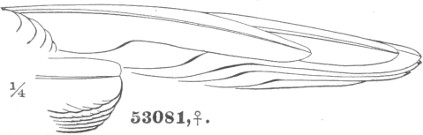
53081, ♀. ¼
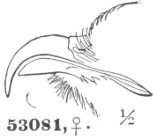
53081, ♀. ½
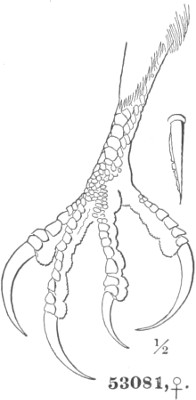
53081, ♀. ½
Rostrhamus sociabilis.
The species of this genus are two in number, and are peculiar to the tropical portions of America, one of them being confined to the Amazon region, the other extending to Florida in one direction and Buenos Ayres on the other. Their nearest allies are the species Circus and Elanus, like them inhabiting marshy localities, where their food is found, which consists, in large part, of small mollusca.
Species and Races.
Common Characters. Adult. Prevailing color plumbeous-black, or bluish-plumbeous; the tail and primaries black. Entirely concolored, or with white tail-coverts. Cere and feet orange-red. Young. Spotted with blackish-brown and ochraceous, the former prevailing above, the latter beneath.
1. R. sociabilis. Tail-coverts, with terminal and basal zones of the tail, white; that of the tail more or less shaded with grayish-brown. Adult. Uniform blackish-plumbeous, darker on the head, quills, and tail. Hab. South America, West Indies, and Florida.
Plumbeous of a glaucous cast, the head dark plumbeous, and the wing-coverts lighter, inclining to grayish-brown. Wing, 13.25–15.50; tail, 6.75–8.25; bill, .85–1.04; tarsus, 1.70–2.40; middle toe, 1.40–1.55. (2 sp. P. A. N. S.) Hab. Florida and West Indies … var. plumbeus.
Plumbeous of a blackish cast, the head deep black, and the wing-coverts not lighter, and not inclining to brownish. Wing, 12.90–14.00; tail, 7.60–7.80; bill, .90–1.25; tarsus, 1.50–1.80; middle toe, 1.45–1.65. Hab. South America … var. sociabilis.76
2. R. hamatus.77 Tail-coverts, with end and base of the tail, slaty-black. Adult. Uniform bluish-plumbeous, darker on the head, wings, and tail. Tail uniform black, or with two narrow, interrupted, white bands across the middle portion (♂, Brazil, B. S. Coll.). Wing, 11.00–12.00; tail, 5.00–7.00; bill, 1.02–1.07; tarsus, 1.75–1.90; middle toe, 1.45. Hab. Amazon region of South America.
Rostrhamus sociabilis, var. plumbeus, Ridgway. HOOK-BILL KITE; EVERGLADE KITE.
Rostrhamus sociabilis, Vieill. D’Orb. Hist. Nat. Cuba, av. p. 15.—Cass. Birds N. Am. 1858, 38.—Maynard, Birds Florida, Prospectus, 1872.
Sp. Char. Adult male (No. 61,187, Everglades, Florida; C. J. Maynard). Prevailing color plumbeous, becoming black on the secondaries, primaries, and tail, somewhat brownish-ashy on the wing-coverts, and with a glaucous cast on the neck, the head becoming nearly black anteriorly. Tail-coverts (the longer of the upper and all of the lower) and base of the tail pure white, this occupying more than the basal half of the outer feather, and changing into grayish-brown next the black; tail with a terminal band of grayish-brown, about .75 wide. Inner webs of primaries marbled, anterior to their emargination, with grayish and white. Tibiæ tinged with rusty fulvous. Wing-formula, 4, 3, 5–2–6–7, 1. Wing, 14.01; tail, 7.25; culmen, .95; tarsus, 1.90; middle toe, 1.55; hind claw, 1.10, the toe, .90. Bill deep black; cere and naked lore bright orange-red; feet deep orange-red.
Young female (Cuba; Dr. Gundlach, Coll. G. N. Lawrence). Prevailing color above brownish-black, with a glaucous cast on the dorsal region; tail deep black, with a faint greenish-bronze reflection, with white and grayish base and tip, as in the adult. Each feather of the upper parts rather broadly tipped with ochraceous-rufous; crown, occiput, and auriculars streaked longitudinally with the same. Prevailing color of the head and lower parts deep ochraceous, on the head forming a broad superciliary stripe from the forehead back to the occiput; throat and cheeks streaked longitudinally with dusky; crissum immaculate; other lower parts, including lining of the wing, thickly covered with large transverse spots of brownish-black. Upper tail-coverts white, with a blackish shaft-line; tail with the basal third white anteriorly and brownish-ashy next the black, and with a terminal band, about 1.00 wide, of brownish-ashy, passing into white at the tip. Under surface of primaries cream-color anterior to the emargination, towards the ends grayish, with transverse spots of dusky. Wing-formula, 4, 3=5–2–6–7, 1. Wing, 13.90; tail, 8.25; tarsus, 1.90; middle toe, 1.55.
An older specimen in young plumage (11,755, Florida) differs as follows: The colors generally are lighter, the ochraceous being more prevalent and lighter in tint; the throat is immaculate, and the markings beneath more longitudinal. The secondaries and primaries are broadly tipped with ochraceous. Wing, 14.00; tail, 7.20; tarsus, 1.95; middle toe, 1.50.
Hab. West Indies and Southern Florida.
LIST OF SPECIMENS EXAMINED.
National Museum, 3; Coll. C. J. Maynard, 7; Philadelphia Academy, 2; Museum Comp. Zoöl., 3; Coll. R. Ridgway, 1. Total, 16.
Habits. The Black Kite is a Central and South American species, well known in that section, but having no other claim to be regarded as a bird of North America than its presence in a restricted portion of Florida, where it is, in the extreme southern section, not very uncommon, and where it is also known to breed. It was first taken in that peninsula by Mr. Edward Harris, and subsequently by Dr. Heermann. It was supposed by Mr. Harris to breed in Florida, from his meeting with young birds; and this supposition has been confirmed by Mr. Maynard, who has since found them nesting, and procured their eggs.
Mr. Salvin met with what he presumed to be this species in Central America, ascribing the immense flights of Hawks seen by him in the month of March, in the Pacific Coast region, migrating in a northwesterly direction, to this Kite. The bird was well known to the Spaniards under the name of Asacuani,—a term that has become proverbial for a person who is constantly wandering from place to place. Mr. Leyland obtained a single specimen of the Rostrhamus near the Lake of Peten. In the spring of 1870, Mr. Maynard met with several individuals of this species among the Florida everglades. He first observed one on February 18, but was not able to secure it. Visiting the same spot ten days later, with Mr. Henshaw, three birds of this species were shot, and the nest of one was discovered. It was at that time only partly completed, was small, flat, and composed of sticks somewhat carelessly arranged. It was built upon the top of some tall saw-grass, by which it was supported. This grass was so luxuriant and thick that it bore Mr. Maynard up as he sought to reach the nest, which did not contain any eggs. On the 24th of March, Mr. Maynard discovered another nest of this species. It was built in a bush of the Magnolia glauca, and was about four feet from the water. It contained one egg. It was about one foot in diameter, was quite flat, and was composed of sticks carelessly arranged, and lined with a few dry heads of the saw-grass. The female was shot, and found to contain an egg nearly ready for exclusion, but as yet unspotted. Other eggs were subsequently procured through the aid of Seminole Indians, by whom this Hawk is called So-for-funi-kar.
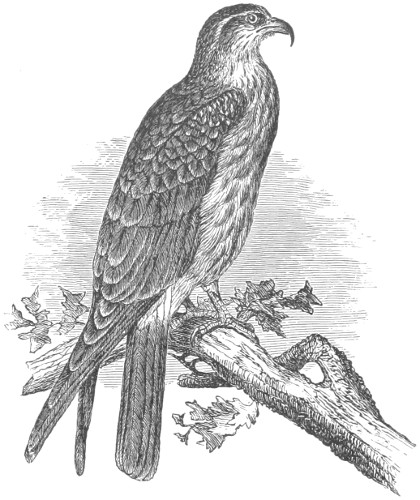
Rostrhamus sociabilis (young).
The usual number of eggs laid by this Kite is supposed to be two, as in three instances no more were found, and this was said to be their complement by the Indians. It also appeared to be somewhat irregular in the time of depositing its eggs.
This Hawk is described as very sociable in its habits, unlike, in this respect, most other birds of prey. Six or eight specimens were frequently seen flying together, at one time, over the marshes, or sitting in company on the same bush. In their flight they resemble the common Marsh Hawk, are very unsuspicious, and may be quite readily approached. The dissection of the specimens showed that this bird feeds largely on a species of freshwater shell (Pomus depressa of Say).
The egg of this species taken in Florida by Mr. Maynard is of a rounded oval shape, equally obtuse at either end, and measures 1.70 inches in length by 1.45 in breadth. The ground-color is a dingy white, irregularly, and in some parts profusely, blotched with groups of markings of a yellowish brown, shading from a light olive-brown to a much duller color, almost to a black hue. These markings in the specimen seen are not grouped around either end, but form a confluent belt around the central portions of the egg. The following description is given by Mr. Maynard of the other specimens taken by him.
Egg No. 1. Ground-color bluish-white, spotted and blotched everywhere with brown and umber. Dimensions, 1.72 × 1.45. No. 2. Ground-color same as No. 1. Two large irregular blotches of dark brown and umber on the larger end, with smaller confluent blotches and streaks of the same, covering nearly the entire surface of that end; smaller end much more sparsely spotted with the same. Dimensions, 1.76 × 1.40. No. 3. Ground-color dirty brown. The entire egg, except the small end, covered with a washing of dark brown, which forms dark irregular blotches at various points, as if the egg had been painted and then taken in the fingers before drying. Dimensions, 1.55 × 1.55.
Genus CIRCUS, Lacepede.
Circus, Lacép. 1800, 1801. (Type, Falco æruginosus, Linn.)
Pygargus, Koch, 1816. (Same type.)
Strigiceps, Bonap. 1831. (Type, Falco cyaneus, Linn.)
Glaucopteryx, Kaup, 1844. (Type, Falco cineraceus, Mont.)
Spilocircus, Kaup, 1847. (Type, Circus jardini, Gould.)
Pterocircus, Kaup, 1851. (Same type.)
Spizacircus and Spiziacircus, Kaup, 1844 and 1851. (Type, Circus macropterus, Vieill.)
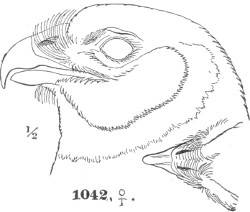
1042, ♀. ½
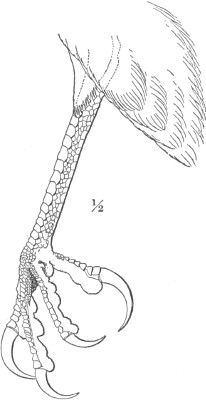
½

¼
Circus hudsonius.
Gen. Char. Form very slender, the wings and tail very long, the head small, bill weak, and feet slender. Face surrounded by a ruff of stiff, compact feathers, as in the Owls (nearly obsolete in some species). Bill weak, much compressed; the upper outline of the cere greatly ascending basally, and arched posteriorly, the commissure with a faint lobe; nostril oval, horizontal. Loral bristles fine and elongated, curving upwards, their ends reaching above the top of the cere. Superciliary shield small, but prominent. Tarsus more than twice the middle toe, slender, and with perfect frontal and posterior continuous series of regular transverse scutellæ; toes slender, the outer longer than the inner; claws strongly curved, very acute. Wings very long, the third or fourth quills longest; first shorter than the sixth; outer three to five with inner webs sinuated. Tail very long, about two thirds the wing; rounded.
The relationships of this well-marked genus are, to Accipiter on the one hand, and Elanus on the other; nearest the former, though it is not very intimately allied to either. I cannot admit the subgenera proposed by various authors (see synonomy above), as I consider the characters upon which they are based to be merely of specific importance, scarcely two species being exactly alike in the minute details of their form.
The species are quite numerous, numbering about twenty, of which only about four (including the climatic sub-species, or geographical races) are American. North America possesses but one (C. hudsonius, Linn.), and this, with the C. cinereus, Vieill., of South America, I consider to be a geographical race of C. cyaneus of Europe.
The birds of this genus frequent open, generally marshy, localities, where they course over the meadows, moors, or marshes, with a steady, gliding flight, seldom flapping, in pursuit of their food, which consists mainly of mice, small birds, and reptiles. Their assault upon the latter is sudden and determined, like the “Swift Hawks,” or the species of Accipiter.
In the following synopsis, I include only the three forms of C. cyaneus, giving the characters of the European race along with those of the two American ones.
Species and Races.
C. cyaneus. Wing, 12.50–16.00; tail, 9.00–10.70; culmen, .60–.80; tarsus, 2.42–3.25; middle toe, 1.10–1.55. Third to fourth quills longest; first shorter than sixth or seventh; outer four with inner webs sinuated. Adult male.78 Above pearly-ash, with a bluish cast in some parts; breast similar; beneath white, with or without rufous markings. Adult female. Above brown, variegated with ochraceous on the scapulars and wing-coverts; beneath yellowish-white or pale ochraceous, with a few longitudinal stripes of brown. Young (of both sexes). Like the adult female, but darker brown above, the spotting deeper ochraceous, or rufous; beneath pale rufous, the stripes less distinct.
Tail and secondaries without a subterminal band of dusky; lower parts without any markings.
Wing, 12.50–15.00; tail, 9.00–10.70; culmen, .60–.75; tarsus, 2.70–2.85; middle toe, 1.10–1.35. Hab. Europe … var. cyaneus.79
Tail and secondaries with a subterminal band of dusky; lower parts with rufous markings.
Wing, 12.90–16.00; tail, 9.00–10.50; culmen, .65–.75; tarsus, 2.90–3.25; middle toe, 1.20–1.55. Lower parts with scattered irregular specks, or small cordate spots, of reddish-rufous. Hab. North and Middle America … var. hudsonius.
Wing, 12.40–14.50; tail, 8.50–10.50; culmen, .62–.81; tarsus, 2.42–3.00; middle toe, 1.20–1.50. Lower parts with numerous regular transverse bars of reddish-rufous Hab. South America … var. cinereus.80
Circus cyaneus, var. hudsonius (Linn.). MARSH HAWK; AMERICAN HARRIER.
Falco hudsonius, Linn. Syst. Nat. p. 128, 1766.—Gmel. Syst. Nat. p. 277, 1789.—Lath. Syn. I, 91, sp. 76, 1781; Gen. Hist. I, p. 97, sp. C. 1821.—Daud. Tr. Orn. II, 173, 1800.—Shaw, Zoöl. VII, 165, 1809. Circus hudsonius, Vieill. Ois. Am. Sept. pl. ix, 1807.—Cass. B. Cal. & Tex. p. 108, 1854; Birds N. Am. 1858, p. 38.—Heerm. P. R. R. Rep’t, II, 33, 1855.—Kennerly, P. R. R. Rep’t, III, 19, 1856.—Newb. P. R. R. Rep’t, VI, 74, 1857.—Coop. & Suck. P. R. R. Rep’t, XII, ii, 150, 1860.—Strickl. Orn. Syn. I, 150, 1855.—Coues, Prod. B. Ariz. 13, 1866.—Blakist. Ibis, 1861, 319.—Lord, Pr. R. A. I. IV, 1864, 110 (Brit. Coll.). Circus cyaneus hudsonius, Schleg. Mus. Pays-Bas, Circi, 2, 1862. Circus cyaneus, var. hudsonius, (Ridgway) Coues, Key, 1872, 210.—Gray, Hand List, I, 37, 1869. Strigiceps hudsonius, Bonap. Consp. Av. p. 35, 1850. Falco spadicens, Gmel. Syst. Nat. p. 273, 1789.—Forst. Phil. Trans. LXII, 383, 1772. Falco buffoni, Gmel. Syst. Nat. p. 277, 1789.—Lath. Gen. Hist. I, 98, D, 1821. Falco uliginosus, Gmel. Syst. Nat. p. 278, 1789.—Lath. Ind. Orn. p. 40, 179; Syn. I, 90, 1781; Gen. Hist. I, 271, 1821.—Daud. Tr. Orn. II, 173, 1800.—Wils. Am. Orn. pl. li, f. 2, 1808.—Sab. App. Frankl. Exp. p. 671. Circus uliginosus, Vieill. Ois. Am. Sept. I, 37, 1807.—De Kay, Zoöl. N. Y. II, 20, pl. iii, figs. 5, 6, 1844.—James. (Wils.) Am. Orn. I, 88, 1831.—Max. Cab. Journ. VI, 1858, 20. Strigiceps uliginosus, Bonap. Eur. & N. Am. B. p. 5, 1838.—Kaup, Monog. Falc. Cont. Orn. 1850, p. 58. Falco cyaneus & β. Lath. Ind. Orn. p. 40, 1790; Syn. I, 91, 7 sp. 6 A.—Shaw, Zoöl. VII, 164, 1809. Falco cyaneus, Aud. B. Am. pl. ccclvi, 1831.—James. (Wils.) Am. Orn. IV, 21, 1831.—Bonap. Am. Orn. pl. 12; Ann. Lyc. N. Y. II, 33; Isis, 1832, p. 1538.—Peab. B. Mass. p. 82, 1841. Circus cyaneus, Bonap. Ann. Lyc. N. Y. p. 33.—Jard. (Wils.) Am. Orn. II, 391.—Rich.
Measurements.—♂. Wing, 12.50–13.25; tail, 9.00–9.30; culmen, .60–.70; tarsus, 2.75–2.90; middle toe, 1.10–1.25. Specimens, 8. ♀. Wing, 13.50–15.00; tail, 9.50–10.70; culmen, .75; tarsus, 2.70–2.85; middle toe, 1.25–1.35. Specimens, 4.
Observations.—The adult female of cyaneus is distinguishable from that of hudsonius by lighter colors and less distinct ochraceous blotches on the shoulders. & Swains. Faun. Bor. Am. pl. xxix, 1831.—Aud. Synop. p. 19, 1839.—Brew. (Wils.) N. Am. Orn. Syn. 685, 1852.—Peab. U. S. Expl. Exp. p. 63, 1848.—Woodh. in Sitgr. Rep’t, Exp. Zuñi & Colorad. p. 61, 1853.—Nutt. Man. Orn. U. S. & Can. p. 109, 1833.—Giraud. B. Long Isl’d, p. 21, 1844.—Gray, List B. Brit. Mus. p. 78, 1844.
Sp. Char. Adult male (10,764, Washington, D. C., December). Head, neck, breast, and upper parts light cinereous, palest anteriorly where it is uninterruptedly continuous; occiput somewhat darker, with a transverse series of longitudinal dashes of white, somewhat tinged with reddish. Back, scapulars, and terminal third of secondaries, with a dusky wash, the latter fading at tips; five outer primaries nearly black, somewhat hoary on outer webs beyond their emargination; lesser wing-coverts faintly mottled with paler, or with obsolete dusky spots. Upper tail-coverts immaculate pure white. Tail bluish-cinereous, mottled with white toward base; crossed near the end with a distinct band of black, and with about five narrower, very obscurely indicated ones anterior to this; tip beyond the subterminal zone fading terminally into whitish. Whole under side of wing (except terminal third or more of primaries) pure white; immaculate, excepting a few scattered transverse dusky spots on larger coverts. Rest of under parts pure white everywhere, with rather sparse transverse cordate spots of rufous. Wing, 14.00; tail, 9.20; tarsus, 2.80; middle toe, 1.30. Third and fourth quills equal, and longest; second intermediate between fifth and sixth; first 5.81 inches shorter than longest.
Another specimen differs as follows: The fine cinereous above is replaced by a darker and more brownish shade of the same, the head and breast much tinged with rusty. Tail much darker, the last black band twice as broad and near the tip; other bands more numerous (seven instead of five), and although still very obscure on middle feathers are better defined than in the one described; inner webs of tail-feathers (especially the outer ones) tinged with cream-color; white of lower parts tinged with rufous; the deep rufous transverse bars on the breast and sides broader, larger, and more numerous than in No. 16,764; abdomen and tibiæ with numerous smaller cordate spots of rufous; lower tail-coverts with large cordate spots of the same, and a deep stain of paler rufous; lining of wings more variegated. Wing, 14.10; tail, 9.00; tarsus, 2.90; middle toe, 1.30.