Volume 3 — Family STRIGIDÆ.—The Owls. (continued 3)
Reading edition
The whole lining of the wing is barred just like the sides. The dark brown prevails on the under surface of the primaries, etc.; the former having transverse, irregular, elliptical spots of white, these touching neither the shaft nor the edge: on the longest quill are seven of these spots; on all they are anterior to the emargination.
♂ (49,808, Nulato, Alaska, April 21, 1867; W. H. Dall). Wing-formula, 3, 4–2–5–6–1. Wing, 9.00; tail, 7.00; culmen, .70; tarsus (of another specimen; wanting in the present), .90; middle toe, .82.
♀ (49,807, Nulato, April 20; W. H. Dall). Wing-formula, 3, 4–2–5–6–7=1. Wing, 9.00; tail, 6.80; culmen, .70; middle toe, .80.
Hab. Arctic America, south in winter into northern United States; Wisconsin (Dr. Hoy); Massachusetts (Dr. Brewer; Maynard); Dakota and Montana (Mus. S. I.).
The Hawk Owl of North America is to be distinguished from that of Europe and Siberia by the same characters which distinguish the American Sparrow Owl from the European, namely, much darker shade of the brown and its greater prevalence. Three perfect specimens of the Old World bird (a pair from Lapland, and a specimen from Kamtschatka, Petropawloosk, W. H. Dall) agree in prevalence of the white over the head above, the confluence of the spots on the scapulars forming a larger, more conspicuous patch, and very broad and almost immaculate jugular belt; the brown bars beneath are very much narrower than in the American bird, and the tint is not different from that of the back. The legs and toes are scarcely variegated. While acknowledging the identity of the two representative forms, the differences are such as to entitle them to separation as races.
Habits. The American form of the Hawk Owl inhabits the northern portions of both continents, and is common in the Arctic portions. On the Atlantic coast of this continent it has been found as far south as Philadelphia and the State of New Jersey, but its presence south of latitude 45° is probably only occasional and rather rare. The European form, according to Mr. Dresser, has not been known to exist in the British Islands, but several instances are quoted of the occurrence of the American form in Great Britain. One was taken off the coast of Cornwall in March, 1830; another was shot near Yatton, in Somersetshire, on a sunny afternoon in August, 1847; a third had previously been taken at Maryhill, near Glasgow, in December, 1863. On the Pacific coast it has not been taken farther south than Alaska, though it is quite probable it may yet be found to be an occasional visitant in Washington Territory and Oregon, and even the northern portions of California. It remains all the winter in high northern latitudes, and the instances of its having been taken even in Massachusetts, so far as is now known, are not many. Wilson only met with two specimens. Audubon and Nuttall never met with one of these birds alive.
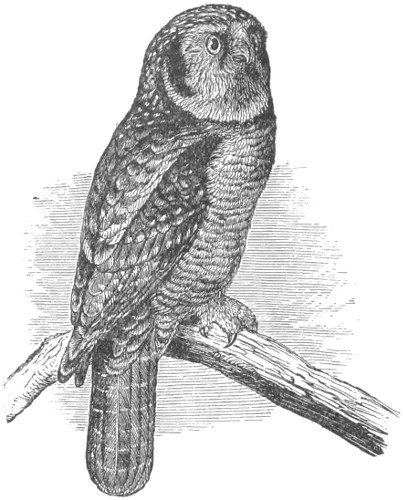
Surnia ulula.
Mr. Downes states that the Hawk Owl is very abundant in Nova Scotia in the winter time in some years, but may not be seen again for four or five seasons. It is common in Newfoundland, where it breeds in the Caribou districts. Mr. Downes often kept living specimens in confinement, which had been taken on board the Cunard steamers off the coast.
Mr. Boardman gives this species as resident, though rare, in the neighborhood of Calais, being occasionally found there in the breeding-season. In Oxford County, Maine, Professor A. E. Verrill says it is a common autumnal and winter visitant, and that it is quite abundant from the first of November to the middle of March, but not found there in the summer. Mr. Allen has never met with it in Western Massachusetts. Near Boston, in some seasons, it is not uncommon, though never occurring with any frequency, and only singly. It is found throughout the State, and is probably more common late in November than at any other time; several having been taken in Westfield, and also in Berkshire County, among the Green Mountains. I am not aware that any have been taken farther south than Philadelphia, near which city Mr. Edward Harris obtained one specimen, while another was shot at Haddington in 1866. Mr. McIlwraith calls it a rare winter visitant near Hamilton, Canada.
Richardson states that it is a common species throughout the fur countries from Hudson Bay to the Pacific, where it is killed by the hunters more frequently than any other, which may be attributed to its boldness and to its diurnal habits. During the summer season it feeds principally upon mice and insects, but in the regions in which it is found in winter, where the snow is very deep, and where this food is not procurable, it must depend on the Ptarmigan, and, indeed, is found a constant attendant upon the flocks of these birds in their spring migrations. When the hunters are shooting Grouse, it is said to be occasionally attracted by the report of the gun, and is often bold enough, when a bird has been killed, to pounce down upon it, although it is unable, from its inferior size, to carry it off. It is also said to occasionally hover round the fires made by the Indians at night.
To this account of its habits Richardson adds that it builds its nest on a tree, of sticks, grass, and feathers, and lays two white eggs. In regard to the number of eggs, he is now known to be inaccurate. Mr. MacFarlane met with this bird in considerable numbers in the region of Anderson River, where he found several nests, and all of which he made any record were built in pine-trees at considerable height from the ground. One nest is said to have been on the top of a pine about twenty feet in height, and was composed of small sticks and twigs, lined with moss. Both parents were obtained. This nest contained two young birds—one of which was about ten days old, the other about three weeks—and an addled egg. This nest was found on the 20th of June, showing that the bird began to incubate early in May.
Another nest, taken on the 28th of April, was found to contain six eggs. It was built in the top crotch of a tall pine, was composed of dry sticks, and lined with hay and a few feathers. A third nest also contained six eggs, and was lined with green mosses and deer’s hair. One nest contained as many as seven eggs, and all but one had as many as six. Mr. MacFarlane speaks of it as a winter resident.
Mr. B. R. Ross states that he found this bird throughout the Great Slave Lake district, but not plentiful. It winters in even the northernmost parts of the wooded country. It is said to build its nest not only on trees, but also on cliffs, and to lay as early as the last of March or the first of April. He states that the eggs are usually four in number, and describes them as of a dead white, of an oblong-oval shape, and as measuring 1.39 inches by 1.21. He received three eggs with the parent bird, taken at Lapierre’s House, and another parent, with nest and four eggs, from Salt River.
Mr. Dall found this the most common species of Owl about Nulato. Many of both sexes were obtained, and on the 16th of April he took from the ovary of a female an egg ready for laying. On the 5th of May Mr. Dall obtained six eggs which were laid on the top of an old birch stump, and fifteen feet from the ground. There was no nest other than that the rotten wood was somewhat hollowed out, and the eggs laid directly upon it. As he was climbing to the nest, the male bird which had been sitting on the nest attacked Mr. Dall, and knocked off his cap. The female did not appear.
Mr. Donald Gunn states that these Owls hunt in the daytime, and feed chiefly upon mice; and Mr. Dall seldom found anything but mice in their crops, and adds that it is very fond of flying, towards dusk, from the top of one tall spruce to another, apparently swinging or balancing itself, calling to its mate at intervals, while chasing or being chased by it.
Captain Drummond states, in “Contributions to Ornithology” (p. 37), that he noticed a bird of this species, on the wing, within a few yards of him, in the Bermudas.
Mr. Dresser, who had ample opportunities of observing the Hawk Owl in New Brunswick, where he found it by no means uncommon, describes it as a true day Owl. It was often seen by him hawking after prey in the strongest sunshine, or seated quietly blinking on the top of an old blasted tree, apparently undisturbed by the glare of the sun. In its general appearance, and particularly in its flight, it appeared to him to have considerable affinity to the Sparrow Hawk. In New Brunswick it affected the open plains or so-called blueberry barrens, where the open country is covered with low bushes and an occasional scathed tree. It would sit on one of these trees for hours in an upright hawk-like position, occasionally hunting over the ground, like the Kestrel of Europe, in search of small field-mice. It showed but little fear, and could be easily approached within gun-shot. When shot at and missed, it would take a short flight and return to its former perch. On one occasion Mr. Dresser, firing at one with a rifle, cut the branch close under the bird, which returned almost immediately to another branch, was a second time missed, and finally fell under a third shot.
Its note is said to be a shrill cry, similar to the call of the European Kestrel, and generally uttered on the wing. The stomach was generally found filled with small field-mice, and rarely contained any remains of small birds. They appeared to hunt after food chiefly early in the forenoon and in the evening. During the day they rested on some elevated perch. In the night they retired to rest like other diurnal Raptores.
An egg of this Owl, taken from the oviduct of its parent by Mr. B. R. Ross, April 16, at Fort Simpson, measures 1.50 inches in length by 1.20 in breadth. It is of oval shape, and of a dull-white color. Another egg measures 1.62 by 1.30 inches, is of a rounded oval, equally obtuse at either end, and of a yellowish-white color. It was taken by Mr. MacFarlane at Fort Anderson.
Genus GLAUCIDIUM, Boie.
Glaucidium, Boie, Isis, 1826, 970. Microptynx, Kaup. (Type, Strix passerina, Linn.)
Microglaux, Kaup. (Type, Strix havanense, Kaup, = G. siju (D’Orb.) Cab.)
? Taenioptynx, Kaup. (Type, Noctua brodiei, Burt.)
Gen. Char. Size very small; head rather small; bill and feet very strong and robust; no ear-tufts; tail long, about three fourths as long as the wing, rounded. Nostrils circular, opening in the middle of the inflated cere-membrane (except in G. siju). Tarsus about equal to the middle toe, densely feathered; toes haired. Four outer quills with their inner webs emarginated; third to fourth longest. Ear-conch very small, simple, rounded. Bill yellowish (except in G. phalænoides?); iris yellow.
The genus is most largely developed within the tropical regions, only one species (G. passerinum) belonging to the cold temperate zone, and this is found on both continents. They are the most robustly organized of all Owls, and, for their size, are very predatory, as in the next genus (Micrathene), though themselves hardly larger than a Sparrow, they frequently feed upon small birds, and, no doubt, often destroy the passerine species of nearly their own size. Like the most of the group to which this genus belongs, they are diurnal in their habits, and fly about during the brightest sunshine. They inhabit chiefly dense forests, and for this reason, are less well known than the more easily accessible Owls.
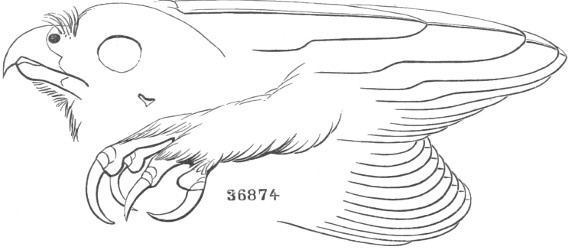
36874
Glaucidium californicum.
The following synopsis includes only the North American and Mexican species of Glaucidium. In tropical America are several others very distinct from those here given.
Species and Races.
Common Characters. Above brown, varying from nearly gray to bright ferruginous, in some species this color interrupted by a more or less distinct whitish nuchal collar, with an adjacent blackish spot (sometimes concealed) on each side of the neck. Tail with narrow bands. Beneath white, the sides striped with brown or blackish. Throat and jugulum white, with a dusky collar between. Crown speckled or streaked with lighter; wings more or less spotted with the same.
A. Markings on the crown circular, or dot-like.
1. G. passerinum. Tail with six to eight narrow white bands. Upper parts varying from brownish-gray to chocolate-brown. Ground-color of the lower parts pure white.
Tail, and stripes on sides, not darker than the back; tail-bands six, and continuous; toes rather thickly feathered. Hab. Europe … var. passerinum.32
Tail, and stripes on sides, much darker than the back; tail-bands 7 (♂)–8 (♀), not continuous; toes only scantily haired. Wing, 3.50–4.00; tail, 2.50–2.80; culmen, .43–.48; tarsus, .60; middle toe, .55. Hab. Western Province of North America. Table-lands of Mexico … var. californicum.
B. Markings on the crown longitudinal and linear.
2. G. infuscatum. Tail dark brown, crossed by six to seven non-continuous bands of white, narrower than the dark ones. Above varying from grayish-brown to reddish-umber and sepia. Beneath white, the stripes on the sides grayish-brown or dark brown, like the back.
Above dark sepia, or blackish-brown. Tail brownish-black or deep black. Wing, 3.70–3.90; tail, 2.50–2.90; culmen, .45; tarsus, .65–.80; middle toe, .65–.70. Hab. Eastern South America … var. infuscatum.33
Above grayish, or reddish-umber. Tail clear dark brown, or grayish-umber.
Wing, 3.60–3.90; tail, 2.35–2.75; culmen, .45–.50; tarsus, .65–.80; middle toe, .60–.70. Hab. Middle America, from the Rio Grande (probably in Texas) to Panama … var. gnoma.34
3. G. ferrugineum. Tail crossed by seven to nine continuous bands of dark brown and bright rufous, of nearly equal width. Above varying from grayish-brown to bright ferruginous; beneath varying from pure white to pale rufous, the stripes on the sides like the back. Wing, 3.70–4.15; tail, 2.20–2.90; culmen, .45–.50; tarsus, .70–.80; middle toe, .70–.75. Hab. Tropical America, from southern border of United States to Southern Brazil.
Glaucidium passerinum, var. californicum (Sclater). THE CALIFORNIA PIGMY OWL.
Glaucidium californicum, Sclater, Proc. Zoöl. Soc. Lond. 1857, p. 4. Glaucidium passerinum, var. californicum (Ridgway) Coues, Key, 1872, 206. Strix passerinoides (not of Temminck!), Aud. Orn. Biog. V, 271, 1831. Glaucidium infuscatum (not of Temm.!), Cass. Birds of Cal. & Tex. p. 189, 1854.—Newb. P. R. R. Rept. VI, IV, 77, 1857. Glaucidium gnoma (not of Wagler!), Cass. Birds N. Am. 1858, 62.—Heerm. P. R. R. Rept. VII, 31, 1857.—Coop. & Suck. P. R. R. Rept. XII, II, 158, 1860.—Coues, Prod. Orn. Ariz. p. 14, 1866.—Cab. Jour. 1862, 336.—Lord. Int. Obs. 1865, 409 (habits).—Gray, Hand List, I, 42, 1869.—Cab. Ueb. Berl. Mus. 1869, 207.
Sp. Char. Adult (♂, 12,054, Puget Sound, Washington Territory; Dr. C. B. Kennerly). Above, including the auriculars, umber-brown, with a faint reddish cast; this tinge most apparent in a sharply defined band across the throat. The continuity of the brown above is interrupted by a scarcely observable collar round the nape of concealed whitish; this is discernible only laterally, where there is also an inconspicuous black space. Whole head above, and neck behind, with numerous small circular spots of reddish-white; back, scapulars, and wings more sparsely and more minutely marked with the same; the two or three lower feathers of the secondary coverts have each a terminal, somewhat oval, larger spot of pure white. Secondaries crossed by three (exposed) bands of pure white, and narrowly tipped with the same; the bands formed by semicircular spots on the outer webs. Primaries almost plain, but showing faintly defined obsolete bands,—the third, fourth, and fifth with two or three conspicuous white spots on outer webs, beyond their emargination; primary coverts perfectly plain. Tail considerably darker than the wings, and purer umber; crossed with seven narrow bands of pure white, the last of which is terminal and not well defined,—these bands are formed by transverse spots, not touching the shaft on either web. Lores, sides of the forehead, sides of the throat (beneath the cheeks and ear-coverts), and lower parts in general, pure white; the ante-orbital white continuing back over the eye to its middle, but not beyond it. Lateral portion of the neck and breast (confluent with the gular belt), and sides, umber, like the back, but more numerously, though more obsoletely, speckled, the spots rather larger and more longitudinal on the sides. Breast, abdomen, anal region, and lower tail-coverts with narrow longitudinal stripes of nearly pure black. Jugulum immaculate. Tarsi mottled on the outside with brown. Lining of the wing white; a transverse patch of blackish across the ends of the under primary coverts, formed by the terminal deltoid spot of each feather; a blackish stripe, formed of blended streaks (parallel with the edge of the wing), running from the bend to the primary coverts. Under surface of primaries dusky, with transverse spots of white anterior to the emargination; these white spots on the longest quill are eight in number. Axillars plain white.
Wing, 3.60; tail, 2.60; culmen, .45; tarsus, .60; middle toe, .55. Wing-formula, 4, 3, 5–2, 6, 7, 8, 9, 10, 1.
♀ (36,874, Fort Whipple, near Prescott, Arizona, October 11, 1864; Dr. Coues). In general appearance scarcely different from the male. Upper surface more ashy, the specks of whitish less numerous, being confined chiefly to the head; those on the scapulars, however, are large, though very sparse. The middle wing-coverts have each a conspicuous roundish white spot near the end of the outer web; the secondary coverts are similarly marked, forming a band across the wing. The primaries and tail are as in the male, except that the latter has eight, instead of seven, white bands. The brown of the gular band extends upward over the throat to the recurved feathers of the chin; the white dots in the brown of the sides are considerably larger and (though very irregular) more circular than in the male; the stripes on the abdomen, etc., are rather broader and less deeply black than in the male. Wing, 4.00; tail, 2.80; culmen, .48. (Wing-formula as in male.)
Hab. Pacific Province of North America, from Vancouver Island southward; Arizona (Fort Whipple); Colorado (El Paso Co., Aiken); Table-lands of Mexico (Coll., G. N. Lawrence). Perhaps whole of the Western Province, from the Rocky Mountains to the Pacific.
One specimen in the collection (59,069) differs from those described in much darker colors. The original label is lost, but it was probably received from the northwest coast, as the darker, more reddish colors bear about the same relation to the paler gray tints of the southern birds that the dark northwest coast style of Scops asio (var. kennicotti) does to the true asio. The stripes beneath are nearly pure black, the general tint above being a reddish sepia-brown. Wing, 3.65; tail, 2.70.
The Glaucidium californicum requires comparison only with the G. passerinum of Europe, to which it is quite closely related, though easily distinguishable by the characters pointed out in the diagnoses; it is not at all like gnoma, nor indeed any other American species, with which it has been confounded by nearly all ornithologists, even by Cabanis, in his excellent paper above cited.
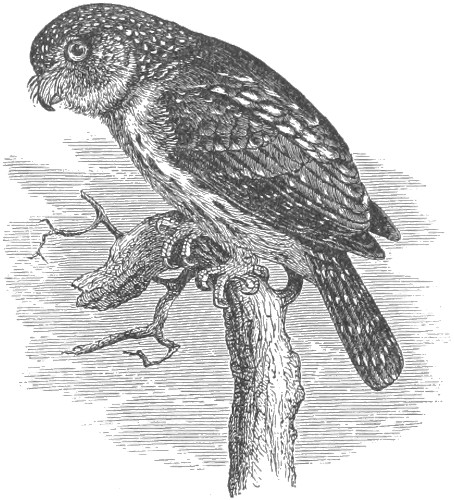
Glaucidium californicum.
I have seen only one Mexican specimen of this species, which is one in Mr. Lawrence’s collection; the locality is not given, but it is probably from the higher regions of the interior. It differs in no respect, except in size, from North American examples; it measures, wing, 3.40; tail, 2.60.
Habits. This species, one of the smallest of our North American Owls, was first obtained on the Columbia River by Dr. Townsend, near Fort Vancouver; and subsequently, Dr. Merideth Gairdner procured several others from the same locality, which were sent to the Edinburgh Museum. Dr. Townsend’s specimen was said to have been taken on the wing at midday.
Dr. Cooper met with a single specimen in Washington Territory early in November, 1854. He observed it among a flock of Sparrows, that did not seem at all disturbed by its presence. At first he mistook it for one of these birds. Its stomach was found to contain only insects.
Dr. Suckley obtained two specimens at Puget Sound, where he found it moderately abundant. It seemed to be diurnal in its habits, gliding about in shady situations in pursuit of its prey. He saw one about midday in a shady alder-swamp near Nisqually. It flitted noiselessly past him several times, alighting near by, on a low branch, as if to examine the intruder.
Near a small lake in the neighborhood of Fort Steilacoom, Dr. Suckley frequently heard the voice of a diminutive Owl, which he supposed to come from one of these birds, as this is the only small species of the family he ever saw in that neighborhood. The notes were subdued and clear, like the soft, low notes of a flute.
Dr. Newberry procured specimens of the Pigmy Owl on the Cascade Mountains, in Oregon, where, however, it was not common. It occurs also in California, as he saw several individuals in San Francisco that had been obtained in that State, but he did not meet with any in the Sacramento Valley. It was apparently confined to wooded districts, which is probably the reason why it is not more frequent in the open country of California. He adds that it flies about with great freedom and activity by day, pursuing the small birds upon which it subsists, apparently as little incommoded by the light as they are. It is, however, doubtful whether it subsists, to any large extent, on small birds. So far as observed it appears to feed almost exclusively on insects, although the Owl taken by Townsend is said to have had the entire body of a Regulus in its stomach.
Dr. Cooper speaks of this Owl as not uncommon in the middle part of California, though he did not meet with it in the southern part of the State. It is
Dr. Heermann met with this beautiful little species among the mountainous districts of the mining regions of California, where it was by no means rare. It was, however, seldom captured by him, and he regarded its flying by night as the reason; but this view is not corroborated by the observations of others. In 1852 he procured three specimens on the borders of the Calaveras River, others were taken on the Cosumnes River, and Mr. J. G. Bell, of New York, met with it on the American River, thus demonstrating its wide and general distribution throughout the State.
Mr. John K. Lord met with a pair on Vancouver Island. He characterizes the bird as of shy and solitary habits, always hiding among the thick foliage of the oak or pine, except when feeding. Early one spring, while collecting specimens of the smaller migrant birds, he was favored with unusual opportunities for watching their habits. The pair had made their home in the hollow of an oak-tree that stood in an open patch of gravelly ground near a small lake. The remains of an Indian lodge which was close to the place enabled Mr. Lord to watch closely the habits of this interesting pair. In the first morning twilight the Owls were up and in motion, hungry after a whole night’s fasting. Their flight was short, quick, and jerking, similar to that of the Sparrow Hawk, but wholly unlike the muffled, noiseless flap of the Night Owls. Their food was found to be entirely insectivorous, chiefly grasshoppers and field-crickets, with an occasional beetle or butterfly. When in pursuit of food, they perch on a small branch near the ground, and sit bolt upright in an indolent drowsy manner until their quick eye detects an insect, when they suddenly pounce upon it, hold it down with their small but powerful claws, and with their sharp beaks tear it to pieces. Only the soft abdominal parts are thus eaten. As soon as their hunger is satiated they return to the tree, cuddling close together, and doze away the greater part of the day. In the evening twilight the Owls again come out of their hole and take erratic flights around their abode, chasing each other up and down the plain, and performing all kinds of inexplicable manœuvres. Occasionally they settle on the ground, but never long at a time.
Mr. Lord never observed them to capture an insect while on the wing, and a very small quantity of food seemed to supply their wants. As soon as it became dark they retired to their nest, and there apparently passed the night.
To this account Mr. Lord adds, that early in May two small eggs were laid, white in color, round and very rough on their surface, a large knot-hole in the branch of the tree having been selected as the nesting-place. Nothing of any kind was used as a lining, the eggs being deposited on the bare wood. The length of time occupied in incubation Mr. Lord was not able to ascertain in consequence of the shortness of his stay.
Glaucidium ferrugineum, Kaup. THE RED-TAILED OWL.
Strix ferruginea, Max. Reis. Bras. I, 105, 1820; Trav. Bras. p. 88; Beitr. III, 234.—Temm. Pl. Col. 199.—Lath. Gen. Hist. I, 373. Noctua f., Steph. Zoöl. XIII, pt. ii, p. 69.—Less. Man. Orn. I, 111; Tr. Orn. 104.—Cuv. Règ. An. (ed. 2), I, 346.—Tschudi, Av. Consp. Wiegm. Archiv. 1844, 267; Faun. Per. pp. 19, 117. Surnia f., Bonap. Oss. Cuv. Règ. An. p. 56; Isis, 1833, 1053. Athene f., Gray, Gen. B. fol. sp. 17; List B. Brit. Mus. p. 92.—Bonap. Consp. Av. p. 38.—Strickl. Orn. Syn. I, 162, 1855. Glaucidium f., Kaup, Mon. Strig. Cont. Orn. 1852, 104.—Burm. Thier. Bras. II, 141, 146.—Caban. Ueb. Berl. Mus. 1869, 206.—Coues, Am. Nat. VI, 370 (Arizona).—Ib. Key, 1872, 206. ? Athene nana (King), Gray, Gen. 1844, pl. xii (normal plumage).
a. Normal plumage.
Sp. Char. Adult (♂, 23,792, Mazatlan, Mexico; J. Xantus). Upper surface umber-brown, more ashy anteriorly, posteriorly more brownish. Head above with a few narrow longitudinal lines of yellowish-white, anteriorly and laterally; a quite distinct collar of whitish spots across the nape, the black lateral spaces rather obsolete; scapulars with a few conspicuous oval spots of pure white; two lower feathers of secondary coverts each with a similar spot on outer web. Secondaries darker brown, crossed with five bands of dull rufous, the last not terminal; outer webs of primaries with semicircular pale spots along the margin, these nearly white beyond the sinuation of the feathers, anteriorly brownish. Tail bright rufous, crossed with about seven distinct bands of dark brown, these hardly equalling the rufous in width, which is also terminal. Longitudinal stripes of the sides of the same soft grayish-brown tint as the head; tarsi sparsely speckled with the same on outer side. Wing-formula, 4, 5, 3–6–7, 2, 8; first shortest. Wing, 3.70; tail, 2.20; culmen, .45; tarsus, .70; middle toe, .70.
b. Rufescent plumage.
Adult. Upper surface continuously deep lateritious-rufous, all the lighter markings almost obliterated. Bars on the tail scarcely traceable. Black cervical transverse space conspicuous. Sides of the breast and stripes of the sides duller rufous than the tint above; white of ground-color with yellowish tinge; legs pale rufous, deepest on outer side, immaculate. Gular collar blackish.
♂ (43,055, La Palma, Costa Rica, January 27, 1866; José Zeledon). Wing-formula, 4=5, 3–6–2; first shortest. Wing, 3.80; tail, 2.40.
♀ (33,216, San José, Costa Rica; J. Carmiol). Wing-formula, 4, 3=5–6, 2; first shortest. Wing, 4.15; tail, 2.90; tarsus, .80; middle toe, .75.
Hab.
Whole of eastern South America, and Middle America (both coasts) north into southern border of United States (Arizona,
Bendire
; probably entire southern border).
The numerous specimens examined come from the Rio Grande of Texas (across the whole breadth of Middle America) to Paraguay, everywhere the same species, those from the extremes of its range showing scarcely any difference.
A specimen of the ferruginous plumage, in the collection of the Philadelphia Academy, is remarkable for the great intensity and uniformity of the rufous; the entire plumage, in fact, being of this color, a fine light tint of which replaces the white below. There is no trace of bars on either wings or tail.
In the very large series before me I find in individuals every possible shade between the two extremes described. Over fifty specimens have come under my notice.
Habits. This little Owl claims a place in our fauna on the strength of several specimens taken in Southern Arizona by Captain Bendire. It is a southern bird, found throughout the whole of Mexico, and ranges thence though the whole of South America, except the Pacific coast, as far south as Southern Brazil. In Mexico it is as abundant on the Pacific as on the eastern coast, and is by far the most common Owl of its genus found in that country.
Mr. E. C. Taylor states that he found this bird pretty common in Trinidad, where it is said to fly about in the daytime, apparently indifferent to the blazing tropical sun, and is much smaller than any other species of Owl he met with.
Genus MICRATHENE, Coues.
Micrathene, Coues, P. A. N. S. Philad. 1866, 57. (Type, Athene whitneyi, Cooper.)
Gen. Char. Size very small (the smallest Owl known); head small, and without ear-tufts. Bill and feet weak. Tail short, less than half the wing, even. Nostril small, circular, opening in the middle of the much inflated ceral membrane. Tarsus a little longer than the middle toe, naked, scantily haired, as are also the toes. Four outer quills with their inner webs sinuated; fourth longest. Ear-conch very small, simple, roundish. Bill pale greenish; iris yellow.
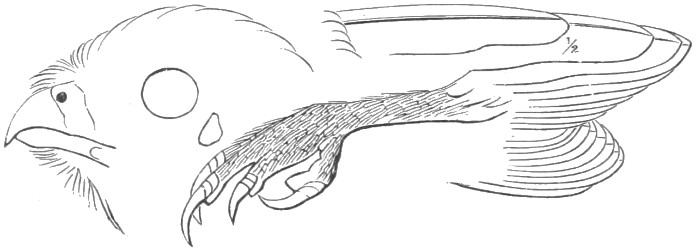
½
Micrathene whitneyi.
This well-marked genus is represented by a single species, found in the Colorado region of the United States, and in Western Mexico. It is the smallest of all known Owls, and has the general aspect of a Glaucidium. From the fact that feathers of birds were found in its stomach, we may reasonably infer that it is of exceedingly rapacious habits, like the species of that genus.
Species.
M. whitneyi. Above grayish olive-brown, sprinkled with small, rather obscure, spots of pale rusty, and interrupted by a whitish nuchal collar; outer webs of the lower series of scapulars pure white. Wings spotted with white and pale fawn-color; tail grayish-brown, crossed by five to six narrow interrupted bands of pale fawn-color. Eyebrows and lores pure white; a cravat of the same on the chin. Beneath white, marked with large, rather longitudinal, ragged blotches of pale rusty, mottled with dusky. Bill pale greenish; iris yellow. Length, 5.50–6.25; extent of wings, 14.25–15.25 (measurements of freshly killed specimens). Wing, 4.00–4.40; tail, 1.90–2.30. Hab. Fort Mohave, California (April), and Socorro Island, west coast of Mexico.
Micrathene whitneyi, Coues. WHITNEY’S OWL.
Athene whitneyi, Cooper, Proc. Cal. Acad. Sc. 1861, p. 118. Micrathene whitneyi, Coues, Pr. Ac. Nat. Sc. Philad. 1866, 15.—Elliot, Illust. Am. B. I, xxix.—Grayson (Lawrence), Ann. N. Y. Lyc.—Coues, Key, 1872, 207.
Sp. Char. Adult (♂, 208, J. G. Cooper, Fort Mohave, California, April 26, 1861). Above umber-brown (less pure and uniform than in Glaucidium), each feather with an irregular, transversely elliptical spot of pale rufous, these largest on the forehead, bordering the white eyebrows; the feathers everywhere minutely mottled transversely with darker, this being most noticeable where bordering the yellowish spots. Scapulars with their outer webs almost wholly white. Wings with the ground-color a little darker than the back; lesser coverts with numerous spots of light rufous, there being two on each feather, one concealed; middle and secondary coverts with a very large oval spot of pure white terminating the outer webs, the white spot on the latter preceded by a pale rufous one. Secondaries with five (exposed) bands of pale ochraceous (the last terminal), these passing into white on the edge; primary coverts with three large ochraceous spots; primaries with about six (including the terminal) conspicuous spots of the same, those anterior to the emargination, on the third, fourth, and fifth quills, almost white. Tail like the wings, but more uniform; crossed by six irregular narrow bands of pale ochraceous, the last, or terminal, of which is not well defined; these do not touch the shaft, and on the inner webs they are pure white. Lores and eyebrows, cheeks, lining of the wings, and ground-color of the lower parts, white; ear-coverts and sub-orbital space like the crown, but more rusty; lateral lower parts much washed with plumbeous, this especially prevalent on the flanks. Behind the sharply defined white of the cheeks is a black transverse wash. Throat, jugulum, breast, and abdomen, with each feather having a medial longitudinal ragged-edged blotch of pale rufous, these blotches most clearly defined on the abdomen, more confused anteriorly; anal region and tibiæ almost immaculate; tibiæ with numerous transverse narrow blackish bars, on a pale ochraceous ground. Lining of the wing faintly spotted at the bend, and on the primary coverts, the terminal half of which is plain dusky; under surface of primaries blackish, with obscure transverse paler spots,—those anterior to the emargination almost white; those beyond darker, the last being scarcely distinguishable; on the longest quill eight can be detected. Wing-formula, 4, 3=5–2, 6, 7, 8, 9–1. Length, “6.25”; extent, “15.25”; wing, 4.40; tail, 2.30; culmen, .35; tarsus, .80; middle toe, .60.
A male from Socorro Island (49,678, Colonel A. J. Grayson) is less adult than the preceding. The upper plumage is more brownish and more mottled; the rufous spots, though deeper and larger, are less sharply defined; the spots on the primaries are all ochraceous; the bands on the tail are broader, though of the same number. Beneath the longitudinal blotches do not appear, but the rusty rufous covers nearly the whole surface, leaving the medial portion only white, and this not well defined; the rusty shows ragged minute transverse bars of blackish. The whitish collar round the nape is also better defined than in the type. Wing, 4.20; tail, 2.10. Wing-formula, 4, 3=5–6, 2–7, 8, 9, 10, 1. Length, 5.20; extent, 14.25.
Another specimen, 50,765, from the same locality, also apparently immature, is just like the preceding in plumage. It measures, wing, 4.00; tail, 1.90.
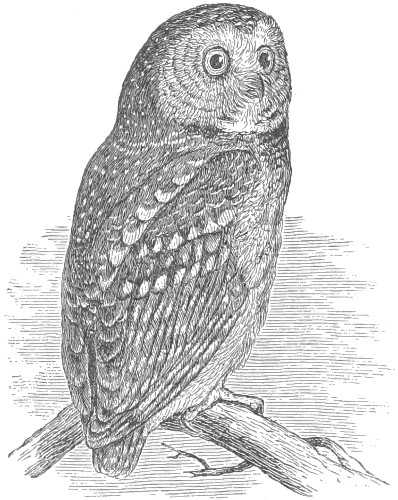
Micrathene whitneyi.
Habits. The type specimen of this diminutive species was shot at Fort Mohave, in the Colorado Valley, latitude 35°, April 26, 1861, and two others have since been taken on the Socorro Islands, off the western coast of Mexico, by Colonel Grayson. It is smaller even than the little California Pygmy Owl, and is therefore the smallest known to inhabit North America. It resembles that species in its colors, but is thought by Dr. Cooper to be more similar to the burrowing Owls in its generic characters. It was found in a dense thicket, on a very windy morning, and where it may have taken only a temporary refuge, after having been blown down from some of the caverns in the barren mountains surrounding the valley. In its stomach were found the remains of insects and the feathers of small birds. Several specimens of this Owl were taken in Arizona by Captain Bendire, one of which is now in the collection of the Boston Society of Natural History. Captain Bendire also found one of their nests, with two fully fledged young ones, in a hole of a mesquite stump.
Genus SPEOTYTO, Gloger.
Speotyto, “Gloger, 1842.” (Type, Strix cunicularia, Mol.)
“Pholeoptynx, Kaup, 1848.” (Same type.)
Gen. Char. Size small; head small, and without ear-tufts. Bill moderately strong, pale yellowish. Tarsi more than twice as long as the middle toe, feathered in front, naked behind; toes scantily haired. Tail short, less than half the wing, nearly even, or very slightly rounded. Three outer quills with their inner webs emarginated; second to fourth longest. Ear-conch very small, simple, roundish. Diurnal and terrestrial.
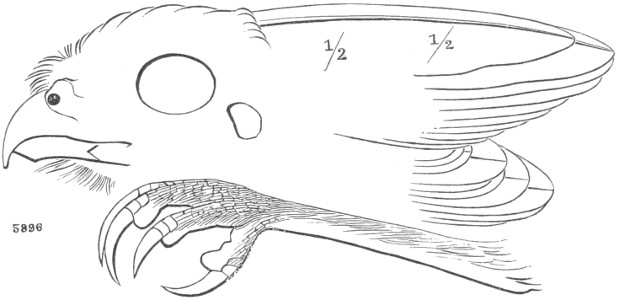
5896 ½ ½
Speotyto hypogæa.
This genus is peculiar to America, where it is distributed over the whole of the southern and the western half of the northern continent, as well as in some of the West India Islands. There appears to be but one well-characterized species,35 this one modified into representative races in the several geographical provinces over which it ranges. The species is terrestrial, inhabiting the abandoned burrows of Armadillos and Rodents. It is diurnal, possessing as much freedom of sight, hearing, and motion in the brightest sunlight, as any species of the Falconidæ.
Species and Races.
S. cunicularia. Colors umber-brown and ochraceous-white, the former predominating above, the latter prevailing below. Upper parts spotted with whitish; lower parts transversely barred with brown on the breast and sides, and sometimes on the abdomen. A white gular patch, and jugular collar, with a brown band between them. Legs, crissum, anal and femoral regions, always immaculate.
A. Primaries with broad regular bars of ochraceous-white on both webs; primary coverts with large spots of the same.
Brown markings of the lower parts irregularly transverse, and ragged. White spots on the upper parts nearly equal in extent to the brown.
Wing, 6.15–6.40; tail, 2.90–3.60; culmen, .58–.62; tarsus, 1.50–1.80; middle toe, .65. Hab. Peru … var. grallaria.36
Brown markings on the lower parts regularly transverse, and not ragged. White spots on the upper parts much less than the brown in extent.
Wing, 7.00–7.50; tail, 3.30–4.00; culmen, .70; tarsus, 1.70–1.85; middle toe, .85. Outer tail-feathers and inner webs of primaries with the white much greater in amount than the brown (sometimes continuous along outer webs of the latter). Hab. Southern South America (Chile, Buenos Ayres, Paraguay, etc.) … var. cunicularia.37
Wing, 6.40–7.00; tail, 3.00–3.30; culmen, .50–.60; tarsus, 1.50–1.70; middle toe, .80. Outer tail-feathers and inner webs of the primaries with the white less in extent than the brown (never continuous along outer webs of the primaries). Hab. Middle America, and Western Province of North America … var. hypogæa.
B. Primaries without broad or regular bars of whitish on either web; primary coverts plain brown.
Brown markings on the lower parts regularly transverse, and equal in extent to the white. White spots on the upper parts very small, reduced to mere specks on the dorsal region.
Wing, 6.40; tail, 3.40; culmen, .60; tarsus, 1.82; middle toe, .85. Outer tail-feathers and inner webs of the primaries with the light (ochraceous) bars only about one fourth as wide as the brown (disappearing on the inner quills). Hab. Guadeloupe … var. guadeloupensis.38
Spheotyto cunicularia, var. hypogæa, Bonap. BURROWING OWL.
Strix hypogæa, Bonap. Am. Orn. I, 72, 1825. Athene hypogæa, Bonap. Consp. Av. p. 39, 1850.—Woodh. (Sitgr.) Expl. Zuñi and Colorado, p. 62, 1853.—Cass. Birds N. Am. 1858, 59.—Newb. P. R. R. Rept. VI, 77, 1857.—Coop. & Suck. P. R. R. Rept. XII, ii, 157, 1860.—Gray, Hand List, I, 52, 1869. Speotyto cunicularia, var. hypogæa, (Ridgway) Coues, Key, 1872, 207. Strix cunicularia (not of Molina!), Aud. B. Am. pl. ccccxxxii, 1831; Orn. Biog. V, 264; Synop. p. 22.—Nutt. Man. Orn. p. 118, 1844.—Bonap. Am. Orn. p. 68, pl. vii, f. 2, 1825; Ann. Lyc. N. Y. II, 36.—James. (Wils.), Am. Orn. IV, 30.—Say, Long’s Exp. Rocky Mts., II, 36, 200. Ulula cunicularia, Jard. (Wils.) Am. Orn. III, 325, 1832. Athene cunicularia, Bonap. List, p. 6; Consp. Av. p. 38. Strickl. Orn. Syn. I, 160, 1855.—Cassin, Birds N. Am. 1858, 60.—Coop. & Suck. P. R. R. Rept. XII, II, 157, 1860.—Canfield, Am. Nat. 1869, 583 (habits). Strix californica, Aud. B. Am. pl. ccccxxxii, 1831. Athene socialis, Gamb. Pr. Acad. Nat. Sc. Phil. III, 47, 1846.
Sp. Char. Adult. Above earth-brown, the whole surface covered with numerous spots of dull white,—those on the scapulars roundish, and in pairs (on both webs); of similar form, but larger and more sparse, on the wings. Anteriorly they become more longitudinal (nearly linear), and medial; on the rump and upper tail-coverts, they are nearly obsolete. Secondaries crossed by four distinct bands of dull white, the last terminal; primaries with five to six transverse series of semi-rounded spots of ochraceous-white on their outer webs; primary coverts with about three transverse series of whitish spots. Tail with five to six bands of dull white, or pale ochraceous (the last terminal), composed of transverse oval spots, those on the middle pair of feathers not touching either the shaft or the edge. Ear-coverts uniform brown, becoming gradually paler beneath the eye and on the cheeks; eyebrows, a transverse chin-patch,—covering the whole chin and jaw and reaching back beneath the auriculars, and another across the jugulum, immaculate cottony-white; shafts of the loral bristles blackish; a broad, well-defined collar across the throat, between the white malar and jugular bands, deep brown, mixed with paler spots.
Beneath white with a faint ochraceous tinge, especially on the legs; the breast, abdomen, and sides with transverse spots of brown, this often predominating on the breast; legs, anal region, and crissum, immaculate. Whole lining of the wing immaculate creamy-white, the primary coverts, however, with large terminal spots of dusky; under surface of the primaries grayish-brown, deeper terminally, and with large, transversely ovate spots of ochraceous-white (about five in number on the longest quill), and growing larger basally.
♂. Wing, 6.40–7.00; tail, 3.00–3.30; culmen, .55–.60; tarsus, 1.50–1.70; middle toe, .80. (Smallest, No. 5,183, Fort Pierre, Nebraska; largest, No. 6,881, Sacramento, California.)
♀. Wing, 6.50–6.80; tail, 3.15–3.30; culmen, .51–.55; tarsus, 1.50–1.60; middle toe, .80. (Smallest, No. 45,020, Laredo, Texas; largest, No. 3,971, San José, Lower California.)
Juv. Upper surface earth-brown, as in the adult, but entirely uniform, except the wings and tail; upper tail-coverts, and a large oval patch on the wing (covering the middle coverts and the posterior half of the lesser-covert region), plain isabella-white; the anterior portion of the lesser-covert region darker brown than the back. Gular region well-defined pure white; jugular collar conspicuous and unspotted. Whole lower parts immaculate isabella-white.
Hab. Western Province of United States, from the Plains to the Pacific, and from the Rio Grande to Cape St. Lucas; Mexico.
Localities: Xalapa (Scl. 1857, 290); Texas (Dresser, Ibis, 1865, 330; resident).
Specimens never vary in the pattern of coloration, and but little in the relative amount of the brown and white spotting; the shade of the brown and the depth of the ochraceous tinge vary considerably, however, in different individuals,—but irrespective of locality,—the brown being paler and the white purer in summer than in fall and winter, after the new dress is freshly assumed. The brown on the breast varies considerably in quantity, being sometimes nearly uniform, thereby abruptly contrasting with the white jugular band, and again frequently with the brown hardly greater in amount than the white, the two colors being in regular bars, as on the sides and flanks.
There is certainly but one species, or even race, of Burrowing Owl in North America. This is represented in the Smithsonian collection by over fifty specimens, including examples from all parts of its range. Upon a close inspection of all the specimens in this extensive series, I was very much surprised to find so little variation; indeed, all the specimens are so much alike that a detailed description of the colors of one would answer for almost any individual. The shade of color varies mainly according to the age of the feathers, those newly acquired having a darkness of tint and a softness of texture not seen in those more worn (as in midsummer dress), which have a bleached or faded appearance. I fail entirely to detect the different styles of plumage which Mr. Cassin has described, and his diagnoses of two supposed species will not at all hold good when applied to specimens from either of the two regions which they were considered to characterize.
Examining critically the large series at my command, I find that the principal discrepancy among individuals is the amount of feathering on the tarsus; this extending to the toes was supposed to characterize the A. cunicularia of North America the habitat of which was considered as restricted in North America to the west of the Rocky Mountains (see Cassin, Birds of North America, as cited above); the nearly naked tarsus was believed to be characteristic of the A. hypogæa, as restricted, and the habitat assigned to this was “from the Mississippi River to the Rocky Mountains.” Now, dividing the series under examination into two sets, according to this feature, we have, first, cunicularia from the following localities: from the Rio Grande, all specimens but one; Tongue River, Montana; and Petaluma, Santa Clara, and San Francisco, California. Next, hypogæa represents the following localities, besides places within the range ascribed to it: Utah; Lower California, including Cape St. Lucas, all specimens; San Diego, California, several specimens; Santa Barbara, San Francisco, Sacramento, and Fort Tejon, California; and Tamaulipas, Mexico.
Though we have but one species or form in North America, the South American bird is different: this is the true cunicularia of Molina, and though not specifically distinct from our bird, is nevertheless an easily recognized geographical race. It is larger, the wing measuring from 7.00 to 7.50, instead of 6.40 to 7.00; the brown of the plumage is appreciably darker than that of most specimens of hypogæa, but less extended; on the outer web of the primaries the white spots are larger,—sometimes confluent along the edge,—and on their inner webs the white largely prevails, the dusky bars appearing only towards the ends; the outer tail-feather is almost wholly white, instead of having brown bars, broader than the white ones. Of the var. cunicularia there are eight specimens in the collection (chiefly from Paraguay, Buenos Ayres, and Chile), while numerous others, in various collections, have been examined besides. All the American forms of this subgenus seem clearly referrible to one species, as being at the most but geographical races.
Habits. The Burrowing Owl of North America inhabits the country between the Pacific coast and the Mississippi River, especially in the lower plains in Nebraska and in Kansas, as well as in particular districts in Utah, Arkansas, New Mexico, the Indian Territory, Texas, Arizona, California, and Mexico. They are usually very abundant, congregating together in large communities, and differing from most members of their family by living and breeding in burrows in the ground. Their habits are peculiar and interesting.
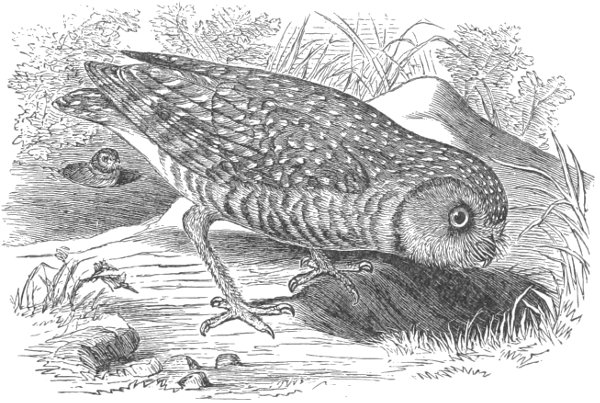
Speotyto hypogæa.
Thomas Say, during Colonel Long’s expedition to the Rocky Mountains, was the first of American naturalists to meet with this bird. He encountered it in our trans-Mississippian Territories, where he described it as residing exclusively in the villages of the prairie-dog, whose excavations are so commodious as to make it unnecessary for the bird to dig for itself, which it is able to do when occasion requires. These villages are very numerous, and variable in their extent, sometimes covering only a few acres, and at others spreading over the surface of the country for miles together. They are composed of slightly elevated mounds, having the form of a truncated cone, about two feet in width at base, and seldom rising as high as eighteen inches above the surface. The entrance is at the top or on the side. From the entrance the passage descends vertically one or two feet, and thence it continues obliquely downward until it terminates in the snug apartment where these animals enjoy their winter’s sleep, and where they and the Owls are common, but unfriendly, occupants.
Mr. Dresser noticed this bird at all seasons, in the prairie country of Texas. They were rather common near the Rio Leon and Medina, and in one place he found they had taken possession of some deserted rat-holes. He obtained several specimens near San Antonio and at Eagle Pass. In the latter place he found them quite common on the sand plains near the town. The stomachs of those he shot were found to contain coleopterous insects and field-mice.
Dr. Newberry states that he found this species in Northern California, in several places between San Francisco and Fort Reading, and again at the Klamath Basin, though less frequently at the northward than in the Sacramento Valley. There they occupied the burrows made by the Beechey’s and the Douglass’s Spermophile. He usually saw them standing at the entrance to these burrows, often permitting him to approach within gun-shot, and before taking to flight twisting their heads about and bowing with many ludicrous gestures, apparently in order to aid their imperfect sight, and to get a better view of the intruder. When shot at or otherwise alarmed, they fly with an irregular jerking motion, dropping down much like a Woodcock.
Dr. Suckley obtained a specimen near Fort Benton, on the Upper Missouri, in Dakotah, and Dr. Cooper procured others thirty-five miles west of Fort Kearney, in Nebraska, in August. He saw them in great numbers on the plains of Nebraska, and did not observe any difference in habits between them and the birds of California.
This species was found in Texas, near Fort Davis, and also at El Paso, by Mr. J. H. Clark. It was taken in Tamaulipas, Mexico, by Lieutenant Couch. Mr. Clark remarks that they were seen by him only in the prairie-dog towns, and were found in conjunction with the rattlesnake, and accuses them of feeding upon the young of the prairie-dog; but this ungrateful requital of the hospitality given them in the burrows of this marmot is discredited by Dr. Kennerly and others, who regard the apparent harmony in which the two dwell together as altogether incompatible with this habit.
This species is also found on our Pacific coast, west of the Rocky Mountains, as far north as British Columbia. Mr. Lord met with it along the entire course of the boundary-line. It was not by any means plentiful, but pairs of them were occasionally seen. While in camp at the Dalles he dug out several squirrel-holes. In one he found two eggs of this species, the female bird, a racer-snake, and a female ground-squirrel (Spermophilus douglassi). The Owl he found to be strictly of diurnal habits, feeding principally on crickets, grasshoppers, large beetles, and larvæ. He thinks it never captures small animals or birds, and regards it as a peaceful and harmless bird.
Dr. Kennerly met with this species near Los Angeles, California. At any hour of the day they might be seen seated upon the mounds erected around the holes of the marmot, or else with head protruding from its orifice, disappearing immediately when approached. When molested, they commence bowing and chattering in a somewhat ludicrous manner at the intruder, or fly swiftly away, keeping near the earth and alighting suddenly in the vicinity of a burrow to renew these amusing motions. He found it very abundant in the valley of the San Gabriel River, where it associated with the large ground-squirrel of that region.
Dr. Heermann, who found them common on the extensive open prairies, speaks of its sight as very clear by day, and adds that it will not allow the hunter on foot to approach within shooting distance; but that, if approached on a horse or a mule, it may be easily shot. The nests he found were formed of a few straws carelessly thrown together at the bottom of its tortuous burrow, which is from six to eight feet in length. The eggs were usually four in number, and are described as nearly spherical, and as pure white.
Dr. Townsend states that this Owl resorts to the forsaken burrows of marmots and badgers, but never lives on terms of intimacy with either. The nest he describes as of fine grass, and placed at the extremity of the hole. The eggs are uniformly four in number, pale white, and about the size of those of the common House Pigeon.
Dr. Gambel, who observed this bird in California, states that he has occasionally found it in solitary burrows, and also that it often makes use of the holes dug by the Spermophilus beecheyi. They occasionally dig their own burrows, and live in scattered companies of four or five. Dr. Gambel also states that the bird is a resident of California throughout the year.
Mr. Darwin, in the Zoölogy of the Beagle, met with the var. cunicularia in crossing the pampas of South America. In Banda Oriental, he says, it is its own workman, and excavates its burrows on any level spot of sandy soil; but in the pampas, or wherever the Bizcacha is found, it uses those made by that animal. It usually preys on mice and reptiles. Lieutenant Gilliss gives a similar account of it, from observations made in Chile.
Mr. Nathaniel H. Bishop met with cunicularia on the banks of the river San Juan, in Banda Oriental, where a few pairs were seen, devouring mice and insects. After crossing the river Las Vacas, and coming upon a sandy waste covered with scattered trees and low bushes, he again encountered it. Upon the pampas of the Argentine Republic they were found in great numbers, from a few miles west of Rosario to the vicinity of San Luis, where the pampas end. On these immense plains of grass it lives in company with the Bizcacha (Lagostomus trichodactylus), dwelling with it in perfect harmony, and during the day, while the animal is sleeping, a pair of Owls stand a few inches within the main entrance of the burrow, and at the first sound, be it near or distant, leave their station and remain outside the hole, or upon the mound that forms the roof of their domicile. At the approach of man, both birds, with their irides dilated, mount above him in the air, and keep up an alarm-note until he passes. Then they quietly settle down in the grass, or return to their former place. On the pampas Mr. Bishop did not observe them taking their prey during the daytime, but as soon as the sun had set, the Bizcacha and Owls both leave their holes in search of food, the young of the former playing about the birds as they alight near them. They do not associate in companies, there being but one pair to a hole. Each couple keep separate from their neighbors, and at night do not stray from their homes.
It is both diurnal and nocturnal, and feeds at all hours. Outside the town of San Juan, which lies upon the eastern base of the Andes, Mr. Bishop had a fine opportunity to watch their habits in a locality differing entirely from the pampas. The country around San Juan is a dreary desert, covered with low thorn-trees, and over this waste a few Owls are found, principally near the town itself, in the vicinity of the pastures that are cultivated by irrigation. They mate in September and October. “One evening,” Mr. Bishop writes, “I was attracted by a strange sound that I supposed proceeded from a frog, but it proved to be the love-note of a little Athene cunicularia, and which was answered by its mate. It alighted upon a post, and commenced turning around upon it, with throat dilated, and emitting a guttural sound. These antics were continued for more than a minute, it occasionally bowing its head in a mysterious manner. The female soon after joined it, and they flew away. Each night it perched upon a tall flagstaff and uttered its love-note. Close by the house was a lagoon, the borders of which were swampy, and over this a pair often hovered in search of food. I watched one that kept on the wing for nearly two hours, some fifty feet from the ground, and during that time did not change its position in any other way than by rising or falling a few feet. A boy brought me a female with five eggs, that had been taken from a burrow five feet from the mouth. The bird was very fierce, and fought me with her wings and beak, uttering all the while a long shrill note, resembling a file drawn across the teeth of a saw. I supplied her with eleven full-grown mice, which she devoured during the first thirty-six hours of her confinement. It is said to place a small nest of feathers at the end of the hole, in which are deposited five white eggs.”
The eggs of the var. cunicularia are of a rounded-oval shape, more obtuse at one end than at the other, measure 1.30 inches in length by 1.05 in breadth, and are of a uniform white color, with a slightly bluish tinge.
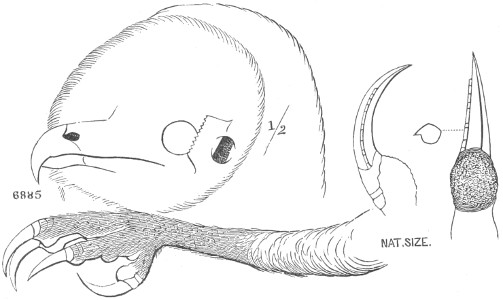
6885 ½ NAT. SIZE.
Strix pratincola. (See page 10.)
The egg of the A. hypogæa is of a rounded-oval shape, equally obtuse at either end, and averages 1.35 inches in length by 1.13 in breadth, and is of a uniform clear white color. This description is taken from an egg obtained by Mr. E. S. Holden near Stockton in California. Captain Bendire writes that he has found as many as nine, and once even ten, eggs in the nest of the North American species.
NOTE.
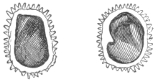
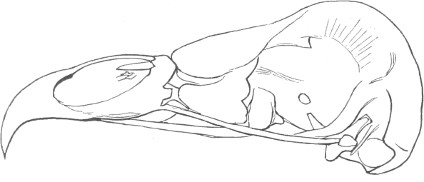
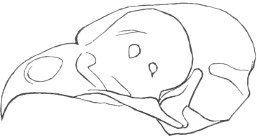
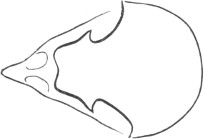
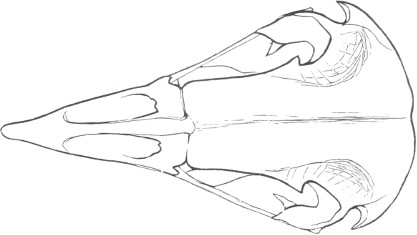
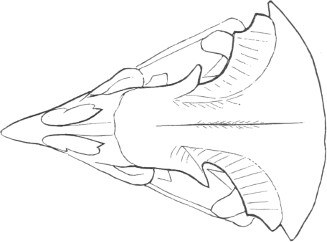
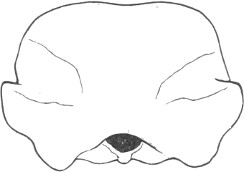
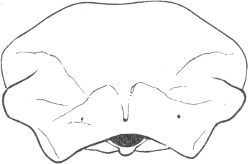
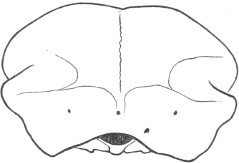
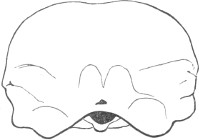
The crania of the Owls present many features of interest, which may serve a good purpose in the definition of the sections and the genera, and to which attention has been occasionally called in the preceding pages. The tendency to asymmetry is especially marked in some species, and the better to illustrate this and other features we append several plates, in which the corresponding views are placed side by side.39 The figures and accompanying lettering tell their own story, without any necessity of a labored description.
R. R.
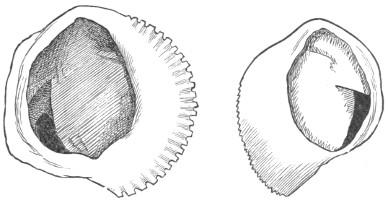
Syrnium aluco (copied from Kaup).
Athene noctua (from Kaup).
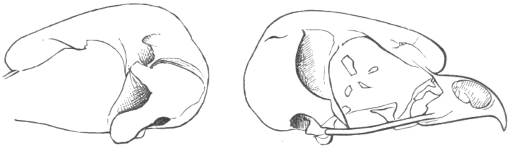
Nyctale richardsoni.
7449.
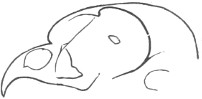
428.
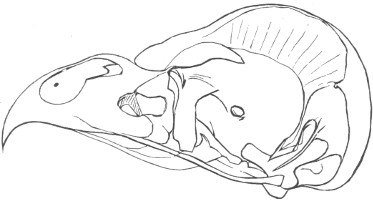
4886.
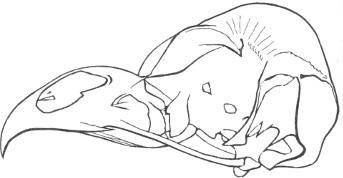
7272.
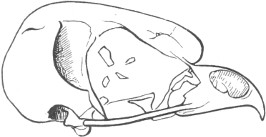
7899.
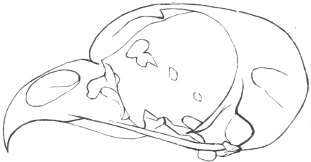
414.
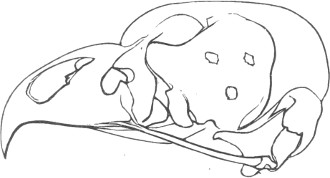
773.
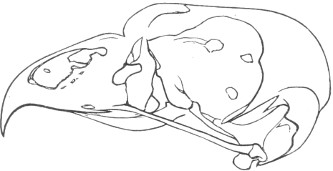
628.
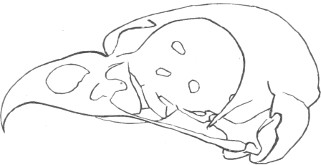
7897.
437.
7449. Strix pratincola. Natural size.
4886. Otus wilsonianus. Natural size.
7272. Scotiaptex cinereum. Two thirds.
7899. Nyctale richardsoni. Natural size.
414. Scops asio. Natural size.
773. Bubo virginianus. Two thirds.
628. Nyctea nivea. Two thirds.
7897. Surnia ulula. Natural size.
428. Glaucidium ferrugineum. Natural size.
437. Spheotyto hypogæa.
428.
7449.
4886.
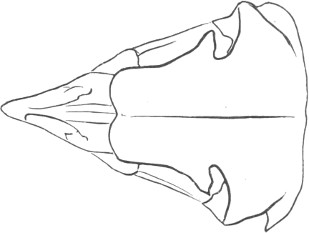
7272.
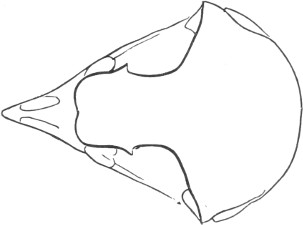
414.
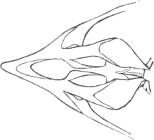
7899.
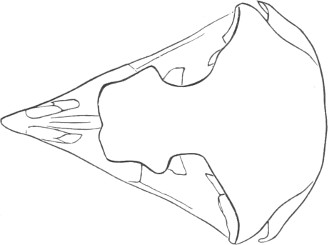
773.
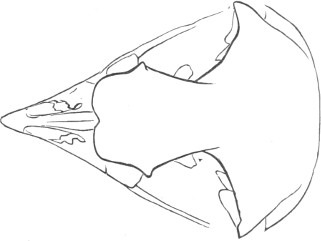
628.
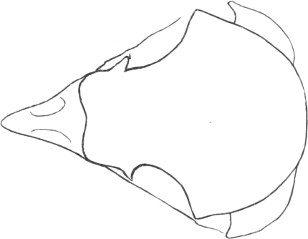
7897.
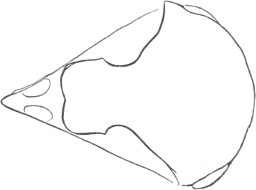
437.
7449. Strix pratincola. Natural size.
4886. Otus wilsonianus. Natural size.
7272. Scotiaptex cinereum. Two thirds.
7899. Nyctale richardsoni. Natural size.
414. Scops asio. Natural size.
773. Bubo virginianus. Two thirds.
628. Nyctea nivea. Two thirds.
7897. Surnia ulula. Natural size.
428. Glaucidium ferrugineum. Natural size.
437. Spheotyto hypogæa.
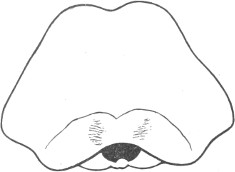
7449.
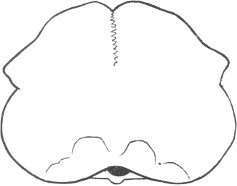
4886.
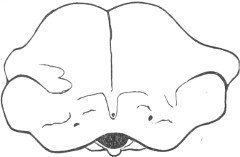
7272.
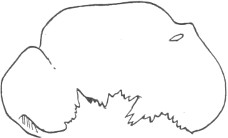
7897.
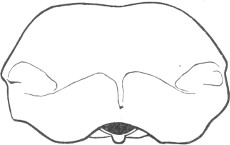
414.
628.
773.
7899.
437.
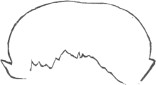
428.
7449. Strix pratincola. Natural size.
4886. Otus wilsonianus. Natural size.
7272. Scotiaptex cinereum. Two thirds.
7899. Nyctale richardsoni. Natural size.
414. Scops asio. Natural size.
773. Bubo virginianus. Two thirds.
628. Nyctea nivea. Two thirds.
7897. Surnia ulula. Natural size.
428. Glaucidium ferrugineum. Natural size.
437. Spheotyto hypogæa.
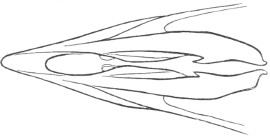
7449.
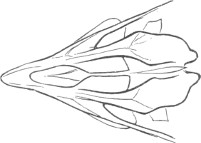
4886.
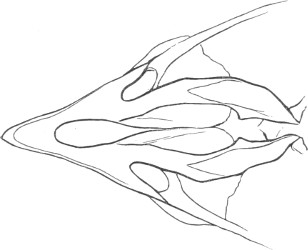
7272.
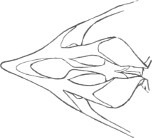
7899.
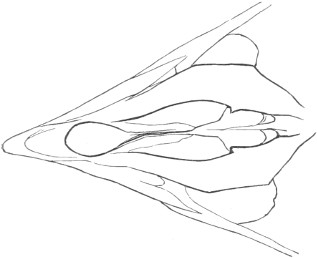
733.
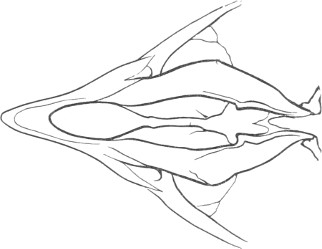
628.
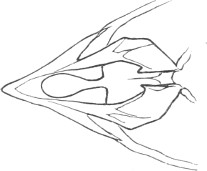
7897.
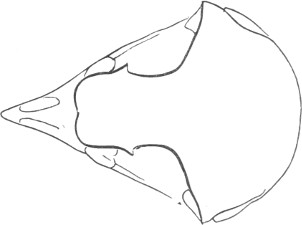
414.
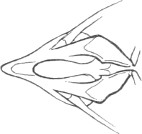
437.
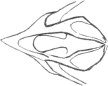
428.
7449. Strix pratincola.
4886. Otus wilsonianus.
7272. Scotiaptex cinereum.
7899. Nyctale richardsoni.
414. Scops asio.
773. Bubo virginianus.
628. Nyctea nivea.
7897. Surnia ulula.
428. Glaucidium ferrugineum.
437. Spheotyto hypogæa.
(All natural size.)
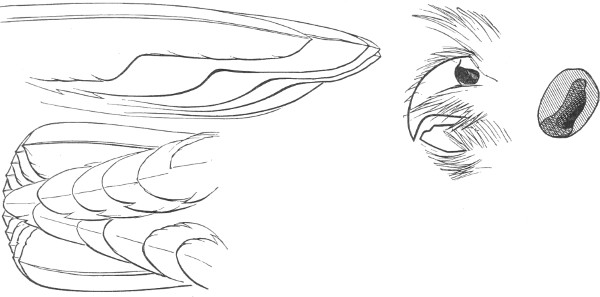
12088.
504.
49808.
504.
A.
49808.
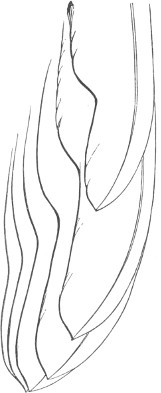
12088. Nyctea nivea. (Ear copied from Swainson, F. B. A)
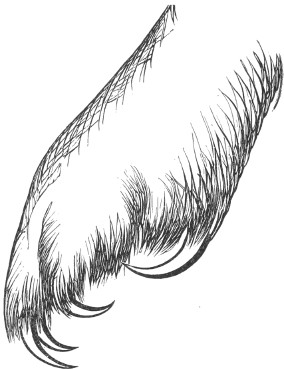
504. Scotiaptex cinereum.
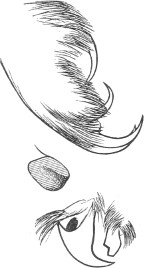
49808. Surnia ulula. (Ear copied from Swainson.)
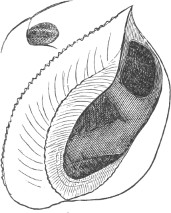
A. Brachyotus “cassinii.” (Left ear and nostril, from fresh specimen.)