Volume 3 — Family FALCONIDÆ.—The Falcons. (continued 2)
Reading edition
This Hawk formerly nested on a high cliff near the house of Professor S. S. Haldeman, Columbia, Penn., who several times procured young birds which had fallen from the nest. The birds remained about this cliff ten or eleven months of the year, only disappearing during the coldest weather, and returning with the first favorable change. They bred early in spring, the young leaving the nest perhaps in May. Professor Haldeman was of the opinion that but a single pair remained, the young disappearing in the course of the season.
Sir John Richardson, in his Arctic expedition in 1845, while descending the Mackenzie River, latitude 65°, noticed what he presumed to be a nest of this species, placed on the cliff of a sandstone rock. This Falcon was rare on that river.
Mr. MacFarlane found this species not uncommon on the banks of Lockhart and Anderson Rivers, in the Arctic regions. In one instance he mentions finding a nest on a cliff thirty feet from the ground. There were four eggs lying on a ledge of the shale of which the cliff was composed. Both parents were present, and kept up a continued screaming, though at too great a distance for him to shoot either. He adds that this bird is by no means scarce on Lockhart River, and he was informed that it also nests along the ramparts and other steep banks of the Upper Anderson, though he has not been able to learn that it has been found north of Fort Anderson. In another instance the nest was on a ledge of clayey mud,—the eggs, in fact, lying on the bare ground, and nothing resembling a nest to be seen. A third nest was found on a ledge of crumbling shale, along the banks of the Anderson River, near the outlet of the Lockhart. This Hawk, he remarks, so far as he was able to observe, constructs no nest whatever. At least, on the Anderson River, where he found it tolerably abundant, it was found to invariably lay its eggs on a ledge of rock or shale, without making use of any accessory lining or protection, always availing itself of the most inaccessible ledges. He was of the opinion that they do not breed to the northward of the 68th parallel. They were also to be found nesting in occasional pairs along the lime and sandstone banks of the Mackenzie, where early in August, for several successive years, he noticed the young of the season fully fledged, though still attended by the parent birds.
In subsequent notes, Mr. MacFarlane repeats his observations that this species constructs no nest, merely laying its eggs on a ledge of shale or other rock. Both parents were invariably seen about the spot. In some instances the eggs found were much larger than in others.
Mr. Dall mentions shooting a pair near Nuk´koh, on the Yukon River, that had a nest on a dead spruce. The young, on the 1st of June, were nearly ready to fly. It was not a common species, but was found from Nulato to Sitka and Kodiak.
In regard to general characteristics of this Falcon, they do not apparently differ in any essential respects from those of the better-known Falco communis of the Old World. It flies with immense rapidity, rarely sails in the manner of other Hawks, and then only for brief periods and when disappointed in some attempt upon its prey. In such cases, Mr. Audubon states, it merely rises in a broad spiral circuit, in order to reconnoitre a space below. It then flies swiftly off in quest of plunder. These flights are made in the manner of the Wild Pigeon. When it perceives its object, it increases the flappings of its wings, and pursues its victim with a surprising rapidity. It turns, and winds, and follows every change of motion of the object of pursuit with instantaneous quickness. Occasionally it seizes a bird too heavy to be managed, and if this be over the water it drops it, if the distance to land be too great, and flies off in pursuit of another. Mr. Audubon has known one of this species to come at the report of a gun, and carry off a Teal not thirty steps distant from the sportsman who had killed it. This daring conduct is a characteristic trait.
This bird is noted for its predatory attacks upon water-fowl, but it does not confine itself to such prey. In the interior, Richardson states that it preys upon the Wild Pigeon, and upon smaller birds. In one instance Audubon has known one to follow a tame Pigeon to its house, entering it at one hole and instantly flying out at the other. The same writer states that he has seen this bird feeding on dead fish that had floated to the banks of the Mississippi. Occasionally it alights on the dead branch of a tree in the neighborhood of marshy ground, and watches, apparently surveying, piece by piece, every portion of the territory. As soon as it perceives a suitable victim, it darts upon it like an arrow. While feeding, it is said to be very cleanly, tearing the flesh, after removing the feathers, into small pieces, and swallowing them one by one.
The European species, as is well known, was once largely trained for the chase, and even to this day is occasionally used for this purpose; its docility in confinement, and its wonderful powers of flight, rendering it an efficient assistant to the huntsman. We have no reason to doubt that our own bird might be made equally serviceable.
Excepting during the breeding-season, it is a solitary bird. It mates early in February, and even earlier in the winter. Early in the fall the families separate, and each bird seems to keep to itself until the period of reproduction returns.
In confinement, birds of this family become quite tame, can be trained to habits of wonderful docility and obedience, and evince even an affection for the one who cares for their wants.
This species appears to nest almost exclusively on cliffs, and rarely, if ever, to make any nests in other situations. In a few rare and exceptional cases this Falcon has been known to construct a nest in trees. Mr. Ord speaks of its thus nesting among the cedar swamps of New Jersey; but this fact has been discredited, and there has been no recent evidence of its thus breeding in that State. Mr. Dall found its nest in a tree in Alaska, but makes no mention of its peculiarities.
The eggs of this species are of a rounded-oval shape, and range from 2.00 to 2.22 inches in length, and from 1.60 to 1.90 in width. Five eggs, from Anderson River, have an average size of 2.09 by 1.65 inches. An egg from Mount Tom, Mass., is larger than any other I have seen, measuring 2.22 inches in length by 1.70 in breadth, and differs in the brighter coloring and a larger proportion of red in its markings. The ground is a deep cream-color, but is rarely visible, being generally so entirely overlaid by markings as nowhere to appear. In many the ground-color appears to have a reddish tinge, probably due to the brown markings which so nearly conceal it. In others, nothing appears but a deep coating of dark ferruginous or chocolate-brown, not homogeneous, but of varying depth of coloring, and here and there deepening into almost blackness. In one egg, from Anderson River, the cream-colored ground is very apparent, and only sparingly marked with blotches of a light brown, with a shading of bronze. An egg from the cabinet of Mr. Dickinson, of Springfield, taken on Mount Tom, Massachusetts, is boldly blotched with markings of a bright chestnut-brown, varying greatly in its shadings.
Subgenus ÆSALON, Kaup.
Æsalon, Kaup, 1829. (Type, Falco æsalon, Gmelin, = F. lithofalco, Gm.)
Hypotriorchis, Auct. nec Boie, 1826, the type of which is Falco subbuteo, Linn.
Dendrofalco, Gray, 1840. (Type, F. æsalon, Gmel.)
This subgenus contains, apparently, but the single species F. lithofalco, which is found nearly throughout the Northern Hemisphere, and in different climatic regions is modified into geographical races. Of these, North America possesses three, and Europe one; they may be distinguished as follows:—
Species and Races.
F. lithofalco. Second and third quills longest; first usually shorter than, occasionally equal to, or rarely longer than, the fourth. Adult female, and young of both sexes. Above brownish, varying from pale earth-brown, or umber, to nearly black, plain, or with obscure transverse spotting of lighter; tail with five to eight lighter bands, which, however, are sometimes obsolete, except the terminal one. Beneath ochraceous-white, longitudinally striped with brown or dusky over the whole surface. Adult male (except in var. suckleyi and richardsoni?). Above plumbeous-blue, with darker shaft-streaks; tail with more or less distinct bands of black, and paler tip. Beneath much as in the female and young, but stripes usually narrower and more reddish. Wing, 7.20–9.00; tail, 4.90–6.30; culmen, .45–.60; tarsus, 1.30–1.60; middle toe, 1.15–1.51.
a. Adult male plumbeous-blue above; sexes very unlike in adult dress. Female and young without transverse spotting on upper parts.
Adult male. Tail deep plumbeous, tipped with ash, with six transverse series of dusky spots (which do not touch the shaft nor edge of the feathers) anterior to the subterminal zone, the black of which extends forward along the edge of the feather. Inner web of the longest primary with ten transverse spots of white. Streaks on the cheeks enlarged and blended, forming a conspicuous “mustache.” Pectoral markings linear black. The ochraceous wash deepest across the nape and breast, and along the sides, and very pale on the tibiæ. Adult female. Above brownish-plumbeous, the feathers becoming paler toward their margins, and with conspicuous black shaft-streaks. Tail with eight (three concealed) narrow bands of pale fulvous-ashy; longest primary with ten light spots on inner web. Outer webs of primaries with a few spots of ochraceous. Young. Similar to the ♀ adult, but with a more rusty cast to the plumage, and with more or less distinct transverse spots of paler on the upper parts. Wing, 7.60–9.00; tail, 5.10–6.30; culmen, .45–.55; tarsus, 1.35–1.47; middle toe, 1.15–1.35. Hab. Europe … var. lithofalco.58
Adult male. Tail light ash, tipped with white, and crossed by three or four nearly continuous narrow bands of black (extending over both webs, and crossing the shaft), anterior to the broad subterminal zone, the black of which does not run forward along the edge of the feathers. Inner web of longest primary with seven to nine transverse spots of white. Streaks on the cheeks sparse and fine, not condensed into a “mustache.” Pectoral markings broad clear brown. Ochraceous wash weak across the nape and breast, and along sides, and very deep on the tibiæ. Adult female. Above plumbeous-umber, without rusty margins to the feathers, and without conspicuous black shaft-streaks. Tail with only five (one concealed) narrow bands of pale ochraceous; outer webs of primaries without ochraceous spots; inner web of outer primary with eight spots of white. Young. Like the adult female, but darker. Wing, 7.90–8.25; tail, 5.15–5.25; tarsus, 1.00; middle toe, 1.25. Hab. Entire continent of North America; West Indies … var. columbarius.
b. Adult male not bluish? sexes similar? upper parts with lighter transverse spots.
Adult. Above light grayish-umber, or earth-brown, with more or less distinct lighter transverse spots; secondaries crossed by three bands of ochraceous spots, and outer webs of inner primaries usually with spots of the same. Tail invariably with six complete and continuous narrow bands of dull white. Beneath white, with broad longitudinal markings of light brown, these finer and hair-like on the tibiæ and cheeks, where they are sparse and scattered, not forming a “mustache.” Top of the head much lighter than the back. Young. Similar, but much tinged with rusty above, all the white portions inclining to pale ochraceous. Wing, 7.70–9.00; tail, 5.00–6.30; culmen, .50–.60; tarsus, 1.40–1.65; middle toe, 1.20–1.51. Second and third quills longest; first equal to fourth, slightly shorter, or sometimes slightly longer. Hab. Interior plains of North America, between the Mississippi River and the Rocky Mountains, from the Arctic regions to Texas … var. (?) richardsoni.
c. Adult male not bluish? sexes similar? upper parts without transverse spots, and tail without lighter bands, except at the tip.
Above plain brownish-black; the tail narrowly tipped with whitish, but without other markings; inner webs of the primaries without lighter spots. Beneath pale ochraceous broadly striped with sooty-black. Wing, 7.35–8.50; tail, 5.25–5.75; culmen, .50–.55; tarsus, 1.30–1.62; middle toe, 1.25–1.35. Hab. Northwest coast region from Oregon to Sitka … var. suckleyi.
Falco (Æsalon) lithofalco (Gmelin). Var. columbarius, Linnæus. PIGEON HAWK; AMERICAN MERLIN.
Falco columbarius, Linn. Syst. Nat. 1766, p. 128.—Gmel. Syst. Nat. 1789, p. 281.—Lath. Ind. Orn. I, 44, 1790; Syn. I, 101, sp. 86; Supp. I, 27, 1802; Gen. Hist. I, 278, 1821.—Daud. Tr. Orn. II, 83, 1800.—Shaw. Zoöl. VII, 188, 1812.—Wils. Am. Orn. pl. xv, fig. 3, 1808.—Jard. (Wils.) Am. Orn. I, p. 254, 1808.—James. (Wils.) Am. Orn. I, 61.—Brew. (Wils.) Am. Orn. I, 683, 1852.—Rich. Faun. Bor. Am. II, 35, 1831.—Aud. Syn. B. A. p. 16, 1839; Orn. Biog. I, 466.—Bonap. Ann. Lyc. N. Y. II, 28; Isis, 1832, p. 1136; Eur. & N. Am. B. p. 4, 1838.—Nutt. Man. I, 60, 1833.—Cuv. Règ. An. (ed. 2), I, 322, 1829.—Less. Tr. Orn. p. 92, 1831.—Forst. Phil. Trans. LXII, 382, 1772.—Swains. Classif. B. II, p. 212, 1837.—Jard. Ann. Nat. Hist. XVIII, 118.—Gosse, B. Jam. p. 17, 1847.—Sagra, Hist. Nat. Cuba Ois. p. 23.—Wedderb. Jard. Cont. Orn. 1849, p. 81.—Hurdis, Jard. Cont. Orn. 1850, p. 6.—De Kay, Zoöl. N. Y. II, 15, pl. iv, f. 9, 1844.—Giraud, B. Long Isl. p. 17.—Blackist. Ibis, III, 315. Tinnunculus columbarius, Vieill. Ois. Am. Sept. I, pl. xi, 1807; Nouv. Dict. Hist. Nat. XII, 104, 1819; Enc. Méth. III, 1236, 1823. Hypotriorchis columbarius, Gray, List B. B. Mus. p. 55, 1844; Gen. B. fol. sp. 11, 1844.—Cass. B. Calif. & Tex. p. 90, 1854.—Woodh. (Sitg.) Exp. Zuñi & Colorad. p. 60, 1853.—Heerm. P. R. R. Rept. II, 31, 1855.—Newb. P. R. Rept. VI, 74, 1857.—Cass. B. N. Am. p. 9, 1858.—Cooper & Suck. P. R. R. Rept. XII, 1860, 142.—Coues, Pr. A. N. S. Phil. 1866, 6.—Brewer, Oölogy, 12. Lithofalco columbarius, Bonap. Consp. Av. p. 26, 1850. Æsalon columbarius, Kaup, Monog. Falc. Cont. Orn. p. 54, 1850.—Gray, Hand List, I, 21, 1869. Falco obscurus, Gmel. Syst. Nat. p. 281, 1789.—Lath. Ind. Orn. p. 44, 1790; Syn. Supp. I, 38, 1802; Gen. Hist. I, 272, 1821.—Daud. Tr. Orn. II, p. 123, 1800. Falco intermixtus, Daud. Tr. Orn. II, p. 141, 1800.—Lath. Gen. Hist. I, 136, 1821. F. temerarius, Aud. B. Am. pls. lxxv, xcii, 1831; Orn. Biog. I, 380, 1831. F. auduboni, Blackw. Res. Zoöl. 1840. Accipiter palumbarius, Catesb. Carol. I, pl. iii, 1754.
Sp. Char. Adult male. Above cinereous, varying in shade, but generally of a slaty-bluish cast; each feather with a distinct shaft-streak of black, these lines most conspicuous on the head above. Tail with a very broad subterminal band of black, about one inch in width; there are indications of three other bands, their continuity and distinction varying with the individual, but generally quite conspicuous, and each about half the width of the terminal one; the subterminal black band is succeeded by a terminal one of white, of about three-sixteenths of an inch in width, sometimes broader; on the lateral feathers the black bands are always conspicuous, being in form of transverse oblong spots, crossing the shaft, but less extended on the outer web, which is often immaculate except at the end, the broad terminal band always extending to the edge of the feather. Primaries dusky-black, margined terminally more or less distinctly with whitish (sometimes fading on the edge only); on the inner web is a series of about eight transverse oval spots of white, and generally corresponding to these are indications of bluish-ashy spots on the outer web. Beneath white, this purest on the throat, which is immaculate: there is generally a more or less strong tinge of fulvous beneath, this always prevalent on the tibiæ, and on a distinct collar extending round the nape, interrupting the blue above; the tibiæ frequently incline to ochraceous-rufous. Lateral portions of the head with fine streaks of dusky, these thickest on upper edge of the ear-coverts, leaving a distinct whitish superciliary streak, those of opposite sides meeting on the forehead. Breast, upper part of the abdomen, sides, and flanks, with longitudinal stripes of umber, each with a shaft-streak of black; on the flanks their shape is modified, here taking the form of spots running in chain-like series; tibiæ with narrower and darker streaks; lower tail-coverts with narrow central streaks like those on the tibiæ. Frequently there is a strong bluish shade on flanks and lower tail-coverts, sometimes replacing the brown of the spots on the former, and clouding in a similar form the latter. Length, 11.00; extent, 23.75; wing, 7.75.
Adult female. Pattern of coloration as in the male, but the colors different. The blue above replaced by dark umber-brown with a plumbeous cast, and showing more or less distinct darker shaft-lines; these on the head above very broad, giving a streaked appearance; white spots on inner webs of primaries more ochraceous than in the male. Tail dark plumbeous-brown, shading into blackish toward end, with five rather narrow ochraceous or soiled white bars, the first of which is concealed by the upper coverts, the last terminal. White beneath, less tinged with reddish than in the male, the tibiæ not different from the other portions; markings beneath as in the male.
Juv. Above plumbeous-brown, tinged with fulvous on head, and more or less washed with the same on the rump; frequently the feathers of the back, rump, scapulars, and wings pass into a reddish tinge at the edge; this color is, however, always prevalent on the head, which is conspicuously streaked with dusky. Tail plumbeous-dusky, darker terminally, with five regular light bars, those toward the base ashy, as they approach the end becoming more ochraceous; these bars are more continuous and regular than in the adult female, and are even conspicuous on the middle feathers. Primaries dusky, passing on edge (terminally) into lighter; spots on the inner webs broader than in the female, and pinkish-ochre; outer webs with less conspicuous corresponding spots of the same. Beneath soft ochraceous; spots as in adult female, but less sharply defined; tibiæ not darker than abdomen.
Hab. Entire continent of North America, south to Venezuela and Ecuador; West India Islands.
Localities: Ecuador (high regions in winter, Scl. P. Z. S. 1858, 451); Cuba (Cab. Jour. II, lxxxiii, Gundlach, Sept. 1865, 225); Tobago (Jard. Ann. Mag. 116); S. Texas (Dresser, Ibis, 1865, 323, breeding?); W. Arizona (Coues, Pr. A. N. S. 1866, 42); Costa Rica (Lawr. IX, 134); Venezuela (Scl. & Salv. 1869, 252).
LIST OF SPECIMENS EXAMINED.
National Museum, 42; Boston Society, 11; Philadelphia Academy, 10; Museum Comp. Zoöl., 7; New York Museum, 3; G. N. Lawrence, 2; R. Ridgway, 4. Total, 79.
Measurements.
Sex. Wing. Tail. Culmen. Tarsus. Middle Toe. Specimens.
♂ 7.20–7.90 4.90–5.50 .48–.50 1.30–1.40 1.15–1.25 34
♀ 8.00–8.55 5.50–6.00 .55–.60 1.55–1.60 1.35–0.0032
The plumage of the adult male, which is not as often seen as that of the younger stages and adult female, is represented in the Smithsonian Collection by fifteen specimens, from various parts of North America. Of these, an example from Jamaica exhibits the purest shades of color, though agreeing closely with some specimens from the interior of the United States; the cinereous above being very fine, and of a light bluish cast. The upper tail-coverts are tipped with white; the tail is a quarter of an inch longer than in any North American specimen, one half-inch longer than the average; the wing, however, is about the same.
A specimen from Santa Clara, California (4,475, Dr. J. G. Cooper), like most of those from the Pacific coast, has the cinereous very dark above, while beneath the ochraceous is everywhere prevalent; the flanks are strongly tinged with blue; the black bars of the tail are much broken and irregular. A specimen from Jamaica (24,309, Spanish Town; W. T. March), however, is even darker than this one, the stripes beneath being almost pure black; on the tail black prevails, although the bands are very regular. Nos. 27,061, Fort Good Hope, British America, 43,136, Fort Yukon, Alaska, and 51,305, Mazatlan, Mexico, have the streaks beneath narrow and linear; the ochraceous confined to the tibiæ, which are of a deep shade of this color.
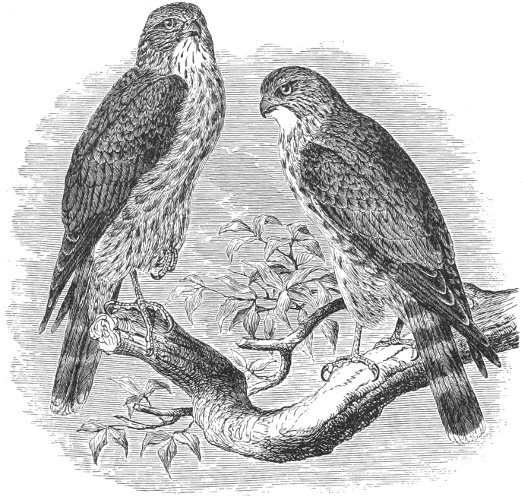
Falco columbarius.
A specimen from Nicaragua (No. 40,957, Chinandega) is like North American examples, but the reddish tinge beneath is scarcely discernible, and confined to the tibiæ, which are but faintly ochraceous; the markings beneath are broad and deep umber, the black shaft-streak distinct.
In the adult female there is as little variation as in the male in plumage, the shade of brown above varying slightly, also the yellowish tinge beneath; the bars on the tail differ in continuity and tint in various specimens, although they are always five in number,—the first concealed by the coverts, the last terminal. In 19,382, Fort Simpson, British America, and 2,706, Yukon, R. Am. (probably very old birds), the light bars are continuous and pale dull ashy.
The young vary about the same as adults. Nos. 19,381, Big Island, Great Slave Lake; 5,483, Petaluma, California; and 3,760, Racine, Wisconsin,—are young males moulting, scattered feathers appearing on the upper parts indicating the future blue plumage.
Var. suckleyi, Ridgway. BLACK MERLIN.
Sp. Char. A miniature of F. peregrinus, var. pealei. Above, uniform fuliginous-black, the secondaries and tail-feathers very narrowly but sharply tipped with white, and the primaries passing into whitish on their terminal margin; nuchal region with concealed spotting of pale rusty or dingy whitish. Beneath, longitudinally striped with fuliginous-black, or dark sooty-brown, and pale ochraceous; the former predominating on the breast, the latter prevailing on the throat and anal region. Sides and flanks nearly uniform dusky, with roundish white spots on both webs; lower tail-coverts with a broad sagittate spot of dusky on each feather. Lining of the wing fuliginous-dusky, with sparse, small roundish spots of white. Inner webs of primaries plain dusky, without spots, or else with them only faintly indicated. Tail plain dusky-black, narrowly tipped with white, and without any bands, or else with them only faintly indicated.
Male (No. 4,477, Shoalwater Bay, Washington Territory; J. G. Cooper). Wing, 7.35; tail, 5.25; culmen, .50; tarsus, 1.30; middle toe, 1.25.
Female (No. 5,832, Fort Steilacoom, Washington Territory, September, 1856; Dr. George Suckley). Wing, 8.50; tail, 5.70; culmen, .55; tarsus, 1.62; middle toe, 1.35.
Hab. Coast region of Northern California, Oregon, and Washington Territory (probably northward to Alaska). Puget Sound, Steilacoom, Yreka, California (Oct.), and Shoalwater Bay (National Museum).
The plumage of this race is the chief point wherein it differs from the other forms of the species; and in its peculiarities we find just what should be expected from the Oregon region, merely representing as it does the melanistic condition so frequently observable in birds from the northwest coast.
The upper parts are unicolored, being continuous blackish-plumbeous from head to tail. The tail is tipped with white, but the bars are very faintly indicated, being in No. 4,499 altogether wanting, while in 21,333 they can scarcely be discovered, and only four are indicated; in the others there is the usual number, but they are very obsolete. In No. 4,499, the most extreme example, the spots on the inner webs of the primaries are also wanting; the sides of the head are very thickly streaked, the black predominating, leaving the superciliary stripe ill-defined; the throat is streaked, and the other dark markings beneath are so exaggerated that they cover all portions, and give the prevailing color; the under tail-coverts have broad central cordate black spots.
Another specimen from this region (4,476, Puget Sound) is similar, but the spots on primaries are conspicuous, as in examples of the typical style; indeed, except in the most extreme cases, these spots will always be found indicated, leading us to the unavoidable conclusion that the specimens in question represent merely the fuliginous condition of the common species; not the condition of melanism, but the peculiar darkened plumage characteristic of many birds of the northwest coast, the habitat of the present bird; it should then be considered as rather a geographical race, co-equal to the Falco gyrfalco, var. labradora, F. peregrinus, var. pealei, and other forms, and not confounded with the individual condition of melanism, as seen in certain species of Buteones.
LIST OF SPECIMENS EXAMINED.
National Museum, 6.
Measurements.
Sex. Wing. Tail. Culmen. Tarsus. Middle Toe. Specimens.
♂ 7.35–7.70 5.25–5.60 .48–.50 1.30–1.45 1.20–0.003
♀ 8.25–8.50 5.70–5.80 .55–.60 1.50–1.60 1.35–1.40 3
Second quill longest; first quill equal to, a little shorter than, or a little longer than, the fourth.
Var. richardsoni, Ridgway. RICHARDSON’S MERLIN.
Falco æsalon, Rich. & Swains. F. B. A. II, pl. xxv, 1831.—Nutt. Man. Orn. II, 558.—Coues, P. A. N. S. Philad. 1866, p. 42 (in text). Falco (Hypotriorchis) richardsoni, Ridgway, P. A. N. S. Philad. Dec. 1870, 145. Falco richardsoni, Coues, Key, 1872, p. 214.
Sp. Char. Adult male like the female and young? The known stages of plumage more like the adult female and young of var. lithofalco (F. æsalon, Auct.) than like var. columbarius.
Adult male (Smithsonian, No. 5,171, mouth of the Vermilion River, near the Missouri, October 25, 1856; Lieutenant Warren, Dr. Hayden). Upper plumage dull earth-brown, each feather grayish-umber centrally, and with a conspicuous black shaft-line. Head above approaching ashy-white anteriorly, the black shaft-streaks being very conspicuous. Secondaries, primary coverts, and primaries margined terminally with dull white; the primary coverts with two transverse series of pale ochraceous spots; outer webs of primaries with spots of the same, corresponding with those on the inner webs. Upper tail-coverts tipped, and spotted beneath the surface, with white. Tail clear drab, much lighter than the primaries, but growing darker terminally, having basally a slightly ashy cast; crossed with six sharply defined, perfectly continuous bands (the last terminal) of ashy-white. Head, frontally, laterally, and beneath,—a collar around the nape (interrupting the brown above),—and the entire lower parts, white, somewhat ochraceous, this most perceptible on the tibiæ; cheeks and ear-coverts with sparse, fine hair-like streaks of black; nuchal collar, jugulum, breast, abdomen, sides, and flanks with a medial linear stripe of clear ochre-brown on each feather; these stripes broadest on the flanks; each stripe with a conspicuously black shaft-streak; tibiæ and lower tail-coverts with fine shaft-streaks of brown, like the broader stripes of the other portions. Chin and throat, only, immaculate. Lining of the wing spotted with ochraceous-white and brown, in about equal amount, the former in spots approaching the shaft. Inner webs of primaries with transverse broad bars of pale ochraceous,—eight on the longest. Wing-formula, 2, 3–4, 1. Wing, 7.70; tail, 5.00; culmen, .50; tarsus, 1.30; middle toe, 1.25; outer, .85; inner, .70; posterior, .50.
Adult female (58,983, Berthoud’s Pass, Rocky Mountains, Colorado Territory; Dr. F. V. Hayden, James Stevenson). Differing in coloration from the male only in the points of detail. Ground-color of the upper parts clear grayish-drab, the feathers with conspicuously black shafts; all the feathers with pairs of rather indistinct rounded ochraceous spots, these most conspicuous on the wings and scapulars. Secondaries crossed with three bands of deeper, more reddish ochraceous. Bands of the tail pure white. In other respects exactly as in the male. Wing-formula, 3, 2–4–1. Wing, 9.00; tail, 6.10; culmen, .55; tarsus, 1.40; middle toe, 1.51.
Young male (40,516, Fort Rice, Dacotah, July 20, 1865; Brig.-Gen. Alfred Sully, U. S. A., S. M. Rothammer). Differing from the adult only in minute details. Upper surface with the rusty borders of the feathers more washed over the general surface; the rusty-ochraceous forms the ground-color of the head,—paler anteriorly, where the black shaft-streaks are very conspicuous; spots on the primary coverts and primaries deep reddish-ochraceous; tail-bands broader than in the adult, and more reddish; the terminal one twice as broad as the rest (.40 of an inch), and almost cream-color in tint. Beneath pale ochraceous, this deepest on the breast and sides; markings as in the adult, but anal region and lower tail-coverts immaculate; the shaft-streaks on the tibiæ, also, scarcely discernible. Wing, 7.00; tail, 4.60.
Hab. Interior regions of North America, between the Mississippi Valley and the Rocky Mountains, from Texas to the Arctic regions.
LIST OF SPECIMENS EXAMINED.
National Museum, 10; Museum Comp. Zoöl., 2; R. Ridgway, 3. Total, 15.
Measurements.
Sex. Wing. Tail. Culmen. Tarsus. Middle Toe. Specimens.
♂ 7.75–8.60 5.70–6.00 .50–.60 1.42–1.55 1.20–1.30 8
♀ 8.50–9.00 6.00–6.30 .55–.58 1.55–1.65 1.35–1.40 7
Since originally describing this bird, I have seen additional examples, and still consider it as an easily recognized race, not at all difficult to distinguish from columbarius. Now, however, I incline strongly to the theory that it represents merely the light form of the central prairie regions, of the common species; since its characters seem to be so analogous to those of the races of Buteo borealis and Bubo virginianus of the same country. It is doubtful whether some very light-colored adult males, supposed to belong to columbarius, as restricted, should not in reality be referred to this race, as the adult plumage of the male. But having seen no adult males from the region inhabited by the present bird obtained in the breeding-season, I am still in doubt whether the present form ever assumes the blue plumage.
As regards the climatic or regional modifications experienced by the Falco lithofalco on the American continent, the following summary of facts expresses my present views upon the subject. First: examples identical in all respects, or at least presenting no variations beyond those of an individual character, may be found from very widely separated localities; but the theory of explanation is, that individuals of one race may become scattered during their migrations, or wander off from their breeding-places. Second: the Atlantic region, the region of the plains, and the region of the northwest coast, have each a peculiar race, characterized by features which are also distinctive of races of other birds of the same region, namely, very dark—the dark tints intensified, and their area extended—in the northwest coast region; very light—the light markings extended and multiplied—in the middle region; and intermediate in the Atlantic region.
Habits. The distribution of the well-known Pigeon Hawk is very nearly coextensive with the whole of North America. It is found in the breeding-season as far to the north as Fort Anderson, on the Anderson and McKenzie rivers, ranging even to the Arctic coast. Specimens were taken by Mr. Ross at Lapierre House and at Fort Good Hope. Several specimens were taken by Mr. Dall at Nulato, where, he states, it is found all the year round. They were also taken by Bischoff at Kodiak. During the breeding-season it is found as far south as Nova Scotia, New Brunswick, and the northern portions of Maine, and probably Vermont and New York. It is abundant on the Pacific coast.
In the winter months it is to be met with throughout the more temperate portions of North America, in Mexico, Central America, and Northern South America. Dr. Woodhouse mentions finding this species very abundant especially among the wooded banks of watercourses throughout Texas, New Mexico, and the Indian Territory.
Mr. March states that this Hawk is a permanent resident in the island of Jamaica, more frequently found among the hills than on the plains, and has been known to breed there. It is a visitant of Cuba. Dr. Cooper thinks they are not very common in Washington Territory, though, as they are found there throughout the summer, they undoubtedly breed there. In August, 1855, Dr. Cooper shot one of a small family of young that had but recently left their nest. They migrate southward in winter, and are abundant in California in October and November.
Dr. Suckley found them abundant about Fort Steilacoom early in August. Near Puget Sound this species is thought to breed in the recesses of the Cascade Mountains, only coming down upon the open plains late in the summer. Dr. Newberry found it paired and nesting about the Klamath Lakes, and states that it also occupies all the region south of the Columbia, in Oregon. Mr. Dresser states that he found this Falcon common about Bexar and the adjoining counties during the entire year, and that they occasionally breed near the Medina River. I have been unable to find any satisfactory evidence that this Hawk ever breeds in any part of Massachusetts, or anywhere south of the 44th parallel in the Eastern States, except, perhaps, in mountainous regions.
This Hawk is remarkable for its rapid flight, and its courage and its enterprise in attacking birds as large as or even larger than itself, though generally it only preys upon smaller birds, such as Grakles, Red-winged Blackbirds, Robins, and Pigeons. Dr. Cooper states that having been attracted by an unusual screaming of some bird close to the house, he was surprised to find that one of these Hawks had just seized upon a Flicker, a bird as large as itself, the weight of which had brought it to the ground, and which it continued to hold in its claws even after it had been mortally wounded. Dr. Heermann once found one of these birds just preparing to feed on a large and plump California Partridge.
In Tamaulipas, Mexico, where Lieutenant Couch found it quite common, he speaks of it as being very quiet, flying but little, and generally watching for its quarry from the limb of a dry tree. Mr. Audubon makes no mention of any peculiarities of habits. Mr. Nuttall was evidently unfamiliar with it, stating it to be unknown in New England, and a resident of the Southern States only.
In Nova Scotia, Mr. Downes speaks of it as common, breeding in all the wooded parts of the country. It is said to be not troublesome to the farmer, but to feed upon the smaller birds. He mentions that once, on his voyage to Boston, one of these birds flew aboard and allowed itself to be captured, and was kept alive and fed readily, but soon after escaped.
Mr. B. R. Ross, in his notes on the birds and nests obtained by him in the country about Fort Resolution, Lapierre House, and Good Hope, mentions this bird as the most common of the true Falcons in that district, where it ranges to the Arctic coast. Its nest is said to be composed of sticks, grass, and moss, and to be built generally in a thick tree, at no great elevation. The eggs, he adds, are from five to seven in number, 1.60 inches in length by 1.20 in breadth. Their ground-color he describes as a light reddish-buff, clouded with deep chocolate and reddish-brown blotches, more thickly spread at the larger end of the egg, where the under tint is almost entirely concealed by them. This description is given from three eggs procured with their parent at Fort Resolution.
From Mr. MacFarlane’s notes, made from his observations in the Anderson River country, we gather that one nest was found on the ledge of a cliff of shaly mud on the banks of the Anderson River; another nest was on a pine-tree, eight or nine feet from the ground, and composed of a few dry willow-twigs and some half-decayed hay, etc. It was within two hundred yards of the river-bank. A third nest was in the midst of a small bushy branch of a pine-tree, and was ten feet from the ground. It was composed of coarse hay, lined with some of a finer quality, but was far from being well arranged. Mr. MacFarlane was confident that it had never been used before by a Crow or by any other bird. The oviduct of the female contained an egg ready to be laid. It was colored like the others, but the shell was still soft, and adhered to the fingers on being touched. In another instance the eggs were found on a ledge of shale in a cliff on the bank, without anything under them in the way of lining. He adds that they are even more abundant along the banks of the McKenzie than on the Anderson River.
Mr. MacFarlane narrates that on the 25th of May an Indian in his employ found a nest placed in the midst of a pine branch, six feet from the ground, loosely made of a few dry sticks and a small quantity of coarse hay. It then contained two eggs. Both parents were seen, but when fired at were missed. On the 31st he revisited the nest, which still contained only two eggs, and again missed the birds. He again went to the nest, several days after, to secure the parents, and was much surprised to find that the eggs were gone. His first supposition was that some other person had taken them, but, after looking carefully about, he perceived both birds at a short distance; and this caused him to institute a search, which soon resulted in his finding that the eggs had been removed by them to the face of a muddy bank at least forty yards distant from the original nest. A few decayed leaves had been placed under them, but nothing else in the way of protection. A third egg had been added since his previous examination. These facts Mr. MacFarlane carefully investigated, and vouches for their entire accuracy.
Another nest, containing four eggs, was on the ledge of a shaly cliff, and was composed of a very few decayed leaves placed under the eggs.
Mr. R. Kennicott found a nest, June 2, 1860, in which incubation had already commenced. It was about a foot in diameter, was built against the trunk of a poplar, and its base was composed of sticks, the upper parts consisting of mosses and fragments of bark.
Mr. Audubon mentions finding three nests of this bird in Labrador, in each of which there were five eggs. These nests were placed on the top branches of the low firs peculiar to that country, composed of sticks, and slightly lined with moss and a few feathers. He describes the eggs as 1.75 inches long, and 1.25 broad, with a dull yellowish-brown ground-color, thickly clouded with irregular blotches of dark reddish-brown. One was found in the beginning of July, just ready to hatch. The young are at first covered with a yellowish down. The old birds are said to evince great concern respecting their eggs or young, remaining about them and manifesting all the tokens of anger and vexation of the most courageous species. A nest of this Hawk (S. I. 7,127) was taken at St. Stephen, N. B., by Mr. W. F. Hall; and another (S. I. 15,546) in the Wahsatch Mountains, by Mr. Ricksecker. The latter possibly belonged to the var. richardsoni.
The nest of this bird found in Jamaica by Mr. March was constructed on a lofty tree, screened by thick foliage, and was a mere platform of sticks and grass, matted with soft materials, such as leaves and grasses. It contained four eggs, described as “round-oval or spherical” in shape, measuring “1.38 by 1.13 inches, of a dull clayish-white, marked with sepia and burnt umber, confluent dashes and splashes, irregularly distributed, principally about the middle and the larger end.” Four others, taken from a nest in the St. Johns Mountains, were oblong-oval, about the same size and nearly covered with chocolate and umber blotches. Mr. March thinks they belong to different species.
Mr. Hutchins, in his notes on the birds of Hudson’s Bay, states that this species nests on rocks or in hollow trees; that the nest consists of sticks and grass, lined with feathers; and describes the eggs as white, thinly marked with red spots. In the oviduct of a Hawk which Dr. Richardson gives as Falco æsalon, were found “several full-sized white eggs, clouded at one end by a few bronze-colored spots.” A nest was found by Mr. Cheney at Grand Menan, from which he shot what he presumed to be the parent bird of this species. Its four eggs agreed with the descriptions given by Hutchins and Richardson much more nearly than with the eggs of this species. The eggs found by Mr. Cheney may have been very small eggs of A. cooperi, in which case the presence of the columbarius on the nest cannot be so easily explained.
Three eggs, two from Anderson River and one from Great Slave Lake, range from 1.53 to 1.60 inches in length, and from 1.20 to 1.22 in breadth, their average measurements being 1.56 by 1.21. They have a ground-color of a rich reddish-cream, very generally covered with blotches and finer markings of reddish-brown, deepening in places almost into blackness, and varying greatly in the depth of its shading, with a few lines of black. In one the red-brown is largely replaced by very fine markings of a yellowish sepia-brown, so generally diffused as to conceal the ground and give to it the appearance of a light buff. Mr. Ridgway, after a careful analysis of the varying markings and sizes of twenty-one eggs, has kindly given the following:—
“Extremes of twenty-one eggs (mainly from Forts Yukon, Anderson, Resolution, and MacKenzie rivers): largest (10,687, Yukon, June), 1.75 × 1.28; smallest (8,808, Anderson River, June), 1.55 × 1.20. The ground-color varies from creamy-white to deep purplish-rufous, there being one egg (4,090, Great Slave Lake, June 6, 1860) entirely and uniformly of the latter color; the lightest egg (normally marked, 2,663, Saskatchewan) is creamy-white, thickly sprinkled with dilute and deep shades of sepia-brown, thickly on large end, and sparsely, as well as more finely, on the smaller end. The markings vary in color from dilute indian-red to blackish-chestnut.
“H. richardsoni is larger than columbarius, and probably has a larger egg. There are no eggs such as Richardson describes in the series of columbarius in the Smithsonian Collection.”
The var. richardsoni was recognized by Richardson as distinct from the more common columbarius; and a single specimen, killed at Carlton House, and submitted to Swainson, was pronounced by him, beyond doubt, identical with the common Merlin of Europe. Other specimens have since been procured, and are now in the Smithsonian Collection. They are recognized by Mr. Ridgway as identical with Richardson’s bird, but quite distinct from the Æsalon of authors. He has named the species in honor of its first discoverer. Of its history and habits little is known. A single pair were seen by Richardson in the neighborhood of Carlton House, in May, 1827, and the female was shot. In the oviduct there were several full-sized white eggs, clouded at one end with a few bronze-colored spots. Another specimen, probably also a female, was shot at the Sault St. Marie, between Lakes Huron and Superior, but this was not preserved.
Mr. Hutchins, in his notes on the Hudson’s Bay birds, states that the Pigeon Hawk “makes its nest on the rocks and in hollow trees, of sticks and grass, lined with feathers, laying from two to four white eggs, thinly marked with red spots.” As Hutchins has been found to be generally quite accurate in his statements, and as this description does not at all apply either to the nest or the eggs of the columbarius, it is quite possible that he may have mistaken this species for the Pigeon Hawk, and that this description of eggs and nests belongs not to columbarius, but to richardsoni.
Subgenus RHYNCHOFALCO, Ridgway.
Species.
F. femoralis. Wing, 9.30–11.60; tail, 6.30–8.80; culmen, .60–.80; tarsus, 1.62–2.00; middle toe, 1.35–1.70. Second and third quills longest; first equal to or shorter than fourth. Adult (sexes similar). Above uniform plumbeous, the secondaries broadly tipped with whitish. Tail darker terminally, crossed by about eight narrow, continuous bands of white, and tipped with the same. A broad postocular stripe, middle area of the auriculars, and entire throat and jugulum, white, unvariegated; the latter with a semicircular outline posteriorly, and the former changing to orange-rufous on the occiput, where the stripes of the two sides are confluent. Sides entirely uniform blackish (confluent on the middle of the abdomen), with narrow bars of white; posterior lower parts immaculate light ochraceous. Young similar, but the jugulum with longitudinal stripes of blackish. Hab. Whole of Tropical America, exclusive of the West Indies, north to the southern border of the United States.
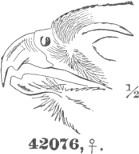
42076, ♀. ½
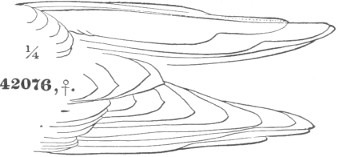
42076, ♀. ¼
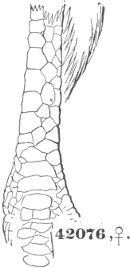
42076, ♀.
Falco (Rhynchofalco) femoralis, Temminck. APLOMADO FALCON.
Falco femoralis, Temm. Pl. Col. 121, 343, 1824.—Spix, Av. Braz. I, 18 (quot. Pl. Cl. 121), 1824.—Vig. Zoöl. Journ. I, 339.—Steph. Zoöl. XIII, pt. 2, p. 39, 1826.—Less. Man. Orn. I, 79, 1828; Tr. Orn. p. 89, 1831.—Cuv. Reg. An. (ed. 2), I, 322, 1817.—Swains. Classif. B. II, 212, 1837.—Nordm. Erm. Reis. um die Erde, Atl. p. 16.—Bridg. Proc. Zoöl. Soc. pt. 11, p. 109; Ann. Nat. Hist. XIII, 499.—D’Orb. Voy. Am. Merid. Av. p. 116, 1835.—Tschudi, Consp. Av. Wieg. Arch. 1844, p. 266; Faun. Per. p. 108, 1844.—Cass. Proc. Ac. Nat. Sc. Philad. 1855, p. 178.—Strickl. Orn. Syn. I, 88, 1855. Brewer, Oölogy, 1857, 14, pl. iii, f. 22. Hypotriorchis femoralis, Gray, Gen. B. fol. sp. 13, 1844; List B. Brit. Mus. p. 56, 1844.—Hartl. Syst. Ind. Azar. p. 3, 1847.—Cass. B. N. Am. p. 11, 1858.—Coues, Pr. Ac. Nat. Sc. Phil. 7, 1866.—Gray, Hand List, I, 21, 1869. Falco fuscocœrulescens, Vieill. Nouv. Dict. Hist. Nat. XI, 90, 1819. Falco cyanescens, Vieill. Enc. Méth. III, 1234 (No. 40, Azara, juv. teste, Hartl.). Falco thoracicus, Licht. Verz. Doubl. p. 62, 1823.
Sp. Char. Adult (sexes similar). Above uniform plumbeous, secondaries broadly whitish at ends; tail with continuous narrow bands of white. A postocular, broad stripe (changing to reddish on nape, where the two of opposite sides are confluent), middle area of auriculars, and entire throat and jugulum, white, unvariegated. Sides entirely uniform blackish (confluent on middle of abdomen), with narrow bars of white; posterior lower parts light ochraceous, immaculate. ♂. Wing, 9.90; tail, 6.70; tarsus, 1.62; middle toe, 1.45. ♀. Wing, 11.30; tail, 7.80; tarsus, 1.70; middle toe, 1.55.
Young. Similar to the adult, but with broad longitudinal stripes of blackish on the breast.
Adult male (No. 30,896, Mirador, E. Mexico; Dr. C. Sartorius). Above brownish-slate, becoming gradually darker anteriorly, the head above being pure dark plumbeous; on the rump and upper tail-coverts the tint inclines to fine cinereous. Secondaries passing very conspicuously into white terminally; primaries plumbeous-dusky, their inner webs with (the longest with twelve) very regular, narrow, transverse bars of white (the outer web plain). Lining of the wing white (becoming more ochraceous toward the edge); under coverts barred and serrated with dusky, the white, however, predominating. Tail black, basally with a perceptible plumbeous cast; crossed with eight narrow, transverse bands of white,—the first two of which are concealed by the coverts, the last terminal and about .27 of an inch in width; the rest are narrower, diminishing in width as they approach the base. Upper tail-coverts bordered terminally with ashy-white, the longer with one or two transverse bars of the same. Forehead (narrowly) white, this extending down across the lores to the angle of the mouth; a broad, conspicuous supraoral stripe, originating above the middle of the eye, and running back above the ear-coverts to the occiput (where the two of opposite sides are confluent), white, more fulvous-orange on the occiput; a broad dark plumbeous stripe running from the posterior angle of the eye back over upper edge of ear-coverts, and continuing (broadly) down the side of the neck; another, but much smaller one, of similar color, starting at lower border of bare suborbital space, passing downward across the cheeks, forming a “mustache,” leaving the middle area of the ear-coverts, the chin, throat, and whole breast, white, the pectoral portion defined with a semicircular outline posteriorly. Broad area covering the sides of the breast, sides, and flanks (meeting rather narrowly across the upper part of the abdomen), black, with narrow, rather indistinct, transverse bars of white. Femorals, tibiæ, abdomen, anal region, and lower tail-coverts fine ochraceous-rufous, palest posteriorly, the whole region immaculate. Wing-formula, 3, 2–4–1, 5. Wing, 9.90; tail, 6.70; tarsus, 1.62; middle toe, 1.45.
Adult ♀ (42,076. Mirador; Sartorius). Similar to the male in almost every respect. Plumbeous above rather darker and more uniform, although the difference is scarcely perceptible. Secondaries more broadly tipped with white, and upper tail-coverts more conspicuously barred with the same. White bars of the black areas beneath scarcely observable. Tail with eight white bars, as in the male longest primary with fourteen white bars on inner web of longest. Wing-formula, 3, 2–4–5=1. Wing, 11.30; tail, 7.80; tarsus, 1.70; middle toe, 1.55.
Juv. a (intermediate stage). ♂ (37,334, Mazatlan, W. Mexico; Col. A. J. Grayson). Plumbeous above darker and more brownish, uniform from rump to head, the former strongly tinged with rusty, this bordering the feathers. Tail darker and more brownish; white bars ten in number, instead of eight, narrower, and tinged with brownish; longest primary with thirteen bars of white on inner web. Lining of the wing black, leaving only a broad ochraceous stripe along the edge; feathers of the black portion with small circular white spots along their edges. Breast strongly tinged with ochraceous, and with large longitudinal blotches of black of cuneate form, and so crowded as to give almost the predominating color; the black patches lack entirely the white bars. Wing-formula, 3=2–4–1–5. Wing, 10.00; tail, 7.20.
♀ (55,019, Mazatlan, Grayson). Similar to the last, but lacking the rusty tinge on the rump; tail with eight white bars, as in the adult; pectoral stripes narrower and less numerous than in the preceding, and white bars distinguishable on the black areas. Wing-formula, 3, 2–4–1–5. Wing, 11.30; tail, 8.20.
b (first plumage). ♂ (45,693 and 49,508, Buenos Ayres, Conchitas; William H. Hudson). Similar to immature male (37,334). Above dull umber-drab, darker on the head; feathers of back, scapular, rump, and wings fading on edges; rump much tinged with rusty, this bordering the feathers. Tail with nine very obsolete, narrow, dull white bars, these not touching the edge of the feather on either web. Longest primary with ten transverse white bars on inner web. Beneath pale ochraceous, almost as deep anteriorly as posteriorly; dark areas restricted to a large patch on each side, and dull dark brown (very similar to the wings), instead of black, and scarcely varied; breast and upper part of abdomen (between the blackish lateral patches) with large longitudinal cuneate blotches of the same. “Winter visitor.”
Hab. Whole of South America; northward through Central America and Mexico, across the Rio Grande, into Texas and New Mexico.
Localities: Guatemala (Scl. Ibis, I, 219); Cathagena (Cassin, Pr. An. N. S. 1860, 132); La Plata (Burm. Reise, 437); Mexiana (Scl. & Salv. 1867, 590); Brazil (Pelz. O. Bras. I, 4); Buenos Ayres (Scl. & Salv. 1868, 143); Chile (Philippi); W. Peru (Scl. & Salv. 1858, 570; 1869, 155); Venezuela (Scl. & Salv. 1869, 252).
A specimen from Paraguay (58,738, ♂ ? Capt. T. J. Page, U. S. N.) has the slaty above lighter than in the Mirador male, approaching to ash. The white bars on the black side-patches are very numerous and regular; the white of the forehead is more sharply defined, and the deep rufescent-ochre of the posterior portion of the postocular stripe is even deeper than that of the tibiæ, etc.; the breast has a few narrow blackish streaks. The bars on wings and tail, however, are as in Mexican examples. This specimen probably denotes greater age than any other in the series.
Another specimen (29,809, ♀, Mirador), perhaps very young, is rather different from the others in the coloration of the lower parts; the rufous of the posterior portions is very deep, and the anterior light places are much tinged with ochraceous, the supraloral stripe being tinged throughout with the same; across the breast is a series of small tear-shaped spots of black, forming an imperfect band; there are, however, no other differences.
Nos. 29,520 (♀, Chile, Berlin Museum) and 29,521 (♂, Venezuela) differ from the rest only in a deeper tinge of ochraceous anteriorly beneath, the occipital stripes being very red.
No. 18,497 (♂, from the Rio Pecos, Texas) is in the plumage described as that of the young male, having the rusty tinge on rump, and more numerous bands on tail; the breast is almost as deeply ochraceous as the tibiæ, and the broad black patches of the sides scarcely meet across the abdomen, being there broken into streaks.
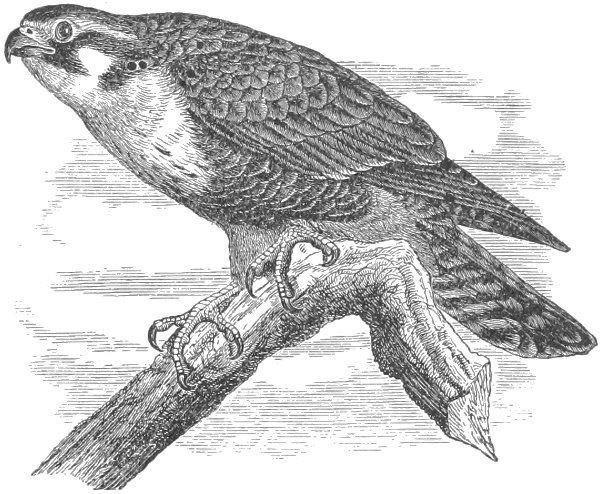
Falco femoralis.
A female, nearly adult, from Buenos Ayres (45,692, Conchitas; W. H. Hudson), has the feathers of the upper parts faintly edged with white; the rump and upper tail-coverts conspicuously barred with the same. The head above is decidedly more bluish than in northern examples, each feather with a shaft-line of black. The tail has only seven white bars,—these, however, very sharply defined, and very pure white; the longest primary has eleven white bars. The lower plumage is similar to that of the immature male from the Rio Pecos, Texas (No. 18,497). This specimen has the second and third quills equal.
LIST OF SPECIMENS EXAMINED.
National Museum, 14; Boston Society, 5; Philadelphia Academy, 2; New York Museum, 1; G. N. Lawrence, 1; R. Ridgway, 2. Total, 25.
Measurements.
Sex.Wing. Tail. Culmen. Tarsus. Middle Toe. Specimens.
♂ 9.20–10.70 6.30–8.00 .60–.68 1.70–1.85 1.35–1.50 12
♀ 11.00–11.60 7.80–8.80 .71–.80 1.80–2.00 1.55–1.70 9
Habits. Only two specimens of this Hawk have been taken within the limits of the United States. One was obtained by Dr. Heermann on the vast plains of New Mexico, near the United States boundary-line. It appeared to be flying over the prairies in search of small birds and mice, at times hovering in the manner of the common Sparrow Hawk (Tinnunculus sparverius). It appears to be resident throughout a large part of Mexico, and in Central and South America. The other is from the Rio Pecos of Texas, collected by Dr. W. W. Anderson.
Mr. Darwin, in his Zoölogy of the Voyage of the Beagle, mentions obtaining one specimen in a small valley on the plains of Patagonia, at Port Desire, in latitude 47° 44′ south. M. D’Orbigny supposed latitude 34° to be the extreme southern limit of the species. Lieutenant Gilliss brought specimens from Chile.
Mr. Darwin states that the F. femoralis nests in low bushes, this corresponding with the observations of Mr. Bishop. He found the female sitting on her eggs in the beginning of January. According to M. D’Orbigny, it prefers a dry, open country with scattered bushes, which Mr. Darwin confirms. Mr. Bishop informs me that he met with this Hawk in the greatest abundance upon those vast plains of South America known as the Pampas, in which no trees except the ombû are found, and that it there nests exclusively on the tops of low bushes, hardly more than a foot or two from the ground. The bird was not at all shy, like most Hawks, but was easily approached so nearly as to be readily recognized.
Mr. Bridges states, in the Proceedings of the London Zoölogical Society (1843, p. 109), that the H. femoralis is trained in some parts of South America for the pursuit of smaller gallinaceous birds, and that it is highly esteemed by the Chilian falconers. It very soon becomes quite docile, and will even follow its master within a few weeks of its capture.
I am indebted to Mr. N. H. Bishop for specimens of the eggs of this Hawk obtained by him on the Pampas. The nest contained but two, and was built on the top of a low bush or stunted tree, hardly two feet from the ground. It was constructed, with some pains and elaboration, of withered grasses and dry leaves.
The eggs measure, one 1.81 inches in length by 1.69 in breadth, the other 1.78 by 1.63. This does not materially vary from the measurement given by Darwin. The ground-color of the egg is white. This, however, is so thickly and so generally studded with fine brown markings, that the white ground to the eye has a rusty appearance, and its real hue is hardly distinguishable. Over the entire surface of the egg is distributed an infinite number of fine dottings, of a color most nearly approaching a raw terra-sienna brown. Over this again are larger blotches, lines, and splashes of a handsome shade of vandyke-brown. In one egg these larger markings are much more frequent than in the other. The latter is chiefly marked with the finer rusty dottings, and has a more dingy appearance.
Subgenus TINNUNCULUS, Vieillot.
Tinnunculus, Vieill. 1807. (Type, Falco tinnunculus, Linn. Tinnunculus alaudarius, Gmel.)
? Tichornis, Kaup, 1844. (Type, Falco cenchris, Naum.)
Pœcilornis, Kaup, 1844. (Type, Falco sparverius, Linn.)
The characters of this subgenus have been sufficiently defined in the diagnosis on page 1427, so that it will be necessary for me only to add a few less important ones.
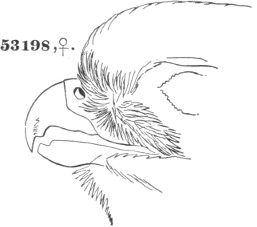
53198, ♀.
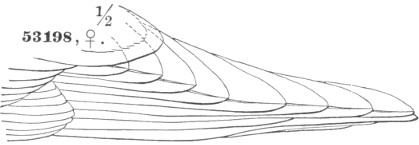
53198, ♀. ½
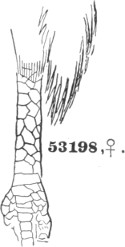
53198, ♀.
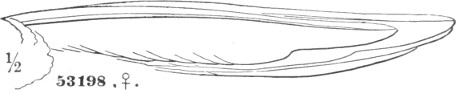
53198, ♀. ½
Tinnunculus sparverius.
The subgenus Tinnunculus is one which is well characterized by peculiarities of manners and habits as well as by features of structure. The species are the most arboreal of the Falcons, and their curious habit of poising in a fixed position as they hover over some object of food which they are watching is probably peculiar to them, and has been remarked of the Old World as well as of the American species. In their structure they are the most aberrant members of the subfamily belonging to the Northern Hemisphere and in their weak bill and feet, lengthened tarsi, obtusely tipped quills, more rounded wings, and more lengthened tail, exhibit a decided step toward Hieracidea, an Australian genus which is almost exactly intermediate in all the characters of its external structure between the true Falcons and the South American genus Milvago, of the Polyborine group.
The subgenus is most largely developed in the Old World, where are found about a dozen nominal species, of which perhaps one half must be reduced to the rank of geographical races. America possesses three species, two of which are restricted to the West India islands, while the other extends over the entire continent.
There is no reason whatever for separating the American species from those of the Old World, and the subgenus Pœcilornis, established upon these by Kaup, is not tenable.
Since the publication of my first paper upon the American forms of Tinnunculus,59 a large amount of additional material has fallen under my observation; the total number of examples critically examined and compared together amounting to over three hundred and fifty skins of which I have kept a record, besides many others which have come casually to my notice. This abundant material merely confirms the views I first expressed, in the paper alluded to, regarding the number and definition of the forms; their comparative relation to each other being the only respect in which I have reason to modify my arrangement.
In my first paper on the American Tinnunculi, three distinct species were recognized; one (sparverius) belonging to the whole of Continental America and the Lesser Antilles, one (leucophrys, Ridgway) to Cuba and Hayti, and one (sparveroides, Vig.) peculiar to Cuba. The first is one modified in different climatic regions into several geographical races, as follows: Var. sparverius, L., North and Middle America, exclusive of the gulf and Caribbean coast regionisabellinus, Swains., the eastern coast region of Tropical America, from Guiana to Florida; var. dominicensis, Gmel. (Lesser Antilles); var. australis, Ridgw. (South America in general); and var. cinnamominus, Swains. (Chile and Western Brazil). That each of these races is well characterized, the evidence of a series abundantly sufficient to determine this point enables me to assert without reserve; for I find in each instance that the characters diagnosed in my synopsis hold good as well with a large series as with a few specimens.
The following synopsis, essentially the same as that before published, may, to most persons, explain satisfactorily my reasons for recognizing so many races of T. sparverius,—a proceeding which, I am sorry to say, does not meet with favor with all ornithologists.60 Though there are at the present time three well-characterized or permanently differentiated species of Tinnunculus on the American continent, yet it is, to my mind, certain that these have all descended from a common ancestral stock, for evidence in proof of this is found in many specimens which I consider at least strongly “suggestive” of this fact; some specimens of var. isabellinus from Florida having blue feathers interspersed over the rump, thereby showing an approximation toward the uniformly blue upper surface of the adult male of T. sparveroides of the neighboring island of Cuba; while in the latter bird the embryonic plumage of the male is very similar to the permanent condition of the male of sparverius.
Synopsis of the American Species.
A. Back always entirely rufous (with or without black bars.) Lower parts white, or only tinged with ochraceous; front and auriculars distinctly whitish.
a. Inner webs of primaries barred entirely across, with white and dusky; “mustache” across the cheeks conspicuous; no conspicuous superciliary stripe of white.
1. T. sparverius.61 Crown bluish, with or without a patch of rufous. ♂. Wings and upper part of head slaty, or ashy-blue; scapulars, back, rump, and tail reddish-rufous; primaries, basal half of the secondaries, and a broad subterminal zone across the tail, black. ♀. The bluish, except that of the head, replaced by rufous, which is everywhere barred with blackish, and of a less reddish cast. Hab. Entire continent of America, also Lesser Antilles, north to St. Thomas.
b. Inner webs of primaries white, merely serrated along the shaft with dusky; “mustache” obsolete or wanting; a conspicuous superciliary stripe of white.
2. T. leucophrys.62 Similar to sparverius, except as characterized above. Hab. Cuba and Hayti.
B. Back rufous only in the ♀. Lower parts deep ferruginous-rufous; front and auriculars dusky.
3. T. sparveroides.63 ♂. Above, except the tail, entirely dark plumbeous, with a blackish nuchal collar; primaries and edges and subterminal portion of tail-feathers, black. Beneath deep rufous (like the back of sparverius and leucophrys), with a wash of plumbeous across the jugulum; throat grayish-white. Inner webs of primaries slaty, with transverse cloudings of darker. ♀. Differing from that of the above species in dark rufous lower parts and dusky, mottled inner webs of primaries. Second and third quills longest; first shorter than or equal to fourth. Hab. Cuba (only?).
The distinguishing characters of F. sparverius having been given in the foregoing synopsis, I will here consider this species in regard to the modifications it experiences in the different regions of its geographical distribution.
The whole of continental America, from the Arctic regions to almost the extreme of South America, and from ocean to ocean, is inhabited, so far as known, by but this one species of Tinnunculus. But in different portions of this vast extent of territory the species experiences modifications under the influence of certain climatic and other local conditions, which are here characterized as geographical races; these, let me say, present their distinctive characteristics with great uniformity and constancy, although the differences from the typical or restricted sparverius are not very great. The F. sparverius as restricted, or what is more properly termed var. sparverius, inhabits the whole of North and Middle America (both coasts included, except those of the Gulf of Mexico and Caribbean Sea), south to the Isthmus of Panama. Throughout this whole region it is everywhere nearly the same bird. This variety appears to represent the species in its greatest purity, being a sort of central form from which the others radiate. The most typical examples of the var. sparverius are the specimens in the large series from the elevated regions or plateau of Mexico and Guatemala. In these the rufous of the crown is most extended (in none is it at all restricted), and the ashy portions are of the finest or bluest and lightest tint.
All specimens, of quite a large series, from the peninsula of Lower California, are considerably smaller than any others, the smallest (1,693 ♂ ad. San José; J. Xantus) measuring, wing, 6.50; tail, 4.20, and tarsus, 1.30; the dwarfed size of these, however, is their only distinguishing feature. Two specimens (50,199, ♂, Cape Florida, and 10,345, ♀, Indian Key) from Florida differ from others in the unusual development of the bill, which toward the end is more suddenly curved, and the point considerably lengthened; these specimens have, also, only a tinge of rufous on the crown, thus showing a proximity to the var. isabellinus. The large bill, however, is no more than would be looked for in specimens from that region.
Along the Gulf border of the United States, and the Caribbean and North Atlantic coasts of South America (probably the whole Atlantic coast of tropical and subtropical America), the true sparverius is changed into what Swainson has called “Falco isabellinus,” which differs from the former only in having the cinereous of the crown and wings considerably darker (as well as less bluish), approaching plumbeous; the rufous of the crown is totally absent, or only present in faint touches; the lower parts are of a deeper ochraceous, and the black spots on the breast and sides sparse.
Allied to the last in tints of coloration, and apparently a direct offshoot from it, is the dominicensis of Gmelin (based upon description by Brisson), which inhabits the Lesser Antilles, from Trinidad northward to Porto Rico. Although I consider this (var. dominicensis) as a modified form of the var. isabellinus, yet it is the one of all the varieties referrible to sparverius which deviates most widely from the typical or original style. The characters of this are, tints those of var. isabellinus, but, in addition, the tail has numerous more or less complete black bands, while those of the back and scapulars are very broad and numerous; also, the crown has a decided rufous patch; the bill, too, is larger than in any other American member of the genus. A style of considerable uniformity spreads over the whole of South America, including both coasts, from Bogota to the Parana, excepting the northeastern coast region, before mentioned as inhabited by the var. isabellinus. It differs from all the other styles, except the cinnamominus of Chile, in having the lower parts continuously dull white, any ochraceous tinge being scarcely perceptible; there is seldom a trace of rufous on the crown, which has the light bluish tint seen in var. sparverius, and the black zone of the tail is scarcely more than half as wide as in the northern races. In size, also, it somewhat exceeds the others. Swainson named this “Falco gracilis”; but the F. (Tinnunculus) gracilis of Lesson being a different species, and the name as applied to it of prior date, I have bestowed upon the present bird the name var. australis.
In Chile and Brazil (Western ?) we find a form resembling the last in some respects, but differing in points of almost specific value. It differs from all the other American members of the genus in having the tail continuously rufous to the extreme tip, the black zone being considerably narrower than the terminal rufous, the lateral tail-feather immaculate rufous, etc. The grayish of the head is much darker and more slaty than in the var. australis. This is, without doubt, the Falco cinnamominus of Swainson, the specimens in the collection corresponding exactly with the description by that author.
The rufous patch on the crown must not be too much considered, as it is of all characters perhaps the most treacherous, though its presence or absence is in a measure characteristic of the several varieties. Neither does the exact number of spots on the lateral tail-feather prove sufficiently constant to serve as a character in which the least reliance can be placed, though Swainson attaches considerable value to it. I have found that, besides varying almost with the individual, in some specimens the feathers of opposite sides did not correspond.
About two hundred and fifty specimens form the basis of the following synopsis.
A. Tail tipped with white; outer tail-feathers (one or more) variegated.
a. ♂. Head above, and wings, fine bluish-ash; usually one tail-feather only (the outer) variegated.
1. Vertex with a conspicuous patch of rufous. ♂. Black zone of the tail 1.00 in width; breast strongly tinged with ochraceous; spots of black on the breast or sides circular. ♀. Above fulvous-rufous, the whole breast and sides with longitudinal dashes of a lighter tint of the same. Hab. Continent of North America north of Panama (except Caribbean and Gulf coast) … var. sparverius.
2. Vertex with only a trace of rufous, or none at all. ♂. Black zone of tail only .60 in width; breast nearly pure white; spots of black usually only on the sides, elliptical. ♀. Above vinaceous-rufous; longitudinal markings beneath deeper brown. Hab. Continent of South America (except North Atlantic and Caribbean coast) … var. australis.64
b. ♂. Head above, and wings, dark bluish-plumbeous; several outer tail-feathers variegated.
3. Vertex without any rufous. ♂. Anterior portions beneath deep ochraceous, without spots. Tail without indication of bars anterior to the subterminal one; black bars above confined to larger scapulars. ♀. Above ferruginous, with the black bars broader and blacker than in either of the preceding. Hab. Gulf, Caribbean, and Atlantic coasts of tropical continental America (Florida to Cayenne) … var. isabellinus.
4. Vertex with a patch of rufous. ♂. Black spots beneath numerous, large and circular. Tail with more or less complete black bars anterior to the subterminal band, sometimes regularly barred to the base; black bars above covering entire rufous surface. ♀. Similar to that of isabellinus, but markings beneath more numerous, and pure black instead of brown. Hab. Lesser Antilles, north to St. Thomas … var. dominicensis.65
B. Tail tipped with deep rufous; outer tail-feather unvariegated.
5. Head above dark slaty-plumbeous, without any rufous. ♂. Tail continuous rufous to the extreme tip, the subterminal black band narrower than the terminal rufous one, and not continuous; the outer feather entirely rufous, without any black. In other respects much like var. australis. (♀ not seen.) Hab. Chile and Western Brazil … var. cinnamominus.66
Falco (Tinnunculus) sparverius, Linn. Var. sparverius, Linnæus. AMERICAN SPARROW HAWK; AMERICAN KESTREL.
Accipiter (Æsalon) carolinensis, Briss. Orn. I, 385, 1760. Accipiter minor, Catesb. Carol. I, 5, 1754. Falco sparverius, Linn. Syst. Nat. p. 128, 1766.—Penn, Arct. Zoöl. pp. 211, 212.—Gmel. Syst. Nat. p. 284.—Lath. Ind. Orn. p. 42; Synop. I, 110, sp. 94; Gen. Hist. I, 290.—Daud. Tr. Orn. II, 142, pl. xii.—Shaw, Zoöl. VII, pl. xxvi.—Wils. Am. Orn. pl. xvi, f. 1, pl. xxxii, f. 2.—James. (Wils.) Am. Orn. I, 56, 60.—Less. Tr. Orn. p. 95.—Benn. gard. Zoöl. Soc. II, 121.—Steph. XIII, ii, 38.—Cuv. Reg. Anim. (ed. 2), I, 322.—Jard. (Wils.) Am. Orn. I, 262; II, 51.—Rich. & Swains. F. B. A. pl. xxiv.—Wagl. Isis, 1831, 517.—Bonap. Ann. Lyc. N. Y. II, 27; Isis, 1832, 1136.—Vieill. Enc. Méth. III, 1234 (in part).—Aud. Birds Am. pl. cxlii; Orn. Biog. II, 246, pl. cxlii.—Brew. (Wils.) Synop. p. 684; Am. Oölogy, p. 16, pl. xi, figs. 13 and 15 a.—De Kay, Zoöl. N. Y. II, 16, pl. vii. f. 16.—Peab. Birds Mass. III, 69.—Nutt. Man. I, 58. Tinnunculus sparverius, Vieill. Ois. Am. Sept. pls. xii, xiii.—Bridg. Proc. Zoöl. Soc. pt. xi, 109.—Gray, Gen. B. fol. sp. 10; List Brit. B. Mus. p. 60.—Woodh. Sitgr. Exp. Zuñi & Colorad. p. 60.—Cass. Proc. Ac. Nat. Sc. Phil. 1855, 278.—Birds Cal. & Tex. p. 92; Birds N. Am. 1858, 13.—Ridgw. P. A. N. S. 1870, 148.—Strickl. Orn. Syn. I, 99, 1855. Cerchneis sparverius, Bonap. List Eur. & N. Am. B. p. 5, 1838. Pœcilornis sparverius, Kaup, Monog. Falc. Cont. Orn. 1850, 53. Tinnunculus phalœna, Lesson, Mam. et d’Ois. 1847, 178 (San Blas & Acapulco).
Sp. Char. Adult male (12,025, Washington, D. C.; W. Wallace). Forehead, lateral and posterior, regions of the vertex, occiput, and wings, bluish-ash. Vertex, nape, scapulars, interscapulars, rump, upper tail-coverts, and tail, fine cinnamon-rufous; scapulars and back barred with black, the bars broadest and most conspicuous posteriorly. Tail tipped with white, and with a broad sharply defined subterminal zone of black, about one inch in width; lateral feather, with outer web and terminal half of inner, ashy-white, the latter with one or two distinct transverse spots anterior to the subterminal one. Wing-coverts with more or less conspicuous cordate spots of black, rather sparsely distributed; basal two-thirds of secondaries and whole of primaries deep black; the latter whitish around the terminal margin and with nine transverse bands of white on inner web of longest (second), the white rather exceeding the black, the points of which do not reach the edge of the feather; lining of the wing white with conspicuous cordate spots of black. Front and superciliary region more hoary than the forehead, almost approaching white. Whole lateral region of the head, with chin, throat, and lower parts, white; the neck, breast, and sides, however, with a deep tinge of ochraceous, the tint hardly approaching the depth of color seen on the nape. On the head there are (considering both sides) seven black spots; the first originating in front of the bare anteorbital space (leaving the lores white), and extending in a stripe downward across the maxillæ, forming a conspicuous “mustache”; the second crosses the tips of the ear-coverts, in form of an oblong transverse spot; the third is smaller, situated as far behind the last as this, and is posterior to the “mustache,” crossing the side of the neck; the last is an odd nuchal spot separating the ash of the occiput from the rufous of the nape. Breast and sides with circular or cordate spots of pure black; these varying in size, but generally larger on the sides. Other lower parts immaculate. Wing-formula, 2=3–4, 1. Wing, 7.10; tail, 4.50; tarsus, 1.32; middle toe, .98; culmen, .45.
Adult female (10,751, Fort Bridger, Utah; C. Drexler). Blue above confined to the head, which shows the rufous patch as in the male; entire upper parts rufous, lighter and less purplish than in the male, everywhere barred with black. Tail with twelve sharply defined narrow bars of black; the subterminal broadest, and about three eighths of an inch in width. Longest primary with eleven transverse spaces of pale rufous, nearly twice as wide as the dusky ones, which scarcely touch the edge. Beneath yellowish-white, paler than in the male, breast and sides with rusty longitudinal spots. Head as in the male. Wing, 7.60; tail, 5.20; tarsus, 1.50; middle toe, .90; bill, .50. Wing-formula, 2=3–4–1.
Young male (5,581, Medicine Bow Creek, Nebraska, August 7, 1856; W. S. Wood). Exactly like the adult male, but with the rufous darker, approaching to chestnut; spots beneath inclining to a tear-shaped form, and, though more numerous, are not so well defined as in the adult; also rufescent tinge beneath more general; blue of the wings with scarcely any spots; white terminal band of tail tinged with rufous. Sometimes the two or three outer feathers are clouded with ash, and possess indication of bars, formed of irregular black spots.
Young female (40,520, Fort Rice, Dacota; S. M. Rothhammer). Generally like the adult, but with rufous above darker, approaching ferruginous; the bars everywhere broader, and purer black; rufous vertical patch streaked centrally with black; spots beneath larger, darker, approaching reddish umber.
Hab. Continental North America (only), across to both coasts, and from Arctic regions to Isthmus of Panama; not in West Indies.
This form ranges over the whole of continental North America, from Panama northward into the British Provinces, and from the Atlantic to the Pacific. Throughout the whole of this extensive area the bird exhibits very little variation, in fact, none not of an almost individual character, consisting mainly in the varying amount of ashy-white and black on the lateral tail-feather, and also, to a less extent, in the depth of the ochraceous tint on the breast, and the abundance and size of the black spots on the sides or flanks. In the Gulf region of the United States it passes gradually into var. isabellinus through intermediate specimens. We have seen Florida skins (kindly lent to us by Mr. J. A. Allen) from Miami (♂, January 29, 1872), Cedar Keys (♂, February 28, 1871), and Florida Keys (♂, February 14, 1871). Of these, only the first (No. 14,491) deviates noticeably from the typical style; it inclines toward var. isabellinus in sparsity of black spots on flanks and restricted rufous on the crown, but in the pure light ash of the crown and wings, and faint ochraceous of the breast, it resembles more the var. sparverius. Wing, 6.50; tail, 4.70. The two other specimens measure as follows: No. 14,487, Florida Keys, wing, 6.90; tail, 5.00. No. 14,492, Cedar Keys, wing, 6.90; tail, 5.00. The former is peculiar in having some of the upper tail-coverts either partly or entirely ashy.
Mexican specimens represent the race in the greatest purity or exaggeration of its characteristic features, in pure and light bluish-ash of wings and crown, greatest extent of rufous on crown, etc. California specimens often exhibit what I have not noticed in eastern examples, though possibly occurring in them; that is, in adult males the cere and feet are of a deep orange-red—almost vermilion color.
LIST OF SPECIMENS EXAMINED.
National Museum, 104; Boston Society, 26; Philadelphia Academy, 7; Mus. Comp. Zoöl., 66; New York Museum, 7; Cab. G. N. Lawrence, 4; Cab. R. Ridgway, 4. Total, 218.
Measurements.
Sex. Wing. Tail. Culmen. Tarsus. Middle Toe. Specimens.
♂ 6.50–8.00 4.50–5.70 .50–.001.25–1.55 .95–0.00117
♀ 6.80–8.40 4.90–5.80 .55–.55 1.40–1.45 .90–1.00 95
Var. isabellinus, Swainson.
Falco isabellinus, Swainson, An. Menag. p. 281, 1838. Tinnunculus sparverius, var. isabellinus, Ridgway, P. A. N. S. Phil. Dec. 1870, p. 149. Tinnunculus dominicensis (not of Gmel.!), Strickl. Orn. Syn. 1, 100, 1855 (in part only).
Sp. Char. Adult male (3,841, Prairie Mer Rouge, La., June, 1853; “J. F.”). Much like var. sparverius, but considerably darker in colors; plumbeous, crown dark with no rufous on vertex, nor darker shaft-lines. Rufous above more purplish-castaneous; cinereous of wings much darker; neck, jugulum, breast, and sides deep soft ochraceous, spots very few, and restricted to the sides. Wing, 7.00; tail, 4.70; tarsus, 1.25; middle toe, .90; culmen, .50. Wing-formula, 2, 3–4, 1.
Adult female (58,339, Jacksonville, Fla., June 10, 1869; C. J. Maynard). Differing from the female of var. sparverius in much darker colors, the rufous inclining to castaneous; bars broader, more sharply defined, pure black. Head above pure dark plumbeous, conspicuously different from the fine light ash of var. sparverius; vertex with touches only of rufous; markings beneath narrower, and nearly pure black, upon a deeper ochraceous ground. Wing, 7.20; tail, 4.50; tarsus, 1.20; middle toe, .83; culmen, .42. Primaries, 2, 3–1, 4.
Hab. North Atlantic and Caribbean coasts of South America, from Demerara northward, along the Gulf coast of Mexico and United States, through Texas and Louisiana to Florida.
This form, though quite different in its extreme condition from true sparverius, gradually grades into it. Few, if any, other specimens possess in so exaggerated a degree all the distinctive characters of those described, though all from the regions indicated agree in having darker colors and less rufous on the crown than specimens from the interior of North and Middle America.
A series of six adult male Sparrow Hawks from Florida, kindly loaned me for examination by Mr. J. A. Allen, includes three typical examples of this littoral race of subtropical continental America. They all agree in very deep dark colors, entire absence or merely slight indication of rufous on the vertex, and deeply ochraceous breast, with few markings. No. 14,499 (Miami, Fla., June 19, 1871) is remarkable for lacking entirely the black spots on wings and flanks, and bars on the back or longer scapulars; the three outer tail-feathers are almost wholly ashy-white, with about five transverse spots of black; the terminal white band is strongly tinged with ash; there is no trace of rufous on the crown. Wing, 6.80; tail, 4.80.
In the unspotted wings and sides and unbarred scapulars there is a resemblance in this specimen to F. leucophrys; which, however, has the ash very much lighter, the black “mustache” obsolete or wanting, the lower breast pure white instead of deep ochraceous; the under surface of the primaries plain white, with shallow dusky serrations along the shaft, instead of being heavily barred with dusky; always has a patch of rufous on the crown, a conspicuous frontal and superciliary stripe of white, and an entirely differently marked tail. In its much barred tail it also resembles the var. dominicensis to a slight extent; but the latter has the middle feathers also barred, and always has the scapulars, generally the entire dorsal region, heavily barred with black, and the wings, breast, and sides heavily spotted; the bill is larger, and there is always more or less rufous on the crown. The other two specimens are more like the average; they both have a mere trace of rufous on the crown, conspicuous bars on the scapulars, and spots on the wings. No. 5,188 (Hibernia, Fla., February 3, 1869) has only a few black specks on the flanks; the outer tail-feather ashy-white, with seven transverse black spots across inner web. Wing, 6.80; tail, 4.80. No. 5,373 (Hawkinsville, Fla., March 12, 1869) is similar, but has the flanks distinctly spotted with black, and the outer tail-feather with inner web plain pale rufous, with only the subterminal large black spot. Wing, 6.80; tail, 4.80.
A series of ten specimens (five males and five females) from Florida, kindly sent me for examination by Mr. C. J. Maynard, contains nothing but var. sparverius, with a few individuals inclining slightly toward var. isabellinus. The extreme are measurements of the series as follows: ♂. Wing, 6.60–6.90; tail, 4.50–4.70. ♀. Wing, 6.90–7.50; tail, 4.80–5.10. Four out of the five males have the deeply ochraceous unspotted breast of var. isabellinus, but all have more or less rufous on the crown, while the ash is of that light shade seen in var. sparverius. No. 476 has the upper tail-coverts mixed with feathers which are either wholly or partially ash, while the light bands of the outer tail-feathers are much tinged with the same; the scapulars are almost wholly fine ash, like the wings, and with heavy black bars. The females likewise all incline toward var. isabellinus, all having the dark bars above equal to or broader than the rufous ones. No. 6,441 is transversely spotted on the flanks with heavy black bars, and is scarcely distinguishable from females of var. dominicensis.
An adult male labelled as coming from Cuba, but probably from the southeastern United States, in the collection of the Boston Society, is so deeply colored as to strongly resemble the young male of T. sparveroides. There is not a trace of rufous on the crown, which is dark plumbeous; the lower parts are entirely deep rufous, except the throat, inclining more to ochraceous on the tibiæ and crissum; the whole lower surface entirely free from spots of any kind. The tail is very uniformly marked, being wholly rufous, except the usual narrow terminal band, or the outer web of lateral feathers, which are white,—the latter with a few indications of black spots near the shaft,—and the usual subterminal zone of black, which is very regular and continuous. Though in these respects so closely resembling the young ♂ of T. sparveroides, it may be distinguished from it by the sharp definition of the black markings on the side of the head and on the wing-coverts, and of the black bars on the inner webs of the primaries. We have every reason to doubt whether this specimen was actually collected in Cuba, since so many of the specimens in the Lafresnaye Collection are incorrectly labelled as regards locality.
A young ♂ from Georgia, in the same collection, is somewhat similar, but differs in the following respects. The rufous beneath is confined to the breast, sides, and abdomen, but is as deep (i.e. only a shade or two lighter than that on the back); the two outer pairs of tail-feathers are mostly ashy-white, with large spots of black.
LIST OF SPECIMENS EXAMINED.
National Museum, 4; Boston Society, 2; Mus. Comp. Zoöl., 3; Philadelphia Academy, 4; New York Museum, 2; G. N. Lawrence, 4. Total, 19.
Measurements.
Sex. Wing. Tail. Culmen. Tarsus. Middle Toe. Specimens.
♂ 7.00–7.70 4.86–5.50 .50–.001.30–1.50 .90–.0011
♀ 7.20–7.70 5.00–5.30 .45–.50 1.35–1.40 .85–.005
Habits. The common Sparrow Hawk of America has an extended distribution throughout the greater portion of North America, although it was not observed by Mr. MacFarlane, nor by any other collectors in the higher Arctic regions, nor was it met with by Mr. Dall in Alaska. Mr. Kennicott found it nesting at Fort Resolution (lat. 62°), on Great Slave Lake, and Mr. Clark at Fort Rae. These are the highest points to which we have any knowledge of its having been traced.
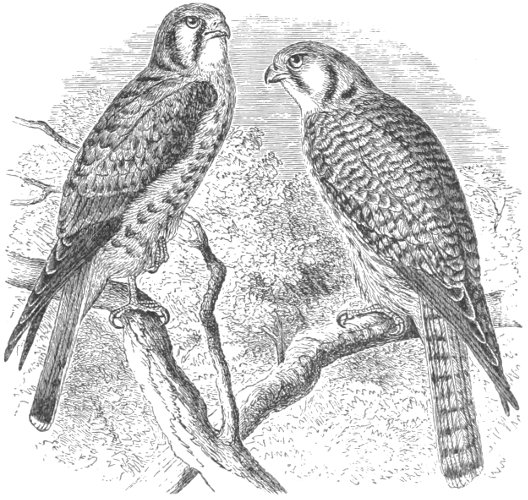
Tinnunculus sparverius.
Sir John Richardson speaks of it as abundant on the banks of the Saskatchewan, in the neighborhood of Carlton House. It probably breeds throughout North America, from Hudson’s Bay to Mexico, and from Maine to California, though it is rare in a large portion of the New England States. It is, however, quite abundant in the vicinity of Calais, Me., in New Brunswick, and in Nova Scotia, though less abundant about Halifax. It has not been taken, or if so only very rarely, in Eastern Massachusetts, though it has been known to breed in Williamstown and Amherst, in the western part of the State. It is equally rare in Rhode Island and in Connecticut. Dr. Woods, of East Hartford, knew of a pair which entered a dove-cot in that place, destroyed its inmates, and laid four eggs. They committed so many depredations on the neighbors’ chickens that they were shot.
Mr. Ridgway found this species exceedingly abundant in all portions of the West. In the cañons of the East Humboldt Mountains it was observed to have nests in holes on the faces of the limestone cliffs.
The Sparrow Hawk is a bird of irregular flight, now momentarily hovering over a particular spot, suspending itself in the air, and then shooting off in another direction. At other times it may be seen perched on the top of a dead tree, or on a projecting branch, sitting there in an almost perpendicular position for an hour or more at a time. It frequently jerks its tail, and appears to be reconnoitring the ground below for small birds, mice, or lizards, on which it chiefly preys. When it alights, it closes its long wings so suddenly that, according to Wilson, they seem to disappear. It often approaches the farm-house early in the morning, skulking about the barnyard in pursuit of mice, and occasionally of young chickens. Frequently it plunges into a thicket, as if at random, but always with an object in view, and with a sure and fatal aim.
Wilson once observed one of this species perched on the highest top of a large poplar, and, just as he was about to take aim, it swept down with the rapidity of an arrow into a thicket of briers, where he shot it, and found a small Field Sparrow quivering in its grasp. It is said to be fond of watching along hedge-rows and in orchards, where small birds usually resort. When grasshoppers are plentiful, they form the principal part of its food. The young are fed with the usual food of the parents,—mice, small birds, grasshoppers, etc. It also feeds upon small snakes, but rarely, if ever, touches anything that it has not itself killed, and has been known to reject its prey when, after having been killed, it proved to be in unsuitable condition for food.
Mr. Audubon states that the flight of this species is never protracted. It seldom flies far at a time; a few hundred yards are all the distance it usually goes before alighting. It rarely sails long on the wing at a time; a half-hour is its utmost extent. In pursuing a bird, it flies with great rapidity, but never with the speed of the Sharp-shinned and other Hawks. Its cry is so similar to that of the Kestrel of Europe that it might be readily mistaken for it but for its stronger intonation. At times it gives out these notes as it perches, but they are principally uttered while on the wing. Mr. Audubon has heard them imitate the feeble cries of their offspring, when these have left the nest and are following their parents.
The young birds, when they first appear, are covered with a white down. They grow with great rapidity, and are soon able to leave their nest, and are well provided for by their parents until they are able to take care of themselves. They feed at first on grasshoppers and crickets.
At Denysville, Me., these Hawks were observed to attack the Cliff Swallows, while sitting on their eggs, deliberately tearing open their covered nests, and seizing their occupants for their prey.
In winter, these birds, for the most part, desert the Northern and Middle States, but are resident south of Virginia. They can be readily tamed, especially when reared from the nest. Mr Audubon raised a young Hawk of this species, which continued to keep about the house, and even to fly to it for shelter when attacked by some of its wilder kindred, and never failed to return at night to roost on its favorite window-shutter. It was finally killed by an enraged hen, whose chickens it attempted to seize.
This Hawk constructs no nest, but makes use of hollow trees, the deserted hole of a Woodpecker, or even an old Crow’s nest. Its eggs are usually as many as five in number, and Mr. Audubon once even met with seven in a single nest. The ground of the eggs is usually a dark cream-color or a light buff. In their markings they vary considerably. Five from a nest in Maryland were covered throughout the entire surface with small blotches and dottings of a light brown, at times confluent, and, except in a single instance, not more frequent at the larger end than the smaller. The contents of a nest obtained by Mr. Audubon on the Yellowstone River had a ground-color of a light buff, nearly unspotted, except at the larger end, with only a few large blotches and splashes of a deep chocolate. In others, interspersed with the light-brown markings are a few of a much deeper shade. In some, the eggs are covered with fine markings of buff, nearly uniform in size and color; and others again are marked with lines and bolder dashes of brown, of a distinctly reddish shade, over their entire surface, and often so thickly as nearly to conceal the ground. The eggs are nearly spherical. The average length is 1.38 inches by a breadth of 1.13. They are subject to variation in size, but are uniform as to shape. They range in length from 1.48 to 1.32 inches, and in breadth from 1.08 to 1.20 inches.
The eggs of Tinnunculus sparveroides, from Cuba, and of var. cinnamominus from Chile, differ in size and markings from those of North American birds. Their ground-color is much whiter, is freer from markings which have hardly any tinge of rufous, but are more of a yellowish-brown. The Cuban egg measures 1.28 by 1.08 inches; the Chilian, 1.25 by 1.08.
Genus POLYBORUS, Vieillot.
Polyborus, Vieill. 1816. (Type, Falco brasiliensis, Gmelin. P. tharus, Molina.)
Caracara, Cuvier, 1817. (Same type.)
Gen. Char. General aspect somewhat vulturine, but bearing and manners almost gallinaceous. Neck and legs very long. Bill very high and much compressed, the commissure very straight and regular, and nearly parallel with the superior outline; cere very narrow, its anterior outline vertical and straight. Nostril very small, linear, obliquely vertical, its upper end being the posterior one; situated in the upper anterior corner of the cere. Lateral and under portions of the head naked and scantily haired, the skin bright-colored (reddish or yellow in life). Occipital feathers elongated. Wings and tail long, the latter rounded; five outer quills with inner webs sinuated; third to the fourth longest; first shorter than the sixth, sometimes shorter than the seventh. Feet almost gallinaceous, the tarsus nearly twice as long as the middle toe, but stout; outer toe longer than the inner; posterior toe much the shortest; claws long, but slender, weakly curved, and obtuse. Tarsus with a frontal series of large transverse scutellæ, the lower fourth to sixth forming a single row, the others disposed in two parallel series of alternating plates; the other parts covered by smaller hexagonal scales.
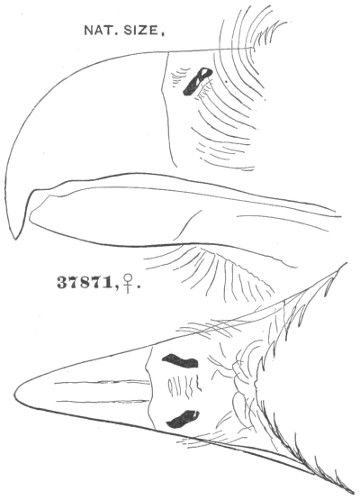
37871, ♀. NAT. SIZE.
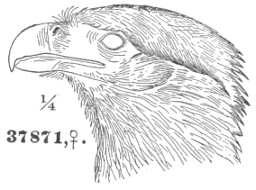
37871, ♀. ¼
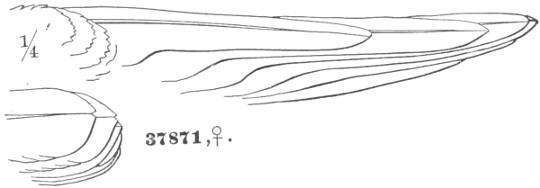
37871, ♀. ¼
Wing and tail.
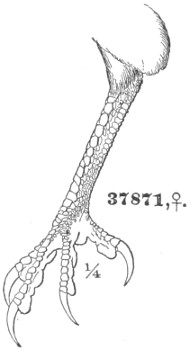
37871, ♀. ¼
Polyborus auduboni.
This well-marked genus contains but a single species, the P. tharus, Mol., which extends its range over the whole of tropical and subtropical America, exclusive of some of the West India Islands. North and south of the Isthmus it is modified into geographical races, the southern of which is var. tharus, Mol., and the northern var. auduboni, Cass.
The closely related genera Phalcobænas, Milvago, Ibycter, and Daptrius are peculiar to South America and the southern portion of Middle America, most of them being represented by two or more species. They all form a well-marked and peculiarly American group, for which I shall retain Schlegel’s term Polybori.
Their habits are quite different in many respects from those of other Falconidæ, for they combine in many respects the habits of the gallinaceous birds and those of the Vultures. They are terrestrial, running and walking gracefully, with the exception of the species of Ibycter and Daptrius, which are more arboreal than the others, and are said also to feed chiefly upon insects, instead of carrion.
Species and Races.
P. tharus. Wing, 14.50–17.70; tail, 10.00–11.00; culmen, 1.20–1.48; tarsus, 3.20–4.20; middle toe, 1.75–2.30.
Adult. Forehead, crown, occiput, back, rump, abdomen, sides, and tibiæ, and terminal zone of the tail, dull black. Neck, breast, tail-coverts, and tail, dingy whitish. Interscapulars, breast, and tail with transverse dusky bars.
Young. Blackish areas replaced by dull brown; region of the transverse bars marked, instead, with longitudinal stripes.
Adult. Whole body, with middle wing-coverts, variegated with transverse bars of black and white; tail-coverts barred. Terminal zone of the tail about 2.00 wide. Young. Longitudinal stripes over the whole head and body, except throat, cheeks, and tail-coverts; tail-coverts transversely barred. Hab. South America … var. tharus.67
Adult. Transverse bars confined to the breast and interscapulars; rest of body continuous black; tail-coverts without bars; wing-coverts unvariegated. Terminal zone of tail about 2.50 wide. Young. Longitudinal stripes confined to the breast and interscapulars; rest of the body continuous brown. Tail-coverts without bars. Hab. Middle America, and southern border of United States, from Florida to Cape St. Lucas … var. auduboni.
Polyborus tharus, var. auduboni, Cassin. CARACARA EAGLE; “KING BUZZARD” OF FLORIDA.
Polyborus auduboni, Cassin, Proc. Acad. Nat. Sc. Philad. 1865, p. 2. Polyborus vulgaris (“Vieill.”), Aud. Orn. Biog. II, 350, 1834 (not of Vieillot!). Polyborus brasiliensis (“Gmel.”), Aud. Birds Am. Oct. ed. I, 21, 1840 (not of Gmelin!). Polyborus tharus (“Mol.”) Cassin, Birds of Cal. & Tex. I, 113; 1854 (not of Molina!); Brewer, Oölogy, 1857, p. 58, pl. xi, figs. 18 & 19; Baird, Birds N. Am. 1858, p. 45.—Heerm. P. R. R. Rept. VII, 31, 1857.—Coues, Prod. Orn. Ariz. p. 13, 1866.—Owen, Ibis, III, 67.—Gurney, Cat. Rapt. B. 1864, 17.—Dresser, Ibis, 1865, 329 (Texas).
Sp. Char. Adult male (12,016, Texas; Capt. McCall). Forehead, crown, occiput, and nape, wings, scapulars, rump, belly, thighs, and anal region continuous deep dull black; chin, neck, jugulum, breast, and tail-coverts (upper and lower), soiled white. Breast with numerous cordate spots of black, these growing larger posteriorly, and running in transverse series; back with transverse bars of white, which become narrower and less distinct posteriorly. Basal two-thirds of tail white, crossed by thirteen or fourteen narrow transverse bands of black, which become narrower and more faint basally; outer web of lateral feather almost entirely black; broad terminal band of the tail uniform black (2.40 inches in width); third, fourth, fifth, and sixth primaries grayish just beyond the coverts, this portion with three or four transverse bars of white. Middle portion of primaries beneath, faintly barred with white and ashy; the barred portion extending obliquely across. Third quill longest, fourth a little shorter, second shorter than fifth; first 3.60 inches shorter than longest. Wing, 16.70; tail, 9.60; tarsus, 3.40; middle toe, 2.10.