Volume 3 — Family FALCONIDÆ.—The Falcons. (continued 4)
Reading edition
Adult female (16,758, Hudson’s Bay Territory; Captain Blakiston). Umber-brown above; feathers of the head and neck edged laterally with pale rufous; lores, and superciliary and suborbital stripes dull yellowish-white, leaving a dusky stripe between them, running back from the posterior angle of the eye. Lesser wing-coverts spattered with pale rufous, this irregularly bordering and indenting the feathers; feathers of the rump bordered with dull ferruginous. Tail deep umber, faintly fading at the tip, and crossed by six or seven very regular, sharply defined, but obscure, bands of blackish; the alternating light bars become paler and more rufous toward the edge of the tail, the lateral feathers being almost wholly pale cream-color or ochraceous, darker terminally; this tint is more or less prevalent on the inner webs of nearly all the feathers. Ear-coverts dull dark rufous, obsoletely streaked with dark brown; the feathers of the facial disk are fine pale cream-color, each with a middle stripe of dark brown; throat and chin immaculate dirty-white, like the supraorbital and suborbital stripes. Beneath dull white, with numerous broad longitudinal stripes of umber-brown; these broadest on the breast, growing gradually smaller posteriorly. Under surface of primaries dull white, crossed at wide intervals with dark-brown irregular bars, of which there are five (besides the terminal dark space) on the longest quill.
Juv. (♀, 15,585, Bridger’s Pass, Rocky Mountains, August; W. S. Wood). Upper parts very dark rich clove-brown, approaching sepia-black; feathers of the head bordered with deep ferruginous, and lesser wing-coverts much spotted with the same, the edges of the feathers being broadly of this color; secondaries and inner primaries fading terminally into whitish; upper tail-coverts tinged with delicate cream-color (immaculate). Tail with four very broad bands of black, the intervening spaces being dark umber on the two middle feathers, on the others fine cinnamon-ochre; the tip also (broadly) of this color. Ear-coverts uniform rich dark snuff-brown, feathers of a satiny texture; feathers of facial disk the same centrally, edged with fine deep rufous. Entire lower parts deep reddish-ochraceous or fulvous-rufous, growing gradually paler posteriorly; immaculate, with the exception of a few faint longitudinal stripes on the breast and sides. Under side of wing as in the last, but much tinged with rufous.
Hab. Entire continent of North America, south to Panama; Cuba, and Bahamas.
Localities: Oaxaca (Scl. 1859, 390); Orizaba (Scl. 1857, 211); Guatemala, winter (Scl. Ibis, I, 221); Cuba (Cab. Journ. II, lxxxiii; Gundlach, Repert. 1865, 222, winter); City of Mexico (Scl. 1864, 178); E. Texas (Dresser, Ibis, 1865, 328, resident); W. Arizona (Coues); Bahamas (Bryant, Pr. Bost. Soc. 1867, 65); Costa Rica (Lawr. IX, 134).
LIST OF SPECIMENS EXAMINED.
National Museum, 53; Museum Comp. Zoöl., 24; Boston Society, 8; Philadelphia Academy, 10; Cab. of G. N. Lawrence, 5; R. Ridgway, 6. Total, 106.
Measurements.
Sex. Wing. Tail. Culmen. Tarsus. Middle Toe. Specimens.
♂ 12.90–13.85 9.90–9.80 .60–.65 2.85–2.90 1.20–0.0034
♀ 13.00–16.00 8.80–10.50 .70–.75 2.85–3.25 1.22–1.55 32
Habits. The Marsh Hawk is one of the most widely distributed birds of North America, breeding from the fur regions around Hudson’s Bay to Texas, and from Nova Scotia to Oregon and California. It is abundant everywhere, excepting in the southeastern portion of the United States. Sir John Richardson speaks of it as so common on the plains of the Saskatchewan that seldom less than five or six are in sight at a time (in latitude 55°). Mr. Townsend found it on the plains of the Columbia River and on the prairies bordering on the Missouri. The Vincennes Exploring Expedition obtained specimens in Oregon. Dr. Gambel and Dr. Heermann found it abundant in California. Dr. Suckley’s party obtained specimens in Minnesota; Captain Beckwith’s, in Utah; Captain Pope, Lieutenant Whipple, and Dr. Henry, in New Mexico; and Lieutenant Couch, in Tamaulipas, Mexico. Dr. Woodhouse met with it abundantly from the Mississippi River to the Pacific Ocean, throughout the summer, showing conclusively that it breeds in those different sections of country. De la Sagra, Lembeye, and Dr. Gundlach, all give it as a bird of Cuba, but not as breeding there.
Dall records it as very rare on the Yukon, and an occasional summer visitor only at St. Michael’s, where an individual was killed as late as November. Donald Gunn states that it makes its appearance in the fur countries about the opening of the rivers, and departs about the beginning of November. It preys upon small birds and mice, is very slow on the wing, flies very low, and in a manner very different from all other kinds of Hawks.
In Nova Scotia it is very abundant, and is very destructive of young game. Mr. Downes regards it as an indiscriminating feeder upon fish, snakes, and even worms. He took two green snakes from the stomach of one of them.
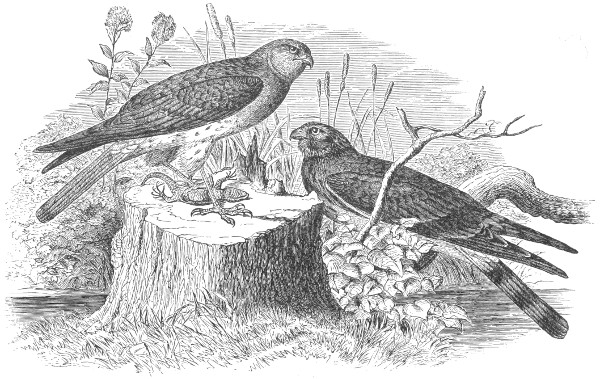
Circus hudsonius (male and female).
Mr. Dresser found them abundant throughout the whole country east of the Rio Nueces at all seasons of the year. They were more abundant in full blue plumage than elsewhere. Near San Antonio he met with them on the prairies, where they feed on the small green lizards which abound there, and which they are very expert in catching. Dr. Coues mentions them as very abundant in Arizona. Dr. Kennerly met with them on both sides of the Rio Grande wherever there was a marsh of any extent. Flying near the surface, just above the weeds and canes, they round their untiring circles hour after hour, darting after small birds as they rise from cover. Pressed by hunger, they will attack even wild Ducks. Dr. Kennerly also observed them equally abundant in the same localities in New Mexico. Dr. Newberry mentions finding this Hawk abundant beyond all parallel on the plains of Upper Pitt River. He saw several hundred in a single day’s march.
In Washington Territory both Dr. Suckley and Dr. Cooper found this Hawk abundant throughout the open districts, and especially so in winter. Dr. Cooper found it no less common in California, and among several hundreds saw but two birds in the blue plumage. Near Fort Laramie he found it no less common, but there, at least one half were in the blue plumage. From this he infers that the older birds seek the far interior in preference to the seaboard.
Mr. Allen mentions it as common in winter about the savannas in Florida, and Mr. Salvin states that it is a migratory species in Guatemala. It occurred in the Pacific Coast Region, and examples were also received from Vera Paz.
In evidence of the nomadic character of the Marsh Hawk it may be mentioned that specimens asserted to be of this species are in the Leyden Museum that were received from the Philippines and from Kamtschatka.
In Wilson’s time this Hawk was quite numerous in the marshes of New Jersey, Pennsylvania, and Delaware, where it swept over the low grounds, sailing near the earth, in search of a kind of mouse very common in such situations, and was there very generally known as the Mouse Hawk. It is also said to be very serviceable in the Southern rice-fields in interrupting the devastations made by the swarms of Bobolinks. As it sails low and swiftly over the fields, it keeps the flocks in perpetual fluctuation, and greatly interrupts their depredations. Wilson states that one Marsh Hawk was considered by the planters equal to several negroes for alarming the Rice-birds. Audubon, however, controverts this statement, and quotes Dr. Bachman to the effect that no Marsh Hawks are seen in the rice-fields until after the Bobolinks are gone. Dr. Coues, on the other hand, gives this Hawk as resident throughout the year in South Carolina.
According to Audubon, the Marsh Hawk rarely pursues birds on the wing, nor does it often carry its prey to any distance before it alights and devours it. While engaged in feeding, it may be readily approached, surprised, and shot. When wounded, it endeavors to make off by long leaps; and when overtaken, it throws itself on the back and fights furiously. In winter its notes while on the wing are sharp, and are said to resemble the syllables pee-pee-pee. The love-notes are similar to those of the columbarius.
Mr. Audubon has found this Hawk nesting not only in lowlands near the sea-shore, but also in the barrens of Kentucky and on the cleared table-lands of the Alleghanies, and once in the high covered pine-barrens of Florida.
After having paired, the Marsh Hawks invariably keep together, and labor conjointly in the construction of the nest, in sitting upon the eggs, and in feeding the young. Their nests are variously constructed as to materials, usually chiefly of hay somewhat clumsily wrought together into the form of a nest, but never very nicely interwoven; occasionally, in more northern localities, they are lined with feathers, in some cases with pine-needles and small twigs.
Richardson states that all the nests of this Hawk observed by him were built on the ground by the side of small lakes, of moss, grass, feathers, and hair, and contained from three to five eggs, of a bluish-white color, and unspotted. The latter measured 1.75 inches in length, and were an inch across where widest. The position and manner of constructing the nest correspond with my own experience, but the size of the eggs does not. The nests have been invariably on the ground, near water, built of dry grass, and lined with softer materials.
Mr. Audubon gives a very minute account of a nest which he found on Galveston Island, Texas. It was about a hundred yards from a pond, on a ridge just raised above the marsh, and was made of dry grass; the internal diameter was eight, and the external twelve inches, with the depth of two and a half. No feathers were found. This absence of a warm lining in Texas really proves nothing. A warm lining may be required in latitude 65° north, and the same necessity not found in one of 29°. A nest observed in Concord, Mass., by Dr. H. R Storer, was on the edge of a pond, and was warmly lined with feathers and fine grasses. Many other instances might be named.
The eggs found in the Galveston nest were four in number, smooth, considerably rounded or broadly elliptical, bluish-white, 1.75 inches in length, and 1.25 in breadth. Another nest, found under a low bush on the Alleghanies, was constructed in a similar manner, but was more bulky; the bed being four inches above the earth, and the egg slightly sprinkled with small marks of pale reddish-brown.
The prevalent impression that the eggs of this Hawk are generally unspotted, so far as I am aware, is not correct. All that I have ever seen, except the eggs above referred to from Texas, and a few others, have been more or less marked with light-brown blotches. These markings are not always very distinct, but, as far as my present experience goes, they are to be found, if carefully sought. In 1856 I received from Dr. Dixon, of Damariscotta, a nest with six eggs of a Hawk of this species. The female had been shot as she flew from the nest. With a single exception, all the eggs were very distinctly blotched and spotted. In shape they were of a rather oblong-oval, rounded at both ends, the smaller end well defined. They varied in length from 2.00 to 1.87 inches, and in breadth from 1.44 to 1.38 inches. Their ground-color was a dirty bluish-white, which in one was nearly unspotted, the markings so faint as to be hardly perceptible, and only upon a close inspection. In all the others, spots and blotches of a light shade of purplish-brown occured, in a greater or less degree, over their entire surface. In two, the blotches were large and well marked; in the others, less strongly traced, but quite distinct.
The nest was found in a tract of low land, covered with clumps of sedge, on one of which it had been constructed. It is described as about the size of a peck basket, circular, and composed entirely of small dry sticks, “finished off or topped out with small bunches of pine boughs.” There was very little depth to the nest, or not enough to cover the eggs from view in taking a sight across it. “No feathers were found in or about it. It was simply made of small dry sticks, about six inches thick, with about one inch of pine boughs for finishing off the nest.” The eggs were found about the 20th of May. They contained young at least two weeks advanced, showing that the bird began to lay in the latter part of April, and to sit upon her eggs early in the following month.
It will be thus seen that the eggs of this Hawk vary greatly in size and shape, and in the presence or absence of marking, varying in length from 1.75 to 2.00 inches, and in breadth from 1.25 to 1.50, and in shape from an almost globular
This Hawk was found breeding in the Humboldt Valley by Mr. C. S. M‘Carthy, on the Yellowstone by Mr. Hayden, at Fort Benton by Lieutenant Mullan, at Fort Resolution by Mr. Kennicott, at Fort Rae and at Fort Simpson by Mr. Ross, at La Pierre House by Lockhart, and on the Lower Anderson by Mr. MacFarlane.
Genus NISUS, Cuvier.
Accipiter, Briss. 1760. (Type, Falco nisus, Linn.)
Nisus, Cuv. 1799. (Same type.)
Astur, Lacép. 1801. (Type, Falco palumbarius, Linn.)
Dædalion, Savig. 1809. (Same type.)
Dædalium, Agass. (Same type.)
Sparvius, Vieill. 1816. (Same type.)
Jerax, Leach, 1816. (Same type.)
Aster, Swains. 1837. (Same type.)
Micronisus, Gray, 1840. (Type, Falco gabar, Daud.)
Phabotypus, Glog. 1842. (Same type.)
Hieraspiza, 1844, Jeraspiza, 1851, and Teraspiza, 1867, Kaup. (Type, Falco tinus, Latham.)
Hieracospiza, Agas. (Same type.)
Nisastur, Blas. 1844. (Same type.)
Urospiza, 1845, Urospizia, 1848, and Uraspiza, 1867, Kaup. (Type, Sparvius cirrhocephalus, Vieill.)
Leucospiza, Kaup, 1851. (Type, Falco novæ-hollandiæ, Gmel.)
Cooperastur, Bonap. 1854. (Type, Accipiter cooperi, Bonap.)
Erythrospiza, Kaup, 1867. (Type, A. trinotatus Temm.? not of Bonap. 1830!)
Gen. Char. Form slender, the tail long, the wings short and rounded, the feet slender, the head small, and bill rather weak. Bill nearly as high through the base as the length of the chord of the culmen, its upper outline greatly ascending basally; commissure with a prominent festoon. Superciliary shield very prominent. Nostril broadly ovate, obliquely horizontal. Tarsus longer than the middle toe, the frontal and posterior series of regular transverse scutellæ very distinct, and continuous, sometimes fused into a continuous plate (as in the Turdinæ!). Outer toe longer than the inner; claws strongly curved, very acute. Wing short, much rounded, very concave beneath; third to fifth quills longest; first usually shortest, never longer than the sixth; outer three to five with inner webs cut (usually sinuated). Tail long, nearly equal to wing, usually rounded, sometimes even, more rarely graduated (Astur macrourus) or emarginated (some species of subgenus Nisus).
Subgenera.
Less than one third of the upper portion of the tarsus feathered in front, the feathering widely separated behind; frontal transverse scutellæ of the tarsus and toes uninterrupted in the neighborhood of the digito-tarsal joint, but continuous from knees to claws. Tarsal scutellæ sometimes fused into a continuous plate … Nisus.
More than one third (about one half) of the upper portion of the tarsus feathered in front, the feathering scarcely separated behind; frontal transverse scutellæ of the tarsus and toes interrupted in the region of the digito-tarsal joint, where replaced by irregular small scales. Tarsal scutellæ never fused … Astur.
The species of this genus are exceedingly numerous, about fifty-seven being the number of nominal “species” recognized at the present date. Among so many species, there is, of course, a great range of variation in the details of form, so that many generic and subgeneric names have been proposed and adopted to cover the several groups of species which agree in certain peculiarities of external structure. That too many genera and subgenera have been recognized is my final conclusion, after critically examining and comparing forty of the fifty-seven species of Gray’s catalogue (Hand List of Birds, I, 1869, pp. 29–35). The variation of almost every character ranges between great extremes; but when all the species are compared, it is found that, taking each character separately, they do not all correspond, and cross and re-cross each other in the series in such a manner that it is almost impossible to arrange the species into well-defined groups. From this genus I exclude Lophospiza, Kaup (type, L. trivirgatus); Asturina, Vieill. (type, A. nitida); Rupornis, Kaup (type, R. magnirostris); Buteola, Dubus (= Buteo, type, B. brachyura, Vieill.); included by Gray under Astur, as subgenera, and Tachyspiza, Kaup (type, T. soloensis); and Scelospiza, Kaup (type, S. francesii); which are given by Gray as subgenera of Micronisus, Gray (type, Accipiter gabar), the species of the typical subgenus of which, as arranged in Gray’s Hand List, I refer to Nisus. All these excluded names I consider as representing distinct genera.
The species of this genus are noted for their very predatory disposition, exceeding the Falcons in their daring, and in the quickness of their assault upon their prey, which consists chiefly of small birds.
Subgenus NISUS, Cuvier.
Accipiter, Brisson, 1760.81
Nisus, Cuvier, 1799. (Type, Falco nisus, Linn.; A. fringillarius (Ray), Kaup.)
Jerax, Leach, 1816. (Same type.)
Cooperastur, Bonap. 1854. (Type, Accipiter cooperi, Bonap.)
Hieraspiza, 1844, Jeraspiza, 1851, and Teraspiza, 1867, Kaup. (Type, Falco tinus, Lath.)
Hieracospiza, Agass. (Same type.)
Urospiza, 1845, Urospizia, 1848, and Uraspiza, 1867, Kaup. (Type, Sparvius cirrhocephalus, Vieill.)
Erythrospiza, Kaup, 1867. (Type, A. trinotatus (Temm.?))
Micronisus, Gray, 1840. (Type, Falco gabar, Daud.)
Nisastur, Blas. 1844. (Same type.)
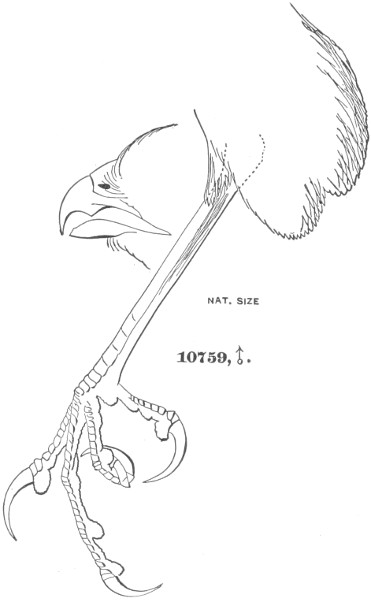
10759, ♂. NAT. SIZE
Nisus fuscus.
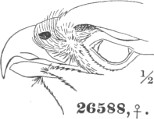
26588, ♀. ½
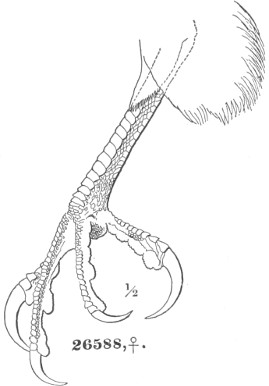
26588, ♀. ½
Nisus cooperi.
The species of this subgenus are generally of small size and slender form; but with a graceful and apparently delicate structure they combine remarkable strength and unsurpassed daring. They differ from the species of Astur mainly in less robust organization. The species are very numerous, and most plentiful within the tropical regions. The Old World possesses about thirty, and America about fifteen, nominal species. Several South American species are intimately related to the two North American ones, and may prove to be only climatic races of the same species; thus, erythrocnemis, Gray (Hand List, p. 32, No. 305) may be the intertropical form of fuscus, and chilensis, Ph. and Landb. (Hand List, No. 314), that of cooperi. But the material at my command is too meagre to decide this.
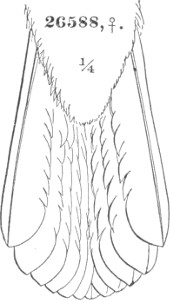
26588, ♀. ¼
Nisus cooperi.
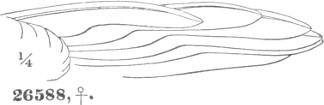
26588, ♀. ¼
Nisus cooperi.
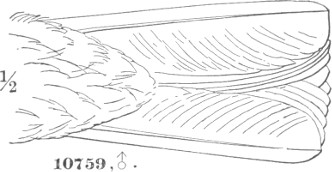
10759, ♂. ½
Nisus fuscus.
In consequence of the insufficient material for working up the South American species, I shall omit them all from the following synopsis of the North American species and races.82
Species and Races.
Common Characters. Adult. Above bluish slate-color; the tail with obscure bands of darker, and narrowly tipped with white. Beneath transversely barred with white and pinkish-rufous; the anal region and crissum immaculate white. Young. Above grayish umber-brown, the feathers bordered more or less distinctly with rusty; scapulars with large white spots, mostly concealed; tail-bands more distinct than in the adult. Beneath white, longitudinally striped with dusky-brown.
1. N. fuscus. Middle toe shorter than the bare portion of the tarsus, in front; tarsal scutellæ fused into a continuous plate in the adult male. Tail nearly even. Top of head concolor with the back; tail merely fading into whitish at the tip. Concealed white spots of the scapulars very large and conspicuous. Wing, 6.45–8.80; tail, 5.70–8.20; culmen, .40–.60; tarsus, 1.85–2.25; middle toe, 1.10–1.55. Hab. Whole of North America and Mexico.
2. N. cooperi. Middle toe longer than the bare portion of the tarsus, in front; tarsal scutellæ never fused. Tail much rounded. Top of the head much darker than the back; tail distinctly tipped with white; concealed white spots of the scapulars very small, or obsolete. Wing, 8.50–11.00; tail, 7.50–10.50; culmen, .60–.80; tarsus, 2.10–2.75; middle toe, 1.30–1.85. Hab. Whole of North America and Mexico.
Adult. Rufous markings beneath, in form of detached bars, not exceeding the white ones in width; dark slate of the pileum and nape abruptly contrasted with the bluish-plumbeous of the back; upper tail-coverts narrowly tipped with white; scapulars with concealed spots of white. Young. White beneath pure; tibiæ with narrow longitudinal spots of brown. Wing, 9.00–11.00; tail, 8.00–9.80; culmen, .65–.80; tarsus, 2.45–2.75; middle toe, 1.55–1.85. Hab. Eastern region of North America; Eastern Mexico … var. cooperi.
Adult. Rufous markings beneath, in form of broader bars, connected along the shaft, almost uniform on the breast; black of the pileum and nape fading gradually into the dusky plumbeous of the back; upper tail-coverts not tipped with white, and scapulars without concealed spots of the same. Young. White beneath strongly tinged with ochraceous; tibiæ with broad transverse spots of brown. Wing, 8.50–10.60; tail, 7.50–10.50; culmen, .60–.75; tarsus, 2.10–2.75; middle toe, 1.30–1.75. Hab. Western region of North America; Western Mexico … var. mexicanus.
Nisus fuscus (Gmel.) Kaup. SHARP-SHINNED HAWK.
Falco fuscus, Gmel. Syst. Nat. p. 283, 1789.—Lath. Ind. Orn. p. 43, 1790; Syn. I, 98, 1781; Gen. Hist. I, 283, 1821.—Mill. Cim. Phys. pl. xviii, 1796.—Daud. Tr. Orn. II, 86, 1800.—Shaw, Zoöl. VII, 161, 1809.—Aud. B. Am. pl. ccclxxiii, 1821; Orn. Biog. IV. 522, 1831.—Brew. (Wils.) Am. Orn. 685, 1852.—Peab. B. Mass. III, 78, 1841.—Thomp. Nat. Hist. Verm. p. 61, 1842.—Nutt. Man. 87, 1833. Accipiter fuscus, Bonap. Eur. & N. Am. B. p. 5, 1838; Consp. Av. 32, 1850.—Gray, List B. Brit. Mus. 38, 1844; Gen. B. fol. sp. 4, 1844.—Cass. B. Cal. & Tex. 95, 1854; Proc. Ac. Nat. Sc. Phil. 1855, 279; Birds N. Am. 1858, 18.—Strickl. Orn. Syn. I, 108, 1855.—Woodh. Sitgr. Exp. Zuñi & Colorad. p. 61, 1853.—Cooper & Suckley, P. R. R. Rep’t, VII, ii, 146, 1860.—Heerm. Williamson’s Rep. 33.—Newb. Williamson’s Rep. 74.—Coues, Pr. Ac. Nat. Sc. Phil. Jan. 1866, p. 7.—Blakist. Ibis, III, 1861, 317 (fresh eggs).—Gray, Hand List, I, 32, 1869. Astur fuscus, De Kay, N. Y. Zoöl. II, 17, pl. ii, fig. 2 (juv. ♂), 1844.—Giraud, B. Long Isl’d, p. 19, 1844. Nisus fuscus, Kaup, Monog. Falc. Cont. Orn. 1850, p. 64. Falco dubius, Gmel. Syst. Nat. 1789, p. 281.—Lath. Ind. Orn. p. 43, 1790; Syn. Supp. I, 37, 1802; Gen. Hist. I, 279, 1821.—Daud. Tr. Orn. 1800, II, 122. Falco velox, Wils. Am. Orn. pl. xlv, f. 1, 1808.—Bonap. An. Lyc. N. Y. II, 29, 1433; Isis, 1832, p. 1137. Accipiter velox, Beech. Voy. Zoöl. p. 15. Astur velox, James. (Wils.) Am. Orn. I, 68, 1831. Falco pennsylvanicus, Wils. Am. Orn. pl. xlvi, fig. 1, 1808.—Lath. Gen. Hist. I, 280, 1820.—Temm. Pl. Col. 67. Accipiter pennsylvanicus, Vig. Zoöl. Journ. I, 338.—Steph. Zoöl. XIII, ii, 32, 1815.—Rich. Faun. Bor.-Am. II, 44, 1831.—Jard. (Wils.) Am. Orn. II, pp. 210, 215, 1832.—Swains. Classif. B. II, 215, 1837. Astur pennsylvanicus, Less. Man. Orn. I, 92.—James. (Wils.) Am. Orn. I, 70, 1831. Nisus pennsylvanicus, Cuv. Règ. An. (ed. 2), I, 334, 1829.—Less. Tr. Orn. p. 59, 1831. Falco columbarius, var., Shaw. Zoöl. VII, 189, 1809. Accipiter ardosiacus, Vieill. Enc. Méth. III, 1274, 1823. Accipiter fringilloides (not of Vigors!), Jard. (Wils.) Am. Orn. II, 215, 1832. ? Nisus pacificus, Lesson, Man. et d’Oiseaux, 1847, 177 (Acapulco to California. Square tail). Accipiter fuscus, Brewer, Oölogy, 1857, 18, pl. III, f. 23, 29; pl. V, f. 54.
Sp. Char. Adult male (11,990, District of Columbia; A. J. Falls). Above deep plumbeous, this covering head above, nape, back, scapulars, wings, rump, and upper tail-coverts; uniform throughout, scarcely perceptibly darker anteriorly. Primaries and tail somewhat lighter and more brownish; the latter crossed by four sharply defined bands of brownish-black, the last of which is subterminal, and broader than the rest, the first concealed by the upper coverts; tip passing very narrowly (or scarcely perceptibly) into whitish terminally. Occipital feathers snowy-white beneath the surface; entirely concealed, however. Scapulars, also, with concealed very large roundish spots of pure white. Under side of primaries pale slate, becoming white toward bases, crossed by quadrate spots of blackish, of which there are seven (besides the terminal dark space) on the longest. Lores, cheeks, ear-coverts, chin, throat, and lower parts in general, pure white; chin, throat, and cheeks with fine, rather sparse, blackish shaft-streaks; ear-coverts with a pale rufous wash. Jugulum, breast, abdomen, sides, flanks, and tibiæ with numerous transverse broad bars of delicate vinaceous-rufous, the bars medially somewhat transversely cordate, and rather narrower than the white bars; laterally, the pinkish-rufous prevails, the bars being connected broadly along the shafts; tibiæ with rufous bars much exceeding the white ones in width; the whole maculate region with the shaft of each feather finely blackish. Anal region scarcely varied; lower tail-coverts immaculate, pure white. Lining of the wing white, with rather sparse cordate, or cuneate, small blackish spots; axillars barred about equally with pinkish-rufous and white. Wing, 6.60; tail, 5.70; tarsus, 1.78; middle toe, 1.20. Fifth quill longest; fourth but little shorter; third equal to sixth; second slightly shorter than seventh. Tail perfectly square.
Adult female (19,116, Powder River; Captain W. F. Raynolds, U. S. A.). Scarcely different from the male. Above rather paler slaty; the darker shaft-streaks rather more distinct than in the male, although they are not conspicuous. Beneath with the rufous bars rather broader, the dark shaft-streaks less distinct; tibiæ about equally barred with pinkish-rufous and white. Wing, 7.70; tail, 6.90; tarsus, 2.10; middle toe, 1.40. Fourth and fifth quills equal and longest; third equal to sixth; second equal to seventh; first three inches shorter than longest.
Young male (41,890, Philadelphia; J. Krider.) Above umber-brown; feathers of the head above edged laterally with dull light ferruginous; those of the back, rump, the upper tail-coverts, scapulars, and wing-coverts bordered with the same; scapulars and rump showing large, partially exposed, roundish spots of pure white. Tail as in adult. Sides of the head and neck strongly streaked, a broad lighter supraoral stripe apparent. Beneath white, with a slight ochraceous tinge; cheeks, throat, and jugulum with fine narrow streaks of dusky-brown; breast, sides, and abdomen with broader longitudinal stripes of clear umber (less slaty than the back), each with a darker shaft-line; on the flanks the stripes are more oval; tibiæ more dingy, markings fainter and somewhat transverse; anal region and lower tail-coverts immaculate white.
Young female (12,023, Fort Tejon, California; J. Xantus). Similar in general appearance to the young male. Markings beneath broader, and slightly sagittate in form, becoming more transverse on the flanks; paler and more reddish than in the young male; tibiæ with brownish-rufous prevailing, this in form of broad transverse spots.
Hab. Entire continent of North America, south to Panama; Bahamas (but not West Indies, where replaced by A. fringilloides, Vig.).
Localities: Oaxaca (Scl. 1858, 295); Central America (Scl. Ibis, I, 218); Bahamas (Bryant, Pr. Bost. Soc. VII, 1859); City of Mexico (Scl. 1864, 178); Texas, San Antonio (Dresser, Ibis, 1866, 324); Western Arizona (Coues); Mosquito Coast (Scl. & Salv. 1867, 280); Costa Rica (Lawr. IX, 134).
LIST OF SPECIMENS EXAMINED.
National Museum, 51; Philadelphia Academy, 14; New York Museum, 7; Boston Society, 5; Museum, Cambridge, 9; Cab. G. N. Lawrence, 1; Coll. R. Ridgway, 4; Museum W. S. Brewer, 1. Total, 92.
Measurements.
Sex. Wing. Tail. Culmen. Tarsus. Middle Toe. Specimens.
♂ 6.45–7.00 5.70–5.90 .40–.001.85–1.95 1.10–1.20 30
♀ 7.50–8.80 6.90–8.20 .50–.60 2.20–2.25 1.45–1.55 40
Specimens from different regions vary but little in size. The largest are 4,198, ♀, San Francisco, Cal., winter, 16,957, ♀, Hudson’s Bay Territory, and 55,016, ♀, Mazatlan, Mexico, in which the wing ranges from 8.40 to 8.50, the tail 7.00. The smallest females are 45,826, Sitka, Alaska, and 11,791, Simiahmoo, W. T., in which the wing measures about 7.80. A female (32,499) from Orizaba, Mexico, one (8,513) from Fort Yuma, Cal., and one (17,210) from San Nicholas, Lower California, have the wing 8.00, which is about the average. The largest males are 54,336, Nulato, Alaska, 58,137, Kodiak, Alaska, 27,067, Yukon, mouth of Porcupine, and 55,017, Mazatlan, Mexico, in which the wing measures 7.00, the tail 5.60. The smallest males are 5,990, Orange, N. J., 8,514, Shoalwater Bay, W. T., 21,338, Siskiyou Co., Cal., 37,428, Orizaba, Mexico, and 5,584, Bridger’s Pass, Utah; in this series the wing measures 6.50–6.70, the tail 5.40–5.60. A specimen from Costa Rica measures: wing 6.70, tail 5.35. Thus the variation in size will be seen to be an individual difference, rather than characteristic of any region. Some immature specimens from the northwest coast of North America (as 45,828, ♂, Sitka, Rus. Am., 5,845, ♂, Fort Steilacoom, W. T., 11,791, Simiahmoo, Puget Sound, and 8,514, Shoalwater Bay, W. T.) are much darker than others, the brown above inclining to blackish-sepia; no other differences, however, are observable. An adult from the Yukon (54,337, ♀) has the rufous bars beneath remarkably faint, although well defined; another (19,384, ♀, Fort Resolution), in immature plumage, has the longitudinal markings beneath so faint that they are scarcely discernible, and the plumage generally has a very worn and faded appearance. A male in fine plumage (10,759, Fort Bridger, Utah) has the delicate reddish-rufous beneath so extended as to prevail, and with scarcely any variegation on the sides and tibiæ; the bars on the tail, also, are quite obsolete.
Habits. This species is one of the most common Hawks of North America, and its geographical range covers the entire continent, from Hudson’s Bay to Mexico. Sir John Richardson mentions its having been met with as far to the north as latitude 51°. Drs. Gambel and Heermann, and others, speak of it as abundant throughout California. Audubon found it very plentiful as far north as the southern shore of the Gulf of St. Lawrence. It has been obtained in New Mexico by Mr. McCall, in Mexico by Mr. Pease, in Washington Territory by Dr. Cooper and Dr. Suckley, in Alaska by Mr. Dall, at Fort Resolution by Mr. Kennicott, at Fort Simpson by Mr. B. R. Ross, etc. Messrs. Sclater and Salvin give it as a rare visitant of Guatemala. It has been ascertained to breed in Massachusetts, New Jersey, Wisconsin, California, and Pennsylvania, and it probably does so not only in the intervening States and Territories, but also in all, not excepting the most southern, Florida, where its nest was found by Mr. Wurdemann.
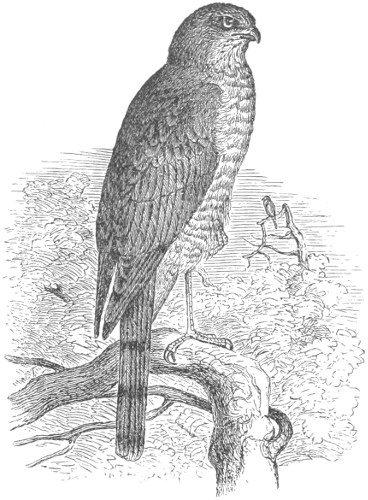
Nisus fuscus.
Dr. Woodhouse, who frequently observed this bird skimming over the prairies while in search of its prey, states that its flight is so peculiar that there is no difficulty in recognizing it, when taken in connection with its form, short wings, and long tail, being very swift and irregular in its movements, first high in the air, then close to the ground, suddenly disappearing among the grass when it has seized the object of which it was in pursuit.
Mr. Dresser met with this Hawk in Texas, but nowhere south or west of San Antonio, where it remains through the breeding-season, nesting in the dense cedar-thickets.
Mr. Audubon regarded it as the very miniature of the Goshawk, in its irregular, swift, vigorous, varied, and yet often undecided, manner of flight, and on occasion greatly protracted. When in search of its prey, it is said to pass over the country, now at a moderate height, now close over the land, and with a surprising swiftness. It advances by sudden dashes, and pounces upon the object of its pursuit so suddenly as to render hopeless any attempt to escape. It has frequently been known to seize and kill a bird so large that it was unable to carry it, and had to drop to the ground with it. In one instance Mr. Audubon saw it strike a Brown Thrush, which it had darted into a thicket of briers to seize, emerging at the opposite side. As Mr. Audubon ran up, the Hawk attempted twice to rise with its prey, but was unable to carry it off, and relinquished it. The Thrush was quite dead, and had evidently been killed instantly.
Mr. Downes, of Halifax, who speaks of this Hawk as common in Nova Scotia, breeding all over that province, adds that it does not molest the poultry-yards, being too weak to attack large prey. But this is not universally the case. They are frequently destructive both to dove-cots and to the younger inhabitants of the poultry-yard. Mr. Nuttall narrates that in the thinly settled parts of Alabama and Georgia it seemed to abound, and was very destructive to young chickens, a single one having been known to come regularly every day until it had carried off twenty or thirty. He was eyewitness to one of its acts of robbery, where, at noonday and in the near presence of the farmer, the Hawk descended and carried off one of the chickens. In another instance the same writer mentions that one of these Hawks, descending with blind eagerness upon its prey, broke through the glass of the greenhouse at the Cambridge Botanic Garden, fearlessly passed through a second glass partition, and was only brought up by a third, when it was caught, though very little injured.
At times this Hawk is seen to fly high, in a desultory manner, with quick but irregular movements of the wings, now moving in short and unequal circles, pausing to examine the objects below, and then again descending rapidly and following a course only a few feet from the ground, carefully examining each patch of small bushes in search of small birds.
Besides the smaller birds, young chickens, and pigeons, this Hawk has been known to occasionally feed on small reptiles and insects, as also upon the smaller quadrupeds.
Mr. Audubon speaks of having met with three nests of this species, and all in different situations. One was in a hole in a rock on the banks of the Ohio River; another was in the hollow of a broken branch, near Louisville, Ky., and the third in the forks of a low oak, near Henderson, Ky. In the first case, the nest was slight, and simply constructed of a few sticks and some grasses, carelessly interwoven, and about two feet from the entrance of the hole. In the second instance there was no nest whatever, but in the third the birds were engaged in the construction of an elaborate nest. The number of the eggs was four in one instance, and five in another. He describes them as almost equally rounded at both ends; their ground-color white, with a livid tinge, but scarcely discernible amid the numerous markings and blotches of reddish-chocolate with which they were irregularly covered. In a nest which was large and elaborately constructed of sticks, and contained five eggs, found by Dr. H. R. Storer in Concord, Mass., there was a single egg which nearly corresponds with this description. It is, however, the only one among many specimens that at all agrees with it. This specimen is a little more than usually elongate, and its ground-color, which is a purplish-white, is nearly concealed by its blotches of various shades of sepia-brown. In every other instance the egg is very nearly spherical, the ground-color white, and beautifully marked with large confluent blotches of sepia, varying in depth from quite a light to a very dark shade. In one, these confluent markings form a broad belt around the centre of the egg. In others, they are chiefly distributed about the larger end. The contrast between the white ground and the dark confluent dashes of brown is very striking. Except in size, the eggs of this bird bear a marked resemblance to those of the Sparrow Hawk of Europe. In a few instances, the brown markings have an intermixture of red and purple. The egg measures 1.35 by 1.15 inches.
In nearly every instance the nest of this Hawk has been constructed in trees. It is usually large in proportion to the size of the bird, and its materials are somewhat elaborately put together; it is composed chiefly of large sticks and twigs, and the whole platform is covered with a thin lining of dry leaves, mosses, grass, etc. Mr. John Krider, of Philadelphia, found a nest in New Jersey, in the vicinity of that city, which was built on the edge of a high rock.
Mr. Robert Kennicott met with the nest of this species at Fort Resolution. It was composed entirely of small dry spruce twigs, with the exception of a half-dozen small flat bits of the scaly outer bark of the spruce, laid in the bottom, and forming a sort of lining. No feathers or other softer materials were used. The nest was shallow and broad. The base was about eighteen inches in diameter, and was about eight feet from the ground. It was in a small spruce in a thick wood and on high ground. When disturbed, the female flew off a short distance; but on Mr. Kennicott’s hiding himself returned and flew near the nest, continually uttering a harsh rapid note. Near the nest were marks indicating the place where the male passed the nights perched on a dry stick near the ground.
Mr. B. R. Ross observed these birds nesting thickly along the cliffs of the Upper Slave River. They were more rare northward of Fort Simpson than F. columbarius.
Mr. William Street, of Easthampton, informs me that he has found this Hawk nesting on Mount Tom, where he has known of six of their nests in one season. In the spring of 1872 he found three nests, on the 24th and 25th of May. They contained two eggs each. One of these, on the 27th contained three eggs, of which he took one; on the 3d of June two more eggs had been laid. Two of these were taken, after which the birds deserted the nest and resorted to an old squirrel’s nest, where they had four more eggs, depositing one every third day. They arrive at Mount Tom about the 1st of May. Their nests are made entirely of sticks, larger on the outside, and smaller within. They usually build in a hemlock-tree, selecting a thick clump. They are very noisy when they are at work building their nest, and often betray their presence by their cries. The younger the pair the more noisy they are. This Hawk appears to live nearly altogether on small birds. Mr. Street mentions having found ten or twelve skeletons in a single nest of this species.
Nisus cooperi (Bonap.). Var. cooperi, Bonap. COOPER’S HAWK.
Falco cooperi, Bonap. Am. Orn. pl. x, fig. 1, 1825; Ann. Lyc. N. Y. II, 433; Isis, 1832, 1137.—James. (Wils.) Am. Orn. IV, 1831, 3.—Peab. B. Mass. III, 78. Accipiter cooperi, Gray, List B. Brit. Mus. 38, 1844; Gen. B. fol. sp. 6.—Cass. Birds Cal. & Tex. p. 96, 1854; Birds N. Am. 1858, 16.—Sclat. Pr. Z. S. 1859, 389 (difference from A. pileatus, Max.).—Heerm. P. R. R. Rep’t, VII, 31, 1857.—Coop. & Suckl. P. R. R. Rep’t, XII, ii, 145, 1860.—Coues, Prod. Orn. Ariz. p. 7, 1866.—Dresser, Ibis, 1865, 323 (Texas).—Blakist. Ibis, III, 1861, 317.—Scl. & Salv. Ex. Orn. I, 1869, 170.—Gray, Hand List, I, 32, 1869. Astur cooperi, Jard. (Wils.) Am. Orn. III, 363, 1832.—Bonap. List, p. 5; Rev. Zool. 1850, 489; Consp. Av. 31.—De Kay, Zoöl. N. Y. II, 18, pl. iv, p. 5.—Newb. P. R. R. Rep’t, VI, iv, 74, 1857.—Max. Cab. Journ. VI, 1858, 13. Falco stanleyi, Aud. B. Am. pls. xxxvi, cxli; Orn. Biog. I, 186. Accipiter pileatus (not of Max.!), Strickl. Orn. Syn. I, 109, 1855. Accipiter cooperi, Brewer, Oölogy, 1857, 20, pl. v, f. 55.
Sp. Char. Adult male (No. 10,086). Forehead, crown, and occiput blackish-plumbeous; the latter snowy-white beneath the surface; rest of upper parts slaty-plumbeous, the nape abruptly lighter than the occiput; feathers of the nape, back, scapulars, and rump with darker shaft-lines; scapulars with concealed cordate and circular spots of white; upper tail-coverts sharply tipped with white. Tail more brownish than the rump, sharply tipped with pure white, and crossed with three broad, sharply defined bands of black, the first of which is concealed, the last much broadest; that portion of the shaft between the two exposed black bands white. Lores grayish; cheeks and throat white, with fine, hair-like shaft-streaks of blackish; ear-coverts and sides of neck more ashy, and more faintly streaked. Ground-color beneath pure white; but with detached transverse bars of rich vinaceous-rufous, crossing the jugulum, breast, sides, flanks, abdomen, and tibiæ; the white bars everywhere (except on sides of the breast) rather exceeding the rufous in width; all the feathers (except tibial plumes) with distinct black shaft-lines; lower tail-coverts immaculate, pure white. Lining of the wing white, with numerous cordate spots of rufous; coverts with transverse blackish bars; under side of primaries silvery-white, purest basally (tips dusky), crossed with quadrate bars of dusky, of which there are six (the first only indicated) upon the longest quill (fourth). Wing, 9.20; tail, 7.80; tarsus, 2.35; middle toe, 1.60. Fourth quill longest; third shorter than fifth; second intermediate between sixth and seventh; first, 2.80 shorter than longest; graduation of tail, 1.00.
Adult female (26,588, Washington, D. C.; Elliott Coues). Similar to the male. Forehead tinged with brownish; upper plumage much less bluish. Neck and ear-coverts uniformly rufous, with black shaft-streaks, there being no ashy wash as in the male. Tail decidedly less bluish than in the male, crossed with four bands, three of which are exposed. The rufous bars beneath less vinaceous than in the male, but of about the same amount, rather predominating on the tibiæ. Wing, 10.70; tail, 9.00; tarsus, 2.45; middle toe, 1.80. Fourth and fifth quills longest and equal; third longer than sixth; second intermediate between sixth and seventh; first three inches shorter than longest.
Young male (55,498, Fort Macon, N. C., February; Dr. Coues). Above grayish-umber; feathers of forehead, crown, and nape faintly edged laterally with pale rusty; occiput unvaried blackish, feathers white beneath the surface. Wing-coverts, scapulars, and interscapulars narrowly bordered with pale yellowish-umber; rump and upper tail-coverts bordered with rusty. Tail paler umber than the back, narrowly tipped with white, and crossed by four bands of brownish-black, the first of which is only partially concealed. Scapulars and upper tail-coverts showing much concealed white, in form of roundish spots, on both webs. Beneath clear white, without any yellowish tinge; throat with a medial and lateral series of clear dark-brown streaks; jugulum, breast, sides, flanks, and abdomen with numerous stripes of clear sepia, each showing a darker shaft-streak; tibiæ with longitudinal streaks of paler and more rusty brown; lower tail-coverts immaculate.
Young female (6,876 “Sacramento Valley, Cal.”; Dr. Heermann—probably from Pennsylvania). Similar to young male; more varied, however. The black middle streaks of feathers of head above narrower, causing more conspicuous streaks; white spots of scapular region considerably exposed; longitudinal stripe beneath narrower and more sparse.
Hab. North America in general, but rare in the western division; Eastern Mexico. Not found in West Indies, where replaced by A. gundlachi, Lawr.
Localities: Southeastern Texas (Dresser, Ibis, 1865, 323, breeds); Arizona (Coues, Prod. 1866, 43); Costa Rica (Lawr. IX, 134).
LIST OF SPECIMENS EXAMINED.
National Museum, 12; Philadelphia Academy, 16; New York Museum, 3; Boston Society, 2; Cambridge Museum, 1; Cab. G. N. Lawrence, 7; Coll. R. Ridgway, 4; Museum, W. S. Brewer, 1. Total, 46.
Measurements.
Sex. Wing. Tail. Culmen. Tarsus. Middle Toe. Specimens.
♂ 9.00–9.30 8.00–8.50 .65–.002.45–2.65 1.55–1.60 7
♀ 10.20–11.00 9.00–9.80 .75–.80 2.60–2.75 1.65–1.85 12
Var.mexicanus, Swainson. MEXICAN BLUE-BACKED HAWK.
Accipiter mexicanus, Swains. F. Bor.-Am. II, 1831, 45.—Jard. (ed. Wils.) Am. Orn. II, 1832, 215.—Bonap. Consp. 32 (under A. fuscus).—Cass. B. Cal. & Tex. 96.—Ib. P. A. N. S. 1855, 279; Birds N. Am. 1858, 17.—Coop. & Suckl. P. R. R. Rep’t, VII, ii, 1860, 146.—Coues, P. A. N. S. Philad. 1866, 18.—Gray, Hand List, I, 1869, 33.
Adult male (12,024, Fort Tejon, Cal.; J. Xantus). Forehead, crown, and occiput plumbeous-black, feathers of the latter with basal two-thirds snowy-white, partially exposed. Upper plumage deep plumbeous, darkest anteriorly, the back being scarcely lighter than the nape; rump fine bluish-plumbeous. No concealed white on the upper parts. Tail brownish-plumbeous, narrowly tipped with pure white, and with four sharply defined broad bands of black,—the first of which is faintest, and concealed by the coverts, the last broadest; shafts of tail-feathers deep brown throughout. Primaries and secondaries much darker than the tail, more bluish; less so, however, than the scapulars. Lores whitish, quite in contrast with the black of the forehead; cheeks and ear-coverts dark ashy, slightly washed with reddish, and with obscure darker streaks; chin and throat white, with sparse hair-like shaft-streaks of black. Breast, abdomen, sides, flanks, and tibiæ fine vinaceous-rufous; feathers (except on tibiæ) with fine hair-like shaft-streaks of black (much narrower than in cooperi); breast, abdomen, sides, and flanks with pairs of transverse ovoid white spots, not touching the shaft; on the abdomen the white and rufous bars are of about equal width; on the tibiæ the rufous is deepest, and exceeds the white; anal region barred with rufous, more faintly than the abdomen; lower tail-coverts snowy-white. Sides of the neck deep reddish-ashy, this washing the whole side of the breast. Lining of the wing reddish-white, with numerous crowded, cordate, somewhat blended spots of rufous; larger coverts transversely spotted with blackish; under side of primaries silvery-white (blackish for about the terminal inch), crossed with quadrate spots of blackish, of which there are about seven on the longest quill (fourth); the basal ones are, however, so much broken, that the number varies in different individuals.
Young male (Fort Tejon, California). Forehead, crown, occiput, and nape deep rusty-rufous; feathers with broad longitudinal streaks of pure black. Rest of upper parts deep umber, darkest on the back; feathers of back and rump, the upper tail-coverts, scapulars, and wing-coverts, broadly bordered with rusty; scapulars with concealed white spots. Tail ashy-umber, tipped (more broadly than in adult) with ashy-white, crossed by four broad bands of brownish-black; the last (or subterminal) of which is broadest, the first concealed by the coverts. Secondaries and primaries similar in color to the tail, but darker; the first showing five obsolete darker bands, and tipped (rather broadly) with pale cinnamon-rufous. Ear-coverts and cheeks fulvous-white, thickly streaked with dark brown. Lower parts white, washed with ochraceous on jugulum and breast; each feather with a central longitudinal lanceolate stripe of clear umber, the shaft of each black; these streaks are very narrow on the throat, broadest on the breast and flanks. Tibiæ with transversely ovate spots, and transverse bars of reddish-umber; lower tail-coverts with narrow shaft-streaks of darker brown. Lining of wing with cordate and ovate spots of dark brown.
Young female (42,136, Orizaba, Mexico; M. Botteri). Similar to the young male; feathers of back, etc., less broadly margined with rusty. Ochraceous wash on lower parts more decided; stripes beneath broader and less lanceolate; on the sides broadly ovate, and on the flanks in form of broad transverse bars; tibiæ more thickly spotted transversely; lower tail-coverts immaculate. Wing, 9.00; tail, 7.80; tarsus, 2.25; middle toe, 2.50. Fourth quill longest; third shorter than fifth; second intermediate between sixth and seventh; first, 2.90 shorter than longest. Graduation of tail, .90.
Hab. Western region of North America; Mexico.
LIST OF SPECIMENS EXAMINED.
National Museum, 22; Boston Society, 2; Museum, Cambridge, 2; Cab. G. N. Lawrence, 2; Philadelphia Academy, 2; Coll. R. Ridgway, 2. Total, 32.
Measurements.
Sex. Wing. Tail. Culmen. Tarsus. Middle Toe. Specimens.
♂ 8.50–9.85 7.50–9.20 .60–.70 2.10–2.75 1.30–1.65 24
♀ 10.20–10.60 9.30–10.50 .70–.75 2.65–2.75 1.65–1.75 4
Habits. This common Hawk appears to have a very general distribution over the United States, from South Carolina to New Brunswick, on the Atlantic; from Texas, New Mexico, and Arizona, in the interior, to the Saskatchewan, and from Southern California to Washington Territory, on the Pacific. Mr. Boardman mentions it as found near Calais, but rare. Mr. Verrill cites it as occurring in Western Maine, but not common. I have received its eggs from South Carolina, where it is resident throughout the year. Mr. Dresser met with it not uncommon near San Antonio, and found it breeding on the Altascosa and Medina Rivers. Dr. Coues says it is generally distributed throughout the Territory of Arizona. Dr. Newberry found it common about San Francisco, and extending north of the Columbia River. Mr. A. Schott obtained a specimen on the Colorado River in Southern California, and Dr. Gambel and Dr. A. L. Heermann speak of it as common throughout that State, while Dr. Cooper and Dr. Suckley mention it as frequent both in Oregon and in Washington Territory. A single specimen was taken by Mr. Salvin in Guatemala. Dr. Cooper states that this Hawk is often killed about the farm-yards of Washington Territory, where it seizes on chickens before the very eyes of the owner, darting down like lightning, and disappearing again before he can see what has caused the disturbance. It is said to be a constant resident, and to breed within the Territory.
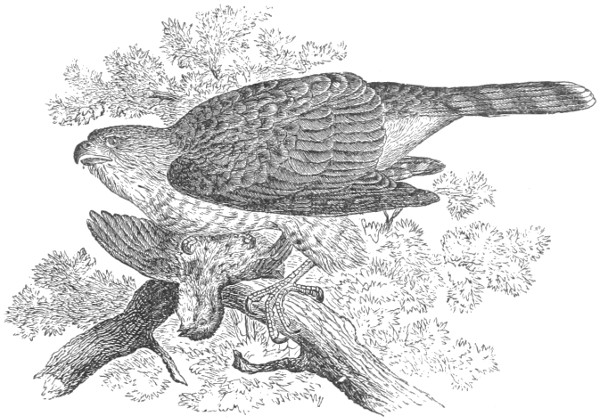
Nisus cooperi.
Mr. Audubon describes the flight of this Hawk as rapid, protracted, and even, and as performed at a short distance from the ground, or over the forest. It is said to move along in a silent gliding manner, and with a swiftness even superior to that of the Wild Pigeon, rarely deviating from a straight course except to seize its prey, and seldom mounting in the air in circles. It is very bold and daring, Mr. Audubon having known one to attack and kill a cock much larger and heavier than itself. It frequently attacks and kills the common Ruffed Grouse. It breeds in especial abundance in the Middle States, and particularly along the banks of the Potomac River. I have received reliable information of its nesting in Vermont, Massachusetts, Ohio, Illinois, Wisconsin, Maryland, Virginia, and South Carolina, and probably nearly all of the States. Mr. Gosse did not meet with it in Jamaica.
Mr. Audubon states that he found its nest usually placed in the forks of the branch of an oak-tree, towards its extremity. In general appearance it resembles that of the common Crow, being composed externally of numerous crooked sticks, and having a slight lining of grasses and a few feathers. The eggs he describes as three or four in number, almost globular, large for the size of the bird, of a dull white color, granulated and rough to the touch.
Dr. Hoy, in a communication to the Boston Natural History Society, mentions finding four nests of this Hawk in a single season, and his careful observations of the habits of the parent birds enabled him to ascertain that in each instance the birds began to sit constantly upon their nest as soon as a single egg had been deposited, and that, as a consequence, the eggs having been deposited at varying intervals, each one was found in a different stage of incubation from the other. In not a single instance did he visit a nest without finding the parent bird occupying it.
These nests were all composed of sticks, rudely lined with strips of bark and a few bunches of Usnea barbata. The nests were quite shallow and small for a Hawk. Most of the eggs were sparingly sprinkled with umber-brown. One set of these eggs was blotched with bluish-green, which soon faded out. While the nests were being molested, the parent Hawk would fly from tree to tree, uttering, in rapid succession, quick-quick-quick-quick.
Dr. Hoy states that the male of this species, during the nesting-season, may frequently be seen flying high in the air, sporting, vaulting, and turning somersaults on the wing, which habit has given to it the name of Tumbler-Hawk. No Hawk is harder to shoot, and none commits greater havoc among barn-yard fowls than this species. He has seen one strike a large hen while she was flying wildly for safety, and kill her on the spot, though it was obliged to abandon the game, as it proved too heavy to carry off.
I have specimens of its eggs from South Carolina, obtained by the young sons of Rev. M. A. Curtis, of Society Hill. Mr. Curtis, Sen., furnished me with the following description of its nest: “The nest of the Cooper’s Hawk was built in the triple fork of a tall black gum (Nyssa multiflora), near the top of the tree, which stood in a swamp. It was formed of a layer of small sticks, ⅓ to ½ inch in diameter. Its external diameter varied from 1½ to 2 feet. This layer was ⅞ of an inch in thickness, with only a slight depression in the centre, hardly enough to keep the eggs from rolling out. A few thin pieces of pine bark formed the bed for the eggs.”
Another nest, obtained in Randolph, Vt., by Charles S. Paine, Esq., is thus described by him: “The nest was built of hemlock twigs, and lined with small, thin pieces of hemlock bark, such as hang loosely on the tree. The Hawk, when the nest was approached, did not whistle, as some others of that family do, but uttered a cry of ge! ge! ge! ge! This was repeated several times, with great rapidity, by both male and female.”
The average size of the eggs of this bird is 1.56 by 1.94 inches. The color is usually a uniform dull white, but is occasionally tinged with as light bluish shade. They are nearly spherical, though not more so than the eggs of several species, and are equal at either end. Their surface is slightly granulated. The number of the eggs varies from three to four, though occasionally there are five in a nest.
The maximum length of the egg of this species is 2.00 inches, the minimum 1.85; the maximum breadth 1.60, the minimum 1.50 inches. In occasional instances I have known the eggs of this species more or less distinctly marked, especially about the larger end, with blotches of a light yellowish-brown. Those most distinctly marked in this manner were taken and identified by Mr. Paine.
A nest of this Hawk, found by Dr. J. W. Velie, was built on a poplar-tree, about forty feet from the ground, and was composed of sticks and lined with moss and leaves. There was a small cleared space of three or four rods in extent, in the middle of which the tree stood, and about a quarter of a mile from the main channel of the Mississippi River, on Rock Island.
The Cooper Hawk was found on Mount Tom by Mr. William Street, nesting for the most part in pine or hemlock trees, usually choosing one in a thick clump. They begin to lay about the first of May, usually depositing four eggs. They are very shy, and it is almost impossible to get within shot of them, even when they have young. They rarely molest the poultry-yard, but seem to live chiefly on small birds and animals. They leave their nest at once whenever it is approached, and will not return until the intruder has gone.
The var. mexicanus, originally described by Mr. Swainson from Mexican specimens obtained near Real del Monte, has been ascertained to cross our boundaries, and is found in all the territory between the Rocky Mountains and the Pacific, as far north as Washington Territory. Dr. Cooper has never met with this Hawk, but supposes its general habits, and especially those regulating its migrations, closely resemble those of A. cooperi, to which the bird itself, in all but size, is so similar. Dr. Coues speaks of it as a common resident species in Arizona. He states that he has seen young birds of this species, reared by the hand from the nest, become so thoroughly domesticated as to come to their master on being whistled for, and perch on his shoulder, or follow him when shooting small birds for their food. They were allowed their entire liberty. Their ordinary note was a shrill and harsh scream. A low, plaintive, lisping whistle was indicative of hunger.
Dr. Suckley, who met with this bird on Puget Sound, where a specimen was shot on a salt marsh, states that, while soaring about, it resembled in its motions the common Marsh Hawk, or Hen Harrier (Circus hudsonius).
Subgenus ASTUR, Lacepede.
Astur, Lacép. 1800. (Type, Falco palumbarius, Linn.)
Dædalion, Savig. 1809. Dædalium, Agass.
Sparvius, Vieill. 1816.
Aster, Swains. 1837.
Leucospiza, Kaup, 1844. (Type, Falco novæ-hollandiæ, Gmel.)
The characters of this subgenus have been sufficiently indicated on page 221, so that it is unnecessary to repeat them here. The species of Astur are far less numerous than those of Nisus, only about six, including geographical races, being known. They are found in nearly all parts of the world, except tropical America, the Sandwich Islands, and the East Indies.
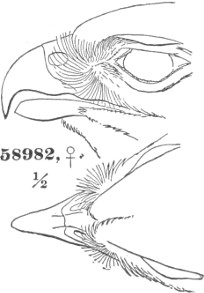
58982, ♀. ½
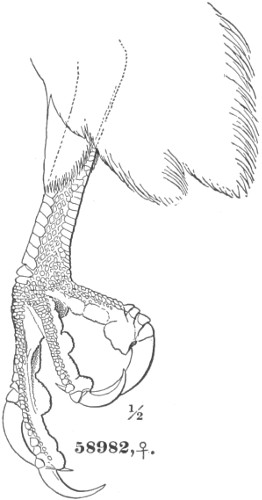
58982, ♀. ½
Astur atricapillus.
Species and Races.
A. palumbarius. Wing, 12.00–14.50; tail, 9.50–12.75; culmen, .80–1.00; tarsus, 2.70–3.15; middle toe, 1.70–2.20. Fourth quill longest; first shortest. Adult. Above, continuously uniform slate-color, or brown; the tail with several more or less distinct broad bands of darker, and narrowly tipped with white. Beneath white, with transverse lines or bars of the same color as the upper surface. Top of the head blackish; a streaked whitish superciliary stripe. Young. Above much variegated with brown and pale ochraceous; bands on the tail more sharply defined. Beneath pale ochraceous, with longitudinal stripes of dark brown.
Adult. Above umber-brown, without conspicuously darker shaft-streaks; top of the head dull dusky. Markings on the lower parts in the form of sharply defined, broad, detached, crescentic bars, and of an umber tint; throat barred. Tail with five broad, well-defined bands of blackish. Wing, 12.25–14.25; tail, 9.40–11.10; culmen, .80–.95; tarsus, 2.80–3.15; middle toe, 1.80–2.20. Hab. Northern portions of the Old World … var. palumbarius.83
Adult. Above bluish slate-color, with conspicuous darker shaft-streaks; top of the head deep black; markings on the lower parts in the form of irregularly defined, narrow, zigzag bars, or fine lines, of a bluish-slaty tint; throat not barred. Tail with only about four indistinct bands of blackish. Wing, 12.00–14.70; tail, 9.50–12.75; culmen, .80–1.00; tarsus, 2.70–3.20; middle toe, 1.70–2.00. Hab. Northern portions of North America … var. atricapillus.
Astur palumbarius, var. atricapillus (Wils.). AMERICAN GOSHAWK.
Falco atricapillus, Wils. Am. Orn. 1808, pl. lii, f. 3.—Bonap. Nouv. Giorn. Pisa, XXV, pt. ii, p. 55. Astur atricapillus, Bonap. Os. Cuv. Règ. An. p. 33.—Ib. List, 1838, 5; Consp. 31.—Wils. Am. Orn. II, 284.—Kaup, Monog. Falc. Jardine’s Contr. Orn. 1850, 66.—De Kay, Zoöl. N. Y. II, 19, pl. ii, fig. 4 (ad.), f. 5 (♂ juv.).—Nutt. Man. 85.—Strickl. Orn. Syn. I, 118.—Newb. P. R. Rep. VI, iv, 74.—Coop. & Suck. P. R. Rep. XII, ii, 144.—Lord, Pr. R. A. I. IV, 1860, 110.—Blakiston, Ibis, III, 1861, 316.—Gray, Hand List, I, 1869, 29.—Brewer, Oölogy, 1857, 17. Falco palumbarius, Sab. Frankl. Exp. 670.—Bonap. Ann. N. Y. Lyc. II, 28.—Aud. Edinb. J. Nat. Geog. Sc. III, 145.—Ib. B. Am. pl. cxli; Orn. Biog. II, 241.—Giraud, B. Long Isl’d, 18.—Peab. B. Mass. III, 77. Astur palumbarius, Sw. & Rich. F. B. A. II, pl. xxvi.—James. Wils. Am. Orn. I, 63.—Aud. Syn. B. Am. 18.—Brewer, Wils. Am. Orn. 685, pl. i, fig. 5.—Gray, List B. Brit. Mus. 63.
Sp. Char. Adult male (44,940, Boston, Mass.; E. A. Samuels). Above continuous bluish-slate, shafts of the feather inconspicuously black; tail darker and less bluish, tipped with white (about .25 of an inch wide) and crossed by five broad, faintly defined bars of blackish, these most distinct on inner webs (the first concealed by the upper coverts, the second partially so; the last, or subterminal one, which is about twice as broad as the rest, measuring about one inch in width). Primaries darker than the tail (but not approaching black). Forehead, crown, occiput, and ear-coverts pure plumbeous-black; feathers snowy-white beneath the surface, much exposed on the occiput; a broad conspicuous supraoral stripe originating above the posterior angle of the eye, running back over the ear-coverts to the occiput, pure white, with fine streaks of black; lores and cheeks grayish-white. Lower parts white; the whole surface (except throat and lower tail-coverts) covered with numerous narrow transverse bars of slate; on the breast these are much broken and irregular, forming fine transverse zigzags; posteriorly they are more regular, and about .10 of an inch wide, the white a very little more. Chin, throat, and cheeks without transverse bars, but with very sharp shaft-lines of black; breast, sides, and abdomen, a medial longitudinal broad streak of slate on each feather, the shaft black; on the tibiæ, where the transverse bars are narrower and more regular, the shaft-streaks are also finer; anal region finely barred; lower tail-coverts immaculate pure white. Lining of the wing barred more coarsely and irregularly than the breast; under surface of primaries with white prevailing, this growing more silvery toward the ends; longest (fourth) with six oblique transverse patches of slate, the outlines of which are much broken. Wing-formula, 4, 5, 3–6–2; 1=10. Wing, 13.00; tail, 9.50; tarsus, 3.70, naked portion, 1.35; middle toe, 2.00; inner, 1.21; outer, 1.37; posterior, 1.00.
No. 8,508 (Fort Steilacoom, Puget Sound, Washington Territory; Dr. Suckley. Var. striatulus, Ridgway). Similar to No. 44,940, but the upper surface more bluish, the shafts of the feathers more conspicuously black; the dorsal feathers nearly black around their borders. Tail-bands nearly obsolete. Lower parts with the ground-color fine bluish-ash, sprinkled transversely with innumerable zigzag dots of white, these gradually increasing in width posteriorly, where they take the form of irregular transverse bars; crissum sparsely and coarsely sprinkled with slaty. Each feather of the lower parts with a very sharply defined narrow shaft-stripe of deep black, these contrasting conspicuously with the bluish, finely marked ground-color. Under surface of primaries uniform slaty to their bases, the usual white spots being almost obsolete. Wing-formula, 4–5, 3–6–2–7–8–9, 1. Wing, 12.50; tail, 9.10; tarsus, 2.60, the naked portion, 1.40; middle toe, 1.75.
Adult female (12,239, Brooklyn, N. Y.; J. Ackhurst). Almost precisely similar to the male. Slate above less bluish; bands on tail more distinct, five dark ones (about .75 of an inch in width) across the brownish-slate; obscure light bands indicated on outer webs of primaries, corresponding with those on inner webs; lores more grayish than in male; bars beneath more regular; longitudinal streaks blacker and more sharply defined. Wing, 14.25; tail, 11.25; tarsus, 1.60–1.20; middle toe, 1.95; inner, 1.40; outer, 1.45; posterior, 1.30.
No. 59,892, (Colorado; F. V. Hayden, var. striatulus, Ridgway). Similar to male No. 8,508, described above, but differing as follows: interscapulars uniform with the rest of the upper surface; tail-bands appreciable, much broader than in ♀, No. 12,239, the subterminal one being 1.61, the rest 1.10, wide, instead of 1.10 and .70. The longest upper tail-coverts with narrow white tips; white spots on inner webs of primaries more distinct. Black shaft-streaks on lower surface broader and more conspicuous. Wing-formula, 4, 3, 5–6–2–7, 1=10. Wing, 14.70; tail, 11.50; tarsus, 2.50; the naked portion, 1.10; middle toe, 2.00.
Young male (second year, No. 26,920, Nova Scotia, June; W. G. Winton). Plumage very much variegated. Head above, nape, and anterior portion of the back, ochraceous-white, each feather with a central stripe of brownish-black, these becoming more tear-shaped on the nape. Scapulars, back, wing-coverts, rump, and upper tail-coverts umber-brown; the feathers with lighter edges, and with large, more or less concealed spots of white,—these are largest on the scapulars, where they occupy the basal and middle thirds of the feathers, a band of brown narrower than the subterminal one separating the two areas; upper tail-coverts similarly marked, but white edges broader, forming conspicuous terminal crescentic bars. Tail cinereous-umber, with five conspicuous bands of blackish-brown, the last of which is subterminal, and broader than the rest; tip of tail like the pale bands; the bands are most sharply defined on the inner webs, being followed along the edges by the white of the edge, which, frequently extending along the margin of the black, crosses to the shaft, and is sometimes even apparent on the outer web; the lateral feather has the inner web almost entirely white, this, however, more or less finely mottled with grayish, the mottling becoming more dense toward the end of the feather; the bands also cross more obliquely than on the middle feathers. Secondaries grayish-brown, with five indistinct, but quite apparent, dark bands; primaries marked as in the adult, but are much lighter. Beneath pure white, all the feathers, including lower tail-coverts, with sharp, central, longitudinal streaks of clear dark-brown, the shafts of the feathers black; on the sides and tibiæ these streaks are expanded into a more acuminate, elliptical form; the crissum only is immaculate, although the throat is only very sparsely streaked; on the ear-coverts the streaks are very fine and numerous, but uniformly distributed.
No. 18,404 (west of Fort Benton, on the Missouri, May 16, 1864; Captain Jas. A. Mullan, var. striatulus). Similar to No. 26,920, but colors much darker. Upper parts with dark brown prevailing, the pale borders to the feathers very narrow, and the basal very restricted and concealed; upper tail-coverts deep ashy-umber, tipped narrowly with white, and with large subterminal, transversely cordate, and other anterior bars of dusky. Tail ashy-brown, much darker than in No. 26,920, with five broad, sharply defined bands of blackish, without any distinct light bordering bar. White of the lower parts entirely destitute of any yellowish tinge, the stripes much broader than in No. 26,920, and deep brownish-black, the shafts not perceptibly darker; tibiæ with transverse bars of dusky; lower tail-coverts with transverse spots of the same. Wing, 12.25; tail, 9.70.
Young female (second year, No. 26,921, Nova Scotia; W. G. Winton). Head above, nape, rump, and upper tail-coverts, with a deep ochraceous tinge; the characters of markings, however, as in the male. Bands on the tail more sharply defined, the narrow white bar separating the black from the grayish bands more continuous and conspicuous; lateral feathers more mottled; grayish tip of tail passing terminally into white. Beneath with a faint ochraceous wash, this most apparent on the lining of the wings and tibiæ; streaks as in the male, but rather more numerous, the throat being thickly streaked.
No. 11,740 (Puget Sound, October 26, 1858; Dr. C. B. Kennerly. Var. striatulus). Similar to No. 18,404, but more uniformly blackish above; tip of tail more distinctly whitish; stripes beneath broader and deeper black, becoming broader and more tear-shaped posteriorly, some of the markings on the flanks being cordate, or even transverse. Wing-formula, 4, 5, 3–6, 2–7–8–9–10=1. Wing, 13.00; tail, 10.80; tarsus, 2.80; middle toe, 1.80.
Young female (first year, No. 49,662, Calais, Me.; G. A. Boardman). Differs from the female in the second year (No. 26,921) as follows: On the wings and upper tail-coverts the yellowish-white spots are less concealed, or, in fact, this forms the ground-color; secondary coverts ochraceous-white, with two very distant transverse spots of dark brown, rather narrower than the white spaces; tips of feathers broadly white; secondaries grayish-brown, tipped with white, more mottled with the same toward bases, and crossed by five bands of dark brown, the first two of which are concealed by the coverts, the last quite a distance from the end of the feathers; upper tail-coverts white, mottled on inner webs with brown, each with two transverse broad bars, and a subterminal cordate spot of dark brown, the last not touching the edge of the feather, and the anterior bars both concealed by the overlaying feather. Tail grayish-brown, tipped with white, and with six bands of blackish-brown; these bordered with white as in the older stage. Markings beneath as in the older stage, but those on the sides more cordate. Wing-formula, 4, 5, 3–6–7–2–8–9, 1, 10. Wing, 14.00; tail, 11.50.
In regard to the form indicated in the above descriptions as “var. striatulus, Ridgway,” I am as yet undecided whether to recognize it as a geographical race, or to merely consider the two adult plumages as representing different ages of the same form. Certain it is that there is a decided difference in the young plumage, between the birds of this species from the eastern portion of North America and those from the western regions; these differences consisting in the very much darker colors of the western individuals, as shown by the above descriptions. My first impression in regard to the adult dress, after making the first critical examination of the series at my command, was, that the coarsely mottled specimens were confined to the east, and that those finely mottled beneath were peculiar to the west; and this view I am not yet prepared to yield. I have never seen an adult bird from any western locality which agrees with the eastern ones described above; all partake of the same characters as those described, in being finely and faintly mottled beneath, with sharp black shaft-streaks, producing the effect of a nearly uniform bluish ground, the black streaks in conspicuous contrast, the tail-bands nearly obsolete, etc. But occasional, not to say frequent, individuals obtained in the eastern States, which agree in these respects with the western style, rather disfavor the view that these differences are regional, unless we consider that these troublesome individuals, being, of course, winter migrants, have strayed eastward from the countries where they were bred. The Colorado female described above exhibits a rather suspicious feature in having a single feather, on the lower parts, which is coarsely barred, as in the eastern style, while all the rest are finely waved and marbled as in the western. If this would suggest that the differences supposed to be climatic or geographical are in reality only dependent on age, it would also indicate that the finely mottled individuals are the older ones.
If future investigations should substantiate this suggestion as to the existence of an eastern and a western race of Goshawk in North America, they would be distinguished by the following characters:—
Var. atricapillus. Adult. Markings of the lower surface coarse and ragged; feathers of the pectoral region with broad medial longitudinal streaks of the same slaty tint as the transverse bars, and with only the shafts black. Tail-bands distinct. Young. Pale ochraceous markings prevailing in extent over the darker (clear grayish-umber) spotting. Stripes beneath narrow, clear brownish; those on the flanks linear. Wing, 12.25–14.25; tail, 10.00–12.75; culmen, .80–1.00; tarsus, 2.90–3.15; middle toe, 1.70–1.95. Hab. Eastern region of North America.
Var. striatulus. Adult. Markings of the lower parts fine and delicate, and so dense as to present the appearance of a nearly uniform bluish-ashy surface; feathers of the pectoral region without the medial stripes of slaty, but with broad shaft-streaks of deep black, contrasting very conspicuously with the finely mottled general surface. Tail-bands obsolete. Young. Darker (brownish-black) markings prevailing in extent over the lighter (nearly clear white) ones. Stripes beneath broad, brownish-black; those on the flanks cordate and transverse. Wing, 12.00–13.60; tail, 9.50–12.20; culmen, .85–1.00; tarsus, 2.70–3.15; middle toe, 1.70–.185. Hab. Western region of North America.
LIST OF SPECIMENS EXAMINED.
Var. atricapillus.
National Museum, 8; Philadelphia Academy, 7; New York Museum, 3; Boston Society, 2; G. N. Lawrence, 4; W. S. Brewer, 2; Museum, Cambridge, 2; R. Ridgway, 2. Total, 30.
Measurements.
Sex. Wing. Tail. Culmen. Tarsus. Middle Toe. Specimens.
♂ 12.25–13.00 10.00–10.50 .80–.85 2.90–3.05 1.70–1.80 5
♀ 14.00–14.25 11.50–12.75 .90–1.00 2.90–3.15 1.80–1.95 7
Var. striatulus.
National Museum, 9; R. Ridgway, 1; Museum, Cambridge, 1 (Massachusetts!). Total, 11.
Measurements.
Sex. Wing. Tail. Culmen. Tarsus. Middle Toe. Specimens.
♂ 12.00–13.25 9.50–10.00 .85–.90 2.70–3.00 1.70–1.80 8
♀ 13.50–13.60 11.80–12.20 .90–1.00 3.00–3.15 1.85–0.002
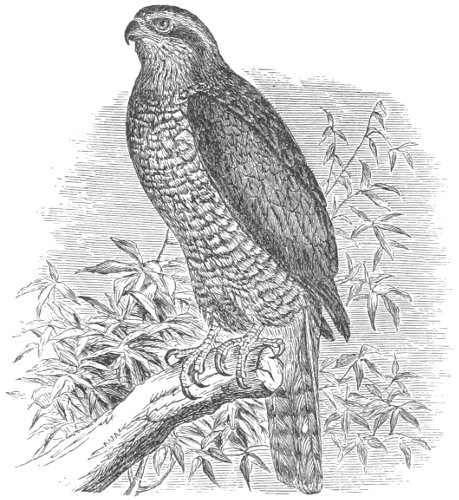
Astur atricapillus.
Habits. The dreaded Blue Hen Hawk, as our Goshawk is usually called in New England, is a bird of somewhat irregular occurrence south of the 44th parallel. It occurs in the vicinity of Boston from November to March, but is never very common. In other parts of the State it is at times not uncommon at this season. It is common throughout Nova Scotia, New Brunswick, and Northern Maine, and may undoubtedly be found breeding in the northern portions of New Hampshire, Vermont, and New York. In the summer of 1872, Mr. George Baxter, of Danville, Vt., procured a nest containing three young birds, which were sent to the New York Central Park. Mr. Downes speaks of it as “far too common” in the vicinity of Halifax, where it is very destructive to Ducks, Pigeons, and poultry. Mr. Boardman gives it as common near Calais, where it breeds, and where he has taken its eggs. Mr. Verrill mentions it as resident in Western Maine, where it is one of the most common Hawks. Mr. Allen found it usually rare near Springfield, but remarkably common during the winter of 1859–60. He afterwards mentions that since then, and for the last ten winters, he has known them to be quite common during several seasons. Mr. C. J. Maynard is confident that this species occasionally breed in Massachusetts. He once observed a pair at a locality in Weston, until the latter part of May. It was found breeding in Iowa by Mr. S. N. Marston. Mr. Victor Brooke records in the Ibis, 1870, p. 538, the occurrence, in Ireland, of an example of this species. It was shot in the Galtee Mountains, in February, 1870. The bird was a mature female, with the ovary somewhat enlarged. The stomach contained the remains of a rabbit.
On the Pacific coast it is comparatively rare in California, though much more abundant farther north, in Oregon and in Washington Territory. Dr. Cooper noticed several in the dense spruce forests of Washington Territory, and regarded it as a special frequenter of dark woods, where other Hawks are rarely seen. Dr. Suckley also obtained several specimens of this bird both at Fort Dalles and at Fort Steilacoom.
Sir John Richardson met with this Hawk and procured several specimens in the Arctic regions, and Captain Blakiston also met with it in the valley of the Saskatchewan. He states that it ranges throughout the interior from Hudson’s Bay to the Rocky Mountains and Mackenzie River. He found it breeding on the Saskatchewan, and one of his specimens was shot on its nest. The Goshawk was obtained at Sitka by Bischoff; and a pair was taken by Mr. Dall, April 24, 1867, within a few miles of Nulato Fort, on the Yukon River. The nest was on a large poplar, thirty feet above the ground, and made of small sticks. No eggs had been laid, but several nearly mature were found in the ovary of the female. The nest was on a small island in a thick grove of poplars, a situation which this species seemed to prefer. Mr. Dall adds that this was the most common Hawk in the valley of the Yukon, where it feeds largely on the White Ptarmigan (Lagopus albus), tearing off the skin and feathers, and eating only the flesh. Mr. Dall received skins from the Kuskoquim River, where it was said to be a resident species.
Dr. Suckley speaks of this Hawk as bold, swift, and strong, never hesitating to sweep into a poultry-yard, catch up a chicken, and make off with it almost in a breath. Its manner of seizing its prey was by a horizontal approach for a short distance, elevated but a few feet from the ground, a sudden downward sweep, and then, without stopping its flight, making its way to a neighboring tree with the struggling victim securely fastened in its talons. For strength, intrepidity, and fury, Dr. Suckley adds, it cannot be surpassed. It seems to display great cunning, seizing very opportune moments for its attacks. In one instance it was several days before he was able to have one of these birds killed, although men were constantly on the watch for it. So adroit was it in seizing opportunities to make its attacks, that it regularly visited the poultry-yard three times a day, and yet always contrived to escape unmolested. He found these birds much more plentiful during some months than at other times, and attributed it to their breeding in the retired recesses of the mountains, remaining there until their young were well able to fly, and then all descending to the open plains, where they obtain a more abundant supply of food.
Mr. Audubon states that in Maine the Goshawk was said to prey upon hares, the Canada and Ruffed Grouse, and upon Wild Ducks. They were so daring as to come to the very door of the farm-house, and carry off their prey with such rapidity as to baffle all endeavors to shoot them. Mr. Audubon found this Hawk preying upon the Wild Ducks in Canoe Creek, near Henderson, Ky., during a severe winter; as the banks were steep and high, he had them at a disadvantage, and secured a large number of them. They caught the Mallards with great ease, and, after killing them, tore off the feathers with great deliberation and neatness, eating only the flesh of the breast.
The flight of this bird he describes as both rapid and protracted, sweeping along with such speed as to enable it to seize its prey with only a slight deviation from its course, and making great use of its long tail in regulating both the direction and the rapidity of its course. It generally flies high, with a constant beat of the wings, rarely moving in large circles in the manner of other Hawks. It is described as a restless bird, vigilant and industrious, and seldom alighting except to devour its prey. When perching, it keeps itself more upright than most other Hawks.
Audubon narrates that he once observed one of these birds give chase to a large flock of the Purple Grakles, then crossing the Ohio River. The Hawk came upon them with the swiftness of an arrow; the Blackbirds, in their fright, rushing together in a compact mass. On overtaking them, it seized first one, and then another and another, giving each a death-squeeze, and then dropping it into the water. In this manner it procured five before the poor birds could reach the shelter of a wood; and then, giving up the chase, swept over the waters, picking up the fruits of its industry, and carrying each bird singly to the shore.
Mr. Audubon, who observed these Hawks in the Great Pine Forest of Pennsylvania, and on the banks of the Niagara River, near the Falls, describes a nest as placed on the branches of a tree, and near the trunk. It was of great size, and resembled that of a Crow in the manner of its construction, but was much flatter. It was made of withered twigs and coarse grass, with a lining of fibrous strips of plants resembling hemp. Another, found by Mr. Audubon in the month of April, contained three eggs ready to be hatched. In another the number was four.
Mr. Dall states that the eggs are usually four in number, of a greenish-white color, and were usually all laid by the first of May. An egg of this bird, obtained by Mr. Dall at Nulato, April 27, 1858, measures 2.28 inches in length and 1.90 in breadth. It is of a rounded-oval shape, and is of a uniform dead-white color, with hardly a tinge of green. Another, obtained by Mr. Charles Pease near the head-waters of the Unalakleet River, measures 2.32 by 1.80 inches, and the ground-color is more distinctly greenish-white. A few small spots of a bronze-brown are scattered in isolated marking irregularly over the egg. Lieutenant Bendire writes that he has found the eggs of this Hawk in Montana; that their number in a set is usually two, and an unspotted white.
Genus ASTURINA, Vieillot.
Asturina, Vieill. 1816. (Type, Falco nitidus, Latham.)
Gen. Char. Somewhat similar to Astur, but of much heavier and more robust build; tarsi longer and stouter, tail shorter and less rounded, wings longer, etc. Bill more elongated than in Astur, the cere longer, and the festoon on the commissure more developed; nostril oval, horizontal. Wings rather short, but less concave beneath than in Astur; third to fourth quill longest; first shorter than eighth or ninth; four outer quills with their inner webs sinuated. Tail considerably shorter than the wing, slightly emarginated, the lateral pair of feathers longest. Feet large and robust, when outstretched reaching almost to the end of the tail; tarsi very robust compared to the toes, about one and a half times as long as the middle toe, the frontal and posterior rows of transverse scutellæ very distinct and regular; outer toe longer than inner; claws strong, well curved, but not very acute. Sexes alike in color; old and young plumages very different.
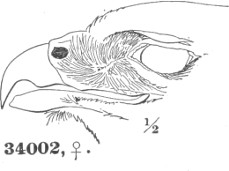
34002, ♀. ½
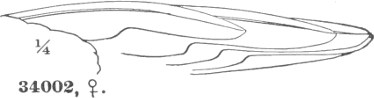
34002, ♀. ¼
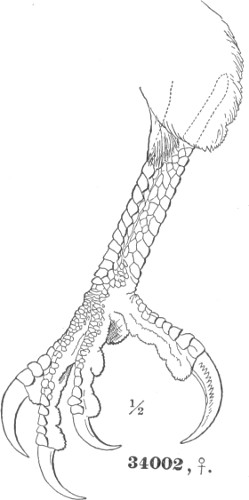
34002, ♀. ½
Asturina plagiata.
This genus is peculiar to tropical America, and contains but a single species, the A. nitida, with its two climatic races, nitida of South America and plagiata of Middle America. The species of Rupornis, Kaup (R. magnirostris and R. leucorrhoa), have been associated with the species of the present genus, but they are very distinct. The genera (or, more properly, subgenera) most nearly related to Asturina are Leucoptrinis, Kaup, of tropical America, and Kaupifalco, Bonap., of Western Africa. The former differs mainly in more or less rounded, instead of emarginated, tail, and in having the old and young plumages similar; the latter in having the posterior face of the tarsus without a well-defined row of transverse scutellæ.
Species and Races.
A. nitida. Wing, 9.80–11.50; tail, 6.70–8.00; culmen, .80–1.00; tarsus, 2.50–2.90; middle toe, 1.40–1.75. Adult. Above clear ash, paler on the head and darker on the rump; the general surface with more or less appreciable transverse bars, or indications of bars, of a paler shade, and with darker shafts. Upper tail-coverts immaculate white. Tail deep black, fading into pale grayish-brown at the end, narrowly tipped with white, and crossed by two to three white bands. Lower parts, including the tibiæ, axillars, and throat, regularly barred with deep ash and white, the two colors about equal in extent; chin and crissum immaculate white. Young. Above blackish-brown, variegated with pinkish-ochraceous. Tail umber, tipped with pinkish-brown or dull whitish, and crossed by six to seven narrow bands of black. Beneath white, sometimes tinged with ochraceous; the breast, abdomen, and sides with longitudinal tear-shaped spots of black.
Adult. Upper surface distinctly barred, the lighter bars predominating; the top of the head as distinctly barred as the lower parts. Young. Tibiæ immaculate white or pale ochraceous. Culmen, .80–.90. Hab. South America, from S. E. Brazil and W. Ecuador, to Panama … var. nitida.84
Adult. Upper surface only obsoletely barred, or almost uniform; the top of the head without any bars. Young. Tibiæ transversely barred with dusky. Culmen, .75–.80. Hab. Middle America, north to the southern border of the United States; straying northward in the Mississippi Valley, to Southern Illinois … var. plagiata.
Asturina nitida, var. plagiata (Schleg.). MEXICAN HAWK.
Asturina nitida, Cass. Birds N. Am. 1858, 35.—Scl. & Salv. Ibis, 1859, 217.—Salv. Ibis, 1861, 68.—Scl. P. Z. S. 1857, pp. 201, 227; 1859, pp. 368, 389; 1864, 178.—Lawr. Ann. N. Y. Lyc. IX, 133.—Owen, Ibis, III, 1868 (egg white). Asturina cinerea, Cass. P. A. N. S. 1855, 283 (not of Vieill.!). Asturina plagiata, Schleg. Mus. Pays-Bas. Asturinæ, p. 1.—Scl. & Salv. P. Z. S. 1868, 173; 1869, 130.—Gray, Hand List, I, 30, 1869.—Ridgw. Am. Nat. VI, July, 1872, 430; VII, April, 1873, 203; (Southern Illinois, August).
Sp. Char. Adult male (51,343, Mazatlan, Mexico; Ferd. Bischoff. “Length, 16.00; extent, 38.00”). Above deep, rather dark cinereous, becoming paler and finer on the head above, where the feathers have the shafts (finely) black; wings with obsolete lighter bars; rump almost black. Upper tail-coverts immaculate pure white. Tail pure black, tipped with pale grayish-brown (this passing terminally into white); about 1½ inches from the tip is a continuous band of white, half an inch in width; and a little over an inch anterior to this is another narrower and less perfect one. Primaries approaching black at ends; the tips broadly edged with dull white, as also the ends of secondaries. Head uniform fine delicate ashy, becoming white on chin and throat, and approaching the same on the forehead; shafts of feathers on head above, and neck, black; neck with obsolete paler transverse bars, these most distinct on jugulum; the breast, abdomen, sides, flanks, axillars, and tibiæ are regularly barred transversely with cinereous and pure white, the bars of each about equal, the white, however, gradually increasing, and the ashy bars narrowing posteriorly, the tibiæ being finely barred; lower tail-coverts immaculate pure white. Lining of the wing white, with very sparse, faint, transverse zigzag bars next the axillars and on larger coverts; under surface of primaries white anterior to their emargination, beyond which they are more silvery, leaving about an inch of the terminal portion black, the end of each, however, ashy; outer two quills crossed by narrow bars of ashy, the rest with indications of the same, near the shaft. Fourth quill longest; third scarcely shorter; second shorter than fifth; first intermediate between eighth and ninth. Wing, 10.50; tail, 7.00; tarsus, 2.60; middle toe, 1.50.
Adult female (34,002, Mazatlan, June; Colonel Grayson). Cinereous above darker, the fasciæ of the wings hardly observable; front and throat scarcely whitish; rump almost pure black; second tail-band much broken and restricted. Ashy prevailing on the jugulum; ashy bars beneath rather broader. Wings, 11.00; tail, 7.50; tarsus, 2.80; middle toe, 1.70.
Young male (35,060, Rio de Coahuyana, W. Mexico, October; J. Xantus). Above, from bill to upper tail-coverts, dark bistre-brown, almost black; feathers of the head and neck edged laterally with pinkish-ochraceous, or sulphuret of manganese color; scapulars with nearly whole outer webs of this color, they being blackish only along edges and at ends; middle wing-coverts spotted with the same. Secondaries and primaries faintly tipped with whitish; secondaries with indications of darker bands, and outer webs of primaries with still more obscure ones; upper tail-coverts white, with sagittate specks of black, one or two on each. Tail umber-brown (considerably lighter than the wings), tipped with pinkish-ash (this passing terminally into dull white), and crossed with six or seven bands of black (these becoming gradually, but very considerably, narrower toward the base). Beneath white, with vinaceous tinge (this deepest laterally); breast, abdomen, and sides with large tear-shaped or cuneate spots of black; tibiæ with numerous transverse bars of the same.
Young female. Similar to last, but the brown lighter, and more approaching umber.
Hab. Middle America (from coast to coast), from Costa Rica and Guatemala to southern border of United States. Arizona, breeding (Bendire). Southern Illinois (Richland Co.) June (Ridgway).
LIST OF SPECIMENS EXAMINED.
National Museum, 13; Philadelphia Academy, 3; Boston Society, 5; Cab. G. N. Lawrence, 1; R. Ridgway, 2. Total, 24.
Measurements.
Sex. Wing. Tail. Culmen. Tarsus. Middle Toe. Specimens.
♂ 9.80–11.50 7.20–7.80 .85–.95 2.50–2.70 1.55–1.70 7
♀ 9.50–11.30 6.70–8.00 .80–1.00 2.75–2.70 1.40–1.75 4
⚪? 10.00–11.70 6.80–8.00 .90–.95 2.65–2.80 1.50–1.65 4
Habits. This is a Mexican and Central American Hawk, which occasionally crosses the borders of the United States, having been seen by Mr. Ridgway in Southern Illinois, and found breeding, by Captain Bendire, in Arizona, near Tucson. It has been found in the State of New Leon, one of the most northern provinces of Mexico, by Lieutenant Couch, who has, however, supplied no notes as to any peculiarities in its habits. It was said to breed in the tops of lofty trees, and to have eggs of a greenish-white, resembling those of Astur atricapillus. In Central America it is said by Salvin to be abundant in the hot country on both coast regions of the Republic of Guatemala, but it is not found in the temperate regions. Its food consists of lizards, and its flesh is in consequence very rank.
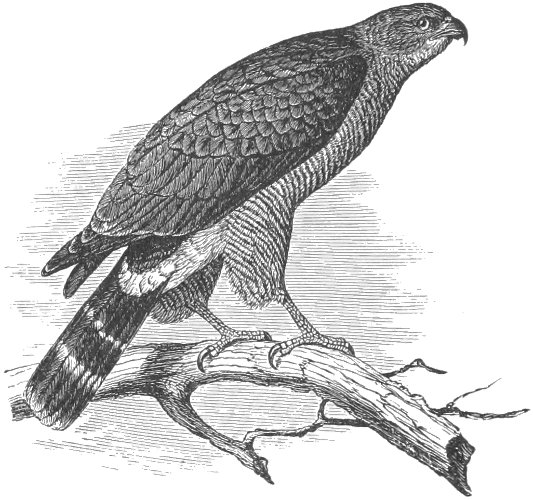
Asturina plagiata.
Mr. Robert Ridgway has met with this Hawk as far to the north as Southern Illinois. It was seen and twice shot at on the 19th of August, 1871, on Fox Prairie, in Richland County. Mr. Ridgway came across it while hunting Swallow-tail and Mississippi Kites. The bird, while being annoyed by these Hawks, was well seen, and there cannot be the slightest doubt as to its identity.
Mr. Robert Owen found this Hawk, known in Guatemala by the local name of Gavilan, a common name for the whole race of birds of prey, breeding at San Geronimo, April 3, 1860. The nests are usually found in the high trees which are scattered over the plain, and not unfrequently within a few yards of the Indian ranchos. Two eggs seemed to be the complement laid by one bird. These eggs are described by Mr. Owen as all white, without any natural coloring. The inner coating of the shell is sea-green, seeming to confirm the apparently close connection between the genera of Astur and Asturina.
Mr. G. C. Taylor met what he presumed to be this Hawk in great abundance at Comayagua, Honduras, in January. He saw a pair making their nest on the top of a lofty cotton-tree.
Captain Bendire found this species not uncommon and breeding in the vicinity of Tucson, in Arizona. He found two nests, one of which was taken June 6, the other a few days later. They were very slightly built of sticks and strips of bark, and placed in low trees on the banks of Reledo Creek. The nest contained two eggs. These are of a rounded oval shape, are quite tapering at one end and rounded at the other. They are of a uniform bluish-white color and unspotted, and measure 2.00 inches in length by 1.60 inches in breadth.
Genus ANTENOR, Ridgway.
Antenor, Ridgway. (Type, Falco harrisi, Aud.)
Craxirex, Authors, not of Gould.85

42559, ♀. ¼
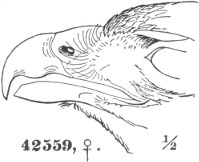
42559, ♀. ½
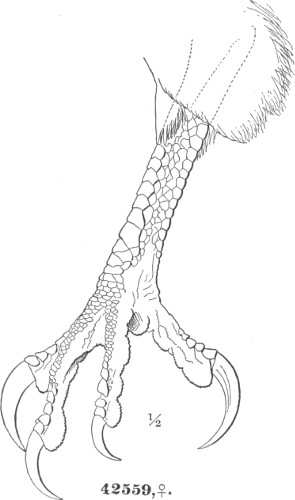
42559, ♀. ½
Parabuteo harrisi.
Gen. Char. Similar to Asturina, but form heavier, the bill and wings more elongated, the tail slightly rounded, and the lores almost naked. Bill very much as in Asturina, but more elongated, the top of the cere longer in proportion to the culmen, and the commissural lobe more anterior; the upper and lower outlines more nearly parallel. Nostril oval, horizontal, with an exposed cartilaginous tubercle. Lores nearly naked, with scant bristles. Wing long (much as in Buteo); the fourth or fifth quill longest, and the first shorter than the eighth to the tenth; outer four with inner webs sinuated. Tail long, more than two thirds the wing; even or slightly rounded. Feet robust, when outstretched reaching nearly to the end of the tail; tarsus nearly twice the length of the middle, very robust, the frontal and posterior rows of scutellæ very distinct; outer toe longer than the inner; claws strong, well curved, and acute. Sexes alike; young and old plumages very different.
This genus includes a single species, the P. unicinctus, with its two climatic races, unicinctus of South America and harrisi of Middle America. It is most nearly related to the genus Urubitinga, of tropical America, the species of which are sluggish and almost Caracara-like in their habits, though they are hardly more so than our own Buteones. The genus Craxirex of Gould having been founded upon Buteo galapagoensis, a species strictly congeneric with B. borealis, it is necessary that a new generic name should be instituted for the present species, since it so well merits separation to that rank. I accordingly propose the name given at the head of this chapter.
Species and Races.
P. unicinctus. Wing, 11.65–14.60; tail, 9.00–11.00; culmen, .82–1.10; tarsus, 2.78–3.75; middle toe, 1.52–2.00. Adult. General color brownish-black or blackish-brown, uniform, or slightly variegated by light spotting; the lesser wing-coverts and tibiæ deep rufous, or chestnut. Tail black; the end and base white, as are also the tail-coverts. Young. Plumage greatly variegated. Above blackish-brown, the feathers edged with rusty; head and neck streaked with pale ochraceous. Lower parts pale ochraceous or yellowish-white, the breast and abdomen with longitudinal ovoid spots of blackish; tibiæ with transverse bars of dark rusty; lower tail-coverts with black shaft-streaks. Lesser wing-covert region only washed with rufous. Tail grayish-brown, whitish at the tip, and crossed by narrow bands of dusky.
Adult with the blackish much broken up by lighter spotting. Wing, 11.65–14.60; tail, 9.00–10.50; culmen, .82–1.02; tarsus, 2.78–3.40; middle toe, 1.52–1.85. Hab. South America … var. unicinctus.86
Adult with the blackish continuous and uniform. Wing, 12.35–14.50; tail, 9.80–11.00; culmen, .90–1.10; tarsus, 3.15–3.75; middle toe, 1.65–2.00. Hab. Middle America, north into southern border of United States … var. harrisi.
Parabuteo unicinctus, var. harrisi (Ridgway). HARRIS’S BUZZARD.
Falco harrisi, Aud. B. Am. pl. cccxcii, 1831.—Ib. Orn. Biog. V, 30. Buteo harrisi, Aud. Synop. 1839, 5.—Bonap. List, 3.—De Kay, Zoöl. N. Y. II, 11.—Craxirex unicinctus, var. harrisi, Ridgway, P. A. N. S. Philad. Dec. 1870, p. 142. Buteo unicinctus, var. harrisi, Coues, Key, 1872, 215. “Craxirex unicinctus, Temm.” Cass. Birds N. Am. 1858, 46.—Dresser, Ibis, 1865, 329 (Texas).—Coues, P. A. N. S. 1866, 13 (Arizona).
Sp. Char. Adult male (17,230, Cape St. Lucas, Lower California; J. Xantus). General plumage uniform sooty-black, purest on the tail, somewhat tinged with chestnut on the rump. Lesser wing-coverts and lateral half of each web of middle coverts, also the tibiæ, rich deep chestnut, perfectly uniform. Upper and lower tail-coverts, and broad basal and terminal zones of tail, pure white, the anterior band concealed (except on outer feathers) by the upper coverts, and about twice the width of the last, which is about 1 inch wide. Tail-coverts with a few irregular narrow shaft-streaks of blackish. Lining of wing deep chestnut, like the shoulders; each greater covert with a black shaft-streak; primaries beneath plain black. Wing, 14.50; tail, 10.00; tarsus, 3.25; middle toe, 2.00. Fourth and fifth quills longest and equal; third considerably shorter; second intermediate between sixth and seventh; first 3.40 shorter than longest.
Adult female (42,559, Iztlan, Mexico; Colonel Grayson). Generally similar to the male; the black, however, less pure and more brownish, the chestnut more extended, the whole rump being of this color, the last feathers merely being blackish in the middle. White of tail-coverts without blackish streaks. Wing, 14.60; tail, 10.30; tarsus, 3.25; middle toe, 1.95.
Immature male (second year, 50,763, Tepic, Mexico; Colonel Grayson). Upper parts similar to adult, but less uniform; the nape and back with feathers edged with rusty; sides of head and neck very much streaked. Breast and abdomen light ochraceous, with large longitudinal oval spots of black; tibiæ light ochraceous, with rather distant transverse bars of dark rusty-brown; lower tail-coverts ochraceous-white, with black shaft-lines. Rufous on the wings more extended and more broken; none on the rump. Terminal band of tail narrower and less sharply defined than in adult; inner webs of primaries with basal two-thirds white, irregularly mottled with dusky. “Iris chestnut-brown; cere, chin, and space round the eyes yellow.”
Immature female (second year, 15,260, Fort Buchanan, New Mexico; Dr. Irwin). Black spots beneath larger and more irregularly defined; tibiæ strongly barred with dark rufous; posterior edge of basal band of tail much broken.
Hab. Middle, or northern tropical, America, from the Isthmus of Panama northward into the southern United States; Mississippi (Audubon); Texas (Mus. S. I.; Dresser); Arizona (Coues).
Localities: Guatemala (Scl. Ibis, I, 216).
LIST OF SPECIMENS EXAMINED.
National Museum, 13; Philadelphia Academy, 3; Cab. G. N. Lawrence, 2; Coll. R. Ridgway, 1. Total, 19.
Measurements.
Sex. Wing. Tail. Culmen. Tarsus. Middle Toe. Specimens.
♂ 12.35–13.75 9.80–10.20 .90–.95 3.15–3.20 1.65–1.70 8
♀ 14.25–14.50 10.80–11.00 1.08–1.10 3.40–3.75 1.90–2.00 6
Habits. This Hawk has a very limited range within the United States, and Mr. Audubon, who was the first to meet with it there, obtained only a single specimen from Louisiana. Supposing it to be an undescribed species, he named it in honor of his friend, Mr. Edward Harris.
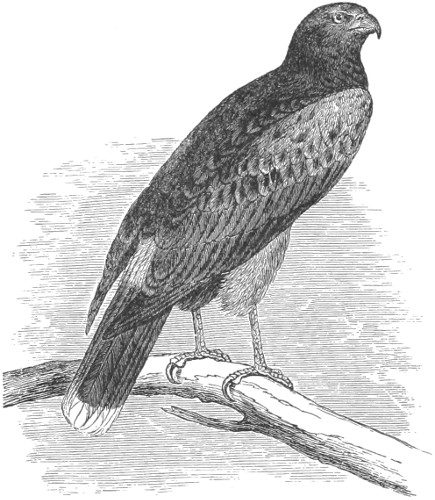
Parabuteo harrisi.
This species is occasionally found in the lower portions of the States of Mississippi and Louisiana, but becomes much more abundant in the southwestern sections of the latter State, and in Texas is common, especially about the mouth of the Rio Grande. In one variety or the other it is frequently met with throughout Mexico, and Central America, and is also said to be an occasional visitant of Cuba and Jamaica.