Volume 3 — Family TETRAONIDÆ.—The Grouse. (continued 2)
Reading edition
Bonasa umbellus, var. umbellus, Stephens. RUFFED GROUSE; PARTRIDGE; PHEASANT.
Tetrao umbellus, Linn. Syst. Nat. I, 1766, 275, 6.—Wilson, Am. Orn. VI, 1812, 46, pl. xlix.—Doughty, Cab. N. H. I, 1830, 13, pl. ii.—Aud. Orn. Biog. I, 1831, 211; V, 560, pl. xli.—Ib. Birds Amer. V, 1842, 72, pl. ccxciii. Tetrao (Bonasia) umbellus, Bonap. Syn. 1828, 126.—Ib. Mon. Tetrao, Am. Phil. Trans. III, 1830, 389.—Nuttall, Man. I, 1832, 657. Bonasa umbellus, Stephens, Shaw, Gen. Zoöl. XI, 1824, 300.—Bonap. Comptes Rendus, XLV, 1857, 428.—Baird, Birds N. Am. 1858, 630.—Elliot, Monog. Tetr. pl.—Gray, Cat. Brit. Mus. V, 1867, 89. Tetrao togatus, Linn. I, 1766, 275, 8.—Forster, Philos. Trans. LXII, 1772, 393. Tetrao tympanus, Bartram, Travels in E. Florida, 1791, 290. Ruffed Grouse, and Shoulder-knot Grouse, Pennant & Latham.
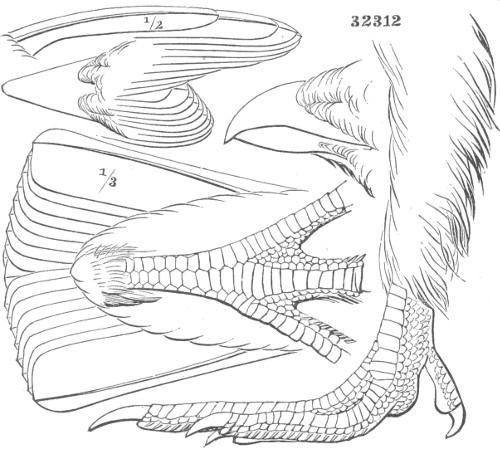
32312 ½ ⅓
Bonasa umbellus.
Sp. Char. Above ochraceous-brown, finely mottled with grayish; the scapulars and wing-coverts with pale shaft-streaks, the rump and upper tail-coverts with medial cordate spots of pale grayish. Tail ochraceous-rufous, narrowly barred with black, crossed terminally with a narrow band of pale ash, then a broader one of black, this preceded by another ashy one. (In specimens from the Alleghany Mountains and New England States, the tail usually more or less grayish to the base, sometimes entirely destitute of rufous tinge.) Throat and foreneck ochraceous. Lower parts white (ochraceous beneath the surface), with broad transverse bars of dilute brown, these mostly concealed on the abdomen. Lower tail-coverts pale ochraceous, each with a terminal deltoid spot of white, bordered with dusky. Neck-tufts brownish-black. Length, 18.00; wing, 7.20; tail, 7.00. Female smaller, and with the neck-tufts less developed, but colors similar. Young (39,161, St. Stephen’s, N. B.; G. A. Boardman). Brown above, and dingy-white beneath; a rufous tinge on the scapulars. Feathers of the jugulum, back, scapulars, and wing-coverts with broad medial streaks of light ochraceous, and black spots on the webs; jugulum with a strong buff tinge. Secondaries and wing-coverts strongly mottled transversely. Head dingy buff, the upper part more rusty; a post-ocular or auricular dusky patch, and a tuft of dusky feathers on the vertex. Chick. Above light rufous, beneath rusty-white; uniform above and below; a dusky post-ocular streak, inclining downwards across the auriculars. Bill whitish.
Hab. Eastern Province of North America; in the northeastern portions (New England, Labrador) and Alleghany Mountains inclining toward var. umbellus in having a gray tail.
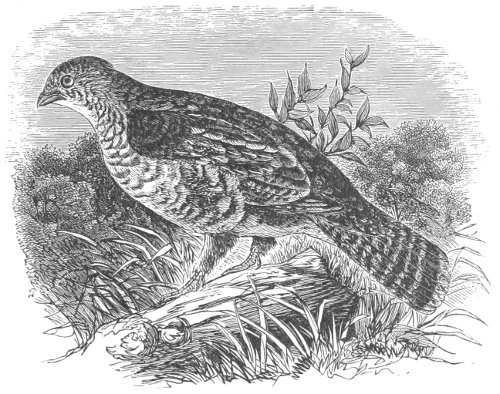
Bonasa umbellus.
Habits. This well-known bird—the common Birch Partridge of the British Provinces, the Partridge of New England and the West, and the Pheasant of the Middle States—is found throughout the wooded portions of eastern North America, from Georgia to Nova Scotia, and from the Atlantic to the Rocky Mountains. Richardson, in his description of its habits in the Fauna Boreali-Americana, states that he met with it as far north as the 56th parallel of latitude, and mentions, in a note, that Mr. Drummond procured specimens on the sources of the Peace River, in the valley of the Rocky Mountains, in no wise different from those taken on the Saskatchewan. On the banks of the latter river it was found very plentiful, frequenting the horse-paths and the cleared spaces about the forts. In winter, when the ground was covered with snow, it occurred in flocks of ten or twelve, perching on trees. These flocks could be approached without difficulty, and several birds successively shot from the same tree without exciting the alarm of the survivors, if the lowest were shot first. When disturbed, like most Grouse they flew off very swiftly, with a loud whirring sound, and to a considerable distance before alighting. The male in spring makes a very singular loud noise, resembling the quick roll of a drum, which is produced by rapid strokes of the wings, and which may be heard to quite a distance. In the mating-season the male struts about in the presence of the female, in the manner of a Turkey-cock, its wings drooping, its tail erected, and its ruffs displayed.
This Grouse is a constant resident in the district in which it occurs, and, as a general rule, is in no sense migratory, though it is stated by Audubon that in some regions where they are very abundant they perform partial sorties at the approach of autumn. These only occur in mountainous regions in which during the winter months there is an insufficiency of food. These movements have been noticed on the banks of the Ohio and the Susquehanna Rivers. Their journeys occur in the month of October, when they are in the best condition for the table, and they are much sought after. In the spring, those which have escaped return to the regions from which they migrated. Mr. Audubon states that in October, 1820, he observed a large number moving from the States of Ohio, Indiana, and Illinois into Kentucky, many of which were shot, and taken to the Cincinnati market.
This Grouse is found wherever wooded country is to be met with, and is especially fond of the craggy sides of mountains and hills, and the borders of rivers and small streams. They also often occur in considerable numbers in low lands, and were discovered by Mr. Audubon breeding in the thickest cane-brakes of Indiana and Kentucky.
They find in these wooded regions at once the means of food and shelter. In these localities they breed, and there they may usually be seen at all seasons of the year. They are thus to be met with in nearly all the Southern States, being abundant in the Carolinas, in Kentucky, Tennessee, and Mississippi, as far to the southwest as Natchez. They are not known to occur in any part of Louisiana. Dr. Newberry did not encounter this bird within the limits of California, but found them very abundant in the wooded portions of the Cascade Mountains and in the Willamette Valley. The Oregon specimens were generally darker than the eastern varieties, but the habits were apparently everywhere the same.
In many important respects the habits of this bird appear to be essentially different from those of the Pinnated Grouse. Unlike that species, it is rarely met with on open plains. Though the food of the two species appears to be very similar, this peculiarity and difference of abode is quite striking. This is more noticeable at the South than in the more northern and western portions of the country, where, however, this species seems to seek, and the cupido to avoid, the wooded sections.
They differ, also, in their more solitary disposition, being never seen in groups of more than four or five, and rarely other than singly or in pairs. Wilson observed, while travelling among the mountains of Pennsylvania, that these birds left the woods early in the morning to seek the open path or road to pick up gravel or to glean among the droppings of the horses, and he was thus enabled to supply himself without leaving the path. On the ground they were observed to move with great stateliness, spreading out their broad fan-like tails.
The flight of this Grouse is low, straightforward, and rarely protracted more than a few hundred yards at a time. It is somewhat stiff, and performed with frequent, almost continual, beatings of its wings. When it is flushed from its nest, or is suddenly startled from the ground by a dog, it rises with a loud whirring sound, which noise, however, is not made when the bird rises of its own accord. Its movements on the ground are very stately and graceful, except when it is approached too near, when it runs in a rapid manner, lowers its head, and spreads its tail, and either seeks shelter or takes to flight. When it hides in the bushes, it usually squats and remains close. They are difficult birds to shoot on the wing, the more so that they make sudden and unexpected changes in the direction of their flight. When they light on a tree, they are more readily followed and shot. The prevalent notion that, where several of these birds are in the same tree, several may be procured if you are careful to shoot the lowest one each time, was not verified by Mr. Audubon’s experience.
The love-season of the Partridge commences early in March, and is indicated by the drumming of male birds. This sound is produced by the male bird only, who, standing on a fallen log or on an elevated rock in the most retired portion of the woods, lowers his wings, expands his tail, contracts his neck, and seems to inflate his whole body. The tufts of feathers on either side of the neck are elevated, and the bird struts and wheels about in the most pompous manner possible to imagine. After manœuvring in this manner for some time, he begins to strike the sides of his own body with his stiffened wings with short and rapid strokes. These become more and more rapid, until the noise they produce seems continuous. These sounds may be heard at all hours of the day, but more generally early in the morning. The sound thus produced has generally been compared to that produced by beating together two distended bladders. But this gives one a very inadequate idea of the rolling, reverberating, ventriloquistic noise which these birds thus occasion. It is more like the distant and closing reverberations caused by remote thunder, and seems to the listener much nearer than it really is. It may be imitated in several ways, so as even to deceive the bird, and to bring him, in a fatal impulse of jealousy, to the shot of the sportsman.
In the spring these birds feed on the buds of several kinds of trees, especially the birches. In Maine they are particularly fond of the buds of the black birch, which gives to their flesh a peculiar and very agreeable flavor, and from this in certain localities they are known as the Birch Partridge. They also feed largely on the esculent berries of the summer, as raspberries, blueberries, and huckleberries, and in the fall become plump and fat, and are esteemed a great delicacy.
Mr. Audubon states that, as this bird rises from the ground, it utters a cackling note, which it repeats six or seven times, and then emits a lisping whistle, like the cry of some young bird, which is rather remarkable. When the ground is covered by a fall of light snow, these birds dive into it and conceal themselves, sometimes burrowing through it to the depth of several feet. When pursued, they frequently escape in this manner. Many are taken under the snow; others are snared by nooses, or by means of figure of four traps.
This Grouse is more or less polygamous, and both sexes are somewhat promiscuous in their intercourse. The males only remain with the females until incubation has commenced, and then keep by themselves, unless recalled by the females when their eggs have been taken or destroyed. The males occasionally indulge in severe contests for the possession of the female, but not to the same extent as with the Pinnated Grouse.
The female places her nest in some retired spot, usually on the edge of the woods, or near an opening in it, always on the ground, and often under the shelter of a projecting rock or a fallen log. The nest is very rude and simple, consisting of only a few leaves laid in a depression and not woven together. The eggs are from seven to twelve in number, and are generally of a uniform yellowish-brown color, and are very rarely mottled or spotted. During incubation the Partridge sits very closely, and permits a near approach before she will leave her charge. The young Partridges leave the nest as soon as they are hatched, following their mother, who calls to them with a clucking sound not unlike that of the common domestic Hen. The mother is very devoted, courageous, and wily in defending them. Coming suddenly upon a young brood of Partridges squatted with their mother near the roadside in a woods, my first knowledge of their presence was received from the old bird flying directly at my face, and then tumbling about at my feet with frantic manifestations of distress and imitated lameness. In the mean while the little ones scattered in every direction, and were not to be found. As soon as she was satisfied of their safety, the parent flew to a short distance, and I soon heard her clucking call to them to come to her again. Altogether, it was one of the most striking scenes of parental devotion and well-managed intervention I ever witnessed. When I came upon the mother, she had squatted upon the ground, and the young had taken refuge under her wings.
The males keep apart from the females and the young until the approach of winter, when they reassemble in their search for food. In severe seasons, when the snow lies very deep, especially in Pennsylvania, they are said to feed on the buds of the Mountain Laurel, or some other poisonous shrub which imparts a poisonous character to their flesh. In Maine they have been accused of resorting to apple-orchards and destroying the fruit-buds, thus occasionally causing a serious injury to the prospective harvest. We apprehend there is some foundation for these charges.
Mr. William Street, of Easthampton, who resides on Mount Tom, writes me that he has found this Grouse very numerous in that vicinity. Having lived in a secluded place ten years, and having met with these birds constantly by day and by night, he has been able to note some interesting peculiarities in their habits. The drumming by the male is often made on a stone as well as a log, the same perch being resorted to, when once chosen by a male bird, as long as it lives. In one instance he knew one of these Partridges persistently adhere to its drumming-place, even though the woods had all been cut away and a new road made close by its post. They roost on the ground as well as on trees, when near their home, and just where night overtakes them. They can fly by night as well as by day, when disturbed, as he has often had occasion to notice, having started them up at all hours of the night. They are very local in their habits, and never wander more than a hundred rods from the drumming-place of the male. This spot seems to be the central point around which they live. The young keep with the old birds throughout the fall and winter, and select their own homes in the spring, not far from those of their parents. When a flock is started up, they separate and fly in every direction; but if one sits quietly down and keeps perfectly still, in less than an hour he will see them all coming back, on foot, and all at about the same time.
The eggs of this species measure 1.60 inches in length by 1.15 in breadth. They are usually unspotted and of a uniform dark cream-color, occasionally marked with darker blotches of the same. They are of an elongated oval, pointed at one end.
Bonasa umbellus, var. umbelloides, Douglas. THE MOUNTAIN PARTRIDGE.
Tetrao umbelloides, Dougl. Linn. Trans. XVI, 1829, 148. Bonasa umbellus, var. umbelloides, Baird, Birds N. Am. 1858, 925 (appendix). Bonasa umbelloides, Elliot, P. A. N. S. 1864. Bonasa umbellus, Aud.—Dall & Bannister, Tr. Chicago, Ac. I, 1869, 287 (Alaska, interior).
Sp. Char. In pattern of coloration exactly similar to umbellus, but colors different. Rufous tints almost wholly replaced by gray, the ground-color of the tail always fine light ash. Neck-tufts deep glossy-black.
Hab. Rocky Mountains of the United States, and interior of British America, from Alaska (on the Yukon) to Canada, where grading into var. umbellus.
Habits. In regard to the habits of this variety we have no information. It was found by Mr. Drummond among the Rocky Mountains, near the sources of the tributaries of the Saskatchewan. He states that those he met with were at least one third smaller than the umbellus, had a much grayer plumage and a shorter ruffle. He regarded it as a distinct species from the common Partridge, which he also encountered in the same locality.
Mr. Ridgway met with this variety on the Wahsatch Mountains in October and during the summer. It was known in that locality as the Pine Hen, in distinction from the T. obscurus, which was known as the Mountain Grouse.
The eggs of this variety measure 1.62 inches in length by 1.20 in breadth. Their ground-color is a deep uniform cream, darker than in the umbellus. They are occasionally marked with dark tints of the same.
Bonasa umbellus, var. sabini, Douglas. THE OREGON GROUSE.
Tetrao sabini, Douglas, Trans. Linn. Soc. XVI, 1829, 137.—Rich. F. Bor. Am. II, 1831, 343. ? Tetrao umbellus, Rich. F. Bor. Am. II, 1831, 342.—Newberry, Zoöl. Cal. & Or. Route, Rep. P. R. R. Surv. VI, IV, 1857, 94. Bonasa sabini, Baird, Birds N. Am. 1858, 631.—Cooper & Suckley, 224.—Elliot, P. A. N. S. 1864.—Ib. Monog. Tetraon.—Lord, Pr. R. A. I. IV, 123 (Br. Col.).—Gray, Cat. Brit. Mus. V, 1867, 89.—Dall & Bannister, Tr. Chicago Ac. I, 1869, 287 (Alaska coast).—Cooper, Orn. Cal. I, 1870, 540.
Sp. Char. Similar to var. umbellus, but much darker. The rufous tints almost castaneous, and the dusky markings larger. Length, about 18.00; wing, 7.30; tail, 6.70.
Hab. Coast Mountains of Oregon, Washington, and British Columbia.
The specimens of Ruffed Grouse from the Pacific coast differ very greatly from others in much darker tints of coloration, although the pattern is precisely the same. The upper parts are dark orange-chestnut, mottled with black, the cordate light spots very distinct. The feathers of the breast are strongly tinged with reddish-yellow; those of the sides marked with broad and conspicuous bars of black, instead of the obsolete brown. The under tail-coverts are orange-chestnut, with indistinct bars of black, and an angular terminal blotch of white. All the light brown blotches and edgings of the eastern variety are here dark brown or black. The jugular band between the ruffles is very conspicuously black. Specimens from Eastern Oregon and Washington have dark gray tails, and thus incline toward var. umbelloides.
Habits. The Western Ruffed Grouse was found abundant by Dr. Suckley in the timbered districts throughout Oregon and Washington Territory. Its habits seemed to be identical with those of the eastern birds. Owing to the mildness of the season in the vicinity of Fort Steilacoom, the males commence drumming as early as January, and in February they are heard to drum throughout the night. In the autumn they collect in great numbers in the crab-apple thickets near the salt marshes at the mouths of the rivers emptying into Puget Sound. There they feed for about six weeks on the ripe fruit of the northwestern crab-apple, the Pyrus rivularis of Nuttall.
Dr. Cooper also speaks of this Grouse as very abundant everywhere about the borders of woods and clearings. It was common near the forests east of the Cascade Mountains up to the 49th degree. These birds vary in plumage there, a pale-grayish hue predominating. West of the mountains they are all of a very dark brown. There was, however, no perceptible difference in their habits or cries from those of the same bird elsewhere.
Mr. J. K. Lord assigns to this species an extended geographical range west of the Rocky Mountains,—from the borders of California, throughout Oregon and Washington Territories, extending high up on the slopes of the Rocky Mountains, plentiful in all the timbered lands between the Cascades and the rocky ruts along the banks of the Columbia, over the ridge of the Cascades, and down their western slopes to Frazer’s River, in all the islands of the Gulf of Georgia, and everywhere on Vancouver Island to its extreme northern end, and on the mainland as far north as latitude 53°. The habits of this Grouse are described as singularly erratic, and its food as varied in its character. In the spring their favorite haunt is in the vicinity of stagnant pools, or in the brush around a marsh in which the wild swamp-crab, the black birch, and the alder grow. In such places they mate, and during the breeding-season are said to be very constant and devoted. During the time of pairing, and at intervals after their young are hatched, the male produces the sound known as drumming. The bird is said to squat on a log or a fallen tree, motionless as though it had no life. Suddenly all the feathers appear as if reversed, the tail is erected, the ruff round its neck stands out stiff and rigid, and the wings droop as if broken. These slowly vibrate, and then produce a sound loud and clear, like the thrum of a double-bass string. Then the wings move with increased rapidity, and the sound becomes a continuous throbbing hum. It then suddenly ceases, and after a few minutes the same performance is repeated.
Mr. Lord also states that he has seen the males of this species fighting furiously during the pairing season. Ruffing up their necks, with their heads and backs almost in a straight line, and with wings dropped, they circle round and round each other, striking and pecking until the vanquished gives in, and the victor mounts upon a log and proceeds to drum furiously.
Their nest is completed about the end of May, and is always placed under a log on the ground, or at the foot of a bush. It is composed of a quantity of dead leaves, lined with dry grasses, bits of moss, and a few feathers.
Mr. Lord adds that he found at least ten nests of this bird in one swamp near the Spokane Prairies. From ten to fourteen eggs was about the average number; they are described as in color of a dirty white, and without any spots or freckles of a darker shade. The chickens at once leave the nest and follow their mother, who calls them with a clucking sound, in the manner of a Hen, covers them when resting, and uses all kinds of feints and stratagems to lure an intruder from her young, fluttering along close to his feet as if her wings were entirely disabled, and then, when her chickens have had time to conceal themselves, suddenly darting off. When frightened, this Grouse rises with a loud rattling sound; but its natural upward movement is noiseless.
After the chickens are old enough, the flock removes to open hillsides where grass-seed, berries, and insects are in abundance. This Grouse never packs, but remains in broods. In the fall, before they begin to feed on the spruce buds, their flesh is said to be delicious; but after the snow shuts them off from other food they feed on the fir buds, and then their flesh acquires a strong flavor of turpentine.
In the tree this Grouse is not an easy bird to discover; so closely does its plumage resemble the lichen-covered bark that it is difficult to distinguish them, especially as, when alarmed, they crouch down lengthwise with the limb, and thus become concealed.
Genus LAGOPUS, Vieillot.
Lagopus, Vieillot, Analyse, 1816. (Type, Tetrao lagopus, L.)
Gen. Char. Nasal groove densely clothed with feathers. Tail of sixteen or eighteen feathers. Legs closely feathered to the claws. The northern species snow white in winter.
The Ptarmigans inhabit the northern regions of both hemispheres, and with the Arctic fox and hares, the lemmings, and a few other species, characterize the Arctic zone. They are of rare occurrence within the limits of the United States, though farther north they become abundant. The species all change to white in winter, except L. scoticus, which appears to be merely a permanently dark, southern, insular form of L. albus. (See Alfred Newton in Proceedings of the Philadelphia Academy, July, 1871, pp. 96, 97.)
Species and Varieties.
A. Tail-feathers always with more or less black.
1. L. mutus. Bill small, slender, the length from the nasal groove to the tip decidedly more than the height through the base. Male in winter with a black stripe on the lores.
♂ in summer with uniform black feathers on the breast; autumnal plumage bluish-gray, mottled. Hab. Northern Europe … var. mutus.
♂ in summer without uniform black feathers on the breast. Autumnal plumage orange-rufous. Hab. Northern North America; Greenland; Iceland … var. rupestris.
2. L. albus. Bill large, stout; the length from the nasal groove less, or not more, than the height through the base. Male in winter without black stripe on lores. Hab. Northern Europe and northern North America.
B. Tail-feathers entirely pure white.
3. L. leucurus. Winter plumage wholly white. Hab. Alpine summits of the Western mountain-ranges, from Colorado to Oregon and Washington, and north into British America.
PLATE LXII.
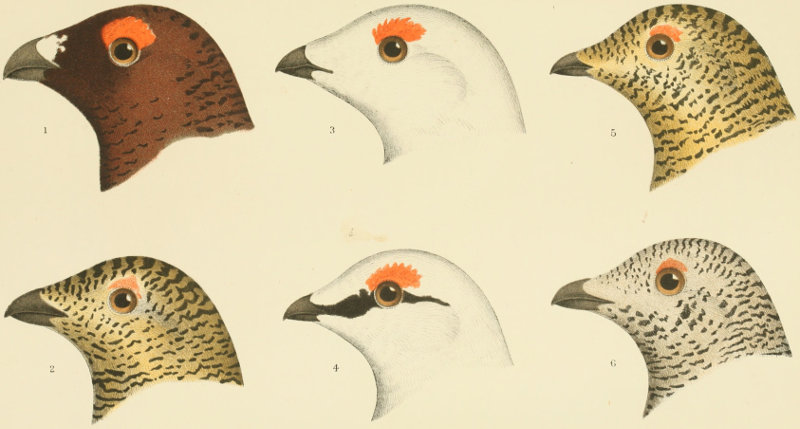
1. Lagopus albus. ♂ Summer. Alaska, 21462.
2. Lagopus albus. ♀ Summer. Labrador, 43468.
3. Lagopus albus. ♂ Winter.
4. Lagopus rupestris. ♂ Winter. 30370.
5. Lagopus rupestris. ♀ Summer. Labrador, 44582.
6. Lagopus leucurus. ♂ Summer. Colorado, 16002.
Lagopus albus, Aud. WILLOW GROUSE; WHITE PTARMIGAN.
Tetrao albus, Gmelin, I, 1788, 750 (Hudson’s Bay).—Lath. Ind. Orn. II, 639. Lagopus albus, Aud. Syn. 1839, 207.—Ib. Birds Amer. V, 1842, 114, pl. ccxcix.—Bonap. Am. Phil. III, new ser. p. 393, sp. 313.—Gray, Gen. B. III.—Baird, Birds N. Am. 1858, 633.—Boie, Isis, 1822, 558.—Gray, Cat. B. Brit. Mus. III, 47, 1844.—Bonap. Geog. & Comp. List. B. p. 44, No. 288.—Elliot, Monog. Tetraon. pl.—Coues, P. A. N. S. 1861, 227.—Gray, Cat. Brit. Mus. V, 1867, 80.—Dall & Bannister, Tr. Chicago Ac. I, 1869, 287.—Finsch, Abh. Nat. III, 1872, 62 (Alaska). Tetrao (Lagopus) albus, Nuttall, Man. I, (2d ed.,) 1840, 816. ? Tetrao lagopus, Forster, Phil. Trans. LXII, 1772, 390. Tetrao saliceti, Sabine, App. Franklin’s Narr. 681.—Rich. App. Parry’s 2d Voyage, 347.—Aud. Orn. Biog. II, 1834, 528, pl. cxci.—Sab. App. Frank. Narr. p. 681. Tetrao (Lagopus) saliceti, Swainson, F. Bor. Am. II, 1831, 351.—Lagopus s. Gould. B. Eur. pl. White Grouse, Pennant. Tetrao lapponicus, Gmel. Syst. Nat. I, 751, sp. 25.—Lath. Ind. Orn. II, 640, sp. 12. Tetrao rehusak, Temm. Pig. et Gall. III, 225. Lagopus subalpinus, Nils. Orn. Suec. I, 307, sp. 139. Lagopus brachydactylus, Temm. Man. Orn. III, 328.—Gould, B. Eur. pl. cclvi.—Gray, Gen. B. III.—Bonap. Consp. List. 44, No. 300.
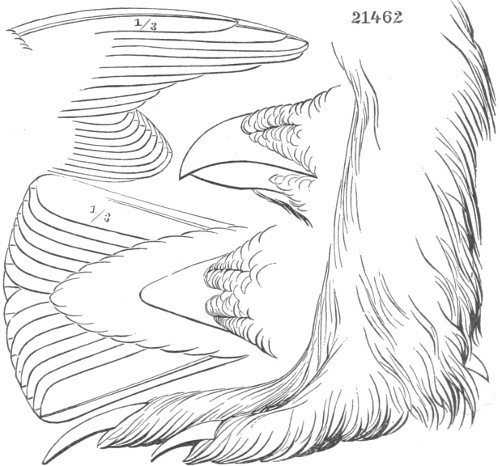
21462 ⅓ ⅓
Lagopus albus.
Sp. Char. Bill very stout. Bill as high as the distance from the nasal groove to its tip. Tail always black, narrowly tipped with white; wing (except upper coverts) pure white.
Summer. Male (43,505, Fort Anderson, September 8; MacFarlane). Head, neck, and jugulum deep cinnamon-rufous; whole upper parts (except wings) paler, more fulvous brown, broadly and closely barred with black. Top of head spotted with black, and the jugulum and neck with scattered bars of the same. Wing, 7.50; bill, .40 from nostril, and .35 deep. Female (53,526, Fort Anderson, June, 1865; MacFarlane). Entire plumage (except wings, tail, and legs) fulvous-buff, heavily spotted and barred above, and regularly barred beneath, with black. Wing, 7.20; bill, .40 by .40.
Winter. Entire plumage, except the tail (which is black with a white tip), immaculate snowy-white; shafts of primaries black. Male (34,968, Northwest R., Labrador; D. Smith). Wing, 7.50; bill, .42 by .45. Female (50,060, Nulato, Lower Yukon, April 12, 1867; W. H. Dall). Wing, 7.50; bill, .42 by .42.
Chick (2,648, Fort Anderson, July, 1864). Prevailing color greenish-buff, tinged with sulphur-yellow on the throat and abdomen, and washed with fulvous on the upper parts. A large oval vertical patch of chestnut-rufous, bordered all round by a black line, which, from the occiput, is continued down the nape in a broad distinct stripe of black. On the upper part of the back this stripe bifurcates, and continues in two broad parallel stripes to the lower part of rump, where they again unite. A black stripe across the wing and one through the eye and auriculars.
Hab. Arctic America from Newfoundland to Sitka.
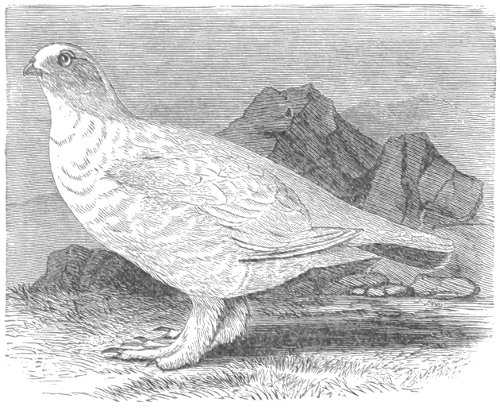
Lagopus albus.
Habits. Richardson regarded this species as an inhabitant of the fur countries from the 50th to the 70th parallel of latitude, being partially migratory within those limits. It was found to breed among the valleys of the Rocky Mountains, on the barren grounds, and along the Arctic coasts. On the approach of winter it collects in flocks, and retires southward as the severity of the weather increases. They remain, however, in considerable numbers as far north as latitude 67° even in the coldest winters. It was found to be tolerably abundant at the 65th parallel all the year, assembling in vast flocks on the shores of Hudson Bay in the winter time. Mr. Hutchins states that ten thousand of these birds have been captured in a single season at Severn River. Richardson adds that in 1819 these birds made their first appearance at Cumberland House, latitude 54°, in the second week of November, and that they returned to the northward again before the beginning of spring. In the winter they are said to shelter themselves in thickets of willows and dwarf birches, on the banks of marshes and lakes, the buds of the smaller shrubs being the principal part of their food at that season. Denuded sandy spots were their favorite resorts in the daytime, but they passed their nights in holes in the snow. When pursued by sportsmen or birds of prey, they often terminate their flight by hastily diving into the loose snow, working their way beneath its surface with considerable celerity. In thick, windy, or snowy weather they were very shy, perching on the taller willows, where it required a sharp eye to distinguish them from flakes of snow. In the summer season they feed chiefly on the berries of the alpine arbutus and other shrubs and plants, which are laid bare by the thaw, and which do not disappear until they are replaced by a new crop. They incubate about the beginning of June, at which time the females moult. The males assume their red-colored plumage as soon as the rocks and eminences become bare, at which time they are in the habit of standing upon large stones, calling in a loud and croaking voice to their mates, which, still in their white wintry garb, are hidden in the snows below. These birds are more usually in motion in the milder light of night than in the broad glare of day.
Captain Blakiston traced this Grouse across the interior from Hudson’s Bay to near the Rocky Mountains, and obtained a single specimen near Fort Carlton. It does not come down every winter, however, so far south on the Upper Saskatchewan. Near Lake Winnipeg, at Fort Cumberland, and to the eastward, they are common every winter, and numbers are obtained from the shores of Hudson’s Bay. Mr. Ross gives this species as common on the Mackenzie. Mr. Robert MacFarlane found it around Fort Anderson, where, he writes, it was always very numerous in that quarter at all seasons, and generally not difficult of approach. During the breeding-season the males were to be found perched upon trees and stumps in the vicinity of the nest, while the female would rarely leave the latter until almost trodden on. They are also said, by Mr. MacFarlane, to assume their summer plumage earlier than the males, differing in this statement from Dr. Richardson’s. Their nest is always on the ground, and consists only of a few decayed leaves placed in a depression. Sometimes other materials, such as hay, moss, feathers, etc., are found. While incubating, the female occasionally sits so close as to allow herself to be caught, rather than leave the nest.
They begin to nest early in June, varying a little with the season, not commencing so soon where the ground at that period was still covered with snow. Eggs taken from the oviduct were almost invariably pure white in color. In one instance an egg taken from the oviduct of a female, June 5, that had previously deposited eight eggs the same season, was covered with coloring matter or marking so soft as to adhere to the fingers when touched. After the female has once begun to lay, Mr. MacFarlane observed that she deposits one egg each day until the whole number has been reached. This varies from eight to ten.
The males were always observed in the immediate vicinity of the nest, and began to assume their summer moult about the 6th of June, most of their necks at that time being already of a reddish-brown color. The nests were always on the ground, and were mere depressions lined with a few soft materials, generally leaves, occasionally mingled with feathers, hay, etc., the feathers often being their own. The same nest was often made use of in successive seasons. Eggs were found as late as the 24th of June, and the female is supposed to sit about three weeks before hatching. Occasionally eggs were found dropped on the bare ground without any signs of a nest. In one instance the egg was pure white, like one taken from the oviduct. It was found lying on the bare ground, without the least appearance of a nest in its vicinity.
In one instance where a nest was met with, on the banks of Swan River, by Mr. MacFarlane’s party, en route, the female was almost trodden under foot before she fluttered off, when she at once turned about to face her enemies, spreading her wings and ruffling her feathers as if to attack or frighten them away. In another case a nest containing only one fresh egg, in which the female had but just begun to deposit, was found as late as June 25. Other eggs found June 27 contained very large embryos. Another nest, examined a fortnight later (July 10), had in it ten perfectly fresh eggs. Mr. MacFarlane inferred that this nest had been robbed at an early period of the season. This time she apparently made no attempt at another laying.
In several instances where both birds were present near a nest that was taken, the male bird would make his presence known by giving utterance to very peculiar rough notes, indicative of alarm and of distress at the proceedings. In one instance a nest was found in the midst of a clump of very small stunted willows, within thirty feet of the spot where Mr. MacFarlane’s tent was pitched. This was on the 21st of June, but the nest escaped notice until the 22d of July, when the female was almost trodden on as she was sitting on her eggs, where she had probably had her nest during their entire stay. The eggs were warm when taken, and their contents were slightly developed. During the night the male Ptarmigan disturbed the encampment by keeping up a constant utterance of his rough and rather unpleasant notes. In another instance the female fluttered off, calling, and pretending to be badly wounded; while the male bird, in the vicinity, made his near presence known by the loud manner in which he expressed his disapprobation of such proceedings.
In one instance where an Indian had found a nest of this Ptarmigan, which then contained seven eggs, the female was seen, and the notes of the male bird were heard. He placed a snare about the eggs, but on returning to the nest a few hours afterwards, he was surprised to find that six of the eggs had disappeared during his brief absence. He supposed a fox had taken them; but as no egg-shells were left behind, Mr. MacFarlane has no doubt they were removed by the parent birds.
When the young are hatched they follow the parents, both of whom keep about them, and display great courage and devotion whenever there is any occasion, suffering themselves to be very closely approached, and utterly regardless of consequences in their desire to save their young. The latter are very hard to recognize, owing to their close resemblance to the grass, in which they squat, and remain perfectly still.
In September and October of each season these Ptarmigans assemble in large flocks, but during winter seldom more than two or three dozen were ever noticed in single companies. They would often alight and feed in the immediate presence of the men, and would even permit a very near approach. During the winter they were frequently to be met with between Fort Anderson and Fort Good Hope, in especial abundance about the last-mentioned post. As the spring approached, they began to migrate to the north; so that in the summer scarcely a Ptarmigan was to be seen south of Lockhart River, on their usual line of march to that post. In February, 1859, Mr. MacFarlane found them numerous to the very borders of the wooded country, along the banks of the Lower Anderson.
Mr. Donald Gunn states that this Ptarmigan is very seldom to be seen south or west of Lake Winnipeg, but is found in all the country north and east of that lake during the winter season. In the summer they are said to breed around Hudson’s Bay, and during the winter to be found along the whole extent of that bay, especially if the winter is mild. During severe winters they go more inland. The males of this species are said by Mr. Gunn to crow morning and evening in the same manner as the Moor-fowl in Scotland, the tone and notes being very similar. The female is said to lay from ten to sixteen eggs, but the largest number taken by Mr. MacFarlane appears to have been ten. These birds are of great service to the Indians, serving as food when larger game fails; and their feathers are also a considerable article of trade, several hundredweight of them being annually sent to London.
Mr. Dall found this Ptarmigan abundant in Alaska, from Fort Yukon to the sea. In winter they feed exclusively on willow buds, a double-handful having often been found in their crops. As soon as the ground was well covered with snow they appeared on the river in coveys among the willow-thickets. They were rather shy, and on an alarm flew immediately, but without noise. They made regular paths along the banks of the river among the willows, along which they always ran. The Indians took advantage of these to snare them, and caught them by hundreds. They were abundant in the fall and midwinter. In February they gathered in immense flocks, and disappeared, no one could tell where, returning about the middle of March as suddenly as they had gone away, remaining a few weeks, then resorting to the mountains and open country to breed. In 1867 they disappeared February 15 and returned April 1, leaving for the mountains May 3. The following year they left February 10, returned March 21, and left for the mountains April 28, going and coming in large flocks. They begin to moult about the middle of April, the feathers of the head, edges of wings, and upper tail-coverts, changing first. At this time the capillaries in the skin of the abdomen become engorged with serous fluid, and give to the bird a disgusting appearance. Mr. Dall obtained eggs in an open tundra near the mouth of the Yukon in the latter part of June. The female defended her nest bravely, and rather than desert her eggs allowed herself to be torn to pieces by a dog.
Mr. Bannister was also struck with the strong attachment shown to each other by both sexes during the breeding-season. He has known the male bird to sacrifice his own life, rather than desert his wounded mate. He mentions them as common at St. Michaels and the adjoining mainland during the greater part of the year, but especially abundant in the spring, when they are found singly or in pairs all over the country. In the fall and winter they kept more to the thickets of willows. The greater part of them were supposed to have gone into the wooded district of the interior for better shelter and more abundant food.
The eggs of this species vary considerably in length and breadth; they average about 1.85 inches in length and 1.20 in breadth, and are oval in shape, one end a little less obtuse than the other. They are all beautifully variegated and marked with bold confluent blotches of a dark claret color, upon a ground of a deep cream tinged with a reddish shading.
Lagopus mutus, var. rupestris, Leach. ROCK PTARMIGAN.
Tetrao rupestris, Gmelin, Syst. Nat. I, 1788, 751 (based on Rock Grouse of Pennant).—Latham, Ind. Orn. II, 1790, 312.—Sabine, Supplem. Parry’s First Voyage, page cxcv.—Richardson, Append. Parry’s Second Voyage, 348.—Aud. Orn. Biog. IV, 1838, 483, pl. ccclxviii. Lagopus rupestris, Leach, Zoöl. Misc. II, 290.—Bon. List, 1838.—Aud. Syn. 208.—Ib. Birds Amer. V, 1842, 122, pl. ccci.—Baird, Birds N. Am. 1858, 635.—Elliot, Monog. Tetraon. pl.—Gray, Cat. Brit. Mus. V, 1867, 92.—Dall & Bannister, Tr. Chicago Ac. I, 1869, 287. Tetrao (Lagopus) rupestris, Swains. F. Bor. Am. II, 1831, 354, pl. lxiv. Attagen rupestris, Reich. Av. Syst. Nat. 1851, page xxix. Rock Grouse, Pennant, Arctic Zoöl. II, 312. Lagopus islandorum, Fab. Prod. der Island. Orn. page 6.—Gray, Gen.—Ib. Cat. B. Brit. Mus. III, 47, 1844. Tetrao lagopus islandicus, Schleg. Rev. Crit. des Ois. d’Eur. p. 76. Tetrao islandicus, Brehm, Eur. Vog. II, 448. Lagopus reinhardti, Brehm. Lagopus groenlandicus, Brehm, Vögelfang, p. cclxiv, note. ? Tetrao lagopus, Sabine, E. Suppl. Parry’s First Voyage, p. cxcvii.—Sabine, J. Franklin’s Jour. 682.—Rich. App. Parry’s Second Voyage, 350. Tetrao (Lagopus) mutus, Rich. F. B. A. II, 1831, 350. Tetrao mutus, Aud. Orn. Biog. V, 1839, 196. Lagopus mutus, Gray, Cat. B. Brit. Mus. 1867, 91 (Ft. Resolution and Ft. Simpson). Lagopus americanus, Aud. Syn. 1839, 207, B. Am. V, 1842, 119, pl. ccc.—Baird, Birds N. Am. 1858, 637.
Sp. Char. Bill slender; distance from the nasal groove to tip (.35) greater than height at base (.27). In summer the feathers of back black, banded distinctly with yellowish-brown and tipped with white. In winter white, the tail black; the male with a black bar from bill through eye. Size considerably less than that of L. albus. Length, about 14.50; wing, 7.50; tail, 4.50.
Female in summer (44,582, Barren Grounds, June 29, 1864; R. MacFarlane). Wings (except upper coverts) and legs white; tail (except intermediæ), black, narrowly tipped with white. Rest of plumage light ochraceous or buff, some feathers tipped with white, and all with broad transverse bars of black, this color prevailing on the dorsal region. On the lower surface the buff bars exceed the black ones in width. Wing, 7.20; tarsus, 1.15; middle toe, .90; bill, .35 by .27.
Hab. Arctic America.
The L. mutus of Europe appears to differ only in its summer and autumnal plumages from the present form, and is then only distinguished by the uniformly black feathers on the breast in the former, and the bluish cast in the latter stage. Those in the winter plumage that we have examined are absolutely identical in size, proportions, and color with the American birds.
Habits. According to Hutchins, this Ptarmigan is numerous at the two extremes of Hudson’s Bay, but does not appear at the middle settlements of York and Severn except in very severe seasons, when the Willow Grouse are scarce; and Captain Sabine informed Richardson that they abounded on Melville Island, latitude 75°, in the summer. They arrived there in their snow-white winter dress about the 12th of May. By the end of the month the females had begun to assume their colored plumage, which was completed by the first week in June, when the change in the plumage had only just commenced in the males. Some of the latter were found as late as the middle of June in their unaltered winter plumage. This Grouse was also found on the Melville peninsula and the Barren Grounds, rarely going farther south, even in the winter, than latitude 53° in the interior, but, on the coast of Hudson’s Bay, descending to latitude 58°, and in severe seasons still farther to the southward. In its general manners and mode of living it is said to resemble the albus, but does not retire so far into the wooded country in the winter. At that season it frequents the more open woods on the borders of lakes, especially in the 65th parallel, but the bulk of this species remains on the skirts of the Barren Grounds. They incubate in June.
Mr. MacFarlane found this species breeding about Fort Anderson, and on the Barren Grounds east of the Horton River. They nest, in a similar manner to L. albus, on the ground, placing the materials in a depression on the ground, and using hay, withered leaves, and a few feathers, and making a rather loose, ill-arranged nest. This is usually placed on an open common, sometimes near the banks of a small stream. They were more early in their breeding than the albus, as young Ptarmigans of a goodly size are mentioned as having been seen June 30. The eggs ranged from four to eight in number.
The female sits very close, and rather than leave will sometimes suffer herself to be taken by the hand. In one instance when a nest was approached, the female crouched as much as possible, in the hope that she might not be noticed, which would have happened had not one of the party observed her eye. Her summer plumage was almost exactly of the same color with the soil, and hardly distinguishable from it. The man was within three feet, and, making a swoop, caught her on the nest.
Excepting in 1862, Mr. MacFarlane did not meet with any of this species west of the Swan River, on his various journeys to Franklin Bay. Every season, almost immediately on leaving the woods fringing Swan River, birds began to be seen as far as and all along the Arctic coast. Although constantly found feeding in large numbers on the Barrens, it was always difficult to find their nests. They were most numerous between Horton River and Franklin Bay, and were frequently seen standing singly, or feeding on the ground, or an occasional pair might be seen, but it was seldom any number were observed in company.
Mr. Dall states that this species was not uncommon in the Romanzoff Mountains, northwest of Fort Yukon, but did not know of its being found farther south or west. It was obtained by S. Weston at Fort Yukon, and among the mountains by Mr. McDougal.
The eggs of this species closely resemble those of L. albus, but are somewhat smaller in size. They measure 1.63 inches in length by 1.18 in breadth, varying slightly in size. Their ground is a deep reddish cream-color, nearly covered by large blotches of a reddish-chestnut, giving a beautifully variegated effect to the whole.
Lagopus leucurus, Swainson & Richardson. WHITE-TAILED PTARMIGAN.
Tetrao (Lagopus) leucurus, Sw. & Rich. F. B. A. II, 1831, 356, pl. lxiii.—Nutt. Man. Orn. II, 1834, 612.—Ib. I, (2d ed.,) 1840, 820.—Dougl. Tr. Linn. Soc. XVI, 146. Tetrao leucurus, Aud. Orn. Biog. V, 1839, 200, pl. ccccxviii. Lagopus leucurus, Aud. Syn. 1839.—Ib. B. Am. V, 1842, 125, pl. cccii.—Gray, Gen. III.—Baird, Birds N. Am. 1858, 637.—Bon. Comp. List. 441, No. 291.—Elliot, P. A. N. S. 1864.—Ib. Monog. Tetraon. pl.—Gray, Cat. Brit. Mus. V, 1867, 93.—Cooper, Orn. Cal. I, 1870, 542.
Sp. Char. Male? winter (4,578, Fort Halkett, Liard’s River). Entirely pure white, including the tail. Wing, 6.70; tarsus, 1.00; middle toe, 1.00; bill, .35 by .29.
Summer. Wings, tail, abdomen, crissum, and legs immaculate snowy-white. Ground-color of rest of plumage grayish-white on head and neck and ashy-buff on other portions, finely and rather sparsely sprinkled with black,—more in form of ragged transverse bars anteriorly and on sides. (♀, 16,002, Camp Skagitt, N. W. B., August 16; C. B. Kennerly.)
Hab. Alpine summits of the Western mountains, from lat. 39° in the Rocky Mountains north into British America, and west to the Cascades of Oregon, Washington, and British Columbia.
Habits. This species was first procured by Mr. Drummond, and described by Swainson in the “Fauna Borealis.” Five specimens were taken on the Rocky Mountains in the 54th parallel, and another, by Mr. MacPherson, on the same chain, nine degrees farther north. They were said to have all the habits of the other Ptarmigans, and to inhabit the snowy peaks near the mouth of the Columbia, as well as the lofty ridges of the Rocky Mountains.
We have but little reliable information in regard to the habits and distribution of this species. It seems to be confined entirely to the range of the Rocky Mountains, and to be found only among their highest points, occurring at least as far to the south as Cochetope Pass, in latitude 39°, and extending north to an undetermined extent. Specimens were procured in 1858 by Captain R. B. Marcy, on his march from Fort Bridger, in Utah, across the Rocky Mountains to Santa Fé. They were met with near the summit of the mountains not far from Cochetope Pass.
Mr. Charles E. Aiken writes me that he has been informed that this bird is common on Snowy Range, in Colorado Territory. He was informed by an old miner, who claimed to have met with these birds breeding near the top of the range in June, that their nest, composed of leaves and grass, is placed on the ground among bushes on hillsides; that the eggs are fourteen in number, of a light bluish-brown, marked and spotted with a darker shade of brown.
Mr. J. A. Allen (Am. Nat., June, 1872) mentions finding, among the snow-fields of the higher parts of the mountains of Colorado, this Grouse as one of the essentially Arctic species that were not met with below the region of snow. The Ptarmigans were quite common, and in the winter descend into the timbered land, where a great number are killed by the miners for food.
An egg, given to Mr. Allen as a genuine egg of this species, was taken on Mount Lincoln, Colorado, by Mr. Arthur Meade. It is of an oblong-oval shape, and measures, as well as its imperfect condition permitted its length to be estimated, about 1.80 inches by 1.20 in breadth. Its ground is a deep ochraceous cream-color, marked with small rounded spots of a deep chestnut. These are pretty uniformly sprinkled over the surface. Except in size, it bears a close resemblance to the eggs of the European Tetrao urogallus.