Volume 3 — Family FALCONIDÆ.—The Falcons. (continued 5)
Reading edition
Mr. Dresser found this Hawk common throughout Texas to the Colorado River, beyond which he noticed but few. It was the only Hawk he noticed at Matamoras in the summer. He describes it as a heavy, sluggish bird, seldom seen on the wing, and subsisting, so far as he could see, entirely on carrion. All along the road from Brownsville to San Antonio, he noticed it either perched on some tree by the roadside, or busy, in company with Vultures and Caracaras, regaling on some offensive carrion. He found it breeding in the neighborhood of San Antonio, Medina, and Altascosa Rivers, having eggs in the month of May. A nest found on the 4th of May, near the Medina River, was built of sticks, very slightly lined, and was placed in a low hackberry-tree. The eggs were four in number, and described as white, with a faint bluish tinge, very sparingly spotted and blotched with red.
Other writers also agree in representing this Hawk as heavy and sluggish in habit, and as frequenting streams of water, and its food as consisting chiefly of the reptiles and smaller animals which frequent the banks of rivers and creeks. It builds its nests on low trees, in the immediate vicinity of its hunting-ground, and often over the water, constructing them of coarse flags and water-plants. The nests are usually not very large for the birds, are flattened or with very slight depressions, and the materials are very loosely put together. The eggs are from three to five in number, usually white and unspotted, occasionally with more or less of a yellowish or tawny tinge. In some instances they are faintly marked with light dashes or stains of a yellowish-brown, and, more rarely, are also marked with small blotches of sepia-brown, and with smaller dottings of purplish-drab. Their average measurement is, length 2.13, breadth 1.69 inches.
Our knowledge of the eggs of these Hawks is derived from the collection of the late Dr. Berlandier, of Matamoras, in the Province of Tamaulipas, Mexico. In the cabinet of that gentleman were several varieties, now in the possession of the Smithsonian Institution, and presented to it by Lieutenant Couch.
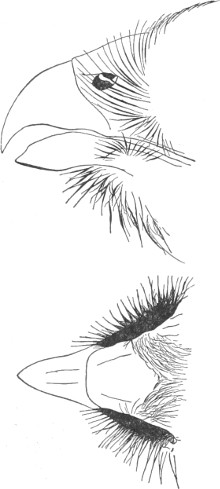
Onychotes gruberi, Type, (41703. California.)
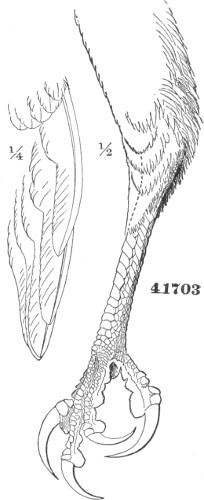
41703 ¼ ½
Onychotes gruberi.
Genus ONYCHOTES, Ridgway.
Onychotes, Ridgway, P. A. N. S. Philad. Dec. 1870, 142. (Type, O. gruberi, nov. sp.)
Gen. Char. Bill short, the tip remarkably short and obtuse, and only gradually bent; cere on top about equal to the culmen, very broad basally in its transverse diameter, and ascending, in its lateral outline, on a line with the culmen; commissure only faintly lobed. Nostril nearly circular, with a conspicuous (but not central or bony) tubercle; cere densely bristled below the nostril, almost to its anterior edge; orbital region finely bristled. Tarsus very long and slender, nearly twice the length of the middle toe; toes moderate, the outer one decidedly longer than the inner; claws very long, strong, and sharp, and curved in about one quarter the circumference of a circle. Tibial feathers short and close, the plumes scarcely reaching below the joint. Feathers of the forehead, gular region, sides, and tibiæ, with white filamentous attachments to the end of the shafts. Wing very short, much rounded, and very concave beneath; fourth quill longest; first shorter than ninth; four primaries emarginated, and one sinuated, on inner webs; five sinuated on outer webs. Tail about two thirds as long as wing, rounded. Outstretched feet reaching beyond end of tail.
This genus has no very near relatives among the American Falconidæ, nor, indeed, among those of other portions of the world. It is, perhaps, most closely related to the genus Rupornis, of South America, from which, however, it is very distinct. It is represented by a single species, the type of which, supposed to have come from California, still remains unique.
The elongated legs, reaching considerably beyond the rather short tail, the close thigh-plumes, the long and extremely acute claws (somewhat like those of Rostrhamus), with the short, rounded, and very concave wing, are its most striking peculiarities. Besides these distinguishing features, the short, thick bill, very deep through the base, and the filamentous attachments to the shafts of the feathers of certain parts of the body, are also very characteristic. The latter feature may possibly be a mark of immaturity, but I have seen nothing like it in other Raptores, and it seems to be more analogous to the nuptial ornaments seen in the Cormorants (Phalocrocoracidæ).
Species.
O. gruberi. Wing, 10.10; tail, 6.50; culmen, about .80; tarsus, 2.70; middle toe, 1.45; posterior claw, 1.00, its digit .80. Immature (?). Uniform grayish-umber, tinged with dull rufous on the neck; lining of the wing and tibiæ dull grayish-cinnamon. Primaries inclining to black, and showing just discernible, obscure hoary bars on their basal half. Tail brownish-gray, with a hoary cast nearer the shaft (not paler at the tip), and crossed with nine or ten narrow bars of dusky, these becoming hardly distinguishable basally and terminally. Inner webs of the primaries plain white anterior to their emargination. Head laterally and beneath obsoletely streaked with whitish. Hab. “California.”
Onychotes gruberi, Ridgway. GRUBER’S HAWK.
Onychotes gruberi, Ridgway, Pr. Ac. Nat. Sc. Phil. Dec. 1870, p. 149.
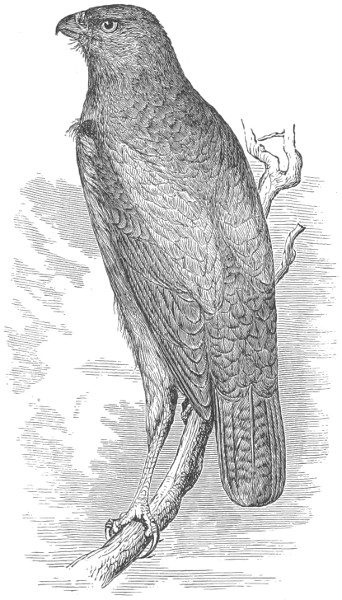
Onychotes gruberi.
Sp. Char. Immature? (41,703, “California”; F. Gruber). Outstretched feet reaching beyond tail. General plumage dull dark-bistre, with a grayish-umber cast in some lights, darkest on the head above and back; the posterior lower parts paler and more reddish; throat and neck much tinged with pale rusty (this obsoletely bordering the feathers, which here have fine whitish filaments attached to the shafts); primaries uniform black. Tail like the rump, but with a more hoary tinge (not paler at the tip), and crossed with seven or eight very narrow obscure bars of darker, the last of which is distant an inch or more from the end. Lining of wing dark bistre, much tinged with rusty, this prevalent toward the edge; under surface of primaries white anterior to their emargination, beyond which they are ashy, approaching black at ends; ashy portion with distant, very obsolete, dusky bars, but the cheeks and throat streaked obsoletely with this color. No distinct white anywhere about the head or neck. Wing, 10.00; tail, 5.80; tarsus, 2.70; middle toe, 1.40; inner, .90; outer, 1.10; posterior, .80; hind claw, 1.00 (chord); inner claw, .91; on front of tarsus, twelve exposed large transverse scutellæ; only 1.70 of the tarsus exposed.
The type of this species still remains unique. It was sent to the Smithsonian Institution by Mr. Gruber, who labelled it as having been obtained in California. Nothing is known of its habits.
Genus BUTEO, Cuvier.
Buteo, Cuv. 1799. (Type, Falco buteo, Linn. = Buteo vulgaris, Bechstein.)
Craxirex, Gould, 1838. (Type, Buteo galapagoensis, Gould.)
Pæcilopternis, Kaup, 1847. (Type, Falco borealis, Gm.)
Tachytriorchis, Kaup, 1844. (Type, Falco pterocles, Temm.)
Gen. Char. Form robust and heavy, the wings long, and rather pointed, the tail moderate and rounded, the bill and feet strong. Bill intermediate between that of Astur and that of Parabuteo. Wing long and rather pointed, the third to fifth quill longest, the first shorter than eighth; three to four with inner webs emarginated. Tail moderate, slightly rounded.
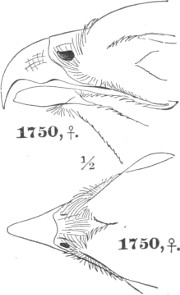
1750, ♀. ½
1750, ♀.
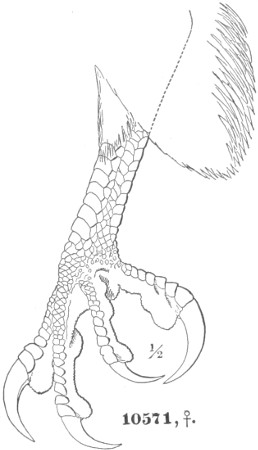
10571, ♀. ½
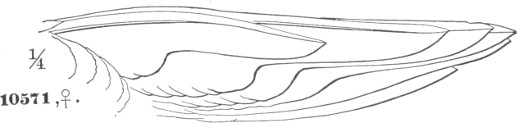
10571, ♀. ¼
Buteo borealis (1750; 10571).
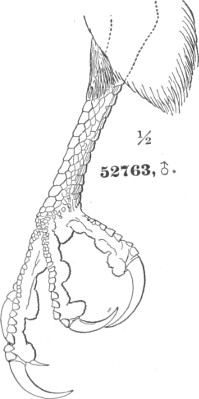
52763, ♂. ½
Buteo zonocercus (52763).

58505, ♀. ¼
Buteo swainsoni (58505).
The species of this genus are very numerous, especially within the tropics, and are found all over the world, except in Australia. About thirty nominal species are known, of which about fifteen distinct species, not including geographical races, belong to America. A single species, B. solitarius (Pandion solitarius, Peale), (Gray’s Hand List, I, 15, No. 136,) belongs to the Sandwich Islands. The genus seems to be wanting in the Australian and East Indian regions.
The following species and races belong to the North American fauna.
Species and Races.
A. Three outer primaries with their inner webs cut or emarginated.
1. B. pennsylvanicus. Wing, 9.85–11.40; tail, 6.30–8.00; culmen, .70–.80; tarsus, 2.15–2.80; middle toe, 1.20–1.40. Third to fourth quill longest; first shorter than seventh. Adult. Tail dull black, paler at the tip, crossed by two to four bands of dilute umber, or brownish-white, varying in width, but the last always broadest. Upper tail-coverts tipped and barred with white. Lower parts dull rufous-brown, nearly unbroken on the breast, but posteriorly much variegated with roundish transverse spots of white, forming broad transverse bars, interrupted by the dusky shaft. Upper parts dark umber, darker on the back. Young. Tail dull grayish-umber, growing darker terminally, narrowly tipped with whitish, and crossed by about six narrow and indistinct bands of dusky; these gradually becoming obsolete basally, the last much broader. Lower parts white, or light ochraceous, with longitudinal spots of dark brown or blackish on the sides of the breast and abdomen, and roundish or transversely cordate ones on the sides, flanks, and tibiæ. A conspicuous “mustache” on the cheeks, from the rictus down. Upper parts much as in the adult. Hab. Eastern North America, and Middle America, south to Bogota and Caraccas.
2. B. swainsoni. Wing, 12.00–17.00; tail, 6.50–9.00; culmen, .80–.95; tarsus, 2.95–2.70; middle toe, 1.50–1.70. Third to fourth (usually third) quills longest; first usually longer than seventh. Adult. Tail dark grayish-brown, sometimes with a hoary cast, crossed by five to seven, or more, narrow bands of dusky, usually very obscure, and becoming obsolete basally. Colors of other portions extremely variable; the upper parts, however, continuous, unvariegated, dark brown, or blackish; the lower parts sometimes also entirely dusky, except the tail-coverts, which are always (?) barred with white. Normal plumage. A dark area covering the jugulum and breast, dull rufous in the ♂, and dark grayish-brown in the ♀. Other lower parts whitish, sometimes pure, and nearly immaculate, but usually more or less tinged with ochraceous and rufous, and transversely barred with various shades of brown. Young. Tail hoary brownish-gray, crossed by numerous, very indistinct, narrow bands of darker, and faintly tipped with whitish. Ground-color of the head, neck, and lower parts, light ochraceous, or cream-color (sometimes nearly white), the anterior upper parts with large longitudinally ovate spots of black; these assuming the form of streaks on the head and neck. Sides of the breast with an aggregation of larger spots of the same, and sides with sparser hastate or deltoid spots. Upper parts purplish-black, more or less variegated with ochraceous; the relative proportion of the two colors varying with the individual.
Wing, 14.40–17.00; tail, 8.00–9.50; culmen, .80–.95; tarsus, 2.30–2.70; middle toe, 1.50–1.70. Weight 1½–3½ lbs. Hab. Western Province of North America, from the Mississippi Valley, and the region of the Great Lakes (Michigan, Wisconsin, Iowa, to Arkansas, also Canada and Massachusetts) to the Pacific … var. swainsoni.
Wing, 12.00–15.30; tail, 6.50–9.00; culmen, .85–.90; tarsus, 1.95–2.60; middle toe, 1.50–1.60. Colors similar, but the young paler than that of var. swainsoni. Adult unknown. Hab. Middle and South America, and southern border of the western United States, from New Mexico to Buenos Ayres (two specimens, Costa Rica, and Buenos Ayres, Mus. S. I.) … var. oxypterus.
B. Four outer primaries with their inner webs cut.
a. Form light, the legs slender; tail of adult without a subterminal band of black more distinct than the others.
3. B. zonocercus. Wing, 15.50–17.40; tail, 8.50–10.75; culmen, .90; tarsus, 2.50–2.80; middle toe, 1.60–1.85. Entirely deep black, with more or less concealed pure white spotting. Adult. Tail carbonaceous-black, with three very broad zones, of pure white on inner webs and ash on the outer webs. Young. Tail dark brown, the inner webs more or less, sometimes entirely, white, crossed by numerous oblique bands of black. Hab. Mexico (chiefly western?) and adjacent southwestern portions of the United States (Arizona, Coues; Southern California, San Diego, Cooper).
4. B. lineatus. Wing, 11.25–14.25; tail, 8.00–10.00; culmen, .75–.90; tarsus, 2.70–3.25; middle toe, 1.30–1.50. Fourth to fifth quill longest; first shorter than seventh. Outer webs of the primaries with quadrate spots of whitish; lesser wing-coverts dark rufous; lower parts rufous more or less barred with whitish, or whitish spotted longitudinally with dusky. Adult. Head, neck, lesser wing-coverts, and lower parts deep rufous, the lower parts more or less barred posteriorly with whitish. Primaries and tail black; the former with quadrate spots of pure white on the outer webs, and the latter crossed by six narrow bands of pure white, and tipped with the same. Young. Head, neck, and lower parts whitish, usually more or less tinged with ochraceous, and with longitudinal markings of dusky. Primaries and tail dusky; the former mostly ochraceous anterior to the sinuation of their outer webs, the latter crossed by numerous narrow bands of pale grayish-brown, these becoming paler and more ochraceous toward the base. Lesser wing-coverts more or less tinged with dark rufous.
Adult. Lower parts light rufous barred with white. Young. White prevailing on the lower parts. Hab. Eastern Province of the United States … var. lineatus.
Adult. Lower parts deep dark rufous, almost free from bars, except posteriorly. Young. Dark spotting on the lower parts predominating. Hab. Pacific Province, and southern Western Province, of the United States … var. elegans.
b. Form robust and heavy, the tarsus stout; tail of the adult with a subterminal band of black broader than the other.
5. B. borealis. Wing, 13.25–17.75; tail, 8.50–11.30; culmen, .90–1.15; tarsus, 2.70–3.40; middle toe, 1.60–1.95. Weight, 2½ to 4 lbs. Third to fifth quill longest; first shorter than seventh and shorter than tenth. Colors extremely variable, ranging from entirely pure white beneath, through various shades of ochraceous and rusty, and greater or less amount of darker spots and bars, to an entirely uniform brownish-black. Adult. Tail deep rufous, generally paler at the tip; with or without black bars. Young. Tail grayish-brown, crossed by nine or ten bands of black, much narrower than the gray ones. Lower parts always with white predominating.
Tibiæ and lower tail-coverts without transverse bars, at any age. Lower parts with white always predominating. Tail never with more than one bar of black.
Feathers of the head and neck edged laterally with rufous; scapulars and wing-coverts much variegated with whitish; upper tail-coverts white, barred with rufous. Throat with blended streaks of blackish, this usually predominating; tibiæ and lower tail-coverts plain yellowish-white. Hab. Eastern Province of North America, to the Missouri plains … var. borealis.
Similar, but colors much paler, the lower parts entirely pure white, with little or no spotting on the abdomen. Tail usually destitute of the black subterminal band. Hab. Plains, from Texas to Minnesota … var. krideri.
Similar to the last, but lower parts strongly tinged with rufous on the tibiæ, and upper parts much darker. Tail always destitute of the subterminal black band. Young not distinguishable from that of var. calurus. Hab. Cape St. Lucas … var. lucasanus.
Whole head, neck (except the throat), and upper parts, continuously uniform unvariegated brownish-black; that of the neck meeting narrowly across the lower part of the throat, leaving the whole throat almost immaculate white. Posterior lower parts fine, deep pinkish-ochraceous; tibiæ deep reddish-ochraceous; upper tail-coverts plain rufous. Hab. Central America (from Tres Marias, Western Mexico, to Costa Rica and Veragua) … var. costaricensis.
Tibiæ and lower tail-coverts always with distinct transverse bars. Tail often with more or less complete transverse bars of black to the base. Lower parts with an excess of ochraceous and darker markings, frequently wholly blackish.
Varying, from individuals distinguishable from the darker examples of var. borealis only by the presence of bars on the tibiæ and crissum, through others with various degrees of rufous tinge and dusky spotting and barring beneath, to a perfectly melanistic condition, in which the bird is almost uniformly black, and the tail with continuous, regular bars of black to the base. Hab. Western Province of North America, from the Rocky Mountains to the Pacific … var. calurus.
6. B. harlani. Wing, 15.00–16.20; tail, 8.80–10.50; culmen, 1.00; tarsus, 2.75–2.90; middle toe, 1.50–1.70. Lateral toes nearly equal; tibial plumes much developed, reaching below the bases of the toes. Entirely brownish-black (except the tail), the concealed bases of the feathers snowy-white. Adult. Tail confusedly mottled with dusky and white, upon a grayish ground; sometimes more or less tinged with rufous. Young. Tail grayish-brown, with nine very regular, sharply defined bands of brownish-black, about equal in width to the gray ones. Lower parts wholly dusky. Hab. Southwestern United States, east of the Rocky Mountains, from Kansas to Texas.
7. B. cooperi. Wing, 15.75; tail, 9.10; culmen, 1.10; tarsus, 3.25; middle toe, 1.70. Adult. Head, neck, and beneath, pure white, the head above and nape streaked with dusky; lining of the wing white, with a large black patch. Above nearly uniform dusky, the primaries plumbeous. Tail longitudinally mottled with light rufous, cinereous, and dusky; the former prevailing. Hab. Santa Clara County, California.
Buteo pennsylvanicus (Wils.). BROAD-WINGED HAWK.
Falco pennsylvanicus, Wils. Am. Orn. VI, 92, pl. liv, f. 1, 1812.—Lath. Gen. Hist. I, 263, 1821.—Aud. B. Am. pl. xci, 1831; Orn. Biog. I, 461, 1831.—Bonap. Ann. Lyc. N. Y. II, 29, 434; Isis, p. 1137, 1832.—Nutt. Man. I, 105, 1833.—Temm. Pl. Col. 67, 1836. Buteo pennsylvanicus, Bonap. Ois. Cuv. Règ. An. p. 35, 1830; Eur. & N. Am. B. p. 3, 1838; Consp. Av. p. 19, 1850.—Aud. Syn. p. 7, 1839.—Brew. (Wils). Am. Orn. Syn. p. 648, 1852.—Gray, Gen. sp. 8, 1844; List B. Brit. Mus. p. 16, 1844.—Cass. B. Cal. & Tex. Syn. p. 100, 1854.—Strickl. Orn. Syn. I, 32, 1855.—De Kay, Zoöl. N. Y. II, 11, pl. v, fig. 11, 1844.—Cass. Birds N. Am. 29, 1858.—Gray, Hand List, B. 7, 1869.—Dresser, Ibis, 1865, 325 (Texas). Astur pennsylvanicus, Cuv. Règ. An. (ed. 2), I, 332, 1829.—James. (Wils.) Orn. I, 65. Falco latissimus, Wils. Am. Orn. (last ed.) VI, 92, pl. liv, f. 1, 1812. A. ? latissimus, Jard. (Wils.) Am. Orn. II, 294. Falco wilsoni, Bonap. Obs. Wils. Nouv. Journ. Ac. Sc. N. Y. III, 348. Pœcilopternis wilsoni, Kaup, Mon. Fal. Cont. Orn. p. 75, 1850. Sparvius platypterus, Vieill. Enc. Méth. III, 1273 (quot. Wils. pl. liv, fig. 1), 1823.
Sp. Char. Adult. Upper surface dark umber-brown, the feathers gradually paler toward edges; on the back, the feathers more uniformly dusky, causing a prevalent blackish appearance. Rump and upper tail-coverts blackish vandyke-brown; the latter tipped with pure white, and with a concealed bar of same, about the middle of each feather. Tail dull black, with an obscure terminal band of dull brown, this fading terminally into whitish; across the middle of the tail a broad band of dull light umber (in some individuals approaching dull white) about ¾ of an inch in width; about as far anterior to the main band as this is from the tip is another much narrower and more obscure band of the same color, crossing just beyond the ends of the coverts, or concealed by them. Primaries uniform brownish-black, fading on terminal edge into pale brown. Head above, and broad but inconspicuous “mustache,” running from beneath the lore downward across the cheek, dull black; the crown posteriorly, with the occiput and nape, having the dull black much broken, caused by the lateral streaks of dull rufous on all the feathers; this dull rufous tint prevails on the rest of the head and neck, as well as the breast, leaving the lores and chin and lateral portion of frontlet alone whitish; throat streaked with blackish. Beneath dull brownish-rufous; that of the breast almost unvaried; medially, however, are roundish spots of white on opposite webs, but these are not confluent; posteriorly these spots become gradually more numerous and more transverse, forming on the flanks transverse bands, almost continuous; on the tibiæ the white prevails, the rufous bars being more distant, and connected only by a brown shaft-line; lower tail-coverts less numerous, transverse spots of dull rufous. Lining of the wing ochraceous-white, with sparse, rather small, irregularly deltoid spots of dull rufous; under surface of the primaries unvaried white, as far as their emargination, beyond which they are black. Fourth quill longest; third a little shorter; second intermediate between fifth and sixth; first about equal to the ninth. Female (extremes 30,969, Brookline, Mass., and 30,895, Mirador, Mexico; the latter the larger.) Wing, 11.00–11.30; tail, 6.80–7.10;Male (32,309, Moose Factory, Hudson’s Bay Territory). Wing, 10.50; tail, 6.30; tarsus, 2.30; middle toe, 1.20.
Young male, second year? (39,106, Remedios, Cuba, June; N. H. Bishop). Upper parts similar to adult, but a reddish tint appreciably washing the edges of the interscapulars and (less noticeably so) the scapulars. Bands on tail nearly as in adult; but very near the base is a fourth, very narrow and faintly defined, pale band, while the bases of all the feathers are much mottled with white. Dull rufous of the breast not continuous, but in the form of large longitudinal broad spots, occupying the greater middle portion of each feather; abdomen, sides, and tibiæ with smaller and more cordate spots of dull rufous; the lower tail-coverts immaculate; the decided ochraceous tinge beneath, deepest posteriorly.
Young, first year (11,984, Washington, D. C.). The blackish above is much variegated, being broken by the narrow rusty borders to interscapulars, rump, and lesser wing-coverts; the broader and more ochraceous borders to scapulars and greater wing-coverts, and partially concealed whitish spotting on the former. Upper tail-coverts white, with broad bars of blackish-brown; secondaries and primaries edged terminally with whitish. Tail dull umber-brown, growing darker terminally; narrowly tipped with white, and crossed with six obscure, narrow bands of dusky, the (concealed) bases of all the feathers white. Superciliary region, cheeks, chin, throat, and entire lower parts, delicate pale ochraceous, or whitish cream-color; a conspicuous “mustache,” a medial longitudinal series of streaks on the throat, with large longitudinal ovate spots on sides of breast, cordate spots on sides and flanks, and sagittate spots on tibiæ, clear blackish-brown. The ochraceous deepest on the abdomen and crissum. Wing beneath as in adult.
A very young bird, scarcely fledged (33,598, Milltown, Me.; G. A. Boardman), differs from the last in a much more continuous black shade above, the deeper ochraceous beneath, and larger, as well as more numerous, blackish spots beneath.
In the adult plumage of this species, the principal variation is in the continuity or distinctness of the anterior light band on the tail, and the extent and depth of shade of the brown beneath. The first feature is characteristic of most specimens, only one (55,980, ♂, Costa Rica) being without it; it is broadest and most conspicuous, as well as less concealed by the coverts, in the females, and this appears to be the principal sexual difference. The dull brownish-rufous of the under parts is most prevalent in a specimen from Mirador, Mexico (30,895, ♀ ? September; Dr. Sartorius), in which specimen the breast is almost continuously of this color, and the lower tail-coverts are strongly barred (or transversely spotted) with the same; the ground-color beneath is also more ochraceous than in any other individual. In the Costa-Rican specimen (the one lacking the anterior tail-band), the brown beneath is quite different from that of the others, being of a much more ashy shade; the lower tail-coverts are also immaculate. The brown markings beneath are most sparse in 20,389, from Coban, Vera Paz (January; O. Salvin); in this, also, the tail-bands are very distinct, and almost white.
A young bird from Costa Rica (30,412; Dr. Frantzius) is exactly similar to No. 27,048, from Fort Garry, Selkirk Settlement.
LIST OF SPECIMENS EXAMINED.
National Museum, 18; Philadelphia Academy, 6; Boston Society, 3; New York Museum, 2 (Caraccas); Museum, Cambridge, 2; Cab. G. N. Lawrence, 5; Coll. R. Ridgway, 2. Total, 38.
Measurements.
Sex.Wing. Tail. Culmen. Tarsus. Middle Toe. Specimens.
♂ 9.85–10.70 6.50–7.00 .70–.002.15–2.80 1.20–1.38 11
♀ 11.00–11.40 7.00–8.00 .70–.78 2.20–2.70 1.30–1.40 14
Hab. Eastern North America southward along Gulf coast through Louisiana, into Mexico and Central America; Cuba, Ecuador, Upper Amazon, Caraccas (N. Y. Museum).
Localities: Ecuador, winter (Scl. 1858, 451); Orizaba (Scl. 1857, 211); Upper Amazon (Scl. 1857, 261); Cuba (Cab. Journ. II, lxxxii; Gundlach, Rept. 1865, 223; resident); Panama (Lawr. VII, 1861, 288); S. E. Texas (Dresser, Ibis, 1865, 325; breeds); Costa Rica (Lawr. IX, 133).
Habits. The Broad-winged Hawk appears to be distributed over eastern North America, somewhat irregularly, as far north as the British Provinces, and as far west at least as the Mississippi. It has been found in Florida by Mr. Wurdemann, where it was said to be not uncommon. It is a resident in Cuba, where it breeds; but it has not been taken in Jamaica. It has also been detected in Guatemala by Mr. Skinner. Audubon states that he never met with it in Louisiana, but Mr. Dresser found it not uncommon from the Nueces eastward. In September he noticed several near the Mission of San Patricio, and during the winter obtained several specimens near San Antonio. In May he shot a young bird on the Medina River, and early in June he found a nest containing young on the Colorado. It was on a high cottonwood-tree, and in an almost inaccessible position.
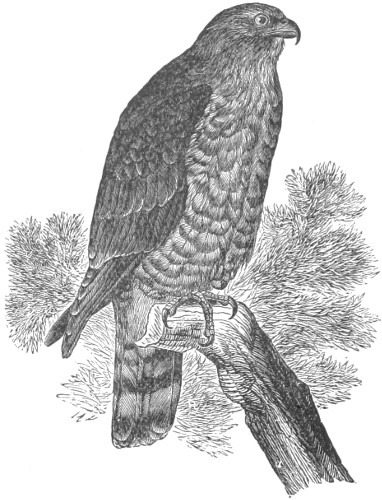
Buteo pennsylvanicus.
It is not mentioned by Mr. Downes as occurring in Nova Scotia, though I think it quite probable it may be found there; but it is quite common near Calais, both in Eastern Maine and in New Brunswick. Professor Verrill gives it as a common summer visitant in Oxford County, Me., near Norway, and as still more abundant near the Umbagog Lakes, and apparently the most common Hawk in that vicinity. He found its nest, June 12, containing two eggs nearly hatched. It is to be met with throughout Massachusetts, having been found breeding near Williamstown, Springfield, and also in the vicinity of Boston. Its nest was also met with in Middlebury, Vt., by the late Professor Adams. Mr. McIlwraith, of Hamilton, Canada, has noted extensive migrations of this Hawk in March of different years, as many as twenty or thirty being in view at one time, passing at a considerable height, and moving in circles towards the northwest. Others, that appeared to be stragglers from the main body, were met with in the woods. Dr. Hoy states it to be rather common near Racine, and Mr. Kumlien has obtained it in the vicinity of Lake Koskonong. From all these data it may naturally be inferred that this Hawk has a pretty general distribution from Florida to Texas, and from New Brunswick to the Mississippi Valley, probably extending northward into the Saskatchewan Valley and south-westerly to Central America.
The Broad-winged Hawk was first described by Wilson, who shot a single specimen that had been feeding on a meadow-mouse. On his approach it uttered a whining whistle and flew to another tree. Another of the same species was observed, and its movements were in wide circles, with unmoving wings. Nuttall never met with it, and regarded it as very rare.
Audubon characterizes this Hawk as spiritless, inactive, and deficient in courage, seldom chasing other birds of prey, but itself frequently annoyed by the little Sparrow-Hawk, the Kingbird, and the Martin. It only attacks birds of a weak nature, young chickens, and ducklings, and feeds on small animals and insects. It is usually found singly, is easily approached, and when wounded throws itself on its back, erects its top feathers, utters a hissing sound, and attempts to defend itself with its talons.
A nest of this bird, found by Mr. Audubon, is said to have been about the size of that of the Crow, and to have been placed in the larger branches of a tree, near the trunk. It was composed externally of dry sticks and briers; internally, of small roots, and lined with numerous large feathers. The nest found by Professor Adams, near Middlebury, Vt., was quite large, and was coarsely constructed of sticks, and lined only with fibrous roots and fine grass. In this instance the eggs were three. This is the more usual number, though occasionally four or five are found.
Mr. Boardman informs me that Mr. Audubon’s account of the spiritless manner in which one of these Hawks suffered him to capture it on its nest does not at all correspond with his own experience. He has, on the contrary, found it one of the most courageous and spirited of its family. On one occasion, when a man employed by him was ascending to a nest, a parent bird assailed the disturber with great fury, tore his cap from his head, and would have done the man serious injury had it not been shot. In another instance one of these birds attacked a boy climbing to its nest, and fastened its talons in his arm, and could not be removed until it was beaten off and killed with a club.
The eggs of this Hawk have an average length of 2.09 inches, and an average breadth of 1.61. The smallest egg measures 1.94 by 1.50 inches, and the largest 2.11 by 1.72 inches, showing considerable variation in their relative capacity, but not so much as is found among the eggs of other species. In shape, the eggs are of a slightly rounded oval, one end a little less obtuse than the other. The ground-color is of a grayish or dirty white, occasionally with a slightly silvery shading. These are marked, usually over the entire egg, in irregular distribution, with varying shades of brown. The more common is a light tawny or reddish-brown. Intermingled with these blotches are often found a peculiar faint purplish-brown, dull shading of a light yellowish-brown, and a deep rich shade of purplish-brown, approaching occasionally almost in intensity to black. These may occur separately, or they may all be found blended in the same egg. The size, shape, and peculiar coloring of the eggs of this Hawk make them readily recognizable, though not readily permitting a satisfactory description.
A nest of this Hawk, taken by Mr. J. P. Ritchie, May 18, 1863,—the parent female of which was secured also,—is described as having been made of large sticks, very loosely put together, lined with a few pieces of bark. It was placed in the crotch of a tree, close to the trunk, and twenty feet from the ground, and contained two eggs.
Buteo swainsoni, Bonap. Var. swainsoni, Bonap. SWAINSON’S HAWK; BAIRD’S HAWK.
Buteo swainsoni, Bonap. Comp. List, p. 3, 1838; Consp. Av. p. 19, 1850; Proc. Ac. N. S. Phil. p. 280, 1855; Birds N. Am. 19, 1858.—Heerm. P. R. R. Rep’t, II, 32, 1855.—Strickl. Orn. Syn. I, 30, 1855.—Dresser, Ibis, 1865, 324 (Texas).—Gamb. Journ. Ac. N. S. Phil. n. δ. I, 27.—Coues, Prod. B. Ariz. 9, 1866.—Blakist. Ibis, III, 1861, 317 (fresh eggs).—Gray, Hand List, I, 7, 1869. Falco buteo, Penn. Arct. Zoöl. II, 207, sp. 103 (♀ Juv.), 1785.—Aud. B. Am. pl. ccclxxii, 1831; Orn. Biog. IV, 508, 1831. Falco obsoletus, Gmel. Syst. Nat. p. 268, 1789.—Kerr, Trans. Gmel. II, 501, 1792.—Lath. Ind. Orn. p. 28, sp. 61, 1790; Synop. Supp. I, p. 30; Gen. Hist. I, p. 254, 1821.—Daud. Tr. Orn. II, 104, 1800.—Shaw, Zoöl. VII, 152, 1812. Buteo cinereus, Vieill. Ois. Am. 1807. Buteo vulgaris, Rich. & Swains. F. B. Am. p. 5, 1831.—Jard. (Wils.) Am. Orn. II, 56, 1808.—Brew. (Wils.) Am. Orn. p. 303; Synop. p. 684, 1852. Buteo montanus, Nutt. Man. Orn. U. S. & Canad. I, 112, 1833. Buteo bairdi, Hoy, Proc. Ac. Sc. Phil. VI, 451, 1853.—Cassin, B. of Cal. & Tex. pl. xli, 1854; Birds N. Am. 21, 1858.—Strickl. Orn. Syn. I, 37, 1855. Buteo insignatus, Cass. B. Cal. & Tex. p. 102, pl. xxxi, 1854; Birds N. Am. 23, 1858.—Heerm. P. R. R. Rep’t, VII, 31, 1857.—Strickl. Orn. Syn. I, 38, 1855.—Coues, Prod. B. Ariz. 9, 1866.—Bryant, Proc. Bost. Soc. X, 1865, 90 (= swainsoni). ? Buteo gutturalis, Max. Cab. Journ. VI, 1858, 17 (and eggs).
Sp. Char. Form robust and strong, like B. borealis; wings long and pointed; only three outer primaries with their inner webs cut. Feet robust, the tarsi strong. Dimensions: Wing, 14.40–17.00; tail, 8.00–9.50; culmen, .80–.95; tarsus, 2.30–2.70; middle toe, 1.50–1.70. Weight, 1½–3½ lbs. Colors: Tail dark grayish-brown with a hoary cast, crossed by numerous obscure narrow bands of a darker shade. Adult, uniform blackish-brown above; upper tail-coverts barred with white. Throat and lower parts posterior to the breast white or pale ochraceous; a broad patch across the breast uniform brown,—reddish-rufous in the male, and grayish-umber in the female,—the whole lower surface varying to entirely uniform dull brownish-black, though intermediate shades. Young, with the ground-color of the plumage soft ochraceous, or cream-color; the head, neck, dorsal region, and sides of the breast, with tear-shaped spots of brownish-black, with a faint purple reflection. Upper parts purplish-black, variegated with ochraceous, sometimes almost wholly black. Tail as in the adult, but more hoary.
a. Normal plumage.
Adult male (53,105, Truckee River, Nevada, July; C. King, R. Ridgway). Head, neck, and upper parts blackish-brown; scapulars slightly variegated with a rufous mottling; upper tail-coverts white tinged with rufous, and with transverse bars of blackish-brown, about six on each feather. Tail dark brown like the back, approaching black terminally, basally with a slight hoary cast; crossed by about ten narrow, very obscure bands of nearly black. Front and whole throat clear white, immaculate, and sharply defined against the surrounding blackish; lores dusky. Whole breast, cinnamon-rufous (forming a wide, sharply defined band), marked laterally with the brown of the neck; each feather with a shaft-line of black; rest of lower parts, including whole lining of the wing, continuous ochraceous white, the latter region unvariegated; sides with sparse, faint, transverse bars of rufous, and shaft-lines of darker. Under side of primaries light slate anterior to emargination, beyond which they are black; slaty portion crossed by very obscure bars of darker. Fourth quill longest, third scarcely shorter; second equal to fifth; first intermediate between seventh and eighth. Length, 19.75; extent, 48.00; wing, 15.40; tail, 8.00; tarsus, 2.32; middle toe, 1.60. (Weight 1½ lbs.) Bill slate-black, bluish basally; cere, and angle of mouth, light dull lemon yellow; iris deep hazel; tarsi and toes deep chrome yellow, claws black.
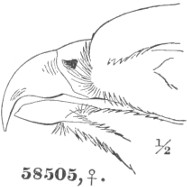
58505, ♀. ½
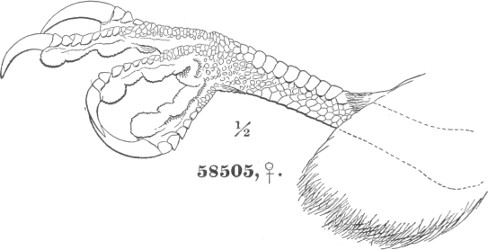
58505, ♀. ½
Buteo swainsoni (Nevada).
Adult female (58,507, Great Salt Lake City, Utah, May; C. King, R. Ridgway). Similar to the male, but pectoral area blackish-brown, like the back; blackish-brown of upper surface untinged with rufous, all the feathers, however, fading on edges; bands of the tail scarcely distinguishable on outer webs; white of forehead very restricted; lining of the wing barred with small cordate or deltoid spots of black; under surface of primaries plain deep slate. Abdomen and sides variegated with a few irregular longitudinal spots, and on the latter, transverse bars of dark brown; tibiæ with faint bars of rufous. Fourth quill longest; third scarcely shorter; second very slightly shorter than fifth; first intermediate between seventh and eighth. Length, 21.50; extent, 54.00; wing, 16.50; tail, 8.50; tarsus, 2.70; middle toe, 1.70. (Weight, 2¾ lbs.)
Young (10,761, Rocky Mountains, September; C. Drexler). Head, neck, and entire lower parts fine delicate light ochraceous, or cream-color; feathers of the crown, occiput, and neck, each with a medial stripe of black, of less amount, however, than the ochraceous; forehead, supraoral region, and ear-coverts, with only a few very fine hair-like shaft-streaks; on the chin, and across the cheeks, are longitudinal spaces of blended streaks of black, the latter forming a conspicuous “mustache”; sides of the breast with large ovate spots of black; middle of the breast with less numerous, smaller, and more longitudinal ones of the same; sides, flanks, and abdomen, with broad hastate spots, more irregular and transverse on the former; throat, tibiæ, anal region, and lower tail-coverts immaculate. Upper surface generally, deep black; feathers bordered with pale ochraceous, the scapulars and middle wing-coverts much variegated with the same. Secondary coverts, secondaries, and primaries narrowly tipped with white. Upper tail-coverts pale ochraceous, barred with black. Tail ashy-brown, very much lighter than the rump (more hoary than in the adult), narrowly, but clearly, tipped with white, and crossed by ten or twelve narrow bands of black, more distinct than in the adult. Under surface of primaries more whitish than in the adult.
(b. Melanistic condition; = B. insignatus of Cassin.)
Adult male (22,567, Onion River; R. McFarlane). Entirely brownish black, whole under surface of wings included; lower tail-coverts equally barred with white and black. Tail blackish slate, narrowly paler at the tip, and crossed with numerous oblique bars of dusky black; upper tail-coverts barred obsoletely with lighter slaty-brown. Wing, 15.00; tail, 8.00; tarsus, 2.20; middle toe, 1.50. Fourth quill longest; third, next; second, shorter than fifth; first, slightly shorter than eighth.
Adult female (12,927, Utah Valley, July; C. S. McCarthy). Similar; lower tail-coverts white, tinged with rusty, and barred with brown; tibiæ tinged with chestnut. Wing, 16.50; tail, 8.80; tarsus, 2.60; middle toe, 1.65. Third and fourth quills equal and longest; third shorter than fifth; first equal to eighth.
LIST OF SPECIMENS EXAMINED.
National Museum, 27; Philadelphia Academy, 2; Boston Society, 1; Museum, Cambridge, 1; Cab. G. N. Lawrence, 2; W. Brewster, 1; R. Ridgway, 5. Total, 39.
Measurements.
Sex. Wing. Tail. Culmen. Tarsus. Middle Toe. Specimens.
♂ 14.40–15.25 8.25–9.00 .80–.90 2.30–2.65 1.50–1.60 11
♀ 14.75–16.50 9.00–0.00.80–.95 2.50–2.70 1.55–1.65 11
Hab. Western regions of North America, east to the Mississippi Valley, north to the Arctic regions; Wisconsin; Arkansas; Canada; Massachusetts.
Localities: S. Texas (Dresser, Ibis, 1865, 324); Arizona (Coues?); Guatemala (Scl. Ibis, I, 216, “insignatus”).
The young plumage described above is the Buteo bairdi, Hoy, of authors. The melanistic plumage is B. insignatus, Cassin.
The young birds of this species are as variable as the adults; thus, No. 53,210, ♂, has the fine ochraceous of the lower parts entirely free from spots, except across the breast; on the upper parts the ochraceous spotting is so extended as to almost prevail, while another, from the same nest, has the black beneath exceeding the ochraceous, the tibiæ being thickly spotted, and the lower tail-coverts barred. Both these specimens belong to a brood of four, which were hardly able to fly, and were shot, with their parents, the male of which is the one described, while the female (No. 53,206) is a very dark example of insignatus, Cassin.
The type of bairdi, and another Wisconsin specimen, are in the collection of the Philadelphia Academy. In plumage, they are unlike any others I have seen, though there is as little resemblance between these two as between any I have compared. Dr. Hoy’s type (Racine, Wisc., January, 1854) differs from others, in exceedingly pale colors; the cream-color beneath is scarcely spotted, there being only a few triangular spots and shaft-lines of black on the sides; the lining of the wing is entirely immaculate. Above, the black is unusually continuous; the under surface of the primaries is unusually white. Wing, 15.00; tail, 8.00.
The other specimen (Menonomee Marsh, Milwaukee, Wisc., spring of 1851) is just the opposite extreme in plumage, being unusually dark, for a young bird. Beneath, the black spots are so large as to nearly cover the whole surface, while the continuity of the black of the upper part is almost unbroken. The head above, and nape, and broad “mustache” stripe from angle of mouth down to the jugulum, with nearly the whole pectoral area, unbroken black, leaving the gular region and side of the head pale, but thickly streaked. Wing, 15.00; tail, 8.80; tarsus, 2.35; middle toe, 1.50. These specimens may be said to form about the extremes of the young plumage. An Iowa skin (No. 59,052; Ricksecker) is like the average of far-western examples.
The melanistic condition bears to the normal plumage of swainsoni precisely the same relation that the black calurus, Cassin, does to the usual style of the western variety of borealis (borealis var. calurus = montanus, Cassin); the variable series, connecting these two extremes, and designated by the name borealis var. calurus, which covers the whole, finds an exact parallel in the present species.
A specimen from the Platte (5,576, ♂, August; W. S. Wood) is entirely dark rufous-brown beneath (excepting the lower tail-coverts), with the shafts of the feathers black.
This species is entirely distinct specifically from the B. vulgaris of Europe. The latter has four, instead of only three, outer primaries deeply emarginated, and is very dissimilar in every stage of plumage.
Var. oxypterus, Cassin. SHARP-WINGED HAWK.
(Normal young plumage.)
Buteo oxypterus, Cass. P. A. N. S. VII, 1855, 282.—Ib. Birds N. Am. 1858, 30.—Strickl. Orn. Syn. I, 1855, 28.—Coues, P. A. N. S. 1866, 9.—Gray, Hand List, I, 8.—Cooper, Birds Cal. 1870, 480. Buteo albicaudatus, “Vieill.,” Sclater, P. Z. S. 1869, 634, No. 22.
(Melanistic plumage.)
Buteo fuliginosus, Sclater, P. Z. S. Lond. 1858, 356.—Ib. Trans. Z. S., July, 1858, 267, pl. lxii.—Ridgway, P. A. N. S. Dec. 1870, 142.
Sp. Char. Adult; melanistic plumage (No. 12,117, Mazatlan, Mexico; Colonel Abert). Entirely fuliginous-black, darkest on head and back; no white on forehead. Tail cinereous-umber, crossed with seven very regular and continuous bands of black, the subterminal one of which is broadest. Lower tail-coverts, and larger under wing-coverts, with transverse bands of dull white; lining of the wing unvaried black; under surface of primaries silvery-white, that portion beyond their emargination black, the whitish portion crossed by distant, very obsolete, transverse bars. Third quill longest; fourth and fifth scarcely shorter, and nearly equal; second equal to sixth; first shorter than eighth. Tail square; scutellæ of the tarsus very faintly defined, or, in fact, scarcely detectable (probably accidental), Wing, 13.00; tail, 7.00; tarsus, 1.95; middle toe, 1.55.
Young male; normal plumage (No. 8,550, Fort Fillmore, New Mexico; Dr. T. C. Henry, U. S. A.). Head, neck, and lower parts, soiled ochraceous-white. Feathers of the head above, and neck laterally and behind, with medial stripes of blackish-brown; jugulum, breast, sides, flanks, and abdomen, with large rounded spots of blackish-brown; tibiæ with transverse bars of the same; lower tail-coverts almost immaculate. A conspicuous “mustache” of blended dusky streaks, from angle of the mouth across the cheeks, the dusky suffusing the lores. Whole oral region scarcely variegated pale yellowish; whole chin and throat immaculate.
Prevailing tint above, blackish-brown, becoming purplish-black on primaries; whole outer surface of wing plain, but interscapular region somewhat variegated with partially concealed, irregular blotches of deeper ochraceous than the lower parts; upper tail-coverts with pairs of indistinct white spots. Tail grayish-brown (white at extreme base), crossed with about ten narrow, indistinct, but regular bands of dusky. Lining of the wings yellowish-white, with sparse cordate spots of blackish, this tint prevailing over the under primary coverts; under surface of the primaries pure purplish-black after their emargination, but anteriorly plain hoary brown, growing paler basally. On inner webs are very indistinct transverse spots of dusky, touching neither the edge nor shaft of the feather, and entirely concealed when the wing is closed. Shafts of primaries pure white on under side; on outer, dark brown. Wing-formula, 3–4–2–5–6–7–1, 8. Three outer primaries emarginated on inner webs; second, third, and fourth, sinuated on outer. Wing, 13.70; tail, 7.00; tarsus, 2.10; middle toe, 1.35. Primaries project beyond secondaries, 5.50. (Cassin’s type.)
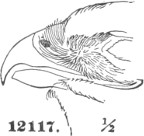
12117. ½
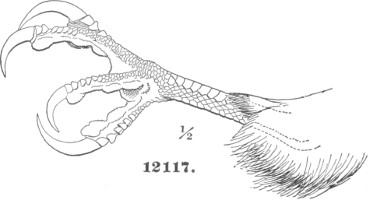
12117. ½
Buteo oxypterus (Mazatlan).
Young female (33,508, San José, Costa Rica; J. Carmiol). Differs from the type chiefly in lighter colors. The whole forehead very broadly immaculate dull white, this continuing back to the occiput in a broad unstreaked superciliary stripe; along the upper edge of the ear-coverts is a rusty suffusion, with condensed, fine dusky streaks, forming an indistinct stripe separating the wholly white ear-coverts from the supraoral stripe; the “mustache” is very conspicuous; the breast has a few large tear-shaped spots of clear blackish-brown, and the sides have very sparse, irregular, and more sagittate spots of the same; the whole posterior parts are immaculate. The upper parts are more variegated with paler, the wing-coverts and rump having the feathers irregularly bordered with whitish. The upper tail-coverts are white, barred with dark brown. Tail, hoary brown, crossed by nine or ten nearly obsolete, narrow bands of dusky. Whole lining of the wings immaculate, except the conspicuous patch on the primary coverts. The whole under surface of the primaries is uniform slaty, gradually deepening into black towards ends. Wing-formula, 3–4–2–5–6–7, 1. Wing, 15.00; tail, 8.00; tarsus, 2.45; middle toe, 1.55. Primaries project beyond secondaries, 6.00.
Hab. Tropical America, from the southern border of the United States to Buenos Ayres.
The melanistic specimen described above agrees perfectly with Mr. Sclater’s excellent figure of his B. fuliginosus above cited, and the only discrepancy in the description is in the measurements,—those given for the B. fuliginosus being, wing 12.00, tail 6.50, and tarsus 2.60. This difference—certainly not great—very likely indicates the proportions of the sexes, while the discrepancy as regards the length of the tarsus, it is probable, results from a different mode of measurement.
The present form is very nearly related to the true B. swainsoni, and, though distinguishable, we find it difficult to express points of absolute difference. The essential distinctions, however, are the longer primaries and lighter colors of the present bird, there being in the immature plumage of oxypterus no approach to the deep, fine ochraceous, the characteristic and prevalent tint of the young B. swainsoni. The spots beneath are more sparse, and there does not appear to be that tendency to their aggregation on the sides of the breast as generally seen in swainsoni.
Both agree, however,—and differ from all other species,—in the unbarred slate-color of the under surface of primaries, the plain black of the outer surface, conspicuous “mustache,” obscurely barred gray tail, etc. In fact, the general pattern is almost exactly the same, while there is little difference in relative proportions.
In view of the very appreciable, though rather indefinite, differences above indicated, and the obscure history of the present bird, we prefer, at least until more familiar with its different stages, to recognize it under the above name.
A third specimen, from Buenos Ayres (Conchitas; William H. Hudson),—exactly similar, in all particulars, to the two specimens described,—was labelled by Mr. Sclater, B. albicaudatus, Vieill., which is usually placed as a synonyme under B. pterocles, an exclusively South American species; though belonging strictly to the same section of the genus with the present bird and B. swainsoni, it is quite distinct, the Smithsonian Collection containing numerous examples illustrating the several stages of plumage.
Habits. Taking the two varieties together, this species appears to range over the entire continent of America, from the Arctic regions to the cold-temperate portion of South America. In Arctic America it appears to have a western distribution, though extending far to the north during the breeding-season, and being more or less nomadic during the winter. A single well-marked specimen was taken by Mr. Brewster, in the winter of 1871–72, in the eastern part of Massachusetts. It was first noticed by Dr. Richardson, and was by him supposed to be identical with the common Buzzard of Europe. It was met with in the fur country, where it was migratory, arriving there early in April, and departing again about the end of September. It frequented the low alluvial points of land which stretch out under the high banks of rivers, where it might be observed sitting for a long while motionless on the bough of a tree, waiting patiently for some small birds or quadrupeds to pass within its reach. As soon as it perceived anything of the kind, it would glide silently into the air and sweep easily but rapidly down upon its prey. One of Dr. Richardson’s specimens was found to have two whole toads in its stomach.
Dr. Richardson states that this Buzzard builds its nest on a tree, of short sticks, lining it sparingly with deer’s hair. The eggs, from three to five in number, are described as equalling in size those of the domestic fowl, and as having a greenish-white color, with a few large dark brown blotches at the larger end. It was seen by the doctor as far to the north as the 57th parallel.
Mr. Audubon’s drawing and description of this bird were taken from a specimen obtained by Dr. Townsend from the Columbia River. A number of specimens have been obtained by the various government exploring expeditions. A single specimen was taken by Mr. Dresser near San Antonio, in Texas.
Captain Blakiston (Ibis, 1861, p. 317) obtained several specimens of this Buzzard at the forks of the Saskatchewan River, in the stomach of one of which he found three toads. He states that it was quite abundant in that neighborhood. He adds that Mr. Bourgeau procured several specimens of the eggs, identified by also obtaining the parents. These eggs are said to have been white, more or less blotched with red. Mr. Bernard Ross also obtained this bird on the Mackenzie River, where it was rare.
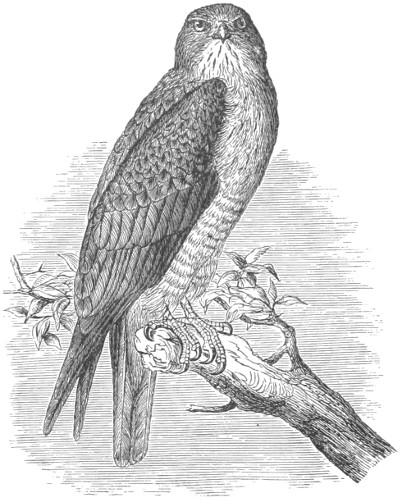
Buteo swainsoni (adult).
This Hawk was observed by Mr. Dall, in Alaska, a skin having been obtained at Koyukuk, May 26, from an Indian. Mr. Dall states that it prefers the thickets and woody places, is not so often seen as some of the other species. It generally builds a very large nest of sticks, and begins to lay about the last of April. The young are hatched out about the 30th of May. It was only a summer visitor. He found not only the bones of rabbits, squirrels, and mice about its nest, but also those of ducks, and in one instance part of a white-fish.
Dr. Heermann obtained an egg of this species in Northern California, which had a yellowish-white ground-color, marked with obscure cloudings of a purplish-gray, and irregular patches of a light tone of umber brown. It measured 2.31 inches in length, and 1.84 in breadth.
We are indebted to Dr. W. J. Hoffmann for the following interesting note in relation to the nesting of this species: “On the 28th of May, 1871, we encamped on Antelope Creek, forty miles north of the Central Pacific Railroad Station, Argenta, Nevada. The stream of water, which is small, is fringed with willows, averaging about twelve feet in height. Strolling along the underbrush, I came to the nest of the Buteo swainsoni, which was built on the top of a willow, and in its construction took in several distinct limbs, so as to give better support. The nest, about two feet across and one foot in thickness, was constructed of thin sticks and fragments of roots. The inside was lined with leaves of tule and grass. The nest contained two eggs. Only eight feet from this nest, on the same bush, and at the same height, a female of Icterus bullocki was on her nest. These birds appeared to be living together in harmony, having been in constant sight of each other for several weeks, as the condition of the eggs proved. I deem this remarkable only as showing a rapacious and an insectivorous bird living so closely together that one might at any time have been made the prey of the other by a single spread of the wings.”
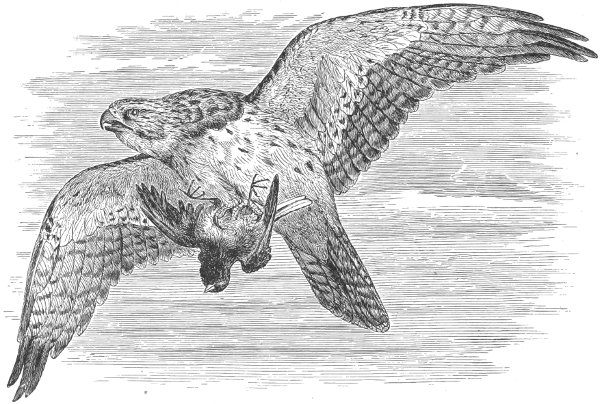
Buteo swainsoni (young).
Dr. Gideon Lincecum, of Washington County, Texas, speaks of this species as one of the common Hawks of the Texan prairies. He states that it nests on the ground in the prairie; lays six eggs, sometimes on tall trees,—when it chooses to rear its young in the forest. It is apt to pounce on a brood of young poultry when it sees them, but being rather timid does not like to go about the houses. Its principal food is grasshoppers, prairie rats and mice, and small birds. Dr. Lincecum has often seen it when the grass on the prairie was burning, in the spring of the year, constantly on the wing, in front of the fire, catching the grasshoppers, rats, mice, and any small game that is driven out of the grass by the crackling fire; and it will keep in the smoke so close to the fire that it soon becomes almost as black as soot. He further remarks that, “when any one approaches their nest on the prairie, they will make a pretty bold attempt to frighten or decoy him away from it. It first tries to lead the intruder off, by alighting in the grass near by, and screeching loudly as if something was greatly the matter; you approach him, and with much seeming difficulty it makes
The Buteo bairdi of Hoy is now ascertained to be only an immature form. It was first met with in Wisconsin, and since then has been taken in various western localities.
A pair of these birds was found by Mr. Ricksecker, breeding in this plumage, in Utah. The nest was built in a young aspen-tree. The egg is marked with larger and more deeply marked blotches than usual, and is nearly of an exact oval shape, measuring 2.30 inches in length by 1.75 in breadth. The ground-color is white, with a slight tinge of rufous, over which are diffused, over the whole surface, fine markings of a reddish, rust-tinged brown. Besides these the larger end, and some other portions of the surface, are boldly dashed with large blotches of the same color, but of a deeper shade.
A black Buzzard, originally described as Buteo insignatus, is now known to be only an individual melanistic condition of the species. It was first met with in the vicinity of Montreal, and the specimen belonging to the Natural History Society of that city was described as new by Mr. John Cassin. A similar specimen was taken by Mr. Macfarlane at Fort Anderson, where it was breeding. It was met with rather abundantly by Dr. Heermann on the San Joaquin River, in California, and seen along his route for a considerable distance. He described it as sluggish in its habits, perching for hours in a quiescent state on some tall tree, and permitting the hunter to approach without showing any signs of fear.
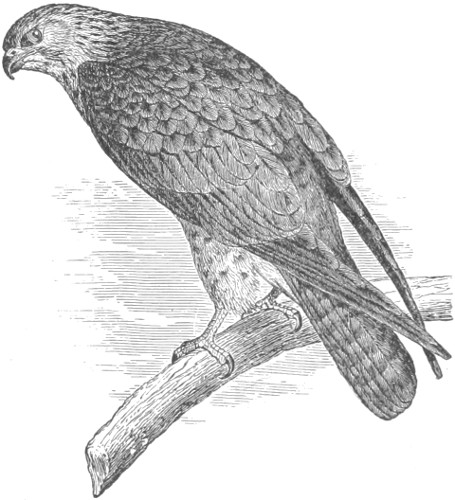
Buteo swainsoni, var. oxypterus (young).
Dr. Cooper found this bird pretty common in the vicinity of San Diego, in March, 1862, when they were apparently migrating northward. In their habits they appeared to resemble the larger varieties of Buzzards. Mr. Salvin obtained a single specimen of a Hawk at Duenas, which is referred by Mr. Gurney to this variety (Ibis, I, 216).
The variety oxypterus, of this species, was first described from an immature specimen obtained at Fort Fillmore, New Mexico. It ranges southward throughout tropical America to Buenos Ayres.
Buteo zonocercus, Sclater. BAND-TAIL HAWK.
?? Buteo albonotatus, G. R. Gray, Isis, 1847, p. 329. Buteo zonocercus, Sclater, Trans. Zoöl. Soc. Lond. IV, pt. vi, 263, 1858.—Coues, Pr. A. N. S. 1866, 46.—Elliot, Birds N. A. pl. xxxiii.—Gray, Hand List I, 8, 1869.—Cooper, Birds Cal. 1870, 479.
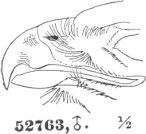
52763, ♂. ½
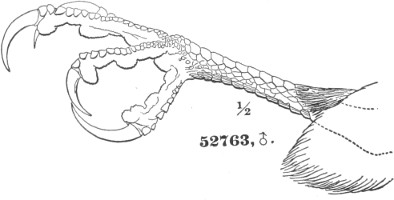
52763, ♂. ½
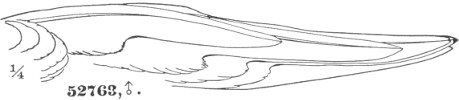
52763, ♂. ¼
Buteo zonocercus.
Sp. Char. Adult (36,872, Hassayampa River, Arizona Territory, August; Dr. Coues). Entirely carbonaceous black; forehead pure white, and feathers of occiput, neck, and breast the same beneath the surface; this on under parts, showing as transverse, ovate spots on webs of feathers, partially exposed. Tail black, faintly tipped with pale ashy, crossed (about 1¾ inches from the end) by a band of hoary plumbeous, nearly an inch in width; about half an inch anterior to this is another plumbeous band, about as broad as the black one which separates it from the last; and about the same distance, near the base, is another, much narrower, and less continuous ashy band. The outlines of these bands are rather irregular; and on the inner webs the plumbeous is replaced by snowy white, which, not exactly corresponding to the plumbeous of outer webs, is rather more extended, as well as more sharply defined, forming three very conspicuous transverse zones (decreasing in width towards the base like those on outer webs), observable only when the tail is spread, or from below. On the two middle feathers both webs are plumbeous and black; and on the lateral feathers, the white prevails on the inner web, the black bands being broken up into narrow zigzags. Primaries less intensely black than the back, and showing obscure transverse bands of deeper black; lining of the wing unvariegated black; under surface of primaries pale plumbeous, passing into hoary white on edges, and crossed from base to ends with very irregular, transverse bars of blackish, these breaking up into a mottling, or blended speckling, along the edges of the feathers. Owing to moulting stage, the wing-formula cannot be ascertained. Wing, 15.50; tail, 8.50; tarsus, 2.50; middle toe, 1.60. Length, 19½; extent, 47½.
Young male (52,763, Mazatlan, Mex.; Colonel A. J. Grayson). Generally similar to the preceding; feathers of neck, back, and under parts more conspicuously spotted with white beneath the surface, these spots considerably exposed on the breast and upper tail-coverts. Tail deep dark vandyke-brown, faintly tipped with paler, and crossed with numerous narrow oblique bands of black; subterminal one broadest, being about three fourths of an inch in width; the next one is not a fourth as wide, and crosses about an inch anterior to the last; the distance between the black bands diminishes towards the base of the tail, so that after the seventh of these, no more can be distinguished. Inner webs passing into whitish towards edges, this prevailing on lateral feathers. Fourth quill longest; third scarcely shorter; fifth but little shorter than third; second intermediate between fifth and sixth; first equal to eighth. Wing, 15.30; tail, 8.80; tarsus, 2.40; middle toe, 1.60. Length, 15¾; alar extent, 48. Bill black at tip, bluish-brown at base; iris dark brown.
Hab. Guatemala, Mexico, and adjoining parts of United States; Arizona (Coues); Santa Clara Co., Cal. (Cooper).
LIST OF SPECIMENS EXAMINED.
National Museum, 2; Philadelphia Academy, 2. Total, 4.
There can be but little doubt that this plumage denotes a younger stage of the same species as the B. zonocercus of Sclater. The adult bird described above is moulting, and two tail-feathers of the old plumage, which have not yet been cast, are precisely like those of this specimen, the new ones being entirely different, as will be seen by the description. Taking with this the exact similarity of the pattern of under side of primaries, as well as the plumage in general, and the sameness of proportions, one cannot but be convinced of their identity. The localities of the two specimens are also so near that it is scarcely possible they are distinct.
The plumage of this stage is parallel, in its relation to the adult, with that of the young of B. albifrons var. minutus, both differing from the mature stage in nearly the same particulars, the more numerous bands on the tail distinguishing the young of nearly all Buteos from adults of the same species.
An adult specimen from Mexico, in the collection of the Philadelphia Academy (without number or other indications on the label), though resembling the two specimens described, in all essential points, differs from them in regard to the coloration of the tail. The main differences are as follows: Tail deep black basally and subterminally, the tip (very narrowly) and a middle zone about 2.00 inches broad, and 1.80 from the tip, being duller and more brownish-black, this irregularly defined anteriorly, but of sharp regular definition along the posterior border; the subterminal black band is very precisely defined on the inner webs, and anterior to this nearly the whole inner web is white, irregularly blotched with black towards the base, however; the markings of somewhat longitudinal direction; the outer webs are black to the very base. Wing, 16.50; tail, 9.00; tarsus, 2.70; middle toe, 1.80. Wing-formula, 4, 3–5–2–6–7, 1.
Whether this is a progressive stage of plumage or a mere individual peculiarity, I do not feel certain, but am inclined to the latter opinion. Both this specimen and the immature one described are labelled B. albonotatus, Gray; I have been unable to refer to Gray’s original description; if there is no doubt of its being pertinent to the immature stage described, then this will be the name of the species, as it has priority; I should much regret, however, to discard the very appropriate and characteristic name zonocercus, for the other, as Mr. Sclater’s species is so satisfactorily described and accurately figured, while the original description of albonotatus is very meagre and difficult of reference.
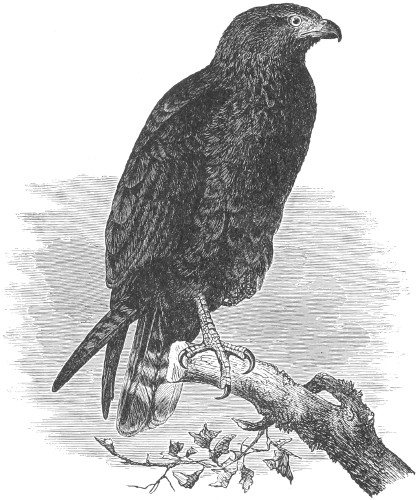
Buteo zonocercus (adult).
Habits. This Hawk is a Mexican and Guatemalan species which occasionally strays into our borders in Arizona and in Southern California. Dr. Cooper was the first of our naturalists to meet with this species within the United States, shooting an individual on the 23d of February, 1862, thirty miles north of San Diego, and within five of the coast. It was associating with specimens of B. insignatus and other Hawks wintering there, and seemed rather sluggish and tame. He saw no other Black Hawks in that neighborhood. Two years afterwards, September 24, 1864, Dr. Coues also procured a single specimen on the Gila River. He regards the species as restricted, within our borders, to the warm valley of the Gila and the Lower Colorado. We possess no information in regard to any distinctive specific habits it may possess. This species was first described by Dr. Sclater from a Guatemalan specimen.
The bird described as B. albonotatus is presumed to be identical with this species. It was observed by Mr. Salvin on the southern slope of the Cordillera, in Guatemala, which appears to be the true habitat of this species, but even there it cannot be said to be common. He states that, like many others of its class, it is a feeder on beetles and locusts.
Buteo lineatus, Gmelin. Var. lineatus, Gmelin. RED-SHOULDERED HAWK.
Falco lineatus, Gmel. Syst. Nat. p. 268, 1789.—Lath. Ind. Orn. p. 27, 1790; Syn. I, 56, sp. 36, 1781; Gen. Hist. I, 268, 1821.—Daud. Tr. Orn. II, 158, 1800.—Shaw, Zoöl. VII, 153, 1812.—Wils. Am. Orn. pl. liii, f. 3, 1808.—Aud. Orn. Biog. I, 296, 1831; Syn. p. 7, 1839. Cuvier, Reg. Anim. ed. 2, I, 334, 1829. Buteo lineatus, Jard. (Wils.) Am. Orn. II, 290, 1832.—Aud. Syn. p. 7, 1839.—Brewer, (Wils.) Am. Orn. 684, 1852.—Cassin, Birds Cal. & Tex. Syn. 99, 1854; Birds N. Am. 1858, 28.—Bonap. Comp. Av. p. 19, 1850.—Kaup, Web. Falk. Mus. Senck. 1845, p. 261.—Strickl. Orn. Syn. I, 30, 1855.—Brewer, Oölogy, 1857, 28, pl. iii, f. 25.—Max. Cab. Journ. VI, 1858, 19.—Gray, Hand List, I, 7, 1869. Poecilopternis lineatus, Kaup, Mon. Fal. Cont. Orn. p. 76, 1850. Falco hyemalis, Gmel. Syst. Nat. 274, 1789.—Lath. Ind. Orn. 35, 1790; Syn. I, 79, sp. 62, 1781; Gen. Hist. I, p. 91.—Daud. Tr. Orn. II, 110, 1800.—Shaw, Zoöl. VII, 153, 1812.—Wils. Am. Orn. pl. 35, fig. I, 1808.—Bonap. Ann. Lyc. N. Y. II, 33; Isis, p. 1138, 1832.—Aud. B. Am. pl. lvi, 71, 1831; Orn. Biog. I, 364, 1831. F. hyemalis, var. Lath. Ind. Orn. Supp. p. 8, 1801; Syn. Supp. II, 39, 1802. Circus hyemalis, Vieill. Ois. Am. Sept. pl. vii, 1807.—James. Wils. Am. Orn. I, 88 & 87, 1808. B. hyemalis, Less. Tr. Orn. p. 81, 1831.—Bonap. Eur. & N. Am. B. p. 3, 1838. Astur hyemalis, Jard. Wils. Orn. II, 72, 1808.—Vieill. Enc. Méth. III, 1273, 1823. Nisus hyemalis, Cuv. Reg. An. ed. 2, I, 334, 1829. Buteo fuscus, Vieill. Ois. Am. Sept. pl. v, 1807. Astur fuscus, Bonap. Oss. Cuv. Reg. An. p. 37, 1830. Falco buteoides, Nutt. Man. I, 100, 1832. Buteo cooperi (not of Cassin), Allen, Am. Nat. III, 1869, 518 (young of B. lineatus!)
Sp. Char. Adult male (32,509, Washington, D. C., January). Head, neck, and interscapulars deep rufous (above becoming darker posteriorly), each feather with a medial stripe of blackish-brown. Throat and cheeks almost destitute of rufous tinge, the ground being dull white,—the dusky forming an indistinct “mustache,” and an imperfect, obsolete collar (formed by confluent, or suffused streaks), across the throat. Breast, sides, abdomen, and tibiæ rather light rufous, becoming paler posteriorly; breast with shaft-streaks of blackish; the rufous of sides of breast almost unvaried; abdomen, sides, and middle of the breast, with transverse bars of ochraceous white; tibiæ uniform pale ochraceous; anal region and lower tail-coverts, immaculate white. Lesser wing-coverts chestnut-rufous, feathers with black shaft-streaks, these becoming larger posteriorly; scapulars and middle wing-coverts edged broadly with rufous, and obsoletely spotted on inner webs with white.—this somewhat exposed; secondaries dark clear brown, tipped and crossed with two (exposed) bands of white; primaries black, fading at tips into dilute grayish-brown, and with quadrate spots of white on outer webs. Rump uniform blackish-brown; upper tail-coverts tipped and banded with black. Tail clear brownish-black, crossed with six sharply defined narrow bands of white, the last of which is terminal, and the first two concealed by the upper coverts. Lining of the wing nearly uniform pale rufous, with very sparse, deeper rufous, somewhat transverse spots; under surface of primaries silvery white, crossed by broad bands, these where the white is clearest being pale rufous, bordered with dusky, but as the white grows more silvery they darken into black; the longest (fourth) has eight of these spots, including the subterminal, very broad one. Fourth quill longest; fifth, just perceptibly shorter; third, a little shorter; second, considerably longer than sixth; first equal to ninth. Wing, 13.00; tail, 8.50; tarsus, 2.90; middle toe, 1.33.
Adult female (11,991, Washington, D. C.; Dr. W. Wallace). Generally similar to the male, but rufous more extended, this tinging the outer webs of secondaries and primaries. On the under parts the rufous is rather deeper, and the tibiæ are strongly barred, and even the lower tail-coverts have obsolete spots of the same. Wing, 13.75; tail, 9.00; tarsus, 2.90; middle toe, 1.50.
Younger (41,683, Washington, D. C.; Dr. Coues). Upper plumage precisely as in adult, but the black prevailing on head above, and nape. Beneath ochraceous-white, deepest on the tibiæ; breast, abdomen, sides, and tibiæ, with diamond-shaped spots of dark rufous-brown, connected along the shaft of the feathers, running thus, in a peculiar, longitudinal, chain-like series (19.50; 42.50; cere, legs, and feet bright chrome-yellow; anterior scales of tarsus with greenish tinge).
Young male (No. 1,210). Ground-color of head, neck, and under parts white; feathers of head and neck, with medial stripes of dark clear vandyke-brown, leaving a superciliary space, and the ear-coverts scarcely striped; a blackish suffusion over cheeks, forming a “mustache,” and large longitudinal spot of the same on middle of throat; breast, abdomen, sides, and flanks, with rather sparse, irregularly sagittate spots of clear vandyke-brown, those on the sides of breast more longitudinal; tibiæ, with a faint ochraceous tinge, and with sparse, small, and irregular specks of brown; lower tail-coverts with a very few distant isolated bars of the same. Upper parts generally, clear dark vandyke-brown; interscapulars and wing-coverts edged (most broadly beneath the surface) with pale rufous; middle wing-coverts with much white spotting on upper webs, partially exposed; wing-coverts generally, and scapulars, narrowly bordered with white; secondaries narrowly tipped with white, and crossed with about four (exposed) bands of paler grayish-brown; primaries inclining to black; faintly margined at ends, with whitish; outer webs anterior to the emargination, rufous-white, with distant, narrow bars of blackish, these widening on inner quills; upper tail-coverts white with transverse spots of blackish. Tail dark vandyke-brown, narrowly tipped with white, and crossed with numerous narrow bands of pale grayish-brown, these obsolete towards the base. Lining of the wing pale ochraceous, with a few irregularly cordate spots of dark brown toward edge of wing; under surface of primaries mostly white, the dusky bars not extending across the web, except on inner quills. Wing, 13.25; tail, 9.30; tarsus, 2.85; middle toe, 1.40.
Young female (11,994, Washington, D. C., January; C. Drexler). Almost precisely similar; tibiæ unspotted; light bands of the tail more sharply defined basally, and pale mottled rufous, instead of pale ashy brown. Wing, 14.50; tail, 9.60; tarsus, 3.10; middle toe, 1.45.
Hab. Eastern N. Am.; south to Florida; west to Texas and the tributaries of the Missouri.
Localities: Orizaba, Scl. 1857, 211; S. E. Texas, Dresser, Ibis, 1865, 325 (breeds); Iverness Shore, England (Feb. 26, 1863), Newcome, Ibis, 1865, 549.
LIST OF SPECIMENS EXAMINED.
National Museum, 19; Philadelphia Academy, 14; Boston Society, 8; Mus. Cambridge, 16; Cab. G. N. Lawrence, 4; Coll. R. Ridgway, 4. Total, 65.
Measurements.
Sex. Wing. Tail. Culmen. Tarsus. Middle Toe. Specimens.
♂ 11.25–13.50 8.00–9.70 .75–.90 2.70–3.25 1.30–1.50 20 Northern.
♀ 13.35–14.25 9.00–10.00 .80–.90 3.10–3.20 1.35–1.50 7 Northern.
This specimen may possibly indicate a mere individual variation, rather than a progressive stage of plumage.
A male (25,198, Washington, D. C., February) is as strongly barred beneath as described in the female; thus it would appear that any differences in plumage in the sexes are nothing more than individual discrepancies.
The yellowish outer webs of the primaries constitute a feature which will serve to distinguish the young of the Buteo lineatus from that of every other North American species.
A series of twelve specimens from Florida, in the Museum of Comparative Zoölogy, at Cambridge, shows that the birds of this species from that peninsula are very much smaller than northern ones; and though that of the adults does not differ appreciably, the plumage of the young birds is considerably darker than in northern specimens, and occasionally approaches quite nearly to that of the young of var. elegans, the markings on the lower parts, including the tibiæ, being often in the form of transverse spots.
The extreme measurements of this series are as follows: Wing, 10.90–12.75; tail, 7.70–8.50; culmen, .80–.90; tarsus, 2.90–3.20; middle toe, 1.25–1.45. Specimens, 12.
Var. elegans, Cassin. RED-BELLIED HAWK.
Buteo elegans, Cass. P. A. N. S. 1855, 281.—Ib. B. N. Am. 1858, 28, plate.—Heerm. P. R. Rep. II, 32.—Kennerly, P. R. Rep. III, 19.—Newb. VII, 75.—Coop. & Suckl. XII, ii, 147.—Strickl. Orn. Syn. I, 38.—? Dresser, Ibis, 1865, 325 (Texas).—Coues, P. A. N. S. 1866, 9 (Arizona).—Gray, Hand List, I, 7.—Cooper, Birds Cal. 1870, 477.
Sp. Char. Adult male (10,573, Ft. Tejon, California, “Oct. 22, 1857”; J. Xantus). Head, neck, interscapulars, anterior scapulars, lesser wing-coverts, lining of the wing, and entire lower parts, dark lateritious-rufous, inclining to chestnut on the shoulders. The upper parts so colored have each feathers with a medial-ovate space of dull black, giving a striped appearance; the lesser wing-coverts, however, have each only a narrow shaft-line of black, these growing larger as they approach the middle coverts. There is a strong black suffusion over the cheeks, forming an obscure “mustache”; orbit blackish, throat streaked with the same. The dark lateritious-rufous of the jugulum and breast is perfectly continuous and uniform, varied only by the obsoletely darker shafts of the feathers; sides and flanks transversely barred with white; lining of the wing, and tibiæ, with very ill-defined bars of paler rufous; anal region and lower tail-coverts with broader and more sharply defined bars of the same. Scapulars and middle wing-coverts brownish-black, narrowly tipped, and irregularly spotted transversely, with pure white; secondaries and greater coverts brownish-black, tinged with rufous, and broadly tipped and crossed, with sharply defined bands of pure white, of which there are on secondaries about six exposed (including the terminal band); primaries and their coverts deep black (tinged anterior to their emargination with rufous), tipped with pure white, and having spots of white on outer webs. Rump and upper tail-coverts brownish-black, with indistinct transverse bands of white, the latter sharply tipped with the same. Tail clear brownish-black sharply tipped with white, and with about five sharply defined bands of the same, about .30 of an inch in width. Under surface of secondaries and primaries white to near the ends, where they are black; the tips, however, again white; the white portion crossed by regular transverse bands, those where the white is purest being light rufous, but as the white shades toward the black they become dusky; the rufous bars are, however, bordered with dusky. Fifth quill longest; third and fourth longer than sixth; second a little shorter than sixth; first intermediate between ninth and tenth. Wing, 12.50; tail, 8.00; tarsus, 2.90; middle toe, 1.40.
Young. Predominating color, blackish-brown; this existing on under parts in large, confluent sagittate spots, which are longitudinal on throat and jugulum, and more transverse on sides, abdomen, tibiæ, and lower tail-coverts, the ground-color of lower parts being dull ochraceous. The head and neck, all around, presenting a uniform, streaked appearance, the edges of the feathers being ochraceous, but the black far exceeding this in amount. Interscapulars and scapulars bordered with rusty rufous; wing-coverts more broadly bordered with ochraceous, and with much concealed dull white spotting; lesser wing-coverts, with a strong wash of rich dark rufous; secondaries tipped with white, and crossed by two or three (exposed) broad bands of dull ashy; primaries brownish-black, narrowly tipped with white, and with ill-defined restricted spots of the same on outer webs. Rump uniform blackish-brown, feathers faintly bordered with rusty; upper tail-coverts tipped and barred with white. Tail brownish-black tipped with white, and crossed with five narrow bands of dull light ashy. Lining of wing dull, dingy ochraceous, with numerous transverse bars of brown; fourth quill longest; third shorter than fifth; second longer than sixth; first equal to ninth. Wing (male, 10,572, Fort Tejon), 12.00; tail, 8.40; tarsus, 2.82; middle toe, 1.35. Female (4,520, Santa Clara, Cal.; Dr. Cooper), wing, 13.00; tail, 9.00; tarsus, 2.90; middle toe, 1.52.
Hab. Pacific, and southern portion of the middle Provinces of the United States; Mexico.
Localities quoted: Texas (San Antonio, winter), (Dresser, Ibis, 1865, 325); Arizona (Coues, P. A. N. S. 1866, 9); city of Mexico (Scl. & Salv. P. Z. S. 1869, 364).
LIST OF SPECIMENS EXAMINED.
National Museum, 4; Philadelphia Academy, 4; Cab. G. N. Lawrence, 1; R. Ridgway, 2. Total, 11.
Measurements.
Wing, 12.00–13.00; tail, 8.75–9.50; culmen, .78–.90; tarsus, 3.00–3.12; middle toe, 1.40–1.50.
The young of the Buteo elegans differs most remarkably from that of B. lineatus; the pattern of coloration appears scarcely the same, for the ochraceous on outer webs of primaries, anterior to their emargination,—which is a feature distinguishing the immature lineatus from all other Buteos,—is in the present bird almost obliterated by the extension of the dusky.
Habits. The Red-shouldered Hawk has an extended distribution, being found more or less abundant from Florida to Nova Scotia, and from the Atlantic to the Pacific coast it is replaced by the Buteo elegans. Mr. J. A. Allen found it by far the most abundant of this family in Florida. In Texas the two races, lineatus and elegans, appear to occur together, Mr. Dresser having met with both near San Antonio. The Red-shouldered Hawk was noticed by this writer from the river Neuces eastward. He found it breeding in the heavily wooded river bottoms of the Medina, and several others of the rivers of Texas, but did not succeed in procuring the eggs. It breeds abundantly in Florida, and thence throughout the United States as far north as Northern Vermont, Nova Scotia, and New Brunswick. Lieutenant Bland notices it as a common and migratory species in Nova Scotia, but Mr. Downes speaks of it as rare near Halifax, where he only met with two specimens. Mr. Boardman gives it as quite common near Calais, breeding there and probably resident. In Western Maine Mr. Verrill regarded the species as a not very common summer resident, where it was also known to breed, as he met with its nest and eggs May 24, 1860. It is quite common in Eastern Massachusetts, where it is found all the year, but where it is more abundant in the fall, from the addition of northern migrants, than at any other time. A few are found throughout the winter, keeping about open springs and in sheltered situations. Mr. Allen also speaks of it as not uncommon in the western part of the same State. It was not taken or seen by Richardson in northern regions, nor does it appear to have been observed in any of the West India Islands.
The history and habits of this very common Hawk seem to have been involved, among earlier writers, in a confusion that seems hardly explicable. Wilson described and always regarded the young and old as two distinct species, calling the former hyemalis, giving to it a northern residence, and the mature bird lineatus. Mr. Audubon repeated this error at first, and sought to demonstrate its correctness by giving to the two forms very dissimilar habits. Bonaparte believed these forms to be identical, and Nuttall did the same, but was altogether in error as to its distribution. He was not aware of its presence in Massachusetts, where it is at times the most abundant of the raptorial birds. This writer only met with it in the Southern States, where he found it very common in swampy situations. He speaks of its having a quailing cry of mutual recognition, which is a plaintive echoing note, like keé-oó, which is continued with little intermission for nearly twenty minutes. He describes the species as not shy, and as very easily approached. These Hawks remain mated throughout the year, and their affectionate treatment of each other is in striking contrast with the selfish indifference of the Red-tail species when their breeding-season is ended.
Nuttall observed it feeding on frogs, cray-fish, and even insects, and rarely troubling larger game. In only one instance did he see one descend upon a Plover. Wilson saw them attack Plover, Sand-pipers, Larks, and even Hawks; but the last is very rare and exceptional. I have never known one of this species to molest the poultry-yard. From 1828 to 1838, during my stay in Roxbury, a pair of these Hawks were residents within a few hundred yards of the house, where, as they never molested the tenants of the barn-yard, they were not allowed to be disturbed. Their breeding-place we could not find, but they kept about an open spring during the winter, feeding upon small game, and were not at all shy. One of them unfortunately was wounded, and was kept in confinement several days. It was the male bird, in full adult plumage, and was by no means wild, feeding readily upon what was given to it, even with our near presence. It would not tolerate a too great familiarity, but manifested great irritation if we attempted to approach it. Its wing had been badly shattered, and it finally died from mortification of the wound. It would never submit to be handled, and fought desperately when we sought to have its limb bound up. After we gave up this attempt as impossible it became rather more familiar, and would even at last greet me with a welcome cry of recognition, and take its food from my hand.
Wilson, in speaking of the adult bird, states that this Hawk has a high and very irregular flight, and is quite different from that of species with longer wings. In his account of the immature plumage, he notes its arrival in Pennsylvania early in November, and its departure in March. He speaks of it as a dexterous catcher of frogs, and adds that it sometimes so stuffs itself that it can fly with difficulty. He has found the remains of ten frogs in the stomach of a single individual.
The Red-shouldered Hawk constructs a large nest, not unlike that of the Crow, in the forked branches of a high tree. It is composed externally of sticks, and is lined with moss and soft leaves. The eggs are four in number, and occasionally three or two. When the nest is approached, the bird utters loud, frequent, and peculiar cries of alarm and resentment, not unlike keé-oó! rapidly repeated, but makes no attempt at resistance. The pair return year after year to the same nest, even when it has been robbed the previous season.
The eggs of this Hawk are of a very uniform spheroidal-oval shape, but slightly pointed at one end, and exhibit certain very general characteristics in the colors of their markings, but vary greatly in their size. The length varies from 2.20 to 2.00, and the breadth from 1.81 to 1.56. The ground-color is usually a dingy white, rarely pure white, and frequently with decidedly brownish tinge. The blotches are most frequently of a yellowish umber color; sometimes blotches of sienna-brown, slate-drab, and more obscure shades of brown are present, and these colors are not unfrequently confusedly mingled. An egg from Cheraw, S. C., has a ground-color of a light drab, tinged with slate and without any blotches whatever. It is not uncommon to find these nearly unspotted eggs in the same nest with others very boldly and profusely blotched. The Cheraw egg measures 2.00 by 1.56 inches; an egg from Massachusetts, 2.20 by 1.81: their relative capacity being nearly as three to four. They average about 2.10 by 1.68 inches.
Mr. L. Heiligbrodt found the nest of this Hawk near Austin, Texas. One egg was taken from the nest, and in a few days after a second was found to have been deposited (S. I. 15,894).
The handsome variety known as B. elegans is generally spoken of by all familiar with its habits, as well as with its appearance, as the almost exact counterpart of the Red-shouldered Hawk, replacing that form on the west coast.
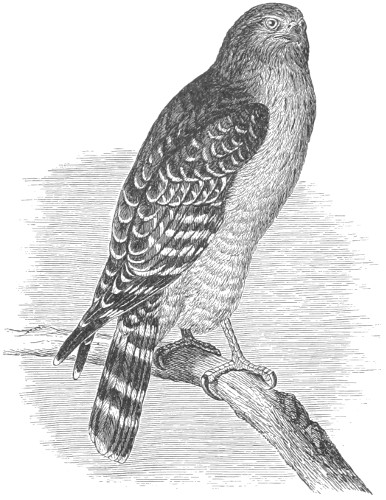
Buteo elegans.
In regard to its distinctive specific habits but little is as yet known, but it is probable they are not essentially different from those of the lineatus, Dr. Cooper bearing positive testimony to this fact. He found this Hawk common in the southern part of the State, especially near San Diego, but he did not meet with any in the Colorado Valley. On his approach to one of them, it would always fly off from its usual perch, circling up high into the air, and uttering short shrill screams in rapid succession in the manner of the lineatus. He noticed a pair constantly at one place near a ranch, and supposed they were about building there, but was not able to find the nest.
Among the memoranda of Mr. Xantus, made at Fort Tejon, Cal., is one dated May 9, mentioning the finding the nest of this species. It contained four eggs, was built in an old decayed tree, in a swamp, and was about fifteen feet from the ground. The nest was large and made of sticks.
Buteo borealis (Gmel.). RED-TAILED HAWK.
Sp. Char. Form heavy and robust; wings moderate, the third to fifth quill longest; the first shorter than the seventh; outer four with inner webs cut. Feet strong, the tarsi and toes robust, and claws not very acute. Dimensions: Wing, 13.50–17.25; tail, 8.50–11.30; culmen, .90–1.15; tarsus, 2.70–3.40; middle toe, 1.60–1.95; weight, 2½ to 4 lbs. Colors: Adult: tail, deep lateritious-rufous, paler at the tip, and usually with a subterminal bar of black (sometimes without any bar, and sometimes with numerous bars to the base). Above blackish-brown, more or less variegated with whitish on the scapulars and wing-coverts; beneath white, usually with a belt of blackish spots across the abdomen; sometimes wholly dusky or blackish beneath, but the pectoral region always appreciably lighter than the abdomen; under surface of primaries plain white anterior to their emargination. Young. Tail grayish-brown, with nine or ten narrow, sharply defined bands of blackish. Pattern of other parts as in the adult, but the white purer, and the plumage generally with less rufous.
Hab. Entire continent of North America; West Indies.
The plumage varies from wholly dusky blackish, with a paler, more brownish, pectoral area, and the tail of the adult with numerous black bars, or indications of bars, to the very base (var. calurus), through various proportionate degrees of rufous and dusky, to entirely pure white beneath, without any spotting; the tail of the adult without a single black bar (vars. krideri and lucasanus).
Var. borealis, Gmelin. EASTERN RED-TAIL.
Falco borealis, Gmel. Syst. Nat. p. 266, 1789.—Lath. Ind. Orn. p. 25, 1790; Syn. I, p. 50, 1780; Supp. II, 34, 1787; Gen. Hist. I, p. 265, 1821.—Daud. Tr. Orn. II, 157, 1800.—Shaw, Zoöl. VII, 112, 1812.—Wils. Am. Orn. pl. lii, fig. 1, 1808.—Sab. Frankl. Exp. p. 670.—Wagl. Isis, p. 517, 1831.—Bonap. Ann. N. Y. Lyc. II, pp. 32, 434; Isis, p. 1138, 1832.—Aud. Birds Am. pl. li, 1831; Orn. Biog. I, p. 265, 1831; Syn. VI.—Gray, Genera, 1840.—Rich. F. B. A. II, 50, 1831.—Nutt. Man. I, 102, 1840.—Gosse, Birds Jam. II, 1847.—Dough. Cab. I, 229, pl. xxx, 1830. Buteo borealis, Vieill. Nouv. Dict. Hist. Nat. IV, p. 478, 1819; Enc. Méth. III, p. 1222, 1823.—Vig. Zoöl. Journ. I, p. 340; Zoöl. Beech. Voy. p. 15.—Steph. Zoöl. XIII, pt. 2, p. 47, 1826.—Less. Tr. Orn. p. 79, 1831.—James. (Wils.) Am. Orn. I, pp. 82, 84, 1808.—Jard. (Wils.) Am. Orn. II, pp. 280, 282, 1808.—Brew. (Wils.) Am. Orn. p. 450; Synop. p. 684.—Bonap. Eur. & N. Am. B. p. 3, 1838; Consp. Av. p. 19.—Aud. Synop. p. 6, 1839.—Gray, Gen. B. fol. sp. 6, 1844; List B. Brit. Mus. p. 34, 1844.—Pucher. Rev. Zoöl. p. 214, 1850.—Gosse, B. Jam. p. 11, pl. ii, 1847.—Cass. B. Cal. & Tex. Syn. p. 97, 1854; Proc. Ac. Sc. Philad. p. 279, 1855.—Gamb. Journ. Ac. Nat. Sc. Phil. N. S. I, p. 26.—Nutt. Man. Orn. U. S. & Canad. p. 102, 1833.—De Kay, Zoöl. N. Y. II, p. 9, pl. viii, f. 17 (Juv.), 1844.—Peab. Bost. Journ. Nat. Hist. III, p. 80, 1837.—Thomp. Hist. Verm. App. p. 63, 1853.—Peale, U. S. Expl. Exp. p. 62, 1848.—Towns. Sit. Exp. Zuñi & Color. p. 59.—Kaup, Ueb. Falk. Mus. Senck. p. 261, 1845.—Strickl. Orn. Syn. I, 29, 1855.—Max. Cab. Journ. VI, 1858, 17.—Blakist. Ibis, III, 1861, 318.—Wood, Am. Nat. III, 1869, 393.—Gray, Hand List, I, 1869, 7. Astur borealis, Cuv. Règ. An. (ed. 2), I, 332, 1829.—Swains. Class. B. I, 316; II, 215, 1837, Pœcilopternis borealis, Kaup, Isis, Mon. Falc. Cont. Orn. 1850, p. 76. Falco leverianus, Gmel. Syst. Nat. 266, 1789.—Lath. Ind. Orn. p. 181, 1790; Syn. Supp. I, 31, 1787; Gen. Hist. I, 620, 1821.—Daud. Tr. Orn. II, 126, 1800.—Shaw, Zoöl. VII, 151, 1812.—Wils. Am. Orn. pl. lii (Juv.), 1808.—Aud. Orn. Biog. I, 265. Buteo leverianus, Vig. Zoöl. Journ. I, 340.—Steph. Zoöl. XIII, pt. 2, p. 47, 1815. Falco aquilinus, Bartr. Tran. p. 390, 1791. Accipiter ruficaudus, Vieill. Ois. Am. Sept. pl. xiv, bis. 1807. Buteo fulvus, Vieill. Ois. Am. Sept. p. 34; Nouv. Dict. Hist. IV, p. 468 (quot. F. jamaicensis), 1819. Buteo ferrugineocaudus, Vieill. Ois. Am. Sept. pl. vi, 1807.—Cuv. Règ. An. (ed. 2), I, 337. Buteo americanus, Vieill. Nouv. Dict. Nat. IV, 477 (quot.), Ois. Am. Merid. pl. vi, Enc. Méth. III, 1224, 1823. ? Buteo gallinivorus, Vieill. Ois. Buteo borealis, Brewer, N. A. Oölogy, 1857.
Sp. Char. Adult. Upper parts rich blackish-brown, approaching black on the back; scapulars and middle wing-coverts edged and barred beneath the surface with dull white, and tinged along edges with ochraceous. Wings generally of a paler shade than the back; secondaries fading into nearly white at tips, and, with the greater coverts, obscurely barred with darker; primaries nearly black, tips edged with pale brown, this passing into whitish. Rump uniform blackish-brown, feathers obscurely bordered with rusty. Upper tail-coverts ochraceous-white, nearly pure terminally, and with about two distinct transverse bars of deep rufous. Tail rich uniform lateritious-rufous, passing narrowly into white at the tip, and about an inch (or less) from the end crossed by a narrow band of black. Head and neck with the feathers medially blackish-brown, their edges rusty-rufous, causing a streaked appearance; the rufous prevailing on the sides of the occiput, the ear-coverts, and neck. The blackish almost uniform on the forehead and on the cheeks, over which it forms a broad “mustache”; lores and sides of frontlet whitish. Throat white, with broad stripes of pure slaty-brown; lower parts in general ochraceous-white; tibiæ and lower tail-coverts immaculate; across the abdomen and flanks (immediately in front of the tibiæ) is a broad interrupted belt of longitudinal black blotches, those on the abdomen tear-shaped, on the flanks larger and more irregular, throwing off bars toward the edge of the feathers; whole pectoral area variegated only with a few shaft-streaks of black (these growing broader laterally), and sometimes washed with rusty. Lining of the wing ochraceous-white, with sparse diamond-shaped spots of pale rufous, and shaft-streaks of darker; under surface of primaries white anterior to their emargination, beyond which they gradually deepen into black; the innermost ones are finely mottled with slaty, and with imperfect transverse bars of the same.
Male. Wing, 13.50–16.50; tail, 8.50–10.00; culmen, .95–1.08; tarsus, 1.40–3.20; middle toe, 1.60–1.70. Weight, 2½–3 lbs.
Female. Wing, 15.25–17.75; tail, 9.50–10.50; culmen, 1.00–1.15; tarsus, 3.15–3.40; middle toe, 1.70–1.80. Weight, 3–4 lbs.
Young (28,154, Philadelphia; J. Krider). Above similar to the adult, but lacking entirely any rufous tinge, the scapulars and wing-coverts more variegated with whitish. Tail light grayish-brown (very much lighter than the rump), tinged, especially basally, with rufous, narrowly tipped with white, and crossed with nine or ten narrow, curved bands of black; upper tail-coverts white, with broad bars of black. Head as in the adult, but the rufous wanting, leaving the streaks black and white; forehead more broadly white; chin and throat wholly white, the latter with a collar of dusky streaks across the lower part; whole pectoral region entirely immaculate, pure white; abdominal band as in the adult; tibiæ somewhat tinged with ochraceous, unvariegated.
Hab. Eastern North America; not in West Indies, nor west of the Missouri.
Localities: (?) Bahamas (Bryant, Pr. Bost. Soc. 1867, 64).
LIST OF SPECIMENS EXAMINED.
National Museum, 9; Philadelphia Academy, 13; Boston Society, 8; Museum, Cambridge, 15; Cab. G. N. Lawrence, 3; Coll. R. Ridgway, 2. Total, 50.
The true Buteo borealis, as restricted, may always be distinguished from the var. calurus, its western representative, by its having the posterior lower parts (tibiæ and lower tail-coverts) entirely free from transverse bars, and by lacking indications of transverse bars on the tail, anterior to the conspicuous subterminal one. It differs from the var. costaricensis, in having the head and neck conspicuously striped with rufous, and the throat thickly striped with black, almost obliterating the white; in the conspicuous abdominal belt of large black spots, and in having the tibiæ lighter ochraceous than the breast; from the var. lucasanus and var. krideri, it is distinguished by having the black tail-band, more spotted under parts, and in the upper tail-coverts being white, banded with rufous, instead of plain white, or deep rufous, uniform with the tail.
A specimen (No. 1,750, Carlisle, Pa.; S. F. Baird) appears at first sight much like the var. calurus, being very dark; the tibiæ, anal region, and the lower tail-coverts are, however, not barred as in this, and the tail possesses but the subterminal band.
An immature specimen (No. 21,488; John Krider) from Philadelphia has the tibiæ quite distinctly barred, but less conspicuously so than in young of var. calurus.
Var. krideri, Hoopes. WHITE-BELLIED RED-TAIL.
Buteo krideri, Hoopes, P. A. N. S. Philad. 1873, p. —
Sp. Char. Adult. Similar to var. borealis, but beneath continuous pure white, without rufous tinge, and without distinct spots across the abdomen, or lacking them entirely; above much lighter, the brown, light rufous, and white being about equal in amount. Upper tail-coverts immaculate white; tail pale rufous, the shafts pure white, and the webs mixed with white along their edges, its amount increasing toward the base; no trace of a dusky subterminal bar, or else only indicated by badly defined spots.
Young. Differing from that of var. borealis in the immaculate, snowy-white lower parts, nearly equal extent of the white and dusky on the upper parts, and whitish cast of the tail.
Two females (one shot from nest of two eggs, near Alexandria, Minn., May 8, 1872,87 and the other, also shot from nest of two eggs, near Pelican Lake, Minn., May 21, 187288) are entirely absolutely pure white beneath, there being but the faintest indications of markings in the region of the usual abdominal belt; even the whole under side of the wing is almost immaculate. The ground-color of the upper parts is pale grayish-brown, about equally variegated transversely, on the scapulars and tertials, with white. In one of them, the sides of the head and neck are pale fawn-color, the “mustache” from the rictus brownish-black in conspicuous contrast; the upper parts are nearly equally variegated with brown, light rufous, and white, the latter predominating posteriorly. The upper tail-coverts are immaculate white. The tail-feathers are light rufous, with pure white shafts, considerably mixed with white along the edges of the feathers, the white considerably increasing towards the base of the tail. Of the subterminal dusky band there is no trace in one specimen, while in the other it is indicated by transverse spots, while the inner webs along the shafts are much variegated with transverse dusky spots. The male specimen (shot at Chippewa Lake, Minn., from nest (!) of two eggs May 19, 187289) is considerably darker, nearly like the average plumage of eastern var. borealis. Still the white of the lower parts is remarkably pure, being of an almost snowy clearness, without any trace whatever of an ochraceous tinge.
No. 8,532, Devil’s River, Texas (Nov. 1855; Dr. C. B. Kennerly), differs only in being a little less pure white beneath, the lower parts being very appreciably tinged with rufous posteriorly.
Hab. Plains of the United States, from Minnesota to Texas (Devil’s River, M. S. I.).
Var. lucasanus, Ridgway. ST. LUCAS RED-TAIL.
“Buteo borealis var. lucasanus, Ridgway,” Coues, Key, 1872, 216 (under B. borealis).
Sp. Char. Adult. General appearance of the normal plumage of var. calurus, but the upper parts more uniformly blackish, and the upper tail-coverts and tail uniform rufous, the latter without a trace of a black bar. Beneath nearly uniform reddish ochraceous, or light rufous, the usual abdominal belt merely indicated by a few inconspicuous spots; no trace of transverse bars on the lower parts. Female ? (No. 16,925, Cape St. Lucas, Sept. 15, 1859; J. Xantus). Wing, 16.00; tail, 9.50; tarsus, 3.00; middle toe, 1.60. Wing-formula 5, 4, 3, 2–6–7–8–9, 1, 10.
Young. Not distinguishable, by positive characters, from that of var. calurus.
Hab. Peninsula of Lower California.
All adult specimens from the peninsula of Lower California agree with that described above, in the peculiar features which I consider as characterizing a well-marked local race. The present form is most nearly related, in its adult dress, to the var. krideri of the plains, in its unbarred tail and immaculate lower plumage, but differs from this in having the upper parts nearly black instead of almost white, the upper tail-coverts deep rufous, like the tail, instead of white, and the lower parts rufous instead of white; in the rufous lower plumage and very dark upper parts, it closely resembles var. costaricensis90 of Central America and Southern Mexico, but the latter has a barred tail, entirely continuous black above, plain white throat patch, and other minor differences, besides having a quite different young plumage. As to the young plumage of var. lucasanus, I cannot find any character by which it can with certainty be distinguished from that of var. calurus.
Var. calurus, Cassin. WESTERN RED-TAIL; BLACK RED-TAIL.
Buteo calurus, Cassin, Proc. Acad. Nat. Sc. Phil. VII, 281, 1855; Birds N. Am. 1858, 22.—Strickl. Orn. Syn. I, 38, 1855.—Coues, Prod. Orn. Ariz. p. 8, 1866.—Gray, Hand List, I, 7, 1869. Buteo montanus (not of Nuttall!), Cassin, Birds N. Am. 1858, 26.—Newb. P. R. R. Rept. VI, iv, 1857.—Heerm. P. R. R. Rept. VII, 31, 1857.—Coop. & Suck. P. R. R. Rept. XII, ii, 147, 1860.—Coues, Prod. Orn. Ariz. p. 7, 1866.—Buteo swainsoni (not of Bonap!), Cass. B. Cal. & Tex. p. 98, 1854.
Sp. Char. Adult. Similar to var. borealis, but darker, with more rufous and blackish in the plumage; tibiæ always, and flanks and crissum usually, barred with rufous; throat with the dark streaks suffused and widened, so as to form the prevailing color. Tail with indications of transverse bars anterior to the usual subterminal one, these varying in number and distinctness with the individual. Whole plumage sometimes sooty black, the breast, however, covered by an appreciably paler patch, usually of a somewhat rufous hue. Tail sometimes with regular and continuous narrow bands to the very base.