Volume 3 — Family FALCONIDÆ.—The Falcons. (continued 6)
Reading edition
Young. Very much darker than that of var. borealis, the pattern being similar, but the dark markings much expanded and more numerous; tibiæ with heavy transverse spots of dusky.
Hab. Western region of North America, from the Rocky Mountains to the Pacific; south into Mexico; West Indies (Jamaica and Cuba, Mus. S. I.).
Localities quoted: (?) Xalapa (Sclater, P. Z. S. 1859, 368); Oaxaca (Scl. P. Z. S. 1859, 389); (?) Cuba (Cab. Journ. II. lxxxii; Gundl. Rep. 1865, 223; resident. “B. borealis”); S. E. Texas (Dresser, Ibis, 1865, 324).
LIST OF SPECIMENS EXAMINED.
National Museum, 44; Philadelphia Academy, 18; Boston Society, 6; Coll. G. N. Lawrence, 2; R. Ridgway, 5. Total, 75.
Measurements.
Sex. Wing. Tail. Culmen. Tarsus. Middle Toe. Specimens.
♂ 13.50–16.00 9.50–10.00 .90–1.10 2.90–3.30 1.70–1.80 30 N. Am.
♀ 16.00–17.25 9.50–11.30 1.00–1.08 3.30–3.40 1.80–1.95 16 N. Am.
♂ 13.25–14.00 9.00–0.001.00–0.003.30–0.001.80–0.002 Jamaican.
♀ 14.50–0.009.00–0.001.10–0.003.25–0.001.75–0.001 Jamaican.
♂ 15.50–0.009.50–0.001.15–0.003.10–0.001.85–0.001 Cuban.
A large collection of specimens of this race presents a series connecting borealis with the black form known as “calurus”; every possible condition between the two being indicated in the range of individual variation. The lightest styles as distinguished from var. borealis always have the tibiæ barred with rufous; the crissum, also, is generally barred, on the throat the blackish-brown predominates, and the tail has more or less perfect bars to the roots of the feathers; generally, however, these are merely indicated by projections from the shafts.
The extreme condition of this is the melanistic form which Mr. Cassin described as “Buteo calurus”; the darkest example of which (5,481, Petaluma, Cal.; E. Samuels) is entirely blackish-brown, wings and scapulars with feathers somewhat paler at tips; breast inclining to dark sepia-brown, the feathers with black shaft-streaks; tibial feathers faintly tipped with pale grayish-brown; lower tail-coverts tipped and barred with rufous; upper tail-coverts deep rufous barred with black; tail deep chestnut-rufous, the subterminal black band very broad, and anterior to this are nine or ten imperfect narrower black bands.
These fuliginous examples have always a more or less appreciably lighter pectoral area, corresponding to the white of this region seen in the lighter styles.
Of this race, almost each individual has its own characteristic markings, and scarcely two are to be found alike in a very large series from Western North America. All the specimens from the Rocky Mountains to the Pacific, and from the table-lands of Mexico, as well as from Cuba and Jamaica, are referrible to this variety, although we are not aware that in the latter region the bird ever becomes black. In the latter island this species (as is also the case with many other birds) seems to be remarkably subject to albinism. In the peninsula of Lower California it is replaced by the var. lucasanus, and in Central America by the very different var. costaricensis; from both of which it may be distinguished by the numerous transverse rufous bars crossing the posterior under parts, which character serves also to distinguish the lightest examples from the eastern typical borealis.
A specimen (50,761; Colonel Grayson) from the Socorro Island, S. W. Mexico, is like some Fort Tejon specimens.
No. 41,759 (immature), Merida, Yucatan (Dr. Schott), is remarkably light colored, or, rather, is unusually variegated with whitish above; the tail, also, is almost white; the bands, however, very conspicuous. The lower parts are as thickly spotted as in specimens from Washington Territory.
The young bird of this western style is as different from that of the eastern as is the adult, and the essential differences are about the same,—i.e. darker colors, or a predominance, or, rather, increase in size, of the dark markings. The numerous heavy transverse spots on the tibia constitute a persistent feature of the young of the var. calurus, as compared with the almost, or perfectly, immaculate white of those in var. borealis.
It being certain that the Buteo montanus of Nuttall is really the B. swainsoni, and not the variety of borealis so called by Mr. Cassin, it becomes necessary to drop this name in connection with the present bird, and transfer it as a synonyme to swainsoni. In its place, Mr. Cassin’s name calurus must be substituted, under which was described the melanistic condition of the present variety of borealis.
In describing his B. montanus, Nuttall cites Audubon’s plate of “Falco buteo,” which, of course, is a name by which the B. swainsoni was first designated before it was distinguished from the B. vulgaris of Europe. Audubon’s plate represents, unmistakably, the adult female of the Buteo swainsoni.
Habits. The well-known Red-tailed Hawk is widely distributed throughout North America from the West Indies and Central America to the Arctic regions, and from the Atlantic to the Pacific.
According to Sir John Richardson, it is common in the fur countries, which it visits in summer, and where a few are known to breed. Specimens were taken by his party on the Rocky Mountains, the plains of the Saskatchewan, and at the York factory. These were all between the 53d and the 57th parallels of latitude.
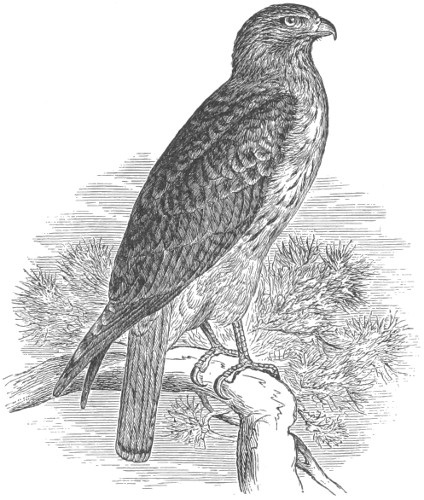
Buteo borealis (adult).
Mr. Salvin cites it as generally and plentifully distributed throughout Guatemala, from whence numerous examples in all stages of plumage, from the young to the adult, were transmitted by Mr. Skinner. It was also found at Dueñas by him. Mr. Swainson states that this Hawk was taken on the plains of Mexico by Mr. Taylor. A single specimen was received by Mr. Lawrence from Panama. Mr. Gosse states that it is the most common bird of this family in Jamaica, where it is a resident, and where it breeds. Mr. Lembeye and Dr. Gundlach both include it in their lists of the birds of Cuba, and the latter marks it as breeding in that island. It has been observed in Florida by Mr. Allen, and is not uncommon in all the New England States, where it is resident throughout the year. In the Southern States it is most abundant in the winter months.
Specimens of this bird are recorded in the government reports as obtained from the Yellowstone, from the Pecos River in Texas, and from Fort Fillmore in New Mexico. Mr. Dresser found it common throughout all of Texas in all seasons of the year, breeding in all parts, but preferring the heavily timbered country. He obtained its eggs from Systerdale and from the Medina River.
This Hawk is a strong and powerful bird, with a firm, steady, and protracted flight, frequently at a great elevation, and often moving quite a distance without any apparent motion of the wings. It is said to generally descend upon its prey from some fixed position, as the branch of a tree, and rarely to dart upon it when flying. It is a cautious bird, and rarely ventures near a house for poultry except when the dwelling is isolated and near its own haunts. It preys chiefly upon small quadrupeds, small birds, and reptiles. It usually darts upon a snake from the branch of a tree, and seizing it near the head bears it writhing through the air. In the valley of the Saskatchewan, Richardson states that it watches for the marmots, and when one imprudently ventures from its burrow, darts upon it, bears it a short distance off, and tears it to pieces.
As they fly, these birds utter a very peculiar and unpleasantly harsh cry or scream, which they repeat very frequently. Capt. Blakiston observed this at the Red River settlement, and speaks of it as the Squealing Hawk.
Though said to be thus generally cautious in exposing itself to danger in approaching a poultry-yard, it is not always thus cautious. Mr. Downes mentions an instance where one of these birds entered a garden in Halifax to pounce upon a tame Crow, and was captured alive by the owner.
Mr. Audubon states that after rearing their young they no longer remain mated, but separate and evince rather jealous hostility to each other than good-will. When one has taken any prey in sight of another, the latter will pursue and struggle with it for possession of the plunder. In these fights they scream vociferously while struggling for possession.
In the Southern States these Hawks begin to build in February; in the Middle States, from March the 24th to April 15th; and in New England usually from April to May. They construct a large nest, composed externally of coarse sticks and twigs, and lined with dried grasses, moss, and leaves, built for the most part in the fork of a lofty tree. The eggs are usually four in number.
Mr. Augustus Fowler of Danvers, who is familiar with the habits of this bird, writes me that in Massachusetts they usually begin to build their nests about the first of April, selecting some tall tree near the middle of the woods, the branches of which form a crotch near its trunk. To this chosen spot the female carries a sufficient quantity of sticks for its outside (the male taking no very active part in the matter), and for its inside she uses the bark from the dead branches of the chestnut, which she beats and pecks to pieces with her bill, making it soft and pliable, or gathers the fallen leaves of the pine, or some other soft material, which she finds conveniently, as a lining, which is about one inch in thickness. It is thirteen inches in diameter from outside to outside, and seven inches in diameter on the inside, while its depth is two and a half inches. The female usually lays five eggs, which are spherical, of a dirty-white color, and marked with large blotches of brown; on some they cover almost the whole egg, while others are marked mostly on the large end, and some even of the same nest are so faintly marked as to appear almost wholly white. They are 2.12 inches in length and 1.95 in diameter.
In Jamaica, according to Mr. March, these Hawks do not confine themselves to any particular mode or place for breeding, height seeming to be their chief object. He has found their nest in a quite accessible tree, not more than twenty feet from the ground, and near a frequented path. In another instance a pair nested for several years on the roof of the turret of the belfry of the Spanishtown Cathedral church. The nest he describes as a platform of dry sticks, more than a foot across and two or three inches thick. The bed of the nest is about six inches across and two deep, of fine inner bark, grass, and leaves, containing four or five eggs, nearly spherical, measuring 2.25 by 2.75 inches, of a dirty or clayish white, dashed with blotches and spots of vandyke-brown and umber, often running with a light shade into the ground-color.
The eggs of the Red-tail exhibit great variations in nearly every respect except their shape, which is pretty uniformly a spheroidal-oval. Their ground-color varies from white to a dingy rusty drab, their markings vary greatly in colors, shades, size, frequency, and distribution. In some the markings are small, few, and light, and the egg appears to be of an almost homogeneous brownish-white. In others the ground is completely concealed by large and confluent blotches of deep and dark purplish-brown, burnt umber, and a peculiar shade known as Dutch umber. In some the markings are distributed in fine and frequent granulations, diffused over the entire surface of the egg, producing the effect of a color of uniform umber brown, through which the ground of yellowish-white can only be traced by a magnifying-glass. Four eggs in my cabinet average 2.22 inches in length by 1.72 in breadth. The largest egg measures 2.55 by 1.90 inches; the smallest, 2.10 by 1.70. The capacity of the largest to the smallest is nearly as five to four.
The season in which this Hawk deposits its eggs varies considerably. Mr. Jackson of West Chester, Penn., gives March 24 the earliest, and April 15 the latest, in which he has met with its fresh eggs.
Mr. Ridgway obtained two eggs of this Hawk at Mount Carmel, Ill., on the 6th of March, the nest having been commenced early in February. It was placed on the summit of a black-gum tree (Nyssa multiflora), and rested upon the topmost branches, about ninety feet from the ground. It was lined with corn-husks, gathered from a field close by. The eggs (No. 12,740, S. I. Collection) measure, respectively, 2.45 and 2.50 in length, by 1.95 and 2.00 in breadth. Their color is plain bluish-white, entirely free from markings of any kind.
In California, the var. calurus is stated to be common in all parts of the State not destitute of trees, and to reside permanently wherever found, pairing only during the breeding-season. They prey upon hares and other small quadrupeds, upon smaller birds, and upon reptiles. Dr. Cooper states that at times, when food is plenty, they become excessively fat. They are known to occasionally seize a fowl from the farm-yard. During the middle of the day, in the cold weather, they are said to soar very high in the air, and occasionally to disappear also in the manner of their eastern relatives, the Buteo borealis. They are said to be abundant and resident species in Washington Territory, having been found by Dr. Suckley quite numerous at Puget Sound, but scarcer on the Upper Columbia, east of the Cascade Mountains. It seems to be more daring than is common with the borealis, for Dr. Suckley states that while he was stationed at Fort Steilacoom he noticed that the poultry-yards were as much harassed by this Hawk as by the Goshawk, not hesitating to seize poultry from the very doors of the dwelling-houses.
Dr. Kennerly states that this Hawk was met with by him between the coast of Texas at Indianola, and the Rio Grande at El Paso del Norte. It seemed to feed indifferently upon reptiles, particularly lizards, and the smaller quadrupeds and birds.
Dr. Cooper states that the nests of this species are numerous in the valleys and on the lower mountains of California. They are generally built in the forks of a sycamore or other large trees, and formed of twigs pretty finely constructed, and with a very distinct cavity. Eggs, taken by Dr. Cooper near San Diego, were laid about the 20th of March, and were three in number. They measured 2.28 by 1.76 inches, were of a dull yellowish-white, with faint brown spots. While Dr. Cooper was climbing to the nest, the old birds darted towards him from a neighboring bluff, but when within a few feet of his head they turned away and did not attempt to make an assault.
Two eggs belonging to the variety calurus were obtained by Mr. E. Samuels near Petaluma, Cal., in 1856; measure 2.31 inches in length by 1.87 in breadth. The shape of one egg is an almost exact ovoid, slightly tending to a spheroid, one end being hardly perceptibly larger than the other. Its ground-color is a very light buff, the spottings and markings giving to it the effect of a yellowish-white. It is marked over the entire surface with blotches, dashes, and lines of a light tint of a brown tending to vandyke. These are mixed with markings of a lighter purplish-brown. The markings, of both shades, are chiefly oblong in shape, and run with the length of the egg. They bear no resemblance to any eggs of the B. borealis that I have ever seen, and are unlike those of other Hawks so far as I am aware. It was built on the top of a large evergreen-oak, at least seventy feet from the ground, and was constructed entirely of large, coarse sticks, lined with a few stray feathers. The male bird was shot as it flew from the nest, which was so hidden by the thick branches that it would have escaped detection.
The black form of this species was first described by Mr. Cassin as Buteo calurus, in 1855, from a specimen procured by Dr. Henry near Fort Webster, New Mexico. In this plumage it was afterwards met with by Mr. Emanuel Samuels, near Petaluma, in California, who found it breeding, and was fortunate enough to secure the parent bird on its nest.
The nest was built near the top of an evergreen-oak, at the height of about sixty feet from the ground, and contained two eggs just on the point of hatching. It was constructed of sticks, and was lined with moss. Both birds were about the spot. The male bird, manifesting much more courage than his mate in resistance to the intruders, was shot. The female was wounded, but escaped.
One of these eggs measures 2.25 inches in length by 1.79 in breadth. Its capacity is considerably less than that of the specimens just described; its shape is a much more oblong-oval; one end is evidently more pointed than the other. Its ground-color is a dirty cream-white, covered, chiefly at the larger end, with blotches and smaller markings of a dark shade of a brown almost exactly corresponding with that known as vandyke-brown, with smaller markings and spottings of a lighter shade of the same. The latter are distributed at intervals over its entire surface.
A nest, found by Mr. Xantus near Fort Tejon, is stated by him to have been found in a swamp. It was built in a water-oak, was about fifteen feet from the ground. The nest was very large and was built of coarse sticks. It contained four eggs.
Buteo harlani (Audubon). HARLAN’S HAWK; “BLACK WARRIOR.”
Falco harlani, Aud. B. Am. 1831, pl. xxxvi; Ib. Orn. Biog. I, 441.—Brewer (Wils.), Am. Orn. Synop. 1852, 684. Buteo harlani, Bonap. List, 1838, 3.—Aud. Synop. 1839, 6.—Gray, List B. Brit. Mus. 18.—De Kay, Zoöl. N. Y. II, 11.—Strickl. Orn. Syn. I, 30.—Cass. Birds N. Am. 1858, 24 (adult, but not the description of young, which is that of B. borealis, var. calurus).—Coues, P. A. N. S. 1866, 43.—Gray, Hand List, I, 7 (under B. borealis).—Ridgway, P. A. N. S. Dec. 1870, 142.—Coues, Key, 1872, 216.
Sp. Char. Form strong and heavy, like B. borealis, but still more robust; tibial plumes unusually developed, long and loose, their ends reaching to or beyond the base of the toes; lateral toes nearly equal. Four outer primaries with inner webs cut. Dimensions: Wing, 14.25–15.75; tail, 8.80–10.00; culmen, 1.00; tarsus, 2.75–3.25; middle toe, 1.50–1.70. Colors: Nearly uniform black, varying from a sooty to a carbonaceous tint, with more or less of concealed pure white. Adult. Tail confusedly mottled longitudinally, with grayish, dusky, and white, often tinged or mixed with rufous, the different shades varying in relative amount in different individuals; a subterminal band of black. Young. Tail grayish-brown, crossed by about nine very regular and sharply defined, broad bands of black, about equal in width to the gray ones.
Adult male (Lawrence, Kansas, Oct., 1871; in Collection of Kansas University). General color deep, almost carbonaceous, black, showing much exposed white on the head, neck, and breast, all the feathers of which are snowy white beneath the surface, the black being merely in the form of tear-shaped spots on the terminal portion of the feather; chin, lores, and front pure white; upper parts in general, the posterior lower parts and the lining of the wing, with the black unbroken, but all the feathers—except the under wing-coverts—more or less spotted with white beneath the surface, on a grayish ground; these spots being usually arranged in pairs on each side of the shaft, on the flanks; tail-coverts, above and below, spotted irregularly with bright rufous, in nearly equal amount with the black and white. Alulæ, primary coverts, and primaries, with quadrate spots of plumbeous on their outer webs, forming transverse bands; under surface of primaries plumbeous-gray except at ends, but much broken by coarse marbling of white, this prevailing anteriorly, where it is much confused, but posteriorly about equal with the grayish, and exhibiting a tendency to form quadrate spots. Tail, with the ground-color white, but this nearly hidden on the upper surface by a longitudinal mottling of dark and light ashy, this growing more uniform terminally, where it becomes slightly suffused with reddish and crossed by a subterminal, broad but broken and irregular, band of black, the tip again very narrowly grayish and reddish.
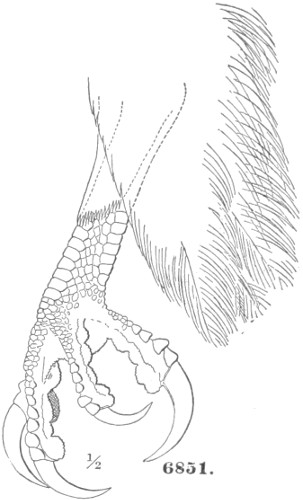
6851. ½
Buteo harlani.
Wing-formula, 4, 3, 5–2, 6; 1=10. Wing, 15.00; tail, 8.80; culmen, 1.00; tarsus, 2.75; middle toe, 1.50; lateral toes equal. Plumage of the flanks, abdomen, tibiæ, and crissum remarkably lengthened and lax, the latter reaching within two inches of the tip of the tail, and the tibial plumes reaching to the base of the toes.
Adult female (6,851, Rio Grande, lat. 32°; Dr. T. C. Henry, U. S. A.). Whole plumage purplish black, or chocolate-black, with a purplish lustre; feathers everywhere pure white at bases, this exposed, however, only on the occiput, or where the feathers are disarranged. Forehead, lores, and chin white. Secondaries and primaries more brown than other portions, crossed by distinct bands of black,—about six on the secondaries. Whole lining of the wing and upper tail-coverts continuous, unvariegated black. Under surface of the primaries ashy-white, more slaty terminally; ends with distinct, and other portions with obsolete mottled, bars of dusky. Tail ashy-brown on outer webs, white on inner; both with a confused, rather longitudinal mottling of blackish; terminally, there is a broad nearly continuous subterminal band indicated by blotches, these mixed very slightly with a rufous tinge. Primaries injured by shot, therefore proportions of the quills cannot be determined. Wing 15.75; tail, 9.10; culmen, 1.00; tarsus, 2.90; middle toe, 1.60; outer, 1.15; inner, 1.15.
Young (Phil. Acad. Coll.; San Antonio, Texas, 1860; Dr. A. L. Heermann). Like the preceding, but basal white rather more exposed, and somewhat fulvous on the breast; the sides, axillars, lining of the wing, and lower tail-coverts have very obsolete transverse spots of the same. Under surface of primaries unvariegated silvery white anterior to their emargination, beyond which they are more hoary, along the edge black, this portion with about five transverse spots of black. Tail grayish ashy-brown to the tip, crossed with about nine very sharply defined bands of black, of equal width with the gray ones. Lores grayish-white. Wing-formula, 4, 3, 5–2–6–7–8=1. Wing, 14.25; tail, 10.00; tarsus, 3.25; middle toe, 1.70.
Hab. Southern Mississippi Valley, from Louisiana (Aud.) and Texas (Mus. S. I.); north to Eastern Kansas (Coll. Kansas Univ.).
Localities quoted: Guatemala (Sclater, Ibis I, 216 (?)); Arizona (Coues, P. A. N. S. 1866, 43).
There is not a doubt in my mind as to the propriety of separating this bird from any close relationship to the B. borealis, nor of the correctness of considering it the B. harlani of Audubon. It only can be referred to Audubon’s plate and description, both of which agree perfectly with the younger plumage described.
The specimens Mr. Cassin describes as the “adult” B. harlani are really such; but those which he describes as the “young” are the young of the Western Red-tail (B. borealis var. calurus). The California specimens to which Mr. Cassin refers, as identified by Mr. Lawrence as B. harlani, are in reality the melanistic condition of B. swainsoni, or the “insignatus” of Cassin. The present bird appears to be restricted to Louisiana, Texas, New Mexico, and adjacent portions, north to Kansas, and probably Eastern Mexico.
Habits. This Hawk was first described by Audubon from a pair obtained by him near St. Francisville, Louisiana. They had bred in that neighborhood for two seasons, were shy and difficult of approach, and for a long while eluded his pursuit. The female was shot while sailing over his head, and wounded in the wing. He endeavored to preserve it alive and to carry it as a present to the Zoölogical Society, but it refused all food and died in a few days. This specimen is now in the British Museum. The male bird was also obtained a few days later, and this too was brought to him yet alive but also wounded. It was even more fierce and wilder than the female, would erect the feathers on its head, open its bill, and prepare to strike with its talons when any object was brought near to it.
This species, though smaller than the Red-tail, to which he regarded it as allied, Audubon thought greatly superior to it in flight and daring. Its flight is described as rapid, greatly protracted, and so powerful as to enable it to seize the prey with apparent ease, or effect its escape from its stronger antagonist, the Red-tail, which pursued it on all occasions. It had been seen to pounce upon a fowl, kill it almost instantly, and afterwards drag it along the ground several hundred yards. It was not seen to prey on hares or squirrels, but seemed to evince a marked preference for poultry, partridges, and the smaller species of wild duck. He saw none of the young, but was told that they appeared to be of a leaden-gray color at a distance, and at the approach of winter became as dark as their parents.
Mr. Dresser states that he noticed this bird on several occasions near San Antonio but was not fortunate enough to shoot one. He received one specimen that had been shot by a lad on the Medina River. He was informed by a man living near there, who was a good sportsman and a careful observer, that he had several times found their nests, and Dr. Heermann is said to have obtained the eggs there several years before. Dr. Coues did not meet with it in Arizona, where it probably, however, will yet be found. Specimens have been received from Mexico, as is stated by Cassin, and a Buzzard, which Mr. Salvin referred to this species, was seen by him near Dueñas, where it was by no means common.
A specimen of this species has recently been taken in Kansas, near Lawrence, as recorded by Professor Snow, and fully identified at the Smithsonian Institution.
Buteo cooperi, Cassin. COOPER’S RED-TAILED HAWK.
Buteo, Cass. P. A. N. S. Philad. VIII, 1856, 253.—Ib. Birds N. Am. 1858, 31, pl. xvi.—Coop. & Suck. P. R. R. Rept. XII, ii, 1860, 148.—Gray, Hand List, I, 8.—Ridgway, P. A. N. S. Dec. 1870, 142.—Coues, Key, 1872, 43.
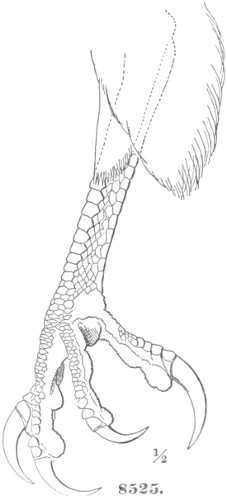
8525. ½
Buteo cooperi.
Sp. Char. Adult (8,525, Santa Clara, California, Oct. 1856; Dr. J. G. Cooper). Head, neck, and whole lower parts white; feathers of the head and neck with medial longitudinal streaks of black, the white prevailing on the occiput and superciliary region,—the black predominating over the cheeks, forming a “mustache”; throat with fine lanceolate blackish streaks; sides of the breast with broader, more cuneate markings of the same; flanks with narrow, lanceolate stripes, these extending sparsely across the abdomen; tibiæ, and lower tail-coverts immaculate, the inner face of the former, however, with faint specks. Upper plumage in general dark plumbeous-brown, inclining to black on the back; plumbeous clearest on primaries, which are uniformly of this color, the inner ones inclining to fine cinereous. Scapulars and wing-coverts spattered with white beneath the surface. Rump black; upper tail-coverts white tinged with rufous, and with irregular, distant transverse bars of blackish. Tail with light rufous prevailing, but this broken up by longitudinal daubs and washes of cinereous, and darker mottlings running longitudinally on both webs; basally, the ground-color approaches white; tips white, and a distinct, but very irregular, subterminal band of black, into which the longitudinal mottlings melt; outer webs of lateral feathers entirely cinereous, and without the black band. Under side of the wing white, with a large black space on the lining near the edge; under surface of primaries white anterior to their emargination, finely mottled with ashy, and with indistinct transverse bands terminally. Fourth quill longest; third shorter than fifth; second equal to sixth; first equal to tenth. Wing, 15.75; tail, 9.10; tarsus, 3.25; middle toe, 1.70.
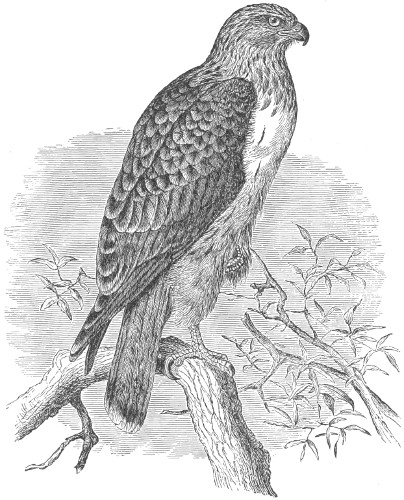
Buteo cooperi (adult).
This remarkable Hawk is certainly not to be referred to the B. borealis, as has been suggested, the proportions of the two being quite different, while there is no similarity of plumage. In plumage, Buteo cooperi very closely resembles the adult of Archibuteo ferrugineus, and the suggestion has been made that it is a hybrid between this and the Red-tail. The markings of the head, and the general tint of the upper parts, are almost precisely as in the former bird, while the tail is exactly similar in character of markings, the only difference being the more reddish tinge and black subterminal band, which are, in fact, the only characters approximating it to the Buteo borealis. The feet are, however, very much stronger than in the A. ferrugineus, while the tarsus is very much longer than in borealis, scarcely more so, however, than in the former. The black patch on the lining of the wing, however, is a feature shared by neither of these birds, being one entirely peculiar to the Buteo cooperi. But one specimen—the one described above—is known to have been obtained. Mr. J. A. Allen, in his “Notes on some of the Rarer Birds of Massachusetts” (see “American Naturalist,” Vol. III, p. 518, and a separate paper, p. 14), mentions the capture of this species near Cambridge, Mass., but probably did not actually see it. The specimen in question being in the possession of Mr. C. J. Maynard, he kindly sent it to the Smithsonian Institution. On examination, it proved to be a young Buteo lineatus, differing from the average in somewhat lighter colors.
Hab. Santa Clara County, California.
The nearest ally of this species is the B. ferox, of the Palæarctic Realm (Northern Asia and Africa and portions of Europe), which has exactly the size and proportions of the present bird, and in certain stages a very similar plumage. I have not seen an unquestionable adult of B. ferox, but specimens almost adult, in the collection of the Boston Society of Natural History, from the Himalaya Mountains, come remarkably close to B. cooperi in plumage, having like it a black spot on the under side of the wing, but apparently on the under primary-coverts, instead of on the lining, near the edge; the tail is also very similarly colored. Upon the whole, I consider the B. cooperi to be a good species, with B. ferox, Gmelin, of Asia, etc., as its nearest relative, unless it proves to be a hybrid between Buteo borealis and Archibuteo ferrugineus, which I think is less likely to be the case.
Habits. A single individual of this bird was shot by Dr. Cooper near Mountain View in Santa Clara Valley, California, in November, 1855. It still remains unique in collections, and during his more recent explorations Dr. Cooper has not been able to obtain any additional specimens or see any like it. Those he mistook for this bird and to which he refers in his report on the birds of Washington Territory, he is satisfied were only the Archibuteo ferrugineus. The suggestion of Sclater, that the bird is not distinct from Buteo erythronotus, is negatived, according to Mr. Ridgway, by the fact of their actually belonging to different sections of the genus.
Genus ARCHIBUTEO, Brehm.
Archibuteo, Brehm, 1828. (Type, Falco lagopus, Gmelin.)
Triorchis, Kaup, 1829 (nec. Leach, 1816). (Same type.)
Butaëtes, Less. 1831. (Same type.)
? Butaquila, Hodgs. 1844. (Type, Butaquila strophiata, Hodgs.)
? Hemiaëtus, Hodgs. 1844. (Same type.)
Char. Similar to Buteo, but bill and feet weaker, wings longer, and tarsi feathers in front, to the toes. Bill small, compressed anteriorly, but very broad through the gape; upper outline of the cere ascending basally; nostril broadly oval, nearly horizontal. Tarsus densely feathered in front and on the sides down to the base of the toes; naked behind, where covered with irregular scales. Tarsus more than twice as long as the middle toe; basal half of the toes covered with small scales; outer toe longer than the inner; claws long, strongly curved, acute. Feathering of the head and neck normal. Wing very long; the third to fourth quill longest; first shorter than seventh; outer four or five with inner webs deeply emarginated. Tail moderate, rounded. Plumage full and soft.
The relationship of this well-marked genus appears to be nearest to Buteo and Circus, with an approach to Circætus in character of the plumage, especially the wing. The Old World species, belonging to the subgenus (?) Butaquila, numbering two or three, according to different authors, I have not seen, and consequently cannot say whether they are really congeneric with the American species or not. Exclusive of these, two species are known, both of which belong to North America, one of them (A. lagopus) being found also in Europe and Africa. These differ very considerably from each other, in the details of external structure, probably quite as much as they do from the Asiatic forms above mentioned. The following synopsis will express the differences between the two North American species, and between the American and European races of the one common to both continents.
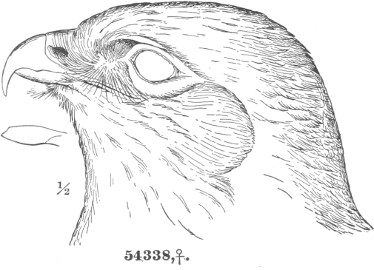
54338, ♀. ½
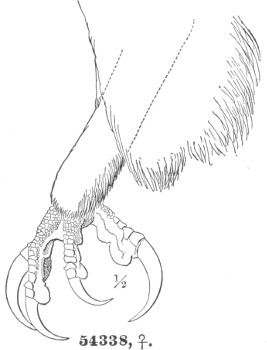
54338, ♀. ½
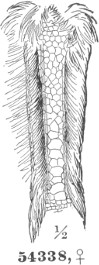
54338, ♀. ½
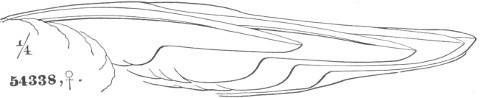
54338, ♀. ¼
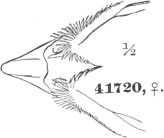
41720, ♀. ½
41720, A. ferrugineus.
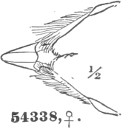
54338, ♀. ½
54338, Archibuteo lagopus.
Species and Races.
Common Characters. Tail more or less white basally; inner webs of the primaries white, without bars, anterior to their emargination. Head and neck with longitudinal streaks of whitish and dusky (except in melanistic individuals of lagopus var. sancti-johannis).
1. A. ferrugineus. Wing, 15.90–17.60; tail, 9.50–11.00; culmen, 1.00–1.20; tarsus, 3.10–3.45; middle toe, 1.40–1.65. Bill wide, the base very broad and depressed. Beneath, continuous pure white, without conspicuous spots, except sometimes a few scattered ones along the sides and across the abdomen; breast immaculate, or with only narrow shaft-streaks. Upper parts always with more or less rufous. Adult. Upper parts and tibiæ fine rufous, the former with longitudinal spots, the latter with transverse bars, of blackish. Secondaries and primaries plumbeous, the latter with a hoary cast. Tail white, washed with pale ash, and more or less stained along the edges of the feathers (longitudinally) with light rufous; sometimes with a badly defined indication of a dusky subterminal bar. Young. Above dark grayish-brown, with only the borders of the feathers rufous or ochraceous; tibiæ white, with sparse transverse spots of dark brown. Tail white only on basal third, and on inner webs, the remaining portion brownish-ashy, with several more or less distinct darker bands. Hab. Western North America, from Arizona, California, and Oregon, east to the Great Plains.
2. A. lagopus. Wing, 15.75–18.20; tail, 8.70–10.50; culmen, .80–1.00; tarsus, 2.30–2.80; middle toe, 1.30–1.50. Bill narrow, compressed; beneath more or less spotted with dusky, which usually predominates; breast with large spots of dusky; no rufous on upper parts, nor on tibiæ. Adult. Whitish, with transverse dusky spots. On the lower parts, the dusky spots or cloudings, largest and most suffused anteriorly (on the jugulum and breast). Terminal portion of the tail with several irregular dusky bands. (Sometimes almost entirely black, varying in shade from a brownish to a carbonaceous tint!) Young. Above grayish-brown, longitudinally spotted with dusky, and more or less edged with pale ochraceous, or rusty whitish. Beneath ochraceous-white, with the spots largest and most suffused posteriorly, forming a wide, more or less continuous belt across the abdomen; markings on the jugulum and breast longitudinal. Terminal portion of the tail without transverse bars.
Spots on the jugulum, in the adult, suffused into a nearly uniform patch. Never melanistic (?). Hab. Europe … var. lagopus.91
Spots on the jugulum, in the adult, scattered. Frequently melanistic. Hab. North America … var. sancti-johannis.
Archibuteo ferrugineus (Licht). CALIFORNIA SQUIRREL HAWK.
Falco ferrugineus, Licht, Berl. Trans. 1838, p. 429. Lagopus ferrugineus, Fraser, Proc. Zoöl. Soc. Lond. 1844, p. 37. Archibuteo ferrugineus, Gray, Gen. B. fol. sp. 3, 1844.—Cass. B. of Cal. & Tex. 1854, p. 104; Birds N. Am. 1858, 34.—Bonap. Consp. Av. p. 18.—Strickl. Orn. Syn. I, 41, 1855.—Heerm. P. R. R. Rept. VII, 31, 1857.—Coop. & Suck. P. R. R. Rept. XII, ii, 149, 1860.—Coues, Prod. Orn. Ariz. p. 10, 1866 (anatomical notes).—Blakist. Ibis, III, 1861, 318 (Saskatchewan; eggs).—Fraser, Pr. Z. S. 1844, 37.—Gray, Hand List, I, 10, 1869. Archibuteo regalis, Gray, List B. Brit. Mus. p. 39, 1844; Gen. B. fol. pl. vi.
Sp. Char. Adult male (41,719, Fort Whipple, Arizona, Dec. 2, 1864; Dr. Coues). Ground-color of head and neck white; each feather with a medial streak of black, these growing broader posteriorly, and along the upper border of the ear-coverts are so blended as to form an indistinct stripe back from the eye. Entire lower parts (except tibia) and whole under surface of the wing continuous pure white; breast with a faint tinge of delicate ochraceous; tibia and tarsus reddish-white, tinged with or inclining to deep ferruginous on upper portion, and with numerous transverse bars of darker ferruginous and blackish; sides of the breast with a very few hair-like shaft-streaks of black; flanks with a few distant, dark ferruginous bars; axillars with two or three cordate spots of ferruginous near ends; feathers of the lining next the body, with blended irregularly hastate spots of rufous; under primary coverts shading into cinereous on terminal half, and with obscure broadly hastate spots of a darker shade of the same; primaries slaty beyond their emargination, deepening gradually toward their tips. Back, scapulars, and lesser and middle wing-coverts fine rufous, each feather with a broad median, longitudinal spot of brownish plumbeous-black, these on the back rather exceeding the rufous; longer wing-coverts and secondaries ashy-umber, with very obsolete transverse bands of darker; primary coverts more ashy, and more distinctly banded; primaries fine chalky cinereous, this lightest on outer four; shafts pure white. Rump nearly uniform brownish-black,—posterior feathers rufous with medial black blotches; upper tail-coverts snowy white on outer webs, inner webs more rufous; a few concealed blackish transverse spots. Tail pale pearly ash, becoming white basally, and with a wash of dilute rufous along the edge of outer webs; inner webs white, with an ashy tinge thrown in longitudinal washes; outer feathers nearly white, with faint pale ashy longitudinal mottlings; shafts of tail-feathers pure white. Fourth quill longest; third but little shorter; second very much shorter than fifth; first intermediate between seventh and eighth. Wing, 16.75; tail, 9.20; tarsus, 2.95; middle toe, 1.35.
“Length, 22.50; extent, 54.50. Iris clear light yellow; cere, edges of commissure, and feet bright yellow; bill very dark bluish horn; mouth, purplish flesh-color, livid bluish along edges.”
Adult female (41,720, Fort Whipple; Dr. Coues). Almost exactly like the male, but black spots on rufous portions of upper parts much restricted, forming oblong spots in the middle of each feather; rump almost entirely rufous, variegated, however, with black. Longitudinal lines on breast more distinct; transverse bars on flanks and abdomen more numerous; tibial and tarsal feathers wholly deep rufous or ferruginous, the bars more blackish. Third and fourth quills equal and longest; second intermediate between fifth and sixth; first equal to eighth. Wing, 17.25; tail, 9.75; tarsus, 2.95; middle toe, 1.40. “Length, 23.25; extent, 56.50. Iris light ochraceous-brown.”
Young female (6,883, Los Angeles head and neck, edged laterally with light rufous; secondaries passing broadly into pale ashy at ends; primaries slaty-brown, with obscure darker bands; no appearance of these, however, on secondaries; rump entirely blackish-brown; upper tail-coverts wholly white. Tail hoary slate, basal third (or more) white, the junction of the two colors irregular and broken; tip obscurely paler; feathers obscurely blackish along edges, and with obsolete transverse spots of the same; white prevailing on inner webs. Beneath entirely pure white, scarcely variegated; tibiæ and tarsi with a few scattered small transverse spots of blackish; flanks with larger, more cordate spots of the same. (Breeds in this plumage.)
Hab. Western North America from California to the Missouri, and from the Saskatchewan to Texas.
Localities: Texas (Fort Stockton), (Dresser, Ibis, 1865, 325); Western Arizona (Coues. Pr. A. N. S., 1866, 40).
LIST OF SPECIMENS EXAMINED.
Nat. Mus., 10; Philad. Acad., 2; Boston Soc., 2; Coll. R. Ridgway, 2. Total, 16.
Measurements.
Sex. Wing. Tail. Culmen. Tarsus. Middle Toe. Specimens.
♂ 15.90–17.00 9.50–10.50 1.00–1.18 3.10–3.45 1.40–1.50 6
♀ 17.00–17.60 10.50–11.00 1.08–1.20 3.20–3.40 1.60–1.65 6
The variations in this species are very slight, and never sufficient to mislead the student. One specimen (26,590, ♂; Fort Tejon, Cal.; J. Xantus) differs from the adults described in having the abdomen quite closely barred, the streaks on the breast distinct, the rufous above tinging the secondary coverts, and spreading over the upper tail-coverts, while the tibiæ and tarsi are of a very deep ferruginous,—the bars black.
In a specimen from the Platte (5,577, ♂; W. S. Wood) white prevails on the tibiæ, the bars being dark ferruginous upon a white ground; the flanks are similarly marked, the other lower parts, however, immaculate; there is much concealed white on the scapulars. The rufous tinge of the tail is very deep, while there is a transverse series of black blotches, indicating the course of a transverse band near the end.
Habits. The California Squirrel Hawk appears to be an exclusively western species, occurring as far to the east as Nebraska and Kansas, and as far to the north as the Plains of the Saskatchewan and Washington Territory. It occurs as far to the southeast as Texas, and has been found also in New Mexico and in Arizona.
This species was first noticed and described in a paper on the natural history of California published in the Transactions of the Royal Academy of Berlin, in 1838, by Professor Lichtenstein, a Prussian naturalist. It was first brought to the notice of American naturalists by Mr. Edward M. Kern, of Philadelphia, who accompanied Colonel Fremont in his expedition of 1846, and who brought home specimens.
Dr. Coues found it quite abundant about Fort Whipple, where it was especially numerous in the winter, and where also he thinks it probable that it is a permanent resident. He found it more generally frequenting meadows, plains, and the more open woods. He usually found their stomachs filled with arvicolæ and other small quadrupeds peculiar to that country. It could always be readily recognized by its conspicuously white under parts, contrasted with its dark chesnut tibiæ and reddish back.
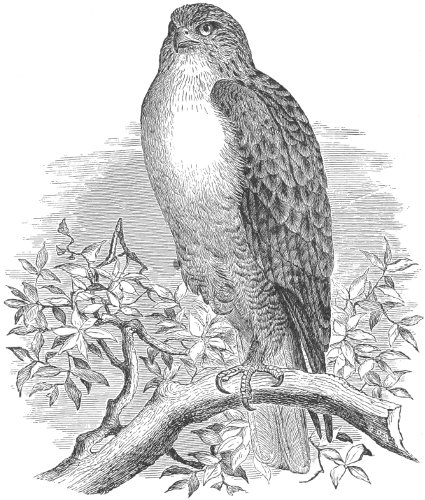
Archibuteo ferrugineus.
At San Pedro, on the southern coast of California, he again found this Hawk very common. It there alights very freely on the ground, where he often observed it. At Fort Whipple he only saw it on trees. At San Pedro its choosing thus the bare plain may have been a matter of necessity.
Dr. Kennerly observed a single individual of this species in a “prairie-dog-town” of large extent, near Fort Davis. It was intently watching at the hole of one of these animals. While in this position, it was observed to strike at the prairie-dog with its claw, when one of these animals protruded its head. As it was very intently watching its prey, it was easily approached and shot.
Dr. Heermann observed this Hawk in the valley of the Sacramento, where he thought it rather rare, but afterwards, during his connection with the government surveying party under Lieutenant Williamson, in the southern part of the State, he found it very abundant. On one occasion five or six individuals were in view at the same moment, among the mountains, sixty miles east of San Diego. It was there much more abundant than any other species. As large tracts of that country frequented by these birds are entirely without trees, they alight on the ground or on some slightly elevated tuft of grass, or a stone, where they sit patiently for hours watching for their prey, which was always found to consist of mice and other small quadrupeds. In one instance the crop was found filled with the remains of a ground squirrel.
Dr. Heermann states that he found the nest and eggs of this bird on the Consumnes River. The nest was in the fork of an oak, and was composed of coarse twigs and lined with grasses; the eggs were two in number, white with faint brown dashes. The nest was placed in the centre of a large bunch of mistletoe, and would have escaped notice had not the Hawk, in flying, betrayed her retreat.
The eggs, however, differ essentially in size from those mentioned by Capt. Blakiston, and it is quite possible that Dr. Heermann was mistaken in his identification. One of these eggs was figured in the North American Oölogy, and resembles much more an egg of Swainson’s Buzzard than any egg I have since seen of this species.
The specimens procured by Mr. Kerr were taken in the Tulare Valley, in January, 1846, and are stated in his notes to have been remarkably fat, and in excellent condition generally, so that some of his party shot these birds whenever opportunity offered, for the mess-kettle, and considered them very good eating.
Dr. Cooper states that in the spring and fall these Hawks abound in Southern California, migrating in summer through the interior plains of the Columbia and the Platte Rivers, at least as far north as the Dalles. He found it in winter at Martinez, and is of the opinion that few migrate beyond the State. It was usually to be seen slowly sailing over the plains, sometimes in circles, and occasionally pouncing down obliquely on its prey, which consists principally of the large ground squirrel. It rarely, if ever, attacks poultry, and limits its prey to wild animals, and is therefore a decided friend to the farmer.
Capt. Blakiston met with this bird breeding between the north and the south branches of the Saskatchewan River, April 30, 1858. The nest was placed in an aspen-tree, twenty feet from the ground, was composed of sticks, two and a half feet across, and lined with buffalo wool. The eggs were four in number. Those taken from another nest near the same locality were five in number. This nest was in a tree, and was only ten feet above a lake. Two eggs were taken by Mr. Bourgeau on the Saskatchewan Plains, July 9. These differences in seasons, from April to July, are suggestive either of great variations in the time of nesting, or of there being two broods in a season. The eggs obtained by Capt. Blakiston measured, one 2.60 by 2.00 inches, the other 2.50 by 1.95 inches, and are described as having been white with large distinct blotches and smaller specks of two shades of brown. The other was more obscurely blotched with a paler brown, and at the same time freckled all over.
An egg of this species taken by H. R. Durkee near Gilmer in Wyoming Territory, May 9, 1870, measures 2.43 inches in length by 1.95 in breadth. The ground-color is a creamy white, over which are very uniformly distributed on every part of the egg, in nearly equal proportions, blotches, plashes, and smaller markings of a dark burnt umber. The nest from which this egg was taken was composed of sticks, and was placed among rocks. The nest contained but one egg. The parent bird was secured, and there was no question as to identification.
Archibuteo lagopus, var. sancti-johannis (Penn.). ROUGH-LEGGED HAWK; BLACK HAWK.
Falco sancti-johannis, Penn. Arct. Zoöl. pl. ix, 1785.—Gmel. Syst. Nat. p. 273, 1789.—Lath. Index Orn. p. 34, 1790; Syn. I, 77; Gen. Hist. I, 276.—Daud. Tr. Orn. II, 105, 1800.—Shaw, Zoöl. VII, 150, 1809.—Bonap. Ann. Lyc. N. Y. II, 32.—Aud. Orn. Biog. II, 381, 1831.—Giraud, B. Long Island, p. 6, 1844.—Kerr, Trans. Gmel. II, 507, 1792. Buteo sancti-johannis, Jard. (Wils.) Am. Orn. II, 287, 288, 1832.—Nutt. Man. Orn. U. S. & Canad. p. 98, 1833.—De Kay, Zoöl. N. Y. II, 7, pl. ii, fig. 3, 1844. Butaëtes sancti-johannis, Cuv. Règ. An. (ed. 1), i, 323, 1829.—Bonap. List, p. 3, 1838. Archibuteo sancti-johannis, Gray, Gen. B. fol. sp. 2, 1844; List B. Brit. Mus. p. 39, 1844.—Bonap. Consp. Av. p. 18, 1850.—Cass. Birds Calif. & Tex. p. 103, 1854.—Blakist. Ibis, III, 1861, 318 (eggs).—Kaup, Monog. Falc. Cont. Orn. 1850, p. 75.—Strickl. Orn. Syn. I, 40, 1855.—Brewer, Oölogy, 1857, 34, pl. iii, f. 28.—Cass. Birds N. Am. 1858, 33.—Gray, Hand List, I, 10, 1869. Falco spadiceus, Gmel. Syst. Nat. p. 273, 1789.—Lath. Ind. Orn. p. 27, 1790; Gen. Hist. I, 279.—Daud. Tr. Orn. II, 109, 1800. Buteo spadiceus, Vieill. Ois. Am. Sept. I, 34, 1807. Falco lagopus, Wils. Am. Orn. pl. xxxiii, f. 1, 1808.—Brew. (Wils.) Am. Orn. Syn. 648, 1852.—Bonap. Ann. Lyc. N. Y. II, 32; Isis, 1852, 1138.—Aud. Birds Am. pl. clxvi, 422, 1831; Orn. Biog. II, 377; V, 217. Buteo lagopus, Rich. Faun. Bor. Am. II, pl. xxviii, 1831.—Aud. Synop. p. 8, 1839.—James. (Wils.) Am. Orn. I, 77, 1831.—Jard. (Wils.) Am. Orn. II, p. 54, 1832.—Nutt. Man. Orn. p. 97, 1833.—Peab. B. Mass. p. 79, 1841. Archibuteo lagopus, Cass. Birds N. Am. 1858, p. 32.—Brewer, Oölogy, 1857, 36, pl. iii, f. 29.—Coop. & Suck. P. R. R. Rept. VII, ii, 148, 1860.—Coues, Prod. Orn. Ariz. p. 16, 1866. Falco niger, Wils. Am. Orn. pl. liii, figs. 1 and 2, 1808.—Lath. Gen. Hist. pp. 256, 257, 1821. Buteo niger, Steph. Zoöl. XIII, pt. ii, p. 47, 1815.—Vig. Zoöl. Journ. I, 340.—James. (Wils.) Am. Orn. I, pp. 79, 80, 1831.—Cuv. Règ. An. (ed. 2), i, 326, 1829. Buteo ater, Vieill. Nouv. Dict. Nat. Hist. IV, 482, 1866; Enc. Meth. III, 1227.
a. Normal plumage.
Sp. Char. Adult male (43,073, Fort Resolution, June; J. Lockhart). Ground-color of the upper parts dull umber-cinereous, this more rufous on the shoulders, and dull white on nape, scapulars, inner secondaries, and upper tail-coverts; rump entirely black, feathers bordered with whitish. All the feathers above with central oblong or irregular spots of black, this color predominating on top of head, and forming transverse bands across the wing-coverts and secondaries; upper tail-coverts pure white, each marked with an exceedingly irregular transverse spot of black. Tail white on basal two thirds, and narrowly, but sharply, tipped with the same; subterminal portion pale mottled cinereous, with a very broad zone of black next the terminal white, and anterior to this three narrower and more irregular bands of the same. Primaries blackish-cinereous, with obsolete darker bands. Ground-color of head and lower parts dull white; cheeks thickly streaked with black; ear-coverts and throat more sparsely streaked; forehead and sub-orbital region plain whitish. Breast with large, longitudinal but very irregular, oblong spots of dark brown, these largest and somewhat confluent laterally; lower part of breast with much less numerous and less longitudinal spots; tibiæ strongly tinged with rusty, and with tarsus, abdomen, crissum, and flanks having irregular transverse spots of blackish-brown; lower tail-coverts unvariegated. Lining of wing white, with numerous spots of black, these becoming more rusty towards the axillars; a large space of continuous clear black, covering the under primary coverts and the coverts immediately anterior; under surface of primaries and secondaries pure white, the former becoming black at ends, the latter ashy; no bars, except toward shafts, of the latter. Fourth quill longest; third equal to fifth; second intermediate between fifth and sixth; first equal to eighth. Wing, 16.50; tail, 9.00; tarsus, 2.50; middle toe, 1.30; bill, 1.30 and .90.
Adult female (28,156, Philadelphia, Pa.; J. Krider). Generally similar to the male. On head and nape, however, the yellowish-white predominates, the central black being much reduced; on the other hand, there is less white on the upper parts, the dull cinereous-drab being much more evenly spread; darker markings less conspicuous. Tail white only at the base, the remaining portion being pale cinereous-drab crossed with four or five distinct, very regular bands of black, the tip being very broadly ashy. Flanks with ground-color light umber-drab, and marked with transverse bands of black. Lower surface generally as in the male; tail-coverts with two or three blackish spots, apparently out of place. Fourth quill longest; fifth much shorter than third; second intermediate between fifth and sixth; first intermediate between seventh and eighth. Wing, 17.00; tail, 9.00; tarsus, 2.40; middle toe, 1.30; bill, 1.30 and .85.
Young (25,934, United States). Upper surface generally light umber, becoming lighter on scapulars and middle wing-coverts, but showing nowhere any trace of spots or bands; wings, scapulars, and back with blackish shaft-streaks; primaries approaching black toward ends, becoming white basally; upper tail-coverts white, with a hastate stripe of brown along shaft; tail, basal half white, terminal half plain drab, becoming darker terminally, the tip narrowly white. Head, neck, and lower plumage in general, white stained with ochraceous, this deepest on tibiæ and tarsi; head and neck streaked with dark brown, ear-coverts almost immaculate; breast with oblong spots of clear brown; flanks, abdomen, and anal region continuous uniform rich purplish vandyke-brown, forming conspicuous transverse belt; tibiæ and tarsi scarcely varied, the few markings longitudinal; lower tail-coverts immaculate. Under side of wing much as in adult; black area, however, more extended; lining much tinged with rufous, and with longitudinal streaks of dark brown.
b. Melanistic condition.
Adult male (28,153, Philadelphia; J. Krider). General plumage blackish-brown, the head streaked by whitish edges of the feathers; wing-coverts, secondaries, primaries, and tibial plumes paler terminally; tarsi mottled with whitish; upper and lower tail-coverts tipped obscurely with white. Tail narrowly tipped with dull white, and with about five very obsolete pale ashy bands. Lining of wing black, spotted with white near edge; whole under surface of the primaries pure white anterior to their emargination, beyond which they are black. Third and fourth quills equal and longest; second intermediate between fifth and sixth; first shorter than seventh. Wing, 16.00; tail, 8.85; tarsus, 2.45; middle toe, 1.25.
Adult female (12,008, Philadelphia; C. Drexler). Continuous pure carbonaceous black; forehead white; occiput same beneath surface. Tail paler at tip, and crossed with four ill-defined though continuous bands of ashy white, the last of which is distant over two and a half inches from the tip; lower tail-coverts with a few white spots. Whole lining of wing glossy coal black; under surface of primaries, anterior to their emargination, white mottled with ashy. Fourth and fifth quills equal and longest; third only a little shorter; second a little longer than sixth; first intermediate between seventh and eighth. Wing, 16.50; tail, 9.00; tarsus, 2.50; middle toe, 1.20.
Young. Similar, but the tail dusky, growing whitish toward the base, and without any bars.
Hab. Whole of North America north of Mexico, but breeding northward of the United States.
Localities: Western Arizona (Coues, Pr. A. N. S., 1866, 48).
LIST OF SPECIMENS EXAMINED.
National Museum, 44; Philadelphia Academy, 17; Boston Society, 1; Museum Comparative Zoölogy, Cambridge, 10; Cab. G. N. Lawrence, 6; Coll. W. S. Brewer, 3; R. Ridgway, 4. Total, 85.
Measurements.
Sex. Wing. Tail. Culmen. Tarsus. Middle Toe. Specimens.
♂ 15.80–16.80 9.80–10.00 .85–.90 2.75–2.80 1.35–0.0018
♀ 16.15–17.70 9.00–10.50 .90–1.00 2.80–0.001.30–1.40 8
15.75–18.00 9.00–11.00 .80–1.00 2.15–3.00 1.20–1.50 40
That all the North American Rough-legged Hawks, whether light or dark (excepting of course the A. ferrugineus), are one species, and also one race, there appears to be but little doubt; a critical comparison and minute examination of about one hundred specimens also proves that the dark plumage, usually separated as “A. sancti-johannis,” has nothing to do with age, sex, season, or locality, but that, as in Buteo borealis var. calurus and B. swainsoni, it is a purely individual condition, black birds being black, and light birds being light, from the first plumage till death. Each phase has its young and adult stages distinctly marked, as the above diagnoses point out. It however appears to be the fact that certain regions are frequented more by birds of one color than another, and of the many hundreds of specimens sent from the Arctic regions to the Smithsonian Institution by officers of the Hudson’s Bay Company, none exhibited the blackish plumage which, on the other hand, appears most abundant about Hudson’s Bay.
The North American birds are distinguishable from European ones (var. lagopus) by the characters given in the synopsis on p. 1619, and description, on p. 1624.
Habits. The Rough-legged Hawk of North America bears so close a resemblance to the European species, in all respects,—plumage, habits, and eggs,—that the two are generally considered to be identical. The distribution of the American variety appears to be nearly throughout the entire Union, from the Atlantic to the coast of the Pacific, and from New Mexico to the Arctic regions. It was taken at Fort Steilacoom, and at Shoal-water Bay in Washington Territory, by Drs. Suckley and Cooper. It was not seen by Mr. Dresser in Texas nor by Dr. Woodhouse in New Mexico, but it was taken near Zuñi by Dr. Kennerly, was found from Mimbres to the Rio Grande by Dr. Henry, and obtained near Fort Fillmore by Captain Pope, and at Fort Massachusetts by Dr. Peters.
The Rough-legged Hawk is quite abundant in spring and fall in the neighborhood of Niagara Falls. In the fall of 1872, Mr. James Booth met with a pair of this species, accompanied by their young. The latter were fully grown. The male bird was in very black plumage, while the female was unusually light, the pair thus presenting well-marked illustrations of the two types, the black sancti-johannis and the common lagopus. The parents were secured, and are now in the museum of the Boston Society of Natural History. One of the young was also shot, but I did not see it. It was said to have been only a little less dark plumaged than the male parent.
It is very abundant throughout the Arctic regions, where it was found breeding in the Anderson River country by Mr. MacFarlane, from whom were received valuable notes and a large number of specimens of birds and eggs. It was observed generally by Dr. Richardson’s party, but owing to its extreme wariness only a single specimen was obtained. Richardson noted its arrival in the fur countries in April or May, and gives the time of its departure as early in October.
Dr. Kennerly mentions finding this Hawk quite abundant in the vicinity of the Pueblo Zuñi, where it confined itself in the neighborhood of the stream, watching eagerly for ducks, which seemed to be its favorite prey.
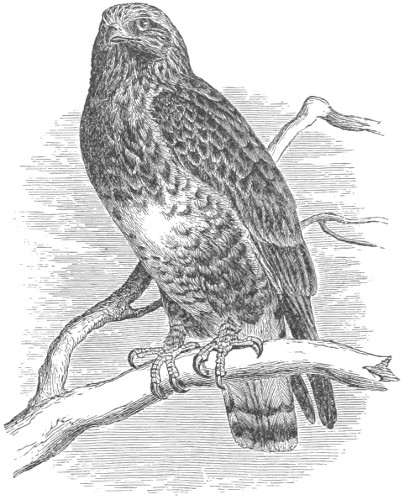
Archibuteo lagopus (Europe).
Dr. Cooper found a large number of these Buzzards on a low point near the sea-coasts, at Shoalwater Bay, Washington Territory, in October. This point was covered with small pines, on the dead tops of which they were observed sitting in the manner of owls. Occasionally one would dart down after a mouse, and alight a short distance off. At times they would call to each other with a loud scream, but they usually sat motionless and silent for hours together. Some remained there throughout the winter, and he had no doubt that a few build near the mouth of the Columbia, where he saw young birds in July. In California, the same writer states, this species is only a winter visitor, and has never been observed by him south of Santa Clara Valley.
Dr. Coues mentions the taking of a single specimen of this bird in the Territory of Arizona in the winter, but no others were observed.
Audubon never met with this species south of North Carolina nor west of the Alleghanies. He regarded it as a sluggish bird, confining itself to the meadows and low grounds bordering the rivers and salt marshes, where its principal food appeared to be moles, mice, and other small quadrupeds. He has never known it to attack a duck on the wing, although it will occasionally pursue a wounded one. Except when alarmed, it flies low and sedately, and manifests none of the daring courage or vigor so conspicuous in most Hawks. They are also described as somewhat crepuscular in habit, watching for their food long after sunset, and Mr. Richardson speaks of their hunting for their prey “by the subdued daylight which illuminates even the midnight hours in the high parallels of latitude.” For these nocturnal hunts it is well fitted by the softness of its plumage, which renders its flight noiseless, like that of the more nocturnal birds.
These birds were once quite abundant in the low lands and marshes in the vicinity of Boston, but are now comparatively rare. They were abundant during October and November, and again in April. They usually kept on or near the ground, appeared to feed chiefly on small quadrupeds or reptiles, were never known to molest the poultry-yard, or even to destroy other birds.
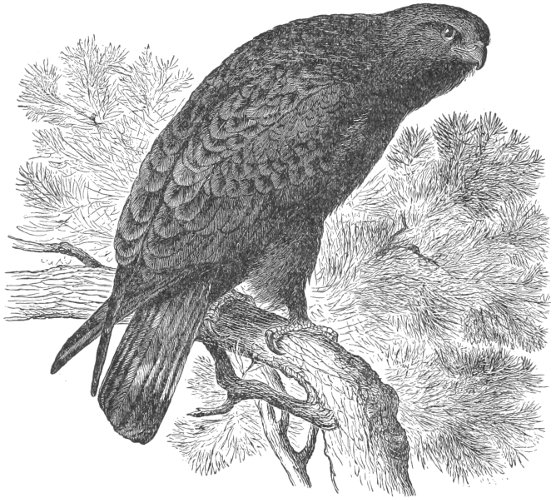
Archibuteo sancti-johannis (black plumage).
They were very wary, and when approached with a gun would slowly and deliberately move off to a safer distance. Wilson found them quite abundant, during the winter months, in the meadows on the Delaware and Schuylkill Rivers, near Philadelphia, where they are still common. Though rendered very shy by the frequent attempts made to shoot them, they would never fly far at a time, usually from one tree to another, making a loud squealing noise as they arose. They all disappeared early in April.
He also speaks of them as common during winter in the lower parts of Maryland, as well as in the extensive meadows below Newark, N. J. He mentions having often seen this Hawk coursing over the surface of meadows long after sunset, and many times in pairs. They roost near these low grounds, and take their station at daybreak near a ditch, watching with patient vigilance for their prey.
Wilson, Audubon, and Nuttall appear to have known nothing in regard to the breeding of the Rough-legged Hawk. A pair was seen by Richardson at their nest, which was built of sticks, and on a lofty tree standing on a low moist alluvial point of land, in a bend of the Saskatchewan; but they were too wary to be shot, and he makes no mention of their eggs.
My nephews, H. R. and F. H. Storer, found a pair of Rough-legged Hawks nesting on a rocky cliff on the coast of Labrador, near the harbor of Bras d’Or. The nest was very rudely constructed of sticks, and placed on a high rock directly over the water, inaccessible from below, but readily approached from above. It contained three young birds and an egg. The young Hawks were just ready to fly, and all scrambled out as the nest was approached, and rolled the egg to the bottom of the cliff, but without injuring it. The nest contained four or five large rats peculiar to that region, collected by the old birds for their young. The old birds were in the light plumage. At the same time a young bird was taken alive from another nest by one of the sailors of their party, which was quite black even in its immature dress, and strikingly different from the young just mentioned.
Mr. MacFarlane’s very complete and careful notes mention, in detail, no less than fifty-eight nests of this species as procured and identified by his party. Of these, forty-six were built on trees, generally spoken of as being large pines, and usually about twenty feet from the ground. Twelve nests were found built on the edge of steep cliffs of shaly mud on the banks of creeks, rivers, and lakes.
The nests that were taken from trees are described as having been built in a crotch, not far from the top, and to have been formed externally of dry twigs, sticks, and small branches, warmly lined with down, feathers, and fine hay. Those found upon cliffs and high river-banks were made of similar materials, but usually with a smaller base of sticks, and a greater supply of hay, moss, and other soft materials. The number of eggs varied from three to five, never more than the latter, and were at times in differing stages of incubation in the same nest. Whenever the nest was approached, the parent birds always manifested great uneasiness, and uttered vociferous screams of distress. The eggs were generally found from the 27th of May to the 25th of June. Those taken after the 20th of June usually contained well-developed embryos. The species was met with by Mr. MacFarlane in great abundance in various localities,—near Fort Anderson, lower down on the Anderson River, near the Arctic coast, and in the vicinity of Rendezvous Lake.
One of the Indians collecting for Mr. MacFarlane informed him that on the 9th of June he discovered the nest of one of these Hawks on a ledge of shaly mud. As he could not kill the parents, he set a snare about the nest. Going to it later in the day, he was disappointed at finding his snare set aside, the eggs gone, and the birds not to be seen. He presumed the parents had removed the eggs, of which there had been three, to a safer place. Several nests were also taken on the shores and among the islets of the Arctic coast, west of Liverpool Bay.
The egg of the Rough-legged Hawk taken by the Storers in Labrador measures 2.06 inches in length by 1.88 in breadth, and is nearly spherical. The ground-color is a soiled white or a light drab, and is marked with a few faint, ill-defined spots of light umber, distributed at intervals over the entire surface.
Two European specimens in my collection are so nearly like the American that the same description would answer for both. They are a trifle larger, but their color and markings are exactly the same. These eggs vary from 2.25 to 2.12 inches in length, and the breadth of each is 1.75 inches. In one specimen the ground-color is of a deeper shade of dingy-white, with larger blotches, and its purplish-slate markings are intermingled with those of umber. A fourth, from Switzerland, varies from most others of this species, and is marked over a cream-colored ground with very numerous and quite large blotches of different shades of umber and sepia-brown. It measures 2.25 by 1.93 inches.
Six eggs taken by Mr. MacFarlane have an average length of 2.18 and an average breadth of 1.79 inches. Their greatest length is 2.24, and their least 2.12 inches. There is but very little variation in their breadth, or only from 1.76 to 1.80 inches. Occasionally these eggs are of a nearly uniform dingy-white, nearly unmarked, and only by very faint cloudings. These cases are rare. Generally they have a creamy-white ground and are boldly marked with blotches of a varying intensity of umber or sepia-brown. Intermingled with these are obscure markings of a purplish-slate.
The dark variety of the Rough-legged Falcon, recognized by some as the A. sancti-johannis, Mr. Ridgway is disposed to regard as rather an individual melanism of the common species, rather than as a distinctive race. In this form it appears to be quite generally distributed over the continent, rather in isolated pairs than as a common bird. It was not taken on the Anderson River by Mr. MacFarlane, where the lagopus style was extremely common, hundreds of skins having been sent by him to the Smithsonian Institution.
The dark-colored birds are seen occasionally in Massachusetts in the winter season, and are usually found frequenting low alluvial tracts in search of small quadrupeds and frogs, and occasionally well-marked specimens have been secured in the neighborhood of Boston. A pair was found breeding near the mouth of the Kennebec River in Maine, and the eggs were secured. They were not readily distinguishable from those of the common Rough-legged Hawk. It is also said, on the authority of Mr. John Krider of Philadelphia, to have been found breeding in New Jersey, and the eggs taken. The parent bird was not secured. These eggs resembled well-marked eggs of the lagopus. Wilson, who observed birds in this plumage on the marshy banks of the Delaware, describes them as remarkably shy and wary, frequenting river-banks, and feeding on mice, moles, and other small game, sailing a good deal and at a great height, which is not the habit of the lagopus, and was seen by him to kill a Duck while on the wing. It has been seen to sit for an hour at a time on a stake by the side of marshes, in an almost perpendicular position, as if dozing. It flies with great ease, and occasionally with great swiftness, and rarely with any flapping of the wings; was most numerous on the Delaware in the winter, but was occasionally to be seen there in the summer. Such is Wilson’s account of its habits as observed by him, and these are partially confirmed by Nuttall from his own observations. It is, however, quite probable that they are mistaken in claiming an essential or specific difference in the habits of the two former. Mr. Audubon regarded it as the adult of the lagopus, and appears not to have been familiar with its habits.
Captain Blakiston mentions the occurrence of the dark bird on the Saskatchewan Plains, where the parent bird and three eggs were obtained by M. Bourgeau, a French collector, in the summer of 1858, and where it is spoken of as not uncommon. Mr. Andrew Murray, in his Contributions to the Natural History of the Hudson Bay Territories, records specimens from Hudson Bay and the country lying between its western shore and Lake Winnipeg. Dr. Gambel speaks of this bird as common in California. Dr. Cooper refers to one obtained by Mr. Lorquin at San Francisco. Mr. Lawrence cites it among the birds of New York. Mr. Boardman gives it as rare near Calais. Mr. Verrill also gives it among the birds of Western Maine, where the lagopus was not observed, but where this form was a regular winter visitant.
The Storers found the Black Hawk not uncommon on the cliffs near Bras d’Or, and their observations of its habits, as contrasted with those of the still more common Rough-legged Hawk, left no doubt in their mind of their specific distinction. While the Black Hawk was observed to be a bold, vigorous, and spirited bird, easy and swift in its motions, and preying upon other birds while on the wing, the Rough-legged was comparatively sluggish, inoffensive, and subsisted only upon rats, mice, moles, frogs, and other small game. A nest containing young birds was found, and one of the latter caught alive. Both old and young were in the same black plumage. The young Hawk was fierce and intractable, and its whole air and manner were utterly unlike the conduct of the young of the other species. Unfortunately, it broke from its confinement and escaped.
The eggs from New Jersey, attributed to this bird by Mr. Krider, vary in the number and depth of coloring of their markings, the blotches in one being darker and less generally distributed. They measure 2.06 by 1.69 inches. Their ground-color is a yellowish white, intermingled with which are faint markings and blotches of a brownish-purple. Over these are diffused confluent blotches of russet-brown.
An egg from near Wiscasset, taken by Edmund Smith, Esq., the parent of which was secured, measures 2.22 by 1.75 inches, has a white ground, and is marked and blotched with deep umber-brown. These markings are chiefly at one end and only vary in their depth, and are unmixed with any other shading or colors.
Genus AQUILA, Auctorum.
Aquila, Mœhr. 1752. (Type, Falco chrysætos, Linn.)
Aëtos, Nitzsch, 1840. (Same type.)
Hieroaëtus, 1844, and Hieraëtus, 1845, Kaup. (Type, Falco pennatus, Gmel.)
Pteroaëtus, Kaup, 1844. (Type, Falco vulturinus, Daud.)
Uroaëtus, Kaup, 1844. (Type, Vultur audax, Lath.)
Pseudaëtus, Hodgs. 1844. (Type, Falco bonelli, Temm.)
Tolmaëtus, Blas. 1845. (Same type.)
Eutolmaëtus, Blas. 1848. (Same type.)
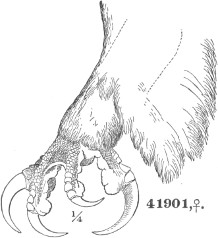
41901, ♀. ¼
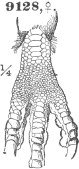
9128, ♀. ¼
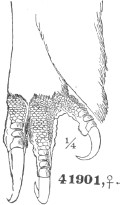
41901, ♀. ¼
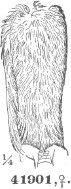
41901, ♀. ¼
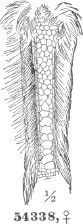
54338, ♀. ½
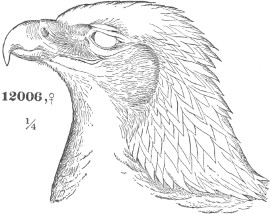
12006, ♀. ¼
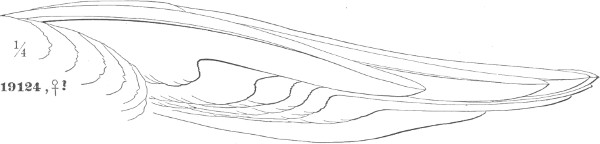
19124, ♀ ? ¼
9128. Haliaëtus leucocephalus.
41901 : 12006 : 19124. Aquila chrysaëtus, var. canadensis.
54338. Archibuteo lagopus (tarsus from behind).
Gen. Char. Form robust and structure powerful; the bearing and general aspect that of Buteo and Archibuteo. Wing long, the primaries long and strong, with their emarginations very deep. Tail rather short, slightly rounded or wedge-shaped. Bill stronger than in the preceding genera, its outlines nearly parallel, and the tip somewhat inclined backward at the point; commissure with a more or less prominent festoon; nostril narrowly oval, vertical; skin of the cere very hard and firm. Superciliary shield very prominent. Feet very strong, the membrane between the outer and middle toes very well developed; tarsus less than twice as long as the middle toe; outer toe equal to, or longer than, the inner; claws very long and strong, very much graduated in size; scutellæ of the toes small except on the terminal joint, where they form broad transverse plates; tarsi densely feathered all round down to the base of the toes; tibial plumes well developed, loose-webbed, their ends reaching down to or beyond the base of the toes. Feathers of the nape and occiput lanceolate, acute, and distinct, forming a nuchal “cape” of differently formed feathers. Third to fifth quill longest; first shorter than the seventh; outer five or six with their inner webs deeply emarginated.
This genus is almost peculiar to the Old World, where about seventeen so-called species are known, while America has no member of the genus exclusively its own, the single North American species being the same as the European one. Though the details of external structure vary somewhat, and the size ranges from that of a Buteo to that of a sea-eagle (Haliaëtus), the generic characters given in the above diagnosis apply well to all the species. The species of Heteropus, Hodgson, 1842 (A. malayensis, Rein. and H. gurneyi, Gray), I remove entirely from Aquila, since they differ so strikingly in many important respects. With the general aspect of Aquila, Heteropus has the outer toe disproportionately shorter than the inner (instead of equal to it, or longer), which curious feature it shares only with Geranospiza of tropical America, and Polyboroides of South Africa,—both terrestrial Buteonine forms of specialized structure. An entirely peculiar feature of Heteropus is the great length and straightness of the claws. Its bill is more like that of Archibuteo than like that of Aquila.
The North American and European races of the single species which occurs on the former continent may be distinguished as follows:—
Species and Races.
A. chrysaëtus. Wing, 23.00–27.00; tail, 14.00–16.00; culmen, 1.50–1.90; tarsus, 3.40–4.20; middle toe, 2.40–3.10. Third to fifth quill longest first shorter than seventh or eighth. Color blackish-brown, or umber-brown, nearly uniform, except on the tail; nuchal cape of lanceolate feathers, and tarsi of a paler and more tawny tint. Adult. Tail transversely clouded with ashy, and not white at the base; feathers of the body not distinctly white beneath the surface. Young. Tail with the basal half plain white, the terminal portion plain blackish; feathers of the body distinctly white beneath the surface. Hab. Nearctic and Palæarctic Realms.
Tarsi of adult pale umber; of young, dirty whitish. Hab. Palæarctic Realm … var. chrysaëtus.92
Tarsi of adult deep umber; of young light brown. Hab. Nearctic Realm … var. canadensis.
Aquila chrysaëtus, var. canadensis (Linn.). GOLDEN EAGLE; RING-TAILED EAGLE.
Aquila chrysaëtus (not of Linn.!)Rich. & Sw. F. B. A. II, 1831, 12.—Jard. (Wils.) Am. Orn. II, 1832, 304.—Bonap. List, 1838, 2.—Aud. Synop. 1839, 9.—De Kay, Zoöl. N. Y. II, 4, pl. vi, f. 14 (Juv.).—Cass. B. Cal. & Tex. 109.—Strickl. Orn. Syn. I, 55 (in part).—Brewer, Oölogy, 1857, 45.—Coues, Key, 1872, 219. Falco chrysaëtus, (Linn.) Max. Cab. J. 1858, VI, 9.—Blas. Ber. XVI, Vers. Deutsch. Orn. 1862, 83 (“absolutely identical with European”). Falco canadensis, Linn. S. N. (ed. 10), 1766, 88. Aquila canadensis, Wils. Am. Orn. 1808, pl. lv, f. 1.—Heerm. P. R. R. Rept. II, 1855, 30.—Cass. Birds N. Am. 1858, 41.—Coues, P. A. N. S. 1866, 13.—Gray, Hand List, I, 40. Falco niger, Gmel. S. N. 359. Aquila nobilis, Pall. Zoög. Ros. As. 1811. Aquila fulva (not of Linn.!)Nutt. Man. Orn. 1833, 62.—Peab. B. Mass. 1841, 71.
Sp. Char. Adult male (24,167, Fort Crook, North California, Dec. 25; D. F. Parkinson). General plumage fuliginous-black, this deepest on the head, throat, lower surface in general, under surface of the wings, back, scapulars, shoulders, secondaries, primaries, and rump; middle and secondary wing-coverts, upper and under tail-coverts, tarsi and inside of tibiæ, considerably paler, inclining to light umber. Lanceolate feathers of occiput and nape with the exposed portions light fulvous, the shafts black; dusky beneath the surface. Tail black, somewhat paler on basal half, and with about three irregular, obsolete zigzag bands of pale brown (on two middle feathers ashy); no concealed white on breast. Fifth quill longest; third and fourth intermediate between fifth and sixth; second considerably shorter than sixth; first intermediate between eighth and ninth. Length, 31.60; extent, 78.30. Wing, 24.50; tail, 13.40; culmen, 1.60; from base of cere, 2.15; tarsus, 3.85; middle toe, 2.40; hind claw (chord) 1.90.
Adult female (12,006, Washington, D. C., March 7, 1869; C. Drexler). Almost exactly like the male. Black covering forehead, ear-coverts, cheeks, chin, throat, foreneck, and under parts generally (except the tarsi, inside and front of tibiæ, and lower tail-coverts, which are light fulvous, the tarsi palest), more tawny than in the male. The lanceolate, pale, tawny feathers, which in the male cover only the occiput and neck, in the female extend forward over the top of the head, leaving the forehead only blackish. Upper parts and tail as in the male. Fourth quill longest; third slightly shorter than fifth; second intermediate between sixth and seventh; first intermediate between eighth and ninth. Wing, 26.00; tail, 14.25; culmen, 1.70; tarsus, 3.80; middle toe, 2.70; hind claw, 2.15; inner toe, 1.90; outer, 2.00; inner claw, 1.80; middle, 1.35; outer, 1.10.
Young male (49,684, Camp Grant, near Tucson, Arizona, July 10, 1867; Dr. E. Palmer). Continuous deep sepia-black, with a purplish lustre; breast and scapulars with large concealed spots of pure white; lanceolate feathers of the “mane” dull brown, not conspicuously different from the throat; under surface of primaries showing much white basally, this most extended on inner feathers. Upper and under tail-coverts more brownish than the rump, the basal portion white. Basal half or more of tail white (more ashy on outer feathers), distinctly defined against the broad, pure black, terminal zone; tarsi dull white, clouded with dilute brownish; inside of tibiæ with feathers tipped with white.
Young female (older?) (9,121, Washington, D. C., Dec., 1856; B. Cross). Similar, but black more brown; “mane” as in adult; tarsi dull whitish brown; tail-coverts deep umber-brown; tail as in young male, but terminal band narrower, the white occupying nearly the basal two thirds. Wing, 25.70; tail, 14.75; culmen, 1.65; middle toe, 2.80; hind claw, 2.20.
Hab. Whole of North America north of Mexico; most common in mountainous regions.
LIST OF SPECIMENS EXAMINED.
National Museum, 8; Philadelphia Academy, 2; Boston Society, 2; Cambridge Museum, 2; Coll. R. Ridgway, 2. Total, 16.
Measurements.
Sex. Wing. Tail. Culmen. Tarsus. Middle Toe. Specimens.
♂ 23.00–24.50 14.00–15.00 1.50–1.62 3.65–3.80 2.40–2.80 5
♀ 25.00–27.00 15.00–16.00 1.68–1.85 4.15–4.20 2.55–2.80 7
A young male from Massachusetts (No. 39, Lexington; Dr. S. Kneeland), in the collection of the Boston Society of Natural History, has the tail plain black, the extreme base and tip white.
Though the Golden Eagles of North America can be distinguished by the characters given in the diagnosis on p. 312 from those of Europe, the differences are appreciable only on direct comparison. The American bird is darker in all its shades of color, the difference being most marked in the young plumage, which in var. chrysaëtus has the tarsal features nearly white, and in var. canadensis light brown, the brown of other portions being also considerably darker. The American bird appears to be rather the larger.
Habits. The Ring-tailed or Golden Eagle of North America is found throughout the continent from the Atlantic to the Pacific, and from New Mexico to the higher Arctic regions.
In its geographical distribution, the Golden Eagle of North America appears to be chiefly confined to the mountainous regions, and the more northern portions, but to be nowhere abundant. Sir John Richardson saw but few individuals in the Arctic regions, nor does he appear ever to have met with its nest. Individual birds on the Atlantic coast have been occasionally obtained,—once as far south as Philadelphia, twice at Washington,—but very rarely. Several specimens appear to have been obtained among the mountains of New Mexico by Dr. Henry’s party.
Although not mentioned by either Dr. Heermann or Dr. Gambel in their lists of the birds of California, it was found in Oregon by Dr. Townsend, and is said by Dr. Cooper to be quite common in almost all parts of California during the colder months. It is, however, much less numerous than the White-headed Eagle. It is very much more a mountain bird, and its descent into the plains or to the sea-coast is said to be quite rare. Dr. Adolphus Heermann, in his Report of the survey between Fort Yuma and San Francisco, speaks of seeing one of these birds near Livermore Pass, and of meeting others in Northern California, and of an individual killed in the mountains near Mokelumne River. He regarded it, both in that state and elsewhere, as a rare and wild bird. It is not mentioned as occurring in Greenland. It was found breeding in Napa Valley, Cal., by Mr. F. Gruber.
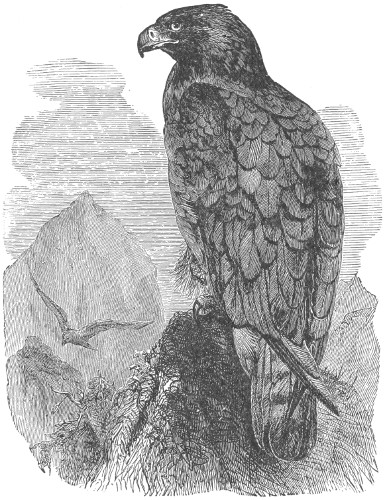
Aquila chrysaëtus.
A bird was secured alive in Brighton, near Boston, in 1837, by being taken in a trap which had been set for another purpose. Its occurrence, however, near the sea-coast, is very rare, and even among the mountains it is never found except in occasional pairs. It breeds in the mountainous portions of Maine, New Hampshire, Vermont, and New York, and was formerly not unfrequent among the cliffs of the Hudson River. Steamboats and railroads have, however, driven this wild bird from its romantic retreats in that quarter. In Franconia, N. H., for quite a number of years, a pair occupied a nest on an inaccessible rock, near the top of a mountain, known as Eagle Cliff, in sight of, and opposite, the Profile House. Repeated efforts have been made to reach its nest, but thus far without success. In the summer of 1855 a renewed attempt was made to scale the precipice over which the shelving rock, on which the nest stands, projects. A party was formed, and although they succeeded in ascending the mountain, which had never been achieved before, they could reach only a point beyond and above, not the nest itself. The attempt to pass to it was abandoned as too perilous. The party reported a large collection of bones in its immediate vicinity, with other evidences of the accumulated plunder of many years, as well as a plentiful supply of fresh food at the time visited.
Without here seeking to affect the question of identity of species, it is interesting to note certain peculiarities in the European Golden Eagle so far not noticed or of rare occurrence in the American birds. Mr. I. W. P. Orde in the Ibis of 1861 (p. 112), gives a very interesting account of a pair of Golden Eagles, which the previous season built their nest in a large Scotch fir-tree, in a wood on the southern bank of Glen Lyon, in Perthshire, within a few hundred yards of Meggerine Castle. Four eggs were laid, two of which were hatched. The nest was one of the Eagles’ own construction, and is specially interesting from being in such near proximity to human habitations. Mr. Tristram (Ibis, 1859, p. 283, in his valuable note on the birds of North Africa), while he never observed this Eagle in any of the cliffs among the mountain ranges of the desert, found it almost gregarious, so abundant was it among the Dayets. In one wood he saw no less than seven pairs of the Eagles, each pair with a nest. There were, besides, many unoccupied nests, and, indeed, very few terebinths of any size were without a huge platform of sticks on the topmost boughs. The birds were undisturbed, and consequently very fearless. On the other hand Mr. Salvin, in the same volume (p. 180) among the mountains of Eastern Atlas, describes very different manner of life in the same birds. “Whatever rock a pair may choose for their eyrie, there they reign alone in dignified solitude, nor do they allow a single Vulture, Kite, or indeed any other species of rapacious bird, to occupy with their nest a single spot in the same rock, however eligible for the purpose; nor are these other species ever to be seen in the haunts of their exclusive majesties. The whole southern precipice at Djebel Dekma was thus tenanted by a single pair of this Eagle, as also several other rocks that came under our notice. Instances of the Golden Eagle building in trees were by no means of unfrequent occurrence.”
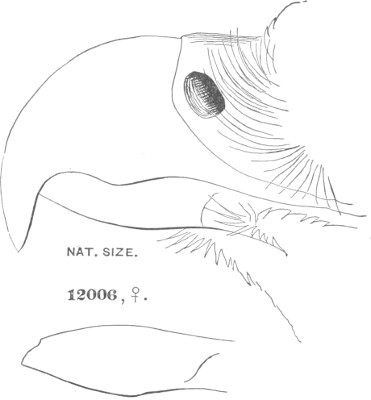
12006, ♀. NAT. SIZE.
Aquila canadensis.
The extreme southern range of the European bird, its gregarious habit, and the frequency of its building in trees, are all peculiarities not observed in the American form. They are not necessarily conclusive, but are at least suggestive.
The Golden Eagle in this country usually constructs its nest on the sides of steep, rocky crags, where its materials are coarsely heaped together on a projecting shelf of rock. These consist of large sticks, loosely arranged, and lined with other softer materials. In rare instances they are said to build on trees, where rocky cliffs are not to be met with. The eggs are usually three in number; sometimes two, or only one. Mr. Audubon describes them as measuring 3.50 inches in length by 2.50 in breadth; the shell thick and smooth, dull white, brushed over with undefined patches of brown, which are most numerous at the larger end. This description is not quite accurate in regard to size. The European egg is presumed to be larger than the American, yet the largest I have ever seen measures but 3.19 inches in length by 2.31 in breadth. An egg of the European bird in the British Museum, and another represented in Hewitson’s British Oölogy, which closely resembled it, were marked over the entire surface with small but distinct blotches of reddish-brown on a white ground. One in my collection, taken in Scotland, is nearly unmarked. A distinctly bluish-white ground is faintly stained with a few very obscure markings of slate and purplish-brown.
Mr. MacFarlane furnishes very full and interesting notes and observations on the habits of our canadensis, as attentively studied by him in the neighborhood of Anderson River, near the Arctic Ocean. Our limits will only permit us to give a summary of his valuable memoranda. In a large majority of instances the nests were built against the face of a steep bank, some sixty or seventy feet from the ground, and about thirty from the summit. They were very strongly constructed with dry sticks, usually of willow, and formed a platform on the top, in the centre of which the eggs were found on a bed composed of moss, hay, and feathers. These platforms were usually about six by seven feet, and ranged from four to six in height. It is said to be “not very scarce in that quarter,” and to be “a resident, in the summer, of the entire Arctic coast and rivers.” Mention is made of ten nests observed by him, and eggs taken therefrom. In several instances these eggs were white and unspotted, exciting his doubts whether they might belong to the leucocephalus.
According to Mr. MacFarlane they feed on ducks, mice, and other small animals, partridges, and the fawn of the reindeer. In confinement they are fierce and nearly untamable, though they readily eat the food that is given them, whether fish or meat. Even when taken young from the nest they evince the same fearless and intractable disposition. In one instance a young female killed its older companion by piercing it with her talons. When first observed, she was standing on and plucking the feathers from the body of the slain bird. This was the second bird this same ferocious, but comparatively tame, Eagle had thus destroyed. When the cage was removed outside, though the weather was very cold, the Eagles did not seem to mind it much, but exercised themselves with jumping off and on their roosting-pole, and seemed very much interested in all that was taking place within the Fort square. They kept their plumage in a cleanly condition, and were generally a very clean bird in all respects. During the fine weather the Eagles were more lively than on other occasions. When feeding they drooped both wings, and, if disturbed, arched their necks and moved their heads in a threatening manner, spreading out their tails like a fan. They grasped the meat or fish in the talons of either leg, and tore it with their beaks. After feeding, they invariably removed any blood or other impurities that may have adhered to the beak by scratching it with their talons or rubbing it against the bars of their cage. Several of these birds, in confinement, especially the female referred to, when their cage was approached, would endeavor to attack Mr. MacFarlane, descending from their sleeping-pole and making a rush at the front bars of the cage, spreading the wings and flapping them with great force, and making active demonstrations with beak and talons. Occasionally they would get out of their cages; then it was no easy matter to get them back again, as, when approached, they would throw themselves on their backs and thrust out their talons in the most formidable manner. They nest as early as the last of April or early in May, as largely developed embryos were found on the 27th of May. When their nests were pillaged they generally deserted them; but in one instance, where the female had been snared upon her nest, and the eggs taken, the same nest was occupied the following season by the male with another mate. The new mate was shot, and proved to be a mature bird. Almost invariably the male birds were too wary to be either shot or taken in a snare. Two of the nests of this bird, pointed out by the Indians, appeared to have been used for several years, and had been known to their discoverers for six or seven years previous. The nests taken were in about latitude 69° 30′.
In one particular case a nest had been discovered two years previously by MacFarlane’s Esquimo interpreter. It had been occupied that season, and a pair of Eagles had been recognized as its inmates. In 1863 the nest was known to have been reoccupied, though he did not visit it. On the 17th of May, 1864, he went to it and found both Eagles engaged in repairing it. The female appeared to act as the builder, and the male as the carrier of the materials, as well as the provider of provisions. The nest was not complete, and contained two half-eaten Ptarmigans, but no eggs. It was built against the face of a steep bank of a small stream, and was of considerable bulk. When first constructed, the nest of this Eagle is comparatively small, but as it is renovated every season, it ultimately becomes large and bulky. A quantity of dry sticks and twigs are laid lengthways over the greater portion of the platform of the previous season, and the spaces between are filled up by smaller twigs, mosses, and hay, and the centre is then covered with the two latter ingredients, intermixed with deer’s hair, etc. This annual addition varies in thickness from three to eighteen inches. In no instance did Mr. MacFarlane find or hear of any accumulation of bones or other débris of food either on or in the neighborhood of the nests. In three instances the nests were constructed in the tops of tall pines. In these cases the sandy nature of the soil did not favor their building on the sides of cliffs.
The “Mountain Eagle,” as this species is called throughout the western regions of the United States, was found by Mr. Ridgway to be a common species throughout the Great Basin along the line of the 40th parallel. It was daily seen soaring about the mountains, and nested on inaccessible cliffs. A pair—the female leading—were observed to give chase to a Sage Hen (Centrocercus urophasianus), chasing her on the wing until the fugitive dropped down to the ground from exhaustion, when she was picked up by the foremost of the Eagles, who then flew off together to the summit of the mountain range (the East Humboldt) near by, where they probably had their nest.
An egg of this bird, taken by Mr. R. MacDonald among the mountains west of the Lower Mackenzie River, measures 2.60 inches in length by 2.18 in breadth. The ground-color is of a rich pinkish cream-color, boldly dashed with large blotches of three or four varying shades of umber-brown, intermingled with a few finer markings of a lighter shade of brown, and a few clouded markings of a purplish-slate. These markings are grouped and confluent about the smaller end. Other specimens vary to whitish, with faint obsolete blotches.
Genus HALIAËTUS, Savigny.
Haliaëtus, Savig. 1809. (Type, Falco albicilla, Linn.)
Thalassoaëtus, Kaup, 1844. (Type, Falco pelagicus, Pallas.)
Cuncuma, Hodgson, 1837. (Type, Falco macei, Temm.)
Pontoaëtus, Kaup, 1844. (Same type.)
Blagrus, Blas. 1849. (Same type.)
Polioaëtus, Kaup, 1847. (Type, Falco icthyaëtus, Horsf.)
Icthyiaëtus, Lafr. 1839 (nec Kaup, 1829). (Same type.)
Gen. Char. Form robust, and organization powerful, as in Aquila; size large. Bill very large, usually somewhat inflated, the chord of the arch of the culmen more than twice the length of the cere on top; commissure with a more or less distinct festoon and sinuation behind it. Nostril oval, obliquely vertical. Feet robust and strong, the tarsus less than one and a half times the middle toe; tarsus feathered in front and on the sides for about one half its length; front of the tarsus and top of the toes with an imperfectly continuous series of transverse scutellæ, entirely interrupted in the region of the digito-tarsal joint; the other portions covered with roundish, somewhat granular, scales, these larger on the posterior face. Claws large, strongly curved, and more obtuse, and less graduated in size, than in Aquila. No trace of a web between outer and middle toes. Wing very large, the primaries well developed and strong; third to fifth quill longest; first longer than the ninth; outer five to six with inner webs deeply emarginated. Tail variable in length and shape, usually short and rounded, cuneate and with fourteen feathers in H. pelagicus, and nearly even, and with twelve feathers, in H. macei, the rest all having twelve feathers, varying in form with the species. Feathers of the neck, all round, lanceolate.
The species of this very strongly marked genus vary between great extremes in the details of their external structure; but these variations I consider to be mainly specific, though two well-defined subgeneric divisions should be made, one to include the Old World H. leucogaster, H. vocifer, and H. icthyætus, which have five, instead of six, outer quills, with their inner webs cut, and the tarsus with the frontal and posterior rows of broad transverse scutellæ nearly as well developed and continuous as in Buteo. The last of these species has the claws nearly uniform in size, and contracted and rounded underneath almost as much as in Pandion; but the other species are less so, each differing in this respect, so that I consider this as only indicating the greatest perfection in the specialization of the piscatorial type of modified structure. In the possession of fourteen tail-feathers, its very large bill, naked lores, and general aspect, the H. pelagicus shows an approach to the Old World Vultures.