Volume 3 — Family STRIGIDÆ.—The Owls. (continued 2)
Reading edition
A female from Alaska (49,802, Nulato, April 28, 1867; W. H. Dall) is considerably darker than the specimen described above; the occiput has numerous circular spots of white, and the tarsi are more thickly spotted; no other differences, however, are appreciable. Two specimens from Quebec (17,064 and 17,065; Wm. Cooper) are exactly similar to the last, but the numerous white spots on the forehead are circular.
Hab. Arctic America; in winter south into northern border of United States; Canada (Dr. Hall); Wisconsin (Dr. Hoy); Oregon (J. K. Townsend); Massachusetts (Maynard).
The Nyctale richardsoni, though, without doubt, specifically the same as the N. tengmalmi of Europe, is, nevertheless, to be distinguished from it. The colors of the European bird are very much paler; the legs are white, scarcely variegated, instead of ochraceous, thickly spotted; the lower tail-coverts have merely shaft-streaks of brown, instead of broad stripes. Very perfect specimens from Europe enable me to make a satisfactory comparison.
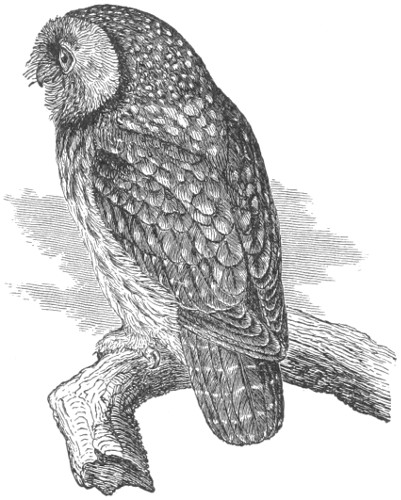
Nyctale richardsoni.
From an article by Mr. D. G. Elliot in Ibis (1872, p. 48), it would appear that the young of N. tengmalmi is very different from the adult in being darker and without spots; a stripe from the eye over the nostrils, and a patch under the eye at the base of bill, white. It is probable, therefore, that the American race has a similar plumage, which, however, has as yet escaped the honor of a name; more fortunate than the young of N. acadica, which boasts a similar plumage. This (N. albifrons) Mr. Elliot erroneously refers to the N. tengmalmi, judging from specimens examined by him from the Alps, from Russia, and from Norway. The most striking difference, judging from the description, apart from that of size, appears to be in the whiter bill of the tengmalmi.
Habits. This race is an exclusively northern bird, peculiar to North America, and rarely met with in the limits of the United States. A few specimens only have been obtained in Massachusetts. Dr. Hoy mentions it as a bird of Wisconsin, and on the Pacific Dr. Townsend met with it as far south as Oregon, where it seems to be more abundant than on the eastern coast.
Mr. Boardman thinks that this Owl is probably a resident in the vicinity of Calais, where, however, it is not common. It was not taken by Professor Verrill at Norway, Maine. Mr. J. A. Allen regards it as a very rare winter visitant in Western Massachusetts, but obtained a specimen near Springfield in December, 1859. In the same winter another was shot near Boston, and one by Dr. Wood, near Hartford, Conn. Mr. Allen subsequently records the capture of a specimen in Lynn, Mass., by Mr. J. Southwick, in the winter of 1863, and mentions two other specimens, also taken within the limits of the State. It is not mentioned by Dr. Cooper as among the birds of California.
Specimens of this Owl were taken at Fort Simpson in May, and at Fort Resolution by Mr. B. R. Ross, at Big Island by Mr. J. Reid, at Fort Rae by Mr. L. Clarke, and at Fort Yukon by Mr. J. Lockhart and Mr. J. McDougall, and at Selkirk Settlement, in February and March, by Mr. Donald Gunn.
Mr. B. R. Ross states that though no specimens of this Owl were received from north of Fort Simpson, yet he is quite certain that it ranges to the Arctic Circle. He says it is a fierce bird, and creates great havoc among the flocks of Linnets and other small birds. Its nest is built on trees, and the eggs are three or four in number, of a pure white color and nearly round shape. It sometimes seizes on the deserted hole of a Woodpecker for a habitation.
Mr. Dall obtained a female specimen of this Owl at Nulato, April 28, where it was not uncommon. It was often heard crying in the evenings, almost like a human being, and was quite fearless. It could be readily taken in the hand without its making any attempt to fly away, but it had a habit of biting viciously. It was frequently seen in the daytime sitting on trees. According to the Indians, it generally nests in holes in dead trees, and lays six spherical white eggs. Richardson informs us that it inhabits all the wooded country from Great Slave Lake to the United States, and is very common on the banks of the Saskatchewan. It was obtained in Canada by the Countess of Dalhousie, but at what season the bird was met with is not stated; the Smithsonian Institution also possesses specimens from the vicinity of Montreal. It probably does not breed so far south as that place, or, if so, very rarely. Mr. Audubon procured a specimen near Bangor, Maine, in September, the only one he ever met with.
This Owl, according to Mr. Hutchins, builds a nest of grass half-way up a pine-tree, and lays two eggs in the month of May.
A drawing, taken by Mr. Audubon from a specimen in an English cabinet, represents a nearly spherical egg, the color of which is white with a slight tinge of yellowish, and which measures 1.18 inches in length by one inch in breadth.
The only authenticated eggs of this variety which have come under my notice are three collected at Fort Simpson, May 4, 1861, by B. R. Ross. One of these measures 1.28 by 1.06 inches.
Nyctale acadica, Bonap. SAW-WHET OWL; WHITE-FRONTED OWL; KIRTLAND’S OWL.
Strix acadica, Gmel. Syst. Nat. p. 296, 1789.—Daud. Tr. Orn. II, 206, 1800.—Vieill. Ois. Am. Sept. I, 49, 1807.—Aud. Birds Am. pl. cxcix, 1831; Orn. Biog. V, 397.—Rich. & Swains. F. B. A. II, 97, 1831.—Bonap. Ann. Lyc. N. Y. II, pp. 38, 436; Isis, 1832, p. 1140.—Jard. (Wils.) Am. Orn. II, 66.—Naum. Nat. Vög. Deutschl. (ed. Nov.) I, 434, pl. xliii, figs. 1 & 2.—Peab. Birds Mass. p. 90.—Nutt. Man. p. 137, 1833. Nyctale acadica, Bonap. List, p. 7, 1838; Consp. Av. p. 44.—Gray, Gen. B. fol. App. p. 3, 1844.—Kaup, Monog. Strig. Cont. Orn. 1852, p. 104.—Ib. Tr. Zoöl. Soc. IV, 1859, 206.—Strickl. Orn. Syn. I, 176, 1855.—Newb. P. R. R. Rept. VI, 77, 1857.—Cass. Birds N. Am. 1858, 58.—Coop. & Suck. P. R. R. Rept. XII, II, 156, 1860.—Coues, Prod. B. Ariz. 14, 1866.—Gray, Hand List, I, 1869, 51.—Lord, Pr. R. A. I. IV, III (Brit. Columb.).—Ridgway, Am. Nat. VI, May, 1872, 285.—Coues, Key, 1872, 206.—Gray, Hand List, I, 51, 1869. Scotophilus acadicus, Swains. Classif. Birds II, 217, 1837. Strix passerina, Penn. Arct. Zoöl. p. 236, sp. 126, 1785.—Forst. Phil. Transl. LXII, 385.—Wils. Am. Orn. pl. xxxiv, f. 1, 1808. Ulula passerina, James. (Wils.), Am. Orn. I, 159, 1831. Strix acadiensis, Lath. Ind. Orn. p. 65, 1790. S. albifrons, Shaw, Nat. Misc. V, pl. clxxi, 1794; Zoöl. VII, 238, 1809.—Lath. Orn. Supp. p. 14. Bubo albifrons, Vieill. Ois. Am. Sept. I, 54, 1807. Scops albifrons, Steph. Zoöl. XIII, II, 51. Nyctale albifrons, Cass. Birds Cal. & Tex. 187, 1854.—Bonap. Consp. Av. p. 54.—Cass. Birds N. Am. 1858, 57.—Gray, Hand List, I, 52, 1869. Strix frontalis, Licht. Abh. Ak. Berl. 1838, 430. Nyctale kirtlandi, Hoy, Proc. Ac. Nat. Sc. Phil. VI, 210, 1852. S. phalænoides, Daud. Tr. Orn. II, 206, 1800.—Lath. Ind. Orn. Supp. p. 16, 1802; Syn. Supp. II, 66; Gen. Hist. I, 372, 1828. Athene phalænoides, Gray, Gen. B. fol. sp. 43, 1844. Athene wilsoni, Boie, Isis, 1828, 315.
Sp. Char. Adult (♀, 120,044, Washington, D. C., Feb., 1859; C. Drexler). Upper surface plain soft reddish-olive, almost exactly as in N. richardsoni; forehead, anterior part of the crown, and the facial circle, with each feather with a short medial line of white; feathers of the neck white beneath the surface, forming a collar of blotches; lower webs of scapulars white bordered with brown; wing-coverts with a few rounded white spots; alula with the outer feathers broadly edged with white. Primary coverts and secondaries perfectly plain; five outer primaries with semi-rounded white spots on the outer webs, these decreasing toward the ends of the feathers, leaving but about four series well defined. Tail crossed with three widely separated narrow bands of white, formed of spots not touching the shaft on either web; the last band is terminal. “Eyebrow” and sides of the throat white; lores with a blackish suffusion, this more concentrated around the eye; face dirty white, feathers indistinctly edged with brownish, causing an obsoletely streaked appearance; the facial circle in its extension across the throat is converted into reddish-umber spots. Lower parts, generally, silky-white, becoming fine ochraceous on the tibiæ and tarsi; sides of the breast like the back, but of a more reddish or burnt-sienna tint; sides and flanks with longitudinal daubs of the same; jugulum, abdomen, lower tail-coverts, tarsi, and tibiæ, immaculate. Wing formula, 4–3=5–1=8. Wing, 5.40; tail, 2.80; culmen, .50; tarsus, .80; middle toe, .60.
Seven specimens before me vary from, wing, 5.25 to 5.80; tail, 2.60 to 3.00 (♀). The largest specimen is 12,053 (♀, Fort Tejon, California; J. Xantus). This differs from the specimen described in whiter face, more conspicuous white streaks on forehead, smaller, less numerous, red spots below, and in having a fourth white band on the tail; this, however, is very inconspicuous. 32,301 (Moose Factory; J. McKenzie), 9,152 (Fort Vancouver, February; Dr. J. G. Cooper), and 11,793 (Simiahmoo, October; Dr. C. B. Kennedy) are exactly like the type. There are no authentic males before me, though only two are marked as females; the extremes of the series probably represent the sexual discrepancy in size.
Young (♂, 12,814, Racine, Wisconsin, July, 1859; Dr. R. P. Hoy). Upper surface continuous plain dark sepia-olive; face darker, approaching fuliginous-vandyke,—perfectly uniform; around the edge of the forehead, a few shaft-lines of white; scapulars with a concealed spot of pale ochraceous on lower web; lower feathers of wing-coverts with a few white spots; outer feather of the alula scalloped with white; primary coverts perfectly plain; five outer primaries with white spots on outer webs, these diminishing toward the end of the feathers, leaving only two or three series well defined; tail darker than the wings, with three narrow bands composed of white spots, these not touching the shaft on either web. “Eyebrows” immaculate white; lores more dusky; face and eyelids dark vandyke-brown; sides of the chin white. Throat and whole breast like the back, but the latter paler medially, becoming here more fulvous; rest of the lower parts plain fulvous-ochraceous, growing gradually paler posteriorly,—immaculate. Lining of the wing plain dull white; under surface of primaries with dusky prevailing, but this crossed by bands of large whitish spots; the three outer feathers, however, present a nearly uniformly dusky aspect, being varied only basally. Wing formula, 3, 4–2=5 6–7, 1. Wing, 5.50; tail, 2.80; culmen, .45; tarsus, .80; middle toe, .65.
Hab. North America generally. Cold temperate portions in the breeding-season, migrating southward in winter. Mexico (Oaxaca, Sclater, P. Z. S. 1858, 295); California (Dr. Cooper); Cantonment Burgwyn, New Mexico (Dr. Anderson); Washington Territory (Dr. Kennerly).
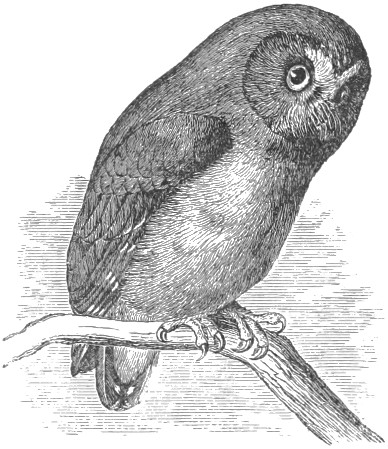
Nyctale acadica. Young.
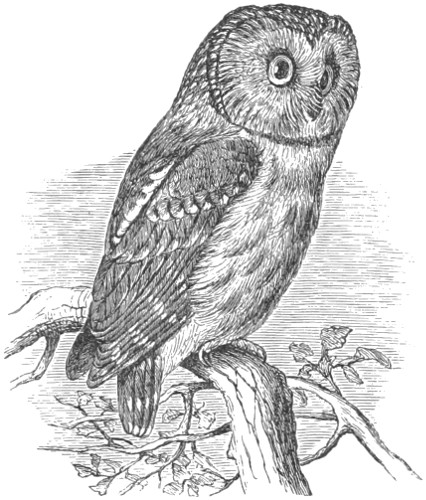
Nyctale acadica. Adult.
A specimen (15,917, ♂, Dr. C. B. Kennerly, Camp Skagitt, September 29, 1859) from Washington Territory is exactly similar to the young described above. No. 10,702 (Fort Burgwyn, New Mexico; Dr. Anderson) is much like it, but the facial circle is quite conspicuous, the feathers having medial white lines; the reddish-olive of the breast and the fulvous of the belly are paler, also, than in the type. No. 12,866, United States, (Professor Baird’s collection, from Audubon,) is perfectly similar to the last.
My reasons for considering the N. albifrons as the young of N. acadica are the following (see American Naturalist, May, 1872):—
1st. All specimens examined (including Hoy’s type of N. kirtlandi) are young birds, as is unmistakably apparent from the texture of their plumage.
2d. All specimens examined of the N. acadica are adults. I have seen no description of the young.
3d. The geographical distribution, the size and proportions, the pattern of coloration (except that of the head and body, which in all Owls is more or less different in the young and adult stages), and the shades of colors on the general upper plumage, are the same in both. The white “scalloping” on the outer web of the alula, the number of white spots on the primaries, and the precise number and position of the white bars on the tail, are features common to the two.
4th. The most extreme example of albifrons has the facial circle uniform brown, like the neck, has no spots on the forehead, and the face is entirely uniform dark brown; but,
5th. Three out of the four specimens in the collection have the facial circle composed of white and brown streaks (adult feathers), precisely as in acadica, and the forehead similarly streaked (with adult feathers). Two of them have new feathers appearing upon the sides of the breast (beneath the brown patch), as well as upon the face; these new feathers are, in the most minute respects, like the common (adult) dress of N. acadica.
The above facts point conclusively to the identity of the Nyctale “albifrons” and N. acadica. This species is easily distinguishable from the N. tengmalmi, which belongs to both continents, though the North American and European specimens are readily separable, and therefore should be recognized as geographical races.
Since the above was published in the American Naturalist for May, 1872, Dr. J. W. Velie, of Chicago, writing under date of November 20, 1872, furnishes the following proof of the identity of N. and N. acadica: “In 1868, I kept a fine specimen of “Nyctale albifrons” until it moulted and became a fine specimen of Nyctale acadica. I had, until the fire, all the notes about this interesting little species, and photographs in the different stages of moulting.”
Habits. The Little Acadian or Saw-Whet Owl, as this bird is more generally denominated, appears to have a widespread distribution over temperate North America. It is not known to be anywhere very abundant, though its nocturnal and secluded habits tend to prevent any intimate acquaintance either with its habits or its numbers in any particular locality. It is rarely found in the daytime out of its hiding-places. It was not met with by Richardson in the fur regions, yet it is generally supposed to be a somewhat northern species, occurring only in winter south of Pennsylvania, but for this impression there does not seem to be any assignable reason or any confirmatory evidence. It has been said to breed near Cleveland, Ohio, and its nest and eggs to have been secured. The taking of Kirtland’s Owl, which is now known to be the immature bird of this species, near that city, as well as in Racine, and at Hamilton, Canada, is also suggestive that this Owl may breed in those localities.
Dr. Townsend is said to have found this Owl in Oregon, Dr. Gambel met with it in California, Mr. Audubon has taken it both in Kentucky and in Louisiana, Mr. Wilson met with it in New Jersey, Mr. McCulloch
This Owl is not unfrequently kept in confinement. It seems easily reconciled to captivity, becomes quite tame, suffers itself to be handled by strangers without resenting the familiarity, but is greatly excited at the sight of mice or rats. Captain Bland had one of these birds in captivity at Halifax, which he put into the same room with a rat. The bird immediately attacked and killed the rat, but died soon after of exhaustion.
The notes of this Owl, during the breeding-season, are said to resemble the noise made by the filing of a saw, and it is known in certain localities as the Saw-Whet. Mr. Audubon, on one occasion, hearing these notes in a forest, and unaware of their source, imagined he was in the vicinity of a saw-mill.
According to Mr. Audubon, this Owl breeds in hollow trees, or in the deserted nests of other birds; and lays from four to six glossy-white eggs, which are almost spherical. He states, also, that he found near Natchez a nest in the broken stump of a small decayed tree not more than four feet high. He also mentions the occasional occurrence of one of these Owls in the midst of one of our crowded cities. One of them was thus taken in Cincinnati, where it was found resting on the edge of a child’s cradle. Mr. McCulloch, quoted by Audubon, gives an interesting account of the notes and the ventriloquial powers of this bird. On one occasion he heard what seemed to him to be the faint notes of a distant bell. Upon approaching the place from which these sounds proceeded, they appeared at one time to be in front of him, then behind him, now on his right hand, now on his left, again at a great distance, and then close behind him. At last he discovered the bird at the entrance of a small hole in a birch-tree, where it was calling to its mate. As he stood at the foot of the tree, in full sight of the bird, he observed the singular power it possessed of altering its voice, making it seem near or remote,—a faculty which he had never noticed in any other bird.
An egg given me by Mr. Rufus E. Winslow as one of this bird, and figured in the North American Oölogy, was undoubtedly that of a Woodpecker. It is of a crystalline whiteness, nearly spherical, and measures 1.13 inches in length by .87 of an inch in breadth.
A well-identified egg in the collection of the Smithsonian Institution, taken by Mr. R. Christ at Nazareth, Penn., (No. 14,538, S. I.,) measures .95 of an inch by .88. The two ends are exactly similar or symmetrical. The egg is white, and is marked as having been collected April 25, 1867.
Genus SCOPS, Savigny.
Scops, Savigny, 1809. (Type, Strix scops, L. = Scops zorca (Gm.) Swains.)
Ephialitis, Keys. & Bl. 1840, nec Schrank, 1802.
Megascops, Kaup, 1848. (Type, Strix asio, L.)
Gen. Char. Size small, the head provided with ear-tufts. Bill light-colored; iris yellow. Three to four outer quills with inner webs sinuated. Wings long (more than twice the length of the tail, which is short and slightly rounded); second to fifth quills longest. Toes naked, or only scantily feathered. Ear-conch small and simple. Plumage exceedingly variegated, the colors different shades of brown, with rufous, black, and white, in fine mottlings and pencillings; feathers above and below usually with blackish shaft-streaks, those beneath usually with five transverse bars; primaries spotted with whitish, and outer webs of the lower row of scapulars the same edged terminally with black. Tail obscurely banded.
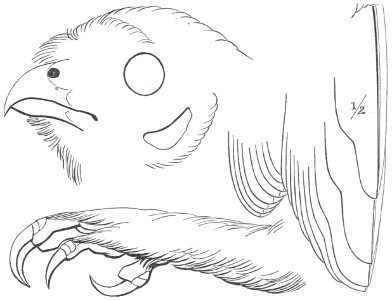
½
Scops asio.
The species of this genus are cosmopolitan, the greater number, however, being found in tropical regions. All the American species differ from S. zorca of Europe in having the fourth and fifth quills longest, instead of the second, and in having three to four, instead of only two, of the outer quills with the inner web sinuated, as well as in having the quills shorter, broader, and more bowed, and their under surface more concave. They may, perhaps, be distinguished as a separate subgenus (Megascops, Kaup). Of the American species all but S. asio (including its several races) have the toes perfectly naked to their very bases.
Species and Races.
Common Characters. Plumage brown, gray, or rufous, and whitish, finely mottled above; lower parts transversely barred, and with dark shaft-streaks. Outer webs of lower scapulars light-colored (white or ochraceous) and without markings. Tail crossed by rather obscure mottled light and dark bars of nearly equal width. Outer webs of primaries with nearly equal bands of whitish and dusky.
1. S. asio. Toes covered (more or less densely) with bristles, or hair-like feathers. Wing, 5.50–7.80; tail, 3.20–4.10; culmen, .50–.70; tarsus, 1.00–1.70; middle toe, .70–.80. Ear-tufts well developed; facial circle black.
Colors smoky-brown and pale fulvous, with little or none of pure white. Outer webs of the scapulars pale ochraceous-fulvous. Wing, 6.90–7.30; tail, 3.50–4.50. Hab. North Pacific region, from Western Idaho and Washington Territory, northward to Sitka … var. kennicotti.
Colors ashy-gray and pure white, with little or none of fulvous. Outer webs of the scapulars pure white. Varying to bright brick-red, or lateritious-rufous.
Mottlings coarse, the blackish median streaks above not sharply defined, and the bars beneath heavy and distinct.
Wing, 6.10–7.75; tail, 3.30–4.35. In the red plumage, white prevailing on the lower parts, where the red markings are not broken into transverse bars. Hab. United States; except the Southern Middle Province, the northwest region, and Florida … var. asio.
Wing, 5.50–6.00;Hab. Florida and Southern Georgia … var. floridanus.
Wing, 5.50–5.80; tail, 3.20–3.30. Gray plumage, like var. asio, but the mottling above much coarser, and the nape with a strongly indicated collar of rounded white spots in pairs, on opposite webs. Red plumage not seen. Hab. Eastern Mexico and Guatemala … var. enano.25
Mottlings fine, the blackish median streaks above very sharply defined and conspicuous; bars beneath delicate and indistinct.
Wing, 6.20–6.50; tail, 3.35–3.50. Hab. Southern Middle Province, and Southern California; Cape St. Lucas … var. maccalli.
2. S. flammeola. Toes perfectly naked, the feathering of the tarsus terminating abruptly at the lower joint. Wing, 5.40; tail, 2.80; culmen, .35; tarsus, .90; middle toe, .55. Ear-tufts short, or rudimentary. Facial circle rusty. Outer webs of the scapulars rusty-ochraceous, in striking contrast to the grayish of the wings and back. Other markings and colors much as in asio. Hab. Mountain regions of Mexico and California, from Guatemala to Fort Crook, Northern California.
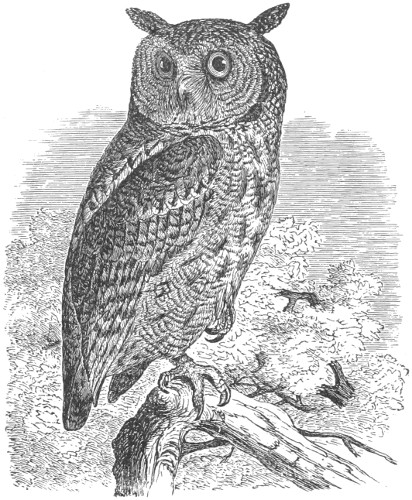
Scops asio, Bonap. LITTLE RED OWL; MOTTLED OWL; “SCREECH-OWL.”
Noctua aurita minor, Catesby, Carol. I, 1754, 7, pl. vii. Asio scops carolinensis, Briss. Orn. I, 1760, 497. Strix asio, Linn. Syst. Nat. 1758, 92.—Gmel. S. N. 1789, 287.—Lath. Ind. Orn. 1790, 54.—Ib. Syn. I, 123.—Ib. Supp. I, 42; Gen. Hist. I, 314.—Daud. Tr. Orn. II, 1800, 216.—Shaw, Zoöl. VII, 1809, 229.—Temm. Pl. Col. 80.—Wils. Am. Orn. 1808, pl. xlii, f. 1.—Jard. (ed. Wils.) Orn. I, 1831, 307.—Bonap. Ann. N. Y. Lyc. II, 36.—Ib. Isis, 1832, 1139.—Audubon, Birds N. A. 1831, pl. xcvii.—Ib. Orn. Biog. I, 486.—Brewer (ed. Wils.) Orn. 1852, p. 687.—Hobs. Nat. 1855, 169. Bubo asio, Vieill. Ois. Am., Sept., 1807, 53, pl. xxi.—Giraud, Birds Long Island, 1844, 28.—Max. Cab. J. VI, 1858, 23. Otus asio, Stephens, Zoöl. XIII, pt. ii, 1815, 57. Scops asio, Bonap. List, 1838, 6.—Less. Tr. Orn. 107.—Cass. Birds Cal. & Tex. 1854, 179.—Ib. Birds N. Am. 1858, 51.—Kaup, Monog. Strig. Cont. Orn. 1852, 112.—Strickl. Orn. Syn. I, 1855, 199.—Heerm. P. R. Rept. II, 1855, 35.—Coop. & Suckl. P. R. Rept. 155.—Maynard, Birds Eastern Mass., 1870, 131.—Coues, Key, 1872, 202.—Gray, Hand List, I, 1869, 46. Ephialtes asio, Gray, Gen. B. fol. 1844, sp. 9.—Ib. List Birds Brit. Mus. 1844, p. 96.—Woodh. 1853, 62. Strix nævia, Gmel. S. N. 1789, 289.—Lath. Ind. Orn. 1790, p. 55.—Ib. Syn. I, 126; Gen. Hist. I, 321.—Daud. Tr. Orn. II, 1800, 217.—Shaw, Zoöl. VII, 1809, 230.—Wils. Am. Orn. 1808, pl. xix, f. 1. Asio nævia, Less. Man. Orn. I, 1828, 117. Otus nævius, Cuv. Reg. An. (ed. 2), I, 1829, 341. Surnia nævia, James. (ed. Wils.), Orn., 1831, I, 96 & 99.
a. Normal plumage.
Sp. Char. Adult. Ground-color above brownish-cinereous, palest on the head, purest ashy on the wings, minutely mottled with fine zigzag transverse bars of black, each feather with a medial ragged stripe of the same along the shaft. Inner webs of ear-tufts, outer webs of scapulars, and oval spots occupying most of the outer webs of the two or three lower feathers of the middle and secondary wing-coverts, white, forming (except on the first) conspicuous spots, those of the scapulars bordered with black. Secondaries crossed with about seven regular paler bands, each enclosing a more irregular dusky one; the ground-color, however, is so mottled with grayish, and the pale bands with dusky, that they are by no means sharply defined or conspicuous, though they are very regular; alula and primary coverts more sharply barred with cream-colored spots, those on the former nearly white; primaries with broad quadrate spots of creamy-white on outer webs, these forming from seven (♂) to eight (♀) transverse bands, the last of which is not terminal. Tail more irregularly mottled than the wings, and crossed by seven (♂) to eight (♀) narrow, obsolete, but continuous, pale bands.
Eyebrows white, the feathers bordered with dusky (most broadly so in ♂); cheeks, ear-coverts, and lower throat dull white, with transverse bars of blackish (most numerous in the ♂); chin immaculate; upper eyelid dark brown; facial circle black; neck and jugulum like the cheeks, but more strongly barred, and with blackish along the shaft. Ground-color of the lower parts white, each feather with a medial stripe of black, this throwing off distinct bars to the edge of the feather; the medial black is largest on sides of the breast, where it expands into very large conspicuous spots, having a slight rusty exterior suffusion; the abdomen medially, the anal region, and the lower tail-coverts, are almost unvaried white. Tibiæ and tarsi in the male dull white, much barred transversely with blackish; in the female, pale ochraceous, more sparsely barred with dark brownish. Lining of the wing creamy-white, varied only along the edge; light bars on under surface of primaries very obsolete.
♂ (16,027, Fort Crook, North California; John Feilner). Wing, 6.70; tail, 3.80; culmen, .61; tarsus, 1.35; middle toe, .72; ear-tufts, 1.00; wing-formula, 3=4, 5–2, 6, 1=9. “Length, 9.50; extent, 23.75.”
♀ (18,299, Hellgate, Montana; Jno. Pearsall). Wing, 7.80; tail, 4.10; culmen, .70; tarsus, 1.70; middle toe, .80; ear-tufts, 1.00.
Young ♂ (No. 29,738, Wood’s Hole, Mass., July 25, 1863; S. F. Baird. “Parent gray”). Secondaries, primaries, and tail, as in the adult, gray plumage; but the latter more mottled, the bands confused. Rest of the plumage everywhere grayish-white, with numerous transverse bars of dusky-brown; eyebrows and lores scarcely variegated dull white; facial circle obsolete.
♀ (41,891, Philadelphia, Penn.; J. Krider). Whole head, neck, back, rump, and entire lower parts transversely barred with dark brown and grayish-white, the bands of the former on the upper parts rather exceeding the white in width, but on the lower surface much narrower; scapulars with large transverse spots of white on the outer webs. Wings and tail as in the adult. Facial disk conspicuous. (More advanced in age than the preceding.)
b. Rufescent plumage.
Adult. General pattern of the preceding; but the grayish tints replaced by lateritious-rufous, very fine and bright, with a slight vinaceous cast: this is uniform, and shows no trace of the transverse dark mottling; there are, however, black shaft-lines to the feathers (these most conspicuous on the head above, and scapulars, and narrower and more sharply defined than in the gray plumage). The inner webs of the ear-tufts, outer webs of scapulars, and lower secondary and middle wing-coverts, are white, as in the gray plumage; those of the scapulars are also bordered with black. The secondaries, primaries, and tail are less bright rufous than the other portions, the markings as in the gray plumage, only the tints being different. The upper eyelid, and, in fact, all round the eye, fine light rufous; cheeks and ear-coverts paler, scarcely variegated; black facial circle rather narrower than in the gray plumage. Lower parts without the transverse bars of the gray plumage, but in their place an irregular clouding of fine light red, like the back; the lower parts medially (very broadly) immaculate snowy-white; most of the feathers having the red spotting show black shaft-stripes, but the pectoral spots are not near so large or conspicuous as in the gray bird. Tibiæ fine pale ochraceous-rufous; tarsi the same posteriorly, in front white with cuneate specks of rufous; lower tail-coverts each with a medial transversely cordate spot of dilute rufous, the shaft black. Lining of the wing with numerous rufous spots.
♂ (12,045, Washington, D. C., January). Wing, 6.30; tail, 3.00.
♀ (22,512, Maryland; R. G. Campbell). Wing, 6.70; tail, 3.50.
Young (29,792, Peoria, Illinois; Ferd. Bischoff). Wings and tail as in adult; markings on head and body as in the young gray bird, but white bars more reddish, and dark ones more brown.
Hab. Temperate North America, from the South Atlantic States to Oregon, and from the northern United States to Texas. Replaced in the southern Middle Province and Southern California by var. maccalli, in Florida by var. floridana, and on the northwestern coast region by var. kennicotti.
Localities: (?) Cuba (Cabanis, Journ. III, 465).
The above stages of plumage have caused ornithologists a great deal of perplexity; and it is only very recently that they have become correctly understood. Even yet many persist in regarding the red plumage as being that of the young bird.
Scops asio.
That these two very different plumages are entirely independent of age, sex, or season, and that they are purely individual, there can be no doubt; since in one nest there may often be found both red and gray young ones, while their parents may be either both red or both gray, the male red and the female gray, or vice versa. Occasionally specimens (such as No. 39,093, ♂, Neosho Falls, Kansas, April 13; parent of five eggs, and captured on the nest with a gray male) are exactly intermediate between these two plumages, it being difficult to decide which predominates; the combination is not only of the tints, but of the markings, of the two stages.
Habits. The habit of all the varieties of Scops asio in their different localities will be found after their zoölogical description.
Scops asio, var. floridana, Ridgway.
Scops asio, Allen, Bull. Mus. Comp. Zoöl. and other citations from Florida.
Char. Similar to var. asio, but much smaller, and the colors deeper. The gray stage very similar to that of var. asio, but the red phase very appreciably different, in there being a greater amount of rufous on the lower parts, the breast being nearly uniformly colored, and the rufous broken elsewhere into transverse broad bars, connected along the shaft. Wing, 5.50–6.00; tail, 2.75–3.10.
Hab. Florida and Lower Georgia.
This extreme southern form is much smaller than the more northern ones, being about the same in size as the var. enano (see p. 1374) of Middle America, and the S. atricapilla, Temm., of Tropical America generally. The colors, as may be expected, are also darker and richer.
In the collection of the Smithsonian Institution there are both red and gray birds from Florida; a red one (No. 5,857, Indian River; Dr. A. W. Wall) measures, wing, 5.50; tail, 2.70; culmen, .55; tarsus, 1.05; middle toe, .65; ear-tufts, .70. The colors are much darker than those of typical asio. The rufous of the neck, all around, shows obsolete darker transverse bars; the black border to the white scapular spots is restricted to the tip, as in the gray plumage; the inner webs of the ear-tufts are scarcely paler than the outer; the neck and face are deeper rufous, while the rufous of the lower parts is more general, and more in transverse rays; tibiæ and tarsi plain rufous; the middle of the abdomen and the anal region only are pure white.
Scops asio, var. maccalli, Cass. WESTERN MOTTLED OWL.
Scops maccalli, Cass. Birds Cal. & Tex. p. 180, 1850; Birds N. Am. 1858, 52.—Strickl. Orn. Syn. I, 200, 1865.—Coues, Prod. Orn. Ariz., p. 13, 1869.—Scl. & Salv. P. Z. S., 1868, 57 (= trichopsis, Wagl. Isis, 1832, 276! see remarks below).—Baird, Mex. Bound. II, 4, pl. i.—Gray, Hand List, I, 47, 1869. Scops asio, var. maccalli (Ridgway) Coues, Key, 1872, 203. Ephialtes choliba (not of Vieillot!), Lawr. Ann. N. Y. Lyc. VI, 1853, p. 4.
Char. Adult (9,147, Camp 118, New Mexico, February 10, 1854; Kennerly and Möllhausen). Above cinereous, the ashy appearance being caused by a minute transverse mottling of blackish and pale ashy, on a deeper ash ground; each feather with a distinct medial stripe of black, these broadest on the forehead; outer webs of only a few scapulars white, these not bordered with black; outer webs of two or three lower middle and secondary coverts white. Secondaries with about seven transverse, mottled pale bands; primaries with about eight transverse series of white spots; tail with about eight narrow pale bands.
Ear-coverts, cheeks, throat, neck, and jugulum finely and uniformly barred transversely with dusky and grayish-white; the facial circle interrupted across the throat, where in its place is a series of longitudinal black dashes.
Lower parts grayish-white, with numerous, very narrow transverse bars of dusky, rather more distant from each other than those of the neck, etc.; each feather with a medial narrow stripe of black, those on the breast forming conspicuous spots; tibiæ and tarsi dull soiled white, with numerous spots of dark brown; lower tail-coverts immaculate. Wing-formula, 3=4–2, 5, 6, 7, 8–1–9. Wing, 6.50; tail, 3.30; culmen, .55; tarsus, 1.15; middle toe, .70; ear-tufts, .85.
(A specimen from California (Stockton, E. S. Holden), kindly sent by Mr. Lawrence for examination, differs from the preceding in rather more brown ground-color above; the black shaft-streaks more obscure. In other respects as regards plumage it is the same, and is typical maccalli. The size is less, it measuring, wing, 6.20; tail, 3.10.)
Young (first full, but incomplete plumage; 16,932, Cape St. Lucas, Lower California). Secondaries, primaries, and tail as in the gray adult. Rest of the plumage transversely barred with grayish-white and dusky, the latter predominating on the upper parts; eyebrows and lores white; rings finely transversely mottled with white, this forming spots on the lower feathers; tibiæ and tarsi with numerous transverse dusky bars. Wing, 5.40; tail, 2.65; tarsi, 1.00; middle toe, .63. No. 16,933 (same locality, etc.) is similar, but smaller, measuring, 5.00, 2.00, 1.00, and .60.
Hab. Southern Middle Province of United States; Lower and Southern California.
Localities. (?) Oaxaca (Scl. 1858, 296); (?) Guatemala (Scl. Ibis, I, 220); (?) Texas (Dresser, Ibis, 1856, 330).
While the Scops maccalli is without doubt to be distinguished from S. asio, its being specifically distinct is not a matter of so much certainty; with a simple statement of the differences between the two, I shall leave the value of these differences to the appreciation of each one, according to his own fancy. The species is represented in the collection by but four specimens, two adult and two young. I have not seen the red plumage as described by Cassin.
The characters of this race, as given in the diagnosis, appear to be really constant; and there is not a specimen in the series of those from the west which may not readily be referred to one or the other.
The gray adult maccalli differs from that of asio in the much finer mottling of the general plumage; the medial black stripes of the feathers above being more sharply defined, and more distinct from the transverse zigzags. Below, the transverse dark bars are much finer, and nearer together. The face, neck, and jugulum more finely and uniformly barred. The white scapular spots have not the black border seen in asio. The size is smaller.
The young of maccalli differs from that of asio in much finer bars above, the dusky rather prevailing; below, also, the bars are finer and nearer together.
It is not necessary to compare this bird with any other than the S. asio, since it is not at all related to choliba, or any other southern species.
Scops maccalli is entirely distinct from the S. trichopsis, Wagler, notwithstanding the statement in the Ibis, for April, 1872 (p. 6), that “the name” is “really synonymous with S. trichopsis of Wagler, the bird being quite distinct from S. asio, as has been pointed out elsewhere.” (P. Z. S. 1868, p. 57.)
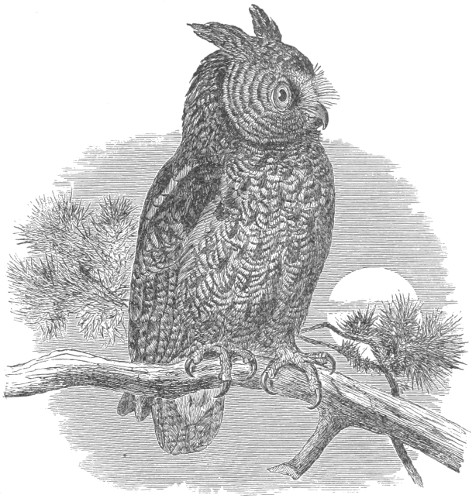
Scops asio, var. kennicotti, Elliot. KENNICOTT’S OWL.
Scops kennicotti, Elliot, Pr. Ac. Nat. Sc. Phil. 1867, p. 69; Illust. Am. Birds, pl. xi.—Baird, Trans. Chicago Acad. Sc. I, II, 311, pl. xxvii, 1869.—Dall & Bannister, Tr. Chic. Ac. I, 1869, 273.—Gray, Hand List, I, 47, 1869.—Elliot, Illust. Birds Am. I, XXVII.—Finsch, Abh. Nat. III, 28.—Scops asio, var. kennicotti, (Ridgway) Coues, Key, 1872, 203. ? Scops asio, Coop. & Suck. P. R. R. Rept. XII, II, 155, 1860 (all citations from northwest coast).
Sp. Char. Adult (♂, 59,847, Sitka, Alaska, March, 1866; Ferd. Bischoff. Elliott’s type). Above umber-brown, with a reddish cast; feathers confusedly mottled transversely with dusky, and showing rounded spots of rufous, most conspicuous on the nape; each feather with a conspicuous medial broad ragged stripe of black, these stripes most conspicuous on the forehead and scapulars; outer webs of scapulars light rufous, bordered terminally with black. Wings of a more grayish cast than the back, but similarly variegated; lower feathers of the middle and secondary wing-coverts, each with a large oval pale rufous spot, covering most of the lower web. Secondaries crossed by six narrow obscure bands of pale rufous; primaries with seven somewhat rounded, quadrate spots of the same on the outer webs, forming as many transverse series; each light spot with a central dusky mottling. Tail more finely and confusedly mottled than the wings; the bands, though present, are so obsolete as to be scarcely traceable, and so irregular or badly defined as to be of uncertain number. The ear-tufts are black and rusty, the former along the shafts, and in transverse spots; on the outer webs the black predominates, on the inner the rusty.
The lores and basal half of the frontal bristles are white, the terminal half abruptly black; eyebrows about equally blackish and paler, the former bordering the feathers; eye surrounded by dark snuff-brown; cheeks and ear-coverts pale rusty, transversely barred with deeper rusty; facial circle not well defined, black. Chin and lores only white.
Ground-color of the lower parts dilute-rusty, becoming white on the flanks; each feather of the throat, jugulum, breast, sides, and flanks with a broad medial stripe of black, this throwing off very narrow, rather distant, bars to the edge; the spaces between these bars are alternately paler and deeper dilute-rusty; the black marks are broadest on the sides of the breast, where they have an external deep rusty suffusion; the abdomen medially, and the anal region, are scarcely maculate rusty-white; the lower tail-coverts have each a central cuneate longitudinal stripe of black. Tibiæ, tarsi, and lining of the wing, plain deep rusty. Wing-formula, 3=4, 5–2, 6–1=9. Wing, 7.40; tail, 4.00; culmen, .65; tarsus, 1.50; middle toe, .80.
No. 59,068 (Idaho; Dr. Whitehead) is considerably darker than the type, the ground-color above approaching to snuff-brown; it differs, however, in no other respect, as regards coloration; the size, however (as would be expected), is considerably smaller, measuring as follows: Wing, 6.80; tail, 3.50; culmen, .60; tarsus, 1.20; middle toe, .80. Wing-formula the same as in type.
Hab. Northwestern coast of North America, from Columbia River, northward; Idaho (Dr. Whitehead).
No. 4,530 (Washington Territory; Dr. Geo. Suckley) is just intermediate in all respects between typical kennicotti and asio, being referrible to either with equal propriety, though perhaps inclining most to the former.
This well-marked form is, according to recognized laws, properly to be regarded as only an extremely dark northwestern form of Scops asio. There is no deviation from the specific pattern of coloration, the difference being merely in the tints; while in this it corresponds in every way with other species as modified in the northwest coast region; the somewhat greater size, too, merely results from its more northern habitat.
The only characters which we find in kennicotti which cannot be recognized in asio are the smaller, more quadrate, and more rufous spots on the primaries, and more obsolete bands on the tail; but this is merely the consequence of the greater extension of the brown markings, thus necessarily contrasting the larger, more whitish, spots on primaries, and more distinct tail-bands, of asio.
Scops asio, var. kennicotti.
The Scops kennicotti must, however, be recognized as a well-marked geographical race, and, not taking into consideration any natural laws which influence changes in species, it would be very proper to recognize the validity of the present bird. If, however, the rule of which we speak will apply to others, as indeed it does to a majority of the birds of the region inhabited by the Scops kennicotti, the extreme conditions of some species of which are even more widely different than in the present instance, and which have been referred to their lighter representatives in consequence of the applicability of this law, we cannot possibly do otherwise with it.
In general appearance, size, and proportions, as well as in pattern and tints of coloration, except in their details, there is a wonderfully close resemblance in this race of S. asio to the S. semitorques, Schlegel, of Japan. Indeed, it is probable that the latter is also a mere geographical form of the same species. The only tangible points of difference are that in semitorques the jugulum is distinctly white centrally, there is a quite well-defined lighter nuchal band, with a more indistinct occipital one above it, and the pencillings on the lower parts are more delicate. The size and proportions are essentially the same; the shades of color are identical, while the markings differ only in minute detail, their pattern being essentially the same. In kennicotti the light nuchal collars are indicated, though they do not approach the distinctness shown by them in semitorques. Should they be considered as races of one species (S. asio), their differential characters may be expressed as follows:—
Var. semitorques.26 A well-defined nuchal collar, of mottled pale ochraceous; jugulum immaculate white centrally. Feathers of the lower parts with their transverse pencillings growing fainter towards the middle line, which is unvariegated white, from the central jugular spot to the anal region. Wing, 6.60–7.10; tail, 3.60–3.70; culmen, .60; tarsus, 1.25–1.40; middle toe, .80–.90. (Two specimens.) Hab. Japan.
Var. kennicotti. No well-defined nuchal band; jugulum closely barred centrally; feathers of the lower parts with their transverse pencillings not growing fainter toward the middle line, which is unvariegated white only on the abdominal portion; the medial black streaks to the feathers of the lower surface much broader, and transverse pencillings rather coarser. Wing, 6.90–7.30; tail, 3.50–4.50; culmen, .60–.65; tarsus, 1.35–1.45; middle toe, .80–.90. (Three specimens.) Hab. North Pacific coast of North America from Sitka to Washington Territory, and Western Idaho.
The zoölogical characters of the different varieties of the Scops asio having been thus indicated, we proceed to consider the species as a whole, and to point out the more important features of its habits and history.
Habits. The common Mottled Owl has an extended distribution throughout the temperate portion of North America. It is also the most numerous of this family wherever found. It does not appear to have been detected in any part of the Arctic regions. Although given on the authority of Fabricius as a bird of Greenland, it is not retained in the list of Reinhardt. It was not met with by Richardson, nor is any reference made to it in any of the Arctic notes furnished by Mr. MacFarlane or others. It is quite common throughout New England, as well as in the Central, the Western, and some of the Southern States. Mr. Boardman gives it as resident, but not very common, near Calais, where it breeds. It is found near Hamilton, Canada, according to McIlwraith, but it is not common, although Dr. Hall found it quite numerous in the vicinity of Montreal. Mr. Downes does not mention its occurrence in Nova Scotia. It was found breeding by Dr. Lincecum, at Long Point, Texas. It occurs in California, and as Scops kennicotti as far to the northwest as Sitka.
The Mottled Owl is nocturnal in its habits, never appearing abroad in the daylight except when driven out by the attacks of hostile birds that have discovered it in its retreat. Its eyes cannot endure the light, and it experiences great inconvenience from such an exposure. During the day it hides in hollow trees, in dark recesses in the forests, or in dark corners of barns, and comes out from its retreat just before dark. During the night it utters a very peculiar wailing cry, not unlike the half-whining, half-barking complaints of a young puppy, alternating from high to low, intermingled with deep guttural trills. These cries, which are sometimes prolonged until after midnight, usually elicit an answer from its mate or companions, and would seem to be uttered as a call soliciting a reply from some lost associate. When kept in confinement the Mottled Owl soon becomes familiarized to its new mode of life, and rarely attempts to injure its captors, though it will at first snap its bill in a threatening manner and manifest considerable irritation on being approached or handled. In the daytime they keep secluded, appear sleepy or stupid, with half-closed eyes, but, as night approaches, become quite lively and eager for their food. They utter their nocturnal cries in confinement, the doleful sounds of which are in singular contrast with the lively and excited air of the birds as they utter them. Their flight is noiseless and gliding, and they move in a manner so nearly silent as to be hardly perceptible. They are excellent mousers, and swallow their food whole, ejecting the indigestible parts, such as hair, bones, feathers, etc.
Wilson caught an adult bird, and kept it in confinement some time. At first it was restless and attempted to escape, beating against the glass of the window repeatedly, and several times with so much violence as to stun itself. In a few days it was reconciled to its situation, and became quite tame and familiar, and in the evening was very lively, sprightly, and active.
The food of the Screech-Owl is chiefly small quadrupeds, insects, and occasionally, when they have young, small birds. They destroy a vast number of mice, beetles, and vermin, and are of great service to the agriculturist, although their services are not appreciated, and they are everywhere persecuted and hunted down without mercy or justice.
The nest of this species is usually constructed in hollow trees or stumps, most frequently in orchards in the vicinity of farm-houses, and not more than six or seven feet from the ground. Mr. Audubon states, however, that he has sometimes found them at the height of thirty or forty. To show the provident habits of this Owl in procuring for its young a great superabundance of food, Mr. Nuttall mentions finding in the hollow stump of an apple-tree, which contained a single brood of these young Owls, several Bluebirds, Blackbirds, and Song-Sparrows.
Dr. Cooper, on the other hand, relates an instance where one of these Owls resided as an inmate in a dove-cot, where it was not known to do any injury to its inmates.
The Screech-Owl can hardly be said to construct any nest, but lines the hollow in which it rears its young with a few loose leaves, dry grasses, and feathers. The eggs are usually five or six in number; they are pure white, and nearly round. Their average measurement is 1.38 inches in length by 1.19 in breadth.
In regard to the distinctive peculiarities of var. maccalli, we are in possession of but little information. Its habits probably do not essentially vary from those of the common Scops asio, which it so closely resembles in other respects, and of which it is to be regarded as a geographical race. It was first taken by Mr. E. S. Holden, near Sacramento, and described by Mr. Lawrence as the Ephialtes choliba of Vieillot. It has since been found in other parts of California, in Northern Mexico, Arizona, and on the Rio Grande. It was obtained in Tamaulipas—where it is evidently rather common—by the late Dr. Berlandier, who had also procured its eggs. A single specimen of this Owl was obtained by Mr. A. Schott in Texas, and Mr. Dresser also obtained two small Owls which he doubtfully refers to this variety,—one near San Antonio, and the other in Bandera County. Lieutenant Bendire writes that it is quite common in the vicinity of Tucson, Arizona, though Dr. Coues did not meet with it. Dr. Kennerly observed it on Bill Williams Fork, in New Mexico. It was there found living in the large Cereus giganteus so common in that region, where it occupied the deserted holes of various kinds of Woodpeckers. It rarely made its appearance during the day, and then only to show its head from the hole, ready at any moment to disappear at the approach of danger. On one occasion it was observed among some very thick bushes near the water. It does not appear to have been met with by Dr. Cooper in California, where he refers all the Owls of this genus to the common asio. A single individual, referred doubtfully to this bird, was taken by Mr. Skinner in Guatemala. The eggs of this bird, taken in Tamaulipas by Dr. Berlandier, are of nearly globular shape, of a clear, almost crystal-white color, and measure 1.13 inches in length by 0.93 of an inch in breadth. As compared with the eggs of Scops asio they are much smaller, their relative capacity being only as five to eight.
The eggs of the var. asio vary greatly in size according to their locality. Those taken in Florida are so much smaller than those from Massachusetts as almost to be suggestive of specific differences. An egg from Hudson, Mass., taken by Mr. Jillson in April, 1870, measures 1.50 by 1.30 inches, while one from Monticello, Fla., taken by Mr. Samuel Pasco, measures 1.30 by 1.15 inches. Mr. T. H. Jackson, of Westchester, Penn., informs me that he has found a nest of this Owl containing six fresh eggs, on the 5th of April.
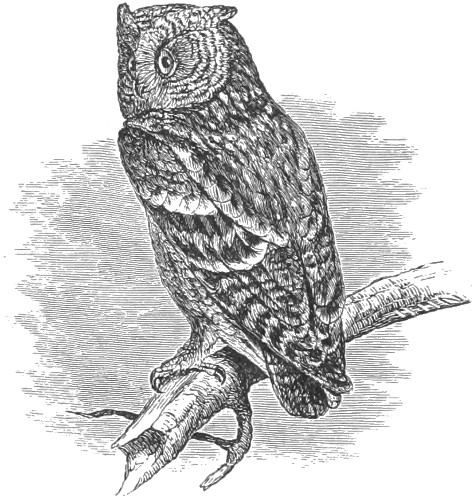
Scops flammeola, Licht. FEILNER’S OWL.
Scops flammeola, Licht. Mus. Berol. Nomenclat. p. 7, 1854.—Kaup, Trans. Zoöl. Soc. IV, 226.—Schlegel, Mus. de Pays-Bas, Oti, p. 27.—Sclat. Proc. Zoöl. Soc. 1858, 96.—Scl. & Salv. P. Z. S. 1868, 57; Exot. Orn. VII, 99, pl. l, July, 1868.—Gray, Hand List, I, 47, 1869.—Elliot, Illust. Birds Am. I, pl. xxviii.—Coues, Key, 1872, 203.
Sp. Char. Adult (42,159, Orizaba Mountains, “rare,” February 3, 1865; Professor F. Sumichrast). Ground-color above pale cinereous, this overlaid on the top of the head, nape, and back by a brownish-olive shade, the ash showing pure only on the borders of the crown and on the wing-coverts and scapulars; the whole upper surface transversely mottled with white and blackish, the latter in the form of fine zigzag lines and a splash along the shaft, this expanding transversely near the end of the feather; the white is in the form of larger transverse spots, these largest across the nape. Outer webs of the scapulars fine light orange-rufous (becoming white beneath the surface), bordered terminally with black. Coverts along the lower edge of the wing spotted with pale rufous; outer webs of the several lower feathers of the middle and secondary wing-coverts with a large conspicuous spot of white. Secondaries crossed by four well-defined narrow pale ochraceous bands; primary coverts transversely spotted with the same; primaries with about five transverse series of very large white spots on the outer webs, the spots approaching ochraceous next the shaft and towards the end of the feather. Tail profusely mottled like the back, and crossed with about five ragged, badly defined pale bands, the last of which is not terminal. Ear-tufts inconspicuous.
Eyebrow white, feathers bordered with blackish; eye encircled with rusty rufous; lores strongly tinged with the same; cheeks, ear-coverts, neck, and jugulum with numerous transverse dusky bars upon a grayish-white ground. Facial circle rusty-rufous spotted with black; throat with a tinge of rufous; chin white.
Scops flammeola.
Lower parts, in general, white; each feather with a black shaft-stripe, this throwing off bars in pairs, across the feather; the medial stripes are very broad, forming longitudinal spots on the breast, and have here an external rufous suffusion; lower tail-coverts very sparsely marked. Tibiæ and tarsi white, with very sparse transverse dusky spots. Lining of the wing plain yellowish-white; bars on under surface of primaries very obsolete, except basally. Wing-formula,
Young (first full, but imperfect plumage: ♂, 24,172, Fort Crook, North California, August 23, 1860; John Feilner). Wings and tail as in the adult (last pale band of latter apparently terminal). Whole head and body with numerous, about equal, transverse bands of dusky and grayish-white; the two colors about equal, but on lower parts both are much wider and more distinct than above the white gradually increasing posteriorly. Breast and outer webs of scapulars with a rusty tinge, the latter scarcely variegated. Eyebrow white, feathers bordered with dusky; eye-circle and ear-coverts bright rusty-rufous; lores much tinged with the same. No facial circle. Wing, 5.50; tail, 2.70.
Hab. Guatemala and central Mexico, northward (along Sierra Nevada) to Fort Crook; California (breeding).
Habits. This is essentially a Mexican and Central American species, occurring among the mountains of Mexico and thence to Guatemala. One individual, however, the only one as yet recorded as taken in the United States, was obtained at Fort Crook by Captain John Feilner, and is now in the collection of the Smithsonian Institution. This was a young bird, evidently raised in that locality, and apparently showing that the species breeds in that vicinity. It has been taken also at Orizaba, in the State of Vera Cruz, Mexico. Nothing is known as to any peculiarities of habit. These are not probably different from those of the asio.
Genus BUBO, Dum.
Gen. Char. Size varying from medium to very large; head with or without ear-tufts. Bill black; iris yellow. Two to four outer quills with their inner webs emarginated. Third or fourth quill longest. Bill very robust, the lower mandible nearly truncated and with a deep notch near the end; cere gradually ascending basally (not arched) or nearly straight, not equal to the culmen. Tail short, a little more than half the wing, slightly rounded. Ear-conch small, simple, without operculum; the two ears symmetrical.
Subgenera.
Bubo. Two to three outer quills with their inner webs emarginated. Ear-tufts well developed; loral feathers not hiding the bill, and the claws and terminal scutellæ of the toes exposed. Lower tail-coverts not reaching the end of the tail. (Type, B. maximus.)
Nyctea. Four outer quills with their inner webs emarginated. Ear-tufts rudimentary; loral feathers hiding the bill, and claws and entire toes concealed by long hair-like feathers. Lower tail-coverts reaching to end of the tail. (Type, N. scandiaca.)
The species of this genus are mostly of very large size, two of them (B. maximus and N. scandiaca) being the largest birds of the family. They are nearly cosmopolitan, and are most numerous in the Eastern Hemisphere.
Subgenus BUBO, Dum.
Bubo, Duméril, 1806. (Type, Strix bubo, Linn. = B. maximus, Sibb.)
Rhinostrix, Kaup, 1849. (Type, Strix mexicana, Gmel. = B. mexicanus, Ridgw.)
Rhinoptynx, Kaup, and Rhenoptynx, Kaup, 1857. (Same type.)
Species and Races.
1. B. virginianus. Lower parts transversely barred with black, and without longitudinal stripes. Above without longitudinal stripes on the anterior portions.
a. A conspicuous patch of white on the jugulum; lining of the wing immaculate, or only faintly barred. Wing, 14.00–16.00; tail, 8.00–10.00; culmen, 1.10–1.20; tarsus, 2.00–2.20; middle toe, 1.95–2.10.
Rufous tints of the plumage prevailing; face dingy rufous. Hab. Atlantic Province of North America … var. virginianus.
Lighter tints of the plumage prevailing; face dirty or fulvous white. All the colors lighter. Hab. Western Province of United States, and interior regions of British America. Upper Mississippi Valley in winter (Wisconsin, Hoy; Pekin, Illinois, Museum, Cambridge) … var. arcticus.
Dusky tints of the plumage prevailing; face dull grayish, barred with dusky. All the colors darker, chiefly brownish-black and grayish-white, with little or no rufous. Hab. Littoral regions of northern North America, from Oregon northward, and around the northern coast to Labrador … var. pacificus.
b. No conspicuous patch of white on the jugulum, which, with the lining of the wing, is distinctly barred with blackish. Wing, 12.00; tail, 7.50; culmen, 1.00; tarsus, 2.10; middle toe, 1.85.
Colors much as in var. virginianus, but more densely barred beneath, the dark bars narrower and closer together. Hab. South America … var. magellanicus.27
2. B. mexicanus.28 Lower parts longitudinally striped with black, and without transverse bars. Above with longitudinal stripes on the anterior portions. Wing, 11.20–12.00; tail, 6.00–6.50; culmen, .90; tarsus, 2.00; middle toe, 1.95. Hab. Middle and South America generally.
Subgenus NYCTEA, Stephens.
Nyctea, Stephens, Cont. Shaw’s Zoöl. XIII, 62, 1826. (Type Strix nyctea, Linn. N. Scandiaca, Linn.).
Species and Races.
1. N. scandiaca. Adult. Color pure white, more or less barred transversely with clear dusky, or brownish-black. Male sometimes almost pure white. Downy young, sooty slate-color. Wing, 16.00–18.00; tail, 9.00–10.00.
Dusky bars sparse, narrow, umber-brown. Hab. Northern parts of Palæarctic Realm … var. scandiaca.29
Dusky bars more numerous, broader, and clear brownish-black. Hab. Northern parts of Nearctic Realm … var. arctica.
Bubo virginianus, var. virginianus, Bonap. GREAT HORNED OWL.
Asio bubo virginianus, Briss. Orn. I, 484, 17, 1760. Strix virginiana, Gmel. Syst. Nat. I, 287, 1788.—Lath. Ind. Orn. p. 52; Syn. I, 119; Supp. I, 40; Gen. Hist. I, 304.—Daud. Tr. Orn. II, 210, pl. xiii.—Wils. Am. Orn. pl. l, f. 1.—Bonap. Ann. Lyc. N. Y. II, 37 and 435; Isis, 1832, p. 1139.—Aud. Birds Am. pl. lxi, 1831; Orn. Biog. I, 313.—Thomps. Nat. Hist. Vermont, pl. lxv.—Peab. Birds Mass. p. 87. Bubo virginianus, Bonap. List, p. 6, 1838; Consp. Av. p. 48.—Jard. (Wils.) Am. Orn. II, p. 257.—De Kay, Zoöl. N. Y. II, 24, pl. x, f. 2.—Nutt. Man. Orn. p. 124.—Max. Cab. Jour. 1853, VI, 23.—Kaup, Tr. Zoöl. Soc. IV, 1859, 241.—Coues, Key, 1872, 202. Bubo virginianus atlanticus, Cassin, Birds of Cal. & Tex. I, 178, 1854.—Birds N. Am. 1858, 49 (under B. virginianus). Otus virginianus, Steph. Zoöl. XIII, ii, 57, 1836. Ulula virginiana, James. (Wils.), Am. Orn. I, 100, 1831. Strix virginiana, α, Lath. Gen. Hist. I, 306, 1821. Strix bubo, δ, Lath. Ind. Orn. p. 52, 1790.—Shaw, Zoöl. VII, 215. Strix maximus, Bart. Trav. Carol. p. 285, 1792. Bubo ludovicianus, Daud. Tr. Orn. II, 210, 1800. Bubo pinicola, Vieill. Ois. Am. Sept. pl. xix, 1807; Enc. Méth. p. 1282.
6886 ½ ½
Bubo virginianus.
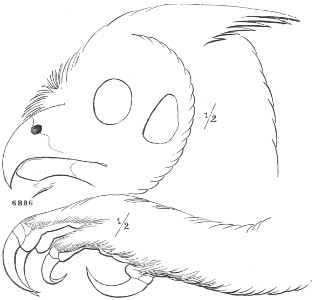
Sp. Char. Adult ♂ (12,057, Philadelphia; C. Drexler). Bases of all the feathers yellowish-rufous, this partially exposed on the head above and nape, along the scapulars, on the rump, and sides of the breast. On the upper surface this is overlaid by a rather coarse transverse mottling of brownish-black upon a white ground, the former rather predominating, particularly on the head and neck, where it forms broad ragged longitudinal stripes (almost obliterating the transverse bars), becoming prevalent, or blended, anteriorly. The lower feathers of the scapulars, and some of the lower feathers of the middle and secondary wing-coverts, with inconspicuous transverse spots of white. On the secondaries the mottling is finer, giving a grayish aspect, and crossed with eight sharply defined, but inconspicuous, bands of mottled dusky; primary coverts with the ground-color very dark, and crossed with three or four bands of plain blackish, the last terminal, though fainter than the rest; ground-color of the primaries more yellowish, the mottling more delicate; they are crossed by nine transverse series of quadrate dusky spots. The ground-color of the tail is pale ochraceous (transversely mottled with dusky), becoming white at the tip, crossed by seven bands of mottled blackish, these about equalling the light bands in width; on the middle feathers the bands are broken and confused, running obliquely, or, in places, longitudinally. Outer webs of ear-tufts pure black; inner webs almost wholly ochraceous; eyebrows and lores white, the feathers with black shafts; face dingy rufous; eye very narrowly encircled with whitish; a crescent of black bordering the upper eyelid, and confluent with the black of the ear-tufts. Facial circle continuous black, except across the foreneck; chin, throat, and jugulum pure immaculate white, to the roots of the feathers. Beneath, white prevails, but the yellowish-rufous is prevalent on the sides of the breast, and shows as the base color wherever the feathers are disarranged. The sides of the breast, sides, and flanks have numerous sharply defined narrow transverse bars of brownish-black; anteriorly these are finer and more ragged, becoming coalesced so as to form conspicuous, somewhat longitudinal, black spots. On the lower tail-coverts the bars are distant, though not less sharply defined. The abdomen medially is scarcely maculate white. Legs and toes plain ochraceous-white.
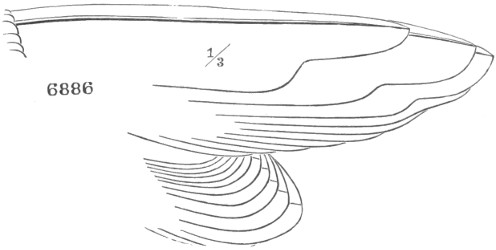
6886 ⅓
Bubo virginianus.
Wing-formula, 2, 3–4–1, 5. Wing, 14.50; tail, 8.20; culmen, 1.10; tarsus, 2.00; middle toe, 2.00.
♀ (12,065, Maryland; R. J. Pollard). General appearance same as the male. Black blotches on head above and nape less conspicuous, the surface being mottled like the back, etc.; primary coverts with three well-defined narrow pure black bands; primaries with only six bands, these broader than in the male; secondaries with only five bands; tail with but six dark bands, these very much narrower than the light ones. Tibiæ and tarsi with sparse transverse bars of dusky. Wing-formula, 3, 2, 4–1=5. Wing, 16.00; tail, 9.00
Young. Wings and tail as in adult. Downy plumage of head and body ochraceous, with detached, rather distant, transverse bars of dusky. (12,062, Washington, D. C., May 20, 1859; C. Drexler.)
Hab. Eastern North America, south of Labrador; west to the Missouri; south through Atlantic region of Mexico to Costa Rica; Jamaica (Gosse).
Localities: (?) Oaxaca (Scl. 1859, 390; possibly var. arcticus); Guatemala (Scl. Ibis, I. 222); Jamaica (Gosse, 23); Texas (Dresser, Ibis, 1865, 330, breeds); Costa Rica (Lawr. IX, 132).
Specimens from the regions indicated vary but little, the only two possessing differences of any note being one (58,747,30 ♂) from Southern Illinois, and one (33,218, San Jose; J. Carmiol) from Costa Rica. The first differs from all those from the eastern United States in much deeper and darker shades of color, the rufous predominant below, the legs and crissum being of quite a deep shade of this color; the transverse bars beneath are also very broad and pure black. This specimen is more like Audubon’s figure than any other, and may possibly represent the peculiar style of the Lower Mississippi region. The Costa Rica bird is remarkable for the predominance of the rufous on all parts of the plumage; the legs, however, are whitish, as in specimens from the Atlantic coast of the United States. These specimens cannot, however, be considered as anything else than merely local styles of the virginianus, var. virginianus.
Bubo virginianus, var. arcticus, Swains. WESTERN GREAT HORNED OWL.
? Strix wapacuthu, Gmel. Syst. Nat. 1789, p. 290. Strix (Bubo) arctica, Swains. F. B. A. II, 1831, 86. Heliaptex arcticus, Swains. Classif. Birds, I, 1837, 328; Ib. II, 217. Bubo virginianus arcticus, Cass. Birds N. Am. 1858, 50 (B. virginianus).—Blakiston, Ibis, III, 1861, 320. Bubo virginianus, var. arcticus, Coues, Key, 1872, 202. Bubo subarcticus, Hoy, P. A. N. S. VI, 1852, 211. Bubo virginianus pacificus, Cass. Birds Cal. & Tex. 1854, and Birds N. Am. 1858 (B. virginianus, in part only). Bubo magellanicus, Cass. Birds Cal. & Tex. 1854, 178 (not B. magellanicus of Lesson!). Bubo virginianus, Heerm. 34.—Kennerly, 20.—Coues, Prod. (P. A. N. S. 1866, 13).—Blakiston, Ibis, III, 1861, 320. ? Wapacuthu Owl, Pennant, Arctic Zoöl. 231.—Lath. Syn. Supp. I, 49.
Char. Pattern of coloration precisely like that of var. virginianus, but the general aspect much lighter and more grayish, caused by a greater prevalence of the lighter tints, and contraction of dark pencillings. The ochraceous much lighter and less rufous. Face soiled white, instead of deep dingy rufous.
♂ (No. 21,581, Camp Kootenay, Washington Territory, August 2, 1860). Wing, 14.00; tail, 8.60; culmen, 1.10; tarsus, 2.00. Tail and primaries each with the dark bands nine in number; legs and feet immaculate white. Wing-formula, 3, 2=4–5–1.
♀ (No. 10,574, Fort Tejon, California). Wing, 14.70; tail, 9.50; culmen, 1.10; tarsus, 2.10; middle toe, 2.00. Tail and primaries each with seven dark bands; legs transversely barred with dusky. Wing-formula, 3, 4, 2–5–1, 6.
Hab. Western region of North America, from the interior Arctic districts to the table-lands of Mexico. Wisconsin (Hoy); Northern Illinois (Pekin, Mus. Cambridge); Lower California; ? Orizaba, Mexico.
Localities: (?) Orizaba (Scl. P. Z. S. 1860, 253); Arizona (Coues, P. A. N. S. 1866, 49).
The above description covers the average characters of a light grayish race of the B. virginianus, which represents the other styles in the whole of the western and interior regions of the continent. Farther northward, in the interior of the fur countries, the plumage becomes lighter still, some Arctic specimens being almost as white as the Nyctea scandiaca. The B. arcticus of Swainson was founded upon a specimen of this kind, and it is our strong opinion that the Wapecuthu Owl of Pennant (Strix wapecuthu, Gmel.) was nothing else than a similar individual, which had accidentally lost the ear-tufts, since there is no other discrepancy in the original description. The failure to mention ear-tufts, too, may have been merely a neglect on the part of the describer.
Bubo virginianus, var. pacificus, Cass.
Bubo virginianus pacificus, Cassin, Birds N. Am. 1858, 49. Bubo virginianus, var. pacificus, Coues, Key, 1872, 202. Bubo virginianus, Coop. & Suckley, P. R. Rept. XII, II, 1860, 154.—Lord, Pr. R. A. S. IV, III (British Columbia). ? Dall & Bannister, Tr. Chicago Ac. I, 1869, 272 (Alaska).—? Finsch, Abh. Nat. III, 26 (Alaska).
Sp. Char. The opposite extreme from var. arcticus. The black shades predominating and the white mottling replaced by pale grayish; the form of the mottling above is less regularly transverse, being oblique or longitudinal, and more in blotches than in the other styles. The primary coverts are plain black; the primaries are mottled gray and plain black. On the tail the mottling is very dark, the lighter markings on the middle feathers being thrown into longitudinal splashes. Beneath, the black bars are nearly as wide as the white, fully double their width in var. arcticus. The legs are always thickly barred. The lining of the wings is heavily barred with black. Face dull grayish, barred with dusky; ear-tufts almost wholly black.
♂ (45,842, Sitka, Alaska, November, 1866; Ferd. Bischoff). Wing-formula, 3, 2=4–5–1, 6. Wing, 14.00; tail, 8.00; culmen, 1.10; tarsus, 2.05; middle toe, .95.
Face with obscure bars of black; ochraceous of the bases of the feathers is distinct. There are seven black spots on the primaries, eight on the tail; on the latter exceeding the paler in width.
♀ (27,075, Yukon River, mouth Porcupine, April 16, 1861; R. Kennicott). Wing-formula, 3, 2=4–5–1, 6. Wing, 16.00; tail, 9.80; culmen, 1.15; tarsus, 2.00. Eight black spots on primaries, seven on tail.
Hab. Pacific coast north of the Columbia; Labrador. A northern littoral form.
A specimen from Labrador (34,958, Fort Niscopec, H. Connolly) is an extreme example of this well-marked variety. In this the rufous is entirely absent, the plumage consisting wholly of brownish-black and white, the former predominating; the jugulum and the abdomen medially are conspicuously snowy-white; the black bars beneath are broad, and towards the end of each feather they become coalesced into a prevalent mottling, forming a spotted appearance.
Another (11,792, Simiahmoo, Dr. C. B. Kennerly) from Washington Territory has the black even more prevalent than in the last, being almost continuously uniform on the scapulars and lesser wing-coverts; beneath the black bars are much suffused. In this specimen the rufous tinge is present, as it is in all except the Labrador skin.
Habits. The Great Horned Owl has an extended distribution throughout at least the whole of North America from ocean to ocean, and from Central America to the Arctic regions. Throughout this widely extended area it is everywhere more or less abundant, except where it has been driven out by the increase of population. In this wide distribution the species naturally assumes varying forms and exhibits considerable diversities of coloring. These are provided with distinctive names to mark the races, but should all be regarded as belonging to one species, as they do not present any distinctive variation in habit.
Sir John Richardson speaks of it as not uncommon in the Arctic regions. It is abundant in Canada, and throughout all parts of the United States. Dr. Gambel met with it also in large numbers in the wooded regions of Upper California. Dr. Heermann found it very common around Sacramento in 1849, but afterwards, owing to the increase in population, it had become comparatively rare. Dr. Woodhouse met with it in the Indian Territory, though not abundantly. Lieutenant Couch obtained specimens in Mexico, and Mr. Schott in Texas.
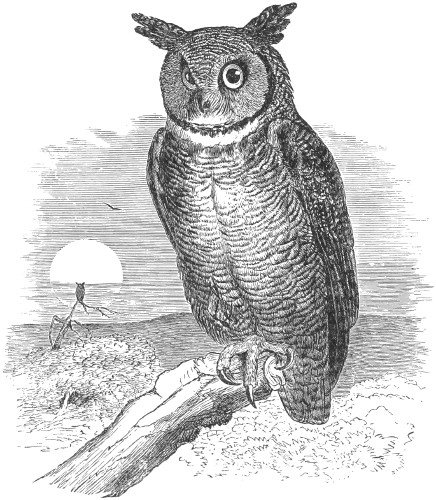
Bubo virginianus.
In the regions northwest of the Yukon River, Mr. Robert Kennicott found a pair of these birds breeding on the 10th of April. The female was procured, and proved to be of a dark plumage. The nest, formed of dry spruce branches retaining their leaves, was placed near the top of a large green spruce, in thick woods. It was large, measuring three or four feet across at base. The eggs were placed in a shallow depression, which was lined with a few feathers. Two more eggs were found in the ovary of the female,—one broken, the other not larger than a musket-ball. The eggs were frozen on their way to the fort. Mr. Ross states that he found this Owl very abundant around Great Slave Lake, but that it became less common as they proceeded farther north. It was remarkably plentiful in the marshes around Fort Resolution. Its food consisted of shrews and Arvicolæ, which are very abundant there. It is very tame and easily approached, and the Chipewyan Indians are said to eat with great relish the flesh, which is generally fat.
Mr. Gunn writes that this Owl is found over all the woody regions of the Hudson Bay Territory. In the summer it visits the shores of the bay, but retires to some distance inland on the approach of winter. It hunts in the dark, preying on rabbits, mice, muskrats, partridges, and any other fowls that it can find. With its bill it breaks the bones of hares into small pieces, which its stomach is able to digest. They pair in March, the only time at which they seem to enjoy each other’s society. The nest is usually made of twigs in the fork of some large poplar, where the female lays from three to six pale-white eggs. It is easily approached in clear sunny weather, but sees very well when the sky is clouded. It is not mentioned by Mr. MacFarlane as found near Anderson River. Mr. Dall caught alive several young birds not fully fledged, June 18, on the Yukon River, below the fort. He also met with it at Nulato, where it was not common, but was more plentiful farther up the river.
Mr. Salvin found this species in August at Duenas and at San Geronimo, in Guatemala. At Duenas it was said to be resident, and is so probably throughout the whole country. It was not uncommon, and its favorite locality was one of the hillsides near that village, well covered with low trees and shrubs, and with here and there a rocky precipice. They were frequently to be met with on afternoons, and at all hours of the night they made their proximity known by their deep cry.
Dr. Kennerly found it in Texas in the cañon of Devil River, and he adds that it seemed to live indifferently among the trees and the high and precipitous cliffs. It was found throughout Texas and New Mexico, wherever there are either large trees or deep cañons that afforded a hiding-place during the day. Attracted by the camp-fires of Dr. Kennerly’s party, this Owl would occasionally sweep around their heads for a while, and then disappear in the darkness, to resume its dismal notes. Sometimes, frightened by the reverberating report of a gun, they would creep among the rocks, attempting to conceal themselves, and be thus taken alive.
Though frequently kept in captivity, the Great Horned Owl, even when taken young, is fierce and untamable, resenting all attempts at familiarity. It has no affection for its mate, this being especially true of the female. Mr. Downes mentions an instance within his knowledge, in which a female of this species, in confinement, killed and ate the male. Excepting during the brief period of mating, they are never seen in pairs.
Its flight is rapid and graceful, and more like that of an eagle than one of this family. It sails easily and in large circles. It is nocturnal in its habits, and is very rarely seen abroad in the day, and then only in cloudy weather or late in the afternoon. When detected in its hiding-place by the Jay, Crow, or King-bird, and driven forth by their annoyances, it labors under great disadvantages, and flies at random in a hesitating flight, until twilight enables it to retaliate upon its tormentors. The hooting and nocturnal cries of the Great Horned Owl are a remarkable feature in its habits. These are chiefly during its breeding-season, especially the peculiar loud and vociferous cries known as its hooting. At times it will utter a single shriek, sounding like the yell of some unearthly being, while again it barks incessantly like a dog, and the resemblance is so natural as to provoke a rejoinder from its canine prototype. Occasionally it utters sounds resembling the half-choking cries of a person nearly strangled, and, attracted by the watchfire of a camp, fly over it, shrieking a cry resembling waugh-hōō. It is not surprising that with all these combinations and variations of unearthly cries these birds should have been held in awe by the aborigines, their cries being sufficiently fearful to startle even the least timid.
It is one of the most destructive of the depredators upon the poultry-yard, far surpassing in this respect any of our Hawks. All its mischief is done at night, when it is almost impossible to detect and punish it. Whole plantations are often thus stripped in a single season.
The mating of this bird appears to have little or no reference to the season. A pair has been known to select a site for their nest, and begin to construct a new one, or seize upon that of a Red-tailed Hawk, and repair it, in September or October, keeping in its vicinity through the winter, and making their presence known by their continued hooting. Mr. Jillson found a female sitting on two eggs in February, in Hudson, Mass.; and Mr. William Street, of Easthampton, in the spring of 1869, found one of their nests on the 3d of March, the eggs in which had been incubated at least a week. If one nest is broken up, the pair immediately seek another, and make a renewed attempt to raise a brood. They rarely go more than a mile from their usual abode, and then only for food. Mr. Street’s observations have led him to conclude that they mate about February 20, and deposit their eggs from the 25th to the 28th. They cease to hoot in the vicinity of their nest from the time of their mating until their young have left them in June. On the 19th of March, 1872, Mr. Street found two of their eggs containing young nearly ready to hatch.
Mr. Street’s observations satisfied him that the period of incubation of this Owl is about three weeks. When they have young and are hard pressed for food, they hunt by day as well as by night, and at this time they hoot a good deal. The young are ready to leave their nest about six weeks after hatching. At this time their feathers are nearly all grown, except their head-feathers, which have hardly started. In the spring of 1872 Mr. Street found a young bird that had fallen from its nest. Though very small it was untamable, and not to be softened by any attentions. Its savage disposition seemed to increase with age. It readily devoured all kinds of animal food, and was especially fond of fish and snakes. It was remarkable for its cowardice, being always ridiculously fearful of the smallest dog, the near approach of one always causing extravagant manifestations of alarm. He was therefore led to conclude that it does not prey upon quadrupeds larger than a hare, that it rarely is able to seize small birds, and that reptiles and fish form no inconsiderable portion of its food. The young Owl in question assumed its full plumage in November, when less than eight months old. It was of full size in all respects except in the length of its claws, which were hardly half the usual size.
Mr. T. H. Jackson, of West Chester, Penn., has met with fresh eggs of this Owl, February 13, 22, and 28, and has found young birds in their nests from the 2d of March to the 28th.
Mr. Audubon states that while the Great Horned Owl usually nests in large hollows of decayed trees, he has twice found the eggs in the fissures of rocks. In all these cases, little preparation had been made previous to the laying of the eggs, the bed consisting of only a few grasses and feathers. Wilson, who found them breeding in the swamps of New Jersey, states that the nest was generally constructed in the fork of a tall tree, but sometimes in a smaller tree. They begin to build towards the close of winter, and, even in the Arctic regions, Sir John Richardson speaks of their hatching their eggs as early as March. The shape of the egg is very nearly exactly spherical, and its color is a dull white with a slightly yellowish tinge. An egg formerly in the old Peale’s Museum of Philadelphia, taken in New Jersey by Alexander Wilson the ornithologist, and bearing his autograph upon its shell, measures 2.31 inches in length by 2.00 in breadth. Another, obtained in the vicinity of Salem, Mass., measures 2.25 inches in length by 1.88 in breadth. In the latter instance the nest was constructed on a tall and inaccessible tree in a somewhat exposed locality. The female was shot on the nest, and, as she fell, she clutched one of the eggs in a convulsive grasp, and brought it in her claws to the ground. An egg obtained in Tamaulipas, Mexico, on the Rio Grande, by Dr. Berlandier, measures 2.18 inches in length by 1.81 in breadth.
An egg from Wisconsin, taken by Mr. B. F. Goss, may be considered as about the average in size and color. It is nearly spherical, of a clear bluish-white, and measures 2.30 by 2.00 inches.
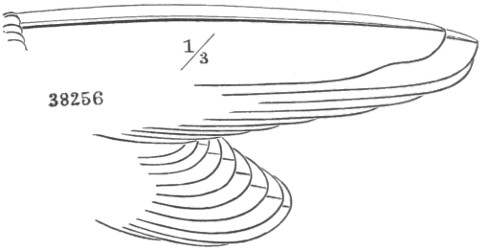
38256 ⅓
Otus wilsonianus.
Nyctea scandiaca, var. arctica, Gray. AMERICAN SNOWY OWL.
Strix arctica, Bartram, Trav. in Carolina, 1792, p. 285. Strix nyctea, (not of Linn.!) Vieill. Ois. Am. Sept. 1807, pl. xviii.—Swains. & Rich. F. B. A. II, 1831, 88.—Bonap. Ann. N. Y. Lyc. II, 36.—Wils. Am. Orn. pl. xxxii, f. 1.—Aud. Birds Am. pl. cxxi.—Ib. Orn. Biog. II, 135.—Thomps. Nat. Hist. Vermont, p. 64.—Peab. Birds Mass. III, 84. Surnia nyctea (Edmondst.), James. (ed. Wils.), Am. Orn. I, 1831, 92.—Nutt. Man. p. 116.—Kaup, Tr. Zoöl. Soc. IV, 1859, 214. Syrnia nyctea (Thomps.), Jardine’s (ed. Wils.) Am. Orn. II, 1832, 46. Nyctea nivea, (Gray) Cass. Birds Cal. & Tex. 1854, 100.—Ib. Birds N. Am. 1858, 63.—Newton, P. Z. S. 1861, 394 (eggs).—Dresser, Ibis, 1865, 330 (Texas!).—Dall & Bannister, Tr. Chicago Acad. I, II, 1869, 273 (Alaska).—Coues, Key, 1872, 205. Nyctea candida, (Lath.) Bonap. List, 1838, 6.
Sp. Char. Adult. Ground-color entirely snow-white, this marked with transverse bars of clear dusky, of varying amount in different individuals.
♂ (No. 12,059, Washington, D. C., December 4, 1858; C. Drexler). Across the top of the head, and interspersed over the wings and scapulars, are small transversely cordate spots of clear brownish-black, these inclining to the form of regular transverse bars on the scapulars; there is but one on each feather. The secondaries have mottled bars of more dilute dusky; the primaries have spots of black at their ends; the tail has a single series of irregular dusky spots crossing it near the end. Abdomen, sides, and flanks with transverse crescentic bars of clear brownish-black. Wing, 16.50; tail, 9.00; culmen, 1.00; tarsus, 1.90; middle toe, 1.30. Wing-formula, 3, 2=4–5, 1.
♀ (No. 12,058, Washington, D. C., December 4, 1858). Head above and nape with each feather blackish centrally, producing a conspicuously spotted appearance. Rest of the plumage with regular, sharply defined transverse bars of clear brownish-black; those of the upper surface more crescentic, those on the lower tail-coverts narrower and more distant. Tail crossed by five bands, composed of detached transverse spots. Only the face, foreneck, middle of the breast, and feet, are immaculate; everywhere else, excepting on the crissum, the dusky and white are in nearly equal amount. Wing, 18.00; tail, 9.80; culmen, 1.10. Wing-formula, 3=4, 2–1=5.
Young (No. 36,434, Arctic America, August, 1863; MacFarlane). Only partially feathered. Wings and tail as in the adult female described, but the blackish bars rather broader. Down covering the head and body dark brownish or sooty slate, becoming paler on the legs.
Hab. Northern portions of the Nearctic Realm. Breeding in the arctic and subarctic regions, and migrating in winter to the verge of the tropics. Bermuda (Jardine); South Carolina (Bartram and Audubon); Texas (Dresser).
Localities: Texas, San Antonio (Dresser, Ibis, 1865, 330).
The Snowy Owls of North America, though varying greatly among themselves, seem to be considerably darker, both in the extremes and average conditions of plumage, than European examples. Not only are the dusky bars darker, but they are usually broader, and more extended over the general surface.
Habits. This is an exclusively northern species, and is chiefly confined to the Arctic Circle and the adjacent portions of the temperate zone. It is met with in the United States only in midwinter, and is much more abundant in some years than in others. Individual specimens have been occasionally noticed as far south as South Carolina, but very rarely. It has also been observed in Kentucky, Ohio, the Bermuda Islands, and in nearly every part of the United States.
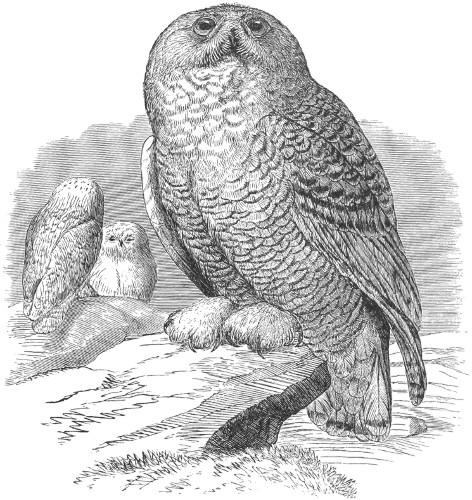
Nyctea scandiaca.
In the Arctic regions of North America and in Greenland it is quite abundant, and has been observed as far to the north as Arctic voyagers have yet reached. Professor Reinhardt states that it is much more numerous in the northern than in the southern part of Greenland. Sir John Richardson, who, during seven years’ residence in the Arctic regions, enjoyed unusual opportunities for studying the habits of this Owl, says that it hunts its prey in the daytime. It is generally found on the Barren Grounds, but is always so wary as to be approached with difficulty. In the wooded districts it is less cautious.
Mr. Downes states that this Owl is very abundant in Nova Scotia in winter, and that it is known to breed in the neighboring province of Newfoundland. In some years it appears to traverse the country in large flocks. In the winter of 1861–62, he adds, these birds made their appearance in Canada in large numbers.
Mr. Boardman states that they are present in winter in the vicinity of Calais, but that they are not common. A pair was noticed in the spring of 1862 as late as the last of May, and, in Mr. Boardman’s opinion, were breeding in that neighborhood. In the western part of Maine Mr. Verrill found it also rather rare, and met with it only in winter. He states that it differs greatly in disposition from the Great Horned Owl, being naturally very gentle, and becoming very readily quite tame in confinement, differing very much in this respect from most large Raptores.
It makes its appearance in Massachusetts about the middle or last of November, and in some seasons is quite common, though never present in very large numbers. It is bold, but rather wary; coming into thick groves of trees in close proximity to cities, which indeed it frequently enters, but keeping a sharp lookout, and never suffering a near approach. It hunts by daylight, and appears to distinguish objects without difficulty. Its flight is noiseless, graceful, easy, and at times quite rapid. In some seasons it appears to wander over the whole of the United States east of the Rocky Mountains, Dr. Heermann having obtained a specimen of it near San Antonio, Texas, in the winter of 1857.
It is more abundant, in winter, near the coast, than in the interior, and in the latter keeps in the neighborhood of rivers and streams, watching by the open places for opportunities to catch fish. Mr. Audubon describes it as very expert and cunning in fishing, crouching on the edges of air-holes in the ice, and instantly seizing any fish that may come to the surface. It also feeds on hares, squirrels, rats, and other small animals. It watches the traps set for animals, especially muskrats, and devours them when caught. In the stomach of one Mr. Audubon found the whole of a large house-rat. Its own flesh, Mr. Audubon affirms, is fine and delicate, and furnishes very good eating. It is described as a very silent bird, and Mr. Audubon has never known it to utter a note or to make any sound.
Richardson states that a few remain in the Arctic regions even in midwinter, but usually in the more sheltered districts, whither it has followed the Ptarmigan, on which it feeds. When seen on the Barren Grounds, it was generally squatting on the earth, and, if disturbed, alighted again after a short flight. In the more wooded districts it is said to be bolder, and is even known to watch the Grouse-shooters, and to share in their spoils, skimming from its perch on a high tree, and carrying off the bird before the sportsman can get near it.
Mr. MacFarlane writes from Fort Anderson that he did not find this species abundant in that quarter, and that its eggs were unknown to him. Mr. B. R. Ross speaks of this Owl as widely distributed, but not common. He found it a winter resident, and has repeatedly seen it at that season near Fort Resolution, and it has been shot in February at Fort Norman. It is very destructive to the snares set by the Indians, eating the hares and breaking the snares, in which they are sometimes caught. The Indians are said to attract these birds near enough to be shot at, by tying a mouse or a piece of hare’s skin to a line, and letting it drag behind them.
Mr. Donald Gunn writes that the Snowy Owl is merely a visitor in the districts to the west of Lake Winnepeg, but is a constant inhabitant of the country surrounding Hudson Bay. There they hatch their young, from three to five in number, making their nests in the forks of some tall poplar-tree. They lay their eggs very early in the spring, and have hatched their young before other birds begin to nest. This account of their breeding differs from all other statements I have seen, and, if correct, is probably exceptional.
Although a bird of great vigilance, seldom permitting the hunter to get within range of shot, and equally careful in keeping at a distance from its foe in its flight, it is, Mr. Gunn states, readily deceived and decoyed within easy range by tying a bundle of dark rags to a piece of stout twine, and letting this drag from the end of the hunter’s snow-shoe. The hungry Owl pounces upon the bait, and the hunter turns and shoots it. These birds are sometimes quite fat, and are much prized for food by the Indians. At times they migrate from the more northern regions to the more inland districts. An instance of this took place in the winter of 1855–56. These birds made their appearance about the Red River Settlement in October, and before the latter end of December became very numerous, especially on the plains, where they were to be seen flying at any time of the day. In March all left that vicinity and disappeared. A few pass the summer near Lake Winnepeg, as occasional birds are seen there in the spring and fall. These migrations are supposed to be caused by unusual snow-falls and the scarcity of the animals on which they feed.
Mr. Dall found them rather rare in the valley of the Lower Yukon, and he has noticed them occasionally flying over the ice in the winter season.
Mr. Hutchins, in his manuscript observations on the birds of Hudson Bay Territory, speaking of this Owl as the Wapacuthu, states that it makes its nest in the moss on the dry ground, and lays from five to ten eggs in May. Professor Alfred Newton (Proc. Zoöl. Soc. 1861, p. 395) thinks there can be no doubt he refers to this Owl. Richardson states, as the result of his own inquiries, that it breeds on the ground, which the observations of Mr. Hearne confirm. Professor Lilljeborg (Naumannia, 1854, p. 78) found, June 3, 1843, on the Dovrefjeld, a nest of this species which contained seven eggs. It was placed on a little shelf, on the top of a bare mountain, far from the forest, and easy of access. Professor Nilsson was informed, on good authority, that in East Fiarmark the Snowy Owl is said by the Lapps to lay from eight to ten eggs in a little depression of the bare ground on the high mountains. Mr. John Wolley received similar information, and was told that the old birds sometimes attack persons that approach their nests. The 16th to the 24th of May is said to be the time when they usually breed. I received in 1860 an egg of this Owl from Herr Möschler. It had been taken near Okkak, a missionary station of the Moravians, in Labrador, and collected by the Esquimaux. The accounts given by these collectors confirm the statement that this bird always breeds on the ground in open places, and frequently lays quite a large number of eggs. This specimen measures 2.50 inches in length and 1.88 in breadth. It is oblong-oval in shape, equally rounded at either end, and of a dull soiled white. The egg is much discolored, apparently by its contact with the ground.
Mr. H. S. Hawkins (Ibis, 1870, p. 298) gives an account of the nest and eggs of this species, derived from a correspondent at one of the Moravian missionary stations on the coast of Labrador. The nest is said to consist of only a few feathers, and to be placed generally on a ledge of rocks where there is a slight hollow, sufficient to prevent the eggs from rolling out, but sometimes on the ground. The usual number of eggs is eight; these are not all laid and brooded at one time, but the first two are often hatched by the time the last is laid, so that you may find in one nest young birds, fresh eggs, and others more or less incubated.
Herr von Heuglin, in his Notes on the birds of Novaja Zemlia (Ibis, 1872, p. 61), mentions meeting with this Owl in Seal’s Bay, on Matthew’s Strait, in the Sea of Kara, where he found three nests with two young birds covered with down. The nest was formed of a shallow depression in the turf, without any lining. The food of the Snowy Owl, in Novaja Zemlia, during the summer time, consisted exclusively of a species of Myodes, which were very numerous. The down of the young is plain brownish-gray. They were easily tamed, and their comical gestures and vivacity are said to have been very amusing.
Captain C. F. Hall, the celebrated Arctic voyager, during one of his expeditions found a nest and four eggs of this species on the bare ground. These were packed up in an old moccasin, and sent, without emptying, to the Smithsonian Institution, where, after an interval of several months, they were successfully emptied, and are now among the choice treasures of the national museum.
Genus SURNIA, Duméril.
Surnia, Duméril, Zoöl. Anal. 1806, 34. (Type, Strix ulula, Linn.)
Gen. Char. Size medium; form elongated, and general aspect hawk-like. No ear-tufts. Four outer quills with their inner webs sinuated, the third longest; tail nearly as long as the wing, graduated. Ear-conch small, simple, oval. Bill strong, yellow; eyes small, the iris yellow. Tarsi and toes thickly covered with soft dense feathers; tarsus shorter than the middle toe. Plumage much more compact, and less downy, and remiges and rectrices stiffer and straighter than in other Owls.
The single species of this genus belongs exclusively to the cold temperate and arctic zones of the Northern Hemisphere, and is circumpolar. Though somewhat hawk-like in its appearance, it is nevertheless a true Owl, and possesses no affinities of structure with the Hawks, any more than other species of Strigidæ.
Species and Races.
S. ulula. Above dark vandyke-brown, the head above dotted with white, and the scapulars spotted with the same. Beneath transversely barred with vandyke-brown and white, the bars regular, continuous, and sharply defined. Head and neck with two lateral, and one posterior medial, stripes of brownish-black, the space between them with white prevailing. Bill and iris yellow. Wing, about 9.00; tail, 6.80–7.00.
White spotting prevailing. Hab. Palæarctic Realm … var. ulula.31
Brown spotting prevailing. Hab. Nearctic Realm … var. hudsonia.
Surnia ulula, var. hudsonia (Gmelin). AMERICAN HAWK OWL.
Strix freti hudsonis, Briss. Orn. I, 520, 1760. Strix hudsonia, Gmel. Syst. Nat. p. 295, 1789.—Wils. Am. Orn. pl. l, f. 6, 1808.—Shaw, Zoöl. VII, 274, 1809.—Vieill. Ois. Am. Sept. I, 50. Surnia hudsonia, James. (Wils.) Am. Orn. I, 90, 1831. Surnia ulula, var. hudsonica, (Ridgway) Coues, Key, 1872, 205. Strix canadensis, Briss. Orn. I, 518, pl. xxxvii, f. 2, 1789.—Shaw, Zoöl. VII, 273, 1809. Strix funerea (not of Linnæus!), Rich. & Swains. F. B. A. II, 92, 1831.—Aud. Birds Am. pl. ccclxxviii, 1831; Orn. Biog. IV. 550.—Bonap. Ann. Lyc. N. York, II, 35.—Brewer (Wils.), Am. Orn. p. 686.—Thomps. Hist. Vermont, p. 64.—Peab. Birds Mass. III, 83. Surnia ulula (not ulula of Linn.!), Cass. Birds Calif. & Tex. p. 191, 1854.—Birds N. Am. 1858, 64.—Gray, Hand List, I, 39, 1869.—Blackist. Ibis, III, 320.—Lord, Pr. R. A. I. IV, III (Brit. Columb.).—Kaup, Tr. Zoöl. Soc. IV, 1859, 214.—Dall & Bannister, Tr. Chicago Acad. I, II, 274.—Maynard, Birds Eastern Mass., 1870, 133.
Sp. Char. Adult. Above rich dark vandyke-brown, darker anteriorly, less intense and more grayish on tail. A narrow streak of brownish-black originating over the middle of eye, and extending backward above the upper edge of the ear-coverts, where it forms an elbow passing downward in a broad stripe over the ends of the ear-coverts; confluent with this, at about the middle of the vertical stripe, is another of similar tint, which passes more broadly down the side of the nape; between the last stripes (those of opposite sides) is another or medial one of less pure black, extending from the occiput down the nape. Every feather of the forehead, crown, and occiput with a central ovate dot of white; those anterior more circular, on the occiput less numerous and more linear. Between the lateral and posterior nuchal stripes the white prevails, the brown forming irregular terminal and transverse or medial spots; these grow more linear toward the back. Interscapulars plain; posterior scapulars variegated with partially concealed large transverse spots of white, the lower feathers with nearly the whole outer webs white, their confluence causing a conspicuous elongated patch above the wing. Rump with sparse, irregular, but generally transverse, spots of white; upper tail-coverts with broader, more regular bars of the same, these about equal to the brown in width. Lower feathers of the middle and secondary wing-coverts each with an ovoid spot of white on the outer web; secondaries crossed by about three transverse series of longitudinally ovoid white spots (situated on the edge of the feather), and very narrowly tipped with the same; primary coverts with one or two less continuous transverse series of spots, these found only on the outer feathers; primaries with about seven transverse series of white spots, these obsolete except on the five outer feathers, on which those anterior to the emargination are most conspicuous; all the primaries are very narrowly bordered with white at the ends. Tail with seven or eight very narrow bands of white, those on the middle feathers purely so, becoming obsolete exteriorly; the last is terminal. Eyebrows, lores, and face grayish-white, the grayish appearance caused by the blackish shafts of the feathers; that of the face continues (contracting considerably) across the lower part of the throat, separating a large space of dark brown, which covers nearly the whole throat, from an indistinct collar of the same extending across the jugulum,—this collar uniting the lower ends of the auricular and cervical dusky bands, the space between which is nearly clear white. Ground-color of the lower parts white, but everywhere with numerous very regular transverse bars of deep brown, of a tint more reddish than the back, the brown bars rather more than half as wide as the white ones; across the upper part of the breast (beneath the dark gular collar) the white invades very much and reduces the brown, forming a broad lighter belt across the jugulum; below this the brown bars increase in width, their aggregation tending somewhat to a suffusion, giving the white jugular belt better definition. On the legs and toes the bars are narrower, more distant, and less regular.