Chapter III · (continued 2)
Walter Armstrong translation
Philologists have attempted to trace back the etymology of the word πυραμίς to the ancient language of Egypt. The term was first employed by the Greeks, and from their language it has been adopted into that of every civilized nation, with a meaning which is scientifically exact. Its origin has been sought for in the coptic term pi-rama, height, and in the term pir-aa, which occurs continually in Exodus, and was used by Moses to signify the reigning Pharaoh. But egyptologists now seem to be unanimous in rejecting both these derivations. They are, we are told, refuted by the fact that the terms which are supposed to have meant a pyramid are never used in that sense in any of the texts. 'The words which mean a royal tomb or a tomb of any kind, have not the remotest likeness,' says Herr Brugsch,[175] 'to the term πυραμίς. Each royal pyramid had its own name, a composite epithet which was peculiar to itself.' Thus the largest of them all was called "the brilliant dwelling of Choufou;" the second, "the great;" the third, "that which is on high." The word pyramid appears therefore to be a purely Greek term, derived from πῦρ, fire, and suggested by the similarity between its shape and that of a tongue of flame.
We shall not waste our time in noticing and refuting those fantastic explanations of the pyramids which have been given in modern times. We shall not trouble ourselves to prove that they were not observatories. Those sloping tunnels, at the bottom of which some modern writers would set unlucky astronomers to watch the passage of stars across the meridian, were hermetically sealed, and minute precautions were taken with the sole object of obstructing and concealing their entrance. The four slopes of the pyramid faced to the cardinal points, simply because the orientation of the tomb was habitual with the Egyptians; we have already explained its meaning. Still less need we occupy ourselves with the theory, which made, however, some stir in its time, that the pyramids were bulwarks by which the ancient Egyptians attempted to keep back the sand from the fertile valley of the Nile. The science of M. de Persigny was well worthy of his policy. There was in both, the same turn for fantastic invention, the same want of reflection and common sense. If such a costly barrier had been either useful or necessary it should at least have been prolonged from one end of Egypt to the other, and all the pyramids would not have been found assembled, with but few exceptions, in the neighbourhood of Memphis.[176]
No one in our day thinks of either starting or discussing such theories as these. There are, of course, several obscure points in the history of the pyramids, several details of their construction, which stimulate to fresh research and lend themselves to many different explanations; but there can be no doubt as to their general character. Their exploration and the interpretations of the Egyptian texts have confirmed the assertions of those Greek writers who were most familiar with Egypt, such as Herodotus,[177] Diodorus Siculus,[178] and Strabo.[179] The Pyramids are sepulchres. "They are massive, simply conceived, carefully sealed up tombs. All entrance is forbidden even to their most carefully built corridors. They are tombs without windows, without doors, without exterior openings of any kind. They are the gigantic and impregnable dwellings of the mummy; ... their colossal dimensions have been invoked to bear out the arguments of those who would attribute to them some other destination, but they are in fact to be found of all sizes, some being no more than twenty feet high. Besides this, it must be remembered that in all Egypt no pyramid, or rather group of pyramids, is to be found, which is not the centre of a necropolis, a fact which is enough by itself to indicate their funerary character."[180] It is proved still more definitely, if that be possible, by the sarcophagi which have been found in the internal chambers, empty in most cases, because those chambers had been entered and despoiled, either in the days of antiquity or in those of the middle ages, but sometimes intact, as in the pyramid of Mycerinus. The pyramids were hermetically sealed. Even without direct evidence we might assert that it was so, knowing as we do the precautions which the Egyptians took elsewhere to guard their tombs against intrusion; but direct proof of the fact is not wanting. When in the ninth century the Kaliph Al-Mamoun wished to penetrate into the Great Pyramid he was only enabled to do so by breaking into it violently, near the centre of its northern face, and thus stumbling accidentally upon the descending passage at some distance from its mouth. That he was reduced to employ this method at the risk of meeting with nothing but the solid masonry shows that no external indication had been left of the opening through which the mummy had been carried in. The casing seems to have been then complete and consequently the four sides of the Pyramid must have been free from débris and generally uniform. That the Arabs should have chosen the right side for their attack was perhaps owing to the survival of some ancient tradition indicating the northern side to be that of the entrance, which, as a fact, it has been found to be in all the pyramids as yet explored. Perhaps too the Arabs may have been guided by the traces of previous attempts made either in the time of the Persians or in that of the Romans.[181] However this may be it is very certain that had they perceived any signs of an original doorway, they would have directed their attentions to it. Those who seek for treasure do not, like archæologists, strike out lines of exploration in all directions for the satisfaction of their curiosity, they go straight to their point.
The pyramid includes two of those four parts into which we have divided the typical Egyptian tomb; it contains the well and the mummy chamber. As for the funerary chapel, there were obvious difficulties in the way of including it in the thickness of the monument itself. It would have been difficult to preserve it from being crushed by the immense weight above it, and as it would have had to be lighted from the door alone, it must always have been of the most restricted dimensions. A different arrangement had therefore to be devised from that adopted in the case of the mastaba. The open part of the monument was separated from that which was destined to be sealed up from the outer world. The chapel or temple, in which the successors of the prince buried in the pyramid and the priests told off for its service performed the prescribed rites, was erected at some distance from the eastern face. The remains of such buildings have been found to the east of both the second and third pyramids. That of Cheops has not been discovered, but we may assert with confidence that it has either been destroyed by the hand of man, or that it still lies under the veil of sand. Were there any serdabs concealed in the thickness of the temple walls? That question cannot be answered. The remains of those buildings are in such a condition that all traces of such an arrangement would have vanished had there been any. The walls have disappeared. The lower courses of masonry are still in place, and allow us to follow the very simple plan upon which these chapels were erected; and that is all. It is possible, however, that the Egyptians depended solely upon the profound respect which was felt for the royal person, combined with the sacredness of the spot and the vigilance of the established priesthood of the necropolis, to preserve the august images of the sovereign from insult or destruction. The seven or eight statues of Chephren which were found at the bottom of a pit in what is called the Temple of the Sphinx, were all more or less mutilated, proving that this want of precaution was sometimes disastrous. In the course of so many centuries, during which the Hyksos, the Ethiopians, the Assyrians, and the Persians overran the country by turns, such statues as were not sheltered in some well dissembled retreat must more than once have been struck off their pedestals and broken, or, like those of the unlucky Chephren, thrown head-foremost into the depths of the earth.
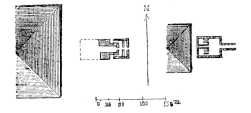
Fig. 127.—Plans of the temples belonging to the second and third pyramids; from Perring.
As such vast importance was attached to the preservation of the portrait statues upon which the prolongation of life after death was made so largely to depend, is it not probable that the idea of hiding some of them in the innermost recesses of the pyramids themselves may have occurred to those who caused those monuments to be built? It is obvious that no hiding-place could be more secure. No such retreats have yet been discovered in any of the galleries which have been explored by modern curiosity, but it does not follow that they do not exist in some corner which has not yet been reached, which will perhaps never be reached by the most persevering explorer. Quite lately M. Maspero believed that he recognized a serdab in a subterranean chamber with three niches which he found near the mummy chamber in the Pyramid of Ounas, the last king of the fifth dynasty.[182] Before we could say that such an arrangement does not exist elsewhere, we should have to take some pyramid to pieces from the first stone to the last. It might, however, be asserted that the images of the deceased would, if hidden in the pyramid, be too far removed from that public hall to which his relations brought their offerings and their pious homage. At such a distance they would not have heard the friendly voices or the magic chants; nor would the scent of the incense have reached their nostrils. In a word, they would have been ill placed for the fulfilment of the office assigned to them by the Egyptian faith.
We have hitherto spoken only of the social purposes of the pyramid, of its office as the sepulchre of the ancient kings of Egypt, or rather as the part of that sepulchre that corresponded to the least interesting parts of private tombs. In the plants of our gardens and orchards, we see cultivation develop certain organs at the expense of others. We find stamens changed into petals, giving us double flowers, and the envelope of the seeds thickened and made to shed perfume. We see the same process of development in the tombs of the early Egyptian monarchs. Under the influence of their pride of station, and as a consequence of the effort which they made to perpetuate their rank even after death, the stone hiding-place which protected the mummy took a size which is oppressive to the imagination, while the funerary chapel remained of modest dimensions. This disproportion is to be easily explained. The simple method of construction which distinguishes the pyramid permitted almost indefinite extension, while architecture, properly speaking, was not yet sufficiently advanced to make use of those grandiose orders which distinguish the porticos and hypostyle temples of the Theban period.
We have now to consider the pyramids from another point of view, from that of their probable origin, of their variety of form, and of the materials of which they are composed. Descriptions of these monuments, such as those contained in the great works of Vyse[183] and Perring[184], works which gave to the world the accumulated results of long and costly explorations, must not be looked for in these volumes. We do not think it necessary that we should give even a succinct account of the more important pyramids, such as that given by Bædeker or Isambert. Such a proceeding would be a mere duplication of those excellent manuals, and would moreover, be foreign to the purpose which we have before us. We take the pyramids as known. The two books just mentioned are within the reach of all. Thanks to the precise information and the numerous figures which they contain, we may content ourselves with making a few general observations. Some of these observations will refer to the pyramids as a whole, some to the peculiarities of construction which distinguish a few, peculiarities which do not affect that general type which seems to be as old as the Egyptian monarchy itself.
As soon as a society had sprung up on the banks of the Nile which attempted to organize itself under the directing lead of chiefs or headmen, the latter seem to have been stung by the desire to make known their final resting-place by some conspicuous sign. The most simple way of arriving at the desired result was to heap up the earth over the corpse, so as to form an artificial hillock which should be visible from a distance over the level plain. This was the origin of that funerary mound which modern archæologists call a tumulus. The tumulus is to be found in most districts of the ancient as well as of the modern world. But to confine ourselves to our own province, it is to be found in pre-Christian times among the Scythians of Herodotus and our ancestors the Gauls, as well as among the Greeks of the heroic age. We all know the frequent expression of Homer, σῆμα χεύειν, which is literally to display a signal, that is to say, to accumulate over the corpse of a warrior a sufficient number of spadefuls of earth to signalize it, for the worship and admiration of posterity. Tradition ascribes those tumuli which are yet to be seen on the plain of Troy to the observance of this custom.
The funerary architecture of Egypt commenced in the same fashion, in those distant ages which were called by the Egyptians themselves the times of Hor-schesou or slaves of Horus. We cannot doubt that the pyramid sprang from the mound. Its birth must have taken place after Menes had, by uniting the various tribes under his own sceptre, caused the whole race to take a distinct step onwards in civilization. The pyramid is but a built mound. It is a tumulus in which brick and stone take the place of earth. This substitution adds very greatly to its chances of duration, and makes it a much safer place of deposit and a much more lasting monument for the body committed to its charge. The Nile mud, when moulded and dried in the sun, gave bricks which still remain good; their manufacture and their constructive use seem to have been understood by the Egyptians as soon as they emerged from primitive barbarism. Thanks to the facilities thus afforded, they were enabled to build monuments upon the graves of their rulers which could offer a better resistance to injuries of time and human enemies than a few handfuls of earth and grass. They began, perhaps, by placing a few blocks of stone upon their mounds, so as to fix them more securely, or by covering them with a thin coat of brickwork. But, after a few experiments in that direction, they found it better to construct the whole body of the tumulus in the harder material. Its size increased with the constructive skill and material appliances of its builders, until it became first a hillock and finally a mountain of stone, with the impenetrable rock for its base and flanks of solid masonry.
The built-up tumulus of masonry took a form very different, in its definite lines, from the rounded slopes of the mound. The squared forms of brick or cut stone infallibly give to the edifice upon which they are employed one of those more or less rigid forms which are defined by geometry. When they leave the hands of the builder they are either cubes or parallelopipeds, pyramids or prisms, cylinders or cones. They present the general appearance, they possess the essential properties, of one of those forms. We may say that architecture was born on the day when man began to use the unyielding materials by which definite geometrical forms can alone be given. As soon as this early development was reached he set to work to combine those elementary forms in different proportions and to add to their effect by elegance and richness of decoration, and so in the end to form national architectures.
When the first pyramid was built upon the borders of the desert man was on the threshold of the movement to which we have referred. The form adopted for the royal tomb was one of the most simple which could be chosen for a building. The most simple of all would have been the tetrahedron, or pyramid built upon a triangular base. But not a single pyramid of that kind has been discovered in Egypt. The whole of the pyramids, large or small, are built upon a right-angled base, and in most instances upon one with sides practically equal.[185] Mystic reasons for this shape have been given. It has been said that each face was dedicated to one of the four powers of Amen, which corresponded to the cardinal points of heaven.[186] We are not yet sufficiently well acquainted with the genesis of the Egyptian religion to be able to decide how far into the past the four powers of Amen may be traced: but it is quite possible that they were derived from the four faces of the strictly oriented pyramids. Were we inclined to enter into this discussion we should rather, perhaps, attribute the shape of the pyramid to the prevailing Egyptian desire to turn one face of their tombs towards the west, the abode of the dead, and another to the east, whence the hoped-for resurrection was to come. The three-sided pyramid would not have lent itself to such an arrangement.
There is also something unpleasant to the eye in the sharp angles which form the three arêtes of the tetrahedron; it looks as if there had been a lack of material, and as if the structure would suffer in consequence. The four-sided pyramid has more dignity and more amplitude; its four faces, placed back to back in pairs, seem to counterpoise and sustain each other in a fashion which is impossible in the case of the tetrahedron.
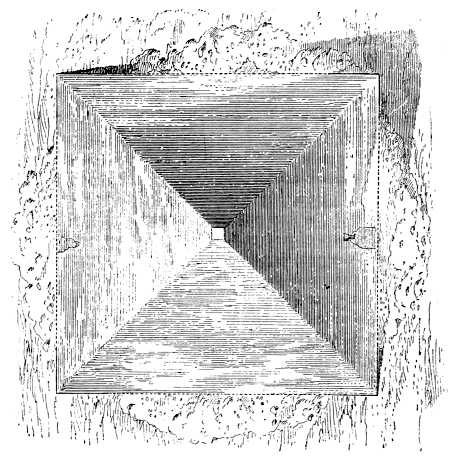
Fig. 128.—Plan of the Pyramid of Cheops.
The one characteristic possessed in common by those relics of the Ancient Empire which we call pyramids, is their four-sidedness. To an attentive observer these buildings offer more diversities than would at first sight be believed. From Meidoum in the south to Abou-Roash in the north is a distance of 43-1/2 miles as the crow flies. Between these two points, which may be called the northern and southern boundaries of the pyramid field, about one hundred have been discovered, sixty-seven of which have been examined by Lepsius. Now, in this whole number there are not two which resemble each other in all particulars, or which seem to be copies of one model. We do not refer only to their height, which differs in an extreme degree. The three large pyramids at Gizeh are 482, 454, and 218 feet high respectively, while at their feet are several little pyramids which hardly exceed from 50 to 70 feet of vertical height. Between these two extremes many of intermediate sizes may be inserted. The Stepped Pyramid, near Sakkarah, is about 190 feet high; the largest of those at Abousir is about 165; one of those at Dashour is not quite 100 feet. These differences in height are easily explained by one of those national habits to which we have already alluded. Every Egyptian, as soon as he arrived at years of discretion, set about building his own tomb. He dug the well and the mummy chamber, he caused the sarcophagus to be carved and the funerary chapel to be built. It often happened that those who had ordered such works died long before they were finished, and it would seem that their heirs were content with doing no more than was strictly necessary. They placed the mummy in its grave with the prescribed ceremonies, they filled up the well and sealed the private parts of the tomb; but being occupied with the preparations for their own funeral, they did not continue the decoration of the chapel, which thenceforward remained in statu quo. Thus only can we explain the state in which several important tombs have been discovered both at Memphis and at Thebes. On one wall we find paintings and sculptures carried out with the greatest care and finish, while on another nothing is to be seen but the first rough outline, in red paint, by the artist charged with the undertaking. The completion of the work must have been suddenly arrested by the death of the destined inhabitant of the tomb.
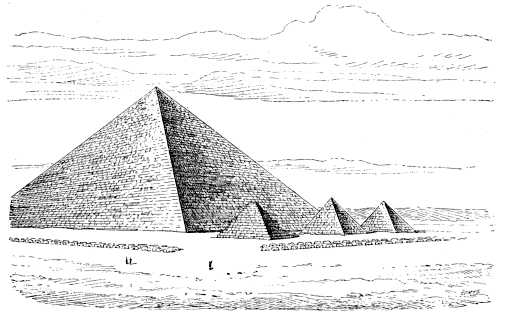
Fig. 129.—The great pyramid and the small pyramids at its foot; from Perring.
It was the same with the sepulchres of the kings. Each sovereign began the construction of his pyramid as soon as he found himself upon the throne. But, in case his life and his reign should be cut short, he began with those constituents of the tomb which were absolutely necessary. He pressed on the work until he had raised a pyramid of moderate size with its mummy chamber. When this point had been reached, his immediate anxiety came to an end; but that was no reason for interrupting the course of the work. The higher and wider his pyramid, the more efficient a guardian of his body would it be, and the more impressive would be the message carried down by it to posterity as to the power of its builder. Year after year, therefore, he employed crowds of impressed workmen to clothe it in layer after layer of dressed stone or brick, so that the edifice raised in comparative haste at the beginning of his reign, became in time nothing but the nucleus or kernel of one many times its size.[187] The construction was thus begun in the centre and was developed outwards, like the timber of a tree in successive years. As the pyramid grew in extent and height, each successive coat, so to speak, required more hands and more time. We have no reason to believe that each coat had to be finished within a certain period, and so it would be futile to attempt to found any calculation as to the duration of the different reigns upon the number of these concentric layers; but we may assert in a general way that the highest pyramids correspond to the longest reigns. We know, by the witness of ancient authors, that the kings who built the three great pyramids at Gizeh, namely, Cheops, Chephren, and Mycerinus, each reigned about sixty years. History thus confirms the truth of the induction which arises from the study of those monuments and from a comparison of the constructive processes made use of by the architects of the pyramids.[188]
The author of Bædeker's Guide has not been content with believing, like Perring, Lepsius, and Mariette, that the pyramid grew by the application of successive envelopes of stone round the central mass, either in horizontal courses or in courses sloping towards the axis of the building. He has brought forward an elaborate theory of construction, which, though very ingenious, encounters several grave objections. We shall point out those objections while we endeavour to explain the system itself by the help of special illustrations drawn for us by the author of the Guide in question.[189]
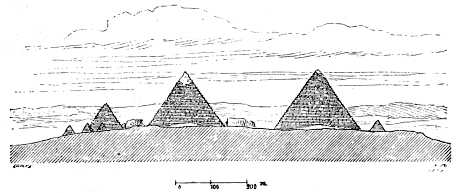
Fig. 130.—The three great pyramids; from the south.
When Cheops first began to think about building his tomb, he could not have counted upon giving it the colossal dimensions which it presents even in its actual injured condition. The area of the great pyramid is more than double that of Saint Peter's at Rome. If we deduct from its total volume the core of rock which it incloses[190] and the openings which it contains, the masonry in its primitive integrity must have amounted to a total of 3,479,600 cubic yards. Even now, when so much of its substances has been detached and carried away, there still remains the enormous mass of 3,246,600 cubic yards. Supposing that, two or three years after the commencement of a work upon this colossal scale, death had carried off its projector, can we believe that any successor, even a son who was sincerely devoted to the memory of his father, would have burthened himself with the continuation and completion of such an enterprise? The new sovereign would have enough to do in commencing and carrying on the erection of his own tomb, and, moreover, would be irresistibly tempted to make use, for its construction, of the accumulated material and collected labour of his predecessor.
Even four or five thousand years before our era, men were too sagacious to reckon upon the piety or gratitude of an heir. For the closing and final sealing up of the pyramid, its builder and destined inhabitant was obliged to depend upon his survivors, he could not do it himself. Moreover, the external completion, which, in the case of the greater monuments, must have been a long and costly matter, had to be entrusted to the same hands. The reigning king, so long as he was not too sternly reminded of the end by disease or the infirmities of age, must have felt great reluctance to order the cessation of the work which had gone on under his own eye for so many years, or to arrest that course of development which, after being a continual source of pride and pleasure to himself, might end in giving him a monument surpassing those of his famous predecessors. He was, therefore, very likely to be surprised by death with his tomb still unfinished, with the final cope-stone still upon the ground, or, even when that had been put in place so as to show the total height, with the casing of polished stone which was destined to hide the inner courses of the masonry and the entrances, still incomplete. Upon two-thirds or three-quarters of each face, his pyramid would still present the aspect which necessarily belonged to it during the period of its construction; an aspect which has again distinguished the great pyramid since it was despoiled of its casing. As each course was set back from that upon which it was placed, the final ensemble looked like an enormous staircase with steps gradually diminishing in length as they neared the summit.
There were many of the Egyptian princes who from want of patience or zeal, or from some other motive, failed to carry on the enterprise of their predecessors to its destined conclusion. We are ignorant as to the condition of the three great pyramids of Gizeh at the death of their projectors. But they appear to have been finished in most of their details with a care which would seem to indicate that Cheops, Chephren, and Mycerinus, must have been there to overlook the smallest details of their execution. Other pyramids, on the other hand, seem to have been left in a comparatively imperfect state.
These observations furnish us with an initial objection to the theory to which we have referred. Some may refuse to believe that Cheops intended from the beginning that his pyramid should have the dimensions and the internal arrangements which we now see. But why should he not have done so? If he had died at the end of a few years, his pyramid would, perhaps, have presented to us a shape like that of some other edifices of the same kind, a large base which had never received either its cope-stone or its casing. So too with those of Mycerinus and Chephren. Have not absolute monarchs existed at all times, whose infinite power seems to have made them forget the eternal limits of time and space? Sometimes Fortune has been cruel to them: but often she seems to have placed herself entirely at their disposal.
Among the causes which combine to make the royal tombs of the first six dynasties so unequal in height and appearance, the very unequal length of the reigns is the most important. If we were better acquainted with the condition of Egypt in those remote epochs, we should, no doubt, be enabled to give other reasons for their want of uniformity. The chances of completion and even of preservation in its complete state enjoyed by a pyramid must have greatly depended upon the descent of the crown. When king succeeded king in one family those chances were much better than when dynasty succeeded dynasty, whether the break were due to internal revolution or to the failure of the legitimate line. It is even possible that some of those pyramids which are now to outward appearance mere heaps of débris never received the mummy for whose reception they were designed and built.
The pyramids differ also in the materials employed. The great pyramids at Gizeh are built of fine limestone from Mokattam and Toura; the chief one at Sakkarah of a bad clayish limestone from the neighbouring rocks; at Dashour and Abou-Roash there are pyramids of unburnt brick. Finally there are pyramids built chiefly of stone which is kept in place by a carefully constructed skeleton, so to speak, of brick. This construction is to be found in the pyramid of Illahoun, at the entrance to the Fayoum (Fig. 131).
There is the same variety in the position of the mummy chamber. Sometimes this is within the sides of the pyramid itself, as in that of Cheops; sometimes, after the example of the mastaba, it is cut out of the living rock upon which the pyramid stands. This arrangement is to be found, for instance, in the pyramid of Mycerinus, where the roof of the mummy chamber is about 33 feet below the lowest course of the pyramid itself. So too in the Stepped Pyramid, where the whole complicated system of corridors and cells, which distinguishes that edifice, is cut in the rock, so that the building itself is absolutely solid. Most of the pyramids have no more than one or two entrances, giving access to narrow galleries, sometimes ascending, sometimes descending, which lead to one or two chambers of very small dimensions when compared to the enormous mass which rises above and around them (Fig. 132). In the subterranean part of the Stepped Pyramid the proportion of voids to solids is far less insignificant. This pyramid, which is not nearly so carefully oriented as the others, has four entrances and a series of internal passages, horizontal galleries, staircases and cells, which make it little else than a subterranean labyrinth. It is singular also in having, upon its central axis and at the point upon which, at various heights, all its galleries converge, a sort of large well, a chamber about twenty feet square and eighty feet high, in the pavement of which a huge block of granite cut into the shape of a cork or plug was so placed as to open at will[191] and leave a free passage for the descent into a second chamber, the purpose of which is more than obscure, as it is too small even to have contained a sarcophagus.[192] The end of the long passage which leads to the thirty chambers which have been counted beneath this pyramid has been found in the neighbouring sands (Fig. 134).
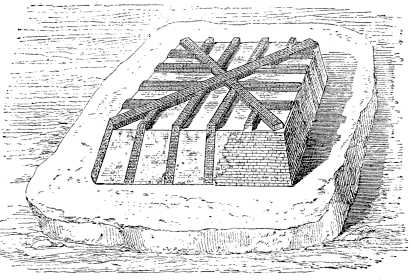
Fig. 131.—The pyramid of Illahoun, horizontal section in perspective; from the plan of Perring.
Another point of difference: most of the pyramids are built round a core of living rock, which is embraced by the lower courses of their masonry. But the pyramid of Mycerinus is just the reverse of this. It is built over a hollow in the rock which is filled up with masonry. The inequalities of the surface were usually taken advantage of so as to economize material, and make a greater show with less labour. Mycerinus, however, did not fear to increase his task by rearing his pyramid over a depression in the plateau.
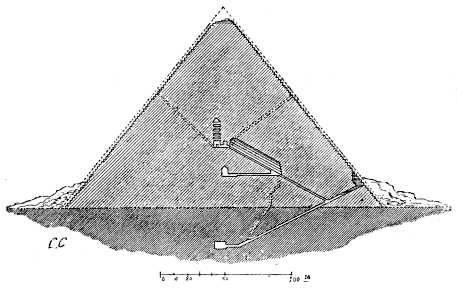
Fig. 132.—Section of the pyramid of Cheops; from Perring.
There is no less diversity in the external aspects of the pyramids. We are most familiar with the shapes of the great pyramids at Gizeh (Fig. 130 and Pl. 1, 2); their images have been multiplied to infinity by engraving and photography, but we make a great mistake when we imagine all the royal tombs at Memphis to be built upon this one model. They do not all present the same simplicity of form, the same regular slope from summit to base, or the smooth and polished casing which distinguished those great monuments when they were in complete preservation. The southern pyramid of Dashour offers us one of the most curious variations upon the original theme (Fig. 133). Its angle-ridges are not unbroken straight lines from base to summit. The slope of its faces becomes less steep at about half their height. The lower part of its sides make angles of 54° 41' with the horizon, while above they suddenly fall back to an angle of 42° 59'. This latter slope does not greatly differ from the 43° 36' of the other pyramid in the same neighbourhood. No indication has yet been discovered as to the builder of this pyramid.
A second variation, still more unlike the Gizeh type, is to be found in the great pyramid of Sakkarah, the Stepped Pyramid, which was considered by Mariette as the oldest of them all. Taking a passage from Manetho as his authority, he thought himself justified in attributing it to the fourth king of the first dynasty, Ouenephes or Ata, and he was inclined to see in it the Serapeum, or Apis tomb, of the Ancient Empire. Its present elevation is about 190 feet. Each of its sides is divided horizontally into six large steps with inclined faces. The height of these steps decreases progressively, from the base to the summit, from 38 feet 2 inches to 29 feet 6 inches. The width of each step is nearly 7 feet. It will be seen, therefore, that this building rather tends to the pyramidal form than achieves it; it is a rough sketch for a pyramid.
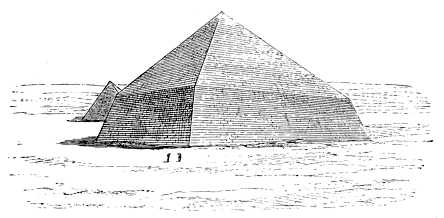
Fig. 133.—The southern pyramid of Dashour; from the measurements of Perring.
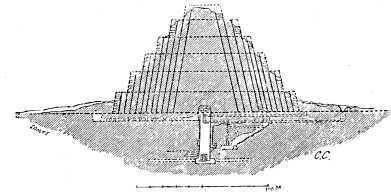
Fig. 134.—Section of the Stepped Pyramid; from Perring.
Does this want of completion result from accidental causes, or must it be referred to ignorance of the full beauties of the pyramidal form on the part of its builders? If the conjecture of Mariette is well founded, the Stepped Pyramid is not only the most ancient building in Egypt but in the whole world; and in the remote century which witnessed its construction men may not yet have learnt to fill up the angles left in their masonry, they may have been quite satisfied to leave their work in a condition which to us seems imperfect.
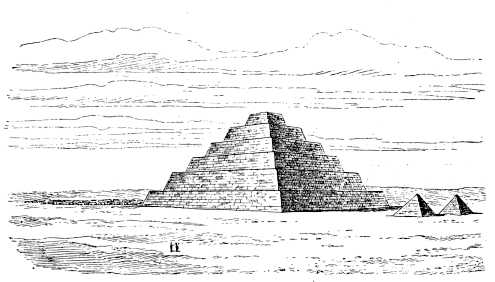
Fig. 135.—The Stepped Pyramid; restored from the measurements of Perring.
The Germans have evolved a complicated system of construction from notes made by Lepsius upon the details of the masonry in different pyramids. In order that this system may be more easily understood, we give, on the opposite page, a series of representations of such a pyramid in different stages of completion (Figs. 136 to 142). A commencement was made by erecting a very narrow and perpendicular pyramid crowned by a pyramidion, like a stumpy obelisk (Fig. 136). This finished, sloping masses were erected against it so as to form, with the pyramidion of the first mass, a second pyramid. The apex of this pyramid, a pyramidion of a single stone, might be put in place and the work considered finished (Fig. 137); or, if the builder were sanguine as to time, he might seek to push on still farther. Then, at the line where the slopes of the pyramid left the earth, four perpendicular walls were erected to the height of the pyramidion. The space between the sides of the pyramid and the inner faces of these walls was filled in, and thus a kind of terrace, or huge rectangular block, was obtained (Fig. 138), which served as the core for a new pyramid (Fig. 139). This again disappeared under a pyramid of larger section and gentler slope (Fig. 140), whose sides reached the ground far beyond the foundations of the terrace. In the case of a long reign this operation might be repeated over and over again (Figs. 140 and 142). A large pyramid would thus be composed of a series of pyramidal envelopes placed one upon another. The mummy-chamber was either cut in the rock before the laying of the first course of stone, or it was contrived in the thickness of the masonry itself; as the casing of stone went on increasing in thickness, galleries were left for ventilation and for the introduction of the sarcophagus and the mummy. The mummy-chamber is always found either upon the axis of the pyramid, or in its immediate neighbourhood, and always nearer the base than the summit.
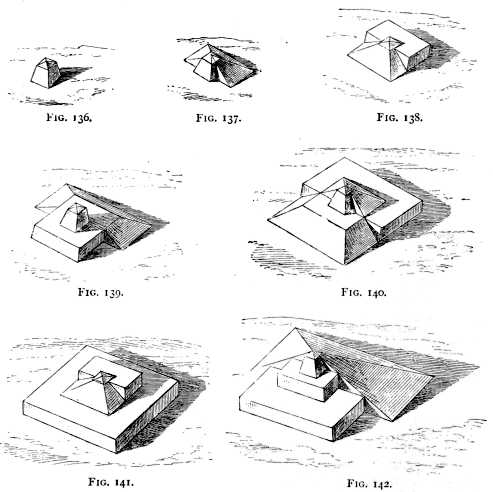
Figs. 136-142.—Successive states of a pyramid, according to the system advocated in Bædeker's Guide.
We are told that the system of construction here set forth is rendered almost certain by the fact that "the deeper we penetrate into the pyramid the more careful do we find the construction, which becomes more and more careless as the exterior is approached. In fact, as each new envelope was commenced, the chances of its being completed became less." The mass of stone to be worked and placed was greater, while the king, upon whose life the whole operation depended, was older and nearer his death. The builders became less sure of the morrow; they pressed on so as to increase, at all hazards, the size of the monument, and trusted to the final casing to conceal all defects of workmanship.
This system of pyramid building would explain the curious shapes which we have noticed in the Stepped Pyramid and the southern pyramid of Dashour.[193] Both of those erections would thus be unfinished pyramids. At Sakkarah, the angles left by the successive stages would be waiting for their filling in; at Dashour, the upper part of a pyramid of gentle slope would have been constructed upon the nucleus which was first erected, but the continuation of the slope to the ground would have been prevented by the stoppage of the works at the point of intersection of the upper pyramid and its provisional substructure. Hence the broken slope which has such a strange effect, an effect which could not have entered into the original calculations of the architect.
But although this theory seems satisfactorily to explain some puzzling appearances, it also, when tested by facts, encounters some very grave objections. The explorers of the pyramids have more than once, in their search for lost galleries and hidden chambers, cut for themselves a passage through the masonry, but neither in these breaches made by violence, nor in the ancient and carefully constructed passages to which they were the means of giving access, have any signs been, discovered, or at least, reported, of the junctions of different surfaces and slopes which must have existed according to the theory which we are noticing. We should expect, at least, to find the nearly upright sides of the cubic mass with which the pyramid began, contrasting with the comparatively gentle slopes which were built against it. These different parts of the pyramid, we are told, were built and finished separately, a proceeding which, if the later parts were to be properly fitted to the earlier and the final stability of the monument assured, would have demanded a minute and scrupulous care which was not common with Egyptian workmen. How, without numerous through bonding-stones, could those slides and settlements be prevented to which the want of homogeneity in the structure would otherwise be sure to lead? But we are not told that any such junctions of old and new work are to be found even in those points where they would be most conspicuous, namely, in the galleries leading to the internal chambers, where a practised eye could hardly fail to note the transition. We do not say that there are no such transitions, but we think the advocates of the new theory should have begun by pointing them out if they exist.
There is another difficulty in their way. How is their system to explain the position of the mummy-chamber in certain pyramids? Let us take that of Cheops as an example. If its internal arrangements had been fixed from the beginning, if the intention had been from the first to place the mummy-chamber where we now find it, at about one-third of the whole height, why should the builders have complicated their task by imposing upon themselves these ever difficult junctions? Would it not have been far better to build the pyramid at once to the required height, leaving in its thickness the necessary galleries? The same observation applies to the discharging chambers above the mummy-chamber. The whole of these arrangements, the high vestibule with its wonderful masonry, the chambers and the structural voids above them, appear to have been conceived and carried out at one time, and by the same brains and hands. Not a sign is to be found of those more or less well-veiled transitions which are never absent when the work of one time and one set of hands has to be united with that of another. Or are we to believe that they commenced by building a hill of stone composed of those different pyramids one within another, and that they afterwards carved the necessary chambers and corridors out of its mass? One of the heroes of Hoffmann, the fantastic Crespel, made use indeed of some such method in giving doors and windows to his newly-built house, but we may be sure that no architect, either in Egypt or elsewhere, ever thought of employing it. The disintegration to which it would lead may easily be imagined.
We may here call attention to a circumstance which justifies all our reserves. There is but one pyramid which seems to have been built upon a system which, though much less complicated, resembled that which we are noticing in some degree, we mean the Stepped Pyramid of Sakkarah. Now we find that the whole of the complicated net-work of chambers and passages in that pyramid is cut out of the living rock beneath its base, and that they are approached from without by subterranean passages. The difficulty of deciding upon the position of the chambers in advance, and of constructing the galleries through the various slopes of the concentric masses which were to form the pyramid, was thus avoided, and the builder was able to devote all his attention to increasing the size of the monument, by multiplying those parallel wedges disposed around a central core of which it is composed.
The observations made by Lepsius in the Stepped Pyramid and in one at Abousir seem to prove that some pyramids were constructed in this manner. In both of those buildings all necessary precautions were taken to guard against the weaknesses of such a system. It is difficult to understand how separate slices of masonry, placed one upon the other in the fashion shown by the section which we have borrowed from Perring's work (Fig. 134), could have had sufficient adherence one to another. Lepsius made a breach in the southern face of this pyramid, and the examination which he was thus enabled to institute led him to suggest a rather more probable system of construction. Upon the external sloping face of each step he found two casing-walls, but these did not extend from the ground to the apex of the monument, they reached no higher than the single step, so that they found a true resisting base in the flat mass (see Fig. 143) upon which they rested. Moreover, the architect provided for the lateral tying of the different sections of his work, as Lepsius proves to us by a partial section of the pyramid of Abousir. Two walls of fine limestone blocks inclose a filling in of rubble, to which they are bound by perpend stones which penetrate its substance. This method of construction has its faults, but it is so rapid that its employment is not to be wondered at.
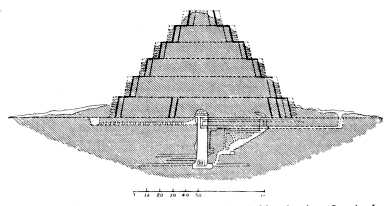
Fig. 143.—Section of the Stepped Pyramid at Sakkarah; from Lepsius.[194]
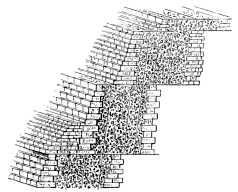
Fig. 144.—Construction of the Pyramid of Abousir in parallel layers; transverse section in perspective from the geometrical section of Lepsius.[195]
Do these parallel walls reach from top to bottom? A detail discovered by Minutoli would seem to indicate that a base was first constructed of sufficient extent for the whole monument. In the lower part of the Stepped Pyramid Minutoli[196] shows concave courses of stone laid out to the segment of a circle. These courses formed a kind of inverted vault, abutting, at its edges, upon the rock. This curious arrangement should be studied upon the spot by some competent observer. As we do not know whether these curves exist upon each face or not, or whether they meet each other and penetrate deeply into the structure or not, we cannot say what their purpose may have been. But however this may be, they afford another argument against the notion that all the great pyramids were built round such a pyramidoid core as that represented by our Fig. 136. We fear that this system must be regarded merely as an intellectual plaything. The views of Lepsius as to the enlargement of the pyramid by the addition of parallel slices are worthy of more respect, and their truth seems to be demonstrated in the case of some pyramids. But these all belong to that category of monuments which have subterranean chambers only. We have yet to learn that they were ever made use of in those pyramids which inclose the mummy-chamber and its avenues in their own substance. Variety is universal in that Egypt which has so often been described as the land of uniformity and immobility—no two of the pyramids resemble each other exactly.
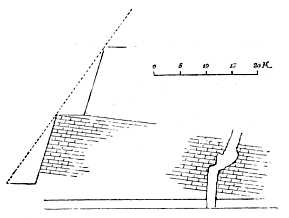
Fig. 145.—Partial section of the Stepped Pyramid; from Minutoli.
We have yet to speak of two ancient monuments in which some would recognize unfinished pyramids, namely, the Pyramid of Meidoum and the Mastabat-el-Faraoun. We do not agree with this opinion, which has, however, been lately put forward, so far, at least, as the former monument is concerned.[197] These two sepulchres seem to us to represent a different type of funerary architecture, a type created by the ancient empire, and meriting special notice at our hands.
The monument which rises so conspicuously from the plain near the village of Meidoum on the road to the Fayoum, is called by Arabs the Haram-el-Kabbab, or "the false pyramid." It is, in fact, not so much a pyramid, strictly speaking, as a mass formed of three square towers with slightly inclined sides superimposed one upon the other, the second being less in area than the first, and the third than the second. The remains of a fourth story may be distinguished on the summit of the third; some see in them the remains of a small pyramid; others those of a cone. Judging from the names found in the neighbouring mastabas, which were opened and examined by Mariette, this is the tomb of Snefrou I., one of the greatest kings of the third dynasty.[198]
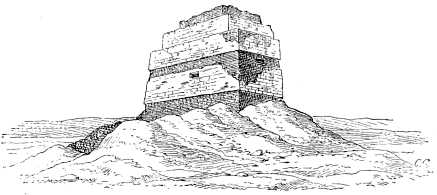
Fig. 146.—The Pyramid of Meidoum; from Perring.
The Mastabat-el-Faraoun or "Seat of Pharaoh," as the Arabs call it, is a huge rectangular mass with sloping sides; it is about 66 feet high, 340 long, and 240 deep. It is oriented like the pyramids. It is a royal tomb with internal arrangements which resemble those in the pyramid of Mycerinus; the same sloping galleries, the same chambers, the same great lateral niches. Upon a block lying at the foot of the structure of which it had once formed a part, Mariette found a quarry-mark traced in red ochre which seemed to him to form part of the name of Ounas, one of the last kings of the fifth dynasty (Figs. 109 and 147).
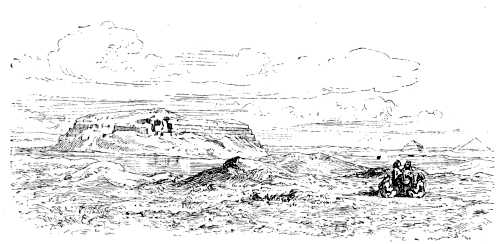
Fig. 147.—The Mastabat-el-Faraoun; from Lepsius.
Upon the platform of the Mastabat-el-Faraoun certain blocks are to be found which, from their position, must have been bonding-stones. They seem to hint, therefore, either that the structure was never finished, or that it has lost its former crown. The latter hypothesis is the more probable. Among the titles of people buried in the necropolis at Sakkarah, we often come upon those of priests attached to the service of some monument with a form similar to that represented by our Fig. 148. Who can say asks Mariette, that it is not the Mastabat-el-Faraoun itself?[199]
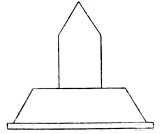
Fig. 148.—Funerary monument represented in the inscriptions.
M. Mariette cites, in support of this conjecture, certain other structures of a similar character, such as the large tomb situated near the south-eastern angle of the second pyramid at Gizeh, and the little monument which is called the Pyramid of Righa. From these he concludes that the principles of the mastaba and the pyramid were sometimes combined under the ancient empire. The royal tombs in the Memphite region were not always pyramids, they were sometimes composed of a mastaba and of one or more high square tower-like erections upon it, the whole ending in one of those small pyramids which we call pyramidions. This type allowed of numerous combinations, many of which are to be discovered in the monuments of a later period.
The pyramid was employed as a terminal form throughout the whole of Egyptian history. Both Thebes and Abydos offer us many examples of its use, either in those sepulchral edifices which are still extant, or in the representations of them upon bas-reliefs. But the pyramid properly speaking was confined to the Memphite period. The princes of the twelfth dynasty seem to have constructed some in the Fayoum. The pyramids of Hawara and Illahoon correspond to those which, we are told, were built in connection with the labyrinth and upon the islands of Lake Mœris respectively. These, so far as we can judge, were the last of the pyramids. There are, indeed, in the necropolis of Thebes, upon the rocks of Drah-abou'l-neggah, a few pyramids of crude brick, some of which seem to belong to Entefs of the eleventh dynasty; but they are small and carelessly constructed.[200] When the art of Egypt had arrived at its full development, such purely geometrical forms would seem unworthy of its powers, as they did not allow of those varied beauties of construction and decoration which its architects had gradually mastered.
The pyramids have never failed to impress the imaginations of those foreign travellers who have visited Egypt. Their venerable antiquity; the memories, partly fable, partly history, which were attached to them by popular tradition; their colossal mass and the vast space of ground which they covered, at the very gates of the capital and upon the boundary between the desert and the cultivated land, all combined to heighten their effect. Those nations who came under the living influence of Egypt could hardly, then, escape from the desire to imitate her pyramids in their own manner. We shall find the pyramidal form employed to crown buildings in Phœnicia, Judæa, and elsewhere. But the kingdom of Ethiopia, the southern annexe of Egypt and the copyist of her civilization, was the chief reproducer of the Egyptian pyramid as it was created by the kings of the ancient empire. Napata, Meroe, and other places have pyramids which may be counted by dozens. Like those in Egypt, they are the tombs of the native monarchs.
We shall not attempt any study of these remains. Like all the other products of Ethiopian art, they are neither original nor interesting. The people who inhabited the region which we now call by the names of Nubia and the Soudan, had, indeed, reconquered their political independence a thousand years before our era, but they were not gifted by nature with power to assimilate the lessons of their former masters. Even during the short period when the Ethiopian monarchs reigned over a divided and weakened Egypt, Ethiopia remained the clumsy pupil and imitator of the northern people. She never learnt to give to her royal pyramids the air of grandeur which distinguishes the great structures of Memphis. The Ethiopian pyramids were generally so narrow and steep in slope that their whole character was different from those of Egypt. In Egypt the base line was always greater than the vertical height, upon the Upper Nile the proportions were reversed.[201] The latter edifices thus lost some of that appearance of indestructible solidity which is their natural expression. They remind one at once of the obelisk and the pyramid. Add to this that an unintelligent taste overspread them with ill-devised decoration. Thus the upper part of their eastern faces, for they are oriented, generally bears a false window surmounted by a cornice, about as incongruous an ornament as could well be conceived, and one which expresses nothing either to the eye or the mind.
We shall, therefore, take no further notice of these more or less ill-designed variations upon the type which was created by the Egyptians in the early days of their civilization and fully understood by themselves alone.
We must return, however, to that type for a moment, in order to show, in as few words as possible, how far the art of working and fixing stone had advanced even at the time of the first dynasties.
The Great Pyramid affords us a curious example of the elaborate precautions taken against the violation of the royal tomb (Fig. 132). At the point where the ascending gallery branched off from that descending corridor which was the only entrance to the pyramid, the mouth of the former was closed by a block of granite which exactly fitted it. This block was so heavy and so well adjusted, that entrance could only be obtained by cutting a passage through the surrounding masonry, which, being of limestone, did not offer such an unyielding resistance to the tools brought against it. Formerly the mouth of a gallery, which seemed to be the continuation of the entrance corridor, remained open, and, when followed to the end, led to an unfinished chamber cut in the rock at about the level of the Nile. If this had been finished the waters would perhaps have invaded it by infiltration. This seems to have been intended by the constructor, because Herodotus, who no doubt thought the work had been completed, tells us of a subterranean conduit which admitted the waters of the Nile.[202] The violaters of the tomb would believe the corpse to be in this unsuspected reservoir, and would search no farther, or if they guessed the deception and persevered till they found the entrance to the ascending gallery, they would find another obstacle to their success which would be likely to arrest them longer than the first. The upper extremity of the great gallery, at which we suppose them arrived, opens upon a small vestibule which would still separate them from the sarcophagus-chamber itself. Four flat blocks of granite, sliding in grooves, masked the entrance to the latter; Figs. 150 and 151 show the arrangement of these portcullis stones. The narrow passage leading to the discharging chambers above the mummy-chamber, would be likely to lead our supposed robbers into the upper part of the pyramid. The entrance to this passage is high up in the end wall of the grand gallery; it was left open. The unbidden visitors would thus have explored the interior of the pyramid high and low without result, and even supposing that they expended considerable time and trouble in the search, they might easily have failed to penetrate into the mummy-chamber itself.[203]
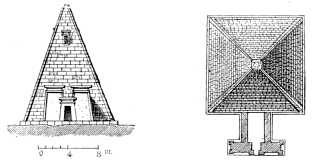
Fig. 149.—Plan and elevation of a pyramid at Meroe: from Prisse.
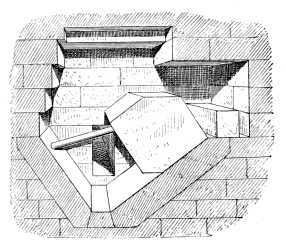
Fig. 150.—Method of closing a gallery by a stone portcullis; from the southern pyramid of Dashour. Drawn in perspective from the plans and elevations of Perring.
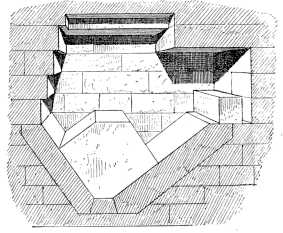
Fig. 151.—Portcullis closed.
Another ingenious arrangement which demands our notice is that of those discharging chambers to which we have already alluded. These chambers were explored, not without trouble, by Colonel Howard Vyse and J. L. Perring, who at once comprehended their use. The roof of the sarcophagus-chamber consists of nine slabs of fine red granite, like those which form the walls of the same chamber. They are 18 feet 9 inches long and their ends rest upon the side walls of the chamber. In spite of their thickness and of the hard nature of the rock of which they are composed, it was feared that they might give way under the enormous weight of the masonry above, for the floor of the chamber is still nearly 340 feet below the actual apex of the pyramid. This danger was met in the fashion figured above.
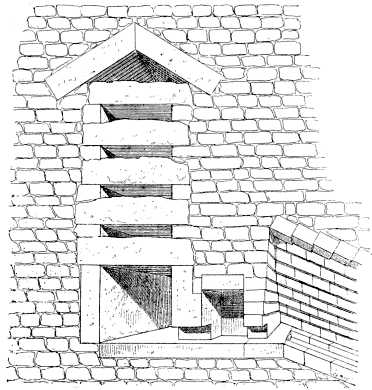
Fig. 152.—Transverse section, in perspective, through the sarcophagus-chamber and the discharging chambers; from the elevation of Perring.
As the structure grew above the roof of the mummy-chamber, five small chambers were left, one above the other, to a total height of 56 feet, which would relieve the flat ceiling of the mummy-chamber of the weight to be placed above it. The first four of these chambers were of similar shape and had flat roofs, but the roof of the fifth was formed of sloping slabs, meeting in a ridge, and giving the chamber a triangular section (see Fig. 152). Thanks to this succession of voids immediately over the main chamber, and to the pointed arch which surmounts them, the vertical pressure of the superstructure is discharged from the chamber itself and distributed over the lateral parts of the pyramid. These precautions have been quite effectual. Not a stone has been stirred either by the inward thrust or by the crushing of their substance; not a block is out of place but those which have been disturbed by the violence of man; and, moreover, the whole structure is so well bonded and so well balanced that even his violent attacks have led neither to disruption nor settlement in the apartment of Cheops or in the galleries which lead to it.[204]
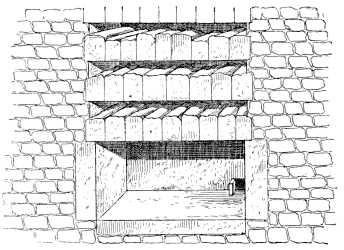
Fig. 153.—Longitudinal section through the lower chambers; perspective after Perring.
The glory of the workmen who built the Great Pyramid is the masonry of the Grand Gallery, the gallery which opens immediately into the vestibule of the King's Chamber. As this corridor is 28 feet high and 7 feet wide, the visitor can breathe more freely than in the low and narrow passages which lead to it, and can examine at his ease the beautiful blocks of limestone from Mokattam of which its polished walls are composed. The faces of these blocks have been dressed with a care which is not to be surpassed even by the most perfect examples of Hellenic architecture on the Acropolis at Athens. The internal faces must have been worked with equal care. No cement has been employed in the fixing, and the adherence is so perfect that, in the words of Abd-ul-Latif "not a needle, not even a hair, can be introduced into the joints."[205] These joints are not even to be distinguished without careful examination. The roof of this gallery is built with no less care.[206] Each of the upper courses is slightly set off from the one below it, so that in time they come so near together that the opening may be closed by a single stone, or rather, row of stones. These, being held between the two upper courses of a quasi vault, play the part of key stones. This method of vaulting has been employed in other parts of the pyramid, especially in what is called the Queen's Chamber, which is almost directly beneath the king's, or sarcophagus-chamber. The same care is conspicuous in those linings of red granite which form the walls of the two chambers. Even the fine limestone used for the walls of the Grand Gallery was not considered rich and solid enough for the walls of the apartment in which the prince in whose honour the whole of the colossal edifice was reared would repose; and it was determined to use the richest and most costly material of which the Egyptian architect could dispose.[207] The plain sarcophagus, without either inscription or ornament, which is still in the King's Chamber, is also of red granite.
The external casing of the pyramid has entirely disappeared, as we have already said. On account of their moderate size the stones of which it was composed would seem to be especially well fitted for use in building those great cities which, after the collapse of the ancient civilization, succeeded each other, under different names, in the neighbourhood of the Memphite necropolis. This casing seems to have been made of more than one kind of stone, if we may believe an ancient text which has been interpreted by Letronne with the skill and sagacity of which he has given so many proofs.[208]
The author, named Philo, of a treatise upon the Seven Wonders of the World, tells us that the Egyptians employed upon this work "the most brilliant and varied stones, which were carefully fixed." He mentions as contributing to the splendid result white marble, basalt, porphyry, and a green breccia from Arabia, which must have been what is called verde antique. And as for his white marble, it must have been the white limestone from Mokattam, which, in its best strata, is almost as white and fine in grain as marble. Marble, properly speaking, was only introduced into Egypt by the Greeks, and that in very small quantities, for the use of sculptors. Philo says nothing of granite, but its use was so general that it must have found a place in the scheme of decoration.[209]
The various kinds of stone must have been so placed as to form zones, and perhaps patterns, of different colours, white, red, black, rose, green, and so on. To form an idea of the effect we must think of Giotto's campanile at Florence and various other Italian buildings of the same kind.
It has been questioned whether the testimony of this Philo is to be depended upon, as few of those who have busied themselves with the pyramids seem to have laid much stress upon it. It seems to us to be worthy of great respect. We do not know when Philo lived, but we know that the casing of the pyramid was still in place, at least in part, during the Middle Ages, because in the time of Abd-ul-Latif it had almost its original height, and its ascent was still very difficult.[210] On the other hand we have proofs that, although the author of the Seven Wonders of the World may have written more in the tone of a rhetorician than of an eyewitness of the wonders which he describes, he took some of his information from excellent sources. In fact with the exception of Pliny, he is the only ancient writer who gives us an approximately true statement of the length of the base line of Cheops' Pyramid. While the measurements of other writers are very far from accurate, the figure given by Philo is only 16 feet 6 inches in excess of the truth. The idea of decorating such an expanse of surface with varied colour was quite in accordance with Egyptian taste. They loved polychromatic ornaments; they covered every available surface with the gayest hues; they delighted in the juxtaposition of the most brilliant tones. They could hardly think of covering such an immense surface with paint, and as it was necessary, in any case, to cover it with a smooth casing, it would be no more difficult to employ many kinds of stone than one. They would thus obtain a kind of gigantic mosaic which may perhaps have been heightened in effect by the use of gold. We know that the pyramidion of an obelisk was frequently gilded, and it is probable enough that similar means were sometimes taken, in the case of the more magnificent and carefully finished pyramids, to draw the eye to their topmost stone and thus to add to the impression made by their height. No more fitting adornment could be imagined for the sharp peak of a pyramid rising nearly five hundred feet into the pure blue of an Egyptian sky.
But this is a conjecture which can never be verified. Even if the topmost stone were still in place upon any of the pyramids it would, after all these ages, have lost all traces of gilding; but the whole of those edifices have their apex more or less truncated. Even before our era, Diodorus[211] found the Great Pyramid crowned by a plateau six cubits square.
It has sometimes been supposed that the pyramids, when complete, were terminated by such a plateau as that described by Diodorus, and that it bore a statue of the king whose mummy rested below. This hypothesis is founded upon the passage of Herodotus which treats of the Lake Mœris. "There are," he says, "in the middle of the lake, two pyramids, each fifty fathoms high (309 feet) ... each of them is surmounted by a colossal stone statue seated upon a throne."[212] Herodotus insists so often upon having seen the Labyrinth and Lake Mœris with his own eyes, that we cannot affect to doubt his assertions; we shall therefore confine ourselves to a few observations upon them.
In the descriptions which he gives of the three great pyramids, and among his comments upon the methods employed in their construction, Herodotus does not say a word which can be construed into the most distant allusion to statues upon their summits. If he had seen colossi perched upon those lofty pedestals, or if he had heard from his dragomans—whose exaggerations he has elsewhere so naïvely reproduced—that they had formerly existed, would he not have made some allusion to them in that passage, at least, where he explains how they raised such huge stones to so great a height, and describes the successive stages in the construction of a pyramid?[213] Would he not have found room, in the elaborate antithetical passage in which he contrasts the virtues of Mycerinus with the imaginary wickedness of Cheops and Chephren, for moral and critical reflections called up by the sight of their statues upon their respective pyramids; still more if one of them had happened to be missing? Would he not have attempted, through some popular tradition, to have accounted for the presence of one statue and the absence of another? It is evident, therefore, that Herodotus neither saw any statues upon the Pyramids of Memphis nor had he any reason to suppose those structures had ever been crowned in such a fashion. He lays stress upon the seated statues of the pyramids in Lake Mœris because they were new to him, because he had seen nothing of the same kind in the neighbourhood of the ancient capital.
Unless we are very much mistaken, this superposition of a colossus upon a pyramid was a novelty devised by the architects of the middle empire, when, under the Ousourtesens and Amenemhats, it was proposed to revive the pyramidal form of tomb with which the early Pharaohs had obtained such imposing results. Although most conservative on the whole, the art of Egypt attempted, at each period of renascence, to introduce new combinations into the details, at least, of the ancient forms, and this was one of the number.
Another innovation of the same kind is to be found in the decoration which covered, again according to Herodotus,[214] another pyramid constructed at about the same time, namely, that which formed one side of the Labyrinth. "It had," says the historian, "forty fathoms, and it was sculptured with animals of large size. The entrance was by a subterranean passage." From the Greek word used (ἐγγέγλυπται) we see that Herodotus means that the faces, or perhaps only the principal face, of this pyramid about two hundred and fifty feet high, were covered with bas-reliefs. There is in Egypt no other example of a pyramid so decorated. The architectural works of this period have almost entirely vanished, but we may, perhaps, look upon it as one of their characteristics that the bareness which they had inherited from the early creators of Egyptian art, was relieved and adorned by the intervention of the sculptor.
It was the desire for such ornament that made them convert their pyramids into gigantic pedestals for statues. According to all the analogies afforded by later ages, these statues must have been those of the princes who built the pyramids in question. We have no reason to suppose that any of the kings of the first six dynasties erected any colossal figures like those which were set up in such numbers by the Theban dynasties; with the single exception of the Sphinx, none of the statues left to us by the ancient empire greatly exceed the natural size. But it is evident that such figures as would be fit to crown the pyramids of Cheops and Chephren would have to be of extravagant size even if no more than their general outlines were to be visible from below. Seen from a point nearly 500 feet below, and in consequence of the inclination of the pyramid faces, at some considerable distance laterally, even a statue fifty feet high, like the two colossi of Amenophis III. on the plain of Thebes, would appear small enough to a spectator. Its artistic results would be very slender, and yet its erection would require prodigious mechanical efforts. It would have required all the multitudes of labourers, the patience, and the time, which the Egyptians alone dared to expend upon their monuments. But perhaps it may be said that these colossi were statues built-up of comparatively small stones. To this we must answer that every colossus as yet discovered in Egypt is a monolith. A statue, of whatever size, made in different pieces would form an exception to the whole practice of Egyptian sculpture as we know it. Until such works are proved to exist we decline to believe in them.
The problem was a much simpler one in the cases of the pyramids in Lake Mœris. They were not nearly so lofty. According to Herodotus they were about 309 feet high, doubtless including their statues. Situated as they were in the middle of the lake, Herodotus could not himself have measured them, and his statement that they sank as far below the level of the water as they rose above it is an obvious exaggeration. When the bed of the lake was formed, two masses of rock were no doubt reserved, as in the cases of the other pyramids, to form the core of the projected edifices, and therefore it is likely enough that the lowest courses of the constructions themselves dipped but little below the surface of the lake.[215] In his amazement at the scale upon which the Egyptian buildings were conceived, Herodotus has too often attributed excessive dimensions to them; thus he says that the height of the Great Pyramid was eight plethra, or about 820 feet, nearly 340 feet in excess of the truth. It is therefore probable that the figures which he gives for the lake pyramids are also exaggerated. These pyramids were, on account of their comparatively modest dimensions, much better adapted to the ideas of the Ousourtesens and Amenemhats than the gigantic piles of Cheops, Chephren, and Mycerinus.
Finally there is not a text to be found, outside the pages of Herodotus, which mentions pyramids surmounted by statues, and upon none of those monuments which in one way or another bear representations of the pyramids are they shown in any other way than with pointed summits. Thus do we find them in the papyri, upon those steles of the Memphite necropolis which commemorate the priests devoted to their service, and in those tombs at Memphis, Abydos, and Thebes where the pyramid, placed upon rectangular figures of various heights, is used as a terminal element. Neither in the small number of pyramids which have come down to us comparatively intact, nor in those which are represented in reliefs, is there the smallest sign of a truncated summit or of any platform which could by any possibility have borne a statue.
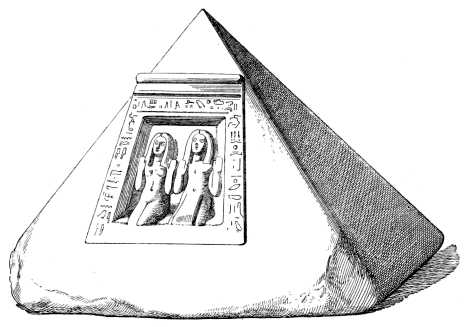
Fig. 154.—Pyramidion: Louvre.
We may say the same of those small pyramidions which have been found in such great numbers in tombs and which fill our museums. It is well known that these are votive offerings in connection with the worship of the sun. "The principal figure," says M. de Rougé, "is generally shown in a posture of adoration, with his face turned to the sun. On his left hand is the invocation to the rising, and on his right that to the setting sun. These arrangements are modified in various ways, but they are always upon the same genera lines as the orientation of the tombs themselves."[216] These minute pyramids also end in a point whether they be of basalt, granite, or calcareous stone, and it is natural that we should look upon them as the faithful reproductions upon a small scale of those great funerary monuments which furnished a type, consecrated by the most venerable of the national traditions, of that structure facing the four cardinal points which we may call the normal Egyptian tomb.
We may believe, then, that the pyramid of the ancient empire terminated in a pyramidion. This apex once fixed in place, the workmen charged with the final completion of the edifice worked downwards from one course to another, covering the immense steps which each face displayed five or six thousand years ago and now displays again, with the final casing which protected them for so many centuries. Even Herodotus saw that this must have been the method of completion.[217] Any other way of proceeding would have been too dangerous after the slope of the sides had been made smooth and continuous by the completion of the casing of polished granite. Workmen could only have kept their footing upon such a surface, with its 51 or 52 degrees of elevation, by means of a complicated arrangement of ropes and ladders. And again, points of resistance could not have been obtained for the elevation of the materials to ever increasing heights without cutting or leaving holes in the casing, which would afterwards have to be filled up. These difficulties would have unnecessarily complicated an operation which was a simple matter when begun from the top. The masons could then make use of the steps for their own locomotion, and when the stones were too large to be lifted from hand to hand, nothing could be easier than to fix windlasses by which the largest blocks could be raised with facility.
Dummy Footnote Text Greek: Exepoiêthê d'ôn ta aiôtata autês prôta, meta de ta hepomena toutôn exepoieun ... (ii. 125).
As the workmen approached the base they left above them an ever increasing extent of polished surface, sloping at such an angle that no foot could rest upon it, and forming the only safeguard against the degradation of the pyramid by removing its copestone or its violation by breaking into the passages which led to the mummy-chamber. The casing gave to the pyramid those continuous lines which were necessary to make its beauty complete, and, if the materials employed were varied in the way suggested, it furnished colour effects which had their beauty also. But, above all, it was a protection, a defensive armour. So long as the pyramid preserved its cuirass intact, it was difficult for those who meditated violence to know where to begin their attack. But this obstacle once pierced it was comparatively easy to learn all the secrets of the building. The inner mass was much less carefully built than the casing; the joints were comparatively open, and the stones were soft and easily cut. Hence we see that some pyramids, especially those which were built of bricks, have been reduced by the action of time into heaps of débris, in which the pyramidal form is hardly to be recognised.
Philo, who seems to be so well informed, tells us with what extreme care the casing was put in place. "The whole work," he says, "is so well adjusted, and so thoroughly polished, that the whole envelope seems but one block of stone."[218] The pyramid of Cheops has been entirely despoiled of its outer covering, and it is to that of Mycerinus that we must now turn if we wish to have some idea of the care with which the work was done. The lower part of this pyramid is still covered with long blocks of the finest granite, fixed and polished in the most perfect manner. At the foot of the Great Pyramid several blocks have been found which seem to have formed part of the casing of that edifice.[219] They are trapezoidal in form, and they show, as Letronne[220] long ago remarked, that the casing stones were placed one upon another, and adjusted by their external faces. They were not, as was at first supposed, sunk into the upper face of the course below by mortices which would correspond to the trench in the living rock in which the first course was fixed. As to whether the external faces of these blocks were dressed to the required angle before they left the quarry, or whether the work were done after they were in place we cannot say with any certainty, but it is most likely that the methods of proceeding changed with the progress of time and the succession of architects. In such a matter we should find, if we entered into details, diversity similar to that which we have already shown to have characterized the forms of the pyramids, their internal arrangements, and the materials of which they were composed.
Thus some triangular prisms of granite have been found at the foot of the pyramid of Chephren, which seem to have formed part of its lower casing.[221] Such a section seems, upon paper, the simplest that could be adopted for the filling in of the angle between two of the steps, but it is far inferior in solidity to the trapezoidal section. The prisms had no alliance one with another; they had to depend for their security entirely upon their adherence to the faces of the graded core, so that they could easily be carried off, or become dislocated from natural causes. This system, unlike the first described, did not give a homogeneous envelope with a thickness of its own, and partly independent of the monument which it protected.[222]
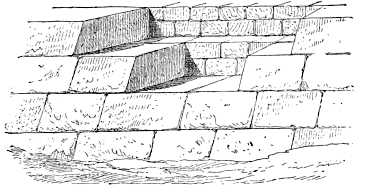
Fig. 155.—The casing of the pyramids; drawn in perspective from the elevation of Perring.
The casing of the Second Pyramid, moreover, does not seem to have been carried out on the same principle from top to bottom. The upper part, which still remains in place, is composed of a hard cement formed of chalk, gypsum, and pieces of burnt brick. They may have wished to obtain the parti-coloured effect of which Philo speaks, by making simultaneous use of granite and concrete, and it is quite possible that yet other materials entered into the composition of the casing.[223]
In other pyramids we find different combinations again. In the double-sloped erection at Dashour, the courses of casing stones are vertical instead of horizontal,[224] while a brick pyramid—the most northern—in the same locality, was covered with slabs of limestone, fixed, no doubt, with mortar.
Sometimes we find the revetment in a state of semi-completion; the blocks in place, and cut to the proper angle, but without their final polish. Such is the case with the Second Pyramid, upon which blocks of granite are to be found which are still rough in face. It would seem that the patience required for the minute completion of such a terribly long and tedious piece of work was not forthcoming. But we ought in fact to be surprised, not so much at the unfinished state of a pyramid here and there, but rather that they should ever have been completed.
The variety which is so conspicuous in the architectural construction of the pyramids is also to be found in their epigraphy. The first explorers of the Pyramids of Gizeh were surprised at the absence of all inscriptions beyond the masons' marks; the silence of those enormous structures seemed amazing; but soon Colonel Vyse discovered in the pyramid of Mycerinus the sarcophagus of that king, and the mummy case, now in the British Museum, which bears an inscription of some length. Recent discoveries, too, of which full details are yet wanting, prove that some of the pyramids contained long texts, which contain the names of kings and other information which is of great importance to the historian of the Egyptian religion. In 1879 and 1880, Mariette caused three pyramids at Sakkarah to be opened, which until then had remained unexplored. One of them was silent and empty, but in the others the inscriptions and sarcophagi of two kings of the sixth dynasty, Papi and his son Merenzi, were found. Fragments of a Ritual of the Dead were recognized among them. Pleasure at this discovery, the last which he was destined to make in the soil of Egypt, brightened the last days of Mariette.[225]
In March 1881, M. Maspero, the successor of M. Mariette as director of the excavations, opened a pyramid belonging to a different group, which turned out to be the tomb of Ounas, the last Pharaoh of the fifth dynasty. In this pyramid, portcullis stones similar to those which have already been figured were found. When these obstacles were passed "the continuation of the passage was found, the first part of polished granite, the second of the close-grained limestone of Tourah. The side walls are covered with fine hieroglyphs painted green, the roof sprinkled with stars of the same hue. The passage finally opens into a chamber half filled with débris, upon the walls of which the inscription is continued.... The mummy-chamber, like that which precedes it, is covered with hieroglyphs, with the exception of the wall opposite to the entrance. This wall is of the finest alabaster, and is effectively decorated with painted ornaments. The sarcophagus is of black basalt, without inscription.... The text of the inscription which covers the walls is almost identical with that in the tomb of Papi, but it has the advantage of being complete. M. Maspero, whom Mariette had previously entrusted with taking squeezes from the inscription in the tomb of Papi, recognised certain formulæ and phrases which had already struck him in another place.... These texts make up a composition analogous to one which covers the walls of certain little known Theban tombs. Without presenting any very considerable difficulties, they demand careful examination from those who would comprehend their meaning.
"M. Maspero, encouraged by this first success, ordered a second pyramid to be opened. He wished to verify, upon the spot, a theory which he had long upheld in spite of the adverse opinions of the majority of egyptologists. It is well known that between the sixth and the tenth dynasties a great gap exists, so far as monumental remains are concerned. M. Maspero has always believed that there is no such gap. He has observed that the pyramids are, so to speak, grouped chronologically from north to south; those of the fourth dynasty at Gizeh, those of the fifth at Abooseer, those of the twelfth in the Fayoum. The excavations of Mariette as well as his own showed the tombs of the fifth and sixth dynasties to have been at Sakkarah. Hence M. Maspero thinks that the pyramids erected by the sovereigns of the seventh, eighth, ninth, and tenth dynasties are those between Sakkarah and the Fayoum. The future will show whether he is right or wrong. In any case science will profit by the new excavations which he is about to undertake."[226]
When cross-examined by such questioners as M. Maspero the pyramids will tell us much. Hitherto they have attracted but little of that examination which discovers the most curious secrets, but their size and the beauty of their masonry will ever make the three great pyramids of Gizeh the most striking objects to the traveller and to the historian of art.
Considering their age, these three pyramids are wonderfully well preserved. In their presence, even in their actual state of partial ruin, the oriental hyperbolism of Abd-ul-Latif, an Arab writer of the thirteenth century, seems no more than natural. "All things fear Time," he cries, "but Time fears the Pyramids!" And yet time has done its work during the last few hundreds of years. The summits of the great structures have been slightly lowered; the gaping breaches in their flanks have been gradually widened; and although in spite of their stripped flanks and open wounds they still rear their heads proudly into the Egyptian sky, all those accessory structures which surrounded them, and fulfilled their own well-defined offices in the general monumental ensemble, have either been destroyed by the violence of man or engulfed by the encroaching sand. Where, for example, are those wide and substantial causeways, whose large and carefully adjusted blocks excited the wonder of Herodotus.[227] After having afforded an unyielding roadway for the transport of so many heavy materials, they formed truly regal avenues by which the funeral processions of the Egyptians reached the centre of the necropolis as long as their civilization lasted. In the plain they were above the level of the highest inundations, and their gentle slope gave easy access to the western plateau. The great Sphinx, the image of Harmachis, or the Rising Sun, was placed at the threshold of the plateau. Immovable among the dead of the vast cemetery, he personified the idea of the resurrection, of that eternal life which, like the morning sun, is ever destined to triumph over darkness and death. His head alone now rises above the sand, but in the days of Herodotus his vast bulk, cut from a rock nearly 70 feet high, was well calculated to prepare the eye of the traveller for the still more colossal masses of the pyramids. His features have now been disfigured by all kinds of outrage, but in the thirteenth century, although even then he had been mutilated, Abd-ul-Latif was able to admire his serene smile, his head enframed in a richly carved wig which added to its size and dignity. His body was never more than roughly blocked out, but a painted decoration, of which traces may still be found, compensated in some degree for the deficiencies in the modelling.
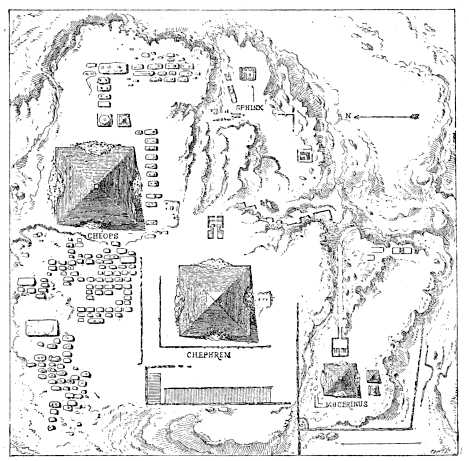
Fig. 156.—Plan of the Pyramids of Gizeh and of that part of the necropolis which immediately surrounds them.
The soil around each pyramid was carefully levelled and paved with dressed limestone slabs. Upon this pavement rested the foundations of the stylobate surrounding the pyramid. Both stylobate and pavement are now in almost every case concealed by sand and débris, but at the pyramid of Chephren, which is less banked up than the others, traces of them have been proved to exist. They added somewhat to the imposing effect of those monuments upon the eye, and gave additional definition to their bases.[228] The area thus paved was inclosed with a wall, which had an opening towards the east, in front of which the temple, or funerary chapel of the pyramid, was raised. The latter, no doubt, was magnificently decorated. At the foot of the mountains of stone under which reposed the ashes of the Pharaohs themselves, smaller pyramids were raised for their wives and children. Of these some half dozen still exist upon the plateau of Gizeh. One of them has been recognized as the tomb of that daughter of Cheops, about whom Herodotus tells one of those absurd stories invented by the Egyptians of the decadence, with which his dragomans took such delight in imposing upon his simple faith.[229] Around the space which was thus consecrated to the adoration of the dead monarch, the long rows of mastabas stretched away for miles through the vast necropolis.
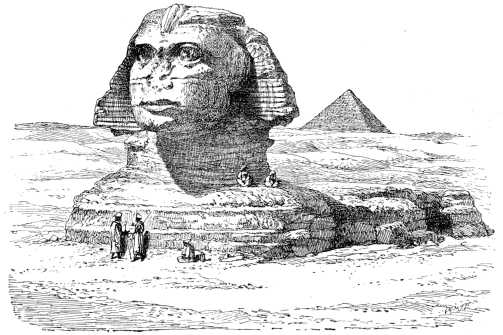
Fig. 157.—The Sphinx.
The great ones of Egypt, all those who had been near the Pharaoh and had received some of his reflected glory, grouped their tombs as closely as possible about his. Distributed thus by reigns, the private tombs were erected in close juxtaposition one with another, each being provided with a stele, or sepulchral tablet upon which the name of the deceased was inscribed, most of them being adorned with painted bas-reliefs, and a few with statues placed upon their façades. Upon the causeways which connected Memphis with the necropolis, upon the esplanades erected by the Pharaohs to the memory and for the adoration of their ancestors, in the countless streets, lanes, and blind alleys which gave access to the private tombs, advanced endless processions of mourners, driving before them the bleating and lowing victims for the funeral rites. Priests in white linen, friends and relations of the dead with their hands full of fruit and flowers, flitted hither and thither. On the days appointed for the commemoration of the dead, all this must have afforded a curiously animated scene. The city of the dead had its peculiar life, we might almost say its festivals, like that of the living. But amid the coming and going, amid all the bustle of the Egyptian jour des morts, it was the giant forms of the pyramids, with their polished slopes[230] and their long shadows turning with the sun, that gave the scene a peculiar solemnity and a character of its own. Morning and evening this shadow passed over hundreds of tombs, and thus, in a fashion, symbolized the royal dignity and the almost superhuman majesty of the kingly office.
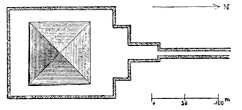
Fig. 158.—Pyramid with its inclosure, Abousir; from Perring.
Of all this harmonious conception but a few fragments remain. The necropolis is almost as empty and deserted as the desert which it adjoins. The silence is only broken by the cry of the jackal, by the footsteps of a few casual visitors hurrying along its deserted avenues, and by the harsh voices of the Bedouins who have taken possession of the Pyramid of Cheops, and, in their own fashion, do its honours to the curious visitor. But despoiled though they be of their ornaments and of their proper surroundings, the pyramids are yet among those monuments of the world which are sure to impress all who possess sensibility or powers of reflection. In a remarkable passage in the Description générale de Memphis et des Pyramides, Jomard has well defined the effect which they produce upon the traveller and the impressions which they leave behind: "The general effect produced by the pyramids is very curious. Their summits, when seen from a distance, look like those of high mountains standing out against the sky. As we approach them this effect diminishes; but when we arrive within a very short distance of their sides a totally different impression succeeds; we begin to be amazed, to be oppressed, almost to be stupefied by their size. When quite close to them their summits and angles can no longer be seen. The wonder which they cause is not like that caused by a great work of art. It is the sense of their simple grandeur of form and of the disproportion between the individual power and stature of man and these colossal creations of his hands. The eye can hardly embrace them, nor the imagination grasp their mass. We then begin to form some idea of the prodigious quantity of dressed stone which goes to make up their height. We see hundreds of stones each containing two hundred cubic feet and weighing some thirty tons, and thousands of others which are but little less. We touch them with our hands and endeavour to realize the power which must have been required to quarry, dress, carry, and fix such a number of colossal blocks, how many men must have been employed on the work, what machines they used, and how many years it must have taken; and the less we are able to understand all these things, the greater is our admiration for the patience and power which overcame such obstacles."[231]
§ 3. The Tomb under the Middle Empire.
We have shown how the mastaba, that is to say, the most ancient form of tomb in the necropolis of Memphis, was an expression, both in arrangement and in decoration, of the ideas of the Egyptians as to a future life. In literature and in art the works created by a people in its infancy, or at least in its youth, are the most interesting to the historian, because they are the results of the sincere and unfettered expansion of vital forces; this is especially the case when there is no possibility of a desire to imitate foreign models. The mastaba deserved therefore to be very carefully studied. No other race has given birth in its funerary architecture, to a type so pure, a type which may be explained in every detail by a master-idea at once original and well defined. We therefore dwelt upon it at some length and described it with the care which it demanded. We found it again in the pyramids, the royal tombs of the Ancient Empire, which though sensibly modified by the great change in proportion, by the colossal dimensions which the pride of the Pharaohs gave to one part of their tomb, are yet penetrated by the same spirit. We have yet to follow the development of the same idea through the later years of Egyptian civilization, and in localities more or less removed from that in which she gave her first tokens of power. In one place we shall find it modified by the nature of the soil to which the corpse had to be committed, in another by the inevitable progress of ideas, by the development of art, and by the caprices of fashion, which was no more stationary in Egypt than elsewhere.
The most important necropolis of the First Theban Empire was that of Abydos in Upper Egypt, upon the left bank of the river. The great number of sepultures which took place in it, from the first years of the monarchy until the end of the ancient civilization, is to be explained by the peculiarly sacred character of the city of Abydos, and by the great popularity, from one end of the Nile valley to the other, of the myths which centred in it. According to the Egyptian belief, the opening through which the setting sun sank into the bowels of the earth for its nightly transit, was situated to the west of Abydos. We know how the Egyptian intellect had established an analogy between the career of the sun and that of man; we may therefore conclude that in choosing a final resting-place as near as possible to the spot where the great luminary seemed to make its nightly plunge, they believed they were making more completely sure of triumphing, like him, over darkness and death.
The sun is not extinguished, he is but hidden for a moment from the eyes of man. This sun of the infernal regions is Osiris, who, of all the Egyptian gods, was most universally adored. Although many Egyptian towns could show tombs in which the members of Osiris, which had been dispersed by Set, were re-united by Isis and Nephthys, none of them were so famous, or the object of such deep devotion, as that at Abydos. It was, if we may be permitted to use such a phrase, the Holy Sepulchre of Egypt. As, in the early centuries of Christianity, the faithful laid great stress upon burial in the neighbourhood of some holy martyr, "The richest and most influential Egyptians," says a well informed Greek writer, "were ambitious of a common tomb with Osiris."[232]