Chapter III · (continued 4)
Walter Armstrong translation
These tombs resemble those of the kings in having no well; and as for the funerary chapel we do not as yet know whether it existed at all, how it was arranged, or what took its place. Perhaps each of the more carefully constructed tombs was divided into two parts, a chamber more or less decorated and a niche contrived in the masonry, like the rock-cut ovens of the Phœnician catacombs. As soon as the mummy was introduced, the niche was walled up, while the chamber would remain open for the funerary celebrations. In order that the tombs situated at some height above the level of the soil, and in the middle of the block of buildings, should be reached, a complicated system of staircases and inclined planes was necessary. In the course of centuries the tombs of the first layer and especially those in the centre of the mass, were overwhelmed and buried from sight and access by the continual aggregation above and around them. The families to which they belonged, perhaps, became extinct, and no one was left to watch over their preservation. Had it not been for the infiltration of the Nile water, these lower strata of tombs would no doubt have furnished many interesting objects to explorers. In any case it would seem likely that, if deep trenches were driven through the heart of these vast agglomerations of unbaked brick, many valuable discoveries would be made.[281] Such a system left slight scope to individual caprice; space must have been carefully parcelled out to each claimant, and the architect had much less elbow room than when he was cutting into the sides of a mountain or building upon the dry soil of the desert. In the royal tombs alone, if time had left any for our inspection, could we have found materials for judging of the funerary architecture of Sais, but, as the matter stands, we are obliged to be content with what we can gather from Theban and Memphite remains as to the prevailing taste of the epoch.
Upon the plateau of Gizeh, to the south of the Great Pyramid, Colonel Vyse discovered and cleared, in 1837, an important tomb to which he gave the name of Colonel Campbell, then British Consul-General in Egypt. The external part of the tomb had entirely disappeared, but we may conclude that it was in keeping with the subterranean portion. The maker of the tomb had taken the trouble to define its extent by a trench cut around it in the rock. The external measurements of this trench are 89 feet by 74. A passage had been contrived from one of its faces to the well, which had been covered in all probability by an external structure. The well opens upon a point nearer to the north than the south, and its dimensions are quite exceptional. It is 54 feet 4 inches deep, and 31 feet by 26 feet 8 inches in horizontal section; it terminates in a chamber which is covered by a vault 11 feet 2 inches thick. It was not however in this chamber, but in small lateral grottos that several sarcophagi in granite, basalt, white quartz, &c., were found. The remains of two other wells were traced. This tomb dates from the time of Psemethek I.
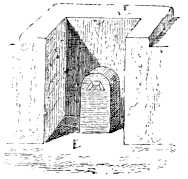
Fig. 199.—Section in perspective of "Campbell's tomb," from the plans and elevations of Perring.
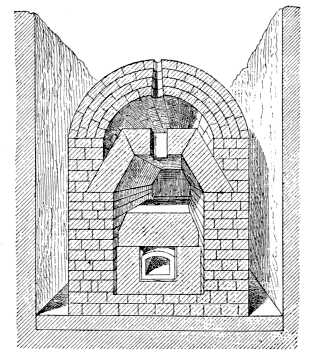
Fig. 200.—Vertical section in perspective of the sarcophagus chamber of the above tomb; compiled from Perring.
In the necropolis of Thebes there is a whole district, that of the hill El Assassif, where most of the tombs belong to the twenty-sixth dynasty. Their external aspect is very different from that of the Theban sepulchres. The entrance to the subterranean galleries is preceded by a spacious rectangular courtyard, excavated in the rock to a depth of 10 or 12 feet. This court was from 80 to 100 feet long and from 40 to 80 feet wide; it was surrounded by a stone or brick wall, and reached by a flight of steps. A pylon-shaped doorway gave access to the courtyard from the side next the rock, another door of similar shape opened upon the plain; "but some tombs are entirely closed (see Fig. 201) except towards the mountain, from which side they may be entered by one or two openings."
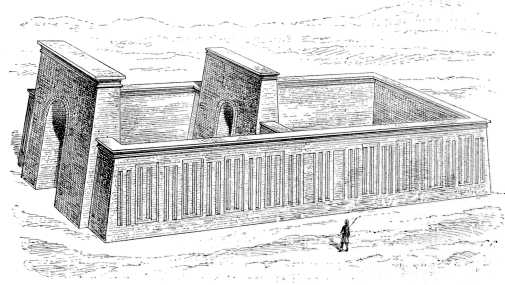
Fig. 201.—A Tomb on El-Assassif (drawn in perspective from the plans and elevations of Prisse).
The subterranean part of these tombs varies in size. In some of them a gallery of medium length leads to a single chamber. In others, and these form the majority, there is a suite of rooms connected by a continuous gallery. To this latter group belongs the largest of all the subterranean Theban tombs, that of Petamounoph (Fig. 191). We have already noticed the extraordinary dimensions of its galleries; there are also two wells which lead to lower sets of chambers. All the walls of this tomb are covered with sculptured reliefs. In the first chambers these are in very bad condition, but they improve as we advance, and in the farthest rooms are remarkable for their finish and good preservation. The exterior of this sepulchre is worthy of the interior. The open court, which acts as vestibule, is 100 feet long by 80 wide. An entrance, looking towards the plain, rises between two massive walls of crude brick, and, to all appearance, was once crowned by an arcade; within it a flight of steps leads down into the court. Another door, pierced through the limestone rock, leads to a second and smaller court which is surrounded by a portico. From this peristyle a sculptured portal leads to the first subterranean chamber, which is 53 feet by 23, and once had its roof supported by a double range of columns. The next chamber is 33 feet square. With a double vestibule and these two great saloons there was no lack of space for gatherings of the friends and relations of the deceased.
Neither at Memphis nor at Thebes do the tombs of this late period contain any novel elements, but they are distinguished by their size and the luxury of their decoration. In some, the wells are much wider than usual; in others it is upon the external courts and upon those double gateways which play a part similar to that of the successive pylons before a Theban temple, that extra care is bestowed. Vaults are frequently employed and help to give variety of effect. Private tombs become as large as those of sovereigns, and similar tendencies are to be found in the sculpture. The Egyptian genius was becoming exhausted, and it endeavoured to compensate for its want of invention and creative imagination by an increase in richness and elegance.
A chronological classification is only possible in the cases of those tombs which bear inscriptions and figures upon their walls. At Memphis, as at Thebes, the remains of thousands of tombs are to be found which give no indication of their date. Sometimes they are deep mummy pits, slightly expanding at the bottom; sometimes, as at Thebes, the rock is honeycombed with graves between the border of the cultivated land and the foot of the Libyan chain. In the mountains themselves there are hundreds of small chambers, with bare walls and often extremely minute in size, cut in the sides of the cliffs. Finally, there are the vast catacombs, in each chamber of which the mummies of labourers and artisans were crowded, often with the instruments of their trade by their sides.[282] Pits full of mummified animals are also found among the human graves. Rhind saw some hundreds of the mummies of hawks and ibises taken from a tomb at the foot of the Drah-Abou'l-Neggah. They were each enveloped in bandages of mummy cloth, and beside them numerous small boxes, each with a carefully embalmed mouse inside it, were found. The lids of these boxes had each a wooden mouse upon it, sometimes gilt.[283]
We have endeavoured to notice all that is of importance in the funerary architecture of Egypt, because the Egyptian civilization, as we know it through the still existing monuments, carries us much farther back than any other towards the first awakening of individual thought and consciousness in mankind. The primitive conceptions of those early periods were, of course, different enough from those to which mankind was brought by later reflection, but nevertheless they were the premises, they contained the germ of all the development that has followed; and to thoroughly understand the origin and constitution of this development it was necessary to follow it up to its source, to the clearness and transparency of its springs.
The art of Egypt is the oldest of all the national arts, and the oldest monuments of Egypt are its tombs. By these alone is that earliest epoch in its history which we call the Ancient Empire known to us.
In later ages the country was covered with magnificent temples and sumptuous palaces, but, even then, the tomb did not lose its pre-eminent importance. The chief care of the Egyptian in all ages was his place of rest after death. Rich or poor, as soon as he arrived at full age he directed all his spare resources towards the construction and decoration of his tomb, his happy, his eternal "dwelling," with which his thoughts were far more preoccupied than with that home in the light, upon which, whether it were a miserable mud hut or a vast edifice of brick or wood, he looked with comparative indifference, regarding it as an encampment for a day or a mere hotel for a passing traveller. The tombs, when not hollowed from the living rock, were built with such solidity and care that they have survived in thousands, while the palaces of great sovereigns have perished and left no trace, and the temples which have been preserved are very few in number.
Being mostly subterranean and hidden from the eye of man, sepulchres preserved the deposits entrusted to them much better than buildings upon the surface. Those among the latter which were not completely destroyed, were, in very remote times, damaged, pillaged, stripped, and mutilated in a thousand ways. All that subsists of their decoration—shattered colossi and bas-reliefs often broken and disfigured—tells us nothing beyond the pomps and triumphs of official history. The tombs have suffered much less severely. The statues, bas-reliefs, and paintings which have been found in them, seem, in many instances, to have been the work of the very men whose footprints were found in the sand which covered their floors when they were opened.[284] The pictures offered to our eyes by the walls of the private tombs are very different from those which we find in the temples. All classes of the people appear in them in their every-day occupations and customary attitudes. The whole national life is displayed before us in a long series of scenes which comment upon and explain each other. Almost all that we know concerning the industrial arts of Egypt has been derived from a study of her tomb-houses. In every hundred of such objects which our museums contain at least ninety-nine come from those safe depositories.
In order to give a true idea of the national character of the Egyptians and to enable the originality of their civilization to be thoroughly understood, it was necessary to show the place occupied in their thoughts by the anticipation of death; it was necessary to explain what the tomb meant to them, to what sentiments and beliefs its general arrangements and its principal details responded; it was necessary to follow out the various modifications which were brought about by the development of religious conceptions, from the time of the first six dynasties to that of the Theban Empire.
The brilliant architectural revival which distinguished the first and second Theban Empires was mainly due to this development of religious thought. Almost all the peculiarities of the Memphite tomb are to be explained by the hypotheses with which primitive man is content. But when mature reflection evolved higher types for the national gods, when polytheism came to be superimposed upon fetishism, the hour arrived for the temple to take its proper place in the national life, for majestic colonnades and massive pylons to be erected on the banks of the life-giving river. The temple was later than the tomb, but it followed closely upon its footsteps, and the two were, in a fashion, united by those erections on the left bank of the Nile, under the Theban necropolis, which partook of the character of both. The temple is the highest outcome of the native genius during those centuries which saw Egypt supreme over all the races of the East, supreme partly by force of arms, but mainly by the superiority of her civilization.