Chapter III
Walter Armstrong translation
Sepulchral Architecture.
§ 1. The Egyptian Belief as to a Future Life and its Influence upon their Sepulchral Architecture.
The most ancient monuments which have yet been discovered in Egypt are the tombs; they have therefore a right to the first place in our sketch of Egyptian architecture.
In every country the forms and characteristics of the sepulchre are determined by the ideas of the natives as to the fate of their bodies and souls after life is over. In order to understand the Egyptian arrangements, we must begin then by inquiring into their notions upon death and its consequences; we must ask whether they believed in another life, and in what kind of life. We shall find a complete answer to our question in the collation of written texts with figured monuments.
In the first period of his intellectual development, man is unable to comprehend any life but that which he experiences in his own person. He is as yet unable to observe, to analyse or to generalize. He does not perceive the characteristics which distinguish him from things about him, and he sees nothing in nature but a repetition of himself. He is therefore incapable of distinguishing between life such as he leads it and mere existence. He dreams of no other way of being than his own. As such is the tendency of his intellect, nothing could be more natural or more logical than the conception to which it leads him in presence of the problem offered to him every time that a corpse descends into the grave. M. Maspero has so thoroughly understood the originality of the solution adopted by the Egyptians that we cannot do better, in attempting to explain the hypothesis, at once gross and subtle, to which they had recourse for consolation, than borrow his rendering of the texts which throw light upon this subject, together with some of the reflections which those texts suggested to him.[114]
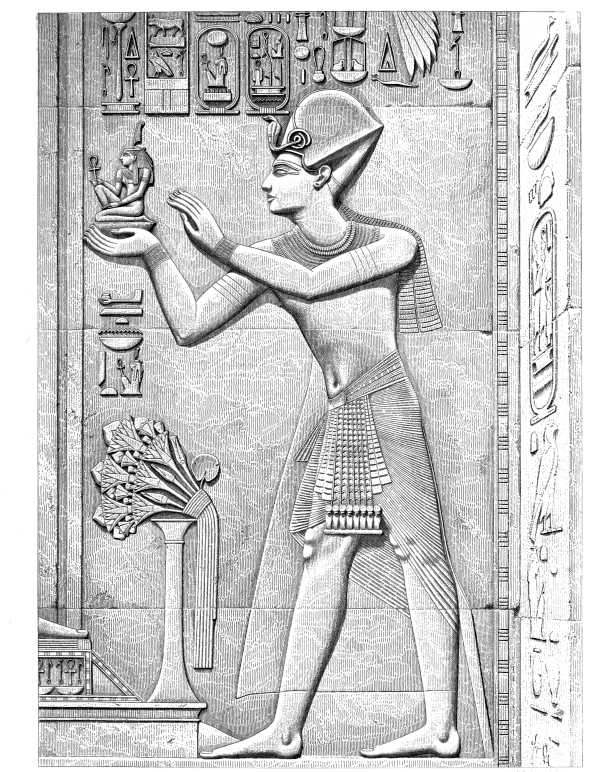
J. Sulpis del. et sc. SETI I BAS-RELIEF AT ABYDOS
Were we to affirm that during thousands of years no change took place in the ideas of the Egyptians upon a future life, we should not be believed, and, as a fact, those ideas underwent a continual process of refinement. Under the eighteenth and nineteenth dynasties, during those centuries when the limits of Egyptian empire and Egyptian thought were carried farthest afield, we find traces of doctrines which offer notable variations, and even, when closely examined, actual contradictions. These are successive answers made during a long course of time to the eternal and never-changing enigma. As they became more capable of philosophic speculation the Egyptians modified their definition of the soul, and, by a necessary consequence, of the manner in which its persistence after death must be understood, and as always happens in such a case, these successive conceptions are super-imposed one upon another; the last comer did not dethrone its predecessor but became inextricably blended with it in the popular imagination.
We refer all those who wish to follow minutely this curious development of the Egyptian intellect to the subtle analysis of M. Maspero. That historian has applied himself to the apprehension of every delicate shade of meaning in a system of thought which has to be grasped through the veil thrown around it by extreme difficulties of language and written character, but at the same time he has never attempted to endow it with a precision or logical completeness to which it had no claim. By well chosen comparisons and illustrations he enables us to understand how the Egyptian contented himself with vague notions, and how he managed to harmonize ideas which seem to us inconsistent.
We shall not enter into those details. We shall not seek to determine the sense which the Egyptians attached, after a certain period, to the word bâi,[115] which has been translated soul, nor the distinction between it and khou, luminousness, which the soul seems to have enveloped like a garment. We shall not follow the soul and its internal light in its subterranean journey across Ament, the Egyptian Hades, to which it entered by a cleft, Pega, to the west of Abydos, which was the only portal to the kingdom of the shades; nor shall we accompany them in the successive transformations which made them acquainted with every corner of the earth and sky in the infinite series of their becomes (to use the Egyptian expression); what we have to do is to trace out the most ancient of their religious conceptions, the conception which, like the first teachings of infancy, was so deeply engraved upon the soul and intellect of the race as to exercise a much stronger influence than the later more abstract and more philosophical theories, which were superimposed upon it. In this primitive conception we ought to find the determining cause of the Egyptian form of tomb. Its constitution was already settled in the time of the ancient Empire, and, from the Memphite dynasties until the end, it remained unchanged in principle. In this constitution we shall find embodied the essential idea adopted by the Egyptians when they first attempted to find some eternal element in man, or, at least, some element which should resist the annihilation of death for a period much longer than the few days which make up our mortal life.
The Egyptians called that which does not perish as the dying man draws his last sigh, the ka, a term which M. Maspero has rendered as the double. "This double was a duplicate of the body in a matter less dense than that of the body, a projection, coloured but aërial, of the individual, reproducing him feature for feature, a child if coming from a child, a woman if from a woman, and a man if from a man."[116]
This double had to be installed in a lodging suitable to its existence, had to be surrounded by objects which it had used in its former state, had to be supplied with the food which was necessary for the sustenance of its life. And all these things it obtained from the piety of its relations, who, on fixed days, brought them to the threshold of the good dwelling or the eternal dwelling, which were the phrases used by the Egyptians.[117] By these offerings alone could the hungry and thirsty phantom which had replaced the living man be kept alive. The first duty of the survivors was to take care that this dependent existence should not be extinguished by their neglect, to provide food and drink for the support, if we may use such a phrase, of the precarious life of the dead, who would otherwise be irritated against them and use the almost godlike power attributed to his mysterious condition for the punishment of his ungrateful posterity.[118]
This conception is not peculiar to Egypt. The double of the Egyptian sepulchral records corresponds exactly to the εἴδωλον[119] of the Greeks and the umbra of the Latins. Both Greeks and Latins believed that when the funeral rites had been duly accomplished, this image or shadow entered upon the possession of a subterranean dwelling and began a life which was no more than the continuation of that in the light.[120] The dead thus remained in close relation with the living, on the one hand by the nourishment which they received, on the other by the protection which they afforded; even in the funeral repast they took their parts, in the strictest sense of the word, in the eating and drinking.[121] They looked impatiently forward to these supplies because, for a moment, they awoke their dormant thoughts and feelings and gave them glimpses of the true life, the life above ground and in the sunshine.[122] If they were kept waiting too long they became angry and revenged themselves upon those who had caused their sufferings. Woe to the family or city which was not careful to interest the dead in its stability and thus to associate them with its prosperity![123]
These beliefs seem to have been common to all ancient peoples during that period of their existence which is lost in the shadow of prehistoric times. From India to Italy all the primitive forms of public and private rights betray their presence. For this fact and its consequences we may refer our readers to the fine work of M. Fustel de Coulange, La Cité antique.[124]
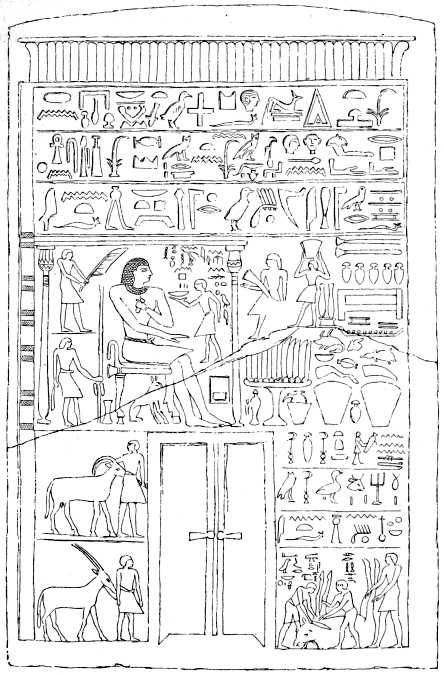
Fig. 86.—Stele of the 11th dynasty. Boulak. Drawn by Bourgoin.
With the progress of centuries and the development of religious thought, more elevated ideas prevailed. The growth of the scientific spirit tended to make the notion of a being suspended between life and death ever more strange and inadmissible. Experience accumulated its results and it became daily more evident that death not only put an end to the activity of the organs, but that, immediately upon its occurrence, it began to dissolve and decompose their tissues. As time rolled on men must have found it very difficult to believe in a shadow thus placed outside the normal conditions of life, in a something which was not a spirit and yet survived the destruction of its organs.
It would seem then that observation and logical reflection should soon have led to the abandonment of a theory which now appears so puerile; but, even in these scientific times, those whose intellects demand well defined ideas are few indeed.[125] At a period when the diffusion of intellectual culture and the perfection of scientific methods add daily to our accumulations of positive knowledge, most men allow their souls to be stirred and their actions to be prompted by the vaguest words and notions; how much greater then must the influence of those confused beliefs and baseless images have been in antiquity when but a few rare minds, and those ill provided with means of research and analysis, attempted to think with originality, clearness and freedom.
The prestige of this illusion was increased and perpetuated by its intimate connection with several of those sentiments which are most honourable to human nature. Such a worship of the dead surprises and even scandalizes us by its frank materialism, but if we seek for the source of its inspiration and its primitive meaning, we find them in the remembrance of lost objects of affection, in feelings broken by the supreme separation, in the gratitude of children to the parents who gave them birth and nourished their infancy, in the recognition by the living of the blessings which they enjoy through the long and laborious efforts of their ancestors. There was no doubt a perishable element in the funerary ideas of Egypt, an element which the progress of reason was sure to destroy, and we may be tempted to smile when we think of the Greek or Egyptian giving himself the trouble to feed his departed ancestors with blood, milk, or honey, but with all their simplicity, both one and the other were alive to a truth which the revolutionary spirit of our days, with its childish and brutal contempt for the past, is often unable to grasp. They realized the complete solidarity of one human generation with another. Guided by their hearts alone they anticipated the results at which modern thought has arrived by close and attentive study of history. From a reasoned out conviction of this truth and its consequences, philosophy now draws the principles of a high morality! but long before our days this idea and the tender, grateful, sentiments which it provoked had been a powerful instrument in the moral improvement of the first-born of civilization and a bond of union for their civil and domestic life.
We have thought it right to dwell upon this worship of the dead and to describe its character at some length, because the beliefs upon which it was based are not to be found so clearly set forth in the art of any other people. Their most complete, clear, and eloquent expression, in a plastic form, is to be seen in the tombs which border the Nile. And why is this so? It is because the Egyptian industries were already in full possession of their resources at the period when those beliefs had their strongest hold over the minds and feelings of the people. In the case of Greece, art did not arrive at its full development until the worship of the dead had lost its high place in the national conscience. When the Greek genius had arrived, after much striving, at its complete power of plastic expression, the gods of Olympus had been created for several centuries, and art was called upon to interpret the brilliant polytheism of Homer and Hesiod, to give outward image to those gods, and to construct worthy dwellings for their habitation. Sculptors, painters, and architects still worked indeed, at the decoration of the tomb. They strove to give it beauty of shape and arrangement, and to adorn its walls with bas-reliefs and pictures; they designed for it those vases and terra cottas which, in our own day, have been found in thousands in the cemeteries of Greece and Italy, but all this was only a subordinate use of their talent. Their ambition was to build temples, to model statues of Zeus, Pallas, and Apollo. On the other hand, those distant ages in which primitive and childish ideas of religion prevailed, had no art in which to manifest their beliefs with clearness and precision.
It was otherwise in the valley of the Nile. A well provided industry and an experienced art laid themselves out to interpret the popular beliefs and to defend the dead against final dissolution, or the agonies of hunger and thirst. Egypt did not differ from other nations in its opinions upon the mystery of death. In the infancy of every race the same notions on this matter are to be found, and in this respect the only difference between the Egyptians and the rest of the world is very much to the credit of the former; they rapidly attained to a degree of civilization which was only reached by other races after their religious development was comparatively mature. Thanks to this advantage, they were enabled to push their ideas to consequences which were not to be attained by tribes which were little less than barbarous, and they had no difficulty in expressing them with sufficient force and precision.
It remains for us to show the use which the Egyptians made of their superiority in doing more honour to their dead, in guarding them more safely against the chances which might shorten the duration or destroy the happiness of their life in the tomb. The fulfilment of this duty was, as the Greek travellers rightly affirmed, their chief pre-occupation. Their sepulchral architecture was, of all their creations, the most original and the most characteristic of their genius, especially in the forms which we find in the cemeteries of the Ancient Empire. In the time of the New Empire, at Thebes, it is less complete and homogeneous. In the latter the arrangement and decoration do not spring, as a whole, from a unique conception; we find traces in it of new hypotheses and novel forms of belief. These do not supersede the primitive ideas; they are added to them, and they bear witness to the restless efforts made by human thought to solve the problem of human destiny. These apparent contradictions and hesitations are of great interest to the student of the Egyptian religion, but from the art point of view the Memphite tombs are more curious and important than those of later date. They have the great merit of being complete in their unity both of artistic form and of intellectual conception. They are the offspring of a single growth, and are perfect in their clear logical expression. And again, they are the type of all the later tombs, of those at Abydos, at Beni-Hassan, and at Thebes. Certain details, indeed, are modified, but the general disposition remains the same to the end. We shall, therefore, find the ruling principle of Egyptian sepulchral architecture most clearly laid down in the cemeteries of Gizeh and Sakkarah.
The first and most obvious necessity for the obscure form of life which was supposed to commence as soon as the tomb had received its inmate, was the body. No pains, therefore, were spared which could retard its dissolution and preserve the organs to which the double and the soul might one day return.[126] Embalming, practised as it was by the Egyptians, rendered a mummy almost indestructible, so long, at least, as it remained in the dry soil of Egypt. On the warm sands of Sakkarah and close to the excavations from which the fellahs of the corvée were returning at the end of their day's labour, we—my travelling companions and myself—stripped a great lady of the time of Ramses of the linen cloths and bandages in which she was closely enveloped, and found her body much in the same condition as it must have been when it left the workshop of the Memphite embalmer! Her black hair was plaited into fine tresses; all her teeth were in place between the slightly contracted lips; the almond-shaped nails of her feet and hands were stained with henna. The limbs were flexible and the graceful shapes but little altered under the still firm and smooth skin, which, moreover, seemed to be still supported by flesh in some parts. Had it not been for its colour of tarred linen or scorched paper, and the smell of naphtha which arose from the body and from the numberless bandages which were strewn about, we might have shared the sentiment attributed to Lord Evandale in Theophile Gautier's brilliant Roman de la Momie; with an effort of good-will we could almost sympathise with those emotions of tenderness and admiration which were excited in the breast of the young Englishman at the sight of the unveiled charms of that daughter of Egypt whose perfect beauty had once troubled the heart of the proudest of the Pharaohs.[127]
In order that all the expense of embalming should not be thrown away, the mummy had to be so placed that it could not be reached by the highest inundations of the river. The cemeteries were therefore established either upon a plateau surrounded by the desert, as in the case of Memphis and Abydos, or in the sides of the mountain ranges and in the ravines by which they were pierced, as at Thebes and Beni-Hassan. In the whole valley of the Nile, no ancient tomb has been discovered which was within reach of the inundation at its highest.[128]
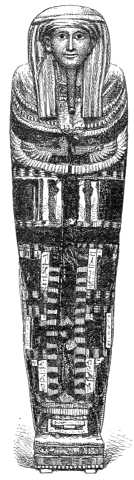
Fig. 87.—Mummy case from the 18th dynasty. Boulak.
The corpse was thus preserved from destruction, first by careful and scientific embalming, secondly by placing its dwelling above the highest "Nile." Besides this we shall see that the Egyptian architects made use of many curious artifices of construction in order to conceal the entrance to the tomb, and to prevent the intrusion of any one coming with evil intentions. All kinds of obstacles and pitfalls are accumulated in the path of the unbidden visitor, with a fertility and patient ingenuity of invention which has often carried despair into the minds of modern explorers, especially in the case of the pyramids. Mariette was fond of saying that there are mummies in Egypt which will never, in the strictest sense of the word, be brought to light.
But in spite of all this pious and subtle foresight, it sometimes happened that private hate or, more often, the greed of gain, upset every calculation. Enemies might succeed in penetrating to the sepulchres of the dead, in destroying their bodies, and thus inflicting a second death worse than the first; or a thief might drag the corpse from its resting place, and leave it naked and dishonoured upon the sands, that he might, with the greater ease, possess himself of the gold and jewels with which it had been adorned.
The liability of the mummy to accident had to be provided against. The idea of the unhappy condition in which the double would find itself when its mummy had been destroyed, led to the provision of an artificial support for it in the shape of a statue. Art was sufficiently advanced not only to reproduce the costume and ordinary attitude of the defunct and to mark his age and sex, but even to render the individual characteristics of his physiognomy. It aspired to portraiture; and the development of writing allowed the name and qualities of the deceased to be inscribed upon his statue. Thus identified by its resemblance and its inscriptions it served to perpetuate the life of the double, which was in continual danger of dissolution or evaporation in the absence of a material support.
The statues were more solid than the mummy, and nothing stood in the way of their multiplication. The body gave but one chance of duration to the double; twenty statues represented twenty chances more. Hence the astonishing number of statues which are sometimes found in a single tomb. The images of the dead were multiplied by the piety of surviving relations, and consequently the double was assured a duration which practically amounted to immortality.[129]
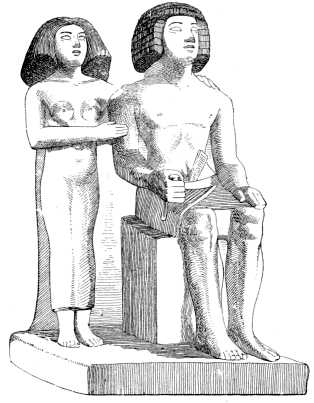
Fig. 88.—Man and his wife in the style of the 5th dynasty. Calcareous stone. From the Louvre.
We shall see that a special recess was prepared in the thickness of the built up portion of the tomb for the reception of wooden or stone statues, so that they might be kept out of sight and safe from all indiscreet curiosity. Other effigies were placed in the chambers of the tomb or the courts in front of it. Finally, we know that persons of consideration obtained from the king permission to erect statues in the temples, where they were protected by the sanctity of the place and the vigilance of the priests.[130]
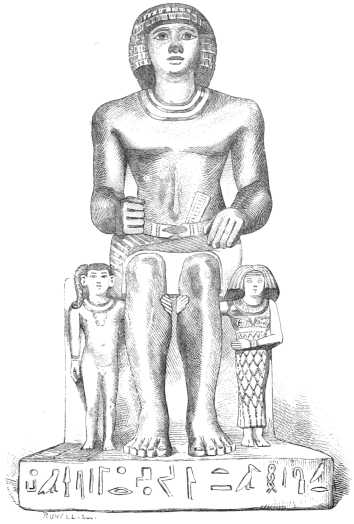
Fig. 89.—Sekhem-ka, his wife Ata, and his son Khnem, in the style of the 5th dynasty. Limestone. From the Louvre.
From the point of view of the ancient Egyptians such precautions were by no means futile. Many of these effigies have come down to us safely through fifty or sixty centuries and have found an asylum in our museums where they have nothing to fear but the slow effects of climate and time. Those which remain intact may therefore count upon immortality. If the double required nothing to preserve it from annihilation but the continued existence of the image, that of Chephren, the builder of the second great pyramid, would be still alive, preserved by the magnificent statue of diorite which is the glory of Boulak, and thanks to the durability of its material, it would have every chance of lasting as long as the world itself. But, unhappily for the shade of Pharaoh, this posthumous existence which is so difficult of comprehension to us, was only to be prolonged by attention to conditions most of which could not long continue to be observed.
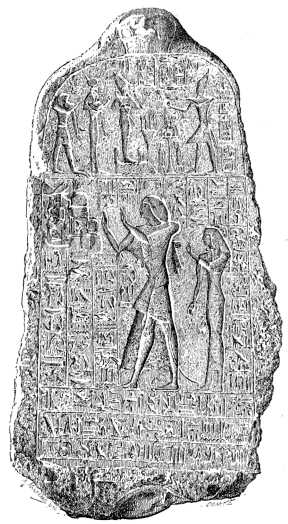
Fig. 90.—Stele of Nefer-oun. Boulak.
It was entirely a material life. The dead-alive had need of food and drink, which he obtained from supplies placed beside him in the tomb,[131] and afterwards, when these were consumed, by the repasts which took place periodically in the tomb, of which he had his share. The first of these feasts was given upon the conclusion of the funeral ceremonies,[132] and they were repeated from year to year on days fixed by tradition and sometimes by the expressed wish of the deceased.[133] An open and public chamber was contrived in the tomb for the celebration of these anniversaries. It was a kind of chapel, or, perhaps, to speak more accurately, a saloon in which all the relations and friends of the deceased could find room. At the foot of the stele upon which the dead man was represented sacrificing to Osiris, the god of the dead, was placed a table for offerings, upon which the share intended for the double was deposited and the libations poured. A conduit was reserved in the thickness of the wall by which the odour of the roast meats and perfumed fruits and the smoke of the incense might reach the concealed statues.[134]
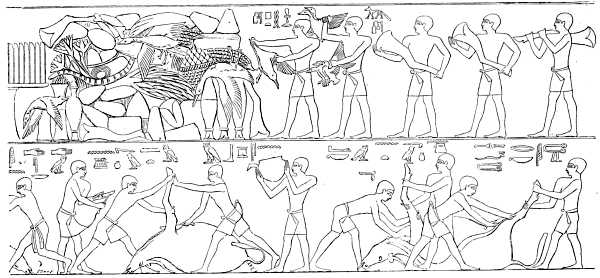
Fig. 91.—Preparation of the victims and arrival of funeral gifts, 5th dynasty. Height of each band, 13-1/2 inches. Boulak. Drawn by Bourgoin.
The Egyptians did not trust only to the piety of their descendants to preserve them from a final death by inanition in their neglected tombs. At the end of a few generations that piety might grow cold and relax its care; besides, a family might become extinct. All those who could afford it provided against such contingencies as these by giving their tombs what we now call a perpetual foundation. They devoted to the purpose the revenues of some part of their property, which was also charged with the maintenance of the priest or priests who had to perform the ceremonial rites which we have described.[135] We find that, even under the Ptolemies, special ministers were attached to the sepulchral chapel of Cheops, the builder of the great pyramid.[136] It may seem difficult to believe that a "foundation" of the ancient empire should have survived so many changes of régime, but the honours paid to the early kings had become one of the national institutions of Egypt. Each restoring sovereign made it a point of duty to give renewed life to the worship of those remote princes who represented the first glories of the national history.
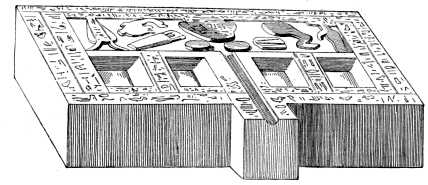
Fig. 92.—Table for offerings. Louvre.
Besides which there were priests attached to each necropolis, who, for certain fees, officiated at each tomb in turn. They were identified by Mariette upon some of the bas-reliefs at Sakkarah. Their services were retained much in the same way as masses are bought in our days.[137]
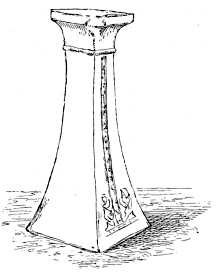
Fig. 93.—Another form of the table for offerings. Boulak.
The same sentiment led to the burial with the dead of all arms, clothes, jewels, and other objects of which they might have need in the next life. We know what treasures of this kind have been obtained from the Egyptian tombs and how they fill the cases of our museums. But neither was this habit peculiar to Egypt. It was common to all ancient people whether civilized or barbarous. Traces are to be found even in the early traditions of the Hellenic race of a time when, like those Scythians described by Herodotus,[138] the Greeks sacrificed, at the death of a chief, his wives and servants that they might accompany him to the next world. When she began to reveal herself in the arts Egypt was already too far civilized for such practices as these; thanks to the simultaneous development of science, art and religion, she found means to give the same advantages to her dead without permitting Scythian cruelties. Those personal attendants and domestic officers whose services would be so necessary in another life, were secured to them at a small expense; instead of slaying them at the door of the tomb, they were represented upon its walls in all the variety of their occupations and in the actual moment of labour. So too with all objects of luxury or necessity which the double would wish to have at hand, as for instance his food and drink.[139]
A custom which would seem to have established itself a little later may be referred to the same desire; we mean the habit of placing in the tomb those statuettes which we meet with in such vast numbers after the commencement of the second Theban Empire.[140] Mariette obtained some from tombs of the twelfth dynasty, and the sixth chapter of the Book of the Dead, which is engraved upon them, seems to be one of the most ancient. Egyptologists are now inclined to believe that the essential parts of this ritual date back as far as the Memphite period.
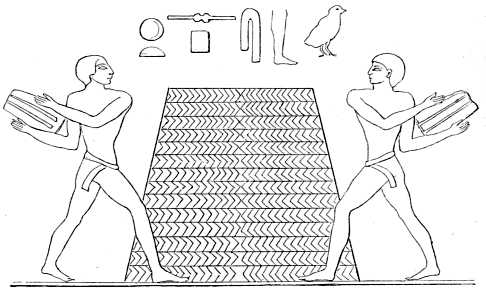
Fig. 94.—Labourers heaping up ears of corn, from a tomb at Gizeh. (Description de l'Égypte.)
These statuettes are of different sizes and materials. As a rule they do not exceed from eight to twelve inches, but there are a few which are three feet or more in height. Some are in wood, some in limestone, and some in granite, but as a rule they are made of that kind of terra cotta which, when covered with green or blue enamel, has been called Egyptian porcelain. They are like a mummy in appearance; their hands are crossed upon the breast and hold instruments of agriculture such as hoes and picks, and a sack meant for grain hangs from their shoulders. The meaning of all this is to be sought in the Egyptian notions of a future life; it is also explained by the picture in chapter XC. of the Ritual, which shows us the dead tilling, sowing and harvesting in the fields of the other world. The texts of the Ritual and of certain inscriptions call these little figures oushebti or answerers from the verb ousheb, to answer. It is therefore easy to divine the part attributed to them by the popular imagination. They answered to the name traced upon the tomb and acted as substitute for its tenant in the cultivation of the subterranean regions.[141] With the help of the attendants painted and sculptured upon the walls they saved him from fatigue and from the chance of want. This is another branch of the same old idea. In his desire to take every precaution against the misery and final annihilation which would result from abandonment, the Egyptian thought he could never go too far in furnishing, provisioning and peopling his tomb.
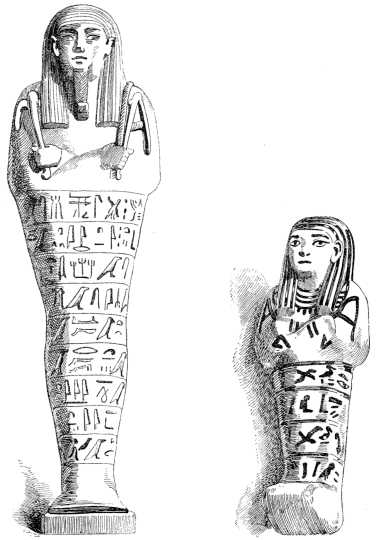
Figs. 95, 96.—Sepulchral statuettes, from the Louvre.
The ingenuity of their contrivances is extraordinary. Food in its natural state would not keep, and various accidents, might, as we have shown, lead to the death of the double by inanition. It was the same with furniture and clothes; the narrow dimensions of the tomb, moreover, would forbid the accumulation there of everything which its sombre tenant might desire. On the other hand the funerary statuettes were made of the most indestructible materials and the bas-reliefs and paintings were one with the thick walls of stone or living rock. These have survived practically unaltered until our day. We visited the tomb of Ti a short time after its chambers had been opened and cleared. It was marvellous to see how form and colour had been preserved intact and fresh under the sand, and this work which was four or five thousand years old seemed to be but lately finished. By the brightness of their colours and the sharp precision of their contours these charming reliefs had the effect of a newly struck medal. Such scenes from the daily life of the people continued to be figured upon Egyptian tombs from the old empire to the new. When their study and comparison were first begun different explanations were put forward. Some believed that they were an illustrated biography of the deceased, a representation of his achievements or of those over which he had presided during the course of his mortal life; others saw in them an illustration of his future life, a setting forth of the joys and pleasures of the Egyptian Elysium.
Both these interpretations have had to give way before the critical examination of the pictures themselves and the decipherment of their accompanying inscriptions. It was soon perceived, through comparisons easily made, that these scenes were not anecdotic. On a few very rare occasions they seem to be connected with circumstances peculiar to the inhabitant of the tomb. There are a few steles and tombs upon which the dead man seems to have caused his services to be described, with the object, no doubt, of continuing in the next world his career of honour and success in this. Such an inscription is so far biographical, and a similar spirit may extend to the decorations of the stele and walls of the tomb. As an example of such narrative epigraphs we may cite the long inscription of Ouna, which gives us the life of a sort of grand-vizier to the two first Kings of the sixth dynasty;[142] also the inscriptions upon the tombs of those feudal princes who were buried at Beni-Hassan. In the latter there are historical representations as commentaries upon the text. Among these is the often reproduced painting of a band of Asiatic emigrants bringing presents to the prince and demanding, perhaps, a supply of wheat in return, like the Hebrews in the time of Jacob.
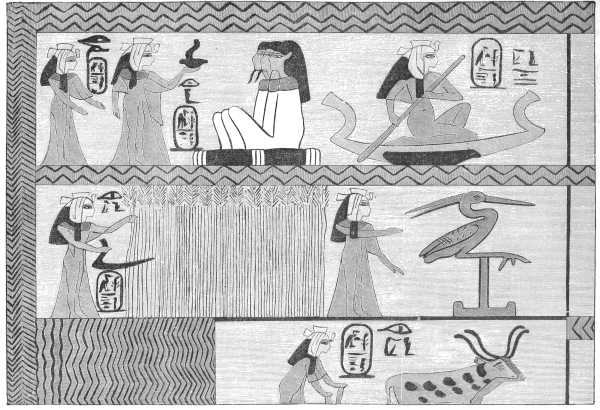
Fig. 97.—Vignette from a Ritual upon papyrus, in the Louvre. Chap. XC., 20th dynasty.
But all this is exceptional. As a rule the same subjects occur upon the tombs again and again, in the persistent fashion which characterizes traditional themes. The figures by which the flocks and herds and other possessions of the deceased were numbered are too great for literal truth.[143] On the other hand the pictured tradesmen and artificers, from the labourer, the baker, and the butcher up to the sculptor, seem to apply themselves to their work with an energy which excludes the notion of ideal felicity. They, one and all, labour conscientiously, and we feel that they are carrying out a task which has been imposed upon them as a duty.
For whose benefit do they take all this trouble? If we attempt to enter into the minds of the people who traced these images and compare the pictured representations with the texts which accompany them, we shall be enabled to answer that question. Let us take by chance any one of the inscriptions which accompany the scenes figured upon the famous tomb of Ti, and here is what we find. "To see the picking and pressing of the grape and all the labours of the country." Again, "To see the picking of the flax, the reaping of the corn, the transport upon donkeys, the stacking of the crops of the tomb." Again, "Ti sees the stalls of the oxen and of the small animals, the gutters and water-channels of the tomb."
It is for the dead that the vintage takes place, that the flax is picked, that the wheat is threshed, that oxen are driven into the fields, that the soil is ploughed and irrigated. It is for the supply of his wants that all these sturdy arms are employed.
We shall leave M. Maspero to sum up the ideas which presided at the construction of the Egyptian tomb, but first we must draw our readers' notice to the fact that he, more than once, alludes to a conception of the future life which differs somewhat from the early Egyptian notions, and belongs rather to the Second Theban Empire and its successors.
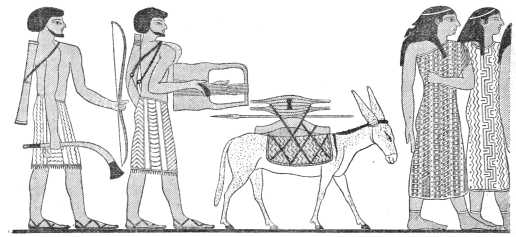
Fig. 98.—Arrival in Egypt of a company of Asiatic emigrants (Champollion, pls. 362, 393).
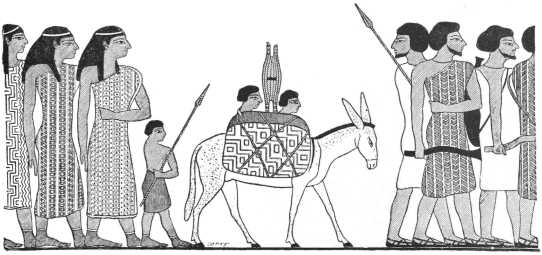
Fig. 98, Continued.—Arrival in Egypt of a company of Asiatic emigrants (Champollion, pls. 362, 393).
"The scenes chosen for the decoration of tomb walls had a magic intention; whether drawn from civil life in the world or from that of Hades, they were meant to preserve the dead from danger and to insure him a happy existence beyond the tomb.... Their reproduction upon the walls of the sepulchre guaranteed the performance of the acts represented. The double shut up in his σύριγξ[144] saw himself going to the chase upon the surrounding walls and he went to the chase; eating and drinking with his wife, and he ate and drank with her; crossing in safety the terrible gulfs of the lower world in the barque of the gods, and he crossed them in safety. The tilling, reaping, and housing on his walls were for him real tilling, reaping, and housing. So, too, the statuettes placed in his tomb carried out for him under magic influence all the work of the fields, and, like the sorcerer's pestle in Goethe's ballad, drew water for him and carried grain. The workmen painted in his papyri made shoes for him and cooked his food; they carried him to hunt in the deserts or to fish in the marshes. And, after all, the world of vassals upon the sides of the sepulchre was as real as the double for which they laboured; the picture of a slave might well satisfy the shadow of a master. The Egyptian thought that by filling his tomb with pictures he insured the reality of all the objects, people, and scenes represented in another world, and he was thus encouraged to construct his tomb while he was yet alive. Relations, too, thought that they were doing a service to the deceased when they carried out all the mysterious ceremonies which accompanied his burial. The certainty that they had been the cause of some benefit to him consoled and supported them on their return from the cemetery where they had left their regretted dead in possession of his imaginary domain."[145]
Such a belief is astonishing to us; it demands an effort of the imagination to which we moderns are in no way equal. We have great difficulty in realising a state of mind so different from what ours has become after centuries of progress and thought. Those early races had neither a long enough experience of things, nor a sufficiently capable power of reflection to enable them to distinguish the possible from the impossible. They did not appreciate the difference between living things and those which we call inanimate. They endowed all things about them with souls like their own. They found no more difficulty in giving life to their carved and painted domestics, than to the mummy or statue of the deceased, or to the phantom which they called the double. Is it not natural to the child to take revenge upon the table against which he hurts himself, or to speak tenderly to the doll which he holds in his arms?
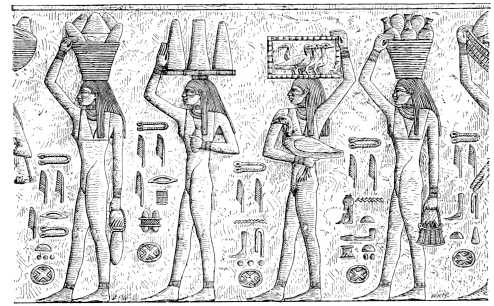
Fig. 99.—The tomb of Ti; women, representing the lands of the deceased, carrying the funeral gifts.
This power to endow all things with life and personality is now reserved for the poet and the infant, but in the primitive days of civilization it belonged to all people alike. Imagination had then a power over a whole race which in our days is the gift of great poets alone. In the efforts which they made to forestall the wants of the helpless dead, they were not content with providing the food and furniture which we find upon the walls. They had a secret impression that these might be insufficient for wants renewed through eternity, and they made another step upon the way upon which they had embarked. By a still more curious and still bolder fiction than those which had gone before, they attributed to prayer the power of multiplying, by the use of a few magic sentences, all objects of the first necessity to the inhabitants of the tomb.
Every sepulchre has a stele, that is to say, an upright stone tablet which varied in form and place in different epochs, but always served the same purpose and had the same general character. Most of these steles were adorned with painting and sculpture; all of them had more or less complicated inscriptions.[146] In the semicircle which forms the upper part of most of these inscribed slabs, the dead person, accompanied by his family, presents offerings to a god, who is usually Osiris. Under this an inscription is carved after an unchanging formula: "Offering to Osiris (or to some other deity, as the case may be) in order that he may give provision of bread, liquid, beef, geese, milk, wine, beer, clothes, perfumes, and all good and pure things upon which the god subsists, to the ka of N..., son of M...." Below this the defunct is often shown in the act of himself receiving the offerings of his family. In both divisions the objects figured are looked upon as real, as in the wall decorations. In the lower division they are offered directly to him who is to profit by them; in the upper, the god is charged to see that they are delivered to the right address. The provisions which the god is asked to pass on to the defunct are first presented to him; by the intervention of Osiris the doubles of bread, meat and drink pass into the other world to nourish the double of man. But it was not essential for the gift to be effective that it should be real, or even quasi-real; that its image should even be given in paint or stone. The first-comer could procure all things necessary for the deceased by their enumeration in the proper form. We find therefore that many Egyptians caused the following invocation to passing strangers, to be engraved upon their tombs:
"Oh you who still exist upon the earth, whether you be private individuals, priests, scribes, or ministers entering into this tomb, if you love life and do not know death, if you wish to be in favour with the gods of your cities and to avoid the terrors of the other world, if you wish to be entombed in your own sepulchres and to transmit your dignities to your children, you must if you be scribes, recite the words inscribed upon this stone, or, if not, you must listen to their recital: say, offering to Amen, master of Karnak, that he may give thousands of loaves of bread, thousands of jars of drink, thousands of oxen, thousands of geese, thousands of garments, thousands of all good and pure things to the ka, or double, of the prince Entef."[147]
Thanks to all these subtle precautions, and to the goodwill with which the Egyptian intellect lent itself to their bold fictions, the tomb deserved the name it received, the house of the double. The double, when thus installed in a dwelling furnished for his use, received the visits and offerings of his friends and relations; "he had priests retained and paid to offer sacrifices to him; he had slaves, beasts of burden, and estates charged with his support. He was like a great lord sojourning in a strange country and having his wants attended to by intermediary officials assigned to his service."[148]
This analogy between the house and the tomb is so complete that it embraces details which do not seem very congruous. Like the house of the living, the tomb was strictly oriented, but after a mystic principle of its own.
As soon as the Egyptian began to think he perceived the most obvious of the similarities between the sun's career and that of man. Man has his dawn and his setting. Man grows from the early glimmerings of infancy to the apogee of his wisdom and strength; he then begins to decline and, like the magnified evening sun, ends by disappearing after his death into the depths of the soil.
In Egypt the sun sets every evening behind the Libyan chain; thence he penetrates into those subterranean regions of Ament across which he has to make his way before the dawn of the next day. The Egyptian cemeteries were therefore placed on the left bank of the Nile, that is, in the west of the country. All the known pyramids were built in the west, and there we find all the more important "cities of the dead," the necropolis of Memphis and those of Abydos and Thebes. A few unimportant groups of tombs have indeed been found upon the eastern bank; but these exceptions to a general rule are doubtless to be explained by a question of distance. For any city placed near the eastern border of the wider parts of the Nile valley, a burying-place in the Libyan chain would be very inconvenient both for the transport of the dead, and for the sepulchral duties of the survivors.[149]
Each morning sees the sun rise as youthful and ardent as the morning before. Why then should not man, after completing his subterranean journey and triumphing over the terrors of Ament, cast off the darkness of the tomb and again see the light of day? This undying hope was revivified at each dawn as by a new promise, and the Egyptians followed out the analogy by the way in which they disposed their sepulchres. They were placed in the west of their country, towards the setting sun, but their doors, the openings through which their inmates would one day regain the light, were turned to the east. In the necropolis of Memphis, the door of nearly every tomb is turned to the east,[150] and there is not a single stele which does not face in that direction.[151] In the necropolis of Abydos, both door and stele are more often turned towards the south, that is towards the sun at its zenith.[152] But neither at Memphis, at Abydos, nor at Thebes is there a tomb which is lighted from the west or presents its inscription to the setting sun.[153] Thus, from the shadowy depths where they dwell, the dead have their eyes turned to that quarter of the heavens where the life-giving flame is each day rekindled, and seem to be waiting for the ray which is to destroy their night and to rouse them from their long repose.[154]
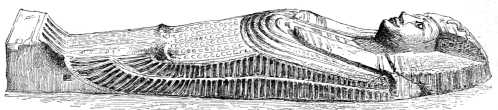
Fig. 100.—Lid of the coffin of Entef, 11th dynasty. Louvre.
The ideas and beliefs which we have described were common to all Egyptians, irrespective of class. When he felt his last hour approaching, the humble peasant or boatman on the Nile was as anxious as Pharaoh himself to insure the survival of his double and to guard against the terrors of annihilation:
. . . . Mais, jusqu'en son trépas, Le riche a des honneurs que le pauvre n'a pas.
Those who, when alive, had to be content with a hut of earth or of reeds, could not, when dead, expect to have a tomb of stone or brick, a habitation for eternity; they could not look for joys in the other world which they had been unable to procure in this. So that such tombs as those which most fully embodied the ideas we have described must always have remained the exclusive privilege more or less of the governing classes. These consisted of the king, the princes and nobles, the priests, the military chiefs, and functionaries of every kind down to the humblest of the scribes attached to the administration. As for those Egyptians who did not belong to this aristocracy, they had to be content with less expensive arrangements. The less poor among them at least took measures to be embalmed and to be placed in a coffin of wood or papier-mâché, accompanied by scarabs and other charms to protect them against malignant spirits. The painted figures upon the coffin also helped to keep off evil influences. If they could afford it they purchased places in a common tomb, where the mummies were heaped one upon the other and confided to the care of priests who performed the funerary rites for a whole chamber at once.[155] It was the frequent custom to put with the dead those pillows of wood or alabaster which the Egyptians seem to have used from the most ancient times for the support of their heads in sleep. This contrivance, which does away with the necessity for continually rearranging their complicated head-dress, is still used by the Nubians and Abyssinians.
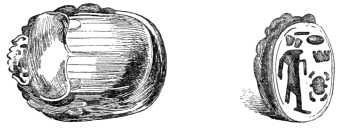
Figs. 101, 102.—Scarabs. Louvre.
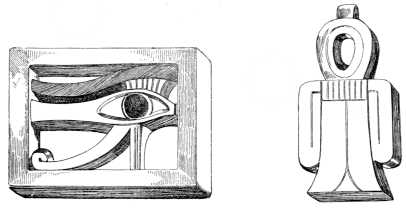
Figs. 103, 104.—Funerary amulets. Oudja and ta. Louvre.
But those who could procure even these slight advantages were still among the favourites of fortune. Many were unable to obtain even this minimum of funeral honours. On the confines of all the great cemeteries, at Thebes as well as at Memphis, corpses are found deposited in the loose sand two or three feet from the surface. Some of these are packed in the leaves of the palm, others are roughly enveloped in a few morsels of linen. They have been hastily dipped in a bath of natron, which has dirtied rather than embalmed them.[156] Sometimes even these slender precautions have been omitted. Bodies have been found in the earth without vestige of either coffin or linen swathes. The sand seems to have been intrusted with the work of drying them, and they have been found in our days in the condition of skeletons.
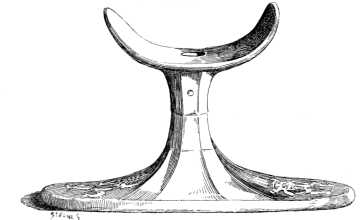
Fig. 105.—Pillow, Louvre.
On the other hand, the fortunate ones of the world, those who were so easy in their circumstances in this life that they could place themselves in the same happy condition in the next, spared no expense in anything connected with their burial. They never allowed themselves to be surprised by death, as we so often do. Whether kings or private individuals, they made their preparations while they were still alive, and caused their tombs to be constructed under their own eyes.[157] Their forethought when living and the piety of relations spared nothing that could add to the beauty and convenience of dwellings which were to be the eternal resting places of their inmates. The palaces of the princes and rich men of Egypt were so lightly built that they have left no traces upon the soil; but many of their tombs have subsisted uninjured to our day, and it is from them that we have obtained our treasures of Egyptian art. All the other nations of the ancient world followed the good example thus set, or rather, to speak more accurately, being all penetrated with similar ideas, they took similar courses without borrowing one from the other. Whenever we moderns have opened any of those ancient tombs which have happily remained intact, we have been met by the same discoveries. Whether it be in Egypt or Phœnicia, in Asia Minor, Cyprus or Greece, in Etruria or Campania, the same astonishing sight meets our eyes. The tombs are filled with precious objects and chefs d'œuvres of art which their depositors had intended never again to see the light of day.
In modern times, when piety or pride stimulates to the decoration of a tomb, all the care of the architect, the sculptor and the painter is given to the outside, to the edifice which surmounts the actual grave. The grave or other receptacle for the coffin is as plain and simple in the most sumptuous monuments of our cemeteries as in the most humble. Our funerary architecture is based upon our belief that the tomb is empty; that the vital part of the deposit confided to it has escaped to rejoin the current of eternal life. Under such conditions the tomb becomes above all things a commemorative structure, a more or less sincere manifestation of the grief of a family or of society at large for the loss of one of its members. As for the narrow pit into which the "mortal coil" is lowered, all that we demand of it is that it should be deep enough and properly closed. Art makes no attempt to illumine its darkness. She leaves to workmen the task of excavation and of building its walls and confines herself to the visible parts of the tomb. The dead within furnishes the pretext for her activity, but it is the admiration of the living that is her real incentive.
The ideas of the ancients on this matter were, as we have seen, very different. They looked upon the tomb as an inhabited house; as a house in which the dead was to lead some kind of existence. Rich men wished their tombs to look well outside, even to the distant spectator, but it was to the inside that their chief attention was turned. They wished to find there all the necessaries, the comforts, the luxuries, to which they had been accustomed during life. So we find that the Egyptians, the Greeks or the Etruscans, were willing enough, when they built their own tombs or those of their relations, to throw a tumulus of earth above it, or, later, a constructed building which was conspicuous at a distance. In those sepulchres which were cut out of the side of a mountain, the fronts were carved with frieze, pediment and columns into the shape of a regularly constructed portico; but the chief object of solicitude to the proud possessor of such a tomb, was its internal furnishing and disposition. For him there was no removal should he be discontented with his lodging. When a man is condemned by illness or accident to keep his room, he takes care to surround himself with everything that he may want. He gathers immediately about him all the comforts and luxuries which he can afford; and death is an illness from which there is no recovery.
Impelled by such ideas as these, the ancients filled their tombs with precious objects and decorated them with sumptuous art, all the more that they seemed well guarded against intrusion for the sake of gain. Thus the Achæans of Mycenæ (if that be the proper name of those mysterious people) buried, in the sepulchres discovered by Dr. Schliemann, the innumerable objects of gold and silver which now fill the museum of Athens; thus the tombs of Bœotia were filled with those marvels of grace and delicate workmanship, the terra cottas of Tanagra; and those of Etruria and Campania with the most beautiful painted vases ever produced by Greek taste.
Identity of religious conception thus led, from end to end of the antique world, to funerary arrangements which bore a curious resemblance one to another, so that sepulchral architecture among the ancients had, as a whole, a very different character from that of the moderns. This character is more strongly marked in Egypt than anywhere else, and therefore we have studied it in detail. The general observations to which it has given rise have been made once for all, and we shall not have to repeat them when we describe the funeral customs of other ancient peoples. We shall then confine ourselves to pointing out the slight differences which naturally spring up in the several interpretations of a common belief.
We have still to show how the varying circumstances of time and place caused the Egyptian tomb to pass through certain modifications of form and decoration, which, however, were never of so radical a nature as to affect its general appearance and arrangement. Until Egypt became a mere geographical expression and her venerable civilization lost its independence and originality, these latter remained practically unchanged.
§ 2. The Tomb under the Ancient Empire.
Among the tombs which date from the time of the ancient empire, the most interesting to the traveller are, of course, the Pyramids. Long before his arrival at Cairo he sees the summits of those artificial mountains rising into the air above the vapours raised by the sun, and above the dust thrown up by the teeming population of the city. At that distance their peaks seem light and slender from their height above the horizon (Plate I. 2).
The tourist's first visit is paid to the Pyramids, and many an European leaves Egypt without seeing any other ancient building. He thinks that he has qualified himself to discourse upon Egyptian architecture because a few shouting Arabs have landed him, exhausted, upon the topmost stone of the pyramid of Cheops, and have painfully dragged and thrust him along those passages of the interior which will ever be among his most disagreeable recollections. During all this his eyes and thoughts are entirely given to the preservation of his own equilibrium, and he sees nothing of the real constitution of the structure he has come to visit.
In spite of the wonderful panorama which repays the fatigues of the ascent, and of the overpowering impression made upon the mind by their colossal mass, the Pyramids, as we see them to-day are far from being the most complete and interesting of the sepulchral monuments left to us by the early dynasties. The largest and best preserved are not so old as some of the tombs in the necropolis of Memphis, and, royal burying-places as they are, their arrangement and ornamentation are less rich and expressive than those of many sepulchres built by private individuals. Many of the latter, in their comparatively restricted dimensions, answer better to the definition of a tomb suggested to us by our study of the national beliefs.
We shall, therefore, reserve the Pyramids for future treatment, and in our review of the successive forms taken by sepulchral architecture, we shall assign the first place to those private tombs, dating from the Ancient Empire, which are to be found in the necropolis of Memphis. Notwithstanding a few differences, to which we shall refer hereafter, these tombs, as a whole, can be traced to a single type, of which Lepsius was the first to perceive the interest.[158] This type, which was first clearly brought to light by the many and deep excavations carried out by Mariette, has been known for some years past by the Arab term mastaba,[159] which means literally a bench, a bench of stone or wood. This name was given by the labourers employed upon the excavations, and seemed well adapted to their long and low shapes, which bear some resemblance to those divans, or ottomans, which are found in every room of an oriental dwelling. Mariette was struck by the fitness of the expression, and used it ever after to designate that particular kind of tomb.
Mariette will be our constant guide in this part of our study. After having opened many hundreds of these monuments, he published in the Revue archéologique, what we may call a theory of the mastaba.[160] In all essential matters we shall allow his words to speak for themselves; when he enters into more detail than is necessary for our purpose, we shall content ourselves with epitomizing his descriptions.
THE MASTABAS OF THE NECROPOLIS OF MEMPHIS.
The space over which the monuments which we propose to describe are spread, is on the left bank of the Nile, and extends from Abou-Roash to Dashour; it is thus, in all probability, the largest cemetery in the world, being more than fifteen miles in length, and of an average width of from two to two and a half miles.[161] It was, in a word, the burial-place for Memphis and its suburbs, and Memphis seems to have been the largest city of Egypt, and to have boasted an antiquity which only Thinis could rival. Excavations have failed, apparently, to confirm the assertion of Strabo, who describes the early capital of Egypt as reaching to the foot of the Libyan chain. On the contrary, it seems to have been confined between the canal which is called the Bahr Yussef and the Nile. It would thus have formed a very long and rather narrow city, close upon the river, of which the site may still be traced by the more or less barren hillocks strewn with blocks of granite and fragments of walls, which crop up from the plain between Gizeh and Chinbab. For forty centuries there was a continual procession of corpses from Memphis itself, and probably from towns on the other side of the Nile, such as Heliopolis, to the plateau which lies along the foot of the Libyan chain. The formation of this plateau makes it peculiarly well adapted for the purpose to which it was put. It consists of a thick bed of soft limestone, covered by a layer of sand which varies in depth from many yards to a few feet according to the inequalities of the ground beneath it.
It was easy, therefore, either to lay bare the rock and to construct the tomb upon it, or to dig the mummy pits in its substance, and the winds might be trusted to quickly cover the grave with sand which would protect it when made. The same sand covered the coffinless corpse of the pauper with its kindly particles. Age after age the dead were interred by millions in this great haven of rest. At first there was plenty of room, and the corpses were strewn somewhat thinly in the sand,[162] but with time economy of space had to be practised, until at last bodies were squeezed into the narrowest spaces between older inhabitants. Sometimes these new comers even intruded into the tombs of those who had gone before them, and that without always troubling themselves to conceal their usurpation by effacing the name of the rightful owner.[163]
The number of tombs was increased to a prodigious extent by the non-employment of those family tombs which, as we shall see, were made use of by the Phœnicians, the Greeks, and the Etruscans. The Egyptian sepulchre was a personal appanage. The husband and father of a family admitted into it only his wife and such of their children as died young. The son, when he in turn became the head of a family, built a tomb for himself. Each generation, each human couple marked their passage through the world by the erection of a new tomb.
All the mastabas belong to the period of the Memphite empire. Those who built them were able to give free play to their fancies, and to develop the structure, both above and below ground, both in arrangement and in decoration, to any extent they pleased. We may therefore look upon them as the freest, the most spontaneous, and the most complete expression of the ideas formed by the men of that remote age concerning death and the life beyond the grave.
The mastabas of Sakkarah will receive most of our attention, and in describing them we shall often have occasion to quote the words of Mariette.[164] Those which are to be found in the more northern part of the necropolis, in the neighbourhood of the Great Pyramid, differ only in unimportant details from those at Sakkarah. The general appearance now presented by these monuments may be guessed from the sketch which M. Bourgoin has sent us of the tomb of Sabou (Fig. 106). The other mastabas figured by us have all been more or less restored.
"The mastaba is a massive structure, rectangular on plan, with four faces of plain walling, each being inclined at a stated angle towards their common centre. This inclination has led some people to assert that it is nothing more than an unfinished pyramid. Such an idea is refuted, however, by the fact that the divergence from the perpendicular is in some cases so slight that, were the walls prolonged upwards, their ridges, or arêtes, would not meet for some eight or nine hundred yards. The mastaba might be more justly compared to the space comprised between two horizontal sections of an obelisk, supposing the obelisk to have an oblong base.
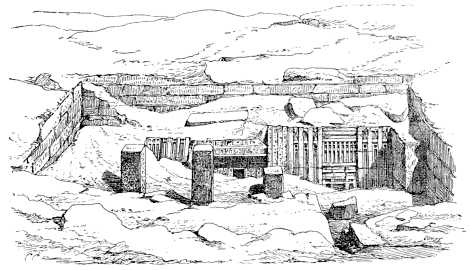
Fig. 106.—Actual condition of a mastaba. The tomb of Sabou. Drawn by Bourgoin.
"The major axis of the rectangle upon which these structures are planned, always runs due north and south, and at the pyramids of Gizeh, the necropolis of the west, they are arranged upon a symmetrical plan so as to resemble a chess board on which all the squares are strictly oriented.[165] The more carefully built mastabas are oriented according to the true astronomical north. All the others show the same intention, and, in those instances where an error of a few degrees is to be discovered, it is to be clearly attributed to carelessness on the part of the builder, a common fault in these tombs, and not to a difference of intention. We often find that the northern face is not strictly parallel to the southern, nor that on the west to that on the east.
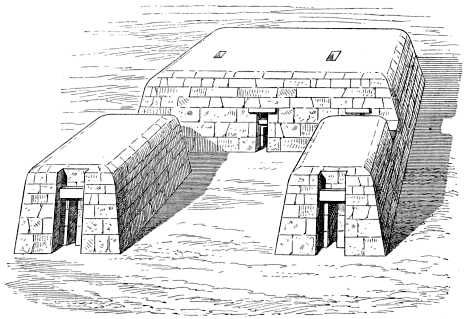
Fig. 107.—Three mastabas at Gizeh. Perspective view, after the plan of Lepsius. (Denkmæler, vol. i. pl. 24.)
"Although not varying much from true orientation, the mastabas of Sakkarah are not arranged with the symmetry which distinguishes those on the south and west of the Great Pyramid.[166] They are sprinkled about in a rather haphazard fashion. Here we find them well interspaced and there actually placed one upon another. It follows that the chess-board arrangement which is so conspicuous at Gizeh is not here to be noticed. Even at Sakkarah there were streets between the rows of tombs, but they are so irregularly placed, and they are often so narrow, many of them being nothing more than blind alleys, that the inexperienced visitor may well fancy himself in a maze.
"The Sakkarah mastabas are built either of stone or brick.
"The mastabas of stone are of two kinds: those of a very hard blue siliceous limestone and those of a softer chalky limestone which is found upon the spot. This latter stone was used for the Stepped Pyramid. The tombs upon which it was used seem to be much the oldest in the necropolis; they are also the least rich and important.
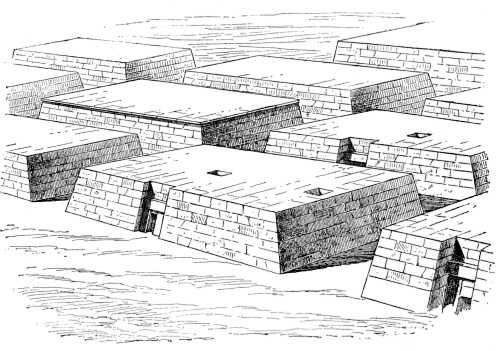
Fig. 108.—Restoration of part of the Necropolis of Gizeh.
"Our general notion of Egyptian architecture would lead us to look for the use of huge stones in these mastabas, and, in fact, certain important monuments, such as the Mastabat-el-Faraoun, and parts of important monuments, such as the Temple of the Sphinx and the passages and chambers of the greater pyramids, were constructed of very large blocks. But the Sakkarah architects were more modest. Apart from the ceilings, architraves and other places where big stones were necessary, the blocks are of an average height of about half a yard, with a proportionate length and thickness.
"The brick-built sepulchres are of two kinds also. The more elaborate are of black brick, while a yellowish brick is used for the others. The yellow bricks are a mixture of sand and pebbles with a little clay; the black bricks are of earth and straw. The former are always small (8·8 in. x 4·4 in. x 2·8 in.); the latter are comparatively large (15·2 in. x 7·2 in. x 5·6 in.). Both kinds are dried simply in the sun. The yellow bricks seem to be the more ancient. Their employment begins and ends with the Ancient Empire. The black bricks, on the other hand, appear for the first time about midway through the fourth dynasty. At first they were rarely employed, but under the eighteenth dynasty and those which followed it, they came to be exclusively used."
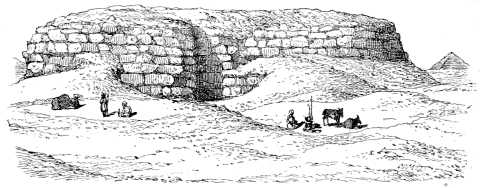
Fig. 109.—The Mastabat-el-Faraoun.
All these mastabas, whether of brick or stone, betray an amount of negligence in their construction which is astonishing. Considering the ideas which the Egyptians had formed of a future life, the chief preoccupation of their architects should have been to give a stability to their sepulchres which would have insured their perpetuity, and, with it, that of the deposit committed to their charge. The whole of our description will be pervaded by accounts of the minute precautions devised to that end. "Now these mastabas are constructed with care on their outsides alone. The core of their walls is composed of sand, of rubbish, of blocks of stone mingled with the flakes struck off by the masons, and all this in most cases without any cement to give it coherence. The mastabas of Sakkarah are not homogeneous constructions of masonry and cement, like the pyramids and most of the mastabas of Gizeh. They are confused heaps of ill assorted materials, which would collapse but for the retaining strength of their covering of solid stone.
"At Sakkarah the outward faces of the mastaba are not smooth. Each successive course is slightly set back from the one below it. At Gizeh the walls form a smooth plane gently inclined from the perpendicular.
"There are mastabas of all sizes. That of Sabou measures 172 feet by 84; that of Ha-ar, 149 by 74; that of Ra-en-ma 169 by 81, and that of Hapi no more than 25 ft. 6 in. by 19 ft. 6 in. In height they vary less. The highest are not more than from 26 to 30 ft. high, the smallest about 12."
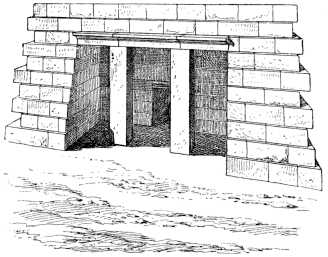
Fig. 110.—Entrance to a Mastaba at Sakkarah. Mariette.
The roof of the mastaba is a plain surface without irregularity of any kind; but the soil above it is sprinkled with vases buried at a slight depth. These vases are pretty evenly distributed, but they are rather more numerous in that part of the soil which covers the ceilings of the chambers, a circumstance of which Mariette often made use to guide him in his excavations. Like all the vases of this epoch, those which are found upon the roof of the mastabas are roughly made, pointed at the bottom and without handles. They each contain a thin film of yellow clay deposited by the water with which they were filled. They were placed in their curious position under the notion that the water which they contained would quench the thirst of the dead man below. The mouths of the jars were covered with flat stones, and the water would last long enough to satisfy at least the immediate necessities of the inhabitant of the tomb.
"The principal face of the mastaba is turned to the east. In four cases out of five the entrance to its chambers, when there is one, is found upon this face. The general arrangement is, almost always, as follows: 1. At a few metres distance from the north-eastern angle we come upon a quadrangular niche or recess, very high and very narrow, in the depths of which those long vertical grooves which distinguish the steles of this epoch are carved upon the actual masonry of the tomb. For this recess an unimportant stele, with or without inscription, is occasionally substituted, or (2) we find, at a few metres distance from the south-eastern angle, either a deeper, larger, and more carefully built recess, in the depths of which a monolithic stele of white limestone covered with hieroglyphs is placed; or a regular architectural façade in miniature with a door in the centre. When the recess is found near the southern angle of the eastern face, the tomb begins and ends there. It has no internal chamber, or rather, the recess acts as substitute for one. But when, instead of the niche or recess, we meet with a door, we then know that we have come upon a regularly completed tomb. The name of its proprietor is often carved upon the lintel. Several of these lintels, of a peculiar shape, are to be seen in the Louvre.
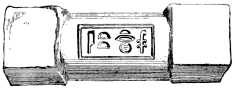
Fig. 111.—Lintel of the tomb of Teta, 6th dynasty. Louvre.
"Next after the eastern face, in relative importance, comes that which is turned to the north. When the entrance is in the northern wall the door is invariably at the back of a kind of vestibule, in front of which are two monolithic columns, without base or capital, supporting the architrave which, in turn, supports the roof.
"Still more seldom than in the northern face, the entrance is occasionally found upon that which is turned to the south. This exceptional arrangement is, in most instances, caused by some local circumstance which may readily be perceived. When the entrance is on the south its arrangement is sometimes the one, sometimes the other, of the two which we have described.
"As for the western face, we have no evidence that it ever played any more ambitious rôle than that of completing the inclosure. It is always destitute of both openings and ornaments."
We have thus explored, with Mariette, the outside of the mastaba. We have described its form and general aspect, we have noticed the materials of which it was constructed, the principles upon which it was oriented, and its average size. We have explained, too, how this single type of sepulchre was repeated many thousands of times with but slight variations, until, upon the plateau between Memphis and the desert there gradually arose a metropolis of the dead more populous than that of the living. It remains to describe the contents of those huge blocks of masonry. We shall begin by visiting the chambers planned by the architect in the building itself; we shall afterwards penetrate, by the paths which modern curiosity has established through the débris of ages and the depths of the soil, to those recesses of the tomb which were meant to be for ever inaccessible.
The interior of a mastaba is composed of three parts—the chamber, the serdab, and the well. The last-named of the three is the only part which is never wanting. Many of the mastabas are, in fact, solid. In them the chamber is in a very rudimentary condition, being represented merely by one of those external niches which Mariette has described. This arrangement was the earliest, and, as long as the mastaba continued to be built, the less ambitious tenants of the necropolis were contented to reproduce it. But in these pages, as in a natural history, it is important to study the species when fully developed and provided with all its organs. When we have clearly established a general type nothing is more easy than to recognise and point out its variations. It suffices to say here that some tombs are wanting in one, some in another of those constituent parts whose meaning and uses we shall attempt to determine, and that, in a few, they are of an unaccustomed importance.
It is natural that we should first turn our attention to the chamber. This was a kind of neutral ground upon which the quick and the dead could meet, the former to present, the latter to receive the funeral offerings.
"The interior of a mastaba may be divided into several 'chambers' (there are three in the tomb of Ti), but generally there is only one. It is entered by the door in the middle of the façade.
"These chambers have, as a rule, to depend upon the door for light, but there are a few instances in which they are lighted from openings in the roof. A remarkable example of the latter arrangement is to be seen in the tomb of Ti, where the innermost chamber, which otherwise would be in complete darkness, is lighted from the roof.
"The chamber is sometimes quite bare, sometimes covered with sculptures and paintings such as those whose character and meaning we have already pointed out. At its further end, and always facing eastwards, stands the inscribed tablet or stele. There are some chambers in which the walls are bare and the stele engraved, but there are none where the walls are carved and the stele plain."
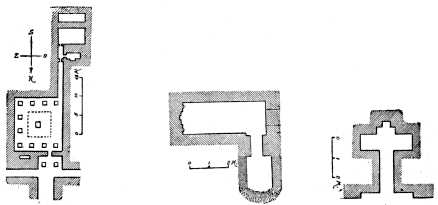
Fig. 112.—Plan of the tomb of Ti. Figs. 113, 114.—Mastaba at Sakkarah, from Prisse.
In the tomb of Ptah-Hotep, of which we reproduce the principal side, the stele proper is on the left, but the figures and the funerary inscriptions cover all the central part of the richly decorated wall (Fig. 115).
We see, then, that the stele is the one indispensable part of this complicated whole. It was, in fact, upon the formula with which it was inscribed, that the Egyptians depended for those magical agencies by which Osiris became the active medium of transmission between the living and the dead.
"At the foot of the stele there was often a table for offerings, in granite, alabaster, or limestone. This was laid flat upon the ground (Fig. 92).
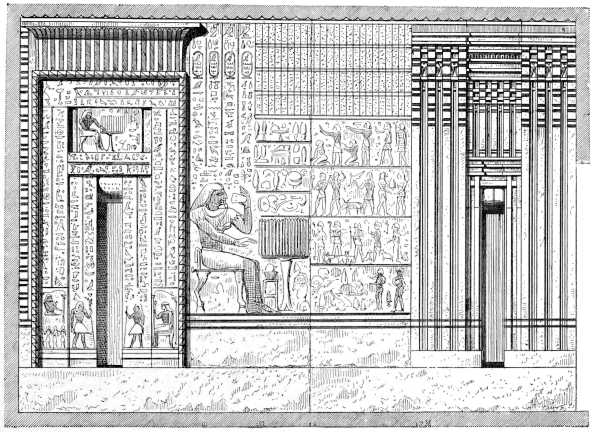
Fig. 115.—Western wall in the chamber of the tomb of Ptah-Hotep, 5th dynasty. Drawn by Bourgoin.
"As a rule this was the only piece of furniture in the chamber; but occasionally we find, on each side of the stele and always placed upon the ground, either two small limestone obelisks, or two objects in that material resembling table legs hollowed out at the top for the reception of offerings."
This chamber was left open to every comer. The entrance was in fact left without a door. To this rule Mariette found but two exceptions in the many hundreds of tombs which he examined.[167]
"Not far from the chamber, oftener on the south than the north, and oftener on the north than the west, a passage in the masonry, high, narrow, and built of very large stones, is found. The workmen employed upon the excavations christened it the serdab, or corridor, and their name has been generally adopted."[168] In Figs. 116-119 we give the plan and three sections of a mastaba at Gizeh which has four serdabs.
"Sometimes the serdab has no communication with the other parts of the mastaba, it is entirely walled in, but in other instances there is a narrow quadrangular opening, a sort of pipe or conduit, which unites the serdab with the chamber. It is so small that the hand can only be introduced into it with difficulty.[169]
"The use of the serdab is revealed by the objects which have been found in it; it was to hold one or more statues of the deceased. The Egyptians believed these statues to be the most certain guarantees, always with the exception of the mummy itself, of a future life for the dead. Hidden from sight in their dark prison, they were protected from all violence, while they were separated only by a few stones from the chamber where the friends and relations met together, and the conduit by which the intervening wall was often pierced, allowed the smell of fruit and incense and the smoke of burnt fat to come to their nostrils.[170]
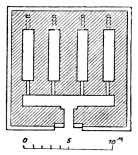
Fig. 116.—Plan of a mastaba with four Serdabs. (Lepsius, i., pl. 24.)
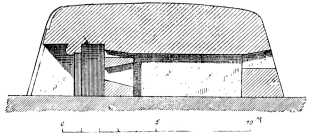
Fig. 117.—Longitudinal section of the same mastaba.
"No inscriptions have been found in a serdab except those upon the statues. And no objects other than statues have ever been found in a serdab." So that the function of the serdab was to afford a safe and final asylum to the statues. These were, no doubt, to be found in other situations also, because, not to mention the numerous bas-reliefs upon which the figure of the deceased appeared in the chamber or in the niche which sometimes took its place, he was sometimes portrayed in high relief, and of full life size, in the public hall of the tomb.[171] Sometimes, also, we find a statue in one of those front courts which, especially at the time of the fourth dynasty, seem to have been in great favour. But this court, as well as the chamber, was open to every chance passer by, and the statues which they both contained were in continual danger from careless or malicious hands. It was to guard against such chances as these that the inventive architects of Egypt contrived a safe retreat in the heart of the massive structure which should provide a reserve of statues against every contingency. When all those which were exposed to accident should have perished, these would still survive and would furnish to the double the material support, the tangible body, to which that phantom was obliged to attach himself unless he wished to perish entirely.
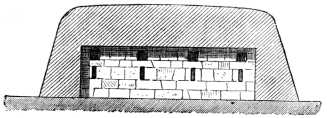
Fig. 118.—Transverse section through the chamber.
These precautions were not ill conceived. The serdab kept efficient guard over its deposit; the museum of Boulak contains at least a hundred statues from the ancient empire which were found at Sakkarah, and nine-tenths of them were found in the serdabs.
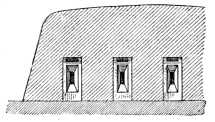
Fig. 119.—Transverse section through the serdabs.
We have now described all those parts of the tomb which were above ground. We have not been content with visiting the chamber only, which was freely left open, we have penetrated into the farthest recesses, and have discovered those secrets of the massive walls which their constructor thought to hide for ever from the eye of man. But even yet we have not arrived at the actual place of burial; we shall reach it, however, through our third internal division, the well or pit.
"The well is an artificial excavation, square or rectangular in plan, never round, at the bottom of which is the chamber in which the mummy is deposited.
"To arrive at the opening of the well, we must mount to the platform, or roof, of the mastaba (Fig. 122). As there was never any staircase to a mastaba either within or without, it will be seen that the well must have been a very inaccessible part of the tomb." In one single instance, namely, in the tomb of Ti, the well is sunk from the floor of the largest of the internal chambers, but whether it opened upon the roof or upon the floor of the chamber, it was always closed with the utmost care by means of a large flat stone.
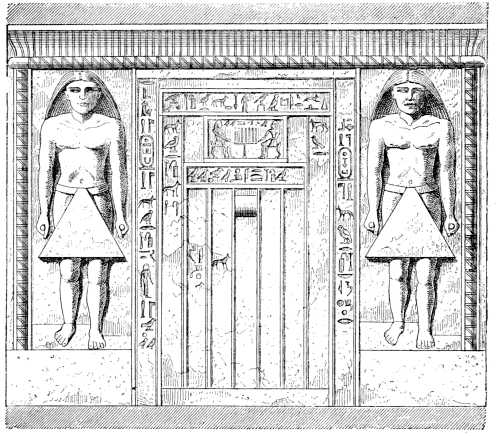
Fig. 120.—Figures in high relief, from a mastaba at Gizeh, 5th dynasty (from Lepsius).
"The well is generally situated upon the major axis of the mastaba, and, as a rule, nearer to the north than to the south. Its depth varies, but, on an average, it is about forty feet. Now and then, however, it has a depth of sixty-five or even eighty feet. As the well begins at the platform and ends in the rock-carved mummy chamber, it follows that it passes vertically first through the mastaba, secondly through the rock upon which the mastaba is founded. The built part of the well is carefully constructed of large and perfect stones, and in this we find one of the distinguishing characteristics of the tombs of the ancient empire." In the tomb of Ti the well takes the form of an inclined plain like a passage in the pyramids. In the common form of well the mummy pit could only be reached by means of ropes.
"When the bottom of the well is reached a gaping passage is seen in the rock which forms its southern wall. This passage, which is not high enough to allow one to walk upright, does not run quite parallel to the axis of the mastaba. It is directed obliquely towards the south-east, like the chamber above. Suddenly it becomes enlarged into a small cavern, which is the mortuary chamber properly speaking, that is to say, the room with a view to which the whole structure has been planned and to which all its other parts are but accessories.
"This mortuary chamber is vertically under the public hall above, so that the survivors who came together in the latter for the funeral ceremonies had the corpse of the deceased under their feet, at a distance which varied according to the depth of the well."
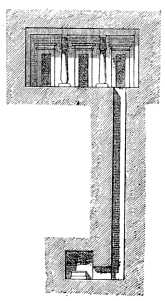
Fig. 121.—The upper chamber, well, and mummy chamber.[172]
The mortuary chambers are large and carefully built, but generally without ornament or inscription. Of all those explored by him Mariette found but one which had its walls ornamented; in the middle of its decorations, which he does not describe, he contrived to make out a few phrases which seemed to belong to the Ritual of the Dead.
The sarcophagus was placed in one corner of the chamber. It was generally of fine limestone, sometimes of red granite, and on a few occasions of opaque black basalt. It was rectangular on plan with a round-topped lid squared at the angles.
Mariette found none at Sakkarah with inscriptions. On the other hand we find them upon the sarcophagus at Khoo-foo-Ankh, which was discovered at Gizeh and belongs to the fourth dynasty (Figs. 123, 124).
"The Egyptians did not always trust to the mere size and weight of the lid for the secure closing of the sarcophagus. The under-side of the cover is made with a rebate at its edge which fits into a corresponding groove on the upper edge of the sarcophagus, and the two edges were bound still more tightly together by a very hard cement. Finally, as if all these precautions were not enough, wooden bolts were affixed to the under-side of the lid which fitted into slots in the sarcophagus and helped to render the two inseparable."
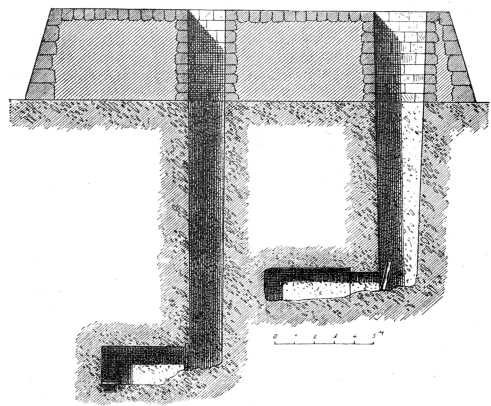
Fig. 122.—Double mastaba at Gizeh, transverse section (from Lepsius, t. i., pl. 22).
So far as we can judge from the few human remains which have been gathered from these ancient tombs, the process of embalmment was then carried on in simple and elementary fashion, and it was this imperfection that the Egyptians attempted to neutralize, by the innumerable and complicated precautions which they took to insure that the corpse should not be disturbed in its envelope of stone. In later times, when the preparation of the mummy was better understood, they were not so careful to seal up the sarcophagus from the outer air.
"The furniture of the mummy chamber comprised neither statues, nor funerary statuettes, nor amulets of any kind. Sometimes a few ox bones bestrew the ground. Two or three large and pointed red vases, containing nothing but a thin deposit of clay, rest against the walls. Within the sarcophagus we find the same sobriety of sepulchral furniture. Beyond a wooden or alabaster pillow (Fig. 105) and half a dozen little drinking cups of alabaster, nothing has been found there but the mummy itself."
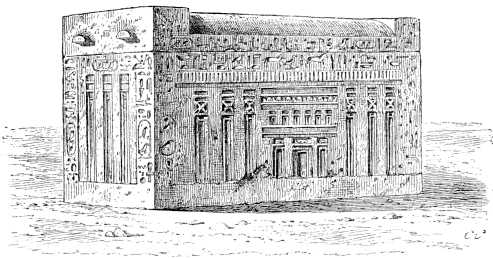
Fig. 123.—Sarcophagus of Khoo-foo-Ankh. Perspective after Bourgoin. Red granite. Height 1·33 metres. Boulak.
These beef bones must be the remains of the quarters of meat which were placed in the tomb for the nourishment of the dead. No scene is more frequently represented upon the walls of the public chamber of the mastaba than the killing and flaying of victims for the funeral ceremonies (Fig. 125). Like those which are found upon the roof, the vases must have held water for the double. The pillow was placed under the head of the mummy, it was the one he had used during his life. As for the drinking cups, their use has not yet been determined, so far as we know.
"As soon as the mummy was in the sarcophagus, the sarcophagus sealed, and the various objects which we have described in place, the opening at the bottom of the well was walled up; the well itself was filled with stones, earth, and sand, and the dead was left to his eternal sleep."[173] These precautions make it no easy thing to reach the mummy chamber. To find the entrance to the well is the first difficulty, and when it is found, many hands and no little time are required to remove the rubbish with which it is filled. The only mechanical helps which the Egyptians have ever used in such work are those which we ourselves have seen in the hands of Mariette's labourers, namely, the wooden shovel and the little rush basket which is filled with a few handfuls of sand and pebbles, and then carried on the head to be emptied at a convenient distance. It may be guessed how many journeys to and fro have to be made before a few cubic yards of débris are cleared by such means as this!
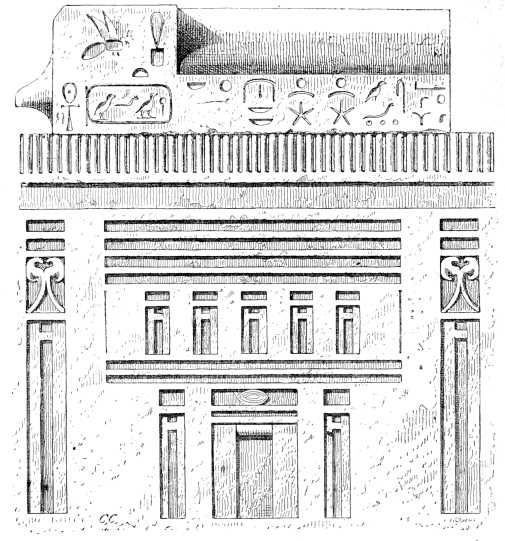
Fig. 124.—Details of the Sarcophagus of Khoo-foo-Ankh.
We have so far followed Mariette, and have frequently had to make use of his ipsissima verba. To his pages and to the plates of the great work of Lepsius, we must refer those readers who are not contented with being told general rules but wish to know the exceptions also. We shall not go into all the changes which variety of taste and the progress of art introduced into the arrangement and decoration of Egyptian buildings; they do not affect the general statements which we have made. We shall not re-state the evidence which enabled Mariette to apportion the 142 painted and sculptured mastabas explored by him in 1869, to the first six dynasties. It is certain that those monuments form a chronological series extending over a space of from twelve to fifteen centuries, and that during the whole of that long period, the general character of Egyptian sepulchral architecture remained unchanged.
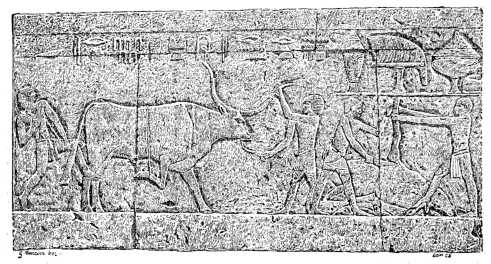
Fig. 125.—Bas-relief from Sakkarah. Boulak.
We should here, perhaps, in order to make our description complete, attempt to convey a true idea of the reliefs which cover the sides of the chamber, and of the statues which fill the serdab. We should, perhaps, by a judicious choice of examples, endeavour to estimate their style and composition; but we shall postpone all such examination until we come to treat of sculpture, and of the way in which the earliest Egyptian artists treated the human form. A didactic and analytic method is so far despotic that it compels us, in order to marshal our facts and to make them easily understood, to separate phenomena which are intimately connected, and to destroy the unity of natural groups. We have thus been driven to separate the figured decorations of the tomb from the architectural arrangements which enframe and support them; with the latter, alone, are we now concerned.
We may sum up the foregoing details by the following general description of the Egyptian tomb as it was established in the early ages of the national life, in those years when the national civilization put on the form and colour which it retained until the last days of antiquity.
This tomb, when complete, included (1) a built up part which, being raised well above the surface of the soil, was a conspicuous object in the landscape; and (2) a subterranean part cut in the living rock which was never more than a few feet below the surface of the sand. The constructed part inclosed a chamber which was sometimes internal and sometimes external, a chamber in which the relations of the deceased deposited the funeral offerings, and in which the priests officiated before the stele, to which the most conspicuous place was always given. Sometimes this chamber is nothing more than a recess in the façade, a mere frame for the stele. The structure also contains a retreat in its thickness where the statues of the deceased were walled up. The subterranean part is composed of the well and the mummy chamber. The well is sunk from different parts of the building; usually traversing its whole depth; it leads to the mummy chamber which is found at varying depths in the bowels of the earth.
Such are the constituent elements of the mastaba, that is to say, of those private tombs which were contemporary with the Pyramids. All over Egypt, in every one of the cemeteries, no matter where they are situated or what their date, the same elements are to be found, modified in certain particulars by the rank of the deceased, by the nature of the soil, by the size of the tomb, and by the changes of fashion, but always to be easily recognized. Of all these elements there is but one which does not persistently reappear in monuments other than the mastaba, and that is the serdab. This retreat for statues has not, as yet, been found in any of the royal tombs of the first six dynasties, neither has it been met with in the tombs of the two Theban empires, or of later epochs. And yet it was connected with one of the most vital hopes of the Egyptian religion. It fulfilled in the happiest manner, one of the conditions imposed upon the Egyptian architect by the strange conceptions of a future life which we have described. Why then do we, as a rule, find the serdab only in the mastabas of the Memphite necropolis? Its absence under the Theban princes is, perhaps to be explained by the progress made in the science of embalming. The heads of more than one mummy have now been exhibited in the cases of European museums for many years, and, in spite of the dampness of our climates, they still preserve their skin, their teeth and their hair (Fig. 126). When they had learnt the secret of preserving the body from corruption, so that after a long series of centuries it should be pretty much in the same condition as on the day after death, they did not indeed, cease to make those images which were supposed to guard the double from annihilation, but they attached less importance to their safety, and took less trouble to hide them. They considered that they had done enough for their preservation by putting them in the precincts of their tombs and temples, and so under the guardianship of their venerated religion.
As for the other parts of the tomb, a little attention will always suffice for their identification even in those sepulchres which differ most from the mastaba. In some instances we shall find the mummy chamber contrived in the upper structure, in others the whole tomb is cut in the living rock. Sometimes we find the chapel, as we may call the public chamber in which the miraculous nourishment of the double took place, more or less distantly separated from the mummy chamber; sometimes the well almost disappears, sometimes it ceases to be vertical and becomes a long corridor with but a gentle slope. As a rule all these variations are easily explained, and may be connected without difficulty with that primitive type which we have attempted to define by its most wide-spread and constant features.
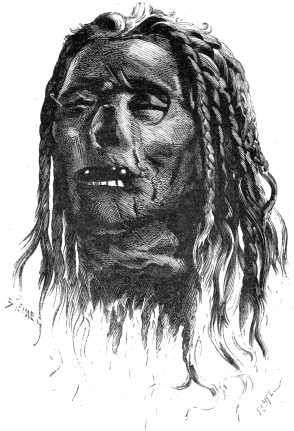
Fig. 126.—Head of a Mummy. Louvre.
Another method of sepulture was made use of in the Ancient Empire, a method which afterwards came into general use in Egypt, we mean the hypogeum, or subterranean tomb. The Egyptian Commission has described several rock-cut tombs in the neighbourhood of the Pyramids, especially some which face the western slope of the Second Pyramid. Similar tombs are to be found near the pyramid of Mycerinus. Some of these sepulchral grottos declare their extreme antiquity by their imitations of wooden architecture;[174] others by their inscriptions dating from the fourth and fifth dynasties. We shall not dwell long upon these rock-cut tombs. They are generally composed of one or two small sculptured chambers, upon one of which the well opens which leads to the mummy chamber. We shall postpone their study to a later chapter, as the time of the Middle Empire affords us richer and more complete examples of them than the earlier period; but, indeed, the New Empire has left us the most important examples of this kind of sepulchre. We shall here content ourselves with pointing out that the architects of Memphis did not ignore the facilities offered by the easily cut limestone rocks, not only for construction of well and mummy chamber, but also for those open parts of the tomb where the funeral rites and the ceremonies of the Ritual of the Dead were performed. In the whole course of her long vitality Egypt did little more, either in art or religion, than develop, with variations, the themes presented to her by the generations which were ruled by her first six dynasties.
THE PYRAMIDS.
The mastaba was the private tomb of the great lord or rich citizen of primitive Egypt; the pyramid was the royal tomb for the same epoch, the tomb of that son of the gods, almost a god himself, before whom all foreheads were bowed into the dust. As his head towered over those of his prostrate subjects during life, so, after death, should his sepulchre rise high above the comparatively humble tombs of his proudest servants. The most imposing mastabas, before the sand had buried them to the summit, must have looked small enough beside those prodigious masses. They were ant-hills at the foot of a palace.
It may seem that in considering the mastaba before the pyramid we have reversed the natural order. We were led to do so by the fact that the enormous mass of the pyramids and their peculiarities of construction compelled their architects to separate elements which are found closely allied in the mastaba. In consequence of this separation the elements in question have not all had the same fate. In the case of the mastaba all survived or perished together, but, in the pyramids, some are in a marvellous state of preservation, while others have disappeared and left hardly a trace behind. We are therefore obliged to make use of the private tomb in our restoration of that which was peculiar to the king.