Chapter IV
Reading edition
TOBACCO IN EUROPE.
The discovery of the tobacco plant in America by European voyagers aroused their cupidity no less than their curiosity. They saw in its use by the Indians a custom which, if engrafted upon the civilization of the Old World, would prove a source of revenue commensurate with their wildest visions of power and wealth. This was particularly the case with the Spanish and Portuguese conquerors, whose thirst for gold was gratified by its discovery. The finding by the Spaniards of gold, silver, and the balmy plant, and by the Portuguese of valuable and glittering gems, opened up to Spain and Portugal three great sources of wealth and power. But while the Spaniards were the first discoverers of the plant there seems to be conflicting opinions as to which nation first began its culture, and whether the plant was cultivated first in the Old World or in the New. Humboldt says:—
Another author says of its introduction into Europe:—
Murray says of the first cultivation of tobacco and potatoes in the Old World:—
"Amidst the numerous remarkable productions ushered into the Old Continent from the New World, there are two which stand pre-eminently conspicuous from their general adoption. Unlike in their nature, both have been received as extensive blessings—the one by its nutritive powers tends to support, the other by its narcotic virtues to soothe and comfort the human frame—the potato and tobacco; but very different was the favor with which these plants were viewed. The one long rejected, by the slow operation of time, and, perhaps, of necessity, was at length cherished, and has become the support of millions, but nearly one hundred and twenty years passed away before even a trial of its merits was attempted; whereas, the tobacco from Yucatan, in less than seventy years after the discovery, appears to have been extensively cultivated in Portugal, and is, perhaps, the most generally adopted superfluous vegetable product known; for sugar and opium are not in such common use. The potato by the starch satisfies the hunger; the tobacco by its morphia calms its turbulence of the mind. The former becomes a necessity required, the latter a gratification sought for."
As the history of Nicot is so intimately connected with that of the plant, a short sketch of this original importer will doubtless be interesting to all lovers of the weed:—
"John Nicot, Sieur de Villemain, was born at Nismes in 1530, and died at Paris in 1600. He was the son of a notary at Nismes, and started in life with a good education, but with no fortune. Finding that his native town offered no suitable or sufficient field for his energies, he went to Paris and strove hard to extend his studies as a scholar and his connections as an adventurer. He made the acquaintance of some courtiers, who felt or affected an interest in learning and in learned men. His manners were insinuating; his character was pliable. When presented at court he succeeded in gaining the esteem and confidence of Henry II., the husband of Catherine de Medicis. Francis II., the son of Henry II., and the first husband of Mary Stuart, continued to Nicot the favor of which Henry II. had deemed him worthy, and sent him in 1560 as ambassador to Sebastian, King of Portugal. He was successful in his mission. But it was neither his talents as a diplomatist, nor his remarkable mind, nor his solid erudition, which made Nicot immortal. It was by popularizing tobacco in France that he gained a lasting fame.
"The Spaniards call it Tobaco, it were better to call it Nicotiana, after the name of the Lord who first sent it into France, to the end that we may give him the honor which he hath deserved of us, for having furnished our land with so rare and singular an herbe: and thus much for the name, now listen unto the whole historie: Master John Nicot, one of the king's counsell, being ambassador for his Maiestie (Majesty) in the realme of Portiugall, in the yeere of our Lord God, 1559. 60. and 61. went on a day to see the monuments and northie places of the said king of Portiugall: at which time a gentleman keeper of the said monuments presented him with this herbe as a strange plant brought from Florida. The nobleman Sir Nicot having procured it to growe in his garden, where it had put forth and multiplied very greatly, was aduertifed (notified) on a daie by one of his pages, that a yoong boie kinsman of the said page, had laide (for triall sake) the said herbe, pressed, the substance and juice and altogether, upon an ulcer which he had upon his cheeke, neere unto his nose, next neighbor to a Noli me tangere, (a cancer) as having already seazed upon the cartilages, and that by the use thereof it was become marvellous well: upon this occasion the nobleman Nicot called the boie to him, and making him to continue the applying of this herbe for eight or ten days, the Noli me tangere became thoroughly kild: nowe they had sent oftetimes unto one of the king's most famous phisitions, the said boie during the time of this worke and operation to make and see the proceeding and working of the said Nicotiana, and having in charge to do the same until the end of ten days, the said phisition then beholding him, assured him that the Noli me tangere was dead, as indeed the boie never felt anything of it at any time afterward.
"Some certain time after, one of the cooks of the said ambassador having almost all his thombe (thumb) cut off from his hand, with a great kitchin knife, the steward running unto the said Nicotiana, made to him use of it five or six dressings, by the ende of which the wounde was healed. From this time forward this herbe began to become famous in Lisbon, where the king of Portiugal's court was at that time, and the vertues thereof much spoken of, and the common people began to call it the ambassador's herbe. Now upon this occasion there came certain days after, a gentleman from the fields being father unto one of the pages of the said Lord ambassador, who was troubled with an ulcer in his legge of two years continuance, and craved of the said Lord some of his herbe, and using it in manner afore mentioned, he was healed by the end of ten or twelve daies. After this yet the herbe grewe still in greater reputation, inasmuch as that many hasted out of all corners to get some of this herbe. And among the rest, there was one woman which had a great ring worme, covering all her face like a mask, and having taken deepe roote, to whom the said Lord caused this Petum to be given, and withall the manner of using it to be told her, and at the end of eight or ten daies, this woman being thoroughly cured, came to shewe herself unto the said Lord, and how that she was cured. There came likewise a captain bringing with him his son diseased with the king's evill, unto the said Lord Ambassador, for to send him into France, upon whom there was some triall made of the said herbe, whereupon within four daies he began to show great signs and tokens of healing, and in the end was thoroughly cured of his king's evil."
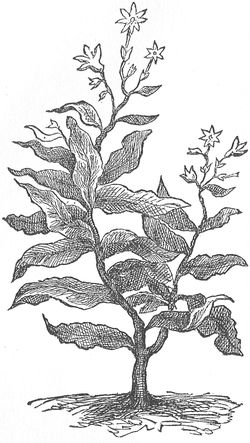
Old Engraving of Tobacco.
"In a pleasant room of Durham House, in the Strand,—a room overhanging a lovely garden, with the river, the old bridge, the towers of Lambeth Palace, and the flags of Paris Garden and the Globe in view,—three men may have often met and smoked a pipe in the days of Good Queen Bess, who are dear to all readers of English blood; because, in the first place, they were the highest types of our race in genius and in daring; in the second place because the work of their hands has shaped the whole after-life of their countrymen in every sphere of enterprise and thought. That splendid Durham House, in which the nine-days queen had been married to Guilford Dudley, and which had afterwards been the town-house of Elizabeth, belonged to Sir Walter Raleigh, by whom it was held on leave from the queen. Raleigh, a friend of William Shakespeare and the players, was also a friend of Francis Bacon and the philosophers. Raleigh is said to have founded the Mermaid Club; and it is certain that he numbered friends among the poets and players. The proofs of his having known Shakespeare, though indirect, are strong. Of his long intercourse with Bacon every one is aware. Thus it requires no effort of the fancy to picture these three men as lounging in a window of Durham House, puffing the new Indian weed from silver bowls, discussing the highest themes in poetry and science, while gazing on the flower-beds and the river, the darting barges of dames and cavalier, and the distant pavilions of Paris Garden and the Globe."
"He was the first that brought tobacco into England, and into fashion. In our part—Malmsbury Hundred—it came first into fashion by Sir Walter Long. They had first silver pipes. The ordinary sort made use of a walnut shell and a strawe. I have heard my grandfather Lyte say that one pipe was handed from man to man round the table. Sir Walter Raleigh standing in a stand at Sir Ro. Poyntz parke at Acton tooke a pipe of tobacco, which made the ladies quitte it till he had donne."
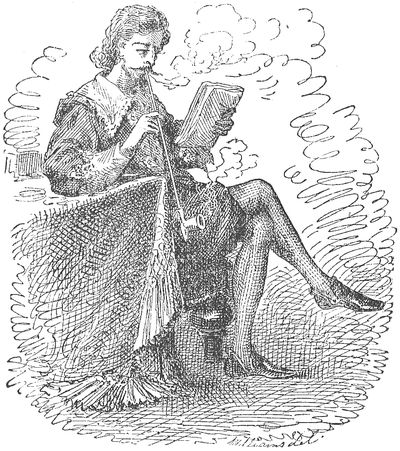
Sir Walter Raleigh.
A writer has truthfully said in regard to associating the name and use of the plant with the primitive users of it.
"The ambitious sought fame by associating themselves with the introduction of the plant and its cultivation; hence we find it named after cardinals, legates, and embassadors, while in compliment to Catherine, wife of Henry the Second, it was called the Queen's herb."
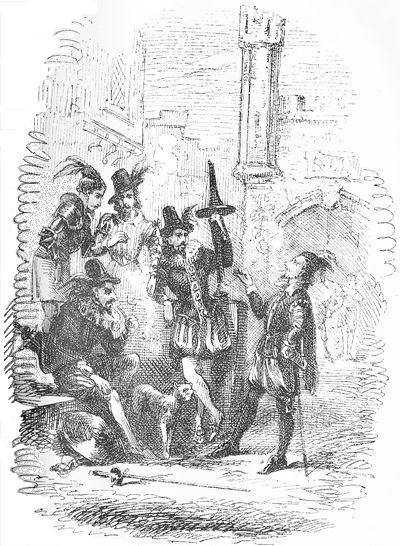
English Gallants.
In England, tobacco taking soon became a favorite custom not only with the loiterers about taverns and other public places, but among the courtiers of Elizabeth. Smoking was called drinking tobacco, as the fashionable method was to "put it through the nose" or exhale it through the nostrils. At this period tobacco seemed to have nearly the same effect as it did upon the Indian, producing a sort of intoxication; thus in "The Perfuming of Tobacco" (1611) it is said:
"The smoke of tobacco drunke or drawen by a pipe, filleth the membranes of the braine, and astonisheth and filleth many persons with such joy and pleasure, and sweet losse of senses, that they can by no means be without it."
The term "drinking tobacco" was not confined to England, but was used in Holland, France, Spain and Portugal, as the same method of blowing the smoke through the nostrils, seemed to be everywhere in vogue.
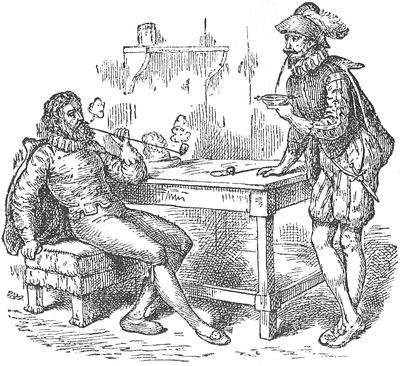
"About the latter end of the sixteenth century, tobacco was in great vogue in London, with wits and 'gallants,' as the dandies of that age were called. To wear a pair of velvet breeches, with panes or slashes of silk, an enormous starched ruff, a gilt handled sword, and a Spanish dagger; to play at cards or dice in the chambers of the groom-porter, and smoke tobacco in the tilt-yard or at the play-house, were then the grand characteristics of a man of fashion. Tobacconists' shops were then common; and as the article, which appears to have been sold at a high price, was indispensable to the gay 'man about town,' he generally endeavored to keep his credit good with his tobacco-merchant. Poets and pamphleteers laughed at the custom, though generally they seem to have no particular aversion to an occasional treat to a sober pipe and a poute of sack. Your men of war, who had served in the Low Countries, and who taught young gallants the noble art of fencing, were particularly fond of tobacco; and your gentlemen adventurers, who had served in a buccaneering expedition against the Spaniards, were no less partial to it. Sailors—from the captain to the ship-boy—all affected to smoke, as if the practice was necessary to their character; and to 'take tobacco' and wear a silver whistle, like a modern boatswain's mate, was the pride of a man-of-war's man.
"Ben Jonson, of all our early dramatic writers, most frequently alludes to the practice of smoking. In his play of 'Every Man in his Humour,' first acted in 1598, Captain Bobadil thus extols in his own peculiar vein the virtues of tobacco; while Cob, the water carrier, with about equal truth, relates some startling instances of its pernicious effects.
"'Bobadil. Body o' me, here's the remainder of seven pound since yesterday was seven-night! 'Tis your right Trinadado! Did you never take any, Master Stephen?
"'Stephen. No, truly, Sir; but I'll learn to take it since you commend it so.
"'Bobadil. Sir, believe me upon my relation,—for what I tell you the world shall not reprove. I have been in the Indies where this herb grows, where neither myself, nor a dozen gentlemen more of my knowledge, have received the taste of any other nutriment in the world, for the space of one and twenty weeks, but the fume of this simple only. Therefore, it cannot be but 'tis most divine. Further, take it, in the true kind, so, it makes an antidote, that had you taken the most deadly poisonous plant in all Italy, it should expel it and clarify you with as much ease as I speak. And for your greenwound, your balsamum, and your St. John's-wort, are all mere gulleries and trash to it, especially your Trinidado: your Nicotian is good too. I could say what I know of it for the expulsion of rheums, raw humours, crudities, obstructions, with a thousand of this kind, but I profess myself no quack-salver: only thus much, by Hercules; I do hold it, and will affirm it before any prince in Europe, to be the most sovereign and precious weed that ever the earth tendered to the use of man.'
From the first announcement that English navigators had discovered tobacco in Virginia, until the London and Plymouth companies sailed for the New World, the deepest interest was taken in the voyagers. Drayton, the poet, wrote of "The Virginian Voyage," while Chapman and other dramatists wrote plays in which allusions were made to Virginia. In the "Mask of Flowers," performed at White Hall upon Twelfth Night, 1613-14, one of the characters challenges another, and asserts that wine is more worthy than tobacco. The costumes were exceedingly grotesque and suggestive of the New rather than of the Old World. Kawosha one of the principal characters rode in, wearing on his head a cap of red-cloth of gold, from his ears were pendants, a glass chain was about his neck, his body and legs were covered with olive-colored stuff, in his hands were a bow and arrows, and the bases of tobacco—colored stuff cut like tobacco leaves. The play abounds with allusions to the "Indian weed."
"Silenus.—Kawosha comes in majestie, Was never such a God as he; He's come from a far countrie To make our nose a chimney.
Kawosha.—The wine takes the contrary way To get into the hood; But good tobacco makes no stay But seizeth where it should. More incense hath burned at Great Kawoshae's foote Than to Silen and Bacchus, both, And take in Jove to boote.
Silenus.—The worthies they were nine tis true, And lately Arthur's knights I knew; But now are come up Worthies new, The roaring boys Kawoshae's crew.
Kawosha.—Silenus toppes the barrel, but Tobacco toppes the braine And makes the vapors fire and soote, That mon revise againe. Nothing but fumigation Doth charm away ill sprites, Kawosha and his nation Found out these holy rites."
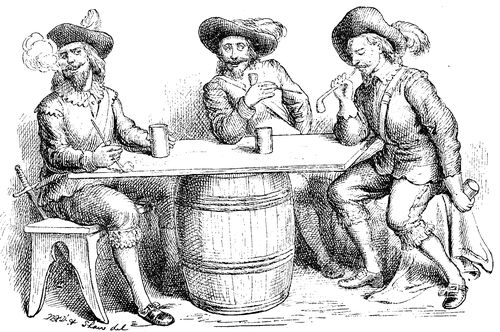
Smoking in the Seventeenth Century.
"How is it that our great dramatist never once makes even the slightest allusion to smoking? Who can suggest a reason? Our great poet knew the human heart too well, and kept too steadily in view, the universal nature of man to be afraid of painting the external trapping and ephemeral customs of his own time. Does he not delight to moralize on false hair, masks, rapiers, pomandens, perfumes, dice, bowls, fardingales, etc? Did he not sketch for us, with enjoyment and with satire, too, the fantastic fops, the pompous stewards, the mischievous pages, the quarrelsome revellers, the testy gaolers, the rhapsodizing lovers, the sly cheats, and the ruffling courtiers that filled the streets of Elizabethan London, persons who could have been found nowhere else nor in any other age? No one can dispute that he drew the life that he saw moving around him. He sketched these creatures because they were before his eyes and were his enemies or his associates; they live still because their creator's genius was Promethean, and endowed them with immortality. Bardolph, Moth, Slender, Abhorson, Don Armado, Mercutio, etc., are portraits, as everyone knows and feels who is conversant with the manners of the Elizabethan times as handed down in old plays.
"If Shakespeare's contemporaries were silent about the then new fashion of smoking, we should not so much wonder at Shakespeare's taciturnity. But Decker's and Ben Jonson's works abound in allusions to tobacco, its uses and abuses. The humorist and satirist lost no opportunity of deriding the new fashion and its followers. The tobacco merchant was an important person in London of James the First's time—with his Winchester pipes, his maple cutting-blocks, his juniper-wood charcoal fires, and his silver tongs with which to hand the hot charcoal to his customers, although he was shrewdly suspected of adulterating the precious weed with sack lees and oil. It was his custom to wash the tobacco in muscadel and grains, and to keep it moist by wrapping it in greased leather, and oiled rags, or by burying it in gravel. The Elizabethan pipes were so small that now when they are dug up in Ireland the poor call them 'fairy pipes' from their tininess. These pipes became known by the nickname of 'the woodcock's heads.' The apothecaries, who sold the best tobacco, became masters of the art, and received pupils, whom they taught to exhale the smoke in little globes, rings, or the 'Euripus.' 'The slights' these tricks were called. Ben Jonson facetiously makes these professors boast of being able to take three whiffs, then to take horse, and evolve the smoke—one whiff on Hounslow, a second at Staines, and a third at Bagshot.
"Ben Jonson makes that dry, shrewd, water carrier of his, Cob, rail at the 'roguish tobacco:' he would leave the stocks for worse men, and make it present whipping for either man or woman who dealt with a tobacco-pipe. But King James, in his inane 'Counterblast,' is more violent than even Cob. He argues that to use this unsavory smoke is to be guilty of a worse sin than that of drunkenness, and asks how men, who cannot go a day's journey without sending for hot coals to kindle their tobacco, can be expected to endure the privations of war. Smoking, the angry and fuming king protests, had made our manners as rude as those of the fish-wives of Dieppe. Smokers, tossing pipes and puffing smoke over the dinner-table, forgot all cleanliness and modesty. Men now, he says, cannot welcome a friend but straight they must be in hand with tobacco. He that refused a pipe in company was accounted peevish and unsociable. 'Yea,' says the royal coxcomb and pedant, 'the mistress cannot in a more mannerly kind entertain her servant than by giving him out of her fair hand a pipe of tobacco.' The royal reformer (not the most virtuous or cleanly of men) closes his denunciation with this tremendous broadside of invective:
'Have you not reason, then' he says, 'to be shamed and to forbear this filthy novelty, so basely grounded, so foolishly received, and so grossly mistaken in the right use thereof? To your abuse thereof sinning against God, harming yourself both in persons and goods, and taking also thereby the notes and marks of vanity upon you by the custom thereof, making yourselves to be wondered at by all, foreign civil nations and by all strangers that come among you, and be scorned, and contemned; a custom both fulsome to the eye, hateful to the nose, harmful to the brain, dangerous to the lungs, and in the black stinking fume thereof nearest resembling the horrible Stigian smelle of the pit that is bottomless."
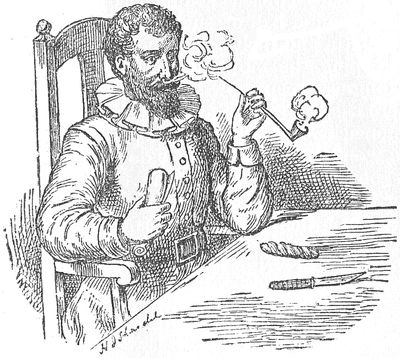
Exhaling through the Nose.
The supposed curative virtues of the tobacco plant had much to do with its use in Europe while the singular mode of exhaling through the nostrils added to its charms, and doubtless led to far greater indulgence. Spenser in his Fairy Queen makes one of the characters include it with other herbs celebrated for medicinal qualities.
"Into the woods thence-forth in haste she went, To seek for herbes that mote him remedy; For she of herbes had great intendiment, Taught of the Nymph which from her infancy, Had nursed her in true nobility: There whether it divine Tobacco were, Or Panachæ, or Polygony, She found and brought it to her patient deare, Who all this while lay bleeding out his heart-blood neare."
Lilly also a little later, in his play of The Woman in the Moone (1597), speaks of it (through one of the characters) as being a medicinal herb—
"Gather me balme and cooling violets And of our holy herbe nicotian, And bring withall pure honey from the hive To heale the wound of my unhappy hand."
Barclay, in his tract on "The Vertues of Tobacco," recommends its use as a medicine. The following is one of the modes of use:
"Take of leafe Tobacco as much as, being folded together, may make a round ball of such bignesse that it may fill the patient's mouth, and inclyne his face downwards toward the ground, keeping the mouth open, not mouthing any whit with his tongue, except now and then to waken the medicament, there shall flow such a flood of water from his brain and his stomacke, and from all the parts of his body that it shall be a wonder. This must he do fasting in the morning, and if it be for preservation, and the body be very cacochyme, or full of evil humors, he must take it once a week, otherwise once a month. He gives the plant the name of 'Nepenthes,' and says of it, that 'it is worthy of a more loftie name.'" He writes the following verse addressed to:
"The Abusers of Tobacco."
"Why do you thus abuse this heavenly plant, The hope of health, the fuel of our life? Why do you waste it without fear of want, Since fine and true tobacco is not ryfe? Old Enclio won't foul water for to spair, And stop the bellows not to waste the air."
He also alludes to the quality of tobacco and says: "The finest Tobacco is that which pearceth quickly the odorat with a sharp aromaticke smell, and tickleth the tongue with acrimonie, not unpleasant to the taste, from whence that which draweth most water is most veituous, whether the substance of it be chewed in the mouth, or the smoke of it received."
He speaks of the countries in which the plant grows, and prefers the tobacco grown in the New World as being superior to that grown in the Old. In his opinion, "only that which is fostered in the Indies, and brought home by Mariners and Traffiquers, is to be used." But not alone were Poets and Dramatists inspired to sing in praise or dispraise of tobacco, Physicians and others helped to swell in broadsides, pamphlets and chap-books, the loudest praises or the most bitter denunciation of the weed. Taylor, the water poet, who lost his occupation as bargeman when the coach came into use, thought that the devil brought tobacco into England in a coach. One of the first tracts wholly devoted to tobacco is entitled Nash's "Lenten Stuffe." The work is dedicated to Humphrey King, a tobacconist, and is full of curious sayings in regard to the plant. Another work, entitled "Metamorphosis of Tobacco," and supposed to have been written by Beaumont, made its appearance about this time. Samuel Rowlands, the dramatist, wrote two works on tobacco; the first is entitled "Look to it, for I'll Stabbe Ye," written in 1604; the other volume is a small quarto, bearing this singular title: "A whole crew of Kind Gossips, all met to be Merry." This is a satire on the time and manners of the period, and is written in a coarse style worthy of the author. In 1605 there appeared a little volume bearing for its title, "Laugh and Lie Down, or the World's Folly." This work describes the fops and men of fashion of its time, and shows how popular the custom of tobacco taking had become. In 1609, in "The Gull's Horne Book," a gallant is described as follows:
"Before the meate comes smoaking to the board our Gallant must draw out his tobacco box, the ladle for the cold snuff into his nostrils, the tongs and the priming iron. All this artillery may be of gold or silver, if he can reach to the price of it; it will be a reasonable, useful pawn at all times when the current of his money falles out to rune low. And here you must observe to know in what state tobacco is in town, better than the merchants, and to discourse of the potecaries where it is to be sold as readily as the potecary himself."
One of the severest tirades against tobacco appeared in 1612, "The Curtain Drawer of the World." In speaking of the users of the weed, and especially noblemen, he says:
"Then noblemen's chimneys used to smoke, and not their noses; Englishmen without were not Blackamoores within, for then Tobacco was an Indian, unpickt and unpiped,—now made the common ivy-bush of luxury, the curtaine of dishonesty, the proclaimer of vanity, the drunken colourer of Drabby solacy."
In the "Soule's Solace, or Thirty-and-One Spiritual Emblems," by Thomas Jenner, occurs the following verses:
"The Indian weed, withered quite, Greene at noone, cut down at night, Shows thy decay; all flesh is hay; Thus thinke, then drinke Tobacco.
The Pipe that is so lily-white, Show thee to be a mortal wight, And even such, gone with a touch, Thus thinke, then drinke Tobacco.
And when the smoake ascends on high, Thinke thou beholdst the vanity Of worldly stuffe, gone with a puffe, Thus thinke, then drinke Tobacco.
And when the Pipe grows foul within, Thinke on thy soul defiled with sin, And then the fire it doth require; Thus thinke, then drinke Tobacco.
The ashes that are left behind, May serve to put thee still in mind, That unto dust return thou must; Thus thinke, then drinke Tobacco."
Buttes, in a little volume entitled "Dyets Dry Dinner," (1599) says that
"Tobacco was translated out of India in the seede or roote; native or sative in our own fruitfullest soils. It cureth any griefe, dolour, imposture, or obstruction proceeding of colde or winde, especially in the head or breast. The fume taken in a pipe is good against Rumes, ache in the head, stomacke, lungs, breast; also in want of meate, drinke, sleepe, or rest."
The introduction of tobacco from the colony of Virginia was followed soon after by a reduction of price that led to more frequent use among the poorer classes, such as grooms and hangers on at taverns and ale-houses, who are alluded to in Rich's "Honestie of this Age":
"There is not so base a groome that comes into an ale-house to call for his pott, but he must have his pipe of tobacco; for it is a commodity that is nowe as vendible in every tavern, wine and ale-house, as eyther wine, ale or beare; and for apothecaerie's shops, grocer's shops, chandler's shops, they are never without company, that from morning till night, are still taking of tobacco. What a number are there besides, that doe keepe houses, set open shoppes, that have no other trade to live by, but by selling of tobacco. I have heard it told, that now very lately there hath been a catalogue of all those new erected houses that have sett up that trade of selling tobacco in London, and neare about London; and if a man may believe what is confidently reported, there are found to be upwards of seven thousand of houses that doth live by that trade.
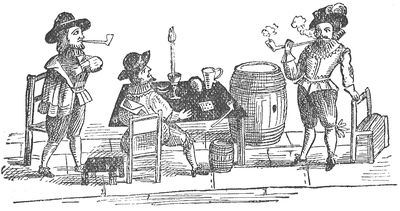
Old London Ale-house.
"If it be true that there be seven thousand shops in and about London, that doth vend tobacco, as it is credibly reported that there be over and above that number, it may well be supposed to be but an ill customed shop, that taketh not five shillings a day, one day with another throughout the whole year; or, if one doth take lesse, two other may take more; but let us make our account, but after two shillings sixpence a day, for he that taketh lesse than that would be ill able to pay his rent, or to keepe open his shop windows; neither would tobacco houses make such a muster as they do, and that almost in every lane, and in every by-corner round about London."
"A Tobacco seller is described after this manner by Blount in a volume "Micro-Cosmographie; Or A Piece of the World discovered; in Essays and Characters" (1628).
"A tobacco seller is the only man that finds good in it which others brag of, but doe not, for it is meate, drinke, and clothes to him. No man opens his ware with greater seriousness, or challenges your judgment more in the operation. His Shop is the Randenvous of spitting, where men dialogue with their noses, and their conversation is smoke. It is the place only where Spain is commended, and preferred before England itself.
"He should be well experienced in the World; for he has daily tryall as men's nostrils, and none is better acquainted with humour. His is the piecing commonly of some other trade, which is bawd to his Tobacco, and that to his wife, which is the flame that follows the smoke."
Quaint old Burton in his "Anatomy of Melancholy," recognizes the virtues of the plant while he anathematizes its abuse. He says:—
"Tobacco, divine, rare, superexcellent tobacco, which goes far beyond all their panacetas, potable gold, and philosophers' stones, a soveraign remedy to all diseases. A good vomit, I confesse, a vertuous herb, if it be well qualified, opportunely taken, and medicinally used; but, as it is commonly abused by most men, which take it as tinkers do ale, 'tis a plague, a mischief, a violent purger of goods, lands, health, hellish, divelish and damned tobacco, the ruine and overthrow of body and soul."
The duty on importation had been only twopence per pound, a moderate sum in view of the prices realized by the sale of it.
"However absurd his reasoning may appear, it unfortunately happened that he possessed the power to reduce his aversion to practice, and he may be considered as the author of that unwarrantable persecution of the tobacco plant, which under varying circumstances, has been injudiciously continued to the present time."
One of the edicts which he issued was against the taking of snuff in St. Peters, at Rome; this was in 1690; it was, however, revoked by Pope Benedict XIV., who himself had acquired the indulgence.
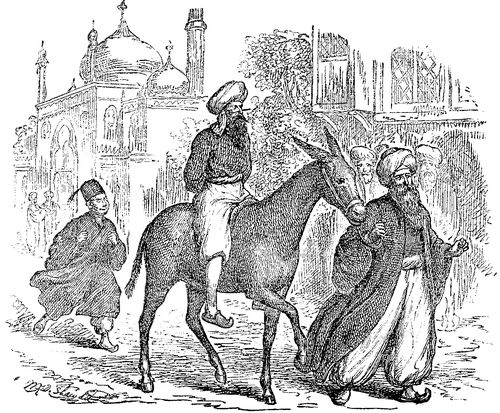
Punishment for Snuff Taking.
Early in the Seventeenth Century tobacco found its way to Constantinople. To punish the habit, a Turk was seized and a pipe transfixed through his nose.
"Cromwell disliked the plant, and ordered his troops to trample down the crop wherever found."
It is an historical fact that both James I. and the two Charleses as well as Cromwell had the strongest dislike against the Indian weed.
During the reign of Anne, the custom of smoking appears to have attained its greatest height in England; the consumption of tobacco was then proportionally greater, considering the population, than it is at the present time. Spooner, in his "Looking-Glass for Smokers," 1703, says of the custom:
"The sin of the kingdom in the intemperate use of tobacco, swelleth and increaseth so daily, that I can compare it to nothing but the waters of Noah, that swell'd fifteen cubits above the highest mountains. So that if this practice shall continue to increase as it doth, in an age or two it will be as hard to find a family free, as it was so long time since one that commonly took it."
When tobacco was first introduced into England its sale was confined to apothecaries, but afterwards it was dealt in by tobacconists, who sold other goods besides tobacco.
About the middle of the Seventeenth Century the culture of tobacco commenced in England; it continued, however, only for a short time, for the rump parliament in 1652 prohibited the planting of it, and two years later Cromwell and his council appointed commissioners for strictly putting this act in execution: and in 1660 it was legally enacted, that from the first of January, 1660-1, no person whatever should sow or plant any tobacco in England, under certain penalties.
In England drinking or smoking tobacco seems to have met with more success (as a mode of use) rather than chewing (now so popular). It was principally confined to the lower classes, and was common among soldiers and sailors. When used by gentlemen it was common to carry a silver basin to spit in.
Silver Spittoons.
The habit of smoking or using tobacco in any form was then more constant than now, and its use was common in almost all places of public gathering. It was the custom to smoke in theatres; stools being provided for those who paid for their use and the privilege of smoking on the stage. Tobacco was also sold at some of the play-houses, and proved a source of profit, doubtless, beyond even the representation of the plays. We should infer also from some of the early stage plays, that the "players" used the weed even when acting their parts. Rowlands gives the following poem on tobacco in his "Knave of Clubs," 1611:—
"Who durst dispraise tobacco whilst the smoke is in my nose, Or say, but fah! my pipe doth smell, I would I knew but those Durst offer such indignity to that which I prefer. For all the brood of blackamoors will swear I do not err, In taking this same worthy whif with valiant cavalier, But that will make his nostrils smoke, at cupps of wine or beer. When as my purse can not afford my stomach flesh or fish, I sop with smoke, and feed as well and fat as one can wish. Come into any company, though not a cross you have, Yet offer them tobacco, and their liquor you shall have. They say old hospitalitie kept chimnies smoking still; Now what your chimnies want of that, our smoking noses will. Much vituals serves for gluttony, to fatten men like swine, But he's a frugal man indeed that with a leaf can dine, And needs no napkins for his hands, his fingers' ends to wipe, But keeps his kitchen in a box, and roast meat in a pipe. This is the way to help down years, a meal a day's enough: Take out tobacco for the rest, by pipe, or else by snuff, And you shall find it physical; a corpulent, fat man, Within a year shall shrink so small that one his guts shall span. It's full of physic's rare effects, it worketh sundry ways, The leaf green, dried, steept, burnt to dust, have each their several praise, It makes some sober that are drunk, some drunk of sober sense. And all the moisture hurts the brain, it fetches smoking thence. All the four elements unite when you tobacco take. For earth and water, air and fire, do a conjunction make. The pipe is earth, the fire's therein, the air the breathing smoke; Good liquor must be present too, for fear I chance to choke. Here, gentlemen, a health to all, 'Tis passing good and strong. I would speak more, but for the pipe I cannot stay so long."
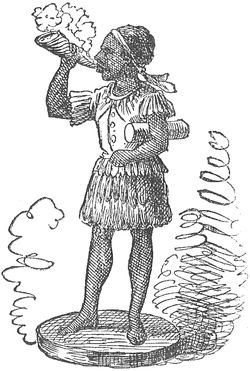
The Negro Image.
In 1602 appeared a sweeping tirade entitled, "Work for Chimney Sweepers, or a Warning against Tobacconists." It abounds with threats against all who indulge in tobacco. The most singular work, however, appeared in 1616, bearing the following singular title: "The Smoking Age, or the Man in the Mist; with the Life and Death of Tobacco. Dedicated to Captain Whiffe, Captain Pipe, and Captain Snuffe." A frontispiece is given representing a tobacconist's shop with shelves, counters, pipes and tobacco; a carved figure of a negro stands upon the counter, which shows how soon such figures were used by dealers in pipes and tobacco. The title-page contains the following epigram:
"This some affirme, yet yield I not to that, 'Twill make a fat man lean, a lean man fat; But this I'm sure (howse'ere it be they meane) That many whiffes will make a fat man lean."
The following effusion resembles many of the verses of the day on the fruitful subject:
"Tobacco's an outlandish weed, Doth in the land strange wonders breed, It taints the breath, the blood it dries, It burns the head, it blinds the eyes; It dries the lungs, scourgeth the lights, It numbs the soul, it dulls the sprites; It brings a man into a maze, And makes him sit for other's gaze; It makes a man, it mars a purse, A lean one fat, a fat one worse; A sound man sick, a sick man sound, A bound man loose, a loose man bound; A white man black, a black man white, A night a day, a day a night; The wise a fool, the foolish wise, A sober man in drunkard's guise; A drunkard with a drought or twain, A sober man it makes again; A full man empty, and an empty full, A gentleman a foolish gull; It turns the brain like cat in pan, And makes a Jack a gentleman."
The well-known song of "Tobacco is an Indian Weed," was written most probably the last half of the Seventeenth Century, Fairholt gives the best copy we have seen of it. It is taken from the first volume of "Pills to Purge Melancholy," and reads thus:
"Tobacco's but an Indian weed, Grows green at morn, cut down at eve, It shows our decay, we are but clay; Think of this when you smoke tobacco.
"The pipe, that is so lily white, Wherein so many take delight, Is broke with a touch—man's life is such; Think of this when you smoke tobacco.
"The pipe, that is so foul within, Shews how man's soul is stained with sin, And then the fire it doth require; Think of this when you smoke tobacco.
"The ashes that are left behind Do serve to put us all in mind That unto dust return we must; Think of this when you smoke tobacco.
"The smoke, that does so high ascend, Shews us man's life must have an end, The Vapor's gone—man's life is done; Think of this when you smoke tobacco."
One of the strongest objections against the use of the "Indian novelty" was its ruinous cost at this period. During the reign of James The First and Charles The Second, Spanish tobacco sold at from ten to eighteen shillings per pound while Virginia tobacco sold for a time for three shillings. In no age and by no race excepting perhaps the Indians was the habit so universal or carried to such a length as in the Seventeenth Century—its supposed virtues as a medicine induced many to inhale the smoke constantly. This was one reason why tobacco was condemned by so many of the writers and playwrights of the day yet many of them used the weed in some form from Ben Johnson to Cibber the one fond of his pipe the other of his snuff.
In 1639 Venner published a volume entitled "A Treatise" concerning the taking of the fume of tobacco. His advice is "to take it moderately and at fixed times." Many of the clergy were devoted adherents of the pipe. Lilly says of its use among them:
"In this year Bredon vicar of Thornton a profound divine, but absolutely the most polite person for nativities in that age, strictly adhering to Ptolemy, which he well understood; he had a hand in composing Sir Christopher Heydon's defence of judicial astrology, being that time his chaplain; he was so given over to tobacco and drink, that when he had no tobacco, he would cut the bell-ropes and smoke them."[Back to Contents]