Chapter VII
Reading edition
PIPES AND SMOKERS. (Continued.)
In Russia and Denmark as also in Norway and Sweden the pipes are more simple and are principally formed of wood sometimes tipped with copper but usually of inferior material and work when compared with French and German pipes. The German pipes considered as works of art are doubtless the finest made. Many are made of meerschaum (sea foam). This material is found in various parts of Asia Minor. When first obtained it is capable of forming a lather like soap, and is used by the Tartars for washing purposes. The Turks use it for pipes which are made in the same way that pottery is and afterwards soaked in wax and is then ready for smoking. It heats slowly and is capable of greater absorption than any other material used in pipe making. To properly color a meerschaum is now considered as one of the fine arts and when completed is considered quite a triumph. When the pipe takes on a rich deep brown tint it is considered a valuable pipe and is watched and guarded as a most valuable treasure.
M. Ziegler thus describes the source whence the considerable annual supply of meerschaum for meerschaum pipes is derived:
"Large quantities of this mineral so highly esteemed by smokers, comes from Hrubschitz and Oslawan in Austrian Moravia where it is found embedded between thick strata of serpentine rock. It is also found in Spain at Esconshe, Vallecas and Toledo; the best however comes from Asia Minor. The chief places are the celebrated meerschaum mines from six to eight miles southeast of Eskis chehr, on the river Pursak chief tributary to the river Sagarius. They were known to Xenophon, and are now worked principally by Armenian Christians, who sink narrow pits, to the beds of this mineral, and work the sides out until water or imminent danger drives them away to try another place. Some meerschaum comes from Brussa, and in 1869 over 3,000 boxes of raw material were imported from Asia Minor at Trieste, with 345,000 florins. The pipe manufacture and carving is principally carried on in Vienna and in Rhula, Duchy of Saxe-Coburg-Gotha. The commercial value of meerschaum carving at these places may be estimated at $2,000,000 annually. However very large quantities of them are not made from genuine but artificial material. The waste from these carvings is ground to a very fine powder, and then boiled with linseed oil and alum. When this mixture has sufficient cohesion, it is cast in molds and carefully dried and carved, as if these blocks of mineral had been natural. It is said that about one-half of all pipes now sold are made from artificial meerschaum. Meerschaum is one of the lightest of minerals and it is said that in Italy bricks have been made of it so light that they would float on the top of the water. Some pipes (doubtless owing to the quality of meerschaum) take on more color in a given time than others this is owing in a great measure however to the thickness of the bowl."
Pipe-colorers, who go around coloring pipes or meerschaums, pride themselves on the rapidity with which they are enabled to color a pipe. The following, on "Pipe Colorers," is from "The Tobacco Plant":
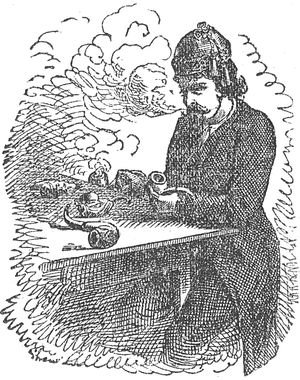
Pipe Colorer.
"There are men who pride themselves upon the skill with which they are able to color the pipes they smoke. Some of these are amateurs, who smoke Tobacco only with the view of gratifying that taste for color which is satisfied when a bowl of clay or meerschaum is sufficiently yellowed, browned, or blacked. There are men who care nothing for Tobacco of itself, and would be much more easily and rationally pleased were they to set their pipes upon an easel and paint them with oils and camel's-hair. Others of the class are professional colorers, who hire themselves to pipe-sellers or connoisseurs by the week, or day, or hour, to smoke so many ounces or pounds of strong Tobacco through such and such pipes in such and such a time, with the view of causing such and such stains of Tobacco-juice to make themselves visible on the bowls or stems of those specified pipes. These are mostly old, well-seasoned smokers, to whose existence the weed has become essential; who smoke their own old pipes, which lack artistic coloring, in the intervals when they lay aside the pipes they are employed to color. Another and much smaller section of the class are those who smoke for smoking's sake, and yet are weak enough to nurse some special pipes for show. To such it is a joy to say, when friends are gathered at the festive board 'Look! is not that well colored? I colored it myself.' In such an age as this, when the learned cannot tell us which of our various branches of knowledge and inquiry are sciences and which are not, it may not seem a great anomaly that this pipe-coloring should, by some, be called 'an art.' Nor is it, when we think that there is such an 'art' as blacking shoes; and when we must perforce admit that he who, barber fashion, cuts our hair—and he who, cook-wise, broils the kidney for our mid-day dinner—is an artist. We have not come as yet to give this title to the weaver who watches the loom that weaves our stockings, or to the hammer-man who beats the red-hot horse-shoe on the anvil in a smithy; but even there we designate 'artisans,' and 'artists' may come next. So, hey! for the art of coloring pipes!
"It may not be denied that there is beauty in a well-colored meerschaum; but in the admission lies the contradiction of Keats' well-known line—
"A thing of beauty is a joy for ever."
For, your meerschaum is a fragile thing, and eminently frangible. This present writer once did see four beauties break within a single moon. And when they break, what previous joy of coloring can over-top the sorrow of their dire destruction? It is a singular difficulty in the way of those who most desire to beautify utility or utilize the beautiful, or show that beauty is most lovely when made practical, that these artistic colorers of pipes are always those who make least use of Tobacco, save for the immediate purpose of obtaining the clay in which it is smoked. Ask such an artist why he smokes, and he will scarcely tell you. His best reason certainly will be, that others smoke, and, as a custom, it becomes him. And when you find an ardent smoker—one who smokes because he likes Tobacco for itself, or finds it useful—who spends his time in tinting pipes, you will have found a rara avis, or a monstrosity. Apart from taste, there are some practical objections to this custom of coloring pipes. Smoking, to be worthy, should be free and unrestrained; while he who colors his pipe is tied by system and confined to rule.
"A pipe to be enjoyable, should be its master's slave; but he who keeps a 'well-colored' pipe is slave thereto. He cannot smoke it as, or when, or where he will. He must not smoke it in a draught, or near a fire; he must not lay it down, or finger it; he must not puff too fast, nor yet too slow. In short, he is the creature of this 'Joss'—this home-made deity—to which he bows down and worships. The pipe-colorers are the Sabbatarians of smoking. Whereas, the pipe was made for man, they treat man as made for the pipe. And thus, as in all cases where the cart is expected to draw the horse, the economy of nature is reversed, and mischief is evolved."
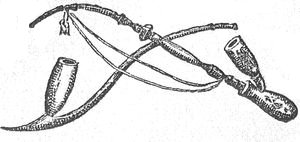
German Porcelain Pipes.
Dibdin, in his "Tour in France and Germany," says of Vienna, that it is a city of smokers,—"a good Austrian thinks he can never pay too much for a good pipe." Many of the Germans use a kind of pipe carved from the root of the dwarf oak; wooden pipes of a similar kind are made of brier root, and are very common, as are also those made from maple and sweet-brier. One of the favorite pipes used by Germans is the porcelain pipe, which consists of a double bowl—the upper one containing the tobacco, which fits into another portion of the pipe, allowing the oil to drain into the lower bowl, which may be removed and the pipe cleaned. The bowls are sometimes painted beautifully, representing a variety of subjects, and in no way inferior to the painted porcelain for the table.
The Dutch are famous smokers and are constantly "pulling at the pipe." They use those with long, straight stems, and both their clay and porcelain pipes are of the finest form and finish. Irving, in "The History of New York from the Beginning of the World to the End of the Dutch Dynasty," has given a good description of the smoking powers of the Dutch. Speaking of his grandfather's love for the weed, he says:
"My great-grandfather, by the mother's side, Hermanns Van Clattercop, when employed to build the large stone church at Rotterdam, which stands about three hundred yards to your left, after your turn from the Boomkeys; and which is so conveniently constructed that all the zealous Christians of Rotterdam prefer sleeping through a sermon there to any other church in the city. My great-grandfather, I say, when employed to build that famous church, did, in the first place, send to Delft for a box of long pipes; then, having purchased a new spitting-box and a hundred weight of the best Virginia, he sat himself down and did nothing for the space of three months but smoke most laboriously.
"Then did he spend full three months more in trudging on foot, and voyaging in the Trekschuit, from Rotterdam to Amsterdam—to Delft—to Hærlem—to Leyden—to the Hague—knocking his head and breaking his pipe against every church in his road. Then did he advance gradually nearer and nearer to Rotterdam, until he came in full sight of the identical spot whereon the church was to be built. Then did he spend three months longer in walking round it and round it, contemplating it, first from one point of view, and then from another,—now would he be paddled by it on the canal—now would he peep at it through a telescope from the other side of the Meuse, and now would he take a bird's-eye glance at it from the top of one of those gigantic windmills which protect the gates of the city.
"The good folks of the place were on the tip-toe of expectation and impatience. Notwithstanding all the turmoil of my great-grandfather, not a symptom of the church was yet to be seen; they even began to fear it would never be brought into the world, but that its great projector would lie down and die in labor of the mighty plan he had conceived. At length, having occupied twelve good months in puffing and paddling, and talking and walking,—having traveled over all Holland, and even taken a peep into France and Germany,—having smoked five hundred and ninety-nine pipes and three hundred weight of the best Virginia tobacco,—my great-grandfather gathered together all that knowing and industrious class of citizens who prefer attending to anybody's business sooner than their own, and having pulled off his coat and five pair of breeches he advanced sturdily up and laid the corner-stone of the church, in the presence of the whole multitude,—just at the commencement of the thirteenth month."
He also alludes to Hudson whom he says was:
"A seafaring man of renown, who had learned to smoke tobacco under Sir Walter Raleigh, and is said to have been the first to introduce it into Holland, which gained him much popularity in that country, and caused him to find great favor in their High Mightinesses, the lords and states general, and also of the honorable West India Company. He was a short, square, brawny old gentleman, with a double chin, a mastiff mouth, and a broad copper nose, which was supposed in those days to have acquired its fiery hue from the constant neighborhood of his tobacco pipe. * * * As chief mate and favorite companion, the commander chose Master Robert Juet, of Limehouse, in England. By some his name has been spelled Chewit, ascribed to the circumstance of his having been the first man that ever chewed tobacco. * * * * Under every misfortune he comforted himself with a quid of tobacco, and the truly philosophical maxim, 'that it will be all the same a hundred years hence!'"
Further on he alludes to the attempt to subjugate New Amsterdam to the British crown and the effect produced by the burghers lighting their pipes.
"When" he says "Captain Argol's vessel hove in sight, the worthy burghers were seized with such a panic, that they fell to smoking their pipes with astonishing vehemence, insomuch that they quickly raised a cloud, which, combining with the surrounding woods and marshes, completely enveloped and concealed their beloved village; and overhung the fair regions of Pavonia:—so that the terrible Captain Argol passed on, totally unsuspicious that a sturdy little Dutch settlement lay snugly couched in the mud, under cover of all this pestilent vapor."
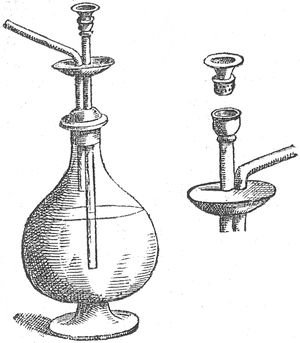
A Persian Water Pipe.
"The hookah of India is the most splendid and glittering of all pipes; it is a large affair, on account of the arrangements for causing the smoke to pass through water before it reaches the lips of the smoker, as a means of rendering it cooler and of extracting from it much of its rank and disagreeable flavor.
"On the top of an air-tight vessel, half filled with water, is a bowl containing tobacco; a small tube descends from the bowl into the water, and a flexible pipe, one end of which is between the lips of the smoker, is inserted at the other end into the vessel, above the level of the water. Such being the adjustment, the philosophy of the inhalation may be easily understood. The smoker sucks the air out of the vessel, and makes a partial vacuum; the external air, pressing on the burning tobacco, drives the smoke through the small tube into the water beneath; purified from some of its rank qualities, the smoke bubbles up into the vacant part of the vessel above the water, and passes through the flexible pipe to the smoker's mouth. Sometimes the affair is made still more luxurious by substituting rose-water for water pur et simple. The tube is so long and flexible that the smoker may sit (or squat) at a small or great distance from the vessel containing the water. In the courts of princes and wealthy natives the vessels and tubes are lavishly adorned with precious metals. One mode of showing hospitality in the East is to place a hookah in the center of the apartment, range the guests around, and let all have a whiff of the pipe in turn; but in more luxurious establishments a separate hookah is placed before each guest. Some of the Egyptians use a form of hookah called the narghile or nargeeleh—so named because the water is contained in the shell of a cocoanut of which the Arabic name is nargeeleh. Another kind, having a glass vessel, is called the sheshee—having, like the other, a very long tube. Only the choicest tobacco is used with the hookah and nargeeleh; it is grown in Persia.
"Before it is used, the tobacco is washed several times, and put damp into the pipe-bowl, two or three pieces of live charcoal are put on the top. The moisture gives mildness to the tobacco, but renders inhalation so difficult that weak lungs are unfitted to bear it. The dry tobacco preferred by the Persians does not involve so much difficulty in 'blowing a cloud.'"
TURKISH CHIBOUQUES AND WOOD PIPES.
"The stiff-stemmed Turkish pipes, quite different from the flexible tube of the hookah and narghile, are of two kinds, the kablioun or long pipe, and the chibouque or short pipe. Some of the stems of the kablioun, made of cherry tree, jasmine, wild plum, and ebony, are five feet in length, and are bored with a kind of gimlet. The workman, placing the gimlet above the long, slender branchlet of wood, bores half the length, and then reverses the position to operate upon the other half. The wild cherry tree wood, which is the most frequently employed, is seldom free from defects in the bark, and some skill is exercised in so repairing these defective places that the mending shall be invisible."
The tubes or pipe-bowls used with these stems are mostly a combination of two substances—the red clay of Nish and the white earth of Rustchuk; they are graceful in form and sometimes decorated with gilding. It is characteristic of some of the Turks that they estimate the duration of a journey, and with it the distance traveled, by the number of pipes smoked, a particular size of pipe-bowl being understood. Dodwell, in his "Tour through Greece," says that
"a Turk is generally very clean in his smoking apparatus, having a small tin dish laid on the carpet of his apartment, on which the bowl of the pipe can rest, to prevent the tobacco from burning or soiling the carpet. The tubes of the kabliouns are often as much as seven or eight feet long. Some of the gardens of Turkey and Greece contain jasmine trees purposely cultivated to produce straight stems for these pipes."
Of those Turkish pipes which are used in Egypt, Mr. Lane, after mentioning the narghile and the chibouque or "shibuk," says:—
"The most common kind used in Egypt is made of wood called garmashak (I believe it is maple). The greater part of the stick, from the mouth-piece to three-fourths of its length, is covered with silk, which is confined at each extremity by gold thread, often intertwined with colored silks, or by a tube of gilt or silver; and at the lower extremity of the covering is a tassel of silk. The covering was originally designed to be moistened with water in order to cool the pipe, and consequently the smoke by evaporation; but this is only done when the pipe is old or not handsome. These stick pipes are used by many persons, particularly in winter; in summer the smoke is not so cool from them as from the kind before mentioned. The bowl is of baked earth, colored red or brown."
AUSTRIAN AND HUNGARIAN PIPE STEMS.
Before passing to the subject of the costly mouth-pieces of Oriental pipes, we must say a few words concerning the extraordinary care bestowed on some kinds of plain wood sticks for stems or tubes. Cherry-tree stems, under the name of agriots, constitute a specialty of Austrian manufacture. The fragrant cherry (prunus makaleb) is a native of that country; and the young trees are cultivated with special reference to this application. They are all raised from seed. The seedlings, when two years old, are planted in small pots, one in each; as they grow, every tendency to branching is choked by removing the bud; and as they increase in size from year to year, they are shifted into larger pots or into boxes. Great care is taken to turn them round daily, so that every part shall be equally exposed to sunshine. When the plants have attained a sufficient height they are allowed to form a small bushy head; but the daily care is continued until the stems grow to a proper thickness. They are then taken out of the ground, the roots and branches removed, and the stem bored through after being seasoned for some time. The care shown in rearing insures a perfect straightness of stem, and an equable diameter of about an inch or an inch and a half. The last specimens, when cut from the tree, are as much as eight feet in length, dark purple-brown in color, and highly fragrant. At Pesth are made pipes about eighteen inches in length, of the shoots of the mock orange, remarkable for their quality in absorbing the oil of tobacco, they are flexible without being weak. The French make elegant pipe-bowls of the root of the tree-heath, but their chief attention is directed, as far as concerns wood pipes, to those of brier-root, which are made by them in large quantities. The bowl and the short stems are carried out of one piece, and the wood is credited with absorbing some of the rank oil of tobacco.
Amber—the only kind of resin that rises to the dignity of a gem—is unfitted for the bowl of a tobacco-pipe, because it cannot well bear the heat; but it is largely used for mouth-pieces, especially by wealthy Oriental smokers. The Turks have a belief that amber wards off infection; an opinion which, whether right or wrong, tells well for the amber workers. There has always been a mystery connected with this remarkable substance. So far back as the Phenicians, amber was picked up on the Baltic shore of what is now called Prussia; and the same region has ever since been the chief store-house for it. Tacitus was not far wrong when he conjectured that amber is a gum or resin exuded from certain trees, although other authorities have preferred a theory that it is a kind of wax or fat which has undergone slow petrifaction. At any rate, it must at one time have been liquid or semi-liquid; for insects, flies, detached wings and legs, and small fragments of various kinds, are often found imbedded in it—those odds and ends of which Pope said:—
"The things, we know, are neither rich nor rare; The wonder's how the devil they got there!"
Whether new stores of amber are now being formed, or whether, like coal, it was the result of causes not now in operation, is an unsolved problem. The specimens obtained differ considerably; some are pale as primrose, some deep orange or almost brown; some nearly as transparent as crystal, some nearly opaque. Large pieces, uniform in color and translucency, fetch high prices; and there are fashions in this matter for which it is not easy to account,—seeing that the Turks and other Orientals buy up, at prices which Europeans are unwilling to give, all the specimens presenting a straw-yellow color and a sort of cloudy translucency. The Russians, on the contrary, prefer orange-yellow transparent specimens. The amber is seldom obtained by actual mining.
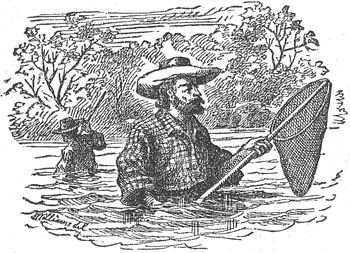
Searching for Amber.
It is usually found on sea-coasts, after storms, in rounded nodules; or, if scarce on shore, it is sought for by men clad in leather garments, who wade up to their necks in the sea, and scrape the sea-bottom with hooped nets attached to the end of long poles; or (rather dangerous work) men go out in boats, and examine the faces of precipitous cliffs, picking off, by means of iron hooks, the lumps of amber which they may see here and there. Sometimes a piece weighing nearly a pound is found, and a weight of even ten pounds is recorded. As small pieces can easily be joined by smoothing the surfaces, moistening them with linseed oil, and pressing them together over a charcoal fire, and as gum copal is sometimes very like amber, there is much sophistication indulged in, which none but an expert can guard against. In fashioning the nodules of amber, whether genuine or fictitious, into pipe mouth-pieces, they are split on a leaden plate in a turning lathe, smoothed into shape by whet-stones, rubbed with chalk and water, and polished with a piece of flannel. It is an especially difficult kind of work; for unless the amber is allowed frequent intervals for cooling, it becomes electrically excited by the friction and shivers into fragments; the men, too, are put into nervous tremors if kept too long at work at one time. Amber is one of the most electrically excitable of all known substances; in fact, the name electricity itself was derived from electron, the Greek name for amber. Hookahs, chibouques, narghiles, meerschaums, all are largely adorned with amber mouth-pieces. The mouth-piece often consists of two or three pieces of amber, interjoined with ornaments of gold and gems; it is in such case the most costly part of the pipe.
At one of the greater industrial exhibitions four Turkish amames, or amber mouth-pieces, were shown, illustrating clearly enough the value attached to choice specimens; two of them were worth £350 each, two £200 each, diamond studded. The Turkish and Persian pipes have often a small wooden tube inside the amber mouth-piece. They require frequent cleaning with a long wire and a bit of tow, and in some large towns there are professional pipe-cleaners.
The natives of British Guiana have a curious kind of pipe, made of the rind of the fruit of the areca-palm, coiled up into a kind of cheroot, with an internal hollow to hold the tobacco. The poorer Hindoos make a simple pipe of two pieces of bamboo,—one cut close to a knot for the bowl, and a more slender piece for the tube. A lower class of natives in India make two holes of unequal length, with a piece of stick, in a clay soil; the holes are unequally inclined so as to meet at the bottom; the tobacco is placed in the shorter hole, and the smoker, applying his mouth to the longer, inhales the fumes in this primitive fashion. The pipes used for opium-smoking in various parts of the East have small bowls; the drug is too costly to be used otherwise than in small portions at a time, and too powerful to need more than a few whiffs to produce the opium-smoker's dreary delirium.
The Tunisians use reeds for pipes. Stone pipes are found among the natives of Vancouver; while Strong Bow, the North American Indian chief, has his long wooden pipe of peace, decked out with tassels and fringes, but with an ominous-looking sharp steel cutting instrument near the end most remote from the bowl.
Chinese, Japanese, Philippine Islanders, Madagascans, Central Africans, Algerine Arabs, Mexicans, Paraguayans, Siamese, Tahitians, South American Indians, Mongols, Malays, Tartars, Turcomans, as well as the nations of Europe and the chief nations of Southern Asia, all have their smoking-pipes, plain or ornate, as the case may be, and made of wood, reeds, bamboo, bone, ivory, stone, earthenware, glass, porcelain, amber, agate, jade, precious metals and common metals, according to the civilization of the country and the pecuniary means of the smoker.
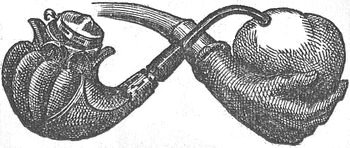
Fancy Pipes.
"The French clay pipes have quite a special character; they are well made, and great ingenuity is shown in the preparation of the moulds in which they are pressed; but being mostly intended for a class of purchasers who prefer grotesque ideas to refined taste, the bowls are often ornamented with queer shaped heads, having bead-like eyes; sometimes imaginary beings, sometimes caricature portraits of eminent persons. Where more than the head is represented, license is given to a certain grossness of idea; but this is not a general characteristic. The clay of which these French pipes are made is admitted to be superior to that of England, due to the careful mixture of different kinds, and to skilful manipulation.
"We need not say much about Dutch pipes as distinct articles of manufacture, because the process adopted in their production are pretty much like those in use elsewhere. The Dutch are famous clay-pipe smokers, not countenancing the cigar so much as their neighbors the Belgians, nor the meerschaum so largely as their German neighbors on the Rhine frontier. A notable bit of sharp practice is on record in connexion with the pipe-smokers of Holland—a dodge only to be justified on the equivocal maxim that all is fair in trade provided it just keeps within the margin we need not speak. A pipe manufactory was established in Flanders about the middle of the last century.
"The Dutch makers, alarmed at the competition which this threatened, cunningly devised a stratagem for nipping it in the bud. They freighted a large worn-out ship with an enormous quantity of pipes of their own make, sent it to Ostend, and wrecked it there. By the municipal laws of that city the wreck became public property; the pipes were sold at prices so ridiculously low that the town was glutted with the commodity; the new Flemish factory was thereby paralyzed, ruined, and closed."
The Turks (especially those of the lower orders) use a kind of clay pipe made of red earth decorated with gilding. The stem of the pipe is made from a branch of jasmine, cherry tree or maple and is sufficiently long to rest on the floor when used by the smoker. A writer in the Tobacco Plant says of Old English Clay pipes:
"Of all the various branches of the subject of tobacco, that of the history of pipes is one of the most interesting, and one that deserves every attention that can possibly be given. Whether considered ethnographically, historically, geographically, or archæologically, pipes present food for speculation and research of at least equal importance to any other set of objects that can be brought forward. Some branches of the subject have already been treated in these columns, and others, in what is intended shall follow, will hereafter be discussed. The present article will be devoted to 'Fairy Pipes' and the history of the earliest pipes of this country. Smoking is an old and venerable institution in this kingdom of ours, and dates far back beyond the introduction of tobacco to our shores. Long before Sir Walter Raleigh was thought of, there is reason to believe herbs and leaves of one kind or other—coltsfoot, yarrow, mouse-lax, sword-grass, dandelion, and other plants, and even dried cow-dung—were smoked for one ailment or other, and in some instances for relaxation and pleasure, and thus, no doubt, became habitually used. These are still, in some of our rural districts, smoked by people as cures for various ailments, and are considered not only highly efficacious but very pleasant. I have known these or other herbs smoked through a stick from which the pith had been removed, the bowl being formed of a lump of clay moulded by the fingers at the time, and baked in the household fire.
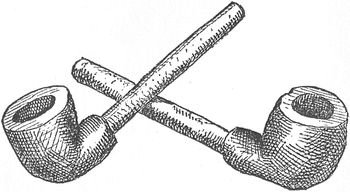
Clay and Reed Pipes.
"The small branches of the elder tree, or sometimes the stem of the briar and bramble, are what I have seen used, but even the stem of the hemlock and keckse are sometimes brought into requisition for the purpose.
"I believe that long before the time Dr. Wilson states on the authority of Sharpe, that it was common within memory, for the old wives of Annandale to smoke a dried white moss gathered on the neighboring moors, which they declared to be much sweeter than tobacco, and to have been in use long before the American weed was heard of; before Sir Walter Raleigh wooed and won Elizabeth Throgmorton, or Sir Richard Granville voyaged to Virginia with Masters Ralph Layne, Thomas Candish, John Arundell, Master Stukely, Bremize, Vincent, Heryot, and John Clarke; before Sir Francis Drake made his first voyage, or the Spanish Armada was dreamed of; before Sir John Hawkins, Captain Price, Coft, Keat or others for whom the honor of the introduction of tobacco has been claimed, drew breath—smoking was to some extent indulged in by our forefathers and (still medicinally, of course) in this country. In mediæval times, when the Ceramic art was but little practiced, and when all the domestic vessels that were produced were of the rudest and coarsest character both in material, form, and decoration, it is not to be expected that pipes for the smoking of herbs would be manufactured as a matter of sale, and those of the people who wished for such an indulgence would naturally be thrown on their own primitive resources such as I have described, for instruments for the purpose.
"A portion of a very rude pipe-head, formed of common red clay—a lump of clay moulded by hand, and ornamented with small circles pressed into it as from the end of a stick—has come under my notice, as have also others of an equally primitive character, found in different parts of this kingdom. These I have no hesitation in ascribing to a pre-Raleigh period. It is not to these, however, but to the small pipes formerly used in this kingdom for smoking tobacco, and tobacco alone, that I wish to draw attention. Most people, especially in the Midland and Northern counties of England, as well as in Scotland and Ireland, will have heard the name of Fairy Pipes applied to the small, old-fashioned, and sometimes oddly-shaped tobacco pipes which are not infrequently turned up in digging and plowing and other operations. To these and the general forms of old English pipes, I purpose confining myself in the present article. Many years ago I collected together a large number of these 'Fairy Pipes' from all parts of the kingdom. Since then, my own researches have, with the aid of inquiries carried on for me, enabled me to bring forward many interesting points, so as to verify dates of manufacture and more fully to carry out their classification. Like their Irish brethren and sisters, English people were formerly apt to ascribe everything unusually small to the fairies, and anything out of the common way to the people of very remote ages.
"Thus, these small pipes are commonly in England called 'fairy pipes,' or 'Carl's pipes,' or 'old man's pipes;' in Ireland, where they are likewise known as 'fairy pipes,' they are also called 'Dane's pipes;' and in Scotland, where their common name is 'elf pipes,' or 'elfin pipes,' they are, in like manner, known as 'Celtic pipes.' They are also sometimes named 'Mab pipes,' or 'Queen's pipes,' from the same fairy majesty, Queen Mab. Thus, while in each country they are ascribed to the elfin race—the 'small people' of Cornish folk-lore—their secondary names attach to them a popular belief in their extreme antiquity. Anything apparently old is at once, by the Irish, set down to the 'Danes;' by the Scots to the 'Celts;' and by people in the rural districts of our own country to the 'carls,' or 'old men'—carl being indicative of extreme antiquity. In Ireland, the pipes are believed to have belonged to the cluricaunes—a kind of wild, ungovernable, mischievous fairy-demon—who were held in awe by the 'pisantry;' and whenever found, these pipes were, with much superstitious feeling, immediately broken up, so as to destroy and break up the spell their finding might have cast around the finder. But it was not only among the peasantry that this belief in the extreme antiquity of tobacco pipes existed.
"Serious essays were written to prove their pre-historic origin, and to claim for them a history that in our day reads as arrant nonsense. In 1784, a short pipe was asserted to have been found between the jaws of the skull of an ancient Milesian exhumed at Bannockstown, county Kildare. Upon this discovery, an elaborate and learned paper was written in the 'Anthologia Hibernica,' setting forth this pipe as a proof of the use of tobacco in Ireland long before that country was invaded by the Danes. This pipe has been proved by comparison to be probably quite late in the reign of Elizabeth. They also have a more modern pipe, the stem of which describes one or more circles, while another is tied in a knot, yet allows a free passage of air. At another time, in opening an Anglo-Saxon grave mound, some of the men employed came across a fairy pipe which evidently had rolled down from among the surface-soil, and, being turned out in juxtaposition with undoubted Anglo-Saxon remains, was immediately set down by the learned director of the proceedings as a relic of that period. At another time I had brought to me, as a great curiosity, two 'Roman pipes,' as I was informed—the finders jumping to the conclusion that because they had dug them up at little Chester (the Roman station Derventio), they must be Roman pipes! I believe they expected to receive a large sum from these relics: how grievously they were disappointed I need not tell. Instances of this kind are far from rare.
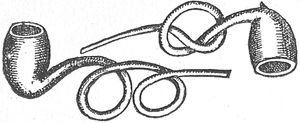
Fairy Pipes.
"I remember a man once bringing me some fragments of Roman pottery and other things of the same period, which he had turned up in the course of excavations, and among them was a Tobacco stopper formed of a Sacheverell medal! and a George II. half-penny, all of which he was ready to swear he had found "all of a heap together," inside a hypocaust tile, which, on examination, certainly had remained in situ from Romano-British times! The cupidity of a man had evidently led him to collect together these odds and ends, and try to turn them to profitable account. Some twenty years ago, a large number of "elfin pipes" were dug up at Bomington, near Edinburgh, along with a quantity of placks or bodles of James VI., which thus gave trustworthy evidence of their true date. Others were found in the ancient cemetery at North Berwick, adjoining to which is a small Romanesque building of the Twelfth Century, close upon the shore. Within the last half-century, the sea has made very great inroads upon this ancient burial-place, carrying off a considerable ruin, and exposing the skeletons, and bringing to light many interesting relics at almost every spring-tide. Among these, many pipes have been washed down. A similar circumstance has occurred on the seashore at Hoy Lake, Cheshire, where several "fairy pipes" have been found.
"Notices of several discoveries occur. Dr. Wilson says, in the statistical accounts of Scotland, many of which are suggestive of a pre-Raleigh period. Thus, 'in an ancient British encampment in the parish of Kirk Michael, Dumfriesshire, on the farm of Gilrig, a number of pipes of burnt clay were dug up, with heads smaller than the modern tobacco-pipes, swelled at the middle and straighter at the top. Again, in the vicinity of a group of standing stones at Cairney Mount, in the parish of Carluke Lanarkshire, a celt or stone hatchet, elfin bolts (flint and bone arrow-heads), elfin pipes, numerous coins of the Edwards and of later date, and other things are all stated to have been found.' An example is also recorded of the discovery of a tobacco-pipe in sinking a pit for coal, at Misk, in Ayrshire, after digging through many feet of sand. All these notes are pregnant with significant warnings of the necessity for cautious discrimination in determining the antiquity of such buried relics."
In Turkey the jasmine is cultivated for the purpose of pipe smoking. Barillet describes the growing of the common jasmine near Constantinople. He says:
"The object sought is a long straight stem, free from leaves and side branches. For this purpose the plants are grown quickly in a rich soil, and drawn up by being grown in a sheltered situation, to which the sun has little access at the sides, but only at the top. Pinching is resorted to, and during the second year's growth one end of a thread is attached to the top of the jasmine stem. This thread passes over a pulley attached to the post to which this jasmine is trained, and from it is suspended a weight, the effect of which is to keep the stem always in a vertical direction. When the jasmine stem is about two centimeters (say three quarters of an inch) in diameter a cloth is wrapped around it to prevent access of dust and of the sun's rays. Twice or thrice in the year the stem is washed with citron-water, which is said to give the clear color so much esteemed. When the stem has acquired a length of some fifteen feet, it is cut down and perforated by the workmen, and fitted with a terra-cotta bow and an amber mouth-piece."
Blackburn, in his work entitled "Artists and Arabs," gives the following picture of life and manners in Algiers:—
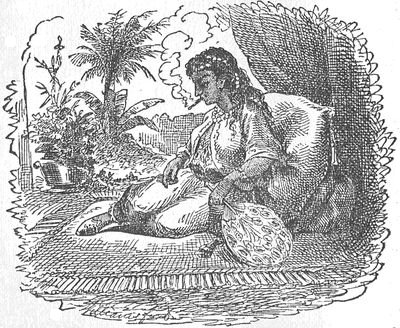
Female Smoking in Algiers.
"There is one difficulty here, however, for the artist—that of finding satisfactory models. You can get one at last, and here is her portrait. Her costume, when she throws off her haik (and with it a tradition of the Mohammedan faith, that forbids her to show her face to an unbeliever), is a rich, loose, crimson jacket embroidered with gold, a thin white bodice, loose silk trousers reaching to the knee and fastened round the waist by a magnificent sash of various colors, red morocco slippers, a profusion of rings on her little fingers, and bracelets and anklets of gold filagree work. Through her waving black hair are twined strings of coins and the folds of a silk handkerchief, the hair falling at the back in plaits below the waist. She is not beautiful, she is scarcely interesting in expression, and she is decidedly unsteady. She seems to have no more power of keeping herself in one position or of remaining in one part of the room, or even of being quiet, than a humming-top. The whole thing is an unutterable bore to her, for she does not even reap the reward—her father, or husband, or other male attendant always taking the money. She is petite, constitutionally phlegmatic, and as fat as her parents can manage to make her; she has small hands and feet, large rolling eyes—the latter made to appear artificially large by the application of henna or antimony black; her attitudes are not ungraceful, but there is a want of character about her, and an utter abandonment to the situation, peculiar to all her race. In short, her movements are more suggestive of a little caged animal that had better be petted and caressed, or kept at a safe distance, according to her humor. She does one thing—she smokes incessantly, and makes cigarettes with a skill and rapidity which are wonderful. Her age is thirteen, and she has been married six months; her ideas appear to be limited to three or four, and her pleasures, poor creature, are equally circumscribed. She had scarcely ever left her father's house, and had never spoken to a man until her marriage. There seems to be in the Moorish nature a wonderful sense of harmony and contrasts of color. Two Orientals will hardly walk down a street side by side unless the colors of their costumes harmonize. You find a negress selling oranges or citrons; an Arab boy with red fez and white turban, carrying purple fruit in a basket of leaves—always the right juxtaposition of colors. The sky furnishes them a superb background of deep blue, and the repose of these solemn Orientals, who sit here like bronze statues, save that they smoke incessantly, inspires you with a curious respect. They are men who believe in fate—what need that they should make haste?"
In Africa the pipes are made of clay and horn, and are mostly rude affairs, but well suited to their ideas of implements used for holding tobacco. King gives the following description of smoking among them:—
"A party of headmen and older warriors, seated cross-legged in their tents, ceremoniously smoked the daghapipe, a kind of hookah, made of bullock's horn, its downward point filled with water, and a reed stem let into the side, surmounted by a rough bowl of stone, which is filled with the dagha, a species of hemp, very nearly, if not the same, as the Indian bang. Each individual receives it in turn, opens his jaws to their full extent, and placing his lips to the wide mouth of the horn, takes a few pulls and passes it on. Retaining the last draught of smoke in his mouth, which he fills with a decoction of bark and water from a calabash, he squirts it on the ground by his side through a long ornamented tube in his left hand, performing thereon, by the aid of a reserved portion of the liquid, a sort of boatswain's whistle, complacently regarding the soap-like bubbles, the joint production of himself and neighbor. It appeared to be a sign of special friendliness and kindly feeling to squirt into the same hole."
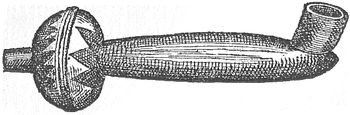
African Pipe.
"A Painter's Camp in the Highlands" defends the custom of smoking in the following well chosen words:
"People who don't smoke—especially ladies—are exceedingly unfair and unjust to those who do. The reader has, I daresay, amongst his acquaintances ladies who, on hearing any habitual cigar-smoker spoken of, are always ready to exclaim against the enormity of such an expensive and useless indulgence; and the cost of Tobacco-smoking is generally cited by its enemies as one of the strongest reasons for its general discontinuance. One would imagine, to hear these people talk, that smoking was the only selfish indulgence in the world. When people argue in this strain, I immediately assume the offensive. I roll back the tide of war right into the enemy's intrenched camp of comfortable customs; I attack the expensive and unnecessary indulgences of ladies and gentlemen who do not smoke. I take cigar-smoking as an expense of, say, half-a-crown a-day, and pipe-smoking at threepence.
"I then compare the cost of these indulgences with the cost of other indulgences not a whit more necessary, which no one ever questions a man's right to if he can pay for them. There is luxurious eating, for instance. A woman who has got the habit of delicate eating will easily consume dainties to the amount of half-a-crown a-day, which cannot possibly do her any good beyond the mere gratification of the palate. And there is the luxury of carriage-keeping, in many instances very detrimental to the health of women, by entirely depriving them of the use of their legs. Now, you cannot keep a carriage a-going quite as cheaply as a pipe. Many a fine meerschaum keeps up its cheerful fire on a shilling a-week. I am not advocating a sumptuary law to put down carriages and cookery; I desire only to say that people who indulge in these expensive and wholly superfluous luxuries, have no right to be so hard on smokers for their indulgence.
"Nearly every gentleman who drinks good wine at all will drink the value of half-a-crown a-day. The ladies do not blame him for this. Half-a-dozen glasses of good wine are not thought an extravagance in any man of fair means, but women exclaim when a man spends the same amount in smoking cigars. The French habit of coffee-drinking and the English habit of tea-drinking are also cases in point. They are quite as expensive as ordinary Tobacco-smoking, and, like it, defensible only on the ground of the pleasurable sensation they communicate to the nervous system. But these habits are so universal that no one thinks of attacking them, unless now and then some persecuted smoker in self-defence.
"Tea and tobacco are alike seductive, delicious, and deleterious. The two indulgences will, perhaps, become equally necessary to the English world. It is high treason to the English national feeling to say a word against tea, which is now so universally recognized as a national beverage that people forget it comes from China, and that it is both alien and heathen. Still, I mean no offence when I put tea in the same category with Tobacco. Now, who thinks of lecturing us on the costliness of tea? And yet it is a mere superfluity. The habit of taking it as we do is unknown across the Channel, and was quite unknown amongst ourselves a very little time ago, when English people were no less proud of themselves and their customs than they are now, and perhaps with equally good reason. A friend of mine tells me that he smokes every day, at a cost of about sixpence a-week. Now, I would like to know in what other way so much enjoyment is to be bought for sixpence. Fancy the satisfaction of spending sixpence a-week in wine! It is well enough to preach about the selfishness of this expenditure; but we all spend more selfishly, and we all love pleasure, and I should very much like to see that cynic whose pleasures cost less than sixpence a-week."
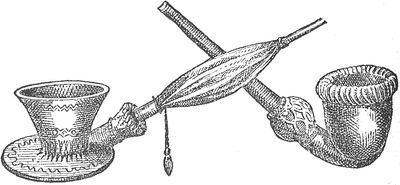
Egyptian Pipes.
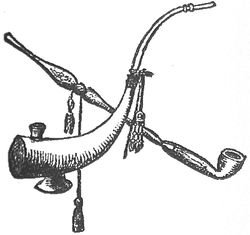
Japanese Pipes.
A writer says of smoking among the Japanese:
"Let us sit down to a good Japanese dinner—down on the floor. Food on the floor. Fire and cigars or pipes on the floor. Sit on your heels, waiting. Enter first course—Fish-skin soup. Smoke. Third—Fish, cake and bean-cheese. Smoke. Fourth—Row fish and horse-radish. Smoke. Fifth—Broiled fish. Smoke again, Sixth—Custard soup. Smoke. Seventh—Chicken stew, turnips and onions. Smoke a little. Eighth—Cuttle-fish, wafer cakes, Nipon tea. Here, if tired you can stop at the end of about two hours' ankle-ache. All is cleanly, well spiced with talk, and served with the utmost politeness. Sipping tea may be substituted for the infinitesimal whiffs of polite smoking. A grand dinner is much more elaborate; at least, so far as the variety of smokes is concerned. After dinner, rest and smoke."
An English writer could very appropriately call this a cloud of smoke as he has another scene herein described.
"'Tis all smoke, possibly, but what cannot we discern, through a cloud of smoke? Objects dim, but
'Thick as autumnal leaves that strew the brooks In Vallambrosa.'
Be the medium of the smoke an honest 'churchwarden,' a short clay, or a costly meerschaum; does the smoke emanate from a refined Havana, a neat Manilla, or a dainty cigarette, such as we are at this moment enjoying as a sequel to a modest breakfast, 'tis all smoke."
We have thus given a somewhat lengthy description of the custom and implements used in smoking, from the first discovery of the plant until now, and turn to other implements used in connection with the pipe. We, however, give the following from Cop's "Tobacco Plant," descriptive of the part played by tobacco on the stage two centuries ago:
"The 'Return from Parnassus' was published anonymously, and the copy I have used is dateless. It was 'publicly acted by the students of St. John's College in Cambridge.' In Act I., Scene 2d, characters are given of Spenser, Ben Jonson, Marlow, Drayton, Marston and Shakespeare, together with some other of the known poets and dramatists of the Elizabethan age. It contains many references to tobacco. In 'Act IV., Scene 1st,' the characters are thus placed: 'Sir Rodericke and Prodigo at one corner of the stage, Recorder and Amaretto at the other. Two pages scouring of Tobacco pipes.' Actual smoking from tobacco-pipes was introduced on the stage afterwards; and instances from the early dramas have been given by the writers on tobacco history. In the second scene of Act III. smoking is alluded to as one of the marks of the current man of fashion, and is coupled with that of wearing love-locks, which was to prove such a scandal to the Puritans. 'He gins to follow fashions. He wore thin sireduelt in a smooky roofe, must take tobacco and must weare a locke.' 'Work for Chimney Sweepers, or a Warning against Tobacconists, by J. H.,' was published in quarto in the year 1602.
"It was answered in the same year by the anonymous 'Defence of Tobacco,' a quarto of seventy pages. The author of the attack followed the line of King James, or, I should rather say, showed him the line to take, for the King's 'Counterblast' did not appear until he had been King of England for some years. The book is divided into sections, each section being called 'A Reason.' The seventh 'Reason' against the use of tobacco is, that the devil is the discoverer and suggester of smoking. 'It was first used and practised,' says J. H., 'by devils, priests, and, therefore, not to be used by us Christians. That the devil was the first author hereof. Monardus, in his 'Treatise of Tabaco,' dooth sufficiently witnesse, saying: The Indian priests, who, no doubt, were instruments of the devil, whom they serve, even before they answer to questions propounded to them by their princes, drinke of this tobacco-fume, with the vigour and strength whereof they fall suddenly to the ground as dead men, remaining so according to the quantity of smoke that they had taken. And when the hearbe hath done his worke, they revive and wake, giving answers according to the vissions and illusions which they saw while they were wrapt in that order.' It is not unlikely that J. H.'s authority had confused opium with tobacco.
"It was the opinion of the age that every Pagan deity had a real existence in the world of evil spirits. After further quotations of Monardus, to prove that the devil is 'the author of Tobacco, and of the knowledge thereof,' J. H. concludes his seventh reason by declaring, 'Wherefore in mine opinion this practice is more to be excluded of us Christians, who follow Veritie and Truth, and detest and abhor the devil as a lyar and deceiver of mankind.' In the first year of this century, pipes were not only exhibited, but were used upon the stage. They seem at first to have been smoked, not during 'the induction.' In the induction to Ben Jonson's 'Cynthia's Revels' (1601), the Third Child says: 'Now, sir, suppose I am one of your genteel auditors, that am come in, having paid my money at the door, with much ado; and here take my place, and sit down, I have my three sorts of tobacco in my pocket, my light by me, and thus I begin.' The Third Child thereupon smokes; but it seems as if the smoking on the stage was a kind of protest against a prior smoking in the pit. In John Webster's 'Malcontent,' as augmented by John Marston in 1604, Sly says in the introduction: 'Come, coose, (coz or goose!) let's take some tobacco.'
"In 'The Puritan, or the Widow of Watling Street,' published in 1607, and attributed by some to Shakespeare, tobacco-taking or tobacco-drinking (as smoking was then usually called) appears no longer in the induction, but in the play itself, Idle, the highwayman, says to the old soldier, Skirmish, 'Have you any tobacco about you?' Idle being supplied, smokes a pipe on the stage. These extracts, however, may have been cited before, together with others of like character in the great days of the English Drama. Pipes continued to appear upon the stage until its abolition (in company with the Prayer Book) by the Puritan rulers. They reappeared on the stage of the Restoration. In Thomas Shadwell's 'Virtuos' (1676),—to take one instance,—Mirando and Clarinda fling away Snarl's cane, hat and periwig, and break his pipes, because he 'takes nasty tobacco before ladies.'"
There is printed evidence, however, in this same period to show not only that all the English ladies of the time were not enemies to tobacco, but that some of them were themselves smokers. In 1674 an anonymous quarto appeared under the title of "The Women's Petition against Coffee." It was a protest against the growing influence of the coffee-houses in seducing men away from their homes to sit together making mischief and drinking "this boiled soot." It was answered in the same year by "The Men's Answer to the Women's Petition." After speaking of the providential introduction of coffee into England in the midst of the Puritan epoch, when Englishmen wanted some kind of drink which would "at once make them sober and merry," the writer glorifies the coffee-house.
John Taylor, "the Water Poet," made a kind of compromise when he attributed the introduction of tobacco, not to the devil, but to Pluto,—"Pluto's Proclamation concerning his Infernal Pleasure for the Propagation of Tobacco." It appears in the folio collection of his works of the year 1628. The confusion of tobacco with opium and such destructive drugs seems to have been common with the travelers of the Sixteenth and Seventeenth centuries. Camerarius, in his "Historical Meditations," translated into English by John Malle (folio, 1621), speaks of tobacco as to be seen growing in many gardens throughout Europe. He quotes Jerome Benzo as saying that in Hispaniola "there be among them some that take so much of it, as their senses being all overcome and made drunke with the same, they fell down flat to the ground as if they were dead, and there lie without sense or feeling most part of the day or of the night."
The tobacco-box, during the reign of Elizabeth, was no unimportant part of a dandy's outfit; sometimes a pouch or bag was used. Tobacco-boxes came into general use in England soon after the introduction of tobacco, and were much sought after by all who "drank" tobacco. Marston, the Duke of New Castle, and other dramatists, alluded to the tobacco-box as a part of the smoker's outfit; thus in the play of "The Man in the Moone" (1609), one character, in answer to an inquiry who one of the company is, answers: "I know not certainly, but I think he cometh to play you a fit of mirth, for I behelde pipes in his pocket; now he draweth forth his tinder-box and his touchwood, and falleth to his tacklings; sure his throate is on fire, the smoke flyeth so fast from his mouth; blesse his beard with a bason of water, lest he burn it; some terrible thing he taketh, it maketh him pant and look pale, and hath an odious taste, he spitteth so after it."
The tobacco boxes of the Seventeenth Century were much larger than those of the present. Some of them held a pound of tobacco besides space for a number of pipes.
Many of them were made of brass while others were fashioned from horn:
"There is also a simple and ingenious tobacco-box used frequently in ale-houses, 'which keeps its own account,' with each smoker and acts also as a money-box. It is kept on parlor tables for the use of all comers; but none can obtain a pipe-full, till the money is deposited through a hole in the lid. A penny dropped in, causes a bolt to unfasten, and allow the smoker to help himself from a drawer full of tobacco. His honor is trusted so far as not to take more than his pipe-full, and he is reminded of it by a verse engraved on the lid:—
'The custom is, before you fill, 'To put a penny in the till.'"
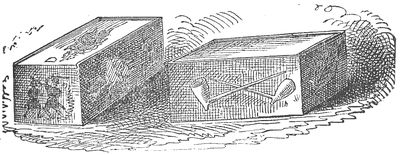
Engraved Boxes.
Some of the tobacco boxes were made of silver and beautifully engraved with fancy sketches, historical scenes, or representations of personages, landscapes, flowers, etc. The late Duke of Sussex had a large collection of pipes and tobacco boxes.
A journal describing them says of the collection:
"The Duke of Sussex had a wonderful collection of these, the values attached to some of them being almost fabulous. One example from the work-shop of Vienna—long celebrated for this description of art,—represented the combat of Hector and Achilles, the cover of the pipe being a golden hemlet cristatus of the Grecian type."
Swiss and Tyrolean artists also produce exquisite carving, but use wood as a material; and in the famous collection of Baron de Watteville will be found a marvelous piece of carving representing Bellerophon overturning the Chimera. But French pipes are the most interesting of all to collectors, from the fact that tobacco was introduced into that country long before it was known in England, and also from the ingenuity of a people who can give interest of various kinds to what might seem a simple and prosaic branch of manufacture. In the sentiment of the following lines on "A pipe of Tobacco" by John Usher, all lovers of the plant will heartily join:
"Let the toper regale in his tankard of ale, Or with alcohol moisten his thropple, Only give me I pray, a good pipe of soft clay, Nicely tapered, and thin in the stopple; And I shall puff, puff, let who will say enough, No luxury else I'm in lack o', No malice I hoard, 'gainst Queen, Prince, Duke or Lord, While I pull at my pipe of Tobacco.
"When I feel the hot strife of the battle of life, And the prospect is aught but enticin', Mayhap some real ill like a protested bill, Dims the sunshine that tinged the horizon; Only let me puff, puff,—be they ever so rough, All the sorrows of life I lose track o', The mists disappear, and the vista is clear, With a soothing mild pipe of Tobacco.
"And when joy after pain, like the sun after rain, Stills the waters, long turbid and troubled, That life's current may flow, with a ruddier glow, And the sense of enjoyment be doubled,— Oh! let me puff, puff, till I feel quantum suff, Such luxury still I'm in lack o', Be joy ever so sweet, it would be incomplete, Without a good pipe of tobacco.
"Should my recreant muse,—Sometimes apt to refuse The guidance of bit and of bridle, Still blankly demur, spite of whip and of spur, Unimpassioned, inconstant, or idle; Only let me puff, puff, till the brain cries enough, Such excitement is all I'm in lack o', And the poetic vein soon to fancy gives reign, Inspired by a pipe of Tobacco.
"And when with one accord, round the jovial board, In friendship our bosoms are glowing; While with toast and with song we the evening prolong, And with nectar the goblets are flowing; Still let us puff, puff—be life smooth, be it rough, Such enjoyment we're ever in lack o'; The more peace and goodwill will abound as we fill A jolly good pipe of Tobacco."
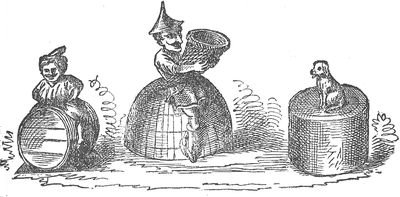
Tobacco Jars.
The tobacco jar is another accessory of more recent date than tobacco pipes but interesting from the varieties of style and shapes. The finest are made of porcelain and are lavish in design and enrichment. Of all the articles of the smokers' paraphernalia none however exhibit more fanciful designs than Tobacco-stoppers used by smokers for crowding the tobacco into the pipe while smoking. The author of "A Paper of Tobacco" says:
"This was the only article on which the English smoker prided himself. It was made of various materials—wood, bone, ivory, mother-of-pearl, and silver: and the forms which it assumed were exceedingly diversified. Out of a collection of upwards of thirty tobacco-stoppers of different ages, from 1688 to the present time, the following are the most remarkable: a bear's tooth tipped with silver at the bottom, and inscribed with the name of Captain James Rogers of the Happy Return whaler, 1688; Dr. Henry Sacheverel in full canonicals, carved in ivory, 1710; a boat, a horse's hind leg, Punch, and another character in the same Drama, to wit: his Satanic majesty; a countryman with a flail; a milkmaid; an emblem of Priopus; Hope and Anchor; the Marquis of Granby; a greyhound's head and neck; a paviour's rammer; Lord Nelson; the Duke of Wellington; and Bonaparte. The tobacco-stopper was carried in the pocket or attached to a ring worn on the finger."
In Butler's Hudibras it is alluded to in connection with the astronomer's sign.
"——Bless us! quoth he, It is a planet now I see; And if I err not, by his proper Figure that's like tobacco-stopper, It should be Saturn!"
In James Boswell's "Shrubs of Parnassus" (1760) a description in verse of the various kinds of tobacco-stoppers is given:
"O! let me grasp thy waist, be thou of wood Or levigated steel, for well 'tis known Thy habit is disease. In iron clad Sometimes thy feature roughen to the sight, And oft transparent art thou seen in glass, Portending frangibility. The son Of laboring mechanism here displays Exuberance of skill. The curious knot, The motley flourish winding down the sides, And freaks of fancy pour upon the view Their complicated charms, and as they please, Astonish. While with glee thy touch I feel, No harm my fingers dread. No fractured pipe I ask, or splinters aid, wherewith to press The rising ashes down. Oh! bless my hand, Chief when thou com'st with hollow circle crowned With sculptured signet, bearing in thy womb The treasured Cork-screw. Thus a triple service In firm alliance may'st thou boast."
Tobacco-stoppers were often made of wood from some relic like a celebrated tree or mansion which gave additional value by its historic associations. Taylor alludes to several made from the well known Glastonbury thorn. He says:—
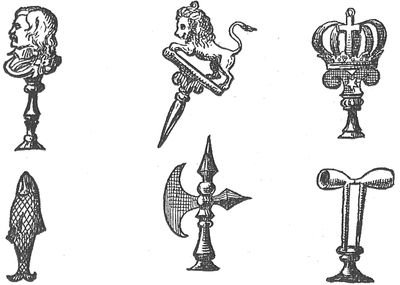
Tobacco Stoppers.
"I saw the sayd branch, I did take a dead sprigge from it, wherewith I made two or three tobacco-stoppers, which I brought to London."
Pipes and tobacco-stoppers have often been favorite testimonials of friendship and reward. Fairholt says:—
"It was the custom during the last century to present country churchwardens with tobacco-boxes, after the faithful discharge of their duties."
The following lines from "The Tobacco Leaf," penned by some favored one on receiving a rare pipe, are no doubt as neat as the object that called them forth:—
"I lifted off the lid with anxious care, Removed the wrappages, strip after strip, And when the hidden contents were laid bare, My first remark was: "Mercy, what a pipe!"
A pipe of symmetry that matched its size, Mounted with metal bright—a sight to see— With the rich umber hue that smokers prize, Attesting both its age and pedigree.
A pipe to make the royal Freidrich jealous, Or the great Teufelsdrockh with envy gripe! A man should hold some rank above his fellows To justify his smoking such a pipe!
What country gave it birth? What blest of cities Saw it first kindle at the glowing coal? What happy artist murmured "Nunc dimittis," When he had fashioned this transcendent bowl!
Has it been hoarded in a monarch's treasures? Was it a gift of peace, or price of war? Did the great Khalif in his "Houre of Pleasures," Wager and lose it to the good Zaafar?
It may have soothed mild Spenser's melancholy, While musing o'er traditions of the past, Or graced the lips of brave Sir Walter Raleigh, Ere sage King Jamie blew his "Counterblast."
Did it, safe hidden in some secret cavern, Escape that monarch's pipoclastic ken? Has Shakespeare smoked it at the Mermaid Tavern, Quaffing a cup of sack with rare old Ben?
Ay, Shakespeare might have watched his vast creation Loom through its smoke—the spectre-haunted Thane, The Sisters at their ghostly invocations, The jealous Moor and melancholy Dane.
Round its orbed haze and through its mazy ringlets, Titania may have led her elfin rout, Or Ariel fanned it with his gauzy winglets, Or Puck danced in the bowl to put it out.
Vain are all fancies—questions bring no answer; The smokers vanish, but the pipe remains; He were indeed a subtle necromancer, Could read their records in its cloudy stains.
Nor this alone: its destiny may doom it To outlive e'en its use and history— Some ploughman of the future may exhume it From soil now deep beneath the eastern sea.
And, treasured by some antiquarian Stultus, It may to gaping visitors be shown, Labelled: "The symbol of some ancient Cultus, Conjecturally Phallic, but unknown."
Why do I thus recall the ancient quarrel 'Twixt Man and Time, that marks all earthly things? Why labor to re-word the hackneyed moral, Ως φυλλωνγενεη, as Homer sings?
For this: Some links we forge are never broken: Some feelings claim exemption from decay; And Love, of which this pipe was but the token, Shall last, though pipes and smokers pass away."
The verse that has been written in praise as well as dispraise of the "Indian Novelty" would of itself fill a volume of no "mean pretentions." The following clever lines from The Tobacco Plant entitled "Puffs from a Pipe," convey much advice to all smokers of tobacco.
Sage old friend! with judgment ripe; Come and join me in a pipe.
Brother student! brother joker, Thee I greet, O! brother smoker.
Smoke, O! men of every station, Every climate, every nation.
East and West, and South and North, Recognize Tobacco's worth.
Red man! let thy warfare cease: Smoke the calumet of peace.
Chinaman! shun opium-grief: Use the pure Tobacco leaf.
Frenchmen! no more foes provoke: Follow arts of peace—and smoke!
German victors! crowned with laurel, Smoke, content; and seek no quarrel.
Americans no one needs bid To blow a cloud, or take a quid.
Though rows shake Dame Europa's school, Johnny Bull smokes, calm and cool.
Toffy, it will ease thy brain, man! Smoke and snuff, and smoke again, man!
Paddy, light of heart and gay, Smoke thy dhudeen: short black clay.
Sawney, on thy Hielen' hill, Tak' thy sneishin'; tak' thy gill!
Tourist, thou hast journey'd far; Rest, and light a mild cigar.
Sailor, from the stormy seas, Take a quid, and take thine ease.
"Soldier tired," put off thy shako; Prepare to fire, and burn tobacco.
Workman, prize thine honest labor; Burn thy weed, and love thy neighbor!
Evil-doers, when ye burn The weed; think how soon 'twill be your turn.
Artist, let thy "coloring" be Of a pipe; thy "drawing," free!
Miser, moderate thy greed! Mend thy life, and take a weed.
Lawyer, loose thy bitter gripe! Burn thy writ—to light a pipe.
Statesman, harassed night and day, Blow a cloud; puff care away!
Hardy tiller of the soil! Light a pipe; 'twill lighten toil.
Usurer, we surely know Thou wilt have thy quid pro quo.
Merchant, smoke thy pipe; hang care! Draughts are always honored there.
Gentle friend, whom troubles fret! Smoke a soothing cigarette.
Preacher! take a pinch with me: Snuff is dust, and so are we.
Hence with moralizings musty! I say life is "not so dusty."
Smoke in gladness; smoke in trouble; Soothe the last, the former double!
Teach the Fiji Indians, then, To chew their quids, instead of men.
Pain from heart and brain to wipe, Pass the weed, and fill your pipe!
Prince and peasant, lord and lackey, All in some form take their 'Baccy.
Lord and Lackey.
The evil effects occasioned by man's indulging too frequently in tobacco have been the subject of many a fierce debate between the friends and foes of the "great plant." Many, however, are not aware of the fatality attending its use by the brute creation. A modern English poet on hearing of the result produced on a cow from chewing tobacco, penned the following sad lines which he entitles—"An elegy on somebody's Cow."
Weep! weep, ye chewers! Lowly bend, and bow; Here lieth what was once a happy cow. No more her voice she'll raise, now low, now high, In amber fields, beneath an autumn sky; No more she'll wander to the milking-pail, While swine stand by to see her chew "pig-tail;" No more round her the bees, a busy crew, Shall linger, eager after "honey-dew;" No more for her shall smoking grains be spread: All bellowless remains her empty shed.
Sad was her fate. Reflect, all ye who read: Life's flower destroyed by the accursed weed. When first the yellow juice streamed o'er her lip, One might have said, "This is a sad cow-slip." To chew the peaceful cud by nature bid, Degraded man taught her to chew a quid. Sad the effect on body and on mind: Her coat grew "shaggy," her milk nicotined; Over her head shall naught but clover grow, While o'er her peaceful grave the clouds shall blow.
No invalid shall ask for her cow-heel, To heal his ailments with the simple meal; Her whiskful tail into no soup shall go; Mother of "weal" that would but bring us woe. Her tripe shall honor not the festive meal, Where smoking onions all their joys reveal; Nor shall those shins that oft lagged on the road, Be sold in cheap cook-shops as "a la mode," Her tongue must soon be sandwiched under ground, Nor at pic-nics with cheap champagne go round; Yea, even her poor bones are past all hope— Not fit to be boiled down for scented soap.
Ah! hide her hide, poor beast. Her stomachs five Dyed with the chewing she could not survive; The very worms from her will turn away, To seek some anti-chewer for their prey. Ye chewers! be ye pilgrims to her tomb; Lament with us o'er her untimely doom. Awhile she stood the anti-chewer's butt, Till scythe-arm'd Time gave her an "ugly cut." She stagger'd to her death, and feebly cried, And sneezed, "Achew! achew!" and chewing died.
There are many parodies of popular poems written in praise of the weed; of which the following in imitation of Tennyson's "Charge of the Light Brigade," entitled "The Charge of the Tobacco Jar Brigade," is one of the best.
"Epigrams, epigrams, Pour'd in, and numbered— Good, bad, indifferent— More than Six Hundred. "Epigrams potters want," Quoth The Tobacco Plant: Write! you for fame who pant; Write! we'll three prizes grant." Wrote for Tobacco-Jars, Over Six Hundred.
Postmen, ere morning's light; Postmen, whilst day was bright; Postmen, as closed in night, Ran—tan'd and thunder'd Loud at our office door; Brought letters, many score— Contents of bags—to pour Table and desk all o'er: Handfuls and armfuls bore, Casting them on the floor. Then through the town they tore, Hastening back for more— More than Six Hundred.
Letters to right of us, Letters to left of us, Letters in front of us, Seeming unnumbered! Envelopes every size Met our astonish'd eyes. Writer with writer vies! Which wins the chiefest prize Out of Six Hundred.
How did each writer strain After a happy vein! Pegasus, spurning rein, Shied, jibb'd, and blunder'd. Reverend writers, then Took up the winged pen; Suff'rers on beds of pain Sought the bright muse again; Lawyer and barrister Courted and harassed her; M. D.s and editors; Debtors and creditors; Artists and artisans, Nicotine's partisans; Nurses and gentle dames Call'd it endearing names; Poets, ship-masters, too; Ay! poetasters, too; Wooing fair Nicotine, Six hundred scribes were seen. Anti-Tobacco cant, Bigoted, bilious rant, Bursting to vent their spleen, Joined the Six Hundred.
Flash'd many fancies rare; Flash'd like Aurora's glare; Quick jotted down with care; Some the reverse of fair; Some that we well could spare; Some that were made to bear Blunders unnumbered. Plunging in metaphor, Not a bit better for— Pardon the Cockney rhyme!— Similies plunder'd. Praising Tobacco smoke, Heeding not grammar's yoke, Prosody's rules they broke. Many a rhyming moke, Sense from rhyme sundered: Many wrote well, but not— Not the Six Hundred. Honour Tobacco! roll'd, Cut, press'd, however sold. Alpha and Beta, bold, Ye shall be tipp'd with gold. Omega shall be sold, Others in type behold Nearly Six Hundred."
The following poem entitled "Weedless," after Byron's "Darkness," gives a vivid description of the world without tobacco.
"I had a dream, and it was all a dream: Tobacco was abolish'd, and cigars Were flung by "Antis" fearsome space— The foreign and the British fared alike— And the blue smoke was blown beyond the moon. Night came and went and came, and brought no "weed," And men forgot their suppers, in the dread Of the dire desolation; and all tongues Were tingling with the taste of empty pipes; And they did live all wretched; old hay bands, And street-door mats, and clover brown and dry; Carpets, rope-yarn, and such things as men sell, Were burnt for 'bacca; haystacks were consumed, And men were gathered round each blazing mass, To have another makeshift sniff. Happy were those who smoked, with smould'ring logs, The harmless Yarmouth bloater after death— Another pipe not all the world contain'd; The furze was set on fire, but, hour by hour, The stock diminish'd; all the prickly points Quivered to death, and soon it all was gone. The lips of men by the expiring stuff Drew in and out, and all the world had fits. The cinders fell upon them; some sprang up, And blew their noses loud, and some did stand Upon their heads, and sway'd despairing feet; And others madly up and down the world With "two-pence" hurried, shouting out for "Shag;" And wink'd and blink'd at th' unclouded sky, The "Anti's" smokeless banner—then again Flung all their halfpence down into the dust, And chewed their tainted pockets; snuffers wept, And, flatt'ning noses on the dreary ground, Inhaled the useless dust; the biggest "rough" Came mild, tobacco-begging; p'licement came, And mix'd themselves among the multitude, "Run in" forgotten; uniforms were chew'd, And teeth which for a moment had had rest, Did move themselves again; old beaver hats Fetch'd little fortunes; they were torn in bits, And smok'd or chew'd at will; no bits were left. All earth was but one thought, and that was smoke, Immediate and glorious; and a pang Of horror came at intervals, and men Cried; and the boys were restless as themselves, Till by degrees their stockings were devour'd; E'en pipes were dropp'd despairing—all, save one, One man was faithful to his pipe, and kept Despair and deeper misery at bay, By seeking ever for a "topper," dropped From some spurned pipe, but that he could not find; So, with a piteous and perpetual glare, And a quick dissolute word, sucking the pipe, Which answer'd never with a whiff, he slept; The crowd dispersed by slow degrees, but two Of all the dreary company remain'd, And they kept 'bacca shops; they sat upon The scanted lid of a tobacco tub, Wherein was heap'd a mass of coined bronze— Profits of 'bacca, sold—they were sold out; They, grinning, scraped with their warm, eager hands The little halfpence and the bigger pence, Counted a little time, and cried "Haw! haw!" Like a whole rookery; then lifted up The tub as it grew lighter, and beheld Each other's profits; saw, and smiled, and winked, Uncaring that the world was poor indeed, So they were rich in pence. The world was mad, The populace and peerage both alike Birds—Eyeless, Shagless, and returnless, too— Oh! day of death, oh! chaos of hard times!— And princes, dukes, and lords, they all stood still, Feeling within their pockets' silent depths; And sailors went a-moaning out to sea, And chew'd their cables piecemeal: then they wept, And slept on the abyss without a quid. All quids were gone, cigars were in their graves; The plant, their mother, had been rooted up; Pawnbrokers had a ton of pipes apiece, And "Antis" triumph'd. Then they had no need To keep a "Sec.," so Reynolds got the "sack."
One of the best of all parodies is one in imitation of Longfellow's "Excelsior," entitled "Tobacco." It is from "Copis' Tobacco Plant."
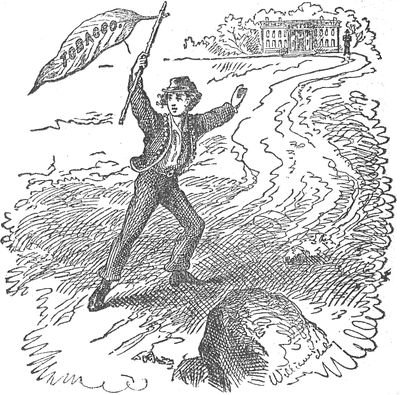
The Strange Youth.
"The summer blight was falling fast, When straight through dirty London passed A youth, who bore, through road and street, A packet, thereon written neat; "Tobacco!"
His brow was glad, his laughing eye Flashed like a gooseberry in a pie; And like a penny whistle rung The piping notes of that strange tongue— "Tobacco!"
In dusty homes he saw the light Of supper fires gleam warm and bright; Above, the ruddy chimneys smoked: He from his lips the word evoked— "Tobacco!"
"Try not the weed," good Reynolds said; "I've smoked it 'till I'm nearly dead: Take not the juice in thy inside;" But loud the jovial voice replied— "Tobacco!"
"Oh! stay," the maiden said, "and rest; I have got on my Sunday best:" A wink stood in his bright blue eye, And answered he, without a sigh— "Tobacco!"
"Beware the briar's poison'd root; Beware the birds-eye put into 't." This was the Anti's latest greet. A voice replied, far up the street— "Tobacco!"
At break of day, on Clapham Rise. A pot-boy opened both his eyes, And to himself did gently swear, To hear a voice call through the air— "Tobacco!"
A traveler up a tree he found, Who smoked and spat upon the ground; And then among the blossoms ripe He cried, while puffing at his pipe— "Tobacco!"
There in the grayish twilight, "What's That you say?" cried eager Pots, And from the branch so green and far, A voice fell like a broken jar— "Tobacco."
The following lines from the same source have been very appropriately called "The Smoker's Calendar."
When January's cold appears, A glowing pipe my spirit cheers; And still it glads the length'ning day, 'Neath February's milder sway. When March's keener winds succeed, What charms me like the burning weed? When April mounts the solar car, I join him, puffing a cigar; And May, so beautiful and bright, Still finds the pleasing weed a-light. To balmy zephyrs it gives zest, When June in gayest livery's drest. Through July Flora's offspring smile, But still Nicotia's can beguile; And August, when its fruits are ripe, Matures my pleasure in a pipe. September finds me in the garden, Communing with a long churchwarden. Ev'n in the wane of dull October, I smoke my pipe and sip my "robur," November's soaking show'rs require The smoking pipe and blazing fire: The darkest day in drear December's— That's lighted by their glowing embers.
The Hon. "Sunset" Cox in his lecture on American Humor alluded to the national characteristics of the French, Spanish, German, and other nationalities, says:—
"The highest enjoyment of a Frenchman is to hear the last cantatrice, the Spaniard enjoys the most skillful thrust of the matador in the bull arena, the Neapolitan the taste of the maccaroni, the German his beer and metaphysics, the darkey his banjo, and the American—
'To the American there's nothing so sweet As to sit in his chair and tilt up his feet, Enjoy the Cuba, whose flavor just suits, And gaze at the world through the toes of his boots.'"
This would seem to be a feature of the Dutch according to a late traveler, who says:—
"I like Holland—it is the antidote of France. No one is ever in a hurry here. Life moves on in a slow, majestic stream, a little muddy and stagnant, perhaps, like one of their own canals; but you see no waves, no breakers; not an eddy, nor even a froth bubble, breaks the surface. Even a Dutch child, as he steals along to school, smoking his short pipe, has a mock air of thought about him."
The following epigrams for tobacco jars from "The Tobacco Plant" evince much "taste, wit, and ingenuity."
Fill the bowl, you jolly soul, And burn all sorrow to a coal. Henry Clay.
That man is frugal and content indeed, Who finds food, solace, pleasure in a weed. The "Weed".
Behold! this vessel hath a moral got, Tobacco-smokers all must go to pot. Epigrammatic.
A weed you call me, but you'll own No rose was e'er more fully blown. Sic Itur ad Nostra.
Great Jove, Pandora's box with jars did fill This Jar alone has power those jars to still. In Nubilus.
Tobacco some say, is a potent narcotic, That rules half the world in a way quite despotic; So to punish him well for his wicked and merry tricks, We'll burn him forthwith, as they used to do heretics. Zed.
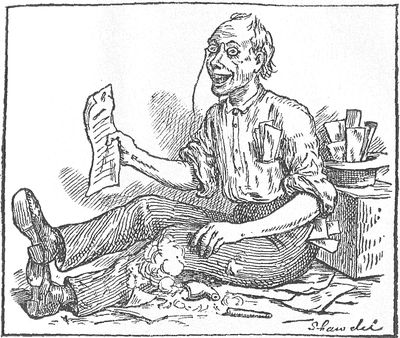
Smoker Reading Epigrams.
No use to draw upon a bank if no effects are there, But a draw of this Tobacco is quite a safe affair; And a pipe with fragrant weed (such as I hold) neatly stuffed, Is just the only thing on earth that ought to be well puffed. R. S. Y. P.
Poor woman "pipes her eye," When in affliction's gripe; But man, far wiser grown, Just eyes his pipe. In Nubilus.
Sir Walter Raleigh! name of worth, How sweet for thee to know King James, who never smoked on earth, Is smoking down below. Ex Fumo dare Lucem.
Travelers say Tobacco springs From the graves of Indian kings: Fill your pipe, then—smoke will be Incense to their memory. Though the weed's nor rich nor rare, 'Tis a balm for every care. Peter Piper.
Give me the weed, the fragrant weed, My wearied brain to calm; In a wreath of smoke, while I crack my joke, I'll find a healing balm.
Day after day, let come what may, The pipe of peace I'll fill; I readily pay for briar or clay, To save a doctor's bill. Pompone.
Great men need no pompous marble To perpetuate their name; Household gear and common trinkets Best remind us of their fame.
Raleigh's glory rests immortal On ten thousand thousand urns, Every jar is in memoriam, Every fragrant pipe that burns. At an Ash.
There are jars of jelly, jars of jam, Jars of potted-beef and ham; But welcome most to me, by far, Is my dear old Tobacco-Jar. There are pipes producing sounds divine, Pipes producing luscious wine; But when I consolation need, I take the pipe that burns the weed. Jars.
Friend of my youth, companion of my later days, What needs my muse to sing thy various praise? In country or in town, on land or sea, The weed is still delightful company. In joy or sorrow, grief or racking pain, We fly to thee for solace once again. Delicious plant, by all the world consumed, 'Tis pity thou, like man, to ashes too art doom'd. Erutxim.
Hail plant of power, more than king's renown, Beloved alike in country and in town; In hotter climes oft mingled with the jet Of falling fountains; whilst the cigarette Kisses the fair one's lips, and by thy breath Redeems the wearied heart from ennui's death. Theta.
If e'er in social jars you join, Seek this, and let them cease: Let all your quarrels end in smoke, And pass the pipe of peace. Fumigator.
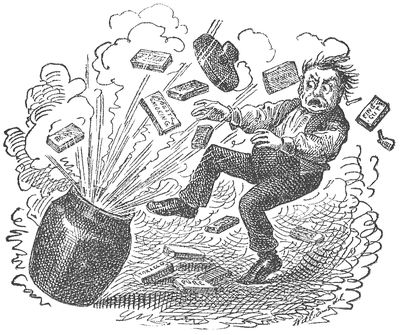
The Explosion.
Many a jar of old outbroke Into fire and riot; This will yield, with fragrant smoke, Happy thought, and quiet. 41,911.
The moralist, philosopher, and sage. Have sought by every means, in every age, That which should cause the strife of men to cease, And steep the world in fellowship and peace; But all their toil and diligence were vain, 'Till Raleigh, noble Raleigh! crossed the main, And brought to Britain's shores the wish'd-for prize, The sovereign balm of life—within it lies. Dum Spiro Fumigo.
To rich men a pastime, to poor men a treat, To all a true tonic most bracing and sweet, To talent a pleasure, to genius a joy, To workmen a comfort, to none an alloy, The tyrant it softens; it soothes him if mad, The king who may rule if he smokes not, is sad. Kit.
Sacred substance! sweet, serene; Soothing sorrow's saddest scene: Scent-suffusing, silv'ry smoke, Softly smoothing suffering's stroke;— Solacing so silently— Still so swift, so sure, so sly: Smoke sublimated soars supreme, Sweetest soul-sustaining stream! Similia Similibus.
Why should men reek, like chimneys, with foul smoke, Their neighbors and themselves to nearly choke? Avoid it, ye John Bulls, and eke ye Paddies! Avoid it, sons of Cambria, and Scottish laddies! Let reason convince you that it very sad is, And far too bad is, And enough to make one mad is To be smoked like a red herring or rank Finedon haddies. J. S.
No punishment save hanging's too severe For those who'd rob the poor man of his beer; But for the wretch who'd take away his pipe, I think he's fully execution ripe! Pipe Clay.
Weeds are but cares! Well, what of that! There's one weed bears a goodly crop; And this exception, then, 'tis flat, Doth give that rule a firmer prop. Tobacco brings the genial mood, Warm heart, shrewd thought, and while we reap From this poor weed such harvest good, We'll hold more boasted harvests cheap. Festus.
To poets give the laurel wreath, let heroes have their lay, Of roses twine for lovely youth the garland fresh and gay; But we poor mortals, quite content, life's fev'rish way pursue, Can we but crown our foolish pates with wreaths of fragrant blue, Convinced that all terrestrial things which please us or provoke, Of ashes come, to ashes go, and only end in smoke. Pocosmipo.
Whilst cannon's smoke o'erwhelms with deadly cloud The soldier's comrades in a common shroud, And whilst the conflagration in the street, With crushing roar the ruin makes complete, Tobacco's smoke like incense seeks the skies— Blesses the giver, and in silence dies! Theta.
Use me well, and you shall see An excellent servant I will be; Let me once become your master, And you shall rue the great disaster!
As coin does to he who borrows, I'll soothe your cares and ease your sorrows; Abuse me, and your nerves I'll shatter, Your heart I'll break, your cash I'll scatter, Use, not Abuse.
The savage in his wild estate, When feuds and discords cease, Soothes with the fragrant weed his hate, And smokes the pipe of peace.
Long may the plant good-will create, And banish strife afar: Our only cloud its incense sweet, And this our only jar. Scire Facias.
Breathes there a man with soul so dead, Who never to himself hath said; I'll have to smoke, or I'll be dead? If so, then let the caitiff dread! My wrath shall fall upon his head. 'Tis plain he ne'er the Plant hath read; But "goody" trash, perchance, instead. Dear Cope, good night!—Yours, Master Fred.
That tobacco in one form or another has been patronized from the cottage to the throne, no one will deny who is at all acquainted with the history of the plant. And while it has had many a royal hater, it can also boast of having many a kingly user. A favorite of king and courtier, its use was alike common in the palace and the courtyard. It can claim, also, many celebrated physicians who have been its patrons, and among them the noted Dr. Parr. We give an anecdote of him showing his love of weed and wit.
The partiality this worthy Grecian always manifested for smoking is well known. Whenever he dined he was always indulged with a pipe. Even His Majesty, when Dr. Parr was his guest at Carlton Palace, condescended to give him a smoking-room and the company of Colonel C——, in order that he might suffer no inconvenience. "I don't like to be smoked myself, doctor," said the royal wit, "but I am anxious that your pipe should not be put out." One day, Dr. Parr was to dine at the house of Mr. ——, who informed his lady of the circumstance, and of the doctor's passion for the pipe. The lady was much mortified by this intimation, and with warmth said, "I tell you what, Mr. ——, I don't care a fig for Dr. P.'s Greek; he shan't smoke here." "My dear," replied the husband, "he must smoke; he is allowed to do so everywhere." "Excuse me, Mr. ——, he shall not smoke here; leave it to me, my dear, I'll manage it." The doctor came; a splendid dinner ensued; the Grecian was very brilliant. After dinner, the doctor called for his pipes. "Pipes!" screamed the lady. "Pipes! For what purpose?" "Why, to smoke, madam!" "Oh! my dear doctor, I can't have pipes here. You'll spoil my room; my curtains will smell of tobacco for a week." "Not smoke!" exclaimed the astonished and offended Grecian. "Why, madam, I have smoked in better houses." "Perhaps so, sir," replied the lady, with dignity; and she added with firmness, "I shall be most happy, doctor, to show you the rights (rites?) of hospitality; but you cannot be allowed to smoke." "Then, madam," said Dr. Parr, looking at her ample person; "then, madam,—I must say, madam,—" "Sir, sir, are you going to be rude?" "I must say, madam," he continued, "you are the greatest tobacco-stopper in all England." Of the clergy, Whatley was one of the greatest in intellect, and, as a smoker was devotedly attached to tobacco; his pipes, when out, served him for a book-marker. In summer-time he might be seen, of an evening, sitting on the chains of Stephen's Green, thinking of "that," as the song says, and of much more, while he was "smoking tobacco." In winter he walked and smoked, vigorously in both cases, on the Donnybrook road; or he would be out with his dogs, climbing up the trees to hide amid the branches a key or a knife, which, after walking some distance, he would tell the dogs he had lost, and bid them look for it and bring it to him.
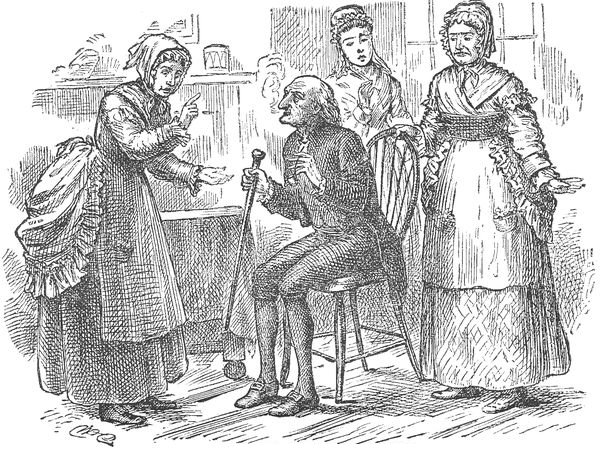
Theory against Experience.
Of many warriors, none have been more devoted to the plant than Napoleon, Frederick of Prussia and Blücher the Bold. The following anecdote of the latter is one of the best of its kind: "As is well-known, Field-Marshal Blücher, in addition to his brave young 'fellows' (as he called his horsemen), loved three things above all, namely, wine, gambling, and a pipe of Tobacco. With his pipe he would not dispense, and he always took two or three puffs, at least, before undertaking anything. 'Without Tobacco, I am not worth a farthing,' he often said. Though so passionately fond of Tobacco, yet old 'Forwards' was no friend of costly smoking apparatus; and he liked best to smoke long, Dutch clay pipes, which, as everybody knows, very readily break. Therefore, from among his 'young fellows' he had chosen for himself a Pipe-master, who had charge of a chest well packed with clay pipes; and this chest was the most precious jewel in Blücher's field baggage. If one of the pipes broke, it was, for our hero, an event of the greatest importance. On its occurrence, the 'wounded' pipe was narrowly examined, and if the stem was not broken off too near the head, it was sent to join the corps of Invalids, and was called 'Stummel' (Stump, or Stumpy). One of these Stumpies the Field-Marshal usually smoked when he was on horseback, and when the troops were marching along or engaged in a reconnoissance, and eye-witnesses record that many a Stumpy was shot from his mouth by the balls of the enemy—nothing but a piece of the stem then remaining between his lips. Blücher's Pipe-master, at the time of the Liberation War, was Christian Hennemann, a Mecklenburg and Rostock man, like Blücher himself, and most devotedly attached to the Field-Marshal. He knew all the characteristic peculiarities of the old hero, even the smallest, and no one could so skillfully adapt himself to them as he. His duties as Pipe-master, Hennemann discharged with great fidelity; yea, even with genuine fanatical zeal. The contents of the pipe-chest he thoroughly knew, for often he counted the pipes. Before every fierce fight, Prince Blücher usually ordered a long pipe to be filled. After smoking for a short time, he gave back the lighted pipe to Hennemann, placed himself right in the saddle, drew his sabre, and with the vigorous cry, 'Forward, my lads!' he threw himself into the fierce onset on the foe.
On the ever-memorable morning of the battle of Belle-Alliance (Waterloo), Hennemann had just handed a pipe to his master, when a cannon-ball struck the ground near, so that earth and sand covered Blücher and his gray horse. The horse made a spring to one side, and the beautiful new pipe was broken before the old hero had taken a single puff. 'Fill another pipe for me,' said Blücher; 'keep it lighted, and wait for me here a moment, till I drive away the French rascals. Forwards, lads!' Thereupon there was a rush forwards; but the chase lasted not only 'a moment,' but a whole hot day. At the Belle-Alliance Inn, which was demolished by shot,—the battle having at last been gained,—the victorious friends, Blücher and Wellington, met and congratulated each other on the grand and nobly achieved work, each praising the bravery of the other's troops. 'Your fellows slash in like the very devil himself!' cried Wellington. Blücher replied, 'Yes; you see, that is their business. But brave as they are, I know not whether one of them would stand as firmly and calmly in the midst of the shower of balls and bullets as your English.' Then Wellington asked Blücher about his previous position on the field of battle, which had enabled him to execute an attack so fatal to the enemy.