Chapter X · (continued 2)
Reading edition
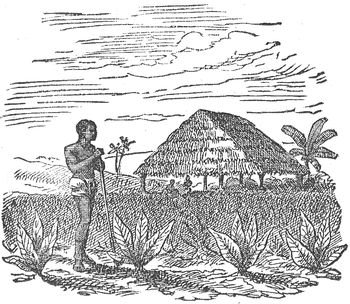
Tobacco Field in Africa.
The tobacco plant is also cultivated in other parts of Africa besides Algiers. In Egypt and Nubia it is grown to a considerable extent, as well as by most of the native tribes of the South-west. Among some tribes it forms an important article of trade, and serves the purpose of money or its representative. The natives are partial to the plant, and devotedly attached to smoking. Little patches may be seen near their huts, on which they lavish their attention and care. In some parts of Africa tobacco grows to a very great height. Livingstone gives an account of a variety that attained an altitude much higher than the American plant. Several varieties are cultivated, some of them resembling the Shiraz and Latakia, while most of it is said to be similar to Virginia tobacco, only larger. With careful culture the plant would doubtless thrive in most parts of Africa, as the soil is light and the season usually favorable. Though the heat is extreme the plant flourishes even in the hottest part of the season, and attains a degree of perfection corresponding to the labor bestowed by the natives in cultivating. Their manner of curing is simply by drying the leaves, and is not suited to the taste of any besides themselves. In Egypt, Algiers, and Nubia, the plant is cultivated with more care, and a better system of curing is adopted than by the natives of the interior. Burton gives an account of the cultivation of tobacco by the natives of East Africa:—
"Tobacco grows plentifully in the more fertile regions of East Africa. Planted at the end of the rains, it gains strength by sun and dew, and is harvested in October. It is prepared for sale in different forms. Everywhere, however, a simple sun-drying supplies the place of cocking and sweating, and the people are not so fastidious as to reject the lower or coarser leaves and those tainted by the earth. Usumbara produces what is considered at Zanzibar a superior article; it is kneaded into little circular cakes four inches in diameter by half an inch deep: rolls of these cakes are neatly packed in plantain-leaves for exportation. The next in order of excellence is that grown in Uhiao: it is exported in leaf or in the form called kambari, roll-tobacco, a circle of coils each about an inch in diameter. The people of Khutu and Usagara mould the pounded and wetted material into discs like cheeses, 8 or 9 inches across by 2 or 3 in depth, and weighing about 3 lbs.; they supply the Wagogo with tobacco, taking in exchange for it salt. The leaf in Unyamwezi generally is soft and perishable, that of Usukuma being the worst; it is sold in blunt cones, so shaped by the mortars in which they are pounded. At Karaguah, according to the Arabs, the tobacco, a superior variety, tastes like musk in the water-pipe. The produce of Ujiji is better than that of Unyamwezi; it is sold in leaf, and is called by the Arabs hamumi, after a well-known growth in Hazramaut. It is impossible to give an average price to tobacco in East Africa; it varies from 1 khete of coral beads per 6 oz. to 2 lbs."
Some of the most beautiful and fragrant tobacco fields in the world are to be found in Syria. Indeed it may truthfully be said that a field of Latakia tobacco is hardly inferior in beauty to the large and fragrant orchards of the olive and mulberry, or the wheat fields on the terraced sides of Mount Lebanon.
The tobacco plant is cultivated in various parts of Syria and particularly by the Druses on "The Lebanon," as it is usually called.
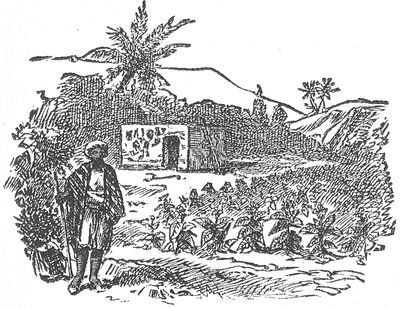
Tobacco Field in Syria.
The cultivation of tobacco in Syria, has been a considerable industry, and the product has acquired a reputation in European markets that has demonstrated its real value, and a constant demand for this variety of the plant. Latakia tobacco resembles in flavor the yellow tobacco of Eastern Thibet and Western China, both of them grown from the same seed. Latakia tobacco is not sweated like most tobacco, but is first cured in the sun and then hung up in the peasants' huts to cure until ready for market. The plants ripen very fast and emit an aromatic odor, increasing in strength as the plants ripen. For smoking it has but few superiors. After curing, it is baled and sent to Europe, where it is manufactured into smoking tobacco. The plants are well cultivated and watched against the ravages of birds, which seem to like the young and tender plants especially before they are transplanted. From the nature of the soil the plants are watered frequently, and when the leaves are about the size of a large cabbage leaf are ready to harvest. As the plants ripen the leaves gradually thicken and take on a lighter shade; the leaf when green is very thick, but after curing is quite thin and of a bright yellow or brown, according to the process employed in curing. The peasants take equal pains in its fumigation, using various kinds of wood according to the color of leaf they wish to obtain. They usually make two kinds of leaf, the finest being colored brown and known by the name of abowri. The tobacco is fumigated with two kinds of wood, gozen (pine wood) and sindian (oak), the tobacco fumigated with gozen having the best smell. The fumigation, however, is said not to be resorted to expressly for the tobacco, but the mountaineers of necessity burn much wood in their huts in the winter, and the smoke improves the tobacco in color, smell, and flavor. All the tobacco grown about Latakia derives its origin from the same seed, but the difference between the abowri and the other kinds is owing to the cultivation of the former about high mountains and with the use of pine wood in fumigating it. A field of Latakia tobacco presents a novel appearance, the short straight plants with their ovate leaves bearing yellow blossoms form a striking contrast to towering seed leaf rising fully two or three feet higher than the Syrian plant.
Fairholt says that "Latakia tobacco is a native of America but grows wild in other countries, and is a hardy annual in English gardens, flowering from midsummer to Michaelmas, so that by some botanists it has been termed 'common, or 'English tobacco.'" Burton's work on unexplored Syria is full of passages relating to tobacco and the custom of smoking.
"The tobacco which is grown on the slopes of the Libanus and the Anti-Libanus mountains appears to be one of the finest quality and most delicate flavor. The monks of the convents are famous for the production of a snuff, which for pungency, at least, is far superior to the snuffs of Europe. Personal experience of it convinces us that a great deal of the pungency of this snuff is due to the addition of some aromatic herb in addition to the natural acridity produced by the highly dried tobacco. The cultivation of tobacco in Syria, will probably increase in proportion to the improved condition of affairs in Syria, we have little doubt; and we trust that when agricultural science is better studied there, Englishmen will have the opportunity of testing the value and importance of Syrian tobacco products."
Connor says of the tobacco fields of India:—
"In the Bombay Presidency tobacco is largely produced, and its quality in such districts as Kaira and Khandesh is superior. In 1871 there were nearly 43,000 acres of land under tobacco in the presidency, the largest quantities being grown in Kaira, Khandesh, Belgaum Sattara, Shalopoor, and Poona. The trade is extensive. The exports of tobacco to foreign countries amount to several million pounds annually. Among foreign countries, Mauritius, Bourbon, and neighboring places, not reckoned as part of British India, take a large share of the exports. Bombay exports tobacco to other Indian presidencies. Small quantities of the fine Guzerat tobaccos find their way by rail into the North-western Provinces. Numerous endeavors have for many years past been made to improve the quality of Bombay tobacco. In 1831 the Resident in the Persian Gulf sent to the local Government a maund of seed of the 'very finest tobacco grown in Persia,' and with it he sent some observations on the mode of cultivating tobacco in the neighborhood of Shiraz. In 1867 fifteen small packets of genuine Shiraz tobacco were forwarded for trial in the Bombay Presidency. Of the seed sown in Kolhopoor, about eight or nine germinated, and the plants grew to a height of five feet two inches; of these only four survived. There were two varieties, one with oblong the other with circular leaves.
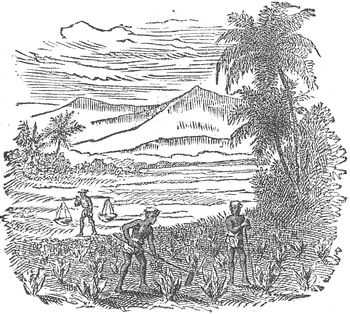
Tobacco Field in India.
"Of the seeds sent to Kandesh, only a few germinated. All the seed put down in the Victoria Gardens failed. That sent to Sind, though said to have been carefully sown, also failed to germinate. The Conservator of Forests had the seeds sent him sown in beds, and the plants, when a few inches in height, were transplanted into pots. They grew with the greatest luxuriance, and produced abundance of flowers and seed. Some of the seed was sent to the collector of Kaira, who forwarded a sample of the tobacco grown from it. The Conservator considered the produce very good, and the secretary of the Agri-Horticultural Society pronounced it 'of a superior kind.' The flavor was exceedingly fine, but it had not been allowed to come to maturity, hence it was thin and shriveled. It had also been spoilt by rain, and consequently its market value could not be fairly tested. The experiment, it is clear, was not conducted with proper care by most of those to whom the seed was confided, but the Local Government considered that on the whole the result was satisfactory, as showing that there was every probability that Shiraz tobacco, with care and proper gardening, might be introduced into the Bombay Presidency.
"In August, 1869, the Bombay Government again distributed a small supply of seed of the Shiraz, Havana, and other varieties to the superintendents of cotton experiments, and to the collectors of Kaira, Khandesh, Dharwar, and Kurrachee, for experimental cultivation. The seeds did well in the hands of all the superintendents, who reported very favorably on the plants raised from them. In Sind only the soil in which the seed was sown proved unsuitable. In Dharwar all the five varieties germinated, though the Maryland failed to some extent, and a considerable quantity of seed of each variety was secured. Of Latakia, only twenty grains were sent to the superintendent; and the quantity in each case increased to one pound from the produce of the plants. These two varieties of tobacco, however, were not so much admired by the cultivators as Shiraz, Havana, and Maryland, to which they gave a decided preference. The only varieties of seed which were available for experiments at Broach and Veermgaum were Havana and Shiraz. In both places the plants came up well, and a large quantity of seed was obtained from them. That sent to Broach arrived a little too late in the season to admit of an extensive experiment being made; this indeed appears to have been the case at all the other places. The seed, however, was of good quality, germinated freely, and produced excellent plants in a very short time.
"The first transplanting was made out into a field in an open piece of land, where they commenced growing vigorously, but the rains being then over, swarms of small locusts made their appearance, and ate up the young plants before they had thoroughly established themselves in the ground. The second lot was transplanted into a more sheltered patch, where the progress was all that could be desired, both the varieties growing rapidly, the Havana especially producing some leaves of enormous size. The first cutting was entrusted to a potel, who managed it according to the native process of curing. The tobacco was so strong, however, that only old confirmed smokers could manage it. The most formidable difficulty which presented itself was the management of the midrib, which in the large leaves was extremely coarse and juicy. When the leaves were made up into hands for the purpose of fermentation before the midrib was thoroughly dry, the result was invariably mould and discoloration. On the other hand, when dried sufficiently to insure freedom from mould, the lamina of the leaf became so brittle that it was crushed to powder at the slightest touch, and so wrinkled and dry that the heaps did not ferment at all. Of the varieties supplied, the Shiraz, Havana, and Maryland attracted most attention and promised the best results. The great drawback was the curing part of the process. So far as the cultivation was concerned, there was every prospect of success; but not so with regard to the curing."
Robertson says of the curing of the leaf:—
"In my opinion, all efforts to produce good tobacco will be useless until the services of a competent curer are obtained."
He considers the fault of all Indian tobacco to lie in the curing. The leaf itself is good, and it is simply the art of curing that should be studied.
"I have cured tobacco of different varieties, some of which would hold a good place in the English market, but the fault generally found with the tobacco is that it is too full flavored. Further experiments were carried on in the same districts with varying results. In Sind the experiments and their results were insignificant. In Broach they were somewhat more successful, the superintendent thus summarising his experience:—'Havana, Shiraz, and other varieties of exotic tobacco will, with ordinary care and attention, yield fair and certain crops on ordinary black land, and presumably on every other kind to be met with in Guzerat. By the skillful application of manure, leaf of any desired quality or peculiarity of flavor and texture may be obtained. The quantity of produce is so great that, should it be found practicable to cure the leaf well enough to make it a salable article in the European market, a source of profit by no means insignificant would be opened up to the Guzerat ryot. For the native market the country plant is more suitable, and its cultivation consequently the more profitable.' In Dharwar the superintendent was enabled to distribute seed in sufficient quantities to those applying for it, but found the ryots would not cultivate it on a large scale, being apprehensive of loss. Native tobacco he considers less liable to injury than the exotic varieties during the squally weather prevalent about the time the leaf is approaching maturity."
Robertson, in replying to the assertion that the tobacco of India contains little if any nicotine, says:
"It appears to me that there must be some mistake as to the tobacco containing little or no nicotine. Very many have tried the tobacco, and pronounce it to be good, with, however, the fault of being exceedingly strong. Now, the strength of tobacco comes from its nicotine, and if the specimens I sent contain no nicotine, whence the strength? I believe that nothing destroys tobacco so much as moistening it. How, then, are acetic acid and chloride of soda to be used in the curing? If the process of desiccation had been carried on too quickly, the tobacco would have been of either a green or greenish-yellow color. If too slowly, it would have been black, like much of the country tobacco. I perceive that the amount of nicotine in a great measure depends on the extent to which the leaf is allowed to ripen. The riper the leaf the more the nicotine. The amount of nicotine does not appear to depend on the amount of curing. The soil the tobacco was grown in is a hardish red moorum soil, containing much iron; probably that may account for the red coloring matter being so much developed. I intend to have some of each description of the tobacco leaf analyzed, and also intend to submit the soil in which it was grown to the same process. I have had some of the cigars packed up for some months to test how far they are proof against insects. None have been attacked by insects. Some Manilla cigars, some Trichinopoly cheroots, all packed up at the same time, have, however, been entirely destroyed by insects.
"It is clear from the reports that both in Guzerat and Khandesh, Havana and Shiraz tobacco will flourish, and that they may be introduced without difficulty. The ryots, it is said, preferred the new kinds to their own, and desire their introduction, the foreign varieties commanding a higher price in the market. The chief drawback is the want of knowledge and appliances for the proper curing of the leaf. This, indeed, is the great drawback throughout India. In the district of Kaira the seed is always sown in nursery beds in the month of July, and transplanting commences about the end of August, the operation continuing for about two months. The tobacco planted on the dry soil called 'koormit' ripens and is fit for cutting in January and February; that which is grown on irrigated land during March and April. In Canara, tobacco is generally grown in elevated situations. The seed is sown in August, and the seedlings are transplanted in November, the crop arriving at maturity in three or four months. North Canara derives its supply chiefly from Mysore, the leaf produced in that province being said to be less liable to affect the head than that of the Canara plant."
The Turk and his family love to cultivate tobacco as well as to smoke it; and give it their attention from seed-sowing until it is sold to the merchant. The Turk is very particular in cultivating it, as on its color depends in a great measure its value. He commences work on his plant-bed in March, sowing the seed about the same time as the Virginia planters. After the leaves are gathered the same scrupulous care is taken with them; especially in drying and baling, that the leaf may be in just the right condition to ferment properly, and be ready to be assorted by the "tobacco pickers." The Turk presses his whole family into the cultivation of the plants. The children are engaged in weeding while he waters the beds or prepares the tobacco field for the planting of the tobacco. In pruning and picking the leaves he removes only those that are small—the removal of which will still further advance the growth of the plants, and is careful to gather only those leaves that are turning yellow, giving evidence of their maturity. Says one in regard to the cultivation of tobacco in Turkey:
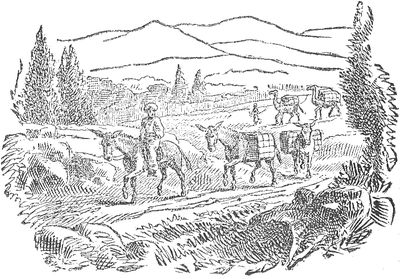
Turkish Tobacco going to Market.
"The Turk and his family, it will seem, have now been occupied upon their tobacco crop for nearly a whole year. The leaf is just becoming a bright light yellow when it falls into the hands of the merchant, and it is during this period that the process of fermentation or heating generally occurs, before which the tobacco can not be shipped. The bales having been placed in the merchant's store, are left end up until a fermentation or baking has taken place, the ends being reversed every three or four days. In the course of a few weeks a bale is reduced to about two-thirds of its original size. It is then placed upon its sides to cool. When it is discovered to be cold it is broken open by the native tobacco-pickers, and every leaf sorted and classified. The patience with which this operation is carried out is truly astonishing. There is a good deal of difference in their rate of work. One man may pick only fifty pounds weight a day, while another does twice that quantity. It is necessary to watch them closely, or they will put a dirty brown leaf with a pale yellow. They neither know nor care about the losses that may be incurred by the merchant, whose samples may be thus spoiled. A bale of leaf purchased at five piastres per oque, when dissected by the Greek for various markets will be found to contain varieties ranging in price from 5 to 60 piastres; of these some are dispatched to Odessa, some to Smyrna, others to Constantinople, Alexandria, and England—the mixed and common qualities generally to the latter country, the price there obtained being the least remunerative to the Greek shippers. The bales are brought from the interior to the shipping ports upon mules, each animal carrying two bales; and it is a pretty sight to witness, say 150 mules at a time, crossing mountains and rugged paths with their burdens, followed by perhaps fifty camels laden with cotton, marching to the merry tinkle of the bells on their necks. When the tobacco reaches the shipping port the troubles of the exporter are intensified. The bales are first taken to the Custom House, and there weighed. The weights thus arrived at are compared with the quantity received from the interior, and if there be any material difference the shipper has to account for it. If any has been sold for consumption in Turkey, duty has to be paid upon the amount; and in order that no part of his shipment may be used in the country, he has to sign a bond that the tobacco shall not be landed in any other port of Turkey. On the arrival of the tobacco in England, the landing certificates are forwarded to Turkey. It is in this way that the trade is retained in the hands of a few Greeks, who naturally put every obstacle in the way of the foreigner, whose sole remedy is at last found to be the payment of the universal 'backshish,' to the comptroller of customs."
The merchant who buys the tobacco of the planter at a low price, and thereby takes the profit from him of cultivating it, is preyed upon in the same manner by the Greek buyers who have the sole monopoly of the trade. Like Shiraz tobacco, that of Turkey has to be handled frequently and pass through several stages of curing before it is ready to be manufactured. In this respect it is unlike most of the tobaccos of America, but its treatment is not unlike that of the varieties of the East.
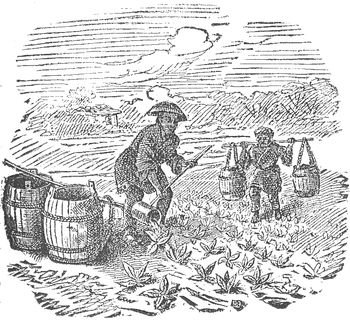
Japan Tobacco Field.
The tobacco plant is cultivated with great success in many of the provinces of Japan, and is exported in large quantities to Europe. The leaf is excellent, and is in request by many buyers of Eastern tobaccos. Robertson gives the following interesting account of the Japan tobacco fields:—
"According to a native account, tobacco was introduced into Japan in the year 1605, and was first planted at Nagasaki in Hizen. It is now very generally grown throughout the country. In the province of Awa, where a great deal of tobacco is grown, the seed is sown in early spring in fields well exposed to the sun and duly prepared for its reception. Well sifted stable manure is strewn over the field, and the seedlings appear after the lapse of about twenty days. The old manure is then swept away, and liquid manure applied from time to time. If the plants are too dense they are thinned out. The larger plants are now planted out into fields well prepared for the purpose in rows, with about eight inches space between each plant, the furrows between each row being about two feet wide. They are again well sprinkled with liquid manure, also with the lees of oil at intervals of about seven days. A covering of wheat or millet bran is now laid over the furrows. The bitter taste of the leaf is in a measure an effectual safeguard against the ravages of insects, but the leaves are nevertheless carefully tended to prevent damage from such cause. If the reproduction from seed is not desired the flowers should be cut off and the stem pruned down, otherwise the leaves will lose in scent and flavor. In Osumi exceptional attention is paid to the cultivation of the tobacco plant. The lees of oil, if liberally used, and stable manure sparsely applied, have great effect on the plant, producing a small leaf with an excellent flavor; while, if the opposite course is followed, the leaves grow to an immense size, but are inferior in taste.
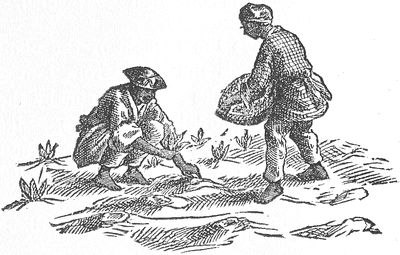
Transplanting.
"When the flowers are in full bloom the 'sand' leaves are picked. After the lapse of twelve or fourteen days the leaves are gathered by twos. Any leaves that may remain are afterwards broken off along with the stalk. Any sand adhering to the leaves is removed with a brush; the stems having been cut off, the leaves are rolled round, firmly pressed down with a thin board, and cut exactly in the centre. The two halves are then placed one on the top of the other in such manner that the edges exactly correspond, and being in this position firmly compressed between two boards, they are cut into fine strips, the degree of fineness depending on the skill of the cutter. A machine made of hard wood, but with the vital parts of iron, is used by some persons for this purpose. The machine was devised about sixty years ago by a skillful Yeddo mechanic, the idea being taken from those used in Osaka and Kiyoto for cutting thread used for weaving into silk embroidery. Since then numerous improvements have been made in it, and it is now extremely well adapted for the economization of labor. Another machine was invented about eight years since, also by a Yeddo mechanic. It is smaller than the first mentioned, but being very easily worked is much in use. Tobacco is sometimes cut in the following crude manner:—The leaves are piled one on top of the other, tightly compressed into the consistency of a board, and then cut into shavings by a carpenter's plane. This is, however, about the worst method, and even the best tobacco, if treated in such fashion, loses its flavor and valuable qualities."
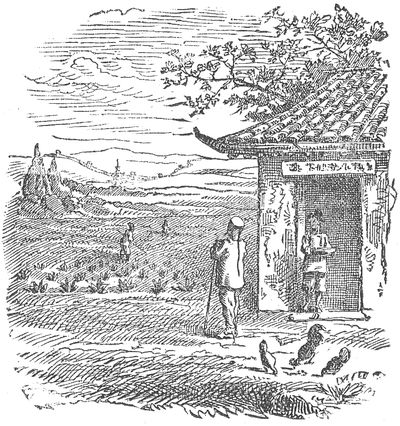
Chinese Tobacco Field.
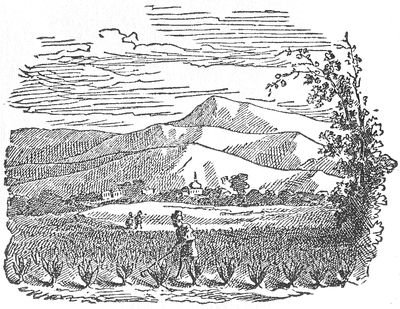
Tobacco Field in Persia.
In Persia tobacco is cultivated near Shiraz, which gives name to the variety. The soil is very fertile and richly cultivated. Not only does the tobacco plant flourish finely, but all kinds of vegetables grow to perfection. The Persians cultivate the plant principally for their own use. It is a fine smoking tobacco, and when cured properly is said to be equal to Latakia. Their mode of curing is unlike that adopted by any other cultivators of the weed but is very successful, and is no doubt the proper method of preparing the leaves for use. Their mode of pressing in large cakes is unlike that of any other growers—but doubtless adds to the aromatic quality of the leaf which makes it so popular in the East.
The tobacco field is trenched so as to retain water, while the plants are set on the ridges where they flourish and mature until the buds and flowers are broken off. The harvest occurs in the autumn, when the singular process of curing begins.
Abbott says of the culture and commerce of tobacco in Persia:
"Jehrum, South Persia, is the principal mart for tobacco, which is brought here from all the surrounding districts, and disposed of to traders, who distribute it over the country far and near. These traders are numerous, and many established here are wealthy; they usually transact their business in their private houses, without resorting to the caravansaries of which there are six in the place. There are many grades and qualities of Shiraz tobacco but that produced at Tuffres (according to Forster), a town about one hundred miles to the south-west of Turshish, is esteemed the best in Persia.
"Of the many varieties of the tobacco plant grown in the East, that known as Manilla is among the most famous and the most extensively cultivated. It is grown in several of the Philippine islands, particularly in Luzon and the southern group, known as the Visayos. The Philippines are a large group of islands in the North Pacific Ocean, discovered by Magellan in 1521; they were afterwards taken posession of by the Spaniards, in the reign of Philip II., from whom they take their name.
"The islands are said to be eleven hundred in number, but some hundreds of them are very small, and all are nominally subject to the Spanish government at Manilla. The Philippines produce a great variety of tropical products such as rice, coffee, sugar, indigo, tobacco, cotton, cacao, abaca, or vegetable silk, pepper, gums, cocoa-nuts, dye-woods, timber of all descriptions for furniture and the buildings, rattans of various kinds, and all the agreeable fruits of the tropics. On the shores are found nacre, or mother of pearl, magnificent pearls, bird's-nests, shells of every description, an incredible quantity of excellent fish, and the trépang, or balatê, a sea-worm, or animal substance, found on the shores of the Philippine Islands, resembling a large pudding. The Chinese esteem it as a great delicacy and mix it with fowl and vegetables. The inhabitants practise various kinds of industry; they weave matting of extraordinary fineness and of the brightest colors, straw hats, cigar cases and brackets; they manufacture cloth and tissues of every sort from cotton, silk, and abaca; they, from filaments taken from the leaves of the etuana, make cambric of a texture much finer than that of France; and they also manufacture coarse strong cloth for sails, and ropes and cables of all dimensions; they tan and dress leather and skins to perfection; they manufacture coarse earthen ware, and forge and polish arms of various kinds; they build ships of heavy tonnage, and also light and neat boats; and at Manilla they frame and finish-off beautiful carriages; they are also very clever workers in gold, silver, and copper; and the Indian women are specially expert in needlework, and in all kinds of embroidery.
"The island of Luzon is the largest of the Philippines, and extends from north to south for the length of about six degrees. It is divided throughout its whole extent by a chain of mountains, which in general owe their formation to volcanic eruptions. In the provinces of Laguna and Batangas there is the high mountain called Maijai, one of the loftiest in Luzon, which is beyond doubt an ancient crater; on the summit a little lake is found, the depth of which cannot be measured. At some period the lava that then flowed from the summit towards the base, in the neighborhood of the town of Nacarlan, covered up immense cavities, which are now recognizable by the sonorous noise of the ground for a great extent; and sometimes it happens that, in consequence of an inundation or an earthquake, this volcanic crust is in some places broken, and exposes to the view enormous caverns, which the Indians call 'the mouths of hell.' In the district about the town of San Pablo, which is situated on the mountain, are found great numbers of little circular lakes and immense heaps of rotten stones, basalt, and different descriptions of lava, which show that all these lakes are nothing else than the craters of old volcanoes. Altogether the soil to the southward, in the province of Albai, is completely volcanic, and the frequent eruptions of the volcano bearing that name may, as the natives say, be attributed to the same cause as the earthquakes so often felt in the island of Luzon. Over almost the whole of these mountains, where fire has played so conspicuous a part, there is a great depth of vegetable earth, and they are covered with a most splendid vegetation. Their declivities nourish immense forests and fine pastures in which grow gigantic trees—palm trees, rattans, and lianas of a thousand kinds, or gramineous plants of various sorts, particularly the wild sugar cane, which rises to the height of from nine to twelve feet from the ground; in their interior are rich mines of copper, gold, iron, and coal.
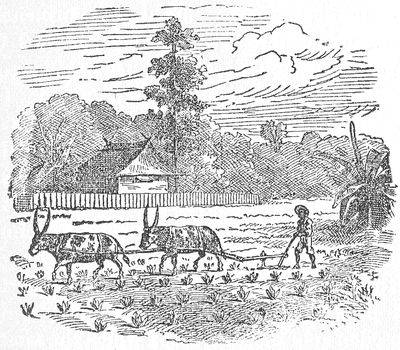
Growing Tobacco on the Philippine Islands.
"There are two distinct and strongly marked seasons in the island of Luzon, namely, the rainy or the wintry season, and the dry or summer season. For six months of the year—that is from June to December—the wind blows from the south-west to the north-east, and then the declivities of the mountains and all the western side of the island are in the season of the rains; in the six other months, the wind changes, and blows from the north-east to the south-west, when all the eastern parts of the island have the season of winter. During the rainy season, the incessant fall of rain on the mountains causes the rivers, both large and small, to overflow and to become torrents, that rush down upon the plains, covering them with water, and depositing the broken earth and slime which they have gathered in their course. In the dry season, water is supplied for irrigation from reservoirs, which are carefully filled during the rains. From these causes it follows that without any manuring, and with scarcely any improvement from human industry, the soil of the Philippines is as fertile as any in the world; so that, without great labor, the cultivator has most abundant harvests."
The above description of the Philippines by Gironiere gives a faithful account of the vast resources of the islands. Of the products cultivated rice and tobacco are the most important. The finest tobacco plantations are situated in the northern parts of the island of Luzon, and furnish the finest quality of Manilla tobacco. That grown in the Visayos is of an inferior quality, and is sold to merchants holding a permit to purchase at the shipping ports and transport to Manilla for sale to the government. In the island of Luzon, the greatest quantity of tobacco is cultivated in the provinces of Nueva Ecija and Cagavan.
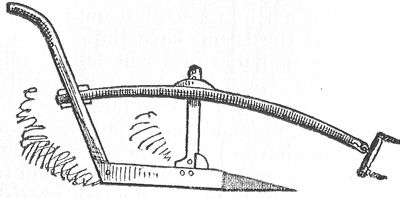
Tobacco Plow.
Tomlinson in an account of the tobacco of the Philippines says: "Manilla leaf comes from the three principal districts of the island of Luzon—Visayos, Ygarotes and Cagayan." The mode of cultivation does not differ in any great respect from that followed in other parts of the world. Great seed beds are made on the plantations where the plants are grown until ready to transplant in the tobacco ground. Unlike most land adapted for tobacco, large crops are grown without the aid of any fertilizer whatever. In cultivating the plants, buffaloes are used, yoked one after the other, going between the rows several times, and at the last ploughing leaving a trench in the middle of the rows, for letting off the water. The Indian plow used in cultivating is exceedingly simple: it is composed of four pieces of wood which the most unhandy ploughman can put together, with the mould board and share, which are of cast iron. The lightness and simplicity of this plough render it easy to be used in every kind of cultivation, where the plantations are divided into rows, such as those of tobacco, maize and sugar cane. It is used with great advantage, not only for cutting down weeds, but also for giving to each row a ploughing, which is serviceable to the plantation, and which is less costly and quicker than simple weeding with the mattock.
When the leaves are ripe they are stripped from the stalks and separated into three classes, according to their size, and afterwards made into bunches of fifty or a hundred, by passing through them, near the foot, a little bamboo cane, as if it was a skewer, by which the bunches are afterwards hung up to dry in vast sheds, into which the sun's rays cannot enter, but in which the air circulates freely; they are left to hang there until they become quite dry, and for this, a greater or less time is required, according to the state of the weather. When the drying is effected the leaves are placed according to their quality, in bales of twenty-five pounds, and in that state they are handed over to the administration of the monopoly. Gironiere in describing the mode of culture on the tobacco plantations says:
"During the first two months after the transplanting it is indispensably necessary to give four ploughings to the ground between the rows of the plants, and every fifteen days to handpick, or even better, to root out with the mattock, all the weeds which cannot be touched by the plough. These four ploughings ought to be done in such a manner as to leave alternately a furrow in the middle of each line, and on the sides, and consequently, at the last ploughing, the earth covers the plants up to their first leaves, leaving a trench for carrying off all water that may accumulate during the heavy rains. As soon as each plant has gained a proper height, its head is lopped off to force the sap to turn into the leaves, and, in a few weeks afterwards, it is fit for being gathered."
The tobacco fields or plantations are very large, and together with the vast sheds for curing, the fields present a beautiful appearance; the long straight rows with their dark green leaves adding not a little to the beauty and variety of the landscape. The great growers of the plant are very careful in cultivating the fields and give the tobacco frequent hoeings, until ready to be gathered and taken to the sheds. The planters are obliged to take the utmost pains, as the product is obliged to be given up to the monopolizing government which is the sole purchaser, and which, in its great establishment at Binondoc, employs continually from 15,000 to 20,000 workmen and workwomen in manufacturing cigars for the consumption of the country and for exportation.
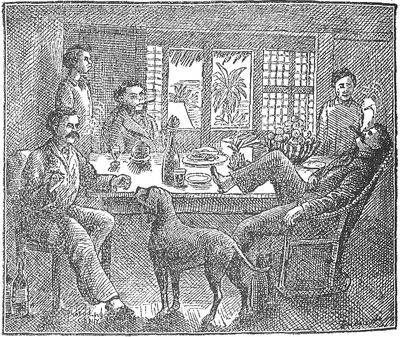
Spanish Planters.
Manilla tobacco is much esteemed in the islands both by the Spaniards and the Chinese. The custom of smoking is universal among all classes and at all times. In the house, on the road and street, the aroma of a fragrant Manilla is ever borne on the breeze. The Spaniards are the principal owners of the tobacco fields, and, like their brother planters on the island of Cuba, are fond of the weed and its more potent companion. After a luxurious breakfast the planter elevates his feet for a quiet smoke, and lights either a cigar or cheroot, filling the room with smoke and with the most fragrant perfume.
Of all the various products cultivated, but few vie with the tobacco plant in beauty of form and general appearance. By its great variety of colors in leaves and flowers, it offers a striking contrast with the more sombre hues of most other plants. When left to grow until the plants have reached full size, the tobacco field has the appearance of a vast flower garden, the tiny blossoms exhaling their fragrance and the entire plant emitting odors as rare and as delicate as the most fragrant exotic. In the tropics the finest tobacco plantations are found, as nature is more lavish, not only in the richness of the soil, but in the variety of the vegetable products. Here the tobacco plant attains its finest form and most delicately flavored leaves. The hues of the flowers are brighter and their fragrance sweeter. In the tropics the tobacco field may be scented from afar, as its odors are wafted on the breeze. In its native home it flourishes and matures as readily as the more common kinds of vegetation, while it affords the planter a larger revenue than many of the more useful of nature's products.[Back to Contents]