Chapter XIII
Reading edition
TOBACCO CULTURE.
Tobacco at the present time is one of the great products of the world. As an article of agriculture and of commerce, it holds an important place among the great staples, while as a luxury, its use has become as extensive as its culture. The tobacco plant is now cultivated in nearly all parts of the world with varying success, according to the system of cultivation adopted by its growers. Primarily cultivated by the aborigines of America in the rude manner common to uncivilized races, the plant has, by numerous experiments and careful culture, become one of the greatest of agricultural products. When first discovered by the Spanish and Portuguese, the plant was small, and in flavor "poor and weak and of a byting taste." As soon, however, as the Spaniards began its cultivation in the islands of St. Domingo and Trinidad, attention was paid to developing it, and in a few years the description we find of the latter variety is that it is "large, sharp, and growing two or three yards from the ground."
At the close of the sixteenth century the Portuguese began its cultivation in Portugal, the soil of which seemed well adapted to the plant, and still further increased the size and quality of the leaf. Tobacco is now cultivated through a wider range of temperature than any other tropical plant, and whether grown amid the sands of Arabia, the plains of South America, or in the rich valley of the Connecticut, develops its finest form and perfection of leaf. During the last half-century the plant has been developed to a greater extent than during the three hundred years succeeding its discovery. Now its cultivation has been reduced to almost an exact science, and the quality of the leaf is in a great measure within the control of the growers of the plant.
Formerly it was supposed that the varieties that grew in the tropics could not be successfully cultivated in the temperate regions, but recent and repeated experiments have demonstrated the fact that the tobacco of Cuba can be grown with success in the Connecticut valley. While the tobacco of the tropics is the finest in flavor, the more temperate regions produce the finest and best colored leaf. The tobacco of the tropics, as to the uses to which it is put, is limited, while the tobacco of the more temperate regions can be used for all the purposes for which the plant is designed.
The cultivation of the plant varies with the variety, the soil, and the use to be made of the leaf. Thus a tobacco designed for cutting purposes is cultivated somewhat differently from that designed for the manufacture of snuff or cigars. In the one case the plant is allowed to remain growing longer in the field, while in the other the work of topping the plants is performed at an earlier stage of their growth. Primarily but little attention was paid to the color and texture of the leaf, the principal object being the production of a leaf of large size, rather than one of good color, and of a silky texture. Now, however, these are most important considerations, and give value to the tobacco in proportion to the perfection of these qualities.
The soil, too, is carefully chosen and fitted in the most thorough manner, while the fertilizers used are selected with reference to the color of leaf desired. When first cultivated in the United States it was thought that tobacco designed for various uses could not be grown in the same state or section; now, however, tobacco for cigars and for cutting are grown nearly side by side. But in the fineness of the leaf, tobacco culture has made its greatest stride. By a careful selection of soil, and by the judicious application of proper fertilizers, the leaf tobaccos of Connecticut, Cuba, and Virginia, resemble in texture the finest satins and silks. This result has been reached, not by the sacrifice of the strength of the leaf, but by the most careful culture and improved methods of curing.
The first labor to be performed in connection with the growth of a crop of tobacco, is the selection of a site for, and the making of, the "plant bed" or "plant patch." These beds for the early growth of the plants until large enough to transplant, are made in various ways and at different times, according to the method of tilling adopted and the climate. In California the tobacco bed is made in January, in the Southern States, Syria, Turkey, and Holland, in March. In New England in April. In Mexico and Java in June, and in Persia in December. In the Connecticut valley the manner of making the
PLANT BED,
as given by a Massachusetts tobacco-grower, is as follows:—
"No rigid rules can be given for any process in tobacco culture, which depends much upon weather and season, but certain advantages may be obtained by skillful adaptation of general principles to circumstances. This is especially true of raising tobacco plants, which occupy an extremely slight depth of ground for weeks after sowing, making it necessary to prepare the whole soil with reference to the state of this thin surface. Any slight mistake of treatment may make in the end a difference of several days; consequently each item is of importance. While every tobacco-raiser wants early plants, and appreciates the value of a good location for growing them, many naturally sheltered spots of ground, protected from northerly winds by buildings, trees, or hills, remain unappreciated. Tight board fences are no protection worth mentioning.
"A heavily manured crop of tobacco would fit such places for tobacco beds, and leave them freer from weeds than any other cultivation; and a subsequent use of some commercial fertilizer would avoid the introduction of weed seed. With these precautions, and a careful destruction of all neighboring weeds, a tolerably clean bed may be expected. To prepare the ground, plow or loosen deeply with a large cultivator; harrow in two-thirds of the fertilizer to be used; rake the bed perfectly level, then rake in the other third; roll once, and another slight raking will fit the bed for sowing, after which it should be rolled down hard. If the soil is handled in drying weather, it should be done quickly, because damp ground, if prepared and rolled down before drying, will 'set' like mortar, and remain damp on the surface. Moisture and darkness are essential to the germination of the seed, and these conditions can be secured only by making the surface compact while damp. The disintegration of the deeper lumps, and the decomposition of fertilizers, will cause the surface to grow gradually softer. The effect of plowing is to break the ground into lumps, which lie upon each other, giving free admission to the air between them. Harrowing makes finer the lumps near the surface, and mixes the fertilizer deeper than a rake can be used. The first raking is to pulverize and level, so that rains will neither collect in ponds, nor run off, but penetrate the soil evenly. The second raking is to mix the fertilizer equally through the soil, to the depth of an inch or less, and reduce the lumps to the size of peas, which is as fine as a medium loam can be made without danger of a tough crust. Too much working destroys the healthy grain of the soil, and reduces it to a paste, which the roots of the tobacco plants can penetrate but slowly.
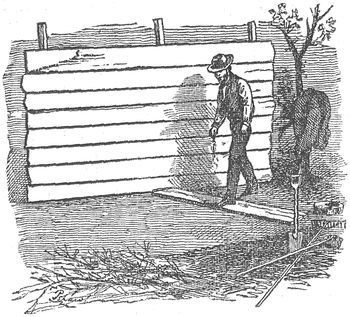
Making the Plant Bed in Connecticut.
"The bed should not be watered before nor after the plants come up. The ground will be cold enough without any extra evaporation, and if the place is suitable for tobacco plants, and rightly fitted, the surface will be damp in the morning, even in very dry weather. If the plants need stimulating, sow on them a coat of Peruvian guano or super-phosphate at the commencement of a rain, regulating the quantity used by the amount of the water likely to fall. Superphosphate makes dark-colored, thick-leaved, stocky plants. Fish guano has about the same effect, but gives a lighter color and thinner leaf. Peruvian guano is more stimulating than either, and makes a light-colored, thin leaf. Great caution is necessary in the use of these powerful medicines to avoid an over-dose. A quantity that would be safe in a heavy rain, would in a light rain kill many or nearly all the plants.
"Old seed will sprout sooner than new. The seed should be measured while dry, and the same spoon used every year, so the effect of a given amount may be noted and the quantity regulated by experience. Level the seed in the spoon with a knife-blade, like measuring grain in a half-bushel. After sprouting again, allowing for the seed, increase in bulk for each rod separately. The amount of seed needed to the square rod varies with different seasons, soils, and seeds, but can be loosely a tablespoonful. There are many breeds of tablespoons. Too thick sowing will nearly spoil a bed by causing it to produce weak, yellow, spindling plants, while thin sowing will give good square ones. A bed should appear about half stocked till the plants are nearly ready to set, when they will suddenly spread and seem to multiply.
"Some growers sprout and some prefer dry seed. In favorable circumstances sprouting will give a gain of four to six days, but in many cases dry seed will be fully as early. A long sprout is liable to be broken off in sowing, or killed by cold, after it is in the ground. A sprout just showing will endure several nights' freezing if there is some warm sun in the day-time. One way to sprout is to spread the seed thinly on cotton cloth, and roll it up inside of woolen cloth, keep it in a warm place, and dip in warm water every day. In about four days the white spots will show. Sprouted no more than this, it will stand unfavorable weather as well as dry seed. A pint of meal and a pint of plaster to each rod, is a good mixture to sow in. Pouring from one dish to another many times will mix the plaster, meal, and seed perfectly if dry. If sprouted, it should be rubbed through the hands a few times with the mixture, to dry it and prevent any bunches of plants coming from seed stuck together. The plaster will show on the ground whether the sowing is being done evenly.
"Weeding should of course be done early and thoroughly. Weeds are stronger than the plants, and a little neglect will check them, making practically, perhaps, a difference of several days. A good way to prepare for weeding and taking up plants, is to make the bed about fifteen feet wide, and place round, straight poles across it about eleven feet apart. The poles should be three inches in diameter at the smallest end. They cost nothing and save moving blocks around with the weeding planks."
If the plants are tardy of growth, or the season is backward, wooden frames covered with cloth soaked in linseed oil may be placed over the beds, which is far better than to cover with pine boughs or glass even. The cloth soaked in oil draws the rays of the sun and keeps the earth dry and warm, causing a rapid growth of the plants, which at this stage need forcing in order to be forward enough for early transplanting. A Virginia planter gives the following description of making the
PLANT PATCH.
"Cut wood in September or October, so that it may season, to burn patches (beds) in winter or spring. For ten acres, or fifty thousand hills, burn and sow three patches each of seventy-five square yards. Say one (if the land be in good condition) the latter part of December, and if it be not in condition then, burn one hundred and fifty square yards the first good weather in January or February, and the other the first of March. Select a place on some small constant running stream, not liable to overflow, with a moist, sandy soil; cut down all trees close to the ground; get off all shrubbery, leaves, etc. The patch will then be ready for wooding. Commence by laying on skids ten or twelve feet long, four in diameter, three and a half feet apart; cover thickly with brush, then put on wood regular all over, and thick enough to burn dry an inch in depth. Commence your fires on the side, and continue to move after it has burnt hard enough. After it has burned, sweep off all coals, but not the ashes: then it will be ready for hoeing up, which can be done with good grub hoes; hoe deep, but do not turn over the soil; get off all large and small roots; chop over with hill hoes, and rake until the earth is thoroughly pulverized; then put on twenty-five bushels of good, fine, stable manure, without weed and grass seed, and twenty-five pounds of Peruvian guano, which should be put on regularly, hoed and raked in.
"For sowing, lay off beds four feet wide, so that the water from rains may run or drain off. For every bed four feet wide and twelve yards long, sow one chalk pipe bowl full of seed, after being mixed with ashes; tread with the feet or pat it over with weeding hoes, that it may be close and smooth; cover it with dog-wood, maple, or any fine brush, to the depth of twenty or twenty-four inches, to protect the young plants from cold or a drouth. After the plants have commenced coming up, re-sow the patches with half the quantity of seed first sown, which will not interfere with the plants first up, but make good re-planting plants. When the plants, or some of them, have grown to the size of a Spanish mill dollar, take off the brush, pick off all sticks, weeds, and grass, and keep them well picked until you have finished setting out.
"Should the plants not grow fast enough to suit, manure with Peruvian guano; have it fine, and sow over in the middle of the day when they are dry, or if it be raining briskly, it may then be sown over. Should the patches be suffering for rain, put five pounds of Peruvian guano in twenty gallons of water, and sprinkle it over with a watering-pot. To destroy the flea, bug, or fly, put dry leaves around the patch, and set fire to them at night, which will attract and destroy them if they are disturbed with a broom or leafy brush."
The old Virginia planters selected and made the plant patch as follows:—
"The quality of earth, and places which are universally chosen for this purpose, are newly cleared lands of the best possible light black soil, situated as near to a small stream of water as they can be conveniently found, due attention being paid to the dryness of the place.
"The beds, or patches, as they are called, differ in size, from the bigness of a small salad bed to a quarter of an acre, according to the magnitude of the crop proposed; and they are prepared for receiving the seed in March and the early part of April, as the season suits, first by burning upon them large heaps of brush wood, the stalks of the maize or Indian corn, straw, or other rubbish; and afterwards, by digging and raking them in the same manner of preparing ground for lettuce seed; which is generally sown mixed with the tobacco seed (the same process being suitable to both plants); and which answers the double purpose of feeding the laborer, and of protecting the young tobacco plant from the fly; for which intent a border of mustard seed round the plant patch is found to be an effectual remedy, as the fly prefers mustard, especially white mustard, to any other young plant; and will continue to feed upon that until the tobacco plant waxes strong, and becomes mature enough for transplantation."
A Tennessee planter gives the following description of making the plant bed as practised in his State. In some respects, especially in preventing the growth of weeds, it is the best process of making the "plant patch" that we have ever seen described. He says:—
"To make a good plant bed it requires good management and pretty hard work. It will hardly be done well without the presence of the farmer to attend to it. The time to make a bed is from the 15th of October to the first of April. The best beds are made in the Fall, for the reason that the ground is then very dry and therefore more easily burned, and besides there is more time for the ashes to rot before the hot weather. A bed turned in the Fall will hold moisture better than burned later. It takes less wood to burn well. The plants are more vigorous and tougher. The soil should be rich and light and never tilled before. The location should be as much exposed to the sun as possible. It is best for a bed to be surrounded by timber. The bugs are not so apt to find it. Low rich valleys will generally do better than ridges, though any good rich new ground will make good plants if well burned and prepared. The ground should be raked very clean of leaves before packing on the brush and wood. The fire must have a fair chance at the ground. The brush should be packed on straight and close, at least enough wood mixed with it to make it lie close. If the brush is green, endeavor to mix what dry stuff there is thorough, so the fire will burn through without trouble. It is very important that the fire should be as hot as possible while it is burning. The bed should not be rained upon after it is set before it is burned, as it will be doubtful whether the ground beneath the brush will get dry well.
"The ground should always be as dry as possible when it is burned. The bed should be set on fire in several places at once so as to have a very great heat on it at once. If the ground is well burned it will be a little crusty and whitish, and will pulverize beautifully. As soon as the ground is cool enough it may be loosened up and pulverized. This should be done well, and may be done with a good sharp harrow and then followed with hoes and grubbing hoes. Aim to keep the ashes and rich soil on the surface, and for this reason a bed is sometimes damaged by a too deep working. Rake carefully, getting off all the roots and trash. The bed should be drained by a little ditch around it on the upper side. If it is very early in the Fall, the seed should not be sown until the danger of very warm days has passed. After the last of November the sowing should be as soon as the bed is prepared. A little less than a heaping tablespoonful to ten steps square is about the quantity of seed. Cover the seed very lightly with the rake or tramping the ground with the feet. Cover the bed with a good layer of straight brush, not enough to keep the light rains from the bed, but at the same time enough to keep the ground in a moist condition even in hot weather. Make a low close brush fence around the bed to keep the leaves from being blown upon it. Re-sow whenever the plants are well up, so as to have two chances. Take off the brush cover when the plants are big enough to shade the ground themselves. If the plants are rather thin on the bed, do not uncover until you go there to draw the plants. If there is any danger of a scarcity of plants, always put the trash back after drawing."
In Cuba the
"SEMILLEROS"
or planting beds as a rule, lie higher than the rest of the farm. On the large vegas or tobacco plantations, numbers of planting beds are made under the supervision of the mayoral. Siecke gives the following account of making the beds or semilleros:
"On the island of Cuba any field selected for the cultivation of tobacco is divided into long beds (Canteras) twenty-five to twenty-eight feet long, and nineteen to twenty inches wide. The soil is then manured with a mixture of two parts of well rotten dung and one part of either sand or fine sandy earth. During the months of August, September, and even October, the beds are watered, and the seeds mingled with the nine-fold quantity of fine sand, are sown broad cast or through a fine sieve, and immediately after covered with a mixture of dung and triturated or molaxated earth, in such a manner that this mixture forms a covering layer of about 1-32 inches.
"The utmost care is taken to protect the seeds against the stifling heat of sunrays as well as heavy showers. To this end forked sticks about three inches high, are placed around the tobacco beds, opposite one another, and into these forks thin twigs are laid, which are covered with palm-leaves in such a way as to form a slight roof."
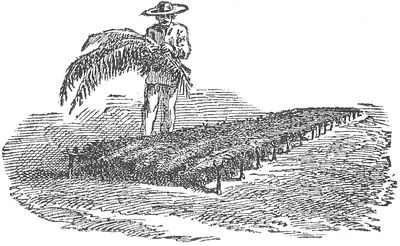
Covering Plant Bed.
In Syria the tobacco seed is sown in ground free from stones, well manured with goats dung, and strewn over with prickly bushes to protect the young plants from birds. The plants are watered daily till they reach the height of eight or ten inches, when they are transplanted. In Persia where the celebrated Shiraz tobacco is cultivated, the seed is planted in a dark soil slightly manured; the ground is covered with light thorny bushes to keep it warm, and these are removed when the plants are a few inches high. The ground is regularly watered if required, and when the plants are six to eight inches high are transplanted. In Turkey
"the tobacco seed is sown early in the spring, in small beds carefully prepared for the early growth of the young plants. In a few weeks the plants appear thick; then begins the occupation of the farmer's wife, and their numerous children, whose little fingers are engaged day by day in thinning the beds, care being taken to leave the most healthy looking plants. The husband is engaged either in carrying water from the nearest well by the aid of his mule, or in preparing the land for the reception of the plants. The beds are well watered before sunrise and after sundown."
"The Hungarian peasantry always make their tobacco beds against the south ends of their houses. These beds are enclosed by hurdles two feet high, at the bottom of which stones are laid, and on the outside of these, thorns are thickly placed, to exclude the moles. They fill this enclosure to the height of eighteen inches with fresh, coarse manure, which they press closely by beating as they throw it on; covering with finely pulverized earth mixed with dung of the preceding year that had become soil. They do not regulate their time of sowing either by the moon, month, the season, but by the holy week of the passing year; it is on Good Friday that all of their beds are sown, and although this day may vary nearly one month in different years, they are faithful to their thermometer—their piety not permitting them to know any other. To the mysterious influence of the day, without regard to the season, they ascribe their success and they generally succeed."
Bickinson gives an account of the manner of making the plant bed in the East Indian Archipelago. He says:
"Not far from us is a hut inhabited by two natives, who are engaged in cultivating tobacco. Their ladangs, or gardens, are merely places of an acre or less, where the thick forest has been partially destroyed by fire, and the seed is sown in the regular spaces between the stumps."
After making the plant bed and tending through the weeding season, the next step to be taken is the
CHOICE OF GROUND
for the tobacco fields. Tobacco, unlike any other plant, readily adapts itself to soil and climate. The effect produced upon the plant may be seen in comparing the tobacco of Holland and France, the one raised upon low, damp ground, the other on a sandy loam. The early growers of the plant in Virginia, were very particular in the selection of soil for the plant. The lands which they found best adapted were the light red, or chocolate-colored mountain lands, the light black mountain soil in the coves of the mountains, and the richest low grounds.
In the Connecticut valley where tobacco is grown for wrapping purposes, the selection of soil will depend upon the color of leaf in demand (as the soil as well as the fertilizers determine in a measure the color and texture of the tobacco). If the grower wishes to obtain dark colored tobacco then the soil selected should be a dark loam; on the other hand, if a light colored wrapper is desired he selects a light loam, and with the application of proper fertilizers the proper color will be obtained.
The tobacco plant flourishes well either on high or low ground, providing the soil be dry and free from stones, which are a source of annoyance during the cultivation of the plants and especially in harvesting. When grown on very low ground the plants should be "set" early, so as to harvest before early frosts. The plant may be cultivated on such soil in almost any part of the valley excepting only near the sound, or other body of salt water, the effect produced by planting tobacco too near the sea, more especially in Connecticut, being injurious to the leaf, which is apt to be thick and unfit for a cigar wrapper. In some countries, however, the leaf grown near salt water is equal in color and texture to any grown in the interior. But generally the plant obtains its finest form and quality of leaf—whether in the islands of the ocean, on the great prairies of the west, amid the sands of Arabia, on the mountains of Syria, or along the dykes of Holland—on lands bordering the largest rivers. This is true of the tobacco lands of Connecticut, Kentucky, Virginia, Florida, Brazil, Venezuela, and Paraguay, as well as of those in the islands of Cuba and St. Domingo, where the rivers flow to the southern coast from the mountains which lie to the north. It must not be imagined from this that tobacco can not be successfully cultivated at a distance from valleys enriched by large and overflowing rivers. Some of the finest tobacco grown in Connecticut is grown in counties some distance from the river that gives name to our state.
When possible, select that kind of soil for the tobacco field that will produce the color and texture of leaf desired. For Connecticut seed leaf a light moist loam is the proper soil. The same field can be used a number of seasons in succession; the result will be a much finer leaf than will come from selecting a new field each year. The early planters of tobacco in Virginia soon ruined their fields by failing to manure them. In Maryland the soil best adapted for the growth of tobacco is a light, friable soil, or what is commonly called a sandy loam, not too flat, but of a rolling, undulating surface, and not liable to overflow in excessive rains. New land is far better than old.
A Missouri tobacco grower gives the following account of the selection of soil for tobacco in that State:—
"Select upland, or black oak ridges and slopes, which comprise a large area of the tobacco lands of our county, and carefully clear off all the timber, and take out all the roots we can conveniently, and break up the ground as thoroughly as can be done by ploughing and harrowing until all the tufts and dirt are perfectly pulverized."
In Cuba the planters select the red soil as the best for fine tobacco. Some planters, however, prefer a soil mixed of 1/4 sand and 1/2 to 3/4 of decayed vegetable matter. In St. Domingo the soil is not uniform. The planters select a deep black loam or tenacious clay, or even loams mixed with sand. The most fertile places are on the banks of the Yuna, from Laxay to Jaigua, in the vicinity of Mocha, on the banks of the Camoo, and around La Vega. Around Santiago, clay and sand predominate, and the soil can not be highly praised. Most of the tobacco grown in the island is raised in the valley of the Vega.
Cussree, in treating of this subject, says:—
"The quality of tobacco depends as much upon the nature of the soil as of the climate. The plant requires peculiarities of soil to develop certain of its qualities. And these peculiarities are such that art cannot furnish the conditions to produce them where they are naturally wanting. The sugar-cane grows chiefly on soils derived from calcareous formations; but few or none of these are fitted for tobacco, which is cultivated only on sandy loams. Both the Cuban and American planters concur in asserting that a large quantity of silicious matters in soils is essential for the growth of good tobacco.
"As already noticed, the rich clay loams on the banks of the James River, in Virginia, do not grow good tobacco; while the less fertile silicious soils in the county of Louisa produce it much superior in quality. Small patches of tobacco are everywhere seen growing over the sugar producing districts of Cuba; but I saw no tobacco plantations in the calcareous regions over which I traveled. The soils rest upon the primary formation. Even in the tobacco districts the planters know the spots in the different fields that produce the various qualities of leaf."
In
PREPARING THE SOIL
for the reception and growth of the plants, the fertilizing as well as the plowing of the fields should be performed in the most thorough manner. The first is essential for a large and vigorous growth, while the latter renders the cultivation of the plants much easier. The careful preparation of soil is so intimately connected with all that pertains to the plant, that it should be done well in order that the best results may follow. Tobacco of good body, color, and texture, cannot be grown on land devoid of fertility. The field selected for tobacco, if heavy sward, should be plowed early in the spring or the fall before, and later in the season if the turf is well rotted. After spreading on the manure, the field may be plowed again and harrowed frequently until all the lumps are made fine, and the surface mellow.
In the use of fertilizers select, if a light colored leaf is desired, either horse manure or tobacco stems. In the Connecticut valley nearly all kinds of Domestic, Commercial, and Special fertilizers are used. Of domestic fertilizers, horse manure is considered the best, as it produces the finest and lightest colored leaf of any known fertilizer. Of commercial fertilizers, Peruvian guano is doubtless one of the best—imparting both color and fineness to the leaf. Of special manures, tobacco stems are perhaps the best, at least the most frequently used. Of the other special fertilizers, such as cotton seed meal, castor pomace, ground bone, damaged grain, tobacco waste and saltpetre waste, much may be said both in praise and dispraise. Cotton seed meal, when used with domestic manure is an excellent and powerful manure.
If domestic manures are applied, use about twelve cords to the acre, composting before plowing under. As soon as spread, plow the field and see that all of the manure is covered. If tobacco stems are used, plow in from three to five tons to the acre, all of them at once, or a part in the fall and the remainder in the spring. If Peruvian guano is applied, sow on about three hundred pounds to the acre in connection with the domestic manure. Fish guano should be composted before sowing, either with loam or manure, and when used on light soil is a very good fertilizer, producing a light, thin leaf. After the tobacco field is harrowed it is ready for the ridger, which makes the hills and gathers together all of the loose manure on the surface, and collects it in the ridges. Where a ridger is not used, work off the rows from three and one half to four feet apart, or even wider than this. In the Connecticut valley the field is marked and hilled so as to give about 6000 hills to the acre. This will be a sufficient number if the growth is likely to be large. Where a ridger is used, manure can not be dropped in the hill and in many respects it is well not to do so, as the plants are liable to be blown over during a storm—not standing as firmly in the hills as plants when no manure is used in the hills. If the hills are to be made with the hoe, avoid all stones, bits of turf and grass in making them, and select only the fresh earth—gently patting the top of the hill with the hoe. New made hills are better than old, but it will make but little difference unless the soil is very dry at the time of transplanting.
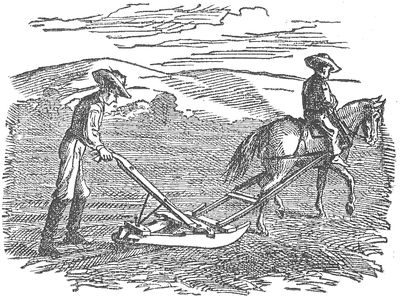
A Tobacco Ridger.
The following description of the manner of preparing the tobacco field in Virginia by the old planters is quite interesting, and gives some idea of the amount of labor to be performed on the tobacco plantation:—
"There are two distinct and separate methods of preparing the tobacco ground: the one is applicable to the preparation of new and uncultivated lands, such as are in a state of nature, and require to be cleared of the heavy timber and other productions with which Providence has stocked them; and the other method is designed to meliorate and revive lands of good foundation, which have been heretofore cultivated, and, in some measure, exhausted by the calls of agriculture and evaporation.
"The burning of this brush-wood, and the log piles, is a business for all hands after working hours; and as nightly revels are peculiar to the African constitution, this part of the labor proves often a very late employment, which affords many scenes of rustic mirth. When this process has cleared the land of its various natural incumbrances (to attain which end is very expensive and laborious), the next part of the process is that of the hoe; for the plough is an implement which is rarely used in new lands when they are either designed for tobacco or meadow. There are three kinds of the hoe which are applied to this tillage: the first is what is termed the sprouting hoe, which is a smaller species of mattock that serves to break up any particular hard part of the ground, to grub up any smaller sized grubs which the mattock or grubbing hoe may have omitted, to remove small stones and other partial impediments to the next process. The narrow or hilling hoe follows the operation of the sprouting hoe. It is generally from six to eight inches wide, and ten or twelve in the length of the blade, according to the strength of the person who is to use it; the blade is thin, and by means of a movable wedge which is driven into the eye of the hoe, it can be set more or less digging (as it is termed), that is, on a greater or less angle with the helve, at pleasure. In this respect there are few instances where the American blacksmith is not employed to alter the eye of an English-made hoe before it is fit for use; the industrious and truly useful merchants of Glasgow have paid more minute attention to this circumstance.
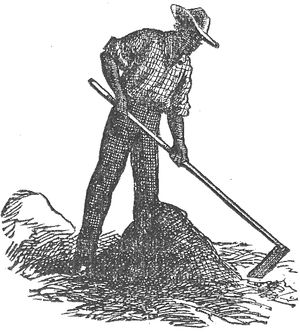
Drawing the Dirt Around the Foot.
"The use of this hoe is to break up the ground and throw it into shape; which is done by chopping the clods until they are sufficiently fine, and then drawing the earth round the foot until it forms a heap round the projected leg of the laborer like a mole hill, and nearly as high as the knee; he then draws out his foot, flattens the top of the hill by a dab with the flat part of the hoe, and advances forward to the next hill in the same manner, until the whole piece of ground is prepared. The center of these hills are in this manner guessed by the eye; and in most instances they approach near to lines of four feet one way, and three feet the other. The planter always endeavors to time this operation so as to tally with the growth of his plants, so that he may be certain by this means to pitch his crop within season.
"The third kind of hoe is the broad or weeding hoe. This is made use of during the cultivation of the crop, to keep it clean from the weeds. It is wide upon the edge, say from ten inches to a foot, or more; of thinner substance than the hilling hoe, not near so deep in the blade, and the eye is formed more bent and shelving than the latter, so that it can be set upon a more acute angle upon the helve at pleasure, by removing the wedge."
The manner of preparing the soil in Virginia at the present time is thus described by a Virginia planter:—
"The crop usually, grown in Virginia is divided into three classes, viz.:—Shipping, Sun-cured Fillers, and Bright Coal-cured Wrappers and Smokers. The first may be grown on any good soil, upland or alluvial: the latter two on dry, well-drained upland only. All require thorough preparation of the soil to insure good crops. The work first necessary for this crop is to burn a sufficiency of plant land. To prepare the land for transplanting, put the land in full tilth, then mark off with a shovel, plow furrows three feet to three feet four inches apart, and into these furrows sow the fertilizers; then with turning plows, bed the land on these furrows, and to facilitate the hilling, cross these beds three feet apart with furrows by a shovel plow, and the hills are made, except to pat them with hoes. Hilly lands will seldom admit of this cross-plowing, and the beds must be chopped into hills. On new ground apply the fertilizers broadcast. It acts well, and for fine yellow pays better on new grounds than any other lands. The culture is essentially the same for all classes of tobacco. Stir the land up as often as necessary to promote a rapid growth of the plants, and to keep down grass and weeds. 'Shipping' tobacco may be plowed later and worked longer than 'fine yellow.' For 'coal-curing' sacrifice pounds for color."
The next operation to be performed on the tobacco farm or plantation is
TRANSPLANTING.
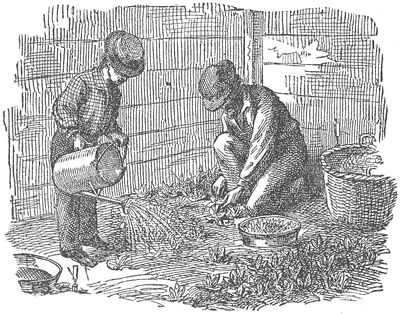
Transplanting.
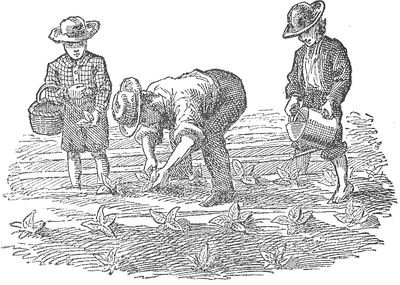
Transplanting.
Plants with large broad leaves are considered the best, those that grow tall and "spindling" or "long shank" plants, as they are called at the South, are rejected and should not be set out when others that are more "stocky" can be obtained. Avoid, however, setting too large plants, as they are not as apt to live as smaller ones. Transplanting should be done as fast as possible, that the tobacco field may present an even appearance and be ready to harvest at one time. If the plants are to grow and ripen evenly, the transplanting should be finished in a week or two from the time of the first setting. This can generally be done unless plants are very scarce, when circumstances, beyond the growers' control, often make the field give apparent evidence of want of care, although the real trouble is a want of plants.
"It may be necessary to water the plants once or twice after transplanting; this in a measure will depend upon the season."
Tatham in his Essay on the Culture and Commerce of Tobacco, (London 1800,) gives an account of the manner of transplanting in Virginia at that period. Under the head of
"THE SEASON FOR PLANTING,"
he says:
"The term, 'season for planting,' signifies a shower of rain, of sufficient quantity to wet the earth to a degree of moisture which may render it safe to draw the young plants from the plant bed, and transplant them into the hills which are prepared for them in the field, as described under the last head; and these seasons generally commence in April, and terminate with what is termed the long season in May; which (to make use of an Irishism), very frequently happens in June; and is the opportunity which the planter finds himself necessitated to seize with eagerness for the pitching of his crop: a term which comprehends the ultimate opportunity which the spring will afford him, for planting a quantity equal to the capacity of the collective power of his laborers when applied in cultivation. By the time which these seasons approach, nature has so ordered vegetation, that the weather has generally enabled the plants, (if duly sheltered from the spring frosts, a circumstance to which a planter should always be attentive in selecting his plant patch,) to shoot forward in sufficient strength to bear the vicissitude of transplantation.
"They are supposed to be equal to meet the imposition of this task, when the leaves are about the size of a dollar; but this is more generally the minor magnitude of the leaves; and some will be of course about three or four times that medium dimension. Thus, when a good shower or season happens at this period of the year, and the field and plants are equally ready for the intended union, the planter hurries to the plant bed, disregarding the teeming element, which is doomed to wet his skin, from the view of a bountiful harvest, and having carefully drawn the largest sizable plants, he proceeds to the next operation, (that) of planting.
"The office of planting the tobacco, is performed by two or more persons, in the following manner: The first person bears, suspended upon one arm, a large basket full of the plants, which have just been drawn and brought from the plant bed to the field, without waiting for an intermission of the shower, although it should rain ever so heavily; such an opportunity indeed, instead of being shunned, is eagerly sought after, and is considered to be the sure and certain means of laying a good foundation, which cherishes the hope of a bounteous return. The person who bears the basket, proceeds thus by rows from hill to hill; and upon each hill he takes care to drop one of his plants. Those who follow make a hole in the center of each hill with their fingers, and having adjusted the tobacco plant in its natural position, they knead the earth round the root with their hands, until it is of a sufficient consistency to sustain the plant against wind and weather. In this condition they leave the field for a few days, until the plants shall have formed their radifications; and where any of them shall have casually perished, the ground is followed over again by successive replantings, until the crop is rendered complete."
In tropical regions, the plants are transplanted as well in summer and fall as in the spring, but more frequently in the early autumn. In Mexico, transplanting is performed from August till November. In Persia, the tobacco plants are "transplanted on the tops of ridges in a ground trenched so as to retain water. When the plants are thirty to forty inches high, the leaves vary from three to fifteen inches in length, when the buds are ready to be pinched off; the leaves increase in size until August and September, when they have attained their growth." In Turkey "when the young plants are about six inches in height they are removed from the small beds and planted in fields like cabbages in this country, and are then left to nature to develop them to a height of from three to four feet; three leaves, however, are removed from each plant to assist its growth."
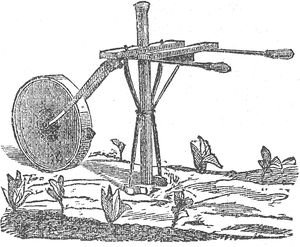
American Transplanter.
A year or two since, a machine was invented and offered to the growers of the Connecticut valley, called a transplanter, of which we here give an engraving. The inventor claimed that the "American Transplanter" could do the work of several men and do it equally well. It rolls along the ridge something like a wheelbarrow, marking the hills with a sharp joint in the wheel and setting the plants as they are dropped into the receptacles at the top.
The tobacco plant, like most of the vegetable products, has many and varied foes. Not only is it most easily affected and damaged by wind and hail, but it seems to be the especial favorite of the insect world, who, like man, love the taste of the plant. The first of them "puts in an appearance" immediately after transplanting, which necessitates the performance of what is known to all growers of the plant as
WORMING.
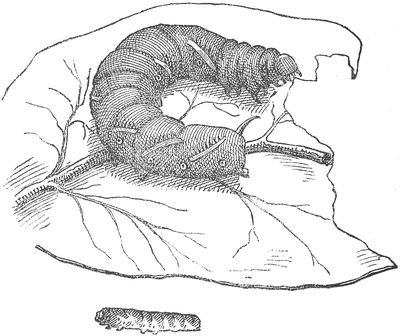
The Worm.
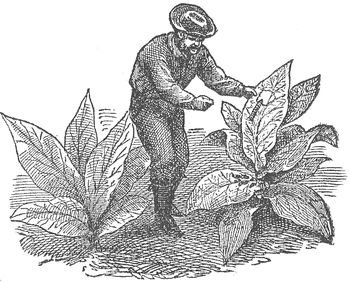
Worming Tobacco.
Almost as soon as the plants have been transplanted, the work of
CULTIVATING
should commence. As the tobacco plant grows and ripens in a few weeks from the time it is transplanted in the field, it is of the utmost importance that the plants get "a good start" as soon as possible. In a favorable season, and with ordinary culture, the plants will do to harvest or "cut" in from eight to ten weeks after transplanting. From the rapidity of its growth it will readily be seen that the plant should come forward at once, if large, fine leaves are desired. In a week from the time of transplanting a light cultivator should be run between the rows, stirring the soil lightly, after which the plants should be hoed carefully, drawing away from the hill and plant the old and "baked" earth and replacing it with fresh. If the hill is hard around the plant it should be loosened by striking the hoe carefully into the hill and gently lifting the earth, thus making the hill mellow. This is apt to be the case with stiff, clayey soil, which, if possible, should be avoided in selecting the tobacco field.
It is doubtless as true a saying as it is a common one with Connecticut tobacco-growers, that the plants will not "start much until they have been hoed." Where the first hoeing is delayed two or three weeks, the plants will to a certain extent become stunted and dwarfed, and will hardly make up for the delay in growing. In from two to three weeks, the field should be hoed again, and this time the cultivator should mellow the soil a little deeper than the first time, while the hoeing should be done in the most thorough manner. Draw the earth around the plant and cut up with the hoe all grass and weeds, and remove all stone and lumps of manure and any rubbish that will hinder easy cultivation, or retard the growth of the plants. At this period the most careful attention must be given to the plants, as they are (or ought to be) growing rapidly, and upon their early maturity will depend the color and texture of the leaf.
In a short time the plants may be hoed for the third and last time (as a fourth hoeing is but rarely necessary). At this time they have attained considerable size, (say two or three feet high) and are rapidly maturing, and ere long will be ready to harvest. At the last hoeing the plants should be "hilled up," that is, the earth should be drawn around the plant under the leaves, causing it to stand firmly in the hill, and keeping the roots well protected and covered. The tobacco plant requires constant cultivation, and the cultivator may be run through the rows after loosening the earth and turning up the manure towards the plants.
Some growers of tobacco in the early stages of its growth apply some kind of fertilizers to the backward plants; this will be found to be of advantage, and should be done just before a rain, when the plants will start in a manner almost surprising. A little phosphate or Peruvian guano may be used, but should be applied with care or the plants may be retarded instead of quickened in their growth.
There is much to be done in the tobacco field besides cultivating and hoeing the plants. In many hills there will be found two plants, which should be re-set at the second hoeing if needed, and if not, pulled up and destroyed, as it is better to have one large plant in the hill than two small ones. Again, after the last hoeing, the tobacco should be kept free from worms. If any have been overlooked they will have attained to a good size by this time, and will devour in a short time enough tobacco to make a "short six."
From this account of the cultivation of tobacco as practiced in the Connecticut valley, one will readily see that the labor performed during the growing of the plants should not be superficial. On their rapid growth depends the color and texture of the leaf. Plants that are slow in maturing never make fine wrapping leaves or show a good color. Where the growth is rapid the plants will be more brittle than if of slower growth, and must therefore be handled with care in passing through the rows to worm, top, and sucker the plants.
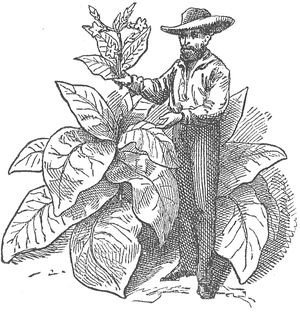
Topping.
A century ago the Virginia planters cultivated their tobacco fields in the following manner:—
"Hoeing commences with the first growth of the tobacco after transplantation, and never ceases until the plant is nearly ripe, and ready to be laid by, as they term the last weeding with the hoe; for he who would have a good crop of tobacco, or of maize, must not be sparing of his labor, but must keep the ground constantly stirring during the whole growth of the crop. And it is a rare instance to see the plough introduced as an assistant, unless it be the slook plough, for the purpose of introducing a sowing of wheat for the following year, even while the present crop is growing; and this is frequently practiced in fields of maize, and sometimes in fields of tobacco, which may be ranked amongst the best fallow crops, as it leaves the ground perfectly clean and naked, permitting neither grass, weed, nor vegetable to remain standing in the space which it has occupied."
The next operation to be performed in the tobacco field is known by the name of
TOPPING,
and is simply breaking or cutting off the top of the stalk, preventing the plant from running up to flower and seed. By so doing the growth of the leaves is secured, and they at once develop to the largest possible size. The leaves ripen sooner if the plant is topped, while the quality is much better. There are various methods of topping as well as different periods. Some growers top the plant as soon as the capsules appear, while others wait until the plants are in full blossom. If topped before the plants have come into blossom, the operation should be performed as soon as possible, as a longer time will be required for the leaves to grow and ripen than when topping is delayed until the plants are in blossom. In the Connecticut valley most growers wait until the blossoms appear before breaking off the top. Topping must not be delayed after the blossoming, in order that all danger from an untimely frost may be avoided. The top may be broken off with the hand or cut with a knife, the latter being the better as well as the safer way. Sometimes the rain soaks into the stalk, rotting it so that the leaves fall off, injuring them for wrappers. Top the plants at a regular height, leaving from nine to twelve leaves, so that the field will look even, and also make the number of leaves to a plant uniform. Late plants may be topped with the rest or not, at the option of the grower. This mode of topping refers more particularly to cigar rather than cutting leaf. Those varieties of tobacco adapted for cutting leaf should be topped as soon as the button appears; top low, thereby throwing the strength of the stalk into a few leaves, making them large and heavy. The number of leaves should not exceed fourteen. Let it stand from five to six weeks after it is topped. The object in letting it stand so long after topping is to have it thoroughly ripe. This gives it the bright, rich, golden color, entirely different from cigar leaf, but very desirable for chewing leaf. On account of the length of time it must stand after topping, it is desirable to take that which has been topped early, in order to have it ripen, and get it in before a freeze, although ripe tobacco is not injured by cold nights, and will sometimes stand even an ordinary frost.
The manner of topping in Virginia by the first planters in the colony, is thus described:—
Now the custom is to top for shipping from eight to ten leaves, for coal-curing from ten to twelve, according in both cases to strength of soil and time of doing the work.
In Mexico "as soon as the buds begin to show themselves the top is broken off. Not more than from eight to ten leaves are left on the plant, without counting the sand-leaf, which is thrown away," and destroyed in the same manner as the Dutch are said to do of spies. In some countries the plants are not topped at all, and the leaves are left upon the stalk until fully ripe, when they are picked.
The next labor following the topping of the plants is called
SUCKERING.
Immediately after topping the plants, shoots or sprouts make their appearance at the base of the leaves where they join the parent stalk. They are known by the name of suckers and the removal of them by breaking them off is called suckering. At first the suckers make their appearance at the top of the plants at the base of the upper leaves, and then gradually appear farther down on the stalk until they are found at the very root of the plant. The plants should be suckered before the shoots are tough, when they will be removed with difficulty, frequently clinging to both stalk and leaf, thereby injuring the latter, as the leaf very often comes off with the sucker if the latter is left growing too long. The plants should be kept clean of them and especially at the time of harvesting.
An old writer on tobacco says of Suckers and Suckering:—
"The sucker is a superfluous sprout which is wont to make its appearance and shoot forth from the stem or stalk, near to the junction of the leaves with the stem, and about the root of the plant and if these suckers are permitted to grow, they injure the marketable quality of the tobacco by compelling a division of its nutriment during the act of maturation. The planter is therefore careful to destroy these intruders with the thumb-nail as in the act of topping, and this process is termed suckering."
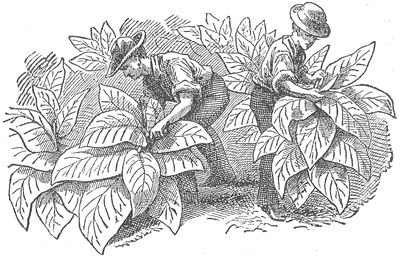
Suckering.
After this operation is performed the planter ascertains in regard to the
RIPENING OF THE PLANTS.
As soon as the plants are fully ripe they not only take on a different hue but give evidence of decay. The leaves as they ripen become rougher and thicker, assume a tint of yellowish green and are frequently mottled with yellow spots. The tobacco grower has two signs which he regards as "infallible" in this matter. One is that on pinching the under part of the leaf together, if ripe it will crack or break; the other is the growth of suckers to be found (if ripe) around the base of the stalk.
Tatham says:—
"Much practice is requisite to form a judicious discernment concerning the state and progress of the ripening leaf; yet care must be used to cut up the plant as soon as it is sufficiently ripe to promise a good curable condition, lest the approach of frost should tread upon the heels of the crop-master; for in this case, tobacco will be among the first plants that feel its influence, and the loss to be apprehended in this instance, is not a mere partial damage by nipping, but a total consumption by the destruction of every plant. I find it difficult to give to strangers a full idea of the ripening of the leaf: it is a point on which I would not trust my own experience without consulting some able crop-master in the neighborhood; and I believe this is not an uncustomary precaution among those who plant it. So far as I am able to convey an idea, which I find it easier to understand than to express, I should judge of the ripening of the leaf by its thickening sufficiently; by the change of its color to a more yellowish green; by a certain mellow appearance, and protrusion of the web of the leaf, which I suppose to be occasioned by a contraction of the fibres; and other appearances as I might conceive to indicate an ultimate suspension of the vegetative functions."
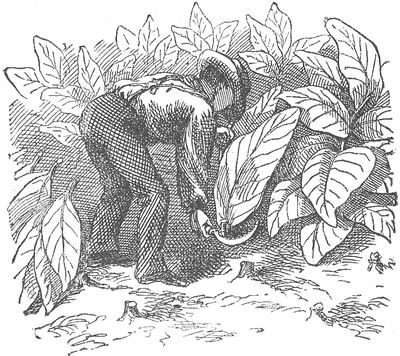
Cutting the Plants.
After the plants have ripened the operation of cutting or
HARVESTING
begins. The cutter passes from plant to plant cutting only those plants that are ripe. In harvesting a light hatchet or saw may be used or a tobacco cutter which is the better and not as liable to injure the leaves. The plants may be cut either in the morning (after the dew is off) or just at night, providing there are no indications of frost. Lay the plants carefully on the sides to avoid breaking the leaves. If the plants are cut during a very warm day they should be examined from time to time as they are liable to "sun-burn," an injury much dreaded by the planter, as sun-burnt leaves are useless for cigar wrappers.
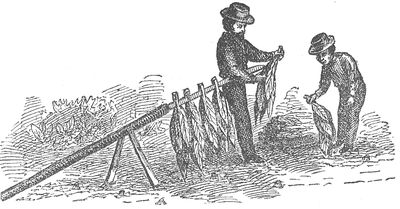
Putting on Lath.
After the plants are wilted on one side they are turned so that the entire plant will be in good condition to handle without breaking. Harvesting should be performed in the most careful manner. At this time the leaves are very brittle and unless the cutter is an experienced hand much injury may be done to the leaves. The stem of each plant is severed as near as possible to the ground and afterwards if hung on lath they are divided longitudinally to admit the air and dry them sooner. When the plants are to be hung on lath they may be wilted before "stringing" or not, at the option of the grower. Most growers are of the opinion now that the plants should be harvested without wilting at all, stringing on the lath as soon as cut and carrying them immediately to the shed.
When wilted in the field there is often much damage done to the leaves whether they are sun-burnt or not. Oftentimes the ground is hot and the plants in a few hours both on the under and upper sides become very warm and almost burnt by the rays of the sun. For this reason the manner of hanging on lath is the better way and in New England is fast displacing the old method of hanging with twine. When hung in this manner five or six plants to the lath are the usual number unless they are very large. When placed or strung on the lath the plants are not as liable to sweat or pole rot, owing in part to the splitting of the stalk, which causes the rapid curing of the leaves as well as the stalk itself. A new method of hanging tobacco has been introduced of late in the Connecticut valley by means of tobacco hooks attached to the lath. This mode is considered by many growers the safest way, and by others as no better than the more common way of hanging simply on the lath.
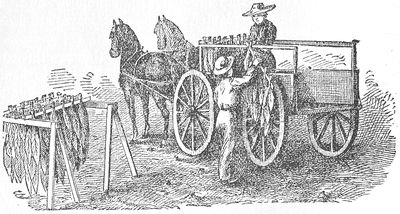
Carrying to the Shed.
In Virginia in "ye olden time," the following method of harvesting was adopted:—
"When the plant has remained long enough exposed to the sun, or open air, after cutting, to become sufficiently pliant to bear handling and removal with conveniency, it must be removed to the tobacco house, which is generally done by manual labor, unless the distance and quantity requires the assistance of a cart. If this part of the process were managed with horses carrying frames upon their backs for the conveniency of stowage, in a way similar to that in which grain is conveyed in Spain, it would be found a considerable saving of labor. It becomes necessary, in the next place, to see that suitable ladders and stages are provided, and that there be a sufficient quantity of tobacco sticks, such as have been described to answer the full demand of the tobacco house, whatsoever may be its size; time will be otherwise lost in make-shifts, or sending for a second supply.
"When everything is thus brought to a point at the tobacco house, the next stage of the process is that termed hanging the tobacco. This is done by hanging the plants in rows upon the tobacco sticks with the points down, letting them rest upon the stick by the stem of the lowest leaf, or by the split which is made in the stem when that happens to be divided. In this operation care must be taken to allow a sufficient space between each of the successive plants for the due circulation of air between: perhaps four or five inches apart, in proportion to the bulk of the plant. When they are thus threaded upon the sticks (either in the tobacco houses, or, sometimes, suspended upon a temporary scaffold near the door), they must be carefully handed up by means of ladders and planks to answer as stages or platforms, first to the upper tier or collar beams of the house, where the sticks are to be placed with their points renting upon the beams transversely, and the plants hanging down between them. This process must be repeated tier after tier of the beams, downwards, until the house is filled; taking care to hang the sticks as close to each other as the consideration of admitting air will allow, and without crowding. In this position the plants remain until they are in condition to be taken down for the next process."
The mode of harvesting tobacco in Virginia at present is thus described by a Virginia planter:—
"In bringing to the barn place the tobacco on scaffolds near the barn-door, so that it can be readily housed in case of rain. As Bright Wrappers and Smokers pay so much better than dark tobaccos, it is advisable, whenever practicable, to coal-cure all that ripens of a uniform yellow color. The quality of the leaf will determine the hanging: 'Shipping' should be hung seven to nine plants to the stick four and a half feet long. To cure the plants properly requires some experience, great care, and much attention. The plants should not be 'cut' until fully ripe. Be careful in cutting to select plants of a uniform size, color, and quality, putting six or seven to the stick. Let the plants go from the cutter's hands on to sticks held in the hands of women or boys; and as soon as the sticks are full, place them carefully on wagons and carry them to the barn. Place the sticks on tiers about ten inches apart, and regulate the plants on the sticks.
"It is impossible to lay down any uniform system or give specific instructions. General principles will be suggested to guide the planter amid the changeableness of seasons and variableness of material to be operated upon."
In Turkey—
"The planters calculate always fifty-five days from May 12th, for their crops to be ready for gathering. When the leaves show the necessary yellow tips, they are carried to the house, and there threaded into long bunches by a large, flat needle, about a foot long, passed through the stalk of each."
In Ohio the process of harvesting tobacco for cutting is thus described by a grower:—
"When thoroughly ripe, having stood two or three weeks longer than is necessary for cigar leaf, it is ready to cut. This is done with a knife made for the purpose. It resembles a wide chisel, except that the handle and chisel are at right angles. Before cutting, the stalk is split down through the center. Being ripe, it splits before the knife, and following the grain the leaves escape unharmed. This splitting is done in as little time as is necessary to cut the stalk off in the ordinary way. Split it to within about three or four inches of the ground, and cut it off in the ordinary way with the same knife. Cut it off and hang it over one of your sticks that you have driven slanting into the ground near you. Cut and put six stalks on the stick, and then lay it down on the ground to wilt, taking the usual care to prevent sun-burn. When it is sufficiently wilted, haul to the shed and hang it up."
In the East Indian Archipelago,
"as soon as the leaves are fully grown they are plucked off, and the petiole and a midrib are cut away. Each leaf is then cut transversely into strips about a sixteenth of an inch wide, and these are dried in the sun until a mass of them looks like a bunch of oakum."
In Persia, when the plants are ripe they are cut off close to the root, and again stuck firmly in the ground. By exposure to the night dews the leaves change from green to yellow. When of the proper tint, they are gathered in the early morning while wet with dew, and heaped up in a shed, the sides of which are closed in with light thorny bushes, so as to be freely exposed to the wind.
In Japan, the leaves are gathered in the height of summer. When the flowers are of a light tint, two or three of the leaves nearest the root are gathered. These are called first leaves, but produce tobacco of second quality. After the lapse of a fortnight, the leaves are gathered by twos, and from these the best tobaccos are produced. Any remaining leaves are afterwards broken off along with the stem and dried. These form the lowest quality of tobacco. After gathering, the leaves are arranged in regular layers and covered with straw matting, which is removed in a couple of days. The leaves are now of a light yellow color. They are then fastened by the stem in twos and threes to a rope slung in a smoke room, and after being so left for fourteen or fifteen days, they are dried for two or three days in the sun, after which they are exposed for a couple of nights in order that they may be moistened with dew. They are then smoothed out and arranged in layers, the stems being fastened together, pressed down with boards, and packed away in a dark room. D'Almirda says that in Java, the leaves are gathered and tied up in bundles of fifteen, twenty or thirty, and suspended from bamboo poles running across the interior of the shed, where they are left to dry for twenty days or more, according to the state of the atmosphere.
As soon as the plants have been hung in the shed the process of
CURING
begins. If fully ripe at the time of harvesting, the plants will "cure down" very fast and take on a better hue than when they cure less rapidly. During cool weather the doors and ventilators should be left open that the plants may have a free circulation of air and cure the faster. When, however, the weather is damp, they should be closed, to avoid sweating and pole rot. When a light leaf is desired, the tobacco shed should be provided with windows to let in plenty of sunlight, which has much to do with the color of the leaf. When a dark leaf is desired, all light should be excluded.
The time necessary for the curing of the plants will depend upon the ripeness of the plants as well as the weather during curing. There are three kinds or methods of curing, viz: air curing, sun curing and firing, or curing by flues. Air curing is the curing of the plants in sheds or barns. Sun curing is the process of curing in the open air, while "firing" is the process of curing by "smoke," the common method employed at the South and to some extent at the West. This is the common way of curing cutting leaf, while air curing is the manner of curing cigar leaf. Tatham, already quoted, gives the following account of the process as performed in Virginia of
"SMOKING THE CROP."
"From what has been said under the head of hanging the plant, it will be perceived that the air is the principal agent in curing it, but it must be also considered that a want of uniform temperature in the atmosphere calls for the constant care of the crop-master, who generally indeed becomes habitually weather-wise, from the sowing of his plants, until the delivery of his crop to the inspector. To regulate this effect upon the plants he must take care to be often among them, and when too much moisture is discovered, it is tempered by the help of smoke, which is generated by means of small smothered fires made of old bark, and of rotten wood, kindled about upon various parts of the floor where they may seem to be most needed.
"In this operation it is necessary that a careful hand should be always near: for the fires must not be permitted to blaze, and burn furiously; which might not only endanger the house, but which, by occasioning a sudden over-heat while the leaf is in a moist condition, might add to the malady of 'firing' which often occurs in the field."
In Virginia the manner of curing tobacco at the present time, is thus described by a planter.
"For curing tobacco the simplest method is sun-curing or air curing and the one most likely to prove successful. The tobacco barn should be so constructed as to contain four, five or six rooms four feet wide, so that four and a half feet sticks may fit, all alike. Log barns are best for coal curing. All should be built high enough to contain four firing tiers under joists covered with shingles or boards and daubed close. Fire with hickory all rich, heavy, shipping tobacco.
"As soon as the barn is filled kindle small fires of coals or hickory wood, about twenty fires to a barn twenty feet square, four under each room. Coal is best, but hickory saplings, chopped about two feet long, make a good steaming heat. The successful coal-curer is an artist, and all engaged in the business are experimenters in nature's great laboratory." A North Carolina planter gives an interesting account of curing tobacco yellow. "Curing tobacco yellow, for which this section is so famous, is a very nice process and requires some experience, observation, and a thorough knowledge of the character and quality of the tobacco with which you have to deal, in order to insure uniform success. Much depends upon the character of the crop when taken from the hill. If it is of good size, well matured and of good yellowish color, there is necessarily but little difficulty in the operation. As soon as the tobacco is taken from the hill and housed, we commence with a low degree of heat, say 95° to 100° Fahr., 'the yellowing' or 'steaming' process. This is the first and simplest part of the whole process, and requires from fifteen to thirty-six hours, according to the size and quality of the tobacco, and this degree of heat should be continued until the leaf opens a lemon color, and is nearly free from any green hue. When this point is reached, the heat should be gradually raised to 105° in order to commence drying the leaf, and here lies the whole difficulty in curing (I mean in drying the leaf). The last degree of heat indicated, should be continued five or six hours, when it should again be gradually raised to 110°, when it should be maintained at this point, until the tail or points of the leaves begin to curl and dry. Indeed it will probably be safest for beginners to continue this degree of heat until one-third of the leaf is dried.
"The temperature may then be gradually increased to 115°, and kept for several hours at that point, until the leaf begins to rattle when shaken, then again raise the heat to 120°, at which point it should be continued until the leaf is dried, after which the temperature may be increased to 150° or 160° to dry the stem and stalks; the latter should be blackened by the heat before the curing is complete. Ordinarily it requires from two and a half to five days to cure a barn of tobacco, dependent entirely upon the size and quality. Put seven or eight plants on each stick and place them eight inches apart on tier poles. In the yellowing process the door of the barn should be kept closed to exclude the air. When this point is reached for drying the leaf, the door may be opened occasionally, and kept open for twenty or thirty minutes at a time, especially if the tobacco gets into a "sweat," as it is called, or becomes damp and clammy.
"The temperature is raised in the barn by cautiously adding coal from time to time to the fires, which should be placed in small piles on the floor, in rows, allowing about five feet between each pile, which should at first contain a double handful of coal. In adding coal, you will soon learn the quantity necessary to be applied by the effect produced. Avoid raising the heat hastily after the drying is commenced, lest the leaf should be scalded and reddened; on the other hand, it should not be raised too slowly for fear of 'raising the grain,' or the leaf becoming spongy and dingy. Both extremes are to be avoided, and the skill required is attained only by experience and observation. We usually cut tobacco the latter part of the week, house it and suffer it to remain until the first of next week, that we may not violate the fourth commandment."
In California tobacco is cured by the method known as the "Culp process" from the name of its patentee. When the plant lies in the field, Mr. Culp's peculiar process begins which is described as follows:
"Tobacco had long been grown in California, even before Americans came. He had raised it as a crop for fifteen years; and before he perfected his new process, he was able usually to select the best of his crop for smoking tobacco, and sold the remainder for sheep wash. One year, two millions of pounds were raised in the State, and as it was mostly sold for sheep wash, it lasted several years, and discouraged the growers. Tobacco always grew readily, but it was too rank and strong. They used Eastern methods, topping and suckering, and as the plant had here a very long season to grow and mature, the leaf was thick and very strong. The main features of the Culp process are, he said, to let the tobacco, when cut, wilt on the field; then take it at once to the tobacco house and pile it down, letting it heat on the piles to 100° for Havana. It must, he thinks, come to 100°, but if it rises to 102° it is ruined. Piling, therefore, requires great judgment. The tobacco houses are kept at a temperature of about 70°; and late in the fall, to cure a late second or third crop they sometimes use a stove to maintain a proper heat in the house, for the tobacco must not lie in the pile without heating. When it has had its first sweat, it is hung up on racks; and here Mr. Culp's process is peculiar.
"He places the stalk between two battens, so that it sticks out horizontally from the frame; thus each leaf hangs independently from the stalk; and the racks or frames are so arranged that all the leaves on all the stalks have a separate access to the air. The tobacco houses are frame buildings, 100x60 feet, with usually four rows of racks, and two gangways for working. On the rack the surface moisture dries from the leaf; and at the proper time it is again piled, racked, and so on for three or even four times. The racks are of rough boards, and the floor of the houses is of earth. After piling and racking for three weeks, the leaves are stripped from the stalk and put into 'hands,' and they are then 'bulked' and lie thus about three months, when the tobacco is boxed. From the time of cutting, from four to six months are required to make the leaf ready for the manufacturer. "Piling" appears to be the most delicate part of the cure, and they have often to work all night to save tobacco that threatens to overheat."
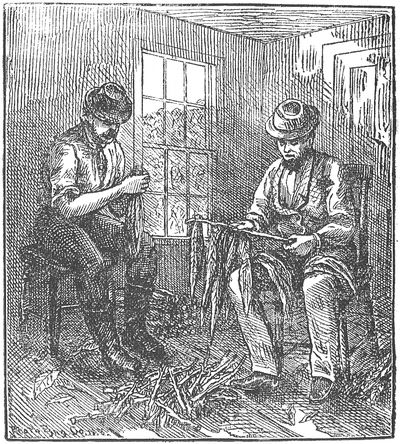
Stripping.
In Turkey the bunches of leaves are exposed to the sun to dry, and some months' exposure is necessary before they are sufficiently matured for baling. Rain sets in at a later period, and the tobacco becoming moist and fit for handling, is then removed from the threads, and made into bundles or "hands" of about sixty leaves each and tied around the stems.
After the leaves are thoroughly cured they are in condition for
STRIPPING.
The leaves of the tobacco are easily affected by the humidity of the atmosphere and during damp weather every opportunity is improved by the grower for taking down the tobacco preparatory to stripping. After taking down from the poles the plants should be packed in order to keep moist until stripped. The tobacco should not be removed from the poles when it drips or the juice exudes from either the stalk or the leaves. If stripped in this condition the leaves are apt to stain and thus become unfit for wrappers. The operation of stripping consists in taking the leaves from the stalk and tying them in bundles or hands with a leaf around the base of the hand. Each "hand" or bunch should contain at least eight leaves and from that number to twelve. If the plants are large the leaves of one stalk will form a hand; a poor leaf is used for binding as it can not be used for the same purpose as the leaves around which it is bound.
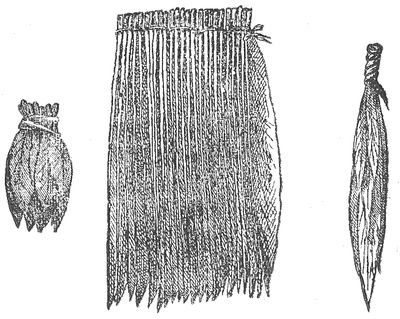
Hands.
The old planters of tobacco in Virginia called this operation of taking off the leaves and tying them up "stripping and bundling" which is here described.
"When the plants of tobacco which are thus hanging upon the sticks in the house have gone through the several stages of process before the time of stripping, and are deemed to be in case for the next operation, a rainy day (which is the most suitable) is an opportunity which is generally taken advantage of when the hands cannot be so well employed out of doors. The sticks containing the tobacco which may be sufficiently cured, are then taken down and drawn out of the plants. They are then taken one by one respectively, and the leaves being stripped from the stalk of the plant are rolled round the butts or thick ends of the leaves with one of the smallest leaves as a bandage, and thus made up into little bundles fit for laying into the cask for final packing."
Hazard gives the following method of assorting and stripping tobacco in Cuba:—
"Among the Cubans, the leaves are divided into four classes: first, desecho, desecho limpio, which are those immediately at the top of the plant, and which constitute the best quality, from the fact that they get more equally the benefit of the sun's rays by day and the dew by night; second, desechito, which are the next to the above; third, the libra, the inferior or small leaves about the top of the plant; and fourth, the injuriado, or those nearest the root. Of the injuriado there are three qualities; the best is called injuriado de reposo, or 'the picked over,' and the other two, firsts and seconds (primeros, sequndos).
"Tobacco of the classes desechito and libra, of which the leaves are not perfect, is called injuriado bueno, while all the rest, of whatever quality, that is broken in such a manner as to be unfit for wrappers are called injuriado malo. Amongst the trade in place of the above names, the different qualities are simply designated by numbers."
Meyer, a German writer who resided several years in Cuba, gives another classification, making ten classes altogether, while Hazard mentions only four general classes.
After the leaves are stripped from the stalk the process known as
ASSORTING
commences. Assorting tobacco is doing up in hands the various qualities and keeping them separate. In the Connecticut valley the growers make usually but two kinds or qualities excepting only when the crop is poor when three qualities are made, viz: Wrappers, Seconds, and Fillers. The Wrappers are the largest and finest leaves on the plant and should be free from holes and sweat as well as green and white veins. The leaves selected for this quality come from the middle and even the top leaves of the plant. The Seconds are made up of leaves not good enough for Wrappers and too good for Fillers. Such leaves sometimes are worm-eaten and of various colors on the same leaf—one part dark and another light. The fillers are the poorest quality of leaves to be found on the plants, and consist of the "sand" or ground leaves, one or two to each plant. Some of our largest growers in assorting the leaves keep each color by itself, an operation known as
SHADING.
This is a very delicate operation and requires a good eye for colors as well as a correct judgment in regard to the quality of the leaf. This mode of assorting colors in stripping is similar to that of shading cigars, in which the utmost care is taken to keep the various colors and shades by themselves. In shading the wrappers only are so assorted, and may be "run into" two or three shades depending on the number of shades or colors of the leaf. The better way is to make only two qualities of the wrappers in shading—viz., light and dark cinnamon "selections." Shading tobacco does not imply that it is carried to its fullest extent in point of color as in shading cigars, but simply keeping those general colors by themselves like light and dark brown leaves. Cutting tobaccos before being used are subjected to a process known as
STEMMING.
Tatham gives the following account of the process of stemming in Virginia a century ago:—
"Stemming tobacco is the act of separating the largest stems or fibres from the web of the leaf with adroitness and facility, so that the plant may be nevertheless capable of package, and fit for a foreign market. It is practised in cases where the malady termed the fire, or other casual misfortune during the growth of the plant, may have rendered it doubtful in the opinion of the planter whether something or other which he may have observed during the growth of his crop, or in the unfavorable temperature of the seasons by which it hath been matured does not hazard too much in packing the web with a stem which threatens to decay. To avoid the same species of risk, stemming is also practised in cases where the season when it becomes necessary to finish packing for a market is too unfavorable to put up the plant in leaf in the usual method; or when the crop may be partially out of case. Besides the operation of stemming in the hands of the crop-master, there are instances where this partial process is repeated in the public warehouses; of which I shall treat under a subsequent head.
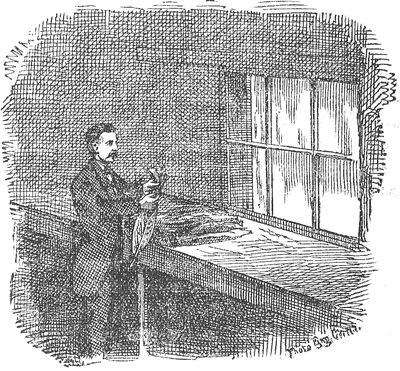
Stemming.
"The operation of stemming is performed by taking the leaf in one hand, and the end of the stem in the other, in such a way as to cleave it with the grain; and there is an expertness to be acquired by practice, which renders it as easy as to separate the bark of a willow, although those unaccustomed to it find it difficult to stem a single plant. When the web is thus separated from the stem, it is made up into bundles in the same way as in the leaf, and is laid in bulk for farther process. The stems have been generally thrown away, or burnt with refuse tobacco for the purpose of soap-ashes; but the introduction of snuff-mills has, within a few years back, found a more economical use for them."
As soon as the tobacco has been stripped it is ready for
PACKING.
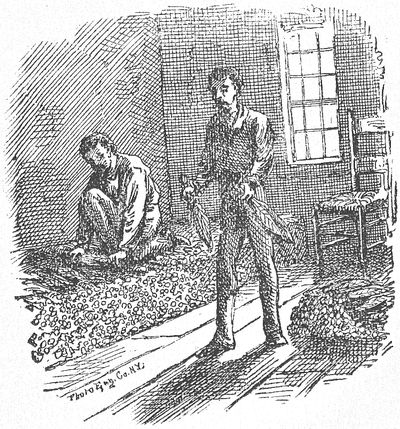
Packing.
It is necessary to pack the "hands" after stripping in order to keep it moist, or in nearly the same condition as when stripped. Select a cool place, not too dry or too damp, but one where if properly protected, the tobacco will remain moist. It should be packed loosely or compact, according as the hands are moist or dry. It may be packed in the center of the floor so that it may be examined from either side, or against the sides of the packing house, as may be thought best. Hand the tobacco to the packer, who presses the hands firmly with his knees and hands, laying the tobacco in two tiers and keeping the pile at about the same height until all is packed. If possible pack all together, that is, each kind by itself, as it is better to have the wrappers or fillers all together rather than in several places, as the moisture is retained better than when it is packed in small piles or heaps. Use in packing a plank or board, placing it against the front of the tier and bring the ends of the hands up against it. This will make the tobacco look much better and also render the process of packing firmer.
The tobacco may be packed any height or length desired, according to the quantity, but usually from three to four feet high will be found to be convenient while the length may be proportioned to the height or not. Tobacco may be packed by the cord or half cord so as to be able to judge of the quantity—good large wrappers averaging a ton to the cord. Seconds and Fillers will not contain as many pounds to the cord as wrappers. After the tobacco is packed, cover first with boards—planed ones are preferable,—or even shingles—and press firmly, especially if the tobacco is dry, then cover with blankets or any kind of covering, adding plank or pieces of timber if additional pressure is needed. It can now remain packed until sold or cased, and will hardly need to be examined unless packed while very damp or kept packed until warm weather.
Wailes says of planting by the early planters of tobacco in Mississippi:—
"The larger planters packed it in the usual way in hogsheads. Much of it, however, was put up in carrets, as they were called, resembling in size and form two small sugar-loafs united at the larger ends. The stemmed tobacco was laid smoothly together in that form coated with wrappers of the extended leaf, enveloped in a cloth, and then firmly compressed by a cord wrapped around the parcel, and which was suffered to remain until the carret acquired the necessary dryness and solidity, when together with the surrounding cloth, it was removed, and strips of lime-bark were bound around it at proper distances, in such a manner as to secure it from unwrapping and losing its proportions."
In Turkey, after the tobacco is made into bundles or hands, it is piled against the walls inside the dwelling rooms and a carefully graduated pressure put upon it until ready for baling. In Java, when the tobacco is ready to pack the leaf is examined, and if found quite brown, it is tightly pressed and packed up either in boxes or matting for exportation, or in the bark of the tree plantain, for immediate sale.
The next process on the tobacco plantation is that of
PRIZING, CASING, AND BALING.
The term prizing originated in Virginia, and as performed by the early planters, is thus described by an old writer on tobacco culture:—
"Prizing, in the sense in which it is to be taken here is, perhaps, a local word, which the Virginians may claim the credit of creating, or at least of adopting; it is at best technical, and must be defined to be the act of pressing or squeezing the article which is to be packed into any package, by means of certain levers, screws, or other mechanical powers; so that the size of the article may be reduced in stowage, and the air expressed so as to render it less pregnable by outward accident, or exterior injury, than it would be in its natural condition.
"The operation of prizing, however, requires the combination of judgment and experience; for the commodity may otherwise become bruised by the mechanic action, and this will have an effect similar to that of prizing in too high case, which signifies that degree of moisture which produces all the risks of fermentation, and subjects the plant to be shattered into rags. The ordinary apparatus for prizing consists of the prize beam, the platform, the blocks, and the cover. The prize beam is a lever formed of a young tree or sapling, of about ten inches diameter at the butt or thicker end, and about twenty or twenty-five feet in length; but in crops where many hands are employed, and a sufficient force always near for the occasional assistance of managing a more weighty leverage, this beam is often made of a larger tree, hewn on two of its sides to about six inches thick, and of the natural width, averaging twelve or fourteen inches. The thick end of this beam is so squared as to form a tenon, which is fitted into a mortise that is dug through some growing tree, or other, of those which generally abound convenient to the tobacco house, something more than five feet above the platform. Close to the root of this tree, and immediately under the most powerful point of the lever, a platform or floor of plank is constructed for the hogshead to stand upon during the operation of prizing. This must be laid upon a solid foundation, levelled, upon hewn pieces of wood as sleepers; and so grooved and perforated that any wet or rain which may happen to fall upon the platform may run off without injuring the tobacco. Blocks of wood are prepared about two feet in length, and about three or four inches in diameter, with a few blocks of greater dimensions, for the purpose of raising the beam to a suitable purchase; and a movable roof constructed of clap-boards nailed upon pairs of light rafters, of sufficient size to shelter the platform and hogshead, is made ready to place astride of the beam, as a saddle is put upon a horse's back, in order to secure the tobacco from the weather while it is subjected to this tedious part of the process.
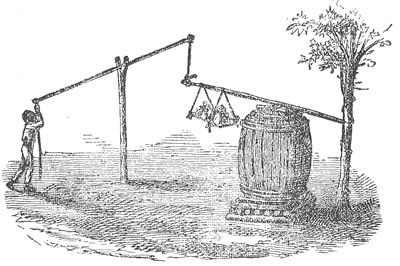
Prizing in Olden Times.
"That part of the apparatus which is designed to manage and give power to the lever is variously constructed: in some instances two beams of timber about six feet long, and squared to four by six inches, are prepared; through these, by means of an auger hole, a sapling of hickory or other tough wood, is respectively passed; and the root thereof being formed like the head of a pin to prevent its slipping through the hole, the sapling is bent like a bow, and the other end is passed through the same piece of wood in a reversed direction, in which position it is wedged. These two bows are in this manner hung by the sapling loops upon the end of the prize beam or lever; and loose planks or slabs of about five or six feet long being laid upon these suspended pieces of timber, a kind of hanging floor or platform is constructed, upon which weights are designed to act as in a scale. A pile of large stones are then carted to the place, and a sufficient number of these are occasionally placed upon this hanging platform, until the lever has obtained precisely the power which the crop master wishes to give it by this regulating medium.
"The prizing or packing by the old planters must have been a tedious affair, and far different from the quick work made by the screw-press now owned by all well to-do planters. The size of the hogsheads containing the tobacco was regulated by law to the standard of four feet six inches in length, but the shape of the cask varied according to the fancy of the cooper, or roughness of his work. At this period (a century ago), the tobacco hogshead was made most generally of white oak; but Spanish oak, and red oak, were sometimes used, when the usual kind could not be so readily commanded. Now the hogsheads are made of pine, but are nearly as rough as those made by the colonial growers.
"Tobacco, if well packed, and prized duly, will resist the water for a surprising length of time. An instance is recorded in strong proof of this, which occurred at Kingsland upon James river in Virginia, where tobacco, which had been carried off by the great land floods in 1771, was found in a large raft of drift wood in which it had lodged when the warehouses at Richmond were swept away by the overflowing of the freshets; an inundation which had happened about twenty years before this cask was found."