Chapter X
Reading edition
TOBACCO PLANTERS AND PLANTATIONS.
The grounds selected for the cultivation of tobacco are called by various names even in the same countries. Thus in the Connecticut Valley, such lands are called tobacco fields, at the South they are known as tobacco plantations, while in Cuba they are called Vegas or tobacco farms. In Cuba almost the entire tobacco farm is planted to tobacco while at the South and in New England this is rarely the case unless the plantations or tobacco farms are small and contain but a few acres. In the Connecticut Valley and more especially along the banks of the Connecticut River, where the farms are frequently small, this is sometimes the case but farther removed from the river, where the farms are much larger but a few acres of the best land is used for this purpose.
In the Connecticut Valley the tobacco fields average from one to forty acres, rarely exceeding the latter and indeed seldom including as large an area. The average size of tobacco fields is about five acres—sometimes all in one lot but oftener divided into several small pieces on various parts of the farm.
The Connecticut planter is deeply interested in the plant and gives it his undivided attention from seed-sowing until it is sold to the speculator or manufacturer. All other crops in his opinion are of but little importance compared with the great New England product, one crop is frequently not off his hands before he is preparing for another. The Connecticut planter stands first in the rank of tobacco growers; he is thoroughly acquainted with the nature of the plant and knows just what land to select and what kind of fertilizers to apply. He has reduced the cultivation to almost an exact science and can obtain (the season being favorable) the color most desirable. He has thoroughly tested all kinds of fertilizers, and knows just what kinds will produce the various shades of color as well as the desired texture and size of leaf. No other tobacco planter so thoroughly understands the methods of curing, sweating and doing up the crop, and he takes no little pride in showing his crop to the buyer.
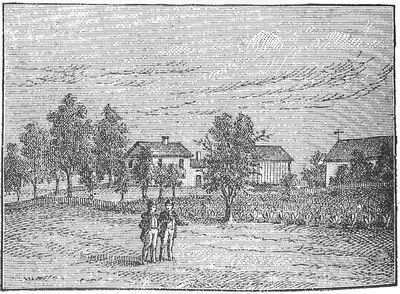
Connecticut Tobacco Field.
It is his aim to obtain not only the best leaf for a cigar-wrapper but also a tobacco of the finest possible flavor; hence he tries the principal varieties grown in Cuba, Brazil and other countries in order to judge of their quality and whether they can be cultivated with profit on his lands. He has the best constructed sheds for hanging and curing and the latest and most improved agricultural implements for the cultivation of the plants. The greatest pains are taken in securing the crop and harvesting and handling the plants without injuring the leaves. The tobacco fields are kept in the best possible condition, no weeds or grass is allowed to grow and the entire surface is as free from stones as a lawn. He usually, if his farm is small, plants the same field year after year, securing a much finer leaf and by yearly manuring keeping the ground fertile and in good condition. When the tobacco is stripped the utmost care is taken to assort the leaves and he frequently shades or assorts the colors, obtaining fancy prices for such "selections."
The Connecticut grower is well acquainted with the different soils, and is able to judge with considerable accuracy in regard to selecting the right fields for tobacco. The warmest land is chosen—mellow and free from stones or shaded by trees and prepared as if for a garden. All of the improved methods of obtaining early plants as well as transplanting, he adopts, and in spite of early freezing, is generally able to outwit Jack Frost, and secure the plants before this great foe of the weed ravages the fields. It may safely be said of the Connecticut planter that he secures more even crops than any other grower of the plant, and obtains the finest colored leaf for cigar wrappers.
The growers are thoroughly informed as regards the prices, and although the buyers may steal suddenly upon them, are generally prepared to "set" a price upon their crops. Some refuse to sell on the poles, or even after it is stripped, preferring to pack their tobacco until it has passed through the sweat, when larger prices are obtained. Many growers not only pack their own crop, but buy up that of others, thus acting as both producer and buyer. During the growing of the crop, and particularly after it has been cured and stripped, the growers congregate together, and talk over the condition of the crop and the prices likely to be realized. Sometimes they form an association or club, agreeing to "hold" the tobacco for satisfactory prices, and frequently employing an agent to sell the crop. Many of the tobacco fields or farms in the Connecticut valley are very valuable, especially those near large cities and means of transportation; such lands often selling for one thousand dollars per acre.
The finest tobacco lands in the Connecticut valley are located in the vicinity of Hartford about fifty miles from Long Island Sound. These lands are near enough to the sound to get the salts in the atmosphere from the south winds that blow up the valley in the precise amount which the plant needs. Not much farther north does the atmosphere possess this peculiar quality, while lower down the river the salt air is too strong for the plant, and the leaves in consequence are thick and harsh. Fine tobacco leaves can be manufactured as well as fine broadcloth or costly silks. These results depend in a great manner upon the proper soil and the fertilizers, applied together with the most thorough cultivation of the plants. The soil of our best Connecticut tobacco fields is alluvial, varying in composition from a heavy sandy loam to a light one containing very little clay.
For the past few years light soil has been preferred for the tobacco field, on account of the demand for light colored leaf. The soil can hardly be too light when leaf of a light cinnamon color is desired; as the color of all kinds of tobacco depends upon the soil and the fertilizers used.
A quarter of a century since Havana tobacco commanded very high prices, both in this country and in Europe. It burnt freely and purely. The Cuban planters, although getting rich on the ordinary crops, were not satisfied with their gains, and attempted to increase their crops by the use of guano and artificial fertilizers. They secured heavier crops, but the quality became poorer. The prices fell off and the planters did not realize as much for their crops as formerly, although the growth was larger. About this time Connecticut seed leaf became known as a cigar wrapper, and in a short time took the lead for this purpose, as it still continues to. It cured finely, burnt white and free, and in a short time brought high prices. The profit realized from its growth led some Connecticut growers into the same mistake as it did the Cuban planters, when they, by misguided culture, nearly ruined their crops and injured the reputation of Cuban tobacco.
Artificial fertilizers and strong manure produce a leaf larger and heavier, but their effect on the character of the leaf is injurious, the salts destroying its fine qualities, so that it sweats and cures poorly, and compared with the finest leaf burns dark and emits a rank and unpleasant odor.
The Connecticut tobacco grower requires considerable capital when engaged extensively in the business, as ordinarily he buys large quantities of fertilizers and requires many hands to cultivate the crop. On the largest tobacco farms the sheds or "hanging houses" are built near or in the field, and are sometimes very large, say two or three hundred feet in length, and capable of holding the crop of from five to ten acres.
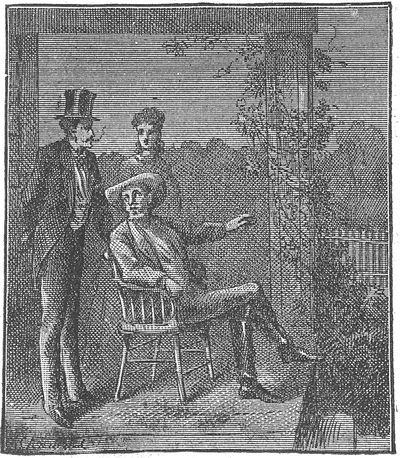
Home of the Connecticut Planter.
His broad fields of the weed can usually be seen from his house and he loves to show to visitors the plants growing in all their luxuriance, or to sit on his piazza and call attention to their waving leaves and graceful showy tops. Few tobacco-growers can discuss the relative merits of the numerous varieties like the Connecticut planter, and he is well acquainted not only with the various kinds grown in his own country but also with those of others. Indeed you may often see growing in his garden specimens of Cuban, Brazil or Latakia tobacco; such is his love for all that pertains to this great tropical plant. He considers it one of the greatest of all the vegetable products and never tires of lauding the plant and its use. He sincerely hates all anti-tobaccoites and has a supreme disgust for the memory of King James I. and all royal foes of the plant. He is, however, a man of large and liberal views and bestows his favors with a princely hand. If fortune frowns he may lessen his crop but never his attachment for the plant. Amid all the cares and perplexities incident to life, he puffs away and as the ashes drop from his cigar meditates upon the probable future of tobacco growers and all users of the weed.
The Connecticut tobacco grower is in all respects a man of genuine refinement and nobility of soul. He is always ready to give information on his particular system of culture, and how he obtains such large and fine crops. He is a good judge of leaf tobacco, and can tell in a moment the quality of his famous variety. He is thoroughly awake to modern improvements, and always willing to try new implements, such as tobacco hangers or transplanters in his sheds or fields. He is just the person one likes to meet, jovial and good-natured; he naturally loves the plant he cultivates and uses it freely; lighting his after-dinner cigar or evening pipe with a gusto that is peculiar to the grower of tobacco everywhere. Indeed he is hardly in a proper frame of mind to converse about tobacco until he lights a cigar.
No other cultivator of the soil gains as many friends as the tobacco-grower. His table is well supplied from the choicest his larder affords and he cheerfully welcomes all to its side. He is the friend of the poor and the companion of the rich. No meanness or low chicanery is his. His attachment for home, friends, and country is as firm and strong as for the plant he cultivates.
Olmsted in his work "The Seaboard Slave States" gives the following description of a Virginia plantation:
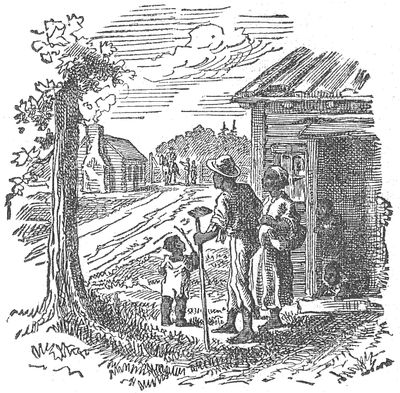
Negro Quarters.
"Half an hour after this I arrived at the negro quarters—a little hamlet of ten or twelve small and dilapidated cabins. Just beyond them was a plain farm gate at which several negroes were standing; one of them, a well-made man, with an intelligent countenance and prompt manner, directed me how to find my way to his owner's house. It was still nearly a mile distant; and yet, until I arrived in its immediate vicinity, I saw no cultivated field, and but one clearing.
"In the edge of this clearing, a number of negroes, male and female, lay stretched out upon the ground near a small smoking charcoal pit. Their master afterwards informed me that they were burning charcoal for the plantation blacksmith, using the time allowed them for holidays—from Christmas to New Years—to earn a little money for themselves in this way. He paid them by the bushel for it. When I said that I supposed he allowed them to take what wood they chose for this purpose, he replied that he had five hundred acres covered with wood, which he would be very glad to have any one burn, or clear off in any way. Cannot some Yankee contrive a method of concentrating some of the valuable properties of this old field pine, so that they may be profitably brought into use in more cultivated regions? Charcoal is now brought from Virginia; but when made from pine it is not very valuable, and will only bear transportation from the banks of the navigable rivers whence it can be shipped, at one movement to New York. Turpentine does not flow in sufficient quantity from this variety of the pine to be profitably collected, and for lumber it is of very small value.
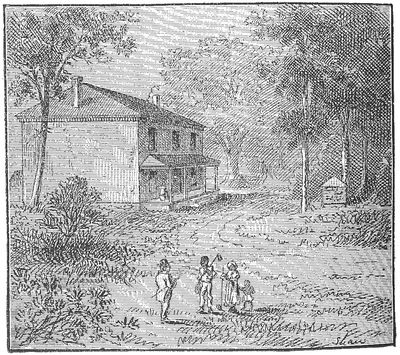
The Planter's Home.
"Mr. W.'s house was an old family mansion, which he had himself remodeled in the Grecian style, and furnished with a large wooden portico. An oak forest had originally occupied the ground where it stood; but this having been cleared and the soil worn out in cultivation by the previous proprietors, pine woods now surrounded it in every direction; a square of a few acres only being kept clear immediately about it. A number of the old oaks still stood in the rear of the house, and, until Mr. W. commenced his improvements, there had been some in its front. These, however, he had cut away, as interfering with the symmetry of his grounds, and in place of them had ailanthus trees in parallel rows.
"On three sides of the outer part of the cleared square there was a row of large and comfortable-looking negro quarters, stables, tobacco-houses, and other offices, built of logs. Mr. W. was one of the few large planters, of his vicinity, who still made the culture of tobacco their principal business. He said there was a general prejudice against tobacco, in all the tide water regions of the State, because it was through the culture of tobacco that the once fertile soil had been impoverished; but he did not believe that, at the present value of negroes, their labor could be applied to the culture of grain with any profit, except under peculiarly favorable circumstances. Possibly the use of guano might make wheat a paying crop, but he still doubted. He had not used it, himself. Tobacco required fresh land, and was rapidly exhausting, but it returned more money, for the labor used upon it, than anything else; enough more, in his opinion to pay for the wearing out of the land. If he was well paid for it, he did not know why he should not wear out his land. His tobacco-fields were nearly all in a distant and lower part of his plantation; land which had been neglected before his time, in a great measure, because it had been sometimes flooded, and was, much of the year, too wet for cultivation. He was draining and clearing it, and it now brought good crops. He had had an Irish gang draining for him, by contract. He thought a negro could do twice as much work in a day as an Irishman. He had not stood over them and seen them at work, but judged entirely from the amount they accomplished: he thought a good gang of negroes would have got on twice as fast. He was sure they must have 'trifled' a great deal, or they would have accomplished more than they had. He complained much of their sprees and quarrels. I asked why he should employ Irishmen, in preference to doing the work with his own hands. It's dangerous work, (unhealthy!) and a negro's life is too valuable to be risked at it. If a negro dies it's a considerable loss, you know.' He afterwards said that his negroes never worked so hard as to tire themselves—always were lively, and ready to go off on a frolic at night. He did not think they ever did half a fair day's work. They could not be made to work hard: they never would lay out their strength freely, and it was impossible to make them do it. This is just what I have thought when I have seen slaves at work—they seem to go through the motions of labor without putting strength into them. They keep their powers in reserve for their own use at night, perhaps.
"Mr. W. also said that he cultivated only the coarser and lower-priced sorts of tobacco, because the finer sorts required more pains-taking and discretion than it was possible to make a large gang of negroes use. 'You can make a nigger work,' be said, 'but you cannot make him think.'"
In speaking of the early tobacco culture of Virginia, he says:—
The light, rich mould resting on the sandy soil of Eastern Virginia was exactly suited to the cultivation of tobacco, and no better climate for this plant was to be found on the globe. This had just been sufficiently proved, and a suitable method of culture learned experimentally, when the land was offered to individual proprietors by the king, (James I.) Very little else was to be obtained from the soil which would be of value to send to Europe, without an application to it of a higher degree of art than the slaves, or stupid, careless servants of the proprietors could readily be forced to use. Although tobacco had been introduced into England but a few years, an enormous number of persons had initiated themselves in the appreciation of its mysterious value.
"The king, having taken a violent prejudice against it, though he saw no harm in the distillation of grain, had forbidden that it should be cultivated in England. Virginia, therefore, had every advantage to supply the demand. Merchants and the super-cargoes of ships, arriving with slaves from Africa, or manufactured goods, spirits, or other luxuries from England, very gladly bartered them with the planters for tobacco, but for nothing else. Tobacco, therefore, stood for money, and the passion for raising it, to the exclusion of everything else, became a mania, like the 'California fever' of 1849.
"The culture being once established, there were many reasons growing out of the social structure of the colony, which, for more than a century, kept the industry of the Virginians confined to this one staple. These reasons were chiefly the difficulty of breaking the slaves, or training the bond-servants to new methods of labor, the want of enterprise or ingenuity of the proprietors to contrive other profitable occupations for them, and the difficulty or expense of distributing the guard or oversight, without which it was impossible to get any work done at all, if the laborers were separated, or worked in any other way than side by side, in gangs, as in the tobacco-fields.
"Owing to these causes the planters kept on raising tobacco with hardly sufficient intermission to provide sustenance, though often, by reason of the excessive quantity raised, scarcely anything could be got for it. Tobacco is not now considered peculiarly and excessively exhaustive; in a judicious rotation, especially as a preparation for wheat, it is an admirable fallow crop, and, under a scientific system of agriculture, it is grown with no continued detriment to the soil. But in Virginia it was grown without interruption or alternation, and the plantations rapidly deteriorated in fertility. As they did so, the crops grew smaller in proportion to the labor expended upon them; yet, from the continued importation of laborers, the total crops of the colony increased annually, and the market value fell proportionately to the better supply.
"With smaller return for labor and lower prices, the planters soon found themselves bankrupt, instead of nabobs. How could they help themselves? Only by forcing the merchants to pay them higher prices. But how to do that, when every planter had his crop pledged in advance, and was obliged to hurry it off at any price he could get for it, in order to pay for his food, and drink, and clothing, and to keep his head above water at credit for the following year. The crop supplied more tobacco than was needed, but no one man would cease to plant it, or lessen his crop for the general good. Then it was agreed all men must be made to do so, and the colonial legislature was called upon to make them.
"Acts were accordingly passed to prevent any planter from cultivating more than a certain number of plants to each hand he employed in labor, and prescribing the number of leaves which might be permitted to ripen upon each plant permitted to be grown. An inspection of all tobacco, after it had been prepared for market, was decreed, and the inspectors were bound by oath, after having rejected all of inferior quality, to divide the good into two equal parts, and then to burn and destroy one of them. Thus, it was expected the quantity of tobacco offered for sale would be so small that merchants would be glad to pay better prices for it, and the planters would be relieved of their embarrassment."
Mrs. M. P. Handy gives the following interesting sketch, entitled "On the Tobacco Plantation":—
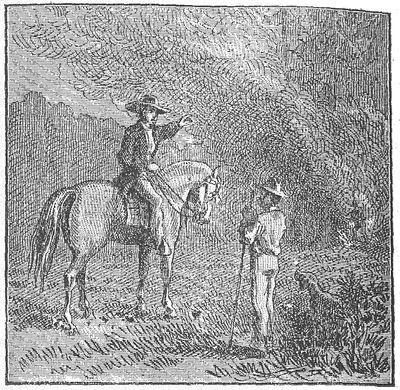
"Burning the Patch."
"Riding through Southside, Virginia, any warm, bright winter's day after Christmas, the stranger may be startled to see a dense column of smoke rising from the forest beyond. He anxiously inquires of the first person he meets—probably a negro—if the woods are on fire. Cuffee shows his white teeth in a grin that is half amusement, half contempt, as he answers: 'No, sar, deys jis burnin' a plant-patch.' For this is the first step in tobacco-culture.
"A sunny, sheltered spot on the southern slope of a hill is selected, one protected from northern winds by the surrounding forest, but open to the sun in front, and here the hot-bed for the reception of the seed is prepared. All growth is felled within the area needed, large dead logs are dragged and heaped on the ground as for a holocaust, the whole ignited, and the fire kept up until nothing is left of the immense wood-heap but circles of the smoldering ashes. These are afterward carefully plowed in; the soil, fertilized still further, if need be, is harrowed and prepared as though for a garden-bed, and the small brown seed sown, from which is to spring the most widely-used of man's useless luxuries. Later, when the spring fairly opens, and the young plants in this primitive hot-bed are large and strong enough to bear transplanting, the Virginian draws them, as the New Englander does his cabbages, and plants them in like manner, in hills from two to four feet apart each way. Lucky is he whose plant-bed has escaped the fly, the first enemy of the precious weed. Its attacks are made upon it in the first stage of its existence, and are more fatal, because less easily prevented, than those of the tobacco-worm, that scourge, par excellence, of the tobacco crop. Farmers often lose their entire stock of plants, and are forced to send miles to beg or buy of a more fortunate planter. Freshly-cleared land—'new ground,' as the negroes call it—makes the best tobacco-field, and on this and the rich lowlands throughout Southside is raised the staple known through the world as James River tobacco.
"On this crop the planter lavishes his choicest fertilizers; for the ranker the growth, the longer and larger the leaf, the greater is the value thereof, though the manufacturers complain bitterly of the free use of guano, which, they say, destroys the resinous gum on which the value of the leaf depends. Once set, the young plant must contend, not only with the ordinary risk of transplanting, but the cut-worm is now to be dreaded. Working underground, it severs the stem just above the root, and the first intimation of its presence is the prone and drooping plant. For this there is no remedy, except to plant and replant, until the tobacco itself kills the worm. In one instance, which came under our observation, a single field was replanted six times before the planter succeeded in getting 'a good stand,' as they call it on the plantations; but this was an extreme case.
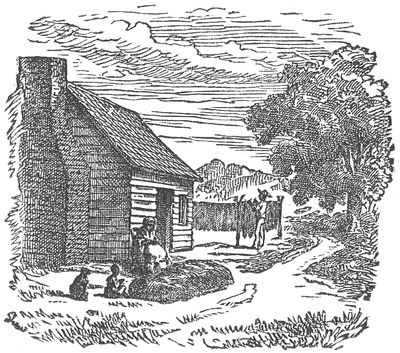
Stringing the Primings.
"When the plants are fairly started in their growth, the planter tops and primes them, processes performed, the first by pinching off the top bud, which would else run to seed, and the second by removing the lower leaves of each plant, leaving bare a space of some inches near the ground, and retaining from six to a dozen stout, well-formed leaves on each stem, according to the promise of the soil and season, and these leaves form the crop. The rejected lower leaves or primings, in the days of slavery, formed one of the mistress' perquisites and were carefully collected by the 'house-gang,' as the force was styled, strung on small sharp sticks like exaggerated meat-skewers, and cured, first in the sun, afterwards in the barn, often placing a pretty penny in her private purse. Now when all labor must be paid for in money, they are not worth collecting, and, except when some thrifty freedman has a large family which he wishes to turn to account, are left to wither where they fall.
"There is absolutely no rest on a large tobacco plantation, one step following another in the cultivation of the troublesome weed—the last year's crop is rarely shipped to market before the seed must be sown for the next—and planting and replanting, topping and priming, suckering and worming, crowd on each other through all the summer months. Withal the ground must be rigidly kept free from grass and weeds, and after the plants have attained any size this must be done by hoe; horse and plow would break and bruise the brittle leaves.
"'Suckering' is performed by removing every leaf-bud which the plant throws out after the priming (and topping), thus retaining all its sap and strength for the development of the leaves already formed, and this must be done again and again through the whole season. Worming is still more tedious and unremitting. In the animal kingdom there are three creatures, and three only, to whom tobacco is not poisonous—man, a goat found among the Andes, and the tobacco-worm. This last is a long, smooth-skinned worm, its body formed of successive knobs or rings, furnished each with a pair of legs, large prominent eyes, and is in color as green as the leaf upon which it feeds. It is found only on the under side of the leaves, every one of which must be carefully lifted and examined for its presence. Women make better wormers than men, probably because they are more patient and painstaking. When caught the worm is pulled apart between the thumb and finger, for crushing it in the soft mold of the carefully cultivated fields is impossible. Carelessness in worming was an unpardonable offence in the days of slavery, and was frequently punished with great severity. An occasional penalty on some plantations—very few, in justice to Virginia planters be it said—was to compel the delinquent wormer to bite in two the disgusting worm discovered in his or her row by the lynx-eyed overseer. Valuable coadjutors in this work are the housewife's flock of turkeys, which are allowed the range of the tobacco lots near the house, and which destroy the worms by scores. The moth, whose egg produces these larvæ, is a large white miller of unusual size and prolificness. Liberal and kind masters would frequently offer the negro children a reward for every miller captured, and many were the pennies won in this way. One of these insects, placed one evening under an inverted tumbler, was found next morning to have deposited over two hundred eggs on the glass.
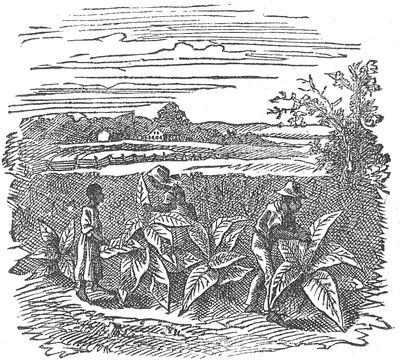
Worming.
"As the plant matures the leaves grow heavy, and, thick with gum, droop gracefully over from the plant. Then as they ripen, one by one the plants are cut, some inches below the first leaves, with short stout knives,—scythe or reaper is useless here,—and hung, heads down, on scaffolds, in the open air, till ready to be taken to the barn. A Virginia tobacco-barn is totally unlike any other building under the sun. Square as to the ground plan, its height is usually twice its width and length. In the center of the bare earthen floor is the trench for firing; around the sides runs a raised platform for placing the leaves in bulk; and, commencing at a safe distance from the fire, up to the top of the tall building, reach beams stretching across for the reception of the tobacco-sticks, thick pine laths, from which are suspended the heavy plants. Safely housed and beyond all danger of the frost, whose slightest touch is sufficient to blacken and destroy it, the crop is now ready for firing, and through the late autumn days blue clouds of smoke hover over and around the steep roofs of the tall tobacco-barns. A stranger might suppose the buildings on fire, but not a blaze is within, the object here, as in bacon-curing, being smoke, not fire.
"For this the old field-pine is eschewed, and the planter draws on his stock of oak and hickory-trees. Many use sassafras and sweet gum in preference to all other woods for this purpose, under the impression that they improve the flavor of the tobacco-leaf. When the leaves, fully cured, have taken the rich brown hue of the tobacco of commerce, so unlike the deep green of the growing plant that a person familiar with the one would never recognize the other as the same plant, the planter must fold his hands and wait until they are in condition for what is technically known as striking, i. e., taking down from the rafters on which they are suspended. Touch the tobacco when too dry and it crumbles, disturb it when too high or damp, and its value for shipping is materially lessened, while if handled in too cold weather it becomes harsh. But there comes a mild damp spell, and the watchful planter seizing the right moment, since tobacco, like time and tide, waits for no man, musters all the force he can command for the work of stripping and stemming. This done, the leaves are sorted and tied in bundles, several being held in one hand, while around the stalk-end of the cluster is wrapped another leaf, the loose end of which is tucked through the center of the bundle. Great care is taken in this operation not to break the leaf, and oil or lard is freely used in the work. During this process the crop is divided into the various grades of commerce from 'long bright' leaf to 'lugs' the lowest grade known to manufacturers. These last are not packed into hogsheads, but are sent loose, and sold without the trouble of prizing, in the nearest market-town.
"Shades imperceptible to a novice, serve to determine the value of the leaf. As it varies in color, texture, and length, so fluctuates its market price, and at least half the battle lies in the manner in which the crop has been handled in curing. From the mountainous counties of South-western Virginia, Franklin, Henry, and Patrick, comes all the rarest and the most valuable tobacco, 'fancy wrappers' but these crops are smaller in proportion to those raised along the lowlands of the rivers. This tobacco is much lighter in color, much softer in texture, than the ordinary staple, and is frequently as soft and fine as silk. Some years ago a bonnet made of this tobacco was exhibited at the Border Agricultural Fair, and had somewhat the appearance of brown silk. Only one such plant have I ever seen grown in Southside, and that, a bright golden brown, and nearly two feet in length, was carefully preserved for show on the parlor-mantel of the planter who raised it.
"After tying, the bundles are placed in bulk, and when again 'in order,' are 'prized' or packed into the hogsheads,—no smoothly-planed and iron-hooped cask, by the way, but huge pine structures very roughly made. The old machine for prizing was a primitive affair, the upright beam through which ran another at right angles, turning slightly on a pivot, heavily weighted at one end, and used as a lever for compressing the brown mass into the hogsheads. Now, most well-to-do planters own a tobacco straightener and screw-press, inventions which materially lessen the manual labor of preparing the crop for market. Each hogshead is branded with the name of the owner, and thus shipped to his commission-merchant, when the hogshead is 'broken' by tearing off a stave, thus exposing the strata of the bulk to view. Of late years some planters have been guilty of 'nesting,' or placing prime leaf around the outer part and an inferior article in the center of the hogshead.
"At a tobacco mart in Southside, occurred perhaps the only instance of negro-selling since the establishment of the Freedman's Bureau. At every town is a huge platform scale for weighing wagon and load, deducting the weight of the former from the united weight of both to find the quantity of tobacco offered for sale. A small planter has brought a lot of loose tobacco to market, which, being sold, was weighed in this manner, and for which the purchaser was about to pay, when a bystander quietly remarked, 'You forgot to weigh the nigger.' An explanation followed, and the tobacco, re-weighed, was found short 158 lbs., or the exact weight of the colored driver, who had, unobserved, been standing on the scales behind the cart while the first weighing took place.
"Thirty years or more ago—before the Danville and Southside Railroads were built—the tobacco was principally carried to market on flat-boats, and the refrain to a favorite negro song was:—
"'Oh, I'm gwine down to Town! An' I'm gwine down to Town! I'm gwine down to Richmond Town To cayr my 'bacca down!'
"Then all along the rivers, at every landing, was a tobacco warehouse, the ruins of some of which may still be seen. With no crop has the Emancipation Act interfered so much as with this, and the old tobacco planters will tell you with a sigh that tobacco no longer yields them the profits it once did: the manufacturers are the only people who make fortunes on it now-a-days; $12 per hundred is the lowest price which pays for the raising, and few crops average that now. Still every farmer essays its culture, every freedman has his email tobacco patch by his cabin door, and the Indian weed is still the great staple of Eastern Virginia."
The first planters of tobacco at the West were the Ohioans, who began its culture about fifty years ago. From the first they have taken much interest in the plant, and as the result of many experiments not only produce seed leaf, but the finest cutting leaf grown in this country. The Ohio tobacco growers have shown a spirit of enterprise in this direction that is as commendable as it is rare. While they have not tested the great tropical varieties like their brother tobacco growers of Connecticut, they have succeeded in producing a leaf for cutting that is the admiration of the world. At first their experiments were unsuccessful, and the early growers were ridiculed for entertaining the belief that tobacco could be grown at the West. Yet despite all objections and seeming failures, the growers continued its cultivation until it has become one of the great products of the State. Of late the Ohio growers have demonstrated that their soil is better adapted for the finer grades of cutting leaf, than for seed leaf or even the more common "cinnamon blotch."
The soil is rich, and an experience of half a century has at length given them a thorough knowledge of the plant and the most successful modes of cultivation. In appearance an Ohio tobacco field resembles those of the Connecticut valley—the leaf is large, and though coarser, cures down a dark rich brown, like "cinnamon blotch," or a light yellow, the color of the famous "white tobacco." The Ohio growers have taken much pains with the Ohio broad leaf, and have produced a seed leaf tobacco that in many respects is a superior wrapper for cigars. While it does not possess the fine texture of Connecticut seed leaf it still has many good qualities, and with the careful culture given it will doubtless become still finer as a leaf tobacco, for wrapping cigars. But it is in the production of cutting leaf that the Ohio growers take rank, and ere long will supply the vast demand made upon them for their great cutting variety.
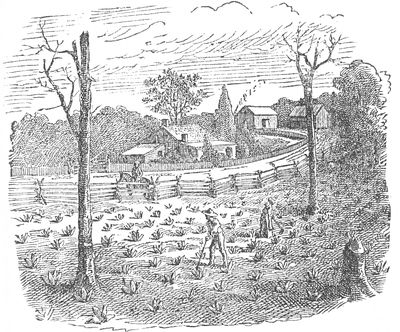
Ohio Tobacco Field.
With a degree of pride peculiar to all tobacco growers, (when any new variety has originated,) they point with no little egotism to their fields of "white tobacco," and ask their fellow-growers of New England to rival this "great plant." So successful have they been of late with cutting leaf, that their fields yield them returns not inferior to many of the choicest tobacco farms on the Connecticut River. The Ohio growers have one advantage over earlier growers of the plant—their land has not been cultivated as long as the famous tobacco lands of the Connecticut valley, and does not require that thorough fertilizing which is so necessary in New England. Still the tobacco field cannot be too thoroughly prepared for the growth of tobacco, whether in the tropics or in the more temperate regions.
In the curing of tobacco, the Ohio growers have but few equals, and no superiors. At first, the complaint made by the buyers of Ohio tobacco was, that "Ohio tobacco has the appearance of being too hard fired, indeed so much so as to have the flavor of being baked." The early culture of tobacco in the State attracted the attention of tobacco buyers, especially those who had dealt largely in Maryland leaf, and so much so, that one large firm issued a circular and sent to all the prominent growers in the tobacco growing section giving instructions in regard to its cultivation and management. We copy from one lying before us, and dated 1842. It reads as follows:
"As tobacco is every year becoming a more prominent article in your State, we deem it of so much importance that we have had this circular printed on the subject of its Cultivation and Management, and take the liberty to address it to you. New ground produces the finest and highest priced tobacco. The plants should be set about 2 feet 9 inches or three feet apart, which will give them sufficient air and sun to ripen, and give the leaf a good body. It should be topped as soon as it buttons, kept clear of suckers, and cut as soon as it is ripe—if favorable weather, it will be fit for the house in 15 to twenty days after it is topped.
"When cut, let it remain until sufficiently lank to handle without breaking; but it should be housed before it is sun-killed, or much deadened, to prevent which, put it up in small heaps, say as much as a man can carry, with the heads to the sun, as soon as cut, and even then the top plants may be too much deadened, unless soon removed to the house. If sun-killed, it will not cure fine. The Maryland system is to fire without flues, and when the precaution is taken to lay planks or boards directly over the fire, accidents seldom occur.
"Slow fires are kept up for the first four or five days after the house is filled, so as to give it a moderate heat throughout, until the Tobacco is generally yellow, then the fires are raised or increased so as to kill the leaf and stem in forty-eight hours or less. When cured on the stock, as is done in Maryland, it can be better assorted, or the different qualities more readily separated than when stripped in the field and cured in the leaf. When stripping and tying up in bundles, it should be assorted according to the following classifications: 1st, Fine Yellow; 2d, Yellow; 3d, Spangled; 4th, Fine Red; 5th, Good Red; 6th, Brown and Common. It is often put up as if there were but two or three qualities, hence there is a great mixture of the several sorts, which is a very serious disadvantage in selling, as the purchaser generally values it at the price of the most inferior in the sample.
"The process of curing unfired, or air-dried tobacco, is similar to the above, except the firing; when so cured, it is more difficult to condition, so as to make it keep; but it generally sells quite as well. Planters should be very careful to have their Tobacco in good dry condition when they deliver it to the dealer or purchaser, as it is all-important to him to receive it free from dampness or moisture, which bruises it and injures its quality. We think such management as directed above would raise the value of Ohio tobacco as high as similar quality of Maryland."
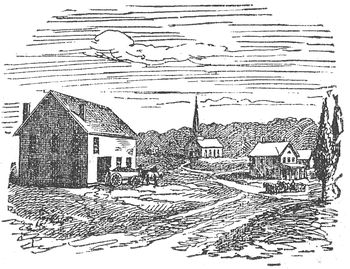
Tobacco Warehouse.
As when first cultivated, the Ohio growers still select new land as the best adapted for tobacco, though not as easy of cultivation. When the tobacco growers are ready for preparing their "new ground" they invite in their friends and neighbors, and the field is "grubbed" in a short time. "Grubbing Day," with the young people, is an event of no common interest; the farmers gather from the adjoining farms and with mirth and muscle soon render the field fit for the "Indian herb." In the evening, the planter's home is filled with the young people, bent on having a right good time, and with "stripping the willow" and other games, close the day if not the night in the most enjoyable manner. Many of the country merchants take the tobacco of the growers when in condition to handle, paying them (or at least a portion of it,) in goods, or purchasing the tobacco as they do other merchandise. They have large warehouses where they receive and pack the tobacco until shipped to market. In the early Spring the growers take their tobacco to the workhouses, where it is packed by the merchants who frequently have a claim on the crop for advances made on the same.
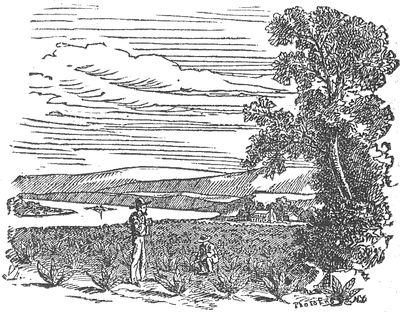
Kentucky Tobacco Plantation.
The system adopted by the Kentucky growers is similar to that adopted by all growers of cut tobacco, and the fine quality of Kentucky "selections" has deservedly gained the leaf a reputation that must place it in the front rank of American tobacco. The vast quantity grown in the state is an evidence not only of the good quality of Kentucky tobacco, but of the adaptation of the soil and of the method of cultivation in use. As a cut tobacco, Kentucky-leaf is held in the highest esteem, the exportation of the leaf to all parts of Europe gaining for it a reputation hardly equaled by any Southern tobacco. The system of cultivation is similar to that pursued by the Virginian, and the same process of curing is also adopted.
The Kentucky growers generally succeed in getting a "good stand" and when once the plants have commenced to grow they come forward with a rapidity that is truly astonishing. The soil of Kentucky is well adapted for the production of the largest varieties of tobacco as well as the finest grades of cutting leaf. Much attention is paid to the selection of soil, that the light standard of Kentucky leaf may be further advanced. On the large plantations a vast amount of tobacco is grown, in some instances equaling the entire product of some of the tobacco-growing towns in the Connecticut Valley. The tobacco is packed in hogsheads, each one containing twelve hundred pounds, the same as in Virginia and Missouri.
The Kentucky planter prides himself on the superior quality of tobacco, as well as his famous blooded stock. If there is anything more remarkable than the high character of the latter, it must certainly be the renowned plant which has given the wealthy planters of Kentucky a national popularity among all cultivators of tobacco. The Kentuckians are thorough in all of their methods of cultivation, and with the first stock and tobacco farms in the country bid fair to achieve still further honors as "tillers of the soil." Possessed of the largest means, they have brought their farms up to a high state of cultivation, and produce in their famous valleys the very finest of Nature's products.
Kentucky planters are men of the largest endowments; Nature, in her gifts to them has been most lavish, and the princely fortunes which they have acquired shows how well they have benefited by her munificence. In manners affable, and in benevolence unsurpassed, the Kentucky planter gains the plaudits of all. He is polite to both friend and foe, and possessed with all of that polished manner which marks the true gentleman, and especially all growers of the "kingly plant." Easy of approach, he has still that reserve that bids all sycophants mark well their conduct and demeanor. On the plantation or at the race, the Kentuckian is ever in his best mood for recreation and enjoyment.
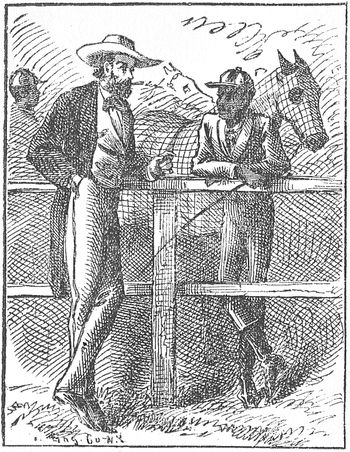
The Kentucky Planter.
His attachment for the horse has developed qualities of patience and thoroughness that are shown elsewhere than on the "course." Benefiting by years of training and study, the success that follows his efforts shows at once that such talents are not confined to a single field of operations. In many respects like the Virginia planter, they differ somewhat in their taste in all that pertains to the turf and the field. But we would not lose sight, among his many noble traits of character, of that love of his State that pre-eminently characterizes the Kentuckian. He is justly proud of her soil and of her sons, and whether in the halls of Congress or on the field of carnage and blood, fears not to maintain the honor and safety of the one and the other.
It is surprising to one acquainted with the growth of tobacco and the value of the Southern States for its production that so small an area of land is devoted to its culture in Georgia, Florida and Louisiana. When owned by Spain, West Florida was noted for its tobacco, and produced large quantities which were exported to Spain and France. The soil of Florida is well adapted for tobacco, and the rich hummock lands produce an excellent quality for cigars, not unlike Havana leaf. Its cultivation has been tried in various parts of the State, but the result has not warranted its cultivation to any great extent excepting in Gadsden County where the plant flourishes as well as in Cuba.
The seed used in Havana and the plant resembles it so closely that even Cuban planters cannot distinguish it from that grown on the island. The mode of cultivation is nearly the same, and the soil is said to produce a leaf of tobacco similar to that of the celebrated Vuelta de Albajo. Formerly the product was sent to New Orleans, and the leaf was pronounced by some dealers to be bitter, but most of them considered it valuable. The planter selects the high lands or hummocks, the soil of which is light and rich for the tobacco field. The plants are carefully drawn from the bed, and transplanted afterwards. The mode of culture is to plow between the rows and hoe the plants carefully.
A Florida tobacco field in appearance is not unlike a vega, or Cuba tobacco field; the same luxuriant growth of the forest may be seen on every hand, and the "queen of herbs" grows underneath or near the fragrant Orange and the stately Magnolia. The soil of Gadsden County is in some respects unlike that of the rest of the State in that there is an entire absence of limestone, which is found elsewhere all through Florida. The climate of the State is well adapted for the growth of tobacco, and is less changeable on the Gulf side than along the Atlantic coast.
Formerly larger crops were raised than now. Under the old régime when on every plantation were a score or more of idle negro urchins, a large portion of the labor could be performed by them, such as worming, dropping the plants, and picking up the primings, while now the labor has to be paid for in money or its equivalent. At this time, the "wrapper leaf" was considered to be among the best for cigars, and brought high prices. In the days of slavery, tobacco was considered to be as profitable as the cotton crop, and good tobacco plantations were considered to be the most valuable in the State.
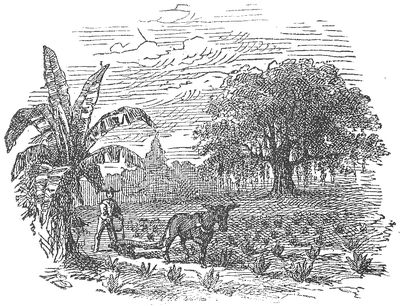
Florida Tobacco Plantation.
This peculiar tobacco region is without doubt capable, with proper management, of producing a superior article for cigars, both wrappers and fillers, and when grown on "new ground" the staple is exceedingly fine. The leaf cures as rapidly, and is of as good color as in Cuba, and in a favorable season and when harvested fully ripe, is destitute of that bitter taste formerly ascribed to it. The plants grow large, and have that smooth, shiny appearance peculiar to Havana tobacco, the leaves growing erect, and frequently covered with "specks" or "white rust," one of the best evidences of a fine flavored and a good-burning tobacco. A Florida tobacco-grower gives the following account of the plant:
"The Gadsden 'wrapper-leaf' was always in high repute, and extensively used in the manufacture of cigars, being in size, firmness, and texture fully equal to the best Cuba, and far superior to the Connecticut seed-leaf. Where the variety known as the Cuba filler has been tried, it has succeeded finely in this county, possessing that delicate and peculiar aroma so highly prized in the Havana cigars. We need but the capital to make the most profitable crop that is grown. It is a fact, that of all the counties of the State, many of them abounding in the very finest soil, Gadsden is the only one that has succeeded in making the Cuba tobacco a staple market-crop. Prior to 1860 it rivaled in net returns the great staple cotton, and from present indications, it is about to resume its former status among the great agricultural products of the country."
"Whether this success is attributable to any peculiarity in the elements of the soil, I am not able to determine, but this fact is worthy of note, that, except immediately on the banks of the Apalachicola River, which forms the Western boundary of the County, there is an entire absence of the rotten limestone which so largely pervades the other sections of the State. For the planter of limited means, there is no crop so well suited to his condition as the Cuba tobacco. To produce a given result there is a less area of land required than is demanded for the production of any other field crop. The cultivation, harvesting, and preparation for market is simple, and the labor so light that it may be participated in by every member of the family, male and female, over six years of age. The growth of the plant is so rapid, and its arrival at maturity so quick, that it never interferes with any of the provision crops, and rarely with a moderate cotton crop."
In Louisiana the tobacco plant flourishes well and grows as well and as luxuriantly as sugar cane. Even along the banks of the Mississippi the plants attain good size, and succeed as finely as in some of the other parishes in the interior of the State. The Perique and Louisiana tobacco are the principal varieties cultivated, and attain nearly the size of Connecticut seed leaf. In St. James parish the soil seems well adapted for Perique tobacco, and here it readily takes on that black hue that is one of the peculiar features of this singular variety. In Coddo parish tobacco is cultivated to some extent, but does not produce a leaf equal to that grown in St. James Parish. The tobacco grown in the Parishes of Bossier and Natchitoches is used chiefly by the growers of the parishes and is fitted for both smoking and snuff.
The Louisiana planters have adopted the method of the French in doing up their tobacco—twisting it in rolls, or as the French call them, "Carrots." The planters of St. James Parish annually put up from ten to fourteen thousand carrots of Perique, each carrot weighing about four pounds.
Mr. Perique, from whom the tobacco takes its name, made many improvements in the manner of preparing the tobacco for market, one of which consisted in taking up the twisted lumps (after remaining in press for six months), spreading them to fifteen or sixteen inches in length and having completed four pounds in weight, rolling it into a lump which retained its shape by means of a rope one-fourth inch in diameter, tightly twisted around it. The labor in pressing and twisting is entirely done by hand, and attended to with the most scrupulous care.
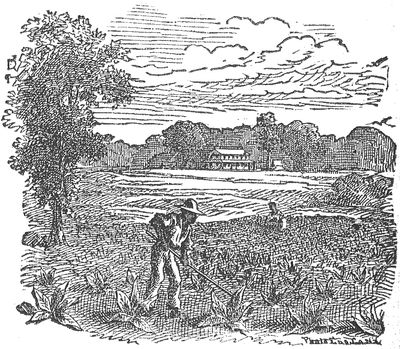
Louisiana Tobacco Plantation.
The Creole planters sometimes raise two, and even three crops on the same field, two of them being the growths of suckers or shoots from the parent stock or stump. The growers of Perique tobacco have tested Havana seed, but can see but little difference between the product and that from Virginia or Kentucky tobacco seed, while the growth is much smaller. In color Louisiana tobacco is very dark, entirely different from any other variety grown in the Mississippi valley.
Some few years since tobacco culture was introduced into California, and the belief then entertained by those who planted the consoling weed, that the state would soon become as famous for raising tobacco as she now is for producing wheat and gold seem likely to be realized. The soil and climate of California are admirably adapted for tobacco. In the valleys the land is a deep alluvial loam, easily worked, producing bountiful crops of the finest leaf tobacco. The planters have experimented with several varieties, including Havana, Florida, Latakia, Hungarian, Mexican, Virginia, Connecticut, Standard and White leaf. Large crops are grown, especially of Florida tobacco, which, with careful culture, produces two thousand five hundred pounds of merchantable leaf to the acre. The planters get their Havana seed from Cuba, preferring to do so rather than to risk the seed from their own plants. At first they used home-grown seed and could not see any serious deterioration or change in the quality of the tobacco, but a singular change in the form of the leaf took place. That from home-grown seed grew longer, and the veins or ribs, which in Havana tobacco stand out at right angles from the leaf stalks took an acute angle, and thus became longer and made up a greater part of the leaf. Of Florida tobacco the home-grown seed comes true.
Tobacco is now being tested in the several counties in the State and with every promise of success. Many of the ranches seem well adapted for the plant and the planters are confident by their new process of curing, of being able to produce an article equal to the best Havana brand. The plants attain a remarkable size, and grow up like many kinds of tropical vegetation, without much care being bestowed upon them, although the plants are regularly cultivated and hoed. The planters are not troubled with that foe of most tobacco fields, "the worm." They attribute this in part to the excellence of their soil and partly to the abundance of birds and yellow jackets. The planters do not always "top" the Havana and do very little "suckering." If the ground is rich, and free from weeds they let one of the suckers from that root grow, and thus become almost as large and heavy as the original plant. They believe that the soil is strong enough to bear the plants and suckers, and that they get a better leaf and finer quality without suckering.
In summer the roads are very dusty in California, and this dust is a disadvantage to the tobacco planter. On some of the plantations double rows of shade trees are planted along the main roads, and gravel is spread on the interior roads; and to protect the fields of tobacco from the high winds which sweep through the California valley, almonds and cottonwoods are planted for wind-breaks in the fields.
Some of the planters employ Chinese to cultivate the plants, who are very careful in hoeing and weeding the tobacco, living an apparently jolly life in shanties near the fields. A witty California correspondent of the Tobacco Leaf writes concerning the early cultivation of tobacco in that State:
"We are doing a great many other things in California now besides raising grain, fruit, wine, wool, and gold. We are doing a lively business in tobacco. Fifteen years ago I was down East on one occasion when they were gathering the tobacco crop—which goes to New York, and, by a process equal to wine making, becomes Havana tobacco. It struck me that this country was admirably adapted to its cultivation, and I brought back some seed, which I gave to a friend living on the bank of the Sacramento River, instructing him to plant it as per direction given me. We sat down and calculated the immense fortune we would make raising tobacco, if the experiment was a success. A week later my friend, who was an impatient sort of a fellow, wrote me just a line—'No results.' I replied, and asked him if he expected a crop of tobacco in seven days. A few weeks later he wrote, 'Here she comes;' two weeks later, 'How big is the stuff to be?' two weeks later, 'Not room for tobacco and me too. Who shall quit?' I heard no more for a month and thought I would go up and see it. I did so, and the steamboat landed me at my friend's ranch. I could not see the house, and hallooed. I heard an answer from the depths, and then following a path, I found my friend swinging in a hammock in the shade of a grove of tobacco trees. I desire to maintain my reputation for truth and veracity, so necessary to a correspondent, so I won't say how big or how high those tobacco plants were; but my friend's hammock was slung from them—and he was no feather-weight—the leaves completely embowered the cottage. I congratulated him on the results—such a grove and such a shade—and moreover I said, 'You will be permanently rid of mosquitoes.' 'Will I!' said he. 'Do you know that these gallinippers have learned to chew already, and the habit is spreading so that all the old he-fellows are coming down from Marysville to take a hand.' I inquired if my friend had cured any or smoked any. He pointed to a Manyanita pipe split open on the ground, and said. 'Before it was real strong, some three weeks ago, I tried a leaf in that pipe. Observe the result—busted it the second whiff, and knocked me off the log I was sitting on.' Such was the first experiment in tobacco raising in California. But now they have learned the trick. They have searched the State for the poorest and most barren soil, and, having found it are cultivating a splendid article of genuine Havana leaf tobacco, manufacturing cigars as good as you get one time in twenty even in Havana, making several brands of smoking tobacco, and, lastly, an article of Louisiana perique, ('peruke' proper,) that any old smoker would go into ecstasies over, fully equal, it is said to the genuine old-fashioned article, and that is saying a good deal. Now if we can supply the world with cigars and tobacco, we have got a dead sure thing for the future, even if gold gives out, grain fails and the pigs eat up all the fruit. Your people who have been paying fifteen cents apiece for genuine Havana cigars imported direct from—Connecticut, should rejoice and join in an earnest hooray!"
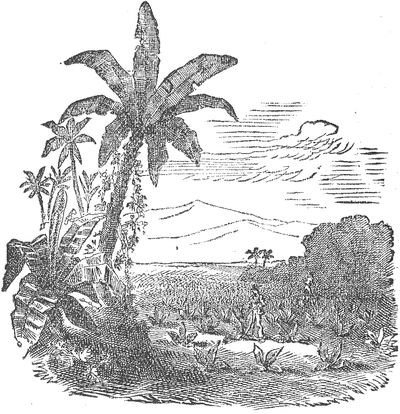
Mexican Tobacco Plantation.
"Various kinds of tobacco are planted, mostly that with the short, dingy, yellow blossoms, which has a very large, strong leaf. But there is little doubt that the sorts would be more carefully selected, if the trade were not fettered by the monopoly. Most of the government planters enter into an arrangement with the small farmers and peasants who have to grow a certain number of plants, on conditions of handing over the harvest at a low figure—six to eight dollars per crop. These aviados receive something in advance, and their chief profit consists in securing the sand leaf and the greater part of the after-harvest, which they sell to the contrabandists. It is indeed allowed to export whatever remains; but it is attended with so many annoyances from the authorities, that it is never attempted. The many ships which enter the Mexican harbor of the east coast with European manufactures, find no return freight except gold and silver, cochineal, vanilla, a few drugs and goat skins, all of which take up very little room in the ships (money is usually sent off in the English government steamers); consequently they must either proceed to Laguna to buy log-wood, or they must take in sugar, coffee, or tobacco, in a Cuban or Haytian port. As soon as tobacco becomes an export article, its cultivation must increase immensely in the Coast States, the Mexican being very partial to this branch of agriculture, which occupies him part of the year only."
Mayer also alludes as follows to the same subject:—
"A large portion of the tobacco sold in the republic is contraband; for the ridiculous and greedy restrictions and exactions with which a plant of such universal consumption is surrounded, necessarily disposes the people to violate laws which they feel were only made to impair their rights of production and trade under a constitution professing to be free."
The government planters in the State of Vera Cruz have large, fine plantations, and the plants are carefully tended and cultivated as in all countries where tobacco is a government monopoly. On each plant a certain number of leaves are taken off, including the sand leaf, which is thrown away, and everything in the way of topping and suckering performed as carefully as on the tobacco farms in Cuba. The small farmers who raise only a few thousand plants are not as careful as the large planters, and are sometimes guilty of planting more than the number agreed upon, while the mountain passes towards the table-land are carefully guarded to prevent smuggling of the crop, which is far more remunerative than selling to the government.
We will now take the reader to the primitive tobacco plantations of America about the middle of the Sixteenth Century. The plantations were not located in Cuba as many have supposed but what has been variously named Hispaniola, Hayti, and St. Domingo. It was in this island that the Spaniards first began the cultivation of tobacco and inaugurated (under the guise of Christianity) that career of monstrous cruelty, with which their insatiable appetite for the burning of heretics and for the baiting of bulls so well accords. In 1509, Diego Columbus, the eldest son of the great discoverer, assumed in St. Domingo, or as it was then called, Hispaniola, the vice-regal powers which had been intrusted to him. Diego as portrayed by the historian "was a man as noble as his father, and almost as gifted; and he had his father's fate. Like his father, he had to bear all that Spanish envy and Spanish malignity could inflict. In 1511, Diego Columbus sent Diego Velasquez to conquer Cuba." From historians Velasquez gets a better character than most of the Conquistadores, who in general were as ferocious as they were audacious and fortunate. No serious opposition was or could be offered. With the name of Velasquez the prosperity of Cuba is inseparably identified. As Governor of Cuba he was a vigorous colonizer and civilizer. He founded Havana, which he called the Key of the New World, and which is said to rank as the eighth place in the hierarchy of commercial cities. Havana, however had long been flourishing before the seat of Government had been transferred to it from Santiago. It was Velasquez who introduced slavery into Cuba; and it was during his vice-royalty and under his sanction that those memorable exploratory and conquering expeditions began, the most astonishing of which was that to Mexico, led by Cortez, the insubordinate lieutenant of Velasquez, whose death is said to have been hastened by the rebellious and ungrateful conduct of Cortez, and perhaps by the spectacle of such immense and rapid success. The agricultural, commercial, and general growth of the West India islands at this period would have been much more rapid if the Spaniards had not annihilated the native population, and if they had not been exposed to incessant piratical attacks. These were often of the most desolating kind. In 1688, the city of Puerto Principe was plundered and destroyed. From its strongly fortified position Havana set the buccaneers at defiance, and sometimes saved the whole island from ruin.
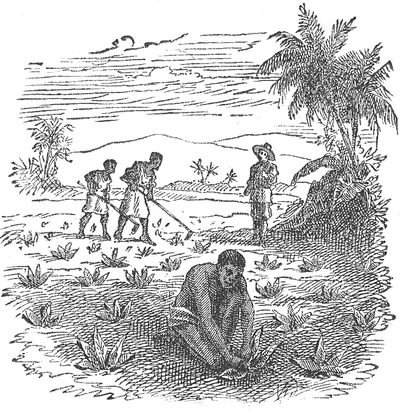
St. Domingo Tobacco Field, 1535.
The exact period of the first cultivation of tobacco in St. Domingo is not known, but we find that as early as 1535 the negroes had habituated themselves to the use of it in the plantations of their master. Soon however its cultivation increased, and during the latter part of the Sixteenth Century the Spaniards shipped vast quantities to Europe, a very large amount of which found its way to England, where it brought fabulous prices. The Spaniards, by the application of the lash and other cruelties, extorted from the negroes an amount of labor never equaled by any other task masters in the world. Forcing these slaves to labor on the plantations from morning until night, with the fierce rays of a tropical sun shining full upon their uncovered backs, and goaded on to the performance of the severest toil, is it any wonder that the haughty cavaliers of Spain grew rich from their industry, and feasted on the products of the Indies. Cultivated on the rich soil of this fertile island, the tobacco of St. Domingo had no competitor, until the Spaniards began its culture a little later on the island of Trinidad, the product of which in time stood at the head of all the tobaccos of the Indies and of South America. The tobacco trade at this time was wholly controlled by the Spaniards, who, though successful in this direction, made but slow progress in colonization. Compared in the British colonies in the New World, the Spanish possessions were weak and incompetent, and for all their advantages in their great product, it was ultimately rivaled by the English Colonial tobacco. In the conquest of the New World, Spanish energy and enterprise seem to have exhausted themselves; and as Spain was declining, its colonies could not be expected rapidly to advance. The history of the Spanish conquest in America is a record of cruelty and of blood, while that of English colonization is marked by English rigor and enterprise, and is one of successful daring and ultimate triumph.
The West India plantations, however, were still worked, and for more than a century St. Domingo yielded a vast amount of tobacco, until the soil of Cuba was found to be better adapted for its production than any other of the West India islands, not excepting even the island of Trinidad.
Hazard, in his work on Cuba, describes the celebrated vegas or tobacco plantations, of the island as follows:
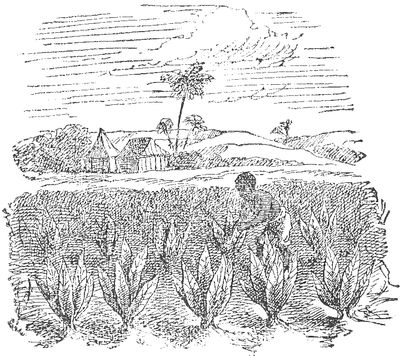
A Cuban vega.
"The best properties known as vegas, or tobacco farms, are comprised in a narrow area in the south-west part of the island, about twenty-seven leagues broad. Near the western extremity of the Island of Cuba, on the southern coast, is found one of the finest tobaccos in the world. Within a space of seventy-three miles long and eighteen miles wide, grows the plant that stands as eminent among tobacco plants as the lordly Johannisberger among the wines of the Rhine. Shut in on the north by mountains, and south-west by the ocean, Pinar del Rio being the principal point in the district. These vegas are found generally on the margins of rivers, or in low, moist localities, their ordinary size being not more than a coballeria, which amounts to about thirty-three acres of our measurement. The half of this is also most frequently devoted to the raising of the vegetable known as the platano (banana), which may be said to be the bread of the lower classes. A few other small vegetables are raised. The usual buildings upon such places are a dwelling house, a drying-house, a few sheds for cattle, and perhaps a small bohio (hut), or two, made in the rudest manner, for the shelter of the hands, who, upon some of the very largest places number twenty or thirty, though not always negroes—for this portion of the labor of the island seems to be performed by the lower classes of whites. Some of the places that are large have a mayoral, as he is called, a man whose business it is to look after the negroes, and direct the agricultural labors; but, as a general thing, the planter, who is not always the owner of the property, but simply the lessee, lives upon, directs, and governs the place.
"Guided by the results of a long experience transmitted from his ancestors (says a Spanish author), the farmer knows, without being able to explain himself, the means of augmenting or diminishing the strength or the mildness of the tobacco. His right hand, as if guided by an instinct, foresees what buds it is necessary to take off in order to put a limit to the increase or height, and what amount of trimming is necessary to give a chance to the proper quantity of leaves. But the principal care, and that which occupies him in his waking hours, is the extermination of the voracious insects that persecute the plant. One called cachaga domesticates itself at the foot of the leaves; the verde, on the under side of the leaves; the rosquilla, in the heart of the plant; all of them doing more or less damage. The planter passes entire nights, provided with lights, clearing the buds just opening, of these destructive insects. He has even to carry on a war with still worse enemies,—the vivijagnas, a species of large, native ants, that are to the tobacco what the locust is to the wheat. This plague is so great, at times, that prayers and special adoration are offered up to San Marcial to intercede against the plague of ants.
"The plant, whose original name was cohiba, seems to have been cultivated first by Europeans on the island in the vicinity of Havana. The island of Cuba is without doubt well adapted for the cultivation of tobacco—the soil, climate, and improved methods of culture all tend to the production of a leaf tobacco as celebrated as it is valuable.
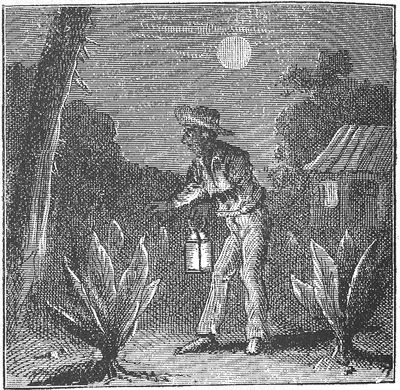
Killing Bugs by Night.
"Between the 'Lower Valley,' in the Nicotian, not the geographical, sense of these words, lie the so-called Partidos which produce the tobacco that is sent to Europe as Partido or Cabañas. The leaf often surpasses that of the 'Lower Valley' in size and fineness, as well as in the beauty of the color; but it is inferior in quality. The tobacco farmers though stalwart fellows are not fond of work, and too often waste their time at the tavern. Many of them from thriftlessness are plunged into debt; and scarcely is the harvest ended when they borrow money from the tobacco merchant on the following harvest, who thereby obtains the right to interfere, it may be despotically, with the management of the crop. Continual embarrassments tempt the tobacco planters to be dishonest. To cheat their creditors, they often sell the best part of the crop in underhand fashion. Such of the tobacco farmers as wish to produce a great deal of tobacco, without regard to the excellence of the article, leave the plant to its natural growth, which is both scientifically and otherwise objectionable, for it is on a process of thinning and pruning a due diffusion of sap in the leaves depends, and consequently the quality of the tobacco."
The tobacco, after being baled, is sent to the Havana market. The bales of tobacco are carried on the backs of mules or horses to the city or to the nearest railway station.
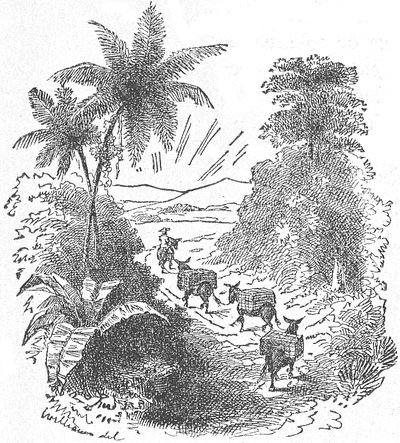
Going to Market.
"In the long line or train of mules or horses, the head of one mule or horse is tied to the tail of the one before it. On the back of the foremost sits the driver. The hindmost carries a bell, which enables the driver to know whether any of the animals have broken loose."
From the description given by Hazard of Cuba, its soil, climate, and other resources, it will readily be seen by all acquainted with the tobacco plant that this famous island is well adapted for the production of a tobacco that for fineness and delicacy of flavor is hardly rivaled. With the peculiar composition of the soil, and with a climate well adapted for the perfection of all kinds of tropical plants and fruits, it can hardly be imagined that any finer variety of tobacco can be grown than that produced in Cuba and the adjoining islands. Doubtless the climate of Cuba is nearly the same as when Columbus discovered the island, and wrote in such extravagant language its praise. The soil of Cuba is prolific, and the variety of tropical plants and fruits grown upon the island is quite remarkable. Nowhere is this seen to a greater extent than in the varieties of tobacco cultivated. Although there are several kinds and qualities grown on the island, the mode of culture upon all the vegas is nearly the same. These vegas or tobacco farms greatly outnumber the coffee and sugar estates, but are much smaller, and require a less number of hands to work them. Hazard estimates the number at ten thousand, while they are constantly increasing as new fields are being tried and new modes of culture introduced. Russell says of tobacco culture in Cuba:—
"In regard to climate, it is worthy of observation that tobacco is only cultivated during winter, when there is little rain. It grows most luxuriantly in summer with the increased heat and moisture; but the leaves grown in this season are devoid of those qualities for which the weed is esteemed. The conditions of growth are less powerful in winter, when the temperature is ten degrees lower, and the fall of rain small. At the same time, there is more sunshine to impart those aromatic qualities which are so much relished by smokers of tobacco. In Virginia the torrid heat and thunder showers during the summer months are by no means favorable for developing the mild aroma of a good smoking leaf. Such atmospheric conditions are better suited for cotton and Indian corn than tobacco, which must have dry weather and sunshine to produce it in perfection."
No country in Europe is more celebrated for its tobacco than Germany. The tobacco plant has been cultivated in some parts of Prussia for nearly two centuries. The tobacco of Germany is used for all purposes for which the leaf is designed—for cutting, cigars, and snuff. There are various kinds of German tobacco, the finest being grown in the Grand Duchy of Baden. The native tobacco of Germany, however, is not powerful in flavor, and may be smoked continuously to an extent which would be dangerous and disagreeable if American tobacco were used. Although it is cultivated in most of the States of Germany, and by a large number of growers, still the tobacco fields as a rule are small. The Germans are among the most thorough cultivators of the plant in Europe, and every operation in the field is done at the proper time and in the right manner. After it is cured they prepare it nicely in rolls and carots, the latter for manufacturing into snuff. The tobacco fields are faithfully tended, and the utmost pains taken to secure large, well-formed leaves. The fields present a much more even appearance than similar fields in France, where the tobacco grown is small and uneven. The South German growers of tobacco are without doubt the most successful tobacco-growers in Europe, not excepting the Hollanders, who raise an excellent tobacco for snuff. The time of gathering the leaves is the occasion of quite a merry-making among the growers and villagers, and is considered an event of considerable importance. Fairholt says:—
"The time of harvesting the leaves is an interesting period for a stranger to visit the villages, which put on a new aspect as every house and barn is hung all over with the drying leaves."
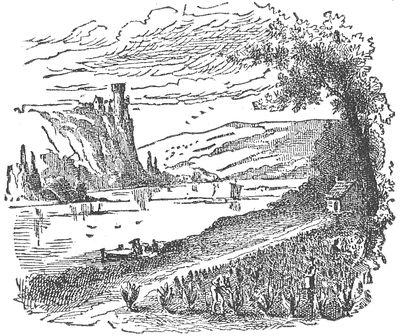
German Tobacco Field.
German tobacco cures well, and some of the finer sorts make excellent cigar wrappers and are much esteemed throughout Europe. The following account of the cultivation and production of tobacco in the different German States, will give some idea of the amount cultivated and used in Germany:—
"The aggregate area of land cultivated with tobacco in Prussia during the year 1871, amounted to 5.925 hectares (a hectare being equal to 2.47 English acres). It appears that the extent of tobacco-growing land has, during the last fifty years, been gradually diminishing in Prussia, and that accordingly the expectations entertained in the beginning of that period of a great future development of this branch of agriculture, have not been realized; for whilst the area of land planted with tobacco in the year 1825 was 12.374 hectares, it amounted in 1871 to less than one-half this amount. The reasons for this gradual decline are considered to be, on the one hand, the growing competition of the South German growers, and the increase in the importations of American tobacco; on the other, the fact that the cultivation of beet-root (for sugar manufacturing) and of potatoes (for the distilleries) has proved to be a more profitable business than the cultivation of tobacco. It has, moreover, been found by many years' experience, that whilst the quality of the tobacco cultivated in most parts of Prussia is not such as to enable the growers to compete successfully with the importers of foreign (particularly of North American) sorts, the labor attending its cultivation and its preparation for the market, as well as the uncertainty of only an average crop, are out of proportion, as a rule, to the average profits arising therefrom. The cultivation of the plant has, consequently, gradually become restricted, chiefly to those districts of the country where either the soil is peculiarly adapted for the purpose, or where it is carried on for the private use of the producer."
With regard to the various provinces of Prussia, it appears that "In East Prussia the extent of tobacco land is only a limited one, and is confined to the district around Tilsit, where about two-thirds of the entire cultivation is in the hands of peasants, who consume their own produce. In West Prussia (the western portion of the province of Prussia proper) the cultivation is rather more extensive, particularly near the town of Marienwerder; the tobacco, however, is very inferior. The most important districts of the province of Posen are those of Chodziesz and Meseritz. In Pomerania, next to Brandenburg the most important tobacco-growing province of the kingdom, the area of land cultivated is very large. The principal districts are those near Stettin. In Silesia the most important districts are those around Breslau, Ratibor, and Oels. The principal tobacco-growing province of Prussia is Brandenburg, and here again, particularly the part of the government district of Potsdam, which contains the towns of Neustadt, Eberswalde and Prenzlau. Besides the districts mentioned, tobacco is grown largely in that of Frankfort-on-the Oder. In the province of Saxony the chief districts are those of Stendal, Salzwedel, Nordhausen, Burg, and Wittenburg. Hanover, like the other western provinces of the kingdom, produces a superior quality of tobacco to that raised in the eastern parts of Prussia—the most important district is that of Munden. The chief tobacco-growing districts of Hesse-Nossau are situated near the towns of Cassel and Hanau. In Rhenish Prussia the plant is cultivated, particularly in the neighborhood of Cleve, Emmerich, Coblenz, Creuznach, and Saarbruck; the districts first mentioned produce a very superior quality. The production of tobacco in Westphalia is extremely small, while in the province of Schleswig-Holstein the plant is not cultivated at all. In the account given it will be seen that the tobacco plant holds an important place among the products of Prussia, and although not as extensively cultivated as formerly, has not been entirely driven from the soil by other products which yield a larger profit to the producer. The plant is cultivated in other parts of Germany, especially in Bavaria, where large quantities of tobacco are grown, particularly so in the Bavarian Palatinate and in Franconia (viz., the districts around Nuremberg and Erlangen). In the Kingdom of Saxony but little tobacco is raised, as is also the case in Wurtemberg, although the soil and climate in parts of this state are said to be very favorable to the growth of the tobacco plant; the area of land cultivated is upon the whole, a very limited one, and in 1871 did not exceed 178.2 hectares. The Grand Duchy of Baden has at all times been the chief tobacco-growing part of Germany; as far back as the end of the Seventeenth Century, special laws for regulation of the cultivation, preparation, and warehousing of this article were in force. The most prominent tobacco-growing districts of Baden are those of Carlsruhe, Mannheim, Heidelburg, Badenburg, Schwetzingen, and Lahr; the quality of the plant grown in those parts being a very superior one (among the various kinds of German tobacco). The produce of the districts mentioned is therefore applied chiefly in the manufacture of cigar wrappers, and is exported in considerable quantities to Bremen, Hamburg, Switzerland, Holland, and even to America for the use of cigar manufacture. The prices of the best kinds of Baden tobacco are consequently also, on an average, much higher than those realized by other German growers. In the Grand Duchy of Hesse the plant is cultivated, the chief district being that around the town of Darmstadt; in the Thuringian States, tobacco is grown; the most prominent among them as regards its production is the Duchy of Saxe-Meiningen. In Mecklenburg also some tobacco is raised, the most important district being that of Neu Brandenburg (in Mecklenburg-Strelitz). In Brunswick only a small extent of land is used for tobacco growing, the same being situated near the town of Helmstadt. In Alsace and Lorraine, the recently acquired provinces of Germany, the cultivation of tobacco has been extensively carried on for many years, more especially in the country around Strasburg, Mulhausen, Schirmeck, and Munster, and to a small extent near Metz and Thionville."
It is apparent from this account that the German tobacco fields produce a vast quantity of tobacco, some of which is of excellent texture and flavor, and well adapted to the taste of European smokers of the plant.
Ever since the introduction of tobacco into Holland, its cultivation and its use has been looked upon with favor by the "true-born Nederlander," who associates the plant with every social enjoyment. The Dutch, on the discovery of tobacco, were among the first to use it and encourage its cultivation. In the history of the Dutch colonies in the Indies it plays an important part. Tobacco began to be cultivated in Holland about Amersfoot in 1615, and from that time until now, its culture has increased until it has become one of the greatest of agricultural products of the country. The plant is grown in the Veluive (the valley of Guelderland), where the soil is particularly adapted for the rich snuff-leaf which is manufactured from Amersfoot tobacco. The Dutch, like the Germans, are excellent cultivators of tobacco, selecting the richest and the strongest land, and working the fields of as fine a tilth as possible. The plants do not grow as rapidly as in America, as they are transplanted into the fields in May, and are not harvested until the latter part of September or beginning of October. The plants attain good size—larger than most of the tobacco of Europe, and a tobacco field in Holland compares favorably with any in this country. The color of the plants while growing, is a dark rich green, and they are of a uniform size, maturing slowly but thoroughly. Connor says of Amersfoot tobacco: "This tobacco is much esteemed, the fineness of the leaf and its freedom from fibres fitting it for cigar-wrappers."
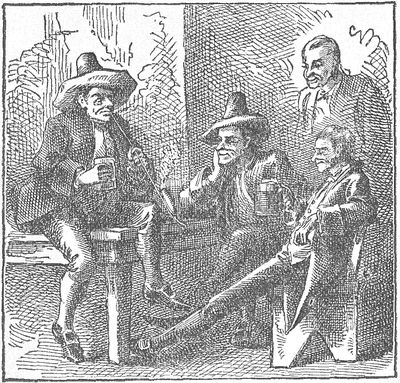
Dutch Planters.
The Dutch planters of tobacco are among the happiest cultivators of the plant in Europe, if not in the world, and unlike the renowned Van Twiller never "have any doubts about the matter," and believe that tobacco is absolutely necessary to sustain life. After the evening meal the planter lights his pipe or calls upon the good dominie, to have a social chat, discoursing over their favorite beverage the virtues of two great luxuries. Oftener, however, he passes his evenings at the village inn, where, surrounded by other comrades, he discourses as follows of his favorite plant,—tabak:
"That the smoking of tobacco is of infinite benefit, no one who is impartial and unprejudiced can deny. In a country like Holland, where the atmosphere is always laden with heavy and hurtful particles, and where, while people breathe that atmosphere from above, they feel themselves not less affected from below by the cold, moist, swampy soil—the smoking and the chewing of tobacco are the wholesome prophylactics of which we can make use. To the Indians and the Negroes, tobacco is almost the only solace in this transient life. They learn, by means of it, to support nature, and to encounter valiantly, by its help, all the tribulations incidental to the human lot. If they are depressed, they smoke or chew tobacco, and gladden themselves therewith. If they are exhausted, and the sun and their hard and inhuman masters appear to conspire to destroy them, a little tobacco restores their strength, makes them forget their slavish life, and go vigorously to work again.
In the Thirty Years' War in Germany, the smoking and chewing of tobacco proved the salvation of many thousands of men, who by its aid guarded themselves against the deadly effects of deficient food and of bad meats and drinks. Nothing is so good, nothing so serviceable to human life, as the smoking of tobacco—which may well be called a kingly plant, seeing that the monarchs of the earth are not ashamed to use it. While tobacco cultivates sociality, and is of great avail in severe hunger and thirst, it strengthens the body and checks fluxions, and colds, and slimy humors. Nature has willed it that men should make use of plants like tobacco, which, by their heat and sharpness, draw the humors outward, and cause a slight salivation. Witness, as confirmation of what has been said, cloves and pepper, which hold sway nearly over the earth; betel, which to the Hindoos is the remedy for every disease; the onions and leeks of the Egyptians, who while building the pyramids and obelisks, spent their money eagerly on those dainties; and tobacco, which is adopted by the four quarters of the world.
The justly celebrated British physician, Cheyne, has remarked that both chewing and smoking of tobacco are exceedingly serviceable for those who suffer from rheumatic and catarrhal affections, have a sluggish digestion, or live a luxurious life. As tobacco has numerous slanderers, so there are many who know not how to turn tobacco to a good purpose. Excess and abuse may be found in the smoking and chewing of tobacco as in other things. Instead of using tobacco in moderation, there are persons who make themselves its slaves, and render themselves incapable of the immense benefit of the enlivening and stimulating effect they would otherwise owe to it. A little tobacco smoked or chewed three or four times a day cannot fail to be beneficial. But the adversaries of tobacco, in order to furnish themselves with an argument, make tobacco bear all the blame when some one who has given himself up to an intemperate and luxurious life, and who is besides a great smoker, becomes the victim of all kinds of discomforts and sickness. To condemn tobacco by saying those who begin to chew or smoke it nearly always suffer from malaise and nausea, is surely preposterous. May we not in fairness contend that tobacco is essentially wholesome, that it helps digestion, relieves the mind and cheers the spirits."
The following humorous account of "Thirsty Tobacco" is a most curious illustration of the superstitions which spontaneously grow up in the hearts of the people.
"Soon after the introduction of tobacco into Holland many of the Dutch were of the opinion that the tobacco plant drank in moisture greedily and required to be often and abundantly watered. From this insatiable thirst the belief arose that tobacco was the cause of rain, brought clouds to the heavens, and restored the general crops. Once, in the neighborhood of Amersfoot, the weather was very rainy, and the crops suffered accordingly. On the tobacco growing round the town the blame of the calamity was thrown; and it was resolved to punish tobacco, the sottish rain-drinker and wicked rain-bringer. A rabble, consisting chiefly of boys and youths, rushed to the tobacco fields, and scattered havoc with the ferocity of stupidity. The mad creatures pulled up the stalks, tore off the leaves, and trampled leaves and stalks under foot. Before they had done the work of destruction quite as completely as they desired, soldiers appeared on the scene. They sternly commanded the rioters to desist, but the rioters paid no heed either to entreaties or threats. Thereupon they drew their swords, as if by the mere flash of these to terrify the rioters, who laughed a laugh of contempt. Then effectually to frighten the rioters, the soldiers fired at them with blank cartridges. This harmless noise drove the mischief-makers to ignominious flight, and the tobacco plants which were still uninjured were left in peace."
At what exact time this destruction of "thirsty tobacco" took place we are left in doubt. It is doubtless a "good joke" got up by some "ponderous joker" for the amusement of Dutch smokers.
All admirers of tobacco like Holland and its people. It is emphatically the land of smoke. One is constantly in cloud-land, and whether in the house or on the street the incense of tobacco is perpetual, from the good natured dominie who puffs leisurely at many pipes to the humblest peasant who works modestly among the plants, all burn the fragrant weed and pay homage to its shrine. Ever since the Dutch looked upon the plant it has been more to them than king and courtier. The old Dutch burgomasters "who dozed away their lives and grew fat upon the bench of magistracy in Rotterdam; and who had comported themselves with such singular wisdom and propriety, that they were never either heard or talked of, owed all to the use and influence of the 'kingly plant.'" Not only are the Dutch prodigious smokers, but they use the pipe at all places and at all times. On the way to Church the pipe is lighted, and after service it is the solace of the evening hour.
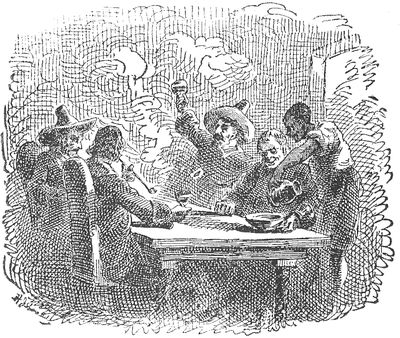
Success to Von Tromp.
In all public places the pipe plays an important part. The traveler is constantly reminded of the use of tobacco; for even the bridges have public notices affixed to them requesting all visitors to prevent the fall of tobacco-ashes on the gravel or grass; and not to knock out their pipes within bounds of the place. The old Dutch planters were fond of a "silent pipe," and after the labors of the day gathered together to drink and smoke to the success of Admiral Von Tromp, whose exploits in the British Channel carried terror to many a heart. Or, speculated upon the voyage of the "Goede Vrouw" (Good Woman), which had been fitted out to colonize the new country.
The progress of tobacco-culture in Oceanica, is shown in the following account which Connor gives of the tobacco plantations of Australia:
"The development of tobacco culture in Australia has been great and rapid. In these colonies, where only a few years ago the plant was not known, there are now hundreds of acres under tobacco. The local manufacture is also keeping pace with the production of the leaf, and the import of tobacco into the Australian colonies yearly diminishes in proportion to the increased consumption of locally grown and manufactured tobacco. Imported leaf is used in the manufacture of cigars, those made from colonial leaf being held in low esteem. Steady efforts are being made by the cultivators to improve the quality of the produce, and with every prospect of success, many places in the colonies being well adapted for the growth of the plant. Colonel De Coin says Australia is capable of producing very good qualities. Tobacco has hitherto been grown upon alluvial lands, but a preference is evinced for lands somewhat less rich but free from floods. Alluvial land gives a larger crop per acre, but the flavor is ranker. In 1872 there were 567 acres under tobacco in New South Wales. The average produce of the colonies is about 1,300 pounds to the acre. The amount of produce varied from 976 pounds to the acre in New South Wales to 2,016 in Tasmania, the climate of this island being moister and more favorable for tobacco than that of the other colonies. Manilla and Havana tobacco has been grown with great success for seed for many years at the Adelaide Botanic Gardens, and the seed raised has been largely distributed."
The Australian growers may demonstrate the fact that as good or better Manilla tobacco can be grown by them than in the Philippine islands. If the leaf will burn freely, and leave a white, firm ash, the product will no doubt prove a rival of the leaf grown in Luzon. From the composition of the soil, it is hardly probable that Havana tobacco can be grown to perfection; it may, however, resemble in some measure the Cuban leaf. The climate has much to do with the flavor of tobacco; more than with the size of the plants or the color of the leaf. Cuba in this respect has a decided advantage over Australia; and Havana tobacco will hardly find a rival in Australian leaf, though grown on the finest soil, and given the most thorough care.
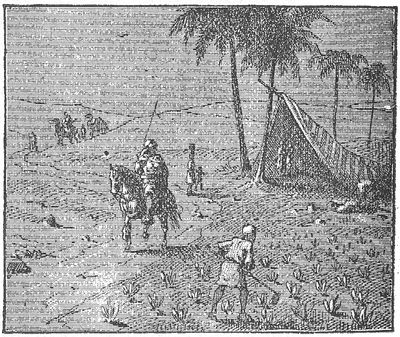
Tobacco Field in Algiers.
So extensive is the cultivation of the tobacco plant, that even the Arab cultivates it in the burning desert. In Algiers it is an important product; and through the efforts and encouragement of the French government its cultivation is assuming large dimensions. Some portions of Algiers seem to be well adapted for tobacco, the finest of which is equal to any obtained from America; but a large portion of the product from that province is of poor quality. It is a favorite plant with the Arab, and his attention seems to be about equally divided between his tobacco and his camels. The plant is light in color and of peculiar flavor, well suited to his taste, and in keeping with his idea of quality and excellence. The crop is usually bountiful, notwithstanding the heat of the summer and the absence of moisture in the soil.