Chapter XIV
Reading edition
THE PRODUCTION, COMMERCE AND MANUFACTURE OF TOBACCO.

Few comparatively of the users or even of the growers and manufacturers of tobacco, are aware of the vast amount cultivated, manufactured and used. Many suppose that its cultivation is confined to the United States and a few of the West India Islands, having no idea of the large quantities grown in Europe, Asia and Africa and the islands of the East India Archipelago. The Spaniards first began the cultivation of the plant on the Island of St. Domingo, afterwards extending it to Trinidad, the coast of South America, Mexico and the Philippine Islands. In Portugal the cultivation commenced about 1575-80, and continued some years. The Dutch a little later, began the production of tobacco in the East Indies, and in connection with the Spaniards and Portuguese were the only cultivators of tobacco until the English commenced its growth in Virginia in 1616.
The first production in St. Domingo by the Spaniards was sometime previous to 1535, and the island has continued to produce the great staple until now. In Trinidad, however, a finer article was yielded, and its cultivation became more general here until the Spaniards began to plant it in Cuba in 1580. From the West Indies, South America and the East Indies, Europe raised its supply of tobacco until the English colonists commenced its cultivation in Virginia. The Spaniards and Portuguese at first controlled the trade in tobacco, and extorted most fabulous prices for it. As soon, however, as the Dutch and English began to cultivate it and receive it from their colonies the price gradually fell while the demand and consumption for it increased in proportion to the falling off of prices. From the island of Trinidad, Europe received its finest tobacco, and it continued to maintain its reputation as such until that variety known as Varinas tobacco from South America appeared; this variety attracted the attention of European buyers and consumers, from its superiority in flavor and appearance which it has maintained for more than two hundred and fifty years.
In South America, the cultivation of tobacco took its rise in Venezuela, Brazil and Colombia. The varieties there produced had acquired an established reputation as early as 1600, together with St. Lucia, Philippine and Margarita tobaccos. Early in the Seventeenth Century, the Dutch became the great producers and importers into Europe, and the growths of their colonies continued to furnish a large proportion of the quantity used until English colonial tobacco made its appearance from Virginia.
The Plymouth and London companies from its first appearance in their markets, saw its vast importance as an article of agriculture and commerce, and in twenty years after the first planting of it, began to reap rich returns from its sale and production. From this time forward, not only in America, but in Europe and Asia, its cultivation spread among other nations until at length it has become one of the great sources of revenue of almost every country, and a leading product of nearly every clime. The islands of St. Domingo, Trinidad, St. Lucia and Martinique, do not produce as large quantities of tobacco as formerly; its cultivation in the West Indies being now confined chiefly to the island of Cuba.
This island produces at the present time the finest cigar leaf of the West Indies, which is considered by many as the best grown. The value of the annual product of Cuba is estimated at $20,000,000, nearly as much as that of the entire United States. Brazil, Colombia, Venezuela, and Paraguay, which are the tobacco-producing countries of South America, furnish Europe with a large amount of leaf tobacco. In Brazil according to Scully it "occupies the fourth place in the exports" and is extensively cultivated in various parts of the empire. In Venezuela it is an important article of agriculture, and the product is of fine quality and in good repute in Europe. Colombia has long been noted for the amount and excellence of its tobacco; its various growths are fine in all respects and are among the finest cigar tobaccos grown. In Paraguay large quantities of excellent cigar tobacco are raised, much of which is used in various parts of South America, the remainder going to Europe.
As we go South, we reach the great tobacco-growing states, Maryland, Virginia, Kentucky, and others. Maryland has long been noted for its tobacco, and annually exports thousands of hogsheads to European markets. Virginia, as we have seen, is the oldest tobacco-producing state in the Union, and still continues to raise thousands of acres of the "weed" for home use and for export. In 1622, six years after its cultivation began, she produced 60,000 pounds of leaf tobacco. North Carolina also raises a fine article of smoking tobacco—of fine color and superior flavor. This state has long been noted for its superior leaf tobacco, and ever since the first settlement of the state has produced large quantities of it. In 1753 100 hogsheads were exported, the number constantly increasing until the present. In Georgia some tobacco is grown. Havana tobacco was first cultivated in this state by Col. McIntosh, and succeeded finely in some of the counties along the coast.
In Florida, Havana tobacco is cultivated altogether. It differs somewhat in flavor, however, so that it is called Florida tobacco, not because it is grown in that state, but because it is a little bitter, unlike that grown in Cuba. Kentucky is the great tobacco-producing state of the Union. Two-fifths of the entire amount grown in the country comes from this state. In 1871 nearly 150,000 acres were devoted to it in the state—producing 103,500,000 pounds of leaf tobacco. In Ohio and Missouri large quantities of tobacco are grown, the former state furnishing both cutting and seed leaf tobaccos. The other Western states including Illinois, Indiana, and Wisconsin, are engaged largely in its production, and furnish a good article of leaf.
California for the last few years has given the culture of tobacco some attention, and promises to become a great tobacco-producing state. The United States have cultivated in some seasons 350,769 acres of tobacco, valued at $25,901,769. The average yield per acre is greater in Connecticut than in any other state, being 1,700 pounds, while the smallest yield is in Georgia, 350 pounds. The average price per pound in Connecticut is 25 cts; in Kentucky 7 7-10 cts; in Georgia 21 4-10 cts; in Ohio 9 1-10 cts; and in Pennsylvania 15 2-10 cts. In 1855 there was exported from this country 150,213 hogsheads and 13,366 cases of tobacco.
In Europe large quantities of tobacco are grown, excepting in England, Spain, and Portugal, where its culture is prohibited by law to benefit the colonial growers of the plant. Austria is the great tobacco-producing country of Europe, and yields an annual product of 45,000,000 pounds of tobacco; the leaf is of good quality, and is used for cigars. France also raises about 30,000,000 pounds of tobacco besides importing large quantities from the United States. In Russia the annual tobacco crop is about 25,000,000 pounds. In Holland about as much tobacco is grown as in the state of Connecticut—6,000,000 pounds and the product is adapted for both cigar and snuff-leaf. Large quantities of tobacco are also imported, from 30,000,000 to 35,000,000 pounds. The tobacco factories in the country are stated to give employment to one million operatives. Belgium produces considerable tobacco, about 3,000,000 pounds annually. Switzerland also raises from 1,000,000 to 1,200,000 pounds of leaf. In Greece tobacco is an important product and the quality of leaf is very fine; her product has been as high as 5,500,000 pounds.
In Asia tobacco has long been cultivated, and is one of the greatest products of the country. In both Asiatic and European Turkey the annual production is about 43,000,000 pounds. In China and Japan large quantities are grown, as well as in Persia, Thibet, and other portions of Asia. In the Philippine Islands its cultivation is carried on by the Spaniards, as it has been for upwards of 250 years. Bowring says of its culture:—
"The money value of the tobacco grown in the Philippines is estimated at from 4,000,000 to 5,000,000 of dollars, say 1,000,000l. sterling. Of this nearly one half is consumed in the island, one quarter is exported in the form of cheroots (which is the Oriental word for cigars), and the remainder sent to Spain in leaves and cigars, being estimated as an annual average contribution exceeding 800,000 dollars. The sale of tobacco is a strict government monopoly, but the impossibility of keeping up any sufficient machinery for the protection of that monopoly is obvious even to the least observant. The cultivator, who is bound to deliver all his produce to the government, first takes care of himself and his neighbors, and secures the best of his growth for his own benefit. From functionaries able to obtain the best which the government brings to market, a present is often volunteered, which shows that they avail themselves of something better than the best. And in discussing the matter with the most intelligent of the empleados, they agreed that the emancipation of the producer, the manufacturer and the seller, and the establishment of a simple duty, would be more productive to the revenue than the present vexatious and inefficient system of privileges.
"In 1810 the deliveries were 50,000 bales (of two arrobas), of which Gapan furnished 47,000 and Cayayan 2,000. In 1841 Cayayan furnished 170,000 bales; Gapan, 84,000; and New Biscay, 34,000. But the produce is enormously increased; and so large is the native consumption, of which a large proportion pays no duty, that it would not be easy to make even an approximative estimate of the extent and value of the whole tobacco harvest. Where the fiscal authorities are so scattered and so corrupt;—where communications are so imperfect and sometimes wholly interrupted; where large tracts of territory are in the possession of tribes unsubdued or in a state of imperfect subjection; where even among the more civilized Indians the rights of property are rudely defied, and civil authority imperfectly maintained; where smuggling, though it may be attended with some risk, is scarcely deemed by any body an offense, and the very highest functionaries themselves smoke and offer to their guests contraband cigars on account of their superior quality,—it may well be supposed that lax laws, lax morals and lax practices, harmonize with each other, and that such a state of things as exists in the Philippines must be the necessary, the inevitable result.
"I am informed by the alcalde mayor of Cayayan that he sent in 1858 to Manilla from that province tobacco for no less a value than 2,000,000 dollars. The quality is the best of the Philippines; it is all forwarded in leaf to the capital. The tobacco used by the natives is not subject to the estanco, and on my inquiring as to the cost of a cigar in Cagayan, the answer was 'Casinada' (Almost nothing). They are not so well rolled as those of the government, but undoubtedly the raw material is of the very best."
In Sumatra some of the finest tobacco in the world is produced which has an established reputation in European markets.
In Africa tobacco is grown to some extent in Egypt, Algiers and Tripoli as well as by the natives of Central and South, Western Africa. The French have paid particular attention to its culture in Algiers and have succeeded in producing tobacco of good flavor and texture. In Australia the plant does remarkably well and promises to become as celebrated as that of other portions or islands of the East India Archipelago.
The tobacco of South America is exported almost entirely to Europe. England receives a large quantity of South American tobacco as well as Spain and Portugal. The varieties cultivated in Asia and Africa for export are shipped mostly to Europe. Great Britain, Spain, France and Germany are the great tobacco-consuming countries of the world, or at least of Europe. In Great Britain, Spain and Portugal, no tobacco is cultivated, and these countries are therefore dependent upon their colonies for a supply of the great product. The commerce in the plant is extensive and reaches to every part of the globe. No nation, state, or empire now ignores the revenue to be derived from its import or culture, and many a government receives more from this plant alone than from any other source.
While some nations prohibit its culture at home, their colonies are allowed to grow it, and thus the article and the revenue are both secured. But while the production of the plant and the commerce depending on it are extensive, they are not more so than the manufacture of the leaf into the various preparations for use. The government work-shops of Seville and Manilla, as well as those of Havana and Paris are of enormous proportions and employ thousands of operatives in the manufacture of cigars and cigarettes. In this country and in England, large quantities of cigars are made both from domestic and foreign tobaccos.
In South America also many are made, but more for home use than for export. Cutting leaf is largely manufactured in this country, especially near the great leaf growing sections. Most of this is used here, the leaf for manufacture abroad being exported in hogsheads for cutting in any form desired. Snuff leaf is exported largely from this country to Great Britain and France, where are the largest manufacturers of snuff in the world. At the present time the demand seems greater for cutting than for cigar leaf. The growths of the West Indies and South America furnish a large quantity of fine tobacco for cigars, but comparatively little for cutting purposes. European tobaccos are adapted for both cutting and for cigars, and are used extensively at home though not considered equal to American varieties, being of a milder flavor. As an article of production and commerce, tobacco must be considered as important as any of the great products or staples, since the demand is constant and continually increasing. Year by year its cultivation extends into new sections, where it becomes a permanent production if the soil and climate prove congenial. From time to time new varieties become known, and are cultivated in various countries with success varying according to the soil and climate and the knowledge of the planter. Nowhere is the plant receiving more attention both in its cultivation and manufacture, than in this country. The varieties grown in the tropics have been tested with more or less success, and bid fair ere long to become the leading kinds in some sections. But not alone in this country is the plant attracting the attention of the great commercial nations. In Europe and Asia as well as in Africa, its production is assuming the large proportions due to its vast importance to Agriculture and Commerce.[Back to Contents]
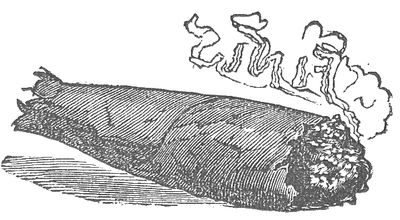
"From the first introduction of the weed, the votaries of the pipe have enjoyed all the blessings of persecution. Kings have punished, priests have anathematized, satirists satirized and women scolded; but still the weed, with its divers shapes and different names, reigns supreme among narcotics in every region of the globe."—Emerson's Magazine.[Back to Main Text]
"For physic and farces his equal there scarce is; His farces are physic, his physic a farce is."[Back to Main Text]
"To such a height with some is fashion grown They feed they very nostrils with a spoon. One, and but one degree is wanting yet, To make their senseless luxury complete; Some choice regale, useless as snuff and dear, To feed the mazy windings of the ear."[Back to Main Text]