ROTISSERIE
Reading edition
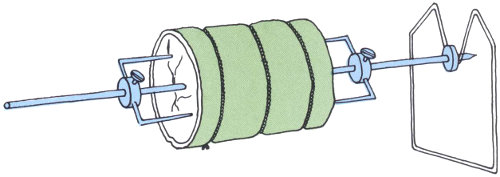
ROTISSERIE TIPS
Foods cooked on the rotisserie require little attention because they rotate slowly, basting themselves to achieve flavor and appearance.
It is best to bring meat to room temperature before cooking.
Before preheating, check to see that food on rotisserie spit is centered under the burner and rotating evenly. Reposition food if necessary.
For most accurate test of doneness, use a meat thermometer. It will indicate internal temperature which is more accurate than estimating time. Insert carefully so thermometer does not touch fat, bone or rotisserie spit, or hit any part of compartment when meat is rotating.
Bones and fat are both good conductors of heat, so roasts which have larger amounts will cook more quickly than lean boneless pieces.
Smaller pieces of meat require a longer cooking time per pound than large pieces of meat.
Season the cavity of poultry before cooking. Stuff if desired. Tie wings and legs close to body before securing firmly on rotisserie spit. Season skin. Brushing with butter is not necessary.
When using High flame, baste only during the last 10 minutes of cooking. When a longer basting period is desired, it is best to use Low flame.
To make a roast carve more easily, allow the meat to “set” after cooking. Rare roasts should be covered loosely and allowed to stand in a Gas oven at 170 degrees for 20 to 30 minutes before carving. The medium and well-done roasts should be allowed about half this much time.
46
CONVENTIONAL BURNER ROTISSERIE GUIDE
Consult manufacturer’s instruction booklet for specific information. The following is intended only as a guide.
The rotisserie may be located in the oven, broiler or on top of the range. FOR ROTISSERIE LOCATED IN OVEN, FOLLOW TIME AND TEMPERATURE GIVEN IN OVEN MEAT ROASTING GUIDE.
In built-in ranges with rotisserie located in broiler compartment under oven, set oven thermostat at 350 degrees for low flame; at “broil” for high flame. Keep door closed as for broiling.
Preheat 10 minutes.
FOOD WEIGHT POUNDS FLAME SETTING FOR ROTISSERIE MINUTES PER POUND
BEEF
Rolled Rib 4-6 In Broiler—Low Rare 26-30
Medium 35-40
Well-done 40-45
Tenderloin 2½-3 In Broiler—medium Rare 10-15
Medium 15-20
Well-done 22-28
LAMB
Rolled Leg 4-5 In Broiler—low ... 40-45
PORK
Canadian Bacon 3-4 In Broiler—low ... 20-25
Ham-cured 3-4 In Broiler—low ... 35-40
Ham-precooked 4 In Broiler—low ... 20
Loin, fresh (boned and rolled) use meat thermometer to make sure that pork roasts are well-done. 3-5 In Broiler—low ... 45-55
47
FOOD WEIGHT POUNDS FLAME SETTING FOR ROTISSERIE COOKING TIME
Spareribs In Broiler—low 1½-2 hours
Weiners In Broiler—medium 12-15 min.
POULTRY
Chicken (halved) 2-3 In Broiler—low 1-1¼ hours
Chicken (whole) 2-3 In Broiler—medium 1¼-1½ hours
Cornish Hen ¾-1 In Broiler—low 1½-2 hours
Duckling 4-5 In Broiler—low 2½-3 hours
INFRARED BURNER ROTISSERIE GUIDE
Use High flame for preheating and cooking
Preheat 5 minutes
FOOD WEIGHT POUNDS DONENESS MINUTES PER POUND INTERNAL TEMPERATURE
BEEF
Rolled Rib 4-6 Rare 20 140°F.
Medium 22 160°F.
Well-Done 25 170°F.
Rib Eye Roast 3-4 Rare 20 140°F.
Medium 22 160°F.
Well-Done 25 170°F.
LAMB
Rolled Leg 3-4 Medium 25 175°F.
PORK
Canadian Bacon 2-3 Well-Done 20 170°F.
Ham—Ready-to-Eat 5-6 Well-Done 20 160°F.
Loin—Bone In 4-5 Well-Done 15 170°F.
POULTRY
Broiler-fryer 2-3 Well-Done 20 190°F.
Turkey (not stuffed) 6-8 Well-Done 15 190°F.
48