CARE AND CLEANING
Reading edition
You will find that your Gas Range is as easy to care for as it is to use. The following suggestions will help keep it looking—and cooking—like new. Remember, good care means longer wear and maximum good service from any household appliance.
AN OUNCE OF PREVENTION:
1. Use correct flame size. A flame which is too high will cause spattering and spillovers. Also, avoid overfilling utensils.
2. Before putting utensils into the oven or on a surface burner, be sure outside of pan is thoroughly clean.
3. Time cooking operations properly, and use CORRECT TEMPERATURES for roasting, baking and thermostatic top burner cooking. This will not only give you better cooking results, but also eliminate the possibility of spillovers and hard-to-clean pans.
4. A little care regularly keeps a range like new and is much easier than waiting until stains are cooked on and a major cleaning job is necessary. All surfaces can safely be washed with detergent and hot water. To retain the original appearance, RINSE and wipe surfaces dry after washing.
5. To keep the fine porcelain enamel and polished metal finishes free of scratches, avoid the use of gritty, harsh cleansers and abrasives which in time take away the shiny new finish.
6. If acid foods such as fruit juices, vinegar, coffee, tea or milk are spilled on the range, wipe them off immediately to guard against permanent discoloration of the finish.
7. Never place extremely hot utensils on the porcelain finished areas.
THE POUND OF CURE:
1. If there is a spillover when the range is warm, wipe off with a dry cloth or paper towel. After the range is cool, finish cleaning with warm water and a mild soap, or wash with a solution of 3 tablespoons baking soda dissolved in 1 quart of warm water. Rinse in clear warm water and dry with soft cloth.
2. Never scrape surfaces with a sharp object such as a knife or razor blade. In most cases, ordinary stains can be removed from the range with baking soda and a damp cloth. If the stain proves to be stubborn, use a mild cleanser such as Bon-Ami, Bab-O, or similar cleansers.
3. In most cases, a damp cloth will wipe the chrome surface clean. Use any one of the many good chrome cleaners if the stains prove to be stubborn.
4. All removable parts (except aluminum) will clean more easily if soaked in ammonia and hot water (4 tablespoons to 2 quarts) for a few hours.
5. If food spills over in the oven, sprinkle with salt to stop smoke and odor. Clean as soon as finished baking. Failure to do so may result in a permanently pitted surface.
7
COOK TOP
BURNERS
Burners can be wiped off without removing them from the range. However, they are removable for an occasional thorough washing in a solution of detergent water. Remove stubborn spots with a damp cloth and baking soda. They may be placed in an inverted position in a warm oven to be dried. It is not necessary to boil burners. Be sure to fit burners securely back into place.
BURNER PORTS
To clean top burner ports, use a pipe cleaner which has been dipped in ammonia or a wire, such as a straightened out paper clip rather than a toothpick which could break off and further clog the ports.
THERMOSTATIC SENSING DEVICE
Cooking is carefree and accurate if the sensing device of the thermostatic top burner is kept clean. Simply wipe with a damp cloth or remove stubborn spots with SOAPLESS, fine steel wool. Generally the sensing devices do not lift out, however, there are exceptions. Refer to your range manufacturer’s manual for specific instructions.
BURNER BOWLS, GRIDS, DRIP TRAYS
Burner bowls, grids and drip trays can be removed for washing at the sink. Wash with mild detergent and hot water. If especially soiled, soak in a solution of hot ammonia water. Remove stubborn spots with a damp cloth and baking soda.
BURNER CONTROL
Burner control knobs are removable. Be sure control is in OFF position before removing knob. If knobs do not remove easily, slide a dish towel or cloth under the edge of the knob; encircle the knob and pull. Wash with mild detergent and hot water.
OVEN
OVEN INTERIOR
The oven interior and all removable parts clean much easier if a small dish of undiluted household ammonia is allowed to stand in it for several hours or overnight prior to washing. In most cases, cleaning can be completed with hot soapy water. Baking soda or a mild cleanser can be used on stubborn spots and stains. Soap filled steel wool pads may be used if well moistened and used gently.
Teflon-lined oven: Refer to range manufacturer’s instruction booklet.
OVEN WINDOWS
Oven windows are not removable in most ranges. Wash in place with mild detergent and water or a solution of baking soda and water (3 tablespoons to 1 cup water).
OVEN DOORS
Oven doors are removable on some ranges for easy cleaning. Also, once removed, access to the oven interior is easy. Refer to your range manufacturer’s manual regarding this feature.
OVEN BOTTOM
The oven bottom and oven racks are easily removed for cleaning at the sink in mild detergent and water. If necessary, clean with fine steel wool pads, rinse well and wipe dry. Be sure to replace in correct position for even heat distribution.
8
MEAT PROBE
A meat probe should not be immersed in water when cleaned. Wipe with a damp cloth.
A meat probe is a delicate instrument which should not be abused. When disconnecting the probe after cooking, grasp the plug on one end and the solid part of the probe on the other end. DO NOT PULL ON THE CABLE AT ANY TIME.
Also, the meat probe should not be stored in the oven or other parts of the range. Since the probe could become defective if it is exposed to 350 degrees or over, it should be stored at room temperature.
BROILER
Broiler pan cleaning can be minimized by removing the broiler pan BEFORE preheating broiler compartment. Cold food placed on a hot broiler pan will stick before it is placed in the broiler. After food is cooked, remove it AND the broiler pan from broiler compartment. Drippings will bake on the broiler pan if left in a hot broiler compartment. As soon as food has been removed from the broiler pan pour off grease. Sprinkle pan and insert with soap powder or liquid detergent and cover with a hot damp cloth or wet paper towels. Drippings will steam and loosen while the meal is being served. A soapy fine steel wool pad may also be used if needed. Do not cover broiler pan insert with aluminum foil during broiling. Grease MUST be allowed to drip through the broiler pan insert into the lower pan away from the heat.
ACCESSORIES
ROTISSERIE
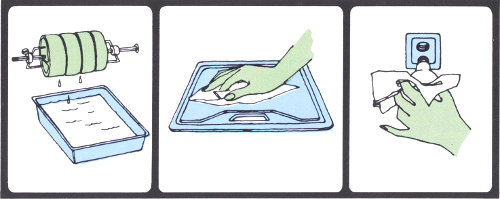
Rotisserie with burner above food: Use broiler pan without insert as a drip pan. Keep at least ½ inch of water in pan to eliminate spattering of basting sauces and to aid cleaning.
Rotisserie with indirect heat from oven burner: Water in the rotisserie pan is not recommended when using this type rotisserie. Since the water is between the food and the burner—there is too much steaming. Instead, crumple aluminum foil and place in rotisserie pan to catch drippings and help reduce spattering.
9
GRIDDLE
To keep a gleaming griddle, turn off the flame when cooking is finished and wipe the surface with paper towels. When cool, wash with hot soapy water (not synthetic detergent), rinse and dry thoroughly. Avoid using a soda or alkaline cleaner.
To preserve the finish of the griddle never scrape it with knives or other sharp objects.
Overheating or sudden temperature changes can damage a griddle.
Teflon: Refer to manufacturer’s instructions.
LIGHT BULBS
If oven light needs replacing, buy a 40 watt Heat Resistant lamp (not an ordinary light bulb). Turn light switch to OFF position, cover old lamp with a dry cloth and unscrew; replace with new one. When cleaning, do not touch hot lamp with a wet cloth; it may break.
CLEANING CHART
MATERIAL OR FINISH RANGE PART TO REMOVE SOIL
Porcelain Enamel Cook Top Door and Side Panels Burner Grids Burner Bowls Detergent OR baking soda (3 Tbsp. to 1 qt. water) and hot water
Oven Interiors Broiler Pan Detergent OR ammonia and hot water
Broiler Compartment Interior Soap filled steel wool pad with plenty of water
Oven Racks and Guides Ammonia Solution (½ C. to 1 gal. water)
Chrome Burner Bowls Oven Interior Handles Detergent and hot water or chrome polish
Aluminum Burner Caps Trim Detergent and hot water, soapy fine steel wool pad, or aluminum cleaner. Dry aluminum parts fairly rapidly. To prevent darkening, do not soak.
Glass, Plastic and Enamel Paint Back Panel Oven Window Burner Control Knob Range Bottom Detergent and hot water only; rinse well and polish dry.
Stainless Steel or Brushed Chrome Doors Range Tops Full strength ammonia OR full strength liquid all-purpose cleaner with ammonia; rinse well and polish dry.
10
TOP OF RANGE
TOP BURNERS
Gas burners provide a thousand and one shades of heat from high to very low to suit every cooking need. Heat is supplied instantly, and there is no leftover heat when the burner is turned off. To use the burner, turn the burner control until the burner ignites; then turn to adjust the flame size. Some burners have audible “clicks” to indicate heat settings.
FLAME SIZE
Correct flame size is determined by pan size, pan material, what you are cooking and whether you are cooking with liquid. Even when cooking in a liquid or with a pan which conducts heat well, you may want to lower the flame to adjust for pan size (see sketch below). The flame should never extend beyond the outer edge of the utensil. Any higher flame is wasted heat.
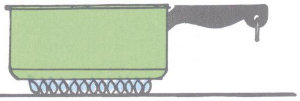
For all cooking in aluminum utensils or for cooking in liquid in other utensils, adjust the flame so it touches the pan about ½ inch from the outer edge.
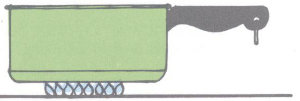
For non-aluminum pans (unless you are cooking in liquid) adjust the flame so it is about half the diameter of the pan.
Foods cook just as quickly at a gentle boil as at a rapid rolling boil—in both cases the water temperature is 212 degrees. A high boil is used only to bring food to the boiling point; then lower the flame and finish cooking with a minimum flame.
EXCESS HEAT RESULTS IN HARD-TO-CLEAN GREASE AND STEAM DEPOSITS ON WALLS, CABINETS AND CEILINGS. WHILE THE FUEL IS OFTEN BLAMED FOR SUCH DIRT, THE REAL PROBLEM IS TOO MUCH HEAT AND/OR FAILURE TO COVER UTENSILS WHENEVER POSSIBLE.
HIGH FLAME
For instant heat needed to bring foods to a rapid boil.
MEDIUM FLAME
To brown and fry food.
SIMMER FLAME
To maintain gentle boil for boiling or steaming, cream sauces, gravies, puddings, etc.
KEEP WARM
To keep foods hot without additional cooking; melting and keeping hot beverages at serving temperature. Always cover utensils with this setting.
11
FLAME ADJUSTMENT
Of all its advantages, the cleanliness of GAS is perhaps the greatest. A properly adjusted Gas flame is one of the cleanest energy sources known.
The color of the flame is the key to proper burner adjustment. A good flame is clear and blue and hardly visible in a well lighted room. Each cone of flame should be steady and sharply defined.
A THOUGHT OR TWO ABOUT A POT OR TWO
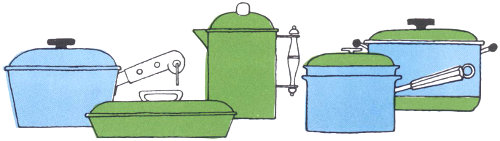
Cooking is easier with the correct pan; a well designed pan. Look for these characteristics when selecting new pans:
GOOD BALANCE
aids even heating and ease of use. The pan should set level with or without food.
WELL FITTED COVER
helps to retain moisture, flavor and nutrients during the cooking process. It keeps temperature in the pan more even and holds in heat, aroma, and steam. Cover pans whenever you can so foods cook with maximum speed and minimum clean-up. Cooking with a cover will require a lower flame setting than will be needed for the same food cooked uncovered.
HEAT-RESISTANT HANDLE
aids in easy handling of the utensil and avoids discomfort or burn.
DENT-RESISTANT MATERIAL
aids in retaining the original shape of the pan to insure good lid fit and ease in cleaning.
GOOD HEAT CONDUCTOR MATERIAL
insures more even heating of the pan and more even browning or cooking. Examples of good heat conducting materials are: aluminum or aluminum-clad stainless steel. Materials which conduct heat slowly (stainless steel, cast iron, glass and enamel) may require special attention for desired results. GENERALLY, LOWER FLAME HEIGHTS ARE BEST FOR NON-ALUMINUM UTENSILS.
12