Chapter VIII · THE OBI.
Reading edition
Dimensions of river.—Its tributaries.—Province of Tobolsk.—Geographical features.—Population.—Voguls.—Samoyedes.—Intemperance.—Commercial prospects of Obi.—Siberian produce.—Corn land.—Timber.—Cost of provisions.—Carriage.—Discoveries of Wiggins.—Followed by Nordenskiöld.—Ship-building at Tiumen.—Navigation of Kara Sea.—Books on basin of Obi.
The Obi is one of the largest rivers of the Old Continent, and seems destined to play an important part in opening up to commerce the immense wealth of Western Siberia. Something, therefore, should be said of this enormous stream, and the province of Tobolsk through which it flows. The basin of the river contains more than a million and a quarter of square miles; an area nearly 2,000 miles in length, and, at the widest part, 1,200 in breadth.[1] This vast area is covered with a network of streams, navigable from the Arctic Ocean to the best parts of Western Siberia, the importance of which can hardly be overestimated, when it is borne in mind that the success of recent enterprise has demonstrated the possibility of carrying produce by water to Europe.
But let us now speak of the province, inhabitants, and aborigines of Tobolsk, which, though not the largest, is at once the oldest and by far the most populous of the governments of Siberia. It extends from the frozen ocean down to the 55th parallel, a distance of 1,200 miles from north to south, and of 700 miles in its widest part from east to west, its total area covering 800,000 square miles—a country, that is to say, seven times as large as Great Britain and Ireland. The surface, save where the western border approaches the Urals, is flat—so flat, indeed, that Tobolsk, which is 550 miles from the sea, is only 378 feet above its level. It has no large lakes, but there are several small ones, from which salt is obtained.[2]
Ethnographically considered, the province is not so varied as some others, the people being for the most part Russians, Tatars, Voguls, Ostjaks, or Samoyedes; the Tatars belonging to the Turkish, and the Voguls and Ostjaks to the Finnish stock. Some writers classify the Samoyedes as Finns, but Mr. Howorth considers they should be treated as a race apart. Mr. Rae, in his “Land of the North Wind,” and Mr. Seebohm, in his “Siberia in Europe,” have recently given interesting information concerning the Samoyedes.
The Voguls inhabit a district which coincides pretty closely with the ridge of the Northern Urals, and were estimated in 1876 at 5,000 in number. Their country makes them hillmen and foresters, for they lie within the northern limit of the fir and birch, in the country of the wolf, the bear, the sable, the glutton, the marten, the beaver, and the elk. They usually dress like the Russians, and live by hunting, for they have no plains for the breeding of cattle, and no climate for agriculture. They are said to use no salt. Their villages are scattered and small, consisting of from four to eight cabins. Obdorsk is their trading town. To this town, on the Arctic circle at the mouth of the Obi, come also the Samoyedes and Ostjaks, of which latter I shall speak as I saw them further east.
The Samoyedes inhabit a larger tract of country, stretching along the shore of the frozen ocean from the north-east corner of Europe, all across the Tobolsk government to the Yenesei, descending to the region of the Ostjaks, and on some parts of the southern border to Tomsk. With the Samoyedes I felt already in a measure acquainted, partly by correspondence from my friend in Finland, and partly by a near approach to them in 1878, when I travelled to Archangel. Their numbers were estimated, in 1876, at 5,700. Their riches consist of herds of reindeer, which they pasture on the mosses of the vast bogs or tundras, from which the animals in winter scrape the snow with their feet, and thus find their sustenance. To the Samoyede the reindeer is everything; when alive, the animal draws his sledge, and, when dead, its flesh is eaten and the skin used for tent and clothing.
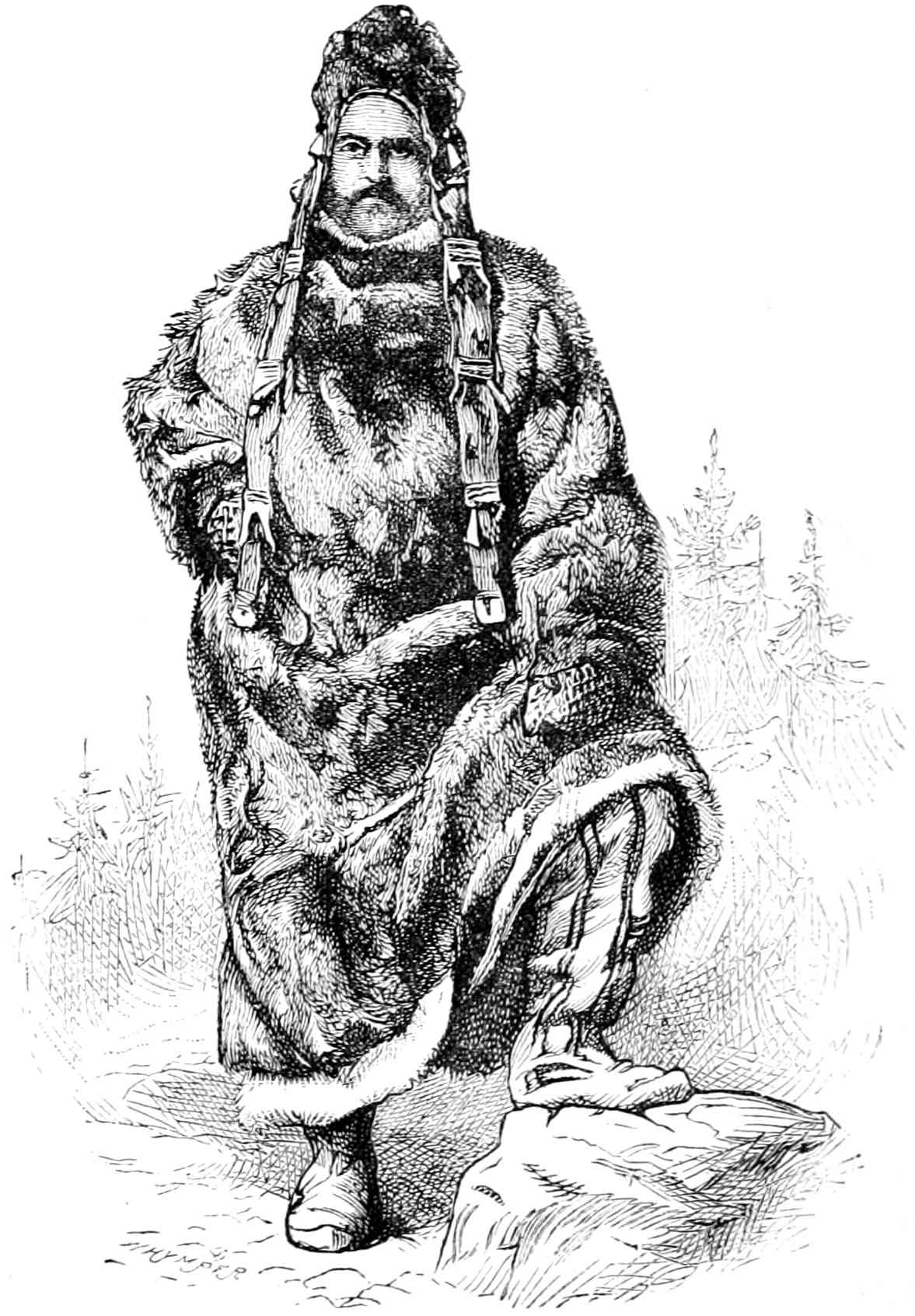
MY SAMOYEDE DRESS.
At Archangel I bought a sovik or tunic, a cap, and a wonderful pair of Samoyede boots; and as the Samoyede manner of dressing resembles in its main features that of other northern aborigines in Siberia, I may as well describe it particularly. In winter, then, to be in the (Samoyede) fashion, one should dress as follows:—First a pair of short trousers made of softened reindeer skin, fitting tight, and reaching down to the knee. Then stockings of peshki, the skin of young fawns, with the hair inwards. Next come the boots, called poumé leepte, which means boot-stockings, reaching almost to the thigh, the sole being made of old and hard reindeer hide, the hair pointing forward to diminish the possibility of slipping on the ice or snow. Common boots have the hair only on the outside. Mine are a gay “lady’s” pair, lined inside with the softest fur, and made of white reindeer skin without, sewn with stripes of darker skin, and ornamented in front with pieces of coloured cloth. The clothing of the lower limbs being completed, one must work one’s way from the bottom to the top of the tunic, or sovik, which has an opening to put the head through, and is furnished with sleeves. Mine has a high straight collar, but in some brought by Mr. Seebohm from the Yenesei this collar rises behind above the top of the head. The costume is completed by a cap of reindeer skin, with strings on either side ornamented with pieces of cloth. The hair of the sovik is worn outside in fine weather, and inside when it rains; but when prolonged exposure to cold is apprehended, a second garment, called a “gus,” is worn, with the hair outside, and a close-fitting hood, leaving exposed only a small portion of the face. The Ostjaks are said to have at the end of the sleeve a glove or mitten, made of the hardest hide of the reindeer, and suitable for heavy work, and also a slit under the wrist to allow of the fingers being put through for finer work. A girdle is worn round the loins, over which the sovik laps a little, and thus forms a pocket for small articles.
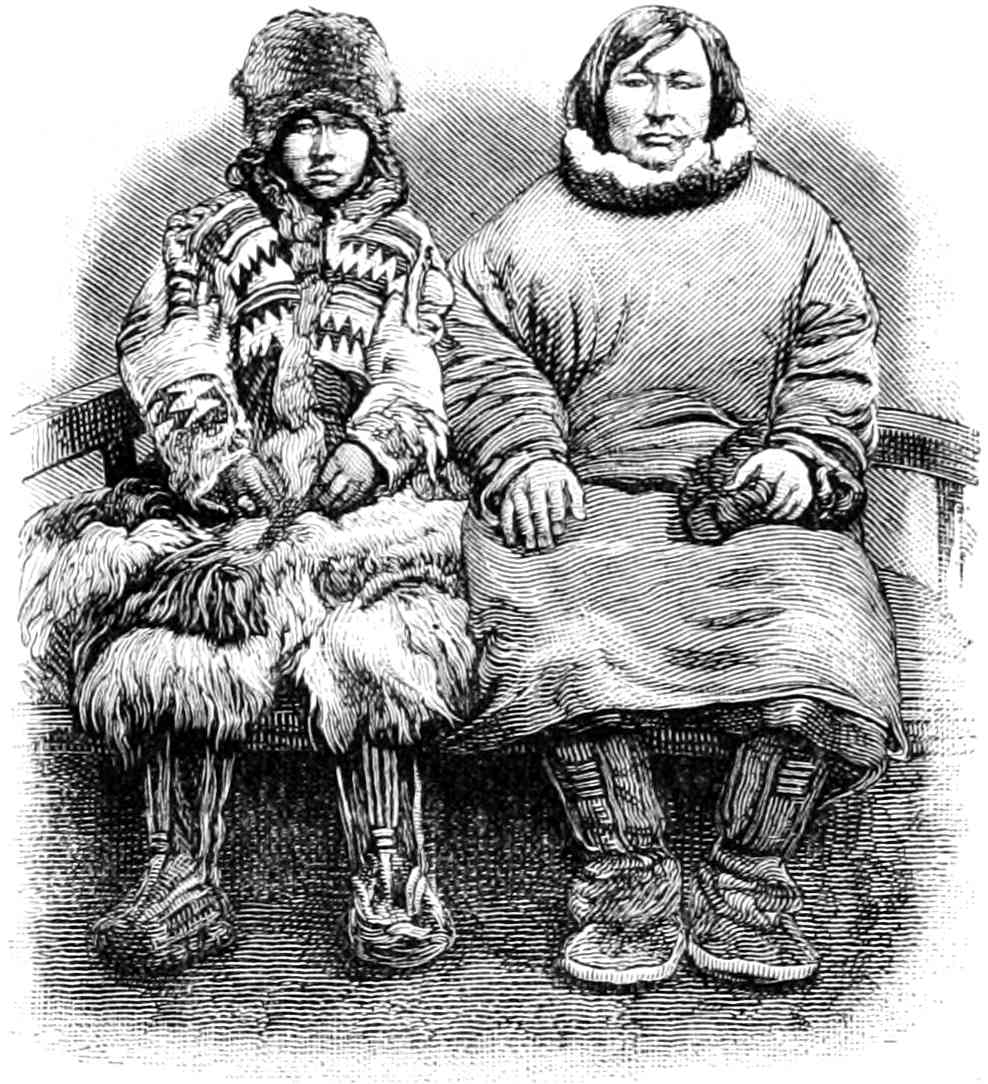
SAMOYEDES OF ARCHANGEL.
I have been told, by one well acquainted with the Samoyedes, that it is often very difficult to trade with them before giving a glass of vodka, and that, when once given, they are irrepressible in clamouring for more. Men may sometimes be seen who have brought in their wares to barter for winter necessaries, and who will exchange the whole for spirits, and reduce themselves to beggary. This has caused the Russian Government to forbid the sale of spirits in these northern regions, but the traders smuggle them in.[3]
I must not forget to add that some pleasing accounts of the honesty of the Samoyedes and Ostjaks were related to us. The merchants of Tobolsk, for instance, when they go north in the summer to purchase fish, take with them flour and salt, place them in their summer stations, and, on their return, leave unprotected what remains for the following year. Should a Samoyede pass by and require it, he does not scruple to take what he wants, but he leaves in its place an I.O.U., in the form of a duplicate stick, duly notched, to signify that he is a debtor; and then, in the fishing season, he comes to his creditor, compares the duplicate stick he has kept with the one he left behind, and discharges his obligation. Captain Wiggins also records that when, in the winter months of 1876–77, his ship the Thames was laid up in the Kureika, it was surrounded by hundreds of Ostjaks and other natives, but that nothing was stolen.
The difficulties of educating and Christianizing these wandering tribes are very great.[4] I heard, however, that in European Russia a priest is sent yearly to a town in the far north of the Archangel province, to baptize the children and marry such among the Samoyedes of that region as are professedly Christian. Réclus, however, speaks of the Yurak-Samoyedes as still practising their bloody rites, and thrusting pieces of raw flesh into the mouths of their idols. In 1877 the Russians opened a school at Obdorsk for the natives. We may hope, therefore, that for them better days are coming, both by reason of what the Russians are doing, and also, possibly and indirectly, by the efforts which certain Englishmen are making to invade the lands of these aborigines for the purposes of trade.
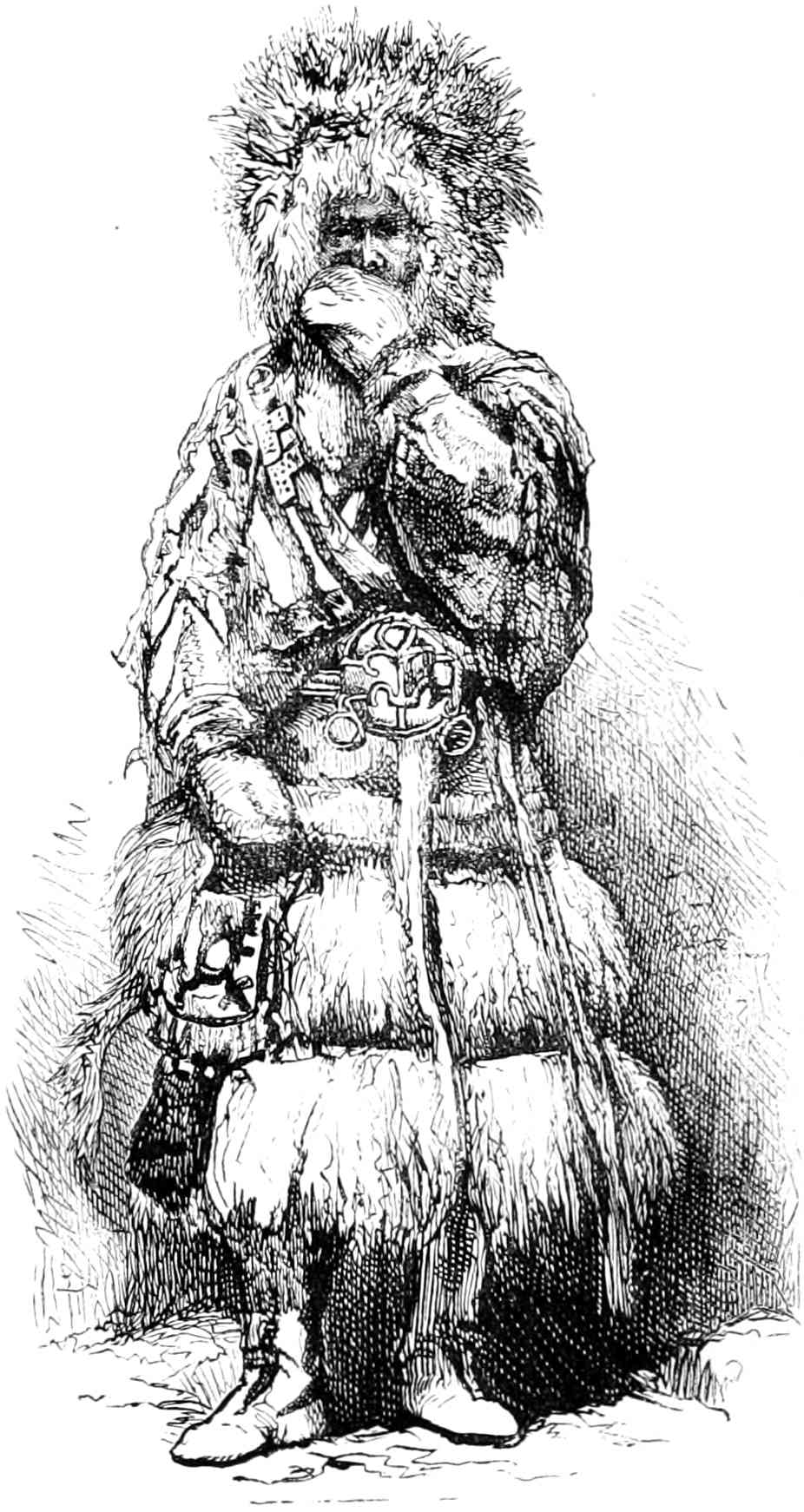
A YURAK-SAMOYEDE.
That the commercial value of the basin of the Obi and a large part of Western Siberia is not yet realized by European capitalists is the opinion of most of those that I have met who have been there. A limited demand exists for English merchandise, and the possibility of an almost unlimited supply of products needed by England. The Altai mountains, for instance, are rich in silver, copper, and iron, which last is also abundant in the valley of the Tom. But these are as nothing compared with grain, for the production of which the country is admirably fitted. From the southern border of the Tobolsk province, for 600 miles northward, lies a district of fertile black earth; and so exclusively is it of this character in the valleys of many of the rivers, which overflow like the Nile, and leave a rich deposit, that the geologist finds it difficult to pick up even a few specimen pebbles. It is like a vast tract of garden land, well suited for the production of wheat, oats, linseed, barley, and other cereals. Farther north are prairies for cattle, and a wooded region, inhabited by various fur-bearing animals, where the pine, fir, and birch abound. These remarks apply to the valley of the Obi no less than to that of the Yenesei, where Mr. Seebohm found he could purchase a larch, 60 feet long, 3 feet diameter at the base, and 18 inches at the apex, for a sovereign, and that a hundred such could be had to order in a week. In the city of Tobolsk the cost of provisions, we were told, had advanced to five times what it was 30 years ago; but even so, the present price of meat was quoted at 2d., and rye flour at a halfpenny, per pound.[5] Again, north of the wooded region come the tundras, over which roam the reindeer, wild and tame; and about 100 miles up the Kureika, which flows into the Yenesei, there is a valuable mine of graphite lying on the surface; besides which the rivers are so full of fish that the fishermen try not to catch too many, because of the frequent breaking of their nets.
These riches have long been known to the Siberians, to whom they were practically useless for export, by reason of expensive land carriage over the Urals; and the only other way of transit to Europe was through the Kara Sea, which was supposed to be ice-blocked perpetually. So far back as the sixteenth century, the English and the Dutch tried hard to penetrate the Siberian ocean, but were always stopped at Novaia Zemlia; so that for two centuries no fresh effort was made. Of late years, however, Captain Wiggins, of Sunderland, who, from his youth, appears to have been a bold and adventurous seaman, happened to read in Wrangell’s “Polar Sea” that, three centuries ago, the Russians were wont to coast from Archangel, for purposes of trade, to Mangasee, on the Taz, near the gulf of the Obi; and it occurred to him that, if they could do it in their wretched “kotchkies,” or boats of planking, fastened to a frame with thongs of leather, and calked with moss, he ought much more easily to be able to do so with the aid of steam. With his characteristic love of adventure, therefore, and at his own expense, he determined to make the attempt; and on June 3rd, 1874, he left Dundee in the Diana, a small steamer of only 104 tons. In little more than three weeks the Kara Sea was entered, and found free of ice; and the Diana entered the gulf of Obi on the 5th of August—the first sea-going vessel that had ever done so. Circumstances did not permit of his ascending the river; he returned, therefore, paid off his crew, and employed the winter in making known the feasibility of the route. He found great difficulty, however, in persuading the mercantile world, and applied in vain to the Royal Geographical Society for help to follow up his discoveries. Whereupon there came forward another explorer to snatch the rose from the captain’s hand; for Professor Nordenskiöld, seeing what Wiggins had done,—amply supported by his Government, by private enterprise, and without cost to himself (as it should be)—followed next year through the Kara Sea, passed the Obi gulf, and entered the Yenesei, from whence, having sent back his ship, he returned overland to Petersburg. The feasibility of the sea-route was now manifest; and, as I passed through Tiumen, Messrs. Wardropper were building, at a distance of 700 miles from the ocean, two sea-going ships, for Messrs. Trapeznikoff and Co., of Moscow, to be floated down the Obi and round the North Cape to England.
It is the opinion of both navigators that “a regular sea communication between Siberia and Northern Europe, during a short season of the year, ought not to be attended with greater risks and dangers than seamen encounter on many other waters now visited by thousands of vessels.” These are the sober words of Professor Nordenskiöld; and to the same effect are the words spoken publicly by Captain Wiggins, in whom we have a brave and honest seaman, and concerning whose work England need only be ashamed that he received so little support. He has shown, however, by a voyage made in 1878, that steamers of any size, but of shallow draught, can go some 400 miles up the Obi. On the 2nd of August he left Liverpool in the Warkworth, an ordinary steamer of 340 tons net register, chartered through Mr. Wm. Byford, of London, shipbroker, for sole account of Mr. Oswald Cattley, first guild merchant of Petersburg, with a miscellaneous cargo, and arrived in 15 days. He was met by lighters from the Barnaul district, with wheat, flax, etc., to load the steamer, and then convey inland the cargo from Liverpool. No mishap occurred on the outward voyage; but, in consequence of the Obi falling so rapidly, the steamer touched the ground on coming down the river. He arrived safely, however, in London on the 3rd of October; thus occupying two months on the passage out and home. Subsequent trading voyages have been attempted, some of which failed; but the causes of failure were such as may in future be overcome, the Neptune of Hamburg having made successful voyages in 1878 and 1880. It appears, then, that the trade only awaits further development,[6] and if, with specially strengthened steamers, the carriage of produce can thus be arranged between England and Siberia, both countries will doubtless be gainers thereby.[7]