Chapter XLII · THE MIDDLE AMUR.
Reading edition
Departure from Blagovestchensk.—The Zeya.—Climate.—Employment of time.—Russian tea-drinking.—The Bureya river and mountains.—Delightful scenery.—Ekaterino-Nicolsk.—Distribution of books and Scriptures.—Recognized by a passenger.—Prairie scenery.—Shooting a dog.—The Sungari.—Chinese exclusiveness.—Course of the river.—The Amur province.—An excise officer.—Remarks on alcohol.—Teetotalism in Russia.
We left Blagovestchensk on the morning of the 6th of August, and soon found the river widened. A short distance below the town is the mouth of the Zeya, the largest affluent of the Amur we had yet seen.[1]
It was along the Zeya that the first Russians reached the Amur in 1643. Since the Russian occupation, 5,000 peasants have been settled along the river, which is said to be navigable for steam three or four hundred miles from its mouth. It is, I believe, owing to the immense volume of water at times discharged by this river that Blagovestchensk is liable to serious inundations. At the time of my visit the town stood from 20 to 30 feet above the river, but in the course of a few weeks, news reached the Lower Amur that Blagovestchensk was so deeply flooded that the water had risen to the telegraph wires, and that there were several feet of water in the houses of the town. I heard, subsequently, of a flood higher by five feet that took place in 1872.
Beyond Blagovestchensk we experienced a decided rise in the thermometer. This town is on about the same parallel as London, and has a summer temperature not very different; but its winter climate is much more severe.[2] So far as my own experience is concerned, I was highly favoured in the weather, for the only day on which any rain worth noticing fell was the last of July, on the Shilka. At the commencement of the voyage, at night, I put my maximum and minimum thermometers out of the cabin window; but, having broken the latter on the 2nd of August, I am unable to say more than that the nights became very much warmer. On August 6th I noted that the heat was very great, and was doubly thankful in the morning for a cold bath. My cabin was about the size of an old-fashioned oblong church pew, with seats on the longer sides. These were too narrow to sleep upon, so I inflated my air bed and placed it on the floor; then in the morning it was necessary merely to remove the bed and unfold my bath previous to calling for water. I nowhere found in Russia or Siberia the use of “the tub” as English people now use it; and when on one occasion in Moscow I asked the landlord whether in the morning I could have a cold bath, he said he had never been asked for such a thing in his life!
Time on board hung by no means heavily upon my hands; for, having received several papers of statistics and official information written in Russ, I was glad to get them translated by some of the ladies who spoke French. I thus had opportunities of receiving explanations upon points not quite clear, and of correcting wrong impressions. With this writing-up books I alternated letter-writing, both private and official, though it seemed to be not much use writing to England, since I expected to get there by crossing the Pacific in less time than a letter could do so by crossing Siberia. The captain, however, expected to meet a steamer that would take mails to Stretinsk, and I therefore wrote a number of “open letters,” as the Russians call them, if only that my friends might receive a penny post-card from the land of my temporary exile. Among them, I remember, was one to Miss Frances Ridley Havergal, to whom I had written the previous year during my Archangel tour. I little thought at the time I was writing she had passed away, and that when crossing America I should read of her death.[3]
Thus, what with translating and writing, reading some small manuals I had brought on botany and geology, and gathering information on Russian affairs, the days passed happily enough. My fellow-voyagers were pleasant, and, after being thrown together for nearly a fortnight, we became quite sociable. The afternoon samovar was a great rallying-point, for Russians dearly love their tea—and not a little of it either. When two Moscow merchants have concluded a satisfactory bargain, they retire to a traktir, or tea-shop, where they call for a samovar, drink so many potations and make themselves so hot, that they call for a towel to wipe off the perspiration, and then—“begin again.” Our cook replenished his pantry at Blagovestchensk, and so did I, for I bought up all the white bread I could find, and Mr. Peko kindly gave his parting guest both butter and cheese. On the first day we travelled 340 miles, to Ekaterino-Nicolsk. When we started, the river was 1,200 yards in width, with soundings of 15 feet. At Aigun, 14 miles lower, it had increased to 1,866 yards wide, and to 30 feet deep. The scenery during the early part of the day displayed an extensive plain, with no visible limit on the left hand, and bounded on the right by low ranges of hills. The soil of this prairie is clayey, with an upper stratum of rich black mould, which is covered with luxuriant grasses, attaining often the height of a man. Among them may be seen Manchurian panic grass, and succulent, broad-bladed kinds of which I do not know the names; also grape and pea vines, and many varieties of flowers, among which the lily of the valley is so abundant as to fill the air with its fragrance. Small shrubs of cinnamon-rose are hidden everywhere by the grass, and, with vetches and other climbing plants, render travelling over these prairies, as Mr. Collins testifies, extremely difficult.
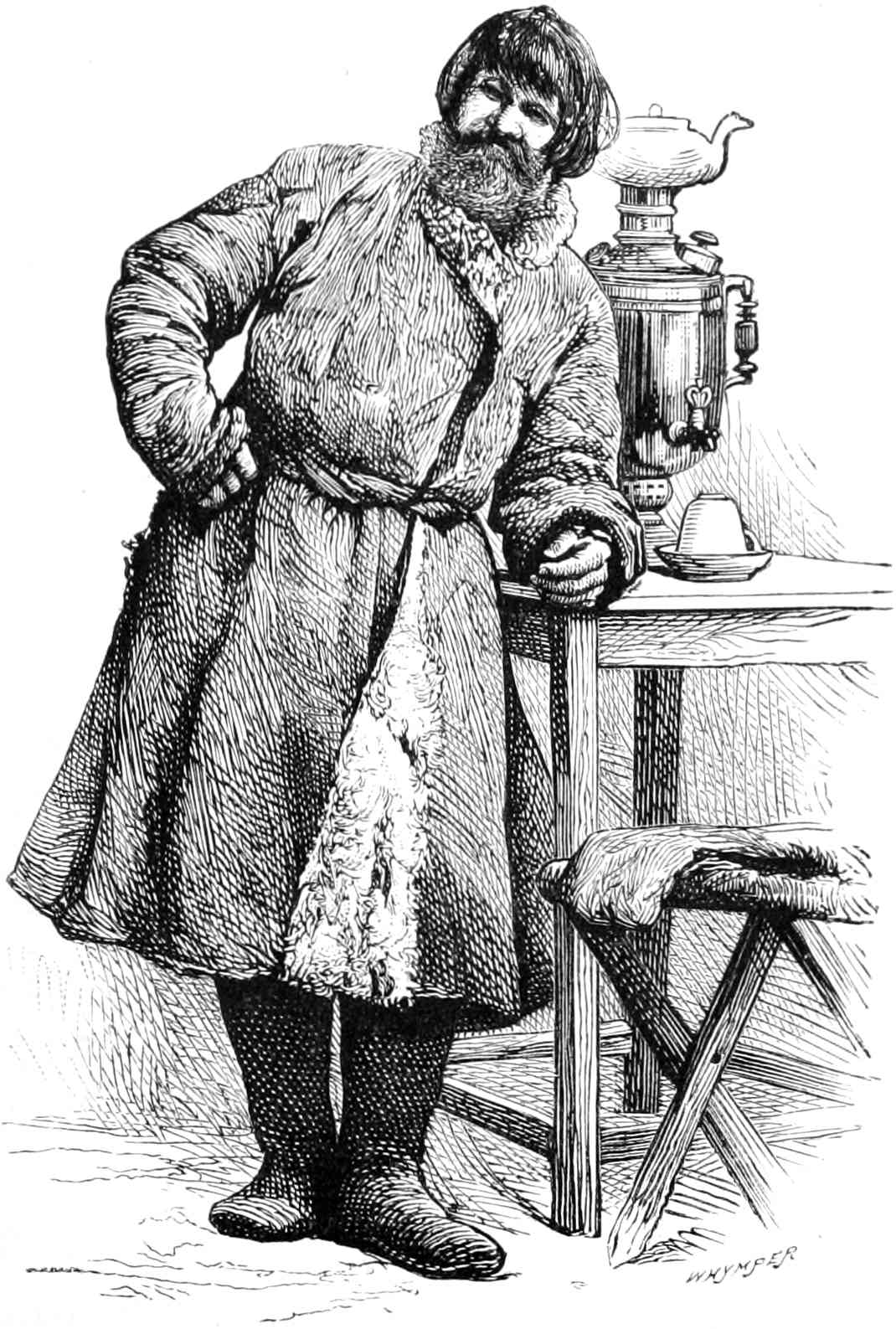
RUSSIAN PEASANT, WITH SAMOVAR.
Below Aigun, the country on the north continues flat, and is covered with a rich black soil, in places fourteen inches thick. About 30 miles below Aigun, the river divides into many channels, and the right bank in several places is scooped out and steep. On the left are extensive shallows and sandbanks—some barren, others covered with grasses and willows. Of this last there are nine species on the river. The natives use the bark for making ropes. At Skobeltsina, 160 miles below Blagovestchensk, the Bureya comes in from the north, after a course of 703 miles. This river flows through a level prairie country, diversified by clumps of oaks and maples. At its mouth it has a breadth of half a mile. Beyond this stream the south bank rises, and toward the latter part of the day we found ourselves not far from the Bureya mountains, where the hills approached close to the river. Coal seams from three to four inches thick, resembling cannel coal, have been discovered in this district. The lower portions of the hills were wooded with small oaks, and on more elevated parts were denser forests of young oak and black birch. In shady ravines are found groves of white birch and aspen, and in open situations, and on the islands, various kinds of willows, limes, bird-cherry trees, small Tatar apples, elms, the Manchu ash, the Mongol oak, and a few cork trees of small size. Hazels also grow here, and at the skirt of the forest may be found the vine climbing the trees to the height of 15 feet. The most characteristic shrub of these forests is the Manchurian virgin’s bower, the numerous white blossoms of which contribute not a little to its beauty.
We were favoured with a delightful evening for our journey through the Bureya mountains, the scenery of which reminded me forcibly of some parts of the Danube.[4]
The Bureya, or Little Khingan, mountains cross the valley of the Amur at nearly right angles. They are of mica schist, clay slate, and granite. Porphyry has been found in one locality, and there are said to exist indications of gold. As we journeyed down the stream in the evening light, the tortuous course of the river added much to the beauty of the scene. Almost every minute the picture changed, hill, forest, and cliff giving variety to the prospect as we wound our way through the defile. Here and there were tiny cascades breaking over the steep rocks to the edge of the river, and occasionally a little meadow nestled in a ravine. At times one seemed completely enclosed in a lake, from which there was no escape visible save by climbing the hills, and it was impossible to discover any trace of an opening half a mile ahead. And thus we travelled on, till at dusk we arrived for the night at Ekaterino-Nicolsk, a settlement of 300 houses, standing on a plateau 40 feet above the river. Here I found a church, which was approached through an avenue of trees in a public garden. I afterwards learned that specimens of all the trees in the region were planted there; but when I entered it, the light was too far gone to allow of my seeing more than that we had come to beauties of vegetation superior to anything I had yet beheld in Siberia.
The arrival of a steamer at Ekaterino-Nicolsk is not an event that takes place daily throughout the year, and the whistle draws a large proportion of the population to the river’s bank—some to sell garden produce, some to meet friends, and some to look on. These little crowds afforded me excellent opportunities for distributing my tracts, and selling or giving away the Scriptures. A large proportion of the Russian colonists get their living by supplying fuel for the steamers. In 1866 the Government used wood to the value of £6,000, and private firms £1,200; and as we had frequently to stop at these wood stations, I was able to go on shore, and leave my printed messengers in the most out-of-the-way places, where they were always thankfully received, and often gladly purchased.[5]
This attracted the attention of the passengers, who wished also to purchase. One day, on the Shilka, I sold more than 30 copies, some of them to very poor-looking persons. A merchant on board wished to invest largely, but I was unwilling to sell wholesale, preferring rather to scatter my stock over as wide an area as possible. I found, moreover, that travelling merchants in Siberia ask a shilling for the books I was selling at sixpence; and though, considering the difficulties of carriage from Petersburg, this was not perhaps exorbitant, yet I wished rather to bring my wares directly within reach of as many purchasers as possible, and even to give them, if necessary, in lonely and far-off places. We reached some out-of-the-way spots on the Obi by sending parcels of books to the priests, with a letter, but this I was unable to do on the Upper and Middle Amur.
The curiosity of my fellow-passengers was of course aroused by what appeared to them my strange proceedings, and they hit upon various conjectures as to who and what I might be. It has not unfrequently been my experience to find, after curiosity has subsided, that my distributing religious literature has secured for me many attentions and acts of kindness from those who, before reading the tracts, were disposed to be prejudiced and perhaps opposed. I found this particularly the case in Siberia, though I was hardly prepared to learn that the intelligence of what I had done three years before in Finland had reached the Amur. On the second day, however, between Blagovestchensk and Khabarofka, a passenger, who had come on board the previous day, espied my name on my luggage, and, coming on deck, he asked if I had travelled round the Gulf of Bothnia. On receiving a reply in the affirmative, he said he had read of my tour, which had been translated by my Finnish friend for a paper called the Helsingfors Dagblad. He thus remembered what I had done, and was abundantly willing to be of service if he could. His name was M. Emil Kruskopf, an inspector in the telegraph service, and he performed several kindnesses for me unasked. He had been flattered as a Finn by the way I had spoken of the Scandinavian steamers, and thus I found that a kind word was bearing its fruit after many days, and far from the place where it was spoken.
Among the crowd who came to look on at Nicolsk was the priest, to whom I gave some pamphlets and some copies of the Russian Workman. Next morning we departed, hoping by nightfall to reach Khabarofka. After proceeding a short distance the mountains receded on the left, and, a little lower, on the right also. Then appeared two islands, the one on the right being about half a mile long and a few yards high, covered with birches and elms, in the shade of which grasses grow to the height of six feet. The second island is a steep rock. The depth of the river continued to be 70 feet.[6]
The country in this part is the most desolate along the whole course of the Amur; though, with us, the monotony of the afternoon was enlivened by a cry that a bear was swimming across the river. And, surely enough, there was the head of some animal above the water, not very far from the steamer, though I confess it did not appear to me to be that of a bear. Some of the passengers went below for their revolvers and rifles, and began to fire, much to the excitement of every one on board. The captain stopped the ship, and as the animal came nearer, the shot entered the water so close to his nose that he raised himself to see what was the matter. At last a bullet struck him in the head, and the discolored water proclaimed a fatal shot. A boat was lowered, and some of the crew put off, but only to find that all the excitement had been bestowed upon an unfortunate dog!
We passed the mouth of the Sungari, on the southern bank of the Amur, 992 miles below Ust-Strelka.[7] The Sungari, with its affluents, drains the larger portion of Manchuria. Very little is known about it, though its valley is said to be tolerably well peopled and fertile.[8]
We had now reached the most southerly bend of the Amur, and had entered a somewhat different climate from that of the Bureya range, for these mountains are cooler than either of the prairies above or below them.[9]
Below the Sungari the level prairie continues along the left bank of the Amur. On the right bank a range of hills accompanies the river for a distance of 20 miles, and at the villages of Dyrki, Etu, and Kinneli are bold cliffs. The hills are covered with an open forest. Underneath them a luxuriant herbage shoots up to the height of five feet, and in July are seen the numerous red flowers of the Lespedeza, the blue blossoms of vetches, large white umbels of the Biotia, and catkins of the Sanguisorba. On the shores of the islands in the river are heaped up the bleached trunks of fallen trees and driftwood.
As we drew towards the end of our voyage, we were approaching likewise the confines of the Amur province, which is at once the smallest and least populous of the provinces of Siberia.[10] There are 31 stations between Blagovestchensk and Khabarofka, the distance is 560 miles, and I paid for first-class fare £2 10s. The largest of the stations and the most important is Michael Semenovsk, about 17 miles below the mouth of the Sungari, so named in honour of a Governor-General of Eastern Siberia. It is a military post, and rejoices in the possession of two iron guns pointing over the river in the direction of China, though they are said to be utterly useless for purposes of war, and can only be employed for firing salutes.
At this place we put off some of our passengers, and among them the wife of the artillery officer whom we had first seen as far back as Kansk, and with whom we had been brought in contact on the Baikal, and again on the Shilka. It looked as if our acquaintance was now to cease, but it was not so; for when I reached Vladivostock this lady appeared again, at a distance of more than 3,000 miles from where we first met. I had made another acquaintance also since leaving Blagovestchensk, one Baron Stackelberg. This gentleman had been sent to the Amur to put the screw on in the matter of excise. At the annexation of the country, the Government was so anxious to people it that they promised emigrants immunity from taxes for 20 years, and this time was nearly up. The Baron had, therefore, to put things in order, and had been doing so since 1875, when he crossed Siberia by land and happened to fall in and travel with Mr. Milne, to whose journey across Europe and Asia I have alluded in a previous chapter. The Baron spoke pleasingly of his journey with his English friend, as he called him, and he was evidently disposed to give a second Englishman a welcome. He spoke French fluently, and gave me some interesting statistics about alcohol, which is the principal source of the Government revenue both in Russia and Siberia.[11] I hesitate, from my own experience, to endorse the opinion sometimes expressed, that the Russians, as a people, are more intemperate than the English. Among them, it is true, the vice seems to pass for less sin and for less shame than with us; but England has the unenviable notoriety of arresting in one year 203,989 persons for crimes in which drunkenness is entered as part of the charges! I can present no statistics on the number of drunkards in Russia. One does see a great many, certainly, on a festival. I was lamenting this to a Russian lady, when she acknowledged its truth, but reminded me that with them the evil is confined chiefly to men; and without doubt, whatever comparison may be instituted between the two countries with regard to drunkenness among the male sex, they have no town in Russia which has more drunken women than men—that apprehends in a single year 6,276 females to 5,537 males, or 32 drunkards a day! For this, alas! we must look to England—to Liverpool. Still, drunkenness is a most fruitful cause of crime in Russia, as witnessed by what I saw and heard in the prisons at Tiumen, Tobolsk, and Barnaul; and it may very well be questioned whether the evil habits among Russians of gambling, drunkenness, and idleness are not in part to be traced to the very large number of holy days in their calendar, on many of which they abstain from work more completely than on Sundays. They fast rigorously and long, and then, at the close, break out in excess.
Teetotalism has not yet made much way among the Russian people or clergy. I chanced, indeed, to be dining in Petersburg in company with a gentleman, who said that the priest of his country parish was an abstainer, whom he sometimes invited to dinner; and when he would give him a little red wine for his stomach’s sake, the priest declined, saying that if he did not abstain altogether he might soon become a drunkard, because invited so often to drink by his parishioners. This case, however, was sufficiently uncommon to cause a lady present to observe that she had never heard of an abstaining priest before. Accordingly, it is with great satisfaction I have observed from the newspapers that the matter has been under the consideration of the present Emperor, and that his Majesty has called in certain experts to advise on the subject. God send them help against this national curse, the demon of intemperance!
My meeting with Baron Stackelberg had an important bearing on my wanderings; for I had intended, on arriving at Khabarofka, to leave the Amur, and proceed direct up the Ussuri to Vladivostock. But so it was not to be, and in less than 24 hours I found myself going 1,250 miles out of my way, and in the opposite direction. But before leaving the Chinese border I must say something of the southern bank of the Amur, concerning which and its inhabitants I have hitherto been almost silent.