Chapter XXVII · THE SIBERIAN FRONTIER AT KIAKHTA.
Reading edition
Hospitable reception.—History of Kiakhta.—Treaties between Russians and Chinese.—Early trading.—Decline of commerce.—The tea trade.—Troitzkosavsk church.—Miraculous ikons.—Kiakhta church.—Russian churches in general.—Bells.—Valuable ikons.—Climate of Kiakhta.—Drive to Ust-Keran.
I have said in the previous chapter that we reached Kiakhta. It would have been more accurate to have said Troitzkosavsk, which is within sight of and may be called a suburb of Kiakhta, situated on the Siberian frontier. Here we were lodged, for by the terms of a treaty between Chinese and Russians, no officer or stranger may sleep in Kiakhta proper. On arriving, we learned, to our dismay, that there was no hotel or guest-house in either town. We therefore went to the office of the Ispravnik, and in his absence showed our documents, which served so far to establish our respectability, that we were told we might have accommodation at the police-station. For this offer of course we were grateful, but, before accepting it, we thought we would present some of our letters of introduction. One was addressed to Mr. Tokmakoff, a first-class merchant in the place; but he was away in Mongolia, and his wife and family were living at their summer house “in the country.” We had another letter, given me by Mr. Larsen, the telegraphist at Irkutsk, to Mr. Koecher, the principal of the real or commercial school, who lived in one of the best houses of the town, and who, upon our presenting the letter, immediately pressed us to take up our abode with him. We were only too thankful to do so, and, after a fortnight’s inconveniences in sleeping, to find ourselves in quarters with proper and comfortable beds. Our host was living bachelor fashion, and was expecting to leave shortly for Petersburg; his wife had already preceded him. He spared no pains to make us comfortable, and, being thus settled, we had time to look about the place, which, on leaving England, had been the utmost bound to which my travelling imagination had carried me. The Mohammedans say, “See Mecca and expire”; the Italians, “See Naples and die”; and in somewhat of the same spirit I had fixed upon Kiakhta as the ultima thule of my Siberian wanderings: not that there is much that is remarkable in the physical aspect of the place, but from Kiakhta one walks out of Siberia into China and sees the blue hills of Mongolia. The town, moreover, has a history, and was the scene of a treaty between the two largest empires in the world.
So far back as the 17th century, trade was carried on, though not protected by Government, between the Siberians and their southern neighbours the Chinese.[1]
But in 1692 a treaty was made at Nertchinsk, opening the way to regular and permanent commerce between the two countries, though subject to certain vexatious forms and restrictions. Subsequently Peter the Great, seeing the advantage of this treaty, desired that the privilege of trading with China, then confined to individuals, should be extended to caravans; and, the Emperor approving, the right of trading thus was appropriated as a monopoly by the Russian Crown.
So things went on till 1722, when, the Russians offending their celestial neighbours, the Chinese Emperor expelled all Muscovites from his dominions, and brought trading affairs to a standstill. Six years later the treaty of Kiakhta was concluded, which stipulated that a caravan of not more than 200 persons should visit Peking every three years, and that the subjects of each nation, though not allowed to cross the frontier with their wares, might dispose of them to each other at two places on the border—Kiakhta, and Tsurukhaitu on the Argun, about 60 miles from Nertchinsk. This led to the foundation of the town of Kiakhta; and as there were certain conditions in the treaty limiting the number of persons, and imposing various restrictions upon those who should live there, another town was built a mile off, and called Troitzkosavsk, in which these restrictions were evaded.[2]
The traveller of to-day does not see Kiakhta as it was in palmy times, though a considerable trade is still carried on between China and Eastern Siberia, and large consignments are sent to Nijni Novgorod and Moscow. The tradition is still kept up that the sea passage injures the flavour of the herb, and that caravan tea is the best, which commands, accordingly, prices up to ten shillings per pound. I have heard quite recently of “yellow” tea, which even at Kiakhta costs this sum, and which, brought overland, would probably command in Petersburg 16s. or 18s. per pound. One hears also in Russia of “blossom” tea, which consists of only the dried flowers of the tea plant, and of other choice growths, the best of which are not brought to England at all. There is one kind of yellow tea, I am told, costing as much as five guineas a pound. The Emperor of China is supposed to enjoy its monopoly. A friend of mine, who received a few pounds as a present, tells me she did not think it distinguishable from that sold at 5s. a pound. Blossom tea is well known throughout Russia, and is mixed in the proportion of two-ounces to one pound of ordinary tea.[3]
In addition to ordinary and superior sorts, the Russians import, chiefly for consumption by the military and native populations, immense quantities of tea pressed into the form of tablets, or bricks, each of which weighs about 2 lbs. These bricks are made of tea-dust mixed with a common coarse sort made of twigs, stalks, and tea refuse, the whole being first submitted for a minute to the action of steam and then pressed into a mould. Some say that bullocks’ or other blood is also mixed with brick tea, but I have not heard this corroborated. The tea-dust used for brick tea costs in China about 5d. per pound, the manufacture about 1½d. more, and the article bears a handsome profit. In 1878 the Russian manufacturers in China were said to have realized a profit of 75 per cent. This they cannot do, however, all the year round, for the making of the bricks goes on only from the middle of June to the end of September, during which season they work at it night and day.
Apart, however, from the trade which passes over the Siberian frontier, there is much in Kiakhta and Troitzkosavsk to interest the western traveller. Among other novelties are to be seen Mongolian cavalry dashing about the streets, the soldiers being known mainly by a piece of ribbon streaming from their hats. The united population of the two places amounts to nearly 5,000, who are supplied with provisions by both Russians and Chinese. There may be seen coming from their farms and gardens numbers of peasant wagons, as well as clumsy Mongolian carts, the latter on wheels without spokes, formed of large wooden discs, which oxen cause to wabble along. Common vegetables are to be had in abundance. A large square in the centre of Troitzkosavsk is used for a corn and hay market, and is provided in Russian fashion with a huge pair of scales sanctioned by the authorities. Here the vendors of agricultural and garden produce assemble, and generally manage to get rid of their stock and garden produce early in the day. Young chickens cost 4d. each, lemons in winter 1s. a-piece, and occasionally even double that price, and Cognac brandy 9s. per bottle. Troitzkosavsk is also supplied with excellent fish, but we found it difficult to get good fruit. Besides the market square at Troitzkosavsk, there are two public gardens at Kiakhta, and also a cemetery.
We went to the small prison, and found it a poor affair. The police-master told us he had received a letter concerning our intended visit long before, and had been expecting us. Where the information came from he did not say; but it served to remind us again that, though more than 4,000 miles from the capital, we were not lost sight of. This was the last place at which I heard of our coming having been announced beforehand, though a general at Petersburg had told me that I might usually expect this; for how, said he, are the Governors to whom your letter is addressed to know that your document is not forged unless they are advised that a letter has been given you? and then, to illustrate his remark, he said that, on one occasion, a man, dressed like a gendarme, presented himself at Irkutsk with a forged letter and got a prisoner released.
I may add to the foregoing that Kiakhta was the last, and almost the only, place other than Petersburg where symptoms of a disaffected or revolutionary spirit came under my notice; and this in the solitary instance, that when an educated man in the town was shown in an English newspaper a portrait of Vera Sassulitch, the would-be murderess of Trepoff, I heard that he admired and praised her. As for Nihilism, I heard, in crossing Russia, so little about it that I am ashamed to say I left the country with very vague ideas as to what it is. I am not sure that I know much about it now, but an Englishman who has spent a large portion of his life in Russia and Siberia tells me there are various kinds of Nihilists. The mildest type, if they can be called such, simply want free speech and a free press, as do, I am told, all the “Slavophils”; the next wish for a ministry responsible to the people; but both these classes (which are supposed to be numerous) think the time not yet come, and that they must wait for further enlightenment of the people. With this opinion my friend agreed, feeling sure that at present the educated Russian and the moujik would quarrel, he said, if one were dependent on the other. The third class are the “black” Nihilists, who want the dethronement of the reigning dynasty and a republic, and who are willing to adopt any means, even the most criminal, to gain their end.
Of all this and its like I heard next to nothing after leaving Petersburg; there, however, great excitement prevailed. I arrived only a few days after one of the attempts on the late Emperor’s life, and a friend called to tell me they were at their wits’ end to know what to do. Turning back his coat collar, he showed me sewn thereon the certified badge of his calling, so placed that it might be ready to show the police, if required, at a moment’s notice. The English, he said, were strongly suspected, and he doubted whether he should be safe in affording me his usual protection and kindly services. He had told one of his Russian friends that I had arrived in the country for the purpose of distributing books and tracts, but the Russian did not believe that I could be come for such a charitable object, but thought I must be sent by the English Government. The rumours afloat respecting the English were both numerous and ridiculous. The authorities had not then succeeded in finding the press from which were issued the Nihilist placards and papers, and, as the ambassadors’ residences are privileged places, supposed to be closed against the police, it was affirmed that the secret press must be there. My friend told me he heard it said that “proclamations” against the Russian Government could be bought at the English Embassy for a rouble each. Another rumour said that the Russians were persuaded that the centre of the revolution was in the English Embassy, and that they had even thought of setting fire thereto, with the hope of securing, in the confusion, the revolutionary papers. I smiled on hearing this, and concluded that it could be only the most ignorant of the people who believed such puerilities, but on repeating it as a joke to a Russian fellow-traveller from Moscow, he said he quite believed that the forbidden press was in the Ambassador’s house, and that the revolutionists obtained their money from the English Government. I heard, too, in Petersburg that it was thought by the lower orders that the Nihilists obtained a large portion of their funds from the “International” in England.
All this smoke and rumour, however, we left behind on quitting Moscow, and though we may perchance have been watched, I was never conscious of it. I mention this because as some were surprised at my going to Russia when in such a disturbed condition, so others may be curious to know how this disturbance affected me as a traveller; and though I am far from supposing that my very limited and isolated experience is worth much, or perhaps anything, in showing the political condition of Russia and Siberia at the time of my visit, yet I wish to convey the impression that Russian atrocities and inflamed horrors, as posted on placards and shouted by London newsboys, shrink into very much smaller dimensions when the scene of action is reached. Such at least has been my invariable experience, and to this I shall further allude hereafter.
They have also at Troitzkosavsk a church in which “a miracle” seemed about to be recognised during our sojourn; for, on the first night of our stay, after I had gone to bed, a woman came to the party of friends with whom I had left Mr. Interpreter, and told them that she could see a strange halo of light in the church, but whether caused by celestial radiance or angels’ wings she did not say. The party turned out, therefore, my interpreter included, and made for the church, into which they could not gain admittance, and which was apparently empty, though they managed at last, by looking through a crevice or window, to descry a lamp burning before a glass ikon, which happened to slant at such an angle as dimly to reflect through the darkness the rays of light to the spot where they had been seen by the woman. This took away the sense of the miraculous, not altogether to the satisfaction of some of the party, who seemed to think “there was something in it.”[4]
The great ecclesiastical wonder of Kiakhta is its cathedral, said to be the finest in Eastern Siberia, and to have cost 1,400,000 roubles, equal at the time of building to at least £150,000. It was built at the expense of the Kiakhta merchants, and possesses some excellent bells.[5]
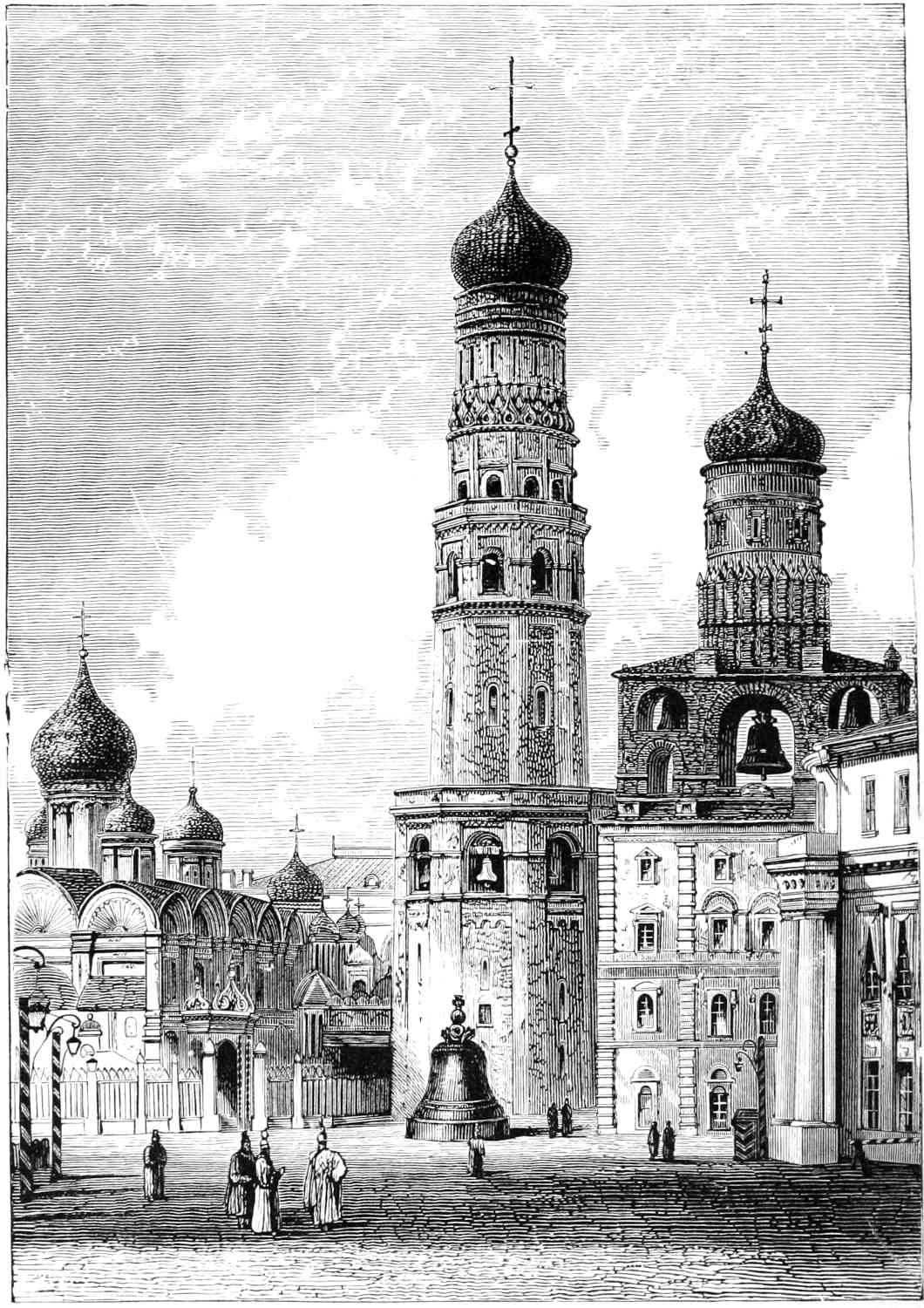
THE GREAT BELL OF MOSCOW AND IVAN VELIKI TOWER.
In bells, the Russian Church is the richest in the world—so far, at least, as regards their size. The largest we have in England—that of Christ Church, Oxford, weighing 7 tons—is but a baby compared with many in Russia. The largest in Petersburg weighs 23 tons; “Great John,” in the older capital, weighs 96 tons; whilst the old “Tsar Kolokol,” or the King of Bells, in Moscow, weighed originally nearly 200 tons, or 432,000 lbs. Reckoning their value at 18 silver roubles per pood, we get a price for our Oxford bell of £1,100; and for that of the largest one of Moscow of £32,000. This monster bell is 26 ft. high, and 67 ft. round!
It was neither its bells, however, nor its architecture that made Kiakhta cathedral “a fine church,” but rather its costly fittings. It has two altars, both of silver; a candlestick with numerous rubies and emeralds, and a large chandelier studded with precious stones. More striking still, perhaps, was the profusion of objects made of solid silver, such as the “royal doors,” which are said to weigh 2,000 lbs.; and, above all, the ikonostasis of gold and glass, or crystal—the value of the last, no doubt, being considerably enhanced by the cost of carriage to so remote a spot. There were also several paintings, executed at great expense in Europe.
We mounted the tower, and from thence had a view of the surrounding country and of the three towns of Troitzkosavsk, Kiakhta, and the Chinese Maimatchin. On a slight elevation, about a mile to the north, at the head of an open sand-valley between two ranges of moderately high hills, lay Troitzkosavsk, with its 4,600 inhabitants, its school, houses, shops, Government buildings, and a number of persons and officials who could not strictly be called merchants. There is also a large building which formerly was the Custom House, where the duties on tea were collected.[6] Below us was Kiakhta, with about 400 inhabitants, the abode of Russian mercantile aristocrats and their belongings, making a population, according to Hoppe’s Almanack, of about 5,000. The town lies snugly in a hollow, between hills of sand and fir-trees, well sheltered from northerly winds, and opening out southwards towards Mongolia. A small rivulet, called the Bura, runs through the hollow, and, turning westward to the sandy plain, makes its way at last into the Selenga. The country round looks sandy and dry, which is in keeping with the meteorological conditions of the place. Southerly winds prevail, and there is a deficiency of moisture in the atmosphere; hence they have only a slight fall during the year either of rain or of snow. So much is this the case that wheeled vehicles are used all through the winter, and goods and travellers at that season are thus driven some miles out of Troitzkosavsk to the spot where snow begins, and sledges are usable. Kiakhta is about 2,500 feet above the sea level. The greatest cold in 1877 was in February, when the thermometer stood at 42° below zero; whilst the greatest heat that year, namely 100°·5, was in August.
On the first morning after our arrival, our host sent us in his carriage for a drive of 20 miles to Ust-Keran, the summer residence of Mr. Tokmakoff, where also we expected to find a fellow-countryman, who, we heard, was Professor of English in the gymnase at Troitzkosavsk. It was a fine day, and our horses dashed along over a wide extent of country, somewhat suggestive of Salisbury plain. We saw very few people, but, happening to meet a vehicle, we pulled up, and my interpreter, having descended, went to the carriage to know if we were taking the right road. He called to me that we were right for Madame Tokmakoff’s, upon which I shouted, “Ask him if the Englishman is there!” whereupon someone in the carriage replied, “I am the Englishman.” It was pleasant to hear this spoken in my native tongue, and I hastened to make the acquaintance of Mr. Frank M——, who was spending his vacation as tutor, and teaching English, in the very family to which we were going. He therefore turned back, and accompanied us to Madame Tokmakoff’s, by whom we were heartily welcomed, and where we were reminded of home by the sight of cricket-bats, stumps, and sundry other English things.
The great event of the afternoon was driving some miles further to a Buriat lamasery, or monastery, inhabited by priests, for whom I had taken some Scriptures; but none of them spoke Russian, and as we could not well make them understand, I left the books with our friend to give when an interpreter could explain, and this little commission he kindly performed. I shall have occasion to speak of this lamasery hereafter. On our way we had to cross a river, the vehicle being put on a raft, and the horses swam through the stream—not considered extraordinary in these parts, for the same evening we saw a dozen horses returning from their work, and when they came to the river, they plunged in of their own accord, and swam across.
One of the men on the bank was very much puzzled to make me out, especially as I asked questions, and made notes of the replies. He seemed to think there might be “something up,” but said that “I wore no official clothes, and so he could not tell what sort of a ‘tchinovnik’ I was.” His suspicions, however, abated, and his vanity seemed tickled, when he was told that I had come from a very far country, that I was anxious to know about their manners and customs, and made notes of what I heard and saw to tell my countrymen on my return. After inspecting the monastery, we drove back to Kiakhta the same evening, having spent a particularly agreeable day.