Chapter XVIII · THE YENESEI.
Reading edition
Sources of the river.—Discoveries of Wiggins and Nordenskiöld.—The Yenesei at Krasnoiarsk.—Current, width, depth.—Breaking up of ice.—The Yeneseisk province.—Geography.—Meteorology.—Forests.—Timber.—Fish of Yenesei.—Birds.—Russian population.—Navigation.—Corn and cattle.—Towns.—A Scoptsi village.—Salubrity of climate.—The aborigines.—Ethnology.—Tunguses.—Fur-bearing animals.—Methods of hunting.—Minerals.
The most remarkable of the natural features of the Yeneseisk province is its wonderful river, the Yenesei,[1] much of our knowledge of which, below Krasnoiarsk, we owe to the discoveries of Wiggins and Seebohm, Nordenskiöld and Théel, all of whose information has come to us within the past seven years.[2]
As I stood on the banks of the Yenesei at Krasnoiarsk, it appeared to me the most majestic stream I had ever beheld; and, when looking at the rush of its waters, I was thankful that we had attempted nothing so rash as to descend by a raft on its bosom; for, however pleasant a method of travelling from Minusinsk this might be in summer, it would be nothing short of madness to attempt it during the spring floods. Some idea of the swiftness of the current may be gathered from the report of M. Théel, who says that, including stoppages and without rowing, they were carried in their boat from Krasnoiarsk to Yeneseisk, a distance of 300 miles, in 2½ days; that is to say, they floated down the stream at just about the same speed as we attained with three horses at our best travelling, namely, 130 miles in a day and night. Allowing for stoppages, they floated at the rate of seven miles an hour. Dr. Peacock, who lives at Krasnoiarsk, informed me that the river in quiet places has a current of five miles an hour; in swifter places of 10 miles, and in some very rapid parts of 17 miles an hour; but this last may perchance refer to the two rapids, through one of which M. Théel’s party had to shoot at Padporoschensk, about 170 miles below Krasnoiarsk, and the other, of which Mr. Seebohm speaks as remaining unfrozen all the winter through.[3]
I imagine that the grandest thing to be witnessed on the Lower Yenesei is the breaking-up of the ice, which Mr. Seebohm has described as he saw it in 1877. Proceeding down the river on the ice with Captain Wiggins, they reached the ship Thames in her winter quarters near the confluence of the Kureika with the Yenesei, and were quietly waiting for the opening of the navigation, when on the 1st of June commenced what Mr. Seebohm calls the “battle of the Yenesei.” The pressure underneath caused a large field of ice to break away, which, by collision with an angular point of the bank, resulted in the piling up of a little range of ice mountains 50 or 60 feet high, and picturesque in the extreme. Huge blocks of ice, six feet thick and 20 feet long, were seen standing perpendicularly, whilst others were crushed up in fragments like broken pottery. Some were white, and some clear as glass, and blue as an Italian sky. Then the river began to rise, and in the course of the night the whole crust of the Yenesei, as far as could be seen, broke up with a tremendous crash, and a dense mass of ice-floes and pack-ice rushed irresistibly up the Kureika, driving the poor ship like a toy before it, and leaving it in the evening, amidst huge hummocks of ice, almost high and dry. The velocity of these masses of pack-ice on the Yenesei was reckoned on some days to be not less than 20 miles an hour. This sort of thing continued for a fortnight, and during two days it was calculated that 50,000 acres of ice passed the ship up the constantly changing Kureika, which alternately rose and fell. Many square miles of ice were marched up for some hours, and then marched back again. Sometimes the pack-ice and floes were jammed so tightly together that it looked as if one might scramble across the river without much difficulty. At other times there was a good deal of open water, and the icebergs “calved” as they went along, with much commotion and splashing, that could be heard a mile off. Underlayers of icebergs grounded, and after the velocity of the enormous mass had caused it to pass on, the “calves,” or pieces left behind, rose to the surface like whales coming up to breathe. Some of them must have done so from a good depth, for they rose out of the water with a considerable splash, and rocked about for some time before settling down to their floating level. At last took place the final march past of the beaten winter forces in this great 14 days’ “battle,” and for seven days more came slowly down the stragglers of the great Arctic army—worn and weather-beaten little icebergs, dirty ice-floes looking like mudbanks, and broken pack-ice in the last stage of destruction—after which the river was found to have risen to a height of 70 feet.
To proceed, however, from the river to the basin through which it flows. The Yenesei gives its name to Yeneseisk, that central Siberian province which is bounded on the west by the governments of Tobolsk and Tomsk, and on the east by those of Yakutsk and Irkutsk. It is the only province that stretches across the country from the Altai range to the Arctic Ocean, a distance from north to south of nearly 2,000 miles; or, to put it in another way, it extends from the latitude of London to that of the most northerly point of Asia, within 14 degrees of the North Pole.[4]
The province is divided into six uyezds, with six principal towns, viz., Krasnoiarsk, Minusinsk, Yeneseisk, Kansk, Atchinsk, and Turukhansk. The differences of temperature between its various parts are, of course, very great. The southern portions about Minusinsk we heard spoken of as the Italy of Siberia; and at Krasnoiarsk, towards the end of June, we found the temperature like that of an English summer. Further north, at Yeneseisk, the greatest heat of the year 1877 (registered in June) was 92·5, whilst the greatest cold sunk to 59·2 below zero. This cold was exceeded in December of the same year at Turukhansk, where the thermometer sank to 63·0 below zero.
The province is covered with magnificent forests up to the Arctic Circle, but the trees rapidly diminish in size further north, and disappear soon after lat. 69°. These forests are principally of pine. In the neighbourhood of Krasnoiarsk the pine and the larch attain to colossal dimensions. The pine frequently rises to 200 feet in height, but is never more than six feet in diameter at the base. The larch, which has the furthest northern range, sometimes attains to the same height, but its diameter is but four feet on the surface of the ground.[5]
The forests abound with animal life, as do the rivers with fish. Fish forms the principal food of the natives, and in summer almost every one is a fisherman, using nets and lines, or spearing by torchlight. In the Yenesei are found pike, ruff, perch, and tench, all which are little esteemed, and serve as food for the dogs. The more valued are the sturgeon, salmon, and various species of the genus Coregonus. The common sturgeon is caught along the whole Yenesei, and sometimes weighs more than 200 lbs. The sterlet usually weighs only three or four lbs., but occasionally reaches 18. The salmon is most numerous in the upper course of the river at Minusinsk, where it is caught in great numbers.
The birds of the Yeneseisk province have received much attention from Mr. Seebohm. He brought home, in 1877, about 500 eggs, and more than 1,000 skins, but he thinks that he would have had a still larger bag had he made Yeneseisk his head-quarters instead of the Kureika. He speaks of a perfect Babel of birds when the ice was breaking up at the beginning of June. Gulls, geese, and swans were flying about in all directions, also flocks of redpoles and shore-larks, bramblings and wagtails; and in the course of the summer were seen the sea-eagle, the rough-legged buzzard, the sparrow-hawk, and various kinds of owls. In addition to our species of cuckoo, the Himalayan cuckoo made its way to these regions, though it had a different note to that of our English bird—a guttural and hollow-sounding hoo, which could be heard at a great distance. Ravens and carrion-crows were plentiful, and jackdaws, magpies, and starlings were seen at Yeneseisk, though the jackdaw and starling did not go much further north, which remark applies also to the bullfinch. The nut-cracker was found as far north as the Kureika, where it showed a desire to be sociable, and often perched on the rigging of the Thames. Besides these, Mr. Seebohm, among many other birds, mentions the thrush, the black, hazel, and willow grouse, the capercailzie, bittern, crane, lapwing, and golden plover. Towards the end of summer is to be seen, he says, a curious sight on the tundras—flocks of geese in full moult and unable to fly.
The Russian population of the province is settled for the more part in towns and villages by the side of the river, and along the great high road crossing it. The natives wander over the remainder. Russian villages are seen from 10 to 15 miles apart on the rivers’ banks, at which travellers proceeding north may find oarsmen in summer and horses in winter,—horses, that is, as far as Turukhansk, beyond which first dogs and then reindeer are employed.
Most of the corn that is raised in the province grows about Minusinsk, where it may be bought at a fabulously low price, and whence it is brought down the river in barges and flat-bottomed boats.[6] Rye is not cultivated further north than Antsiferova, 40 miles below Yeneseisk, and oats not beyond Zotina, on the 60th parallel. Potatoes are cultivated up to Turukhansk, but they are small. Agriculture, in fact, practically ceases a little beyond Yeneseisk. The Russians alone give any attention to it, as the natives are too busy fishing during their short summers to till the land. Cattle are raised to some small extent in the valley of the Yenesei, though the people do not appear to understand how to make the most of them. Cows are found as far as Dudinsk; but though in some of the villages they may have 40 or 50, it is almost impossible to get a glass of milk, the calves being allowed to take it all. An Anglo-Russian lady informs me that, were these cows treated like English ones, even for a few days, they would lose their milk; therefore a Russian cow is only partially milked, the rest being left for her calf. A scientific gentleman told my friend that it is the peculiarity of all cows only lately redeemed from a wild state to lose their milk when deprived of their calves. The making of butter is only half known on the Yenesei, and of cheese not at all. Sheep are found as far as Vorogova, and goats up to Yeneseisk.
Of the towns and villages on the Yenesei, Yeneseisk is the oldest, having been founded in 1618; and the most curious is that of Silovanoff, near Turukhansk. It is inhabited by exiled Scoptsi, a fanatical sect whose principal doctrine is based on Matt. xix. 12, who mutilate themselves, and endeavour to persuade others to follow their example. When these people are caught so acting, they are banished.[7]
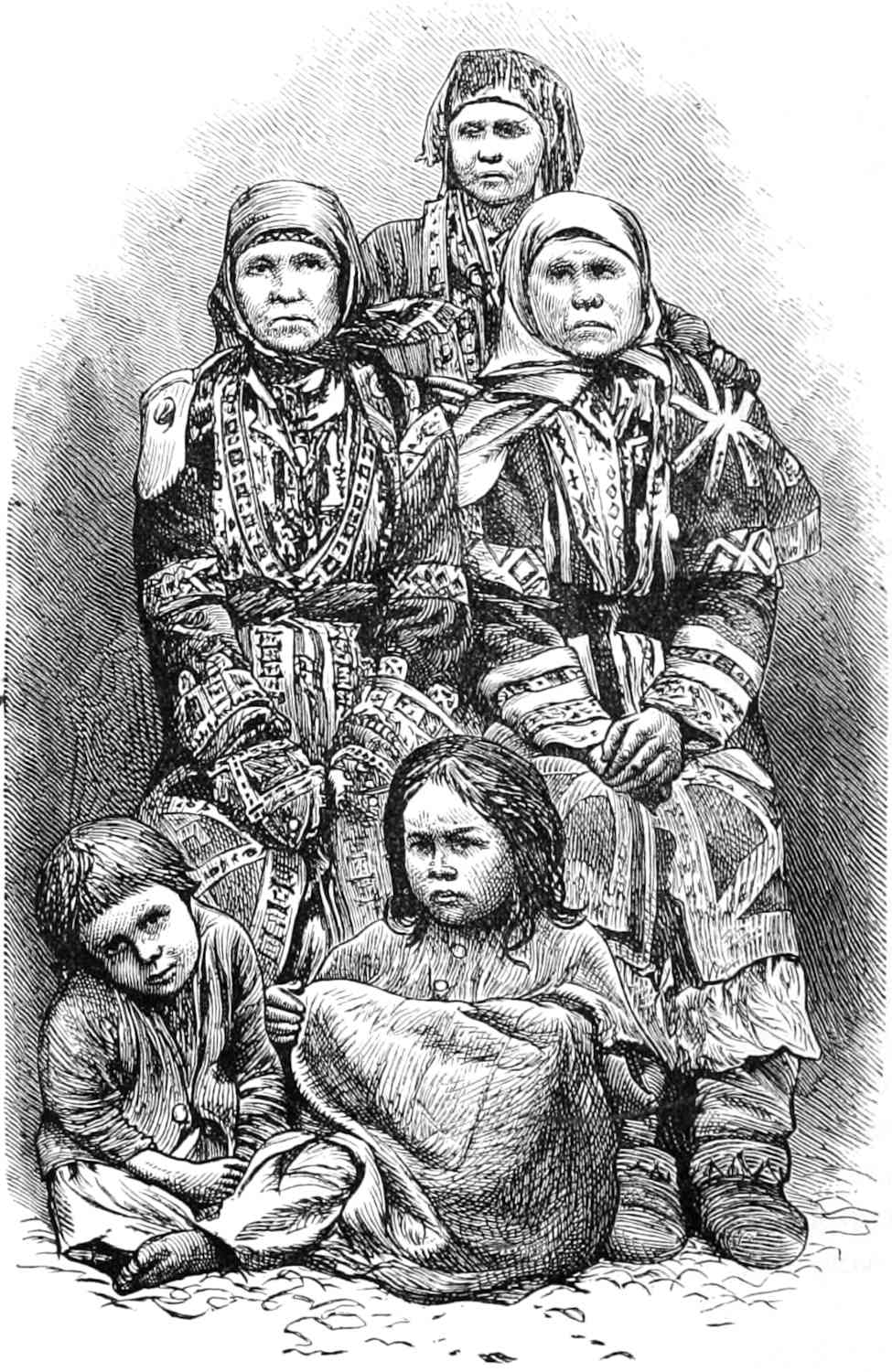
OSTJAK WOMEN OF THE YENESEISK PROVINCE.
It has already been intimated that the aborigines wander over the uninhabited parts of the province. In the south, about Minusinsk, are Tatars, most of whom have embraced the Christianity of the Russian Church. In the north, to the west of the river, are the Samoyedes and Ostjaks. West of the river, at the extreme north, are the Yuraks, and below them the Tunguses, which latter wander over a far larger area than any other tribe in Siberia.[8] Those in the Yeneseisk province give themselves to the care of reindeer and to the chase. M. Théel speaks of them as the most intelligent of the natives on the Yenesei, and says that their rich women, probably wives of chiefs, often wear furs of beaver, sable, and black fox to the value of many hundreds of pounds sterling. He mentions also, as some proof of their intellectual taste, that there was presented to him a hexagonal spindle of ivory, upon which the days, the weeks, and the months were indicated by different signs. He speaks also of a game they had resembling chess, of which all the pieces were of ivory.
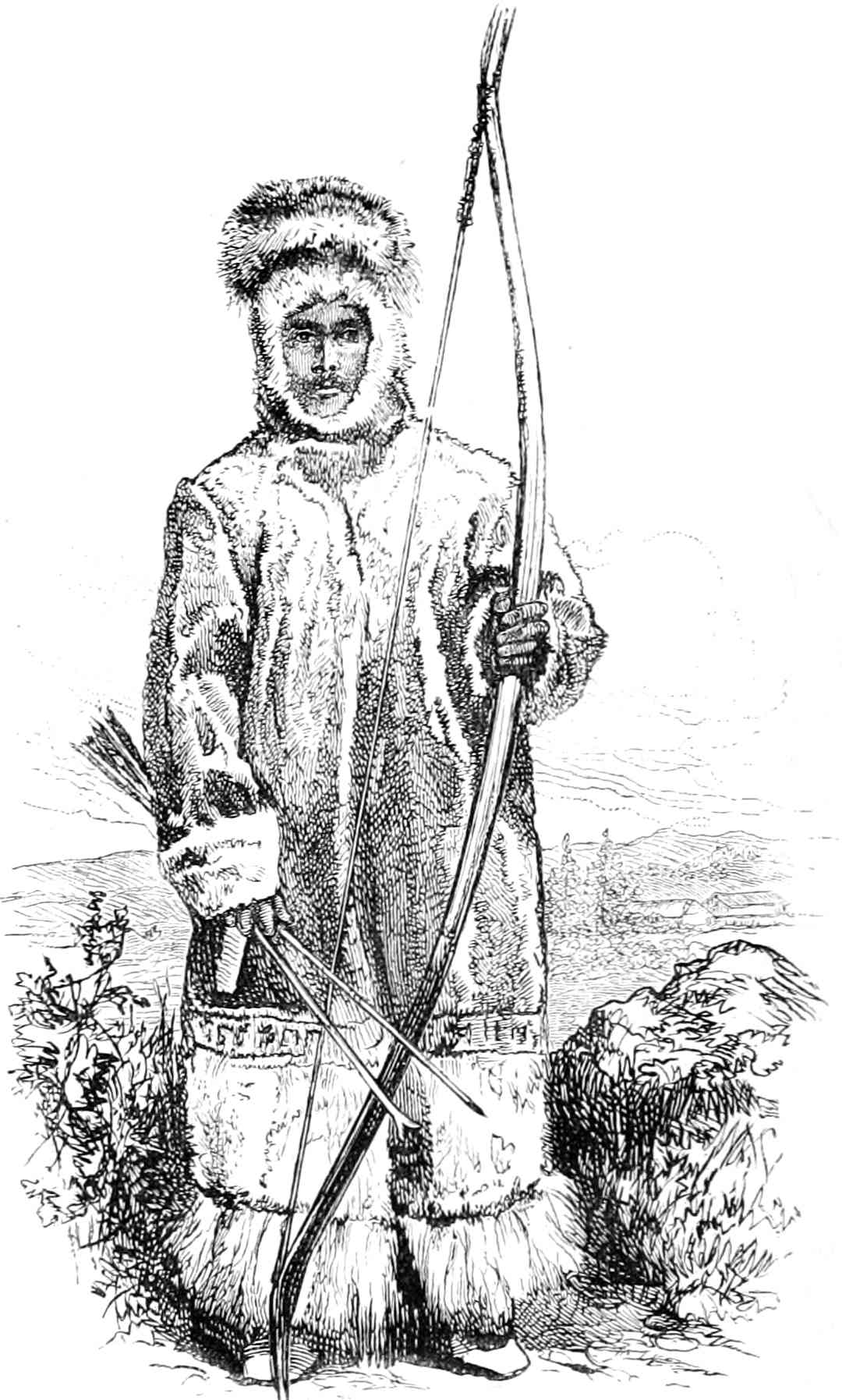
YURAK HUNTSMAN.
Among the principal animals, objects of their chase, are the sable, the common fox, the white fox, the elk, the reindeer, the wolf, the bear, the ermine, and the squirrel. At the beginning of October, and sometimes also of January, they start on snow-shoes. Alone, or in company, the hunter goes into the virgin forest, some hundreds of versts from any habitation, and is followed by a little sledge drawn by dogs. If he finds the track of a sable, he follows, and, on lighting upon the animal, he has not much difficulty in killing it. But the sable often takes refuge in a hole, and then there is nothing to be done but to await his pleasure in coming out; and as this may be by night as well as by day, his retreat is covered with fine threads attached to bells, which give the alarm. The hunter may thus have to wait two or three days; but, if he happen to kill the much-coveted animal, his trouble is well rewarded; for a good sable skin fetches from 50s. to £10. In skinning, the coat ought not to be stretched; but, on the contrary, contracted as much as possible, in order to render the hairs more bushy, which enhances the value. Hence the skins one meets with in commerce are all short and wide.
The common fox is taken with snares and traps. The black fox is very rare in these parts, and its skin is valued up to £100. The white fox is taken on the tundra by means of traps placed on the top of little hills. This animal generally retires south towards the middle of September; and as it is known that the fox, rather than jump over an obstacle, however low, goes round it, the hunters, profiting by this knowledge, set up barriers of branches, leaving openings where they plant their snares, and catch their prey. The hunting of the elk is carried on by men on snow-shoes; and such numbers of this animal are killed that in some years one may buy at Yeneseisk as many as 10,000 skins. Reindeer are taken in numbers equally large, sometimes in traps, and sometimes by driving whole herds into an enclosure, from which they cannot get out.[9]
One of their modes of capturing the bear in the Yeneseisk province is by fixing a wooden platform to the trunk of a tree, and at such a height from the ground that the bear is forced to stand on his hind-legs at full length to reach the middle. On this platform are numerous barbed iron spikes, and at the higher part a joint of meat. The bear arrives, stands up, and puts forward one paw to seize the bait; but, bringing it down on the spikes, finds it fixed. The furious animal puts down the second to release the first, which also is caught, and he thus becomes an easy prey to the huntsman.
Thus the natives spend their days—fishing in summer and hunting in winter. They have no towns, no villages, no houses, but live in tents of skins or of bark, according to the season; and they have little idea of civilized life, or the mineral wealth with which their country abounds. Iron ore is found in the valley of the Yenesei, and from the province, in 1877, 2,700 tons were cast; also from the mine of graphite, on the Kureika, Captain Wiggins ballasted one of his vessels. The greatest mineral product of the province, however, is gold, of which I shall speak in the following chapter.