Chapter XIV · BARNAUL.
Reading edition
Situation of town.—Cemetery.—Burial of the dead.—The Emperor’s usine.—Visit to Mr. Clark.—Visits to hospital and prison.—A recently-enacted tragedy.—Crime of the district.—Smelting of silver and gold.—Price of land and provisions.—Return to Tomsk.
We reached Barnaul very early on Sunday morning, having traversed, after leaving the flooded river Obi, a miniature Sahara, or desert of sand. Barnaul, like Tobolsk and Tomsk, lies at the foot of a hill. It has 13,000 inhabitants. On the top of the hill is a cemetery, which was the first we had met with; but it did not convey a favourable impression of Siberian burying-places. Indeed, I have not been greatly struck by Russian cemeteries, whether in Europe or in Asia, though on the graves of their emperors the Russians place monuments of considerable taste, which deserve to be placed in the same category with memorials of the departed such as those of Frederick William III. and his Queen at Charlottenburg, or the tomb of Napoleon in the Hotel des Invalides. But it is otherwise, as I have said, with average Russian tombs.[1]
From the cemetery at Barnaul are seen its half-dozen churches and a large building known as the Emperor’s usine, or gold and silver smelting works. Most of the business of the town is connected with mining; and many surveyors and engineers live in the adjacent mountains in summer, and in Barnaul in winter. The discovery of the precious metals in the Altai regions was made by one of the Demidoffs, who is said to have been sent there by Peter the Great. His monument in brass stands in the public square at Barnaul. We had an introduction to the manager of the usine, Mr. Clark, who is the son of an Englishman, and who reads but does not speak his father’s language. We found in his spacious house a good collection of English books, together with copies of the Nineteenth Century, the Graphic, All the Year Round, and the weekly edition of the Times. On the Sunday afternoon our host took us to visit the poor-house and the hospital. In this latter were 14 rooms, which had the advantage of being very lofty and airy, though they struck me as not particularly tidy.
In the 9 rooms of the prison were 120 criminals, one of whom, a day or two previously, had within the prison walls enacted a tragedy, the circumstances of which would furnish material for a sensational novel. The rooms of the prison are ranged on either side of a wide corridor, and in one of them was a number of women, one of whom had murdered her husband and was condemned to Eastern Siberia, to which she was on her way, though for some reason detained at Barnaul. In one of the male wards was a young man, formerly under-manager of a shop in the town, who had been suspected of stealing, and was imprisoned for three months. He had served out this time within a week; but during his stay in the prison he made the acquaintance of, and became more or less attached to, the murderess, holding conversation with her from the corridor during the time allowed for exercise. Another male prisoner was by these two taken into council, and the three determined to attempt an escape, by means of wooden keys which the men were to make. The plot, however, was discovered, and the woman, finding that she must proceed to her destination and leave her lover, tried to kill herself. But she was prevented. She therefore adopted another plan of ridding herself of life. In the door of the women’s chamber was an inspection-hole, unusually large. This she cut a little larger, thrust her head through into the corridor where the man was walking, and begged him, if he loved her, to take her life; upon which he took a knife, cut her throat, and so effectually killed her. We saw the stains of the blood still on the door, for the deed had been done only a day or two before our visit. Close at hand was the prisoner, placed in a separate and rather dark cell, and chained hand and foot—the only man I saw so chained in Siberia. As he walked out of his cell, I walked in, and found on the floor a quantity of cigarettes and a book of songs. Upon my pointing to the cigarettes, the officer said that the prisoners managed to smuggle them in; and then came out the old story, that this prisoner had managed also to smuggle in drink, under the influence of which he had committed this horrid murder. On asking what punishment he would be likely to receive, we were told that he would probably be condemned to hard labour for about 16 years; and we were further informed that in the small district of Barnaul, consisting of less than half the population of Liverpool, there are usually about 10 murders a year. As we went from room to room, the police-master introduced me to the prisoners as an Englishman travelling through Siberia who had brought them books, which usually elicited an expression of thanks. We left them a New Testament and papers for each room, doing the like also for the hospital and poor-house, and sending a supply for the prison at Biisk.
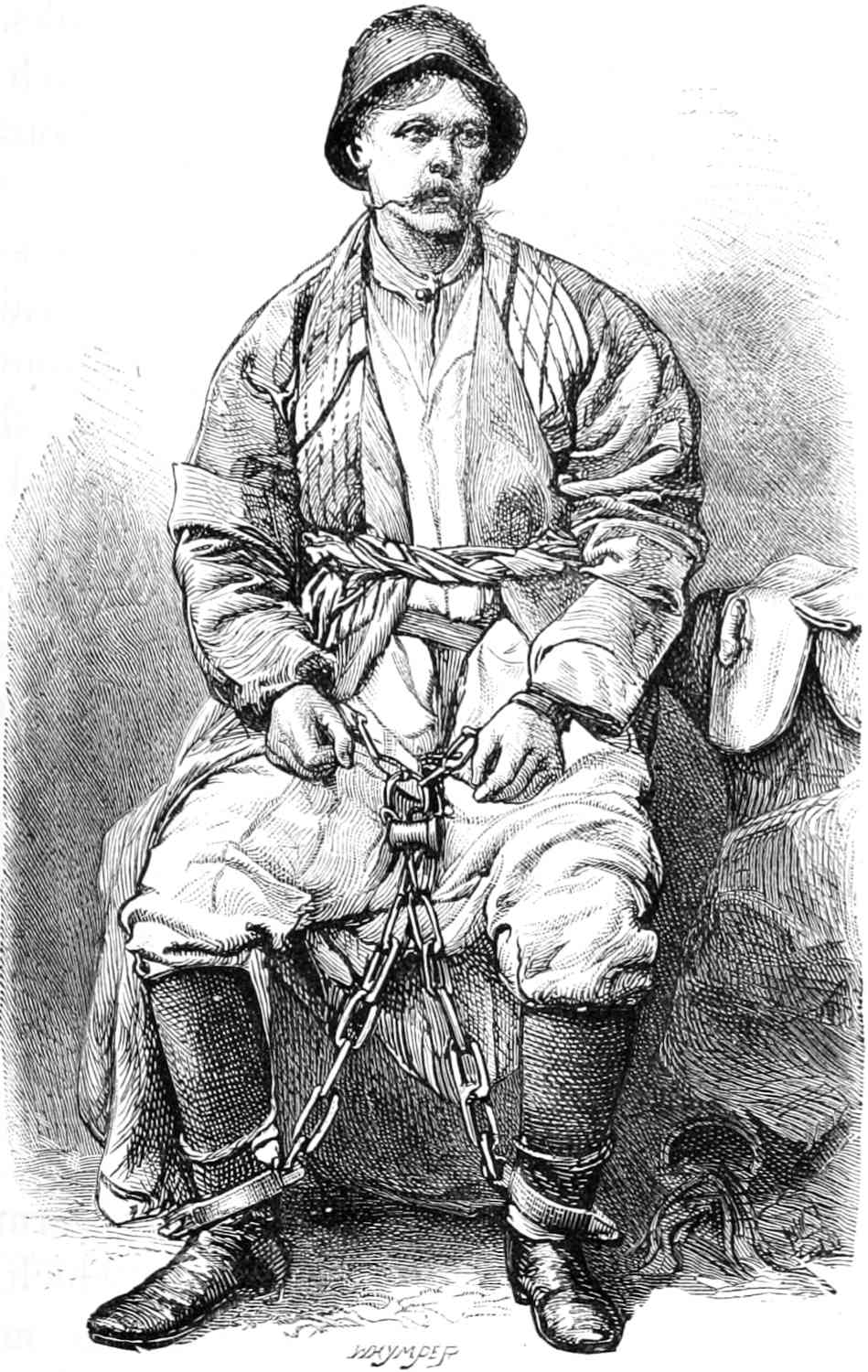
CONVICT SUMMER CLOTHING AND CHAINS.
On Monday we went with Mr. Clark to see the Emperor’s usine, to which is brought mineral from Smirnagorsk, 200 miles distant, as well as from other parts of the Altai mountains, where are mines, the ore from which contains for the more part copper and silver. They find there but very little lead. Nor is the quantity of iron worked at all large—chiefly, I believe, for lack of capital and energy. In 1879 only 507 tons of iron were cast, and 238 tons wrought in the government of Tomsk. Many thousand poods of copper are obtained annually in the district, but not smelted at Barnaul. These mines are called the private mines of the Emperor, and the revenues belong to the Crown. In them are employed from 1,500 to 2,000 men (not, in this case, convicts), and the ore from the Altai regions is brought to be smelted to four different works for silver, and one for copper.
The smelting of silver is carried on at Barnaul all the year round. They burn charcoal, which costs 10s. a ton. The ore as brought from the mine is called mineral, and 4,000 tons of mineral yield 2 tons of silver—that is, 2,000 parts of ore yield one part of pure metal.[2]
We went from the usine to the museum, which could not fail to be interesting to a mining engineer or a geologist. There was a large and well-assorted collection of minerals; models of the principal Altai silver-mines, showing the shafts, adits, and galleries, with their machinery; models of gold-washing machines, of quartz mills, and of furnaces and works in various parts of Siberia. Among the natural curiosities of the museum were the stock of a tree, with branches that represented pretty accurately a man in a sitting posture; and a piece of wood, which, when split, had been found to contain a cross inside. In the ethnological department were some good costumes of the Kirghese and of a Tunguse shaman, or priest and priestess. They had also in another room an eagle’s nest, and several specimens of the Altai eagle; but in the zoological department the most remarkable specimen was the stuffed skin of a tiger killed in the southern part of the district, where this animal is usually unknown.
The price of land and provisions at Barnaul was such as might make many a man sigh to live there. The price for the hire of cleared black soil was 3½d. an English acre. We saw them scratching the surface of it (for their instrument was so shallow that it was a mockery to call it ploughing), and yet such farming yields there an abundant crop. They take just a little of their stable manure for cucumber beds, but burn the rest to get rid of it, never thinking of putting it on the land; but when they have used a field for a few years, and it is becoming exhausted, they take fresh ground. The cost of provisions in this fertile district is on a level with the prices quoted on the Obi. Black rye flour costs half-a-farthing per English pound; undressed wheat flour, such as we use for brown bread, costs 2s. per cwt.; whilst white wheaten flour costs up to 16s. for a sack of 180 pounds. The price of meat is similar. In the summer, when it will not keep and is dear, beef costs 1¼d. per lb.; but in winter, when it can be kept in a frozen condition, it sells for less than ½d. per English pound. Veal is more expensive, and costs 1½d.; whilst aristocratic persons, who live on grouse, have to pay as much as from 2d. to 2½d. per brace. In this part of Siberia it is rare to find a peasant without a stock of horses and cows, and a man with a family to help him can make an excellent living. When I wrote, in April 1880, some letters to the Times on Siberian prisons, one gentleman said he thought there would be a rush thither, because I made things look so comfortable. In case, therefore, the quotation of these prices should tempt any of my readers to emigrate, I think it right to point out that in this district carriage is dear and labour is scarce, a workman earning 1s. 3d. a day, or, if provided with food, 6s. a month.
We should have liked well to have stayed longer in this part of the country, and to have made our way among the hordes south and west, in the provinces of Akmolinsk and Semipolatinsk, which contain a population of 10,000 and 9,000 respectively.[3] Our time, however, did not permit of our so doing; and therefore, after a very pleasant stay at Barnaul, and a final lunch with Mr. Clark, we bade our host adieu, and on Wednesday, June 18th, we re-entered Tomsk, where we found our luggage arrived, and for the carriage of which, by steamer, Mr. Ignatoff—to his liberality be it said—would make no charge. When I added this concession to the reduced rate we had paid on the Obi for our tarantass, our berths, and excess luggage—to say nothing of the personal attention shown on board to “Mr. Missionary,”—and all this without my having breathed a word as to charges, I thought it very handsome, and I gladly record this good deed spontaneously emanating from beneath the double-breasted coat of a Russian merchant.