Chapter XVI · THE SIBERIAN CHURCH (continued).
Reading edition
Parochial clergy.—Their emoluments.—Duties.—Official registers.—Discipline.—Morality.—Status.—Our clerical visits.—Monastic clergy.—The Metropolitan Macarius.—Fasting.—General view of Russian Church.—Compared with Roman.—Teaching respecting Holy Scripture and salvation by faith.—Needs of Russian Church.
The Russian clergy are of two orders—the parochial and the monastic; or, as they are sometimes called, the white and the black—the secular and the regular clergy. Such was the plethora of them in the time of Peter the Great that they had to restrict the number of ordinations and of those who should serve.[1] Now, however, there is no superabundance.[2] Speaking generally, every parish church is under the control of prikhod or corporation, consisting of the priest, deacon, and two dïechoks, or bell-ringer and reader, and also a widow-woman to prepare the sacramental bread.
The parish priest may rise to be a protopope or head priest of an Episcopal Church, or one who holds a position in which there are other priests under him; but so long as his wife is living he can go no higher. Should he become a widower, and take the monk’s habit, he is then eligible to be made a bishop.[3]
The pay of the town clergy in Russia is better than of those in the country, where it is very little. The salaries of the Siberian clergy, to judge from the district of the Amur, vary from £125 to £180 a year.[4] Hence those who have families are miserably poor. It is not uncommon to hear them spoken of as exacting, avaricious, and grasping (such charges are easily made, all the world over); but due allowance is not always made for the dire needs of poverty; and they sometimes are obliged almost, if not quite, to beg their bread.[5]
It must not be supposed, however, that, because the pay of the priests is so small, their duties are light. Of their three daily services, the first often begins between four and five in the morning (fancy that with a thermometer below zero!), vespers at sunset, and the liturgy before mid-day. To these must be added occasional services in district churches or chapels, as well as in houses; at every birth, every death in the parish; when a building is begun, after it has been repaired, and when it is supposed to be haunted; together with the blessing of school-houses and children before they begin work after the holidays; to say nothing of processions through the streets with miraculous pictures in times of harvest, pestilence, and danger. In Siberia we saw one of these processions, with a picture, lanterns, and flags, leaving a village church at four o’clock in the morning.
But this is not all. There are the church registers to be kept—all the more important because in Russia no one can stir hand or foot without a character paper, which sets forth, with the minutest details, the particulars of his birth, baptism, marriage, etc. These papers have to be signed and countersigned by the priest and deacon, and then to be sent to the bishop’s registry, which, in Siberia, may be 1,000 miles away—and all this with an expenditure of stamps, and red tape, and filling up of blank forms that is simply appalling.[6] Again, every priest has to keep a clerical journal of his official acts as to what he and his fellows do daily. This is for the bishop’s assistant; and, should the journal be suddenly found not written up to date, the priest is liable to be punished. “How would you be punished?” said I to a protopope. “With a good talking to, perhaps, for the first offence, and for the second a fine, or, it may be, have the delinquency inscribed on my character paper”; in other words, to carry a blot on his escutcheon perhaps for life!
Verily, ecclesiastical discipline, whether in great things or small, is not a dead letter in Russia. Perhaps it is not altogether uncalled for. By it priests are forbidden to find their amusements at the theatre, or in cards, buffoonery, or dancing; and mention is made of another evil greater than these, in which we shall recognize an old foe, too well known in England. It is drink![7]
It is not matter for surprise, then, that the status of the Russian clergy is low, as it was in England when Christianity had existed no longer here than it now has in Russia—say in the fourteenth century, when Chaucer wrote his “Canterbury Tales.” We have no room for boasting; nor are these remarks made with any idea of drawing unfavourable comparisons, but only to give a true picture of a large class of the Russian ecclesiastics. I called upon some few of the priests in Siberia, who, like the peasants, seemed decidedly superior to, and better off than, those in Russia. On arriving at a post-station, I not unfrequently sent for or called upon the priest, gave him tracts to circulate in his parish, and offered to sell him, at a reduced rate, portions of Scripture for distribution, which offer was almost always accepted.
Let me now pass to the monastic clergy, who alone fill all the higher offices in the Russian Church. Among the monastic clergy are many scholars. The present Metropolitan (Macarius) of Moscow, formerly a professor at the Academy, may be selected as a bright example. He has written extensively, and, from the very outset of his literary career, is said to have resolved to devote all the money derived from his works to the progress of knowledge. He has founded scholarships and-prizes at Kieff, Petersburg, and Vilna, and as long ago as 1867 he possessed a capital of £12,000, the interest of which is distributed yearly in premiums for the best compositions in the Russian language. It was this amiable dignitary, as related in my first chapter, whom I had the honour of visiting when passing through Petersburg. Other things might be said to the praise of many of the Russian clergy—notably their simple manner of living. In none of their houses that I entered in Siberia was there the least approach to luxury, and the library of one of the best priests I met was all too scanty for the literary work he had in hand. I remember, too, that I entered the sleeping-room of the archimandrite (who is also the Metropolitan of Moscow) at the “Skit,” near the Troitza monastery, and found a chamber that would be thought not too well furnished for a guest in an average English rectory. Further, in Russia, both orders of clergy fast at least 226 days in the year; and the monastic clergy, which includes all the bishops, never eat flesh at all. I met with a practical illustration of the strictness with which the clergy abstain from forbidden food. At a post station where we stopped, and where the priest had come to us, we invited him to drink tea, and I cut for him a slice of white bread and buttered it. This he declined, as it was a fast-day, and butter was forbidden. I then offered him a slice of bread; but another difficulty arose, for, having to lay in a large stock of white bread at the previous town, we had requested the baker to put in a little butter to keep it moist. The good man’s conscience therefore, he felt, would be denied even by this, and so I was obliged to call for black bread wherewith to entertain our fasting guest.[8]
Something must be said of the Russian monasteries for women and men. They are of three sorts: Lavra, of which there are only three, namely, at Kieff, Petersburg, and Troitza, near Moscow; next are those called “Cœnobia”; and, lastly, others called “Stauropegia.” Their general characteristics are Egyptian rather than Roman.[9]
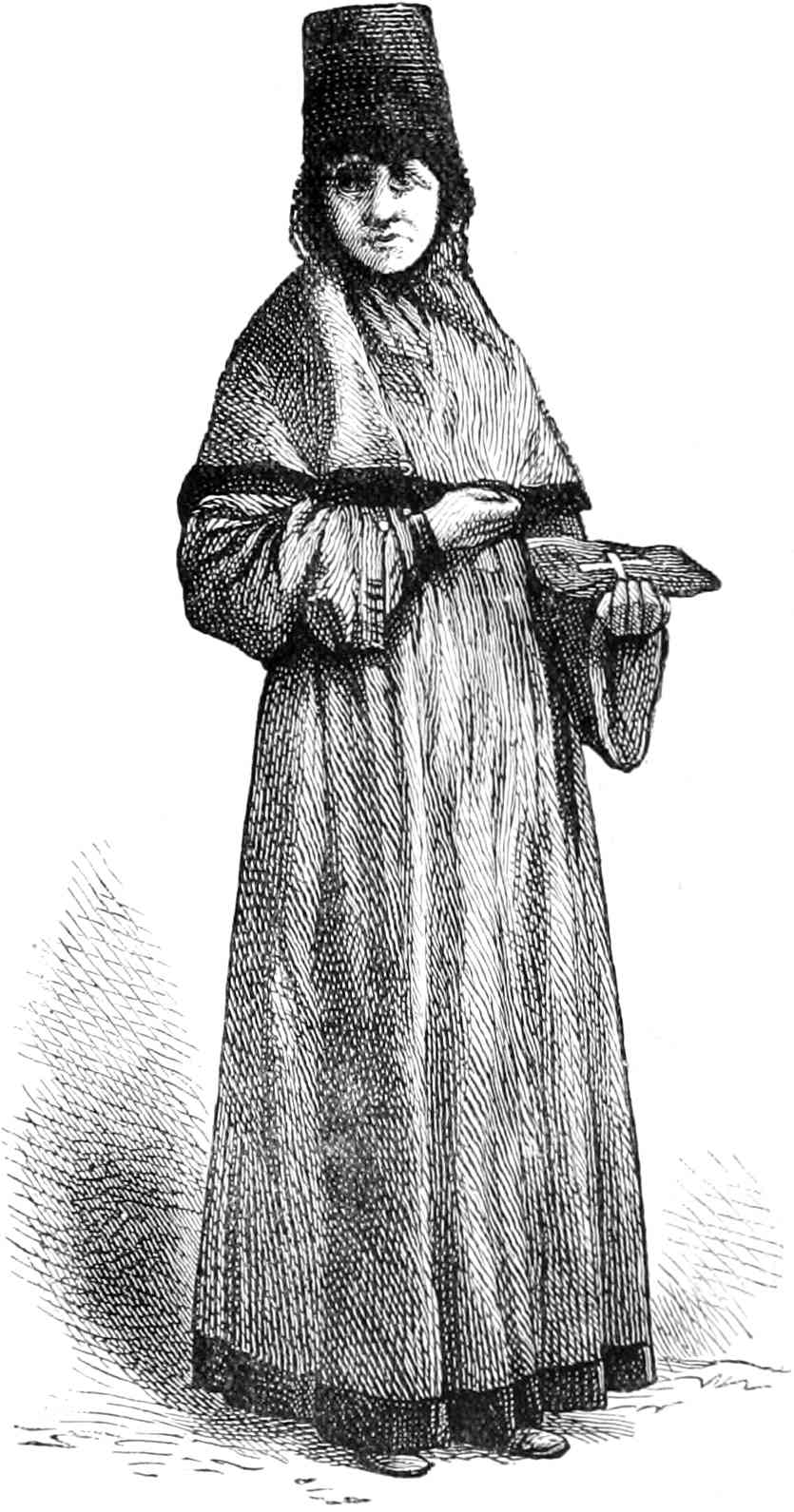
A RUSSIAN NUN.
One of the monks of the Yuryef Monastery, near Novgorod, gave me the following outline of their daily life: They rise at half-past two (one o’clock on festivals), go to church till six, and from six till nine they sleep. Then they go to church again for an hour and a half, and afterwards breakfast. This over, they are free to sleep or do as they please till five in the afternoon, when evening service brings them together for an hour and a half, after which they sup and go to bed. They have but two meals a day, never eat flesh, and, when observing the fasts, eat vegetables only.
To sum up, then, all that need here be said of the Russian Church—very different thoughts arise according as one looks at the every-day religion of the people, or their formularies and theology. The former may cause pain and grief, the latter excite sympathy and hope; and it will be my object in the remainder of this chapter to expand these thoughts in a fair and honest way, without sparing blame or withholding praise.
Most persons, who have had the opportunity of observing, allow that the Russians are a religious people. One sees this not only in the large numbers both of men and women who attend the churches, but also in the tens of thousands who yearly go on pilgrimage to sacred places. The monks of Troitza sometimes have in summer, on a feast day, a thousand guests. Some, of course, are idle wanderers, going from place to place to get food; but many walk hundreds—nay, thousands—of miles to redeem a vow or offer a prayer for something specially desired. Much of this, no doubt, is eminently unspiritual and superstitious. Much of their worship is perilously like, if not altogether, idolatry; yet it should be remembered that the average Russian knows no better; and what can be expected of the peasant, if the highest authorities of the land, on arriving at a city, make it their first object to pay their devotions, if not, as at Ephesus, before “the image which fell down from Jupiter,” yet before a picture to which is attributed miraculous powers? We can at least admire, however, the intention in these things; and if the Russian peasant can only be kept sober, he displays a number of virtues, some of which are not found so abundantly in other and more advanced countries. They are a kind, a generous, and a hospitable people, by no means unmindful of philanthropic effort, and at least, we may add, intensely ecclesiastical.
Again, there is much to admire in the formularies of their Church, although Dean Stanley brings against it, and justly, three weighty charges—extravagant ritual, excessive dogmatism, and a fatal division between religion and morality. When, however, the Russian Church is compared with the Roman, and spoken of as like it, certain considerations should be borne in mind which make the comparison result in favour of the former. Russia did not receive the religion of Jesus Christ in its purity. The merest tyro in Church history knows that when the stream of Christianity had flowed down to the tenth century, it was no longer pure as at its source. But follow the stream as it branches east and west, and observe which of the two remains the purer.[10] And if this be said to be negative, and much of it belonging to the past, then other considerations may be adduced which seem to bring the Greek Church nearer to the English than many suppose, and notably so in two vital points, namely, the attitude of the Russian Church to the Holy Scriptures,[11] and her doctrine respecting salvation through Christ alone.[12] She does not forbid or hide the Scriptures from the people, even if she neglects them, nor has she stereotyped her errors by the claim to infallibility. There is room, therefore, to hope for a change for the better, which in my humble opinion should be attempted from within, by a wider circulation and more general study of the Scriptures; next, by a vastly increased amount of good and Scriptural preaching; and, once more, by a powerful attack on the prevailing sin of intemperance. Would the priests only endeavour to instil into their people, respecting drink, half the abstemiousness and self-denial that they teach them to observe concerning forbidden food, they would render Russia such a service as I have no words to express.