Chapter XLI · BLAGOVESTCHENSK.
Reading edition
Russian orthodox missions.—Particulars of Orthodox Missionary Society.—Visit to telegraph station.—Seminary for training priests.—Salaries of Russian clergy.—Blagovestchensk prison.—Leafy barracks.—View of the town.—Molokan inhabitants.
“Blagovestchensk,”—I hope that the tongue of the reader curls round the syllables of this word more easily than did mine on the first occasion I attempted to pronounce it. The g should be guttural, and the first e like the French é. The meaning of the name is “Annunciation,” or, as some put it, “glad tidings.” I know not whether this has anything to do with the fact that Blagovestchensk is the head-quarters of Oriental Siberian missionary effort, about which it will here be a rest to say a few words by way of change from the waters of the river.
As Russia ranges under her standards many nations, so she is brought into contact with many religions; with Lutheranism in the Baltic provinces and Finland, Buddhism in Mongolia, Mohammedanism along her southern frontier, Paganism in the Caucasus and Armenia, and, we may add, Shamanism and other ’isms among the aboriginal inhabitants of both her European and Asiatic territories. The Russians have long made persistent efforts to win back their own dissenters, whether from the various bodies of Raskolniks, or the Uniats, which latter were seduced from them by the Church of Rome.[1] Besides this reclaiming work of her own people, foreign missionaries were, in the time of Alexander I., allowed to work among the heathen within the empire, and I have already noticed the London mission to the Buriats. The Synod, however, put a stop to this foreign work; and that their jealousy in this matter continues, I learnt from a Lutheran pastor, who, when he was taking up his residence near some of the native tribes, was bidden “not to busy himself as a missionary.”
Compared with the Western Churches, whether Roman or Reformed, the Eastern Church has never been remarkable for missionary zeal, and I was therefore not a little surprised and pleased in Siberia to stumble unexpectedly upon the latest report (for 1876) of the “Orthodox Missionary Society,” published at Moscow the year before my visit. The book is of respectable size, extends to 100 pages, and the statistics are displayed with considerable fulness. At present it is with the Russians only the day of small things; but it should be borne in mind that 1876 was only the seventh year of the Society’s existence.
Some particulars of this young Society will be interesting, the more so as I am able to supplement what I learned in Siberia by extracts from the report for 1879, quoted in the Journal de St. Petersbourg, September 7th, 1881. The Society has a central council, and branches in 29 dioceses, with 7,560 members, which means, I suppose, subscribers. Its capital in 1879 amounted to 660,000 roubles, of which 121,000 were spent during the year.[2] Among the remittances sent to the central council from associations is £77 from “the army and navy.” Again, there appears what I imagine to be a special fund for “propagating the orthodox faith among the heathen.” This is apart from their efforts among Mohammedans and Romanists; but the Russian Church has missions to the adherents of all religions within her empire, except Protestants.
As for the spending of the money, it appears that the council and 27 associations distributed, among 19 missions, funds to the amount of £11,580. The 21 mission stations are, with one exception, within the bounds of the empire. The other mission, to which I have alluded in a previous chapter, is in Japan. I heard at Kasan that they have a missionary also in Jerusalem, New York, and San Francisco; but these, I presume, are chaplains. Their chief European pagan missions are in the governments of Astrakhan, Riazan, Perm, and Kasan, in which last are several semi-heathen tribes.[3]
It is in Asiatic Russia, however, that most of the Society’s money is expended, and the conversion of 5,000 Pagans is reported to have taken place in 1879. They have opened a school among the Samoyedes. They have also missions in Kamchatka (including probably, the Sea-coast province), upon which, in 1876, they expended £300, and from whence the following year, according to the Almanack, they obtained 606 converts. The provinces, however, in which most money is spent are those of Tomsk, Irkutsk, and the Trans-Baikal. In the latter two are the Buriats, amongst whom the Russians have 30 mission stations and 68 missionaries.[4] The province of Tomsk includes the region of the western chain of the Altai mountains, where schools and missions have been established for the Kirghese of the Steppes. In the Altai mission, during the first half of the year 1877, they enrolled 195 converts. Further east they have missionaries, some of whom I met, among the Goldi and Gilyaks; but I shall speak of them when we come to their districts. At Blagovestchensk lives the Bishop of the diocese, who had been described to me as “a good missionary.”
We stopped at Blagovestchensk on Tuesday, August 5th, and I made my way to the telegraph station, where, as in other towns, thanks to good introductions, I received much kindness from the officials. When travelling to Barnaul, I chanced to light on a telegraph officer, Mr. Friis, whose name was on my list, and he told me of a brother officer in Tomsk who spoke English. At Irkutsk Mr. Larsen gave considerable linguistic help; so did Mr. Koch at Stretinsk; and now, at Blagovestchensk, I found a Mr. Niellsen, who had worked in London, and spoke English; and Mr. Peko, who spoke French and English too. Mr. Peko, I found, was the director of this station of first rank.[5] When dining with the manager, Mr. Peko, and Mr. Niellsen, in the garden, I was interested to hear, among other scraps of professional information, that English is the best of languages for telegraphy, for that in it they can express more in few words than in any other. The Russians, they said, prefer to use English rather than their own language for telegrams. My nationality was further flattered in the town by a doctor’s wife telling me that to speak English was now in Siberia and Russia more fashionable than to speak French. Said she, “On peut oublier maintenant le Français pour apprendre l’Anglais.”
Blagovestchensk has a seminary for the training of priests, similar to those established in Russia by Peter the Great. He found his clergy exceedingly ignorant, and established these institutions for their sons, enjoining the bishops to support them with a twentieth part of the income from the monasteries. In these establishments, and others which have been added, are educated the rank and file of the Russian clergy.[6]
I did not once meet in Russia with a priest who could speak French, German, or English. Perhaps they throw their strength into patristic and ecclesiastical learning, since the parochial clergy are usually said to be not well instructed in secular studies. An instance was given me by an Englishman, who travelled in Siberia with a Russian archbishop, who one day asked the Englishman which had the greater population, London or San Francisco. Whereupon my wicked friend said, “Well, you see, London has a population of two hundred thousand, and San Francisco four millions.” “Ah!” said the archbishop with satisfaction, “I thought so; I thought San Francisco was the larger!”
Those students who wish to attain to the higher degrees of learning, on leaving the seminary, proceed to one of the ecclesiastical academies which correspond to our universities, and where they can take the degrees of student, candidate, master, and doctor of theology. There is no theological faculty in the Russian universities, but it is now required that all who are to be consecrated bishops shall have passed through the academy.
To return, however, to the seminary: the students enter at the age of eight, and remain normally till twenty-two, when they receive a diploma, which is accepted by the bishop, and the candidate without further examination is ordained.
The case of one of these students presented a curious instance of the working of the inconsistent requirement of the Russian Church, that the parochial clergy at the time of their ordination must be married. “Do you see that boy running about on the deck?” said a fellow-passenger to me, pointing to one of the seminary students. “He is nineteen years old, and is returning to the seminary for the last time. In the course of a few months his mother is to find him a wife, and next year he will return to be married, and then immediately ordained!”[7] This would be before the canonical age for ordination, but was owing to the lack of clergy in the Primorsk, in which there are about 50 congregations with churches or chapels. Between Nikolaefsk and Vladivostock, a distance of 1,300 miles, are only 14 priests and 2 deacons; and so pressing was the need of clergy a few years since that tradesmen, letter carriers, and even yemstchiks in some few instances were ordained.
Mr. Peko accompanied me at Blagovestchensk to call upon Mr. Petroff, the deputy-governor, from whom I learned that there was only one prison in the province, having 26 rooms. We visited it, but the only notes I have are “dirty and overcrowded,” and “punishment cells all full,” some having two men in a place not too large for one. What made the prison so full I know not, nor am I able to say whether they were local offenders from the province or exiles temporarily there on their way eastwards. There were none lounging about in the yard, so I suppose they had all been gathered for our inspection. The punishment cells being occupied was not, as far as I know, because the men had misbehaved, but because they were compelled to use all available space. Moreover, since the prison authorities seem to look upon solitary confinement as so great a punishment, it may be that two were put in some of the cells for the sake of company. I remember that when I spoke to the president of the Tomsk prison approving the separate as opposed to the gang system, he thought it was decidedly bad to put a moujik, or simple peasant, in a cell alone; for “having nothing to think about,” he said, “he might go mad!” This good man informed me, too, in connection with my self-imposed mission, that the prisoners did not want so much religion, but liked also books of history, travels, etc. This I knew, but since three wagonloads did not more than suffice for the little I attempted, and my means were limited both as to carriage and in other ways, I was only too thankful to take so many books as we did, and leave it to other philanthropists to complete the work. I left 50 New Testaments and 12 wall pictures at Blagovestchensk with Mr. Petroff for the prison, for the 20 rooms of his two hospitals and a school in the course of erection, with four rooms for prisoners’ children.
Near the hospital were summer Cossack barracks, put together in the most primitive fashion. The ordinary barracks needing repair, they had cut branches of trees and leafy underwood, tied them in fagots, and stood them up so as to form walls and roof, which gave tolerable shelter for hot weather, but served as poor protection from wind and rain. They were intended, however, to last only for a few weeks.
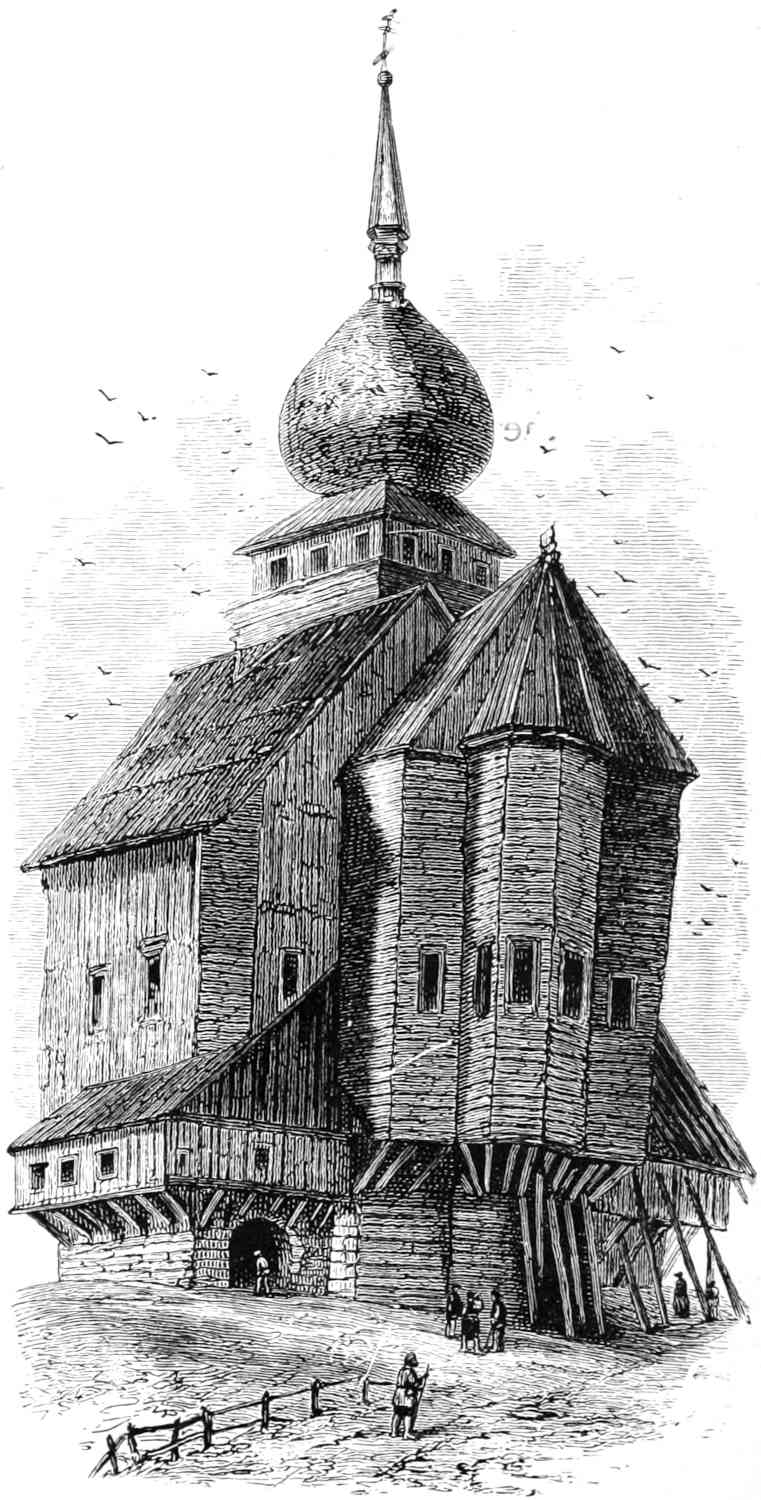
A STAROVERS OR OLD BELIEVERS’ COUNTRY CHURCH.
From these summer barracks there was a fine view of the river and town. The houses are situated on a plain 15 feet or 20 feet above the water. The Government establishments and merchants’ stores are large and well built, each having plenty of space around it. Some of them have gardens, and stretching along the bank from the wharf to the roomy telegraph office is a green sward planted with trees for a park. Blagovestchensk has a population of only 3,400, but its long river front and its cross streets give it the appearance of an important town. Some of the shops were excellent, and well supplied with merchandise. The town was founded in 1858, and the Amur Company kept there one of its principal stores. On the winding up of its affairs, this store was bought by the company’s clerk. Mr. Knox says, in 1866, that the Russian officers complained of the combinations among the merchants to maintain prices at an exorbitant scale. I heard, too, that this is still done. If, for instance, in the middle of the winter a merchant discovers that his brother tradesmen have sold all their sugar or any other article, and that his stock is all the town possesses, then, knowing that no more can arrive till the ice goes and the navigation opens, he can demand higher prices for goods of which he has a monopoly. Candles were quoted to me as costing usually 11d. or 1s. per lb., but as rising sometimes to 2s. 6d. Cheese costs from 2s. to 2s. 6d. per lb., but I suppose that these articles must be of European or American manufacture. Chickens at Blagovestchensk vary from 6d. to 2s. each, veal from 4d. to 5d., and beef from 2½d. to 4d. per lb. Milk costs 2d. per pint in summer, and 4d. in winter; live geese, bought from the Manchu, cost from 2s. 6d. to 4s.; but in winter, from the Molokans, 5s. In connection with these prices should be quoted the cost of land, which may be purchased from the Government for 2s. an acre.
I was told that the town is full of dissenters. I did not hear of any Starovers or Old Believers, nor observe on any church the three transverse beams of their form of the cross; but there were many Molokans,—colonists, I suppose, or descendants of exiles. Their presence, doubtless, accounts for a good deal of the prosperity of the town, for they are “honest, sober, and industrious.”
The Molokans are so called because they drink milk on the usual fasting days. Their origin is involved in obscurity, and by some is dated back to the middle of the last century. Early in the present century many were living in the south of Russia. An English gentleman, residing at Berdiansk in 1848, visited their villages, and from his wife I learn that Salamatin, the Molokan chief, and his family were pious, but very simple, uneducated people. My friend used sometimes to invite them to her table. She tells me that their enlightenment came, to all appearance, simply from reading the Bible. They found there the worship of images forbidden, and accordingly declined to bow down before them, on which account some were persecuted, even to bodily pain, but to no purpose; they would not give way. Blunt’s “Dictionary of Sects” says that a Baron Haxthausen, in 1843, visited a colony of 3,000 Molokans in the Crimea, and found that they denied the necessity of baptism and the Lord’s Supper. With Blunt’s statement partly agrees what my friend told me, namely, that some important official came to visit the Molokans in her neighbourhood (not, however, in the Crimea, but in the government of Ekaterinoslav, which was then their habitation, their villages being situated on the banks of the Moloshna), and found so little objectionable among them, and so much that was good, that the official gave them an excellent character, and they were afterwards left unmolested. Also their alleged disuse of baptism and the Lord’s Supper seems to agree with what I heard of them from a fellow-traveller, who lodged in the house of a Molokan; for he told me that on Sundays they hold meetings, read the Scriptures, pray, sing, expound the Bible, and ask questions, but he thought they did not baptize nor receive the Lord’s Supper. But I remember my lady friend telling me that when the Molokans separated from, or were turned out of, the Russian Church, they had no priests nor any person of education to guide them, nor have they priests now, but only elders; hence, if they are without sacraments, I am not clear whether it is from choice or necessity.[8] My fellow-passenger spoke in high terms of the Molokans of Blagovestchensk. He said he never saw any of them intoxicated, or even enter a tavern; that he rarely or never saw them out of temper, or heard them use bad language; and that they spent their spare time in reading the Scriptures.
But this does not save them from annoyance. Their manner of living at Blagovestchensk has enabled many of the Molokans to become rich, so that they can hire servants. An old Russian law, however, forbids a Molokan to employ an orthodox Russian. The Russians, notwithstanding, like to serve the Molokans, because they are good masters, and pay well. Hence the law has become practically obsolete; but the summer before my visit, the police-master (a man of anything but exemplary moral character), having a grudge against a principal Molokan, and, Haman-like, thinking scorn to lay hands on one only, began doing his best to annoy the whole of them in the town. How the matter ended I did not hear.
I saw, before I left Siberia, an official confirmation of the good opinion I was led to form of the Molokans. The governor of a province wrote officially to Petersburg thus: “We have 105 Molokans, most of them living in the South Ussuri district. They are living quietly, and are very laborious, and amenable to authority. They are civil in their bearing towards the members of the orthodox Church, and are not fanatical.” Looking, therefore, at this triple testimony, and comparing the lives of the Molokans with the lives of the orthodox, I felt that to bring the orthodox into contact with the Molokans would be likely to improve the orthodox rather than otherwise, and that the Tsar would have more good subjects than he now has if he had more Molokans.