Chapter XLIV · THE PRIMORSK OR SEA-COAST PROVINCE.
Reading edition
Fuller treatment of this province.—Boundaries and dimensions.—Mountains, bays, and rivers.—Climate.—Fauna and flora.—Aboriginal and Russian population.—Government.—Food products.—Imports.—Taxes.—Civil government.—Health of the people.
A story is told of a certain preacher who, on mounting his afternoon pulpit, discovered he had brought again the manuscript from which he preached in the morning, whereupon, rising to the occasion, he announced his intention to redeliver the morning’s discourse; and, said he, “I have a particular reason for doing so.” History does not relate what followed; but I would advertise the reader that I purpose to treat more fully of the Primorsk than of the other provinces of Siberia, and “I have a particular reason for doing so”; the “particular reason” in my case being that I know, personally, a great deal more of this province than of the rest. Through other regions I passed as rapidly as possible, never continuing long in one place; but on the sea-coast I lived, moved, and had my habitation for several weeks. I was stationary simply because I could not get forward, and used my leisure to read up Siberia and arrange notes. Moreover, I had the great advantage of staying with persons who spoke English, who had lived in Asiatic Russia for many years, who knew the country well, and could therefore inform me upon Russian affairs. Nor was this all, for I was brought in frequent contact with military and naval officers who spoke French and English, and during my stay at Vladivostock was almost a daily guest at the Governor’s house, and so was enabled to gather information respecting the condition of the province from official sources.
The Littoral, or Sea-coast province, which the Russians call “The Primorsk,” is a strip of seaboard, beginning on the frontier of Corea, and continuing northwards along the coast of Manchuria, round the Sea of Okhotsk and Kamchatka, and terminating at the Chaunskaia Bay in the Arctic Ocean, about 700 miles west of Behring’s Straits.[1] The general aspect of the country is mountainous throughout. Along the Manchurian coast, at a distance of from 25 to 80 miles of the sea, runs the Sikhota-Alin range, a continuation of the Shangan-Alin mountains. The western slope is the birthplace of many streams, which run into the Lower Amur and Ussuri. The eastern slopes drain into the channel of Tartary, those rivers entering the sea having a short course, and being navigable only near the mouth. These mountains attain an elevation of from 4,000 to 6,000 feet. West of the Okhotsk Sea runs the Stanovoi range, which is a continuation of the tableland lying to the north of the Amur, and is estimated, according to Mr. Ravenstein, as having an elevation of from 1,000 to 2,000 feet, the highest peaks reaching perhaps to 5,000 or 6,000 feet. Besides these ranges, there are in the peninsula of Kamchatka nearly 40 mountains, evidently volcanic, though not more than a dozen volcanoes now throw out scoria.
On the sea-coast are several bays suitable for harbours, which might become of commercial importance if the district were sufficiently colonized, and good means of communication opened over the mountains and forests of the Littoral.[2]
The principal rivers of the province are the Ussuri, the Lower Amur, with its largest tributary the Amgun, and in the far north the Anadir, which runs into Behring’s Sea. The Primorsk has one or two lakes on the Arctic Circle, also Lake Kizi, which almost connects the Lower Amur with the Gulf of Tartary at Castries Bay, and Lake Khanka, the largest of them all, out of which flows the Sungacha, an important affluent of the Ussuri. What marshes there are in the province are found on the left bank of the Amur.
The variations of climate must of course be very considerable over a tract of country which in the north lies within the Arctic Circle to the 70th parallel, whilst its most southerly point is nearer the equator than the Pole, being situated in latitude 43°, as far south, that is, as the Pyrenees. Of the 14 meteorological observatories in Siberia, two are situated in the Primorsk, at Nikolaefsk and Vladivostock. For meteorological information from further north we are indebted to travellers, especially to Baron Nordenskiöld.[3] The climate of Nikolaefsk cannot be recommended to those in search of a mild one.[4] During the eight months of winter keen winds prevail, bringing snowstorms of such violence and density that I heard of a man losing himself in crossing the street from the club to his own house. The snow lies frequently from four to five feet deep. I stayed at Nikolaefsk from the 13th to the 30th August, during which time the summer was unusually cold. On several days it rained, and, when taking an evening stroll, I did not feel an Ulster coat too warm.[5]
Descending ten degrees further south to Vladivostock, we find the summer extending to six and a half months, but with an annual temperature about ten degrees lower than at Marseilles, which is on the same parallel.[6]
Thus it will be seen that even in the most southerly portion of the Primorsk the winter climate is severe. The Bay of Peter the Great, it is true, is not frozen at a certain distance from the shore at any period of the year; yet ice is formed upon its creeks and inlets at the beginning of December, and for more than a hundred days ships are locked in the port of Vladivostock. On the other hand, the summer heat on the Manchurian coast is very great, and rises in the port of Olga to more than 96°.
The climate of the Lower Primorsk is more than commonly dependent on two influences: that of the prevailing winds, and of the temperature of the neighbouring seas. The warm Kuro Scivo, or Japan current, soon after it passes the Loo Choo islands, divides, and a small part enters the Sea of Japan, and, skirting its eastern shore, passes out through La Perouse Strait to reunite itself with the main stream that has kept to the eastward of the Japan archipelago. Under the name of “the North Pacific drift,” this Japan current afterwards passes a little south of the Kurile and Aleutian Isles, and then turns southward along the western coast of North America. From the north-east corner of the Sea of Okhotsk two cold currents start and run—the one along the coast of the mainland of Siberia, the other down the west side of Kamchatka. Sakhalin is thus on both shores washed by these cold waters, which continue their course southward along the western shore of the Sea of Japan, round the Corea, past the entrance of the Yellow-Sea, until, near the island of Formosa, they mingle with the monsoon drifts of the China Sea. The effect of this body of cold water along the Siberian coast is obvious, and we find the winter climate far more severe than in corresponding latitudes on the western side of the Pacific or in the Niphon, and the southern islands of Japan. The prevailing winds in winter are from the north and east, and, passing as they do over this same cold sea-water, they get chilled, and add to the rigour of the season. In summer the winds are generally from the west and south-west, and in July the south-west monsoon even extends to the Sea of Okhotsk; and the temperature is abnormally above that of corresponding latitudes. If, however, the climate of the Lower Primorsk and of Eastern Siberia is remarkable for its extremes of cold and heat, drought and humidity, it has at least the advantage of regularity in its yearly progress, and has none of the abrupt changes of temperature met with in Western Siberia. The dry cold of winter, the humid heat of summer, are maintained without sudden changes.[7]
To the phenomena of the particular climate of the sea-coast correspond naturally the distinctive features of its fauna and flora. The forests one passes through in the basin of the Amur are not, like the taigas, sloping towards the Frozen Ocean, composed uniformly of the same species of conifers; but the kinds of trees are very diverse, though their distribution is little varied. With the fir, pitch pine, cedar, and larch are mixed not only the Russian birch, but also the oak, elm, hornbeam, ash, maple, lime, and poplar, some of which grow to the height of 100 feet, with trunks more than a yard in diameter. The bark of the larch is almost as valuable to the tanner as that of oak, and also produces the substance called Venice turpentine, which flows abundantly when the lower parts of the trunks of old trees are wounded. A kind of marrow also exudes from its leaves in the shape of white flakes, which are ultimately converted into small lumps. In the southern parts of the Ussuri country, and on the slopes of the Sikhota Alin, deciduous trees outnumber the conifers. The forest pines are often draped with wild vines, whose grapes ripen, though the cultivation of the vine has not yet been successful. On the Upper Ussuri the Chinese have plantations of ginseng. In the woods grow hazels, peach trees, and wild pears; and what orchards there yet are about the villages show that the Ussuri district might become, for the product of fruits, one of the richest countries in the world.
But the glory of the Lower Primorsk is the wealth of herbaceous plants which grow on the alluvial soils on the banks and the islands of its rivers. Umbelliferous plants, mugwort, roses, cereals of various kinds, form a mass of vegetation to the height of 8 or 9 feet, penetrable only axe in hand, or along the track of some wild animal. The wild boar, the stag, the roebuck hide themselves in these tall herbs better even than in the forest. The tiger as well as the panther inhabit the bushy herbage of the Ussuri, and there meet also the bear and the sable. Thus the representatives of the south mingle with those from the north in this rich fauna, belonging at once to Siberia and to China.
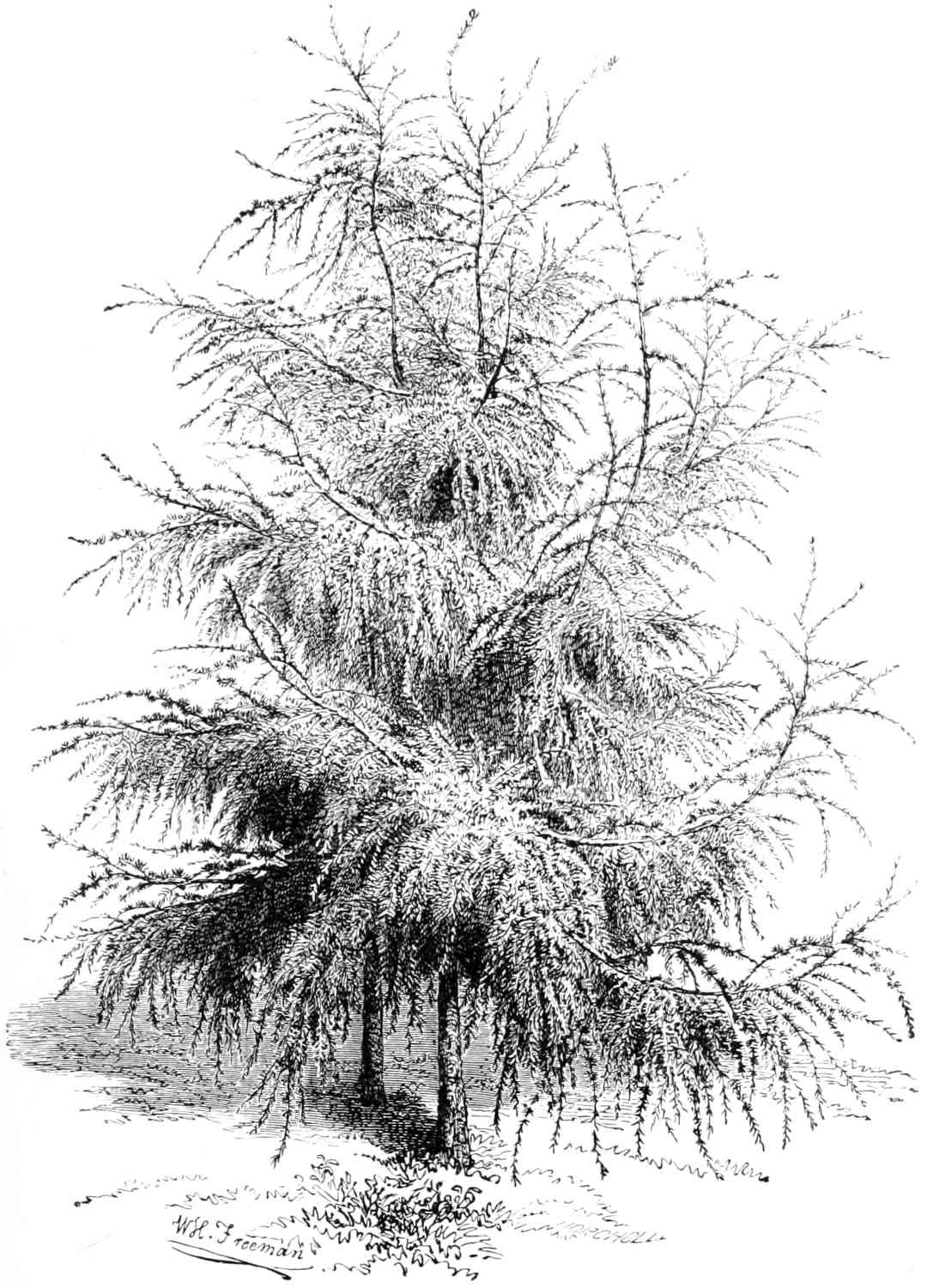
THE SIBERIAN LARCH.
As regards the inhabitants of the Sea-coast province, in the south are Chinese, Manzas, Tazas, and Coreans, who are constantly travelling, and so cannot well be counted; but, calculating from the registers of births and deaths, their number is estimated at 62,000. North of these, on the Ussuri, are the Goldi, and, on the Lower Amur, another race called Gilyaks, of whom I shall hereafter speak particularly. Proceeding round the Sea of Okhotsk, we come to the territories of the Lamuti, Tunguses, and Yakutes; and then reaching the north-east corner of Siberia, we have three other peoples—the Kamchatdales to the south of the peninsula, with the Koriaks above them, and furthest north the Chukchees. Besides these might be mentioned a few Orochi about the mouth of the Amur, and the Aïnos of Sakhalin and the Kurile islands. Owing to the wandering habits of these tribes, no census can be obtained, but from the church books their number, including both sexes, is estimated at 44,000.[8]
The province is divided into seven uyezds, and the principal towns, beginning from the south, are Vladivostock, Khabarofka, Sophiisk, Nikolaefsk, Ayan, Okhotsk, and Petropavlovsk. The Littoral was erected into a province in 1857, and placed under a Governor who was at once Admiral of the Fleet, Commander of the military forces, and Head of Civil Affairs; and this was the condition of things in 1879—Admiral Erdmann being Governor, and residing at Vladivostock. The military command, however, has since been separated, and given to General Tichmeneff, who resides, I am told, at Khabarofka.
Proceeding now to the natural products of the Primorsk, and the sources of sustenance to its population, we find that agriculture holds a very different place in the upper, middle, and lower parts of the country. The Upper Primorsk extends from Behring’s Straits down to Nikolaefsk, and produces no corn. The inhabitants live by hunting, the fur trade, or on grain supplied by the Government.
The Middle Primorsk extends from Nikolaefsk to Khabarofka, which means virtually the basin of the Lower Amur. Only the Russian subjects till the ground, the total cereal produce for the year 1878 being 327 tons, together with 811 tons of potatoes. The cost of meat in this district is from 5d. to 9d. per English pound, according to the season. The Lower or Southern Primorsk is populated by Ussuri Cossacks, and by voluntary and involuntary settlers. This is the most productive part of the province, the yield for 1878 being more than 1,000 tons of corn and 800 tons of potatoes. Meat costs from 4d. to 6d. per lb. Three qualities of wheaten flour are used throughout the Primorsk—the first and second of which are imported from America. About 15,000 fifty-pound bags (say 330 tons) are sold yearly in Nikolaefsk, the best costing from 4d. to 6d. per lb., the second from 3d. to 3½d., and the third quality, grown at home, from 1½d. to 2½d. per lb. The price of rye-flour at Nikolaefsk and Sophiisk varies from 1½d. to 2d. per lb. On the Ussuri it costs rather less, and north of Nikolaefsk 2d. per lb. is asked.
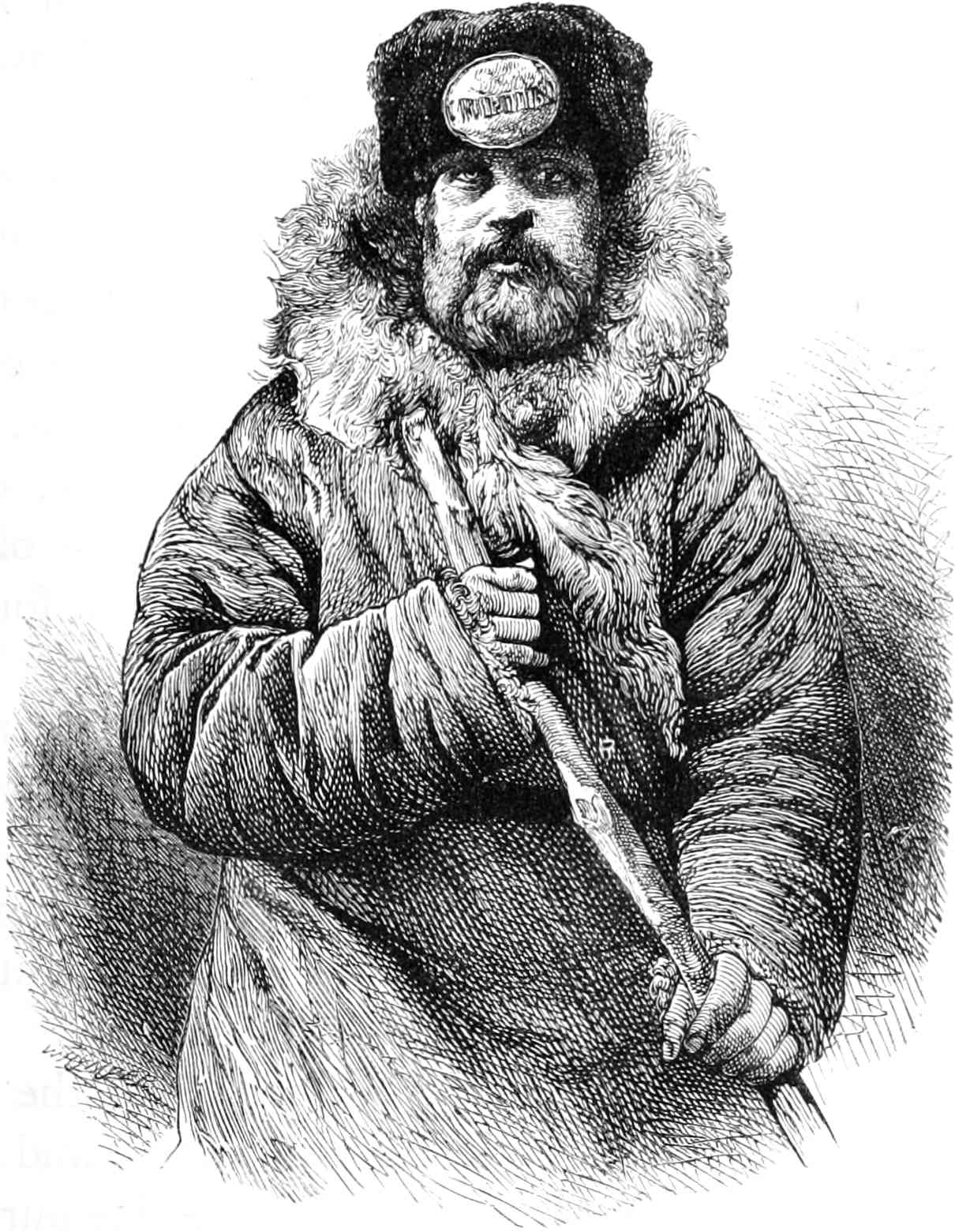
A DVORNIK, OR RUSSIAN HOUSE-PORTER.
Throughout the province the price of fish is from 9s. to 24s. per cwt.; butter (not fresh) costs from 10d. to 1s. 1½d. per lb.; black tea from 2s. to 4s. the Russian pound, and brick tea from 10d. to 1s. 2d. The price of sugar varies from 6d. to 8d. per lb. Labour throughout the Littoral is scarce. The cost for a man and horse in summer is 6s. per day, but in winter 30s. a month and hay for the horse. At Nikolaefsk a man earns 3s. as a day’s wage; a dvornik, or night-watchman, gets as much as £3 10s. a month without board, and a man-servant £2 10s. a month and his food. At Vladivostock, convict women for domestic servants are paid from 16s. to 30s. a month board wages; mechanics earn from 3s. to 4s. a day, and common labourers 2s. This last is a decided advance on the 18s. or 20s. a month paid to the wharf-porters at Nijni Novgorod, who live, however, on 8s. a month, eating little but bread and stchee, the latter being made of good beef, with an allowance of one pound of meat for each person. A half-drunken man at Nijni told me boastfully that in good times he could earn nearly 2s. a day; but just then he could get no regular work, and so he said he had taken to drink!
In addition to the home produce of the Primorsk, the Government also imports largely in anticipation of bad seasons and famine, and for the military.[9] They have, too, in this province a fund for loan to the aborigines to the annual amount of nearly £3,000, and rather more than this sum as a reserve fund for famine purposes.
I gathered from an official report in manuscript, which I was courteously permitted to see, some account of the taxes of the province. Personal taxes are paid in the north in money or in furs. In money, in 1878, was paid £28, and in furs the value of nearly £800. The whole of the settlers in the Amur district were to be free from personal taxes, land taxes, and recruiting up to 1881. Hence the land taxes of the province amounted to only £90.[10]
The report above quoted also treated of the health of the people, from which I noticed that vaccination throughout the province had not been wholly successful, partly for want of good vaccine, and partly from the lack of persons qualified to perform the operation. This latter was not greatly to be wondered at, seeing that the yearly remuneration attached to the appointment of district vaccinator was only two guineas, while the work involved much and difficult travelling. In the towns from which reports had come, it appeared that of 375 persons vaccinated, only seven cases had failed.
The total number of (I presume civil) patients through the province in 1878 was 319 (215 males and 104 females), of whom 247 recovered, 40 died, 32 were still under treatment; the average time spent in the hospital by each completed case being 31⅓ days.[11]
The Siberians generally are said to be remarkably strong and robust, for which the reason has been suggested that all the weakly babies are killed by the climate. What truth there may be in this I know not, but in a table given me by the priest of Vladivostock, showing at what ages had occurred the 102 deaths in his parish, for 1878, it was seen that 58, or more than one-half, died under five years of age; and of these, 37 attained to less than the age of 12 months. Further, 24 died between the ages of 25 and 40, and only four exceeded the age of 50.
The report went on to speak of the civil affairs of the province, its public institutions and communications, the morality of the people and their religious dissensions, the prisons[12] and statistics concerning fire[13] and floods; but I need enlarge no further upon the Primorsk as a whole. It has been already pointed out that the country can be best described in three sections,—the Upper or Northern portion, the Lower or Southern portion, and the Middle Primorsk, corresponding roughly to the basin of the Lower Amur, to the description of which last I shall now proceed.